Report says Iran may have replicated Israeli missile downed in Syria
Press TV – April 20, 2020
A Russian aviation news outlet says Iran may have replicated an Israeli missile that was shot down in Syria, citing a video of the test of a new Iranian anti-tank missile.
Avia.Pro reported that the new missile seems to resemble one of the Israeli projectiles that were downed by the Russian electronic warfare system during an attack on Syria,.
The report added that the downed missile was later successfully removed from the country by “Iranian intelligence service”, and was studied and completely copied.
The news outlet shared a video that showed the accuracy of the Iranian copy of the Israeli “Spike” missile in hitting its target.
Avia.Pro quoted experts as saying that Iran may use Israeli missiles against Tel Aviv itself in the near future.
Iranian authorities have repeatedly said that the country’s missile program has not been established for non-conventional purposes and is only meant as part of the country’s deterrence capability.
Iran holds the very first ranking in the field of missile technology among the Middle Eastern countries, according to a commander of the Islamic Revolution Guards Corps (IRGC).
“Today, we rank first in the missile technology at the regional level and are placed among the few global powers in this regard,” Brigadier General Amir Ali Hajizadeh, the commander of the Aerospace Division of the IRGC, said last August.
In June, Major General Hossein Salami, the chief commander of the IRGC, said Iran had managed to change the balance of power in its favor by harnessing the technology required for manufacturing ballistic missiles.
Salami said the Islamic Republic acquired the know-how 12 years ago while trying to prepare its defenses against the United States’ aircraft carriers.
Iraqi parliament demands Baghdad’s procurement of Russia’s S-400 missile system
Press TV – April 18, 2020
The Iraqi parliament’s security and defense committee has submitted an in-depth study to the country’s caretaker prime minister Adel Abdul-Mahdi, requesting the procurement of the Russian-built long-range, surface-to-air S-400 missile defense system.
“The committee has presented a comprehensive study to the prime minister, demanding approval for the purchase of the advanced S-400 air defense system. The issue has already been discussed with relevant figures at the General Command of Armed Forces, and now awaits the premier’s agreement,” Badr al-Ziyadi, a member of the committee, told Arabic-language al-Sabaah newspaper.
He emphasized that the purchase of the S-400 missile system, with the aim of boosting the country’s defense capabilities, will be finalized once the next Iraqi government is formed and it ratifies procurement of the system.
“The approval to acquire such a sophisticated system requires large financial allocations and a political decision in order to diversify the sources to get the weapons as we cannot just rely on the Western camp, but rather need to incline towards the Eastern camp as well,” Ziyadi pointed out.
The Iraqi lawmaker went on to say that his parliamentary committee “will support the next Iraqi government’s decisions in this regard, and will present relevant proposals and pieces of advice to it.”
Back on March 18, Ziayadi said US and Israeli arms firms were putting pressure on the Baghdad government not to discuss the purchase of sophisticated military equipment with other states, and sign arms contracts with them.
“There are companies and traders pushing to prevent Iraq from concluding contracts to purchase weapons from developed countries,” he told Arabic-language al-Maalomah news agency in an exclusive interview at the time.
The same Iraqi parliamentarian said on January 20 that the Baghdad government was planning to send delegations to Russia, China and Ukraine to hold negotiations over the acquisition of advanced air defense missile systems to protect its territory from any possible act of aggression.
“The delegations intend to visit countries like Russia, China and Ukraine to negotiate the purchase of modern systems to protect Iraq’s airspace,” he told al-Sabaah daily then.
The lawmaker added, “The Iraqi parliament is right now forming a joint executive and legislative delegation to visit developed countries and sign contracts on procuring advanced weapons.”
The United States has already warned Iraq of the consequences of extending military cooperation with Russia, and striking deals to purchase advanced weaponry, particularly S-400 missile systems.
Former US State Department spokeswoman Heather Nauert said on February 22, 2018 that Washington has contacted many countries, including Iraq, to explain the significance of the Countering America’s Adversaries Through Sanctions Act (CAATSA), and possible consequences that would arise in the wake of defense agreements with Moscow.
On August 2, 2017, US President Donald Trump signed into law the CAATSA that imposed sanctions on Iran, North Korea, and Russia.
Moscow Aware of US Offer to Tbilisi to Expand Military Research in Lugar Biolab
Sputnik -April 18, 2020
Moscow is aware of Washington’s offer to Georgia to expand military research in the Richard Lugar biological laboratory, located not far from Tbilisi, the Russian Foreign Ministry’s spokeswoman, Maria Zakharova, said on Friday.
“According to the information that we have, high-ranking Pentagon representatives have just recently paid a new visit there, to offer to Georgian authorities to expand the range of research conducted there. Meanwhile, it cannot be excluded that Americans work on creating and modifying different dangerous disease pathogenic agents, including with military aims, in reference laboratories in third countries,” Zakharova said at a briefing.
According to the Russian Foreign Ministry, at the US-Georgian Richard Lugar Public Health Centre in the suburbs of Tbilisi, Georgia’s US partners had taken the initiative to expand the range of studies.
“We noticed, and we cannot help but pay attention to the strengthening of the American biological (weapons development) presence abroad directly,” she said at a briefing. She noted that, in particular, she was talking about the former Soviet republics, where under the pretext of combating bioterrorism, the US Department of Defence was organizing dual-purpose biological research laboratories.
The lab was opened in the Georgian capital in 2011 and has been at the center of controversy for allegedly trying to weaponize diseases. Russia said last fall it was part of a network of research labs that the US military was running in former Soviet republics.
NWO, Globalism and US “Leadership” – RIP
The Saker • Unz Review • April 7, 2020
“And the unbelievers plotted and planned, and God too planned, and the best of planners is God”
Quran, Sura Al-Imran (The Family of Imran) – 3:54
It has been pretty obvious for many years already that the AngloZionist Empire was not viable, that it had to tank sooner or later. There were two main scenarios which were typically considered for this collapse: an external crisis (typically a major military defeat) or an internal one (economic collapse). Personally, I always favored the first scenario (specifically, as described here). I even had a “favorite” location for such a catastrophic military defeat (for the US): Iran and the Middle-East. Irrespective of the scenario one preferred, this was obvious:
- The Empire was not viable
- The Empire was not reformable
The same is true of the US political system, by the way.
There was one huge problem, however. The quality and sheer size of the AngloZionist propaganda machine was very successful in keeping most of the people in the West in total ignorance of these realities. The faster the Empire was collapsing, the more Obama or Trump peppered their patriotic flag-waving ceremonies (aka “press conferences”) with references to an “indispensable nation” providing “vital leadership” thanks to its “the best economy in history”, the “best military in history” and even “unbelievable CEOs”, “incredible politicians” and even “incredible conversations”. The message was simple: we are the best, better than all the rest and we are invincible.
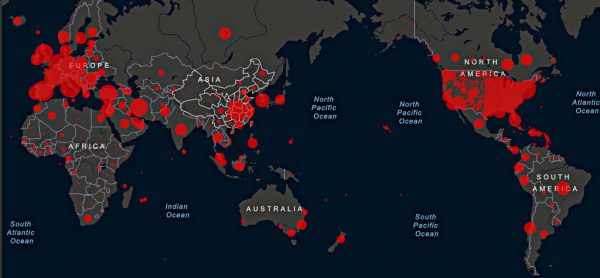
Then COVID19 happened.
The initial reaction in the US to the pandemic was to either dismiss this completely, or blame it on the Chinese. Another exceptionally dumb theory was that the virus only affected Asians. This one tanked pretty quickly. Other myths, and even outright lies, proved much more resilient, at least for a while.
Then “Italy” happened. Soon followed by Spain and France.
Some folks started to change their tune. Other still thought that the EU was not as “incredible” as the US.
Then “New York” happened and all hell broke loose for the “indispensable nation” and the “imperial parasite” this nation was hosting. Even the Idiot-in-Chief switched from “it will be over by Easter” to talk about saving “millions” of (US) “Americans” (the US does not care about non-Americans).
I predict that this process will now only accelerate.
Here are a few reasons for this conclusion:
First, the imperial propaganda machine is simply unable to conceal the magnitude of the disaster, even in countries like the US or the UK. Oh sure, initially doctors and even USN ship commanders were summarily fired for speaking the truth, but even those cases proved impossible to conceal and public opinion got even more suspicious of official assurances and statements. The truth is that most of the entire planet already realized that this is a huge crisis and that countries like Russia or China responded almost infinitely better than the US. The planet also knows that the US “health notcare” system is broke, corrupt, and mostly dysfunctional and that Trump’s initial optimism was based on nothing. BTW – Trump haters have immediately instrumentalized the crisis to bash Trump. The sad thing is that while they are no better (and most definitely not the braindead Uncle Joe), they are right about Trump being completely out of touch with reality. In the age of the Internet this is a reality which even the US propaganda machine is unable to conceal from the US public forever.
Second, and that is now quite obvious, it is becoming clear that the capitalist ideology of free markets, globalism, consumerism, extreme individualism and, above all, greed, is totally unable to cope with the crisis. Even more offensively to those who still believed in an ideology based on the assumption that the sum of our greeds will create an optimal society, countries with stronger collectivist traditions of solidarity (whether “enhanced” by Marxist or Socialist ideas or not) did much better. China for starters, but also Cuba and even Russia (which is neither Marxist nor Socialist, but which has very strong collectivist traditions) or South Korea or Singapore (both non-Marxists with strong collectivist traditions). Even tiny Venezuela, embattled and under siege by the Empire, managed to do much better than the US or the UK. Not only did these countries all fare much better than much richer, and putatively much “freer”, countries, they did so while under US sanctions. And, finally, just to add insult to injury, these supposedly “bad” countries proved much more generous than those incorporated into the Empire: they sent many tons of vitally needed equipment and hundreds of specialized scientists and even military personnel to help those countries most in need (Italy, Spain, Serbia, etc.).
Eventually, even the US has to accept aid from Russia: the contents of two huge military AN-124 transporters:
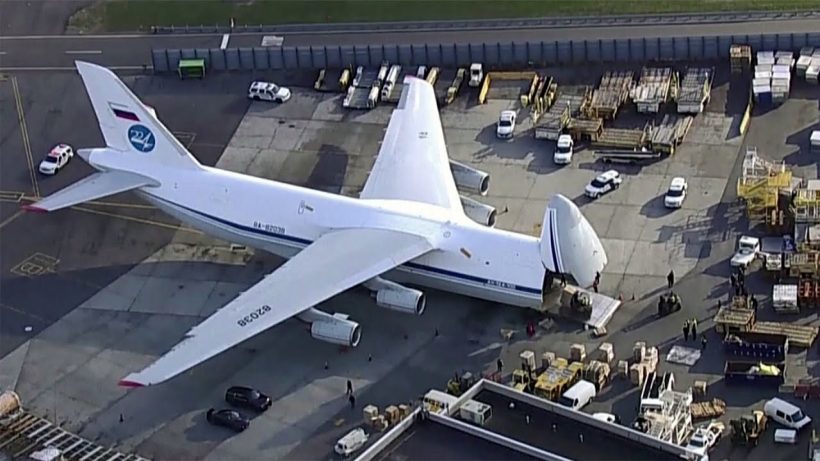
Think of the irony! The country whose economy was supposed to be “in tatters” (Obama) delivers humanitarian aid to the “indispensable nation” (Obama again). Not only was this aid delivered from a country under US sanctions, the gear delivered was produced by a Russian company also under US sanctions. The “grateful” US media immediately declared that this was a Russian PR action, especially since 50% of the cargo was paid for by the US (the rest, including transportation costs, were paid by Russia).
At least in Italy questions began arising why the US, NATO or the EU did absolutely *nothing* to help them when they were in such dire need of help, and why countries which did generously help (Russia, China, Cuba) were all under sanctions, including Italian ones! Good questions indeed. It was answered by Serbian President Vucic who declared that European solidarity was a “fairy tale“. He is quite correct, of course.
Third, then we all saw the ugly sight of various western “democracies” literally stealing vital medical gear from each other, over and over again. In fact, under a purely capitalistic logic, this kind of “competition” was both inevitable (true) and even desirable (false): major Med & Pharma companies all have used this financial windfall to maximize their profits (which is, after all, what all corporations have to do in a capitalist system: get as much money as possible for their shareholders). Even states and countries are competing against each other for medical equipment now! As long as all was well and the West was free to plunder the rest of the planet, Capitalism could be seen as a promise of a better future (just like Communism was, by the way). But now that this big “propagandistic house of cards” is tumbling down and capitalism shows its true face (an ideology created by the rich to screw the poor), the comparison with (supposedly “backward”) collectivistic societies is most embarrassing yet inevitable.
Fourth, we also witness the raw nastiness of the imperial propaganda machine in articles about how “Russia sent useless gear to Italy”, that “Chinese equipment did not work” or about how all the countries which responded better and sooner were all lying about the real numbers (which is utter nonsense, the Chinese have been very open, as have the Russians: the truth is that in the early phases of a pandemic it is impossible to get real numbers, that can only be done much later). This is as false as the “Iraqi incubators”, “genocidal Serbs” or “Gaddafi’s Viagra” and time will prove it.
Fifth, then there is the issue of poverty. We see the first signs that this pandemic (like all pandemics) is affecting the poor much harder than the rich. Hardly a surprise… For example, in the US cities like New York, Chicago, Detroit, Miami or New Orleans have a lot of poor neighborhoods and that people there are getting hit very hard. But this is only the beginning, there are much bigger slums in other countries, including in Latin America and, even probably worse, Africa. Barring a miracle of some kind, the death-toll in the third world slums will be absolutely horrendous. And, you can be pretty sure that collectivistic poor countries will do much better than those in the grip of the delusions of the free market economy. Again, there will be major political consequences in all those countries: I predict that we will see some cases of regime change in the not too distant future.
Sixth, just like the Empire itself, NATO and the EU are also in free fall, both clueless as to what to do and in a panic about doing anything proactive. Besides the flag-waving Idiot-in-Chief, I also took the time to listen to both Macron and Merkel. They are both in a full-freak-out mode, Macron speaks over and over about a “war” while Merkel declared that the pandemic is the most serious challenge facing Germany since WWII! Still, the most amazing contrast to the US might well be Russia. Putin has made several special appeals to the Russian people, and his mood was both clearly determined and clearly somber. I took this screenshot of Putin’s latest message to the Russian people, and see his expression for yourself:

As for the main MD in charge of the COVID19 crisis in Moscow, he told Putin that Russia needs to prepare for what he called “the Italian scenario in order to avoid it”, even though at the time (March 30th) there were only 1,836 confirmed COVID19 cases in Russia, including 9 death and 66 recoveries. Let’s compare the three countries:
| Country | COVID cases detected | Deaths | Recoveries |
| US | 161,807 | 2,978 | 5,644 |
| Italy | 101,739 | 11,591 | 14,620 |
| Russia | 1,836 | 9 | 66 |
All the numbers above come from here: https://coronavirus.jhu.edu/map.html (as of March 30th!!)
Furthermore, the Russian special medical teams of the Nuclear, Biological and Chemical Protection Troops of the Russian Armed Forces are now on full alert and even though there is no shortage of specialized ABC/NBC medical gear in Russia, the Russian Armed Forces are now building 16 special hospitals in various locations in Russia. Russia is also almost completely shutting down internal air and rail traffic. A lot of that was predictable, since Moscow is much richer than any other Russian region, Moscow is doing fine, in spite of being a huge population (about 12 million in the city, plus another 7 or so in the Moscow Oblast’). Here are the official Russian numbers for the Moscow area: (also as of March 30th!!)
| Location | Infected | Deaths | Recovered | % death |
| City of Moscow | 1’226 | 11 | 28 | 0.9% |
| Moscow Oblast | 119 | 1 | 14 | 0.85% |
The source of these numbers is: https://coronavirus-monitor.ru/
Does it not strike you as very strange that a country like Russia, which clearly is faring much better than the US (even in per capita indicators) is preparing for the worst? What do the Russians know that the US leaders are not telling you?
Of course, the anti-Russian propaganda machine has an explanation. For example, it claims that the Russians are lying about everything. There is even a psyop going on with western agents of influence impersonating Russian MDs claiming that there are thousands of hidden deaths, that Russia has no equipment and that the Russians are clueless. One previously sober-minded analyst now even claims that “Putin is losing control“.
To be totally honest, I have never in my life seen such a tsunami of nonsense, false information, unfounded rumors, and, last but certainly not least, shameless clickbaiting. For some, this crisis is clearly a chance to regain some visibility. It is shameful, really, a total disgrace: just a new form of profiteering from a crisis.
I am not medical expert for sure. But I know the Russian government and its “body language” if you wish, and I can tell you that the Russians are preparing very, very seriously, for what might well become a huge crisis even for Russia (having the Ukraine and Belarus both sitting in deep denial will obviously not help!).
Seven, in the US, the contrast between the Federal government and the state authorities is quite startling. As much as the Federal government is terminally dysfunctional, state governors have often had to use a lot of out of the box thinking to get supplies and specialists. For example, the governor of FL, Ron DeSantis (R) had to call a friend of his in Israel to get the giant Israeli pharma company Teva Pharmaceuticals to send in desperately needed medical gear to Florida. Similar things are happening in other states I believe. This is one of the reasons why Americans are typically very suspicious of the Federal government but much more supportive of their local authorities (again, as a general rule, there are, of course, exceptions to this). There are many reasons for the contrast between the Federal and State authorities, including the fact that governors are much “closer” to their constituents on a local level than on the national one.
While not as dramatic as the contrast between societies based on pure greed and societies based on solidarity, this contrast between the local and national level will also contribute to the collapse of the imperial system, albeit more indirectly.
Conclusion: NWO, globalism and US “leadership”- RIP
The first (non-human) victim of this pandemic will be the so-called “New World Order” promised by several US presidents. The same goes for its underlying globalist ideology. If the putative “Illuminati world government” imagined by some really did trigger this pandemic, then it shot itself right in the foot and is now quickly bleeding out.
The US is now showing to the world that the so-called “US leadership” is nothing but a crude lie to conceal what I would describe as the rule of one, single, narcissistic world hegemon who will screw over even its closest “allies” (really colonies) to get any advantage.
Right now most of what we see are only warning signs, say like the EU members closing their borders. But irrespective of how this pandemic progresses, what will happen next is a huge economic crisis which will dwarf both the Great Depression, the crash after 9/11 and 2008.
Of course, the world will, sooner or later, recover from this pandemic and economic collapse. But the kind of world which we will then see will be dramatically different from the one we have lived in until now.
For the time being, there are still observable manifestations of the “US leadership”: the US tries hard to rob medicine and medical gear from other countries, the US imposes sanctions on countries like Iran and Venezuela who desperately need meds, and the US re-plays the Noriega scenario with Maduro. This foreign policy of “US leadership” can be summed up in terms like evil, immoral, hypocritical, dysfunctional, narcissistic. etc. Whatever label one chooses to apply to it, it is always a morally repugnant and practically self-defeating policy.
Right now, after blaming China, Trump is now pointing fingers at the WHO. Truly, a noble soul and a brilliant, 5D, chess player…
There is no more hiding it. The SARS-COV-2 achieved that which even RT or PressTV could not: it put a bright spotlight on the true nature of the AngloZionist Empire.
As the Quran says, God is the better planner.
Coronavirus: Consequences of Staggering Magnitude
By Alain DeBenoist | Occidental Observer
Excerpts from the interview, April 2, 2020; translated by Tom Sunic.
… A few years ago I wrote that only in a state of emergency one can take full measure of somebody. Now we know where we are at. A statesman makes decisions, gives orders and requisitions. Macron, however, relies on the advice of “experts” who, as a rule, never agree with each other.
… There was a wish to include in the logic of the (free) market a sector which by definition lies outside the free market. Public services have been systematically weakened and destroyed. Now it is us who are paying the price. And this is just the beginning, because the confinement will last for weeks, if not for months. We are not at the end of the beginning, much less at the beginning of the end.
… At the start, as a rule, everyone stands together. However, as we arrive at “the day after” and when the time comes for accountability, the people’s judgment will show no mercy. If this matter ends up, as I suspect it will, in a social crisis of huge magnitude, then the Yellow Vests movement will look like, more than ever before, as a dress rehearsal. We can now clearly see that it will be most difficult for the working class and the middle class to put up with [coronavirus] confinement.
… [The European Union ] didn’t commit suicide for the simple reason that it had already been dead. One of the merits of the crisis has been to allow everybody to see its dead body. Faced with the epidemic the leaders of the European Commission are showing signs of shock. They are now going to release funds which will be distribute by “helicopter,” after ramping up the monetary printing press. But in real terms nothing comes of it. It was not Europe that came to the rescue of Italy, but China, Russia and Cuba. Fidel Castro’s posthumous revenge!
… [The economic crisis ] will last much longer than the current epidemic; it will do far more damage and kill far more people. If it goes hand in hand with a global financial crisis, we will be witnessing then a tsunami: an economic crisis and therefore a social crisis, financial crisis, health crisis, ecological crisis, migration crisis. In 2011 I published a book called Au bord du gouffre (On the Brink of the Abyss). It seems to me that we have arrived there now.
… We should also anticipate political and geopolitical consequences of staggering proportions. The unfolding of the epidemic in a country such as the United States, whose health system, organized of course in a liberal fashion, is one of the world’s least performing, will be challenged to play a decisive role. It must be followed very closely (the global epicenter of the epidemic today is New York). The United States will likely come out of it much weaker than Russia and China, its only two rivals for the time being. Again, we are only at the beginning…
We need to cut around 10 mln barrels per day of oil production, Russia is ready to act with US on oil markets – Putin
RT | April 3, 2020
Russian President Vladimir Putin has said his country is ready to work with the Trump administration to halt the freefall of oil prices. His comments come after a phone call with President Trump earlier this week.
Putin also noted that the daily oil output should be cut by around 10 million barrels, as there is lower demand due to coronavirus. Oil prices started dwindling after OPEC+ countries disagreed on production cuts, with Saudi Arabia refusing to lower the output.
With an ongoing “price war” between Russia and Saudi Arabia driving prices even further down, US president Trump said on Thursday that “it would be great” if the two countries could make a deal to limit production.
Putin had already spoken to Trump by phone earlier this week, and on Friday announced that he is ready to cut production by 10 million barrels per day.
The Russian leader said that moving forward, Moscow would be comfortable with a price of $42 per barrel, roughly $10-15 higher than current levels.
Oil prices jumped prior to Putin’s Friday announcement, after Trump spoke of a pending deal.
No talks between Moscow and Riyadh have yet taken place, Kremlin spokesman Dmitry Peskov said on Friday. However, non-OPEC member Azerbaijan announced that the petroleum bloc and its allies will hold discussions on Monday aimed at restoring “balance to the oil market.”
Saudi Arabia, ramped up its production on Wednesday to a record high of more than 12 million barrels per day, after previous OPEC+ production cuts expired at the end of March.
During a televised meeting with Energy Minister Alexander Novak Putin said the Saudi crown is flooding the market to force competing shale oil producers out of business, among them the US and Russia.
Novak noted that he doesn’t know when the world’s plummeting demand for oil will finally bottom out.
West Trying to Take Advantage of Venezuela’s Coronavirus Woes to Topple Gov’t – Moscow
Sputnik – April 2, 2020
The West is trying to take advantage of Venezuela’s difficulties during the coronavirus outbreak to depose the Maduro government, Russian Foreign Minsitry said on Thursday.
“Unfortunately, we see that a number of countries are still guided by the desire to take advantage of the difficult situation in the world and the epidemiological situation in Venezuela in particular to achieve political goals”, spokeswoman for the Foreign Ministry Maria Zakharova said during a briefing on Thursday.
According to her, the idea of a coup that would lead to the ouster of the legitimately elected president of the country still remains in the minds of some political forces in the West.
“We object to the blocking of assistance to Caracas through the IMF. We condemn the US far-fetched drug-trafficking accusations against the head of a sovereign state”, she added.
Venezuela has so far registered 143 COVID-19 cases and three deaths. Last week, Russia delivered the first batch of 10,000 coronavirus test kits to the country and vowed to continue this assistance. China, in turn, sent a team to medical experts to help the sanctioned and the cash-strapped country. Both nations have called for lifting sanctions on Venezuela.
Amid these developments, Pompeo said on Tuesday that an interim government could be established in Venezuela, consisting of National Assembly members and accepted by both Caracas and the opposition, to serve until the next presidential and legislative elections. The US pledges to remove sanctions should the conditions of its plan, including “the departure of foreign security forces” and free elections, be met.
Venezuelan Foreign Minister Jorge Arreaza rejected firmly on Tuesday Washington’s crisis settlement plan, which envisions the creation of an interim government and elections within the next year.
UAE’s Rapprochement With Syria Aimed Against Turkey
By Paul Antonopoulos | March 31, 2020
In the midst of the coronavirus crisis, Syria’s President Bashar al-Assad and Abu Dhabi’s Crown Prince Mohammed bin Zayed Al-Nahyan, the head of United Arab Emirates (UAE), spoke by phone on Friday in the first such communication since the Syrian War began in 2011. This shows a metamorphosis of alliances and geopolitics in the Middle East and the wider region considering the UAE was one of the main backers of terrorist organizations who fought to remove Assad from power. However, for more than a year, the UAE has been sending signals showing a change in policy towards Syria. The phone call was after a long series of rapprochement that began in late 2018 with the reopening of the Emirati embassy in Damascus.
“I have discussed with the Syrian president… updates on the coronavirus. I assured him of the support of the UAE and its willingness to help the Syrian people,” Prince Mohammed said on Twitter. “Humanitarian solidarity during trying times supersedes all matters, and Syria and her people will not stand alone.”
A diplomatic source close to the case was quoted by the Lebanese daily L’Orient-Le Jour as saying the “Westerners, the Americans and French particularly, were against” a Syrian-Emirati rapprochement. According to the diplomatic source, the UAE is trying to gain favours from Moscow and has already won dozens of contracts, including in armaments, gas and infrastructure, but also with space cooperation. This is part of a broader geostrategic context and the stakes go far beyond Syria and the UAE. Rather, the UAE has acknowledged that Russia has taken a greater interest in the region, in particular in Syria and Libya.
Relations between the Gulf monarchies and the United States, traditional allies, have greatly deteriorated in recent years. The gradual disengagement of American forces from the region, but especially the lack of support from Washington against Turkey, made the monarchies with the exception of Qatar, lose the confidence they once had in the United States. According to the diplomatic source quoted by L’Orient-Le Jour, the UAE is trying to get closer to Beijing and Moscow, and the Crown Prince’s phone call to Assad is evidence of that. The call also comes as relations with Iran softened, especially seen with the many Emirati delegations who visited Iran last year, however this has not softened the UAE’s brutal Yemeni policy. None-the-less, this suggests a change in foreign policy that appeals to Moscow.
It appears then that the UAE’s turn around in its Syria policy serves two purposes: first – to strengthen relations with Russia, second – to form an anti-Turkish bloc.
As Turkey actively pursues the establishment of a neo-Ottoman Empire, the UAE is aggressively undermining the project as it opposes the Muslim Brotherhood, an organization that Turkish President Recep Tayyip Erdoğan has openly supported and backed in Syria, Libya and Egypt. The UAE recognized the Muslim Brotherhood as a terrorist organization in 2014 after the fundamentalist group made plans to infiltrate and destabilize the Gulf country to take control – the main reason for the ever-increasing deterioration in relations between the UAE and Turkey.
Since then, the UAE has been actively countering Turkish influence across the region. As part of its efforts to create an anti-Turkish block, the UAE have strengthened their relations with Saudi Arabia and Egypt. Both Saudi Arabia and Egypt fear being taken over by Muslim Brotherhood rule. However, the UAE’s pursuit of countering Turkey has not been reduced to only the Islamic world.
Greece, considered the “Old Enemy” by the Turks, received 11 tons of medical aid from the UAE on Thursday, with a Greek government press release stating that relations “began as economic cooperation, but thanks to the trust that was developed, it evolved into a strong bond.” This came as a working meeting of the Greece-UAE Broader Strategic Cooperation Forum was held in Athens on February 19 following the Greek Prime Minister Kyriakos Mitsotakis’ visit to UAE. In 2019 and 2020, the UAE and Greece has conducted joint military drills and military heads have been meeting each other often in a clear directive against Turkey.
In Libya, the UAE has not held back in supporting the Libyan National Army in their struggle against the Muslim Brotherhood government in Tripoli, headed by the ethnic Turk Fayez al-Sarraj who has the full backing of Erdoğan. The UAE’s material assistance has been crucial in the success of the Libyan National Army’s battle against Muslim Brotherhood forces, a clear demonstration that the UAE are willing to directly check Turkey’s ambitions to exert its influence and power across the region.
By securing close relations with Greece and directly countering Turkey in Libya, the UAE’s rapprochement with Syria is another step in formulating an anti-Turkish bloc, with itself at the head. While Turkey has acted to strangulate countries who oppose its hegemony in the region, it now appears that it is the UAE who is pressurizing Turkey and isolating it. There is every chance that the UAE will begin sending material aid to Syria that will be crucial in its future battles to expel the Turkish military and their jihadist proxies from Syrian territory. This will once again undermine Turkey’s efforts to dominate Syria and be the main power in the region, a move that Erdoğan would not have expected.
Paul Antonopoulos is a Research Fellow at the Center for Syncretic Studies.
Trump tiptoeing toward energy market management
Oil price war in the time of Covid-19
By M. K. BHADRAKUMAR | Indian Punchline | March 31, 2020
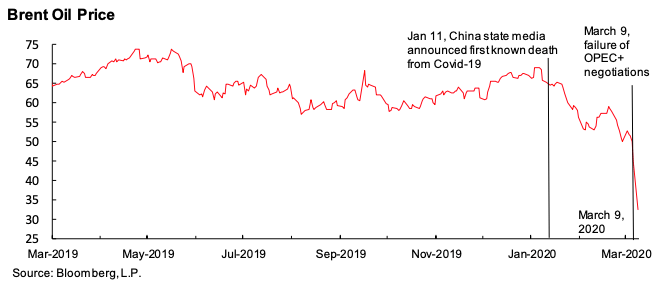
On Monday, the US President Donald Trump literally bit the bullet by telephoning Russian President Vladimir Putin to discuss the state of the energy markets, which are at a crisis point not seen in history. As of last weekend, global oil prices collapsed by over 50 percent and are the lowest seen in almost twenty years.
A defining moment has come. Starting April 1, OPEC+ countries (OPEC plus Russia) are at liberty to pump as much oil as they please. The increased oil volumes are sure to flood the oil market. Saudi Arabia has talked of offering 12.3 million barrels per day to the market.
The combination of a massive supply overhang and a significant demand shock at the same time has created an unprecedented situation in the oil market history. It threatens to have a multiplier effect on the deep recession in the world economy due to the coronavirus and the consequent lockdowns in large swathes of China and the industrial world.
For the US, the oil market bust could mean that over half of its shale industry, which has been charioting the country’s newfound oil superpower status, may go bankrupt. Breakeven price for US shale industry ranges from $40-50 per barrel — and prices have plummeted to around $20.
A similar crisis had arisen in 2014-2016 period but shale industry survived through a combination of pushing costs lower and retrenching — and bouncing back with higher profits once the crisis was over. However, this time around, shale drillers were already facing substantial hurdles with cash flow problems and maturing debt and the dramatic fall in income simply drives them bankrupt. Again, whereas the problem earlier was one of fall in oil prices, today it is also combining with the biggest demand slump in the history of oil.
The US shale sector is getting completely killed and tens of billions of dollars in equity could get wiped out. 13 US senators wrote to the Saudi Crown Prince Mohamed bin Salman earlier this month urging halt to efforts to boost production and lower prices. They threatened to take action against Saudi Arabia if the “economic warfare” continued.
Sen. Ted Cruz from Texas told CNBC on Monday: “The Saudis are hoping to drive out of business American producers, and in particular shale producers, largely in the Permian Basin in Texas and in North Dakota. That behaviour is wrong, and I think it is taking advantage of a country that is a friend… If they don’t change their course, their relationship with the United States is going to change very fundamentally.”
However, the Saudis are not backing down from the oil price war for market share and are planning another increase in its oil exports starting in May. A prominent Saudi establishment commentator Bernard Haykel wrote recently that Riyadh’s decision reflects a broader and more fundamental strategic shift led by the Crown Prince. To quote Haykel, “He (Crown Prince) has embarked on a policy of capturing market share rather than trying to set the price.”
Indeed, the warning bells are ringing already for the shale industry. Tens of thousands of roughnecks are getting laid off. The Oil Price magazine forecasts that layoffs in the US oil industry could be as high as 200,000 jobs.
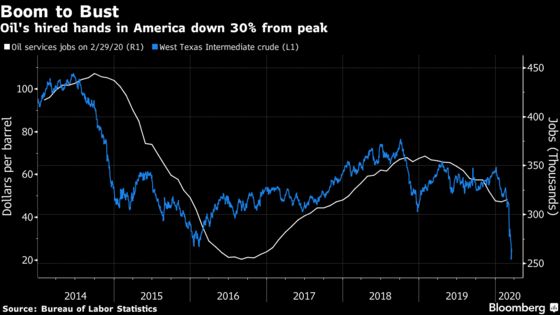
Tens of thousands are getting laid off in the US shale patch
The Brookings Institution anticipates in a study that the Midland-Odessa region of West Texas, where Occidental Petroleum and Parsley Energy have dominated, could be decimated. A top oil executive, Dan Eberhart, CEO of Denver-based Canary has been quoted as saying, “There’s definitely blood in the water. The weakest oil and gas companies, oilfield service companies and banks with heavy energy exposure might submerge beneath the waves before the end of the cycle never to surface again.”
The ripple effect is staggering. When the fracking companies go bankrupt and cannot repay debts, the credit market and the banks face a crisis, which in turn threatens the whole system of oil stock exchange.
Simply put, Saudi Arabia and Russia have dealt a lethal blow to the decade-old American fracking industry, which they have seen as a mortal enemy. The crux of the matter is that they are independently fighting the US and are determined to take the price war forward to conclusively finish off the American encroachment into their market share. (See my blog Oil price war is more about market share)
Recently, the chairman of Russia’s state-owned Rosneft, Igor Sechin, who is a longstanding associate of President Vladimir Putin, stated bluntly that as soon as US shale leaves the market, prices will rebound and could reach $60 a barrel.
The bottom line is that for President Trump, the political costs are exceedingly high. For one thing, his boast that the US has become the most significant player in global oil markets is coming unstuck and his agenda to secure “energy dominance” on the back of a shale boom is exposed as a pipedream.
More importantly, Trump’s trademark policy of weaponisation of sanctions against Iran, Venezuela and Russian oil industry and its flagship Nord Stream 2 gas pipeline project to grab these countries’ market shares is running into headwinds.
Russia is moving in quickly to turn the “oil war” also into a war for natural gas market share in Europe. Russia has watched with unease the arrival of shale gas on European shores that could potentially erode its commanding position as the single largest supplier of natural gas to Europe. The US has been touting the LNG sales to Europe as “freedom gas”, which helps European countries to reduce their high level of dependence on Russian supplies.
The US sanctions against Nord Stream 2 gas pipeline project, which connects Russian fields with Germany and northern Europe and was nearing completion, is a case in point. The sanctions targets Russia’s Gazprom from expanding and consolidating its towering presence in Europe’s energy market. Unsurprisingly, Moscow is in an unforgiving mood.
Following Trump’s phone call to Putin, the White House said the Russian and US leaders “agreed on the importance of stability in global energy markets.” The US Department of Energy Spokeswoman Shaylyn Hynes hyped it up further and told TASS, “[US Energy] Secretary Brouillette will discuss with his Russian counterpart, Minister Novak, ways the world’s largest producers can address volatility in the global oil markets during this unprecedented period of turmoil.”
But the Kremlin readout merely said, “They (Trump and Putin) exchanged views on the current state of the global oil market and agreed that Russian and American energy ministers should hold consultations on this topic.”
The big question is whether Trump’s phone call to Putin signifies Washington’s first step in a historic move to cooperate with Moscow in energy market management. Objectively speaking, the oil crisis needs a joined-up international response, and, arguably, the solution lies in looking beyond OPEC (and OPEC+) at a wider coalition — OPEC++ that includes the US. In principle, Saudi Arabia and Russia would favour the idea that the high-cost producers outside the OPEC+ group must finally share the burden of balancing the oil market.
Given the fact that Trump is vying for re-election this year and a significant portion of his supporters are engaged in shale oil and gas production, he may bite the bullet — at least, as a one-off, time-limited bite.
Open Letter to Chinese Government Highlights MSM Hypocrisy
By Daniel Lazare | Strategic Culture Foundation | March 30, 2020
The Washington Post, New York Times, and Wall Street Journal have written an open letter to the Chinese government urging it to reverse its “damaging and reckless” decision to expel their reporters amid a spiraling COVID epidemic.
The letter makes all the usual points about a “free flow of reliable news and information” in the middle of a growing international emergency. And however clichéd, such sentiments are correct since access to the broadest possible sources of information is indeed essential if the world is to make it through the crisis.
But the letter would have been a lot more convincing if the three papers had spoken up on Mar. 2 when the Trump administration moved to expel sixty Chinese journalists working for five news organizations that the White House regards as little more than state propaganda outfits.
Moreover, they’d be on even firmer footing if they had not actively cheered on the most dangerous anti-media effort of all, the U.S. crackdown on the TV news service RT, formerly known as Russia Today, that began in November 2017.
The crackdown on RT was in some ways even worse than McCarthyism since the latter was at least about something real and important, which is to say a Communist movement that controlled roughly forty percent of the global population and was pressing in on capitalism from every side. If the ruling class seemed spooked, it was facing a challenge of unprecedented dimensions.
But the threat this time around was about something entirely made up, i.e. the belief that Russia had supposedly used various dark arts to trick Americans into voting for Trump. The nonsense began in January 2017 when the CIA, NSA, and FBI “assessed” that Vladimir Putin had interfered in the previous year’s election in order “to undermine public faith in the U.S. democratic process, denigrate Secretary Clinton, and harm her electability” and, in the process, boost Trump. The report was entirely devoid of evidence, yet the press took it as gospel. Even worse, the intelligence report included a seven-page annex accusing RT of engaging in “criticism of U.S. and Western governments as well as the promotion of radical discontent,” running “numerous reports on alleged U.S. election fraud and voting machine vulnerabilities,” contending that U.S. election results cannot be trusted and do not reflect the popular will,” and hosting third-party candidates who contend that “the U.S. two-party system does not represent the views of at least one-third of the population and is a ‘sham.’”
Imagine – a foreign news service daring to suggest that U.S. politics were flawed! If papers like the Times or Post had the slightest inkling of self-respect, they would have laughed themselves silly over such hyper-sensitivity and told the CIA to grow a thicker skin. But they didn’t. Instead, they worked themselves up into ever greater levels of indignation. Within a few months, the New York Times was warning that “if there is any unifying character to RT, it is a deep skepticism of Western and American narratives of the world and a fundamental defensiveness about Russia and Mr. Putin” and that, thanks to snazzy graphics and snappy repartee, the network had put together “the most effective propaganda operation of the 21st century so far, one that thrives in the feverish political climates that have descended on many Western publics.”
Of course, one might observe that outlets like CNN and MSNBC are characterized by a deep skepticism of Russian narratives, so what’s the difference? But that wouldn’t be fair since everyone knows that America is right and Russia wrong and that any comparison between the two is automatically invalid, isn’t it?
Not to be outdone, the Washington Post – official slogan: “Democracy dies in darkness” – ran not one but two op-eds (here and here) calling on the federal government to require RT to register as a foreign agent, a step the Trump administration would dutifully take just two months later.
So the big two turned out to be more aggressive than the Trump administration in reducing journalistic diversity and using the power of the state to undermine a foreign competitor. Finally, just a month ago, the Times ran a front-page article declaring – queue the ominous music – that Radio Sputnik, RT’s sister outlet, had begun “broadcasting on three Kansas City-area radio stations during prime drive time.” Horror of horrors, the station was bombarding Missourians with Russki propaganda criticizing impeachment, the media, and the U.S. political system in general and informing that, in the words of one Sputnik host, that “the masses of poor and working people don’t have access to even the most essential things.”
Where did Radio Sputnik come up with such a notion? Doesn’t everyone know that perfect equality reigns in the United States and that anyone who says otherwise must be working for a foreign power?
In fact, while America never tires of touting its devotion to the First Amendment, it loses control when a foreign news service turns tables by engaging in journalism that is cheeky and irreverent. It wants a free press, which is to say one that is free to repeat over and over again how perfectly wonderful America really is. But it does not believe in a free press that allows foreigners to say the contrary.
Featured Video
Dan Dicks with James Corbett on Solutions Watch
or go to
Aletho News Archives – Video-Images
From the Archives
Secret document reveals plans for civil war in Lebanon, Israeli false flags, and invasion
By Randi Nord | Geopolitics Alert | April 5, 2019
Beirut – During his visit with US Secretary of State, Mike Pompeo, Lebanese President Michael Aoun reportedly received a US-Israeli document detailing plans for creating a civil war in Lebanon with covert false flag operations and possible Israeli invasion.
Although the source of the document is Israeli and created in partnership with Washington, no one knows who presented it to Aoun. The Lebanese TV station, Al-Jadeed, initially reported the document on Lebanese TV and a video on its website. Geopolitics Alert translated the report for this article. … continue
Blog Roll
 Aletho News
- How to MAKE THE CONSPIRATORS PAY for their crimes! Dan Dicks with James Corbett on Solutions Watch
- There’s a drought in academia: A drought in honest research on the subject of drought and other weather extremes
- Department of War Awards $20.7 Billion Contract to Raytheon for Air-to-Air Missiles
- ‘Distance yourselves from Israel’: IRGC urges US population to question govt policies
- America’s Greenland deal has a radioactive backstory
- The RAF Fairford ‘terror plot’: Unpacking escalation in the UK echo-chamber
- EU Council Advances Chat Control 2.0 Scanning Proposal
- Ex-Greek MEP files complaint against Israeli spyware firm over alleged Pegasus surveillance
- Troubling ideas throughout the Torah, Talmud, Mishneh Torah and Tanya
- ‘Grave, alarming’: Iran mission on Trump’s UNGA ‘annihilation’ threats
- If Americans Knew
- New Report: “Scholasticide and Genocide in Gaza: Assessment, Testimonies and Legal Analysis”
- Ex-Biden officials are desperate for a Gaza scapegoat
- Israeli “settlers” Invade Al-Aqsa; Pour Boiling Water on 75-Year-Old
- Israel Has Kidnapped Another American Teenager
- US arms sales to Israel worth $21.6 billion in 20 months
- Three Palestinians Killed in Israeli Attacks on Gaza
- Revealed: German “Anti-Semitism Expert” Driving Crackdown on Palestine Solidarity is Former Israeli Spy
- Egypt’s Warning to Israel Before Oct 7
- Israel’s siege signals another cruel winter for 1.8 million Gazans – Daily Update
- Netanyahu Asked UAE Leader to Deny Report on Oct. 7 Warning in Secret Visit, Sources Say
- No Tricks Zone
- New Study: Earth And Venus Surface Warmth Largely Explained By Convection And Lapse Rate, Not CO2 Or Radiation
- 2025 Nature Paper Claiming Worsening Global Drought Gets RETRACTED …Heavily Flawed
- New Study: ‘Global Drought Shows No Detectable Recent Acceleration Under Climate Warming’
- Economic Masterminds: German Socialists Suggest Taxing Productivity Gains Stemming From Using AI
- The South China Sea Has Not Been Cooperating With The Climate Change Narrative
- Energy Crisis: Germany Enters Heating Season With Historically Low Gas Reserve Fill Levels
- New Study: The Antarctic Ice Sheet Gained Mass From 2020-2024 Due To Staggering Snow And Ice Accumulation
- Study: Ocean Heating Rates From Thousands Of Years Ago ‘Dwarf’ Modern Ocean Heating Rates
- Climate Extremists Target, Attack Large-Scale Power Grid Infrastructure In Germany!
- New Study: Antarctic Ice Melt Has Contributed Less Than 1 Centimeter To Sea Level Rise In The Last 30 Years

