Russia quizzes US on coronavirus’ parentage
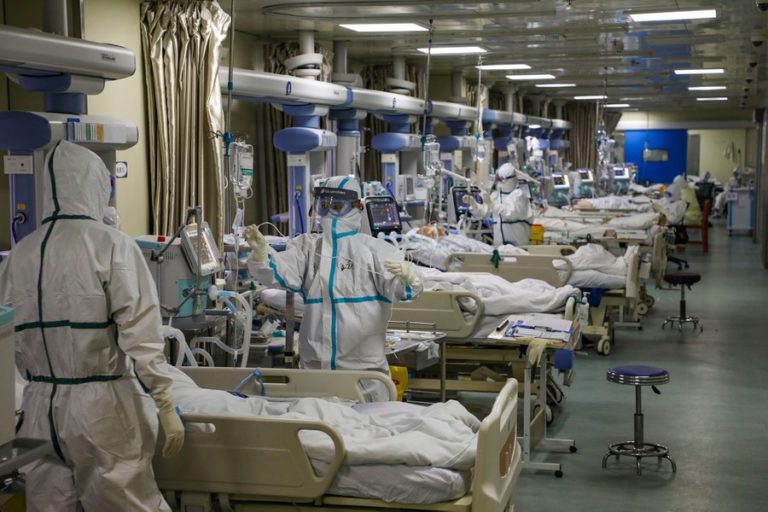
Medical workers in protective suits attend to coronavirus patients at the Intensive Care Unit of a designated hospital in Wuhan, China, February, 2020.
By M. K. BHADRAKUMAR | Indian Punchline | March 30, 2020
All through the recent weeks since US President Donald Trump coined the epithet “China virus” to rename Coronavirus, Moscow kept a deafening silence.
Finally, on Sunday, March 29, Moscow broke that silence. That the first Russian statement came at the level of the Russian foreign ministry makes this particularly significant.
In an exclusive remark, a “source in the Russian Foreign Ministry” told the state news agency Tass :
“In order to unambiguously answer the question about the origin, about where the first case emerged, major research needs to be carried out. So, Washington’s accusing tone in comments against China arouses blatant bewilderment.”
The source then went on to touch on the allegation made in China —namely, that a team of American military personnel had visited Wuhan, China, previously before the outbreak. The Russian Foreign Ministry source said:
“As for “US trace” in the COVID-19 outbreak, we don’t have this data today. However, for a long time we have been watching with concerns the US military and biological activity carried out in direct proximity with our borders. In other words, there are indeed questions for the US.”
Now, a few things must be said right at the outset. Any longtime observer of the Russian state system, media culture and Russian diplomacy would know that Tass, which functions under the supervision of the Kremlin is not in the business of lapping up stray remarks by a moonlighting Russian source.
As for Russian diplomats, even the dumbest of them know better than to casually chat up a Tass correspondent. And, of course, Tass will never put out as lead story a stray remark of such significance without clearance from a high level, possibly even from the Kremlin.
What it adds up to is that Russia is signalling that it knows something about coronavirus’ parentage that is explosive in its impact on world politics and international security. Russia has highly privileged intelligence sharing arrangements with China. The Kremlin is the only interlocutor with which President Xi Jinping’s office maintains an institutionalised system of sharing vital information and coordination.
All these factors come into play while assessing yesterday’s Tass report.
Suffice to say, one plausible explanation for the Tass report today is that Moscow has alerted Trump to something that he may not yet be aware of.
Indeed, no attempt has been made by the US so far to disprove the Chinese allegation. There has been a media cover-up instead. Meanwhile, experts have opined that it is unlikely that coronavirus has been used by anyone as a biological weapon but it cannot be ruled out that during research, the virus might have “escaped”.
Interestingly, the Russian “source” drew a pointed comparison with covert attempts by the US military to indulge in “biological activity” near Russia’s borders as well.
Trump is on record that his “china virus” reference was an instinctive reaction to the Chinese allegation. Trump since added that he has stopped using that expression. In fact, he has more than made up by making a telephone call to Chinese President Xi Jinping to bury the hatchet.
After their conversation on March 27, Trump seemed relieved that Beijing is agreeable to bury the past and to look forward to a future of joint effort to combat coronavirus. Trump tweeted in unusually empathic language, even expressing his “respect” for the Chinese system:
“Just finished a very good conversation with President Xi of China. Discussed in great detail the Corona Virus that is ravaging large parts of our Planet. China has been through much & has developed a strong understanding of the Virus. We are working closely together. Much respect!”
Xinhua carried an unusually detailed report on the conversation which highlighted that a serious discussion took place between Trump and Xi and made it clear that POTUS quizzed Xi closely and held out reassuring words:
“Stressing that China’s experience is very illuminating to him, he said he will make personal efforts to ensure that the United States and China can ward off distractions and concentrate on cooperation against COVID-19.”
The references here to “personal efforts” and “distractions” merit particular attention. Has Xi taken Trump into confidence? The Russians have broken their silence within 2 days of the conversation between Trump and Xi.
However, this isn’t the end of the story. The orphan who appeared in Wuhan late last year may be establishing its parentage by reaching the US and creating an apocalyptic situation in New York. The big question will continue to haunt the world community: Was the coronavirus originally conceived in the womb of a Pentagon lab developing biological weapons?
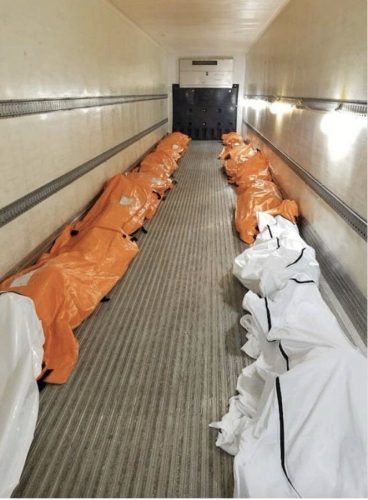
Harrowing imagine from the inside of a truck in New York City. All victims of the coronavirus for disposal. Image taken by a local nurse, New York, March 29, 2020
Russia now says it has information to that effect. Was the Pentagon conducting tests of potential biological weapons on the two big powers that the Deep State in America regards as the US’ principal adversaries and existential threats?
Moscow has a way of drawing the White House’s attention to sensitive issues through such modes at a time when the direct communication channels remained hopelessly clogged. Moscow knows fully well from past experiences that the POTUS may not always be kept briefed on the shenanigans of the cold warriors in the US intelligence and defence establishment.
The military-industrial complex and the ‘Deep State’ have been historically a law unto themselves. Remember the farewell speech by President Dwight Eisenhower on 17 January, 1961 when he forewarned the nation to be on guard against the potential influence of the military-industrial complex (a term he is credited with coining). Eisenhower said:
“In the councils of government, we must guard against the acquisition of unwarranted influence, whether sought or unsought, by the military-industrial complex. The potential for the disastrous rise of misplaced power exists and will persist. We must never let the weight of this combination endanger our liberties or democratic processes. We should take nothing for granted. Only an alert and knowledgeable citizenry can compel the proper meshing of the huge industrial and military machinery of defense with our peaceful methods and goals, so that security and liberty may prosper together.”
Eisenhower was drawing deep into the bitter experience during his presidency that despite his profound military background and being the only general to be elected president in the 20th century, the military-industrial complex torpedoed his efforts to initiate detente with the USSR.
In the wake of the famous U-2 spy plane incident on May 1, 1960 (just days before a summit meeting between Eisenhower and Soviet leader Nikita Khrushchev in Paris), which infuriated the Kremlin, Eisenhower had to abandon a planned Moscow visit in June to flesh out his pet foreign-policy project of detente with the USSR, which the highly decorated World War 2 general had deeply cherished would be his finest presidential legacy.
Russia Concerned by Proximity of US Bioweapon Labs Amid Outbreak – Source

© CC BY 2.0 / PublicDomainPictures / 17907 images
Sputnik – 29.03.2020
MOSCOW – Russia is concerned by how close Pentagon-funded biological warfare labs are to its borders at the same time as it battles the coronavirus, a Foreign Ministry source told reporters on Sunday.
The official slammed US authorities for blaming China for the COVID-19 pandemic and manipulating its data on the virus, and in turn, accused the United States of spinning the global health crisis into political attacks.
“We do have questions for the US. It would be nice to hear its justification for placing so many labs near Russia and China, instead of its playing propaganda games with the coronavirus”, the official said.
He admitted that Russia had no credible information on a US role in the emergence of the deadly virus, which was first reported in China last December, but said globalisation made transmission of viral diseases “a matter of hours”.
“Thus, the accusatory tone of remarks directed against China from Washington is outright baffling”, the official said, adding that the source of the virus was yet to be discovered.
China hit back at the United States this month, after getting a grip on the epidemic, saying that US military personnel might have introduced the new coronavirus to Wuhan during the 2019 Military World Games in October.
A Russian firewall for Venezuela against US sanctions
By M. K. BHADRAKUMAR | Indian Punchline | March 29, 2020
The optics of the Russian oil leviathan Rosneft’s decision to sell its subsidiary Rosneft Trading SA and sell all its assets in Venezuela after the US Treasury sanctioned its trading arm two weeks ago as part of Washington’s regime change project to oust president Nicolás Maduro, may not look good to the uninformed outside observer.
It may appear, prima facie, that Russia is ditching Maduro and succumbing to US president Donald Trump’s latest act of weaponisation of sanctions against the Venezuelan government. At least, that was how the BBC Radio’s morning bulletin today projected the development.
But as one digs deeper, it emerges, on the contrary, that the Kremlin is having the last laugh. What Russia is doing is, funnily enough, borrowing from the US diplomatic toolbox — the equivalent of what the US does constantly in its war on terrorism, that is, whenever a terrorist group that Washington sponsors gets exposed on the battlefield, it gets promptly rebranded and reappears as a new avatar, and life moves on.
So, what is happening needs to be understood as follows: Rosneft is disengaging from its trading arm Rosneft Trading SA, the Geneva-based trading subsidiary, in a deliberate ploy to create a firewall against potential US sanctions in future.
This is important for preserving Rosneft’s global operations — Rosneft accounts for about 6 per cent of global oil production — which might otherwise be risking the US sanctions in the downstream.
Rosneft is acting with prudence since, although Rosneft is majority-owned by the Kremlin, it is listed in London, and counts BP and the Qatari sovereign wealth fund as large minority shareholders.
A Rosneft spokesman has ben quoted as saying, “As a public international company, we have made a decision in the interests of our shareholders in the context of the situation that has objectively developed. Now we have the right to expect from American regulators to fulfil their publicly given promises.” The last reference is to statements from the US that sanctions against its trading arm would be removed if Rosneft wound down its Venezuelan business.
Interestingly, an unnamed company owned entirely by the Kremlin will be buying the Rosneft subsidiary and its oil services and trading operations in Venezuela. The deal between Rosneft (headed by Igor Sechin) and the Kremlin (headed by Vladimir Putin) boils down to the latter now directly taking over assets in Venezuela amounting to more than 80m tonnes in oil reserves and oil production of 66,500 barrels a day via five joint ventures with PDVSA, Venezuela’s state oil company.
A Rosneft subsidiary will receive 9.6 per cent of the company’s stock from the Kremlin in exchange for the assets. That leaves with Trump an only remaining option of sanctioning the Kremlin itself if he wants to punish Maduro.
Moscow honed this innovative technique to outwit Trump’s sanctions earlier also in Venezuela when it rebranded a joint-Russian/Venezuelan bank facing US sanctions with the Russian joint-venture partners — VTB and Gazprombank —transferring their shares to the Russian government.
Clearly, the deal between Rosneft and the Kremlin (read between Sechin and Putin — who are of course longstanding associates in Russian politics through thick and thin — gives an unambiguous signal that Moscow is in Venezuela for the long haul, no matter what it takes.
The geopolitical implications are hugely consequential for the future of the Maduro government, enhancing Russia’s overall standing in the western hemisphere and highlighting the limits to US hegemony in its own backyard. (Isn’t it Ukraine in reverse order?) The Latin American countries (and China) will be closely watching, too.
Sechin, a former KGB officer himself, has been a key figure in the Kremlin hierarchy who choreographed and founded Moscow’s close relationship with Caracas. He had an exceptionally warm personal friendship with late Hugo Chavez, the self-styled leader of the ‘Bolivarian Revolution’ in Venezuela. (A 2012 Guardian thumb sketch zeroed in on Sechin as “the head of the Kremlin’s siloviki clan, made up of nationalist hardliners with a security or military background.”)
At any rate, between 2014 and 2018, Rosneft had advanced a loan of $6.5 billion in loans to Chavez to help Venezuela tide over the economic difficulties due to the US’ hostile policies. Venezuela has since mostly paid back the Russian loan in oil deliveries.
Rosneft was marketing between half and two-thirds of Venezuela’s oil and Rosneft Trading SA was Venezuela’s sole supplier of gasoline. The business now will be handled by the unnamed Kremlin company. Evidently, this is a strategic move which signals Russia’s determination to retain its commanding presence in Venezuela’s oil sector.
This has implications for the world oil market, since Venezuela’s proven oil reserves — 300 billion barrels as of 2016 — accounts for over 18 percent of proven oil reserves all over the world and ranks the country as No 1 in the world.
At a time when the OPEC is mutating and the OPEC+ is caught up in the maelstrom of the sharp fall in oil prices due to coronavirus, the future of world oil market has become highly volatile and uncertain. It is already having a deleterious impact on the US shale industry which cannot survive unless oil sells at $45-50 per barrel. But oil prices are certain to go up in the coming years and Venezuela is destined to be a big presence in the world oil market in the long term.
Suffice to say, the Kremlin is playing the long game, while strengthening in the process in immediate terms the Maduro government’s capacity to withstand the US pressure and to retain its strategic autonomy.
Covid-19: Modi, Putin to coordinate efforts
By M. K. BHADRAKUMAR | Indian Punchline | March 26, 2020
Soon after Russian President Vladimir Putin’s address to the nation on Wednesday on the government’s coronavirus response and measures to be adopted to deal with the pandemic, Prime Minister Narendra Modi spoke to him on the phone. The Indian and Russian readouts (here and here) have alike highlighted that the two leaders “agreed to strengthen coordination in the coronavirus response effort” (Kremlin).
The two countries are facing similar challenges. Having done very little by way of testing, the actual figures of coronavirus patients could be higher than the official estimate in Russia and India alike.
The total number of infected people as of today touched 840 in Russia, while the Indian figure has reached 660. Importantly, the figures are dramatically rising. There was a 28% jump in Russia since Wednesday.
Putin has admitted candidly that the outbreak is worse than what he had thought previously. The head of a top Moscow hospital treating coronavirus patients told Putin on Tuesday when he visited the patients undergoing treatment that Russia needs to “prepare for the Italian scenario.”
To a degree, the relatively low number of cases so far in both India and Russia can be attributed to an early ban on entry for Chinese citizens at the time the epidemic was at full swing in that country.
But India has been ahead of Russia in denying entry to all foreigners except diplomats and members of official delegations. It was only last week that Russia imposed such restrictions. Again, India shut down international flights earlier than Russia which announced the decision only today.
Both Indian and Russian authorities were inclined to project an upbeat view on the situation, claiming that all measures have been taken to prevent a bigger outbreak. But both have acknowledged lately that there is indeed a crisis looming ahead.
On Tuesday, Moscow Mayor Sergei Sobyanin, who leads a task force on dealing with the virus, told Putin at a meeting in the Kremlin that provincial governors must receive orders to move more quickly to ready hospital beds for the gravely ill. “Otherwise, the system won’t be able to cope,” he said.
Sobyanin has ordered all Moscow citizens over 65 to stay home starting Thursday. Construction of a new hospital for coronavirus patients that is being built from scratch is going on at breakneck speed in Moscow suburbs.
Basically, Russia suffers from the same disadvantages as India to cope with a big coronavirus crisis — underfunded healthcare system, paucity of hospital beds, shortage of protective gear for medical communities, grossly insufficient network of labs to conduct / analyse coronavirus tests and so on.
But the Russian system is better adapted to handle such crises. Sobyanin signed a decree today “to temporarily suspend … from 28 March to 5 April, the work of restaurants, cafes, canteens, buffets, bars, snack bars and other catering establishments, with the exception of takeaway services without citizens visiting the premises of such enterprises, as well as order delivery.”
Shops, except pharmacies and those selling essential goods, will suspend operation during this weeklong period. Sobyanin was almost apologetic: “The restrictions introduced today are unprecedented in the modern history of Moscow and will create many inconveniences in every person’s daily life. But, believe me, they are absolutely necessary to slow down the spread of the coronavirus infection and reduce the number of cases.”
The big question is whether these measures will suffice or Putin will also opt for a “total lockdown”, as Modi ordered on Tuesday. But then, Russia is a vast country spanning 9 time zones, and the Kremlin can always ramp up measures as cases grow. The regional imbalances are simply mind-boggling — between Moscow and St. Petersburg (European Russia) on the one hand and the Caucasus, Urals, Siberia or the Russian Far East (Asiatic Russia) on the other hand.
Having said that, the crucial difference is that Russia is a developed country in most ways in the social sector, thanks to the Soviet rule, whereas India is a developing country with a much lower level of social formation.
The mammoth population of India puts additional pressure on social sectors of the economy. Again, the structure of the Russian economy is very different. It has nothing comparable, for example, to India’s “informal sector” or “migrant labour” that infinitely add to the complexity of the present crisis.
Russia was all set to join the OECD when the Ukraine crisis erupted in 2014 and the European Union imposed sanctions. In fact, at that point in time, Russia had already signed on to some of the landmark OECD standards.
However, the raison d’être of the two countries’ desire to “to strengthen coordination in the coronavirus response effort” lies in their capacity to show a third way in addressing the present crisis.
Neither Russia nor India has followed China’s Wuhan model of “suppressing” the coronavirus and moving on to resuscitate the economy.
On the other hand, their humanistic traditions also do not allow the pitiless approach that US President Donald Trump espouses.
Both Russia and India stress “social distancing” as the key. PM Modi used a powerful metaphor from Ramayana which every Indian would understand, to drive home that one’s home is one’s ultimate citadel in these extraordinary times. Putin meant much the same thing when he said, “Don’t think: ‘This can’t happen to me.’ It can happen to anyone. The most important thing is to stay home.”
Putin announced paid leave for all Russians next week due to COVID-19. He announced, amongst other relief measures for the economy, that families eligible for maternity capital will receive an extra 5,000 rubles ($44.80) per month from the government for each child under 3 years old.
Small and midsized businesses will receive a six-month tax deferral. And those who lose their jobs or take sick leave will receive payments at minimum wage until the end of the year. The allowance for the unemployed has been raised by 50 percent and brought on par with the prescribed minimum wage.
Today, the Modi government also announced a massive $22 billion package of cash transfer and food security exclusively targeting the poor.
Both Russian and Indian leaderships are acutely conscious of grim economic warnings for their countries. Both economies could shrink significantly in a worst case scenario. Nonetheless, both Putin and Modi have chosen to concentrate on socially sensitive clusters — pensioners and families with children in Russia, the teeming hundreds of millions of poor people in India.
One may say they stay true to their history as “populist” leaders. But this time around, it is far from an opprobrium.
Riyadh’s “Oil War” on Russia has some Global Objectives
By Salman Rafi Sheikh – New Eastern Outlook – 24.03.2020
The on-going Saudi ‘oil war’ with Russia has its roots in the logic of increasingly using natural resources for geo-political and geo-economic purposes. While this is not something entirely new, the latest push comes against the backdrop of increasing competition between the US and Russia for global leadership roles and the former’s attempts at forcing the latter out, squeeze its share in the global oil market to increase that of the US shale oil, thus denting Russia’s economic capacity and its ability to project power in regions beyond its borders.
Whereas the Saudis blame Russia for the ‘oil war’ and Kremlin’s refusal to further cut oil production, the proposed cut, as it stands, would have ultimately meant a further decrease in Russia’s share of the global market and a significant increase in the US’ shale-oil production and exports. Ever since OPEC+ agreement of 2016 and the related cuts in oil production, the output of US shale oil has soared by 4.5 million barrels a day. Whereas the Western political pundits have been speaking and writing of Russia as the ‘malign’ player targeting the US’ ‘booming’ shale oil industry, the fact of the matter is that the US shale industry would not have grown in the first place if there had been no OPEC+ agreement. Russia, as it stands, has only refused to further cut its production, and is willing to extend the OPEC+ to continue a stable system of oil production.
How the OPEC+ benefited the US shale oil is evident from the fact that balanced production of crude oil meant stable and high prices, which made the US shale oil more profitable, further allowing the US to use the scenario to build its production and export infrastructure. As it stands, since 2016 when the OPEC+ deal was struck, US oil exports have increased five-fold and shale production increased from 8.9 million barrels per day to 13.1 million barrels per day. Thus, to a significant extent, by refusing the Saudi proposal of further cuts in oil production, Russia essentially refused to allow the US shale oil industry a further free-way for global expansion.
At the same time, Russia continues to stick with the OPEC+ deal. The Russian Prime Minister Mikhail Mishustin has said,
“We did not initiate the withdrawal from the agreement [OPEC+ deal]. On the contrary, we proposed to extend the agreement on the existing terms, at least until the end of the second quarter or for a year, so as not to complicate the situation that has developed with the spread of coronavirus.”
At the recent meeting between Russia’s Putin and energy officials, Putin reportedly said that:
“OPEC+ has “proved to be an effective instrument to ensure long-term stability on global energy markets. Thanks to that, we have obtained extra budget revenues and, what is important, provided a possibility for upstream companies to confidently invest in promising development projects.”
What becomes evident here is that the blame for reduced oil prices can hardly be put on the Russians. Its roots lie in the global struggle for market share. This struggle is taking place at two levels. The first is between the Russians and the Saudis whereby the latter, known for playing on the US side in every war, want to expand their share of the market to sustain their massively oil-dependent economy. The second level, linked as it is with the first, is again about reducing Russian share of the market and allowing for the shale-oil sector to expand. Since this expansion will theoretically come at the expense of Russian oil, the Saudis would still benefit.
There is as such a Saudi-US consensus behind the dropped oil prices. US President Donald Trump spoke on the phone to the Saudi Crown Prince Mohammed bin Salman on the eve of the Vienna meeting, and their subject of discussion, according to the White House, was the “energy market.”
That the US and Saudi Arabia have a deep interest in squeezing out Russia’s share of the global hydrocarbon market is evident from the way the US has been trying to block and even sanction the joint Russian-German Nord Stream-2 pipeline project.
Who will win this war? Unlike the Saudis, Russia’s economy does not solely depend on oil prices, although it still does play a significant role in enabling the Russian government to fulfil its budgetary commitments. The Saudis would be thus at a loss much sooner than the Russians. If the US president called the Saudi ruler to discuss the “energy market” and it was mainly about finding ways of squeezing Russia, it was equally about finding a way to stabilise oil prices because the continuously falling oil prices would only make shale-oil companies suffer losses. According to a Bloomberg report, “The US shale sector is getting completely killed. A complete bloodbath. Billions of dollars in equity wiped out.”
Whereas some in the West think that this is a Saudi-Russian project to destroy the US economy, this is not the case; for, if both oil producers had wanted this, they could have done this by doing a new OPEC+ deal in a way that would have allowed a cut in prices and still maintain production levels at agreed levels. This has not happened, and given the nature of deep Saudi interests in the US, it is difficult to conceive of a Saudi project to ‘kill’ the US economy. What it signifies is an attempt at squeezing the Russian share of the market. This explains the Saudi proposal for cutting oil production (and thus allowing that of the shale-oil grow further). The falling oil prices only indicate that the project is failing; Russia is resilient and has enough reserves to sustain itself for a decade.
Salman Rafi Sheikh is a research-analyst of International Relations and Pakistani foreign and domestic affairs.
Western Journalists Really Want There to be a Huge Corona Epidemic in Russia
By Anatoly Karlin • Unz Review • March 21, 2020
The stream of articles suggesting that Russia is covering up its Corona numbers has increased from a stream to a veritable flood:
- CBC: Russia’s coronavirus count under scrutiny as Putin government denies hiding cases
- Moscow Times : Russia Says It Has Very Few Coronavirus Cases. The Numbers Don’t Tell the Full Story.
- Reuters : Sharp increase in Moscow pneumonia cases fuels fears over coronavirus statistics
- Business Insider : Doctors in Russia are accusing the government of covering up its coronavirus outbreak and denying them protective equipment
- CNN: Why does Russia, population 146 million, have fewer coronavirus cases than Luxembourg?
- Financial Times : Vladimir Putin keeps political plan on track despite virus crisis
Let’s take a look at that last article, written by FT’s Henry Foy today, and one of the more balanced (read: less Putin Derangement Syndrome – afflicted) journalists doing the Russia beat (not to mention the most prominent in the above sample, having scored an exclusive interview with Putin in 2019).
“The present number of patients with coronavirus will be hidden from us,” said Anastasia Vasilieva, chairman of Doctors’ Alliance, a Russian lobby group affiliated with opposition politician Alexei Navalny.
Now Foy, to his credit, at least has the journalistic integrity to acknowledge that this doctors’ group (which I have never heard of before now) is affiliated with Navalny, whose entire shtick is to oppose everything and anything the Kremlin does.
A political tilt that its chairwoman helpfully confirms:
“The value of human life for our president is nil . . . We don’t want to admit to any pandemic,” said Ms Vasilieva. “We know of hospitals that are completely full and nurses who are asked to sew face masks from gauze.”
***
But otherwise it follows the usual template on Russia COVID-19 coverage.
She claimed Moscow was instead classifying cases of the virus as pneumonia, the incidence of which increased by almost 40 per cent in January compared with a year previously, government data showed.
The aim here is to insinuate that there was a raging coronavirus epidemic camouflaged as the flu from as early as January 2020.
Oh Corona, where to start.
1. Flu mortality fluctuates wildly season to season by a factor of as high as 4x. So this is a perfectly meaningless fact from the outset.
2. Even China’s epidemic only broke 1,000 cases in January 25. Where were Russians getting infected??
3. If this was true, it is Russia, not Italy, that would be the center of the COVID-19 epidemic now – something that would certainly be noticed, e.g. in overflowing hospitals (no sign of that to date) or in exported cases (but that was all China in February, and predominantly Italy, Iran, and other EU nations now). It is Britons that Vietnam has started barring ten days ago, not Russians.
Here’s what I guess happened. People got agitated by reports from China, and were more likely to consult doctors, producing more flu diagnoses. Even though the actual chance of Russians having COVID-19 in January if they hadn’t been to Wuhan was on the order of a meteorite hitting them on the head.
While other foreign leaders have steeled their citizens for a long crisis and have spoken of a “war” against the pandemic, Mr Putin has played down the threat and urged citizens to remain calm in an effort to minimise panic — and ensure the nationwide ballot on April 22 takes place. …
“The virus is a challenge and comes at a very bad moment for him,” said Tatiana Stanovaya, founder of R. Politik, a political analyst. “Putin doesn’t want to postpone and is insisting that the referendum takes place as soon as possible . . . The longer they wait, the more risks will appear.”
LOL. Trump was saying Corona was fake news/nothingburger up until the end of February.
The US epidemic (22k cases) is about two orders of magnitude more advanced than Russia’s (306 cases), but most states have continued to hold primaries for the Dem nomination.
And in any case Putin has allowed the possibility that the April 22 Constitutional Referendum may be postponed. There’s no indication it’s a hard, immovable date.
At the same time, Mr Putin has sought to project an image of control, continuing with his diary of local visits and meetings with senior officials, shaking hands and never wearing a face mask.
Although it would be nice for Putin to set a better example, this is the rule, internationally – not the exception. Stressing this is so petty, LOL.
“No matter what happens in the next 35 days, they have to lie, hush up, and deny. It doesn’t matter at all what really will happen to coronavirus in Russia, whether there will be a moderate outbreak or tens of thousands are killed,” said Igor Pitsyn, a doctor in Yaroslavl, a city 250km north-east of Moscow.
“By Putin’s decree all information about this is declared a state secret until April 22 . . . This ‘nationwide vote’ will be held at all costs.”
First time I hear of this. Searching “путин коронавирус гостайна” doesn’t produce any relevant results. This doctor must have some very high placed sources.
Or perhaps Foy had to travel all the way to Yaroslavl to get a sufficiently juicy quote.
While officials have cited the low number as proof of the success of swiftly closing its border with China in January and steadily cutting flights to affected countries, experts have questioned how the country has proved far more immune than almost any other. … Neighbouring Belarus has five times more infections per capita than Russia, and France, which has roughly half Russia’s population, has more than 50 times the number of cases.
Russia doesn’t have large numbers of Gastarbeiters in the EU, unlike Belarus. Our Belorussian commenters also tell us that there are next to no control measures in place.
But Ukraine has perhaps 20x more Gastarbeiters in the EU than Belarus, and yet 2 days ago reported only 1/3 as many Corona cases (16 vs. 51). Which suggests where Western journalists covering Eastern Europe should really focus their attention. If they, you know, cared about the Corona situation in Eastern Europe. As opposed to promoting the US line that Russia bad and China bad.
***
Incidentally, an update on Ukraine, two days after my alarm-raising article, in which I suggested that it’s likely there’s a big cluster developing undetected in Ukraine.
Even though testing in Ukraine remains extremely patchy – even in per capita terms, its ~500 tests are two orders of magnitude lower than Russia’s ~150k, or for that matter Belarus’ ~16k – the past two days have seen a surge of new cases from 16 to 41. The majority of those cases, some 25 of them, are concentrated in Chernivtsi oblast, which also saw the death of a 33 year old woman from existing problems magnified by the coronavirus.
The unlikelihood of such a mortality profile, coupled with the flood of new cases despite continued low testing rates, strongly suggests that this is just the tip of the iceberg, and that a cluster is developing in Chernivtsi oblast.
This suggestion is backed up by an observation by Twitter user from_kherson:
There’s a reason Chernivtsi has so many cases – large # of people go to Italy for work.
An acquaintance of mine from there confirmed his business partner just tested positive for the virus.
But just in case you think I am piling on to Ukraine because of my own political obsessions you would be mistaken.
I will say that after Ukraine, probably the second biggest undetected Corona timebomb in Europe may be Serbia. Unfortunately, the Wikipedia page on COVID-19 testing doesn’t have information for Serbia. However, one of my Serbian friends on Thursday wrote me that:
We are still testing around 50 per day, with 1/5 being positive…
So both the intensity of testing and the rate of positives is similar to Ukraine.
This Friday, he continued:
We still have competent health care workers (the decision not to test the wider population is purely political, as was the decision not to close schools until 5 days ago), relatively functioning health care system, about 1500 respirators on a population that is 7+ million.
On the other hand, we have the second lowest reported total test volume anywhere in the world, after Malorossiya :), at 545 total as of this morning, one of the highest positive rates per 1000 tests (after Italy, Spain, Ecuador and the Philippines). We have seen an influx of over 250,000 gastarbeiters from Western Europe in the past 10 days… Many people are breaking the 14 day mandatory self isolation. When I say many, I’m talking about thousands every day…
We have 3 things potentially on our side. God, warmth, and Sun. Or it’s all just God? 🙂
And to think that Serbia was one of the first countries in the world to eradicate smallpox in the 1830s… Under the lifelong illiterate knyaz Miloš…
The large number of Gastarbeiters in Western Europe, most of whom are now going to be let go, is another similarity that Serbia shares with Ukraine. And is something that will be a very problematic issue going forwards.
Fortunately, it appears that China (and Russia) are going to bail Serbia out with test kits.
Despite their rather different geopolitical viewpoints, European attitudes to both Serbia and the Ukraine are quite similar. They are to be exploited to the extent they are useful; otherwise discarded as needed. It’s a lesson they should mull over.
Top Doctor at Moscow’s leading disease hospital says current Covid-19 crisis will likely last Six months

By Bryan MacDonald | RT | March 20, 2020
Coronavirus panic is already threatening a worldwide economic disaster, as millions are forced to live under lockdown. This has left many people wondering how long we can expect these circumstances to endure.
“When I call my parents, I say jokingly: ‘see you in September,'” Denis Protsenko has told RT. He’s the head doctor of Moscow’s main disease hospital in Kommunarka.
Protsenko believes that while the pandemic may slow in summer, it’s more like it will be autumn before the siege will be lifted. If the country has a similar experience to China, then the spread will decline in May or June, he believes, but “If we get an explosion along Italian lines, we will consider a September conclusion a good result.”
The doctor emphasized that stopping the spread of coronavirus in Moscow will require “draconian prevention measures,” including the strict enforcement of a two-week self-isolation regime. At the same time, he stressed his belief that the capital should be temporarily closed for quarantine, right now.
The candid observations of Protsenko differ from previous mainstream thought in Russia. For instance, popular TV presenter Alexander Myasnikov, who is himself a Doctor by trade, urged Russians not to panic but warned that the psychological condition of people, and the economy itself, means more than a month of strict quarantine regulations isn’t realistic. Myasnikov, and others, had expressed the belief that the worst of the crisis would be over by mid-April.
According to the latest data, 253 are infected with coronavirus in Russia. The official tally rose by 54 on Friday and 52 on Thursday. While Moscow has the most cases, infections are spread across the country, with six reported in the remote Yakutia region. Twelve patients in Russia have been given the all-clear and discharged. One woman, suffering from Covid-19, died in Moscow on Thursday, but an autopsy showed the cause of death was a blood clot, rather than respiratory issues. She had a range of pre-existing conditions.
Democratic Front for the Liberation of Palestine delegation meets with Russian foreign minister
MEMO | March 18, 2020
On Tuesday a delegation from the Democratic Front for the Liberation of Palestine (DFLP) met with Russian foreign minister, Sergey Lavrov, and special presidential representative for the Middle East and Africa and deputy foreign minister, Mikhail Bogdanov, in the Russian capital of Moscow.
According to a statement issued by the DFLP, the two sides discussed the general situation in the Middle East, specifically the Palestinian issue and the Palestinian people’s national rights. This came in light of the repercussions of US President Donald Trump’s endeavour to liquidate the cause of the Palestinians and confine the Palestinian state to a series of isolated patches of land ghettos, under the hegemony of the occupation state and its apartheid laws.
The DFLP stated that the two parties agreed that Trump’s vision violates international standards to solve the Palestinian issue, and constitutes a complete disregard for international legitimacy resolutions, as well as a threat to the stability of the region, in addition to paving the way for the emergence of more conflicts.
The two sides described the Israeli policies in the occupied areas as violations of international legitimacy resolutions, rising to the level of war crimes.
The two parties agreed that the United Nations, the International Council for Human Rights Policy (ICHRP) and the International Criminal Court (ICC) are required to assume their political, legal and moral responsibilities towards the Palestinian people.
The two sides stressed the necessity to end the division among Palestinian political actors, and reunite the Palestinian front in the face of the occupation and settlement, as well as Trump’s plan.
The two parties reaffirmed the Palestinian people’s right to fight for a fully sovereign independent state with Jerusalem as its capital, and to resolve the refugee issue in accordance with Resolution 194, which grants them the right of return.
Why has NATO Failed to Exploit Turk-Russia “Tensions” in Syria?
By Salman Rafi Sheikh – New Eastern Outlook – 17.03.2020
In any other sort of circumstances, the NATO countries from Europe and North America would have rushed to help Turkey fight the “Russian invaders” in Syria and accomplish their avowed mission. This, however, did not happen when Turkey and Russia came “eye ball to eye ball” in Syria over the question of the liberation and control of Syria’s Idlib province and the adjoining strategically important areas, including the M-4 highway. Tensions are already disappearing with a Turkey-Russia “deal”, paving the way for an eventual settlement of interests. The question, however, that begs attention here is: why could the NATO countries not change Turkey’s position in a way that would have re-established it as a NATO ally in Syria, pitched against the Russians, Syrians and the Iranians?
While the US did “offer” its support to Turkey, words could not be translated into action, even though a number of Western political pundits have been writing and speaking about the “fragility” of the Turkey-Russia alliance and the need for the West to win Turkey back. A number of reasons explain why this has not happened.
First of all, there is little doubt in that Turkey is an important regional player even for Russia. This explains why the Russians have, despite crisis after crisis, continued to manage their relations with Turkey through intensive diplomatic engagements, leaving no room for big and unbridgeable gaps to occur. The latest deal and the deals before the crisis reflect the strength of their diplomatic channels working at the highest possible levels.
However, notwithstanding the resilience of their bi-lateral ties, NATO’s lethargy is due largely to the crisis that NATO is itself facing from within.
On the one hand, the US and European members of the alliance are increasingly pushing for changes in different and opposing directions, and on the other hand, even Turkey itself is reluctant to project its policies in Syria as a NATO member. At the same time, the European members of the alliance are up in arms over Erdogan’s bold and cynical effort to pressure NATO to come to its aid by opening its border with Greece to Syrian refugees, thereby threatening a repeat of the 2015 refugee crisis. NATO, therefore, has no interest in coming to Turkey’s aid and help start a war that would ultimately come to bite them hard.
NATO countries, therefore, continue to think that delivering more humanitarian aid and financial support via the European Union for Syrian refugees already in Turkey is a better option that militarily committing to a war between Turkey and Syria/Russia, which will inevitably involve a massive inflow of refugees, causing both political and economic problems for them to handle. This, for them, is unnecessary and needs to be avoided.
It was perhaps this very reason in the first place which led NATO to discourage Turkey from starting its military operations in Syria in 2019. In fact, NATO countries cannot militarily help Turkey inside Syria even if Turkey really wanted them to.
The Article 5 of the NATO charter cannot be applied to the Syrian scenario. Whereas any NATO country can invoke Article 5, the actual application of this article is limited by the Article 6 which defines the ‘territorial scope’ of the Article 5. Among other areas, Article 6 defines Article 5’s ambit as including the territory of Turkey and the forces, vessels and aircraft of NATO members located in the Mediterranean Sea. But it crucially doesn’t cover attacks on Turkish forces on Syrian territory.
NATO countries would be morally obliged to help Turkey if only Turkey’s territory comes under attack from an offensive originating from within Syria. For this support to come, however, relations between NATO and Turkey need to be perfect, which has not been the case since the 2016 failed coup attempt.
At the same time, there is a strong realisation in NATO that Turkey has increasingly been acting as an ‘independent player’ in the region since at least 2016. It explains why Turkey chose to buy Russia’s S-400 system despite opposition from the NATO alliance.
This brings us to another aspect of why NATO has not ‘intervened’ in Syria on behalf of Turkey. Whereas Article 5, as mentioned earlier, does not apply to this situation, NATO has not always acted in strict accordance with its charter. For instance, it intervened in Libya even though it had no mandate for such an intervention, and no attack or direct threat was originating from Libya against any NATO countries. However, NATO still decided to intervene in Libya to topple the Col. Muammar Gaddafi regime. Why has NATO not done a similar thing in Syria even though the increasing Turkey-Russia “tensions” provided just the context for such an intervention.
The Russian military presence is certainly a factor, but an equally important factor is the “tension” that exists between Turkey and the rest of the NATO allies specifically, and within the alliance more generally, giving the US and European members of the alliance no material reasons to exploit the Russo-Turk “tensions” to their advantage.
Salman Rafi Sheikh is a research-analyst of International Relations and Pakistan’s foreign and domestic affairs.
Ace Up Their Sleeve: US Media Outlet Says Russian Oil Companies Can Survive Price of $15 Per Barrel
By Tim Korso | Sputnik | March 12, 2020
Russia’s Energy Minister Alexander Novak earlier stated that the sudden drop in crude prices, which happened following the collapse of the OPEC+ deal, doesn’t mean that Russian oil companies will stop being competitive on the global market.
Russian oil companies could survive and compete on par with their Saudi rivals even if the price of black gold drops to 15 to 20 dollars per barrel, Bloomberg reported, citing several energy analysts. This is possible due to a number of strengths of the country’s oil industry, as well as to precautions taken by Moscow in the aftermath of the last price drop.
“Russian companies can ensure sustainable production until oil hits $15 to $20 per barrel”, Karen Kostanian, an oil and gas analyst at Bank of America, was quoted by Bloomberg as saying.
The news outlet notes that due to having well-developed infrastructure, as well as cost-efficient railways and pipelines, major Russian oil companies can extract and transport crude at a price of $17 – including capital and operational expenditures.
Taxes and duties would not prevent them from working at extremely-low prices either, since Moscow established a floating tax rate after the last oil price dive in 2016. This means that instead of paying 40% of their revenue when oil prices were near $50, they will be paying next to nothing at prices under $20, Bloomberg reported, citing Senior Director at Fitch Ratings Dmitry Marinchenko.
“Under the current tax regime, it is the Russian state that shoulders most of the risks associated with low oil prices”, Marinchenko said.
Naturally, this means that the Russian budget, which is prepared for oil prices of around $40, will not receive some of the money from selling the crude, but at the same time Moscow still has the capacity to survive a relatively short-term price war, the media outlet said. According to Moscow-based analyst for Raiffeisenbank Andrey Polischuk, quoted by Bloomberg, such a war would only begin to affect Russia after three to five years, while the last price dip was over sooner than that.
In addition to this, Russian oil producers also benefit from the ongoing weakening of the national currency, the media outlet stressed. Because they are mostly paid in foreign currencies for their exports and most of their costs are denominated in rubles, they actually benefit from the current decline. When crude prices plunged and the ruble to dollar exchange rate doubled in 2016, one of Russia’s top oil producers, Rosneft, made use of the abnormal situation by boosting its capital spending by 66%. At the same time, other oil producers were forced to cut their spending that year, as their revenues dropped drastically.
This Isn’t a “Saudi-Russian” Oil War. It’s a Saudi & Russian War on Shale
MBS couldn’t get Russia to join him in aggressive cuts, so he forced it to join him in aggressive pumping — but Russia is not his target
By Marko Marjanović | Anti-Empire | March 11, 2020
The media is so eager to see Putin behind everything that it can’t see it is the Saudis who started this, and it’s US oil they’re targeting exactly as they already did once before.
At OPEC+ in Vienna Russia offered to extend the current cuts for another three months and then meet again. Saudi Arabia instead wanted to take another 1.5 million bpd from the market.
When Russia balked the Saudis made a 180-degree turn and declined the extension of existing cuts, slapped a big discount on their oil, and started warming up their spare capacity to start flooding the market come April 1st when the current OPEC+ quotas expire.
The 67-year old Putin wanted to continue the current neither here nor there approach. The 34-year old MBS wanted to try something radical and new. At least ostensibly he wanted more cuts that could lift all producers for which he needed Russia’s cooperation. When he couldn’t get it he instead went the flooding route for which he did not.
The media did MBS a huge favor by failing to notice it was he — the supposed US ally — who blew up the OPEC+ cuts and not Putin. (A typical headline: How Putin spurned the Saudis to start a war on America’s shale oil industry)
The media committed another mistake. It keeps deluding itself this is “Saudi-Russian” war where US energy is merely collateral damage:
- Saudi-Russian price war sends oil and stockmarkets crashing — The Economist
- How a Saudi-Russian Standoff Sent Oil Markets Into a Frenzy — The New York Times
- Putin just sparked an oil price war with Saudi Arabia — and US energy companies may be the victims — CNBC
- The U.S. Oil Industry Was Already Struggling Before Saudi-Russian Price War — NPR
This is silly. Just because MBS started flooding after talks with Russia didn’t go his way the media assumes his pumping is directed against Russia. When in fact every indication is that he wanted Russia as a partner, if not in radical cuts for which he needed its acquiescence, then at least in radical pumping for which he did not.
Whatever Russia’s previous preferred path it now has no choice but to fight for market share which will only increase the pressure on shale further. In other words, despite Moscow’s unwillingness the Saudis have in the end added Russian strength to their own, just for a different strategy.
Sure enough, Saudi Arabia is not in a great state to wage a long campaign, but it may not have to. Shale has never been weaker. The Saudis tried to drive it out before, between 2014 and 2017, and failed. Frackers found ways to slash cost and financial markets propped them up with even more loans.
Neither is likely this time around. Most cost-cutting that was possible has likely already been made, and with the next great recession and a drop in demand around the corner financial markets aren’t standing in line to get into energy that barely makes sense even now
Riyadh needs $85 oil to balance its budget. It can not hope to outlast Russia which can live on $40. But a 6-month flooding campaign to see if it can’t, together with Russia, collapse US shale isn’t the dumbest idea ever.
In fact, precisely the fact MBS needs oil at $85 is what would make him more desperate to try radical means to get there, whether they’re deep cuts or unrestricted production.
Call it the MBS stress test of the US oil bubble in an election year. Truly Trump has great friends…
Russia Reportedly Creating ‘Medical Special Ops Units’
Sputnik – March 10, 2020
The Russian Defence Ministry will be creating medical special ops units in all military districts starting this year, Russian media reported on Tuesday, citing an unnamed military source.
Each of the medical units will comprise around 200 military medics capable of working in acting combat zones, in zones with declared emergency situations and epidemic zones.
Besides military medics and necessary medical equipment, the newly introduced units will also include field kitchens, bathhouses, tents and truck-mounted dressing rooms.
“Highly qualified medics, capable of carrying out complicated surgery are very important in acting combat zones as it can save the health and lives of servicemen. It’s of critical importance to receive professional surgery in the first hours after a heavy injury,” the source said.
According to the source, the medical special ops units could take part in military campaigns as well as conduct peacekeeping and humanitarian missions.
Previously, such units were used for relief efforts in Syria, assisted the authorities of the Republic of Guinea during the Ebola virus outbreak and helped to deal with outcomes of the last year’s devastating floods in Russia’s Irkutsk Oblast.
Featured Video
Dan Dicks with James Corbett on Solutions Watch
or go to
Aletho News Archives – Video-Images
From the Archives
Secret document reveals plans for civil war in Lebanon, Israeli false flags, and invasion
By Randi Nord | Geopolitics Alert | April 5, 2019
Beirut – During his visit with US Secretary of State, Mike Pompeo, Lebanese President Michael Aoun reportedly received a US-Israeli document detailing plans for creating a civil war in Lebanon with covert false flag operations and possible Israeli invasion.
Although the source of the document is Israeli and created in partnership with Washington, no one knows who presented it to Aoun. The Lebanese TV station, Al-Jadeed, initially reported the document on Lebanese TV and a video on its website. Geopolitics Alert translated the report for this article. … continue
Blog Roll
 Aletho News
- Sheikh al-Asadi warns of Iraqi government compliance with US demands
- How to MAKE THE CONSPIRATORS PAY for their crimes! Dan Dicks with James Corbett on Solutions Watch
- There’s a drought in academia: A drought in honest research on the subject of drought and other weather extremes
- Department of War Awards $20.7 Billion Contract to Raytheon for Air-to-Air Missiles
- ‘Distance yourselves from Israel’: IRGC urges US population to question govt policies
- America’s Greenland deal has a radioactive backstory
- The RAF Fairford ‘terror plot’: Unpacking escalation in the UK echo-chamber
- EU Council Advances Chat Control 2.0 Scanning Proposal
- Ex-Greek MEP files complaint against Israeli spyware firm over alleged Pegasus surveillance
- Troubling ideas throughout the Torah, Talmud, Mishneh Torah and Tanya
- If Americans Knew
- New Report: “Scholasticide and Genocide in Gaza: Assessment, Testimonies and Legal Analysis”
- Ex-Biden officials are desperate for a Gaza scapegoat
- Israeli “settlers” Invade Al-Aqsa; Pour Boiling Water on 75-Year-Old
- Israel Has Kidnapped Another American Teenager
- US arms sales to Israel worth $21.6 billion in 20 months
- Three Palestinians Killed in Israeli Attacks on Gaza
- Revealed: German “Anti-Semitism Expert” Driving Crackdown on Palestine Solidarity is Former Israeli Spy
- Egypt’s Warning to Israel Before Oct 7
- Israel’s siege signals another cruel winter for 1.8 million Gazans – Daily Update
- Netanyahu Asked UAE Leader to Deny Report on Oct. 7 Warning in Secret Visit, Sources Say
- No Tricks Zone
- New Study: Earth And Venus Surface Warmth Largely Explained By Convection And Lapse Rate, Not CO2 Or Radiation
- 2025 Nature Paper Claiming Worsening Global Drought Gets RETRACTED …Heavily Flawed
- New Study: ‘Global Drought Shows No Detectable Recent Acceleration Under Climate Warming’
- Economic Masterminds: German Socialists Suggest Taxing Productivity Gains Stemming From Using AI
- The South China Sea Has Not Been Cooperating With The Climate Change Narrative
- Energy Crisis: Germany Enters Heating Season With Historically Low Gas Reserve Fill Levels
- New Study: The Antarctic Ice Sheet Gained Mass From 2020-2024 Due To Staggering Snow And Ice Accumulation
- Study: Ocean Heating Rates From Thousands Of Years Ago ‘Dwarf’ Modern Ocean Heating Rates
- Climate Extremists Target, Attack Large-Scale Power Grid Infrastructure In Germany!
- New Study: Antarctic Ice Melt Has Contributed Less Than 1 Centimeter To Sea Level Rise In The Last 30 Years

