Saudi Supreme Court approves Sheikh Nimr death penalty
Press TV – October 25, 2015
Saudi Arabia’s Supreme Court has approved the death penalty for prominent Shia cleric Sheikh Nimr al-Nimr, his brother says.
Mohammad al-Nimr, the prominent cleric’s brother, said in a message on social media on Sunday that the Saudi Supreme Court and an appellate court had approved the execution of the Shia cleric and authorized the Saudi Interior Ministry to carry out the sentence.
The execution warrant has been reportedly sent to Muhammad bin Naif bin Abdulaziz Al Saud, the Saudi crown prince, who is also the first deputy prime minister and the minister of interior of Saudi Arabia.
The warrant will now be sent to Saudi Arabia’s ruler Salman bin Abdulaziz Al Saud after the approval of the Interior Ministry.
To be implemented, the warrant must be approved by the Saudi king.
The execution of the Shia cleric can be carried out by the Interior Ministry without any prior warning if the Saudi king signs the order.
Nimr was attacked and arrested in the Qatif region, east of Saudi Arabia, in July 2012, and has been charged with undermining the kingdom’s security, making anti-government speeches, and defending political prisoners. Nimr has denied the accusations.
In October 2014, a Saudi court sentenced Sheikh Nimr to death, provoking huge condemnations and criticism in the Middle East and the world.
Ali Mohammed Baqir al-Nimr, the nephew of the prominent Saudi Shia cleric, has also been also sentenced to death over his alleged role in anti-regime protests in 2012, when he was 17 years old.
“We don’t want anything to happen to him or to Ali or the other young men,” Mohammed al-Nimr said.
Ali Mohammad was arrested during an anti-government protest in Qatif and was later convicted of alleged criminal activities and handed down a death penalty by Saudi Arabia’s Specialized Criminal Court in May 2015.
Peaceful demonstrations erupted in Saudi Arabia’s Eastern Province in February 2011, with protesters demanding reforms, freedom of expression, the release of political prisoners and an end to widespread discrimination against people of the oil-rich region. Several people have been killed and many others have been injured or arrested during the demonstrations.
International rights bodies, including Amnesty International, have criticized Saudi Arabia for its grim human rights record, arguing that widespread violations continue unabated in the oil-rich country even though a new ruler, King Salman bin Abdulaziz Al Saud, has taken the helm of the absolute monarchy.
72% of Saudi death sentences handed down for non-violent crimes – report
Reprieve | October 21, 2015
The vast majority of people facing execution in Saudi Arabia were convicted for non-violent crimes including political protest and drugs offences, according to new research from the human rights organization Reprieve.
The report includes data gathered by Reprieve on 171 of the prisoners currently on death row in Saudi Arabia. It finds that 72 per cent of those prisoners whose alleged offences Reprieve has been able to determine were sentenced to death for non-violent crimes – including attendance at political protests and drug offences. Reprieve has also been able to establish that of 62 of the 224 prisoners estimated to have been executed in Saudi Arabia since January 2014, some 69 per cent had also been sentenced to death for non-violent offences.
Among those facing execution are prisoners who were sentenced to death as children, such as Ali Mohammed al-Nimr and Dawoud Hussain al-Marhoon. The two juveniles were arrested at 2012 protests, and were tortured into ‘confessions’ that were later used to convict them in the country’s secretive Specialized Criminal Court (SCC). Reprieve’s report also establishes that the use of torture to extract ‘confessions’ is widespread, with specific cases identified where prisoners have been beaten to the point of suffering broken bones and teeth.
The death sentences handed down to the two juveniles have provoked strong public concern from countries allied to Saudi Arabia such as the UK, the US and France. Yesterday, speaking to MPs both about Ali’s case and that of British citizen Karl Andree, British Foreign Secretary Philip Hammond said: “I do not expect Mr Andree to receive the lashings that he has been sentenced to, and I do not expect Mr al-Nimr to be executed.” However, Mr Hammond provided no details of any assurances received from the Saudi government.
Speaking to human rights organization Reprieve earlier today, Ali’s father Mohammed al-Nimr, said while he was glad politicians may have received some assurances from the Saudis, “the facts on the ground leave much fear and doubt”. He revealed that Ali was now being held “in the solitary cells reserved for those facing execution”, adding: “I tried to visit him yesterday but they prevented me.”
Commenting, Kate Higham, caseworker at Reprieve, said: “This report shows how Ali and Dawoud’s death sentences are just the tip of the iceberg. The Saudi government appears to be routinely sentencing people, including juveniles, to death for non-violent crimes such as attending protests. All too often, these sentences are handed down on the basis of ‘confessions’ extracted through torture, as in Ali and Dawoud’s cases. Ali and Dawoud are now being held in solitary confinement and could face imminent execution at any time. The UK and other close allies of Saudi Arabia must redouble their efforts to see the juveniles released to their families – they must also send a strong message to the Saudis that these widespread abuses are utterly unacceptable.”
Recep Tayyip Erdoğan: Terrorist Unleashed
By James Petras | October 20, 2015
The October 12, 2015 terror bombing in Ankara, resulting in the death of 127 trade unionists, peace activists, Kurdish advocates and progressives, has been attributed either to the Recep Tayyip Erdoğan regime or to ISIS terrorists.
The Erdoğan regime’s ‘hypothesis’ is that ISIS or the Kurdish Workers Party (PKK) was responsible for the terrorist attack, a position echoed by all of the NATO governments and dutifully repeated by all of the Western mass media. Their most recent claim is that a Turkish member of ISIS carried out the massacre – in a ‘copy-cat action’ after his brother, blamed by the Turkish government for an earlier bombing which left 33 young pro-Kurdish activists dead in July in Suruc, on the Syrian border.
The alternative hypothesis, voiced by the majority of the Turkish opposition, is that the Erdoğan regime was directly or indirectly involved in organizing the terrorist attack or allowing it to happen.
In testing each hypothesis it is necessary to examine which of the two best accounts for the facts leading up to the killing and who benefits from the mayhem.
Our approach is to examine those behind various acts of violence preceding, accompanying and following the massacre in Ankara. We will examine the politics of both the victims and the Erdoğan regime, and their conception of political governance, especially in light of the forthcoming November 2015 national elections.
Antecedents to the Ankara Terror Bombing
Over the past several years the Erdoğan regime has been engaged in a violent crackdown of civil society activity. In 2013, massive police action broke-up a major social protest in the center of Istanbul, killing 8 demonstrators and injuring 8,500 environmental and civil society activists defending Taksim Gezi Park from government-linked ‘developers’. In May 2014, over 300 Turkish coal miners in Soma were killed in an underground explosion in a mine owned by an Erdoğan supporter. Subsequent demonstrations were brutally suppressed by the state. The formerly state-owned mine had been privatized by Erdoğan in 2005 – many questioned the legality of the sale to regime cronies.
Prior to and after these violent police actions against civilian demonstrators, thousands of officials and public figures were arrested, fired, and investigated by the Erdoğan regime for allegedly being supporters of a legal Islamic social organization – the so-called Gülen movement.
Hundreds of journalists, human rights activists, publishers and other media workers were arrested, fired, and blacklisted at the behest of the Erdoğan regime, for criticizing high level corruption in the Erdoğan cabinet.
The Erdoğan regime escalated its domestic repression of the secular opposition in order to concentrate power in the hands of an Islamist cult-ruler. This was particularly the case after the government deepened its support of thousands of foreign jihadi extremists and mercenaries streaming into Turkey on their way to the Syrian jihad.
From the beginning of the armed uprising in Syria, Turkey became the main training ground, arms depot and entry-point for armed Islamist terrorists (AIT) entering Syria. The Erdoğan regime directed the AIT to attack, dispossess and destroy the Syrian and Iraqi Kurds whose fighters had liberated a significant section of northern Syria and Iraq and served as an ‘example of self-government’ for Turkish Kurds.
The Erdoğan regime has joined the brutal Saudi monarchy in financing and arming AIT groups and especially training them in urban terror warfare against the secular government in Damascus and the Shiite regime in Baghdad. They specialized in bombing populated sites occupied by Erdogan’s enemies or the Saudi targets especially secular Kurds, leftists, trade unionists and Shiites allied with Iran.
The Erdogan regime’s intervention in Syria was motivated by its desire to expand Turkish influence (neo-Ottomanism) and to destroy the successful Kurdish autonomous government and movement in Northern Syria and Iraq.
To those ends, Erdoğan combined four policies:
(1) He vastly expanded Turkish support for and recruitment of Islamic terrorists from around the world, including Libya and Chechnya.
(2) He facilitated their entry into Syria, and encouraged them to attack villages and towns in the ethnic Kurdish regions.
(3) He broke off peace negotiations with the PKK and re-launched a full-scale war against the militant Kurds.
(4) He organized a covert terrorist campaign against the legal, secular, pro-Kurdish electoral party, the People’s Democratic Party (HDP).
The Erdoğan regime sought to consolidate dictatorial powers to pursue and deepen its ‘Islamization’ of Turkish society and to project his version of Turkish hegemony over Syria and the Kurdish regions inside and outside Turkey. To accomplish these ambitious and far reaching goals, Erdoğan needed to purge his Administration of any rival power centers.
He started with the jailing and expulsion of secular, nationalist Kemalist military figures. He continued with a purge of his former supporters in the Gülen organization.
Failing to gain a majority in national elections because of the growth of the HDP, he proceeded with a systematic terror campaign: organizing street mobs made up of his followers in the ‘Justice and Development Party’, who burned and wrecked HDP offices and beat up activists. Erdoğan’s terror campaign culminated with the July 2015 bombing of a leftist youth meeting in Suruc whose activists were aiding Syrian Kurdish refugees and the beleaguered fighters resisting Islamist terrorists in Korbani, a large Syrian town across the border controlled by the Erdoğan-backed ISIS. Over 33 activists were murdered and 104 were wounded. Two Turkish covert intelligence officers or ‘policemen’, who knew in advance of the bombing, were captured, interrogated and executed by the PKK. This retaliation for what was widely believed to be a state-sponsored massacre provided Erdoğan with a pretext to re-launch his war on the Kurds. Erdoğan immediately declared war on both the armed and unarmed Kurdish movements.
The Erdoğan regime trotted out the claim that the Suruç terrorist attack was committed by ISIS suicide bombers, ignoring the regime’s ties to ISIS. He announced a large-scale investigation. In fact it was a perfunctory round up and release of suspects of no consequence.
If ISIS was involved in this and the Ankara massacres, it did so at the command and direction of Turkish Intelligence under orders of President Erdoğan.
The Suruç Massacre: A Dress Rehearsal for Ankara
Suruç was a ‘dress rehearsal’ for Erdoğan’s terrorist attack in Ankara, three months later.
Once again the main target was the Kurdish opposition electoral party (the HDP) as well as the major progressive trade unions, professional associations, and anti-war activists.
Once again Erdoğan blamed ISIS, without acknowledging his ties to ISIS. Certain facts point to Turkish state complicity:
1) Why were the bombs placed in the midst of the unarmed demonstrators and not next to the police and intelligence headquarters within a block of the carnage?
2) Why did Erdoğan’s police attack and prevent emergency medical assistance to the demonstrators in the immediate aftermath of the bombing?
3) Why did he block popular leaders, independent investigators and representatives from targeted groups from examining the bombing site?
4) Why did Erdoğan immediately reject a cease-fire offer from the PKK and launch a vast military operation while promoting rabidly chauvinistic street demonstrators against Kurds engaged in legal political campaigning?
5) Why did the police attack mourners at the subsequent funerals?
Who Benefited from the Terror Attacks?
The terror attacks benefited Erdoğan’s immediate and long-range strategic political goals – and no one else!
First and foremost, they killed activists from the HDP party, anti-war leftists and trade unionists. The violent government attacks against the HDP in the aftermath of the massacre has increased Erdoğan’s chances of securing the electoral majority that he needs in order to change the Turkish constitution so he can assume dictatorial powers.
Secondly, it was aimed at (1) reducing the ties between the Turkish and Syrian Kurds; (2) breaking the ties between progressive Turkish trade unions, secular professionals, peace activists and the Kurdish Democratic Party; (3) mobilizing the right-wing ultra-nationalist Turkish street mobs to attack and destroy the electoral offices of the HDP; (4) intimidating pro-democracy activists and progressives and silencing dissent to Erdoğan’s domestic power grab and intervention in Syria.
To the question of who is responsible for serial violent attacks on civil society organizations, opposition political parties, and purges and arrests of independent officials in the lead-up to the terror attack? The answer is Erdoğan.
Who was behind the campaign of violence and bombing in Kurdish neighborhoods in Istanbul and elsewhere leading up to the Suruç and Ankara terrorist attacks? The answer is Erdoğan.
Conclusion
We originally counter-posed two hypotheses regarding the terrorist attack in Ankara: The Erdoğan regime’s hypothesis that ISIS – as a force independent of the Turkish government – or even the PKK were responsible for brutally killing key activists in Turkish and Kurdish civil organizations; and the opposite hypothesis that the Erdoğan regime was the mastermind.
After reviewing the motives, actions, beneficiaries, and interests of the two hypothetical suspects, the hypothesis, which most elegantly and thoroughly accounts for and makes sense of the facts is that the Erdoğan regime was directly responsible for the planning and organization of the massacres through its intelligence operatives.
A subsidiary hypothesis is that the execution – the placing of the bombs – may have been by an ISIS terrorist, but under the control of Erdoğan’s police apparatus.
UK seeking closer ties with Saudi Regime: Report
Documents demonstrate that British companies are being secretly encouraged to sign major contracts with Riyadh as a priority market. This is while London has openly censured Riyadh for beheading sentences handed to two Saudis for alleged anti-government activities. The Ministry of Justice was also forced to end a multi-million-dollar prison contract with Saudi Arabia over a lashing sentence given to a British citizen. Britain has at the same time licensed over six billion dollars worth of arms sales to Saudi Arabia since 2010, including the selling of Hawk jets next year. But activists, including the rights group ‘Reprieve’ have blasted London’s hypocrisy. Reprieve says the government should come clean about the true extent of its agreements with repressive regimes, such as Saudi Arabia.
Hey Mr. Cameron, Who’s the Extremist?
By Finian Cunningham – Sputnik – 15.10.2015
When British Prime Minister David Cameron lambasted Labour Party leader Jeremy Corbyn for having a “terrorist-sympathising, Britain-hating ideology” the rightwing British media went into raptures over the bashing.
But amid the boorish braying, the question is: what about Cameron’s own extremist-supporting politics? And not just Cameron, but the whole British establishment.Cameron made his cheap shot at Corbyn while addressing his Conservative Party annual conference last week. With the fulsome help of British media, Corbyn’s views on the death of Al Qaeda leader Osama bin Laden, as well as on foreign policy issues, including Russia, Palestine, Hezbollah and Irish republicanism, have been wildly distorted. But the crude demonisation of Corbyn as national traitor is an easy job when you have a phalanx of willing media hatchet-wielders on your side.
How richly ironic it is then that a week after Cameron’s mud-slinging at Corbyn, news emerges of a British man who is facing a death sentence in Saudi Arabia.
Karl Andree, a 74-year-old British expatriate living in the oil-rich kingdom for the past 25 years is to receive 350 lashes under the archaic Saudi justice system. The man was caught last year reportedly in possession of homemade wine — in a country where alcohol is officially forbidden.
His family in Britain are making desperate appeals to British premier David Cameron to intervene in the case to save the pensioner’s life.
Suffering from cancer and asthma, the family of Karl Andree fear that he will die from the flogging, especially after having spent a year already in a Saudi jail. A son of the man told British media this week that Cameron’s government had done little to seek clemency from the Saudi rulers. Simon Andree “accused the Foreign Office of allowing business interests to get in the way of helping to free his father.”
Cameron may be obliged to finally intervene, such is the furore. But the mere fact that London has to be pushed into doing something to save the man’s life shows just how deeply entwined the British establishment is with the House of Saud.
The case is just one of many instances where the British government has steadfastly given the Saudi rulers political cover for their extremist practices. With an estimated 30,000 political prisoners languishing in Saudi jails and over 100 people executed by public beheadings every year, the kingdom has been described as one of the most despotic regimes on Earth. Some observers have noted that the House of Saud beheads as many people as the notorious terror group, Islamic State, which shares the same Wahhabi ideology as the Saudi rulers. Indeed probably bankrolled by the Saudi monarchs, as are other extremist jihadi groups, including Al Qaeda and Jabhat al Nusra.
Yet while Cameron and his government make high-profile calls for sanctions against Russia over alleged violations in Ukraine, London keeps silent when it comes to international appeals for human rights in Saudi Arabia.
Earlier this year it emerged from leaked cables that Cameron’s government was involved in “back-room deals” with the Saudis for the kingdom to be appointed to a chair on the United Nations Human Rights Council. This is while international campaigners have recently appealed in two particularly disturbing cases, one involving a Saudi blogger sentenced to receive a 1,000 lashes and the other of a pro-democracy activist, Ali Mohammed al-Nimr, who is due to be beheaded and crucified. Labour’s Jeremy Corbyn has personally entreated Cameron to intervene — but so far, Downing Street has declined to mediate.
Cameron has gone on the defensive about British-Saudi relations, telling media that Britain has a “special relationship” with the kingdom, and insisting that it must maintain “close ties”.
The British leader never fails to pontificate to international audiences about how Britain is “supporting democracy and human rights” around the world.
Cameron’s double-think fails, spectacularly, to acknowledge that his government and Downing Street predecessors have “close ties” with the Saudi regime, where elections are banned, women are prohibited from driving cars, and freedom of speech is exercised under the pain of death.
Even as Saudi Arabia carries out more than six months of slaughter in Yemen, the British government maintains a stony silence. Evidence of war crimes involving Saudi bombing of civilians in Yemen has not registered a pause by Britain in supplying the Saudis with Tornado and Typhoon fighter jets equipped with 500-pound Pave IV missiles.Thousands of women and children have been massacred in the onslaught, while Britain reportedly finds new reserves for ordnance to sustain the Saudi bombardment, along with deadly supplies from Washington of course.
In 1985, former Conservative Prime Minister Margaret Thatcher — a political heroine of Cameron — lent her personal intervention in signing the al Yamamah arms deal between Saudi Arabia and Britain.
That ongoing deal — worth an estimated £80 billion ($120 billion) — is the biggest weapons contract ever signed by Britain. A reputed 50,000 jobs depend on its fulfilment, mainly by Britain’s top weapons manufacturer, British Aerospace Engineering (BAE).
The contract is mired in corruption. Investigations have shown that some $1 billion in bribes were funnelled to key members of the House of Saud by BAE, including the former spy chief Bandar bin Sultan. In 2010, a US court found BAE guilty of corruption, for which the firm had to pay $400 million in fines.But Britain’s own legal probe into corruption over the Al Yamamah arms deal was dramatically blocked in 2006 by then Labour leader and Prime Minister Tony Blair. Blair, as with Cameron recently, simply invoked “national security interests” to close the prosecution. Once again, the supposed “special relationship” between Britain and Saudi Arabia trumped any concerns about criminality or the despotic nature of the House of Saud.
One factor in why Blair gave cover to Britain’s Saudi clients was the threat from the House of Saud that it would pull the plug on the whole Al Yamamah contract, and instead direct its business to France. The French-made Rafale fighter jets were dangled as an alternative to the British-made Typhoon.
Resonating with that, this week a French delegation led by Prime Minister Manuel Valls, Foreign Minister Laurent Fabius and Defence Minister Jean-Yves Le Drian was in Saudi Arabia where it signed $11 billion in contracts for various industrial and military products.
This is the same French government that cancelled the $1.3 billion Mistral helicopter ship contract with Russia over alleged — yet unproven — violations by Moscow in Ukraine.
As with the British, the French government’s high-minded claims of democracy, rule of law and human rights are nothing but cynical public relations when it comes to the altar of financial profits, no matter how “extremist” the customers are.
So, let’s re-run that clip again of David Cameron denouncing others for “extremist-sympathising ideology”. Whatever Jeremy Corbyn’s alleged views are, they are nothing, absolutely nothing, when compared with the extremist-supporting practices of David Cameron and a host of British governments in their courting of Saudi oil money.
Saudi Arabia set to behead two Pakistanis for drug offences
Reprieve | October 16, 2015
Two Pakistani men are facing imminent beheading in Saudi Arabia after being forced by traffickers to bring drugs into the country.
Muhammad Irfan and Safeer Ahmad, from Pakistan, were taken to Saudi Arabia in 2010 and 2012 by men posing as ’employment agents’, believing they would find work there. Instead both were forced into bringing drugs into the country, and were arrested by Saudi police on arrival. Both were sentenced to beheading, and it is understood that the sentences have now been upheld, and that they face imminent execution.
Irfan and Safeer have both been denied access to a lawyer throughout their imprisonment, and faced secretive trial proceedings that were conducted in Arabic – a language neither of them understands. Both men are believed to have told Saudi police that they had been trafficked – however, the courts disregarded the complaints, in violation of international and Saudi law.
The plans come amid an outcry over the imminent beheading of two Saudi juveniles arrested at protests. Ali al-Nimr and Dawoud al-Marhoon were both 17 when they were tortured into ‘confessions’ that would be used to convict them in the country’s secretive Specialized Criminal Court.
The British government faced questions from MPs this week over its continued cooperation with the Saudi criminal justice system, following the cancellation of a controversial Ministry of Justice bid to provide services to the country’s prisons.
Lawyers at international human rights organization Reprieve and Justice Project Pakistan (JPP) have urgently appealed to the UN Special Rapporteurs to intervene to stop the Pakistani men’s executions from going ahead.
Commenting, Maya Foa, head of the death penalty team at Reprieve, said: “It is shocking that, amid an outcry over the planned executions of two juveniles, the Saudis are also preparing to behead two exploited drug mules – two men who travelled to Saudi Arabia in the belief that they would be better able to support their families back home. They have been denied justice at every turn, and now face imminent execution. The Pakistani government must urgently intervene with the Saudi authorities on behalf of Irfan and Safeer – while other countries must also step in and prevent this outrage from going ahead.”
Saudi Arabia jails two human rights activists
Press TV – October 15, 2015
Saudi Arabia has sentenced two human rights activists to prison for various charges, including calling for political reform, a human rights lawyer says.
The lawyer, speaking anonymously over fear of reprisal, told the Associated Press that the pair were sentenced by Saudi Arabia’s Specialized Criminal Court on Tuesday.
The court was initially established to deal with cases related to terrorism but since a 2014 law that defined actions towards “defaming the state’s reputation” as terrorism, it has been convicting rights activists.
According to the lawyer, both men, who are in their 40s and from the country’s central al-Qassim region, do have the right to appeal the court verdicts.
Abdelrahman al-Hamid, the founding member of the Saudi Association for Civil and Political Rights (HASEM), received a nine year sentence and was banned from traveling abroad for another nine years after his release. He also should pay a penalty equal to $13,300.
He was arrested last year over accusations of the illegal establishment of a human rights organization and questioning the judiciary’s credibility and independence.
A large number of HASEM’s members are currently behind bars. Apart from Hamid, six other founders are serving time in Saudi prisons and four others are yet to be sentenced.
The second activist, Abdelaziz al-Sinedi, received an eight-year sentence plus an eight-year travel ban and a $13,300 fine for social media activity concerning calling for reforms.
Pentagon approves $495 million sale of Sikorsky helicopters to Riyadh
Press TV – October 15, 2015
The United States has approved selling Saudi Arabia nine UH-60M Black Hawk helicopters, valued at $495 million, the Pentagon says.
According to Pentagon’s Defense Security Cooperation Agency, the deal is aimed at providing security to the country, engaged in daily bombardment of neighboring Yemen, Reuters reported Wednesday.
Tasked with overseeing foreign arms sales, the agency said the Saudis had requested nine helicopters, 21 T700-GE-701D engines built by General Electric Co, embedded GPS systems, machine guns, and missile warning systems.
It further claimed they were supposed to be used by the Royal Saudi Land Forces Aviation Command (RSLFAC) for search and rescue, disaster relief, humanitarian support, counterterrorism, and combat operations.
Earlier in the day, Saudi Arabian warplanes bombarded Sa’ada and Ta’izz provinces, respectively in the northwest and southwest of the impoverished Yemen, taking the lives of at least five people.
Yemen has been under military strikes on a daily basis since Saudi forces launched a military aggression on March 26, in a bid to undermine the Houthi Ansarullah movement and restore power to fugitive former Yemeni President Abd Rabbuh Mansour Hadi, a staunch ally of Riyadh.
Around 7,000 people have reportedly lost their lives, including hundreds of Yemeni children.
France signs deals worth €10bn with Saudi
MEMO | October 14, 2015
France has signed deals worth €10 billion with Saudi Arabia, French Prime Minister Manuel Valls said yesterday.
Valls, who is visiting the gulf kingdom, announced the deal on his official Twitter account saying it aimed to “mobilise our companies and employment”.
Saudi King Salman Bin Abdulaziz met Valls in his palace in Riyadh yesterday.
The Saudi Press Agency said the two leaders discussed bilateral relations and ways of enhancing them as well as the latest developments in the region.
Meanwhile, French Defence Minister Jean-Yves Le Drian announced during a press conference in Riyadh that the kingdom intends to purchase 30 French naval corvettes before the end of this year. France’s foreign ministry said in a statement that the deal includes the start of negotiations to provide Saudi Arabia with its own communication and observation satellites.
Valls arrived in Saudi Arabia on Monday after a regional tour that included visiting Egypt and Jordan.
US Must Call Off Dogs of War in Syria
By Finian Cunningham – Sputnik – 12.10.2015
 Ambiguity can be a useful skill in diplomatic engagement. It can wrong-foot adversaries, or otherwise tamp down tensions to avoid confrontation. But there is a danger that ambiguity can rebound badly by blurring reality, thereby impairing decisive action when decisive action is actually the best tactic.
Take Russia’s preferred lexicon of “partners” when referring to Washington and its various allies. The use of the term no doubt has served well to frustrate belligerent Western attitudes. But is there a danger that such polite engagement creates a false sense of negotiation? Or, worse, an unhelpful distraction from Russia’s priorities?
Moscow has magnanimously offered partnership to Washington and its allies over the immediate challenge of defeating terrorism in Syria.
Moscow has called on the United States to coordinate military operations, although, it has to be said, to not much avail so far.
Just this week, Russian President Vladimir Putin hosted Washington’s main client in the Arab region – Saudi Arabia – in a related bid to try to advance military cooperation in Syria against terror groups.
Both sides reportedly expressed willingness to prevent the “formation of a terrorist caliphate” in Syria under the control of the Islamic State group and other associated jihadists.
But, unambiguously, Russia knows full well that the American and Saudi “partners” are the principal sponsors of the jihadist mercenary armies that have been destroying Syria for the past nearly five years.
Washington and its Saudi and other regional allies may talk out of the side of their mouths about “degrading and defeating” the Islamic State and other terror groups. But the reality is that Syria would not be in the dire condition of 250,000 dead, $100 billion worth of infrastructure decimated and millions of refugees if it were not for the US-led covert criminal war for regime change in that country.
Leaked US official cables testify that Washington was plotting to overthrow Syrian President Bashar al-Assad from as early as 2006 – five years before the Western-orchestrated uprising began in March 2011.
US President Barack Obama and his top diplomat John Kerry have repeatedly insisted that Assad must stand down in any eventual political outcome. In other words, the Americans want regime change by hook or by crook against what is, as Putin has clearly stated, the “legitimate government of Syria” – and a long-time strategic ally of Russia to boot.
Again this week, the Saudi rulers reiterated the same objective during their visit to Moscow. Saudi Foreign Minister Abel al-Jubeir may have talked about military cooperation with Russia in Syria, but the bottom-line for the House of Saud is that Assad “must go”.
This imperative demanded by Washington and its Saudi ally is an outrageous ultimatum – especially coming from an unelected dictatorship that imprisons tens of thousands of its own people for daring to call for democratic rights in the oil-rich kingdom.
Moreover, in recent days it has been reported that the Obama administration and the Saudis are to step up their supply of anti-tank weapons to the jihadi mercenaries in Syria.
The BBC reports: “The well-placed [Saudi] official, who asked not to be named, said supplies of modern, high-powered weaponry including guided anti-tank weapons would be increased to the Arab- and western-backed rebel groups fighting the forces of Syria’s President Bashar al-Assad and his Russian, Iranian and Lebanese allies. He said those groups being supplied did not include either Islamic State (IS) or al-Nusra Front, both of which are proscribed terrorist organisations. Instead, he said the weapons would go to three rebel alliances – Jaish al-Fatah (Army of Conquest), the Free Syrian Army (FSA) and the Southern Front.”
Who is the BBC trying to kid? One of the recipients of Saudi-supplied weapons – the Army of Conquest – is known to be affiliated with the Al-Qaeda network. As for the other supposed “moderate rebels” it is abundantly clear by now that that depiction is a ridiculous fiction and that these groups operate like a revolving door, exchanging fighters and weapons.
The New York Times also reported that the Obama administration, while cancelling its failed program to train “moderate rebels”, is now planning to send arms, including anti-tank missiles, directly to “vetted” rebel groups. “The new program would be the first time the Pentagon has provided lethal aid directly to Syrian rebels, though the CIA has for some time been covertly training and arming groups fighting Mr Assad,” notes the Times.
These “vetted” rebels are part of the same chimeric Free Syrian Army that Russia’s Foreign Minister Sergei Lavrov last week dismissed as a “phantom”.
The Washington Post also reported this week that the BGM-71 TOW anti-tank missiles previously supplied to Syria by the CIA are now going to be increased. “Now that Russia has entered the war in support of Assad, they are taking on a greater significance than was originally intended… [it] amounts to proxy war of sorts with Moscow.”
What seems clear then is that the interests of Russia and the US in Syria are fundamentally irreconcilable. Washington and its Saudi client are motivated by regime change against Moscow’s ally, and they are moving to escalate arms supplies to their mercenary terror networks fighting to topple the Syrian government and its allies – Russia and Iran.
The notion that Washington and Saudi Arabia could be called upon to form an “anti-terror” front is not just misplaced wishful thinking. It a dangerous ambiguity. Washington and its cronies are not “partners”.
They are implacably working to undermine Russia, and worse, to draw Moscow into an “Afghanistan-type” quagmire.
This deeper enmity towards Russia should be of no surprise. Earlier this year, Russia’s top national security official Nikolai Patrushev warned that Washington was trying to topple the Russian government of Vladimir Putin through “colour revolutions” in former Soviet republics, including Ukraine. By extension, Syria is following the same US script aimed at undermining Russia.
Rather than betting that the United States and its clients might somehow be counted on to fight terrorism in Syria, Moscow would be better defining more clearly who is the root cause of conflict. The logical thing to do then is to not engage with poisonous “partners” – but instead to unambiguously state terms for ending the conflict. One such term would be for the US and its clients to call off their dogs of war in Syria.
Saudi juveniles now in ‘solitary confinement’ far from families, says father
Reprieve | October 9, 2015
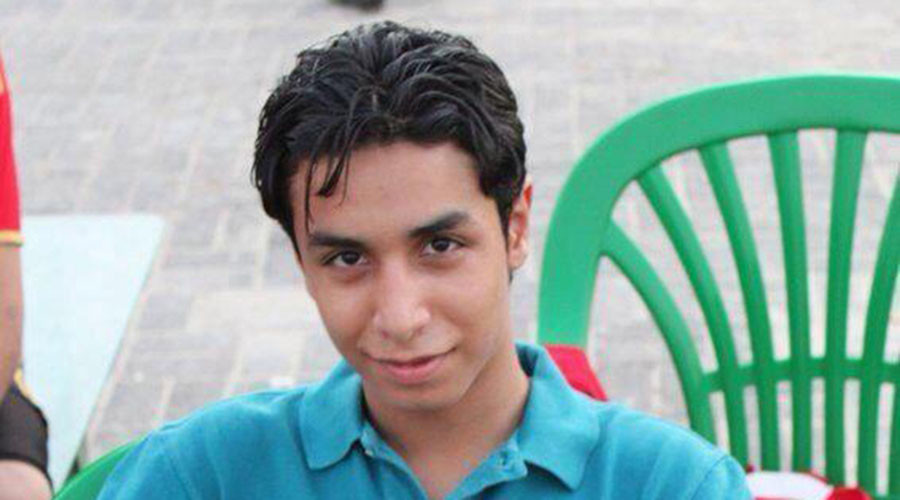
The father of Ali al-Nimr, a Saudi juvenile facing execution for his role in protests, has spoken of his uncertainty and concern about the fate of his son, as it emerged Ali and a second juvenile are now being held in solitary confinement in a prison in Riyadh.
Speaking last night, Mohammed al-Nimr said that the family hadn’t seen their son since 15th September, saying: “I’m very worried now, because they’ve moved my son to a prison in Riyadh, and he’s in solitary confinement – I fear he could be executed at any moment.” He added that Ali was among several other young men sentenced to death in the wake of protests, including Dawoud al-Marhoon, whose sentence of beheading was upheld last week.
Both Ali and Dawoud were 17 when they were arrested in the wake of protests in Saudi Arabia’s Eastern Province. Both received death sentences after being tortured into ‘confessions’ used to convict them in the country’s secretive Specialized Criminal Court. Executions are shrouded in secrecy in Saudi Arabia, and it is possible that both juveniles could now be executed at any time, without prior notification to their families. However, speaking to Al Jazeera this week, Abdallah al-Mouallimi, the Saudi permanent representative to the UN, suggested that Ali’s case was still “being reviewed in legal circles”, ahead of his execution receiving the “personal approval of the King”.
Speaking to Channel 4 last night, Ali’s father Mohammed al-Nimr said that as the UK and Saudi Arabia had a “warm relationship”, he hoped that interventions by the British government would save his son. Prime Minister David Cameron has said the government has raised Ali’s case with the Saudi authorities; however, the Ministry of Justice has faced criticism over its ongoing bid to provide services to the Saudi prison system, which would be responsible for carrying out Ali and Dawoud’s executions.
Concerns over the UK’s position come amid growing calls for firmer interventions from close allies of Saudi Arabia, such as the UK and the US. Yesterday, the European Parliament passed a resolution that called on member states – including the UK – to “deploy all their diplomatic tools and make every effort to immediately stop the execution” of Ali and others arrested at protests.
Commenting, Kate Higham, caseworker at human rights organization Reprieve, said: “Saudi Arabia’s plans to kill Ali and Dawoud are appalling, and have rightly caused an international outcry. Now these two juveniles – who have been through a shocking ordeal of torture and unfair trials – have been disappeared to solitary confinement, far from their families, who have no idea what the next few days could bring. We can only imagine how terrified they must be. Countries like the UK and the US, who count the Saudis among their closest allies, must listen to Ali’s father and urge a halt to these executions. Britain’s Ministry of Justice must also urgently call off its bid to provide services to the Saudi prison service that will carry out these executions.”
Featured Video

HE SAVED LIVES. NOW HE FACES PRISON.
or go to
Aletho News Archives – Video-Images
From the Archives
NATO Sanctions and the Coming Global Diesel Fuel Disaster
By F. William Engdahl – New Eastern Outlook – 11.04.2022
Amid the ongoing global inflation crisis, NATO heads of state and mainstream media repeat a mantra that high energy prices are a direct result of Putin’s actions in Ukraine since end of February. The reality is that it is the western sanctions that are responsible. Those sanctions including cutting SWIFT interbank access for key Russian banks and some of the most severe sanctions ever imposed, are hardly having an impact on the military actions in Ukraine. What many overlook is the fact that they are increasingly impacting the economies of the West, especially the EU and USA. A closer look at the state of the global supply of diesel fuel is alarming. But Western sanctions planners at the US Treasury and the EU know fully well what they are doing. And it bodes ill for the world economy.
While most of us rarely think about diesel fuel as anything other than a pollutant, in fact it is essential to the entire world economy in a way few energy sources are. The director general of Fuels Europe, part of the European Petroleum Refiners Association, stated recently, “… there is a clear link between diesel and GDP, because almost everything that goes into and out of a factory goes using diesel.” … continue
Blog Roll
 Aletho News
- Italy to move military personnel from Taif base after missile strike
- Finland’s Stubb tells European leaders to calm down
- Defeating Russia on battlefield impossible – Fico
- Finland’s Gender Clinic Reversal
- Massachusetts Wants Mental Health Visits, Why Does Government Use ‘Health’ to Enter Our Homes & Families?
- US lawmaker admits American people footing bill for Trump’s failed aggression against Iran
- Pfizer Gave $500,000 to Groups That Lobbied to End Religious Exemption in Massachusetts
- HE SAVED LIVES. NOW HE FACES PRISON.
- Israeli lobby seeks to bind US fate to ‘Israel’: Araghchi
- Pakistan-Iran talks secure LNG shipment to Islamabad through Hormuz
- If Americans Knew
- Israel Blocking Hundreds of Wheelchairs for Injured Children From Entering Gaza
- Israel Is Expanding and Upgrading Compounds for Palestinian Militias in Gaza
- The Palestinian-American Residents of This West Bank Town Are Wondering: Where Is Trump?
- Gaza desperately needs tents, wheelchairs, fuel… and everything else (Israel blocks it all) – Daily Update
- Israeli Attacks in Gaza Kill at Least Seven Palestinians Over Three Days, including Woman and Child
- Trump’s militarization of Washington DC as he pursues Israel’s war against Iran
- Why Israel Fears This Searing New Documentary
- Huckabee aide solicited cash gifts from Israelis
- This isn’t sci-fi, AI is already killing people
- ‘The Most Brutal Thing’: Investigation Reveals Execution of Elderly Woman in Rafah
- No Tricks Zone
- 2025 Nature Paper Claiming Worsening Global Drought Gets RETRACTED …Heavily Flawed
- New Study: ‘Global Drought Shows No Detectable Recent Acceleration Under Climate Warming’
- Economic Masterminds: German Socialists Suggest Taxing Productivity Gains Stemming From Using AI
- The South China Sea Has Not Been Cooperating With The Climate Change Narrative
- Energy Crisis: Germany Enters Heating Season With Historically Low Gas Reserve Fill Levels
- New Study: The Antarctic Ice Sheet Gained Mass From 2020-2024 Due To Staggering Snow And Ice Accumulation
- Study: Ocean Heating Rates From Thousands Of Years Ago ‘Dwarf’ Modern Ocean Heating Rates
- Climate Extremists Target, Attack Large-Scale Power Grid Infrastructure In Germany!
- New Study: Antarctic Ice Melt Has Contributed Less Than 1 Centimeter To Sea Level Rise In The Last 30 Years
- Fear Of Debate: Alarmist German Climate Scientist Calls On Mainstream Media To Discredit Skeptic Voices

