Saudi Navy Set to Order American Littoral Combat Ships
Sputnik – 16.09.2015
Saudi Arabia has selected a variant of a warship Lockheed Martin is building for the US Navy as the frigate for the kingdom’s Eastern Fleet modernization program, a source told Defense News.
The frigates sale will be the cornerstone of the modernization of the Royal Saudi Navy’s eastern fleet and its aging US warships in the Arabian Gulf.
A letter of request from the Saudi Navy that detailed requirements for the program was signed in early August, the source said, and the Saudis have asked the US Navy and Lockheed to complete a letter of agreement by November, Defense News reported.
The deal calls for four frigates capable of hosting Sikorsky MH-60R helicopters.
Saudi and US officials also are finalizing a $1.9 billion deal to buy 10 MH-60R helicopters, which can be used for anti-submarine warfare and other missions. Lockheed is in the process acquiring Sikorsky.
The ships are also expected to be fitted with a vertical launch system that can accommodate surface-to-air missiles.
The entire Eastern Fleet expansion program is expected to cost between $16 billion and $20 billion and also includes patrol boats, three maritime patrol aircraft, and 30 to 50 unmanned aerial vehicles, Defense News reported.
The four large frigates are expected to take up about 20-25% of the total cost. Saudi Arabia earlier this year budgeted $3.5 billion for the program, money that needs to be spent in calendar 2015.
The deal, if finalized, would mark the first international sale of a US littoral combat ship.
The Saudi Navy’s expansion program has been in the works for years, but US sources say Saudi Arabia’s concerns about Iran have accelerated the effort.
In July, world powers and Iran reached a deal aimed at curbing Tehran’s nuclear program in exchange for lifting sanctions. Regional neighbors worry about the threat posed by a financially strong Iran.
Assad Must Go? No, American Arrogance Must Go!
By Andrew Korybko – Sputnik – 15.09.2015
The US’ obsessive insistence that “Assad must go” is the most dangerous expression of American arrogance in years.
White House Press Secretary Joshua Earnest channeled President Obama’s famous chant that “Assad must go” when he claimed during a regular press briefing that:
“The international community has decided that it’s time for Assad to go. He clearly has lost legitimacy to lead. He has lost the confidence of those citizens of his country — at least the ones that — or I guess I should say particularly the ones that he is using the resources of the military to attack.”
The arrogance on display is both stupefying and dangerous. The problem in Syria isn’t, nor ever has been, President Assad – it’s always been the US’ arrogance in dictating demands and then militarily enforcing them after they’ve been rejected.
American Arrogance
Syria’s ills are directly traceable to the failure of American foreign policy in the Mideast. The US rabidly went on a regime change streak that began during the Bush years, with former Supreme Allied Commander of Europe for NATO General Wesley Clark revealing in his 2007 memoirs that a senior general showed him a memo and said:
“‘Here’s the paper from the Office of the Secretary of Defense [then Donald Rumsfeld] outlining the strategy. We’re going to take out seven countries in five years.’ And he named them, starting with Iraq and Syria and ending with Iran.”
Earlier that year, investigative journalist Seymour Hersh wrote an expose in The New Yorker in which he detailed, among other proposed regional regime change specifics, that the Bush Administration was planning to use the Muslim Brotherhood to launch a Gulf-funded sectarian war against the Syrian government.
At the time, the reason was supposedly because of Damascus’ closeness to Tehran, but later information as reported by The Guardian reveals that the decision to build a Friendship Pipeline between Iran, Iraq, and Syria in 2010, and Damascus’ rejection of a similar one from Qatar, likely had a lot to do with why the anti-government terrorist plan was pushed forward for activation the year after.
Beginning in 2011, the Mideast was rocked by the so-called “Arab Spring”, which Russian General Chief of Staff Valery Gerasimov would in hindsight categorize as a theater-wide Color Revolution during an official conference on the topic last year in Moscow.
What the US had wanted to do is overthrow all of the Mideast’s republics (even those allied with the US such a Egypt) in order to bring a transnational Muslim Brotherhood clique to power in each of them that would thus make it a lot easier to control the entire region.
Think of it as the neocons’ version of a 21st-century communist party, but directed towards control of the Mideast and not Europe (which has the EU for that).
The Gulf Monarchies were not targeted because of their staunch pro-American allegiance and the potential that any domestic disruption would have in upsetting the US’ economic interests there.
Between the pro-American Gulf Monarchies and the pro-American EU thus lay a handful of republics that weren’t so firmly under the US’ sway (or not at all influenced by it like Syria), so in order for the US to securely control the broad swatch of Afro-Eurasia stretching from Iceland to Yemen, it needed to overthrow those governments, ergo the “Arab Spring” Color Revolutions.
The People’s Will
But something went wrong as it always does with the US’ plans, and it was that the Syrian people wholeheartedly rejected the Muslim Brotherhood’s ploy at regime change, instead favoring to preserve the secular and multicultural society that Syrian civilization is historically known for.
For this simple reason, the Color Revolution attempt was a dismal failure from the very beginning, hence why the US and its allies (notably Turkey, Qatar, and Saudi Arabia) sought to transform it into an Unconventional War by arming their proxies and ordering them to escalate their soft coup attempt into a hard one.
The resultant Hybrid War that’s been raging for the past four and a half years is thus a manifestation of the US’ geopolitical obsession for regime change. Far from realizing that the people had resoundingly rejected such an approach from the very beginning, the US and its allies dug in by reinforcing their proxy elements inside the country and allowing foreign fighters to flood into Syria via the Turkish border.
Amidst this external onslaught being launched against them, the Syrian people continued to bravely soldier on and democratically show the rest of the world that they supported their government.
A constitutional referendum in 2012 passed by an 89% margin and with the participation of 57% of the population, while President Assad was reelected in 2014 with 88.7% of the vote in which 73% of the electorate took part.
Both sets of numbers trump the civil society participation and political legitimacy of Western countries and their leaders, and as President Assad once said, there is no way he could remain in office during this war if he didn’t truly have the support of the vast majority of the population.
It’s also telling that most of the country’s refugees haven’t fled the country, but have instead decided to stay in their homeland and seek safety under the protection of the Syrian Arab Army, which currently provides security to around 80% of Syria’s citizens.
Be that as it is, the US and its allies stubbornly ignored the people’s will, and instead continued to blindly pump weapons and fighters into the country in clear confirmation of the adage that insanity is “repeating the same thing over again but expecting different results”.
Ground Zero In The War On Terror
All of those fighters and weapons that the US and its allies were shipping into Syria were bound to lead to some major problems, chief among them the rise of ISIL, but this was actually predicted and supported by the US government a couple years ago. Judicial Watch published a declassified report that it received in May from a Freedom Of Information Act request that proves that the Pentagon’s Defense Information Agency thought that:
“If the situation unravels there is the possibility of establishing a declared or undeclared Salafist principality in Eastern Syria (Hasaka and Der Zor), and this is exactly what the supporting powers to the opposition want, in order to isolate the Syrian regime, which is considered the strategic depth of the Shia expansion (Iraq and Iran).”
This bombshell dovetails with what Syrian Ambassador to Russia Riyad Haddad recently said in an interview where he accused the US of using terrorism to promote regime change in his country. President Putin followed up at the CSTO summit by warning countries of the risks inherent in employing double-standards towards terrorists and directly or indirectly using them to further certain tactical objectives.
In order to stem the tide of terror that the US unleashed in the Mideast, Russia is rapidly moving forward with assembling an inclusive anti-ISIL coalition, and President Putin is expected to use his keynote speech at the UN General Assembly later this month to make his case that the situation is far too pressing to care about regime change, and that the world must unite in supporting Syria as it fights on its behalf on the frontlines against terror.
American arrogance got the world into this mess, but if you ask Russia, it’ll be Syrian humility that gets it out in one piece.
Read more:
EU Migrant Crisis: Coincidence or Plot Aimed at Starting Military Operation in Syria?
Bernie Sanders Again Insists That Saudi Arabia Should Kill More People
By David Swanson | War Is A Crime | September 14, 2015
Senator Bernie Sanders taped a PBS show at the University of Virginia on Monday. I had corresponded with the host Doug Blackmon beforehand, and offered him ideas for questions on military spending and war, questions like these:
1. People want to tax the rich and cut military spending, which is 54% of federal discretionary spending according to National Priorities Project, but you only ever mention taxing the rich. Why not do both? What — give or take $100 billion — is an appropriate level of military spending?
2. Do you agree with Eisenhower that military spending creates wars?
3. Can you possibly be serious about wanting to keep the wars going but have Saudi Arabia play a bigger role? Do you approve of Saudi Arabia dropping U.S. cluster bombs on Yemen?
4. Would you approve of John Kerry promising Israel $45 billion of free weapons over the next decade?
5. Jeremy Corbyn was just elected leader of the Labour Party. He wants to pull out of NATO. Do you? He wants to unilaterally disarm of nuclear weapons? Do you? He wants to end drone murders and wars. Do you? Are you both socialists?
Blackmon at the very end asked Sanders to say something about foreign policy. Sanders replied with the 2002 Iraq vote. Then Blackmon mentioned Saudi Arabia, including its slaughter in Yemen, but rambled on until it became an unrelated softball. Sanders nonetheless brought it back to Saudi Arabia and insisted that Saudi Arabia should “get their hands dirty” and take a much bigger role in a war against ISIS and generally lead the wars with U.S. support.
Who has dirtier hands than Saudi Arabia? Is this some kind of a sick joke?
After the taping of the show, a member of the audience asked “But how will you pay for it?” What the “it” was went unstated, but presumably it wasn’t the military which is considered cost-free in such discussions. Sanders answered with progressive taxation. No mention of the military.
Later in the audience Q&A, Sanders brought up Eisenhower without mentioning the military.
Here are tips for future interviewers of Bernie Sanders:
As you know, Bernie Sanders focuses on money issues, taxing the rich, spending on the poor, but has thus far been permitted to engage in the general practice of speaking only about the 46% of federal discretionary spending that it not military.
Nobody has asked him about the 54% that by the calculation of National Priorities Project is military. Nobody has asked him if Eisenhower was right that military spending produces wars. Here are 25,000 people who want to know whether and how much Sanders would want to cut military spending.
He’s silent on the public support for two, not one, great sources of revenue: taxing the rich (which he’s all over) and cutting the military (which he avoids).
When he is asked about wars and says Saudi Arabia should pay for and lead them, nobody has followed up by asking whether the wars are themselves good or not or how the theocratic murderous regime in Saudi Arabia which openly seeks to overthrow other governments and is dropping US cluster bombs on Yemen will transform the wars into forces for good. Since when is THAT “socialism”?
If you go to Bernie’s website and click on ISSUES and search for foreign policy it’s just not there. He recently added the Iran agreement, after the fact, in which statement he says that war should “always be on the table” even though the U.N. Charter ban on threatening war makes no exception for candidate websites.
If Senator Sanders were to add anything about war in general to his website, judging by his standard response when asked, it would be this:
The military wastes money and its contractors routinely engage in fraud. The Department of Defense should be audited. Some weapons that I won’t name should be eliminated. Some cuts that I won’t even vaguely estimate should be made. All the wars in the Middle East should continue, but Saudi Arabia should lead the way with the U.S. assisting, because Saudi Arabia has plenty of weapons — and if Saudi Arabia has murdered lots of its own citizens and countless little babies in Yemen and has the goal of overthrowing a number of governments and slaughtering people of the wrong sect and dominating the area for the ideology of its fanatical dictatorial regime, who cares, better that than the U.S. funding all the wars, and the idea of actually ending any wars should be effectively brushed aside by changing the subject to how unfair it is for Saudi Arabia not to carry more of the militarized man’s burden. Oh, and veterans, U.S. veterans, are owed the deepest gratitude imaginable for the generous and beneficial service they have performed by killing so many people in the wars I’ve voted against and the ones I’ve voted for alike.
He’s silent on how much he’d cut the military, even within a range of $100 billion. He’s silent on alternatives to war. He’s usually silent on U.S. subservience to Israel. (Does he favor $45 billion in more free weapons for Israel paid for by the U.S. public whom he usually wants to spare lesser expenses than that?)
Jeremy Corbyn just won leadership of the Labour Party in England by promoting socialism at home and actively opposing wars and seeking peace. What is Bernie afraid of?
Fears that Saudi Arabia is set to ‘crucify’ juvenile prisoner
Reprieve – September 15, 2015
Saudi Arabia has dismissed the final appeal of a prisoner sentenced to death as a child, leading to fears his execution could take place in a matter of days.
Ali Mohammed al-Nimr was arrested when he was 17 and initially held at a juvenile offenders facility. There is evidence that he was tortured and forced to sign a document amounting to a confession, which then formed the basis of the case against him.
Last week, his family found out that his final appeal had been heard in secret, without Ali’s knowledge, and dismissed. This means that there are now no remaining legal hurdles before he faces his sentence of ‘death by crucifixion,’ originally handed down on 27 May 2014.
Ali was arrested on 14 February 2012 in the wake of anti-Government protests, and has been accused by the authorities of participation in an illegal demonstration and firearms offences – no evidence has been produced for the latter charge, which he and his family strongly deny. The opaque nature of the Specialised Criminal Court (SCC) through which Ali was convicted makes it hard to determine the detail of the charges against him.
The Government appears to have rested its case against him in large part on his relation to Sheikh Nimr al-Nimr, a prominent religious leader in the Kingdom and human rights activist.
The Saudi Government has been widely criticised for its heavy-handed response against protesters and human rights activists since Arab Spring demonstrations began – including a death sentence for Sheikh Nimr. Ali is one of a number of people – thought to possibly include other juveniles – who has been sentenced to death following involvement in those protests. In January 2015, prominent Saudi blogger Raif Al-Badawi received the first of 1,000 lashes as part of his sentence for his statements critical of the Saudi regime in 2012.
The Saudi Government has carried out executions at a high rate since the coming to power of King Salman in January 2015, surpassing 100 for the year so far.
Commenting, Maya Foa, Director of the death penalty team at legal charity Reprieve said: “No one should have to go through the ordeal Ali has suffered – torture, forced ‘confession,’ and an unfair, secret trial process, resulting in a sentence of death by ‘crucifixion.’ But worse still, Ali was a vulnerable child when he was arrested and this ordeal began. His execution – based apparently on the authorities’ dislike for his uncle, and his involvement in anti-government protests – would violate international law and the most basic standards of decency. It must be stopped.”
Britain fueling war in Yemen, breaking international law – Oxfam UK
RT | September 11, 2015
The conflict in Yemen has been exacerbated by the UK government’s arms deals with Saudi Arabia, causing a terrible humanitarian catastrophe and potentially placing the government in breach of international law, Oxfam UK has said.
The ongoing war has seen Saudi Arabia, backed by US and UK arms, carry out airstrikes on Houthi rebels attempting to take control of Yemen.
International law states that arms deals should be prohibited if there is a risk they could be used to commit war crimes or human rights abuses, the charity said, adding the UK’s response to the conflict has been a “paradox.”
The British government insists is has not been directly involved in the bombings, but Oxfam says the UK has been replenishing Saudi weapons since the conflict began. Simultaneously, it has been donating money from the Department of International Development to aid the millions of civilians caught up in Saudi bombing raids, which have targeted factories, warehouses and markets.
Oxfam Chief Executive Mark Goldring called the conflict a “humanitarian disaster.”
“Yemen has descended into a humanitarian disaster putting its people at risk of famine and the UK is materially involved through its export of arms and military support to the bombing campaign. An estimated eight children a day are killed or injured in Yemen’s conflict. The ongoing conflict in Syria and the refugee crisis it has produced show why it is so vitally important to search for political solutions before it is too late. It is time the government stopped supporting this war and put every possible effort into bringing an end to the carnage.
“There is a paradox at the heart of the government’s approach to Yemen. On the one hand the Department for International Development is funding efforts to help civilians caught up in the conflict, while on the other the government is fueling the conflict that is causing unbearable human suffering,” he said.
“The UK successfully lobbied hard over many years for a UN Arms Trade Treaty to regulate the arms trade which came into being last year. This government has incorporated the treaty into national law, yet at the first test of the new law it has turned a blind eye to mounting evidence of potential misuse of its weapons and support.”
The charity is calling for a suspension of arms trading with Saudi Arabia and a full investigation into the legal implications of its trade with the country, as well as a push for more humanitarian aid.
Its plea comes after an investigation into the conflict by BBC’s Newsnight revealed the plight of civilians in Yemen, many of whom have been forced to flee their homes.
The report showed one target of a Saudi airstrike believed to have been a training camp and arms factory. In actual fact the target was a water-bottling plant. The airstrike killed many workers, some as young as 13.
Saudi airstrikes in Yemen kill 22 Indian fishermen
Press TV – September 8, 2015
At least 10 people have been killed in a fresh wave of Saudi attacks on the Yemeni capital of Sana’a while nearly two dozen Indian fisherman were killed in air strikes in the west of the impoverished country.
The latest airstrikes on Tuesday targeted several areas in Sana’a, including a police academy and the security services headquarters.
Witnesses said many people were wounded during the attacks, most of them by flying glass when the blasts shattered windows.
An earlier attack hit several houses in the capital, including those of the senior members of the Houthi Ansarullah movement, leaving at least two children dead and three women injured.
Yemen’s Saba news agency, which is under the control of Ansarullah, put the death toll from the Tuesday attacks at 15, saying at least 77 were injured in the raids.
Elsewhere in western Yemen, at least five people were killed and 10 others injured when Saudi warplanes targeted trucks carrying fuel and foodstuff in the port city of Mukha in Ta’izz Province.
Reports said that nearly a dozen people were also killed and some 40 others injured in similar airstrikes on the southwestern province of Ibb.
Yemen’s al-Masirah TV said Saudi warplanes targeted a vessel carrying Indian fishermen off the coast of al-Khukhah in Yemen’s western province of Hudaydah, killing nearly 22 people onboard.
The attacks on Yemen, which are now well in their sixth month, have seen a dramatic rise since September 4, when Ansarullah forces and allies managed to kill dozens of troops fighting for the so-called Saudi-led coalition against Yemen.
Yemenis continued retaliatory attacks with the army and people’s committees firing a barrage of rockets at the Saudi border guard headquarters in Dhahran al-Janub.
A report by al-Masirah said Yemeni forces shelled the positions of Saudi forces inside the kingdom with the latest of them inflicting losses on a police command in the Khobah district of the southern province of Jizan.
Saudi Arabia started its brutal air campaign against Yemen on March 26 in a bid to block the advance of Ansarullah across Yemen and restore power to the fugitive former President Abd Rabbuh Mansour Hadi, a close ally of Riyadh.
According to Yemeni sources, more than five thousand people have been killed in the attacks over the past few months, while more than a million have been displaced.
White House: Russian Military Action Against ISIS in Syria Would be ‘Destabilizing’
By Daniel McAdams | Ron Paul Institute | September 4, 2015
Today’s lesson in how propaganda works: The rumor mill turns a trickle of a story early this week about “thousands” of Russian soldiers deploying to Syria any day — a wholly unsourced story originating on an Israeli website — into a torrent of hyperventilating about the “Russian invasion” of Syria.
Today neocon convicted felon Eliot Abrams took to the Council on Foreign Relations website to amplify the Israeli article (again with no sources or evidence) to a whole new and more dramatic article ominously titled “Putin in Syria.” Abrams adds “reporting” by Michael Weiss, who has long been on the payroll of viscerally anti-Putin oligarch Michael Khodorkovsky, without revealing the obvious bias in the source. Never mind, all Weiss adds to Abrams’ argument is that the Pentagon is “cagey” about discussing Russian involvement in Syria before again referencing the original (unsourced) Israeli article.
See how this works? Multiple media outlets report based on the same totally unsourced article and suddenly all the world’s writing about the Russian invasion of Syria.
Now the White House has gotten into the game. According to an article by Agence France Press, the White House is “monitoring reports” that the Russians are active in Syria.
What reports? The article does not say nor does the White House. Presumably the White House is referring back to the original (unsourced) Israeli article.
But in the category of never let a good “crisis” go to waste, the White House, which began bombing Syria last August in violation of both international and US law, has declared that any Russian involvement in the Syria crisis would be “destabilizing and counterproductive.”
Apparently a year of US bombs is not “destabilizing.”
This is where the hypocrisy is so thick you could cut it with a knife. The US is illegally bombing Syria, illegally violating Syrian sovereignty, illegally training and equipping foreign fighters to overthrow the Syrian government, and has backed radical jihadists through covert and overt programs.
ISIS and al-Qaeda in Syria were solely the products of the 2003 US invasion of Iraq under false pretenses — the lies of the neocons — and after a year of US bombing ISIS seems as strong as ever while scores of civilians are killed by US attacks.
All of this is perfectly fine and should never be questioned. But even the hint that the Russians, who have had to contend with their fair share of radical Islam and are much closer to Syria than the US, may have an interest in joining the fight against ISIS is met with hysterical reproaches by a White House that admits it has no evidence.
What is the White House afraid of? While the stated goal of the Obama Administration is to defeat ISIS, the real, long-term goal is to overthrow Assad. The Russians disagree with the US insistence that Assad’s departure must be the starting point of any political settlement of the crisis. The Russians have long ago come to understand that Assad may be key to saving Syria from the kind of jihadist chaos that has engulfed Libya after its “liberation” by the US and its allies.
That is why the US government is flirting with the (unsourced Israeli) rumors of a massive Russian invasion of Syria. Regurgitated cries that the Russians are coming may serve to divert attention from another failed US intervention in the region.
One might think that if the US was serious about defeating ISIS it would welcome involvement from Russia and Iran, both of which would like nothing more than to see the back of the Islamic State. One might think if the US was serious about defeating ISIS it would rethink its “Assad must go” policy and allow the one force that has the most incentive to defeat ISIS — the Syrian Arab Army.
Yet the US will only work with the same states that have trained, funded, and turned a blind eye to the radical Islamic fighters as they have poured into Syria over the past four years — Saudi Arabia, Qatar, Turkey, etc.
Conspiracy-minded people must be wondering why the US is so reluctant to accept assistance from forces that so earnestly and with such military capacity seek the end of ISIS while partnering with those forces that have done so much to create ISIS.
Despite Human Toll, US to Supply More Weapons to Saudis
Sputnik – 05.09.2015
Turbulence in the Middle East presents an obvious challenge for the Obama Administration, seeking to satisfy all major players in a series of convoluted games. Washington continues to supply weapons to “crucial ally” Saudi Arabia, where coalition airstrikes on Yemen kill innocent people and humanitarian aid is blocked from entry.
President Obama and Saudi King Salman met Friday in the Oval Office. The details of their chat remain undisclosed, though various sources earlier hinted arms supplies would be on the table for discussion.
Among possible candidates are Boeing’s GPS-guided Joint Direct Attack Munitions, according to Bloomberg. Approved for use in the Royal Saudi Air Force’s F-15s back in 2008, it’s likely they have been used for the bombardment of Yemen this year, which has reportedly claimed the lives of dozens of civilians. There are also numerous reports of the use of internationally banned cluster munition in the airstrikes, which began in March.
Reuters reported Wednesday a deal had nearly been reached for two frigates worth over $1 billion to the Saudis by Lockheed Martin Corp. The US recently approved a possible $5.4 billion sale of advanced Patriot missiles to Riyadh, the US Defense Security Cooperation Agency (DSCA) said in a statement in July, the same month US defense contractor Raytheon was awarded a $180 million contract to provide Saudi Arabia with guided air-to-ground missiles.
Defense buildup in Saudi Arabia, which became the world’s top arms importer this year, has considerably benefited several American weapons manufacturers. And the US relies on defense contractors to fill the void created by Pentagon budget constraints, as former US Assistant Secretary of Defense Lawrence Korb told Sputnik, adding that the Saudis have increased orders for US missile defense systems out of fear that Iran will grow stronger militarily after nuclear sanctions are lifted.
Ahead of today’s meeting with King Salman, Barack Obama announced they planned to discuss Iran, Syria, the self-proclaimed Islamic State terror group, the global economy and energy issues, among others.
“I look forward to continuing to deepen our cooperation on issues like education and clean energy and science and climate change because His Majesty is interested, obviously, ultimately in making sure that his people, particularly young people, have prosperity and opportunity into the future,” Obama said. “And we share those hopes and those dreams for those young people, and I look forward to hearing his ideas on how we can be helpful.”
No mention of any arms sales.
As western countries profit from the sales of advanced weapons systems to Riyadh — including American and British warships to maintain a blockade on humanitarian aid to Yemen — they turn a blind eye to what many call Saudi war crimes and the obvious violation of human rights under Saudi leadership at home.
“The entire affair is a blatant breach of international law, and an assault on authentic democracy and self-determination,” Canadian writer and activist Stephen Gowans noted earlier this month.
On Monday, Amnesty International accused the Saudi-led, US-backed coalition of using internationally banned weapons in Yemen in a report that also lambasted the US for supplying the coalition with intelligence and material support, and the disastrous consequences for local populations the war perpetrates.
Why Don’t Gulf Arab ‘Friends of Syria’ Take in Any Refugees?
Sputnik – 05.09.2015
As refugees from Syria stream into Europe, the Gulf Arab financial and diplomatic sponsors of Syria’s rebel groups have taken in zero refugees from the conflict.
Friends of Syria was a group of countries including Saudi Arabia, Qatar and the United Arab Emirates, which united to provide diplomatic and often financial support to facilitate “regime change” in Syria in 2012.
The group’s Arab country members have since then rejected refugees leaving the country as a result of its civil war and resulting massive humanitarian crisis. The same countries have also sponsored rebel organizations in Syria, often supporting them with financial and logistical aid.
At the same time, the Gulf Arab states largely rely on migrant labor for everyday work, something that could provide Syrian refugees with the opportunity to provide for themselves in a temporary new home.
Refugees Not Welcome
According to the BBC, in addition to having complex visa rules and not participating in conventions on refugees, the countries rely largely on migrant workers from Southeast Asia.
To make matters worse, Saudi Arabia has been deporting migrant workers, particularly those from neighboring Arab countries such as Yemen. According Human Rights Watch, the country deported an average of 2,000 migrants per day between November 2014 and March 2015.
In addition, Saudi Arabia’s kafala system only allows migrants to enter the country with sponsorship from their employment.
Planned Catastrophe
The Gulf countries also foresaw the refugee crisis after Syria’s conflict began in 2011, according to Alexander Sotnichenko, dean of the international relations department at Saint Petersburg State University.
“The Gulf countries foresaw the humanitarian catastrophe as a result of the civil war in Syria and in 2011 financed the construction and maintenance of large camps in Turkey and Jordan,” Sotnichenko wrote.
According to Sotnichenko, most refugees from Syria went to Turkey because of the country’s announcement that it is prepared to accept refugees. This allowed the Gulf countries to largely deflect the stream of refugees from Syria’s conflict, which they had taken part in sponsoring.
“From Turkey it is even more difficult to get to Gulf countries [than from Syria], while Europe is much closer,” Sotnichenko added.
As a result, refugees are able to get to Europe illegally from Turkey, while entering Gulf countries is much more difficult, according to Sotnichenko. In addition, Syrian refugees in Saudi Arabia’s neighbor Jordan are detained and sent to refugee camps.
Missing From Reports of Yemeni Carnage: Washington’s Responsibility
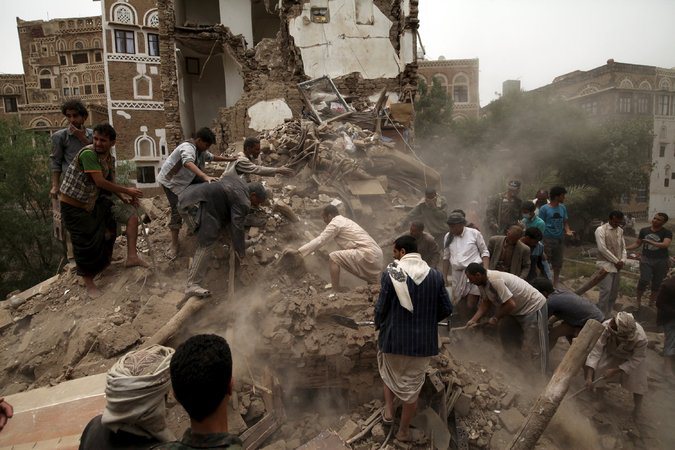
This photo of the aftermath of an airstrike in Sana, Yemen, accompanied a New York Times story (6/24/15) that provided a detailed account of the human toll of the air war—but made no mention of the US’s responsibility. (photo: Mohamed Al-Sayaghi/Reuters)
By Jim Naureckas | FAIR | August 31, 2015
The New York Times (8/30/15) reported on the deaths of civilians in a military assault in Yemen. Wrote reporter Saeed Al-Batati:
Airstrikes by a Saudi-led military coalition killed at least 13 civilians working early Sunday at a water plant in northern Yemen, the plant’s owner said.
The bombings appeared to be the latest in a series of airstrikes by Saudi Arabia or its Arab coalition partners that have hit civilian facilities with no apparent military target nearby.
The Washington Post (8/30/15) briefly covered the story too, using a Reuters wire report that gave a higher death toll:
An airstrike by warplanes from a Saudi-led coalition, which said it targeted a bomb-making factory, killed 36 civilians working Sunday at a bottling plant in the northern Yemeni province of Hajjah, residents said.
Noting that another airstrike had killed four people in Sanaa, Yemen’s capital, the piece continued:
The attacks were the latest in an air campaign launched in March by a Saudi-led alliance in support of Yemen’s exiled government, which is fighting Houthi forces allied with Iran.
Both of these reports left out the information that made this news particularly relevant to the papers’ mostly American readership: The US government is actively backing the air war in Yemen that killed those civilians, as the Times and Post have both reported. The Times (3/26/15) wrote at the start of the Saudi assault:
A spokeswoman for the National Security Council said Wednesday night that the United States was providing intelligence and logistical support for the campaign in Yemen, and that President Obama had authorized a ”joint planning cell” with Saudi Arabia to coordinate American support for the military offensive.

The Washington Post provided a photo of the kind of jets the US had sold to Saudi Arabia—but when such jets were used to kill civilians, they were out of the picture. (photo: Fayez Nureldine/AFP)
And the Post, in a piece headlined “How US Weapons Will Play a Huge Role in Saudi Arabia’s War in Yemen” (3/26/15), noted that the weaponry involved largely comes from the US:
US officials said they will offer intelligence and logistical support to the Saudis, but that’s really only a piece of it: The Saudi military is equipped with billions of dollars in advanced American-made weapons.
But that “huge role” often disappears when the the leading papers are discussing the carnage that results from the air attacks that the US is supporting and supplying. Thus when the Times‘ Rick Gladstone (8/22/15) reported that “Saudi-led airstrikes on a residential district in Yemen’s southwestern city of Taiz had killed more than 65 civilians, including 17 people from one family,” according to Doctors Without Borders, and that the death toll in the war included “hundreds of civilians killed in airstrikes,” Washington’s role in facilitating those deaths went unmentioned.
Featured Video

HE SAVED LIVES. NOW HE FACES PRISON.
or go to
Aletho News Archives – Video-Images
From the Archives
NATO Sanctions and the Coming Global Diesel Fuel Disaster
By F. William Engdahl – New Eastern Outlook – 11.04.2022
Amid the ongoing global inflation crisis, NATO heads of state and mainstream media repeat a mantra that high energy prices are a direct result of Putin’s actions in Ukraine since end of February. The reality is that it is the western sanctions that are responsible. Those sanctions including cutting SWIFT interbank access for key Russian banks and some of the most severe sanctions ever imposed, are hardly having an impact on the military actions in Ukraine. What many overlook is the fact that they are increasingly impacting the economies of the West, especially the EU and USA. A closer look at the state of the global supply of diesel fuel is alarming. But Western sanctions planners at the US Treasury and the EU know fully well what they are doing. And it bodes ill for the world economy.
While most of us rarely think about diesel fuel as anything other than a pollutant, in fact it is essential to the entire world economy in a way few energy sources are. The director general of Fuels Europe, part of the European Petroleum Refiners Association, stated recently, “… there is a clear link between diesel and GDP, because almost everything that goes into and out of a factory goes using diesel.” … continue
Blog Roll
 Aletho News
- Italy to move military personnel from Taif base after missile strike
- Finland’s Stubb tells European leaders to calm down
- Defeating Russia on battlefield impossible – Fico
- Finland’s Gender Clinic Reversal
- Massachusetts Wants Mental Health Visits, Why Does Government Use ‘Health’ to Enter Our Homes & Families?
- US lawmaker admits American people footing bill for Trump’s failed aggression against Iran
- Pfizer Gave $500,000 to Groups That Lobbied to End Religious Exemption in Massachusetts
- HE SAVED LIVES. NOW HE FACES PRISON.
- Israeli lobby seeks to bind US fate to ‘Israel’: Araghchi
- Pakistan-Iran talks secure LNG shipment to Islamabad through Hormuz
- If Americans Knew
- Phosphorus Munitions Fired by Israel Burn Groves, Orchards in Southern Lebanon
- Israel Carries Out New Ceasefire Violations Across Gaza
- AI – Emphasis on the ‘I’: Israel Is Funding AI Chatbot Propaganda
- Israel Blocking Hundreds of Wheelchairs for Injured Children From Entering Gaza
- Israel Is Expanding and Upgrading Compounds for Palestinian Militias in Gaza
- The Palestinian-American Residents of This West Bank Town Are Wondering: Where Is Trump?
- Gaza desperately needs tents, wheelchairs, fuel… and everything else (Israel blocks it all) – Daily Update
- Israeli Attacks in Gaza Kill at Least Seven Palestinians Over Three Days, including Woman and Child
- Trump’s militarization of Washington DC as he pursues Israel’s war against Iran
- Why Israel Fears This Searing New Documentary
- No Tricks Zone
- 2025 Nature Paper Claiming Worsening Global Drought Gets RETRACTED …Heavily Flawed
- New Study: ‘Global Drought Shows No Detectable Recent Acceleration Under Climate Warming’
- Economic Masterminds: German Socialists Suggest Taxing Productivity Gains Stemming From Using AI
- The South China Sea Has Not Been Cooperating With The Climate Change Narrative
- Energy Crisis: Germany Enters Heating Season With Historically Low Gas Reserve Fill Levels
- New Study: The Antarctic Ice Sheet Gained Mass From 2020-2024 Due To Staggering Snow And Ice Accumulation
- Study: Ocean Heating Rates From Thousands Of Years Ago ‘Dwarf’ Modern Ocean Heating Rates
- Climate Extremists Target, Attack Large-Scale Power Grid Infrastructure In Germany!
- New Study: Antarctic Ice Melt Has Contributed Less Than 1 Centimeter To Sea Level Rise In The Last 30 Years
- Fear Of Debate: Alarmist German Climate Scientist Calls On Mainstream Media To Discredit Skeptic Voices

