How Media Distorted Syrian Ceasefire’s Breakdown
By Gareth Porter | FAIR | August 11, 2016
Coverage of the breakdown of the partial ceasefire in Syria illustrated the main way corporate news media distort public understanding of a major foreign policy story. The problem is not that the key events in the story are entirely unreported, but that they were downplayed and quickly forgotten in the media’s embrace of themes with which they were more comfortable.
In this case, the one key event was the major offensive launched in early April by Al Nusra Front — the Al Qaeda franchise in Syria — alongside U.S.-backed armed opposition groups. This offensive was mentioned in at least two “quality” U.S. newspapers. Their readers, however, would not have read that it was that offensive that broke the back of the partial ceasefire.
On the contrary, they would have gotten the clear impression from following the major newspapers’ coverage that systematic violations by the Assad government doomed the ceasefire from the beginning.
Corporate media heralded the ceasefire agreement when it was negotiated by the United States and Russia in February, with the Los Angeles Times (2/3/16) calling it “the most determined diplomatic push to date aimed at ending the nation’s almost five-year conflict.” The “partial cessation of hostilities” was to apply between the Syrian regime and the non-jihadist forces, but not to the regime’s war with Nusra and with ISIS.
The clear implication was that the U.S.-supported non-jihadist opposition forces would have to separate themselves from Nusra, or else they would be legitimate targets for airstrikes.
But the relationship between the CIA-backed armed opposition to Assad and the jihadist Nusra Front was an issue that major U.S. newspapers had already found very difficult to cover (FAIR.org, 3/21/16).
U.S. Syria policy has been dependent on the military potential of the Nusra Front (and its close ally, Ahrar al Sham) for leverage on the Syrian regime, since the “moderate” opposition was unable to operate in northwest Syria without jihadist support. This central element in U.S. Syria policy, which both the government and the media were unwilling to acknowledge, was a central obstacle to accurate coverage of what happened to the Syrian ceasefire.
Shaping the Story
This problem began shaping the story as soon as the ceasefire agreement was announced. On Feb. 23, New York Times correspondent Neil MacFarquhar wrote a news analysis on the wider tensions between the Obama administration and Russia that pointed to “a gaping loophole” in the Syria ceasefire agreement: the fact that “it permits attacks against the Islamic State and the Nusra Front, an Al Qaeda affiliate, to continue.”
MacFarquhar asserted that exempting Nusra from the ceasefire “could work in Moscow’s favor, since many of the anti-Assad groups aligned with the United States fight alongside the Nusra Front.” That meant that Russia could “continue to strike United States-backed rebel groups without fear … of Washington’s doing anything to stop them,” he wrote.
On the same day, Adam Entous of the Wall Street Journal reported that Obama’s “top military and intelligence advisers don’t believe Russia will abide by a just-announced ceasefire in Syria and want to ready plans to increase pressure on Moscow by expanding covert support to rebels fighting the Russia-backed Assad regime.”
For two of the country’s most prominent newspapers, it was thus clear that the primary context of the Syria ceasefire was not its impact on Syria’s population, but how it affected the rivalry between powerful national security officials and Russia.
Contrary to those dark suspicions of Russian intentions to take advantage of the agreement to hit U.S.-supported Syrian opposition groups, however, as soon as the partial ceasefire agreement took effect on Feb. 27, Russia released a map that designated “green zones” where its air forces would not strike.
The green zones, according to the Russian Ministry of Defense, corresponded with Syrian opposition groups that had signed on to the ceasefire. Furthermore, Russia stopped bombing the Nusra-controlled areas of northwest Syria, instead focusing on ISIS targets, as Pentagon spokesperson Jeff Davis confirmed on March 14.
Breaking the Ceasefire
But instead of separating themselves from Nusra Front, the U.S.-supported armed opposition joined with Nusra and its jihadist allies in a major offensive aimed at destroying the ceasefire.
Charles Lister, a leading British specialist on the jihadists in Syria, has recounted being told by the commander of a U.S.-backed armed group that around March 20, Nusra officials began a round of meetings with non-jihadist opposition groups from Hama, Latakia and southern Aleppo — including those supported by the United States — to persuade them to participate in a major offensive against the Assad regime, rather than in a ceasefire and political negotiations.
News media did not ignore the offensive launched on April 3 by Nusra Front and its “moderate” allies. The Los Angeles Times (4/4/16) described a “punishing attack” by Nusra and several “so-called moderate rebel factions” on the town of Al Eis, southwest of Aleppo, “overlooking the M5 highway, a vital artery connecting the Syrian capital, Damascus, in the southwest of the country, with the government-held city of Homs, in west-central Syria, and Aleppo in the north.”
Associated Press (4/3/16) reported that Nusra Front’s closest ally, Ahrar al Sham, together with U.S.-supported factions had simultaneously “seized government positions in heavy fighting in northwestern Latakia province.” The story quoted Zakariya Qaytaz of the U.S.-supported Division 13 brigade as telling the agency through Twitter: “The truce is considered over. This battle is a notice to the regime.”
The Nusra-led offensive was a decisive violation of the ceasefire, which effectively frustrated the intention of isolating the jihadists. It led to continued high levels of fighting in the three areas where it had taken place, and Russian planes returned to Nusra Front-controlled territory for the first time in nearly six weeks. Yet after the first reports on the offensive, its very existence vanished from media coverage of Syria.
Disappearing Key Facts
No U.S. newspaper followed up over the next two weeks to analyze its significance in terms of U.S. policy, especially in light of the role of “legitimate” armed opposition groups in trashing the ceasefire.
Wall Street Journal correspondent Sam Dagher (4/4/16) suggested in his initial report on the offensive that it was a response to a Syrian air force airstrike in an opposition-controlled suburb of Damascus two days earlier, which activists said killed 30 civilians. But the offensive was so complex and well-organized that it had obviously been prepared well in advance of that strike.
None of the other papers sought to portray the offensive as the result of a pattern of increasing military pressure on the Nusra Front or its allies. In fact, after the initial reports, all four major newspapers — the New York Times, LA Times, Wall Street Journal and Washington Post — simply ignored the fact that the offensive had been carried out.
On April 19, three separate articles presented three variants of what became the broad media approach to explaining the fate of the ceasefire agreement. The Journal’s Nour Malas and Sam Dagher wrote: “A limited truce in Syria, brokered by the US and Russia in late February, has unraveled in recent weeks, with government forces escalating attacks on several fronts and rebels relaunching operations around the northern city of Aleppo.”
That formulation clearly suggested that either the regime had moved first, or that government and rebels had somehow both taken the offensive at the same moment; the former interpretation was encouraged by the headline, “Syrian Government Steps Up Airstrikes.”
On the same day, New York Times Beirut correspondent Anne Barnard wrote a piece focused mainly on regime airstrikes in two Idlib towns, Maarat al Numan and Kafr Nable, that had killed many as 40 civilians.
Barnard’s piece was headlined, “Ceasefire Crumbles as Bombings Kill Dozens” — suggesting that the airstrikes had somehow led to the “crumbling.” Barnard did refer to an otherwise unidentified “insurgent offensive” that preceded the strikes, but did not draw any causal relationship between it and the bombing.
The article cited the opposition claim that the government had repeatedly violated the partial ceasefire, but didn’t cite a single concrete instance of such a violation. And it appears to contradict that argument by observing that the Idlib airstrikes had ended “the relative respite from airstrikes that had lasted nearly two months” – i.e., from the time the ceasefire had gone into effect.
Yet a third article to appear that day, published by Reuters, explicitly asserted that the regime airstrike on a crowded market by Syrian planes to which Barnard referred was the cause of the failure of the partial ceasefire.
“Syrian peace talks appeared all but doomed on Tuesday,” it said, “after airstrikes killed about 40 people in a crowded vegetable market in rebel territory, with the opposition saying a truce was finished and it would keep out of negotiations indefinitely.”
Wrapping Up the Distortions
Finally, on April 27, Karen DeYoung, associate editor of the Washington Post, wrote a news analysis piece looking back on what happened to the ceasefire. The piece never mentioned the major Nusra Front offensive in which U.S.-supported armed groups had played a key role, passing on instead the distorted explanation of the fate of the ceasefire offered by national security bureaucrats.
“Some Defense Department and intelligence officials,” she wrote, “think Russia and its Syrian government client are clearly violating the ceasefire and provoking the opposition into doing the same.”
Like the three April 19 articles, DeYoung focused entirely on military moves taken by the regime more than two weeks after the joint Nusra/opposition April offensive. She cited the Syrian government bombing of Kafr Nabl and Maarat al Numan the previous week, asserting that the towns were “heavily bombed by Assad after rebel forces threw out Nusra occupiers and civilians took to the streets in anti-Assad demonstrations.”
But that characterization of the situation in the two towns, clearly aimed to support the notion that they were free of Nusra control, was false. In fact, Kafr Nabl had formerly been the home of the U.S.-backed Division 13, but far from having been thrown out, Nusra Front had reasserted its direct control over the towns in mid-March, kicking Division 13 out of its base and seizing its U.S.-supplied weapons after a fight over the larger town Maarat al Numan.
DeYoung went so far as to embrace the CIA/Pentagon bureaucrats’ argument that the United States should not have agreed to allow any attacks on Nusra Front in the ceasefire agreement.
“The Nusra ceasefire exception had already left a hole big enough for the Syrian government and Russia to barrel through,” she wrote, “and they have not hesitated to do so in pursuit of regaining the initiative on the ground for Assad.”
The implication of the argument is that the United States should do nothing to interfere with Nusra’s capacity to strike at the Assad regime. Thus DeYoung quoted an analyst for the Institute for the Study of War, which favors a more belligerent U.S. policy in Syria, dismissing the military collaboration by U.S.-supported groups with Nusra Front as not really significant, because it is only “tactical,” and that Nusra merely offers to help those allies “retaliate” against regime attacks, rather than seeking a military solution to the conflict.
Such arguments are merely shallow rationalizations, however, for the preference of hardliners in Washington for pitting Al Qaeda’s military power against Russia and its Syrian client, enhancing the power position of the U.S. national security state in Syria.
A Simplistic Summary
As more time passes, the media version of why the partial ceasefire failed has become even more simplistic and distorted. On July 12, DeYoung revisited the issue in the context of the Obama administration’s negotiations with Russia on military cooperation against Nusra Front. This time she portrayed the ceasefire quite starkly as the victim of Syrian and Russian bombing:
“Despite a ceasefire ostensibly in effect since February, Syrian planes have kept up a steady bombardment of both civilian and opposition sites — where they have argued that Al Nusra forces, exempt from the truce, are mixed with rebel groups covered by the accord. After observing the early weeks of the ceasefire, Russian planes joined the Syrian forces, including in an offensive last weekend that took over the only remaining supply route for both rebels and civilians hunkered down in the northern city of Aleppo.”
Playing the role of ultimate media arbiter of how the attentive public is to understand the pivotal issue of why the ceasefire failed, DeYoung has deleted from memory the essential facts. In her narrative, there was no Nusra Front plan to destroy the ceasefire, and no April Nusra offensive to seize strategic territory south of Aleppo with the full participation of U.S.-supported opposition groups.
The lesson of the Syrian ceasefire episode is clear: The most influential news media have virtually complete freedom to shape the narrative surrounding a given issue simply by erasing inconvenient facts from the story line. They can do that even when the events or facts have been reported by one or more of those very news media.
In the world of personal access and power inhabited by those who determine what will be published and what won’t, even the most obviously central facts are disposable in the service of a narrative that maintains necessary relationships.
Here’s what happened at the Putin-Erdogan summit
Russia and Turkey massively upgrade their cooperation – however, agree to differ over Syria.
By Alexander Mercouris | The Duran | August 10, 2016
As is frequently the case the most information about what Putin and Erdogan discussed and agreed with each other came out of their joint news conference. The Kremlin has provided a transcript.
Syria
Putin and Erdogan both said that they had not discussed Syria prior to the news conference and that their discussion about Syria would take place after.
This could be for any of various reasons: that restoring their bilateral relations was the bigger priority with the contentious issue of Syria being put off till later; that Putin and Erdogan did not want to spoil the mood at the press conference by revealing how far apart they still are on this issue; or that the discussions they were about to have on Syria touched on such sensitive topics that they did not want to be questioned and reveal information about them at the news conference. Probably all of these reasons were in play.
Both Putin and Erdogan did say at the press conference that their positions on Syria remain far apart. In an interview with TASS on the eve of the visit, Erdogan however showed no shift in his longstanding positions on the Syrian conflict. For example, he continued to insist that President Assad had to go: “We don’t want Syria’s disintegration, but the departure of Bashar Assad who is guilty for the deaths of 600,000 people. This is the condition for preventing this scenario. Syria’s unity cannot be kept with Assad. And we cannot support a murderer who has committed acts of state terror.”
In a point that will be particularly contentious for the Russians (and one presumes for some people in the U.S.), he even denied that Jabhat Al-Nusra is a terrorist organisation despite its connection to Al-Qaeda: “Considering that the al-Nusra front is also fighting against the Islamic State, it should not be considered as a terrorist organisation either. This is an incorrect approach.”
Other comments Erdogan made during the TASS interview strongly suggest that it was he who was ultimately behind the recent Jabhat Al-Nusra announcement that it was distancing itself from Al-Qaeda.
In a recent post, the Moon of Alabama expresses bafflement that despite the Turkish rapprochement with Russia that has taken place since the coup attempt, there is no evidence of any slackening of Turkish support for the rebels in Syria. On the contrary, it seems that in connection with the fighting in Aleppo that support has, if anything, been stepped up. The Moon of Alabama speculates implausibly that this is being done by the CIA on Turkish territory contrary to Erdogan’s wishes.
The true position is, as I have said previously, Erdogan has invested too much in supporting the rebellion in Syria over too long a time to make it possible for him to change course. Were he to try to do so, he would expose himself to criticism in Turkey from many of his own supporters that he was selling out to the Russians. He would also risk a violent reaction from the many Jihadist fighters currently in Turkey, which at a time when the Turkish security forces are at their most disorganised following the coup would be highly dangerous. Beyond that, there is the fact that Erdogan is almost certainly sincere about his Syrian policy. His comments to TASS suggest as much, as do his actions on the ground.
The truth is what I said before: what we are seeing between Turkey and Russia is a strictly limited rapprochement, not a fundamental realignment. The two countries have moved closer to each other and are developing their political and economic relations at a blistering pace. However, there will be no switch in alliances, and on the question of Syria they fundamentally differ and continue to support opposing camps. The leaderships of both countries understand this perfectly well but are not prepared to hold the improvement of their mutual relations hostage to the situation in Syria.
On one question related to Syria there may, however be progress. Erdogan’s interview with TASS shows that he is still seething at Russian allegations made earlier this year that members of his family were involved in illegal trading with ISIS:
I had earlier been told that these facts also pointed to Turkey. I asked for the relevant evidence to be demonstrated. However, no one could prove it to me. Nothing of this kind can be found with regard to Turkey. They also tried to entangle my family in this. I said, prove it, I’ll leave my post if you demonstrate the relevant evidence. I turned to those who conjured up these insinuations and asked them about whether they would leave their posts if no evidence was found. Silence followed.
His comments to TASS suggest that Erdogan might be prepared to work with the Russians to destroy ISIS. However, the extent of that cooperation is for the moment difficult to gauge. It is unlikely to involve Russian aircraft operating from Incirlik.
As anticipated, there does appear to have been some discussion during the summit of the Russians and the Turks working together on a joint plan to end the war in Syria. In his interview with TASS, Erdogan hinted as much, also confirming that against U.S. and Saudi opposition he is also prepared to involve Iran in this plan:
Russia is fundamentally the key and most important player in establishing peace in Syria. I believe it is necessary to solve this crisis with the help of mutual action by Russia and Turkey. If the talk is about widening the circle of participants, then I already told my dear friend Vladimir [Putin] earlier: if necessary, we’ll also involve Iran in the effort. We can invite Qatar, Saudi Arabia and America. In this regard, we can form a wide circle of participants. If not, then the Russian Federation and Turkey given our common 950-km border with Syria, can take some steps, without violating Syria’s sovereignty.
However, given the differences between the Russians and the Turks over the future of President Assad and the status of Jabhat Al-Nusra, it is difficult to see at the moment how they could agree a joint position on Syria that they would be able to take forward in order to achieve a settlement of the conflict there. Doubtless the discussions between Putin and Erdogan after the press conference touched on this question. However, given the size of the gap between the two sides, it will take a long time for any consensus on the way forward between them to emerge. Most probably, it will be the situation on the ground that will decide the issue first.
The Turkish coup
Both in the press conference and in his interview with TASS, Erdogan again went out of his way to accuse the Gulen movement of being behind the recent coup attempt. I have previously speculated that Erdogan’s constant references to the Gulen movement are intended to signal that the U.S. (where Gulen is based) was somehow implicated in the coup. Nothing Erdogan said in either the press conference or the TASS interview refutes that speculation. He notably failed to say that the U.S. was not involved in the coup, or that the U.S. is Turkey’s ally and friend. On the contrary, in the TASS interview he appeared to criticise the U.S. for its foot-dragging in handing over Gulen:
In reality, even though we have demanded this man’s extradition. They say if you regard this man as a terrorist, then send us the documents. We will study them first and then take measures in accordance with U.S. legislation. True, there are some documents we had sent them before. By now, we’ve sent 85 boxfuls of paperwork on this case. In the near future, the Turkish justice minister, foreign minister, special envoy and a number of prosecutors and judges who were in charge of this matter will go to the United States and brief the American authorities in person.
By contrast, Erdogan went out of his way to thank his “friend Putin” and Russia for their support during the coup. What is more than a little strange about this however is that Erdogan does not really explain what that support was. Instead, he constantly refers to a telephone call he had from Putin the day after the coup, which he says gave Turkey “psychological support”. By that point, however, the coup had visibly failed, making it difficult to see why Erdogan should attach so much importance to this call.
The true reason for Erdogan’s gratitude to Putin and Russia is probably touched on in his comments to TASS about the reports of a Russian tip-off to Turkish intelligence warning of the coup:
This is the first time that I have heard such a thing. Even if it had really been so, those concerned would have been obliged to inform me first thing. I received no such information, not from intelligence, nor through any other channels. We don’t know who said what and to whom. I believe that this is a groundless rumour.
As I have said before, the Russians will never confirm that there was a tip-off, even if there was one, and for that reason neither will the Turks. Note, however, that Erdogan’s comments about the tip-off to TASS are very far from a denial. Instead, we are asked to believe that Erdogan of all people “doesn’t know who said what to whom” and that “this is the first time that I have heard of such a thing” despite the story being all over the Middle East media for weeks. As I have discussed previously, this looks very much like an agreed position reached by the Russians and the Turks not to deny the tip-off but to pretend to no knowledge of it. That makes it a virtual certainty the report of the tip-off is true.
Turk Stream and South Stream gas pipelines, nuclear cooperation, etc
As I discussed previously, these proved the least contentious issues, allowing for rapid progress. There is also talk of the Russians granting the Turks visa free access or at least simplified visa access to Russia.
Two points can be made briefly. Firstly, it is clear that it is the Turks rather than the Russians who are the main drivers behind both Turk Stream and the nuclear power agreement. Putin confirmed that the Turks continued to do preparatory work on Turk Stream even during the crisis in relations following the SU24 shoot-down in November. Secondly, it is clear that contrary to some reports, the Russians are not prepared to revive South Stream and that their opposition to the EU’s Third Energy Package remains as strong as ever. On the contrary, Putin made it clear that the Russians will not participate in any pipeline project that could be construed as their agreeing to the EU’s Third Energy Package. Moreover, Putin made it quite clear that he sees the U.S. (whom he referred to as “a third party”) as being behind the Third Energy Package and all the problems that exist in relation to Russia’s EU pipeline projects:
We have never politicised economic cooperation. In proposing the South Stream project initially, we assumed that our gas would go directly to EU consumers in southern Europe. However, at first the European Parliament made a decision that prevented the implementation of this project and then the European Commission sent a letter to the Bulgarian Government demanding that preparations for it stop, and ultimately we did not receive the permission of the Bulgarian authorities to enter Bulgarian territory.
Yes, now we see that Bulgaria would like to resume this project, but we incurred some losses due to the refusal of our European partners to carry out this project. So now we will not settle for just intentions and need absolutely rock solid legal guarantees. They have not been forthcoming. Initially, we regarded the Turkish Stream not even as an alternative to the South Stream but as an opportunity to expand our gas cooperation both with Turkey and Europe as a whole. One part of the Turkish Stream was designed exclusively for Turkey’s domestic consumers, given the growing economy of the Republic of Turkey. This is how we discussed the issue today. This part is beyond any doubt and its implementation may be launched very soon.
The second part related to routing our energy to Europe depends, of course, on a third party [emphasis added]. We should work out these issues with European countries and the European Commission in Brussels. Together with our Turkish partners and friends, we are prepared to work toward this, but again we need to have an agreement with all the participants.
Conclusion
In summary, the Putin – Erdogan summit went much as predicted. There is now a strong rapprochement underway between the two countries. This goes well beyond a mere detente, which is a relaxation of tensions. On the contrary, the leaders of the two countries now publicly call each other “friends”. It is not, however, a reversal of alliances. Turkey remains a member of NATO and an ally of the U.S.
In my opinion, this actually suits the Russians much better, at least for the moment. They surely know that an outright attempt to detach Turkey from NATO is for the moment impossible and might actually cause Turkey to become destabilised, which is absolutely not in their interests. However, at a time of heightened East-West tensions, they now have the leader of a key NATO state with NATO’s second biggest army calling their leader a “friend”. Sometimes it is more useful to have a friend in the enemy’s camp than a doubtful and unstable ally in one’s own. That is the situation which through a combination of skill and good luck the Russians have now manoeuvred themselves into.
Rockefeller, Ford Foundations Behind World Social Forum (WSF). The Corporate Funding of Social Activism
By Michel Chossudovsky | Global Research | August 10, 2016
This year the World Social Forum is being held in Montreal, regrouping committed social activists, anti-war collectives and prominent intellectuals.
Most of the participants are unaware that the WSF is funded by corporate foundations including Ford, Rockefeller, Tides, et al. Much of this funding is channelled to the WSF organizers under the helm of the WSF International Council.
This is an issue which has been raised on numerous occasions with progressive organizations and WSF activists: you cannot effectively confront neoliberalism and the New World Order elites and expect them to finance your activities.

The World Social Forum operating under the banner of “Another World is Possible” was founded in 2001 at its inaugural venue of Porto Alegre. Brazil.
From the outset in 2001, the WSF has been upheld as an international umbrella representing grassroots people’s organizations, committed to reversing the tide of globalization. Its stated intent is to challenge corporate capitalism and its dominant neoliberal economic agenda.
The World Social Forum at its inaugural meeting defined itself as a counter-offensive to the World Economic Forum (WEF) of business leaders and politicians which meets annually in Davos, Switzerland. The 2001 Porto Alegre WSF was held simultaneously with that of the WEF in Davos.
While there have been many important accomplishments of the WSF, largely as a result of the commitment of grassroots activists, the core leadership of WSF –rather than effectively confronting the New World Order elites– has (often unwittingly) have served their corporate interests. In this process, co-optation has been achieved through the corporate funding of the WSF.
Among the two major accomplishments are the participation of the WSF in the February 2003 Worldwide protest against the US led war on Iraq. The WSF has also supported progressive movements and governments, particularly in Latin America.
In contrast, at the Tunis 2013 WSF, the final declaration paid lip service to to the US sponsored “Syrian opposition”. Similarly the Al Qaeda affiliated Libya Islamic Fighting Group (LIFG) which allegedly led the “Arab Spring” against the government of Muammar Gaddafi was tacitly upheld as a revolutionary force. Several workshops on Libya applauded Western military intervention. A session entitled “Libya’s transition to democracy” focused on “whether Libya was better off without Muammar Gaddafi.”
Funding dissent
From the outset in 2001, the World Social Forum was funded by governments and corporate foundations, including the Ford Foundation which has ties to US intelligence.
The anti-globalization movement is opposed to Wall Street and the Texas oil giants controlled by Rockefeller, et al. Yet the foundations and charities of Ford, Rockefeller et al will generously fund progressive anti-capitalist networks as well as environmentalists (opposed to Wall Street and Big Oil), etc. with a view to ultimately overseeing and shaping their various activities.
The mechanisms of “manufacturing dissent” require a manipulative environment, a process of arm-twisting and subtle co-optation of a small number of key individuals within “progressive organizations”, including anti-war coalitions, environmentalists and the anti-globalization movement. Many leaders of these organizations have in a sense betrayed their grassroots.
The corporations are funding dissent with a view to controlling dissent.
The Ford Foundation (which has links to the CIA) provided funding under its “Strengthening Global Civil Society” program during the first three years of the WSF.
When the WSF was held in Mumbai in 2004, the Indian WSF host committee declined support from the Ford Foundation. This in itself did not modify the WSF’s relationship to the donors. While the Ford Foundation formally withdrew, other foundations positioned themselves.
The WSF (among several sources of funding is supported by a consortium of corporate foundations under the advisory umbrella of Engaged Donors for Global Equity (EDGE).
This organization, which previously went under the name of The Funders Network on Trade and Globalization (FTNG), has played a central role in the funding of successive WSF venues. From the outset in 2001, it had an observer status on the WSF International Council.
 In 2013, the Rockefeller Brothers representative Tom Kruse co-chaired EDGE’s program committee. At the Rockefeller Brothers Fund, Kruse was responsible for “Global Governance” under the “Democratic Practice” program. Rockefeller Brothers grants to NGOs are approved under the “Strengthening Democracy in Global Governance” program, which is broadly similar to that put forth by the US State Department.
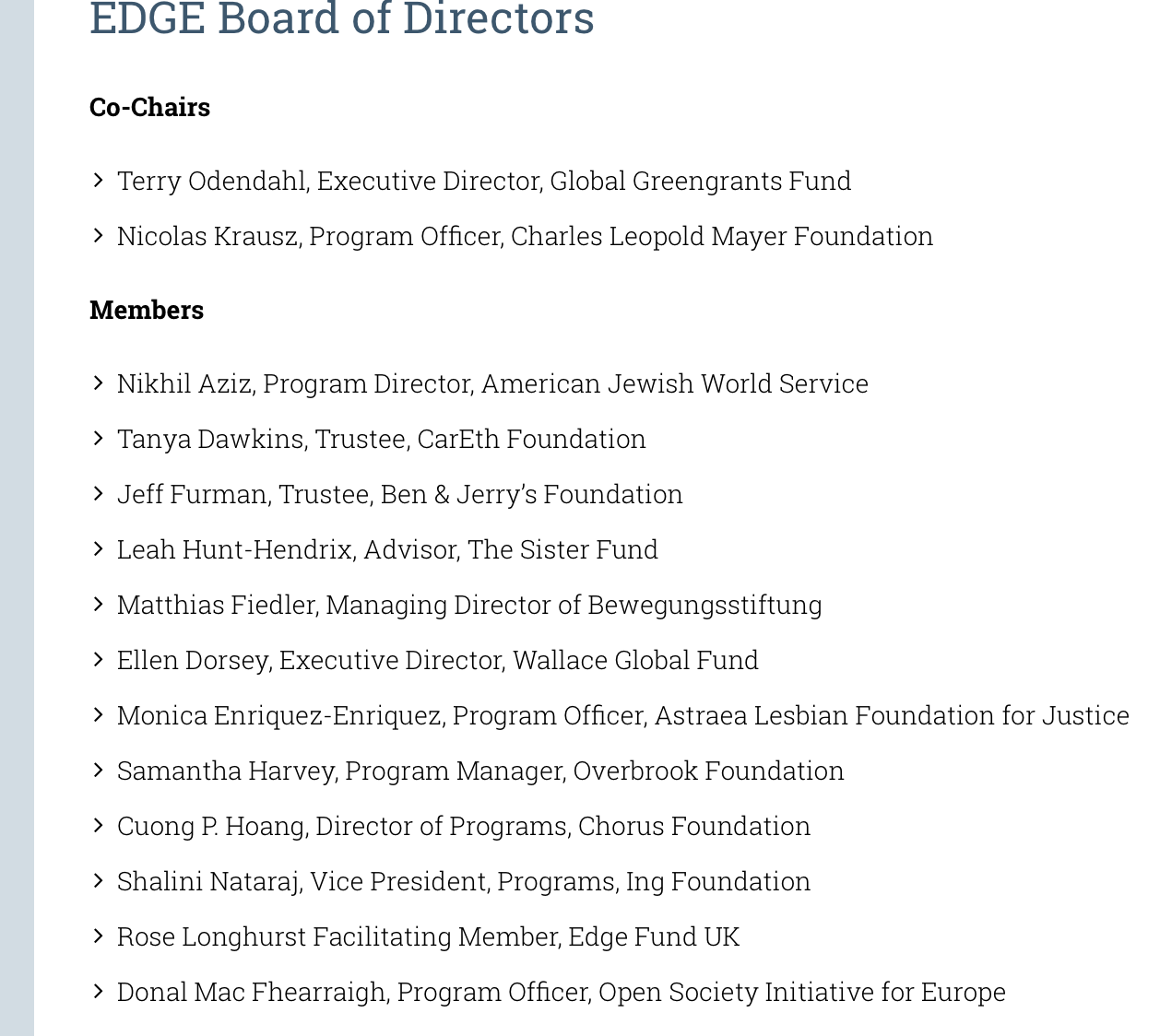
A representative of the Open Society Initiative for Europe currently sits on EDGE’s Board of directors. The Wallace Global Fund is also on its Board of Directors. The Wallace Global Fund is specialized in providing support to “mainstream” NGOs and “alternative media”, including Amnesty International, Democracy Now (which supports Hillary Clinton’s candidacy for president of the US).
Several members of the EDGE BoD, however, are from non-corporative and family foundations with a social mandate. (see below).
 In one of its key documents (2012), entitled Funders Network Alliance In Support of Grassroots Organizing and Movement-Building (link no longer available) EDGE acknowledged its support of social movements which challenge “neoliberal market fundamentalism.” including the World Social Forum, established in 2001:
“From the Zapatista uprising in Chiapas (1994) to the Battle in Seattle (1999) to the creation of the World Social Forum in Porto Alegre (2001), the TINA years of Reagan and Thatcher (There Is No Alternative) have been replaced with the growing conviction that “another world is possible.” Counter-summits, global campaigns and social forums have been crucial spaces to articulate local struggles, share experiences and analyses, develop expertise, and build concrete forms of international solidarity among progressive movements for social, economic and ecological justice.”
But at the same time, there is an obvious contradiction: another world is not possible when the campaign against neoliberalism is financed by an alliance of corporate donors firmly committed to neoliberalism and the US-NATO military agenda.
The following is the EDGE Montreal WSF Communique. The donors not only fund the activities, they also influence the structure of the WSF venue, which was determined in Puerto Alegre in 2001, namely the decentralized and dispersed mosaic of “do it yourself” workshops.
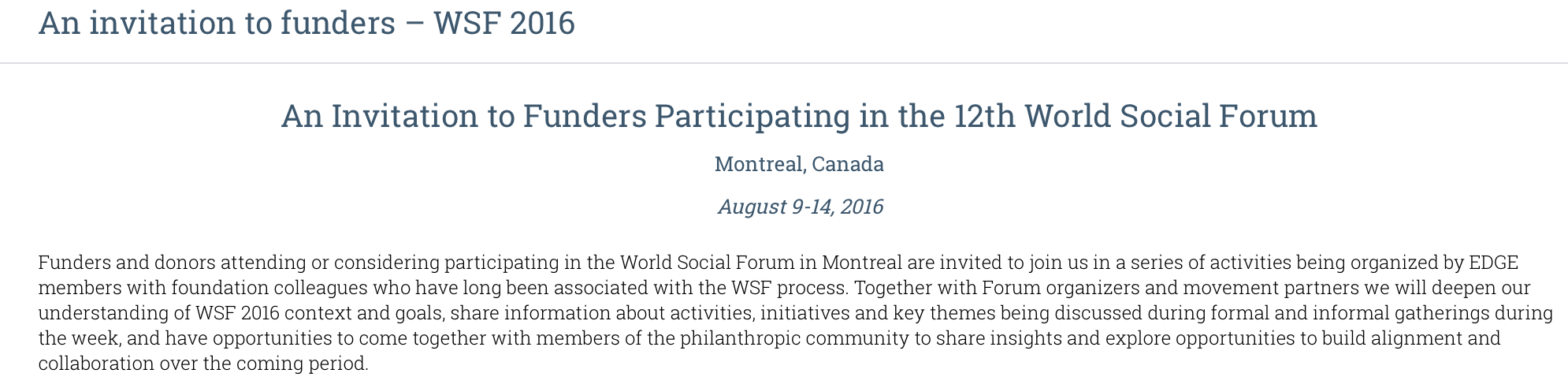

With regard to the Montreal WSF, the Consortium of Donors (EDGE) intent is:
“… to develop an intersectional space for funders and various movement partners – organizers thought leaders and practitioners – to build alignment by cultivating a shared understanding of the visions, values, principles and pathways of a “just transition.” (See http://edgefunders.org/wsf-activities/)
“Just Transition” implies that social activism has to conform to a “shared vision” with the corporate foundations, i.e. nothing which in a meaningful way might upset the elite structures of global capitalism.
From the standpoint of the corporate donors “investing in the WSF” constitutes a profitable (tax deductible) undertaking. It ensures that activism remains within the confines of ”constructive dialogue” and “critique” rather than confrontation. Any deviation immediately results in the curtailment of donor funding:
“Everything the [Ford] Foundation did could be regarded as “making the World safe for capitalism”, reducing social tensions by helping to comfort the afflicted, provide safety valves for the angry, and improve the functioning of government (McGeorge Bundy, National Security Advisor to Presidents John F. Kennedy and Lyndon Johnson (1961-1966), President of the Ford Foundation, (1966-1979))
The limits of social dissent are thereby determined by the “governance structure” of the WSF, which was tacitly agreed upon with the funding agencies at the outset in 2001.
“No Leaders”
The WSF has no leaders. All the events are “self-organized”. The structure of debate and activism is part of an an “open space” (See Francine Mestrum, The World Social Forum and its governance: a multi-headed monster, CADTM, 27 April 2013, http://cadtm.org/The-World-Social-Forum-and-its ).
This compartmentalized structure is an obstacle to the development of a meaningful and articulate mass movement.
How best to control grassroots dissent against global capitalism?
Make sure that their leaders can be easily co-opted and that the rank and file will not develop “forms of international solidarity among progressive movements” (to use EDGE’s own words), which in any meaningful way might undermine the interests of corporate capital.
The mosaic of separate WSF workshops, the relative absence of plenary sessions, the creation of divisions within and between social movements, not to mention the absence of a cohesive and unified platform against the Wall Street corporate elites, against the fake US sponsored “global war on terrorism”, which has been used to justify and US-NATO’s ‘humanitarian’ R2P interventions (Afghanistan, Syria, Iraq, Libya, Ukraine, etc).
The corporate agenda is to “manufacture dissent”.“The limits of dissent” are established by the foundations and governments which ultimately finance this multimillion dollar venue. The financing is twofold:
1. Core financing of the WSF Secretariat and the Costs of the WSF venue.
2. Many of the constituent NGOs which participate in the venue are recipients of donor and/or government support.
3. The WSF venue in Montreal also receives funding from the Government of Canada as well as from the Quebec provincial government.
What ultimately prevails is a ritual of dissent which does not threaten the New World Order. Those who attend the WSF from the grassroots are often misled by their leaders. Activists who do not share the WSF consensus will ultimately be excluded:
“By providing the funding and the policy framework to many concerned and dedicated people working within the non-profit sector, the ruling class is able to co-opt leadership from grassroots communities, … and is able to make the funding, accounting, and evaluation components of the work so time consuming and onerous that social justice work is virtually impossible under these conditions” (Paul Kivel, You Call this Democracy, Who Benefits, Who Pays and Who Really Decides, 2004, p. 122 )
“Another World is Possible” is nonetheless an important concept, which characterizes the struggle of the peoples movements against global capitalism as well as the commitment of thousands of committed activists who are currently participated in the Montreal 2016 WSF.
Activism is being manipulated: ”Another World is Possible” cannot, however, be achieved under the auspices of the WSF which from the outset was funded by global capitalism and organized in close liaison with its corporate and government donors.
The important question for activists in Montreal:
Is it possible to build “an Alternative” to global capitalism, which challenges the hegemony of the Rockefellers et al and then asks the Rockefellers et al to foot the bill?
We call upon participants of the Montreal World Social Forum (WSF) to raise and debate these issues: the campaign against neoliberalism is financed by corporate foundations (and governments) which are firmly committed not only to the tenets of neoliberalism but also to the US-NATO led military agenda.
Why would they fund organizations which are actively campaigning against war and globalization? The answer is obvious. …
Copyright © Prof Michel Chossudovsky, Global Research, 2016
With Libya, US Now Has Ground Forces In Four Wars

Photo by Ali Tweel on Flickr. Original: https://flic.kr/p/HWGom3
By Dan Wright | ShadowProof | August 11, 2016
While it is impossible to know all the dirty deeds of America’s sprawling global empire, news that US ground forces are now fighting in Libya means that US troops are involved in at least four active wars:
Afghanistan: A planned draw-down of troops in 2015 was curtailed by President Obama to leave more troops for combat and advisory missions. This week, US forces were forced to abandon military equipment that then fell into the hands of ISIS.
Iraq: After a removal of major combat forces in 2011, Iraq has become a battleground once again. President Obama has sent roughly 4,600 troops in for combat and advisory roles and built a new base in northern Iraq called “Firebase Bell.”
Syria: Though the US had been supporting Syrian rebel groups, including jihadists, since 2013, US troops have entered the fighting in the country. In January of this year, US special forces took control of a military base in northern Syria.
Libya: In 2011, the US assisted in the overthrow of the Gaddafi government in Libya. In the aftermath, Libya has fallen into total chaos, making it ripe for ISIS to establish a significant presence. Now, according to the Pentagon, US forces are fighting on the ground to drive ISIS out.
This excludes all of the off-the-books special operations in over 100 countries, and the major role the US is playing in supplying weapons for Saudi Arabia’s war on Yemen. Among those weapons are controversial cluster bombs, which are banned by many countries for their impact on civilians.
Preceding the Yemen civil war, the US had an active drone assassination program in the country, which included the targeted killing of American citizens. The drone assassination program continues throughout the greater Middle East.
According to the Obama Administration, these military operations are legally justified by the 2001 Authorization for Use of Military Force [PDF], which stated “the President is authorized to use all necessary and appropriate force against those nations, organizations, or persons he determines planned, authorized, committed, or aided the terrorist attacks that occurred on September 11, 2001, or harbored such organizations or persons, in order to prevent any future acts of international terrorism against the United States by such nations, organizations or persons.”
The bland, vague language apparently justifies any war in any part of the world. So, maybe the US will soon have troops in five active wars. Hell, make it six.
Ex CIA chief’s ‘kill Russians, Iranians’ comment – Clinton job application
RT | August 11, 2016
Former CIA deputy director Michael Morell has proposed the US escalate the conflict in Syria by targeting President Bashar Assad’s allies. He added that killing Russians should be done covertly, but in such a way that the Kremlin would get the message.
Morell endorsed Hillary Clinton for US president and is known as a strong critic of Donald Trump.
RT: Russia and Iran are helping the Syrian government fight terrorists. So what would the US achieve by killing Russians and Iranians there?
Annie Machon: I think it would be jeopardizing world peace, to be quite frank. I think this is more like an alarming job application by Morell – so he would love to have a senior post in any Clinton administration, if she were to be elected. He is saying what he thinks she would like to hear about how America should deal with the situation in the Middle East. If indeed this does reflect her own views, then we’ve got to the absurd position, where actually world peace might be in safer hands if Donald Trump were elected president.
RT: Is Clinton running any risks by siding with a man who is proposing such a radical foreign policy move, do you think?
AM: I think this is a general reflection of the American establishment. Ever since the presidency of George W. Bush there has been a hit list of the countries that America has tried to ensure a regime change happens within. This was the list he called ‘the axis of evil’ comprising Libya, Syria, Iran, Iraq, and North Korea. Now, North Korea is under the patronage of China, so it’s relatively safe; plus it has a nuclear capability. So America can’t really do much about that one. But we’ve seen what they have done in all the other countries.
In fact, back in 2008 America was on the brink of going to war against Iran, as well. The only reason that rush to war was stopped – and this is something Bush has actually acknowledging in his memos – was because of the leaking of the national intelligence estimate of 2008, which is the combined thinking of all 16 US intelligence agencies – about Iran’s nuclear weapons capability and the development thereof. Their assessment then – and it has been re-ratified every year since – is that Iran gave up trying to develop any nuclear capability in 2003, and did not therefore pose a threat to Western interests. That is the only reason Iran is still standing. And we’ve seen all the mess in all the other countries.
RT: How consistent is Clinton’s foreign policy track record?
AM: I think fundamentally consistent with the sort of hawkish neocon approach the American establishment has been taking against many countries in the Middle East – preserve their interest there to prop up some of their close allies like Saudi Arabia and the dictatorships across the Middle East, as well.
But also consistent in trying to provoke reaction from Russia. The US and EU backed coup in Ukraine was an immense provocation. It is because Russia has managed to show a great deal of self-restraint in that area and in the face of provocation with big NATO exercises in the Baltic States and Poland and all the rest of it. That is the only reason that we haven’t seen an escalation into war.
RT: Clinton and her supporters claim Donald Trump is doing Russia a favor. His motto is making America great again. Why would that be perceived as beneficial for the Kremlin?
AM: I think mainly because he has made noises about the fact that he would ratchet down the pressure against Russia. In opposition to what Hillary Clinton has been describing – that the pressure needs to be kept on Russia. She represents the American establishment which is very keen on a unipolar world.
Now, with the resurgence of Russia that monopoly on power that America has enjoyed since the end of the Cold War, they deem to be under threat. Trump himself has said: “We don’t need to think like that. We can focus on building up our own country and let other countries get on with what they want to do, as well.” I think that is an unusually sane comment from the presidential hopeful.
Annie Machon is a former intelligence officer for MI5, the UK Security Service, who resigned in the late 1990s to blow the whistle on the spies’ incompetence and crimes with her ex-partner, David Shayler. Drawing on her varied experiences, she is now a public speaker, writer, media pundit, international tour and event organiser, political campaigner, and PR consultant. She is also now the Director of LEAP, Europe. She has a rare perspective both on the inner workings of governments, intelligence agencies and the media, as well as the wider implications for the need for increased openness and accountability in both public and private sectors.
Washington Escalates Covert Backing for Al Qaeda Militias in Aleppo
By Thomas Gaist | World Socialist Web Site | August 9, 2016
US-backed militias fighting against the Syrian government of Bashar al Assad have broken through the Russian and Syrian government encirclement of their positions inside the war-ravaged northern Syrian city of Aleppo, according to Western media.
During fierce battles over the weekend, the US-backed, Islamist-led militia coalition known as Jaysh al Fateh overran military bases in southwest Aleppo and secured an access road connecting the city to the rest of the country. Russian war planes and Syrian and Iranian ground forces counterattacked Sunday, targeting the anti-Assad forces with aerial bombardments and artillery.
According to Syrian opposition leader Anas al-Abdah, the Islamist offensive has achieved “almost a miracle,” leaving the anti-Assad forces poised to “break the siege and move into a stage where we are talking seriously about liberating the city.” The offensive has carved out a slim corridor linking Aleppo to rebel-held areas, raising the possibility of resupply operations for the desperately besieged Western-backed forces.
The encirclement of Washington’s extremist groups inside Aleppo, who have been reduced to a diminishing pocket in the city’s north and western sectors, in the face of a redoubled Syrian offensive backed by Russian air power and Iranian ground forces, came as a humiliating reversal for US imperialism. Washington has orchestrated a relentless civil war in Syria since 2011, killing hundreds of thousands of Syrians, without achieving its aim of toppling the Damascus regime and installing a neocolonial puppet government.
During the opening phases of the US-NATO orchestrated war, the anti-Assad militias seized control of large areas of the city, which they sought to utilize as a base of operations and object of plunder. Prior to the outbreak of the war, Aleppo’s population numbered between 1 and 2.5 million, according to varying estimates. Today, some 50,000 civilians are estimated to eke out an existence amid the rubble. The city as a whole has been without electricity and running water for more than a year, and entire neighborhoods are completely razed to the ground.
In recent weeks, with the Turkish government of President Recep Tayyip Erdogan withdrawing support for the rebels, in retaliation for Washington’s involvement in the failed July military coup attempt, the American-backed militias have faced the imminent possibility of defeat.
It is not coincidental that the ferocious US-backed assault is unfolding on the eve of Turkish President Erdogan’s trip to St. Petersburg, for talks with Russian President Vladimir Putin, on Tuesday. There are well-grounded fears in American ruling circles that Erdogan will reach a broad-based agreement with Putin, one that would close off all remaining supply routes necessary for sustaining the war against Damascus.
The cause of the sudden reversal in the fortunes of the anti-government forces, who, if US media reports can be believed, have seized the initiative from the jaws of total defeat, was quietly acknowledged in reports published by the New York Times on Saturday and Monday, titled “Military Success in Syria Gives Putin Upper Hand in US Proxy War” and “Rebel Offensive in Syria Challenges Government Siege of Aleppo.”
As Saturday’s Times piece noted, the US Central Intelligence Agency (CIA) has been supplying the Al Qaeda-linked militias with virtually unlimited supplies of sophisticated antitank missiles and other weaponry.
The US-backed rebel coalition, which has been dominated by the Al Nusra Front, “would receive new shipments of the antitank weapons as soon as the missiles were used,” according to comments from a rebel commander made in 2015, and quoted by the Times Saturday.
“We ask for ammunition and missiles, and we get more than we ask for,” the anti-Assad commander said.
In contrast to the Obama administration’s assertions that the shipments were being curtailed and funneled exclusively to “moderate forces,” in reality the CIA has been surging support for the encircled anti-Assad militias in Aleppo, foremost among which are the Al Nusra fighters.
As the Times update on Monday forthrightly acknowledged: “A vital factor in the rebel advance over the weekend was cooperation between mainstream rebel groups, some of which have received covert arms support from the United States, and the jihadist organization formerly known as the Nusra Front, which was affiliated with Al Qaeda.”
The infinite mendacity and hypocrisy of both the Times and the American imperial policy it defends could hardly find sharper expression.
The newspaper presents the change in name and formal disaffiliation of Al Nusra from Al Qaeda as some distant memory, when it was, in fact, announced barely a week and a half earlier. Like most of the Western media, the Times now cheers on the supposed battlefield successes of the so-called “rebels,” who, until the end of July, swore allegiance to Al Qaeda, supposedly the main target of Washington’s 15-year-long “war on terrorism.”
Moreover, in recent weeks, as US intelligence outfitted the surrounded Al Qaeda “rebels” in preparation for a new bloody offensive, America’s top diplomat, Secretary of State John Kerry, has touted steps toward a US-Russian military cooperation pact in Syria, the centerpiece of which would supposedly have been joint strikes against Al Nusra. While Kerry was pledging military cooperation with Moscow, along with joint “counterterrorism” operations, the CIA was giving weapons hand over fist to the Al Qaeda-affiliated forces, dumping fuel on a simmering US-Russian proxy conflict, with the potential to engulf broad areas of the Middle East and Europe in all-out war.
The downing of a Russian Mi-8 transport helicopter over Syria’s Idlib province Monday, which produced the largest single death toll for Russian forces operating in Syria since Moscow launched its intervention last year, grimly illustrated the lethal dynamics being unleashed by American imperialism’s ever more reckless pursuit of unchallenged hegemony over the strategic Levantine nation.
The US media celebrations of the “rebel” victory cannot be taken at face value, and must be weighed against reports from the Syrian government side, which have presented the scope of the rebel counteroffensive in more modest terms. Whatever the true extent of the rebel advances on the ground, it is already clear that the intensified fighting will serve as the political basis for a major military escalation by Washington.
In an interview with Fox News this weekend, Democratic presidential frontrunner, Hillary Clinton, issued bellicose threats against Russia, stating that “the facts raise serious issues about Russian interference in our elections, in our democracy.” Clinton has made clear her intention to pursue a massive escalation of the Syrian war and the broader US war drive against Russia if she wins the White House, saying during last year’s Democratic Party debate, “We have to stand up to his [Putin] bullying and specifically, in Syria.”
While the Obama White House prefers to delay a major escalation until after the elections, the weakness of the American position on the ground is forcing the administration to consider direct strikes against Damascus. Former Obama administration adviser, Dennis Ross, suggested last week that the White House should “begin speaking in a language that Mr. Assad and Mr. Putin can understand,” and employ direct cruise missile and drone strikes against Assad’s military infrastructure.
In the event that the government crushes the rebel attack, powerful factions within the US establishment can be counted on to press for the most aggressive measures against Assad, to be launched in the name of salvaging the American proxy forces, which have been built up at a cost of billions in CIA-supplied cash and weapons.
Even should the Al Qaeda-linked forces complete the breakout, and reassert control over Aleppo and the surrounding region, this will only set the stage for a massive government counterattack, and thus provide a suitable political pretext for further escalation by Washington. Beneath the fog of war in Syria, the only certainty is the constantly growing tendency toward a US-Russian clash that poses the gravest dangers for humanity.
Israeli Study: ISIL Destruction ‘Strategic Mistake’
Al-Manar | August 10, 2016
An Israeli think-tank said that the West should seek the further weakening of the Takfiri ISIL group, but not its destruction.
Begin-Sadat Center for Strategic Studies considered as a “strategic mistake” the destruction of ISIL, stressing that a weak but functioning ISIL can have many advantages.
“A weak but functioning IS can undermine the appeal of the caliphate among radical Muslims; keep bad actors focused on one another rather than on Western targets; and hamper Iran’s quest for regional hegemony,” Efraim Inbar said in his study published on August 2.
“A weak IS(ISIL) is, counter intuitively, preferable to a destroyed IS. IS is a magnet for radicalized Muslims in countries throughout the world. These volunteers are easier targets to identify, saving intelligence work. They acquire destructive skills in the fields of Syria and Iraq that are of undoubted concern if they return home, but some of them acquire shaheed status while still away – a blessing for their home countries. If IS is fully defeated, more of these people are likely to come home and cause trouble.”
Meanwhile, the study said that the destruction of ISIL could strengthen Russia’s grip on Syria, bolster its influence in the Middle East and enhance Iranian control of Iraq contrary to American objectives in that country, and the two effects are not in the West’s interests.
On the other hand, the study added that the destruction of ISIL could also benefit Hezbollah.
“Furthermore, Hizballah (Hezbollah)… is being seriously taxed by the fight against IS, a state of affairs that suits Western interests. A Hizballah no longer involved in the Syrian civil war might engage once again in the taking of western hostages and other terrorist acts in Europe.”
The Western distaste for ISIL brutality and immorality should not obfuscate strategic clarity, Began-Sadat Center added, noting that ISIL “are truly bad guys, but few of their opponents are much better.”
“Allowing bad guys to kill bad guys sounds very cynical, but it is useful and even moral to do so if it keeps the bad guys busy and less able to harm the good guys.”
‘Kill Russians and Iranians, threaten Assad,’ says ex-CIA chief backing Clinton
RT | August 9, 2016
Former CIA deputy director Michael Morell, who supports Hillary Clinton and insists that Donald Trump is being manipulated by Russian President Vladimir Putin, said that Russians and Iranians in Syria should be killed covertly to “pay the price.”
The ex-CIA chief, who worked with Clinton while she was secretary of state, told CBS This Morning co-host Charlie Rose that Iran and Russia should “pay a big price” in Syria – and by that he meant killing them.
“When we were in Iraq, the Iranians were giving weapons to the Shia militia who were killing American soldiers,” Morell said. “The Iranians were making us pay a price.”
“We need to make the Iranians pay a price in Syria, we need to make the Russians pay a price,” he continued.
When asked if that meant killing Russians and Iranians, Morell fully agreed, qualifying the answer with “covertly.”
“Tell the world about it, right?” he went on. “You don’t stand up at the Pentagon and say ‘we did this,’ but you make sure they know it in Moscow and Tehran.”
Referring to the US-backed rebels in Syria, Morell said he wanted Washington to support them in more aggressive actions, not only against Bashar Assad’s government, but against Iranians and Russians.
Morrell then went on a diatribe about how the US should “scare” Assad, including going after his national guard and “bombing his offices in the middle of the night.”
“I’m not advocating assassinating him, I’m advocating going after what he thinks is his power base and what he needs to survive. I want to put pressure on him, I want to put pressure on the Iranians, I want to put pressure on the Russians to come to that diplomatic settlement.”
The former acting director of the CIA publicly endorsed Hillary Clinton last week through an opinion piece in the New York Times, praising her qualifications as commander-in-chief and calling her rival Donald Trump a threat to national security.
After he retired from the CIA in August 2013, Morrell took a job at Beacon Global Strategies, a Washington, DC consultancy founded by Clinton aides Philippe Reines and Andrew Shapiro. There he worked with Leon Panetta, another Clinton aide and his predecessor at the helm of the CIA, who also spoke in support of Clinton at the Democratic convention in Philadelphia last month.
Last year, Morrell apologized to “every American” and finally owned up to the “mistakes” made by the CIA in Iraq, where over 4,000 US soldiers and at least 250,000 Iraqi civilians have been killed since the 2003 US invasion.
READ MORE: Illegal incursion? 1st alleged photo evidence of British presence in Syria
Team Clinton Focuses on the Demise of Hezbollah
By Franklin Lamb | CounterPunch | August 8, 2016
Tel Hara, on the Golan Plain, Syria – The likely next American President, Hilary Clinton is fielding an array of foreign policy advisers, a few being sort of table scraps from the Bush administration and others having resigned from Obama’s. They are today preparing white papers on all manner of “adjustments” to what the presumed 45th American President reportedly believes was a weak and wrongheaded Obama Middle East policy, particularly with respect to the Syrian crisis and Hezbollah.
This according to sources at the Democratic National Committee’s (DNC) Judicial Council on which this observer served representing his State of Oregon many moons ago. One staffer reports that the Neocon-Zionist lobby has a Middle East Policy deal with the Clinton campaign as a linchpin of her pledge to “eternally cover Israel’s back.” The Clinton camp, which appears to be gaining adherents within the CIA, the State Department and the Pentagon, believes that the Obama administration’s policy toward Russia and Syria is badly flawed partly because, so they claim, Obama wrongly assumes that Russia wants to limit its involvement in Syria. Clinton advisers claim that, on the contrary, Putin’s key objectives include demonstrating that Russia is winning in Syria, that the US has become a paper tiger in the region, and that the Arab states best follow Russia’s lead as it dramatically returns to the region a la the former USSR.
To set the stage for the her administration, some would-be Clinton advisers such as WINEP’s Dennis Ross, are counseling that she must increase political pressure now, as the clock runs out on the Obama administration, to dramatically beef up what they view as Obama’s weak “truce agreement” between Washington and Moscow. This as former Defense Secretary and Clinton adviser, Leon Panetta, is advocating that the next president increase US Special Forces in Syria and launch air strikes to shore up “moderates” fighting the Syrian government. Others are urging that after Clinton is sworn-in the US must pounce on all “truce violations” with drones and cruise missiles and target Syrian airbases and artillery positions, while simultaneously setting up safe areas for civilians, and if deemed necessary, no-fly zones.
Still others, including a dissenting internal memo last month signed by 51 State Department diplomats advocated attacks on Syrian government forces especially Hezbollah to end aggression against the country’s civilian population, to alter the military balance and bring about a negotiated political settlement. As Clinton’s Syrian policy is being formed, details will likely be kept out of the Presidential campaign, at least from her side, so as not to alienate the crucial Obama camp before November 8th.
There is reportedly one aspect of Clinton’s Middle East policy that has been detailed and is ready for implementation following her inauguration once details are coordinated with Israel, NATO and the six-member Gulf Cooperation Council (GCC). It is being advocated by AIPAC on Capitol Hill and among Clinton operatives at the DNC and details how the Clinton administration “must destroy Hezbollah and cut off Tehran’s anti-Arab, anti-Sunni and anti- Christian hegemonic lifeline for its rapidly escalating domination of the Middle East.”
Clinton’s Middle East foreign policy shift reportedly will focus on the complete destruction of Hezbollah. Rather than merely containment as Obama insists at meetings of his National Security Council. John Kerry, a rumored Clinton cabinet member refers to Hezbollah solely as “Iran’s Basij in Lebanon/Syria/Iraq/Yemen/Bahrain and you name it.” History may soon record whether the Clinton administration, breaking sharply with the Obama administration, is able to “reshape the region” as Israel’s Netanyahu is squeezing her to do, and destroy Hezbollah, and if necessary, Iran’s IRGC-Al Quds Force. The latter, according to Clinton’s advisers and US allies are active in all the countries on Kerry’s list and far beyond.
Destroying or severely crippling Hezbollah is also being advocated as a cheap throw-away ‘crowd-pleaser’ for the incoming Clinton administration, both in Congress where both sides of the aisle, Democrats and Republicans, would very likely applaud attacks on Hezbollah as part of a rejuvenated “manned-up” and expanding US-led War on Terrorism. The Israel lobby is expressing confidence on Capitol Hill that relentlessly targeting Hezbollah militarily and economically will please and embolden Washington’s friends who remain chagrined by Obama’s containment policy in Syria while this needed policy shift will be discomfiting to US adversaries. It is also being argued that the six GCC monarchies will welcome tough Clinton administration action and can be expected to redouble their funding to shore up the Syrian opposition while at the same time the Clinton administration will also demonstrate US resolve to renew Washington’s commitment to holding Hezbollah accountable for its claimed terrorism. All the above it is claimed would hasten an end to the war here in Syria and make a political settlement more likely.
One “emeritus” Clinton adviser is Amos Yadlin, Israel’s former Military Intelligence chief. Recently Yadlin has been arguing that Israel and the US need to intervene in Syria more actively with a policy, that leads to the defeat of the “our most bitter enemies: “Iran and Hezbollah.” Yadlin makes no secret of the fact that Israel will destroy Hezbollah ‘next time’ in Lebanon and that only the approaching date will not be revealed in advance.
Clinton supports the Hizbullah International Financing Prevention Act, signed by Obama this past April. The U.S. Treasury Department’s Office of Foreign Assets Control, (OFAC) issued regulations aimed at implementing act. The latest U.S. regulations target those “knowingly facilitating a significant transaction or transactions for” Hezbollah and those “knowingly facilitating a significant transaction or transactions of a person identified on the List of Specially Designated Nationals (SDN’s) and Blocked persons.” OFAC’s list includes names of officials, businessmen and institutions that the U.S. says are linked to Hezbollah such as the group’s al-Manar TV and Al-Nour Radio. Clinton advisers argue that even more has to be done targeting Hezbollah.
Several hundred pages of ‘selling points’ circulating Capitol Hill and among EU countries are designed to build “an unshakable global commitment to destroy Hezbollah” according to one staffer on the Senate Foreign Relations Committee. Also being distributed on Capitol Hill are “research papers” from a Iranian opposition group called Naame Shaam. One is titled “Iran in Syria: From an Ally of the Regime to an Occupying Force.” The 200-page report analyzes various aspects of the military, political and economic role played by Hezbollah and Iran since March 2011, following the outbreak of the Syrian conflict.
An Israeli Embassy brief targeting Hezbollah includes the following excerpt on the subject of claimed Hezbollah crimes against humanity and urges the US and the EU to intensify sanctions: “Contrary to claims by Hezbollah’s Sec-General Hassan Nasrallah and Iran’s “Supreme Leader” Ali Khameini, Hezbollah entered Syria in large numbers by April 2011 and started sniping at demonstrators and Syrian army soldiers who refused to shoot children. A July 2012 video taken by Hezbollah and published in July 2011 shows heavily armed Hezbollah fighters and a number of tanks in Horan near Deraa, the city where the uprising started. A report in January of 1212 by The Times, documented large numbers of Hezbollah and Iranian snipers were deployed “to shoot anti-regime protesters.” These reports were confirmed by scores of Deraa residents who have confirmed more than 200 eyewitness reports that Iran deployed Hezbollah fighters “to stand behind Syrian troops and kill Syrian soldiers immediately, if they refused to open fire on demonstrators.” Local residents have confirmed these reports as have some of the more three dozen Iranian and Hezbollah snipers who participated. Three months after the start of the March 2011 civilian protests, the first clashes were reported in June 2011 in al-Qusayr, in the countryside of Homs. By May 2012 Hezbollah, overran 10 of the 23 (Syria-Lebanon) border villages and established fortified bases exclusively for its use, at time expelling Syrian army troops in “their” area which led to the Syrian army killing of three Al Manar journalists at Ma’loula.”
The document, which includes satellite photos, continues, “Nasrallah explained to Lebanese media that ‘Hezbollah did not tell them what to do and this has nothing to do with the fighting in Syria. He omitted to mention that historically this area has been the main route for Iranian arms entering Lebanon and is located near Hezbollah arms depots in Lebanon’s Bekaa Valley.”
Another handout reads: “From the spring of 2011 until today, the Hezbollah’s siege, starving and slaughter of innocent women and children across Syria has continued to intensify despite, until recently, denial after denial. Hezbollah crimes have been extensively documented in an undisclosed European country by the Independent International Commission of Inquiry on the Syrian Arab Republic, established on 22 August 2011 by the Human Rights Council through resolution S-17/1 adopted at its 17th special session with a mandate to investigate all alleged violations of international human rights law since March 2011 in the Syrian Arab Republic. Also gathering and documenting hundreds of cases of individuals committing crimes against humanity is the Commission for International Justice and Accountability.”
As the intense anti-Hezbollah campaign gets organized in Washington, Israel reportedly considers itself the winner to date in Syria, and expects to have much more influence and a green-light to destroy Hezbollah in a Clinton administration than was the case with Obama’s. Tel Aviv has to date been content to bide its time and simply deter Hezbollah in southern Syria/Lebanon and along the Golan Plain while recently occupying another roughly 20 by 12 miles strip of Syria territory. This latest land confiscation was done with impunity as UNDOF observers watched with binoculars. One reason UNDOF was impotent during the Israeli land grab was that a majority of them had relocated from the Syrian side to the Israeli side of the Golan ceasefire line in September 2014. UNDOF will not return until the Syrian war ends, if then.
Israel has made clear via its new Defense Minister, Avigdor Lieberman, leader of the fascist Yisrael Beiteinu party, that Israel will not return one centimeter of its recently occupied Syrian territory “until we sign a peace agreement with the new government of Syria. All Muslims must know that we Israelis are their friends and that we are on the right side of this Syrian war.”
Meanwhile Israel has an understanding with various rebel groups in Southern Syria including the newly re-named Jabhat al Nusra (The Front for the Defense of the Syrian People) now calling itself – Jabhat Fatah al-Sham (the Front for the Conquest of the Levant), giving food and medical treatment to anyone asking for assistance within its new zone. Israel is also reportedly recruiting ‘operatives’ from southern Syria militia around Quneitra, the largely destroyed and abandoned capital of the Quneitra Governorate. Similar recruitment from the local population to what its army undertook during its 22-year occupation of South Lebanon before it was liberated by Hezbollah. Israel is reportedly paying up to $1000 per month, “salaries”, (compared to the average monthly salary in Syria these days of approximately of $100). Israel offers even more for “special services” targeting Hezbollah. Israel is in the process of occupying, in one way or another, parts of southern Syria. And one can feel it in the air.
Whatever success the Clinton team will have with its goal of destroying Hezbollah and however one evaluates Obama’s policy, this region appears headed for yet more prolonged violence and many more deaths of innocent civilians.
Franklin Lamb is a visiting Professor of International Law at the Faculty of Law, Damascus University and volunteers with the Sabra-Shatila Scholarship Program (sssp-lb.com).
Israel pops up in Gulf riding Arab coattails
By M K Bhadrakumar – Indian Punchline – August 7, 2016
The reported statement by former Israeli minister Diaspora Affairs Rabbi Michael Melchior that Saudi Arabia will open its doors to Israeli visitors “much sooner than you dream about” will not come as surprise. To be sure, a critical mass is developing in the secretive Saudi-Israeli intercourse.
The Saudi regime has been chary about links with Israel for fear of annoying the ‘Arab Street’, whereas, Israel has been all along eager to flaunt the breach in the Berlin Wall of Arab-Israeli conflict. But Saudis seem to estimate that the time has come to be open about the relationship.
The point is, if the raison d’etre of the dalliance is the ‘containment’ of Iran, it is resource-sharing. An open relationship is needed to optimally develop security and military cooperation. The Custodian of Holy Places seems to think the Muslim world will learn to live with his country’s strategic cooperation with Israel.
Well, the Palestine issue no longer poses hurdles, either. Arab Spring, conflicts in Syria and Iraq, military coup in Egypt, Saudi-Iranian rivalry, breakdown in Iran’s ties with Hamas, Islamic State – all these have relegated the Palestine issue to the backburner. Besides, Palestine President Mahmoud Abbas is on a tight American and Saudi leash. Abbas even received in Ramallah recently a Saudi delegation led by former general Anwar Majed Eshki who visited Jerusalem and met senior Israeli officials, including the head of the foreign ministry Dore Gold.
Again, Saudi Arabia’s keen interest in taking possession of two Red Sea islands at the mouth of the Gulf of Aqaba – Tiran and Sanafir – needs to be understood as a move to be Israel’s ‘neighbor’. Sanafir and Tiran sit at the mouth of the Gulf of Aqaba, on a strategically important stretch of water called the Strait of Tiran, used by Israel to access Red Sea. King Salman personally camped in Cairo in April to persuade Egyptian President Abdel Fattah al-Sisi to transfer the two islands in lieu of a seductive multi-billion dollar offer to Sisi.
Indeed, both Saudi Arabia and Israel are making haste to position themselves for a new phase of the Middle East’s politics in the post-Barack Obama era. They expect Hillary Clinton to pick up the threads where George W. Bush left them — a muscular regional policy involving switch back to containment of Iran and resuscitation of the pivotal relationships with Israel and Saudi Arabia.
Neither Saudi Arabia nor Israel is willing to reconcile with the Iran nuclear deal. They are doing everything possible, no matter what it takes, to see that the deal gets derailed. On Saturday, Israeli Defence Ministry issued a harshly-worded statement slamming Obama and comparing the Iran deal with the 1938 Munich agreement to appease Hitler. (Jerusalem Post )
Equally, Saudis and Israelis have convergent interests in regard to the conflicts in Syria and Iraq — supporting extremist Sunni groups, promoting the Kurdistan project, creation of ‘spheres of influence’ on Syrian and Iraqi territory, and ultimately, entrapping Iran in a quagmire that will exhaust the regime.
The Saudi-Israeli strategic regional realignment is something that Washington historically encouraged. It is just the underpinning needed for creating a regional security architecture supported by the NATO’s network of partnerships with the GCC states under the canopy of a US missile shield.
Alas, Turkey too could have been a key partner in this enterprise, but for the failure of the July 15 coup. Israel looked distressed when it transpired that the coup failed. As for Saudi Arabia, it probably played a role in the failed coup. (Sputnik )
Without doubt, it is against a complex backdrop that the recent reports regarding Israel and Pakistan taking part in a major air exercise hosted by the US also needs to be viewed. Neither Islamabad nor Tel Avi has denied the reports. Of course, the US always encouraged a Pak-Israeli proximity. Now, the big question is: With Saudi Arabia establishing ties with Israel, can Pakistan be far behind? (Times of Israel )
From the Israeli, Saudi and American perspective, it is of utmost importance that Pakistan aligns with Saudi Arabia instead of remaining neutral in regard of Iran’s rise. Pakistan’s role is crucial to any major plans of destabilization of Iran.
Israel and Saudi Arabia pretended until recently that they have a special thing going with Moscow, too, with a view to create ‘strategic ambiguity’. Moscow played along, while making a strategic decision that Iran is its ‘natural ally’ in the Middle East. This is perfectly understandable, because in the ultimate analysis, Israel and Saudi Arabia are bit players only, while Iran (or Turkey for that matter) is an authentic regional power credited with a world view.
It is possible to see the Russia-Azerbaijan-Iran trilateral summit in Baku on Monday as a strategic counter-move by Moscow and Tehran.
The proposed North-South Transport Corridor is admittedly an old idea with a pronounced economic dimension, but in the present context, an access route for Russia to the Persian Gulf and Middle East via Iran’s territory becomes a geopolitical event of far-reaching significance in the regional alignment that is under way. (See my blog China’s One Belt One Road isn’t only show in town.)
Featured Video

Death Spikes & Rising Cancer In Our Youth Explained
or go to
Aletho News Archives – Video-Images
From the Archives
Politicians lie
By Mazin Qumsiyeh | Popular Resistance | August 18, 2013
There is no way to say this truth nicely: Politicians lie. That includes Japanese, American, Egyptian, Israeli, and Palestinian politicians! Is there something more common sense than that? Yet, so many citizens around the world believe their own politicians or wistfully acknowledge lies but think it is part of the job needed to run things. They believe even when politicians contradict themselves blatantly. This phenomenon is rather remarkable. It is a dissonance and disconnect from reality that many seem oblivious to. It is very dangerous because it can lead to accepting rationales for going to war. These can be deadly wars that lead to millions of lives lost as happened in what was called World War 1 and WW2. Even when incredible and declassified evidence abound, politicians continue to lie and old mythologies refuse to die. Here are just a few of the countless lies told to us over the past few decades… continue
Blog Roll
 Aletho News
- RSF military group defects, joins Sudanese army: State media
- Ireland goalkeeper refuses to play ‘Israel’ as squad weighs boycott
- China pushes back against US on Cuba, Iran
- Ukrainian Soldiers, Potential Mercenaries: Have Gun, Will Travel!
- Burnham’s UN debut… A masterclass in British disinformation
- Iran flights continue despite US aviation sanctions
- Global Tipping Points Lead the World Into a State of Entropy
- The day-after at the White House: USA and Xi Jinping
- The Geopolitical Balance in the Red Sea: The UAE Being Displaced by New Players
- Iraqi resistance group vows to stage airport sit-ins over Iran aerial blockade
- If Americans Knew
- Deconstructing Netanyahu’s pants-on-fire UN rant – Daily Update
- Trump betrayed voters with his campaign lies and prioritized a foreign country once he took office
- Netanyahu calls Israel’s war in Gaza ‘opposite of genocide’ in UN speech to near-empty hall
- Settler Kidnappings: Torture, Sexual Abuse and Terrorisation of Palestinian Abductees as Israel Deepens Annexation of West Bank
- Gaza winter nears as 162,000 tents become unusable, raising fears of humanitarian crisis
- Netanyahu says, “It’s the opposite of genocide”; UN says Gaza economy is world’s ‘most severe crisis on record’ – Daily Update
- Israel’s US-Backed Assault on Gaza Has Created the ‘World’s Most Severe Economic Crisis on Record’: UN
- ‘Protecting U.S. Citizens’… From Israel
- ‘This is where I live now, the back of a truck’: a day in the life of a grandmother in Gaza
- In UN Speech, Iran’s President Displays Pictures of Children Killed by US, Brings Attention to Israel’s Nuclear Arsenal
- No Tricks Zone
- New Study: Earth And Venus Surface Warmth Largely Explained By Convection And Lapse Rate, Not CO2 Or Radiation
- 2025 Nature Paper Claiming Worsening Global Drought Gets RETRACTED …Heavily Flawed
- New Study: ‘Global Drought Shows No Detectable Recent Acceleration Under Climate Warming’
- Economic Masterminds: German Socialists Suggest Taxing Productivity Gains Stemming From Using AI
- The South China Sea Has Not Been Cooperating With The Climate Change Narrative
- Energy Crisis: Germany Enters Heating Season With Historically Low Gas Reserve Fill Levels
- New Study: The Antarctic Ice Sheet Gained Mass From 2020-2024 Due To Staggering Snow And Ice Accumulation
- Study: Ocean Heating Rates From Thousands Of Years Ago ‘Dwarf’ Modern Ocean Heating Rates
- Climate Extremists Target, Attack Large-Scale Power Grid Infrastructure In Germany!
- New Study: Antarctic Ice Melt Has Contributed Less Than 1 Centimeter To Sea Level Rise In The Last 30 Years

