Kurdish PKK and YPG’s Hidden Notorious Crimes
By Sarah Abed | American Herald Tribune | September 25, 2107
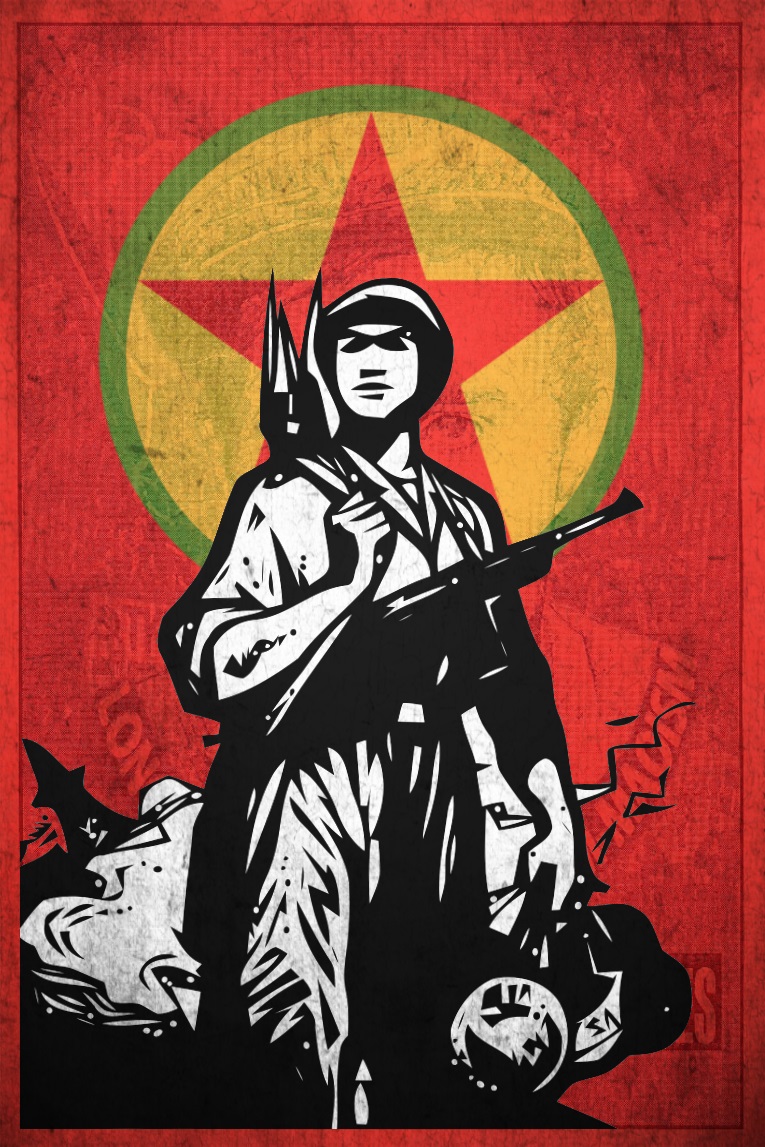
The Kurdistan Workers’ Party, or PKK, and its Syrian spinoff, the YPG, are cult-like radical movements that intertwine Marxism, feminism, Leninism and Kurdish nationalism into a hodge-podge of ideology, drawing members through the extensive use of propaganda that appeals to these modes of thought.
*(PKK Propaganda. Image Credit)
Abdullah Ocalan, the leader of the PKK, took inspiration from American anarchist Murray Bookchin in creating his philosophy, which he calls “Democratic Confederalism.”
The PKK spin-off group YPG represents most of the Syrian Democratic Forces (SDF) in Syria. With Western political support, they have gained popularity and garnered an impressive amount of support from anarchists and military veterans in the West, some of whom have left the comfort of their home countries to fight with the group.
One of their most productive marketing tools has been to use young, attractive female fighters as the face of the guerrillas. During their fight against Daesh, the PKK has saturated the media with images of these young female “freedom fighters,” using them as a marketing tool to take their cause from obscurity to fame. These female fighters in the YPJ are fighting alongside their male counterparts under the direction of the U.S. in the SDF.
Stephen Gowans writes more about this topic in his superb article titled: The Myth of the Kurdish YPG’s Moral Excellence. Here is an excerpt:
In Syria, the PKK’s goal “is to establish a self-ruled region in northern Syria,” [8] an area with a significant Arab population.
When PKK fighters cross the border into Turkey, they become ‘terrorists’, according to the United States and European Union, but when they cross back into Syria they are miraculously transformed into ‘guerrilla” fighters waging a war for democracy as the principal component of the Syrian Democratic Force. The reality is, however, that whether on the Turkish or Syrian side of the border, the PKK uses the same methods, pursues the same goals, and relies largely on the same personnel. The YPG is the PKK.
Child Soldiers forced recruitment, kidnapping, and murder by the PKK and YPG
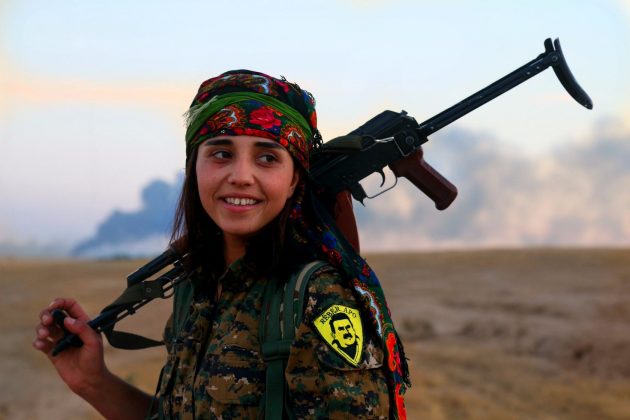
*(Young YPJ Kurdish fighter. Image Credit)
Within the past few years Kurds have gone from almost total obscurity to front page news. What doesn’t get reported however is how these terrorist groups under the guise of being a revolutionary movement for independence have carried out numerous atrocities including kidnappings and murder – not to mention their involvement in trafficking narcotics.
Kurdish families are demanding that the PKK stop kidnapping minors. It started on April 23, the day Turkey marked its 91st National Sovereignty and Children’s Day. While children celebrated the holiday in western Turkey, the Kurdistan Workers Party (PKK) kidnapped 25 students between the ages of 14 and 16 on the east side of the country, in the Lice district of Diyarbakir.
Although the PKK has kidnapped more than 330 minors in the last six months, the Bockum family was the first in the region who put up a tent near their home to start a sit-in protest, challenging the PKK and demanding that it return their son. Sinan was returned to the family on May 4. Al-Monitor reported this incident from the beginning in great detail.
As Bebyin Somuk reported in her article, the PKK and PYD still kidnap children in Turkey and Syria. She states: “As I previously wrote for Kebab and Camel, the PKK commits war crimes by recruiting children as soldiers. Some of the PKK militants that surrendered yesterday were also the PKK’s child soldiers. The photos clearly show that these children are not more than sixteen years old. The Turkish army released video of the 25 PKK militants surrendering in Nusaybin.”
Thousands of children are serving as soldiers in armed conflicts around the world. In 1989, the United Nations Convention on the Rights of the Child, Article 38, proclaimed: “State parties shall take all feasible measures to ensure that persons who have not attained the age of 15 years do not take a direct part in hostilities.” Since then, UNICEF and the UN Security Council took steps to end the recruitment of children in conflict and war.
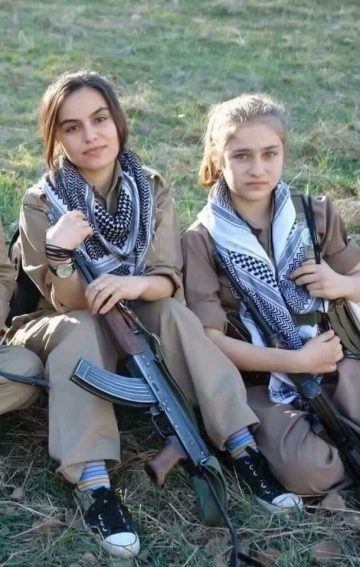
(Young Kurdish fighters. Image Credit)
The PKK, recognized as a terrorist organization by the U.S. , E.U. , and Turkey
The PKK often recruits children. In the past, the PKK even recruited children as young as 7-12 years. In 2010, a Danish national daily newspaper, Berlingske Tidende, published a story about the PKK’s child soldiers. According to that report, there were around 3,000 young militants in the PKK’s training camps. The youngest child at the PKK training camps was eight or nine years old. They were taught Abdullah Öcalan’s life story (the jailed leader of the PKK) and how to use weapons and explosives.
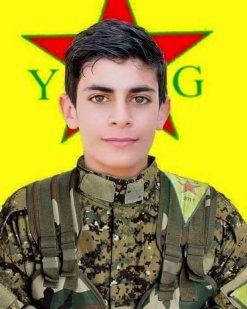
*(Martyrdom notice for a PYD/YPG child soldier Image Credit)
Despite the Deed of Commitment, the PKK continues to recruit minors.
After that story was published, the PKK encountered strong reactions from human rights organizations worldwide. The same year, UNICEF released a statement voicing its “profound concern” about the PKK’s recruitment of child soldiers. In October 2013, the PKK, represented by HPG (the PKK’s military wing) commander Ms. Delal Amed, signed the Deed of Commitment protecting children in armed conflict. This document, drawn up by the Geneva Call NGO, is dedicated to promoting respect by armed non-state actors for international humanitarian norms in armed conflict. Despite this commitment, the PKK continued to recruit minors.
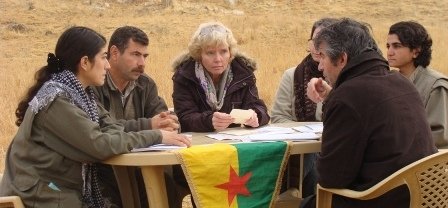
The People’s Defence Forces is the military wing of the Kurdistan Workers’ Party. Image Credit
The PKK abducted children while the peace process was continuing
On March 21, 2013, PKK leader Abdullah Öcalan called for a cease-fire that included the PKK’s withdrawal from Turkish soil and an eventual end to armed struggle. The PKK announced that they would obey, stating that 2013 would be the year of conclusion, either through war or through peace. But that did not happen. Instead, the PKK abducted 2,052 children aged between 12 and 17 while the peace process was still going on, according to Turkish security records. The PKK took these children and trained them. After that, because those childrenwere not involved in any criminal activities, when they were captured by, or surrendered to, Turkish security forces, Turkish courts did not prosecute them, so most of them were released. It was the Turkish state’s goodwill gesture for the sake of the peace process.
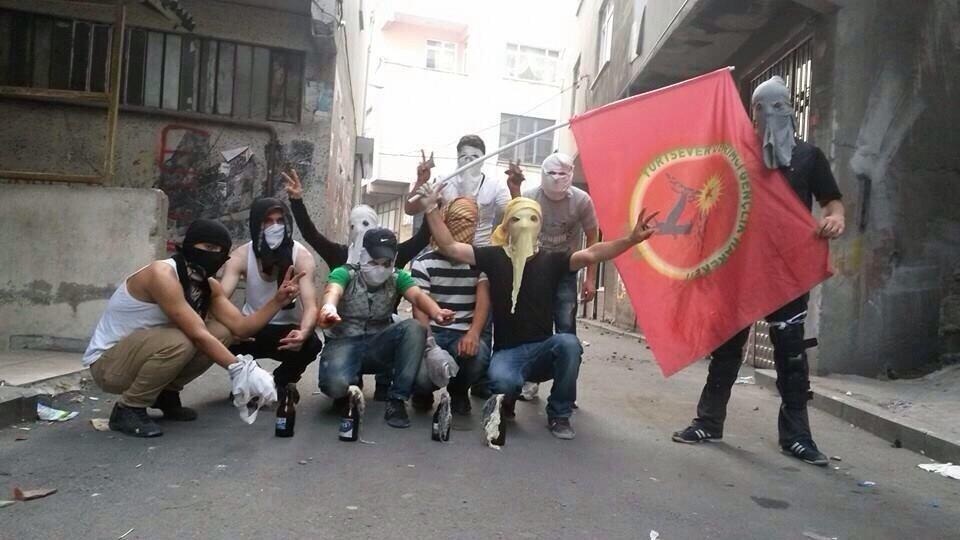
However, once released, most of these children joined the YDG-H, the PKK’s new youth wing, and began to perpetrate illegal and/or violent events in Kurdish populated cities and towns. The YDG-H began to emerge in early 2013 and spread rapidly after the peace process’ beginning. Then, after the 7 June 2015 election, the YDG-H began to attack security forces and civilians in cities and towns such as Cizre, or in Diyarbakır’s Sur neighborhood, with heavy weapons, and to dig trenches and erect barricades in side streets.
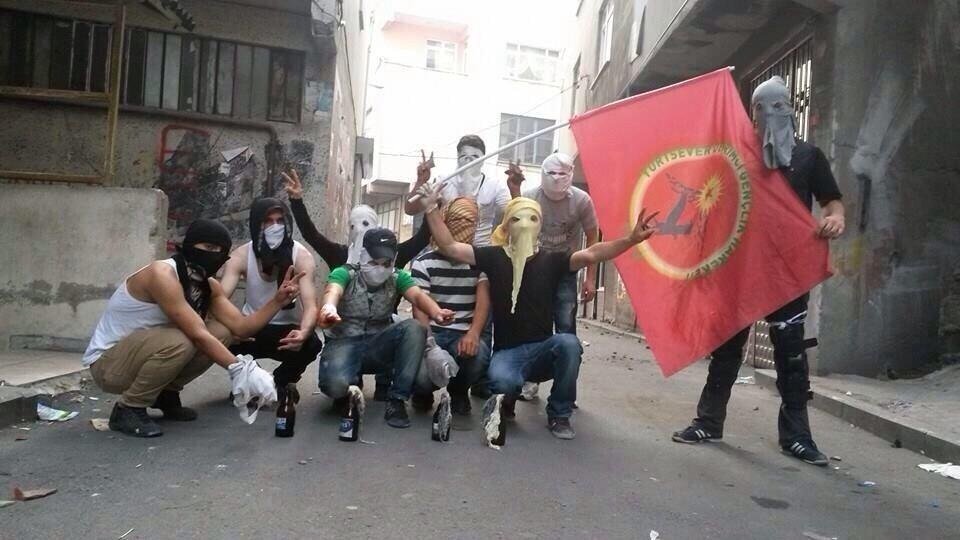
*(YDG H. Image Credit)
A growing number of Kurdish families in Turkey are calling for the return of their children, who they say have been abducted by the Kurdish rebel group, the PKK. The PKK denies the claim, but with the Turkish prime minister stepping in, the issue is putting pressure on an already stalled peace process. Dorian Jones reports from Diyarbakir, the main city in Turkey’s predominantly Kurdish southeast.
The HDP assaulted the mothers demanding their children
In May 2014, mothers from across Turkey whose children had been recruited by the PKK held a sit-in protest in front of the Diyarbakır Metropolitan Municipality building and called on the PKK to release their children. Their children were mostly 14-15 years old at that time. Some families claimed that their sons and daughters were kidnapped by the PKK against their will. The Diyarbakır Municipality, administered by the HDP, used water cannon to disperse the mothers. HDP Co-Chair Selahattin Demirtaş even claimed that these mothers were hired by the Turkish National Intelligence Organization. Despite the resistance coming from the PKK and the HDP, the families continued their protest, and some families’ children were released by the PKK.
The PKK established a child-wing called YPS-Zarok
Another photo from the Yüksekova district shows the child-wing recently established by the PKK called YPS-Zarok (Child) with the headline “YPS-Zarok announcement from the children of the resistance.” The PYD, the PKK’s Syria branch, is also known for its recruitment of child soldiers.
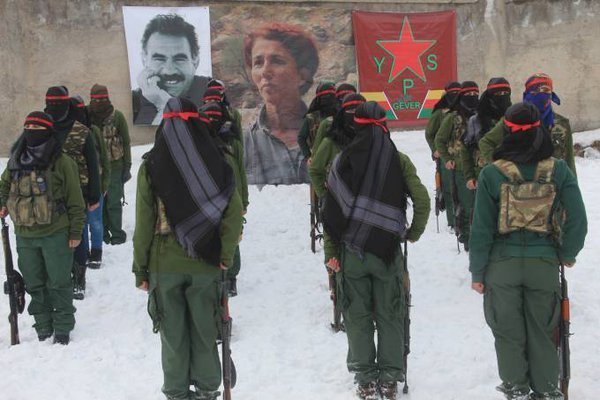
*(YPS. Image Credit)
U.S.’s “reliable partner” the YPG also recruits children
A Human Rights Watch report, “Syria: Kurdish Forces Violating Child Soldier Ban” provides a list of 59 children, ten of them under the age of fifteen, recruited for YPG or YPJ forces since July 2014. International humanitarian law and the Rome Statute that set up the International Criminal Court classify the recruitment of under-15-year-olds as a war crime. While the Obama Administration does not recognize the YPG as a terrorist organization, and supports them as a local partner in the region, the YPG continues to recruit child soldiers.
It’s clear that the U.S. sees the PYD as a “reliable partner” in the fight against ISIS. However, the Obama Administration should notice the fact that the PYD is not an independent organization. It is linked to the PKK and recruiting minors under 18. The decision to found the PYD was made in 2002 during a PKK congress in Qandil. The PYD also has a bylaw stating that “Abdullah Öcalan is the leader of the PYD.”US Special Forces Delta Force, training PYD (Image Credit)
In summary, the YPG is the Syrian wing of the PKK, and recruits children just like the PKK. Regardless of what acronym they go by, whether it be the YPG, PKK, PYD, YPJ or any of the other alphabet soup combinations, they commit crimes against civilians in both Syria and Turkey all with the arms, funds, and training received from the United States.
Female PKK Killing Turkish Soldiers
SouthFront reported on female PKK fighters who have killed Turkish soldiers. “The women fighters command of the Kurdistan Worker Party (PKK) have released a statement, claiming PKK female fighters killed 160 Turkish military servicemen in 2016. According to the statement, the women fighters command of the PKK carried out 115 operations against Turkish government forces in 2016. The group also vowed to ‘proceed the struggle during the new year for a life of freedom and until victory is achieved.’”
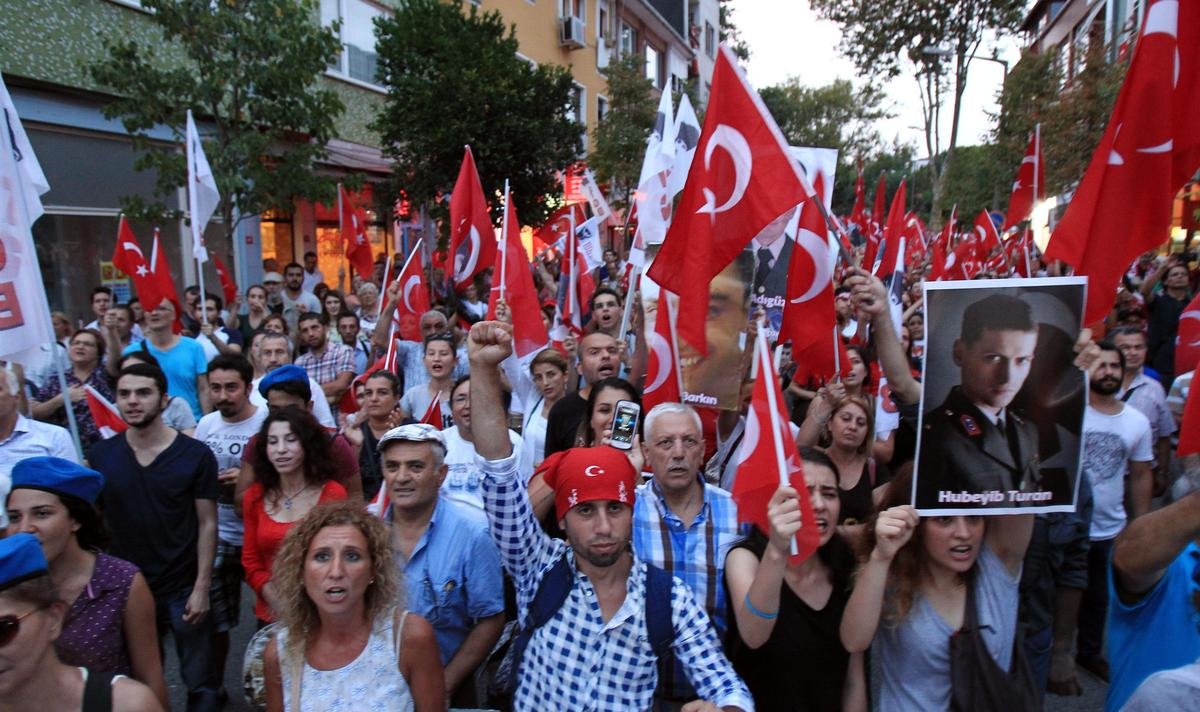
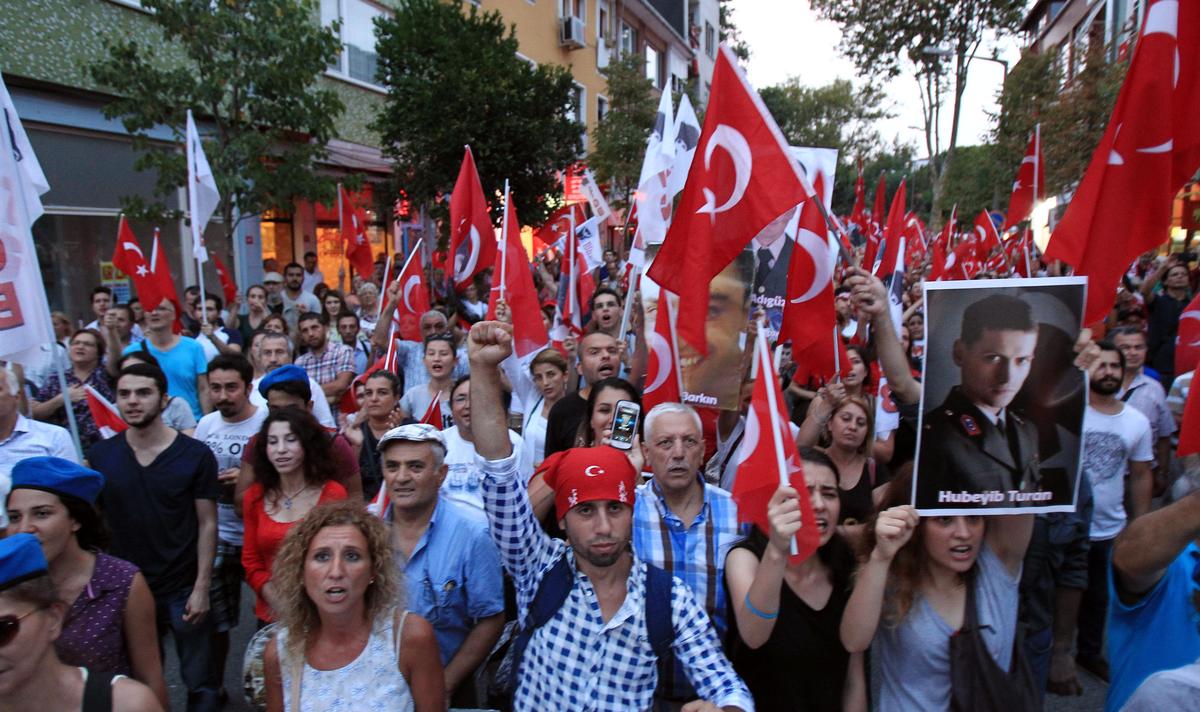
*(Hundreds of people protest against the PKK in Istanbul on 7 September after the PKK killed 16 soldiers and wounded six others in Daglica, Turkey. Image Credit)
The PKK is also killing Kurds under the guise of protecting their rights
“Senior PKK leader Cemil Bayık, in an interview with the Fırat News Agency (ANF) on Aug. 8, said, ‘Our war will not be confined to the mountains like it was before. It will be spread everywhere without making a distinction between mountains, plains or cities. It will spread to the metropolises.’ Terrorist Bayık’s statement signaled that the PKK would take increasing aim against civilians, targeting civilian areas more than ever. And it is happening.
Since July 15, the day when the Gülenist terror cult, FETÖ, launched its failed military coup attempt to topple the democratically-elected government, the PKK perpetrated dozens of terrorist attacks, killing 21 civilians and injuring 319 others – most of them Kurdish citizens.”
According to The Washington Institute:
On November 18, FBI Director Robert Mueller met with senior Turkish officials to address U.S.-Turkish efforts targeting the Kurdistan Workers Party (PKK), also known as Kongra-Gel. A press release from the U.S. embassy in Ankara following the meeting stressed that U.S. officials ‘strongly support Turkey’s efforts against the PKK terrorist organization’ and highlighted the two countries’ long history of working together in the fight against terrorism and transnational organized crime.
The PKK: Terrorist Organization and Foreign Narcotics Trafficker
These discussions are timely. Despite Ankara’s recent bid to alleviate the Kurdish issue — a bid referred to as the ‘democratic opening’ — the PKK is one of a growing number of terrorist organizations with significant stakes in the international drug trade.
In October, the U.S. Treasury Department added three PKK/Kongra-Gel senior leaders to its list of foreign narcotics traffickers. The PKK, along with the Revolutionary Armed Forces of Colombia (FARC), is one of only a few organizations worldwide designated by the U.S. government as both a terrorist organization and a significant foreign narcotics trafficker.” Drug smuggling is reported to be the main financial source of PKK terrorism, according to the organization International Strategic Research, whose detailed report can be seen here.
Western Veterans Blindly Supporting Kurdish Independence
Their exaggerated triumphs against Daesh have helped them evolve from a radical militia to an alleged regional power player. Have they been successful in fighting against Daesh in Syria? Yes – but while the Syrian Arab Army has been more effective, it does not receive a fraction of the praise or recognition that the PKK does.
Pato Rincon, a U.S. military veteran, recently wrote about his experience training with the YPG in Syria.
Although initially interested in their desire for autonomy, he soon got to know a different side of the group.
An Exclusive Eyewitness Account of an American who Trained with the Kurdish Syrian Rebels
Getting retired from the United States Marine Corps at age 23 with zero deployments under my belt was a huge blow to what I figured to be my destiny on this planet. That “retirement” came in 2010 after three years on convalescent leave, recovering from a traumatic brain injury sustained stateside. I got my chance to vindicate myself in 2015 by volunteering to fight in Syria with the Kurdish Yeni Parastina Gel (YPG), or the “People’s Protection Units” in Kurmanji (Northern Kurdish language).
The YPG is the military apparatus of the Partiya Yekitiya Democrat (PYD), the Democratic Union Party, and one of the main forces of the Syrian Democratic Forces fighting ISIS and Bashar al-Assad’s regime. While they are a direct ideological descendant of the Soviet Union, their take on Marxism has a much more nationalistic bent than that of their internationalist forebears. At their training camp that I attended, they constantly spoke of their right to a free and autonomous homeland–which I could support. On the other hand, they ludicrously claimed that all surrounding cultures from Arab to Turk to Persian descended from Kurdish culture. One should find this odd, considering that the Kurds have never had such autonomy as that which they struggle for. All of this puffed up nationalism masquerading as internationalism was easy to see through.
The Westerners were treated with respect by the “commanders” (they eschewed proper rank and billet, how bourgeoise!), but the rank and file YPGniks were more interested in what we could do for them and what they could steal from us (luckily, my luggage was still in storage at the Sulaymaniyah International Airport in Sulaymaniyah, Iraq). By “steal from us,” I mean they would walk up to a Westerner/American and grab their cap, glasses, scarf and whatever else they wanted and ask “Hevalti?” which is Kurmanji for “Comraderie?” and if you “agreed” or stalled (a non-verbal agreement) then they would take your gear and clothing. “Do not get your shit hevalti-ed,” the saying went.
Not only was their idea of Marxism fatuous, their version of feminism was even worse. We had to take mandatory “Female World History” classes in which some putrid fourth or even fifth wave feminist propaganda was espoused. Early on in my brief stay with this “military unit”, I was told not to ever brush my teeth in front of a woman as that might “sexualize” her… … something to do with preparing one’s self for sex or something.
They insisted that we chicken-wing our elbows while sighting in on targets–the same targets that were fired on by everybody in the class, thus making an assessment of individual strengths and weaknesses rather impossible. This was on the ONE day that we went to the range–one day with the AK-47 out of about a month of training. Another day was Some of these guys were straight from civilian life, with only their blood composition to act as a reason for them to be there. Little boys and little girls as young as 13 or 14 were there–reason enough for me to leave.
During one long “Female World History” class, we were taught that if a man had a Dragonov (sniper rifle) and he was elevated from his female comrade’s position and she had a Bixie, then the male in the scenario should not cover his female comrade, but instead should find something else to do lest she lose self esteem, not feeling capable of carrying out the task by herself.
When a student from Kentucky asked, “What if the situation is reversed–can a woman cover a man?” the female instructor smiled and said, “Yes, that’s okay.” I didn’t end up firing a shot in combat for the YPG. After seeing their half-baked ideology, poor level of training, and the child soldiers, I had had enough. They were nice enough to arrange for me to go back to Iraq where I could catch a ride to Turkey.
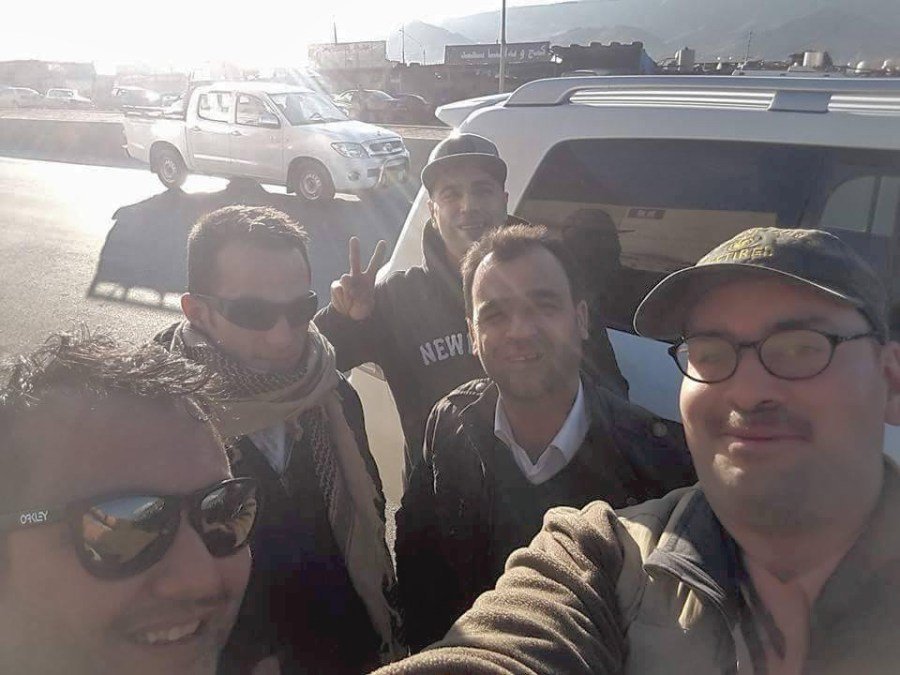
*(Pat Rincon with YPG fighters in Syria. Image Credit)
Accounts such as this will certainly not make it to mainstream media, as they do not fit the narrative that the Kurds and their sponsors promote.
In another example of Western support for the YPG, Joe Robinson, an ex-soldier and UK national, recently returned to the UK after spending five months in Syria fighting with the group. He was detained and arrested by Greater Manchester Police officers on suspicion of terrorism offenses as soon as he returned. He joined the British military when he was 18 and toured Afghanistan with the Duke of Lancaster’s Regiment in 2012.
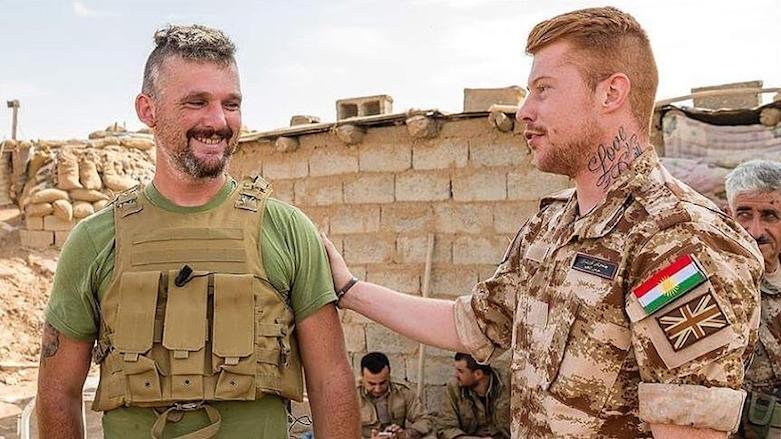
*(Joseph A. R. (right) in a military outfit with flag patches of Kurdistan and the UK, while men who appear to be Kurdistan Region’s Peshmerga forces are seen in the background in this undated social media picture. Picture Credit).
He left the UK when an arrest warrant was issued after he failed to appear in court. Robinson is pictured here in Syria with YPG fighters.
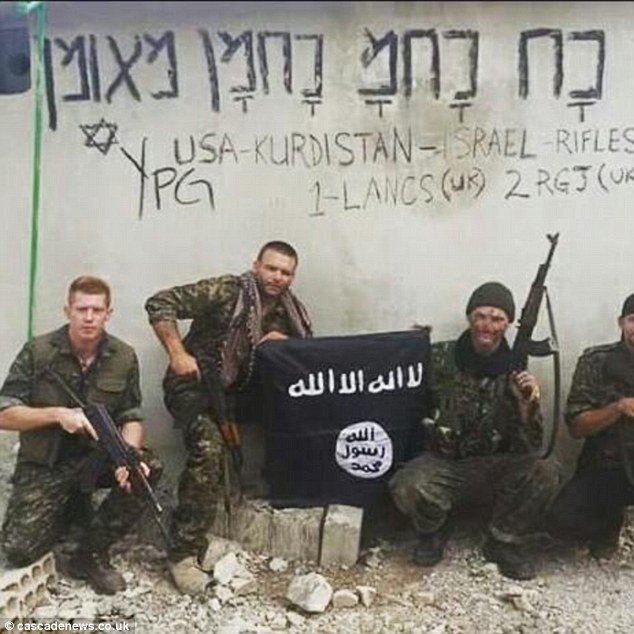
Robinson, at left, holding his weapon while fellow YPG comrades hold Daesh flag. The writing on the wall speaks volumes about the relationship between Israel, the Kurds and the US.
During a trip to Turkey Joe Robinson was arrested for having been part of the YPG.
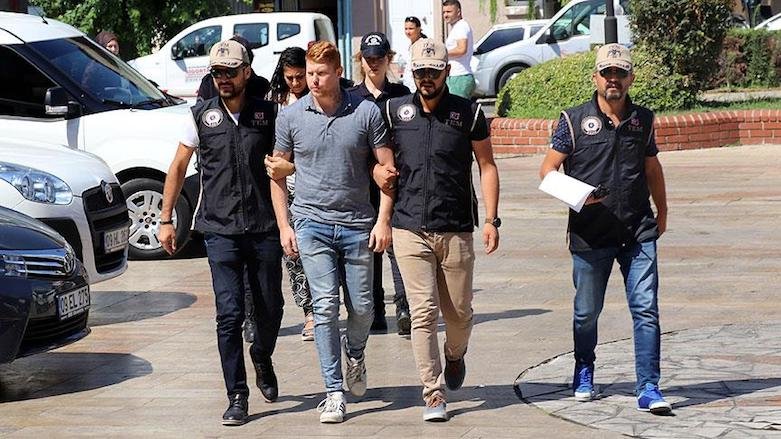
*(Turkish police arrested Joesph A.R. (center) along with two Bulgarian women in the city of Aydin, July 28, 2017. Photo Credit)
“I received arms training from the YPG [People’s Protection Units] for three months but never engaged in combat,” said the foreign fighter during an interrogation.
The information contained in this article serves the purpose of balancing all of the propaganda and romanticization that these Kurdish terrorist groups have received in mainstream media. The bottom line is they are armed, dangerous, and committing crimes with international support. Support for these terrorist groups needs to end immediately before further division, chaos and death spreads in the region.
Israeli support for Kurdish statehood is a poisoned chalice
By Mahan Abedin | MEMO | September 12, 2107
With the referendum on proposed Kurdish independence just two weeks away, the stage is being set for the gravest political and potential military crisis in post-Baathist Iraq. Months of intense lobbying by Iranian, Turkish and even American officials and interlocutors has failed to dissuade the Iraqi Kurdish leadership from staging this catastrophically divisive referendum.
In his combative interview with the BBC, the president of the autonomous Iraqi Kurdistan region, Masoud Barzani, left no doubt that the referendum is the first formal step in the march toward full independence. More ominously, Barzani appeared to acknowledge that plans to officially annex Kirkuk may well spark a major war.
Every regional and extra-regional power, including the United States, is opposed to Kurdish statehood, with one exception. Israel. Whilst sections of the Iraqi Kurdish media are jubilant at this rhetorical support, Kurdish leaders will have to carefully weigh up the pros and cons of Israeli support before they formally declare statehood.
While Israel will undoubtedly prove a strong ally of an independent Kurdish state, it is the support it is willing to offer in the run-up to independence that will prove decisive. Even rhetorical Israeli support will drastically inflame the situation and bring the Kurds into armed conflict with the pro-Iranian Shia militias massed to the south of Kirkuk.
A peripheral policy
Israel’s support for nationalist Kurdish movements is strong and long-standing, dating back to the early 1960s. This policy is part of Israel’s “Alliance of the Periphery” doctrine, which in short amounts to developing strong ties to non-Arab states on the periphery of the Middle East with a view to combating the Arab boycott of the Jewish state.
Whilst the periphery doctrine was originally aimed at Turkey, Iran and Ethiopia, with time it expanded to incorporate non-state actors, principally the Kurds, whose quest for statehood Israel has consistently supported for decades.
Analysis centred on the putative “collapse” of the periphery doctrine is likely to prove premature. Whilst it is true that Turkey can no longer be regarded as a reliable Israeli partner, this will motivate Israeli strategists and operatives to seek out and develop new peripheral partners. Moreover, the peripheral policy survived its biggest crisis nearly forty years ago when almost overnight Iran went from an informal Israeli ally to the most vociferous enemy of the Jewish state.
Given this chequered history of missteps and strategic miscalculations, analysts are right to be wary of how useful this periphery doctrine is. However, as long as Israel’s occupation of Palestine continues to draw strong Arab, Muslim and broader international opposition, Israel will seek to identify and develop stealthy means by which to undermine, isolate and eventually exhaust this opposition.
It is in this context that leading Israeli strategists, including former foreign minister Shlomo Ben-Ami, push the case for Kurdish independence, primarily by trying to align Kurdish statehood with the interests of the United States and the West in general. This devious perspective is entirely in keeping with the perennial Israeli policy of equating its own core interests with that of the West. In this instance, Israeli diplomacy and wider lobbying efforts will try to sell Kurdish independence to policymakers in Washington, by presenting it as the best long-term strategy to contain Iranian influence in Iraq.
The road to war
Apart from strong rhetorical support, what practical steps can Israel take to support the Iraqi Kurdish quest for statehood? This is a vexing question, as on the face of it Israeli influence in Iraqi Kurdistan is practically non-existent. This author spent the first half of 2009 in Iraqi Kurdistan working as a journalist and despite widespread rumours didn’t uncover any evidence of Israeli involvement in Kurdish affairs.
Yet this influence surely exists, particularly at the security and intelligence level. It is in part due to the Israeli connection that the Kurdish intelligence agency, the Asayish, has developed into one of the most capable intelligence agencies in the Middle East. In keeping with Kurdish national aspirations, the Asayish has grown in reach and capability, not only spying on regional countries, but even managing to run modest operations as far afield as the United Kingdom.
Indeed, qualified Kurdish independence in Iraq now seems all but inevitable. This appears to be the assessment of US intelligence services, Washington’s stated opposition to the issue notwithstanding. Qualified independence in this context implies highly contested statehood, lacking widespread international support and drawing immediate internal and external opposition.
The most immediate opponents to Kurdish statehood in Iraq are the Shia paramilitary forces, who alongside their political patrons in Baghdad, have deep-seated interests in Kirkuk, which is home to a sizeable Shia Turkmen population. The collapse of the Iraqi army in the face of Daesh’s sweeping advance in June 2014 has significantly changed the military security landscape in Kirkuk and the immediate areas to the south, bringing the Kurdish Peshmerga and Shia paramilitaries into dangerously close proximity.
The Shia paramilitaries, organised as Popular Mobilisation Units, reportedly maintain six military bases close to Kirkuk and are poised to engage the Peshmerga militarily should the need arise. From a purely speculative point of view, limited military engagements may follow the independence referendum as a means of deterring the Kurdish leadership from taking further steps toward formal independence.
From a broader strategic perspective, Israeli support for the Kurdish cause is a poisoned chalice for Kurdish nationalists in so far as it makes a sustainable Kurdish state unacceptable to Iran and by extension to its Shia allies in Iraq. But judging from Masoud Barzani’s combative rhetoric, he appears to be willing to take the risk.
Read: Israeli flag will be raised in independent Kurdistan, claims prominent Likud member
Facing Defeat in Syria, ISIS Inexplicably Expands Globally
By Tony Cartalucci – New Eastern Outlook – 11.08.2017
Throughout human history, when a military force and its economic center has been defeated, it contracts, then collapses. For the first time in human history, the self-proclaimed “Islamic State” (ISIS), has managed to reverse this fundamental aspect of reality – but not without help.
Facing defeat in Syria as government forces backed by its Russian and Iranian allies close in on the terrorist organization, stripping it of territory it seized, it has managed to spread far beyond Syria’s borders, establishing itself in Libya, Afghanistan, and even as far as Southeast Asia where it has seized an entire city in the Philippines’ south, and carried out attacks and conducting activities everywhere from Indonesia and Malaysia to allegedly Thailand’s deep south.
It should be remembered, according to Western governments and their media, the territory ISIS holds in Syria is allegedly providing it with the summation of its financial resources and thus the source of its fighting capacity. According to official statements, the US and its European allies allege that ISIS fuels its fighting capacity with “taxes” and extortion as well as black market oil sales – all of which are derived from territory it holds in Syria.
The Washington Post in a 2015 article titled, “How the Islamic State makes its money,” would note:
Weapons, vehicles, employee salaries, propaganda videos, international travel — all of these things cost money. The recent terrorism attacks in Paris, which the Islamic State has claimed as its own work, suggest the terrorist organization hasn’t been hurting for funding. David Cohen, the Treasury Department’s Undersecretary for Terrorism and Financial Intelligence, described the Islamic State last October as “probably the best-funded terrorist organization we have confronted” — deep pockets that have allowed the group to carry out deadly campaigns in Iraq, Syria and other countries.
To explain where ISIS actually makes its money, the Washington Post claims:
Unlike many terrorist groups, which finance themselves mainly through wealthy donors, the Islamic State has used its control over a territory that is roughly the size of the U.K. and home to millions of people to develop diversified revenue channels that make it more resilient to U.S. offensives.
The Washington Post would also claim:
Its main methods of generating money appear to be the sale of oil and antiquities, as well as taxation and extortion. And the group’s financial resources have grown quickly as it has captured more territory and resources: According to estimates by the Rand Corporation, the Islamic State’s total revenue rose from a little less than $1 million per month in late 2008 and early 2009 to perhaps $1 million to $3 million per day in 2014.
With this territory quickly shrinking and the intensity of fighting against what remains of ISIS in Syria and Iraq expanding, it is seemingly inexplicable as to how ISIS is expanding globally, instead of contracting and collapsing.
The Washington Post’s already implausible thesis regarding ISIS finances – based on official statements from the US Treasury Department and US corporate-funded policy think tanks like Rand – appears to be the only thing contracting and collapsing.
ISIS Enjoys Global Reach Many Nation-States Lack
Regarding just how expansive ISIS’ global activities are, US Secretary of State Rex Tillerson himself would claim in an August 1, 2017 statement that:
I think our next steps on the global war to defeat ISIS are to recognize ISIS is a global issue. We already see elements of ISIS in the Philippines, as you’re aware, gaining a foothold. Some of these fighters have gone to the Philippines from Syria and Iraq. We are in conversations with the Philippine Government, with Indonesia, with Malaysia, with Singapore, with Australia, as partners to recognize this threat, try to get ahead of this threat, and help them with training – training their own law enforcement capabilities, sharing of intelligence, and provide them wherewithal to anticipate what may be coming their direction.
Tillerson made these remarks after noting ISIS’ shrinking holdings in both Syria and Iraq. He claimed in regards to Iraq:
More than 70 percent of Iraqi territory that was once held by ISIS has been liberated and recovered. ISIS has been unable to retake any territory that it has been – that has been liberated, and almost 2 million Iraqis have returned home. And this is really the measure of success, I think, is when conditions are such that people feel like they can return to their homes.
Regarding Syria, Tillerson would claim:
Similarly, over in Syria, we’re assisting with the liberation of Raqqa, which is moving at a faster pace than we originally anticipated.
The steps outlined by Tillerson to combat ISIS sidestep strategic fundamentals like identifying, isolating, and eliminating the economic and financial source of the organization’s fighting capacity, and instead focus on an indefinite justification for global US military operations – particularly across Southeast Asia at a time when the region is incrementally uprooting American influence and replacing it with Eurasian alliances, networks, as well as military and economic blocs.
For ISIS – fueled by resources found only within the boundaries of its meager and shrinking territorial holdings in Syria and Iraq – to be simultaneously fighting the national armies of Syria and Iraq, backed by Iran, Russia, Lebanon’s Hezbollah, and allegedly a US-led coalition including dozens of countries, all while expanding its reach worldwide, including full-scale military operations in Southeast Asia, begs belief.
ISIS doing all of this with multi-billion dollar multinational state sponsorship, not only makes much more sense, it is the only explanation.
ISIS is State Sponsored
Until recently, ISIS territory butted directly against the borders of NATO-member Turkey. In fact, looking at any map of the Syrian-Iraqi conflict with ISIS revealed what appeared to be logistical trails leading directly out of Turkey and to a lesser extent, Jordan.
A 2014 report from Germany’s public broadcaster Deutsche Welle, revealed a torrent of supplies, men, and weapons flowing daily over the Turkish-Syrian border, headed directly toward ISIS territory, directly under the nose and with the complicity of Turkish officials.
The report titled, “‘IS’ supply channels through Turkey,” would note:
Every day, trucks laden with food, clothing, and other supplies cross the border from Turkey to Syria. It is unclear who is picking up the goods. The haulers believe most of the cargo is going to the “Islamic State” militia. Oil, weapons, and soldiers are also being smuggled over the border, and Kurdish volunteers are now patrolling the area in a bid to stem the supplies.
So obvious was the logistical support for ISIS flowing from Turkey, that ISIS flags were clearly visible from the Turkish border throughout DW’s footage.
It was only until Russia’s military intervention in Syria upon Damascus’ request, that these logistical routes were targeted and significant pressure could be placed on ISIS inside Syria, rolling back its fighting capacity.
ISIS enjoys a global reach few nation-states could achieve because it is financially, politically, and militarily backed by nations with the resources to obtain that global reach. This includes the US itself, NATO, and the Gulf Cooperation Council (GCC) which in turn includes nations like Saudi Arabia, the United Arab Emirates (UAE), and Qatar.
ISIS is America’s Foot in the Door in Southeast Asia
US Secretary of State Rex Tillerson’s comments regarding ISIS’ spread into Southeast Asia implied long-term US involvement in the region, including closer involvement with regional police and even military forces. In the Philippines, where US-Philippine relations were spiraling downward, the sudden appearance of ISIS there and the organization’s ability to seize an entire city led directly to justification for not only a continued US military presence in the country, but its expansion.
Other nations across Southeast Asia – including Indonesia, Malaysia, and Thailand – have been incrementally pushing US influence out of the region in favor of stronger and more stable ties with each other and with neighboring China.
Thailand for instance, has begun replacing aging US military hardware with weapon systems from Russia, China, and Europe. Thailand has also begun joint military exercises with China, ending America’s post-Vietnam War monopoly. Thailand and Indonesia have also begun striking a series of economic and infrastructure deals with China, including immense expansions of their respective national railways.
As each nation has taken steps to move the US out of Asia, the US has increased pressure on each respective nation. It has done this through US-funded fronts posing as nongovernmental organizations (NGOs) and US-backed opposition movements. It also appears to be doing this through the introduction and expansion of ISIS activity in the region.
It should be remembered that it was the US itself that created Al Qaeda in the mountains of Afghanistan to fight the Soviets in the 1980s.
If the situation unravels there is the possibility of establishing a declared or undeclared Salafist principality in eastern Syria (Hasaka and Der Zor), and this is exactly what the supporting powers to the opposition want, in order to isolate the Syrian regime, which is considered the strategic depth of the Shia expansion (Iraq and Iran).
James Le Mesurier: The Former British Mercenary Who Founded The White Helmets

British ex-mercenary, and founder of the White Helmets, James Le Mesurier, pictured in Istanbul, Turkey. (Photo: Twitter/James Le Mesurier)
By Whitney Webb | Mint Press News | July 31, 2017
James Le Mesurier, a British ex-mercenary, founded the White Helmets in 2013. The group has been lauded for its “humanitarian” efforts in Syria, but they have actually functioned more as a logistics and propaganda arm of Syria’s al-Qaeda branch, complete with training from Le Mesurier.
Over the past two years, enlightening information has been revealed that thoroughly and unequivocally debunks the “humanitarianism” of the White Helmets in Syria, sometimes referred to as the Syrian Civil Defense.
Since they were founded in 2013, much of Western media has sought to elevate the White Helmets as the “bravest” and most heroic of Syrians. They have been the subject of a Netflix documentary, which won an Oscar, and has consistently been plastered across TV screens in surprisingly well-produced videos showing them removing children from rubble in war-torn areas claimed by Syria’s “rebels.”
However, missing from this unambiguously positive coverage has been the group’s ties to terrorist groups like al-Qaeda, their doctoring of footage, their role in executing civilians and their use of children – both dead and alive – as props for producing pro-intervention propaganda. Also absent is how the White Helmets have received over $123 million from 2013 to 2016 from the U.S. and UK governments, as well as Western NGOs and Gulf state monarchies.
While numerous articles have been devoted to dispelling the propaganda that surrounds the group and detailing their shady ties to known terrorist organizations like Syria’s al-Qaeda branch Al-Nusra Front, significantly less attention has been focused on how the group was created, particularly on the man who founded them – James Le Mesurier, a British private security specialist, and former British military intelligence officer.
Le Mesurier’s role in founding the White Helmets and propagating its mythology to a Western audience was exposed in 2015 thanks to the work of independent journalist Vanessa Beeley.
Beeley, who spoke to MintPress News at length for this report, notes that it was Le Mesurier’s “‘realization that humanitarian aid was more effective at maintaining war than an army” that spurred his creation of the organization in order “to maintain public support for another costly war in a country that is, in reality, posing little to no threat to mainland America” or its allies.
James Le Mesurier: from mercenary to “humanitarian”
Though mainstream narratives have suggested that the White Helmets were trained by the Red Cross, the White Helmets were actually founded in March 2013 by Le Mesurier. He, like many officers in the British military, attended the Royal Military Academy, where he graduated at the top of his class, receiving the Queen’s Medal.
He later served in the British Army and operated in a variety of theaters. Most notably, Le Mesurier served as intelligence coordinator for Pristina City in Kosovo soon after the NATO intervention that led to NATO being accused of war crimes for its targeting of thousands of civilians and media.

Having served the governments of the UK, US, UN and Gulf States, James Le Mesurier was able to very quickly garner financial support from fervent supporters of Syrian regime change. (Sofie Gran/Aspunvik)
By 2000, Le Mesurier left the army and went to work for the United Nations as he had “realized humanitarian aid was more effective” than an army in theaters of war during his time with the British military. He, again, served in a variety of locations, focusing on “delivering stabilization activities through security sector and democratization programs.” According to Le Mesurier, “stabilization activities” refers to the “framework for engagement in ‘fragile’ states” or, in other words, destabilized nations.
Prior to his founding of the White Helmets, Le Mesurier served as Vice President for Special Projects at the Olive Group, a private mercenary organization that has since merged with Blackwater-Academi into what is now known as Constellis Holdings. Then, in 2008, Le Mesurier left the Olive Group after he was appointed to the position of Principal at Good Harbor Consulting, chaired by Richard A. Clarke – a veteran of the U.S. national security establishment and the counter-terrorism “czar” under the Bush and Clinton administrations.
After joining Good Harbor, Le Mesurier became based in Abu Dhabi, where he specialized in risk management, emergency planning, and critical infrastructure protection. He trained a UAE gas field protection force and “ensured the safety” of the 2010 Gulf Cup in Yemen, a regional soccer tournament. But following this work, Le Mesurier claims to have become dissatisfied, wanting to have a more direct impact on the communities he worked in.
He told Men’s Journal in 2014 that it was the idea of using his military training to benefit civilians that truly enthused him: “the idea of being a civilian carrying a weapon and guiding a convoy in a conflict zone — that leaves me cold.”
White Helmets founded through Western funding
When it came time to found the White Helmets in March 2013, Le Mesurier seemed to have simply been in the right place at the right time. According to his own account, he founded the group in Turkey after being “compelled” by Syrians’ wartime stories.

James Le Mesurier in Istanbul, Turkey.
(Photo: Twitter/James Le Mesurier)
Despite founding the White Helmets in Turkey, he raised $300,000 in seed funding provided by the UK, the U.S. and Japan, which Le Mesurier apparently had no trouble scrounging up. The $123 million dollars that was funneled soon after to the organization by the U.S. and UK governments, along with Western NGOs and Qatar, dispels all notion of the organization’s alleged “impartiality” and “non-partisan” stance on the Syrian conflict stated on their website.
He then used it to train 25 “vetted” Syrians “to deal with the chaos erupting around them.” By September of that year, more than 700 “vetted” individuals were believed to have undergone training under Le Mesurier’s supervision.
However, Le Mesurier’s ties to British military intelligence, mercenary groups and involvement in “stabilization activities” and “democratization programs” suggest that his convenient appearance in Istanbul, Turkey is perhaps not too coincidental. As Beeley noted in an interview with MintPress : “there are very few coincidences in the multi-spectrum, hybrid war that has been waged against Syria by the U.S. coalition since 2011.”
Indeed, the White Helmets were founded when the West was losing on both the propaganda and military front regarding the push for regime change and foreign intervention in Syria. More specifically, as Beeley told MintPress, the group’s founding took place just after “the Syrian government had raised concerns about a terrorist chemical weapon attack in Khan Al Asal against the SAA [Syrian Arab Army].”
It should come as no surprise then that, since their founding, the White Helmets have been instrumental in blaming the Syrian government for any and all subsequent chemical weapons attacks in Syria, acting as both witnesses and responders to events that were later proven to be the work of the armed opposition in Syria or staged. As a result, Beeley argued that it’s well within reason to speculate that the White Helmets were explicitly founded with this purpose in mind.
However, it is Le Mesurier himself who shed light on why the White Helmets were formed at such a crucial point for the foreign-funded opposition. As Le Mesurier noted in a speech delivered on June 2015, in “fragile” (i.e. destabilized) states, security actors – such as mercenaries or foreign armies – have the lowest level of public trust. However, Le Mesurier states that in contrast, those professions with the highest level of public trust in such situations are firefighters, paramedics, rescue workers and other similar types of first responders.
Le Mesurier discusses the White Helmets in June 2015:
https://player.vimeo.com/video/132521006?color=c9ff23&title=0&byline=0&portrait=0
Le Mesurier, however, is not the only figure linked to the British military to take such a perspective. UK Admiral Sir Philip Jones, Chief of Naval Staff, stated last year that “the hard punch of military power is often delivered inside the kid glove of humanitarian relief.” It is for this reason that military actions sponsored by the United States and its allies for the past few decades have often been framed as “humanitarian interventions.”
Thus, the White Helmets were seen as a chance to reclaim the trust that the Syrian opposition fighters had lost, as news of their affiliation with terrorist groups began to spread.
In reclaiming that trust in Western audiences, the White Helmets have done nothing to ease the burden of war in Syria, but have fomented it by underpinning the very propaganda that has kept the conflict raging on for over six years, as well as undermined the ability of the Syrian and Russian governments to secure diplomatic alternatives to continued fighting.
Indeed, despite their claim of “impartiality,” the White Helmets were instrumental in Western attempts to bolster international support for Western intervention and a “no-fly zone” in Syria. However, such intervention will bring much more devastation to Syria, something the White Helmets profess to want to end.
Training the White Helmets
While the White Helmets have successfully been framed as a professionally-trained first responder group active in Syria, there is plenty of evidence suggesting that their training was entirely different. First responders and doctors in other countries have been skeptical about the “aid” the White Helmets have delivered.
For instance, Dr. Leif Elinder, a Swedish pediatrician, told the Indicter that “after examination of the video material [of the White Helmets], I found that the measures inflicted upon those children, some of them lifeless, are bizarre, non-medical, non-lifesaving, and even counterproductive in terms of life-saving purposes of children.”
Other medical doctors have stated that other procedures conducted by the White Helmets as seen in the previously mentioned Netflix documentary were performed so poorly they would have killed the children, who were already deceased when the footage was taken.
In addition, first responder groups have also found flaws with the White Helmet’s trained rescues. Questions have been raised such as: how did the White Helmets know the bodies would be exactly where they found them?; Why are no attacks heard or seen in White Helmet videos – only the “aftermath”?; and why have the White Helmets chosen to “recycle” footage of the people they are allegedly helping?
Thus, if the White Helmets were not actually trained in first aid – as the above suggests – what did Le Mesurier and his team actually train them to do?
According to Beeley, Le Mesurier trained the White Helmets as a military group, as they have been found “working side by side with the Nusra Front and other extremist groups such as Nour Al Din Zinki in East Aleppo, where their ‘humanitarian’ centers were invariably alongside Nusra Front or even in the same building.”
Noting the White Helmet’s lack of paramedic expertise and the numerous photographs showing them carrying weapons, she added that this “confirms that their role has been as military and logistical support for their Nusra Front colleagues.”
However, the training received by the White Helmets likely did not stop there.
Beeley strongly believes that they were given extensive training in the production of propaganda – specifically, trained in camerawork and video production in order to produce videos for the media. She noted that “the sheer number of cameras on site at any one of their rescue productions demonstrates that they are well versed in publicity craft.”
Furthermore, Beeley suggested that the White Helmet’s footage used in their documentary also proves this point:
“The Oscar-winning Netflix documentary that recorded their exploits was based entirely on footage taken by the White Helmets themselves and supplied to the producers of the movie who did not leave Turkey and were therefore unable to verify the authenticity of the footage. The quality of video supplied suggests that the White Helmets were using sophisticated equipment and had been well trained in its use.
Thus, this training has enabled the White Helmets to accomplish two major goals for the governments and organizations that have orchestrated its rise to prominence.
First, as Beeley pointed out, it has facilitated “further proxy military intervention and to incite pseudo-humanitarian outrage from the International community and western public.”
Second, it has allowed the atrocities of the extremist factions that work with the White Helmets to be camouflaged by the “humanitarianism” of the group, which has been instrumental in allowing foreign governments to continue arming and funding these extremist, terrorist organizations with complete impunity.
Le Mesurier, for his part, has apparently become tired of the limelight – perhaps as a result of the thorough debunking of the terrorist-linked organization he fostered. Though still listed as an employee of Good Harbor, Le Mesurier has removed himself from the site of MayDay Rescue, a White Helmets-linked organization he founded, and all mention of him has been erased from the White Helmets website.
Turkey, US accuse each other of terror sponsorship in Syria
Press TV – August 1, 2017
Turkey and the United States have been accusing each other of supporting various terrorist groups in Syria.
Brett H. McGurk, the US special envoy to the international coalition against the Daesh terrorist group, has suggested that Turkey facilitates al-Qaeda terrorists in Syria’s Idlib Province.
He said in a speech delivered at a Washington-based think tank on July 29 that Idlib has turned into a “safe zone for al-Qaeda terrorists on the Turkish border,” asking “why and how” a deputy to al-Qaeda’s leader had allegedly managed to travel to the Syrian province.
He said it might not be the best approach for some partners of the US “to send tens of thousands of weapons and turn their faces to the other side as foreign fighters enter this area,” according to reports.
The US, McGurk reportedly said, intended to work with Turkey to have the border closed to recruited militants.
Ankara has strongly denounced McGurk’s “provocative” remarks, accusing Washington of terror sponsorship in Syria by supporting the Kurdish People’s Protection Units (YPG), which Ankara views as the Syrian branch of the Kurdistan Workers’ Party (PKK), a militant group that has been fighting the central Turkish government since 1984.
“Our reaction to the statements of Brett McGurk, in which he associated Turkey with the presence of terrorist organizations in Idlib, was brought to Mr. McGurk’s attention at a high-level démarche, and his statements, which could be characterized as provocative, were protested,” Turkish media on Monday quoted Foreign Ministry spokesperson Huseyin Muftuoglu as saying.
Muftuoglu also said that the US had to end its support for the Kurdish Democratic Party, aka PYD.
A Turkish Foreign Ministry official, who asked not to be named, also told Hurriyet Daily News that Foreign Ministry Deputy Undersecretary Sedat Onal had urged the US envoy to “correct” his statements.
The official added that Onal warned that such remarks could harm mutual cooperation between Turkey and the US, which is seeking cooperation with Ankara for the post-Daesh period in Syria.
Syria has been gripped by militancy since March 2011, when a section of the opposition in the country took up arms against President Bashar al-Assad. A vast mix of foreign terrorists soon blended with the armed opposition, joining the fight against the Syrian government.
Don’t be Fooled, the CIA was Only Half the Problem in Syria
By Steven MacMillan – New Eastern Outlook – 31.07.2017
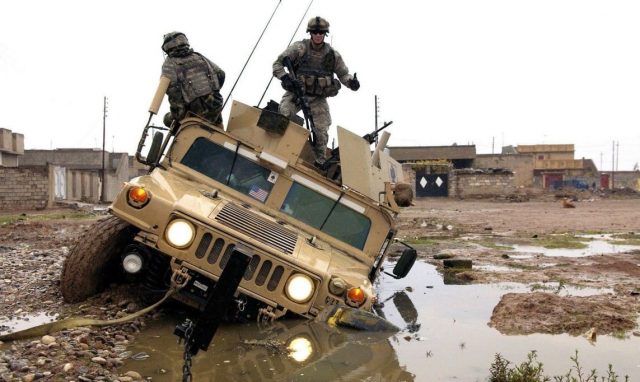
The news that President Trump has halted the CIA program to arm and train rebel groups in Syria should be viewed with caution, as the CIA program only represented half of US involvement in Syria. Even if we take this information as completely accurate, and the CIA will cease to be involved in any covert programs in Syria, there is still a giant arm of US imperialism that is going to be heavily involved in the Syrian conflict for the foreseeable future; namely, the Pentagon.
The notion that the CIA was the only branch of the US establishment involved in the destabilization of Syria is nonsense. The US has always had two operations running simultaneously in Syria, with one being run by the CIA, and other being ran by the Pentagon. As Reuters reported in an article in May of this year, titled: Syrian rebels say U.S., allies sending more arms to fend off Iran threat, military aid has been provided through “two separate channels:”
“Rebels said military aid has been boosted through two separate channels: a program backed by the U.S. Central Intelligence Agency (CIA), known as the MOC, and regional states including Jordan and Saudi Arabia, and one run by the Pentagon.”
These two programs have often clashed, as was the case last year, when militias armed by the CIA fought against militias armed by the Pentagon.
The Pentagon has been as involved in the disastrous operation to arm and train rebels in Syria as the CIA has, and has contributed heavily to the mess on the ground.
In September 2015 for instance, it was reported that a Pentagon-armed group of rebels – named Division 30 – handed over their weapons to al-Qaeda in Syria, a scenario that was a common outcome from many CIA operations as well. The Pentagon, never shy to blow an obscene amount of taxpayers’ money on imperial matters, has already wasted hundreds of millions of dollars training and arming rebels in Syria, yet Trump only wants to increase the US war budget.
Trump: The Man of the Military
Trump’s decision to halt the CIA program was hardly surprising, considering the support Trump has received from large sections of the military. A look at the backgrounds of the individuals that Trump has given cabinet positions reveals Trump’s close relationship with the military.
The Secretary of Homeland Security for instance, John Kelly, is a retired Marine Corps General and former Commander of US Southern Command. Trump’s pick for the Director of the CIA is even more telling, as Mike Pompeo has his roots in the military, graduating from West Point in the 1980s:
“Mr. Pompeo graduated first in his class at the United States Military Academy at West Point in 1986 and served as a cavalry officer patrolling the Iron Curtain before the fall of the Berlin Wall. He also served with the 2nd Squadron, 7th Cavalry in the US Army’s Fourth Infantry Division.”
Undoubtedly, there are many good forces in the US military (as in any other large organization), and there is nothing wrong with having a military background. But equally, there are also many nefarious forces in the military, and the influence of military-industrial complex is pervasive, constantly agitating for more imperial wars.
With this context in mind, it is hardly surprising that Trump favours the Pentagon program over the CIA one, especially considering the power struggle taking place between the CIA and the military within the US. It should be highlighted that Trump has notcompletely halted all US programs to arm and train militias in Syria, he has merely shutdown one channel.
Pentagon Using Kurds to Balkanize Syria
The Pentagon has been heavily involved in arming Kurdish forces in Syria, using them as a tool to attempt to Balkanize and fracture Syria into micro-states. In May of this year, President Trump approved a plan – supported by many in the Pentagon – to arm the People’s Protection Unit (YPG), a Kurdish militia operating predominantly in northern Syria.
The YPG is also the controlling militia in the US-backed Syrian Democratic Forces (SDF), which includes an array of other militias. In addition to providing arms to the YPG, US special forces have been pictured on the ground in northern Syria working in conjunction with YPG fighters.
When most of the public was distracted by the story of Trump halting the CIA program, footage surfaced showing US armed military vehicles passing through Qamishli – a city in northern Syria on the Turkish border – reportedly on route to Raqqa. The recipients of the vehicles are believed to be either the SDF or US forces directly, who are involved in the battle against ISIS in Raqqa.
If (or when) ISIS is defeated in Raqqa, it will be very interesting to see who ends up controlling the city. It is possible that the Pentagon wants to defeat ISIS in Raqqa, and then hand Raqqa to the Kurds – a scenario that many Kurds would only be too happy with. In March of this year, Saleh Muslim, the co-chair of the Syrian Kurdish Democratic Union Party (PYD) – the political affiliate of the YPG – said that once ISIS is defeated in Raqqa, the city should be incorporated into a Kurdish state in northern Syria.
The Pentagon’s support for Kurdish forces is clearly part of a strategy to break the northern part of the country away from control of the Syrian government in Damascus. A subservient Kurdish state in northern Syria (which would probably join with Kurdish zones in Iraq and other countries in the future) would allow the US to have a permanent military presence in Syria, and easy access to the natural resources in the Kurdish region.
The creation of a Kurdish state in northern Syria would of course cause a severe breakdown in relations with NATO member Turkey, given the views of the current Turkish leadership that is. Turkey considers the YPG to be an extension of the Kurdistan Workers Party (PKK), a group Ankara views as a terrorist organization. Turkey has repeatedly denounced US support for Kurdish groups in Syria, with this being a major source of disagreement between the US and Turkey. It is no coincidence that Turkish state media recently published a list of classified US military bases and outposts in northern Syria, with this information revealing the extent to which the US military is embedded in Kurdish-controlled regions in Syria.
The plan to Balkanize Syria is well on its way, and the Pentagon is leading the charge. How Russia positions herself in the coming months will be crucial for the future of Syria.
Turkey Needs Russian S-400 System as Shield Against ‘Western Plan’ in Mideast
Sputnik – 26.07.2017
Russia and Turkey are currently at the final stage of negotiations on the delivery of the Russian-made S-400 missile defense system to Ankara. According to Turkish security expert Abdullah Ağar, the deal indicates a major shift in Turkey’s policy.
Turkish President Recep Tayyip Erdogan said Monday that there is no reason for Washington to be concerned over the Ankara-Moscow talks on the delivery of the S-400 system.
“Why should this be a concern? Each country should take certain measures to ensure its security. How many times have we talked with America, but it did not work out, so like it or not, we began to make plans about the S-400,” Erdogan said at a press conference in Ankara.
The United States recently signaled that Turkey buying the S-400 from Russia would become a major concern for Washington.
“There was a media report that was incorrect. They have not bought the S-400 air defense system from Russia. That would be a concern, were they to do that, but they have not done that,” Chairman of the US Joint Chiefs of Staff Gen. Joseph Dunford said Saturday at a security forum in Colorado.
Earlier, Pentagon chief James Mattis said that the possible deal raises questions about the technical and operational compatibility of the S-400 with NATO’s standards and Turkey would have to explain for itself the choice of the Russian-made weapon.
According to Turkish defense and security expert Abdullah Ağar, the reason behind the concerns of the US is more than the possible S-400 deal and relates to Turkey’s resoluteness to oppose plans that would “threaten Ankara’s territorial integrity.”
“The situation in the region has significantly changed. As for the last three years, Turkey has come to know the threats it faced as well as the actions of its Western partners in this situation. On the one hand, the West works with the Kurdistan Workers’ Party (PKK) and its affiliates in Syria and Iraq. On the other hand, the US and other Western countries support the Gülen movement [FETÖ, designed by Ankara as a terrorist organization] which poses a serious threat to Turkey,” Ağar told Sputnik Turkey.
According to the expert, since the invasion of Iraq in 2003, the West has been implementing a “plan to re-draw the Middle East map,” which resulted in a growing terrorist threat near Turkey’s border, including the rise of Daesh.
“Such a policy may result in new foreign invasions in the region. Turkey needs a new approach to oppose this policy. The delivery of the S-400 is part of a big puzzle,” Ağar pointed out.
At the same time, the situation should not be reduced to arms contracts and should be taken in its connection to shifts in the global geopolitical balance of power.
“There is a trend that may result in a [global power shift] from the US and Europe towards Asia. The West knows it, but continues to support organizations that pose a threat for Turkey. At the same time, the West doesn’t want to lose Turkey. In such a situation, Turkey is looking for the solution to this puzzle,” the expert said.
Ağar also said that the West is losing Ankara’s credibility due to its policy of supporting groups that want to “tear Turkey apart.”
“Of course, Turkey will not stay bound hand and foot. Otherwise, the country will found itself in a big trouble in the future. There is no special reason for Ankara to give credibility to West’s promises,” the expert said.
Furthermore, Ağar underscored that Ankara was not allowed to deploy US-made Patriot missile defense systems and as a result Ankara decided to focus on cooperation with Russia.
“The S-400 [deal] is part of a bigger picture of [Russia-Turkey] bilateral cooperation in various fields, primarily energy and security. The supplies of the S-400 are a sign that Turkey is drifting away from the Western world,” the expert concluded.
The negotiations on the matter between Russia and Turkey have taken place since 2016. In March, Sergei Chemezov, CEO of Russia’s Rostec Corporation, said Ankara was ready to buy the S-400 systems with a loan granted by Moscow. On July 18, Chemezov said technical issues of the contract for the supply of the S-400 systems to Turkey had been resolved, with only administrative ones remaining.
The S-400 Triumph is a next-generation mobile surface-to-air missile system that can carry three different types of missiles capable of destroying aerial targets at a short-to-extremely-long range. It is designed to track and destroy various types of aerial targets, from reconnaissance aircraft to ballistic missiles.
As of today, Russia has a deal on supplying the system only with China. In addition to Turkey, talks are also underway with India.
The Myth of the Kurdish YPG’s Moral Excellence
By Stephen Gowans | what’s left | July 11, 2017
A barbed criticism aimed at the International Socialist Organization, shown nearby, under the heading “If the ISO Existed in 1865” encompasses a truth about the orientation of large parts of the Western Left to the Arab nationalist government in Damascus. The truth revealed in the graphic is that the ISO and its cognates will leave no stone unturned in their search for an indigenous Syrian force to support that has taken up arms against Damascus, even to the point of insisting that a group worthy of support must surely exist, even if it can’t be identified.
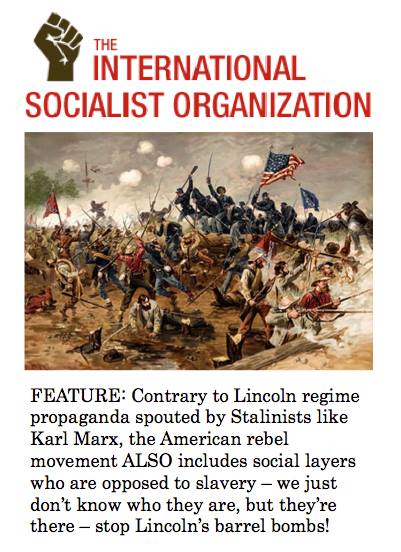
If the ISO existed in 1865.
Of course, Washington lends a hand, helpfully denominating its proxies in the most laudatory terms. Islamist insurgents in Syria, mainly Al Qaeda, were not too many years ago celebrated as a pro-democracy movement, and when that deception proved no longer tenable, as moderates.
Now that the so-called moderates have been exposed as the very opposite, many Leftists cling to the hope that amid the Islamist opponents of Syria’s secular, Arab socialist, government, can be found votaries of the enlightenment values Damascus already embraces. Surely somewhere there exist armed anti-government secular Leftists to rally behind; for it appears that the goal is to find a reason, any reason, no matter how tenuous, to create a nimbus of moral excellence around some group that opposes with arms the government in Damascus; some group that can be made to appear to be non-sectarian, anti-imperialist, socialist, committed to the rights of women and minorities, and pro-Palestinian; in other words, a group just like Syria’s Ba’ath Arab Socialists, except not them.
Stepping forward to fulfill that hope is the PKK, an anarchist guerrilla group demonized as a terrorist organization when operating in Turkey against a US ally, but which goes by the name of the YPG in Syria, where it is the principal component of the lionized “Syrian Democratic Force.” So appealing is the YPG to many Western Leftists that some have gone so far as to volunteer to fight in its units. But is the YPG the great hope it’s believed it to be?
Kurds in Syria
It’s difficult to determine with precision how many Kurds are in Syria, but it’s clear that the ethnic group comprises only a small percentage of the Syrian population (less than 10 percent according to the CIA, and 8.5 percent according to an estimate cited by Nikolaos Van Dam in his book The Struggle for Power in Syria. [1]
Estimates of the proportion of the total Kurd population living in Syria vary from two to seven percent based on population figures presented in the CIA World Factbook. Half of the Kurd community lives in Turkey, 28 percent in Iran and 20 percent in Iraq. A declassified 1972 US State Department report estimated that only between four and five percent of the world’s Kurds lived in Syria [2].
While the estimates are rough, it’s clear that Kurds make up a fairly small proportion of the Syrian population and that the number of the group’s members living in Syria as a proportion of the Kurd community as a whole is very small.

The PKK
Kurdish fighters in Syria operate under the name of the YPG, which is “tied to the Kurdistan Workers’ Party, or PKK, a radical guerrilla movement combining [anarchist ideas] with Kurdish nationalism. PKK guerrillas [have] fought the Turkish state from 1978” and the PKK is “classified as a terrorist organization by the European Union, Turkey and the U.S.” [3]
Cemil Bayik is the top field commander of both the PKK in Turkey and of its Syrian incarnation, the YPG. Bayik “heads the PKK umbrella organization, the KCK, which unites PKK affiliates in different countries. All follow the same leader, Abdullah Ocalan, who has been in prison in Turkey” [4] since 1999, when he was apprehended by Turkish authorities with CIA assistance.
Ocalan “was once a devotee of Marxism-Leninism,” according to Carne Ross, who wrote a profile of the Kurdish nationalist leader in The Financial Times in 2015. But Ocalan “came to believe that, like capitalism, communism perforce relied upon coercion.” Imprisoned on an island in the Sea of Marmara, Ocalan discovered “the masterwork of a New York political thinker named Murray Bookchin.” Bookchin “believed that true democracy could only prosper when decision-making belonged to the local community and was not monopolized by distant and unaccountable elites.” Government was desirable, reasoned Bookchin, but decision-making needed to be decentralized and inclusive. While anarchist, Bookchin preferred to call his approach “communalism”. Ocalan adapted Bookchin’s ideas to Kurd nationalism, branding the new philosophy “democratic confederalism.” [5]
Labor Zionism has similar ideas about a political system based on decentralized communes, but is, at its core, a nationalist movement. Similarly, Ocalan’s views cannot be understood outside the framework of Kurdish nationalism. The PKK may embrace beautiful utopian goals of democratic confederalism but it is, at its heart, an organization dedicated to establishing Kurdish self-rule—and, as it turns out, not only on traditionally Kurdish territory, but on Arab territory, as well, making the parallel with Labour Zionism all the stronger. In both Syria and Iraq, Kurdish fighters have used the campaign against ISIS as an opportunity to extend Kurdistan into traditionally Arab territories in which Kurds have never been in the majority.
The PKK’s goal, writes The Wall Street Journal’s Sam Dagher, “is a confederation of self-rule Kurdish-led enclaves in Iran, Iraq, Syria and Turkey” [6] countries in which Kurdish populations have a presence, though, as we’ve seen, an insignificant one in Syria. In pursuit of this goal “as many as 5,000 Syrian Kurds have died fighting alongside the PKK since the mid-1980s, and nearly all of YPG’s top leaders and battle-hardened fighters are veterans of the decades-long struggle against Turkey.” [7]
In Syria, the PKK’s goal “is to establish a self-ruled region in northern Syria,” [8] an area with a significant Arab population.
When PKK fighters cross the border into Turkey, they become ‘terrorists’, according to the United States and European Union, but when they cross back into Syria they are miraculously transformed into ‘guerrilla” fighters waging a war for democracy as the principal component of the Syrian Democratic Force. The reality is, however, that whether on the Turkish or Syrian side of the border, the PKK uses the same methods, pursues the same goals, and relies largely on the same personnel. The YPG is the PKK.
An Opportunity
Washington has long wanted to oust the Arab nationalists in Syria, regarding them as “a focus of Arab nationalist struggle against an American regional presence and interests,” as Amos Ma’oz once put it. The Arab nationalists, particularly the Ba’ath Arab Socialist party, in power since 1963, represent too many things Washington deplores: socialism, Arab nationalism, anti-imperialism, and anti-Zionism. Washington denounced Hafez al-Assad, president of Syria from 1970 to 2000, as an Arab communist, and regards his son, Bashar, who succeeded him as president, as little different. Bashar, the State Department complains, hasn’t allowed the Syrian economy—based on Soviet models, its researchers say—to be integrated into the US-superintended global economy. Plus, Washington harbors grievances about Damascus’s support for Hezbollah and the Palestinian national liberation movement.
US planners decided to eliminate Asia’s Arab nationalists by invading their countries, first Iraq, in 2003, which, like Syria, was led by the Ba’ath Arab Socialists, and then Syria. However, the Pentagon soon discovered that its resources were strained by resistance to its occupations of Afghanistan and Iraq, and that an invasion of Syria was out of the question. As an alternative, Washington immediately initiated a campaign of economic warfare against Syria. That campaign, still in effect 14 years later, would eventually buckle the economy and prevent Damascus from providing education, health care and other essential services in some parts of the country. At the same time, Washington took steps to reignite the long-running holy war that Syria’s Islamists had waged on the secular state, dating to the 1960s and culminating in the bloody takeover of Hama, Syria’s fourth largest city, in 1982. Beginning in 2006, Washington worked with Syria’s Muslim Brotherhood to rekindle the Brother’s jihad against Assad’s secular government. The Brothers had two meetings at the White House, and met frequently with the State Department and National Security Council.
The outbreak of Islamist violence in March of 2011 was greeted by the PKK as an opportunity. As The Wall Street Journal’s Yaroslav Trofimov recounts, “The PKK, once an ally of… Damascus… had long been present among Kurdish communities in northern Syria. When the revolutionary tide reached Syria, the group’s Syrian affiliate quickly seized control of three Kurdish-majority regions along the Turkish frontier. PKK fighters and weapons streamed there from other parts of Kurdistan.”[9] The “Syrian Kurds,” wrote Trofimov’s colleagues, Joe Parkinson and Ayla Albayrak, viewed “the civil war as an opportunity to carve out a self-governing enclave—similar to the one established by their ethnic kin in neighboring Iraq.” [10] That enclave, long backed by the United States and Israel, was seen as a means of weakening the Iraqi state.
Damascus facilitated the PKK take-over by withdrawing its troops from Kurdish-dominated areas. The Middle East specialist Patrick Seale, who wrote that the Kurds had “seized the opportunity” of the chaos engendered by the Islamist uprising “to boost their own political agenda” [11] speculated that the Syrian government’s aims in pulling back from Kurd-majority areas was to redirect “troops for the defence of Damascus and Aleppo;” punish Turkey for its support of Islamist insurgents; and “to conciliate the Kurds, so as to dissuade them from joining the rebels.” [12] The PKK, as it turns out, didn’t join the Islamist insurgents, as Damascus hoped. But they did join a more significant part of the opposition to Arab nationalist Syria: the puppet master itself, the United States.
By 2014, the PKK had “declared three self-rule administrations, or cantons as they call them, in northern Syria: Afreen, in the northwest, near the city of Aleppo; Kobani; and Jazeera in the northeast, which encompasses Ras al-Ain and the city of Qamishli. Their goal [was] to connect all three.” [13] This would mean controlling the intervening spaces occupied by Arabs.
A Deal with Washington
At this point, the PKK decided that its political goals might best be served by striking a deal with Washington.
The State Department had “allowed for the possibility of a form of decentralization in which different groups” — the Kurds, the secular government, and the Islamist insurgents — each received some autonomy within Syria. [14] Notice the implicit assumption in this view that it is within Washington’s purview to grant autonomy within Syria, while the question of whether the country ought to decentralize, properly within the democratic ambit of Syrians themselves, is denied to the people who live and work in Syria. If we are to take seriously Ocalan’s Bookchin-inspired ideas about investing decision-making authority in the people, this anti-democratic abomination can hardly be tolerated.
All the same, the PKK was excited by the US idea of dividing “Syria into zones roughly corresponding to areas now held by the government, the Islamic State, Kurdish militias and other insurgents.” A “federal system” would be established, “not only for Kurdish-majority areas but for all of Syria.” A Kurd federal region would be created “on all the territory now held by the” PKK. The zone would expand to include territory the Kurds hoped “to capture in battle, not only from ISIS but also from other Arab insurgent groups.” [15]
The PKK “pressed U.S. officials” to act on the scheme, pledging to act as a ground force against ISIS in return. [16] The group said it was “eager to join the U.S.-led coalition against Islamic State in return for recognition and support from Washington and its allies for the Kurdish-dominated self-rule administrations they [had] established in northern Syria.” [17]
The only people pleased with this plan were the PKK, the Israelis and the Americans.
“US support for these Kurdish groups” not only in Syria, but in Iraq, where the Kurds were also exploiting the battle with ISIS to expand their rule into traditionally Arab areas, helped “to both divide Syria and divide Iraq,” wrote The Independent’s veteran Middle East correspondent Robert Fisk. [18] Division redounded to the benefit of the United States and Israel, both of which have an interest in pursuing a divide and rule policy to exercise a joint hegemony over the Arab world. Patrick Seale remarked that the US-Kurd plan for Kurdish rule in northern Syria had been met by “quiet jubilation in Israel, which has long had a semi-clandestine relationship with the Kurds, and welcomes any development which might weaken or dismember Syria.” [19]
For their part, the Turks objected, perceiving that Washington had agreed to give the PKK a state in all of northern Syria. [20] Meanwhile, Damascus opposed the plan, “seeing it as a step toward a permanent division of the nation.” [21]
Modern-day Syria, it should be recalled, is already the product of a division of Greater Syria at the hands of the British and French, who partitioned the country into Lebanon, Palestine, Transjordan, and what is now Syria. In March, 1920, the second Syrian General Congress proclaimed “Syria to be completely independent within her ‘natural’ boundaries, including Lebanon and Palestine.” Concurrently “an Arab delegation in Palestine confronted the British military governor with a resolution opposing Zionism and petitioning to become part of an independent Syria.” [22] France sent its Army of the Levant, mainly troops recruited from its Senegalese colony, to quash by force the Levantine Arabs’ efforts to establish self-rule.
Syria, already truncated by British and French imperial machinations after WWI “is too small for a federal state,” opines Syria’s president Bashar al-Assad. But Assad quickly adds that his personal view is irrelevant; a question as weighty as whether Syria ought to become a federal or confederal or unitary state, he says, is a matter for Syrians to decide in a constitutional referendum, [23] a refreshingly democratic view in contrast to the Western position that Washington should dictate how Syrians arrange their political (and economic) affairs.
Tip of the US Spear
For Washington, the PKK offers a benefit additional to the Kurdish guerrilla group’s utility in advancing the US goal of weakening Syria by fracturing it, namely, the PKK can be pressed into service as a surrogate for the US Army, obviating the necessity of deploying tens of thousands of US troops to Syria, and thereby allowing the White House and Pentagon to side-step a number of legal, budgetary and public relations quandaries. “The situation underscores a critical challenge the Pentagon faces,” wrote The Wall Street Journal’s Paul Sonne; namely, “backing local forces… instead of putting American troops at the tip of the spear.” [24]
Having pledged support for Kurdish rule of northern Syria in return for the PKK becoming the tip of the US spear, the United States is “providing “small arms, ammunition and machine guns, and possibly some nonlethal assistance, such as light trucks, to the Kurdish forces.” [25]
The arms are “parceled out” in a so called “drop, op, and assess” approach. The shipments are “dropped, an operation [is] performed, and the U.S. [assesses] the success of that mission before providing more arms.” Said a US official, “We will be supplying them only with enough arms and ammo to accomplish each interim objective.” [26]
PKK foot soldiers are backed by “more than 750 U.S. Marines,” Army Rangers, and US, French and German Special Forces, “using helicopters, artillery and airstrikes,” the Western marionette-masters in Syria illegally, in contravention of international law. [27]
Ethnic Cleansing
“Large numbers of Arab residents populate the regions Kurds designate as their own.” [28] The PKK has taken “over a large swath of territory across northern Syria—including predominantly Arab cities and towns.” [29] Raqqa, and surrounding parts of the Euphrates Valley on which the PKK has set its sights, are mainly populated by Arabs, observes The Independent’s veteran foreign correspondent Patrick Cockburn—and the Arabs are opposed to Kurdish occupation. [30]
Kurdish forces are not only “retaking” Christian and Muslim Arab towns in Syria, but are doing the same in the Nineveh province of Iraq—areas “which were never Kurdish in the first place. Kurds now regard Qamishleh, and Hassakeh province in Syria as part of ‘Kurdistan’, although they represent a minority in many of these areas.” [31]
The PKK now controls 20,000 square miles of Syrian territory [32], or roughly 17 percent of the country, while Kurds represent less than eight percent of the population.
In their efforts to create a Kurdish region inside Syria, the PKK “has been accused of abuses by Arab civilians across northern Syria, including arbitrary arrests and displacing Arab populations in the name of rolling back Islamic State.” [33] The PKK “has expelled Arabs and ethnic Turkmen from large parts of northern Syria,” reports The Wall Street Journal. [34] The Journal additionally notes that human rights “groups have accused [Syrian and Iraqi Kurdish fighters] of preventing Arabs from returning to liberated areas.” [35]
Neither Syrian nor Democratic
The PKK dominates the Syrian Democratic Forces, a misnomer conferred upon a group of mainly Kurdish fighters by its US patron. The group is not Syrian, since many of its members are non-Syrians who identify as Kurds and who flooded over the border from Turkey to take advantage of the chaos produced by the Islamist insurgency in Syria to carve out an area of Kurdish control. Nor is the group particularly democratic, since it seeks to impose Kurdish rule on Arab populations. Robert Fisk dismisses the “Syrian Democratic Forces” as a “facade-name for large numbers of Kurds and a few Arab fighters.” [36]
The PKK poses as a Syrian Democratic Force, and works with a token force of Syrian Arab fighters, to disguise the reality that the Arab populated areas it controls, and those it has yet to capture, fall under Kurd occupation.
A De Facto (and Illegal) No Fly Zone
In August, 2016, after “Syrian government bombers had been striking Kurdish positions near the city of Hasakah, where the U.S. [had] been backing Kurdish forces” the Pentagon scrambled “jets to protect them. The U.S. jets arrived just as the two Syrian government Su-24 bombers were departing.” This “prompted the U.S.-led coalition to begin patrolling the airspace over Hasakah, and led to another incident… in which two Syrian Su-24 bombers attempted to fly through the area but were met by coalition fighter jets.” [37]
The Pentagon “warned the Syrians to stay away. American F-22 fighter jets drove home the message by patrolling the area.” [38]
The New York Times observed that in using “airpower to safeguard areas of northern Syria where American advisers” direct PKK fighters that the United States had effectively established a no-fly zone over the area, but noted that “the Pentagon has steadfastly refused to” use the term. [39] Still, the reality is that the Pentagon has illegally established a de facto no-fly zone over northern Syria to protect PKK guerillas, the tip of the US spear, who are engaged in a campaign of creating a partition of Syria, including through ethnic cleansing of the Arab population, to the delight of Israel and in accordance with US designs to weaken Arab nationalism in Damascus.
An Astigmatic Analogy
Some find a parallel in the YPG’s alliance with the United States with Lenin accepting German aid to return from exile in Switzerland to Russia following the 1917 March Revolution. The analogy is inapt. Lenin was playing one imperialist power off against another. Syria is hardly an analogue of Imperial Russia, which, one hundred years ago, was locked in a struggle for markets, resources, and spheres of influence with contending empires. In contrast, Syria is and has always been a country partitioned, dominated, exploited and threatened by empires. It has been emancipated from colonialism, and is carrying on a struggle—now against the contrary efforts of the PKK—to resist its recolonization.
The PKK has struck a bargain with the United States to achieve its goal of establishing a Kurdish national state, but at the expense of Syria’s efforts to safeguard its independence from a decades-long US effort to deny it. The partition of Syria along ethno-sectarian lines, desired by the PKK, Washington and Tel Aviv alike, serves both US and Israeli goals of weakening a focus of opposition to the Zionist project and US domination of West Asia.
A more fitting analogy, equates the PKK in Syria to Labor Zionism, the dominant Zionist force in occupied Palestine until the late 1970s. Like Ocalan, early Zionism emphasized decentralized communes. The kibbutzim were utopian communities, whose roots lay in socialism. Like the PKK’s Syrian incarnation, Labor Zionism relied on sponsorship by imperialist powers, securing their patronage by offering to act as the tips of the imperialists’ spears in the Arab world. Zionists employed armed conquest of Arab territory, along with ethnic cleansing and denial of repatriation, to establish an ethnic state, anticipating the PKK’s extension by armed force of the domain of a Kurdish state into Arab majority territory in Syria, as well as Kurd fighters doing the same in Iraq. Anarchists and other leftists may have been inspired by Jewish collective agricultural communities in Palestine, but that hardly made the Zionist project progressive or emancipatory, since its progressive and emancipatory elements were negated by its regressive oppression and dispossession of the indigenous Arab population, and its collusion with Western imperialism against the Arab world.
Conclusion
Representing an ethnic community that comprises less than 10 percent of the Syrian population, the PKK, a Kurdish anarchist guerrilla group which operates in both Turkey and Syria, is using the United States, its Air Force, Marine Corps, Army Rangers and Special Forces troops, as a force multiplier in an effort to impose a partition of Syria in which the numerically insignificant Kurd population controls a significant part of Syria’s territory, including areas inhabited by Arabs in the majority and in which Kurds have never been in the majority. To accomplish its aims, the PKK has not only struck a deal with a despotic regime in Washington which seeks to recolonize the Arab world, but is relying on ethnic cleansing and denial of repatriation of Arabs from regions from which they’ve fled or have been driven to establish Kurdish control of northern Syria, tactics which parallel those used by Zionist forces in 1948 to create a Jewish state in Arab-majority Palestine. Washington and Israel (the latter having long maintained a semi-clandestine relationship with the Kurds) value a confederal system for Syria as a means of weakening Arab nationalist influence in Arab Asia, undermining a pole of opposition to Zionism, colonialism, and the international dictatorship of the United States. Forces which resist dictatorship, including the most odious one of all, that of the United States over much of the world, are the real champions of democracy, a category to which the PKK, as evidenced by its actions in Syria, does not belong.
1. Nikolaos Van Dam, The Struggle for Power in Syria: Politics and Society under Assad and the Ba’ath Party, IB Taurus, 2011, p.1.
2. “The Kurds of Iraq: Renewed Insurgency?”, US Department of State, May 31, 1972, https://2001-2009.state.gove/documents/organization/70896.pdf
3. Sam Dagher, “Kurds fight Islamic State to claim a piece of Syria,” The Wall Street Journal, November 12, 2014.
4. Patrick Cockburn, “War against ISIS: PKK commander tasked with the defence of Syrian Kurds claims ‘we will save Kobani’”, The Independent, November 11, 2014.
5. Carne Ross, “Power to the people: A Syrian experiment in democracy,” Financial Times, October 23, 2015.
6. Dagher, November 12, 2014.
7. Dagher, November 12, 2014.
8. Dagher, November 12, 2014.
9. Yaroslav Trofimov, “The State of the Kurds,” The Wall Street Journal, June 19, 2015.
10. Joe Parkinson and Ayla Albayrak, “Syrian Kurds grow more assertive”, The Wall Street Journal, November 15, 2013.
11. Patrick Seale, “Al Assad uses Kurds to fan regional tensions”, Gulf News, August 2, 2012.
12. Seale, August 2, 2012.
13. Dagher, November 12, 2014.
14. David E. Sanger, “Legacy of a secret pact haunts efforts to end war in Syria,” the New York Times, May 16, 2016.
15. Anne Barnard, “Syrian Kurds hope to establish a federal region in country’s north,” The New York Times, March 16, 2016.
16. Dagher, November 12, 2014.
17. Dagher, November 12, 2014.
18. Robert Fisk, “This is the aim of Donald Trump’s visit to Saudi Arabia – and it isn’t good for Shia communities,” The Independent, May 18, 2017.
19. Seale, August 2, 2012.
20. Yaroslav Trofimov, “U.S. is caught between ally Turkey and Kurdish partner in Syria,” The Wall Street Journal, May 4, 2017.
21. Anne Barnard, “Syrian Kurds hope to establish a federal region in country’s north,” The New York Times, March 16, 2016.
22. David Fromkin, A Peace to End All Peace: The Fall of the Ottoman Empire and the Creation of the Modern Middle East, Henry Holt & Company, 2009, p. 437.
23. “President al-Assad to RIA Novosti and Sputnik: Syria is not prepared for federalism,” SANA, March 30, 2016.
24. Paul Sonne, “U.S. seeks Sunni forces to take militant hub,” The Wall Street Journal, April 29, 2016.
25. Dion Nissenbaum, Gordon Lubold and Julian E. Barnes, “Trump set to arm Kurds in ISIS fight, angering Turkey,” The Wall Street Journal, May 9, 2017.
26. Nissenbaum et al, May 9, 2017.
27. Dion Nissenbaum and Maria Abi-Habib, “Syria’s newest flashpoint is bringing US and Iran face to face,” The Wall Street Journal, June 15, 2017; “Syria condemns presence of French and German special forces in Ain al-Arab and Manbij as overt unjustified aggression on Syria’s sovereignty and independence,” SANA, June 15, 2016; Michael R. Gordon. “U.S. is sending 400 more troops to Syria.” The New York Times. March 9, 2017.
28. Matt Bradley, Ayla Albayrak, and Dana Ballout, “Kurds declare ‘federal region’ in Syria, says official,” The Wall Street Journal, March 17, 2016.
29. Maria Abi-Habib and Raja Abdulrahim, “Kurd-led force homes in on ISIS bastion with assent of U.S. and Syria alike,” The Wall Street Journal, May 11, 2017.
30. Patrick Cockburn, “Battle for Raqqa: Fighters begin offensive to push Isis out of Old City,” The Independent, July 7, 2017.
31. Robert Fisk, “This is the aim of Donald Trump’s visit to Saudi Arabia – and it isn’t good for Shia communities,” The Independent, May 18, 2017.
32. Dion Nissenbaum and Maria Abi-Habib, “U.S. split over plan to take Raqqa from Islamic state,” The Wall Street Journal. March 9, 2017.
33. Raja Abdulrahim, Maria Abi_Habin and Dion J. Nissenbaum, “U.S.-backed forces in Syria launch offensive to seize ISIS stronghold Raqqa,” The Wall Street Journal, November 6, 2016.
34. Margherita Stancati and Alia A. Nabhan, “During Mosul offensive, Kurdish fighters clear Arab village, demolish homes,” The Wall Street Journal, November 14, 2016.
35. Matt Bradley, Ayla Albayrak, and Dana Ballout, “Kurds declare ‘federal region’ in Syria, says official,” The Wall Street Journal, March 17, 2016.
36. Robert Fisk, “The US seems keener to strike at Syria’s Assad than it does to destroy ISIS,” The Independent, June 20, 2017.
37. Paul Sonne and Raja Abdulrahim, “Pentagon warns Assad regime to avoid action near U.S. and allied forces,” The Wall Street Journal, August 19, 2016.
38. Michael R. Gordon and Neil MacFarquhar, “U.S. election cycle offers Kremlin a window of opportunity in Syria,” The New York Times, October 4, 2016.
39. Michael R. Gordon and Neil MacFarquhar, “U.S. election cycle offers Kremlin a window of opportunity in Syria,” The New York Times, October 4, 2016.
Featured Video
Houthis Keep Advancing as the Red Sea Crisis Deepens
or go to
Aletho News Archives – Video-Images
From the Archives
Clash of Civilization, Iran Part II
By Jamal Kanj – Intifada-Palestine.com – January 14, 2011
Israel’s survival kit is: perpetuate conflict, insecurity to rationalize collective hate and finally playing victim.
Devoid of conflict, Israel implodes internally; without hate, Zionism loses its justification; and playing eternal victim to continue blackmailing the West. Absence of this holy trinity, Israel ceases to exist. … continue
Blog Roll
 Aletho News
- ‘We are not like everyone else’ laws that bind other nations do not apply to Israel, says Likud lawmaker
- Report: Saudi Arabia seeks allies’ assistance as missiles deplete amid war on Yemen
- Fuel Crisis Deepens: Pakistan Warns Tanker Attack in Red Sea Would Be an ‘Act of War’
- ‘Bucha massacre’ a false flag orchestrated by UK – Moscow
- China Rejects Outside Pressure on Trade Ties After New US Russia Sanctions Bill
- Houthis Keep Advancing as the Red Sea Crisis Deepens
- Iran spent $1 million to wipe out $30 billion in data center plans, and take down Amazon in the ME
- Zionist billionaire pressure to silence Macklemore sparks exodus from Ed Sheeran tour
- House Votes to End Iran War for Third Time
- North Korea Slams US Plan for ‘AUKUS 2.0’ with South Korea and Japan
- If Americans Knew
- Biden’s Genocide Accomplices Targeted by New Accountability Campaign
- AIPAC’s Network Has Already Spent $67.2 Million to Shape the Midterm Elections
- Jewish Supremacist Manufacturing a Civilizational Threat to License Bigotry
- US bans Palestinian president from speaking at the UN
- Israeli Forces Detain Journalist Alaa al-Rimawi amid Widespread West Bank Raids
- Even a pro-Israel Congress member has put a hold on 40,000 one-ton bombs to Israel
- As Gaza crumbles, Israel preps new ground invasion – Daily Update
- ‘We are not like everyone else’ laws that bind other nations do not apply to Israel, says Likud lawmaker
- Trump’s govt makes ‘treasonous’ claim of weapons shortages
- Palestinian-American Journalist Naqaa Hamed Imprisoned by Israeli Forces After Settlers Targeted Her
- No Tricks Zone
- New Study: ‘Global Drought Shows No Detectable Recent Acceleration Under Climate Warming’
- Economic Masterminds: German Socialists Suggest Taxing Productivity Gains Stemming From Using AI
- The South China Sea Has Not Been Cooperating With The Climate Change Narrative
- Energy Crisis: Germany Enters Heating Season With Historically Low Gas Reserve Fill Levels
- New Study: The Antarctic Ice Sheet Gained Mass From 2020-2024 Due To Staggering Snow And Ice Accumulation
- Study: Ocean Heating Rates From Thousands Of Years Ago ‘Dwarf’ Modern Ocean Heating Rates
- Climate Extremists Target, Attack Large-Scale Power Grid Infrastructure In Germany!
- New Study: Antarctic Ice Melt Has Contributed Less Than 1 Centimeter To Sea Level Rise In The Last 30 Years
- Fear Of Debate: Alarmist German Climate Scientist Calls On Mainstream Media To Discredit Skeptic Voices
- End-Of-August Arctic Sea Ice Extent Hasn’t Fallen In 20 Years, Official Data Show!
 Aletho News