Syrian endgame is nigh as rival factions look to cut deals
Three cities – Deir ez-Zour, al-Raqqa, and Idlib – will define how the country shapes up post-ISIS, as key players edge towards under-the-table agreements
By Sami Moubayed | Asia Times | October 17, 2017
Over the weekend, Moscow hosted Sipan Hamo, commander of the powerful all-Kurdish Syrian Democratic Forces (SDF), the last standing US-backed militia on the Syrian battlefield. It was the most senior visit by a Kurdish military official to Moscow since the Russian Army joined the Syrian War in 2015.
Hamo met with Russian Defense Minister Sergey Shoygu and Chief-of-Staff Valeria Gerasimov to discuss the future of Deir ez-Zour and al-Raqqa, two cities along the Euphrates River which – at time of writing – appear to be in their final hours of control by Islamic State (ISIS).
At the same time, Turkish troops crossed the border into Syria, with the blessing of Russia and Iran, deploying in the northwest city of Idlib, which remains, for now, in the hands of Hayat Tahrir al-Sham (HTS), an al-Qaeda-linked terrorist organization previously known as Jabhat Fateh al-Sham, or Jabhat al-Nusra.
These three cities –Deir ez-Zour, al-Raqqa, and Idlib – will define what the Syrian endgame looks like. Invisible borders are being created around them, outlining each stakeholder’s share of the Syrian patchwork. Contrary to what many presume, very little fighting is now taking place on the streets of Syria, as under-the-table deals are being cut between traditional enemies who, until very recently, were at daggers drawn with each other.
Deir ez-Zour, the largest of these three contested cities, has been under brutal ISIS control since 2014. Government troops have been advancing on the oil-rich city, which lies east of the Euphrates, marching deep into territory once believed to be part of the country’s US/Kurdish fiefdom.
Opposition sources say government troops, with Russian air cover, will only be taking Deir ez-Zour City and not the entire province, arguing that everything around it, including farmland and oil wells, has been earmarked for the SDF. The exact parameters of these borders is what Hamo wanted to discuss in Moscow.
Reportedly, he pressed for a commitment from the Russians not to confront his troops in the Deir ez-Zour countryside, while promising to stop short of al-Sukhna, the last ISIS stronghold in the Homs Governorate, and leave the honors of its liberation to the Syrian and Russian Armies. On October 7, he and his men had stood by and watched government troops overrun ISIS strongholds in the city of al-Mayadeen, in the countryside of Deir ez-Zour — a job that until recently, would have been left to the SDF.
In exchange for such cooperation, the SDF is seeking Russian guarantees that the Turkish Army will not march on the Kurdish city of Afrin, west of the Euphrates River. Kurdish leaders are panicking after Turkish troops plunged into Idlib over the weekend, seemingly to implement part of the de-conflict zone agreement reached at the Astana ceasefire talks in May. Afrin lies within the Russian pocket of influence in Syria, and the Turks are trying to win control of the summit of Sheikh Mount Barakat, which overlooks it. A former radar post for the Syrian Army, it would give Erdogan’s forces a birds-eye view of Afrin. Moscow agreed to give Hamo the specific guarantee he asked for.
Meanwhile, the Turks are cutting their own deals in Idlib – with the militant jihadist group Hayat Tahrir al-Sham. Instead of bankrolling a new proxy army of Syrian recruits, or sending its own troops to battle, Ankara is trying to reach a political understanding with HTS, calling for its silent evacuation from Idlib and safe passage to the countryside of Deir ez-Zour.
On October 8, HTS militants escorted a Turkish reconnaissance unit into Idlib. This was followed by no fewer than three meetings between Turkish officials and HTS commanders, raising eyebrows among the Syrian Opposition. This is the very same group that the Turks have been mandated to crush, but which many believe they helped to create early in the Syrian conflict five years ago.
In exchange for safe exodus, Turkey wants HTS to withdraw quietly from Atme, north of Idlib and east of the Turkish border, through Darat Izzat (30 km northwest of Aleppo), all the way to Anadan, on the Aleppo-Gazientap International Highway. This would further secure the Turkish border from any Kurdish advancements, and create a new buffer zone in which to relocate Syrian refugees living in Turkey since 2011. It would also enlarge Turkey’s zone of influence in Syria, which already includes the two border cities of Jarablus and Azaz, and that of al-Bab, 40km northeast of Aleppo.
Similar secret deals are also being cut between the SDF and ISIS in al-Raqqa, where the jihadists have been on the defensive since the Kurdish campaign started last June.
The city has been subjected to a horrific aerial bombardment by the US-led Coalition, believed to be one of the worst in modern history. Within days, however, al-Raqqa will be liberated fully from ISIS control, bringing an end, once and for all, to the myth of the “capital” of the Islamic State.
Only 120 fighters are left in al-Raqqa, stranded in a pass of just 1.5 km, and all of them are foreign fighters. All local Syrian ISIS fighters were evacuated through secret agreement with the SDF on the night of October 6-7, disguised as ordinary civilians. The agreement with ISIS basically allows local Syrians to jump ship, distancing themselves from the terror group that captured their hearts and minds back in 2014. In exchange for handing back al-Raqqa, these Syrian fighters might even get a free pass to return to ordinary life, if they help eliminate what remains of foreign fighters inside still inside the city.
Syria demands ‘immediate, unconditional’ pullout of Turkish troops from Idlib
Press TV – October 14, 2017
The Syrian government has strongly denounced an incursion of Turkish military forces into the country’s militant-held northwestern province of Idlib, demanding “immediate and unconditional” withdrawal of Turkish troops from the war-ravaged Arab country.
“The Syrian Arab Republic condemns in the strongest terms the incursion of Turkish military units in[to] … Idlib province, which constitutes … blatant aggression against the sovereignty and territorial integrity of Syria and flagrant violation of international law,” an unnamed official source at the Ministry of Foreign Affairs and Expatriates told Syria’s official news agency, SANA, on Saturday.
“The Syrian Arab Republic demands … immediate and unconditional withdrawal of Turkish troops from the Syrian territory,” the source added.
The source further described Ankara’s military incursion as an act of “aggression” which “the Turkish regime can’t justify in any way.”
He also dismissed Turkey’s attempts to link the move to the implementation of the Astana agreements with Iran and Russia on the creation of de-escalation zones in Syria, terming it a “departure” from the deal.
Late on Thursday, Turkey deployed a convoy of around 30 military vehicles to Idlib province.
The Turkish forces entered Syria near the Bab al-Hawa border crossing, and headed to Shaykh Barakat hilltop, which overlooks lands controlled by foreign-sponsored Takfiri militants as well as Afrin area held by US-backed militiamen from the Kurdish People’s Protection Units (YPG).
Idlib and swaths of land in Syria’s northern and northwestern regions are largely controlled by members of Tahrir al-Sham militant group.
Turkish President Recep Tayyip Erdogan has said his country’s military operations in Idlib are the follow-up of the Euphrates Shield operation in northern Syria, which Ankara launched in August last year without any authorization from Damascus.
Ankara said back then that the main objectives behind the operation were clearing Turkey’s southern border of the Daesh Takfiri terrorist group and stopping the YPG from gaining more sway there.
Ankara views the YPG as the Syrian branch of the Kurdistan Workers’ Party (PKK) militant group, which has been fighting for an autonomous region inside Turkey since 1984.
US, Turkey suspend visa services amid arrested employee row
DAILY SABAH | October 8, 2017
The U.S. embassy in Ankara said Sunday that all non-immigrant visa services in its diplomatic facilities in Turkey were suspended after the arrest of one of its employees over the Gülenist Terror Group (FETÖ) ties.
A statement released by the embassy said: “Recent events have forced the U.S. government to reassess the commitment of the Government of Turkey to the security of the U.S. Mission facilities and personnel.”
The statement said the suspension, effective immediately, is intended to minimize the number of visitors to the consulate and embassy buildings.
Hours after the U.S. decision, Turkey said it has halted processing visa applications from the U.S. The move, announced online by the Turkish embassy in Washington, applies to visas in passports, electronic visas and visas at the borders, and is also effective immediately.
Metin Topuz, a Turkish employee working in the U.S. Consulate in Istanbul was arrested on charges of espionage and links to FETÖ, the group blamed for the July 15, 2016 coup attempt that killed 249 people in Turkey.
According to the indictment, the suspect was in contact with a number of former police chiefs in Istanbul where he worked, and all those police chiefs involved in the 2013 coup attempts were FETÖ members in the judiciary and law enforcement.
He was also in touch with Oktay Akkaya, a former lieutenant colonel who was among the main actors in the 2016 coup attempt.
“The suspect acted as a liaison between members of FETÖ and its leader, Fetullah Gülen, who lives in Pennsylvania,” the indictment adds, claiming there is strong evidence to justify Topuz’s arrest.
‘Untangling the Syrian Knot’: Russia-Turkey Coordination in Idlib Pivotal
Sputnik – 08.10.2017
If Russia and Turkey launch a joint military operation in the Syrian province of Idlib, mostly controlled by Tahrir al-Sham, a militant group led by the al-Nusra Front, there will be a major military victory that would also pave the way for the political settlement of the crisis, experts told Sputnik.
“Apparently, the final agreement on this issue [situation in Idlib] was reached during a meeting in Ankara between Russian President Vladimir Putin and Turkish President Recep Tayyip Erdogan. We can now say that all military actions are being coordinated by these two parties,” Oytun Orhan, an expert on the Middle East, told Sputnik Turkey.
He pointed out that bringing peace to Syria requires both military and political actions, and currently there are three countries, namely Russia, Turkey and Iran, that can resolve the Syrian crisis.
After his talks with Erdogan in Astana on September 28, Putin said that Moscow and Ankara had reaffirmed readiness to implement the final agreements reached in mid-September in Astana about four de-escalation zones, including the largest one in Idlib.
On Saturday, Erdogan announced plans to deploy Turkish forces to Idlib, where the Free Syrian Army rebel fighters backed by Ankara have launched an operation. He also said that Russia has agreed to provide air support to the operation; however, there has been no official comment yet by the Russian Defense Ministry supporting the claim.
Meanwhile, Russian Foreign Minister Sergei Lavrov said earlier this week that Russia is ready to support armed groups fighting the al-Nusra Front in the Idlib de-escalation zone.
Commenting on the possible Russia-Turkey coordination in Idlib, Orhan said, “Russian forces could deploy along the external perimeter of the de-escalation zone, with Russian aviation likely to bomb al-Nusra Front positions. At the same time, the Turkish military could launch an operation within Idlib. What is also possible is a joint operation between Turkish forces and the Free Syrian Army (FSA) against the terrorists.”
The expert suggested that joint military actions in Idlib would reduce the territory controlled by the al-Nusra Front and finally result in the defeat of the terrorist group in the region.
“Regarding the fate of terrorists after the liberation of Idlib, there could be several scenarios – some groups may integrate into the Syrian military, some other groups may continue minor activities in certain areas or lay down their arms in exchange for some political concessions,” Orhan said.
According to Turkish journalist Hüsnü Mahalli, the terrorist stronghold in Idlib is the last major obstacle to resolving the Syrian crisis.
“The situation in Deir ez-Zor will be resolved within two or three weeks. There will be only Raqqa left. Currently, the southern part of Raqqa is controlled by the Syrian Army while its north part is controlled by Kurdish forces. [After the liberation of Idlib] Syrian forces will control almost 99 percent of the territory. In fact, the resolution of the Idlib situation would mean the untangling of the Syrian knot,” Mahalli said.
Putin heads to Turkey to meet Erdogan
RT | September 28, 2017
Russian President Vladimir Putin is heading to Turkey to meet his counterpart Recep Tayyip Erdogan as relations between the two states continue to thaw. The situation in Syria and de-escalation zones are expected to be the main issues on the table.
The leaders held a phone conversation on Monday in which they discussed Syria, including de-escalation zones – an initiative proposed by Russia and also brokered by Iran and Turkey – and political settlement of the crisis, according to the statement from the Kremlin.
The parties agreed to further discuss the Syria issue during Putin’s visit to Turkey on Thursday. The leaders will meet in the Presidential Complex in Ankara, Erdogan’s office said in a statement.
Bilateral relations between Turkey and Russia will also be on the table during the meeting, the statement added.
On Tuesday, Kremlin spokesman Dmitry Peskov confirmed that the presidents had discussed the independence referendum of Iraqi Kurdistan on Monday.
The topic of S-400, Russia’s most advanced missile systems which Ankara is planning to purchase, remains hotly-discussed in the media. It’s not yet clear whether Putin and Erdogan will discuss it.
Turkey confirms deposit on Russia’s state-of-the-art S-400 missile systems. Speaking about military cooperation between Moscow and Ankara, Peskov said on Wednesday that “no one has a right to criticize it.”
Moscow-Ankara cooperation is performed “in strict accordance with international law and in no way is directed against any third country,” he said.
Earlier in September, Putin’s aide on military-technical cooperation, Vladimir Kozhin, said that the contract has been “agreed upon,” and Ankara added that a deposit has been paid.
The deal signals closer cooperation with Moscow and a widening rift with its NATO allies, which have criticized the deal, claiming that the Russian system may be incompatible with those of NATO.
US Defense Secretary James Mattis said in July that S-400 anti-aircraft systems are “not going to be interoperable with NATO systems.”
Erdogan rebuffed the critics, saying Ankara had no intention of waiting for the protection of its NATO allies.
“They have gone crazy because we made a deal for S-400s,” Erdogan said.
“What do you expect? Should we wait for you? We take care of ourselves in every security point,” he added.
S-400 delivery to Turkey will start within two years, Defense Undersecretary Ismail Demir said on Monday, as cited by Anadolu news agency.
This is the second visit of the Russian leader to Turkey since the improvement in relations after downing of the Russian jet by Turkish forces in November 2015.
Relations between the two states began to thaw in June 2016 after Erdogan sent a letter to the Kremlin apologizing for the pilot’s death.
Putin visited Istanbul in October 2016 to discuss Syria, as well as stalled energy projects and bilateral trade.
US-Israeli Plot to Establish ‘Barzani State’ in Iraqi Kurdistan Doomed to Failure
Al-Manar | September 28, 2017
Due to numerous reasons, the Middle East continues to witness the most disturbed geopolitical conditions in the entire world. When political analysts and thinkers scrutinize the region’s map they can simply and clearly realize the intersection of the civilizational, anthropological, and geopolitical givens, which cause continuous changes. The Kurdish endeavor to establish an ‘independent’ state in northern Iraq exacerbates the overall complicated image of the whole area. However, could the Kurdish ‘dream’ come true regardless of all the surrounding factors?
Iraqi Kurdistan authorities held a so-called ‘independence’ (separation) referendum on Monday aimed at establishing a Kurdish state.
According to the freshly announced results, more than 92 percent of Iraqi Kurds voted for the separation. Electoral commission officials told a news conference in the regional capital Arbil that 92.73 percent of the 3,305,925 people who cast ballots voted “yes” in Monday’s referendum, which had a turnout of 72.61 percent.
Iraqi Kurdistan
It is a northern area in Iraq, which comprises around 41,710 square kilometers and has a population of 4 million. It has borders with Iran (to the east), Syria (to the west), Turkey (to the north) and the rest of the Iraqi provinces (to the south). So, it is a closed area that can never economically interact with the world without concluding pacts with the neighboring countries.
Economic Facts
According to economic experts, Iraqi Kurdistan achieves an annual oil revenue which approaches $11bn, adding that this cannot be sufficient to pay the employees’ salaries and establish a well-built state in the future.
“The Kurdish authorities suffer from a serious financial crisis.”
Furthermore, Kirkuk city which comprises 85% of the oil production will not be part of the autonomous area as the central government in Baghdad is not going to let the Kurdish authorities control it.
Although several international oil firms have signed contracts with the Kurdish authorities to invest in this vital field, the oil revenues will be unable to match the economic needs of the state.
Political Scene
Despite the clear US-Israeli support to the Kurdish leader Massoud Al-Barzani to establish a state in northern Iraq, the political conditions in Kurdistan indicate that the expected losses of the ‘independence’ will lead to several alterations in the domestic scene, which threatens the entire scheme of Al-Barzani.
The Iranian and Turkish opposition to the Kurdish ‘state’ represents a milestone political alliance which unifies the religious components in the area in face of the US-led plot to cause partition in Iraq and all the regional countries.
Furthermore, the US administration will no longer be able to keep its strong ties with Turkey, which is threatened with a similar scenario carried out by its own Kurds, while backing the Kurdish scheme. This is expected to push the Turks into intensifying their coordination and enhancing relations with Iran and all its axis in the Middle East and reducing those with the United States and its allies, including the Zionist entity.
In brief, the Kurdish ‘state’ is a closed area which can never move economically, politically and militarily without the aid of its neighbors.
The US-Israeli attempt to siege the victories achieved by the axis-of-resistance in the area is exposed, and the counter plans to frustrate the mentioned scheme and prepare for further victories over the vicious American policies are ready to be implemented.
Referendum Blues: The Issue of an Independent Kurdistan
By Dr Can Erimtan | 21st Century Wire | September 26, 2017
Recep Tayyip Erdoğan (aka the Prez) and his Justice and Development Party (or AKP) have been steering the state founded by Mustafa Kemal [Atatürk] (1881-1938) into distinctly Islamic waters for quite some time now… and as Turkey houses the largest percentage of Kurds in the region (14.7 million according to the CIA), solving Turkey’s Kurdish issue had been part and parcel of the AKP’s policy of Sunnification.
The Prez and his AKP henchmen had namely devised a plan to transform the country into a nation of believers, firmly dedicated to Sunni Islam and moving away from Turkish nationalism.
A Nation of Muslim Immigrants versus an independent Kurdistan
But the Iraqi Kurdish leader Masoud Barzani now seems to have thrown a spanner in the works, as he told the international press in 2014 that “We [referring to the Kurdish population of Iraq living in the north of the country] will hold a referendum in [the KRG or Kurdish Regional Government] and we will respect and be bound by the decision of our people and hope that others will do likewise.” In this way, one of Turkey’s deepest fears is finally about to become a reality now – the formation of an independent nation state called Kurdistan in the wake of a popular referendum to be held on Monday, 25 September 2017. Somewhat fortunate for Ankara, though, not quite on Turkish soil, but nevertheless directly adjacent to Turkey’s south-eastern region, which many Kurds as well as their sympathisers refer to as Northern Kurdistan these days. And thus, AKP-led Ankara is now up in arms as the rather natural expectation is that a so-called domino effect will take place and that Turkey’s Kurds might very well want to join their southern brethren in an independent nation state possessing underground hydrocarbon reserves or a coveted natural source of income, if you will.
The Turkish nation state established by, Mustafa Kemal, and his followers developed its own brand of nationalism, its own brand of Turkish nationalism which was meant to transform the ethnically diverse inhabitants of Anatolia and Eastern Thrace into a homogeneous body of Turks (or Turkish citizens). Throughout most of its existence, the ideological construct of Turkish nationalism adhered to the politcal precepts of the state carrying the name Kemalism, in reference to the nation state’s founding father and, as I explained nearly four years ago: “the idea of the Anatolian population as a Turkish entity was first proposed as early as 1922, the year prior to the official proclamation of the republic. And in 1924, the first Turkish constitution proclaimed that the ‘name Turk, as a political term, shall be understood to include all citizens of the Turkish Republic, without distinction of, or reference to, race or religion.’ A policy of ‘Turkification’ carried out in the first decades of the republican existence has meant that these various ethnic subgroups have in time merged with the Turkish mainstream.” This Kemalist exercise in social engineering worked well for the majority of ‘Turks,’ whose ethnic identities became submerged in a superstructure of Turkishness that came to replace the previously employed social construct of Ottomanism, that had been in place in the period 1876-1918. The only notable exception to this narrative were the Kurds, whose tribal organisation at the fringes of both the Ottoman and Turkish state structures basically meant that they were able to continue their lives beyond the strictures of the state and its bureaucratic framework and control.
Prior to the foundation of the Republic in 1923, “Anatolia was . . . home to ethnically heterogeneous Muslim groups: in addition to a large majority of Turkish Muslims, there were Kurds, Arabs, Lazes, Muslim Georgians, Greek-speaking Muslims, Albanians, Macedonian Muslims, Pomaks, Serbian Muslims, Bosnian Muslims, Tatars, Circassians, Abkhazians and Dagestanis among others. Prior to the formulation of Turkish nationalism as an ideological binding-force, the diverse ethnic groups in Anatolia were united by their common identity as Muslims and their allegiance to the Ottoman Caliphate, abolished in 1924 . . . Anatolia has always been home to a wide variety of ethnic and religious groups and sub-groups, and today, the makeup Turkey’s population is the result of Ottoman government policies carried out in the late 19th and early 20th centuries. These policies were aimed at transforming Anatolia (the heartland of the Ottoman Empire and the Turkish Republic’s geo-body, using Thongchai Winichakul’s coinage denoting the territory of a nation as expressed on a map and inscribed on the people’s consciousness) into a Muslim homeland where refugees from the Russian Empire and the Balkans were settled.” And in the 21st century, the Prez and his AKP henchmen are bent to return Turkey’s state-of-affairs to this pre-nationalist reality, dismantling “the nation state Turkey into an Anatolian federation of Muslim ethnicities,” beholden to the Prophet’s example, the strictures of the Shariah and possibly even to a revived Caliphate. As a result, the expectation was that the Prez and his henchmen would be able “to unite and pacify the country as a nation of believers, firmly dedicated to Sunni Islam able to supersede mere ethnic or national ties and solidarity.” And in this way, the issues of Turkish and Kurdish nationalism that had in the Kemalist past (1923-2002) caused major unrest in the country would have been replaced by the common cause of Islam and Muslim solidarity. But events in the real world were such that developments in neighbouring Syria and Iraq have led to a strengthened sense of Kurdish nationalism, not just in Turkey. First in northern Iraq where the KRG emerged on the scene in the aftermath of the first and second Gulf Wars led by Bush, Senior and Junior respectively. As well as in Syria where the “three autonomous cantons of Kobani, Afrin, and Cizre, making up the district of Rojava, are under the control of the PYD (or the Kurdish Democratic Union Party) that is arguably attempting to put into practice precepts and ideas of ‘libertarian municipalism’ developed by the libertarian socialist thinker Murray Bookchin (1921-2006).” This last aspect is particularly troubling for Turkey, as its homegrown Kurdish terror group PKK (or the Kurdistan Workers’ Party) equally espouses these ideals which were popularised by its imprisoned leader Abdullah Öçalan, thereby attesting to the organic ties between the PKK and the PYD, and its military wings the YPG (People’s Protection Units) and YPJ (Women’s Protection Units).
And finally, there is also a notable Kurdish presence in Iran, supporting its own separatist terror group, known as PJAK and which Turkey also sees as being organically linked to the PKK.

The Spectre of a Greater Kurdistan: 25 September 2017
The fact that the Kurds, arguably much like the Palestinians or even the Rohingya, are a social group consisting of Muslims that lack a proper homeland or nation state means that they can easily garner major support around the world, particularly in the West where the cult of the underdog has transformed the Kurds into a perennial favourite amongst human rights’ supporters all around. And as such, the Kurds and the goal of an independent Kurdistan have now also found major backers in the somewhat unlikely duo of Israel and Saudi Arabia, as I explained in the summer of 2015.
The spectre of “an independent Kurdistan in Northern Iraq could very well be the opening move for redrawing the mapped heritage of Sykes-Picot by means of consolidating Kurdish unity – stretching from Syria in the West (Rojava), over Turkey in the North (South-Eastern Anatolia) and Iraq in the South (KRG) to Iran in the East (Rojhilate Kurdistane).” As such, on the sidelines of the U.N. General Assembly meetings in New York City (19 – 25 September 2017), Iranian Foreign Minister Javad Zarif, Iraqi Foreign Minister Ibrahim Jaferi, and Turkish Foreign Minister Mevlüt Çavuşoğlu got together to discuss this thorny issue (20 September 2017)… even managing to publish a joint communiqué afterwards: “In the meeting, the three Ministers, reaffirmed their strong commitment to the territorial integrity and political unity of Iraq, welcomed the recent liberation of the Nineveh Governorate, which constituted a major victory against DEASH [or the Islamic State or ISIS]… acknowledged the perseverance, commitment and resolve of the people of Iraq as a whole in fighting DEASH . . . . . . Expressed their concern that the planned referendum by the KRG, which is scheduled for September 25, 2017, puts Iraq’s hard-earned gains against DEASH under great risk, [f]urther expressed their concern that the planned KRG referendum is unconstitutional and runs the risk of provoking new conflicts in the region, that will prove difficult to contain.” As a result, the Kurds managed to do the impossible – to unite the governments of Turkey, Iraq and Iran. Or, as put by the communiqué: the assembled foreign ministers “… registered their unequivocal opposition to the referendum, decided to urge the leadership of the KRG to refrain from holding the referendum, emphasized that the referendum will not be beneficial for the Kurds and [the] KRG, [and a]greed, in this regard, to consider taking counter-measures in coordination,” adding that there is a “need for concerted international efforts to convince the KRG on calling off the referendum,“ while renewing “their call on the international community to remain engaged on the issue.“
Turkish Reactions: War in the Offing?!??
With the fateful date fast approaching, and the Prez also having had his last minute tête-à-tête with the current Leader of the Free World in New York City (21 September 2017), while his proxy the hapless PM Binali Yıldırım spoke to the Turkish press invoking the Treaty of Lausanne (24 July 1923) in his argumentation against the possible outcome of the upcoming referendum (22 September 1922): “This referendum is an issue of Turkey’s national security. Turkey is determined to use its natural rights originating from international and bilateral conventions and will not hesitate in this.” Hapless Yıldırım referred particularly to articles 3 and 16 of the cited document.
The Lausanne Treaty basically functions as the Turkish Republic’s founding document in the aftermath of the Great War (1914-18), the Turkish War of Independence (1919-22) and the abolition of the Ottoman Sultanate (1922). Its third article holds that the “Turkish and British Governments reciprocally undertake that . . . no military or other movement shall take place which might modify in any way the present state of the territories“ of the Republic of Turkey and Iraq, which was then known as the Kingdom of Iraq under British Administration (1920-32) or simply a British protectorate under the sway of Westminster and nominally ruled by George V (1910-36). Article 16, on the other hand, simply clarifies that “Turkey hereby renounces all rights and title whatsoever over or respecting the territories outside the frontiers laid down in the present Treaty,“ which is basically quite beyond the present scope of Turkey’s foreign policy. But Yıldırım citing the article clearly signifies that Turkey’s Kurds should not harbour any desires of joining their southern ethnic brethren, given the finality of Turkey’s borders. The fact that Yıldırım, representing his boss and the AKP establishment, is now quoting Lausanne to sway the Iraqi Kurds from holding a referendum indicates that AKP-led Ankara is really grasping at straws. Turkish Islamists and the AKP nomenklatura, in particular, have in the past always attacked the Treaty of Lausanne as a document of surrender, signing the death of the Ottoman enterprise and forcing Turkey to renege on much-coveted territories. In fact, but last year the Prez himself referred to the Kemalist ‘National Pact’ or Misak-ı Millî (originally drafted by Mustafa Kemal during the Erzurum Congress, 23 July-5 August 1919, and accepted by the last Ottoman parliament on 28 January 1920) to argue that Aleppo, Kerkük and Mosul are “ours” (23 October 2016) – areas also inhabited by Iraqi Turkmen as well as harbouring underground hydrocarbon reserves.
And now, with the hours counting down and everyone’s nerves on end, “the Turkish government will seek a mandate from the Parliament [or TBMM, in acronymized Turkish] to send troops to Iraq and Syria after consecutive security meetings where measures to be taken against the Erbil administration have been decided. The Turkish Parliament is set to hold an extraordinary session on Sept 23 to vote on a mandate that permits the government to deploy troops to its southern neighboring countries, Iraq and Syria, just two days before the scheduled referendum to be held by the Iraqi Kurdistan Regional Government (KRG),“ as reported by the Turkish press.
As it happens, Turkey’s National Security Council, which was supposed to convene on Wednesday, 27 September 2017, was also been brought forward to coincide with the extraordinary parliamentary session. Tayyip Erdoğan told the Turkish press on Friday (22 September) that “[w]e will initiate another step in conjunction [with the already agreed upon measures]. This step will consist of deciding upon what kind of sanctions will be imposed, we will discuss all these matters in great detail during the National Security Council meeting. It would not be right for me to say anything about that now. The timing of the sanctions, what the road map will be like, all these things will be discussed in the National Security Council meeting and if necessary in the Council of Ministers meeting, and our government shall announce the decisions following the Council of Ministers meeting.” As it turns out, when it comes to the Kurds, the post-Kemalist state (2002-) turns out to be as firm and ruthless as its Kemalist predecessor (1923-2002).
The extraordinary parliamentary session on Saturday approved a motion to extend a mandate permitting the AKP government to deploy its armed forces (or TSK, in acronymized Turkish) to Iraq and Syria for another year. In spite of the extreme political polarisation present in post-Kemalist Turkey, the said motion received the approval of a large majority in the TBMM with deputies from the main opposition CHP (or Republican People’s Party) and the opposition fascist MHP (or Nationalist Movement Party) easily joining the nationalist cause spearheaded by the Prez and his AKP henchmen. The mainly Kurdish opposition HDP (or Peoples’ Democratic Party) quite naturally did not join the nationalist and Islamofascist throng in the Turkish Parliament. During the proceedings, Defense Minister Nurettin Canikli made the following remarks: “Pulling out just a brick from a structure based on very sensitive and fragile balances [which is the territorial status quo that emerged in the wake of the Sykes-Picot agreement, ratified on 16 May 1916] will sow the seeds for new hatred, enmity and clashes . . . Th[is] pirate referendum which is illegal and unacceptable should be cancelled before it is too late,” making plain how the Turkish political establishment is unable to countenance the merest hint of Kurdish independence or even the noun Kurdistan, for that matter.
The opposition CHP MP Öztürk Yılmaz promptly echoed the Defense Minister’s words, declaring somewhat disingenuously that “[w]e want the referendum to be cancelled and support the motion not for war but for peace in the region.” In fact, the rather surreal concordance between government and opposition was all but underlined by a surprise meeting between the hapless PM and the CHP leader Kemal Kılıçdaroğlu and the MHP leader Devlet Bahçeli during a break at the session. The HDP MP Osman Baydemir, on the other hand, simply and matter-of-factly called the session’s predictable outcome a “war mandate . . . [and] a proclamation of enmity towards 40 million Kurds.” Meanwhile, on the same day. south of the border, in the sovereign state that is the as-yet unitary Republic of Iraq, where Kurds constitute about 17% of the population, the KRG’s ruling bloc sent a delegation to the central government in Baghdad, a Shi‘ite Arab coalition led by the PM Haider al-Abadi and ceremonially presided over by the ethnically Kurdish politician Fuad Masum. Kurdish leader Massoud Barzani’s top adviser Hoshiyar Zebari told the Reuters news agency that the “delegation will discuss the referendum but the referendum is still happening . . . We said we would talk to Baghdad before, during and after the referendum.” And then, there is the U.S., the main culprit behind the current predicament as the KRG was set up in 1992 (with first elections organised on 19 May), in the wake of the first Gulf War (2 August 1990–28 February 1991), led by Bush, Senior, the 41st President of the United States of America (1989-93). The current Trump administration has now vocally urged the Kurds to cancel the referendum, while the U.N. Security Council, for good measure, issued a warning calling the vote “potentially destabilizing” for Iraq and the region.
In other words, another frontline in the Middle East’s ongoing military conflict could very well be added to the conflagrations in Syria, Iraq and Yemen . . . another front that might or might not include the south-eastern part of Anatolia, nowadays more commonly referred to as Northern Kurdistan and an integral part of the territories of the Republic of Turkey, albeit largely inhabited by Kurds-carrying-Turkish-passports and ID cards. And this “potentially destabilizing” military action would come to sit on top of the ongoing fight against the Islamic State (or ISIS or Daesh) and pit Turkish soldiers against Kurdish Peshmerga and civilians . . . and northern Iraq as well as the whole of Turkey – as Kurds live dispersed thoughout the whole of the country and not just the South East – might very well join the lands where death and destruction have come to dominate daily life and have turned the solid and stable structures of men into sheer rubble and junk. At the moment, such alarmist words are merely hovering in the air, as on the appointed day, “Kurds voted in large numbers in an independence referendum in northern Iraq” (voter turnout of aproximately 78%), as explained by Reuters. While simultaneously, Turkey and Iran engaged in war games on the Iraqi border. Iraq’s PM al-Abadi, for his part, ordered the Iraqi army to “protect citizens being threatened and coerced” by triumphant Kurds.
Now that the long-awaited and much-feared day of reckoning has come and gone, “Tehran and Ankara fear the spread of separatism to their own Kurdish populations,” as expressed by Reuters, and the Baghdad government is all but fearful of maintaining Iraq’s territorial integrity… and all-out ethnic war could just be around the corner now.
***
21WIRE special contributor Dr. Can Erimtan is an independent scholar who was living in Istanbul for some time, with a wide interest in the politics, history and culture of the Balkans and the Greater Middle East. He attended the VUB in Brussels and did his graduate work at the universities of Essex and Oxford. In Oxford, Erimtan was a member of Lady Margaret Hall and he obtained his doctorate in Modern History in 2002. His publications include the book “Ottomans Looking West?” as well as numerous scholarly articles. In the period 2010-11, he wrote op-eds for Today’s Zaman and in the further course of 2011 he also published a number of pieces in Hürriyet Daily News. In 2013, he was the Turkey Editor of the İstanbul Gazette. He is on Twitter at @theerimtanangle
Syria prepared to discuss post-war autonomy with Kurds in geo-strategic blow to the US and Israel
By Adam Garrie | The Duran | September 26, 2017
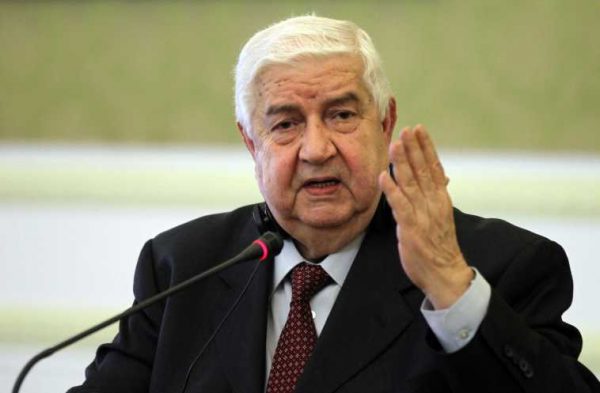
Syria’s Deputy Prime Minister and Foreign Minister Walid Muallem has stated that once the conflict against terrorist groups is finished in Syria, Damascus will be willing to politically negotiate internal autonomy for Syrian Kurds.
Reuters quotes Muallem, who delivered Syria’s address to the United Nations, as stating,
“This topic (Kurdish autonomy) is open to negotiation and discussion and when we are done eliminating Daesh (aka ISIS), we can sit with our Kurdish sons and reach an understanding on a formula for the future”.
There are several geo-political implications to this statement.
1. Seizing the initiative from the US occupiers
First and foremost, Muallem’s proposals take the wind out of the sails of the United States. As I wrote previously in The Duran, with Syria and Russia quickly securing control over areas east of the River Euphrates, the US is being squeezed out of Syria.
Bearing these realities in mind, one of the only options the US has left is to use the Kurdish national cause in order to foment either a new puppet state in the region that is built on stolen Syrian territory or else create a permanently occupied entity similar to the Serbian Autonomous Province of Kosovo and Metohija. Apart from this, the US will have no choice but to either leave Syria or directly confront the Syrian Arab Army and most likely, also its Russia ally. Presently, the US seems unwilling to confront Russia by any means other than through the US of proxy/terrorist forces and this is unlikely to change.
However, given the extreme backlash against Kurdish separatism in Iraq, the US would not only retain old enemies but gain new ones, particularly in the form of Turkey. Ankara is vocally opposed to Kurdish separatism in Iraq and has threatened to take all measures necessary to stop moves in this direction. Turkey has an even worse relationship with Syrian Kurds. This would automatically mean that the US would be in for a very difficult ride if they backed Kurdish separatism in Syria.
With Turkey’s President Erdogan specifically telling Iraqi Kurds “The Israel flag will not save you”, Syria’s proposals would be a geo-strategic blow not only to the US but also to Israel.
2. Separating SDF terrorists from civilian Kurds with Syrian citizenship
The Arab Socialist Ba’ath party has already given Syrian Kurds full citizenship rights which means that they are co-equals to Arabs as well as to other minorities including Assyrians and Armenians, both of whom are grateful to the pluralistic Ba’athist government for protecting them from foreign funded Sunni supremacist terrorism.
While it is clear that the Kurdish fronted SDF proxy militia is operating as a terrorist force in Syria, the old line about separating terrorists from moderates could work in a post-war scenario where the SDF has been defeated in certain regions and rendered irrelevant in others.
In exchange for negotiated autonomy, one which would clearly have to protect the rights of Arabs in ‘Kurdish regions’ of an Arab Republic, Syria could force Kurdish leaders to weed out those who have collaborated with foreign powers and create a new political paradigm for Kurds in Syria.
This would give the moderate Kurds what they want, it would protect the human rights of Arabs and Syrian minorities and it would allow Syria to further purge her soil of terrorists and enemy collaborators.
3. Leverage with Turkey
Unlike Iraq which is currently collaborating with Turkey in military drills bordering separatist regions of Iraq, Syria has no plans to engage with Turkey after years of Turkey’s participation in the pro-jihadist war against Syria.
However, in actively preventing the formation of a Kurdish state in Syria through a negotiated settlement which Turkey’s new found partner Russia could possibly help to broker, Syria could effectively end the current ‘Kurdish excuse’ which is being subtly invoked by Turkey to justify its continued presence in Syria.
Furthermore, Syria could, possibly again via Russia, offer Turkey assurances that Syria will not allow for PKK activity directed against Turkey to foment on Syrian soil. This would be in the best interests of peace in the region as Turkey and Syria both need to eventually come to terms with the fact that they are neighbours.
Historically, Syria’s traditional regional adversaries have been Israel and Jordan and more recently the extremist Arab states of the Persian Gulf. These are the states Syria must be on guard against when looking to the wider future. Because of this, Syria and Turkey will and should slowly but surely normalise relations.
4. Containing Iraqi Kurds
While Iraqi Kurds are politically at odds with their Kurdish counterparts, there exists a fear that the menacing separatist movement in Iraq could lead towards a greater Kurdish push for a multi-state land grab which would be supported by Israel, especially where Syria and Iran are concerned.
If, as is expected, Turkey sends its troops into northern Iraq, it would send a message to the wider Kurdish movement that Kurdish independence equals creating not a greater Kurdistan but a greater Turkey.
Thus, the example of Iraq when viewed simultaneously with the generous offer from Syria, may lead to moderate elements within the Syrian Kurdish movement making the pragmatic choice for guaranteed autonomy versus the prospect of Turkish domination.
Conclusion
Far from being a concession, it was always expected that after the present conflict against imperialism and imperialist funded jihad, Syria would happily engage in a political process with various parts of the Syrian population, including Kurds, in order to develop a settled internal peace.
Syria, in announcing this now however, sends a strong message to radical Kurds and the United States. The message is clear, Syria is a sovereign country and the Kurdish issue is a purely internal matter.
Featured Video
Houthis Keep Advancing as the Red Sea Crisis Deepens
or go to
Aletho News Archives – Video-Images
From the Archives
Clash of Civilization, Iran Part II
By Jamal Kanj – Intifada-Palestine.com – January 14, 2011
Israel’s survival kit is: perpetuate conflict, insecurity to rationalize collective hate and finally playing victim.
Devoid of conflict, Israel implodes internally; without hate, Zionism loses its justification; and playing eternal victim to continue blackmailing the West. Absence of this holy trinity, Israel ceases to exist. … continue
Blog Roll
 Aletho News
- ‘We are not like everyone else’ laws that bind other nations do not apply to Israel, says Likud lawmaker
- Report: Saudi Arabia seeks allies’ assistance as missiles deplete amid war on Yemen
- Fuel Crisis Deepens: Pakistan Warns Tanker Attack in Red Sea Would Be an ‘Act of War’
- ‘Bucha massacre’ a false flag orchestrated by UK – Moscow
- China Rejects Outside Pressure on Trade Ties After New US Russia Sanctions Bill
- Houthis Keep Advancing as the Red Sea Crisis Deepens
- Iran spent $1 million to wipe out $30 billion in data center plans, and take down Amazon in the ME
- Zionist billionaire pressure to silence Macklemore sparks exodus from Ed Sheeran tour
- House Votes to End Iran War for Third Time
- North Korea Slams US Plan for ‘AUKUS 2.0’ with South Korea and Japan
- If Americans Knew
- Biden’s Genocide Accomplices Targeted by New Accountability Campaign
- AIPAC’s Network Has Already Spent $67.2 Million to Shape the Midterm Elections
- Jewish Supremacist Manufacturing a Civilizational Threat to License Bigotry
- US bans Palestinian president from speaking at the UN
- Israeli Forces Detain Journalist Alaa al-Rimawi amid Widespread West Bank Raids
- Even a pro-Israel Congress member has put a hold on 40,000 one-ton bombs to Israel
- As Gaza crumbles, Israel preps new ground invasion – Daily Update
- ‘We are not like everyone else’ laws that bind other nations do not apply to Israel, says Likud lawmaker
- Trump’s govt makes ‘treasonous’ claim of weapons shortages
- Palestinian-American Journalist Naqaa Hamed Imprisoned by Israeli Forces After Settlers Targeted Her
- No Tricks Zone
- New Study: ‘Global Drought Shows No Detectable Recent Acceleration Under Climate Warming’
- Economic Masterminds: German Socialists Suggest Taxing Productivity Gains Stemming From Using AI
- The South China Sea Has Not Been Cooperating With The Climate Change Narrative
- Energy Crisis: Germany Enters Heating Season With Historically Low Gas Reserve Fill Levels
- New Study: The Antarctic Ice Sheet Gained Mass From 2020-2024 Due To Staggering Snow And Ice Accumulation
- Study: Ocean Heating Rates From Thousands Of Years Ago ‘Dwarf’ Modern Ocean Heating Rates
- Climate Extremists Target, Attack Large-Scale Power Grid Infrastructure In Germany!
- New Study: Antarctic Ice Melt Has Contributed Less Than 1 Centimeter To Sea Level Rise In The Last 30 Years
- Fear Of Debate: Alarmist German Climate Scientist Calls On Mainstream Media To Discredit Skeptic Voices
- End-Of-August Arctic Sea Ice Extent Hasn’t Fallen In 20 Years, Official Data Show!
 Aletho News