Merkel agreement with Turkish President Erdogan ‘real treason’ – Marine Le Pen
RT | April 13, 2016
Marine Le Pen, leader of the French National Front party, has called Angela Merkel’s talks with Turkey over the migrant deal “real treason,” saying Erdogan’s government shows “unacceptable leniency” towards Islamic State and “buys oil from terrorists.”
Le Pen has described the recent deal with Turkey as “a serious democratic problem.”
Last month, EU leaders and Turkey agreed a plan aimed at opening a “safe and legal” route to the EU for Syrian refugees. Under the deal, sealed on March 20, Ankara is to take back all migrants and refugees, including Syrians, who cross the Aegean Sea and enter Greece illegally. In return, the EU will take in thousands of Syrian refugees directly from Turkey, rewarding Ankara with a fast visa-free travel regime, advancement in EU membership talks and – last but not least – more money.
“First of all, Frau Merkel did not possess the necessary powers [to strike the deal]. Secondly, she went against the will of the majority of the people in Europe. She conducted talks with Erdogan on unacceptable conditions, such as the €6-billion subvention, visa-free travel for Turks, and even Turkey’s admission to the EU – something that France has been strongly against. This is real treason and betrayal of the people,” the far-right National Front (FN) leader said in an exclusive interview with LifeNews.
“France’s National Front has long been saying that Erdogan’s government shows unacceptable leniency towards Islamic State (IS, formerly ISIS/ISIL). I’m talking about Turkey buying oil from terrorists. We strongly resist Turkey’s integration with the EU, and we insist on respect for freedom of choice, and the French people’s refusal to follow the direction imposed by Frau Merkel,” Le Pen said.
“Today Turkey is establishing relations with Islamic fundamentalists. This goes against the interests of our country. Besides, I’m sorry to say it: Turkey is not a European country, neither historically, nor culturally and geographically. This means it has no business being part of the European Union,” she added.
Last month, the FN leader described Turkey’s request for the EU to provide it with an extra € 3 billion ($3.3 billion) to deal with the refugee crisis as blackmail.
“We have become so weak due to the removing of our [EU] borders that we have given in to Turkey’s blackmail,” Le Pen told RTL.
Last week, President Erdogan warned that Turkey won’t take back Syrian refugees if the EU doesn’t fulfill its promises, according to Reuters. It was previously reported that the Turkish president had threatened to flood the European Union with migrants, should Ankara not be offered enough cash to help curb the influx.
The first deportations started in Greece in early April amid repeated warnings by human rights groups that Turkey is “not a safe third country for refugees.”
In December, the Russian Defense Ministry released evidence it said unmasks the vast and illegal oil trade by Islamic State. It points to Turkey as the main destination for the smuggled oil, implying Ankara’s leadership in aiding the terrorists. However, the ministry said that since the start of Russia’s anti-terrorist operation in Syria on September 30, Islamic State’s income from oil smuggling has been significantly reduced. Erdogan has denied that Turkey procures oil from anything other than legitimate sources.
Le Pen has praised the Russian military mission in Syria, saying: “It’s a relief for us to see Islamic State retreat, and how Russia has succeeded where the EU has totally failed.”
“Russia’s presence in Syria has helped Europe a lot. Of course, our minister of foreign affairs has appropriated the success of airstrikes against Islamic State targets. In reality, the merit is due solely to the Russian troops,” she told LifeNews.
Le Pen said she had long been calling on France to restore diplomatic relations with Syria. “Despite harsh criticism of Bashar Assad’s government, it is the lesser evil in comparison with ISIS. We need to stabilize Syria, to strengthen through diplomacy the government system, which currently appears to be in ruins, with all the power in IS’ hands. We need to maintain high-level relations between the Syrian and French intelligence services. This will help us prevent terrorist acts in France.”
Turkey introduces draft law to strip ‘terrorist’ lawmakers of immunity
RT | April 13, 2016
Parliamentary critics of the ongoing crackdown on Kurdish militias, particularly members of the People’s Democratic Party (HDP), might be stripped of their immunity from prosecution over their “support to terrorism” under a draft proposal submitted by the Turkish government.
“Turkey is conducting its largest and most comprehensive fight ever against terror, while some lawmakers made statements giving support to terrorism before or after being elected, some gave de facto support and help and some lawmakers called for violence, which created great public disgust,” Thursday’s draft proposal said, according to Reuters.
All 316 lawmakers from Turkey’s ruling Justice and Development Party (AKP) reportedly signed the proposal. The collection of signatures was initiated last week in favor of an amendment to the Constitution’s Article 83 that reads “a deputy who is alleged to have committed an offence before or after election shall not be detained, interrogated, arrested or tried unless the General Assembly decides otherwise.”
Turkish President Tayyip Erdogan has repeatedly urged for the prosecution of his critics, generally from among the ranks of pro-Kurdish HDP members, accusing them of being a political umbrella for the Kurdistan Workers’ Party outlawed by Ankara. Intolerant to any public criticism of his policies, Erdogan even submitted a personal complaint against a German comedian for libel.
Meanwhile Prime Minister Ahmet Davutoğlu claimed that the move to strip MPs of their immunity is aimed at “so-called lawmakers who lend support to terror and terrorists,” in an apparent reference to HDP members.
Currently the third largest party in the parliament, the HDP grabbed 59 seats in last year’s election. At the same time more than half of roughly 550 parliamentary complaints urging for the revocation of immunity were filed against HDP members.
Lawmakers in Turkey are protected from prosecution, however back in 1994, amid the previous escalation of the conflict with Kurds, several opposition MPs were stripped of immunity, and four of them landed in jail for a decade.
The current military campaign began in mid-2015, after Ankara ended a two-year ceasefire agreement and revived a conflict that has claimed more than 40,000 lives since 1984. Since then, the operation has been condemned by European leaders and human rights organizations. RT also launched a petition urging the UN to investigate claims of alleged mass killing of Kurdish civilians.
Kurdish militants are fighting for the right to self-determination and greater autonomy for Kurds – demands which Ankara rejects. Since July, almost 400 soldiers and police and several thousand militants have been killed in the conflict, according to government figures. Opposition parties say up to 1,000 of those killed in the crackdown were Kurdish civilians.
US-Turkey-Saudi Arabia Arm Terrorists With Surface-to-Air Missiles in Syria
Sputnik – April 7, 2016
On Tuesday, Islamist rebels shot down a Syrian plane, the second such incident in less than a month, and captured the pilots. Inquiries are being made at the highest level as to how the al-Nusra Front, a branch of al-Qaeda in Syria, has come into possession of advanced Western surface-to-air missiles.
Loud & Clear’s Brian Becker sat down with Institute of Islamic Thought director Zafar Bangash on Thursday to discuss the developing situation in Syria and whether access to this weaponry will undermine Syrian air superiority.
Where are al-Qaeda affiliates getting these advanced weapons?
“According to the information that has emerged, it was al-Nusra Front, a branch of al-Qaeda in Syria,” explained Bangash. He speculated that the missiles were sold to the extremist group by Turkey and paid for by Saudi Arabia, in a continuing effort to overthrow the Assad regime. He suggested that the Americans have a hand in it as well, saying, “the United States has always been involved in providing these weapons, even if not directly.”
The plane shot down on Tuesday was over Aleppo, an al-Nusra and Daesh stronghold. Why is that significant?
“Aleppo is the only major city that has been under the control of al-Nusra or Daesh,” explained Bangash. “The Syrian Army was making progress along with Hezbollah fighters and Iran’s revolutionary guards backed by the Russian Air Force and have been inching towards Aleppo.”
Bangash elaborated that the capture of Aleppo by rebel forces is significant, due to it being the largest city in Syria, and formerly the country’s financial hub. “It is even larger than Damascus, so obviously the terrorist groups and their backers will put up a tough fight not to lose it,” said Bangash.
Does terrorist access to anti-aircraft technology deprive the Syrian army of air supremacy?
“Not completely. I don’t think it will prove a game-changer because Russia is still there,” said Bangash. “These terrorists can cause some damage and some threat to the Syrian air force, and I am sure that the Syrian air force will change their tactics.”
Nonetheless, Russia’s continued presence in the fight against extremist militants will continue to keep rebel groups on their heels as allied forces march towards Aleppo. “Russian air force planes carried out a number of operations last week,” said Bangash. “Further, per the ceasefire agreement between Russia and the US, the terrorist groups were specifically excluded from the ceasefire, so Russia has no obligation whatsoever to avoid attacking these groups.”
Has the US presence in Syria benefitted the extremist organizations?
“Yes,” said Bangash who explained that, since 2005, the Americans along with Saudi Arabia and Turkey have had their eyes on ousting Assad from controlling Syria. “If the Syrian people don’t want Assad, that is for the Syrian people to decide, it isn’t for the United States or any other country to decide.”
He said that he “thinks it is very clear that the US wants to bring down the government of Bashar al-Assad, and that is why the Americans are talking about increasing their special forces in Syria.” Bangash said that the US presence has never been welcomed by the Syrian government. “They have not been given permission by the Syrian government and that is in violation of international law and the UN Charter.”
In contrast, Bangash says that the Russian government came in to maintain the stability of the current Syrian regime, and prevent the country from becoming a failed state, similar to Libya following the ouster of Muammar Gadhafi. “Russia went there with permission of the legitimate government, but the US is there illegally,” he stressed.
Lebanon is being forced to collapse
By Andre Vltchek | RT | April 8, 2016
Lebanon cannot stand on its feet anymore. It is overwhelmed, frightened and broke.
It stands at the frontline, facing Islamic State (IS, formerly known as ISIS/ISIL) in the east and north, hostile Israel in the south and the deep blue sea in the west. One and a half million (mostly Syrian) refugees are dispersed all over its tiny territory. Its economy is collapsing and the infrastructure crumbling. ISIS is right on the border with Syria, literally next door, or even with one foot inside Lebanon, periodically invading, and setting up countless “dormant cells” in all the Lebanese cities and all over the countryside. Hezbollah is fighting ISIS, but the West and Saudi Arabia apparently consider Hezbollah, not ISIS, to be the major menace to their geopolitical interests. The Lebanese army is relatively well trained but badly armed, and as the entire country, it is notoriously cash-strapped.
These days, on the streets of Beirut, one can often hear: “Just a little bit more; one more push, and the entire country will collapse, go up in smoke.”
Is this what the West and its regional allies really want?
One top foreign dignitary after another is now visiting Lebanon: the UN chief Ban Ki-moon, World Bank Group President Jim Yong Kim and the EU foreign policy chief Federica Mogherini. All the foreign visitors are predictably and abstractly expressing “deep concern” about the proximity of ISIS, and about the fate of the 1.5 million Syrian refugees now living in Lebanon. “The war in neighboring Syria is having a deep impact on tiny Lebanon”, they all admit.
Who triggered this war is never addressed.
And not much gets resolved. Only very few concrete promises are being made. And what is promised is not being delivered.
One of my sources who attended a closed-door meeting of Ban Ki-moon, Jim Yong Kim and the heads of the UN agencies in Beirut, commented: “almost nothing new, concrete or inspiring was discussed there.”
The so-called international community is showing very little desire to rescue Lebanon from its deep and ongoing crises. In fact, several countries and organizations are constantly at Lebanon’s throat, accusing it of “human rights violations” and of having weak and ineffective government. What seems to irritate them the most, though, is that Hezbollah (an organization that is placed by many Western countries and their allies in the Arab world on the “terrorist list”) is at least to some extent allowed to participate in running the country.
But Hezbollah appears to be the only military force capable of effectively fighting against ISIS – in the northeast of the country, on the border with Syria, and elsewhere. It is also the only organization providing a reliable social net to those hundreds of thousands of poor Lebanese citizens. In this nation deeply divided along sectarian lines, it extends its hand to the ‘others’, forging coalitions with both Muslim and Christian parties and movements.
Why so much fuss over Hezbollah?
It is because it is predominantly Shia, and Shia Muslims are being antagonized and targeted by almost all the West’s allies in the Arab world. Targeted and sometimes even directly liquidated.
Hezbollah is seen as the right hand of Iran, and Iran is Shia and it stands against Western imperialism determinately, alongside Russia, China and much of Latin America – countries that are demonized and provoked by the ‘Empire’ and its client states.
Hezbollah is closely allied with both Iran and Bashar al-Assad’s government in Syria. It combats Israel whenever Israel invades Lebanon, and it wins most of the battles that it is forced to fight. It is openly hostile towards the expansionist policies of the West, Israel and Saudi Arabia; its leaders are extremely outspoken.
“So what?” many people in the region would say, including those living in Lebanon.
Angie Tibbs is the owner and senior editor of Dissident Voice who has been closely watching events in the Middle East in recent years. She believes a brief comparison between events of 2005 and today is essential for understanding complexity of the situation:
“In a country where, since the end of civil wars in 1990, outward civility masks a still seething underbelly wherein old wounds, old wrongs, real and imagined, have not been forgotten or forgiven, the military and political success of Hezbollah has been the most stabilizing influence. Back in 2005, following the bomb explosion that killed former Premier Rafiq al Hariri and 20 others, the US and Israel proclaimed loudly that “Syria did it” without producing a shred of evidence. The Syrian army, in Lebanon at the request of the Lebanese government, was ordered out by the US, and UN Resolution 1559 stated in part that all Lebanese militias must be disarmed. The plan was clear. With Syrian forces gone, and an unarmed Hezbollah, we had two moves which would leave Lebanon’s southern border completely vulnerable, and then – well, what would prevent Israel from barging in and taking over?”
Ms Tibbs is also convinced the so-called international community is leaving Lebanon defenseless on purpose:
“A similar devious scenario is unfolding today. Hezbollah is busy fighting ISIS in Syria; the Lebanese army, though well trained, is poorly armed. Arms deals are being cancelled, the UN and IMF, and, in fact, the world community of nations are not providing any assistance, and little Lebanon is gasping under the weight of a million plus Syrian refugees. It’s a perfect opportunity for ISIS, the proxy army of Israel and the West, to move in and Lebanon’s sovereignty be damned.”
Indignant, several Lebanese leaders snapped back. The Foreign Minister Gebran Bassil refused to meet with Ban Ki-moon during his two-day visit of Beirut and the Bekaa Valley.
One of Lebanon’s major newspapers, the Daily Star, reported on March 26, 2016:
“Foreign Minister Gebran Bassil Saturday accused the international community of approaching the Syrian refugee crisis with a double standard; hours after UN chief Ban Ki-moon departed Beirut following a two-day visit. ‘They create war, and then call on others to host refugees in line with human rights treaties,’ he said in a televised news conference from his residence in Batroun.”
Lebanon is collapsing. Even its once lavish capital Beirut is experiencing constant blackouts, water shortages and garbage-collection dramas. Economically the country is in a sharp decline.
Dr. Salim Chahine, Professor of Finance, at the American University of Beirut, is usually at least moderately upbeat about the country. Recent developments have worn down his optimism.
“Although the Coincident Indicator issued by the Lebanese Central Bank, BDL, has recently suggested a slight enhancement in economic activity, several officials are sending clear warnings about further deterioration in the situation. The regional geopolitical tensions, the civil conflict in Syria, as well as their implications internally have impacted tourism, trade, and the real estate sectors. According to HSBC, deposits from Lebanon’s largest expatriate population – that usually provide the necessary liquidity for government borrowing – may grow at a slower rate in the near future given the worsening conditions in the Gulf. As the country enters into its sixth year of economic slump, HSBC remains skeptical about a short-term recovery. The public deficit is currently rising by around 20 percent per year, and the GDP growth rate is close to zero.”
Yayoi Segi, an educationalist and the Senior Program Specialist for UNESCO’s Arab Regional Office based in Beirut, works intensively in both Syria and Lebanon. The education sector is, according to her, struggling:
“The public education sector is very small in terms of its coverage in the country, reaching only about 35 percent of the school age population. The state allocation to education is less than 10 percent while the world average or benchmark is 18-20 percent. The situation is further compounded by the current ongoing crisis in the region whereby Lebanon has had to accommodate a large influx of refugees. The public provision of education has expanded and continues to expand. However, it is impacting on quality and contributes to an increasing number of vulnerable Lebanese students dropping out of school, while it can only reach 50 percent of Syrian refugee children.”
Nadine Georges Gholam (not her real name), working for one of the UN agencies, says that lately she feels phlegmatic, even hopeless:
“What has been happening to Lebanon particularly these past five years is really depressing. I used to actively take part in protests to voice my anger and frustration. But now I don’t know if they make any difference or change anything at all. There is no functioning government in sight. Three hundred thousand tons of unprocessed trash accumulated in just eight months. There is sectarian infighting. Regional conflicts… What else? Lebanon can’t withstand such pressure, anymore. All is going down the drain, collapsing…”
“But worse is yet to come. Recently, Saudi Arabia cancelled a $4 billion aid package for Lebanon. It was supposed to finance a massive purchase of modern weapons from France, something urgently needed and totally overdue. That is, if both the West and the KSA are serious about fighting ISIS.”
“The KSA “punished” Lebanon for having representatives of Hezbollah in the government, for refusing to support the West’s allies in the Arab League (who define Hezbollah as a terrorist group), and for still holding a Saudi prince in custody, after he attempted to smuggle two tons of narcotics from Rafic Hariri International Airport outside Beirut.”
These are of course the most dangerous times for this tiny but proud nation. Syrian forces, with great help of Russia, are liberating one Syrian city after another from ISIS and other terrorist groups supported by Turkey, KSA, Qatar and other of the West’s allies.
ISIS may try to move into Iraq, to join its cohorts there, but the Iraqi government is trying to get its act together, and is now ready to fight. It is also talking to Moscow, while studying the great success Russia is having in Syria.
For ISIS or al-Nusra, to move to weaken and almost bankrupt Lebanon would be the most logical step. And the West, Saudi Arabia and others are clearly aware of it.
In fact, ISIS is already there; it has infiltrated virtually all the cities and towns of Lebanon, as well the countryside. Whenever it feels like it, it carries out attacks against the Shia, military and other targets. Both ISIS and al-Nusra do. And the dream of ISIS is blatant: a caliphate with access to the sea, one that would cover at least the northern part of Lebanon.
If the West and its allies do nothing to prevent these plans, it is because they simply don’t want to.
Tiny Lebanon is finding itself in the middle of a whirlwind of a political and military storm that is consuming virtually the entire Middle East and the Gulf.
In recent decades, Lebanon has suffered immensely. This time, if the West and its allies do not change their minds, it may soon cease to exist altogether. It is becoming obvious that in order to survive, it would have to forge much closer ties with the Syrian government, as well as with Iran, Russia and China.
Would it dare to do it? There is no united front inside Lebanon’s leadership. Pro-Western and pro-Saudi fractions would oppose an alliance with those countries that are defying Western interests.
But time is running out. Just recently, the Syrian city of Palmyra was liberated from ISIS. Paradoxically, the great Lebanese historic cities of Baalbek and Byblos may fall soon.
Nagorno-Karabakh Conflict Escalated: In Pursuit of Hidden Agenda
By Pyotr ISKENDEROV – Strategic Culture Foundation – 06.04.2016
The sudden aggravation of the situation in Nagorno-Karabakh is fraught with serious consequences. The warring sides, as well as the OSCE (the Organization for Security and Cooperation in Europe) Minsk Group, have to realize that the situation may get out of hand and entail irreversible consequences against the will of the belligerents.
Armenian First Deputy Defense Minister David Tonoyan said in a statement made at the Sunday (April 3) briefing with foreign defense attaches that Armenia is ready for any scenario as the events unfold, «including direct military assistance to the security of the Nagorno-Karabakh republic».
The statement indicates that things will never be the same as before, especially after Turkey, Pakistan and some other countries have voiced their support for Azerbaijan. Once made public, the statements cannot be taken back. The development of events suggests that some forces pursue a hidden agenda in an effort to unfreeze the Nagorno-Karabakh conflict and make the escalation irreversible.
In recent years, the situation in Nagorno-Karabakh worsened from time to time, but it never escalated to large-scale operations involving aviation and heavy equipment. Moreover, decisions to start combat actions can not be taken in absence of state leaders. Azerbaijan’s President Ilham Aliyev and Armenia’s President Serzh Sargsyan were in Washington when the situation escalated overnight on April 2.
The outside factors probably play a much bigger role than it may seem at first glance.
Evidently, some countries, like Russia, for instance, have no interest in the escalation of the conflict in the Caucasus. Moscow plays the leading role in the crisis management efforts. It has always strived for developing mutually beneficial ties with both Armenia and Azerbaijan.
The aggravation of the conflict creates a problem for the Collective Security Treaty Organization (CSTO). Unlike Azerbaijan, Armenia is a member of the CSTO, which is to defend it if attacked. But the organization has no obligations to defend the self-proclaimed Republic of Nagorno-Karabakh. Article 4 of the Treaty states «If an aggression is committed against one of the States Parties by any state or a group of states, it will be considered as an aggression against all the States Parties to this Treaty. In case an act of aggression is committed against any of the States Parties, all the other States Parties will render it necessary assistance, including military one, as well as provide support with the means at their disposal through an exercise of the right to collective defense in accordance with Article 51 of the UN Charter».
The conflict in Nagorno-Karabakh is not covered by the Treaty, but the broad interpretation of its text may lead to misunderstanding inside the CSTO between Russia and Armenia on the one hand, and Kazakhstan, Kyrgyzstan and Tajikistan on the other hand.
Obviously, the bloodshed does not meet the interests of Armenia and Azerbaijan. Nevertheless, outside forces have entered a «window of opportunity» to incite Baku.
Now who gains as a result of Azerbaijan’s involvement in the conflict? There are at least three parties to benefit.
Turkey tops the list. Having suffered a defeat in Syria and in face of growing impact of the Kurdish factor, Erdogan could go as far as sparking the Caucasian hotbed to entangle Russia. His plans may envision provoking a confrontation between the Russian Federation and NATO. If so, he could have given certain assurances and guarantees to Azerbaijan’s President Aliyev during his visit to Turkey on March 15.
Director of US National Intelligence James Clapper warned about possible escalation of the conflict in February.
The information was confirmed by the fact that the air forces of Azerbaijan and Turkey held March 7-25 joint military exercises TurAz Shahini-2016 in the Turkish province of Konya as part of the TurAz Qartali program of military cooperation. The exercises were held in accordance with the annual plan of joint training events that kicked off last September.
The United States, or, to be more precise, the circles in Washington interested in keeping up tensions in the relationship with Moscow, is the second party, which has a stake in the conflict’s flare up. The goal is to weaken the Collective Security Treaty Organization and create snugs on the way of post-Soviet space integration. Sparking a conflict in Nagorno-Karabakh is the best way to do it.
The third party interested in the conflict is the Cooperation Council for the Arab States of the Gulf, especially Qatar. This country has close ties with Turkey. It challenges Saudi Arabia as the leader of the organization. Besides, there are heightened tensions between the Gulf Cooperation Council members and Iran. Iranian Azerbaijanis account for 15-16% of the country’s population. Tehran has had good relations with Erevan ever since early 1990s. Like Russia, it has no interest in inciting the Nagorno-Karabakh conflict. Qatar and Turkey enjoy special relationship. They are known for tacit support of Muslim Brotherhood. It would be logical to surmise that both countries coordinate policies on the Nagorno-Karabakh dispute.
Azerbaijan and the breakaway region of Nagorno-Karabakh said on April 5 they were halting hostilities after four days of intense fighting.
The world community pins great hopes on the ability of the OSCE to prevent the worst from happening .
Turkish President Calls to Strip ‘Terrorism Supporters’ of Citizenship
Sputnik — 05.04.2016
Turkey’s President Recep Tayyip Erdogan on Tuesday called for a debate on whether those who Ankara deems “terrorist supporters” should be stripped of Turkish citizenship, local media reported.
“We should consider all measures against supporters of terrorism, including stripping them of their citizenship,” Erdogan said, as quoted by the Daily Sabah newspaper.
The Turkish government has stepped up anti-terror efforts in the wake of suicide bombings that rocked its capital Ankara earlier this year. The attacks were claimed by pro-Kurdish militants in response to Turkey’s shelling of Kurdish positions in Syria.
Erdogan also brought up the issue of removing parliamentary immunity of members of the pro-Kurdish and pro-minority Peoples’ Democratic Party (HDP), which he said “should be taken care of immediately,” according to the outlet.
Ankara previously controversially labelled government critics as supporters of terrorism. In January, several academics were held for allegedly engaging in terrorism propaganda after they condemned the ongoing operation in Turkey’s Kurdish-dominated southeast that has killed over a hundred civilians since August.
Russia, Turkey to Build Monuments Honoring Each Other’s Fallen Soldiers
Sputnik – April 2, 2016
The Turkish government has agreed to restore the historic San Stefano Russian monument in Istanbul, Hurriyet Daily News reported.
According to the newspaper, the Turkish parliament’s national defense commission said it would build the monument to commemorate fallen Russian soldiers in return for the construction of five similar monuments in Russia.
The agreement was initially discussed in 2012 and now it would be brought back up at the Turkish parliament. According to the 2012 document, the two countries decided to honor soldiers who died during historic wars on each other’s soil.
The San Stefano monument in Istanbul was initially built at the end of the 19th Century to commemorate 15,000 Russian soldiers who died on Turkish soil during the 1877-1878 Russo-Ottoman war.
However, in 1914 Turkey decided to demolish the monument, calling it a “national shame,” according to the source.

The demolition of the Russian commemorative monument in San Stefano in November 1914 © Wikipedia/ Fuat Uzkınay
Hurriyet also informed that a special joint commission will be set up to discover soldiers’ grave sites in both Turkey and Russia and to help oversee the application of the 2012 treaty.
Relations between Moscow and Ankara have been strained after the Turkish Air Force shot down a Russian bomber above Syria in November 2015, resulting in the death of a Russian pilot. Will the mutual agreement to commemorate each other’s soldiers be the first step to warm relations between the two countries?
Turkey is key supplier of weapons, military hardware to ISIS – Russian envoy to UN
RT | April 1, 2016
Moscow has submitted data on Turkey’s illegal arms and military hardware supply to Islamic State in Syria to the UN Security Council. Supplies are supervised by the Turkish intelligence service, Russian UN envoy Vitaly Churkin said as cited by Russian media.
“The main supplier of weapons and military equipment to ISIL fighters is Turkey, which is doing so through non-governmental organizations. Work in this area is overseen by the National Intelligence Organization of Turkey,” Churkin wrote.
According to the envoy, transportation “mainly involves vehicles, including as part of humanitarian aid convoys.”
The letter mentioned several NGOs, which are funded from Turkish and foreign sources, which sent different cargo, including military equipment, to Syria last year.
“The Besar foundation (President — D. Şanlı) is most actively engaged in pursuing these objectives and, in 2015, formed around 50 convoys to the Turkmen areas of Bayırbucak and Kızıltepe (260 km north of Damascus),” Churkin stressed, adding that Iyilikder Foundation and The Foundation for Human Rights and Freedoms were also involved.
In total, the terrorists were delivered 2.5 thousand tons of ammonium nitrate (worth around $788,700), 456 tons of potassium nitrate ($468,700), 75 tons of aluminum powder ($496,500), sodium nitrate ($19,400), glycerin ($102,500) and nitric acid ($34,000 thousand) via Turkey in 2015, Churkin wrote.
Turkey Eyes Law to Censor Universities Amid Professor Arrests
Sputnik – 24.03.2016
Turkey’s government has proposed a new law, which would have universities fire faculty for political disagreement with the government.
The new law would allow universities to systematically dismiss faculty based on their political leanings.
The law was proposed amid the arrest of several academics, who were arrested for signing a peace petition against the current military operation in Turkey’s southeast. The academics were detained on charges of “terrorist propaganda.”
Under the proposed law, faculty could be dismissed for such charges as “supporting terrorism,” “participation in the strikes and demonstrations that impede the learning process,” and “slandering the reputation of the state.”
“These first arrests are likely to be the tip of the iceberg. The next weeks could see a wave of them in jail,” Gareth Jenkins, a political analyst based in Istanbul told Nature.
The law would also target the arrested professors’ supporters, as their actions, by definition are “behavior which smears the state’s reputation” in the new law.
Under current law, the professors cannot be dismissed, because such charges are not part of the law. One of the more contentious issues is that faculty could be fired for “participation in the activities of political parties, which go beyond the provisions stipulated by the law.”
Turkey orders closed trial for Cumhuriyet editor threatening to expose Erdogan in court

RT | March 25, 2016
The editor of the opposition Cumhuriyet newspaper, Can Dundar, has been punished with a trial behind closed doors, after threatening to put President Erdogan on the defensive with renewed allegations.
Many media trials in Turkey of late have gripped national and international attention, as President Recep Tayyip Erdogan continues his relentless pursuit of alleged enemies of the state.
Dundar has been sentenced to life on the charge of espionage – and has vowed to do his utmost to make the wrongdoings of the Turkish government the focus of his Friday trial, effectively turning the tables.
Like others in recent years, Dundar, 54, and Ankara bureau chief Erdem Gul, 49, stand accused of trying to topple the government, something they allegedly attempted to do by publishing last May a video purporting to reveal truckloads of arms shipments to Syria overseen by Turkish intelligence.
Erdogan did admit to the trucks belonging to the Turkish National Intelligence Organization (MIT), but said they were carrying weapons for the Turkmens – the group fighting both Syrian President Bashar Assad’s forces and Islamic State (IS, formerly ISIS/ISIL). He added that the prosecution had no right to peer into the trucks, and that the whole thing was set up to discredit his administration.
Dundar threatened to show the tape in court, knowing the risks involved. It did not pan out according to plan, and has resulted in the punishment he received Friday morning – that he will not see an open trial. In addition, the courts decided that Erdogan will act as a co-plaintiff in the trials, Reuters learned from a witness.
“We are not defendants, we are witnesses,” he told Reuters in an interview hours before the trial. “We will lay out all of the illegalities and make this a political prosecution … The state was caught in a criminal act, and it is doing all that it can to cover it up.
“We were arrested for two reasons: to punish us and to frighten others. And we see the intimidation has been effective. Fear dominates,” he added.
Dundar and Gul made an appearance before the courthouse on Friday morning, emphasizing that “journalism is not a crime” and once again calling publicly for their acquittal.
Both journalists were arrested in November and released following three months in detention after a constitutional court ruled on their release before trial – something Erdogan was not happy about.
“This institution, with the involvement of its president and some members, did not refrain from taking a decision that is against the country and its people, on a subject that is a concrete example of one of the biggest attacks against Turkey recently,” the state leader said at a rally in early March.
Just after the journalists’ release, Erdogan said he didn’t “obey or respect the [court’s] decision.” Their case “has nothing to do with press freedom,” he said, accusing them of “spying.”
He has also been heard saying Dundar would “pay a heavy price” for his crimes.
Numerous rights groups and press associations have voiced grave concern for press freedom in Turkey, all issuing calls to free Dundar and Gul. The International Press Institute called the trial “politically motivated.” Reporters Without Borders went a step further, calling Erdogan “increasingly despotic.”
The development follows several others in recent months, all involving the media being charged with similar crimes for similar offenses. This month authorities seized control of Zaman – the country’s top-selling newspaper, for allegedly aiding Fethullah Gulen – a religious scholar in exile whom Erdogan accused of leading a “terrorist” movement.
Since Erdogan came to power in 2014, a little under 2,000 such cases have been started, the majority for “insulting” the president.
Read more:
Almost 2,000 court cases opened in 18-months for ‘insulting’ Turkish President Erdogan
Is the ISIS Behind the Brussels Attacks? Who is Behind the ISIS?

By Prof Michel Chossudovsky | Global Research | March 22, 2016
Dramatic loss of life in the terror attacks in Brussels: 34 killed and more than 180 wounded according to the latest reports.
Prior to the conduct of a police investigation, in the hours following the attacks, the Western media went into overdrive, intimating without evidence that the Islamic State (ISIS) operating out of Raqqa, Northern Syria was responsible for the attacks.
According to the Independent “Isis supporters have been celebrating the Brussels attacks online [social media] as speculation mounts that the group is behind a wave of deadly attacks in the Belgian capital.”
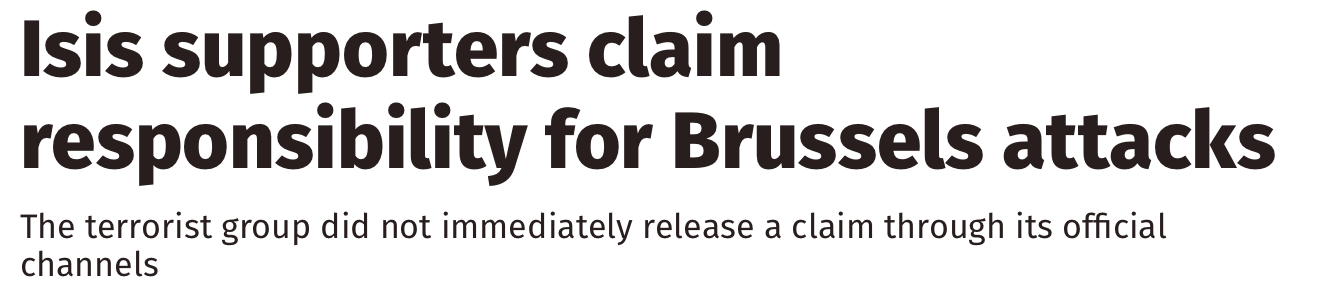
The report is based on information emanating from social media, which does not constitute a reliable source of information.
An unkown self-proclaimed news agency (Amaq Agency ) allegedly representing the ISIS provided the following report:
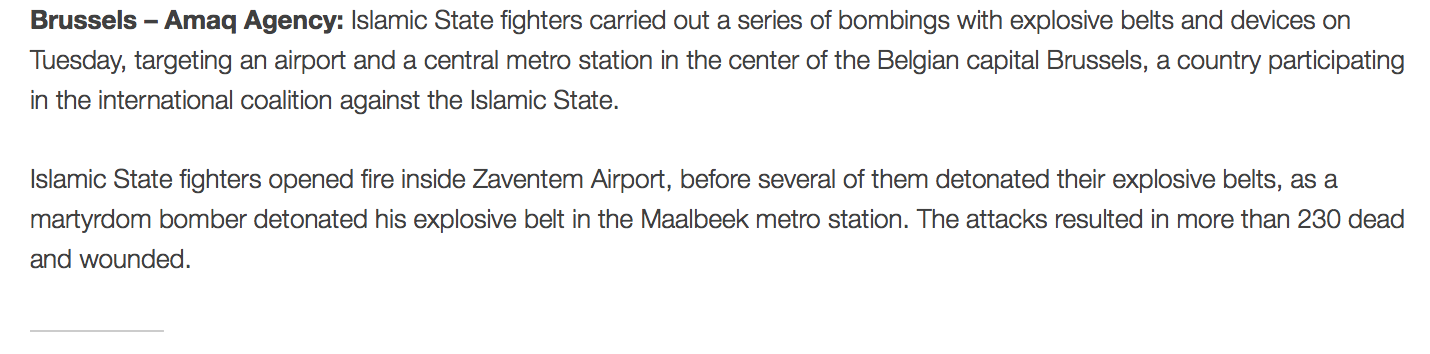
This mysterious agency was then immediately quoted by Reuters in an authoritative report.
In turn, alleged supporters of ISIS on twitter were quoted. According to the Jerusalem Post (March 21, 2016):
The “tears of joy” that were shed by ISIS supporters on Twitter are also related to the fact that the terrorists succeeded in paralyzing the activity in the airport attacked. One of ISIS’ main declared goals is to devastate the Western economy and replace the dollar with its own coin as the only international legal tender.
Who Controls the ISIS social media and twitter accounts?
Police and intelligence are often aware of the identity of ISIS social media, IP addresses, geographic location.
According to London’s Mirror (December 16, 2015):
Hackers have claimed that a number of Islamic State supporters’ social media accounts are being run from internet addresses linked to the [UK government] Department of Work and Pensions.
A group of four young computer experts who call themselves VandaSec have unearthed evidence indicating that at least three ISIS-supporting accounts can be traced back to the DWP.
Every computer and mobile phone logs onto the internet using an IP address, which is a type of identification number.
The hacking collective showed Mirror Online details of the IP addresses used by a trio of separate digital jihadis to access Twitter accounts, which have been used to spread extremist propaganda.
At first glance, the IP addresses seem to be based in Saudi Arabia, but upon further inspection using specialist tools they appeared to link back to the DWP. ..
[T]he British government sold on a large number of IP addresses to two Saudi Arabian firms.
After the sale completed in October of this year, they were used by extremists to spread their message of hate.
Jamie Turner, an expert from a firm called PCA Predict, discovered a record of the sale of IP addresses, and found a large number were transferred to Saudi Arabia in October of this year.
He told us it was likely the IP addresses could still be traced back to the DWP because records of the addresses had not yet been fully updated.

What the Daily Mirror report suggests (as well as other reports) is that the IP addresses of the ISIS are indirectly linked to the British government, i.e. 1) the identity of the ISIS social media is invariable known to police authorities, and 2) The ISIS social media are sponsored by Saudi Arabia, which is also involved in the recruitment and training of terrorists in liaison with US-NATO.
It is worth noting that the British government has acknowledged its responsibility:
The Cabinet Office has now admitted to selling the IP addresses on to Saudi Telecom and the Saudi-based Mobile Telecommunications Company earlier this year as part of a wider drive to get rid of a large number of the DWP’s IP addresses. (Mirror, op cit cit, emphasis added)
The State Sponsors of Terrorism
The events in Brussels raises the broader question: who is behind the ISIS?
Israel intelligence sources (DEBKA) in a 2011 report confirmed the role of NATO operating out of its Brussels headquarters and Turkey’s high command in the training and recruitment of terrorists:
NATO headquarters in Brussels and the Turkish high command are meanwhile drawing up plans for their first military step in Syria, which is to arm the rebels with weapons for combating the tanks and helicopters spearheading the Assad regime’s crackdown on dissent. … NATO strategists are thinking more in terms of pouring large quantities of anti-tank and anti-air rockets, mortars and heavy machine guns into the protest centers for beating back the government armored forces. (DEBKAfile, NATO to give rebels anti-tank weapons, August 14, 2011)
This initiative, which was also supported by Saudi Arabia and Qatar, involved a process of organized recruitment of thousands of jihadist “freedom fighters”, reminiscent of the enlistment of Mujahideen to wage the CIA’s jihad (holy war) in the heyday of the Soviet-Afghan war:
Also discussed in Brussels and Ankara, our sources report, is a campaign to enlist thousands of Muslim volunteers in Middle East countries and the Muslim world to fight alongside the Syrian rebels. The Turkish army would house these volunteers, train them and secure their passage into Syria. (Ibid, emphasis added)
These mercenaries were subsequently integrated into US and allied sponsored terrorist organizations including Al Nusrah and ISIS.
And then in August 2014, Obama launched his counter-terrorism campaign. Yet the evidence confirms that instead of destroying the ISIS, the US and its allies including Turkey, Saudi Arabia and Israel were in fact protecting the ISIS.
Again according to the Daily Mirror in a 2015 report, the counterterrorism campaign was conducive to ISIS doubling the territory under its control, until the launching of the Russian intervention in late September 2015.
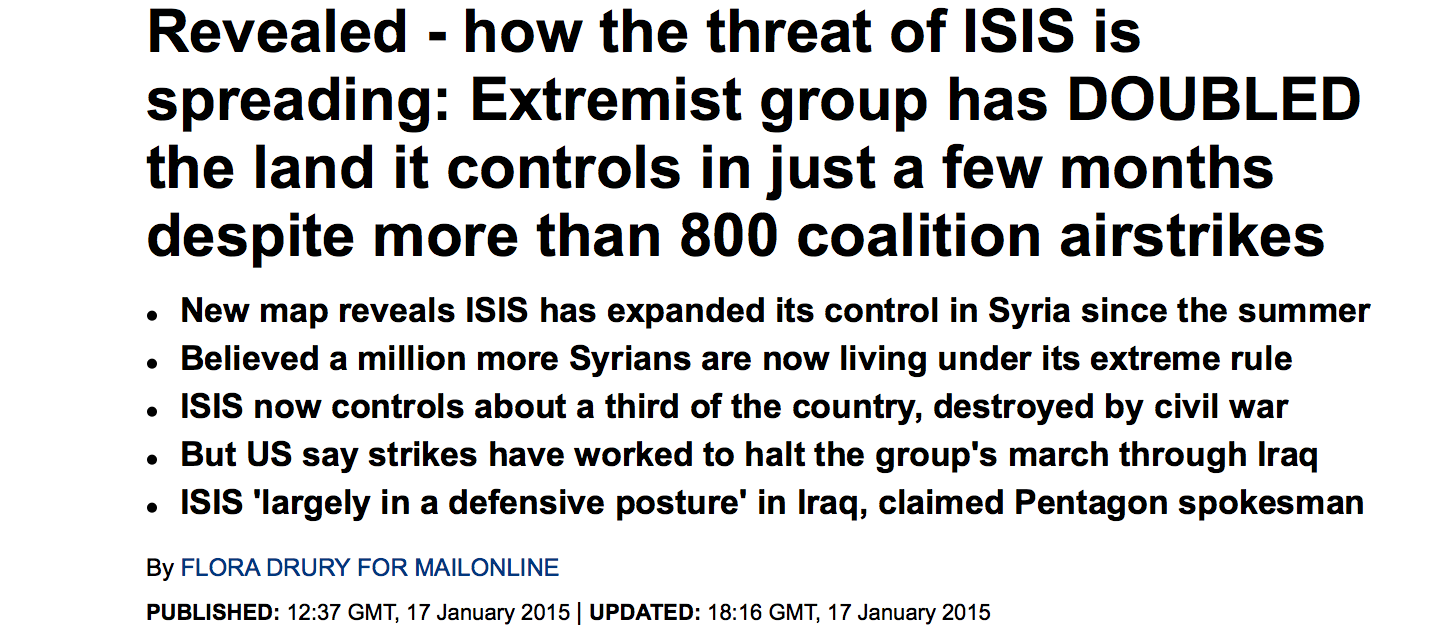
Sheer Incompetence of the US Air Force (doubtful) or Washington’s complicity in protecting the terrorists?
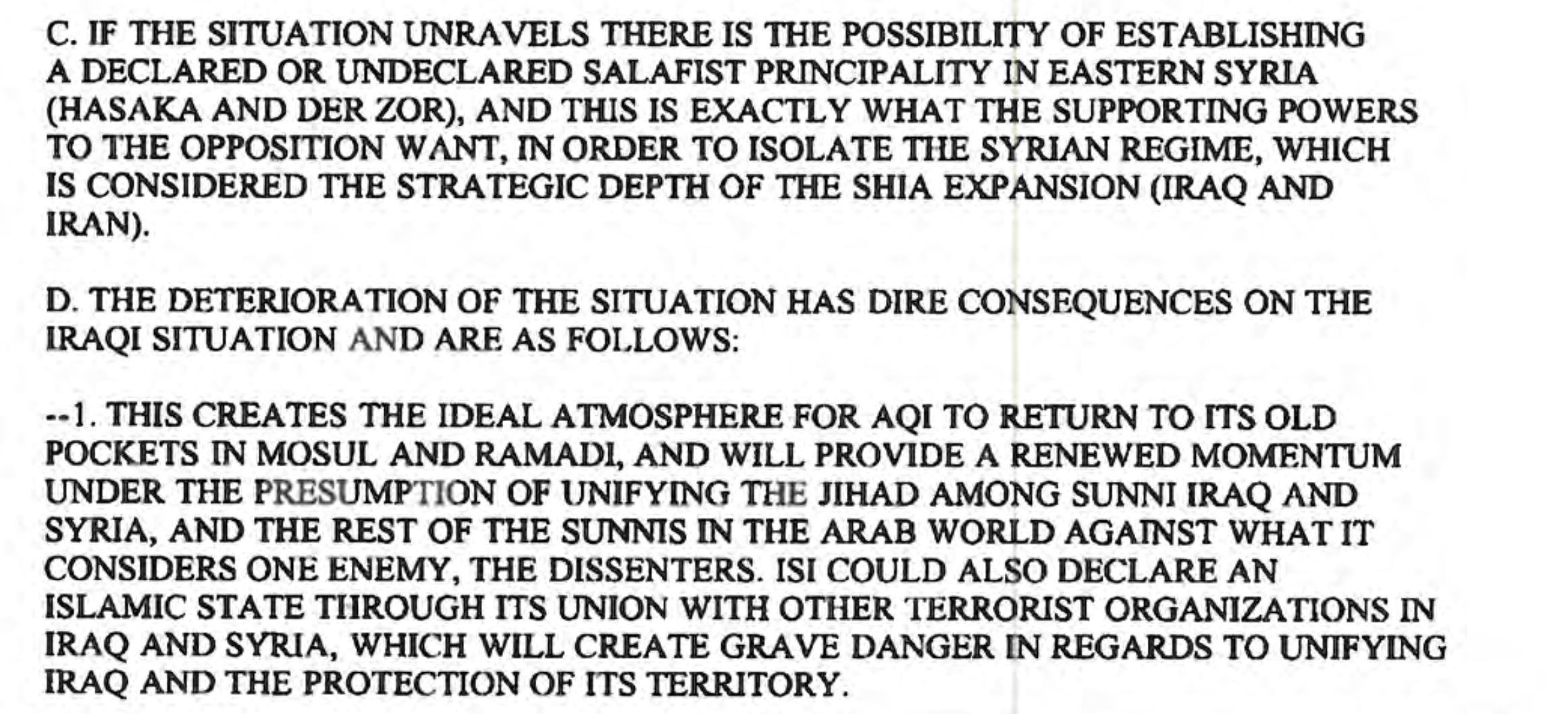
Recently the release of the Hillary Clinton email archive as well as leaked Pentagon documents confirm that the US and its allies were supportive of ISIS, which are according to press reports, the alleged architects of the Brussels attacks.
The 7-page Defense Intelligence Agency (DIA) document dated August of 2012, points to US complicity in supporting the creation of an Islamic State:
Featured Video

Fear Is the Mind Killer
or go to
Aletho News Archives – Video-Images
From the Archives
Alarmist climate science as a textbook example of groupthink
By Paul MacRae | May 1, 2012
A while ago, I received an email from a friend who asked:
How can many, many respected, competitive, independent science folks be so wrong about [global warming] (if your [skeptical] premise is correct). I don’t think it could be a conspiracy, or incompetence. … Has there ever been another case when so many ‘leading’ scientific minds got it so wrong?
The answer to the second part of my friend’s question—“Has there ever been another case where so many ‘leading’ scientific minds got it so wrong?”—is easy. Yes, there are many such cases, both within and outside climate science. In fact, the graveyard of science is littered with the bones of theories that were once thought “certain” (e.g., that the continents can’t “drift,” that Newton’s laws were immutable, and hundreds if not thousands of others).
Science progresses by the overturning of theories once thought “certain.” … continue
Blog Roll
 Aletho News
- Iran Will Respond With Long-Term Strikes to US Attack, Even If It Is Short-Term – IRGC
- Fear Is the Mind Killer
- Israeli strikes kill 10 in southern Lebanon, including 3 rescue workers
- Israeli military ‘failed on all fronts’: Poll
- US at a crossroads: Iran’s firm positions leave Trump no option but to capitulate
- Iran signals decisive response to end US maritime bullying, piracy
- Trump eager for off-ramp in war on Iran, but Netanyahu has him trapped: Former official
- Trump’s ‘Golden Dome’ offers ‘limited’ shield against ballistic missiles: Defense official
- Ukraine Seeks to Provoke a Nuclear Conflict: Zakharova
- US squares up to China over Panama Canal
- If Americans Knew
- How Tony Dokoupil Became the Face of ‘Zionist Fanatic’ Bari Weiss’s CBS
- Far Right Israeli Settler Movement Enters Syria in a Push for “Greater Israel”
- ‘People Have the Right to Be Buried’: In Gaza, Thousands of Palestinians Remain Trapped Under Rubble
- Born during Israel’s genocide: Gaza’s child survivors bear the scars of war
- Who are the women and girls behind Gaza war’s horrific casualty toll?
- Beloved Gaza doctor detained “indefinitely” without charge – Daily Update
- By Week’s End, Trump’s War Will Be Plainly Illegal
- CBS News Reportedly Ousts London Bureau Chief Over Differences With Bari Weiss Over Gaza Coverage
- State Department Says US Is in Conflict With Iran ‘At the Request’ of Israel
- What ceasefire? Israel won’t stop killing in Gaza, Lebanon – Daily Update
- No Tricks Zone
- Oversupply Of Volatile Solar Energy Leads To Record NEGATIVE Prices!
- New Study: Extreme Heat Records, Heatwaves, Extreme Cold Records Declining Across US Since 1899
- It’s The Cold, Stupid! Cold 20 Times More Lethal Than Heat, Multiple Studies Show
- European Institute For Climate And Energy: “Climate Debate is Seldom About Science”
- New Study: The Climate May Be 5 Times More Sensitive To Solar Forcing Than Commonly Assumed
- EV Industry Reached $70 Billion In Losses In 2024 Due To Delusional Green Ideologies
- Reality Check: Maldives Have Actually Grown In Size Or Remained Stable Over Recent Decades
- Abrupt Climate Change Also Occurred NATURALLY In The Past …25 Times During Last Ice Age
- Cave Discovery Reveals Today’s Desert Climates Were Recently Far Warmer, Wetter, Teeming With Life
- German Expert: Heat Dome Led To Record Temps In Western USA…Warmer In 1934, 1936
 Aletho News
