Turkey’s Erdogan Mentions Possible Brussels Bombing Just Days Before Attack
Sputnik -22.03.2016
Less than a week before the terrorist attacks in Brussels, Turkish President Recep Tayyip Erdogan warned of possible bombings in European cities, including Brussels.
“There is no reason why the bomb that exploded in Ankara could not explode in Brussels, or in any other European city,” Erdogan declared during a ceremony commemorating the 101st anniversary of the Battle of Gallipoli in the coastal town of Canakkale on March 18.
It should be noted that Erdogan’s statement followed the deadly terrorist act of March 13, when a car bomb exploded at a bus stop near Ankara’s central Kizilay Square, leaving 37 dead and over 120 injured. The Turkish head of state blamed Kurdish radicals for the attack and berated European leaders for their refusal to recognize certain Kurdish organizations as terrorist groups.
“The snakes you are sleeping with can bite you at any time,” Erdogan added.
On Tuesday, March 22, the city of Brussels – capital of Belgium and administrative center for both NATO and the EU – was hit by a series of explosions, including two blasts in Brussels Airport in Zaventem, Belgium that left 13 people dead and over 35 injured. An additional 15 people were killed in Tuesday’s explosion at the Maalbeek metro station in central Brussels, local media reported.
‘Turkey and EU make refugees a matter of bargaining – a violation of int’l treaties’
RT | March 19, 2016
The EU countries will receive educated and skilled people, and those who are not skilled and educated, they will remain in Turkey, Yasar Yakis, former Foreign Minister and a former ambassador to the UN Office in Vienna, Egypt, and Saudi Arabia, told RT.
RT: Why do you think that the “one in, one out” Turkish-EU refugee plan isn’t feasible? Who stands to benefit from this plan?
Yasar Yakıs: Both sides are going to benefit, but Turkey was in a position where it couldn’t do anything else but ask the cooperation of the European countries. Theoretically, one may think of a scenario whereby the EU could have closed their doors and not let any refugee come in from Turkey. Turkey, by trying to cooperate with the EU and with the initiative taken by Angela Merkel, at least they decided to share the responsibility of Turkey, open the doors, but of course with certain conditions, and this condition is “one in, one out.” But this doesn’t solve several problems that will entail such a decision. One of them is that the refugees who do not come from Syria, who come from distant countries, Afghanistan and the other countries, why on earth would Turkey accept them if they are already in European Union countries to receive also the refugees coming from the third countries… In my opinion, the deal shouldn’t have covered the refugees originating from countries other than Syria.
Second, since this Syrian crisis we do not see any light at the end of the tunnel; the Syrian crisis will continue for some time. Therefore, if there is nobody readmitted from Greece, the EU will be entitled to refuse any additional refugees coming from Turkey and going to the European Union countries, whereas Turkey will continue to receive refugees from Syria…
Third, the EU will receive refugees on the basis of a selection. That is to say, Syrian refugees having arrived in Turkey will submit their demand to be admitted as a refugee in the EU countries, and the EU countries will look at the qualification of the person. If they agree to receive, they will receive. It means they will receive educated and skilled people, and those who are not skilled and educated, they will remain in Turkey. For these reasons, it will work against Turkey’s interests in the long run.
RT: During the Brussels summit, ministers are also going to debate doubling the deal for the refugee crisis to €6 billion. Turkey was earlier accused of “blackmailing” and “holding the EU to ransom”, for example by UKIP’s Farage, Hungary’s Orban, by demanding money to stop the flood of migrants. How do you view such accusations?
YY: First of all, there are restrictions stemming from the international documents, international treaties, which forbid to make the life of the refugees a question of bargaining. What Turkey and the EU are doing is a violation of the international treaties that all the European countries have signed, and also Turkey has signed. This is one thing.
Secondly, the money that was allocated to Turkey will not be paid to Turkey. Turkey will have to submit to the EU projects. These projects will be financed by the EU – the money will not enter the Turkey’s treasury. There is another difficulty there. And if it is not spent in conformity with the EU relations, then the EU will be entitled to stop the payment.
RT: You said that certain EU member countries may find excuses not to implement the visa-free travel agreement with Turkey. Why do you think so? Why do you think the plan has been stalling so far? Who is being insincere here, Turkey or the EU?
YY: Both sides are sincere, but there are of course always ways for not abiding by the promise. There are two reasons for that. One is the number of the conditions that the EU put in order to start the negotiations. There were 72 conditions that Turkey had to fulfill, and 19 of them were fully fulfilled until recently. And something like 7 of them there was no progress at all. Now we have to see, whether Turkey will be fully compliant with all the 72 conditions.
Secondly, many countries were reluctant and they agreed to the deal only upon the pressure coming from Germany, and they will find other excuses in order not to abide by it. Greek Cypriots may be one of them. There are a lot of EU countries that are not satisfied with Turkey’s human rights records – fundamental rights of freedom. And they say that Turkey should not be given such concessions.
Thirdly, there are countries like France, who say that a refugee deal is one thing, Turkish accession process is another thing. Both of these two things should be assessed, evolve, and should continue to function according to their own rule without interacting between themselves.
RT: Is Turkey ready to accept even more migrants in exchange for visa-free regime with the EU and some €6 billion? Or maybe Europe will see the price tag rising, as Turkey keeps asking for money?
YY: The EU is not monolith, which means that they do not speak with the same language – all of them, 28. They all have different views, which differ slightly form the others. Many countries are looking for excuses, either for not giving money, or for abiding by these international treaties, which bans making the refugee deal a question of bargaining between the sending countries and receiving countries.
Thirdly, for the political reasons, like Greek Cypriots and other countries, as well, they are looking for excuses not to let Turkey’s accession process to the EU to continue. It cannot continue forever. It will be due to the two reasons stemming from Turkey, or stemming from the EU.
RT: Turkey says it’s fighting terrorists in its Kurdish areas, but human rights groups are concerned that civilians are being killed in the crackdown. Do you think civilian causalities can be, are justified by the fight against terror?
YY: For me no civilian causalities are justified. You have to take from the standpoint of a family, who sent their 22-year-old son to the military service, and this young man is fighting there. If you ask this family: “Do you agree that this fight against Kurds should continue, but you may also lose your son?” Most probably in many cases he will say: “No, I want my son! I want that my son’s life should not be given away in exchange of something, which is beyond my family’s concern. Of course, there are also some families in Turkey that say ‘for the security of my country I will sacrifice my son.’ But the majority will say ‘no.’
RT: Has Turkey’s international reputation suffered due to its crackdown on Kurds in Diyarbakir, Cizre etc.? And has Erdogan chosen the right strategy here?
YY: Turkey’s human rights record is going down. Turkey lost a lot of altitude in its international relations. Erdogan’s policy on the crackdown – I have to take it from the beginning. I appreciated it very much President Erdogan’s initiative to solve this Kurdish problem – at that time it was called ‘democratization project’ – so this was a very courageous, bold decision taken by President Erdogan… It is a pity now that this process has collapsed. I wish that Turkey should find one way of resuming the negotiations and continue this process…
NATO’s Most Censored Story
By Ronald Thomas West | March 16, 2016
This information has been forwarded on (via email) to the leadership of the German parliament, as well the German federal prosecutor’s office, the German constitutional court, and the International Criminal Court. One can only wonder how long the criminally complicit politicians will sit on their hands and do nothing. German politicians have known for quite sometime that BND (German CIA) head Gerhard Schindler lied to them when he stated Assad ordered the sarin gas attack at Ghouta, Syria in August 2013. As well, Germany has a provision of law under the principle of universal jurisdiction which could be used to prosecute these crimes and a constitutional loophole bigger than the Brandenberg Gate that allows passing on prosecutions in ‘the best interest of the state.’
When the Turkish government seized Today’s Zaman newspaper on 5 March 2016, it was only a matter of time before the Zaman English website was taken down. Today I checked and discovered the site has indeed been taken offline (and has been replaced with a Turkish language site featuring Erdogan’s government line.) Anticipating something like this, I’d saved a few stories together with screenshots; here is the most damning story and a prime motivation behind the criminal Erdogan administration’s act of taking over the most popular news outlet in Turkey. As the several NATO states shed what are clearly crocodile tears over Turkey’s suppression of a free press, none will point to stories such as this following; in fact there will be only relief that evidence NATO is doing business with & propping up war criminals will have been swept under the rug. Verbatim text of the screen shots (full story) pasted in, below:
21 October 2015
Two deputies from the main opposition Republican People’s Party (CHP) have claimed that the government is against investigating Turkey’s role in sending toxic sarin gas which was used in an attack on civilians in Syria in 2013 and in which over 1,300 Syrians were killed.
CHP deputies Eren Erdem and Ali Şeker held a press conference in İstanbul on Wednesday in which they claimed the investigation into allegations regarding Turkey’s involvement in the procurement of sarin gas which was used in the chemical attack on a civil population and delivered to the terrorist Islamic State in Iraq and the Levant (ISIL) to enable the attack was derailed.
Taking the floor first, Erdem stated that the Adana Chief Prosecutor’s Office launched an investigation into allegations that sarin was sent to Syria from Turkey via several businessmen. An indictment followed regarding the accusations targeting the government.
“The MKE [Turkish Mechanical and Chemical Industry Corporation] is also an actor that is mentioned in the investigation file. Here is the indictment. All the details about how sarin was procured in Turkey and delivered to the terrorists, along with audio recordings, are inside the file,” Erdem said while waving the file.
Erdem also noted that the prosecutor’s office conducted detailed technical surveillance and found that an al-Qaeda militant, Hayyam Kasap, acquired sarin, adding: “Wiretapped phone conversations reveal the process of procuring the gas at specific addresses as well as the process of procuring the rockets that would fire the capsules containing the toxic gas. However, despite such solid evidence there has been no arrest in the case. Thirteen individuals were arrested during the first stage of the investigation but were later released, refuting government claims that it is fighting terrorism,” Erdem noted.
Over 1,300 people were killed in the sarin gas attack in Ghouta and several other neighborhoods near the Syrian capital of Damascus, with the West quickly blaming the regime of Bashar al-Assad and Russia claiming it was a “false flag” operation aimed at making US military intervention in Syria possible.
Suburbs near Damascus were struck by rockets containing the toxic sarin gas in August 2013.
The purpose of the attack was allegedly to provoke a US military operation in Syria which would topple the Assad regime in line with the political agenda of then-Prime Minister Recep Tayyip Erdoğan and his government.
CHP deputy Şeker spoke after Erdem, pointing out that the government misled the public on the issue by asserting that sarin was provided by Russia. The purpose was to create the perception that, according to Şeker, “Assad killed his people with sarin and that requires a US military intervention in Syria.”
He also underlined that all of the files and evidence from the investigation show a war crime was committed within the borders of the Turkish Republic.
“The investigation clearly indicates that those people who smuggled the chemicals required to procure sarin faced no difficulties, proving that Turkish intelligence was aware of their activities. While these people had to be in prison for their illegal acts, not a single person is in jail. Former prime ministers and the interior minister should be held accountable for their negligence in the incident,” Şeker further commented.
Erdem also added that he will launch a criminal complaint against those responsible, including those who issued a verdict of non-prosecution in the case, those who did not prevent the transfer of chemicals and those who first ordered the arrest of the suspects who were later released.
UN Secretary-General Ban Ki-moon announced in late August that an inquiry had been launched into the gas attacks allegedly perpetuated by both Assad’s Syrian regime and rebel groups fighting in Syria since the civil war erupted in 2011.
However, Erdem is not the only figure who has accused Turkey of possible involvement in the gas attack. Pulitzer Prize winner and journalist, Seymour M. Hersh, argued in an article published in 2014 that MİT was involved with extremist Syrian groups fighting against the Assad regime.
In his article, Hersh said Assad was not behind the attack, as claimed by the US and Europe, but that Turkish-Syrian opposition collaboration was trying to provoke a US intervention in Syria in order to bring down the Assad regime.


Turkey’s Erdogan Looks to Expand Terrorist Definition to Include Civilians
Sputnik – March 14, 2016
Turkish President Recep Tayyip Erdoğan said on Monday that it is necessary to broaden the definition of terrorism to include supporters of terrorism — even people who are not directly involved in any kind of terror activity.
“It’s not only the person who pulls the trigger, but those who made that possible who should also be defined as terrorists, regardless of their title,” said Erdogan, following a bombing in Ankara which killed 37 people, the Daily Star reported. He added that this could be a journalist, an MP or a civil society actor.
Earlier President Erdogan said that Turkey’s “struggle against terrorism will for certain end in success and terrorism will be brought to its knees.”
The bombing was the fifth attack in Turkey in recent several months. The attacks took lives of total of 200 people.
Libya military intervention needs UN approval, says Russian FM
Press TV – March 14, 2016
Russia’s Foreign Minister Sergei Lavrov says any military operation in Libya requires the approval of the United Nations Security Council (UNSC).
Lavrov said during a joint press conference in Moscow with visiting Tunisian Foreign Minister Khemaies Jhinaoui on Monday that Russia is aware of some plans for military involvement in Libya, but insisted that those plans could be implemented only with the permission of the 15-member council.
“We know about what’s being discussed openly and not so openly on plans of military intervention, including with the situation in Libya. Our common position is that this is possible only under the UN Security Council’s decision,” Lavrov said.
The top Russian diplomat also noted that a possible mandate for an operation against the terrorists in Libya must be defined unambiguously so as not to allow misinterpretations.
Russia says that the US-led military alliance NATO abused a United Nations resolution in 2011 to protect Libyan civilians from slain Libyan dictator Muammar Gaddafi’s forces in order to pursue regime change and political assassinations during a popular uprising across the North African country.
The remarks come as New York Times recently reported that the Pentagon and the highly secretive Joint Special Operations Command have provided the White House with “the most detailed set of military options yet” in Libya.
France’s Le Monde newspaper also reported last month that the country’s special forces and members of the country’s external security agency Directorate-General for External Security (DGSE) were in Libya for “clandestine operations” in cooperation with the US and Britain.
Meanwhile, a UN panel is also investigating claims that Turkey, the United Arab Emirates (UAE) and Sudan have violated an existing arms embargo by providing weapons to warring groups operating in Libya.
In mid-February, Libya’s internationally recognized Prime Minister Abdullah al-Thinni accused Ankara of interference in his country’s internal affairs.
Since 2014, when militants seized the capital Tripoli, Libya has had two parallel parliaments and governments.
Daesh took advantage of the chaos and captured Libya’s northern port city of Sirte in June 2015, almost four months after it announced its presence in the city, and made it the first city to be ruled by the militant group outside of Iraq and Syria.
Lavrov says has evidence of Turkey forces on Syria soil
Press TV – March 13, 2016
Russian Foreign Minister Sergei Lavrov says Moscow has evidence that Turkish forces are on Syrian territory despite Ankara’s denial of troops’ entry to the war-torn Arab country.
Lavrov made the remarks in an interview with Ren-TV that was broadcasted on Sunday.
Last December, Moscow also said it has evidence Turkey is involved in the smuggling of oil from areas held by Daesh in Iraq and Syria. Ankara has strongly rejected the claim.
Russian Defense Ministry officials showed satellite images at a briefing in Moscow, revealing that tanker trucks loaded oil at installations controlled by Daesh in Syria and Iraq, before entering neighboring Turkey.
Turkish Defense Minister Ismet Yilmaz has rejected that Turkish forces have entered Syrian territory to help foreign-backed militants fighting against the Syrian government. Last month, Turkish Foreign Minister Mevlut Cavusoglu, however, said Saudi Arabia and his country could launch a ground operation in Syria.
Also on Sunday, Lavrov referred to Turkey’s shelling of Kurdish positions in Syria and called Ankara’s actions on the border with Syria “creeping expansion.”
The Russian foreign minister further noted that despite Ankara’s opposition, Moscow will call on the United Nations to invite Kurdish groups to a new round of talks between the Syrian government and opposition groups which is scheduled for Monday in Geneva, Switzerland.
Turkey’s tanks have shelled positions of Kurdish People’s Protection Units, also known as YPG, over the past few months, accusing them of having links to the Kurdistan Workers’ Party (PKK) militant group that has been fighting for an autonomous Kurdish region inside Turkey since the 1980s.
The YPG, which is nearly in control of Syria’s entire northern border with Turkey, has been fighting against Daesh.
Lavrov also said in the Sunday interview that Moscow was ready to coordinate its operations in Syria with the US so that the northern city of Raqqah could be freed from Takfiri militants.
Daesh has seized parts of Iraq and Syria, where it has been engaged in bloody acts of terrorism against people of all communities.
Saudis, Turks Bid to Open Lebanon Front
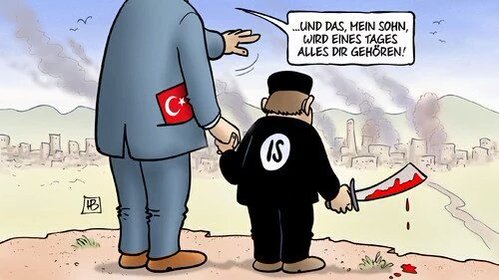
One day, my son, all this will be yours
By Finian CUNNINGHAM – Strategic Culture – 07.03.2016
With a series of blatant measures, Saudi Arabia and its regional allies are evidently trying to destabilize Lebanon. The development is apiece with how Saudi Arabia and Turkey have both sought to undermine the ceasefire in Syria and to escalate that conflict to a region-wide level.
A New York Times report this week poses a rather naive conundrum: «Diplomats and analysts have spent several weeks trying to understand why the Saudis would precipitously start penalizing Lebanon – and perhaps their own Lebanese allies – over the powerful influence of Hezbollah, which is nothing new».
Well, here’s a quick answer: Russia’s very effective squelching of the covert war for regime-change in Syria. That has sent Saudi Arabia and Turkey into a paroxysm of rage.
Russia’s military intervention in Syria to defend the Arab state from a foreign-backed covert war involving myriad terrorist proxy groups, has dealt a severe blow to the machinations of Washington, its NATO allies and regional client states.
While Washington and its Western partners seem resigned to pursue regime change by an alternative political track, Saudi Arabia and Turkey are stuck in the covert-war groove. They are betting that the terrorist proxy armies they have weaponized can somehow be salvaged from withering losses inflicted by Russian airpower in combination with the ground forces of the Syrian Arab Army, Iranian military advisors and the Lebanese Hezbollah militia.
Hence, the immediate breaches of the cessation called a week ago by Washington and Moscow in Syria. Turkish military shelling across the border into northern Syria is not just a breach. It is an outrageous provocation to Syrian sovereignty, as Moscow has pointed out.
Simultaneous Saudi military mobilization, including Turkish forces, on its northeast border with Iraq, as well as the reported deployment of Saudi fighter jets to Turkey’s Incirlik airbase opposite Syria’s northwest Latakia province can also be viewed as calculated moves to undermine the tentative ceasefire. The logical conclusion of this reckless aggression by both Saudi Arabia and Turkey is to precipitate a wider conflict, one which would draw in the US and Russia into open warfare.
The series of Saudi-led initiatives towards Lebanon should be interpreted in this context. In the past week, Saudi Arabia and its closely aligned Sunni monarchies in the Persian Gulf Cooperation Council (GCC) have declared Hezbollah a terrorist organization. The word «anachronistic» comes to mind, belying an ulterior motive.
The Saudi rulers, led by King Salman and his son Crown Prince Mohammad bin Salman, also announced that they were canceling plans to grant Lebanon $4 billion in aid. Most of the aid was to be in form of military grants, to be spent on upgrading the Lebanese national army with French weaponry and equipment.
Without providing any proof, the GCC states – Kuwait, Qatar, Bahrain, the United Arab Emirates and Oman in addition to Saudi Arabia – issued travel warnings to their nationals intending to visit Lebanon. The GCC also claimed that Hezbollah was interfering in their internal affairs and trying to recruit Gulf nationals into the organization to fight in Syria. The GCC has even threatened to deport Lebanese expatriate workers, some half a million of which work in the Gulf.
There were also regional media reports last week of a large cache of weapons having been seized by Greek authorities, stowed illicitly onboard a cargo ship sailing from Turkey to Lebanon.
The cumulative intent seems patent. The Saudis and their regional allies – who have been pushing for regime change for the past five years against the Russian, Iranian and Hezbollah-allied government of President Bashar al-Assad – see the escalation of regional instability as the best way to salvage their covert war in Syria.
Washington, London and Paris probably have sufficient cynical intelligence to realize that the covert war involving terrorist proxies is no longer a viable option – given the formidable forces arrayed in support of the Syrian state, not least Russian air power.
The Saudis and the Turkish regime of Recep Tayyip Erdogan appear to be inflexibly wedded to the covert war agenda. For these powers anything less than the outright removal of Assad would be seen as a grave blow to their despotic egos and, for them, an unbearable boost to their regional rival, Shia-dominated Iran.
The GCC criminalization of Shia-affiliated Hezbollah is obviously a fit of revenge-seeking given how the militia has ably helped the Syrian army retake major areas from the regime-change Sunni extremist insurgents, in conjunction with the Russian air strikes. The steady shutting down of border crossings in Latakia, Idlib and Aleppo has cut-off the terror brigades from their weapons supply routes via Turkey. This is partly why the Erdogan regime has responded by cross-border shelling in order to give re-supply efforts a modicum of artillery cover.
Moreover, the Saudi-led campaign to sanction Hezbollah is also aimed at destabilizing the sectarian fault lines inside Lebanon. Hezbollah may be denigrated by Washington and some other Western states as a «terrorist group» and of presiding over «a state within a state» due to its military wing which exists alongside the Lebanese national army.
Nevertheless, Hezbollah has constitutionally recognized legitimacy within Lebanon. This is partly due to the militia’s primary role in driving out the US-backed Israeli military occupation of the country in 2000 and again in 2006. For many Lebanese people, including Christians and Sunni Muslims, Hezbollah is held with pride as an honorable resistance force to US-led imperialism in the region.
The party – which Russia also recognizes as a legitimate national resistance movement – comprises about 10 per cent of the Lebanese parliament and holds two cabinet positions in the coalition Beirut government.
So the Saudi-led proposal to sanction Hezbollah seems nothing more than a gratuitous bid to open up sectarian fissures that have cleaved Lebanon in the recent past during its 1975-1990 civil war. The provocation of labeling a member of government in a foreign state as «terrorist» – seemingly out of the blue – has to be seen as a tendentious bid to destabilize. Hezbollah leader Hassan Nasrallah this week condemned the Saudi bid to inflame sedition in Lebanon, and it is hard to disagree with that assessment.
There are still pockets of extremist Sunni support within Lebanon that the Saudis and Turkey appear to be trying to incite. During the Syrian conflict, there have been sporadic outbreaks of violence in the cities of Sidon and Tripoli by Salafist elements with close links to Saudi Arabia and Turkey. Now those same elements are being incited to take to the streets again.
It is not clear if Lebanon can hold together. A government minister linked to a pro-Saudi faction has resigned in recent weeks over what he claims is «Hezbollah domination» in Lebanese politics.
Many Lebanese are discontented over social and economic problems dogging the country. A refuse-collection backlog over the past year has left large parts of the capital overflowing with putrid waste. The tiny country of four million is also feeling the strain of accommodating some one million Syrian refugees.
The thought of re-opening old wounds and re-igniting the horror of civil war is a heavy burden on most Lebanese citizens that may be enough to make them baulk at malign pressures.
But what can be said for sure is that the role of Turkey, Saudi Arabia and the other Arab monarchies is absolutely unconscionable and criminal. They seem fully prepared to plunge yet another neighboring country into a sectarian bloodbath in order to gratify their illicit regional ambitions.
‘Human rights abusers’ invited to ‘non-lethal’ weapons show, condemned by activists
RT | March 7, 2016
Activists have denounced a Home Office sponsored security fair, warning that Britain is selling tear gas and other crowd control tools to some of the world’s most oppressive regimes.
Among the governments invited to take part in the fair in Farnborough, Hampshire, 30 miles southwest of London, are Bahrain, Saudi Arabia, Israel, United Arab Emirates (UAE), Egypt and Turkey, the Guardian reported on Saturday.
Police and security officials from 79 countries are expected to participate in the fair later this week, according to the list, which was released under a Freedom of Information request.
Since Prime Minister David Cameron took office in 2010, the UK has approved 126 licenses connected with the sale of tear gas and other irritants, according to the Campaign Against the Arms Trade (CAAT).
Also approved were 75 licenses for crowd control ammunition such as rubber bullets, 79 for “acoustic” crowd control – known as sound grenades – and 259 licenses for riot shields.
CAAT spokesman Andrew Smith told the paper: “There are serious questions to be asked about the impact of the so-called ‘non-lethal’ arms industry. These risks become even more important when these weapons are being sold to human rights abusers and dictatorships.”
“A number of the countries in attendance routinely practice torture, arbitrary detention and other appalling acts of violence. The UK should not be arming these regimes and selling them the means to oppress and kill.”
“[The event] undermines the UK’s claims to be promoting human rights while strengthening the position of repressive regimes.”
Defending the trade show, the Home Office said: “A thriving security industry is vital to help cut crime and protect the public and so it is important these products and services can be showcased and expertise shared.”
Described by organizers as “the perfect place to see the latest security equipment and technology in a secure environment,” the Security and Policy fair will be held behind closed doors, with all visitors “pre vetted to strict Home Office criteria.”
1st edition of Turkish Zaman daily after govt takeover sees smiling Erdogan on front page
RT | March 6, 2016
The editorial policy of Turkey’s best-selling Zaman newspaper, formerly critical of the government, has apparently gone through a change. The Sunday edition, under a newly appointed administration, now appears to support the official line.
President Recep Tayyip Erdogan can be seen on the new Zaman daily’s front page, smiling in an article announcing a presidential reception on upcoming Women’s Day (March 8). A costly governmental project of a new bridge to be built across Istanbul’s Bosphorus Strait was also headlined, as well as reports on the funerals of “martyrs” killed in clashes with the Kurds.
More articles supporting the government could be found in the Sunday edition of the paper that has an estimated circulation of 650,000, AFP reported. Containing just 12 pages, the paper is a slimmer version of its previous self, and the content is sparse, according to Reuters.
Protests that erupted following what was widely seen as the seizure of Zaman’s headquarters in Istanbul by the government were glossed over in the new edition, Reuters reported. On Saturday, police used tear gas, water cannon and fired rubber bullets to disperse hundreds-strong crowds of Zaman readers.
Police also raided Zaman’s building, forcefully imposing a Turkish court order to put the media under administration. The newspaper’s editor-in-chief Abdulhamit Bilici was fired by the new trustees.
“The Sunday edition was not produced by Zaman’s staff,” one of the newspaper’s journalists told AFP, adding, “internet has been cut off, we are unable to use our system.”
“It’s impossible to continue to work at Zaman daily because the trustees who were assigned by the government will fire us a couple of days later. All of us will be fired from the newspaper. But if they don’t, of course we will resign, because it’s impossible to work with the government, we will not write what they want,” Emre Soncan, a journalist from Today’s Zaman newspaper, an English version of Zaman daily, told RT on Saturday.
Zaman’s website has been offline, while Today’s Zaman online services have not been updated since Saturday. Government affiliates have also taken control of and blocked access to the outlet’s Cihan news agency, Today’s Zaman earlier reported.
The Zaman newspaper’s former team has launched a new paper of their own, Yarina Bakis (Look to Tomorrow), local media reported, saying that journalists had decided to remain in line with their previous editorial policy. The new paper reported on the weekend protests in Istanbul.
Turkish Prime Minister Ahmet Davutoglu denied any links between the government takeover of the paper and changes in its editorial policy, saying the seizure had nothing to do with the paper’s criticism of the authorities.
“There are many media outlets in Turkey that criticize our government. None of them are subjected to legal procedures,” Davutoglu told A Haber television on Sunday, as quoted by AFP. “What’s in question here is not merely press activity, but rather an operation targeting a legitimate government that came to power with popular support,” he added, referring to Zaman’s affiliation with now US-based cleric Fethullah Gulen, a fierce critic of President Erdogan, who was put on a “most-wanted terrorist list” by Ankara.
‘Everyone is being framed’, journalist deported from Turkey tells RT amid govt media takeover
RT | March 5, 2016
The latest government takeover of the Zaman media outlet in Istanbul is “not a surprise at all,” a journalist who had been working in the country told RT, adding that “the press has never been free in Turkey.”
“Everybody who opposes them [the government], every journalist who is against the government is being framed. I was framed as a terrorist supporter and Zaman is linked to the Gulen movement – which is a movement of a religious Turkish leader [Sunni cleric Fethullah Gulen] who is based in the US, and they say he is trying to stage a coup against the government. So now Zaman journalists and people who read Zaman are being framed as coup supporters, that’s how the government is doing it,” Frederike Geerdink, Dutch freelance journalist who was deported from Turkey last year, told RT.
On Friday, the Istanbul-based Turkish-language Zaman newspaper, which has been sharply critical of President Recep Tayyip Erdogan, was ordered into administration by a court decision. Following the order, which the outlet journalists proclaimed an “unlawful takeover,” the paper’s editor-in-chief Abdulhamit Bilici was fired by trustees, while police put barbed wire around the headquarters.
“All content management systems at Zaman” have also been blocked by the new administration, Zaman’s sister publication in English, Today’s Zaman, said, with its journalists covering the situation via social media and posting updates on Twitter.
“All internet connection is cut off at the seized Zaman building by police raid,” they posted, adding that after the takeover of the headquarters in Istanbul, the Ankara office has also “lost access to company internal servers.”
Government affiliates have also taken under control and blocked access to the outlet’s Cihan news agency, Today’s Zaman reported, adding that it is “the only news agency that was monitoring elections besides state-run Anadolu.”
“It’s not a surprise at all. Several of the government newspapers have in the last couple of weeks hinted at this [takeover] already, and other media who are linked to the Gulen movement have come under the same procedure with trustees,” Frederike Geerdink, who has herself been prosecuted in Turkey “for making propaganda for a terrorist organization,” said.
The journalist told RT that she has been in contact with one of Zaman’s employees, who told her weeks ago that they had been “having a difficult time” because of government pressure. Zaman was losing advertisers and readers, “because if you work for the state you cannot be seen with Zaman under your arm, as it can lead to losing your job,” the Dutch journalist was told by her Turkish colleague.
“Zaman was being attacked for months,” she said, but added that the current situation with the media in the country “is not something new.”
Two years ago, one of Today’s Zaman journalists, Azerbaijan national Mahir Zeynalov, was deported from Turkey after having worked at the Turkish newspaper for years. The reporter was facing prosecution related to a tweet, his employers said, adding that a complaint against Zeynalov was filed by then PM Erdogan, accusing the journalist of “defamation and inciting public to hatred.”
“People now think that Erdogan invented the lack of press freedom in Turkey – which is totally not true. He takes it to extreme heights – that’s definitely true, but the press has never been free in Turkey,” Geerdink told RT. “For example, 20 years ago nobody could go to the southeast to report on the realities there. At the time it was the army that was censoring the press, and now Erdogan is using the same mechanisms to silence opponents,” she said.
Not only government-owned media outlets are being biased in Turkey, the Dutch journalist said. Some are under indirect, economic pressure.
“Most of the big papers and big channels, also the ones we call ‘mainstream’ which are not necessarily total mouthpieces of the government, have economic ties to the government, because they are part of big companies, and have to report in line with general government policy. [Otherwise] these companies lose contracts in the telecom market,” Geerdink said, adding that CNN Turk – which hasn’t been covering the Zaman protests, is one example.
“CNN Turk cancelled two rather popular talk shows of people who are not really in line with the government – and that is another problem in Turkey,” she said.
Turkish police raid opposition Zaman daily HQ, unleash tear gas & water cannon on protesters
RT | March 4, 2016
Turkish police used water cannon and tear gas to disperse crowds protesting outside the headquarters of the opposition Zaman newspaper. They moved in to secure the premises following a government decision to take over the management of the media group.
Part of the crowd appears to have taken cover inside of the building, as riot police moved in on protesters, according to live feed from the scene.
After clearing their way through the crowd in front of the newspaper’s HQ, the officers pushed their way inside the building.
“Throw him off the staircase!” one of the officers allegedly shouted, as the raid squad pushed one of the publication’s employees down to the hall, according to a tweet written by a Zaman employee.
Zaman Editor-in-Chief Sevgi Akarcesme said that during the raid she was pushed by police as authorities tried to take her out of the building.
“A police officer grabbed my phone forcefully while I was broadcasting on Periscope. I’ll sue him when the rule of law is back. Unbelievable!” she tweeted. “This is beyond comprehension! Such a sad day in Turkey!”
The daily confirmed that police had gone to the management floor in the building, and were preventing editors from entering their offices. The journalists were shut out of their offices while police allegedly confiscated their cell phones, according to reports on social media.
The raid began shortly before midnight after a day of standoffs between police and opposition protesters furious about what they call a government crackdown on the free press.
The biggest opposition publication is being accused by the state of alleged links to America-based Muslim cleric Fethullah Gulen, whom the government accuses of attempting to topple the regime.
The decision by Istanbul 6th Criminal Court of Peace to de facto censor the publication was granted after the request of the Istanbul Chief Public Prosecutor’s Office, that accused the publication of taking orders from what it called the “Fethullahist Terrorist Organization/Parallel State Structure (FETO/PDY).”
The prosecutor said that the alleged terrorist group is working together with the Kurdistan Workers’ Party (PKK) with the aim of toppling the Turkish government.
To remedy the so-called “terrorist threat,” the court ruled to sack the entire management and the editorial team of Feza Media Group companies and to replace the entire group’s administration with a three-member board appointed by the state court.
Following the court ruling the newspaper editorial team released a statement through its English-language sister publication, Today’s Zaman, calling the takeover the “darkest and gloomiest” for the freedom of the press.
The statement added that “media organizations and journalists are being silenced via threats and blackmail.”
After the ruling, hundreds of people gathered outside the newspaper’s offices in Istanbul protesting against the move, before police allegedly fired tear gas at protesters as they stormed the head office building.
READ MORE: Court orders Turkish Zaman daily into administration, raising concerns of free press abuse
The Caesar photo fraud that undermined Syrian negotiations

By Rick Sterling | American Herald Tribune | March 4, 2016
A 30 page investigative report on the “Caesar Torture Photos” has been released and is available online here. The following is a condensed version of the report. Readers who are especially interested are advised to get the full report which includes additional details, photographs, sources and recommendations.
Introduction
There is a pattern of sensational but untrue reports that lead to public acceptance of US and Western military intervention in countries around the world:
* In Gulf War 1, there were reports of Iraqi troops stealing incubators from Kuwait, leaving babies to die on the cold floor. Relying on the testimony of a Red Crescent doctor, Amnesty Interenational ‘verified’ the false claims.
* Ten years later, there were reports of yellow cake uranium going to Iraq for development of weapons of mass destruction.
* One decade later, there were reports of Libyan soldiers drugged on viagra and raping women as they advanced.
* In 2012, NBC broadcaster Richard Engel was supposedly kidnapped by pro-Assad Syrian militia but luckily freed by Syrian opposition fighters, the “Free Syrian Army”.
All these reports were later confirmed to be fabrications and lies. They all had the goal of manipulating public opinion and they all succeeded in one way or another. Despite the consequences, which were often disastrous, none of the perpetrators were punished or paid any price.
It has been famously said “Those who do not learn from the past are doomed to repeat it.” This report is a critical review of the “Caesar Torture Photos” story. As will be shown, there is strong evidence the accusations are entirely or substantially false.
Overview of ‘Caesar Torture Photos’
On 20 January 2014, two days before negotiations about the Syrian conflict were scheduled to begin in Switzerland, a sensational report burst onto television and front pages around the world. The story was that a former Syrian army photographer had 55,000 photographs documenting the torture and killing of 11,000 detainees by the Syrian security establishment.
The Syrian photographer was given the code-name ‘Caesar’. The story became known as the “Caesar Torture Photos”. A team of lawyers plus digital and forensic experts were hired by the Carter-Ruck law firm, on contract to Qatar, to go to the Middle East and check the veracity of “Caesar” and his story. They concluded that “Caesar” was truthful and the photographs indicated “industrial scale killing”. CNN, London’s Guardian and LeMonde broke the story which was subsequently broadcast in news reports around the world. The Caesar photo accusations were announced as negotiations began in Switzerland. With the opposition demanding the resignation of the Syrian government, negotiations quickly broke down.
For the past two years the story has been preserved with occasional bursts of publicity and supposedly corroborating reports. Most recently, in December 2015 Human Rights Watch (HRW) released a report titled “If the Dead Could Speak” with significant focus on the Caesar accusations.
Following are 12 significant problems with the ‘Caesar torture photos’ story.
1. Almost half the photos show the opposite of the allegations.
The Carter Ruck Inquiry Team claimed there were about 55,000 photos total with about half of them taken by ‘Caesar’ and the other half by other photographers. The Carter Ruck team claimed the photos were all ‘similar’. Together they are all known as ‘Caesar’s Torture Photos’.
The photographs are in the custody of an opposition organization called the Syrian Association for Missing and Conscience Detainees (SAFMCD). In 2015, they allowed Human Rights Watch (HRW) to study all the photographs which have otherwise been secret. In December 2015, HRW released their report titled “If the Dead Could Speak”. The biggest revelation is that over 46% of the photographs (24,568) do not show people ‘tortured to death” by the Syrian government. On the contrary, they show dead Syrian soldiers and victims of car bombs and other violence (HRW pp2-3). Thus, nearly half the photos show the opposite of what was alleged. These photos, never revealed to the public, confirm that the opposition is violent and has killed large numbers of Syrian security forces and civilians.
2. The claim that other photos only show ‘tortured detainees’ is exaggerated or false.
The Carter Ruck report says ‘Caesar’ only photographed bodies brought from Syrian government detention centers. In their December 2015 report, HRW said, “The largest category of photographs, 28,707 images, are photographs Human Rights Watch understands to have died in government custody, either in one of several detention facilities or after being transferred to a military hospital.” They estimate 6,786 dead individuals in the set.
The photos and the deceased are real, but how they died and the circumstances are unclear. There is strong evidence some died in conflict. Others died in the hospital. Others died and their bodies were decomposing before they were picked up. These photographs seem to document a war time situation where many combatants and civilians are killed. It seems the military hospital was doing what it had always done: maintaining a photographic and documentary record of the deceased. Bodies were picked up by different military or intelligence branches. While some may have died in detention; the great majority probably died in the conflict zones. The accusations by ‘Caesar’, the Carter Ruck report and HRW that these are all victims of “death in detention” or “death by torture” or death in ‘government custody” are almost certainly false.
3. The true identity of “Caesar” is probably not as claimed.
The Carter Ruck Report says “This witness who defected from Syria and who had been working for the Syrian government was given the code-name ‘Caesar’ by the inquiry team to protect the witness and members of his family.” (CRR p12) However if his story is true, it would be easy for the Syrian government to determine who he really is. After all, how many military photographers took photos at Tishreen and Military 601 Hospitals during those years and then disappeared? According to the Carter Ruck report, Caesar’s family left Syria around the same time. Considering this, why is “Caesar” keeping his identity secret from the western audience? Why does “Caesar” refuse to meet even with highly sympathetic journalists or researchers?
The fact that 46% of the total photographic set is substantially the opposite of what was claimed indicates two possibilities:
* Caesar and his promoters knew the contents but lied about them expecting nobody to look.
* Caesar and his promoters did not know the contents and falsely assumed they were like the others.
The latter seems more likely which supports the theory that Caesar is not who he claims to be.
4. The Carter Ruck Inquiry was faulty, rushed and politically biased.
The credibility of the “Caesar” story has been substantially based on the Carter-Ruck Inquiry Team which “verified” the defecting photographer and his photographs. The following facts suggest the team was biased with a political motive:
* the investigation was financed by the government of Qatar which is a major supporter of the armed opposition.
* the contracted law firm, Carter Ruck and Co, has previously represented Turkey’s President Erdogan, also known for his avid support of the armed opposition.
* the American on the legal inquiry team, Prof David M. Crane, has a long history working for U.S. Dept of Defense and Defense Intelligence Agency. The U.S. Government has been deeply involved in the attempt at ‘regime change’ with demands that ‘Assad must go’ beginning in summer 2011 and continuing until recently.
* Prof Crane is personally partisan in the conflict. He has campaigned for a Syrian War Crimes Tribunal and testified before Congress in October 2013, three months before the Caesar revelations.
* by their own admission, the inquiry team was under “time constraints” (CRR, p11).
* by their own admission, the inquiry team did not even survey most of the photographs
* the inquiry team was either ignorant of the content or intentionally lied about the 46% showing dead Syrian soldiers and attack victims.
* the inquiry team did their last interview with “Caesar” on January 18, quickly finalized a report and rushed it into the media on January 20, two days prior to the start of UN sponsored negotiations.
The self-proclaimed “rigor” of the Carter Ruck investigation is without foundation. The claims to a ‘scientific’ investigation are similarly without substance and verging on the ludicrous.
5. The U.S. Central Intelligence Agency (CIA) is involved.
In an interview on France24, Prof. David Crane of the inquiry team describes how ‘Caesar’ was brought to meet them by “his handler, his case officer”. The expression ‘case officer’ usually refers to the CIA. This would be a common expression for Prof. Crane who previously worked in the Defense Intelligence Agency. The involvement of the CIA additionally makes sense since there was a CIA budget of $1Billion for Syria operations in 2013.
Prof. Crane’s “Syria Accountability Project” is based at Syracuse University where the CIA actively recruits new officers despite student resistance.
Why does it matter if the CIA is connected to the ‘Caesar’ story? Because the CIA has a long history of disinformation campaigns. In 2011, false reports of viagra fueled rape by Libyan soldiers were widely broadcast in western media as the U.S. pushed for a military mandate. Decades earlier, the world was shocked to hear about Cuban troops fighting in Angola raping Angolan women. The CIA chief of station for Angola, John Stockwell, later described how they invented the false report and spread it round the world. The CIA was very proud of that disinformation achievement. Stockwell’s book, “In Search of Enemies” is still relevant.
6. The prosecutors portray simple administrative procedures as mysterious and sinister.
The Carter Ruck inquiry team falsely claimed there were about 11,000 tortured and killed detainees. They then posed the question: Why would the Syrian government photograph and document the people they just killed? The Carter Ruck Report speculates that the military hospital photographed the dead to prove that the “orders to kill” had been followed. The “orders to kill” are assumed.
A more logical explanation is that dead bodies were photographed as part of normal hospital / morgue procedure to maintain a file of the deceased who were received or treated at the hospital.
The same applies to the body labeling / numbering system. The Carter Ruck report suggests there is something mysterious and possibly sinister in the coded tagging system. But all morgues need to have a tagging and identification system.
7. The photos have been manipulated.
Many of the photos at the SAFMCD website have been manipulated. The information card and tape identity are covered over and sections of documents are obscured. It must have been very time consuming to do this for thousands of photos. The explanation that they are doing this to ‘protect identity’ is not credible since the faces of victims are visible. What are they hiding?
8. The Photo Catalog has duplicates and other errors.
There are numerous errors and anomalies in the photo catalog as presented at the SAFMCD website.
For example, some deceased persons are shown twice with different case numbers and dates.
There are other errors where different individuals are given the same identity number.
Researcher Adam Larson at A Closer Look at Syria website has done detailed investigation which reveals more errors and curious error patterns in the SAFMCD photo catalog.
9. With few exceptions, Western media uncritically accepted and promoted the story.
The Carter Ruck report was labeled “Confidential” but distributed to CNN, the Guardian and LeMonde.
CNN’s Christiane Amanpour gushed the story as she interviewed three of the inquiry team under the headline “EXCLUSIVE: Gruesome Syria photos may prove torture by Assad regime”. Critical journalism was replaced by leading questions and affirmation. David Crane said “This is a smoking gun”. Desmond de Silva “likened the images to those of holocaust survivors”.
The Guardian report was titled “Syrian regime document trove shows evidence of ‘industrial scale’ killing of detainees” with subtitle “Senior war crimes prosecutors say photographs and documents provide ‘clear evidence’ of systematic killing of 11,000 detainees”
One of the very few skeptical reports was by Dan Murphy in the Christian Science Monitor. Murphy echoed standard accusations about Syria but went on to say incisively, “the report itself is nowhere near as credible as it makes out and should be viewed for what it is: A well-timed propaganda exercise funded by Qatar, a regime opponent who has funded rebels fighting Assad who have committed war crimes of their own.”
Unfortunately that was one of very few critical reports in the mainstream media.
In 2012, foreign affairs journalist Jonathan Steele wrote an article describing the overall media bias on Syria.. His article was titled “Most Syrians back Assad but you’d never know from western media”. The media campaign and propaganda has continued without stop. It was in this context that the Carter Ruck Report was delivered and widely accepted without question.
10. Politicians have used the Caesar story to push for more US/NATO aggression.
Politicians seeking direct US intervention for ‘regime change’ in Syria were quick to accept and broadcast the ‘Caesar’ story. They used it to demonize the Assad government and argue that the US must act so as to prevent “another holocaust’, ‘another Rwanda’, ‘another Cambodia’.
When Caesar’s photos were displayed at the House Foreign Affairs Committee in Congress, Chairman Ed Royce said “It is far past time that the world act…. It is far past time for the United States to say there is going to be a safe zone across this area in northern Syria.”
The top ranking Democrat in the House Foreign Affairs Committee is Eliot Engel. In November 2015 he said “We’re reminded of the photographer, known as Caesar, who sat in this room a year ago, showing us in searing, graphic detail what Assad has done to his own people.” Engel went on to advocate for a new authorization for the use of military force.
Rep Adam Kinzinger is another advocate for aggression against Syria. At an event at the Holocaust Memorial Museum in July 2015 he said, “If we want to destroy ISIS we have to destroy the incubator of ISIS, Bashar al-Assad.”
The irony and hypocrisy is doubly profound since Rep Kinzinger has met and coordinated with opposition leader Okaidi who is a confirmed ally of ISIS. In contrast with Kinzinger’s false claims, it is widely known that ISIS ideology and initial funding came from Saudi Arabia and much of its recent wealth from oil sales via Turkey. The Syrian Army has fought huge battles against ISIS, winning some but losing others with horrific scenes of mass beheading.
11. The Human Rights Watch assessment is biased.
HRW has been very active around Syria. After the chemical attacks in greater Damascus on August 21, 2013, HRW rushed a report which concluded that, based on a vector analysis of incoming projectiles, the source of the sarin carrying rockets must have been Syrian government territory. This analysis was later debunked as a “junk heap of bad evidence” by highly respected investigative journalist Robert Parry. HRW’s assumption about the chemical weapon rocket flight distance was faulty. Additionally it was unrealistic to think you could determine rocket trajectory with 1% accuracy from a canister on the ground. To think you could determine flight trajectory from a canister on the ground that had deflected off a building wall was preposterous.
In spite of this, HRW stuck by its analysis which blamed the Assad government. HRW Director Ken Roth publicly indicated dissatisfaction when an agreement to remove Syrian chemical weapons was reached. Mr. Roth wanted more than a ‘symbolic’ attack.
In light of the preceding, we note the December 2015 HRW report addressing the claims of Caesar.
HRW seems to be the only non-governmental organization to receive the full set of photo files from the custodian. To its credit, HRW acknowledged that nearly half the photos do not show what has been claimed for two years: they show dead Syrian soldiers and militia along with scenes from crime scenes, car bombings, etc…
But HRW’s bias is clearly shown in how they handle this huge contradiction. Amazingly, they suggest the incorrectly identified photographs support the overall claim. They say, “This report focuses on deaths in detention. However other types of photographs are also important. From an evidentiary perspective, they reinforce the credibility of the claims of Caesar about his role as a forensic photographer of the Syrian security forces or at least with someone who has access to their photographs.” (HRW, p31) This seems like saying if someone lies to you half the time that proves they are truthful.
The files disprove the assertion that the files all show tortured and killed. The photographs show a wide range of deceased persons, from Syrian soldiers to Syrian militia members to opposition fighters to civilians trapped in conflict zones to regular deaths in the military hospital. There may be some photos of detainees who died in custody after being tortured, or who were simply executed. We know that this happened in Iraqi detention centers under U.S. occupation. Ugly and brutal things happen in war times. But the facts strongly suggest that the ‘Caesar’ account is basically untrue or a gross exaggeration.
It is striking that the HRW report has no acknowledgment of the war conditions and circumstances in Syria. There is no acknowledgment that the government and Syrian Arab Army have been under attack by tens of thousands of weaponized fighters openly funded and supported by many of the wealthiest countries in the world.
There is no hint at the huge loss of life suffered by the Syrian army and supporters defending their country. The current estimates indicate from eighty to one hundred and twenty thousand Syrian soldiers, militia and allies having died in the conflict. During the three years 2011 – 2013, including the period covered by Caesar photos, it is estimated that over 52,000 Syrian soldiers and civilian militia died versus 29,000 anti-government forces.
HRW had access to the full set of photographs including the Syrian army and civilian militia members killed in the conflict. Why did they not list the number of Syrian soldiers and security forces they identified? Why did they not show a single image of those victims?
HRW goes beyond endorsing the falsehoods in the ‘Caesar’ story; they suggest it is a partial listing. On page 5 the report says, “Therefore, the number of bodies from detention facilities that appear in the Caesar photographs represent only a part of those who died in detention in Damascus.”
On the contrary, the Caesar photographs seem to mostly show victims who died in a variety of ways in the armed conflict. The HRW assertions seem to be biased and inaccurate.
12. The legal accusations are biased and ignore the supreme crime of aggression.
The Christian Science Monitor journalist Dan Murphy gave an apt warning in his article on the Carter Ruck report about ‘Caesar’. While many journalists treated the prosecutors with uncritical deference, he said, “Association with war crime prosecutions is no guarantor of credibility – far from it. Just consider Luis Moreno Ocampo’s absurd claims about Viagra and mass rape in Muammar Qaddafi’s Libya in 2011. War crimes prosecutors have, unsurprisingly, a bias towards wanting to bolster cases against people they consider war criminals (like Assad or Qaddafi) and so should be treated with caution. They also frequently favor, as a class, humanitarian interventions.”
The Carter Ruck legal team demonstrated how accurate those cautions were. They were eager to accuse the Syrian government of “crimes against humanity” but the evidence of “industrial killing”, “mass killing”, “torturing to kill” is dubious and much of the hard evidence shows something else.
In contrast, there is clear and solid evidence that a “Crime against Peace” is being committed against Syria. It is public knowledge that the “armed opposition” in Syria has been funded, supplied and supported in myriad ways by various outside governments. Most of the fighters, both Syrian and foreign, receive salaries from one or another outside power. Their supplies, weapons and necessary equipment are all supplied to them. Like the “Contras” in Nicaragua in the 1980’s, the use of such proxy armies is a violation of customary international law.
It is also a violation of the UN Charter which says “All Members shall refrain in their international relations from the threat or use of force against the territorial integrity or political independence of any state, or in any other matter inconsistent with the Purposes of the United Nations”.
The government of Qatar has been a major supporter of the mercenaries and fanatics attacking the sovereign state of Syria. Given that fact, isn’t it hugely ironic to hear the legal contractors for Qatar accusing the Syrian government of “crimes against humanity”?
Isn’t it time for the United Nations to make reforms so that it can start living up to its purposes? That will require demanding and enforcing compliance with the UN Charter and International Law.
Featured Video

Fear Is the Mind Killer
or go to
Aletho News Archives – Video-Images
From the Archives
Alarmist climate science as a textbook example of groupthink
By Paul MacRae | May 1, 2012
A while ago, I received an email from a friend who asked:
How can many, many respected, competitive, independent science folks be so wrong about [global warming] (if your [skeptical] premise is correct). I don’t think it could be a conspiracy, or incompetence. … Has there ever been another case when so many ‘leading’ scientific minds got it so wrong?
The answer to the second part of my friend’s question—“Has there ever been another case where so many ‘leading’ scientific minds got it so wrong?”—is easy. Yes, there are many such cases, both within and outside climate science. In fact, the graveyard of science is littered with the bones of theories that were once thought “certain” (e.g., that the continents can’t “drift,” that Newton’s laws were immutable, and hundreds if not thousands of others).
Science progresses by the overturning of theories once thought “certain.” … continue
Blog Roll
 Aletho News
- A pause, not a ceasefire: Washington stalls, Tehran recalibrates
- US blockade crumbles as Iran turns to overland routes
- Hidden costs of US Iran war push total far beyond $25bn Pentagon claim
- Iran Will Respond With Long-Term Strikes to US Attack, Even If It Is Short-Term – IRGC
- Fear Is the Mind Killer
- Israeli strikes kill 10 in southern Lebanon, including 3 rescue workers
- Israeli military ‘failed on all fronts’: Poll
- US at a crossroads: Iran’s firm positions leave Trump no option but to capitulate
- Iran signals decisive response to end US maritime bullying, piracy
- Trump eager for off-ramp in war on Iran, but Netanyahu has him trapped: Former official
- If Americans Knew
- How Tony Dokoupil Became the Face of ‘Zionist Fanatic’ Bari Weiss’s CBS
- Far Right Israeli Settler Movement Enters Syria in a Push for “Greater Israel”
- ‘People Have the Right to Be Buried’: In Gaza, Thousands of Palestinians Remain Trapped Under Rubble
- Born during Israel’s genocide: Gaza’s child survivors bear the scars of war
- Who are the women and girls behind Gaza war’s horrific casualty toll?
- Beloved Gaza doctor detained “indefinitely” without charge – Daily Update
- By Week’s End, Trump’s War Will Be Plainly Illegal
- CBS News Reportedly Ousts London Bureau Chief Over Differences With Bari Weiss Over Gaza Coverage
- State Department Says US Is in Conflict With Iran ‘At the Request’ of Israel
- What ceasefire? Israel won’t stop killing in Gaza, Lebanon – Daily Update
- No Tricks Zone
- Oversupply Of Volatile Solar Energy Leads To Record NEGATIVE Prices!
- New Study: Extreme Heat Records, Heatwaves, Extreme Cold Records Declining Across US Since 1899
- It’s The Cold, Stupid! Cold 20 Times More Lethal Than Heat, Multiple Studies Show
- European Institute For Climate And Energy: “Climate Debate is Seldom About Science”
- New Study: The Climate May Be 5 Times More Sensitive To Solar Forcing Than Commonly Assumed
- EV Industry Reached $70 Billion In Losses In 2024 Due To Delusional Green Ideologies
- Reality Check: Maldives Have Actually Grown In Size Or Remained Stable Over Recent Decades
- Abrupt Climate Change Also Occurred NATURALLY In The Past …25 Times During Last Ice Age
- Cave Discovery Reveals Today’s Desert Climates Were Recently Far Warmer, Wetter, Teeming With Life
- German Expert: Heat Dome Led To Record Temps In Western USA…Warmer In 1934, 1936
 Aletho News