Daesh Receiving Assistance From Turkey ‘With Ankara’s Tacit Approval’
Sputnik – March 4, 2016
Mounting evidence appears to indicate that Turkey is providing extensive support to Daesh and al-Nusra Front, the two key terrorist organizations that have turned Syria into ruins and wreak chaos elsewhere.
“Taking publicly available information into account, we’ve come to the conclusion that Turkey has directly or indirectly served as Daesh’s mediator and ally by helping the radical group to prepare and commit terrorist acts, acquire necessary resources and recruit new fighters,” Ertuğrul Kürkçü, the current Honorary President of the pro-Kurdish Peoples’ Democratic Party (HDP), told Sputnik.
Despite its tough anti-Daesh rhetoric, the Turkish leadership has done nothing to dismantle the existing terrorist network in the country. “After so many horrible terrorist acts, not a single real participant or mastermind has been arrested,” the Turkish politician observed.
Kürkçü also mentioned that some in the Turkish military and law enforcement agencies are in direct contact with the terrorist group. He was referring to a recent report, released by the Cumhuriyet newspaper.
The opposition daily published transcripts of several phone conversations between unnamed Turkish officers and a key Daesh operative in the region bordering Syria. The documents appear to show that Turkish officers not only frequently communicated, but worked with the militants.
It follows then that “at the moment Daesh receives support and recruits with the tacit approval of the Turkish government, as well as the country’s president and prime minister,” Kürkçü concluded.
Meanwhile, RT has published footage shot on the outskirts of the Syrian town of Azaz, which is controlled by al-Nusra Front militants. The Kurdish People’s Protection Units (YPG) have been unable to liberate Azaz because Turkish forces shelled the area.
The YPG told RT’s Lizzie Phelan that al-Nusra Front fighters receive regular supplies of weapons from Turkey.
“We can actually see here the important border town of Azaz, that Turkey is determined to prevent YPG from taking. Just a little beyond that you can see the Bab al-Salam border crossing and a heavy flow of vehicles coming from Turkey into Azaz,” the RT correspondent narrated.
Some 30 towns, villages in Syria’s Hama join national reconciliation
Press TV – March 3, 2016
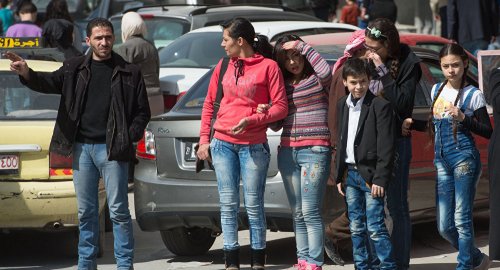
Some 30 towns and villages in the Syrian province of Hama have joined the national reconciliation process in the war-torn country through the mediation of the Russian center for reconciliation, the head of the center says.
“The work is very meticulous and delicate, everything here is based on religious and national matters, but overall about 30 communities have signed an application form to join the peace process and negotiations,” Lt. Col. German Rudenko told reporters on Thursday.
Rudenko noted that the agreement signed by representatives of local communities includes points banning the use of weapons against government forces, facilitating the peace process and return of state power to the region.
On Monday, a large number of militants from Syria’s southern province of Dara’a put down their weapons in exchange for amnesty from the government.
The militants filed their personal information and wrote a letter vowing not to engage in any anti-government activities. The government will provide them with certificates in the future to get back to normal life.
Under the national reconciliation, devised by the Syrian government, citizens who have been involved in the five-year-old militancy in the Arab country could become part of a rehabilitation program if they promise to lay down weapons and accept government investigation. The Syrian Ministry for National Reconciliation Affairs was established in 2012.
On Wednesday, Russian Foreign Ministry spokeswoman Maria Zakharova said that the ceasefire agreement in Syria, which was brokered by Russia and the United States and entered into force on February 27, has been violated 31 times over the past three days.
Zakharova did not specify which side of the conflict had broken the truce.
When asked about the presence of the Kurds in the upcoming peace talks in Geneva on March 9, Zakharova said the participants are invited by the United Nations, but Russia believes that peace talks without the participation of the Kurds will be imperfect.
“The talks without the participation of the Kurds will be incomplete, and it will affect the process, because the Kurds have a large population, they are a faction and they have participated in the ground counter-terrorism operations. It is not correct to ignore or take no account of these factors only because some delegates don’t want the Kurds to participate in it,” she said.
Turkey has already announced opposition to the presence of the Kurds in the peace talks. Ankara regards the Kurdish People’s Protection Units (YPG) and its umbrella group the Kurdish Democratic Union Party (PYD) as an ally of the Kurdistan Workers’ Party (PKK) militant group, which has been fighting for an autonomous Kurdish region inside Turkey since the 1980s.
Turkey has been heavily shelling the positions of Syrian Kurdish fighters who are battling Takfiri groups near the two countries’ border.
The Syrian government has said it accepts the terms of the deal on condition that military efforts against Daesh and the al-Qaeda-linked al-Nusra Front continue.
Photo – © Sputnik/ Iliya Pitalev
Torn Apart: What Lies Behind Washington’s ‘Plan’ B for Syria
Sputnik – 02.03.2016
Syria may be divided into four parts, the Turkish conservative newspaper Yeni Safak recently reported. According to the article, such a scenario is part of a US plan B if the ceasefire agreement between government and opposition forces fails.
The first area would be controlled by Bashar Assad’s government, including southern Damascus, Homs and Tartus and to the Syrian-Turkish border. The second part is the Kurdish region, including the Kurdish-controlled line east of Aleppo. The third zone is central Idlib controlled by opposition groups. The forth projected part is Daesh-controlled areas as well as Raqqa and Palmyra.
After Daesh is defeated this area would be controlled by the international coalition fighting terrorists, the article in Yeni Safak read.
After a ceasefire deal on Syria was reached Washington announced it was considering a backup plan which should be used if the deal fails. The cessation of fire in Syria commenced on February 27.
According to Yeni Safak, among those supporting the plan B are US Defense Secretary Ashton Carter, Chairman of the Joint Chiefs of Staff Joseph Dunford, and CIA Director John Brennan. They have called for President Barack Obama to pressure Moscow and intensify support for Syrian rebel groups.
In the current context, such stove-piping activity is logic, analyst on Middle Eastern affairs Stanislav Tarasov said.
“The recent events have proved that Turkey’s actual policy toward Syria is aimed at dividing the country. What is more, it is logic in the broad context of the Arab Spring, with the gradual fragmentation of Arab states,” he told Svobodnaya Pressa.
According to him, despite the Geneva peace process, there is still a scenario to divide Syria, and some forces are pushing it now.
“One of the most serious issues is Syrian Kurds. If Assad stays in power it would have to pass a new constitution with a new form of territorial division of Syria. Syrian Kurds are now enjoying support from both the US and Russia. And they are likely to ask for more autonomy,” the analyst pointed out.
The Kurdish question is a big concern for Ankara, he added. If Kurds create their own autonomies in both Syria and Iraq, Turkey will be geographically and politically blocked. Such a prospect is also encouraging the Kurdish Workers’ Party (PKK) to intensify its struggle against Ankara, including for a Kurdish autonomous region in Turkey. Turkish President Recep Tayyip Erdogan cannot let this happen.
This is why, now the Turkish government is testing public attitudes toward this scenario.
As a result, it is clear that despite the course on preventing Syria from disintegration, there are a number of actual processes and contradicting interests in Syria, like it was in Iraq after the US invasion, he concluded.
What is more, he added, some, especially in the Middle East, have insisted that there is no need to destroy Daesh. According to them, only its radical groups should be destroyed, to establish dialogue with its “moderate wing.”
“We are witnessing a trend to legalize Daesh as a pseudo-state formation. Earlier, the US and Turkey proposed a new Sunni state in Daesh-controlled parts of Syria and Iraq,” the analyst said.
He also assumed that if Syria is divided into four parts controlled by different groups difficulties will persist in the implementation of peaceful agreements.
The autonomy of the Syrian Kurdistan is almost an accomplished fact, Semyon Bagdasarov, head of the Center for Middle East and Central Asia Studies, said.
“Syria in its current form is nearing the end. But it’s hard to predict how the country will be divided and which parts will governable and which not,” he said.
Pentagon OKs $683 Million Smart Bomb Deal for Turkey
Sputnik – 01.03.2016
As the Turkish government escalates tensions across the Middle East, the Pentagon has authorized a multimillion dollar deal to sell smart bombs to Ankara.
Last December, the Turkish government deployed a battalion of 25 tanks and roughly 1560 troops into northern Iraq. Acting without Baghdad’s permission, the move was roundly condemned as a breach of sovereignty. Ankara has also been engaged its own internal war against Kurdish communities in the country’s southeast, with the death toll reaching some 5,000 people.
Now, with all parties honoring the Syrian ceasefire, Turkey is threatening to plunge its neighbor back into the five-year civil war.
“[The Turkish government] view themselves as victims and losing parties in the Syrian war,” Germany’s Telepolis magazine noted. “For this reason they will resort to provocations until the ceasefire is shattered.”
Despite Turkey’s destabilizing influence in the region, Washington has chosen to award a $682.9 million contract which will provide Ankara with an undisclosed number of smart bombs.
“The deal came timely as we are deeply engaged in asymmetrical warfare and need smart bombs,” one Turkish military official said, according to Defense News.
The contract was granted to Ellwood National Forge and General Dynamics Ordnance and Tactical Systems, and includes the sale of of an unnamed number of BLU-109 bunker busters. These bombs contain roughly 550 pounds of a high explosive compound known as tritonal, and thanks to tail fuse delays, the bomb’s detonation is stalled until it reaches its intended underground target.
This is the first such sale to Turkey by US defense contractors, and Ankara expects the transaction to be completed by 2020.
Despite its continuing aggression, Turkey is a key NATO ally, so Washington’s complicity in Ankara’s actions do not come as a surprise.
The US has also played an active role in Saudi Arabia’s Yemen campaign, providing the bombs used during Riyadh’s air campaigns.
“Saudi Arabia has engaged in war crimes, and the United States is aiding and abetting them by providing the Saudis with military assistance,” Marjorie Cohn writes for teleSUR.
“In November 2015, the US sold $1.29 billion worth of arms to Saudi Arabia. It included more than 10,000 bombs, munitions, and weapons parts manufactured by Raytheon and Boeing, as well as bunker busters, and laser-guided and ‘general purpose’ bombs.”
Greece Detains Turkish Ship Carrying Weaponry, Heading towards Lebanon
Al-Manar | March 1, 2016
Local media outlets in Turkey reported that the Greek coast guard detained on Sunday a Turkish ship loaded with weaponry, adding that it was heading towards Lebanon.
The ship which took off from the Turkish city of Izmir on February 4 contained six containers, two of them holding weapons and munitions.
The Greek authorities also arrested all the crew members who are: six Syrians, four Indians and a Lebanese.
Al-Manar’s correspondent noted that the Turkish officials have not commented on the report.
It is worth noting that Turkey has been providing the terrorist groups in Syria with weaponry, inflaming the crisis which erupted in 2011.
The Academy’s complicity in the Global War of false flag terrorism

By Prof. Tony Hall | American Herald Tribune | February 28, 2016
I met Dr. Kevin Barrett as planned at a small bookstore near the Notre Dame Cathedral landmark in Paris France. On that day, December 11, 2015, the Paris bookstore was the site of a significant academic conference entitled “Islamophobia and the Erosion of Civil Society.”
Hours earlier I had exited the last class of the fall term in my third-year Globalization Studies course at the University of Lethbridge in Alberta Canada. I had driven to Calgary, hopped a flight to Dallas, and then transferred onto a big American Airlines 777 for the trans-Atlantic flight to the City of Lights now under martial law.
For the second time in 2015 Paris had been rocked by violent episodes attributed to the independent actions of Islamic terrorists. After the first event last January, Dr. Barrett had coordinated the emergency responses of a team of analytic observers, myself included.
Together we uncovered the outlines of an outlandish fraud of an externally-engineered false flag terror event. Dr. Barrett assembled the revelations in his edited book entitled We Are Not Charlie Hebdo. Now a sequel volume was in the making as Kevin and I met up in the Paris bookstore where the inner workings of the “Islamophobia Industry” were the subject of scholarly investigation.
The majority of contributors to Dr. Barrett’s book on the first Paris shooter event of 2015 concluded that the attacks on the Charlie Hebdo cartoon office and on the customers of a Jewish Deli were not as they were made to seem in the mainstream media. The evidence pointed to a continuation of the same type of state-manufactured violence directed at civilian populations in Western Europe during the Cold War by the NATO’s overseers of Project Gladio.
The aim of Project Gladio was to discredit the politics of progressive reform by misrepresenting the nature of NATO-concocted episodes of seemingly arbitrary violence directed at civilian populations.
Violent events were engineered by right-wing agents of NATO’s occupation of Western Europe to make it appear that left-wing progressives were subject to the control of psychopathic extremists intent on foisting their will on society through coercive methods.
A new wave of false flag terrorism is underway with the objective of turning public opinion against groups slated for state-sanctioned assaults, including aggressive warfare.
As demonstrated by the deep state politics of Project Gladio, false flag terrorism has long been a standard psy-op deployed by the Western intelligence and counter-intelligence agencies to affect public perception, attitude, and behaviour.
The deployment of false flag terrorism to bring history’s course into conformity with the objectives sought by strategic planners has become the particular specialty of the Israeli deep state.
The most ambitious false flag terror episode ever occurred on September 11, 2001 in the orchestrated strikes on three World Trade Center Towers, on the Pentagon and on the remnants of integrity in our governing structures. The overwhelming weight of evidence derived from these events points squarely at those in charge of the powerful networks of global influence aligned with the expansionary aspirations of Likudnik Israel.
The lies and crimes of 9/11 provided the pretext for the transition from Cold War’s demonization of socialism, as manifest in the engineered terrorism of Project Gladio, to the demonization of Muslims through what might most accurately be described as the Global War of False Flag Terrorism (GWOFFT).
The 9/11 strikes were central episodes that created the core narrative and imagery for a multi-faceted psychological operation that continues yet. This 9/11 psychological operation has been frequently characterized as a global coup d’état. The 9/11 global coup d’état was engineered to entrench neoconservative agendas aimed at concentrating more power in the world’s dominant banking, military, media and academic cartels together with the plutocrats that control them.
In the Global War of False Flag Terrorism, ruling elites everywhere have attempted to entrench their regimes of fraud and corruption by characterizing their critics and opponents as terrorists, as potential terrorists or as terrorist sympathizers.
Without a doubt it is the Jewish state of Israel that gained most from replacing anti-communism with anti-terrorism as the primary purpose and preoccupation of the world’s dominant military-industrial complex. The key to manufacturing consent for this shift has been the incitement and political exploitation of hatred towards Muslims. This engineered hatred of Muslims is often described as Islamophobia.
Convening in Paris to Shed Light on the Islamophobia
The study of Islamophobia brought together scholars from Europe and North America at the conference in the Paris bookstore. This convention of scholars was organized under the auspices of the Race and Gender Studies Center at the University of California in Berkeley.
The Chair was Prof. Hatem Bazian, Professor of Islamic Law and Theology at Zaytuna College in Berkeley. Part of the U of C, Zaytuna College is the first Muslim liberal arts institution of higher learning in the United States.
Prof. Bazian had assembled about a dozen scholars at various stages in their movement through the academic procedures of tenure and promotion. Generally speaking the assembled scholars have taken on some of the most difficult and fraught subjects covered in our university curricula. To study the institutional workings of the cynical business of purposely turning public attitudes against Muslims is an especially difficult academic mission in the poisoned atmosphere of these times.
In spite of our criticism of their work, the dozen or so colleagues who gathered at the Paris bookstore on December 11 deserve much respect and recognition. These colleagues have persisted in following a very contentious line of investigation in spite of the serious professional recriminations often thrown their way by critics who think nothing of destroying academic careers to advance political agendas.
Kevin Barrett and I took part in the proceedings with the anticipation that we would co-host our own alternative conference the following day at a hotel near the Charles De Gaulle Airport.
This plan was a response to the rejection of Dr. Barrett’s paper that was originally accepted as part of their conference.
Dr. Barrett’s proposed contribution highlighted the frequent exclusion of Muslim perspectives from officialdom’s accounts of the originating events triggering the 9/11 wars.
Dr. Barrett’s academic credentials in the subject matter of the conference are of course very strong as evidenced by the initial warm welcome extended to his offer to contribute to the conference’s scholarly proceedings.
Then came the events of Friday November 13th 2015, when the world was told Islamic terrorists had murdered over a hundred victims at a concert at the Bataclan music venue, at the Stade de France and at other Paris locations. In the wake of this development Dr. Barrett was informed by Professor Bazian,
“Due to state of emergency in France and the on-going active operations, the organizing committee is not able to accommodate your paper at this point in time. Our supporters on the ground are under extreme emergency conditions and the whole program is under stress due to it.”
In spite of the declared state of emergency in Paris the organizers had pressed ahead with the conference minus the contribution of Dr. Barrett. No explanation was given of why it was deemed alright to go forward with the other presentations but not the one containing Dr. Barrett’s interpretation of Islamophobia. The exclusion of Dr. Barrett, a Muslim himself with advanced degrees and many publications in Islamic Studies, could be seen as an expression of the very same forces that the Paris event had been convened to identify and analyse.
Rather than step aside without a protest, Dr. Barrett took part in the proceedings. I had joined him with the expectation that the next day we would try to put right the lapse that unfortunately seemed indicative of a more general failure of the academy.
How is it that, generally speaking, professors in our institutions of higher learning have failed so conspicuously to sort out truth from falsehood, accurate reporting from fraud, when it comes to explaining the origins and ongoing impetuses of the 9/11 wars?
Why have we in the academy mostly failed to rise to the responsibility of our higher calling when it comes to the vital job of identifying the thick web of lies and misrepresentations used to justify the post-9/11 surge of aggressive warfare abroad, the betrayal of human rights and civil liberties at home?
How has this treason of the intellectuals been transacted at the very moment society is most in need of evidence-based research to sort out fact from fiction when assessing the claims and assertions of the permanent war economy’s primary protagonists?
Through efforts like those of Dr. Barrett’s in his personal and public truthjihad, there have been significant breakthroughs in illuminating fraudulent reporting by presstitutes that often disseminate the disinformation essential to realizing the subversive agendas of false flag terrorism. Less has been done, however, to highlight the failures of academy to identify the lies and crimes entailed in the wholesale smearing of Muslims essential to the dark objectives of the Global War of False Flag Terrorism.
Islamophobia is the essential mental ingredient in the atmosphere of fear produced by the psychological geo-engineers pushing forward the Global War of False Flag Terrorism. In the words of Prof. Bazian, Islamophobia has to do with “the construction of an imagined and staged world rooted in the mind.”
The dissemination of the imagery of self-directed, self-financing Islamic terrorists acting autonomously out of no other motivation than their own religious zealotry constitutes the core lie of this malevolent psychological operation. The demonization of Muslim people, Muslim religion, Muslim cultures and Muslim countries forms the basis of the scaffolding on which a global and unbridled police state is being constructed.
This background helps explain how it is that Dr. Barrett and I had converged at the Paris bookstore on the eve of our effort to host our own conference of world-class thinkers expert in deciphering the inner workings of the Global War of False Terrorism. In taking on this responsibility we were moving into the vacuum of truth telling that the academic community has created, for the time being at least, by failing to come up with a viable evidence-based explanation of the origins and ongoing genesis of the 9/11 wars.
On December 11, 2015, the effort to go beyond the issues explored by the academics assembled in the Paris bookstore would take form the next day in a four-hour event entitled “False Flag Islamophobia” broadcast live on No Lies Radio. This event, in turn, helped encourage and hearten some of the contributors to Dr. Barrett’s new book.
Introducing the Islamophobia Industry
Sociology Professor David Miller of the University of Bath in Great Britain was one of the senior contributors to the conference at the Paris bookstore. Miller is a prolific scholar whose work on Islamophobia emerges from his important investigations into the relationship between corporate power and public relations as pioneered by the so-called father of media spin, Edward Bernays.
This approach permeates Miller’s Spinwatch website and his co-authored volume published in 2008, A Century of Spin: How Public Relations Became the Cutting Edge of Corporate Power.
In 2011 I had seen Professor Miller offer up a very interesting presentation in the Westminster Parliament in London England. His address in the Mother of All Parliaments helped give rise to his co-authored publication, The Cold War on British Muslims.
Professor Miller’s presentation in Paris on 11 December 2015 continued the development of themes that have brought on significant wrath from elements of the Jewish-Israeli lobby in Great Britain.
For instance the website of the pro-Zionist Gatestone Institute criticized Professor Miller for his work showing the “covert propaganda operations” of several Jewish organizations with preferential access to high-profile media venues. http://www.gatestoneinstitute.org/6677/david-miller-hilary-aked-kevin-macdonald.
Along with Professor Bazian, Miller has been prominent in identifying the financing and workings of an interlinked complex of agencies that Nathan Lean and others have dubbed the “The Islamophobia Industry.”
According to the Legislating Fear report of the Council on American-Islamic Relations, the dozens of agencies that make up this hate-inciting industry are funded to the tune of several hundreds of millions of dollars. In the words of Bazian, the aim of the well-funded endeavour is “to use fear and hate-mongering to lull our intellect to sleep” and “to implant negative and racist ideas about Muslims and Islam in our collective consciousness.”
Prominent among the core institutions of the trans-Atlantic Islamophobia Industry are the Foundation for the Defense of Democracies, the Henry Jackson Society, the Quilliam Foundation, the Gladstone Institute, Daniel Pipe’s Middle East Forum, Campus Watch, Islamist Watch, Pam Geller’s Atlas Shrugs, Tammi Rossman-Benjamin’s AMCHA Initiative, the Clarion Project, the David Horowitz Freedom Center and CAMERA, the Committee for Accuracy in Middle East Reporting.
These and many other agencies whose mission is to incite Islamophobia, derive their funding from a variety of sources including the family foundations of the Koch Brothers, Sheldon Adelson, Sarah Scaife, Harry Bradley, Irving Moskowitz and Canada’s Bronfman dynasty. As noted above, the Gladstone Institute has made the work of Professor David Miller, including the content of his website Spinwatch, a particular target of its pro-Zionist defense of the Islamophobia Industry.
http://www.islamophobiatoday.com/2014/04/16/latent-and-manifest-islamophobia-an-inception-of-ideas/
https://www.americanprogress.org/issues/religion/report/2015/02/11/106394/fear-inc-2-0/
http://www.islamophobiatoday.com/tag/islamophobia-industry/
http://www.ijan.org/wp-content/uploads/2015/04/IJAN-Business-of-Backlash-full-report-web.pdf
Much of the work of David Miller and his colleagues in exposing the pro-Zionist activities of the anti-Muslim hate purveyors involves tracing the money fuelling the Islamophobia Industry. This follow-the-money approach could very easily extend to tracking down the sources of financing for the staging of expensive false flag terror events.
Throughout the academic presentations I witnessed at the Paris bookstore, there was a persistent resistance by all the presenters to engage in some sort of reckoning with the anti-Muslim thrust of the false flag terrorism currently imposed upon us.
In every presentation there was the same conspicuous absence of interest in investigating the primary engine of contemporary Islamophobia, namely the engineering of false flag terror events to be blamed on Muslim fundamentalists said to be acting alone for no other reason than their religious extremism.
According to Kevin Barrett’s record of the event, when it came time for questions and answers I posed my query as follows:
“This is all very interesting, but I’m not hearing any of you get to the root of why there is all this Islamophobia. There is now a huge literature on the fact that these big terror attacks are contrived. It was 9/11 and all of the subsequent events that have created the wave of Islamophobia. I know it’s not a good career move, but: Why can’t we talk about this? Why can’t we –”
I emphasized in my question the observation that the dominant forces animating Islamophobia lie in the extravagant media misrepresentations of false flag terror events. Again and again these episodes of false flag terror are presented as the independent, self-directed work of Islamic extremists acting exclusively out of religious zealotry rather than the actions of mercenaries paid to create the political currency of fear necessary for the maintenance of the permanent war economy.
These misrepresentations form the very core of the activities of the Islamophobia Industry as composed by agencies such as the Foundation for the Defense of Democracies. An outgrowth of the Project for the New American Century (PNAC), the FDD was created a mere two days after the events of 9/11.
It fell to Professor Miller to respond to my question. He began by taking exception to my suggestion that some “psychopaths” might be involved as “assets” in the execution of false flag terrorism. Miller indicated that, in his estimation, Islamic terror events were by and large the product of considered actions on the part of alienated Muslims who had experienced devastating consequences from various forms of hostile invasion into the lives of their own families, communities, and nations.
Their violent responses, he indicated, were often the product of long reflection and preparation by mostly intelligent individuals prone to be especially sensitive to the gross abuses of human rights directed at Islamic populations both within the West and on its resource frontiers.
In retrospect Miller’s response was a classic illustration of the “blowback theory” of 9/11. Blowback: The Costs and Consequences of American Empire is the name of an iconographic text by a former CIA analyst, Chalmers Johnson.
Although Johnson’s Blowback was first published in 1999, the volume became a bestseller after the events of September 11, 2001. Johnson believed the United States was imperiled by the flood of recriminations that would almost inevitably arise from those most negatively affected by the secret incursions of American empire.
Many seized on the central argument of Blowback to explain what had transpired on 9/11. I include myself in that category. Until my friend and colleague, the late Mohawk activist Splitting The Sky, insisted in 2008 that I look into the evidence of what did and did not happen on 9/11, I adhered to the blowback theory.
I mistakenly believed that the 9/11 attacks were the work of Indigenous peoples resisting repeated rounds of imperial assault on their lands, their persons and their ways of life. I recall it was difficult for me to put this interpretation aside once I began looking at the overwhelming evidence that the various agencies charged to protect us were in fact deeply involved in perpetrating the lies and crimes of 9/11.
The response of Professor Miller to my question seemed to demonstrate the continuing allure of the Blowback theory of 9/11 in spite of the conclusions that have emerged from the elaborate citizens’ inquiry into the events of September 11, 2001. The outcome of the citizens’ inquiry demonstrated long ago that the evidence does not support the thesis that all the destruction on 9/11 can be traced back to the independent actions of 19 Saudi jihadists acting to realize a plan hatched by Osama bin Laden.
I found it very instructive to witness how a group of otherwise courageous and conscientious scholars skated around any direct engagement with the origins and genesis of the Global War of False Flag Terrorism. Our collective failure to force on our governments and institutions some basic reckoning with the lies and crimes of 9/11 have made our societies vulnerable to a seemingly endless repetition of the same scenario of manipulation through the incitement of fear towards Muslims. The key to creating these fears lies in the parade of recent false flag terror events in, for instance, London, Madrid, Bali, Ottawa, Paris and San Bernardino to mention only a few.
The event at the Paris bookstore might be characterized as a frontier zone marking the boundary between permitted and prohibited academic discourse. Their proceedings therefore provided an instructive window illuminating the more general failure of the academy to deal in deep and systematic ways with the full extent of the travesty. The potential of humanity is grossly undermined by the absurdity of a never-ending war being waged “on Terror”. The War on Truth is the most essential feature of the Global War of False Flag Terrorism.
The Islamophobia Industry and the Deep State Operations of the False Flag Terror Industry
I have learned a lot at the Paris conference and in my subsequent research into the leads provided by the scholars who participated. Professor Miller and others called my attention to, for instance, the dual preoccupations of the same funders and lobby groups that simultaneously instigate hatred to Muslims even as they invest in and promote Jewish settlements on the expansionary frontiers of the Israeli warrior state.
I found particular value in the content of a report by the International Jewish Anti-Zionist Network entitled, The Business of Backlash: The Attack on the Palestinian Movement and Other Movements of Justice. The document explains in detail the financial, ideological and political community of interests wedding the arms and media industries in the United States to the military and security establishment of Israel.
The channeling of vast treasuries of public funds from the USA to Israel has the effect of creating huge slush funds that end in the coffers of American politicians and in the corporate proprietorships of war profiteers.
The authors go on to explain that this coalition of shared interests is pointed against all manner of progressive movements including environmental groups as well as the decolonization struggles of Blacks, Latinos and Indigenous peoples. It seems the same techniques deployed to cast an aura of criminality over the freedom movement of oppressed Palestinians is being applied more broadly.
Accordingly, the demonization of whole populations by practitioners of the Islamophobia Industry casts a very broad shadow. The hate inciting smear campaigns support oppressive structures of top-down power running contrary to the exercise of even the most fundamental principles of universal human rights.
The Islamophobia Industry’s assault on human rights extended to an attack on the academic freedom of Professor Rabab Ibrahim Abdulhadi, one of the more prominent participants in the proceedings at the Paris bookstore. Abdulhadi is Director of the Arab and Muslim Ethnicities and Diaspora Initiative at San Francisco State University in California. Recently she has was targeted by a formidable array of Islamophobes led by Tammi Rossman-Benjamin’s AMCHA Initiative.
The attack on Professor Abdulhadi was discussed in The Business of Backlash. Her Zionist detractors accused the Palestinian-American academic of being “a terrorist supporter as well as a supporter of the anti-Semitic Boycott, Divestment and Sanctions movement.” She was said to embody “all that is wrong with radical elements of academia who have all but hijacked the social science and humanities fields. Her obsessive focus on Israel and monomaniacal demonization of the Mideast’s only democracy betray a troubling pattern of Judeophobia and overt anti-Semitism.” http://www.frontpagemag.com/fpm/222457/terrorists-campus-ari-lieberman
A formidable coalition of academic colleagues and civil rights organizations rallied to the defense of Professor Abdulhadi who was represented by the lawyers of the Palestinian Solidarity Legal Support network. Abdulhadi’s participation in the Paris conference as a working professor attests to their success in persuading the administration of San Francisco State University to fend off the malicious attempt to end this important scholar’s academic career.
It seems very strange that those who participated in the academic conference in Paris, like those who authored The Business of Backlash, could make themselves so expert on the relationships between the Islamophobia Industry, Jewish Settlements on the West Bank and the deep state machinations of the Israeli-American power elite but not extend their investigations further.
The evidence has become overwhelming that what is portrayed in the media as self-motivated, self-financing, self-directed Islamic terrorism is rather the outcome of a complex network of connections linking intelligence agencies, paid assets, mercenaries and other private sector contractors connected to the operations and objectives of the pro-Zionist Islamophobia Industry.
As my reading on the Islamophobia Industry progressed I came to see the most visible agencies of public hate mongering towards Muslims as but the tip of the iceberg of far larger structures of deceit and corruption. Beneath the overt activities of the Muslim-bashing agencies lie the covert deep state entities devoted to generating the false flag terror events on which the parasitic Islamophobia Industry feeds.
This connection can be well illustrated in the reincarnation after 9/11 of the Project for the New American Century as the pro-Zionist, anti-Muslim Foundation for the Defense of Democracies.
The basic aim of this whole sordid complex of deep state and public agencies is to transform Israel’s Arab and predominantly Muslim regional enemies, the Palestinians, into one element of a larger global entity presented as the antithesis of the West’s self-proclaimed “freedoms.”
Composed of the worldwide community of Muslims, the ommah was instrumentalized in public mythology as the aberrant “other” to be guarded against, pacified and sometimes vanquished. The wholesale demonization of Muslims served the purpose of providing the war machine with a new enemy to replace the defunct enemy of the Soviet Union.
The Memes, Symbols and Demonology Deployed in Generating Hatred Towards Muslims
The same banking-military-media establishment that benefited most from the permanent war economy on the capitalist side of the Cold War was reborn, re-energized and refinanced with the launching of the Global War of False Flag Terrorism. In this fashion a degree of continuity was maintained as the same national security establishment created to fight communism was re-deployed in a very strange operation involving both the creation of, and opposition to, Islamic terrorism.
In the decade and a half since 9/11 a powerful Islamophobia Industry has set the tone for the entire mainstream media. In the process, the imagery of Islamic jihad has been rendered an essential part of the visual vocabulary of popular culture. The project of generating fear of Muslims in mainstream media draws on many tried and true techniques of the Public Relations Industry.
The integration of Islamophobia into popular culture often invokes archetypes and symbols from religious mythology like, for instance, the stereotypical demonology of witchcraft and devil worship. Resort is made to mental imagery rooted in children’s fables such as Peter and the Wolf.
To convey these messages, instant-made-for-TV “terrorist” experts regularly conjure up terms such as “Lone Wolf Terrorist” even as they warn us against the “Homegrown Terrorists” said to be lurking amongst us. In such theatres of normalized hate speech, whole populations are wedged, divided and turned against each other to grease the gears of fear and distrust as primary lubricants for political and commercial exploitation.
The lies and crimes of 9/11 lie at the origins of a Great Transformation for the worse. To fail to deal with what did or did not happen in the Mother of All False Flag Terror Events is to give credence to the interpretation that the saga of misrepresentation essential to the Global War on Terror’s genesis did not begin until 2003.
According to that gatekeepers version of reality, the administration of George W. Bush was an innocent victim of Islamic attacks until the executive branch began floating the lie that the government of Saddam Hussein possessed weapons of mass destruction in order to justify the US-led invasion of Iraq.
Much of the responsibility for publicizing the false assertions that Saddam Hussein’s government possessed weapons of mass destruction has been laid at the doorstep of the New York Times and the work of its star reporter Judith Miller.
Miller’s primary sources on this story included Richard Perle, Paul Wolfowitz, and Douglas Feith, all prominent Israeli-American members of the Project for a New American Century.
In a major report in 2000, PNAC anticipated the events of 9/11 by proclaiming that the realization of their neoconservative agenda could not be achieved “absent some catastrophic and catalyzing event– like a new Pearl Harbour.”
Is it credible that a handful of Saudi Muslims led by Osama bin Laden, armed with nothing but box cutters, a smattering of flight training and intense jihadist zeal, acted independently to bring about the elaborate high-tech crime that took place on 9/11?
Is it credible that the neocon cabal controlling both the Israeli government and the Bush White House was fortuitously presented by self-directed jihadists with precisely the catalytic event it needed to institute its ambitious agenda of police repression at home and military expansion abroad.
Is it credible that the neocon establishment was only a respondent to, rather than an author of, the cataclysmic events of 9/11? If the events of 9/11 were indeed a surprise attack on power symbols of American prowess in warfare and commerce, why was no one responsible for such a stupendous breach of national security fired for such a spectacular failure? How is it that so many of those who accuse the Bush-Cheney regime of lying about so many subjects refuse to explore the extent of the lies whose effect is to protect the actual perpetrators of the 9/11 crimes?
Part of the problem in the official cover story of 9/11 is that the custodians of the fable keep on changing it to suit the changing currents of political expediency. In the early days following 9/11, the culprits were said to be Osama bin Laden and his coterie of Islamic extremists in al-Qaeda.
Then the demonology of 9/11 shifted so that somehow Saddam Hussein and his Iraqi government were made to epitomize the jihadist extremes of Islamic terror. Once Saddam was captured and executed the world was briefly introduced to a person or persons identified by the name Khalid Sheik Mohammed. For a time it seemed that the US executive branch would conduct a show trial in New York of Khalid, the supposed “mastermind of 9/11” to commemorate the 10th anniversary of the infamous day.
The plan to try Khalid Sheik Mohammed for war crimes was abandoned. This prisoner remains jailed in the US concentration camp at Guantanamo Bay on the island of Cuba. There he has been tortured through water boarding many dozens of times in order to elicit all manner of confessions including some that found their way into the 9/11 Commission report in the United States.
The creation of an official government report, whose conclusions are drawn from supposed evidence obtained from illegal torture, is itself a war crime. Accordingly, those academics, jurists, politicians, journalists, and other public intellectuals who accept the 9/11 Commission report as accurate and satisfactory are rendered complicit in war crimes and crimes against humanity.
Instead of conducting a show trial, the government of US President Barack Obama opted to mark the 10th anniversary of 9/11 by announcing that US Navy Seals had hunted down and killed Osama bin Laden at a compound near Abbottabad Pakistan.
In this fashion bin Laden was posthumously returned to the role assigned him by the White House and media agencies within hours of the 9/11 strikes without any formal investigation whatsoever.
According to Seymour Hersh, the White House’s story on bin Laden’s elimination “might have been written by Lewis Carroll.” Bin Laden was supposedly buried at sea. What sense would it make simply to execute the man that would be far and away the world’s foremost authority on international jihadism if the mythological demonology attending the 9/11 psychological operation was actually true.
The elimination by the Democratic Party President of the Republican Party President’s initial 9/11 patsy cleared the way for a new phase in the Global War of False Flag Terrorism overseen by Barack Obama.
http://www.lrb.co.uk/v37/n10/seymour-m-hersh/the-killing-of-osama-bin-laden
This Democratic Party version of the neocon plan for global domination restored al-Qaeda to a role something like it had played in the 1980s as a part of the mujahadeen proxy army army serving US geopolitical strategies. Where al-Qaeda helped overthrow the US-backed puppet regime in Afghanistan in the 1980s, in the second decade of the twenty-first century al-Qaeda was reborn as a mercenary instrument of NATO’s assault on the Libyan government of Muammar Gaddafi.
The instrumentalization of mercenary armies paid to fight under the banner of Islamic religion has grown in scope so that this historical trajectory lies at the very heart of the international showdown for control of the lands and resources of Syria. Under heavy Israeli pressure, the US government with backing from the governments of Saudi Arabia, Turkey and Qatar has built up al-Qaeda’s successor, Jabhat al-Nusra. The aim of this sponsorship of Islamic theocrats hostile to Bashir al-Assad’s more secular and pluralistic Russian-backed Syrian government is to balkanize the region and possibly to prepare the ground for the eastward and northward expansion of Israel.
This US backing of al-Qaeda-related fighters was spun as support for a “moderate opposition” to the Assad government. This scenario unfolded concurrently with the rise, in Iraq and Syria, of the entity known variously as the Islamic State in the Levant, ISIL, ISIS, and more recently Daesh.
The evidence has become overwhelming that this fighting force is financed, armed and organized in part to embody the memes of hatred and extremism essential to the operations of the Islamophobia Industry and the main protagonists of the Global War of False Flag Terrorism.
The close connection in the international oil business linking governments of Turkey, Israel and the non-state entity dubbed the Islamic State, highlight the many layers of complicity in a very strange operation. The US government presents itself publicly as the world’s leading opponent of Islamic terror while it cultivates, assists and facilitates the very forces it says it is fighting.
In a recent post on his website, Voltairenet, Thierry Meyssen has described the prevalent blindness to what has been really taking place in the region of Syria and Iraq. He lays bare the dynamics of a dangerous game that involves “pretending, like NATO, that these [Islamic fighting] groups are independent formations which have suddenly materialised from the void, with all their salaries, armament and spare parts. More seriously, the jihadists are in fact mercenaries in the service of Turkey, Saudi Arabia and Qatar…. to which we must add certain multinationals like Academi, KKR and Exxon-Mobil.”
A Reversion to Old Styles of Imperialism in the Name of Anti-Terrorism?
Since bin Laden was supposedly buried at sea by the US Armed Forces in 2010 the role once assigned to al-Qaeda as the all-purpose boogyman of Islamic terrorism has now been re-assigned to the non-state entity dubbed the Islamic State. When acts of false flag terrorism take place as in Ottawa in October 2014, or in Paris in November of 2015, or in San Bernardino a month later, the authorities in charge of pseudo-investigations are prone to announce almost immediately a connection to ISIS/ISIL Daesh.
The criminal law is thereby put aside and the violent events are immediately elevated to “acts of war” justifying quick retaliation by Armed Forces. Within hours of the Friday the 13th Paris event, for instance, French President Francois Hollande was ordering the French Air Force to intervene in Syria.
While the supposed target was ISIS/ISIL/Daesh encampments and strongholds, there is reason to see the real objective of the supposed anti-terror attacks as the overthrow of the Assad government. This French military intervention could thus be interpreted as a resort to France’s old imperial role in the part of the Middle East assigned it by the Eurocentric Sykes-Picot Agreement of 1916.
The point of this foray into the recent history of the Global War of False Flag Terrorism is to encourage colleagues in the academy to address, document and explain the unfolding patterns of deception so integral to the process of enlarging the unaccountable powers of the covert deep state, diminishing the overt role of the public state. I extend this encouragement especially to the colleagues that Dr. Barrett and I met in the Paris bookstore at the event entitled “Islamophobia and the Erosion of Civil Society”.
These colleagues and their networks of academic collaborators have made a good start in identifying the institutionalization of hate mongering in the Islamophobia Industry. The time has come, however, to connect the visible workings of this Zionist enterprise of anti-Muslim provocation to the deep state operations in the ongoing Global War of False Flag Terrorism.
Dr. Hall is editor in chief of American Herald Tribune. He is currently Professor of Globalization Studies at University of Lethbridge in Alberta Canada. He has been a teacher in the Canadian university system since 1982. Dr. Hall, has recently finished a big two-volume publishing project at McGill-Queen’s University Press entitled “The Bowl with One Spoon”.
Moscow Notes Multiple Attempts to Distort Syrian Truce With Fake Reports
Sputnik – 29.02.2016
Moscow has noted a large volume of information fleecing and attempts to disrupt the truce in Syria, Russian Deputy Foreign Minister Sergei Ryabkov said Monday.
“I’d like to say that there are very many dupes and attempts to distort facts and deliberately disrupting the agreements. Our Western colleagues must very carefully approach the task of controlling those groups that for the most part listen to them and Syria’s neighbors. We are strictly fulfilling all the agreements,” Ryabkov said.
Gazprom cutting gas supplies to Turkey
RT | February 26, 2016
The already strained relations between Moscow and Ankara have taken a turn for the worse. Gazprom has cut gas supplies by nearly a quarter after failing to reach an agreement with Turkish importers on discounts for Russian natural gas.
Delivery is down 23 percent, compared to the same period last year, Interfax reports, quoting data from Bulgarian gas operator Bulgartransgaz that processes about 50 percent of Russian gas going to Turkey.
According to the news agency sources, the reduction is linked to a price dispute between Gazprom and Turkey’s private gas importers.
Last year, Gazprom gave the importers a 10.25 percent discount, but is now doing away with it as energy prices have dropped significantly.
Business daily Kommersant’s sources say Gazprom stopped giving the discount at the beginning of the year. For January deliveries, Turkish companies had to pay at a higher price, but on the payment date of February 21 they only paid the discounted price.
As a result, Gazprom has cut the volume delivered by the size of the underpayment.
Enerco Enerji, Bosphorus Gaz, Avrasya Gaz, Shell, Bati Hatti and Kibar Enerji are the importers affected. Overall, they import 10 billion cubic meters of Russian gas per year. Kommersant’s sources in the companies say the cancellation of the discount hurts their business, as they have signed contracts with clients based on the discount gas price.
From the 1st to the 24th of February Gazprom under-delivered 117 million cubic meters worth $30 million, the newspaper’s calculations say. Kommersant added that Turkey could fine the Russian gas monopoly $2.5 million for not fulfilling its obligations.
The source in Gazprom claimed the reduction in supply will not affect supply of the Turkish market, “especially because Botas does not reach its contractual volumes.”
State-owned Botas imports about 17 billion cubic meters of Russian gas per year. In 2015, it didn’t get a discount from Gazprom due to the failure of the Turkish Stream negotiations and is now suing Gazprom.
America’s Plan B: Supporting Terrorists Till the Bitter End
By Martin Berger – New Eastern Outlook – 25.02.2016
At a time when the international community is looking forward to the possibility of putting an end to the bloody conflict in Syria that has dragged on for years, while putting their hopes behind the agreement that was achieved between the US and Russia on February 22 regarding the cessation of all hostile activities in Syria, certain forces in the United States carry on banging the war drum.
As it has been pointed out by the The Wall Street Journal :
Defense Secretary Ash Carter; Marine Gen. Joseph Dunford, chairman of the Joint Chiefs of Staff; and Central Intelligence Agency Director John Brennan have voiced increasingly hawkish views toward Moscow in recent White House meetings, calling for new measures to “inflict real pain on the Russians,” a senior administration official said.
Moreover, those gentlemen are somehow convinced that Moscow will break the ceasefire, so they have formulated a “Plan B,” that will imply the strengthening of their support to extremists and the introduction of new sanctions against Russia.
Of course, one could only be amazed by such behavior from Washington’s “hawks” if one did not take into consideration the evidence exposing their direct involvement in the continuous aggravation of the situation in Syria, which makes them directly responsible for the deaths of thousands of civilians. Those actions would for sure present the perfect subject for a careful investigation of an international tribunal.
In particular, according to the facts presented by Daveed Gartenstein-Ross and Nathaniel Barr in the Daily Beast, the CIA is now assisting the terrorist organizations that the United States has been allegedly fighting for 15 years. This program was launched in 2013 to further aggravate the armed conflict in Syria. According to this publication, at least one of these CIA-backed groups severed its ties with the CIA and joined a listed terrroist-led coalition, Later, Associated Press reported that CIA-backed groups are gaining ground in Syria, “fighting alongside more extremist factions.”
The article concludes:
Analysis of the geography of “moderate” rebels’ gains during this period and reports from the battlefield demonstrate that CIA-backed groups collaborated with Jaysh al-Fateh, an Islamist coalition in which Jabhat al-Nusra—al Qaeda’s official Syrian affiliate—is a leading player…
and
At this point it is impossible to argue that U.S. officials involved in the CIA’s program cannot discern that Nusra and other extremists have benefited. And despite this, the CIA decided to drastically increase lethal support to vetted rebel factions following the Russian intervention into Syria in late September.
The authors are convinced that now it’s more important than ever to organize a public debate in the US about the role that the CIA played in the Syrian conflict and the considerable strengthening of radical groups.
It would be no less interesting to take a look at yet another investigation of the criminal role American intelligence agencies played in the inciting of the Syrian conflict that was published in The New York Times. The authors, Mark Mazzetti and Matt Apuzzo described in detail how the United States was using Saudi money to provide radical militants in Syria with lethal weapons. Yet, this is but an episode in the continuous and vicious cooperation between Saudi and American security agencies that lasted for decades. The alliance was in place during the Iran-Contra scandal, the hidden fight against Soviet troops in Afghanistan and countless proxy wars in Africa.
These forces are actively involved in the Ukrainian conflict, openly opposing any form of peaceful settlement, pushing all the blame on Russia while Turkey is pulling the strings behind the stage and sending radical mercenaries to Ukraine.
Therefore, one shouldn’t be surprised that this Plan B will be put into action regardless of the facts surrounding how the parties actually observe the agreements reached or even before it’s imposed. It would be safe to assume that the CIA will be put in charge of the operation, funded with the money provided by Saudi Arabia, therefore we can await provocations and misleading articles about how it is Russia who is continuing with provocations, not these forces hidden in plain view.
That is why today the international community is tasked with preventing the failure of the recent agreement between the leaders of the US and Russia by exposing those “hawks”, namely the CIA, the Pentagon, and Saudi intelligence services.
Using terrorists as pawns prolongs Middle East crises: Lavrov
Press TV – February 25, 2016
Russian Foreign Minister Sergei Lavrov says the crises in the Middle East will not be settled as long as terrorists are used as pawns in pursuit of certain geopolitical agendas.
The fight against terrorism “cannot be successful if attempts are not stopped at using terrorists as pawns in doubtful geopolitical games,” Lavrov said in Moscow on Thursday.
“The further degradation of the situation presents a serious threat for the entire international architecture,” he told a session of the Valdai International Discussion Club.
“Obviously a strong stability of the situation is impossible without the destruction of the center of the terrorist threat, first and foremost Daesh,” he said.
During the session, Russian Deputy Foreign Minister Mikhail Bogdanov said Moscow was concerned about statements from US officials about alternatives to a plan for the cessation of hostilities in Syria.
“We are concerned about claims of certain Western partners, including the United States, about the existence of a certain ‘plan B.’ We know nothing about it, and we are not discussing any alternate plans.”
The United States and Russia announced on February 22 that they had reached a deal for a “cessation of hostilities” in Syria, which would begin on February 27.
The Syrian government said the following day that it accepts the terms of the deal on the condition that military efforts against Daesh and the al-Qaeda-linked al-Nusra Front continue.
In the lead-up to the agreement, US Secretary of State John Kerry said the US had a “plan B” for military action to enforce if the cessation of hostilities failed.
Bogdanov, who serves as President Vladimir Putin’s special envoy to the Middle East, said Russia expects the US to negotiate the implementation of the agreement with the Syrian opposition.
“Russia is doing the necessary work with Damascus and the legitimate Syrian leadership. We expect the United States to do the same with groups allied with them and supported by them,” he said.
The Russian diplomat also said the notion of setting up a buffer zone in Syria and to launch a ground operation in the war-hit country could only exacerbate the situation.
“Steps that could further worsen the Syria crisis cause our great concerns. In particular, this includes attempts to implement the idea of setting up a buffer zone on the Syrian-Turkish border and putting together some blocs for a land operation.”
Bogdanov was referring to Ankara’s plans to set up a buffer zone and by send ground troops into Syria by Turkey and Saudi Arabia.
Docs Reveal That Turkish Officers Work With Daesh on Syrian Border
Sputnik – 24.02.2016
Despite Ankara’s declared commitment to fight Daesh, Turkey’s relations with the terrorist group are more complex. Documents recently released by the Cumhuriyet newspaper appear to show that Turkish officers on the border with Syria frequently communicated and worked with Daesh fighters.
The transcripts are said to be part of an ongoing investigation into several individuals and their ties to the terrorist group. They reportedly detail several phone conversations between unnamed Turkish officers and Mustafa Demir, a key Daesh operative in the border region.
“The transcripts and the documents in the investigation revealed that Demir received money… from smugglers at the border and cooperated with the officers as far as [border] crossings are concerned,” the Today’s Zaman newspaper quoted the daily as saying.
The documents also appear to indicate that Turkish officers met with Demir in the border region.
Demir is said to be linked to İlhami Balı, the 33-year-old Daesh leader, who is suspected of ordering the deadliest terrorist attack in Ankara’s history. The twin bombings last October left 102 people dead and more than 400 injured.
One of the transcripts translated into English by Today’s Zaman dates back to November 25, 2014. Demir asked an unnamed officer to arrange a meeting with a commander.
“Is it possible for you to arrange that I talk with the commander here, regarding the business here? What if we could establish a contact here as we helped you…” the Daesh fighter asked a Turkish officer. “Okay. If there are any needs [as far as your request is concerned], [tell them] to inform me here,” the officer responded.
In another conversation, a Turkish officer asked Demir to meet him and his comrades at a minefield. “We have stuff; come here from that side, the men are here… Come urgently; I’m in the mine [field] with a torch. Come running.”
“Okay, big brother, [I’m] coming,” Demir answered.The United States and other stakeholders have repeatedly urged Ankara to seal Turkey’s porous border with Syria, which Daesh, al-Nusra Front and other terrorist groups use to smuggle fighters, weapons and supplies in and out of Syria. The Turkish government has so far failed to deliver on the promise.
Access to unlimited supplies and recruits delivered to the Syrian battlefield through Turkey is largely seen as the key source of Daesh’s resilience and longevity. Ankara’s inability to secure the 60-mile border region has prompted many to question Erdogan’s true agenda with regard to the deadly Syrian conflict.
Featured Video
Fear Is the Mind Killer
or go to
Aletho News Archives – Video-Images
From the Archives
Alarmist climate science as a textbook example of groupthink
By Paul MacRae | May 1, 2012
A while ago, I received an email from a friend who asked:
How can many, many respected, competitive, independent science folks be so wrong about [global warming] (if your [skeptical] premise is correct). I don’t think it could be a conspiracy, or incompetence. … Has there ever been another case when so many ‘leading’ scientific minds got it so wrong?
The answer to the second part of my friend’s question—“Has there ever been another case where so many ‘leading’ scientific minds got it so wrong?”—is easy. Yes, there are many such cases, both within and outside climate science. In fact, the graveyard of science is littered with the bones of theories that were once thought “certain” (e.g., that the continents can’t “drift,” that Newton’s laws were immutable, and hundreds if not thousands of others).
Science progresses by the overturning of theories once thought “certain.” … continue
Blog Roll
 Aletho News
- Iran consolidates Strait of Hormuz control in post-war power shift, leaving US in dark
- A pause, not a ceasefire: Washington stalls, Tehran recalibrates
- US blockade crumbles as Iran turns to overland routes
- Hidden costs of US Iran war push total far beyond $25bn Pentagon claim
- Iran Will Respond With Long-Term Strikes to US Attack, Even If It Is Short-Term – IRGC
- Fear Is the Mind Killer
- Israeli strikes kill 10 in southern Lebanon, including 3 rescue workers
- Israeli military ‘failed on all fronts’: Poll
- US at a crossroads: Iran’s firm positions leave Trump no option but to capitulate
- Iran signals decisive response to end US maritime bullying, piracy
- If Americans Knew
- Politico’s powerful parent company tells Politico they must support Israeli narrative
- How Tony Dokoupil Became the Face of ‘Zionist Fanatic’ Bari Weiss’s CBS
- Far Right Israeli Settler Movement Enters Syria in a Push for “Greater Israel”
- ‘People Have the Right to Be Buried’: In Gaza, Thousands of Palestinians Remain Trapped Under Rubble
- Born during Israel’s genocide: Gaza’s child survivors bear the scars of war
- Who are the women and girls behind Gaza war’s horrific casualty toll?
- Beloved Gaza doctor detained “indefinitely” without charge – Daily Update
- By Week’s End, Trump’s War Will Be Plainly Illegal
- CBS News Reportedly Ousts London Bureau Chief Over Differences With Bari Weiss Over Gaza Coverage
- State Department Says US Is in Conflict With Iran ‘At the Request’ of Israel
- No Tricks Zone
- Oversupply Of Volatile Solar Energy Leads To Record NEGATIVE Prices!
- New Study: Extreme Heat Records, Heatwaves, Extreme Cold Records Declining Across US Since 1899
- It’s The Cold, Stupid! Cold 20 Times More Lethal Than Heat, Multiple Studies Show
- European Institute For Climate And Energy: “Climate Debate is Seldom About Science”
- New Study: The Climate May Be 5 Times More Sensitive To Solar Forcing Than Commonly Assumed
- EV Industry Reached $70 Billion In Losses In 2024 Due To Delusional Green Ideologies
- Reality Check: Maldives Have Actually Grown In Size Or Remained Stable Over Recent Decades
- Abrupt Climate Change Also Occurred NATURALLY In The Past …25 Times During Last Ice Age
- Cave Discovery Reveals Today’s Desert Climates Were Recently Far Warmer, Wetter, Teeming With Life
- German Expert: Heat Dome Led To Record Temps In Western USA…Warmer In 1934, 1936
 Aletho News