Bombs going off in Iraq? Well, it happens all the time – what’s there to see? Let’s all move along shall we?
On Thursday, at least 13 people were killed in a ISIS attack on a café in Baghdad for the ‘crime’ of watching a football match. The day before at least 88 people were killed in three explosions across Baghdad; scores were injured.
Yes, these events got some coverage on Western news channels, but they weren’t the main stories.
The neocon war lobby, who, remember, couldn’t stop talking about Iraq in 2002/3, and saying what a terrible threat the country’s WMDs posed to us, would of course like us to forget the country altogether now. They’ve told us lots of times we need to ‘move on’ from talking about the 2003 invasion and instead focus on more important things – like how we can topple a secular Syrian president who’s fighting the very same terrorists who are bombing Baghdad.
The next few months though are going to be very tricky for the ‘Don’t Mention the Iraq war’ clique. After years of delay, the Chilcot report into the war, is finally coming out in Britain in July.
There are legitimate fears, bearing in mind the composition of the panel, that Chilcot will seek to whitewash those who took us to war. Another Establishment cover-up certainly can’t be discounted.
But if Sir John does try and tell us that the war was all an ‘honest mistake’, he and his panel will be a laughing stock. Whatever Chilcot’s conclusions are, the important thing is that Iraq will be back in the news headlines, and this represents a great opportunity for those of us who opposed the 2003 invasion to ensure that justice is finally done.
It’s surely clear to almost everyone now that we were lied into an illegal war which not only destroyed an entire country, but which also led directly to the rise of IS and helped bring terrorism to Europe too.
We don’t need Sir John to tell us that Bush and Blair knew there were no WMDs in Iraq – as common sense and logic tells us that the deadly duo would never have invaded if they had genuinely believed the lurid claims contained in the decidedly dodgy dossiers.
Everything we were told by the neocons in the lead-up to war was false. To quote the title of a book by the antiwar British MP Peter Kilfoyle, there were Lies, Damned Lies and Iraq.
‘Saddam has existing and active military plans for the use of chemical and biological weapons, which could be activated within 45 minutes’.
Horse manure.
‘Saddam’s weapons of mass destruction program is active, detailed and growing’.
Hogwash.
‘Saddam Hussein… has the wherewithal to develop smallpox’.
Garbage.
‘We know that Iraq and al-Qaeda have had high-level contacts that go back a decade… We’ve learned that Iraq has trained al-Qaeda members in bomb-making and poisons and deadly gases’.
Baloney.
‘The threat is very real and it is a threat not just to America or the international community but to Britain.’ Has the trash been collected yet?
Yet up to now- the people who peddled this bullsh** – bullsh** which led to the deaths of up to 1m people and made the Middle East and the world a far more dangerous place – have got off scot-free.
Tony Blair did step down as British Prime Minister in 2007, but remains a free man. Almost every week, we read in the newspapers about the vast fortune he has accumulated, with much of the money coming from governments and countries which benefited from the toppling of Saddam.
Blair’s partner in crime, George W. Bush, also remains at liberty.
Politicians who voted for an illegal war and who have failed to offer us a mea culpa for doing so – have advanced – but not to the jailhouse. In 2005, as I explained here, the pro-war David Cameron was fast-tracked by the neocons to become Conservative leader – at the expense of the more popular anti-war Ken Clarke.
In the US, the pro-Iraq war Hillary Clinton is the current odds-on favorite to succeed Barack Obama in the White House.
Disgustingly, obscenely, and outrageously, some of the most vociferous opponents of the Iraq war – the people who correctly predicted the disasters that would occur if Iraq was invaded – have seen their careers go into reverse because of the stance they took.
In Britain, George Galloway, the antiwar socialist who toured the country warning us what would happen if we listened to Bush and Blair, has become an outcast. The man who was branded as a ‘traitor’ by the pro-war Blairites for his stance on Iraq, is still waiting for his expulsion from the Labour Party to be rescinded. In the US, as anti-war activist Don Debar pointed out on Crosstalk this week, people of note who had opposed the Iraq war resolution – including Cynthia McKinney and Dennis Kucinich – had been ‘driven out of Congress by one mechanism or another’.
Meanwhile, in the media, the journalists and neocon think-tankers who fed us with conspiracy theories about Saddam’s non-existent WMDs and his non-existent links with Al Qaeda, continue to push pro-war propaganda. They are regular guests on Establishment friendly current affairs programmes on both sides of the Atlantic, imparting their ‘expertise’ on Syria and other foreign policy issues. No one ever has the courage to ask them: ‘Whatever happened to those WMDs you told us that Iraq had?
At the same time, the journalists who called Iraq right – like the great John Pilger – are absent from Western television news and current affairs programs. You’ve got to tune in to channels like RT – which the hawks would dearly love to see taken off air – to see them.
I’m sure that future generations will be shocked and appalled at how the Iraq war brigade were able to get away with it for so long.
Iraq, in the words of John Pilger, was an ‘epic crime against humanity’, yet its perpetrators and enablers, are still there, thirteen years on, making money before our very eyes.
How have we allowed this to happen?
The pro-Iraq war clique have attempted to use political correctness to their advantage. As part of what Media Lenscalls ‘demonising dissent’ – the fourth component of a ’Propaganda Blitz’, principled opponents of western foreign policy are smeared as ‘sexist’ ‘misogynist‘, ‘racist’ ‘conspiracy theorists’ ‘genocide deniers’ and even ‘dictator apologists’ -in the hope that no one will draw attention to the ‘morally virtuous’ attacker’s support for wars which have led to over 1m people losing their lives.
Identity politics has played into the war lobby’s hands. The neocons and Blairites are able to pose as ‘progressives’ who care deeply about the rights of women and gay people- while all the time pushing for wars which will kill women and gay people in great numbers.
To deflect attention away from their crimes, the Iraq war clique- who have clearly read their Orwell- also encourage us to focus on the alleged crimes of ‘Official Enemies’. We’re supposed to feel outraged over a non-existent ‘Russian invasion of the Ukraine’, while forgetting about the all too real invasion of Iraq and its catastrophic consequences.
Cowardly Establishment-friendly ‘leftists’, who wouldn‘t retweet or cite with approval an article published by RT because of fear they’d be excommunicated from the ‘Elite Journos Club’, happily engage with unrepentant pro-Iraq war propagandists on social media.
In doing so these western faux-progressives are effectively saying that the deaths of up to 1m Iraqis don’t matter. They’re sticking a big two fingers up at the people of the global south who have been the victims of neocon wars and destabilization campaigns.
The Nuremberg Judgement was quite clear: To launch a war of aggression, as the Iraq war clearly was, ‘is not only an international crime; it is the SUPREME INTERNATIONAL CRIME differing only from other war crimes in that it contains within itself the accumulated evil of the whole.’
If we have retain any proper sense of right and wrong, then it is those who carried out the ‘supreme international crime’ – and their supporters – who should be treated as pariahs, and not those who opposed the crime.
We don’t just need to campaign for Bush and Blair and their cohorts to stand trial (a website here offers a reward for those who attempt a peaceful citizen’s arrest of Blair), but also to work for a new law to bar those who supported the ‘supreme international crime’ and who have not publicly apologized for their actions, from holding public office in Britain and America.
In Germany after WW2, Denazification took place to remove Nazis from positions of power and influence. We need similar action today against the serial warmongers of the 21st century.
In Britain, the publication of Chilcot in July should provide the perfect opportunity for Labour leader Jeremy Corbyn, who opposed the Iraq invasion, to go on the front foot against his pro-war critics in the party who have worked tirelessly to undermine his democratic mandate.
There’s still hope too that in America, Hillary the Hawk can be defeated.
Let’s talk about Iraq. Let’s talk about it incessantly. Let’s make sure that there is a reckoning, at long last, in 2016. Because if we want justice for the 1m or so people who lost their lives because of pack of lies nothing else will do.
Neil Clark is a journalist, writer, broadcaster and blogger. He is the co-founder of the Campaign For Public Ownership @PublicOwnership. His award winning blog can be found at http://www.neilclark66.blogspot.com. He tweets on politics and world affairs @NeilClark66
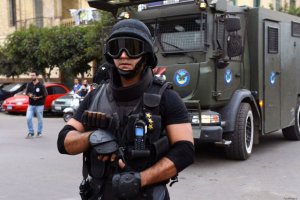
The British Embassy in Cairo has revealed that discussions have been held regarding an increase in arms exports to Egypt. The talks were led by Britain’s adviser for the Middle East at the Ministry of Defence, Lieutenant-General Tom Beckett; the aim is to strengthen Egypt’s capabilities for fighting ISIS/Daesh, Moheet.com has reported.
In a statement issued on Friday, the embassy said that Becket’s visit to Cairo was to consolidate mutual cooperation and Egypt’s military partnership with Britain. “The UK considers Egypt an important military partner in the region and in the fight against Daesh,” the senior army officer was quoted as saying.
Britain exports arms worth millions of pounds to Egypt annually, with a dramatic increase in export licences for weapons recorded in 2015.
Since 2013, Egypt has been waging what it calls a war against Daesh in Sinai. The army claims that it has killed dozens of extremists, although locals say that the war has been waged against them, with soldiers destroying houses and public facilities. Residents have also been evicted from their homes.
There have been periodic attacks on troops and their vehicles, and some have been killed. No group has claimed responsibility, which is unusual. However, the Egyptian authorities insist that Daesh — known locally as Wilayat Sinai – carries out the attacks.
The last couple of weeks have been tumultuous for the Labour Party, to say the least. Jeremy Corbyn’s anti-austerity message has made significant gains at the polls, despite the best efforts of Labour right wingers to smear the left of party with accusations of anti-Semitism.
One of the biggest wins for Labour was the election of Sadiq Khan as Mayor of London.
Khan’s campaign benefitted enormously from the surge of grassroots support for Corbyn, many of whom took to social media and the streets under the slogan “Jez We Khan” – an extension of “Jez We Can”, used to back Corbyn in last year’s leadership race.
Curiously, however, whilst accepting support from these activists, London’s first Muslim Mayor has constantly sought to distance himself from his party’s leader, claiming that he has his “own mandate” and is not beholden to Corbyn.
Although Khan is frequently described as “soft-left” or a “social democrat”, his political record reveals an active hostility toward the principles which saw Corbyn elected as Labour leader last year.
During his election campaign, Khan vowed to be “the most pro-business Mayor London has ever had”; stated his opposition to the “mansion tax”, the nationalisation of banks, and has pledged to work with the Tory government to defeat Corbyn’s push for a “Robin Hood Tax” – a fee on buying stocks, shares and derivatives publicly backed by the Labour leader last summer; and in recent weeks, Khan has described the fact that there are 140-plus billionaires and 400,000 millionaires in London as “a good thing” – echoing the haughty words of Labour’s true blue Tory Peter Mandelson,
Khan has also come out in opposition to Corbyn on the issue of defence, in particular the renewal of Britain’s nuclear “deterrent” Trident – estimated to cost the tax payer a cool £100billion. In an interview with the Telegraph, Khan states unequivocally: “I’m quite clear that I can’t foresee any circumstances in which I would vote to unilaterally end our nuclear capability.”
Since his election, Khan has now expressed support for Chicago Mayor Rahm Emanuel who, he states, “is doing interesting stuff with the infrastructure bank in Chicago.”
The Chicago Infrastructure Trust is a project, backed by former President Bill Clinton, to entice private investors to fund public projects – hardly a left wing solution.
Mayor Emanuel, a former investment banker, is himself a controversial figure, and has been implicated in a number of high profile corruption cases and is renowned for his hostility toward the public sector.
It has also been exposed that Khan, the man who has pledged to solve London’s housing crisis, accepted almost £30,000 in donations from parasite landlords during his election campaign. £10,000 came from a Mancunian firm which Magistrates fined £14,000 for breaching tenant safety rules. And £19,900 came from a south London developer which campaigns against landlord licensing.
Just last week, Khan was one of many Labour MPs calling for the suspension of Corbyn’s close political ally Ken Livingstone over alleged anti-Semitic (in reality anti-Israeli government) statements.
Such scurrilous attacks are intended to discredit the left wing leadership of the Labour Party.
The Labour right, with the full backing of the capitalist class, are cynically and sickeningly using this very real form of discrimination to undermine Corbyn, who has close links with pro-Palestine groups, with an eye, first of all, to isolate him, then eventually to remove him as the party leader.
His high profile mayoral campaign has meant that Khan has played a key role in this process.
But perhaps we should not be surprised. Khan’s association with the Labour right goes back to his election as Labour MP in 2005 – the same year that he became a patron to the Blairite faction of the Labour Party, Progress, the group responsible for organising attacks on Corbyn’s leadership.
Apparently, Sadiq Khan’t stop supporting the 1%
Detaining Suspects Without Trial
In February 2005, Tony Blair’s government voted in favour of the Prevention of Terrorism Bill which, amongst other things, legislated to create “control orders”: civil orders made by the Home Secretary against individuals who the intelligence services suspect of “involvement in terrorism-related activity” on a domestic or an international level.
Control orders allow for a range of restrictions from house arrest and electronic tagging to rules on whom the suspect may contact, where they can go and where they may work. The orders also significantly lowered the standard of proof necessary to detain terror suspects (no trial is necessary, for instance).
The legislation was roundly criticised by human rights organisations for providing the Home Secretary, then Charles Clarke, with powers equivalent to that of the judiciary.
Although Khan was not yet an elected MP when this vote was passed, in 2007 and 2010 he voted to renew these highly undemocratic measures… despite being a former human rights lawyer himself and despite being a persistent critic of the War in Iraq!
Corbyn consistently voted against control orders.
Pro-Academisation
In 2006, Blair’s government voted on the Education and Inspections Bill. The bill served as an important step toward expanding the academisation (i.e. privatisation) project, the rotten fruits of which are being reaped today, by encouraging councils to pass schools from the hands of democratically elected Local Authorities into those of private sponsors.
One representative from the National Union of Teachers described Blair’s Education Bill as giving “even greater opportunities to business and religious sponsors to instil their ideas on young people.”
Khan voted in favour of this bill, but the Labour Party faced a major backbench rebellion, with over fifty MPs (including Corbyn) voting against the proposed legislation.
Revealingly, Blair could rely on the full support of the Tory opposition to push through this attack on comprehensive schools, the leader of whom, David Cameron, said that the reforms were in line with Conservative Party policy.
Anti-Worker
With the Prison Officer Association coordinating a series of strikes at the end of 2007 because of privatisation and cuts to pay, the government responded on January 9, 2008 by strengthening the Criminal Justice and Public Order Act 1994, section 138 of which prohibits prison workers from taking strike action.
Khan voted in favour of this act, Corbyn against.
Treaty of Lisbon
A few weeks later, the news media was dominated by the issue of the Treaty of Lisbon, which was widely understood as providing an EU-wide legislative basis for the privatisation of public services, as well as facilitating attacks on the wages, conditions, and rights of workers.
Article 188c, for instance, helps to remove the ability of states to veto trade deals involving health and education, opening up the prospect that financial speculators, as a right, could intervene and cherry pick the most profitable aspects of health and education.
The Lisbon Treaty was opposed overwhelmingly by delegates at the Trade Union Congress (TUC). Irish workers rejected the Treaty outright in a referendum.
Whether or not one is in favour of remaining or leaving in the upcoming EU referendum, the decision as to whether or not the Lisbon Treaty should have approved should have been put to the public.
Khan voted in favour of the Treaty, and against a referendum on its imposition. Corbyn voted against the Treaty, and in favour of a referendum.
Khan’s Record on Welfare 1
Perhaps one of the most pernicious attacks on welfare that the Tory-Liberal coalition government (2010-2015) carried out was the introduction of the 2013 Jobseeker’s Bill. After the court of appeal quashed the regulations that underpinned the government’s hated Back to Work programme (introduced in 2011) for “lack of clarity”, the Tories responded by rushing through “emergency” Jobseeker’s legislation to set out the bill in more stark terms.
The Workfare program has been described by Dr Simon Duffy, the Director of the Centre for Welfare Reform, as a form of “modern slavery.”
So, what was Labour’s response?
After much debate, discussion, and disputation, the Labour leadership took the bold move of whipping its MPs into abstaining from the vote.
The reason given for this was that by abstaining, and allowing the coalition government to fast-track the workfare scheme through parliament, Labour were able to negotiate concessions, including a full review into the sanctions regime. And yet, just two months prior, the Labour Party described the Work programme as “a worse outcome than no programme at all.”
If this was the case, what would be the purpose of a review?
Khan was one of the many who abstained on the vote. Corbyn voted against it.
Khan’s Record on Welfare 2
Next up is the Welfare Cap which was introduced by the Tory-Liberal coalition in 2014 as a way of curtailing the amount in state benefits that an individual can claim per year, as well as the amount of overall welfare spending.
Diane Abbot gave a particularly impassioned speech against the bill:
This benefits cap is arbitrary and bears no relationship to need, as our benefits system should. It does not allow for changing circumstances—rents going up and population rising—and will make inequality harder to tackle. There are ways to cut welfare. We could put people back to work, introduce a national living wage, build affordable homes and have our compulsory jobs guarantee.
Others read the bill as an attempt to perpetuate a false divide between “strivers” and “scroungers”.
And yet, under the leadership of Ed Miliband, the Labour Party, including Khan, voted overwhelmingly in favour of the cap. Thirteen Labour backbenchers, including Corbyn, defied the party whip to vote against the cap.
Khan’s Record on Welfare 3
More recently we have the controversial Welfare Reform and Work Bill, voted on in the aftermath of the 2015 general elections. The Tories, having narrowly been elected with an outright majority – although with the smallest mandate since Universal Suffrage – took the opportunity to hammer home their cuts agenda against a weak, divided, and (apparently) confused Labour Party.
Amongst other things, the Bill was committed to reducing the household benefit cap from £26,000 to £20,000 (£23,000 in London); freezing the rate of many major benefits and tax credits for four years; limiting the child element of universal credit to a maximum of two children; and stopping those on certain benefits being able to claim additional help towards their mortgage payments.
Against a backdrop of huge anger, the interim Labour leader Harriet Harman whipped fellow MPs to abstain on the vote in order to show the electorate that Labour “was listening” to their concerns about welfare. According to Harman:
The temptation is always to oppose everything. That does not make sense. We have got to wake up and recognise this is not a blip and we have got to listen to why. No one is going to listen to us if they think we are not to listening to them.
Amongst those who absented themselves, many remain in the Labour shadow cabinet: Tom Watson, Angela Eagle, Seema Maholtra, Hilary Benn, Andy Burnham, Heidi Alexander, Rosie Winterton, Lucy Powell, Owen Smith, Jon Trickett, Lisa Nandy, Chris Bryant, Lilian Greenwood, Vernon Coaker, Ian Murray, Nia Griffith, Kerry McCarthy, Kate Green, Maria Eagle, Gloria de Piero, Luciana Berger, Karl Turner, John Ashworth, and John Healey.
That is an astonishing 89% of the current shadow cabinet who refused to oppose the Tories’ Welfare Bill (anyone looking for evidence of Corbyn’s isolation within the Parliamentary Labour Party need look no further than this fact). In fact, only three members of the current shadow cabinet opposed it: Corbyn, McDonnell, and Abbott.
Credit to Khan, however, who, unlike the majority of his right wing colleagues, defied the whip to oppose this bill, but given his background and his planned Mayoral bid it is tempting to speculate that there was no small amount of political opportunism in this vote.
In Summary
Jeremy Corbyn’s landslide election as Labour leader showed the potential for creating a mass anti-capitalist party. Unfortunately, however, the majority of Labour MPs and councillors remain pro-capitalist and pro-austerity. Khan is amongst this group
To defeat the right means starting to mobilise the currently fragmented anti-austerity mood into a mass, democratic movement. This will not succeed if it remains trapped within the current undemocratic structure of the Labour Party, vainly trying to compromise with “the 4.5%” – the Blairite representatives of big business in the Labour Party.
Instead it means building an open, democratic movement – organised on federal lines – that brings together all of those who have been inspired by Corbyn and want to see a determined anti-capitalist party.
Warning Brits about the dangers of a new surveillance bill, UK campaigners have flooded London with sinister captioned portraits of Vladimir Putin. The choice of bogeyman however could be better, given the notoriety of Western global spying operations.
The posters and billboards which have been recently appearing all across the British capital, and also in newspapers, including the Guardian and The Telegraph, feature a very distinctive face with a caption that reads: “A government that spies on its citizens. What’s not to like?”
The Don’t Spy On Us Campaign, which is behind the billboards, is trying to warn British citizens about the danger of the UK governments’ Surveillance Bill currently going through parliament. If passed, it would give “government, intelligence agencies and police the kind of powers you would expect in an authoritarian regime,” the campaign said on its website.
The state will “snoop on our private communications and internet use,” collect and store “data about your emails, phone calls, texts and internet use,” while security agencies will be allowed to hack people’s computers and phones, campaigners stressed.
The Don’t Spy On Us Campaign, a coalition of several pro-privacy organizations, also launched an online petition urging the reformation of the surveillance bill. Photographs of Chinese and North Korean leaders were also used by campaigners, but drew less attention, RT’s Harry Fear reported from London.
“Of course, Putin’s face and the Russian brand, if you will, have resonance here in the UK given all of the demonizing in politics and the media,” Fear said. He noted however that “the British public on average knows a great deal about the American surveillance program, not the Russian or Chinese.”
Indeed many on the internet are puzzled by the choice of the Russian president as the face for the campaign, calling the whole affair “a bit peculiar.”
In particular, some mocked the campaigners’ choice of images, saying that faces of other leaders, such as US President Baraсk Obama or UK Prime Minister David Cameron would have been more suitable.
Mass surveillance practices by the US national Security Agency made headlines worldwide after they were unmasked by whistleblower, Edward Snowden, with the help of the Guardian, back in 2013.
“Some are saying that comparing the UK, perhaps, uncertain security state future to the American’s campaign and having Obama’s face instead of Putin’s face here may have been a more appropriate marketing and campaigning choice,” Fear said.
Israel’s latest display of misplaced ire at the UN Security Council has provided a succinct illustration of how criticism of settler colonialism, even by Israeli NGOs, remains a cloistered subject. Following a presentation by Yesh Din, in which the NGO’s legal adviser Michael Sfard presented statistical information regarding Israeli settler terror, both Sfard and Israel’s Ambassador to the UN, Danny Danon, retaliated against Venezuelan Ambassador Rafael Ramirez’s criticism of their country’s slow extermination policies.
According to Haaretz, Ramirez challenged the UN Security Council to ponder the information, asking: “What does Israel plan to do with the Palestinians? Will they be disappeared? Is Israel trying to impose a ‘final solution’ on the Palestinians in the West Bank?”
Right-winger Danon — who has advocated punitive attacks on the civilian infrastructure in the Gaza Strip — promptly resorted to the clichéd “anti-Semitism” accusation: “These are blunt anti-Semitic statements coming from the Venezuelan ambassador towards the Jewish nation.”
According to Yesh Din’s lawyer, the Venezuelan ambassador’s use of the phrase ‘final solution’ is “offensive, angering and completely incorrect.” Sfard made this claim despite telling the Security Council: “Yesh Din vigorously and unequivocally condemns all human rights violations and all international law infractions. There can be no justification for attacks on civilians no matter who the perpetrators are and whatever the identity of the victim is.”
According to YNet news, the Israeli delegation demanded immediate condemnations following Ramirez’s remarks, and was gratified by the US, Britain and France issuing — predictably — “decisive” statements. Danon also called on Ramirez to apologise for his use of the phrase “final solution” with its obvious connotations with the Holocaust; his apology was met by a demand for a more public version.
Israel thrives upon the blatant contradiction of committing human rights violations openly and without remorse, while resenting criticism of such illegal actions. Furthermore, this episode at the UN is evidence of the cycle of hypocrisy plaguing such organisations which are, allegedly, standing up for Palestinian rights; they fail to act on the evidence, no matter how strong it is, and this exposes their allegiance to the colonial state of Israel as well as the terrorism of its illegal settlers. However, the tactic has now been perfected to project blame elsewhere to the point where logical condemnation of colonial violence is deemed to be offensive, but the violence itself isn’t. This is despite the fact that Israel is adhering publicly to the implementation of Zionism’s ideological goal of “Greater Israel” by continuing its territorial expansion, ethnic cleansing and — yes — slow extermination of the Palestinian population.
Ramirez’s comments expose Israeli state terror, incorporating historical memory and exposing a colonial cycle that has not yet reached its completion. Israel has applied various forms of human rights violations against Palestinians, all geared towards a system that leaves no recourse, thus isolating Palestinians and creating a perpetual implosion. State policies reflect impunity while Israeli ministers such as Naftali Bennett have spoken openly about “disappearing” Palestinians. Hence, nothing in Ramirez’s speech can be construed to be within any context other than that of the reality on the ground. If anything, the Venezuelan’s words portray an awareness that is common to both Palestine and South America, both having experienced colonial and imperialist violence.
Nobody should take offence at what was said by the ambassador from South America. The incident should be seen as an educational experience of how the interpretation of colonial violence through time has navigated the perpetually-changing circumstances and, as a response, carved out a niche that encourages selective remembrance and memory of genocide in order to allow for a new form of genocide to be carried out within the framework of the ambiguities of international law. As Rafael Ramirez has found to his cost, Israel is allowed to commit genocidal crimes with impunity; it is those who condemn them who have to apologise.
Nigerian leader Muhammadu Buhari used a keynote speech at a major anti-corruption conference in London to blast Prime Minister David Cameron for calling the African country “fantastically corrupt.”
The conference, which is currently underway, was meant to address global corruption, but a shadow was cast when Cameron was caught on camera calling Afghanistan and Nigeria “fantastically corrupt” in a conversation with the Queen and Speaker of the House John Bercow.
“What would I do with an apology? I need something tangible,” Buhari said.
“I am not going to demand any apology from anyone. What I am demanding is a return of assets.”
Buhari freely admitted before his address that his country had a graft problem and is thought to have been referring to major assets stashed in the UK by corrupt Nigerian figures.
In April 2016 a group of leading figures from Nigerian civil society raised a similar issue in an open letter, demanding Britain end its role as a “safe haven” for white-collar criminals who steal Nigeria’s wealth and resources for personal gain.
The letter’s signatories stressed the devastating effect corruption can have on ordinary citizens, stunting economic growth and exacerbating violent conflict and mass migration in its wake.
“Our Nigeria is one of those countries that has most bitterly suffered the impact. Despite the blessings of nature, which endowed us with abundant oil wealth, our infrastructure is deplorable,” the letter said.
The conference, a pet project of the PM’s, is likely to see Cameron file a motion to create a global anti-corruption body.
However, his plans have been attacked by critics on the basis the organization would have no meaningful powers of enforcement, instead relying on national and international policing agencies to intervene.
The summit comes only weeks after Cameron himself was caught up in a scandal relating to his father’s offshore company, Blairmore Holdings.
Following the Panama Papers leak that showed Cameron had profited from offshore tax schemes, the parliamentary standards committee said the PM would not be investigated. It gave no reason why.
According to a leaked memo obtained by the Guardian in late March, 2016 King Abdullah of Jordan apparently briefed US officials on the fact that Jordanian Special Forces would be deployed to Libya to work alongside the British SAS. In that same briefing, Abdullah also allegedly stated that British SAS had been active in Libya since early 2016.
As Randeep Ramesh wrote for the Guardian at the time,
According to the notes of the meeting in the week of 11 January, seen by the Guardian, King Abdullah confirmed his country’s own special forces “will be imbedded [sic] with British SAS” in Libya.
According to the memo, the monarch met with US congressional leaders – including John McCain, the chairman of the Senate armed services committee, and Bob Corker, the chairman of the Senate foreign relations committee. Also present was the House of Representatives speaker, Paul Ryan.
King Abdullah said UK special forces needed his soldiers’ assistance when operating on the ground in north Africa, explaining “Jordanian slang is similar to Libyan slang”.
Abdullah also allegedly pointed out that the British had been instrumental in setting up a “mechanized battalion” in Southern Syria made up of “local tribal fighters” (aka terrorists) and lead by a “local commander” for the purposes of fighting against the Syrian government forces.
The Jordanian king also stated that his troops were ready to fight side by side with the British and Kenyans for the purposes of invading Somalia.
According to the Guardian,
The full passage of the briefing notes says: “On Libya His Majesty said he expects a spike in a couple of weeks and Jordanians will be imbedded [sic] with British SAS, as Jordanian slang is similar to Libyan slang.”
The monarch’s apparent openness with the US lawmakers is an indication of just how important an ally Jordan is to the US in the region. Since the 1950s Washington has provided it with more than $15bn (£10.5bn) in economic and military aid.
However, the Jordanians had become frustrated over perceived US inaction over the Middle East in recent months. Five years of fighting in Syria have dramatically impacted on Jordan, which has absorbed more than 630,000 Syrian refugees, and the king has repeatedly called for decisive action to end the conflict.
Interestingly enough, the King also allegedly admitted that Turkey and specifically Recep Erdogan is hoping for the victory of “radical Islamists” in Syria and that Israel is tacitly supporting al-Qaeda/al-Nusra in Syria.
Ramesh summarizes the King’s alleged statements by writing:
The Turkish president, Recep Tayyip Erdoğan, “believes in a radical Islamic solution to the problems in the region” and the “fact that terrorists are going to Europe is part of Turkish policy, and Turkey keeps getting a slap on the hand, but they get off the hook”.
Intelligence agencies want to keep terrorist websites “open so they can use them to track extremists” and Google had told the Jordanian monarch “they have 500 people working on this”.
Israel “looks the other way” at the al-Qaida affiliate Jabhat al-Nusra on its border with Syria because “they regard them as an opposition to Hezbollah”.
In March, Stratfor analysts reported that UK Special Forces were already in Libya and that they were “escorting MI6 teams to meet with Libyan officials about supplying weapons and training to the Syrian army and to militias against the Islamic State. The British air force bases Sentinel aircraft in Cyprus for surveillance missions around [the Isis Libyan stronghold] Sirte as well.”
The presence of Western/NATO Special Forces in Syria is by no means a revelation at this point. These forces have been present in the embattled Middle Eastern country for some time.
In October, 2015, it was announced by the White House that 50 Special Forces troops would be sent to Syria. This announcement came days after it was reported that U.S. Special Forces commandoes were working with Kurdish forces to “free prisoners of the Islamic State” in Syria. Later, the presence of U.S. Special Forces in Syria was tacitly acknowledged in 2015 when the U.S. took credit for the killing of Abu Sayyaf.
Reports circulated in October, 2014 that U.S. soldiers and Special Forces troops were fighting alongside Kurdish battalions in Kobane. An article by Christof Lehmann published in March 20, 2015 stated,
Evidence about the presence of U.S. special forces in the Syrian town Ayn al-Arab a.k.a. Kobani emerged. Troops are guiding U.S. airstrikes as part of U.S support for the Kurdish separatist group PYD and the long-established plan to establish a Kurdish corridor.
A photo taken in Ayn al-Arab shows three U.S. soldiers. One of them “Peter” is carrying a Bushnell laser rangefinder, an instrument designed to mark targets for U.S. jets, reports Ceyhun Bozkurt forAydinlik Daily.
The photo substantiated previous BBC interviews with U.S. soldiers who are fighting alongside the Kurdish separatist group PYD in Syria.
The photo of the three U.S. troopers also substantiates a statement by PYD spokesman Polat Can from October 14, 2014, reports Aydinlik Daily. Can admitted that a special unit in Kobani provides Kurdish fighters with the coordinates of targets which then would be relayed to “coalition forces”.
The first public U.S. Special Forces raid in Syria took place in July, 2014 when Delta Force personnel allegedly attempted to rescue several Americans being held by ISIS near Raqqa. Allegedly, the soldiers stormed the facility but the terrorists had already moved the hostages. While the raid would provide evidence that U.S. Special Forces were operating in Syria in 2014, many researchers believe the story is simply fabricated by the White House to provide legitimacy to the stories of murdered hostages and thus the subsequent pro-war propaganda that ensued as well as to promote the gradual acceptance of U.S. troops on the ground in Syria.
In 2012, an article published in the Daily Star by Deborah Sherwood revealed that SAS Special Forces and MI6 agents were operating inside Syria shortly after the destabilization campaign began in earnest. Sherwood writes,
Special Forces will help protect the refugees in Syria along the borders.
Last week as the president ignored an international ceasefire, plans were being finalised to rescue thousands of Syrians.
SAS troops and MI6 agents are in the country ready to help rebels if civil war breaks out as expected this weekend.
They also have hi-tech satellite computers and radios that can instantly send back photos and details of refugees and Assad’s forces as the situation develops.
Whitehall sources say it is vital they can see what is happening on the ground for themselves so Assad cannot deny atrocities or battles.
And if civil war breaks out the crack troops are on hand to help with fighting, said the insider.
. . . . .
“Safe havens would be an invasion of Syria but a chance to save lives,” said a senior Whitehall source.
“The SAS will throw an armed screen round these areas that can be set up within hours.
“There are guys in the communications unit who are signallers that can go right up front and get involved in close-quarter fighting.”
In addition, in March 2012, it was reported by Lebanon’sDaily Star that 13 French intelligence agents had been captured by the Syrian government, proving not only that Western Special Ops presence in Syria did, in fact, exist but also that it existed essentially from the start.
Britain’s drone ‘kill list’ could leave politicians, pilots and intelligence personnel facing murder charges unless rules of engagement are quickly clarified, a parliamentary report has warned.
The joint committee on human rights warned on Tuesday that killing with drones outside warzones could lead to “criminal prosecution for murder or complicity in murder.”
The report also warned that the widely-used term “targeted killing” sounded “uncomfortably close to assassination“ and took the view that the UK pursues an active policy “to use lethal force abroad outside armed conflict” under the banner of “counter-terrorism.”
The committee acknowledged the likelihood of the Crown Prosecution Service (CPS) pursuing a case is slim, but said authorities in other countries may if their citizens are killed.
Chaired by Labour‘s Harriet Harman, the committee also said the UK owed it “to all those involved in the chain of command for such uses of lethal force to provide them with absolute clarity about the circumstances in which they will have a defense against any possible future criminal prosecution.”
The investigation began in August 2014 after it was announced a UK targeted drone strike had killed British Islamic State (IS, formerly ISIS/ISIL) fighter Reyaad Khan in Syria.
The killing took place prior to December’s parliamentary vote on military action in the country. The US had developed a pattern of carrying out drone strikes in regions which are not official warzones such as Yemen and Pakistan, a trend which critics find worrying.
Harman’s panel said it is “vital that the legal line between counter-terrorism law enforcement and the waging of war by military means does not become blurred, leading to the use of lethal force in circumstances not permitted by law.”
Human rights NGO Reprieve warned on Tuesday the report highlighted some of the risks involved in an assassination policy.
Reprieve staff attorney Jennifer Gibson said “this is a wakeup call.”
She warned there is a “very real danger that the UK is following the US down the slippery slope of kill lists and targeted killings.”
“This is alarming, given the CIA’s secret drone war has killed hundreds of civilians and been described as a ‘failed strategy’ by [US President Barack] Obama’s own former head of defense intelligence,” she added.
While UK Prime Minister David Cameron acknowledged at the time that the Khan killing was a “new departure,” the government maintains it only uses such methods in cases where there is an “immediate” or “imminent” threat to the UK.
On March 23, 2011, at the very start of what we now call the ‘Syrian conflict,’ two young men – Sa’er Yahya Merhej and Habeel Anis Dayoub – were gunned down in the southern Syrian city of Daraa.
Merhej and Dayoub were neither civilians, nor were they in opposition to the government of Syrian President Bashar al-Assad. They were two regular soldiers in the ranks of the Syrian Arab Army (SAA).
Shot by unknown gunmen, Merhej and Dayoub were the first of eighty-eight soldiers killed throughout Syria in the first month of this conflict– in Daraa, Latakia, Douma, Banyas, Homs, Moadamiyah, Idlib, Harasta, Suweida, Talkalakh and the suburbs of Damascus.
According to the UN’s Independent International Commission of Inquiry on Syria, the combined death toll for Syrian government forces was 2,569 by March 2012, the first year of the conflict. At that time, the UN’s total casualty count for all victims of political violence in Syria was 5,000.
These numbers paint an entirely different picture of events in Syria. This was decidedly not the conflict we were reading about in our headlines – if anything, the ‘parity’ in deaths on both sides even suggests that the government used ‘proportionate’ force in thwarting the violence.
But Merhej and Dayoub’s deaths were ignored. Not a single Western media headline told their story – or that of the other dead soldiers. These deaths simply didn’t line up with the Western ‘narrative’ of the Arab uprisings and did not conform to the policy objectives of Western governments.
For American policymakers, the “Arab Spring” provided a unique opportunity to unseat the governments of adversary states in the Middle East. Syria, the most important Arab member of the Iran-led ‘Resistance Axis,’ was target number one.
To create regime-change in Syria, the themes of the “Arab Spring” needed to be employed opportunistically – and so Syrians needed to die.
The “dictator” simply had to “kill his own people” – and the rest would follow.
How words kill
Four key narratives were spun ad nauseam in every mainstream Western media outlet, beginning in March 2011 and gaining steam in the coming months.
– The Dictator is killing his “own people.”
– The protests are “peaceful.”
– The opposition is “unarmed.”
– This is a “popular revolution.”
Pro-Western governments in Tunisia and Egypt had just been ousted in rapid succession in the previous two months – and so the ‘framework’ of Arab Spring-style, grass roots-powered regime-change existed in the regional psyche. These four carefully framed ‘narratives’ that had gained meaning in Tunisia and Egypt, were now prepped and loaded to delegitimize and undermine any government at which they were lobbed.
But to employ them to their full potential in Syria, Syrians had to take to the streets in significant numbers and civilians had to die at the hands of brutal security forces. The rest could be spun into a “revolution” via the vast array of foreign and regional media outlets committed to this “Arab Spring” discourse.
Protests, however, did not kick off in Syria the way they had in Tunisia and Egypt. In those first few months, we saw gatherings that mostly numbered in the hundreds – sometimes in the thousands – to express varied degrees of political discontent. Most of these gatherings followed a pattern of incitement from Wahhabi-influenced mosques during Friday’s prayers, or after local killings that would move angry crowds to congregate at public funerals.
A member of a prominent Daraa family explained to me that there was some confusion over who was killing people in his city – the government or “hidden parties.” He explains that, at the time, Daraa’s citizens were of two minds: “One was that the regime is shooting more people to stop them and warn them to finish their protests and stop gathering. The other opinion was that hidden militias want this to continue, because if there are no funerals, there is no reason for people to gather.”
With the benefit of hindsight, let’s look at these Syria narratives five years into the conflict:
We know now that several thousand Syrian security forces were killed in the first year, beginning March 23, 2011. We therefore also know that the opposition was “armed” from the start of the conflict. We have visual evidence of gunmen entering Syria across the Lebanese border in April and May 2011. We know from the testimonies of impartial observers that gunmen were targeting civilians in acts of terrorism and that “protests” were not all “peaceful”.
The Arab League mission conducted a month-long investigation inside Syria in late 2011 and reported:
“In Homs, Idlib and Hama, the observer mission witnessed acts of violence being committed against government forces and civilians that resulted in several deaths and injuries. Examples of those acts include the bombing of a civilian bus, killing eight persons and injuring others, including women and children, and the bombing of a train carrying diesel oil. In another incident in Homs, a police bus was blown up, killing two police officers. A fuel pipeline and some small bridges were also bombed.”
Longtime Syrian resident and Dutch priest Father Frans van der Lugt, who was killed in Homs in April 2014, wrote in January 2012:
“From the start the protest movements were not purely peaceful. From the start I saw armed demonstrators marching along in the protests, who began to shoot at the police first. Very often the violence of the security forces has been a reaction to the brutal violence of the armed rebels.”
A few months earlier, in September 2011, he had observed:
“From the start there has been the problem of the armed groups, which are also part of the opposition… The opposition on the street is much stronger than any other opposition. And this opposition is armed and frequently employs brutality and violence, only in order then to blame the government.”
Furthermore, we also now know that whatever Syria was, it was no “popular revolution.” The Syrian army has remained intact, even after blanket media coverage of mass defections. Hundreds of thousands of Syrians continued to march in unreported demonstrations in support of the president. The state’s institutions and government and business elite have largely remained loyal to Assad. Minority groups – Alawites, Christians, Kurds, Druze, Shia, and the Baath Party, which is majority Sunni – did not join the opposition against the government. And the major urban areas and population centers remain under the state’s umbrella, with few exceptions.
A genuine “revolution,” after all, does not have operation rooms in Jordan and Turkey. Nor is a “popular” revolution financed, armed and assisted by Qatar, Saudi Arabia, the US, UK and France.
Sowing “Narratives” for geopolitical gain
The 2010 US military’s Special Forces Unconventional Warfare manual states:
“The intent of US [Unconventional Warfare] UW efforts is to exploit a hostile power’s political, military, economic, and psychological vulnerabilities by developing and sustaining resistance forces to accomplish US strategic objectives… For the foreseeable future, US forces will predominantly engage in irregular warfare (IW) operations.”
A secret 2006 US State Department cable reveals that Assad’s government was in a stronger position domestically and regionally than in recent years, and suggests ways to weaken it: “The following provides our summary of potential vulnerabilities and possible means to exploit them…” This is followed by a list of “vulnerabilities” – political, economic, ethnic, sectarian, military, psychological – and recommended “actions” on how to “exploit” them.
This is important. US unconventional warfare doctrine posits that populations of adversary states usually have active minorities that respectively oppose and support their government, but for a “resistance movement” to succeed, it must sway the perceptions of the large “uncommitted middle population” to turn on their leaders. Says the manual (and I borrow liberally here from a previous article of mine):
To turn the “uncommitted middle population” into supporting insurgency, UW recommends the “creation of atmosphere of wider discontent through propaganda and political and psychological efforts to discredit the government.”
As conflict escalates, so should the “intensification of propaganda; psychological preparation of the population for rebellion.”
First, there should be local and national “agitation” – the organization of boycotts, strikes, and other efforts to suggest public discontent. Then, the “infiltration of foreign organizers and advisors and foreign propaganda, material, money, weapons and equipment.”
The next level of operations would be to establish “national front organizations [i.e. the Syrian National Council] and liberation movements [i.e. the Free Syrian Army]” that would move larger segments of the population toward accepting “increased political violence and sabotage” – and encourage the mentoring of “individuals or groups that conduct acts of sabotage in urban centers.”
I wrote about foreign-backed irregular warfare strategies being employed in Syria one year into the crisis – when the overwhelming media narratives were still all about the “dictator killing his own people,” protests being “peaceful,” the opposition mostly “unarmed,” the “revolution wildly “popular,” and thousands of “civilians” being targeted exclusively by state security forces.
Were these narratives all manufactured? Were the images we saw all staged? Or was it only necessary to fabricate some things – because the “perception” of the vast middle population, once shaped, would create its own natural momentum toward regime change?
And what do we, in the region, do with this startling new information about how wars are conducted against us – using our own populations as foot soldiers for foreign agendas?
Create our own “game”
Two can play at this narratives game.
The first lesson learned is that ideas and objectives can be crafted, framed finessed and employed to great efficacy.
The second take-away is that we need to establish more independent media and information distribution channels to disseminate our own value propositions far and wide.
Western governments can rely on a ridiculously sycophantic army of Western and regional journalists to blast us with their propaganda day and night. We don’t need to match them in numbers or outlets – we can also employ strategies to deter their disinformation campaigns. Western journalists who repeatedly publish false, inaccurate and harmful information that endanger lives must be barred from the region.
These are not journalists – I prefer to call them media combatants – and they do not deserve the liberties accorded to actual media professionals. If these Western journalists had, in the first year of the Syrian conflict, questioned the premises of any of the four narratives listed above, would 250,000-plus Syrians be dead today? Would Syria be destroyed and 12 million Syrians made homeless? Would ISIS even exist?
Free speech? No thank you – not if we have to die for someone else’s national security objectives.
Syria changed the world. It brought the Russians and Chinese (BRICS) into the fray and changed the global order from a unipolar one to a multilateral one – overnight. And it created common cause between a group of key states in the region that now form the backbone of a rising ‘Security Arc’ from the Levant to the Persian Gulf. We now have immense opportunities to re-craft the world and the Middle East in our own vision. New borders? We will draw them from inside the region. Terrorists? We will defeat them ourselves. NGOs? We will create our own, with our own nationals and our own agendas. Pipelines? We will decide where they are laid.
But let’s start building those new narratives before the ‘Other’ comes in to fill the void.
A word of caution. The worst thing we can do is to waste our time rejecting foreign narratives. That just makes us the ‘rejectionists’ in their game. And it gives their game life. What we need to do is create our own game – a rich vocabulary of homegrown narratives – one that defines ourselves, our history and aspirations, based on our own political, economic and social realities. Let the ‘Other’ reject our version, let them become the ‘rejectionists’ in our game… and give it life.
Sharmine Narwani is a commentator and analyst of Middle East geopolitics. She is a former senior associate at St. Antony’s College, Oxford University and has a master’s degree in International Relations from Columbia University. You can follow her on Twitter at @snarwani
Reporters Without Borders has published the latest 2016 report on press freedom where Britain has fallen yet again with the organisation making the following statement about press freedom in Britain:
“Terrorist attacks have led to the adoption of draconian security legislation. The government reacted to the London public transport bombings in 2005 with a Terrorism Act the following year that restricts freedom of expression. The Regulation of Investigatory Powers Act (RIPA) adopted in 2000 allows the authorities to obtain the phone records of journalists in cases of threats to national security. Worse still, despite a law protecting the confidentiality of sources, the police have since 1984 been able to ask the courts to order media outlets to hand over unpublished journalistic source material “in the interests of justice.”
It is hardly surprising that Britain has fallen 4 places in 2016 behind such countries as; Tonga, Belize, OECS (Organisation of Eastern Caribbean States), Samoa, Ghana, Suriname, Namibia, Jamaica, with Burkino Faso and Botswana just behind, given recent legislative actions by the Conservative government since 2010.
The Guardianrevealed in January 2015 that the British intelligence agency GCHQ described journalists as a “potential threat to security” and that huge quantities of emails of many journalists were among interceptions that went as far back as 2008. It was only the result of the Edward Snowden leaks that as many as 70,000 emails from journalists captured by Britain’s surveillance agency became known.
On the 15th October, Gordon Raynor, Chief Reporter at The Telegraph said– “Investigative journalism will be stopped dead in its tracks and local newspapers may be driven out of business when new laws restricting Britain’s free press come into force next month.” He continues – Media organisations face “the most substantial threat to press freedom in the modern era” as a result of the “menacing” laws passed in the wake of the Leveson Inquiry.
An independent report into the implications of the Crime and Courts Act, which came into force on November 3, says that The Telegraph’s landmark investigation into what turned out to be the most explosive political scandal in decades over MPs’ expenses would have been all but impossible under the new regime.
Britain sitting at number 38 flatters reality.
‘Freedom of Press’ is published by the US-based Freedom House, an NGO established in 1941 that has been ranking countries worldwide since 1980 in relation to democracy, human rights and press freedom. In May 2014 it reported that Britain has slipped down the global rankings for freedom of the press to 36th place.
According to Freedom House, “only 13 percent of the world’s population enjoys a free press—that is, where coverage of political news is robust, the safety of journalists is guaranteed, state intrusion in media affairs is minimal, and the press is not subject to onerous legal or economic pressures.” Although Britain is ranked as safe in press freedom terms one has to wonder given the very heavy handed behaviour by the government at The Guardian over the Snowden files and state surveillance over journalists more widely.
Meanwhile, without any sense of shame, US President Obama, the leader of the ‘free-world’, having presided over continual declines in press freedom sees the USA drop to a pitiful 41st place has the Whitehouse Briefing Room release the following statement (first paragraph):
“On World Press Freedom Day, we thank the journalists around the world without whom democracy could not flourish and whose courageous work helps hold authorities to account. These are the men and women who work to ensure that debate on public issues can be, in the words of Justice William Brennan, “uninhibited, robust, and wide open.”
One glaring component missing from all these so-called press freedom reports is that the biggest economic trade deals in the history of humanity are due to be signed in 2016 …. in total secrecy. In the EU, the European Commission is making the secret Transatlantic Trade and Investment Partnership (TTIP) trade deal even more secret than any normal person would think possible by the introduction of a new rule last year that means politicians can only view (some selected) TTIP text in a secure ‘reading room’ in Brussels. That is, of course, only after their mobile phones, memo pads, and pens have been taken away and two guards ominously placed in the room to ensure no notes are taken. And even then only after signing confidentiality agreements that threaten prosecutions for any leaks.
In the US, the same ‘reading room’ exists. As The Independent reports:
“In the basement of the US capitol, there is a room, a locked soundproof room, and the only people allowed in this room are US senators, and they can’t bring their assistants, they can’t bring their phones, they can’t even take notes in there. Inside this room is not the codes for our nuclear weapons, it’s not CIA files, it’s not the documents that tell us an alien landed in Roswell. No, in this room is the text of a trade deal (TTIP).”
Press freedom?? This type of secrecy, designed by corporations and the unelected politicians of the EU Commission would have made Joseph Goebbels in Nazi Germany proud. The EU Commission have now become completely independent of the politicians who represent the 508 million citizens of the 28 nation bloc where millions sign petitions and protest on the streets, get arrested and/or fined in their thousands and yet remain unheard. This is extreme press freedom censorship in every sense of the word. It says something when citizens have to rely on people like Wikileaks founder Julian Assange and whistleblower Edward Snowden for any real information on the matter – and both of them are in hiding from British and American police.
And so we come back to RWB who that as it turns out, is financed by none other than the US Congress and by various agencies tied to the US government – who coincidentally are conducting the talks on TTIP.
As GlobalResearch reports: “If we go to the RWB website to find who stands behind these self-anointed judges of world press freedom, we find nothing. Not even their board of directors are named, let alone their financial backers. Their annual published Income and Expenditure statements give no clue who stands behind them financially. RWB’s former Secretary General Robert Menard admitted that the budget for the organization was provided by “US organizations strictly linked with US foreign policy.”
Unfortunately, Reporters Without Borders are pretty much in the same boat as the International Consortium of Investigative Journalists amongst many others who have thoroughly important sounding names but in the end prove to be little more than propagandists for their masters.
We asked Reporters Without Borders why there had been no mention of TTIP in any of their reports. At the time of publication, we have received no reply.
A document in the American Archives, reporting the widespread famine and spread of epidemic disease in Iran, estimates the number of the deceased due to the WWI famine to be about 8-10 million.
One of the little-known chapters of history was the widespread famine in Iran during World War I, caused by the British presence in Iran. After the Russian Revolution of 1917, Britain became the main foreign power in Iran and this famine or–more accurately–‘genocide’ was committed by the British. The document in the American Archives, reporting the widespread famine and spread of epidemic disease in Iran, estimates the number of the deceased due to the famine to be about 8-10 million during 1917-19 (1), making this the greatest genocide of the 20th century and Iran the biggest victim of World War I (2).
It should be noted that Iran had been one of the main suppliers of food grains to the British forces stationed in the empire’s South Asian colonies. Although bad harvests during these two years made the situation worse, it was by no means the main reason why the Great Famine occurred. Prof. Gholi Majd of Princeton University writes in his book, The Great Famine and Genocide in Persia, that American documents show that the British prevented imports of wheat and other food grains into Iran from Mesopotamia, Asia, and also the USA, and that ships loaded with wheat were not allowed to unload at the port of Bushehr in the Persian Gulf. Professor Majd argues that Great Britain intentionally created genocide conditions to destroy Iran, and to effectively control the country for its own purposes. Major Donohoe describes Iran of that time as a “land of desolation and death” (3). But this event soon became the subject of a British cover up.
Britain has a long record of its several attempts to conceal history and rewrite it in their own favor. The pages are filled with conspiracies that were covered up by the British government to hide its involvement in different episodes that would tarnish the country’s image. One of the clear examples is the “Jameson Raid”; a failed coup against Paul Kruger’s government in South Africa. This raid was planned and executed directly by the British government of Joseph Chamberlain under the orders of Queen Victoria (4) (5). In 2002, Sir Graham Bower’s memoirs were published in South Africa, revealing these involvements that had been covered up for more than a century, focusing attention on Bower as a scapegoat for the incident (6).
The records that were destroyed to cover up British crimes around the globe, or were kept in secret Foreign Office archives, so as to, not only protect the United Kingdom’s reputation, but also to shield the government from litigation, are indicative of the attempts made by the British to evade the consequences of their crimes. The papers at Hanslope Park also include the reports on the “elimination” of the colonial authority’s enemies in 1950s Malaya; records that show ministers in London knew of the torture and murder of Mau Mau insurgents in Kenya and roasting them alive (7). These records may include those related to Iran’s Great Famine. Why were these records that cover the darkest secrets of the British Empire destroyed or kept secret? Simply because they might ‘embarrass’ Her Majesty’s government (8).
A famine occurred in Ireland from 1845 until 1852 which killed one fourth of the Irish population. This famine was caused by British policies and faced a large cover up attempt by the British government and crown to blame it on ‘potatoes’ (9). The famine, even today, is famous in the world as the “potato famine” when, in reality, it was a result of a planned food shortage and thus a deliberate genocide by the British government (10).
The true face of this famine as a genocide has been proven by historian Tim Pat Coogan in his book The Famine Plot: England’s Role in Ireland’s Greatest Tragedy published by Palgrave MacMillan (11). A ceremony was planned to take place in the US to unveil Coogan’s book in America, but he was denied a visa by the American embassy in Dublin (12).
Therefore it becomes obvious that Britain’s role in Iran’s Great famine, which killed nearly half of Iran’s population, was not unprecedented. The documents published by the British government overlook the genocide, and consequently, the tragedy underwent an attempted cover-up by the British government. The Foreign Office “handbook on Iran” of 1919 mentioned nothing related to the Great Famine.
Julian Bharier, a scholar who studied Iran’s population, built his “backward projection” estimation of Iran’s population (13) based on reports from this “handbook” and, as a result, ignored the effect of the Great Famine on Iran’s population in 1917. Bharier’s estimations were used by some authors to deny the occurrence of the Great Famine or to underestimate its impacts.
By ignoring Iran’s Great Famine in his estimations, Bharier’s work faces four scientific deficiencies. Bharier does not consider the loss of population caused by the famine in his calculations; he needs to ‘adjust’ the figure of the official census in 1956 from 18.97 million to 20.37 million, and this is despite the fact that he uses the 1956 census as his primary building block for his “backward projection” model. He also ignores the official growth rates and uses his personal assumptions in this regard, which is far lower than other estimates. Finally, although Bharier frequently cites Amani’s estimates (14), in the end Bharier’s findings contradict those of Amani; notably Bharier’s population estimate for 1911 is 12.19 million while Amani put this figure at 10.94 million.
Despite deficiencies in the population estimates offered by Bharier for the period of the Famine and its earlier period, his article offers useful data for the post-Famine period; this is because these figures are generated from 1956 backward. That is to say, numbers generated from 1956 to 1919 are thus credible because they do not include the period of famine. Moreover, this portion of Bharier’s data is also true to that of the American Legation. For example, Caldwell and Sykes estimate the 1919 population at 10 million, which is comparative to Bharier’s figure of 11 million.
Gholi Majd was not the first author to refute Bharier’s figures for this period. Gad G. Gilbar, in his 1976 article on demographic developments during the second half of the 19th century and the first decade of the 20th century, also considers Bharier’s estimates inaccurate for the period.
In an apparently biased review of Majd’s work, Willem Floor confirms Bharier’s model (15), despite its apparent deficiencies, and takes a mocking tone toward the well- documented work of Gholi Majd to undermine the devastation caused by the British-instigated famine in Iran, to the point of total denial of the existence of such a genocide. Floor also offers inaccurate or untrue information to oppose the fact that the British deprived Iranians from honey and caviar in the north, as he argues caviar was haram (religiously prohibited), while no such fatwa has ever existed in Shia jurisprudence and all available decrees assert that caviar is halal or permissible under the Islamic law. There was a rumor made up by Russians at the time, saying that Caviar was haram and Britain made full use of this rumor.
Another criticism made by Floor was to question why Majd’s work does not use British archival sources. A more important question is why Majd should have used these sources when they totally ignore the occurrence of the famine in Iran. The fact that Majd used mainly US sources seems to be reasonable on the grounds that the US was neutral toward the state of affairs in Iran at the time, and made efforts to help by feeding them (16).
*Sadegh Abbasi is a Junior M.A. student at Tehran University. As a student in history he has also worked as a contributor to different Iranian news agencies.
15. Floor, Willem. Reviewed Work: The Great Famine and Genocide in Persia, 1917-1919 by Mohammad Gholi Majd . Iranian Studies. Iran Facing the New Century, 2005, Vol. 38, 1.
Founding political myths provide reassuring points of reference but they do not provide the full, or even, real reason on why major historical moments occurred. As is popularly known the American Revolution was triggered specifically by the Boston Tea Party in defiance of the British Parliament’s Tea Act of 1773. Yet in a recent article in the New York Review of Books, historian Professor Steve Pincus argues it was a series of economic policies, enforced by the British parliament from the 1760’s onward that made no small contribution to the colonialist’s rebellion against King George’s tyranny.
The ‘Asia Minor Agreement’ between the Entente Powers of the British Empire, France and Imperial Russia divided the Ottoman Empire among themselves but after the Russian revolution (and the subsequent withdrawal of Russia from the war) this agreement became popularly known as Sykes-Picot. The British Empire’s failure to breach the Ottoman Empire’s positions at Dardanelles compelled it to fish around amongst the latter’s suzerainty in search of disgruntled groups who would be tricked into executing Great Britain’s dirty work of defeating the Ottomans and breaking up their Empire. Hence we today have the legend of the “Arab Revolt” as championed and jointly led by the British agent T.E.Lawrence aka “Lawrence of Arabia”.
Similarly when one attempts to ascertain the origins of the United States and the Saudi Arabian decades old alliance, the meeting held between President Franklin D. Roosevelt and the Kingdom’s founder, Abd al-Aziz Ibn Saud on board the USS Quincy on 14th February 1945 at Bitter Lake in the Suez Canal is widely regarded as the symbolic starting point. Hitherto, Ibn Saud had been the British Empire’s most reliable and favoured ally or desert stooge.
Since capturing Riyadh, what is now Saudi Arabia’s capital, with British weapons in 1902 Ibn Saud had dutifully and faithfully done the Empire’s bidding. Whether it was attacking the Ottoman’s Empire’s representatives in the Arabian desert or dispatching the recalcitrant Hussain Ibn Ali from the Hijaz, (the western part of today’s Saudi Arabia) in the mid-1920’s after he had refused to accept the Britain’s Zionist colonial project in Palestine; the Empire knew it had a loyal servant in Ibn Saud.
But with the Empire’s resources stretched during World War II, some British diplomats as early as 1941 were attempting to encourage American involvement in Saudi Arabia. The Empire believed it could no longer afford to subsidise Ibn Saud as well as soundly account for its own domestic and other imperial undertakings. According to two British biographers of the Saudi clan, David Holden and Richard Johns, British diplomats “had attempted in the dark days of 1941 to interest the United States Government in taking on some of their financial burden in Saudi Arabia” to no avail.[1]
Two academic studies by Dr. Barry Rubin also confirm it was the British who made the initial approaches to the United States. In the summer of 1941 the Minister-Counsellor in the British embassy in the United States, Neville Butler was attempting to encourage the State Department’s head of Near East Affairs, Wallace Murray to purchase more oil from Saudi Arabia. In a meeting in late July 1941, Butler suggested to Murray that it was “most important” that Ibn Saud knew he had friends in the United States to which he can rely on for assistance.[2]
Several weeks later on August 21st the Americans rebuffed British approaches to subsidise Ibn Saud. Yet this did not stop the British from trying to work out a way of enticing the Americans to take some responsibility in the Middle East. The British remained adamant that the Americans should and must be involved in the Arab World, as the “Foreign Office was trying to work out some division of economic opportunity and political responsibility to avoid being overwhelmed by the United States.”[3]
In other words, for the British, the issue was how to financially cut the Americans into the Middle East. As such, if the Americans were to be appropriately cut in, they would, it was thought, inevitably burden more imperial responsibility for policing the Middle East without threatening other British interests.
But why choose Ibn Saud? Why didn’t the British stealthily offer Iran, Iraq or any other oil wells which the British had carved countries out from i.e. Kuwait, Bahrain, Qatar, etc?
It appears that Saudi Arabia was the nation chosen by British imperialists to ingratiate the Americans with largely because the British clearly felt that they had enough oil in Iran and Iraq to satisfy their needs and therefore could afford to portion out Saudi Arabia to the Americans. More so, with the Empire’s oil needs met in Iran and Iraq there was no need to develop Saudi Arabian oil fields. This was noted by American officials who reported that the British “blessed with ample oil supplies from Iran and Iraq” had no interest in developing Saudi reserves.[4]
Furthermore, In Rubin’s book on American-British rivalry in the early 1940’s in the Middle East he observed that:
“The British, far from seeking to exclude American interests from the region, were attempting to work out a method for providing America with some responsibilities in the Middle East in order to make it a reliable partner in helping to shore up existing British interests.”[5] This responsibility ultimately culminated in transmuting Ibn Saud from a British puppet into an American puppet.
In other words if existing British interests were to be given a second American guard in the region then the Americans too needed something real or “ample” to defend. As Butler argued “Americans are not likely to accept responsibilities in the Middle East unless they first have increasing material interests there.”[6] The historian John Keay states that the “the British were to be seen simply as inviting US collaboration in the face of a new global peril.”[7] The peril was later identified as communism.
After the Americans acquiesced in accepting British invitations to embrace and subsidise Ibn Saud with a lend-lease package other narratives began to be concocted to explain the new geo-political alliance between the USA and Saudi Arabia. One narrative recently advocated by the BBC’s legendry Adam Curtis in his documentary on the meeting at Bitter Lake, is that a quid pro quo was agreed between Roosevelt and Ibn Saud, whereby the former would provide military security in exchange for ‘controlling’ the latter’s oil. But the U.S. oil needs have always largely been met by trade with western hemisphere nations.
Another narrative peddled mainly by British historians bestowed Ibn Saud with the vision, foresight and indeed the ability of reading the desert runes in that he “sensed a coming change in the regional balance of power”[8] or Ibn Saud possessed the “familiar bedouin eye to the main chance which dictated a prompt accommodation to the new facts of life”[9] and this therefore was why he struck a deal with the United States rather than the British Empire. Obviously, Ibn Saud’s sublime intuitions dovetailed neatly with British strategies.
When Roosevelt finally met Ibn Saud in 1945 at Great Bitter Lake it was on the back of almost four years of diplomatic shenanigans between British and American diplomats. When a British diplomat did complain in 1945 of the United States usurping the UK’s long established alliance with Ibn Saud he was rebuffed by central government because “London ‘was glad to see the Americans with a substantial stake in the Middle East.’”[10]
The meeting at Bitter Lake has now come to symbolise the founding of the American and Saudi Arabian geo-political relationship when it most likely represented the ceremonial handover and makeover of a pliable British stooge into an ever more pliable American stooge. In many respects the meeting can also be seen as a belated, decades-old, addendum to the Sykes-Picot carve up: American power was allowed to wiggle into the Middle East alongside the British with its own piece of Saudi booty.
[1] David Holden and Richard Johns, “The House of Saud” (London : Pan Books, 1982), pg.127
[2] Barry Rubin, “Anglo American Relations in Saudi Arabia, 1941-1945”, Journal of Contemporary History, Vol. 14 (1979), pg.254
[3] ibid., pg.255-6
[4] ibid., pg.262
[5] Barry Rubin, “The Great Powers in the Middle East 1941-1947” (London: Frank Cass, 1980), pg. 38-39.
[6] ibid., pg. 39
[7] John Keay, “Sowing the Wind: The mismanagement of the Middle East 1900-1960” (London: John Murray, 2003) pg. 334
[8] Lawrence James, “Churchill and Empire: Portrait of an Imperialist” (London: Pheonix, 2013) pg.326
[9] Holden & Johns, op., cit. Pg. 135
[10] Rubin, “The Great Powers in the Middle East 1941-1947”, op., cit., pg. 64
Beirut – During his visit with US Secretary of State, Mike Pompeo, Lebanese President Michael Aoun reportedly received a US-Israeli document detailing plans for creating a civil war in Lebanon with covert false flag operations and possible Israeli invasion.
Although the source of the document is Israeli and created in partnership with Washington, no one knows who presented it to Aoun. The Lebanese TV station, Al-Jadeed, initially reported the document on Lebanese TV and a video on its website. Geopolitics Alert translated the report for this article. … continue
This site is provided as a research and reference tool. Although we make every reasonable effort to ensure that the information and data provided at this site are useful, accurate, and current, we cannot guarantee that the information and data provided here will be error-free. By using this site, you assume all responsibility for and risk arising from your use of and reliance upon the contents of this site.
This site and the information available through it do not, and are not intended to constitute legal advice. Should you require legal advice, you should consult your own attorney.
Nothing within this site or linked to by this site constitutes investment advice or medical advice.
Materials accessible from or added to this site by third parties, such as comments posted, are strictly the responsibility of the third party who added such materials or made them accessible and we neither endorse nor undertake to control, monitor, edit or assume responsibility for any such third-party material.
The posting of stories, commentaries, reports, documents and links (embedded or otherwise) on this site does not in any way, shape or form, implied or otherwise, necessarily express or suggest endorsement or support of any of such posted material or parts therein.
The word “alleged” is deemed to occur before the word “fraud.” Since the rule of law still applies. To peasants, at least.
Fair Use
This site contains copyrighted material the use of which has not always been specifically authorized by the copyright owner. We are making such material available in our efforts to advance understanding of environmental, political, human rights, economic, democracy, scientific, and social justice issues, etc. We believe this constitutes a ‘fair use’ of any such copyrighted material as provided for in section 107 of the US Copyright Law. In accordance with Title 17 U.S.C. Section 107, the material on this site is distributed without profit to those who have expressed a prior interest in receiving the included information for research and educational purposes. For more info go to: http://www.law.cornell.edu/uscode/17/107.shtml. If you wish to use copyrighted material from this site for purposes of your own that go beyond ‘fair use’, you must obtain permission from the copyright owner.
DMCA Contact
This is information for anyone that wishes to challenge our “fair use” of copyrighted material.
If you are a legal copyright holder or a designated agent for such and you believe that content residing on or accessible through our website infringes a copyright and falls outside the boundaries of “Fair Use”, please send a notice of infringement by contacting atheonews@gmail.com.
We will respond and take necessary action immediately.
If notice is given of an alleged copyright violation we will act expeditiously to remove or disable access to the material(s) in question.
All 3rd party material posted on this website is copyright the respective owners / authors. Aletho News makes no claim of copyright on such material.