A Semi-Competent Report On Energy Storage From Britain’s Royal Society
By Francis Menton | Manhattan Contrarian | September 28, 2023
If you want to power our modern economy on intermittent renewables (wind and solar), and also banish the use of power from fossil fuels and nuclear, then the only option remaining to make the grid work reliably is energy storage on a massive scale. And then it turns out that energy storage on the scale needed is enormously costly — almost certainly so costly that it will in the end sink the entire “net zero” project.
Failure adequately to address the energy storage problem is the fatal defect of nearly all “net zero” plans that are out there. For an example of a thoroughly incompetent treatment of this problem, you might look at New York’s so-called “Scoping Plan” for its mandated “net zero” transition. This Scoping Plan was issued quite recently in December 2022. As examples of its stunning incompetence, it almost entirely discusses the storage problem in the wrong units (watts versus watt-hours), and regularly posits the imminent emergence of magical “dispatchable emissions-free resources,” that have not yet been invented, to cover the gaps in wind and solar generation. The people who issued this Plan have no idea what they are doing, and are setting up New York for an energy catastrophe some time between now and 2030.
But now along comes a report from Royal Society addressing this energy storage problem in the context of Great Britain. The Report came out earlier this month, and has been brought to my attention by my colleagues at the Global Warming Policy Foundation. The title is “Large-scale energy storage.”
Having now put some time into studying this Report, I would characterize it as semi-competent. That is an enormous improvement over every other effort on this subject that I have seen from green energy advocates. But despite their promising start, the authors come nowhere near a sufficient showing that wind plus solar plus storage can make a viable and cost-effective electricity system. In the end, their quasi-religious commitment to a fossil-fuel-free future leads them to minimize and divert attention away from critical cost and feasibility issues. As a result, the Report, despite containing much valuable information, is actually useless for any public policy purpose.
On the plus side of the ledger for this Report, the authors use the correct units to calculate the amount of energy storage needed to back up intermittent wind and solar generation; and their arithmetic appears correctly done as far as I have checked. Also a plus is that it takes them almost no time to conclude that there is essentially no possibility that battery technology will ever be able to solve the energy storage problem for a nation’s grid powered by intermittent sources, no matter how much the technology may improve and no matter how much its costs may decrease.
But then there are the negatives. The authors share the conceit of all green energy advocates — and of all central planners everywhere — that their models and projections have anticipated all costs and problems of their massive schemes. And thus, they think, they know all the answers to how this will work, and can dispense with the tiresome need for any physical demonstration project to prove function and cost. And then there is the discussion, or lack thereof, of ultimate cost to the consumer of these grand plans. The treatment of this subject is inadequate, and characterized by what appears to be an effort to divert the reader’s attention from the subject before too many questions are asked.
But let’s start with some pluses. This is from the “Major conclusions” section of the Executive Summary, page 5:
Wind supply can vary over time scales of decades and tens of TWhs of very long- duration storage will be needed. The scale is over 1000 times that currently provided by pumped hydro in the UK, and far more than could conceivably be provided by conventional batteries.
Go to the body of the Report, and you find that the authors have collected data on generation from wind and solar sources Great Britain over a 37 year period, 1980-2016. Those data show that the intermittency problems of wind and solar generation are far worse than even I had thought. In additional to diurnal and even annual cycles, there prove to be periods of relatively low wind that can persist literally for years. To deal with such situations requires putting huge amounts of energy in storage and then keeping it there for years, maybe decades, in anticipation of these low wind years.
Here is one of my favorite charts from the Report. It depicts the storage balance in a hypothetical 123,000 GWh storage facility for Great Britain over the 37 year period 1980 to 2016. The storage balance never goes much below about 80,000 GWh during the 23 year period 1984 to 2006 — which might have led the incautious to conclude that about half as much storage would be sufficient. But then there was a big low-wind period from 2009-2011:
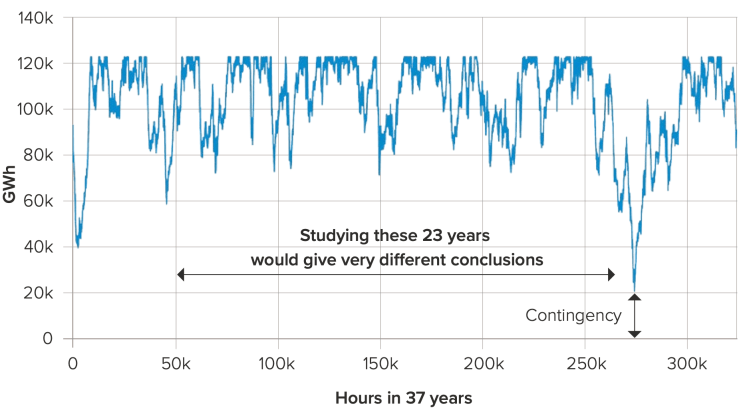
The authors describe the situation as follows (page 31):
Figure 13 exhibits two striking features. First, a study of the 23 years 1984 – 2006 would have found a storage volume very much smaller than found by studying 1980 – 2016. Second, there is a very large call on storage in the period 2009 – 2011 which reflects persistently low wind speeds that lead to the large deficits seen in figure 2 (some of the energy that fills these deficits would have been in the store since 1980). These features reinforce the conclusion that it would be prudent to add contingency against prolonged periods of very low supply and the possible greater clustering of 2009 to 2011-like years.
As a result of observations like this, the authors, I think correctly, conclude that batteries are completely out of the question to solve this problem. The only storage medium that could conceivably work would be a combustible chemical substance that can be put in massive underground facilities for decades. Only two possibilities are out there — hydrogen and ammonia. And ammonia is far more expensive and far more dangerous. So that leaves hydrogen.
Since hydrogen is the one and only possible solution to the storage problem, the authors proceed to a lengthy consideration of what the future wind/solar/hydrogen electricity system will look like. There will be massive electroayzers to get hydrogen from the sea. Salt deposits will be chemically dissolved to create vast underground caverns to store the hydrogen. Hydrogen will be transported to these vast caverns and stored there for years and decades, then transported to power plants to burn when needed. A fleet of power plants will burn the hydrogen when called upon to do so, although admittedly they may be idle most of the time, maybe even 90% of the time; but for a pinch, there must be sufficient thermal hydrogen-burning plants to supply the whole of peak demand when needed.
I find the treatment of the potential cost of all of this to be totally inadequate. There is never a mention of the most relevant subject, which is how much electricity prices to consumers might increase. The closest thing I find is this chart on page 32:
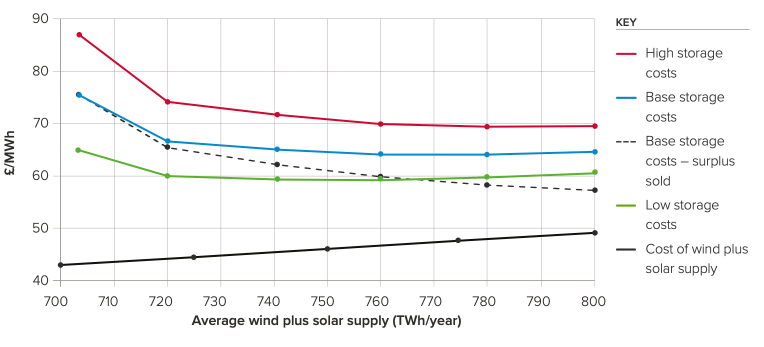
This is cost “to the grid,” thus wholesale cost. Will there be a huge multiplication of final price to the consumer? At first glance this doesn’t look too bad. About 50 pounds/MWh for the wind/solar input, and then 60-70 pounds/MWh for the storage makes about 110-120 pounds/MWh total. Add about 33% to convert to dollars, and you would have about $143-156/MWh, or 14.3 to 15.6 cents per kWh. It’s high, but not completely in the stratosphere.
But wait a minute. Are these guys leaving anything out?
-
How about the new network of pipelines to transport the hydrogen all over the place?
-
How about the entire new fleet of thermal power plants, capable of burning 100% hydrogen, and sufficient to meet 100% of peak demand when it’s night and the wind isn’t blowing.
-
They use a 5% interest rate for capital costs. That’s too low by at least half — should be 10% or more.
-
And can they really build all the wind turbines and solar panels and electroayzers they are talking about at the prices they are projecting?
The whole thing just cries out for a demonstration project to prove feasibility and cost. I’m betting that that will never occur before the whole “net zero” thing falls apart from the disaster of skyrocketing electricity prices. Time will tell.
Britain is Leading the World in Committing Economic Suicide
BY DAVID CRAIG | THE DAILY SCEPTIC | SEPTEMBER 29, 2023
As our leaders bicker over how fast Britain should get to Net Zero, you’ll hear politicians, eco-zealots and media pundits claiming that Britain is leading the world in reducing our country’s CO2 emissions. This is one of the few statements about climate made by our ruling elites which does actually appear to be true. Since 1990, Britain’s CO2 emissions have almost halved from 604 million metric tons to just under 350 million tons by 2022. That equates to a drop from 10 metric tons per capita in 1990 to below five tons per capita:
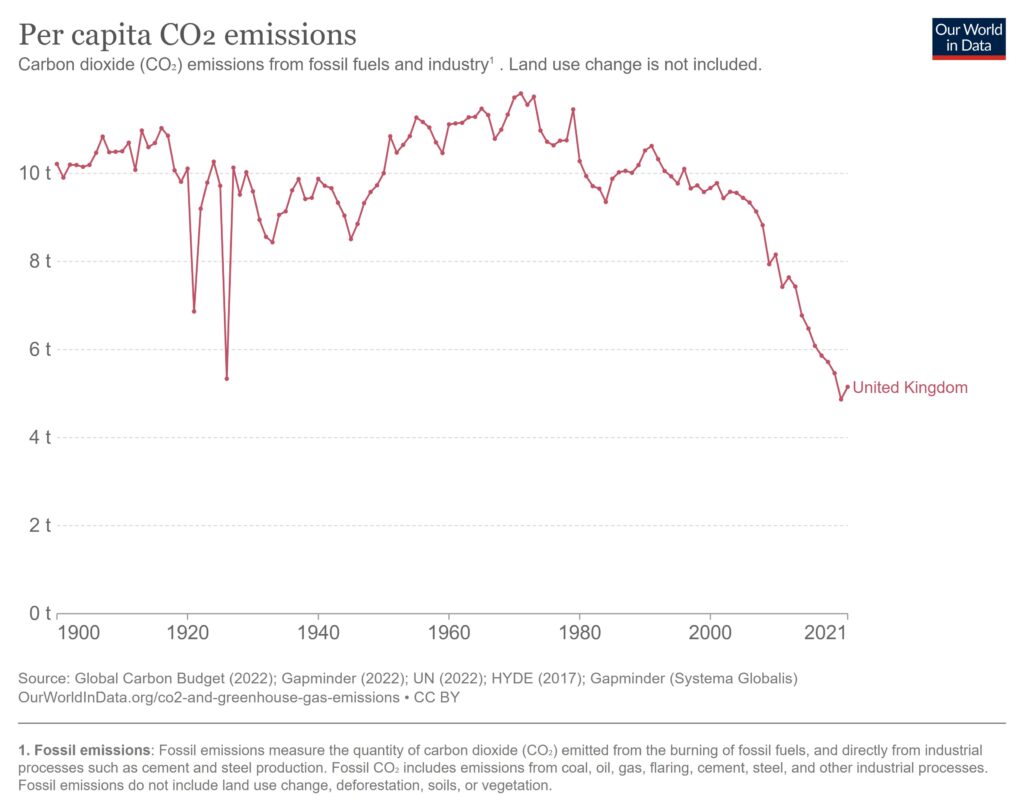
While celebrating this great supposed ‘success’, our politicians, media and eco-activists often seem less keen to explain how this reduction in CO2 emissions was achieved.
Here’s another chart. It shows the share of the U.K.’s GDP made up by manufacturing:
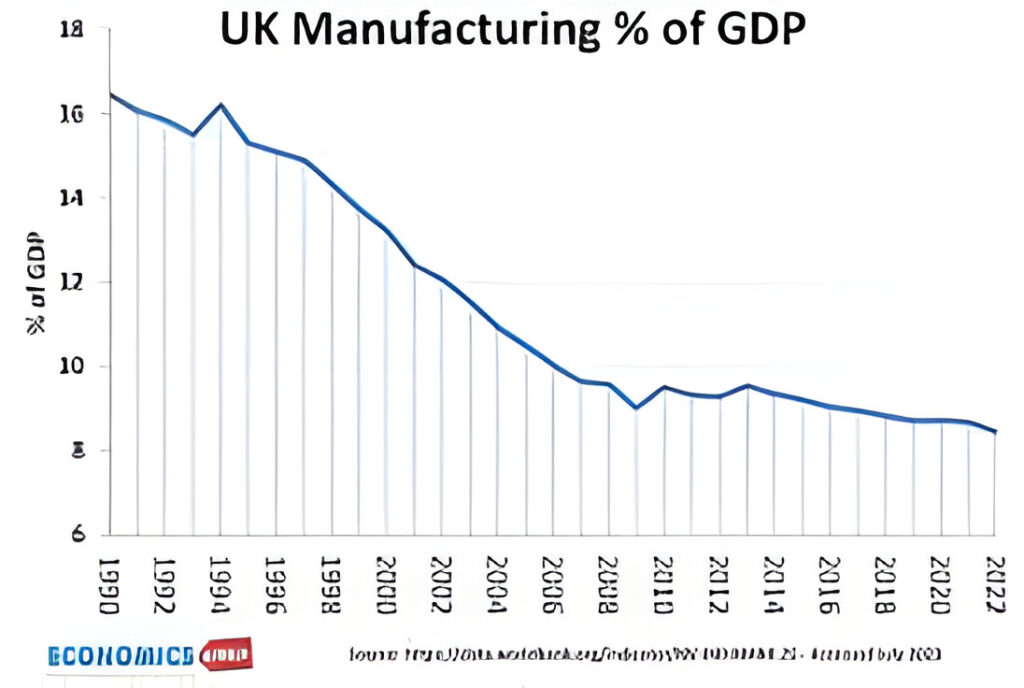
Since 1990, the year U.K. CO2 emissions started falling, the percentage of U.K. GDP from manufacturing has also halved from just over 16% to around 8%.
Moreover, during the same period, the number of people employed in U.K. manufacturing has dropped from 4,963,000 to just 2,601,000. A cynic mighty be tempted to wonder what happened to all those hundreds of thousands of highly-skilled, highly-paid green jobs that our rulers promised us would be created in Britain by the energy transition away from fossil fuels to renewables.
For years the U.K. has had some of the world’s highest energy prices due to our replacement of cheap, reliable fossil fuels with expensive, unreliable and intermittent supposed ‘renewables’. In 2022, in the U.K., which gets only 42% of its electricity from fossil fuels, household energy cost $0.41/kWh. In France, where 70% of its electricity comes from cheap, reliable nuclear, electricity costs were just $0.21/kWh – almost half the U.K. price. In the U.S., which generates about 60% of its energy from fossil fuels, the price was $0.18/kWh – less than half the U.K.’s cost. In China, where 55% of electricity comes from coal and a total of 83% comes from fossil fuels, household electricity costs are only $0.08/kWh – a quarter of the U.K.’s cost. There is a similar picture in India, where over 75% of electricity generation is from fossil fuels, of which three quarters comes from cheap, energy-rich coal, household energy costs only $0.07/kWh – a sixth of the U.K. cost.
So, just to put all of this into context, we can look at how much of the U.K.’s GDP comes from manufacturing – making real things that people in Britain and abroad want to buy – compared to our major competitors. In 2022, 8% of the U.K.’s GDP came from manufacturing compared to 9% for France, 12% for the U.S.A., 13% for India, 14% for Italy, 18% for Germany and a massive 28% for China.
A picture is emerging which suggests that the more a country relies on renewables for its electricity, the higher are its energy costs and the lower is the percentage of its GDP made up by manufacturing.
Economist Richard Salsman wrote: “The science of economics is clear: the production of money and debt is not equivalent to the production of real wealth. To claim otherwise is to follow fantasy, not reality – or science.”
As we in Britain enthusiastically print money and increase national debt in pursuit of our Net Zero goals, we seem to be wrecking U.K. manufacturing with high energy prices thus committing economic suicide as U.K. manufacturing moves to countries with lower energy costs. It’s more than astonishing that not a single one of our politicians and media supposed ‘experts’ seem to understand or are willing to admit what is actually happening and how the U.K. is committing an extraordinary act of self-mutilation by cutting the country’s CO2 emissions.
If there really was a climate crisis, the U.K.’s economic suicide to supposedly save the planet might be justified. But as I try to explain in my most recent book There is No Climate Crisis, there is no emergency that warrants such extreme actions. Yes, the Earth has probably warmed up a little since the freezing 1960s and 1970s when many experts were panicking about global cooling and the advent of a new ice age, which experts predicted would cause crop failures, mass starvation, the migration of millions from the cooling North towards warmer countries and wars over scarce food supplies. But this warming is just part of a natural cycle of warming and cooling driven mainly by the Earth’s rotation, solar activity and cloud cover. Moreover, the ice caps aren’t melting, in spite of the Guardian and the New York Times regularly predicting their demise. The polar bears are doing fine. In fact there may be so many of them that they may have difficulty finding sufficient food. The Great Barrier Reef has record levels of coral. Around five times as much U.S. forest burned each year in the scorching hot 1920s and 1930s as is burnt now. Even the IPCC (Intergovernmental Panel on Climate Change) admits that there has been no acceleration in sea level rise for the last 100 years. And the number of people killed by extreme weather events has fallen by over 95% in the last 120 or so years in spite of the world’s population quadrupling from under two billion in 1900 to almost eight billion now.
It’s a pity that those dragging us towards their Net Zero nirvana aren’t a bit more forthcoming about the economic devastation that their deluded policies are inflicting upon us.
David Craig is the author of There is No Climate Crisis, available as an e-book or paperback from Amazon.
MRNA vaccines must be banned once and for all
By Angus Dalgleish | TCW Defending Freedom | September 29, 2023
Those of us who knew from the beginning that the sequence of CoV-SARS-2 contained inserts which could not have possibly occurred naturally, and were similar to ones that had already been published from the Wuhan laboratory, have had to endure unbelievable scorn, scientific ostracism and the ignominy of being ‘cancelled’ by the MSM as well as by professional colleagues for nearly three years now.
In the summer of 2020 a paper I co-authored, describing the findings of an Anglo-Norwegian team of scientists who had demonstrated unique ‘fingerprints’ of laboratory manipulation in the Covid virus, was suppressed in both the US and UK. This was at the time that the World Health Organization, leading science journals and others were going to huge lengths to persuade us that Covid was a natural occurrence, and that we should spend a lot more money to fight any such future threats.
Only now does the Telegraph (uncritically) report that the US government is no longer going to fund the research it denied doing for nearly three years and the MSM sat on. Yet it has been an open secret for anyone who follows primary sources of information (the ones ignored by the MSM and the BBC specifically, reported as misinformation by Ofcom and targeted by the Orwellian Counter-Disinformation Cell of the UK government) that mRNA vaccines did not do what it says on the vial, as it were.
First the ‘vaccine’ did not stay at the site of injection as promised but travelled throughout the body and were found at post-mortems to be everywhere.
Accusations of dramatic variations in batch-to-batch variability – an absolute ‘no no’ in vaccine manufacture protocols – which could explain why side effects were more common in some batches than others were denied but were borne out by definitive Danish research reported here. These alarming concerns seem to have been brushed off by the regulators when they should have immediately begun investigating them in depth.
All the while the regulatory authorities and politicians, parroting their ‘highest standards’ assurances, have repeatedly declared the mounting disturbing UK Yellow Card and US VAERS adverse event reports to be nothing to be worried about.
Last June, whistleblowers led by the scientists Sucharit Bhakdi and Kevin McKernan raised an entirely new issue of concern – that of serious levels of DNA contamination. Once again this was ignored by the MSM. Though quite happy to report the odd side effect from the vaccines as an excuse to point out that they are extremely rare, they have never addressed the increasingly problematic official ‘safe and effective’ mantra.
Finally there was a small breakthrough. An isolated but braver branch of the MSM in the form of the Spectator Australia has finally blown the lid on serious levels of contamination of both Pfizer and Moderna mRNA Covid vaccines. The article describes how the genomics scientist Kevin McKernan from Boston used Pfizer and Moderna vials as controls in a study only to find that they contained highly significant DNA plasmid contamination. It reports that McKernan was alarmed to find the presence of an SV40 promoter in the Pfizer vaccine vials, a sequence that is ‘used to drive DNA into the nucleus, especially in gene therapies’ and that this is ‘something that regulatory agencies around the world have specifically said is not possible with the mRNA vaccines’. These SV40 promoters are also well recognised as being oncogenic or cancer-inducing.
Others have confirmed these findings. A German biologist whistleblower has found contamination rates of up to 354 times the recommended limit. All this has been reported to the US Food and Drug Administration (FDA). It is highly significant.
To put it bluntly, this means that they are not vaccines at all but Genetically Modified Organisms that should have been subject to totally different regulatory conditions and certainly not be classed as vaccines. This has been recognised by the Australian version of the FDA, the TGA, which has changed the picture so much that the Premier of Victoria Dan Andrews, who was the greatest proponent of the vaccine and of its mandatory use, has resigned – though at the time of writing the vaccine has not been mentioned as the reason for his resignation. (Paula Jardine reported in these pages in December 2021 on this regulatory sleight of hand in granting vaccine Emergency Use Authorisations for what were gene therapies.)
All this data, which is slowly breaking through into the public domain, comes hard on the heels of the latest findings that booster vaccines actually increase the chance of getting infected by 3.6 times. This is according to an in-depth study published by the Cleveland Clinic, one of the largest health care organisations in the world, who monitored their staff as well as patients.
It gets worse. Supporters of this technology have claimed that it can be adapted to chase new variants. But it can’t. The results of bivalent vaccines (with components against at least two variants) are seeing the same result. Authors of the Cleveland study say that ‘there is not a single study that has shown that the Covid-19 bivalent vaccine protects against severe disease or death caused by the XBB lineages of the Omicron variant. At least one prior study has failed to find a protective effect of the bivalent vaccine against the XBB lineages of SARS-CoV-2.’
In one study, all bivalent-vaccinated mice which were challenged with Covid became ill.
This was predicted by many of us as the SARS viruses are subject to immunological imprinting: that is, once they have seen a vaccine they will make the same response to any close variant (this is also known as ‘antigenic sin‘) making further vaccines not only useless but more dangerous as they induce antibodies that enhance infection (ADE antibodies), not cross reactivity as has been claimed by the manufacturers.
This is not the end of the issues with the mRNA ‘vaccines’. Several immunology studies have shown that the boosters induce an antibody switch from neutralising subtypes to tolerising subtypes as well as inducing significant T cell suppression, all of which will encourage new infections and suppress the immune response to cancer.
At the end of last year I reported that I was seeing melanoma patients who had been stable for years relapse after their first booster (their third injection). I was told it was merely a coincidence and to keep quiet about it, but it became impossible to do so. The number of my patients affected has been rising ever since. I saw two more cases of cancer relapse post booster vaccination in my patients just this last week.
Other oncologists have contacted me from all over the world including from Australia and the US. The consensus is that it is no longer confined to melanoma but that increased incidence of lymphomas, leukaemias and kidney cancers is being seen after booster injections. Additionally my colorectal cancer colleagues report an epidemic of explosive cancers (those presenting with multiple metastatic spread in the liver and elsewhere). All these cancers are occurring (with very few exceptions) in patients who have been forced to have a Covid booster whether they were keen or not, for many so they could travel.
So why are these cancers occurring? T cell suppression was my first likely explanation given that immunotherapy is so effective in these cancers. However we must also now consider DNA plasmid and SV40 integration in promoting cancer development, a feature made even more concerning by reports that mRNA spike protein binds p53 and other cancer suppressor genes. It is very clear and very frightening that these vaccines have several elements to cause a perfect storm in cancer development in those patients lucky enough to have avoided heart attacks, clots, strokes, autoimmune diseases and other common adverse reactions to the Covid vaccines.
To advise booster vaccines, as is the current case, is no more and no less than medical incompetence; to continue to do so with the above information is medical negligence which can carry a custodial sentence.
No ifs or buts any longer. All mRNA vaccines must be halted and banned now.
MHRA Finally Admits it Failed to Test the Safety of Mass Manufactured Covid Vaccine Batches
UK’s medicines regulator comes clean
By JJ Starky| The Stark Naked Brief | September 28, 2023
On December 8th, 2020, June Raine, the Head of the Medicines and Healthcare products Regulatory Agency (MHRA), publicly declared that “no corners have been cut” during the temporary authorisation of the Pfizer Covid vaccine. However, thanks to the persistence of former Ministry of Defence employee, Nick Hunt, recent findings prove Raine’s statement was not true.
For context, it’s common in development trials across various sectors to first use products made in small-scale facilities or laboratories. Investing in mass production usually comes later, once there’s sufficient confidence in the product’s design. Scaling up, naturally, introduces new risks.
With pharmaceuticals, regulations are in place to manage this process. This is to ensure the final product remains consistent and effective.
Concerns first arose in 2022 regarding the Pfizer Covid vaccine. There were suspicions that the vaccine MHRA approved in December 2020, manufactured using “Process 2”, differs from the version tested in Pfizer’s clinical trials, manufactured using “Process 1”. Josh Guetzkow, an Israeli academic, brought the difference to light, referencing Freedom of Information requests from various countries and Pfizer documents released by U.S. courts.
In May 2023, he published this rapid response in the British Medical Journal alongside Professor Retsef Levi, airing his concerns.
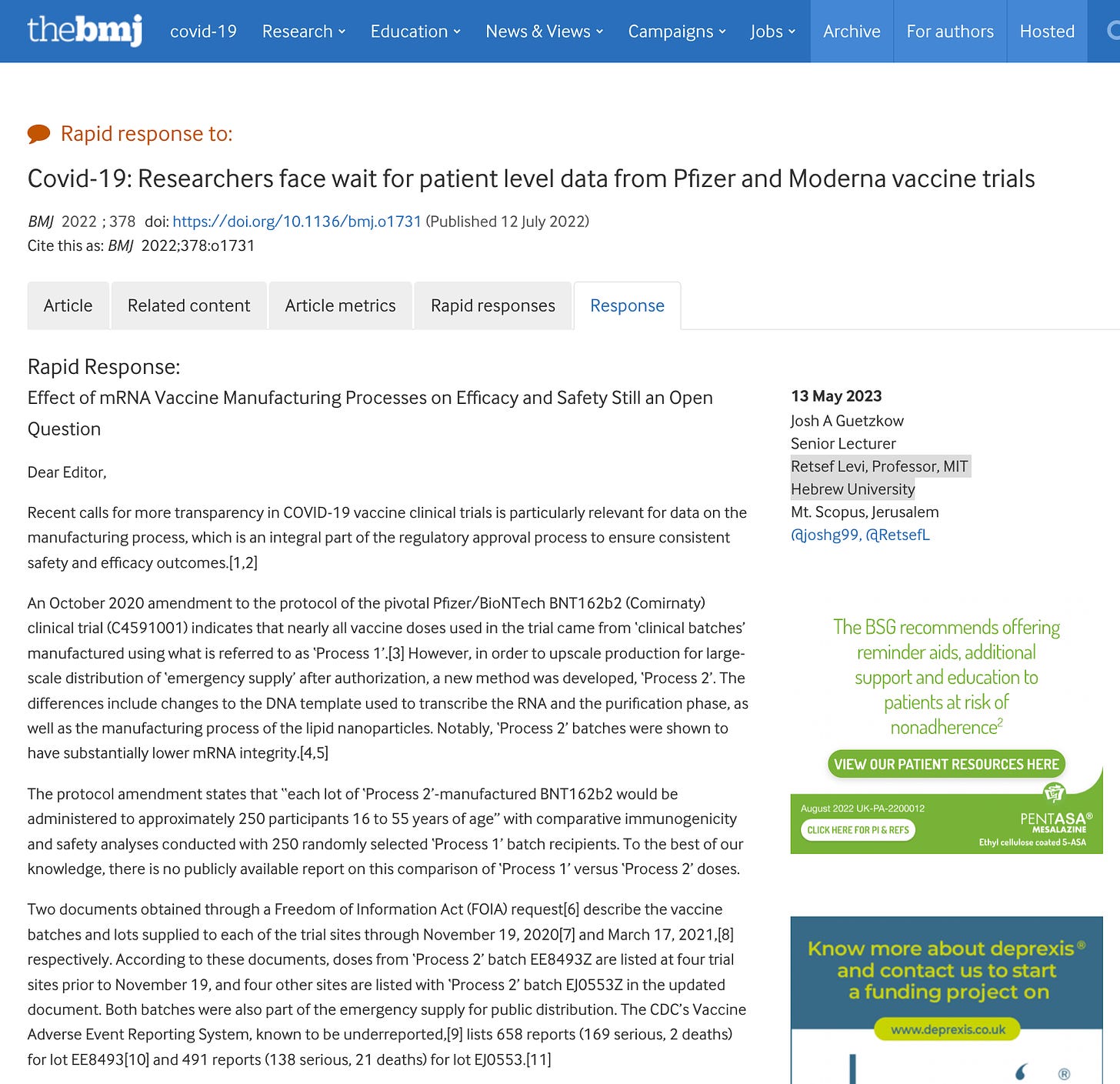
Guetzkow highlighted two things. First, there is a lack of publicly available reports comparing vaccines produced by both processes. Second, there is significant variability in the rate of serious adverse events across different vaccine lots, underscoring the need to better understand variability in the production process.
In October 2020, Pfizer had committed to comparing safety and immunogenicity results between vaccines produced by both processes. Yet, when Hunt submitted his initial FOI request concerning the latter to MHRA in July, their initial response directed him to the European Medicine Agency’s archive without specific guidance.
Here’s the bombshell.
Nick then requested an internal review. In their response, MHRA admit their replies “were not compliant with the (FOI) Act and did not provide or address the specific information (Nick) asked for”.
They then confess they do not possess the “Process 2” report.
The document goes on to state the “Process 2 drug… was shown to be comparable through side-by-side comparability studies and heightened characterisation testing”. In short, trust us, we’ve seen the data but we can’t show it to you and we don’t have it.
Worse yet, MHRA also revealed they failed to chase Pfizer on the promised report that the company should have published comparing the products. This was because of the “extensive usage of vaccines manufactured via Process 2”.
NATO’s 77th Brigade’s Set Their Legal Attack Dogs on Russell Brand
By Declan Hayes | Strategic Culture Foundation | September 29, 2023
Not content with conspiring with the British Parliament in throttling Russell Brand’s voice, NATO has set the entire British legal establishment against him.
Victoria Prentis KC, Britain’s attorney general, has warned the nation’s editors that any pertinent coverage about either Russell Brand or any criminal case that may be taken against him “may amount to contempt”, even though no arrests have yet taken place or cautions to Brand issued and no warrants have yet been issued against him. Legally, even in NATO’s corrupt British heartland, Brand should be free as a bird to go about his business, as should we be to make reasonable comments about him.
That is not now the case. Having been traduced at the behest of the 77th Brigade by the British media, Prentis has now decreed that any salient comments on Brand’s as yet non-existing case is in contempt of court, despite the fact that Brand has not yet got his day in court and no jury of his peers has yet been appointed to adjudicate on the case which, to repeat, as of yet does not exist.
Although the British Contempt of Court Act 1981 makes it illegal for newspapers to publish anything that could prejudice a criminal trial once a suspect has been arrested or a warrant issued, because this is Perfidious Albion we are talking about, laws exist to shut everyone up with or without either a bullet or a judge’s gavel.
As those rarely used laws are now being deployed against Brand, one must wonder why Brand is being singled out for this treatment and why, for example, political prisoner Julian Assange, currently being interned in Belmarsh high security prison, has been spared this further cudgel.
Writing in, of all places, the lifestyle section of Ireland’s regional Cork Examiner newspaper, reformed alcoholic Suzanne Harrington puts NATO’s case as well as any other randomly hired NATO scribe could. Suzanne begins by telling us that she feels “a crushing sense of weariness. Exhaustion, disgust. Fury, obviously, but smothered in a heavy blanket of disillusionment” and asks if we feel the same way about how Brand has betrayed us all.
Suzanne was one of those who went to hear Brand “speak in 12 step meetings.” But now, there is Brand’s “slide to the right. The alt-right. The yoga-Nazi alliance, heightened during lockdown when the entire world went a bit mad. What on earth? Conspiracy theories, rants, dubious company. It felt like he’d started smoking crack again — loony right wing crack, in the company of loony right wing crackheads. Globalist masterplans, great resets, Bill Gates, ivermectin — why? For the clicks? For the millions of followers? Because that’s how you make money away from the mainstream media. You dog-whistle the loonies.”
Although non-loony Suzanne opines there may be an off chance Brand is innocent (of what precisely?), she goes on to say “you only have to look at those who have come out in Brand’s support to see where he has positioned himself politically. He’s way over there, at the extreme toxic end, supported by the shrill voices of Elon Musk, Jordan Peterson, Tucker Carlson, and — oh the shame — Donald Trump Jr. Lower down the rung, voices of hate speechers like Alex Jones, Katie Hopkins, and Tommy Robinson. Sad gits like Laurence Fox. And Piers Morgan, obviously. Imagine having that lot standing up for you.”
One of the reasons such “voices of hate speechers” may be amplified in arrays of obscure corners is because the lifestyle columns of the Cork Examiner and the Irish Independent, Irish Times and the Guardian where this “journalist, TEFL teacher, dole claimer, backpacker, youth worker, painter, wardrobe assistant, washer-upper, pen pusher, house cleaner, comic bagger, market stall holder and cake maker” also opines bring no light to this or any other matter.
And that is not primarily the fault of “mainstream media” grifters like Suzanne but of newspaper proprietors like Rupert Murdoch, who have been destroying the quality of the broadsheets ever since the Sunday Times Insight Team was first eviscerated almost 50 years ago.
But what would I know as I am only a potato eating Irish peasant, who aced Australian legal exams experienced Australian lawyers failed. Not much but I do know this. There are times, as in the notorious Stephen Lawrence murder case or the gangland killing of Irish journalist Veronica Guerin when the media sailed as close to the libel law winds as is possible. And let’s not forget ageing mega pop star Cliff Richard, who was witch hunted by the 77th Brigade’s BBC in a manner that would have appalled even the lynch mobs of America’s Wild West.
And nor should we forget the Bloody Sunday Widgery Tribunal, the Ballymurphy massacre, King Rat, Robin the Jackal Johnson, the Glenanne Gang, the Pat Finucane murder, Stakeknife, the sabotaged Stalker Enquiry, the ongoing 1981 Stardust Inquest and countless more where the entire British and Irish judiciary should be in the dock if not on the gallows.
And then there is this nonsense of a jury of one’s peers, which the great Zsa Zsa Gabor once famously ridiculed. Although NATO’s Parliamentarians are generally exempted from jury service, most of them would be debarred anyway. As over 40% of serving British MPs have criminal convictions and as not one of them has been demonetised as Brand has, one must conclude that the 77th Brigade has one law for those who slavishly collaborate with it and another for the Russell Brands of this world.
And how could we get a jury of our peers from the Nazi worshipping Parliament of Canada, whose dictator, Justin Blackface Trudeau, lies that the standing ovation the Canadian Parliament gave a decorated Waffen SS war criminal is a result of the old reliable Russian disinformation canard. Just what kind of high heel wearing moron is Trudeau?
And what about the moronic Ya’ara Saks, Canada’s clearly unhinged “Jewish” Minister for Mental Health, who tried to distance herself from her collusion in welcoming the Waffen SS to the Canadian Parliament on the eve of the Jewish Yom Kippur holiday before finishing her grovelling non-apology with the Nazi Azov Slava Ukraini salutation. This, incidentally, is the same “Jewish” moron who contended that Canadian Freedom Convoy truckers honking their horns were doing so in secret tribute to Hitler, whose Waffen SS volunteers she gladly venerated.
There is, in intellectual terms, no difference between those Nazi worshipping Canadian Parliamentarians and the hundreds of Germans who gather at Berlin train stations and howl up to the moon for their right to live their lives as “Canine Beings”, as dogs and bitches in plain English.
Plain English, however, cuts no ice in the British courts where one must hire a word wizard, who is totally familiar with its rabbit warren array of quirks, which exist to perpetuate the King’s arbitrary, ad hoc writs. Here is one such barrister expertly talking us through common law contempt as it applies to the Brand (non-) case and cautioning those, like Britain’s newspaper editors who believe they have a dog in this fight or in any other such circumstance as the King’s 77th Brigade may decree is verboten.
The situation with regard to Brand is that the 77th Brigade, working primarily through Caroline Dinenage, has prejudiced Brand’s defence (against what precisely?) and has warned hosting companies like Rumble that, thanks to the Online Safety Bill and the (BBC-Approved) Trusted News Initiative, they are next for NATO’s abattoir.
Although NATO’s British media would claim that they used American journalist Heather Brooke to break their Parliamentary expenses scandal scoop, critics have opined that that was just a ploy to remove some troublesome Parliamentary pebbles from the jackboots of the 77th Brigade and their MI6 body in a bag colleagues. As Brooke disparages political prisoner (and truth-teller?) Julian Assange “a supposed campaigner for truth, manipulated information to build up a cult of personality around himself – and also to see how many people fell for it”, she would, a priori, seem a low level CIA cretin best avoided, lest she morally corrupts us.
But who is to judge her or Pfizer’s track record in Africa? Not us, if the 77th Brigade and their MI6 and CIA colleagues have their way. If you or anyone you know has an opinion on Russell Brand and if your opinion diverges from that the 77th Brigade enforces, you and any site like Rumble that might give you a platform best watch out as Trudeau and his high heeled Nazi worshipping collaborators are clumsily goose stepping their way to morally corrupt and physically destroy you, wherever you may be.
Crime and Impunity… One Year Lying About U.S.-Led NATO’s Nord Stream Terrorism Breeds More War
Strategic Culture Foundation | September 29, 2023
The sheer total impunity over the blowing up of the Nord Stream gas pipelines raises an appalling vista of the lawlessness and barbarity in today’s world.
The United States and its NATO accomplices are recklessly and callously pushing a war in Ukraine against Russia which has seen up to half a million Ukrainian soldiers slaughtered and is putting the world at risk of a nuclear conflagration. The criminal insanity stems from the lack of any legal accountability for the United States, which grotesquely declares itself the custodian of “rules-based order”.
One year ago this week, an outrageous crime against international peace was committed and yet the Western governments and media perform like the proverbial monkeys who incredibly refuse to see, hear or speak of any evil.
The profound moral and philosophical challenges are worthy of exploration in an epic novel akin to Dostoevsky’s classic Crime and Punishment.
But this is not fiction. They are cold facts of real life.
By far, the most credible explanation for the destruction of the Nord Stream pipelines is provided by the investigative reporting of veteran American journalist Seymour Hersh.
Many other independent observers concur with Hersh’s account that the gas pipelines under the Baltic Sea were blown up by a covert U.S. military operation in collusion with other NATO forces.
According to Hersh, the sabotage was ordered by President Joe Biden and his top White House aides.
The infrastructure intended to pump natural gas from Russia to Germany was owned by those two nations as well as several other European companies. It cost at least $20 billion to construct over a decade. On September 26, 2022, the pipes were rendered inoperable by a series of underwater explosions.
Biden had explicitly threatened in February 2022 to take out the gas pipes during a White House press conference accompanied by German Chancellor Olaf Scholz.
The motive for the Americans was to cut off Europe and Germany, in particular, from Russian energy fuel which was to be replaced by vastly more expensive U.S. exports of liquefied natural gas. Great for American business, absolutely detrimental for Europe, as the recession-hit European economies now attest.
The motive and means for carrying out the crime have been thoroughly described by Hersh and others.
And yet in an audacious act of collective denialism, the Western governments and media refuse to investigate this monumental crime. Official reports into the incident carried out by Denmark, Germany and Sweden have been suppressed with no conclusions published about the identity of the perpetrator.
Russia has been refused permission by European states to participate in a joint criminal investigation.
This week Moscow once again called on the United Nations Security Council to issue a condemnation of the sabotage and to launch an impartial probe into the extraordinary violation of international law. Previous appeals at the Security Council from Russia have been rebuffed by Western powers.
Laughably, Western media have feigned an agnosticism about the “mysterious explosions”. Such media have credulously indulged in blatant diversionary disinformation, for example, initially claiming that Russia carried out self-sabotage, and then later claiming that the sophisticated and highly complex military operation was the feat of “pro-Ukrainian militants” working off a yacht.
There is a pre-eminent reason for the Western silence. That is, to avoid the proverbial elephant in the room that this was a terrorist crime committed by the United States under the orders of its president.
To acknowledge this fact would of course bring the United States into fatal disrepute. It would be seen more than ever as a rogue terror state that presumes itself to be above the law.
Washington’s imperialist interests of dominating Europe and displacing Russia as an energy supplier are central to the reason for the war in Ukraine. This selfish and criminal agenda becomes evident if the Nord Stream act of terrorism is acknowledged and properly understood. The Western public would be up in arms over the false propaganda about the Ukraine war and the supposed “defense of democracy”.
Not only that but the European and NATO states would be seen as the criminal accomplices and pathetic vassals that they are. The United States sabotages European civilian infrastructure and the economies of its supposed allies – and yet those allies utter not a word of protest. Indeed, they have willingly and meekly participated in their self-harm.
German Chancellor Olaf Scholz and other European leaders should be prosecuted for complicity in international terrorism and treason against their national interests.
Ironically, this week, Joe Biden while in Arizona dared to tell American voters that they face a stark choice in the presidential elections coming next year. Biden said the choice would be for U.S. citizens to either “support democracy” under his continued leadership or “elect extremism” under Donald Trump or some other Republican candidate.
What could be more extreme than Biden ordering his military agencies to blow up gas pipelines owned by Russia and other European states?
The fact that Biden and the United States have been permitted to get away with the outrage of Nord Stream terrorism is why Washington and its NATO acolytes have continually escalated the proxy war in Ukraine against Russia over the past year.
The astounding impunity afforded to the U.S. and its NATO accomplices over the Nord Stream incident is consistent with the way these same imperialist powers have gotten away with mass murder and waging criminal wars for decades without any prosecutions. The U.S. establishment and its clandestine agencies are a criminal syndicate that also suffers from delusions of virtue.
Impunity breeds more criminality. The United States and its Western partners have rarely, if ever, been held to account for their historic crimes against the rest of the world. When such a transparent, brazen act of terrorism is perpetrated as in the Nord Stream sabotage and it is ignored then the world has shifted to an even more perilous situation where crimes have no punishment and even greater, more nefarious crimes can be engaged in.
The U.S. and its NATO henchmen, in particular Britain, are arming a Nazi regime in Kiev with tanks, cluster bombs, depleted uranium shells and longer-range missiles to strike Russia. The impunity that the Americans and their partners believe that they have acquired is shocking and hideous. There is no restraint.
For years, the NATO axis has been arming and training Nazi battalions in Ukraine to cynically take an imperialist war to Russia’s doorstep. Canada’s scandalous adulation of a Nazi war criminal in its parliament last week is a sign of the depraved times we live in. But we have reached this degeneration because, as the Nord Stream incident illustrates, the Western powers, primarily the executive American power, feel they are not just above the law but entitled to smash the law for whatever objective they deem desirable.
When those who profess to uphold the law, break the law, then there is no law. That is the frighteningly barbaric world we live in today.
Biden warned this week of fascism creeping up on the United States in the form of domestic political rivals. The reality is fascism, imperialist lawlessness and barbarity are already well-ensconced in this White House.
Media and Architects of Online Censorship Law Heap Pressure on Rumble After it Defends Principle of Neutrality
By Tom Parker | Reclaim The Net | September 25, 2023
Media outlets and architects of the UK’s censorship law, the Online Safety Bill, are increasing the pressure on neutral video sharing platform Rumble after it refused to bow down to the UK Parliament’s pressure to demonetize comedian Russell Brand.
The pressure to demonetize Brand came after anonymous sexual assault allegations were made against him. Brand has denied the allegations and has not been arrested, charged, or convicted of any of the allegations made against him.
Several companies, including YouTube, took action against Brand after the allegations surfaced, despite Brand having no content violations on YouTube. But Rumble stood up to the pressure and rejected the UK Parliament’s request to cut off Brand’s monetization, with CEO Chris Pavlovski noting that the allegations against Brand have “nothing to do with content on Rumble’s platform.”
Now, several media outlets and people who helped craft the UK’s online censorship law, the upcoming Online Safety Bill, are targeting Rumble’s stance.
Lord Allan of Hallam, a former Facebook executive who advised on the Online Safety Bill, branded Rumble a “crazy American platform” and expressed disdain at Rumble’s philosophy of allowing free expression.
He and internet law expert Professor Lorna Woods, an architect of the Online Safety Bill, also complained about Rumble’s refusal to bow down to pressure from UK officials and framed it as “grandstand[ing] before the press.”
The Times also took aim at Rumble by noting that under the Online Safety Bill, Rumble will have to “prevent children from seeing pornography… material that promotes self-harm, suicide or eating disorders… violent content… material harmful to health, such as vaccine misinformation” and “take down material that is illegal, such as videos that incite violence or race hate.”
However, Bryn Harris, the Chief Legal Council for The Free Speech Union, pointed out that The Times’ article doesn’t actually provide examples of any of the alleged illegal or harmful to kids content on Rumble.
Additionally, the Associated Press piled in on Rumble after it stood up to the demands of UK officials by claiming that Rumble is a “haven for disinformation and extremism.”
This mounting pressure comes days after the UK passed the Online Safety Bill — one of the most sweeping censorship laws to ever be introduced in the UK. The controversial censorship and surveillance bill is set to come into law next month.
The censorship provisions in the Online Safety Bill can be aimed at both citizens who post speech that’s deemed to cause “harm” and companies that fail to censor this so-called harmful content. The harms in the bill extend beyond physical or direct harm and into the realms of “psychological” harm and “potential” harm. Certain types of “false” communications are also prohibited under the bill.
As UK officials heap pressure on Rumble, reports have revealed that several UK politicians have ties to the pro-censorship Center for Countering Digital Hate (CCDH) and the UK politician that pressured Rumble to demonetize Brand received a donation in kind from Google.
Scotland To Set Up New Police Unit To Tackle “Hate” and “Misgendering,” Ignites Free Speech Concerns
By Christina Maas | Reclaim The Net | September 25, 2023
On the brink of implementing Humza Yousaf’s highly contentious legislation early next year, a specialized hate crime unit has been announced by Police Scotland. With the unit scheduled to be operational by November, a comprehensive training of about 16,400 law enforcement officers will follow in December.
This is all in anticipation of the Hate Crime and Public Order Act, expected to be ratified early in 2024. This Act expands upon the existing law, offering a broader protective net for “vulnerable” groups and introduces the notion of “stirring up hatred”.
However, some critics and free speech advocates have raised concerns that the Act, which holds potential to elevate sentencing if prejudice is based on factors such as age, race, disability, religion, transgender identity or variations in sex characteristics, may invigorate the increasingly toxic culture wars surrounding gender issues. It is posited that the law may sidetrack police resources from tackling violent conduct to address “harmful” words.
The thought of free speech being stifled by the new laws is particularly horrifying for some, with warnings that women’s rights advocates may find themselves entangled in allegations of transphobia.
Critics argue that a significant portion of police time may now be geared towards a subjective concept of hate crime, such as “misgendering,” instead of dealing with tangible violent acts.
Helen Joyce, part of the human rights group Sex Matters, asserted her alarm at the creation of this specific hate crime unit. She voiced concern for those who stand for the rights of women and children, warning of a “chilling effect” on free speech, as reported by The Scottish Express.
Police Scotland remains tight-lipped about the size of the proposed unit plus the financial implications of the new laws – a cause for concern for many.
Values Of Used EVs Plummet, As Dealers Stuck With Unsold Cars
By Paul Homewood | Not A Lot Of People Know That | Septmber 24, 2023
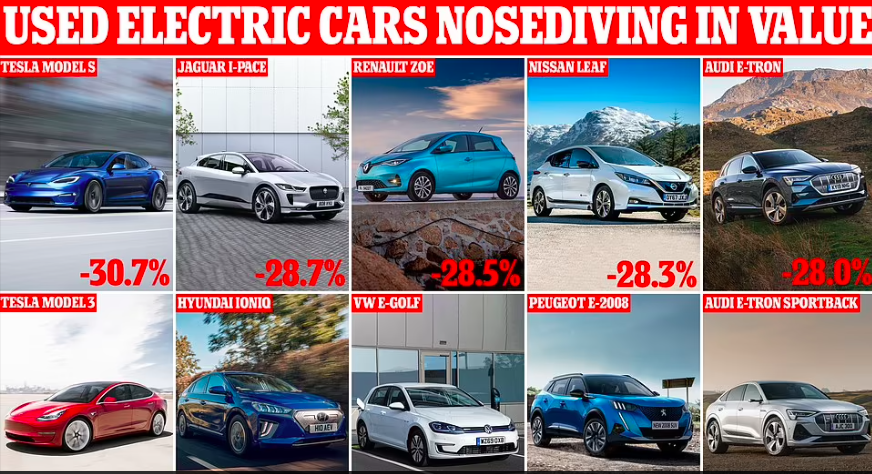
Research by online motor marketplace, AutoTrader, revealed the average price for a used EV has dropped by 21.4 per cent this month, compared to a year ago.
Marc Palmer, the head of strategy and insights at AutoTrader, told MailOnline : “The used market will now be slower to mature. There will be fewer new EVs registered and fewer used cars coming to market.
“There will be sections of the public, especially those who are sceptical, who will want to wait.”
The expert explained that used cars are the “biggest” section of the industry, however motorists are likely to “take longer” in the switch to electric.
According to the Mail :
Mid-month figures for September released by AutoTrader – the largest online marketplace for cars – reveal that the average price of a used EV has fallen by 21.4 per cent to £32,463.
Premium sector EVs, including Tesla, BMW, Mini and Mercedes-Benz, were hit hardest – with values falling by up to 24.1 per cent year-on-year.
The data, reported by The Times, showed that prices of second-hand premium sector EVs peaked at £51,704 last August and have since plummeted by more than £10,000 to £39,268.
The second hand EV is between a rock and a hard place!
Increasing numbers are now coming onto the market, corresponding to the increasing number of new sales in recent years.
Yet at the same time, there seems to be little appetite from buyers. Most new EVs go either to Business/Fleet purchasers, or rich, virtue signallers. Neither sector is interested in buying second hand EVs.
Private buyers of second hand cars cannot afford the inflated price of EVs – if they could, they would buy a new petrol car anyway. And they are less likely to have off street parking, therefore making charging more expensive and problematic. Hence the low turnover of second hand EVs.
EV manufacturers have taken a huge risk in offering cheap PCPs, in the hope attracting buyers. These deals are ultimately based on EVs holding their value well.
With plummeting second hand values, they and the lease companies could be facing massive losses.
What is remarkable about these reports is that the so-called experts seem genuinely surprised about all of this. It was utterly predictable all along.
One “expert”, Marc Palmer, the head of strategy and insights at AutoTrader, told the Mail that the used market will now be slower to mature, and that motorists are likely to “take longer” in the switch to electric.
And the SMMT said “A faster and fairer mass transition [to zero-emission vehicles] is threatened by the absence of support for private buyers, many of whom plan to go electric but are delaying due to concerns over affordability and uncertainty regarding the availability of a charging network.”
They have obviously been believing their own propaganda about EVs for too long.
They still do not seem to have worked out that EVs are utterly useless for most private drivers, who will refuse to make the switch until forced to.
Why are Ukrainian Flags Flying Over British Universities
Ukrainian flags over UK universities
Professor Dame Sally Mapstone
President
Universities UK
Woburn House
20 Tavistock Square
London WC1H 9HQ
11 September 2023
Dear Professor Mapstone
We have noted, with increasing concern, the practice of flying Ukraine flags above many universities across the United Kingdom. We are aware that UUK is a forum and does not direct the work of UK universities. Nevertheless, we wonder if the issue of Ukraine flag flying by UK universities has ever been discussed and, if it has not been discussed, if it should be.
In relation to this, we have several questions the first of which is ‘why?’ The conflict in Ukraine is not one in which our country is directly involved, although we are providing aid along with other western countries. However, we provide military aid to other regions of the world and have, until recently, been directly involved in military action in support of other countries. We do not recall at any time in our university careers having seen the flags of other nations being flown above any UK university. What is so unique about the conflict in Ukraine?
According to figures published by Clarivate in Research Professional News at the end of last year, there were 800 Ukrainian university students in the UK and over 3000 Russian students. Has anyone at UUK evaluated the consequences for the mental health and security of those Russian students? We are aware that not every Russian student will support their country’s military involvement in Ukraine; nevertheless, it could be alienating for them to see the Ukraine flag. How much more so for those Russian students who do support their country? It appears that they may have been judged and found guilty for merely being patriotic.
It is too easy to take sides, as many UK universities clearly have, in the conflict in Ukraine. That the immediate cause of the conflict is Russian’s invasion of a sovereign territory is indisputable. However, it also seems naïve, especially for seats of learning which exist to look beyond immediate facts, to analyse situations and to propose solutions, to make partisan displays of support.
As explained with meticulous supporting information in How The West Brought War to Ukraine by Benjamin Abelow, the roots of the conflict are deep. There are undeniably faults on both sides and some indisputably dangerous elements vying for position on both sides. Moreover, the west is not innocent in its ambitions regarding the region and courting NATO membership of Ukraine contrary to previous agreements with Russia about the status of countries on its borders, while ignoring overtures from Russia about NATO membership now seems very foolish. The presence of the Ukraine flag above UK universities defies these complexities.
We urge UUK to consider this matter and to urge its members to keep UK universities out of the conflict in Ukraine.
Yours sincerely
Professor Roger Watson
Honorary Professor
The University of Hull
Dr Niall McCrae
Workers of England Union
Featured Video

ARE PATIENTS BEING PROPERLY INFORMED ABOUT OZEMPIC?
or go to
Aletho News Archives – Video-Images
New Book
Breast Cancer: Before You Consent
A new Unbekoming paperback
Lies are Unbekoming | September 18, 2026
Peter Gøtzsche reviewed every randomised mammography screening trial ever conducted for the Cochrane Collaboration. Cochrane’s headline is that, assuming a 15% mortality reduction, one woman in 2000 avoids dying of breast cancer over ten years. Ten are overdiagnosed and treated. Two hundred experience false alarms.
But that headline assumes the reduction. When Gøtzsche looked only at the trials with adequate randomisation — the higher-quality ones — the reduction disappeared. No effect on breast cancer mortality. No effect on all-cause mortality.
This is the Cochrane finding, published in the establishment’s own database of systematic reviews.
No woman being asked to consent to a mammogram this week knows it.
That is why the new Unbekoming paperback exists. … continue
Blog Roll
 Aletho News
- The Truth About the Trump Shootings with Ken Silva
- ARE PATIENTS BEING PROPERLY INFORMED ABOUT OZEMPIC?
- US lawmaker blocks $2.8 billion weapons sale to Israel: Report
- Yemeni army claims responsibility for strikes on sensitive sites in Saudi capital, Aramco facilities in Yanbu
- Iran Judiciary issues indictments against 159 US, Israeli officials for assassination of Leader, commanders
- Turkiye revokes Iranian bank license under US sanctions campaign
- US-Denmark Agreement on Greenland Is ‘PR Stunt’ Ahead of Midterms
- Araghchi: Military intervention cannot create security; coercion cannot bring peace
- Fraud Squared
- Breast Cancer: Before You Consent
- If Americans Knew
- Inside Gaza’s death trap of collapsing, bombed-out buildings
- The everyday items Israel bans from Gaza every day
- Inside the siege, the ruined buildings of Gaza – Daily Update
- Debunking The Claim That Macklemore Has A “History Of Antisemitism”
- CPJ demands release of arrested Palestinian-US journalist near Bethlehem
- Robert Kraft: The Billionaire Friend of Netanyahu Pulling The Strings Behind the Macklemore/Ed Sheeran Blow Up
- Columbia Administered Fund Gives Big Money to Pro-Israel Groups
- Deportation Case of Palestinian Activist Salah Sarsour Tests First Amendment
- ‘We Will Not Forget’: Palestinians Mark 44 Years since Sabra and Shatila
- Why do we let Zionists decide what we can and can’t say?
- No Tricks Zone
- 2025 Nature Paper Claiming Worsening Global Drought Gets RETRACTED …Heavily Flawed
- New Study: ‘Global Drought Shows No Detectable Recent Acceleration Under Climate Warming’
- Economic Masterminds: German Socialists Suggest Taxing Productivity Gains Stemming From Using AI
- The South China Sea Has Not Been Cooperating With The Climate Change Narrative
- Energy Crisis: Germany Enters Heating Season With Historically Low Gas Reserve Fill Levels
- New Study: The Antarctic Ice Sheet Gained Mass From 2020-2024 Due To Staggering Snow And Ice Accumulation
- Study: Ocean Heating Rates From Thousands Of Years Ago ‘Dwarf’ Modern Ocean Heating Rates
- Climate Extremists Target, Attack Large-Scale Power Grid Infrastructure In Germany!
- New Study: Antarctic Ice Melt Has Contributed Less Than 1 Centimeter To Sea Level Rise In The Last 30 Years
- Fear Of Debate: Alarmist German Climate Scientist Calls On Mainstream Media To Discredit Skeptic Voices
 Aletho News