Canada Launches UN Declaration Pledging Restrictions On Online “Disinformation”
By Didi Rankovic | Reclaim The Net | September 22, 2023
A “global” declaration – that only manages to garner the support of 27 out of 193 UN member countries. How dreadfully humiliating – some might say.
But rest assured, Canada’s government will find a way to spin this abysmal result of its effort to use this year’s (likely, as ever, a waste of time and taxpayer money) UN General Assembly gathering in NYC to push some of its own agenda – or the agenda it’s tasked to push.
First, what is this yet another “global declaration” – and why has it failed so spectacularly? (The answer may in fact be the same.)
According to an announcement by the Canadian government, cited by the press, the purpose of the “global” declaration is to combat “disinformation.”
“Global Declaration on Information Integrity Online,” is what it’s called, and besides the “trusty” Canadians, the Dutch were also seemingly randomly thrown (an EU country, one or the other) into drafting it.
And look who was readily on the side, to sign it: the US, the UK, Germany, Australia, Japan, Korea, etc.
There are (not many, though) more countries here, but their alignment on “issues” was never in question; and now, instead of a UN General Assembly as a place of the meeting of the minds and meaningful discussions, we have it as a showdown for a world aligning into different, this time huge and truly global blocs, to showcase their different allegiances.
How dreadful – for world peace, going forward.
Meanwhile – what does the Canadian document that only managed a meager backing at the UN have in mind?
It’s “necessary and appropriate measures, including legislation, to address information integrity and platform governance.”
If any of us tried to make the Canadian proposal more ludicrously broad-worded than this is, I’m sure we’d not succeed. But there is an attempt to narrow the “declaration” down. If suitable, “we” go back to “international human rights law.”
So – those who sign the document will do so in a way that complies “with international human rights law.” (?)
Problem: a number of full-fledged UN members are saying, the very UN founding Charter really any longer means anything – having been broken by the likes of Canada, time and time again.
There’s other usual declarative tosh as you might see from these governments’ daily briefings – the only time they ever try to narrow down or clearly define any of the “definitions” is when they mention the tech they’d like to better control – such as ChatGTP.
Sunak’s Net Zero ‘U-turn’ – or is it?
By Ben Pile – September 20, 2023
Rishi Sunak’s ‘watering down’ of certain Net Zero targets is the first time that the green policy agenda has had ANY scrutiny of any consequence, despite many failures, starting with the ruinously expensive Renewable Obligation, extending into the totally failed CfDs that allowed wind farm developers to lie to achieve planning consent over rival generators and technologies. Not one part of the green policy agenda has lived up to any promise to deliver good to the British public.
It was the mildest possible reversal. It is in fact an attempt to SAVE Net Zero, not roll it back.
Complaints that it has left Britain without an ‘industrial policy’ or has left ‘investors’ without ‘confidence’ are for the birds. It has put the UK in the same policy position as the EU (more on which in a bit), and there is no evidence of green policies having delivered any significant industrial development to these shores. No green jobs. No green growth. No green industrial revolution. Not even a BritishVolt. It is a farce.
Politicians, who know nothing of the subject in fact, have been misled into believing that strong climate targets encourage domestic manufacturing. That is a lie. The main beneficiary of UK & EU climate laws has been China, of course, which benefits from cheaper energy prices (among other things) precisely because China does not have energy policies like ours. Strict targets are not industrial policy. Nobody was looking to develop ‘Gigafactories’ in the UK for the fact of the UK having the earliest ICE car sales ban. It’s a nonsense.
Sunak has taken stock of the simplest elements of green policy failure:
1. No politician has any clue how to realise Net Zero targets. To understand this, you need to drill down into the Climate Change Committee’s (CCC) advice to Parliament, and advice from wonks and academics to the CCC itself. They speak more candidly the deeper you investigate. The promises of upsides are simply lies. There are no drop-in replacements for the things that make our lifestyles today. That is why the CCC told Parliament that up to 62% of emissions reduction is going to come from ‘behaviour change’, which is to say that Net Zero requires government to use the criminal law and price mechanisms to regulate what people can do. That is what Sunak means when he says that previous governments have not been straight with the public. It is fact.
2. The green lobby has LONG promised lower prices and greater energy security but has failed to deliver. There have been many claims that the costs of wind power have fallen based on low ‘strike prices’ offered by wind farm developers since the Contracts for Difference (CfD) scheme was introduced in 2017. None of those miraculous strike prices have been achieved. The wind farm developers simply reneged on them. They were never going to take them up. They calculated that they would never have to. This came to crunch in the latest auction, when the government removed the wind farm operators’ ability to walk away from the contract — they called the wind sector’s bluff. No bids were offered. The major promise of renewable energy has been utterly debunked by the green lobby’s own actions.
3. Behind the scenes, the failure of both global and national climate policy has been known for a long time — since the Paris Agreement (PA) at the latest. The PA is not in fact a ‘global agreement’; it allows countries to determine their own commitment. And all that has done in turn is reignite the talking point that beset global climate policymaking in the 1990s and 2000s: the ‘free rider’ problem. Some emerging one-time ‘developing’ economies, are now booming, whereas much of the West/G7 is stagnant and facing deindustrialisation, precisely as critics of climate policy had argued, decades ago. This is why there has been so much emphasis since the PA on LOCAL government, such as LTNs/ULEZ/CAZs, using ‘air pollution’ as a proxy battle in the climate war. This was encouraged by central government, which accelerated this fake ‘localism’ during lockdowns by making large grants available to local authorities to restrict private car use. Sunak has seen the robust response to this in London, in Wales, and in cities that have adopted them, and has realised that the public has been setting down its own red lines. The green agenda is now visible to all and politically toxic.
4. Despite claims that other countries are steaming ahead with boiler bans, car bans, heat pumps, and championing Net Zero policies, especially in Europe, they are in fact creating deep schisms between and within EU member states. Auto manufacturers in Germany are warning that they cannot compete with Chinese rivals. Germany, struggling to find energy, itself is racing towards deindustrialisation, threatening the economic foundations of the Union. Its boiler ban, advanced by psychopathic Greens threatens to destabilise its own political centre of gravity, with a huge surge of interest in the AfD, now biting on the heels of the CDU in the polls. This risks not only the destabilisation of Europe, but geopolitical schism that could ultimately undermine NATO. Poland is pushing back against EU climate targets. The Netherlands, having overextended its green agenda looks set to oust its political establishment at the November election following the growth of the BBB movement, and the even newer New Social Contract party. There is the obvious polarisation of French politics, which needs no repetition here. And there is the case of Sweden’s new right-of-centre government abandoning its Net Zero targets in favour of a technology-first approach. Sunak can see all this green policy failure *everywhere* that green blobbers point to, while claiming such chaos is success.
5. ESG is failing. Former BoE governor Mark Carney, who just this week ranted against Liz Truss, disgraced his former office. Carney was appointed by Johnson to lead the The Glasgow Financial Alliance for Net Zero (GFANZ), which claimed to have aligned financial institutions with $130 trillion AUM. Vanguard and BlackRock seem to be reversing out of the Alliance. And a number of major insurance firms, including Munich Re and Zurich too, have joined the backlash. And Sunak knows about markets.
6. Ukraine, Russia, and the realignment of geopolitics. Who really believes that Western diplomats now have any chance of bringing Russia, China, and India into the Net Zero suicide pact? The drawbridge is up. And the G20 meeting saw Modi humiliate the entire green movement. Sunak offered the climate fund £1.6 billion — roughly speaking a quid per Indian. And as many Indians said “What?!! We’re going to the Moon, mate!”
Sunak can see all of these problems. And none of them are going to be solved by banning petrol and diesel car sales in 2030, or by banning boilers. The world is a fundamentally different place now, post-Brexit, post-covid, post-Russia-Ukraine, after 15 years of Climate Change Act failures, and the deindustrialisation of the West. All that carrying on with Net Zero as usual is going to do is, far from strengthening Britain’s position on the ‘world stage’, is further undermine our economy and industries, and political stability. Nobody else, except countries facing equivalent problems, perhaps, cares about our degenerate political class’s ideological fantasies. Global climate policy is collapsing as global politics shifts, whereas the basis for the UK’s draconian domestic climate policy agenda was ALWAYS global political institutions: the EU & UN etc, not domestic popular support. It’s not 2008 any more. Neither the ROW nor the UK public are as tolerant of being pushed around. And utopian, technocratic, supranational political ambitions look like so much cynical build-back-better bullshit that simply do not wash.
The histrionics that are now the counterpoint to Sunaks mildest possible Net-Zero flip-flop are the chorus of an extremely small, but extremely noisy and over-indulged part of British society that has got far to used to not being slapped down by reality, and, like spoilt infants, they are determined to find the boundaries of their behaviour. They are utterly deranged by ideology, and incapable of allowing their claims to be tested by simple arithmetic. They speak glibly in the most superficial terms about things they know nothing about: how the world must be organised; how the entire economy will be powered; how ordinary people’s lives will be managed. They lie. They try to tell people that banning things and imposing expensive restrictions will make them better off, make them safer and ‘create jobs’. From bottomless bank accounts, they commission idiot wonks at remote think tanks to produce glossy ideological bunk.
Sunak could not have done less to correct this mess. But what he has done is a good thing. And it includes setting a trap for the eco-catastrophists. The more they howl and wail, the more they will expose their utter contempt for ordinary people. It is not in Sunak’s gift, even if he wanted it, to reverse the entire sorry policy agenda. Too much stands in his way. But every scream and tantrum from the blobbers will bring that possibility closer to him or a successor. Because no person with a functioning brain believes that banning the boiler later, rather than earlier, is a good thing. And so the blobbers are set to out themselves, for the duration of this controversy, as brainless ideological zombies. Long may it continue.
Iran’s top medical association blasts The Lancet for ‘spreading disinformation’
The Cradle | September 21, 2023
The president of the Academy of Medical Sciences of Iran, Dr. Alireza Marandi, on 18 September issued an open letter blasting renowned UK medical journal The Lancet for publishing “completely false information” about Iran’s healthcare system and the circumstances that led to the death of Mahsa Amini one year ago.
“We are very disappointed to see the republishing of completely false information about the Islamic Republic of Iran, especially regarding doctors and the health service delivery system, in a publication that is known as a scientific magazine,” Marandi writes in a letter addressed to The Lancet’s Editor-in-Chief, Professor Richard Horton.
Marandi says the article, published on the one-year anniversary of Amini’s death, “does not have any scientific documentation” and accuses the UK publication of getting involved in “material and political interests [by] writing such false reports.”
The article in question, penned by Horton, claims Amini “died in Kasra Hospital … after being arrested, tortured, and beaten” by the Gasht-e-Ershad, or Guidance Patrol, for the alleged improper wearing of the mandatory hijab.
“She was 22 years old and her murder, for that is what it was, triggered unprecedented nationwide protests,” Horton continues, alleging the mobilizations “continue in more muted forms to this day.”
Horton’s accusations are a word-for-word repetition of claims made by western governments, news agencies, and US-funded “human rights” groups since last year. These have, for the most part, ignored visual evidence that shows Amini calmly speaking with an officer before suddenly collapsing in the waiting room of a police station, as well as an autopsy report that concluded her death was caused by severe cerebral hypoxia aggravated by a pre-existing condition.
Nonetheless, eyewitnesses of her detention alleged she had been mistreated.
“As I wrote to you in the previous letter, if the accusations mentioned in that article were supposed to be based on science, they would at least been quoted from sources that are not so utterly hostile to our people and country,” Dr. Marandi writes in his letter to Horton, taking aim at several anti-government Iranian activists cited by the editor-in-chief of The Lancet.
“I wish you had for once exposed the enormous support of Western countries and the US for Saddam Hussein, who committed unique and historical crimes with chemical weapons against our people, including Iranian and Iraqi Kurds residing relatively close to where Mahsa Amini lived. All carried out amidst the deadly silence of western-dominated scientific and international bodies,” the letter continues.
The article by The Lancet last week came as part of a renewed anti-Iran campaign led by western media outlets and governments, which included new economic sanctions imposed on the Islamic Republic, some of which targeted news organizations.
Recent US efforts to spark unrest that could force regime change in Iran date back to the so-called “Green Revolution” in 2009.
MMR and threats to quarantine perfectly healthy children
A coercive scare story to increase vaccine uptake?
Health Advisory & Recovery Team | September 20, 2023
On 14th September BBC News reported London measles warning ‘Outbreak could hit tens of thousands’
Reading on, you discover this is based on our favourite dislocation from the real world: computer modelling.
‘Mathematical calculations suggest an outbreak could affect between 40,000 and 160,000 people… This is a theoretical risk, rather than saying we are already at the start of a huge measles outbreak. There have been 128 cases so far this year, compared with 54 in the whole of 2022.’
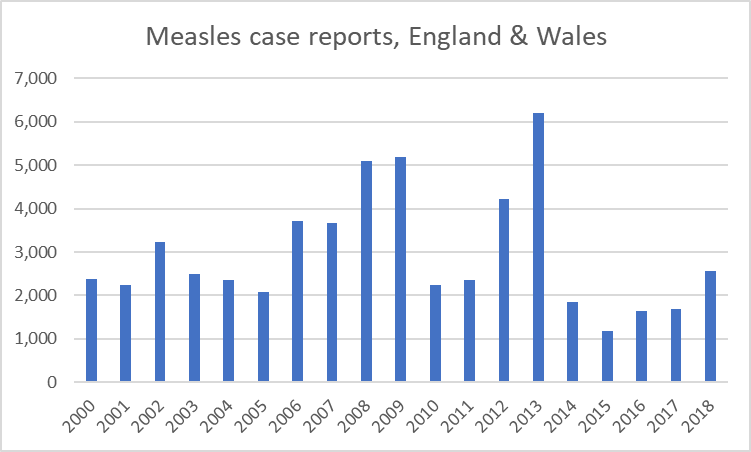
Theoretical is one word for their calculations, scare-mongering is another. Figures for the last 25 years vary widely with the highest being 2000 cases in 2012.
‘The UKHSA also says a large outbreak could put pressure on the NHS, with between 20% and 40% of infected people needing hospital care.’
Ring any PROTECT THE NHS bells?
But worse was to follow. On 15th September, it was reported:
‘Councils in London have written to households to say the capital could be facing a major outbreak unless MMR inoculation rates improve… Measles is highly contagious and severe cases can lead to disability and death… Any child identified as a close contact of a measles case without satisfactory vaccination status may be asked to self-isolate for up to 21 days.’
This threat of sending children home for a disease they don’t have, will resonate with parents whose children were repeatedly sent home for 10 days at a time, for one child with a positive covid test. As also will the inducement of:
‘Parents have been urged to check children’s health records to ensure that their vaccines are up to date.’
A ‘nudge’ technique not a million miles from the threat of vaccine passports for nightclubs, used to increase covid vaccine uptake in 18-25-year-olds but never actually implemented.
MMR vaccine uptake levels have been variable ever since its inception. Herd immunity levels of 95% are quoted as the level required to stop measles completely. But measles has never been a condition listed for total eradication. Cases fluctuate with mini outbreaks every 5-6 years and this was always the case before the availability of the measles and later the MMR vaccine. So how real is the current threat and how could it possibly justify such a discriminatory measure as excluding unvaccinated children from school?
From the headlines, parents may think that measles has a high death rate and whilst that was certainly true in the past and remains true in developing countries, improved nutrition and widespread access to health care in the UK was associated with a huge decline in measles deaths. The death rate declined from over 1,100 per million in the mid nineteenth century to a level of virtually zero by the mid-1960s.
Ninety-nine percent of the reduction in measles deaths in England & Wales occurred before the introduction of the measles vaccine in 1968 and deaths have continued to fall since then.
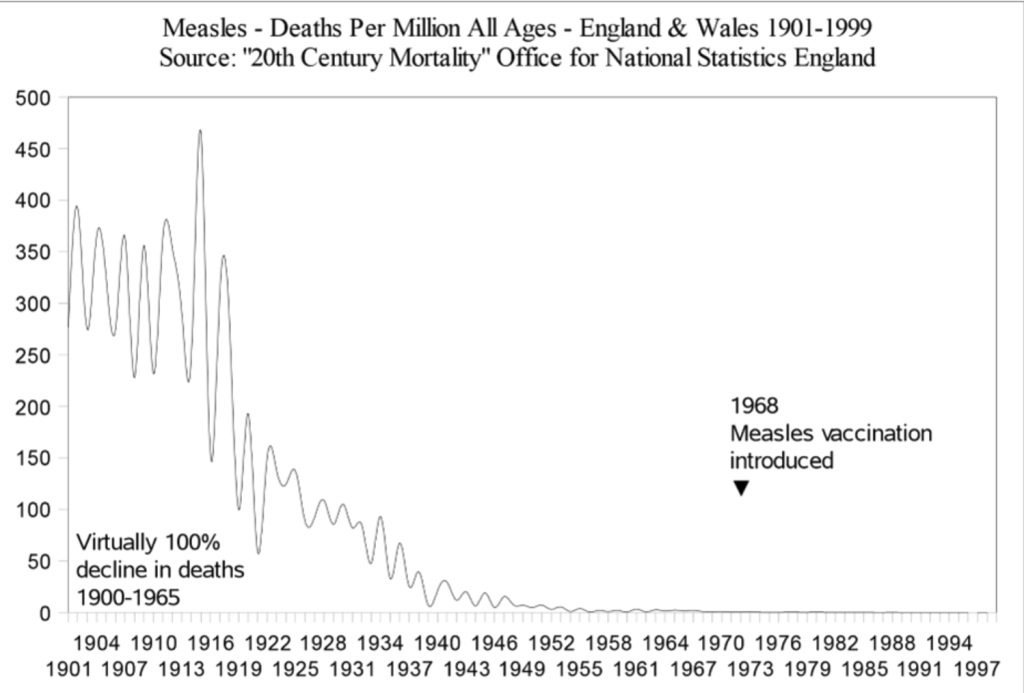
Figure 1 Twentieth Century Mortality CDROM Office for National Statistics. Measles mortality
More recent figures show case reports fluctuating widely and deaths of children from measles varying between 0 and 2 per annum. For example, in 2013 when there were over 6000 reported cases, there was 1 adult and 0 child deaths.
That is not to say that deaths cannot occur and other serious complications such as pneumonia or hearing loss. But for the vast majority of children, measles is what it was always described as, namely a ‘childhood illness’. It is noteworthy that WHO recommends
‘All children or adults with measles should receive two doses of vitamin A supplements, given 24 hours apart. This restores low vitamin A levels that occur even in well-nourished children. It can help prevent eye damage and blindness. Vitamin A supplements may also reduce the number of measles deaths.’
In a systematic review published in 2002, two doses of water based vitamin A were associated with a 81% reduction in risk of mortality (RR=0.19; 95% CI 0.02 to 0.85). Nowhere is this simple measure mentioned in UK guidance.
The parents who have chosen not to get their children vaccinated will accept the possibility of them catching measles, but sending them home for 3 weeks isn’t going to make this go away. A policy which writes in educational discrimination against unvaccinated children is hardly going to improve trust in public bodies. Moreover, the GMC Guidance on Decision making and Consent states in paragraph 48:
‘If you disagree with a patient’s choice of option: You must respect your patient’s right to decide. … you must not assume a patient lacks capacity simply because they make a decision that you consider unwise’
Introducing carrots and sticks is not compatible with NHS Constitution. The seven key principles includes the following:
1. The NHS provides a comprehensive service, available to all
4. The patient will be at the heart of everything the NHS does
Health choices should always be free from coercion and the failure to uptake whatever is on offer should never result in punitive consequences disguised as being ‘for your safety’.
Rumble Rejects UK Government’s Pressure to Demonetize Russell Brand Amidst Allegations
By Dan Frieth | Reclaim The Net | September 20, 2023
Amidst a growing controversy surrounding comedian Russell Brand, video platform Rumble has taken a stand against the UK government’s push to penalize the content creator based on recent allegations.
Last week, The Times and Channel 4’s Dispatches covered serious allegations of assault against Russell Brand. While the comedian has yet to be convicted of any wrongdoing and whether the anonymous accusers are victims is yet to be determined, several major platforms, including YouTube, Netflix, and BBC iPlayer, took swift action, either demonetizing or removing Brand’s content.
“We would be grateful if you could confirm whether Mr Brand is able to monetise his content, including his videos relating to the serious accusations against him. If so, we would like to know whether Rumble intends to join YouTube in suspending Mr Brand’s ability to earn money on the platform,” wrote Dame Caroline Dinenage, in the brazen letter.
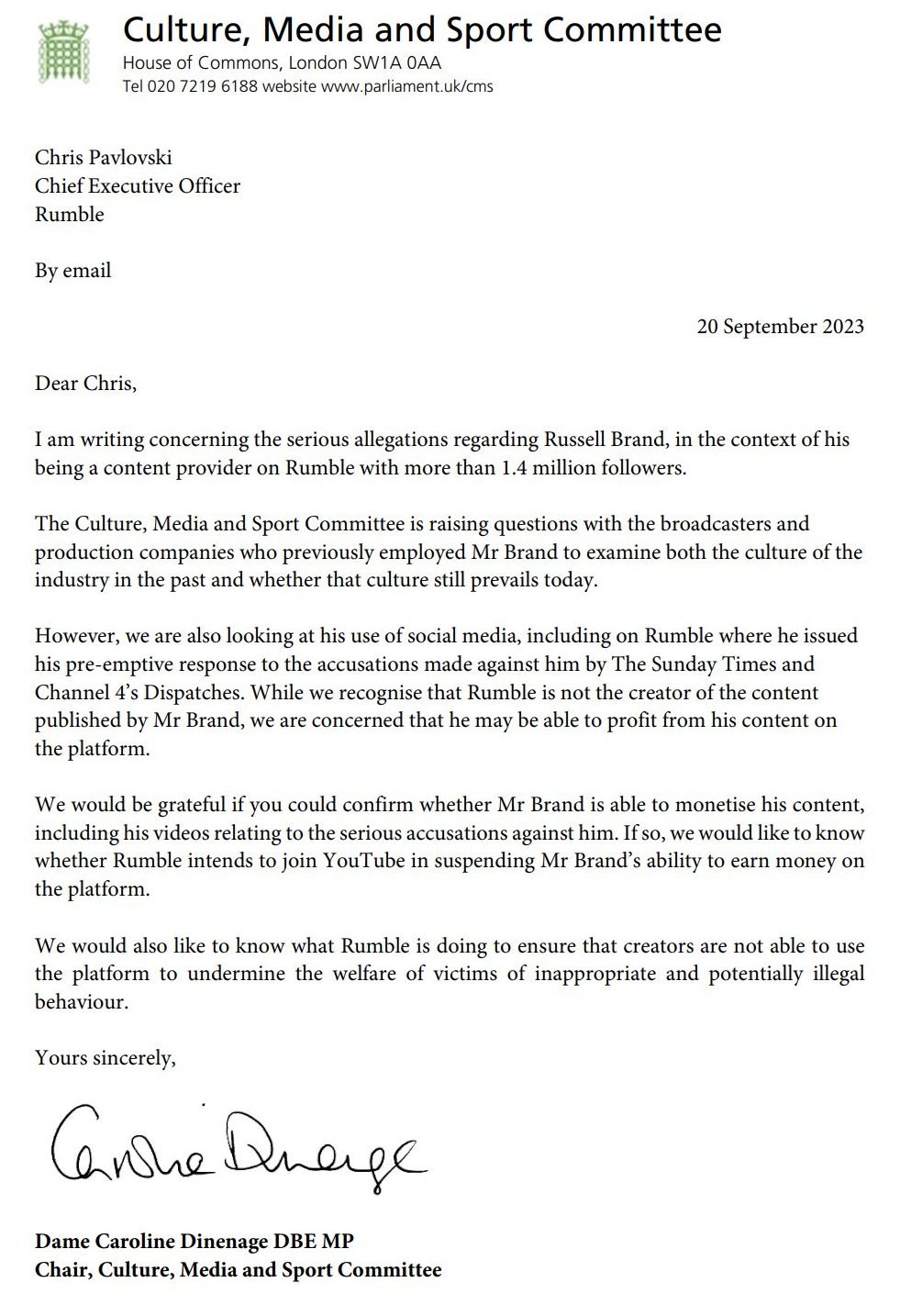
“We would also like to know what Rumble is doing to ensure that creators are not able to use the platform to undermine the welfare of victims of inappropriate and potentially illegal behaviour.”
Rumble, however, has chosen a different route from the other platforms. In response to an inquiry by the UK’s “Culture, Media and Sport Committee” regarding Brand’s monetization on the platform, Rumble CEO Chris Pavlovski issued a statement emphasizing the company’s commitment to a free internet.
In a clear stance against cancel culture and rushes to judgement, Pavlovski responded, stressing that allegations against Brand have no connection with his content on Rumble. He pointed out the importance of a free internet, “where no one arbitrarily dictates which ideas can or cannot be heard.”
From Rumble CEO Chris Pavlovski:
“Today we received an extremely disturbing letter from a committee chair in the UK Parliament. While Rumble obviously deplores sexual assault, rape, and all serious crimes, and believes that both alleged victims and the accused are entitled to a full and serious investigation, it is vital to note that recent allegations against Russell Brand have nothing to do with content on Rumble’s platform. Just yesterday, YouTube announced that, based solely on these media accusations, it was barring Mr. Brand from monetizing his video content. Rumble stands for very different values. We have devoted ourselves to the vital cause of defending a free internet – meaning an internet where no one arbitrarily dictates which ideas can or cannot be heard, or which citizens may or may not be entitled to a platform.
“We regard it as deeply inappropriate and dangerous that the UK Parliament would attempt to control who is allowed to speak on our platform or to earn a living from doing so. Singling out an individual and demanding his ban is even more disturbing given the absence of any connection between the allegations and his content on Rumble. We don’t agree with the behavior of many Rumble creators, but we refuse to penalize them for actions that have nothing to do with our platform.
“Although it may be politically and socially easier for Rumble to join a cancel culture mob, doing so would be a violation of our company’s values and mission. We emphatically reject the UK Parliament’s demands.”
While the letter from Rumble did acknowledge the seriousness of crimes like sexual assault, it underscored the importance of not penalizing creators for allegations unrelated to the platform. Pavlovski also raised concerns over the UK government’s attempt to influence who is allowed to speak or earn on Rumble, especially singling out individuals based on allegations.
The unfolding situation surrounding Russell Brand draws attention to broader discussions on cancel culture, the role of tech platforms, and the overreach in governments in regulating online content.
For now, Rumble remains committed to its principles, rejecting the call to join the growing number of platforms penalizing Brand based on accusations. As the story progresses, the debate over freedom of speech online and the impact of allegations on creators’ livelihoods is likely to intensify.
YouTube Censors Barrister’s Testimony on Vaccine Injuries at Official Covid Inquiry
But it’s for your own safety
The Naked Emperor’s Newsletter | September 20, 2023
YouTube are excelling themselves at the moment.
Yesterday they demonetised all of Russell Brand’s videos after a joint Channel 4, Times and Sunday Times investigation. For those who have not heard anything about this, Russell Brand is a UK comic with a troubled past full of sex, drugs and rock and roll. He managed to conquer Hollywood and marry pop star Katy Perry before settling down, having children and starting a great podcast.
The joint investigation accused Brand of sexual assault and rape which he strongly denies. Nobody knows what the truth is so there is no point in speculating on whether he is guilty or not. The key point is that he is innocent until proven guilty.
Unfortunately, YouTube have set this principle aside. They have dispensed with police gathering evidence and interviewing witnesses and bypassed going to court. Instead, they have decided that Brand is guilty and that his punishment is the inability to earn a living.
Who cares if he has a team to pay and a family to provide for. YouTube have listened to the mob and decided that Brand needs punishing. And of course they are able to do this because Big Tech is more powerful than most countries. Who is Brand going to complain to? The police?…they couldn’t care less. Politicians?…they are more fickle than Big Tech.
So now we are in a position where Big Tech companies have the power to decide whether you can earn a living or not. A police investigation may takes months or years. And then there will be a further wait until it goes to court. Should somebody have their wages withheld for years on end, perhaps being innocent the whole time? That’s not how innocent until proven guilty works.
Of course YouTube haven’t removed Brand’s videos, they still make a lot of money out of them, they have just stopped Russell getting a share of any of that revenue. ‘We think you’re guilty and we are morally superior so you shouldn’t be able to make a living but we are very happy to still earn money from your videos staying on our platform’.
To be honest, I’m surprised that Russell’s videos have been allowed on YouTube for so long, with so many other smaller accounts being censored over the same topics, but that is for another conversation.
Secondly, Stephen Bowie, who was injured after an adverse reaction to the AstraZeneca Covid-19 vaccine, has had one of his videos removed from YouTube. Nothing strange with that you might think, happens all the time.
What is strange and sinister, is that the video he posted was a YouTube live stream of the official UK Government Covid Inquiry. During the inquiry, Anna Morris KC, a Kings Counsel barrister, gave a testimony on vaccine related injuries. But YouTube didn’t like this.
“We reviewed your content carefully, and have confirmed that it violates our medical misinformation policy. We know this is probably disappointing news, but it’s our job to make sure that YouTube is a safe place for all”
Phew, so long as I’m safe.
Even a UK Government Inquiry can’t get past the YouTube censors if it involves a verboten subject.
The UK Passes Sweeping New Surveillance and Censorship Measures in The Online Safety Bill
By Dan Frieth | Reclaim The Net | September 20, 2023
The UK has passed its controversial online censorship act known as the Online Safety Bill. The bill, one of the widest sweeping attacks on privacy and free speech in a Western democracy will become law.
The bill seeks to shield internet users, especially youth, from the slingshots of malicious online content. But the bill goes beyond forcing platforms to remove illegal content. It calls upon social media giants to act as custodians, safeguarding users against ill-intent messages, cyberbullying, and explicit material.
Shrouded in a veil of safetyism and paying only lip service to privacy and free speech rights, we cannot cower from highlighting the bill’s overt undertone of censorship, veering into a territory where freedom of speech and privacy might be sacrificed at the altar of digital safety.
Michelle Donelan, Technology Secretary, voiced her support for the bill, branding it as an “enormous step forward in our mission to make the UK the safest place in the world to be online.” Under the proposed law, social media corporations will be forced into swift action, not just for removing violative content but also for hindering its emergence.
The implementation sword will be wielded by Ofcom, the communications regulator, with the law setting a stringent punishment pathway for non-compliers, inclusive of colossal fines and even incarceration.
The bill further pioneers new criminal offenses to its roster, like cyber-flashing and the distribution of manipulated explicit content, or deepfake pornography.
The bill imbues the government with tremendous power; the capability to demand that online services employ government-approved software to scan through user content, including photos, files, and messages, to identify illegal content. Non-compliance can result in severe penalties such as facing criminal charges.
From a free speech and anti-censorship perspective, this legislation is fundamentally disturbing. Critics argue this bill could enhance potential censorship on the pretext of safety.
The backdoor scanning system poses significant threats. It may be exploited by those with malicious intent, mishandled which could lead to false positives, resulting in unwarranted accusations of child abuse.
These alarming flaws render the online safety bill incompatible with end-to-end encryption – a staple for ensuring user privacy and security – and human rights.
The UK government has subtly conceded that it might not harness some elements of this law to their full potential. During the concluding discussion about the bill, a representative confirmed that the government would only order scans of user files when “technically feasible,” and these orders would be subject to compatibility with UK and European human rights law. This acknowledgment seems a subtle retreat from a previously aggressive stance taken by the same representative.
On the same day of these declarations, it surfaced that the UK government conceded privately that technology capable of examining end-to-end encrypted messages while observing privacy rights does not exist.
But, citizens who value their privacy shouldn’t have to rely on weak assurances from the government. The official safeguarding of privacy rights should be a priority. Rather than relying on murmurs of amendments, the government should offer comprehensive assurance through clear regulations and explicit protection policies for end-to-end encryption.
The bill, as it stands, allows the government to scan messages and photos, posing significant threats to security and privacy to internet users globally. These powers are enshrined in Clause 122 of the bill.
Several end-to-end encrypted service providers like WhatsApp, Signal, and UK-based Element have threatened to pull out their services from the UK if Ofcom demands examination of encrypted messages – an extreme but important move. This reaction is a testament to the perceived invasive nature of the Online Safety Bill.
Net-zero: the annals of absurdity
By Richard North | Turbulent Times | September 17, 2023
Most readers will recall the excited chatter of some commentators, speculating on the result of the summer’s Uxbridge by-election – which was attributed to a backlash over Khan’s ULEZ plans.
After vague noises from No.10 about being “pragmatic”, there was a widespread feeling that Sunak might capitalise on what some took to be an “anti-green” rebellion, and row back on the implementation of net-zero.
Whatever hopes there might have been, though, it must now be crystal clear that, short of any trivial, cosmetic concessions, Sunak has absolutely no intention of slowing down to destroy the British economy in the name of the Great God climate change.
If any further evidence was needed, it comes in an article in The Times yesterday, which tells us that the prime minister has rejected any idea of a reprieve for petrol and diesel cars. The 2030 electric vehicle targets, we are told, will stay.
As if that wasn’t bad enough, we are also warned to expect punitive measures aimed at incentivising the few remaining car manufacturers in the UK to increase their sales of EVs.
The plan is that next year, 22 percent of new cars sold will have to be electric, rising to more than 50 percent in 2028. It is left to the Independent, though, to tell us that manufacturers who fail to meet the targets will face fines of up to £15,000 per car.
A similar stratagem is being used to push the sales of heat pumps, with gas and oil-fired boiler manufacturers being required in the financial year 2024-2025 to ensure that heat pumps make up 4 percent of their sales.
An alternative is to buy “credits” from manufacturers who are over-quota, failing which the manufacturers will have to pay an eye-watering fine of £5,000 for every heat pump short of the quota. As with EVs, the quota will increase each year.
This has led some manufacturers to warn that they will have to increase the unit prices of boilers by £300 – a sum which also might have to increase each year as sales quotas increase.
This way of doing things is particularly devious as it distances the government from the consumer and puts the responsibility on manufacturers to implement net-zero policy, which must then take the blame for the increased prices when people turn their backs on “green” products.
As such, one might expect that manufacturers would be up in arms at this cynical attempt to make them take the fall, except in the case of car-makers, the sales quota system favours those which have committed only to produce EVs – apparently an intended consequence of the plan.
This has emerged after talks between the government an BMW, when it was announced that the car-maker would receive a subsidy of £600 million for its Cowley plant in Oxford – a bribe to dissuade the company from moving its whole operation to China.
But part of the package, it seems, was an “understanding” that the net-zero timescale would not be relaxed, giving the company “certainty” about the rules, and thereby protecting their investment in EVs. In order to protect the developing market, car-makers are said to be keen to see the 2030 ICE new car sales ban go ahead.
This also applies to the emerging charging industry. Ian Johnston, chairman of the industry body ChargeUK, is quoted as saying: “To go further our sector needs certainty in the form of a firm commitment to a strong zero emissions vehicle mandate”. He is said to have cautioned that scaling it down would mean “billions of pounds of investment” being put at risk.
We thus have an interesting, if not disturbing situation where the market in cars is to be heavily distorted, so that consumer preferences will no longer be the primary driver of production plans. A nexus of government, investors and car manufacturers is conspiring to create a producer-led industry.
As for the minor detail of a lack of charging points – which is one of the factors inhibiting sales – officials argue that tough annual targets will give confidence to investors to start building thousands of charge points.
That alone, however, is unlikely to be sufficient to incentivise private buyers, who have proved extremely reluctant to convert to electric. Although the government “fines” may narrow the price differential, EVs will still be substantially more expensive than their ICE counterparts and the lack of chargers continues to put off buyers.
Even then, car-makers are not yet out of the woods as there is the vexed question of battery production to resolve. Faced with subsidies pouring out of the coffers of EU and US governments, Alan Hollis, chief executive of AMTE Power – head of one of Britain’s few surviving homegrown battery manufacturers – is holding out the begging bowl, threatening to build its planned new factory overseas unless the UK closes the subsidy gap. So far, though, the UK’s experiences with building battery plants have not been happy.
Nevertheless, last May, the government offered the owners of Jaguar Land Rover £500 million in subsidies in an effort to persuade the carmaker to build a new electric battery plant in the UK.
The Indian conglomerate Tata, the parent company of JLR, was in the process of deciding whether to build the new electric battery production facility in the UK or Spain and, in July, announced that it was to build a 40GW battery cell gigafactory in the UK – although this may have Chinese backing as well.
BMW has not yet decided on the manufacturing location for its Mini batteries – with mainland Europe or the UK remaining options – but it is germane to note that the company is also producing the Mini marque in China, with exports from that country due to start in 2024.
Therein lies another tale, as Chinese EV and battery production has been heavily subsidised since the inception of the industry. State subsidies for electric and hybrid vehicles were reported at $57 billion from 2016-2022, helping China become the world’s biggest EV producer and to pass Japan as the largest auto exporter in the first quarter of this year.
However, China is not only delivering the volume, but its cars are also typically 20 percent below the prices of European-built models. This has moved the Commission to consider imposing punitive tariffs under anti-dumping laws. It is possible that the UK will follow suit although to do so would present the government with something of a conundrum.
As it stands, the import of cheaper Chinese vehicles is the only sure-fire way of eroding the price differential between ICE and electric cars, and thus the best way of achieving the government’s net-zero targets – notwithstanding that Chinese industry is largely powered by fossil fuels.
Thus, despite its Faustian deal with its own car manufacturers, the government’s best option is to open the doors to Chinese imports, at the risk of wiping out British car manufacturing.
When the BMW deal was done, Sunak was full of himself, declaring that the “investment” was “another shining example” of how the UK was the best place to build cars of the future, claiming that his government was “securing thousands of jobs and growing our economy right across the country”.
But, from current moves, it appears that Sunak is far more interested in the deindustrialisation of Britain through net-zero, in which case he should be looking to ditching the car industry as soon as possible – which is no doubt already in his mind.
After all, except for a few small-scale specialists, most of the industry is already in foreign hands, so handing it over to the coal-fired Chinese shouldn’t make too much difference. In the pursuit of net-zero targets, nothing is too much or too absurd for our government to countenance.
News relating to missiles used or about to be used in Ukraine and about “Russian” ICBMs in North Korea
By Gilbert Doctorow | September 17, 2023
It is widely expected that in the coming week American president Joe Biden will announce the decision to ship American medium range missiles ATACMS to Ukraine. Discussions of this subject have been widespread in both US and European media. The focus has been on the range of missiles and whether their delivery will enable Ukraine to attack across the border into the Russian Federation itself for the purpose of destroying supplies and command centers there. Of course, the issue is complicated by what is meant by RF territory. In the language of the West, all of the Ukrainian territory which has been captured by Russia since 2014 is considered to be fair game for military attack. From the perspective of Russia, any attacks on Crimea, in particular, may be justification for major escalation of the war into a direct fight with the NATO country or countries supplying the given missiles. That said, there is reason to believe that Storm Shadows were used to hit Sevastopol on 13 September, without any sign yet of Russia’s intention to escalate.
The advocates of shipping ATACMSs to Ukraine point out that its range, 190 miles or 300 km, is no greater than that of the Storm Shadow missiles which Britain and France have sent to Ukraine without prompting escalatory actions by Russia. However, that is to overlook the other side of the issue, namely the method of launch. Storm Shadow is an air to ground missile. It is launched from Soviet-era Ukrainian jet fighters which have been especially modified for this purpose. Since the Storm Shadow is devilishly difficult for any air defense system to destroy in flight, the Russians have focused attention on destroying Ukrainian planes that are part of the launch operation. Just this past week, on 11 September a Russian missile attack on the Dolgintsevo air base near Krivoy Rog in the Dnepropetrovsk region of Ukraine destroyed 5 Ukrainian fighters, two MiG-29s and three SU-25s. The MiGs are said to either carry the Storm Shadow or to provide cover for SU-24s which carry them.
The logic of supplying ATCSMs is precisely in the launch mode, not the attack radius of these missiles. They are ground to ground missiles which are launched from mobile platforms similar in principle to the multiple rocket launchers HIMARS. In that sense, they are more difficult to find and destroy than a jet fighter.
In the meantime, in Europe, German Chancellor Scholz has made it plain that he will not approve sending Germany’s long range missiles, the TAURUS, to Kiev until the United States makes a first move by shipping its own missiles. The TAURUS falls into the same launch category as the Storm Shadow; it is sent on its way to target by a jet fighter. Its distinction is only one of distance, at 500 km range. If Ukraine has a fast diminishing or fully destroyed air force, the TAURUS will not be of much use.
*****
Otherwise, over this past week, the interest of major Western media in missiles has focused on what North Korea owns and how it got them. The interest came about as journalists followed the course of North Korean leader Kim Jong Un’s tour of the Russian Far East.
It has occurred to our journalists that North Korea presently possesses ICBMs capable of reaching the North American heartland, and as they pored over the technical characteristics of these missiles they noted that one seems to be very close in design to Soviet era missiles that were once the mainstay of the Russian strategic arsenal. I am speaking of the Korean rebranded Topol-M.
It is not surprising, therefore, that some folks in the States are wondering how is it that the Russians were able to get away with supplying the designs of the Topol-M to Pongyang without the United States raising a hullaballoo.
The answer, my friends, is in the inconvenient fact that those responsible for providing North Korea with production plans and technology for manufacturing the Topol-M were not Russians; they were Ukrainians. This story is discussed in an article on a Russian news portal a couple of days ago. According to the authors, the Ukrainians sold to the North Koreans part of the technology but not all. For example, they held back the secrets of the solid fuel used in this missile, which the Koreans had to develop on their own. Moreover, for the guidance system, the Koreans were assisted or copied a system developed by the Chinese. What this tells us is that if the Koreans should agree with the Kremlin on the purchase of one or another missile-related technology, its integration into their own production will be done by the Koreans themselves. The same may be said of technologies for construction and operation of nuclear powered submarines which the North Koreans are said to be looking for abroad.
*****
Before closing, I use this opportunity to sum up the Russian visit of Comrade Kim after he spent that first day in talks with Vladimir Putin at the Vostochny Cosmodrome about which I wrote earlier in the week. His next stop was Komsomolsk on Amur, where he was shown the Yuri Gagarin factory complex producing Russian military and civilian aircraft, including the “Alligator” multifunctional attack helicopters that have been so effective in the Ukraine war against tanks, armored personnel carriers and other military hardware. The top Russian official with Kim for the day was Minister of Trade and Industry Denis Manturov.
From Komsomolsk, Kim went next to the Knevichi air base in the Amur region, where he was shown the massive turboprop Tupolev Tu-95 and the sleek Tu-160 “White Swan,” both mainstays of the nuclear triad as bombers and missile platforms. Considerable attention was given to an assortment of the most modern fighter jets in the Su family, as well as to MiGs equipped with the hypersonic Kinzhal missile. The Russian hosts were headed by Minister of Defense Shoigu.
Kim’s tour ended in Vladivostok where he was taken aboard the frigate Marshal Shaposhnikov of the Pacific fleet, which is typical of the latest Russian vessels in having an important complement of hypersonic missiles with 1500 km range as well as weaponry for anti-submarine warfare.
When in Vladivostik, Kim visited the Far Eastern Federal University on Russky Island in the Vladivostok harbor, where the Eastern Economic Forum had been held at the start of the week. Kim met with university students. Lastly, there was a typically Russian cultural note to round out Kim’s program: a performance of Swan Lake by the Vladivostok affiliate of the Mariinsky Theater (St Petersburg). I mention parenthetically, that the Russian Federation from coast to coast is looked after culturally by its musical and museum powerhouses: Moscow’s Bolshoi theater maintains a similar performance and training outpost in Kaliningrad.
©Gilbert Doctorow, 2023
Weaponised definition of anti-Semitism is a ‘tool’ to undermine free-speech
By Nasim Ahmed | MEMO | September 15, 2023
The highly controversial International Holocaust Remembrance Alliance (IHRA) definition of anti-Semitism has been repeatedly abused to suppress criticism of Israel and stifle pro-Palestinian activism at UK universities, a startling new report has found.
Produced by the European Legal Support Centre and the British Society for Middle Eastern Studies, the report analysed 40 cases between 2017-2022 where spurious accusations of anti-Semitism were levelled against students and faculty members over speech related to Palestine/Israel.
In nearly every case, the accusations were eventually dismissed after prolonged, stressful investigative processes. However, the harm inflicted on the well-being and reputations of those falsely accused had already been accomplished through these malicious campaigns.
Based on the findings, the report concludes that the IHRA definition is inadequate and unfit for purpose. In practice, it undermines academic freedom and the right to lawful speech for students and staff. The reputation and careers of those falsely accused also suffer harm from such allegations. Overall, the definition is being used to stifle protected speech critical of Israel, in violation of the academic rights and freedoms that universities are legally obligated to protect.
“We have found that since its adoption in UK higher education institutions, the IHRA definition has been used to delegitimise points of view critical of Israel and/or in support of Palestinian rights, silencing political criticism and academic scrutiny of Israeli state policies” Programme Director of the European Legal Support Centre, Giovanni Fassina, told MEMO.
“University staff and students in the UK have been subjected to false allegations of anti-Semitism, unreasonable investigations based on the IHRA definition, or cancellations and disruption of events. These proceedings harm well-being and reputations, including possible damage to education and careers. The complaints have had an adverse effect on academic freedom and free speech on campuses and have fostered self-censorship,” Fassina added.
Despite concerns raised by academics, activists and legal experts over its chilling effect on free speech, the IHRA definition was adopted by a majority of universities. Kenneth Stern, the lead drafter of the IHRA, has himself warned that it is not appropriate for university settings where critical thought and free debate are paramount. Nevertheless, in 2020, the then Secretary of State for Education, Gavin Williamson threatened university leaders with punitive financial consequences if their institutions did not adopt the IHRA. As a result, 119 universities (almost 75 per cent of UK universities) have adopted some version of the definition as a basis for campus policies.
Meanwhile, the UK government has rejected similar calls for protection against discrimination from other minority groups in the name of fighting ‘woke aggression’ and ‘cancel culture’.
For instance, Muslim advocacy groups have urged the adoption of an official definition of Islamophobia to tackle anti-Muslim hatred. But the government rejected this, claiming a singular definition could chill legitimate speech and debate.
In stark contrast to its position on the IHRA, the Tory government and the right in general have argued that a definition of Islamophobia could impact law enforcement and require legislative changes. Critics pointed out this rationale is inconsistent given the IHRA definition’s documented use to restrict speech, curtail events and initiate proceedings against students and faculty.
The contrast reveals not only a double standard in the government’s approach to addressing racism targeting different minority groups, but also a hierarchy of racism, where certain groups are granted greater protection and privileges over others. There is a reluctance to bolster protections for Muslims, even as accusations of anti-Semitism are readily weaponised to demonise certain speech.
A major flaw of the IHRA definition is that it conflates anti-Semitism with legitimate criticism of Israel and Zionism. Seven of the 11 illustrative examples do just that. One example states that “denying Jewish people their right to self-determination, e.g. by claiming that Israel is a racist endeavour” is anti-Semitic. As the report authors explain, this example falsely equates Jewish self-determination solely with the political project of Israel – a contingent position unique to Zionist ideology. It further delegitimises Palestinian claims to self-determination and casts opposition to Israel’s discriminatory policies as anti-Semitic. Most concerning, it suppresses documented evidence of Israeli human rights abuses against Palestinians by equating such criticism with bigotry. Through such examples, the definition chills free speech and makes it difficult to act in solidarity with Palestinians without facing accusations of anti-Semitism.
Several cases where students and teachers were “cancelled” on extremely dubious grounds were highlighted. In December 2020, an academic teaching on the Middle East received notification that a recent graduate had submitted complaints alleging their social media posts from 2016-2020 were anti-Semitic. The posts criticised Zionism, shared an article on the Nakba, and commented on anti-Semitism allegations against Labour.
The graduate argued these violated the IHRA definition. Despite the academic being cleared, they underwent a lengthy disciplinary process causing stress and requiring legal advice. The university referred to the IHRA definition in its policies.
Another example is the treatment of Dr Somdeep Sen. He was invited to deliver a lecture at the University of Glasgow on his book ‘Decolonizing Palestine: Hamas between the Anticolonial and the Postcolonial’. After the lecture was announced, the university received a complaint from its Jewish student society alleging that the event is anti-Semitic.
In response, the university demanded Sen provide details on his talk’s content in advance and confirm he wouldn’t contravene the IHRA definition. As these conditions undermined academic freedom, Sen withdrew and the event was cancelled.
The two examples are just the tip-of the iceberg. All the cases show how vague accusations of violating the IHRA definition have put pressure on universities to investigate or penalise faculty and students for speech related to Palestinian rights and Israeli policies. In all the cases, the burden of proof is on pro-Palestine students and critics of Israel. The presumption is that they are guilty until proven innocent; a perverse inversion of the universal principle that one is innocent until proven guilty.
Commenting on the findings, Neve Gordon, the chair of Brismes’s committee on academic freedom and a professor of human rights law in the school of law at Queen Mary University, said:
What has been framed as a tool to classify and assess a particular form of discriminatory violations of protected characteristics, has instead been used as a tool to undermine and punish protected speech and to punish those in academia who voice criticism of the Israeli state’s policies.
In his comments to MEMO, Fassina mentioned the vicious campaign to police free speech on Israel and Palestine and the ongoing efforts to weaponise anti-Semitism against critics of the apartheid state. “For us and our partners in the UK, it was time to expose a pattern we have been observing for too long: unfounded allegations of anti-Semitism made against academic staff and students after they criticised the policies of the Israeli government or just ‘liked’ some tweets about Palestine, Israel or about the Labour Party.” He explained that the latest report adds to the evidence already produced in Europe, in the US and Canada that demonstrate similar harmful consequences of the IHRA definition for the rights of advocates for Palestine. “This is not just a UK problem but reveals a wider trend of anti-Palestinian racism in Western countries, which is highly problematic for the respect of fundamental rights and democracy,” Fassina added.
Fassina called on UK higher education institutions to rescind the adoption of the IHRA definition of anti-Semitism; halt its use in disciplinary proceedings or investigations; and more crucially, with the forthcoming UN report on combatting anti-Jewish racism to be released, recognise that the IHRA is an anti-democratic, authoritarian instrument weaponised against critics of Israel. “IHRA definition is a tool of anti-Palestinian racism that should not be adopted or used by any institution that aims to respect human rights. As we are waiting for the UN to release its plan to combat anti-Semitism, we hope it will take into account the multiple calls made against the IHRA definition,” Fassina stressed.
Decrepit Britain… Schools Collapsing and Challenger Tanks Blown to Smithereens
By Finian Cunningham | Strategic Culture Foundation | September 13, 2023
Britain’s schools are not just out for summer. Autumn too, apparently. Hundreds of schools across England are being forced to close because they are in danger of falling down on the heads of children. That issue alone says a lot about the decrepit condition of Britain today.
Added to this embarrassing blow to British prestige is the reported destruction of its Challenger 2 main battlefield tank deployed with great fanfare in Ukraine earlier this year.
The supposedly invincible tank was first stopped in its tracks by a Russian mine, and then the turret was promptly blown off by an incoming Russian Kornet missile. It is thought to be first time, the Challenger 2 has been so visibly destroyed. Even the BBC’s reporting couldn’t cover up the shock from such a blow to presumed British military prowess.
In previous deployments during Britain’s criminal wars in Iraq and Afghanistan, the Challengers were up against militarily weaker opponents. They earned an overblown reputation as robust fighting machines. Now up against withering Russian firepower, the British equipment is under more testing conditions – and not faring so well.
Thus, it was a bad week alright for Britain. Schools crumbling from cheap concrete structures and then the formidable Challenger tank being pummeled like a cardboard box under Russian attack.
Interestingly, there is a bodily connection to the seemingly unrelated British misfortunes in the form of Rishi Sunak, Britain’s unelected prime minister. He took over 10 Downing Street last October after his predecessor Liz Truss was ousted due to her gaping incompetence. Truss was only in the job a matter of weeks having taken over from Boris Johnson who was forced to quit over endless corruption scandals.
Sunak, a wealthy heir of Indian heritage whose super-wealthy Indian wife doesn’t pay her taxes in Britain, was shoe-horned into the prime minister job as part of a Tory Party shake-up. He wasn’t elected by the public for his present office. That’s British democracy for you!
As prime minister, Sunak made the decision in January this year to send Challenger 2 tanks to Ukraine. The move was seen as a bold escalation and prompted other members of the NATO alliance to send heavier weapons to the Kiev regime. It was followed by Germany supplying its Leopard 2 tanks, the French donating AMX-10s, and there’s talk of the Americans eventually sending their M1 Abrams.
Sunak hailed his decision to donate 14 of Britain’s supposedly finest hardware as a game-changer that would allow Ukrainian forces to advance against Russian lines.
However, eight months later, the purported British game-changer has given the Ukrainian military no gains, neither have the German Leopard 2 tanks, nor all of the other sundry NATO “wonder weapons”.
Indeed, by nearly all accounts, the NATO-backed Ukrainian counteroffensive is rapidly turning from failure to disaster as troops and equipment get decimated by superior Russian firepower. Even former British army officers are acknowledging the disastrous defeat on the battlefield.
Under the unelected Sunak, Britain has pledged a total of £4.6 billion ($5.7 bn) in military aid to Ukraine. Britain is the second biggest sponsor of the Kiev Nazi regime after the United States, which has committed about $44 billion in military supplies to Ukraine.
Now get this. While Sunak has readily green lighted the supply of Challenger 2 tanks, as well as depleted uranium shells, Storm Shadow cruise missiles and RAF spy and fighter planes to the Black Sea, his personal neglect of school restoration projects in England has put hundreds of institutions at risk of collapsing.
Before his Tory Party appointment as prime minister, Sunak was Britain’s Chancellor of the Exchequer, which is also known as the treasury minister. By tradition, the British chancellor resides in No. 11 Downing Street. It is seen as the second-most powerful political office after the prime minister owing to the fact that the chancellor controls the budgets for all other government departments.
While he was in the chancellor job during 2020-22, Sunak slashed funding for the repair of schools by nearly 50 percent. That was in spite of warnings from educational expert committees that a crisis was looming from dilapidated concrete structures. That crisis is now manifesting with the forced closure of over 100 schools across England as the new academic year begins this month. It has become a national scandal owing to fears that pupils’ and teachers’ lives are at risk from collapsing walls and roofs.
Rich boy Rishi Sunak can directly take the blame for much of the scandal even if he tries to worm his way out of accepting responsibility.
This guy like many other Western political leaders is a charlatan and a pathetic Yes-Man for the U.S.-led proxy war against Russia in Ukraine.
Sunak likes to wear tween friendship bracelets on his wrist and he is prone to giving Hindu peace signs when in public.
Meanwhile, in reality, the ultra-privileged occupant in Downing Street signs off billions of dollars worth of weaponry to Ukraine, paid for by the British taxpayers through relentless cuts in their public services, incomes and social conditions. War and poverty go hand-in-hand in Britain.
It is estimated that to rectify Britain’s decaying schools it would cost around $1 billion, which is about a fifth of what Sunak has pledged in military aid to Ukraine. And yet this warmongering charlatan is not even accountable to British citizens.
Evidently, the unelected British prime minister views the funding of a futile, bloody overseas war – which could spiral into a nuclear world war – as more of a priority than the education and safety of British children. Dare we say that’s because he is not a democratically elected leader. He is an abject vassal of American imperialism. Many of his predecessors in Downing Street could be said to have been of the same cringemaking weakness. But the incumbent and unaccountable Sunak is absolutely shameless.
The obscene misallocation of public funds by an unelected prime minister says everything about decrepit Britain. It’s a democracy only in name and even that has become a stretch.
Featured Video

ARE PATIENTS BEING PROPERLY INFORMED ABOUT OZEMPIC?
or go to
Aletho News Archives – Video-Images
New Book
Breast Cancer: Before You Consent
A new Unbekoming paperback
Lies are Unbekoming | September 18, 2026
Peter Gøtzsche reviewed every randomised mammography screening trial ever conducted for the Cochrane Collaboration. Cochrane’s headline is that, assuming a 15% mortality reduction, one woman in 2000 avoids dying of breast cancer over ten years. Ten are overdiagnosed and treated. Two hundred experience false alarms.
But that headline assumes the reduction. When Gøtzsche looked only at the trials with adequate randomisation — the higher-quality ones — the reduction disappeared. No effect on breast cancer mortality. No effect on all-cause mortality.
This is the Cochrane finding, published in the establishment’s own database of systematic reviews.
No woman being asked to consent to a mammogram this week knows it.
That is why the new Unbekoming paperback exists. … continue
Blog Roll
 Aletho News
- The Truth About the Trump Shootings with Ken Silva
- ARE PATIENTS BEING PROPERLY INFORMED ABOUT OZEMPIC?
- US lawmaker blocks $2.8 billion weapons sale to Israel: Report
- Yemeni army claims responsibility for strikes on sensitive sites in Saudi capital, Aramco facilities in Yanbu
- Iran Judiciary issues indictments against 159 US, Israeli officials for assassination of Leader, commanders
- Turkiye revokes Iranian bank license under US sanctions campaign
- US-Denmark Agreement on Greenland Is ‘PR Stunt’ Ahead of Midterms
- Araghchi: Military intervention cannot create security; coercion cannot bring peace
- Fraud Squared
- Breast Cancer: Before You Consent
- If Americans Knew
- Inside Gaza’s death trap of collapsing, bombed-out buildings
- The everyday items Israel bans from Gaza every day
- Inside the siege, the ruined buildings of Gaza – Daily Update
- Debunking The Claim That Macklemore Has A “History Of Antisemitism”
- CPJ demands release of arrested Palestinian-US journalist near Bethlehem
- Robert Kraft: The Billionaire Friend of Netanyahu Pulling The Strings Behind the Macklemore/Ed Sheeran Blow Up
- Columbia Administered Fund Gives Big Money to Pro-Israel Groups
- Deportation Case of Palestinian Activist Salah Sarsour Tests First Amendment
- ‘We Will Not Forget’: Palestinians Mark 44 Years since Sabra and Shatila
- Why do we let Zionists decide what we can and can’t say?
- No Tricks Zone
- 2025 Nature Paper Claiming Worsening Global Drought Gets RETRACTED …Heavily Flawed
- New Study: ‘Global Drought Shows No Detectable Recent Acceleration Under Climate Warming’
- Economic Masterminds: German Socialists Suggest Taxing Productivity Gains Stemming From Using AI
- The South China Sea Has Not Been Cooperating With The Climate Change Narrative
- Energy Crisis: Germany Enters Heating Season With Historically Low Gas Reserve Fill Levels
- New Study: The Antarctic Ice Sheet Gained Mass From 2020-2024 Due To Staggering Snow And Ice Accumulation
- Study: Ocean Heating Rates From Thousands Of Years Ago ‘Dwarf’ Modern Ocean Heating Rates
- Climate Extremists Target, Attack Large-Scale Power Grid Infrastructure In Germany!
- New Study: Antarctic Ice Melt Has Contributed Less Than 1 Centimeter To Sea Level Rise In The Last 30 Years
- Fear Of Debate: Alarmist German Climate Scientist Calls On Mainstream Media To Discredit Skeptic Voices
 Aletho News