US and allies must address Russia’s security concerns and their past deceptions on Donbass, the Kremlin says
RT | January 20, 2023
US-Russia relations are at their lowest point ever amid the crisis in Ukraine, Kremlin spokesman Dmitry Peskov said on Friday. As the conflict deteriorates, the only way to reverse it is for Western nations to acknowledge their mistakes and change their policies, he added.
Despite initial hopes that under President Joe Biden the US would engage Russia diplomatically, the last two years “have been very bad for our bilateral relations,” the official told journalists. They are now “probably at their lowest point, historically” he added, and “there is no hope for improvement anytime soon.”
The Ukraine hostilities – the focus of the confrontation between Russia and Western nations – are in “an upward spiral” according to Peskov.
“We can see a growing indirect, and sometimes direct involvement of NATO nations in this conflict,” he stated. The nations that back Kiev are acting under “a delusion that Ukraine has any chance to win on the battlefield,” he explained.
Asked how the vicious circle could be broken, Peskov suggested that the US and its allies had to mentally turn the clock back to the end of 2021, “when Russia was suggesting a discussion of its concerns at the negotiations table” only to be dismissed.
Western repentance for its “cynicism” was also in order, he added.
“Germany, France and Ukraine were playing a swindle game with the Minsk agreements. Now is payback time,” he said, referring to the roadmap for Ukraine reconciliation, which the three nations signed with Russia in 2015.
Angela Merkel, Francois Hollande and Pyotr Poroshenko, the leaders at the time of Germany, France and Ukraine respectively, have since stated that the deal they negotiated with Russia was meant to give Kiev time to rebuild its military.
Moscow considers these admissions to be evidence that the negotiations were conducted in bad faith and that the Ukrainian government and its backers had always intended for the Minsk agreements to fail and for the Donbass standoff to be resolved by military means. Russia claimed that its military campaign in Ukraine launched last February preempted an offensive planned by Kiev with NATO’s help.
Ukraine, Germany, and France “lied to the people of Donbass, as they had a terrible fate planned for them, which Russia prevented,” Peskov explained.
Orthodox bishop denounces Ukrainian crimes at UNSC
By Lucas Leiroz | January 20, 2023
The Russian Orthodox Church went to the UN to denounce Ukrainian crimes. At a meeting of the Security Council on January 17, invited by the Russian diplomatic representation at the UN, an Orthodox bishop linked to the Moscow Patriarchate commented on the situation of the Orthodox Church in Ukraine in the face of the persecutions imposed by Kiev’s neo-Nazi regime. This was the first time that a representative of the Orthodox clergy has addressed the UNSC.
The bishop chosen for the interaction was Chairman of the Department of External Relations of the Church of the Patriarchate of Moscow, Metropolitan of Volokolamsk, Anthony. He made it clear to all diplomats of the UNSC that the Orthodox Church is currently experiencing serious political and religious oppression under the Ukrainian government. Metropolitan Anthony said that the Russians are “extremely concerned about the blatant violations of the universal and constitutional rights of Orthodox believers in Ukraine”.
The bishop exposed some shocking data about the Ukrainian reality. Due to the ban on Orthodoxy recently imposed by the Zelensky regime, thirteen Ukrainian bishops were actually deprived of their own Ukrainian citizenship. With this measure, the neo-Nazis intend to coerce the clergy to stop disobeying the dictatorial norms aimed at banning the Church. Currently, Ukrainian clerics are trying to resist the regime’s impositions, continuing to offer liturgical services and protecting local traditions.
However, if bishops continue to lose their nationality, they will certainly be forced into exile, which will further complicate the situation for Orthodox believers in Ukraine. The bishop also highlighted that these revocations of citizenship are decreed irregularly, without any legal procedure that legitimizes them, thus violating the country’s constitution.
Another data informed by him concerns the process of expropriation of the Russian Church. Metropolitan Anthony reported in his speech that last year alone 129 churches belonging to the Patriarchate of Moscow were captured by the Ukrainian regime’s agents. Part of these expropriated churches are then used for non-religious purposes, while others are given to the ultranationalist and non-canonical sect called “Patriarchate of Kiev”, which is widely supported by the Maidan Junta, as it adopts the anti-Russian neo-Nazi ideology of the Ukrainian state. It is important to remember that the Ukrainian Orthodox believers are canonically linked to the Patriarchate of Moscow, therefore these acts of the Kiev regime are an attack against the religion of the Ukrainian people itself.
The head of foreign affairs of the Russian Church also emphasized the importance of understanding the current situation of the Church as a kind of mass political repression. He told the UNSC delegates that since last year the SBU (Ukrainian intelligence agency) agents constantly carry out violent operations in Orthodox churches, during which the clergy are publicly humiliated, and the temples desecrated. He compared the oppression suffered today with that of the early years of the Soviet Union.
These recent attacks have taken place officially, as the Ukrainian state has started a banning campaign against all institutions linked to Russia. However, illegally, since 2014 there has been strong persecution against the Orthodox Church in regions with an ethnic Russian majority. Neo-Nazi militias destroyed temples and killed clergy and believers in Donbass during hostilities against resistance forces. There are several photos and videos circulating on the internet showing the oppression to which the Orthodox Church has been subjected in Ukraine.
According to Metropolitan Anthony, since the Orthodox Church is the majority faith of both Russians and Ukrainians, it can serve as a basis for peaceful dialogue towards the end of hostilities. The recent Russian initiative, rejected by Kiev, to establish a temporary ceasefire during the Orthodox Christmas is an example of this. However, from the moment that one of the sides begins to deliberately oppress the Church, the possibility of dialogue ceases. Therefore, the international society must pay attention to the situation of the Church in Ukraine and demand changes in Kiev’s position.
Furthermore, the reports made by the bishop should also generate discussions in the western world, since it is unacceptable that the regime which promotes ethnic and religious persecution continues to receive money and weapons from the West. Although NATO has already made it clear several times that it has no humanitarian concern and that it is willing to do anything to “defeat” Russia, it is important that the costs of this war are known by Western public opinion.
Lucas Leiroz is a researcher in Social Sciences at the Rural Federal University of Rio de Janeiro; geopolitical consultant.
CIA Chief Warns Zelensky of Assassination (… by the CIA)
By Finian Cunningham | Strategic Culture Foundation | January 18, 2023
So CIA boss William Burns made a secret trip to Kiev in January last year to warn Ukrainian President Vladimir Zelensky that his life was in danger from assassination. The clandestine meeting occurred only weeks before Russia launched its military operation in Ukraine.
A new book that appears to have plenty of insider help from U.S. intelligence sources claims that Burns was sent on President Joe Biden’s orders to deliver a “reality check” to Zelensky.
Western news media are gullibly spinning the claim that Burns warned Zelensky that the Russians were plotting to kill him. The impact of the top secret briefing was said to have had a “sobering effect” on the man in Kiev. In less polite terms, he crapped in his pants.
Some questions arise, however, which the Western media as usual do not ask. Why was it deemed necessary for Burns to make a long and secret flight to Kiev to tell Zelensky of a purported Russian assassination threat? Why couldn’t the CIA director have briefed the Ukrainian leader about the danger in a phone call with a secure line? That Burns had to meet Zelensky in person suggests that the American spymaster wanted to convey another, unreported message, a message that only Zelensky would hear and one that could not be taped at any cost.
If the Russians wanted to kill Zelensky surely they would have done it by now during nearly 11 months of bloody conflict and given the evident capability of Russian missiles to hit anywhere in Ukraine?
Incongruously, the Ukrainian politician seems to be at ease in traveling around the country. Only last month he visited the frontline at Bakhmut where he obtained a battle flag from his troops that he then took a day later to Washington for a made-for-television presentation to Congress.
Are they the movements of a man who is really under threat of Russian assassination?
A partial explanation reported by Western media was that at the time of Burns’ trip to Kiev, Zelensky was doubting U.S. intelligence warnings of an imminent Russian invasion. Well not really “doubting” but, more accurately, not hamming up sufficiently. The CIA boss was reportedly dispatched to give the Ukrainian leader a reality check that Russian troops were poised to cross the then border into the Donbass eastern region. That telling implies that Zelensky was being complacent or disbelieving of a Russian threat.
But that telling is not correct. Zelensky was himself playing up the threat of a Russian invasion in the months and weeks leading up to February 24 when the Russian forces entered Ukraine. Russian President Vladimir Putin ordered that intervention because NATO-backed Ukrainian military was intensifying their eight-year campaign to terrorize the ethnic Russian people in the breakaway Donbass region.
Zelensky had been elected in 2019 on a platform of suing for a peaceful settlement of the Ukrainian civil war. The war had been instigated in 2014 by the CIA-orchestrated coup d’état that brought to power a NeoNazi regime in Kiev.
After being elected, the comedian-turned-politician soon forgot his peace promises to the electorate with a little help from threats of assassination by the CIA-trained NeoNazi paramilitaries. He quickly transitioned from dove to hawk like a professional actor handed a new script.
Maybe Zelensky was getting cold feet and losing his nerve by the time of January last year. He would have known that U.S. and NATO military provocations against Russia and the spurning of Moscow’s diplomatic overtures by Washington and its European minions were leading to war. He did bridle somewhat against Washington’s incessant war drums saying that the “panic” was having an adverse effect on the Ukrainian economy. But that does not mean Zelensky was disbelieving U.S. intelligence. Far from it, he had up to then played along with it.
The reality check that Zelensky needed was to stiffen his nerves for what Washington was lusting for – a proxy war against Russia.
It seems more plausible that William Burns suddenly showed up in Kiev to maximize the intimidation. Washington wanted its proxy war against Russia to go ahead for bigger geopolitical reasons of preserving unipolar hegemony and cutting off Europe from Russian energy, and the Americans did not want their puppet in Kiev to blow it by running scared at the vital moment. Remember too that in April – two months after the conflict erupted – there were peace overtures from Zelensky to Moscow. That incipient diplomacy was promptly scuppered by the American paymasters using the British premier Boris Johnson as a conduit in a suspiciously timed visit to the Ukrainian capital. It seems like Zelensky’s pattern has been one of requiring a bit of ginning up every so often.
Burns warned Zelensky of assassination alright. But the threat wasn’t from Russia. It would have been from the Central Intelligence Agency, the agency that has excelled in bumping off American puppets down the years if they became awkward. Indeed as John F Kennedy’s assassination in Dallas, Texas, in 1963 illustrates, the agency is capable of bumping off American presidents if they become awkward.
The dapper diplomat Burns who previously served as U.S. ambassador to Russia (2005-2008) would be too genteel to utter the vulgar words, “We’re going to kill you”. Oh no, Zelensky would have been told, “Regrettably, we may not be able to protect you”.
The destruction of Ukraine that Zelensky has permitted is the action of a man who is getting lucrative pay-offs as well as living under the shadow of assassination. And the shadow is cast from Washington and Langley, not Moscow.
EU parliament backs tribunal to probe Russia
RT | January 19, 2023
The European Parliament on Thursday voted in favor of an international court to probe Russia over its conflict with Ukraine. Moscow has rejected allegations of war crimes in the past and has also said such a court would have no legal power over it.
In a non-binding resolution, MEPs asked the bloc and its individual member states to create a “special tribunal for the crime of aggression against Ukraine,” accusing Moscow of violating international law. The legislators added that the tribunal would “focus on alleged genocide, war crimes and crimes against humanity committed in Ukraine.”
“The EU’s preparatory work on the special tribunal should begin without delay,” the resolution said.
Ukrainian President Vladimir Zelensky thanked the parliament for the move. “Russia must be held accountable,” he tweeted.
Kremlin spokesman Dmitry Peskov said late last month that an international tribunal tasked with prosecuting Russia would be rejected by Moscow as “illegitimate” and that the West has no legal right to establish it.
He said this in response to European Commission President Ursula von der Leyen proposing a special UN-backed court to probe what she described as Russia’s “horrific crimes” in Ukraine.
Similar suggestions have been made by other Western and Ukrainian officials. Bloomberg reported a few months ago that The Hague-based International Criminal Court (ICC) could start reviewing cases of alleged Russian crimes in Ukraine in late 2022 or early 2023.
The Russian Foreign Ministry said that “the current attempt by Western countries to whip up a quasi-judicial mechanism is unprecedented in its legal nihilism and is yet another example of the West’s practice of double standards.”
Moscow launched a military operation in Ukraine last February, citing the need to protect the people of Donbass, as well as Kiev’s failure to implement the 2014-15 Minsk accords.
Kiev and its Western supporters have since accused Russian troops of killing civilians in Bucha, near Kiev, and other areas. Moscow maintains that its forces only strike military targets and has insisted that allegations of atrocities were fabricated.
Ukraine said in the past that peace can only be achieved if Russia faces an international court. Moscow has rejected this demand as unacceptable.
The Kremlin has said Russian investigators were, however, carefully documenting crimes committed by the Kiev regime since 2014, when a violent coup ousted a democratically elected government and Kiev sent its military to Donbass. Peskov said Moscow had not seen “any critical reaction from the so-called ‘collective West’” on those wrongdoings.
US encouraging terrorist acts against Russia – ambassador
RT | January 19, 2023
Russia’s Ambassador to the United States Anatoly Antonov has warned against future Ukrainian attacks on the Crimean Peninsula, insisting his country would respond in force after Washington suggested Kiev may employ its Western arms to attack the region.
Asked to comment on recent remarks from US State Department spokesman Ned Price, who insisted Crimea is still Ukrainian territory despite Russia’s control over the area for the better part of a decade, Antonov warned against “militant” rhetoric from the United States, saying it only risks further escalation.
“The State Department, through out-of-touch assertions that ‘Crimea is Ukraine’ and that the Armed Forces of Ukraine can use American weapons to protect their territory, is essentially pushing the Kiev regime to carry out terrorist attacks in Russia,” the envoy said on Wednesday night. “Hearing such remarks from Washington, the criminals in Kiev will once again feel complete permissiveness. The risks of conflict escalation will only increase.”
During a press briefing earlier on Wednesday, Price was questioned about whether Washington had ever placed “limits” on Ukrainian strikes, maintaining that the US is “of course not making targeting decisions on behalf of our Ukrainian partners” and that “these decisions are up to them.” He said Kiev is free to select its own targets, including in Crimea, which he argued “is Ukraine” – reiterating Washington’s refusal to accept Moscow’s claim to the region.
The spokesman’s comments followed a New York Times report indicating that the White House is increasingly willing to help Kiev to strike the peninsula, citing a number of unnamed US officials. President Joe Biden, however, is reportedly still refusing to provide the long-range missiles needed for a full-on attack, instead hoping that lighter arms and vehicles might suffice for a major counteroffensive.
Antonov went on to say that no amount of Western aid would stop Moscow’s military operation, arguing “we will destroy any weapons supplied to [President Vladimir] Zelensky’s regime by either the United States or NATO.”
“Is it really incomprehensible to anyone else that pumping weapons into Ukraine, be it American or other NATO countries, will only lead to an increase in civilian casualties and create additional difficulties in the former Soviet republic?” he added.
Crimea held a referendum to reunify with Russia in 2014, after Ukraine’s Euromaidan revolution and the overthrow of the country’s elected leader, Viktor Yanukovich. The region is historically Russian territory and has served as the headquarters for Moscow’s Black Sea Fleet since the late 18th century, though was transferred to Kiev’s administrative control in 1954 under Soviet rule. Along with Washington, Ukraine’s Western backers have declined to recognize Russian control of the peninsula.
Ukrainian interior minister’s death leaves many questions unanswered
By Lucas Leiroz | January 19, 2023
On January 18, a helicopter carrying senior Ukrainian officials crashed on the suburbs of Kiev, killing 14 people, including interior minister Denys Monastyrsky and his first deputy Yevgeny Enin. There are different narrations of what happened. At first, media said that the incident occurred due to a malfunction in the helicopter’s engine, but there are a number of contradictions between the versions, with people believing that it was a planned sabotage.
The helicopter crashed at 8:20 am on January 18, in Brovary, a city of the Kiev oblast. The site was in foggy conditions according to local informants, but so far there is no data to prove that the weather could really disturb the flight. The fall took place near a kindergarten, which led the tragedy to reach even greater proportions, as dozens of children were affected – three of them dying. As many people, including several children, remain hospitalized, it is possible that the number of deaths will increase in the coming days.
The helicopter was a French Airbus H225 (also known as Eurocopter EC225 Super Puma) and belonged to the Ukrainian emergency service since 2018. The reasons for its collapse are still being investigated. The most commented hypothesis is that there has been a technical malfunction, although all possibilities are considered – including sabotage. A report from the local Ukrainian media states that it was already known that this helicopter model had many technical difficulties:
“The helicopter that crashed today in Brovary was from a batch of helicopters purchased from France in 2018. The EC225 (or H225) model, the fall of which the authorities confirmed today, had a number of technical problems. At that time, Airbus Helicopters had several lawsuits over ‘inherent’ malfunction”.
Indeed, one question remains: if it was already known that there were technical problems with the equipment, why did the Ukrainian authorities continue to use it to attend important officers?
This is why many unofficial narratives about the possibility of deliberate assassination have emerged on the internet. The Ukrainian government admits the possibility, claiming to be investigating a hypothesis of sabotage against the Minister, but obviously it does so based on the idea that there would be an intention on the part of the Russian forces to kill him – which is doubtful, considering the low military relevance of such an act.
However, an even more curious fact is that several residents of Brovary commented that they saw a missile in the air hitting the airbus. The rumors have been reported by independent channels on social media, mainly through on the ground journalists who are investigating the case unofficially. The news raises a series of other possibilities.
It is important to remember that the Ukrainian air defense system has made serious mistakes recently, destroying civilian areas and killing innocent people due to the inaccuracy of its attacks. There are many factors that help to understand this process. First, since the beginning of the conflict, Kiev has shown that it does not have a military doctrine concerned with civilians, so there does not seem to be any special care on the part of artillery operators to avoid non-military casualties.
Second, there is the technical issue. Currently, due to significant losses on the battlefield, Kiev is recruiting personnel without military qualifications, incompetent to operate the war equipment that is being used in the conflict. The case becomes even more serious considering that the neo-Nazi regime is receiving NATO’s weapons with which its soldiers are even less familiar, increasing the possibility of errors.
It is important to remember that Monastyrsky was the second major official that the Zelensky government lost in less than twenty-four hours. Earlier, top adviser Alexey Arestovich had resigned precisely for accidentally revealing mistakes made by the Ukrainian artillery.
The fact is that if a projectile did hit the Ukrainian helicopter, it is much more likely that it came from Kiev’s own artillery – accidentally or intentionally – than from Russian artillery, which was not shelling the place at the time. Furthermore, the mere point that Kiev was allowing a top official to fly over a country at war using an unsafe airbus already shows that the government simply did not care about his safety.
It is important to mention that Monastyrsky, as Interior Minister, was the head of the Ukrainian neo-Nazi militias, as since 2014 the ultranationalist gangs have been incorporated into the Kiev’s Ministry of Internal Affairs. So, he certainly had sensitive information about how the neo-Nazi regime manages its security forces.
In July, Kiev bombed a Russian prison in Olenivka where Azov’s militants were placed after their surrender in Azovstal. On that occasion, 50 neo-Nazi soldiers died in what was probably an attempt by Kiev to avoid confessions that could threaten the confidentiality of some data. Ukraine obviously tries to hide information about the practices of its neo-Nazi troops, such as war crimes, training camps for children, arms trafficking, terrorism, among others. In this sense, considering that Monastyrsky had much more concrete information about these same crimes, it is possible that there was an intention to eliminate him, in case Zelensky was really promoting a purge.
So far, the data are uncertain, and many questions remain unanswered. But the evidence seems to point to yet another criminal incident.
Lucas Leiroz is a researcher in Social Sciences at the Rural Federal University of Rio de Janeiro; geopolitical consultant.
Famous French Historian: “This War is About Germany”

BY NOAH CARL | THE DAILY SCEPTIC | JANUARY 18, 2023
Historian Emmanuel Todd is one of France’s leading public intellectuals. At the age of just 25, he predicted the collapse of the Soviet Union in his book The Final Fall: An Essay on the Decomposition of the Soviet Sphere. Later in his career, he carried out pioneering work on family structure and how it impacts societal development.
Now at the age of 71, Todd doesn’t seem to mind ruffling feathers – as his remarks in a recent interview with Swiss magazine Weltwoche make clear. “I’ll give you the first interview because you write in German,” he begins by saying. “This war is about Germany.”
About Germany? What does he mean? Todd explains:
The financial crisis of 2008 made it clear that with reunification Germany became the leading power in Europe and thus also a rival of the USA. Until 1989 it was politically a dwarf. Now Berlin showed its willingness to get involved with the Russians. Combating this rapprochement became a priority of American strategy. The United States had always made it clear that they wanted to torpedo the gas agreement. The expansion of NATO in Eastern Europe was not primarily directed against Russia, but against Germany.
Asked who sabotaged the Nord Stream pipelines, Todd replies, “Of course the Americans. But that is completely unimportant. It is normal.” The important question is, “How can a society believe that it could have been the Russians?”
“We are dealing here with an inversion of possible reality,” says Todd. “The newspapers tell us how the Russians are shooting at prisons they have occupied. That they shoot at nuclear power plants that they control locally. That they blow up pipelines that they built themselves.”
It’s clear, then, that Todd subscribes to the theory I first discussed back in August: that the U.S. deliberately provoked conflict between Russia and Ukraine to sabotage the Nord Stream 2 pipeline, thereby ending (or at least severely curtailing) Russo-European interdependence.
Unfortunately, Todd doesn’t provide any specific evidence to back up his provocative claims. So the theory remains speculative. Of course, this doesn’t mean we should accept the conventional narrative that America just really cares about democracy.
So what, in Todd’s view, should be done? “I wish the Germans would understand: The side of the good they want to be on this time is not that of the United States,” he says. “The good means: end this war.”
While Todd certainly represents a minority viewpoint among Western intellectuals, as he himself acknowledges, it’s still worth considering.
UK circumventing its own sanctions against Moscow to import Russian oil
By Drago Bosnic | January 18, 2023
It is now virtually common knowledge that the political West’s attempts to destroy the Russian economy through sanctions have failed spectacularly. However, what the Western mainstream propaganda machine is fighting tooth and nail to accomplish is suppressing the fact that the sanctions war has also backfired and is now ravaging Western economies, especially those whose prosperity was largely based on access to cheap Russian energy. This is particularly true for Germany, the European Union’s industrial powerhouse which is now suffering the consequences of its suicidal subservience to Euro-Atlantic Russophobia.
However, what’s much less commonly acknowledged is the fact that there are many countries that don’t seem to be too dependent on Russian energy, but are in fact suffering as a result of the sanctions war against Moscow. This is especially true for the United Kingdom, whose political establishment is one of the most fervently Russophobic in NATO. With London being one of the Kiev regime’s key backers, it would be expected to see the former colonial superpower much less dependent on any commodities coming from Russia. Still, Moscow’s status as the world’s premier energy superpower makes this extremely difficult (if not impossible) to achieve.
In order to tackle the mounting energy security issues, exacerbated not only by anti-Russian sanctions, but also by the economic fallout of the COVID-19 pandemic, the UK is now resorting to finding loopholes to circumvent its own sanctions against the Eurasian giant. The escalation of the Ukrainian crisis has led to a dramatic reshaping of European (and, indeed, global) energy markets, with the political West declaring its intention to cut dependency on Russian energy imports. Expectedly, the UK was at forefront of this effort and was even hailed as “one of the most successful countries” in achieving this after it officially stopped importing Russian oil and coal, while also imposing an outright ban on Russian natural gas.
By October last year, London’s imports of Russian energy were officially cut to almost nothing, with approximately $2.5 million of oil purchases and virtually no coal or natural gas from Russia. However, recent revelations cast serious doubt on these numbers, indicating that the UK’s claims mostly boil down to simple semantics. According to reports by various sources, the UK is not importing oil (directly) from Russia, but it still keeps importing Russian oil. This is possible thanks to third countries (India being one of them) that are now re-exporting Russian-sourced oil to the UK and others in the political West. This has provided a very convenient back door for imports of Russian oil into the country, while also being quite lucrative for third parties.
According to Kpler, India’s Jamnagar refinery, operating on the west coast of Gujarat, imported 215 shipments of Russian crude in 2022, which represents a 400% increase in comparison to 2021. At the same time, British companies have imported approximately ten million barrels of diesel and other refined oil products from Jamnagar since February 2022, which is an increase of more than 250% of what they bought from the Indian refinery during the previous year. The data indicates that this can only be explained by a much larger share of Russian oil being refined and then exported to the UK and elsewhere.
More importantly for Britain, this move is blunting the disastrous effects of energy shortages in the UK, a problem that is now affecting many other countries that have been forced to impose sanctions on Russia, often coerced into it by London itself. British companies have simply replaced imports directly from Russia with imports from third-party refineries that are buying Russian crude. Although there’s nothing illegal in such a framework, it’s still quite indicative of the UK government’s hypocrisy. London has been exerting tremendous pressure on others to stop importing Russian energy (Hungary perhaps being the best example of this), while secretly doing just the opposite.
Prior to Moscow’s counteroffensive against NATO aggression, India wasn’t particularly known for importing Russian energy, while it was even less common for its oil refineries to process Russian crude. Indian companies have always been oriented towards exporting refined oil to Europe, but their supplies to the old continent have skyrocketed as the demand is still there and someone needs to fill the gap. This is quite profitable for India, as prices in the EU are quite high, while Russia is supplying the Asian giant with record amounts of discounted crude. Meanwhile, British companies are turning a blind eye to this fact, as they need guaranteed energy supplies, so everybody seems content with this arrangement – except Kiev.
Oleg Ustenko, one of Volodymyr Zelensky’s advisers, is accusing the UK companies of “exploiting weaknesses in the sanctions regime”.
“The UK must close the loopholes that undermine support for Ukraine by allowing bloody fossil fuels to continue flowing across our borders. About one in five barrels of the crude oil that they process is Russian. A big chunk of that diesel they produce now will be based on Russian crude oil,” Ustenko stated.
It remains to be seen if the UK will ever respond to these demands, as they don’t seem to be particularly important to London. It’s quite clear that even if one of the Neo-Nazi junta’s top overlords were to proceed with closing the existing loopholes, the idea that the UK won’t find new ones is downright laughable, as it would’ve never tried bypassing its own sanctions in the first place.
Drago Bosnic is an independent geopolitical and military analyst.
US quietly shipping arms from Israel to Ukraine – NYT
RT | January 18, 2023
The US military is supplying Ukraine with hundreds of thousands of artillery rounds pulled from stockpiles based in Israel, according to the New York Times. The Pentagon is reportedly “scrambling” to find munitions as Ukrainian forces continue to exhaust their arsenal.
The Pentagon has drawn from a “vast but little-known stockpile of American ammunition in Israel to help meet Ukraine’s dire need for artillery shells,” the Times reported on Tuesday, citing multiple unnamed Israeli and American officials. While it’s unclear when the deal was struck, Israel has agreed to allow Washington to source some 300,000 155-millimeter rounds from warehouses on its territory.
“About half of the 300,000 rounds destined for Ukraine have already been shipped to Europe and will eventually be delivered through Poland,” the Times added.
Though the stockpile in Israel is intended for use in America’s Middle East conflicts, several of which continue on a simmer, the Pentagon has been forced to seek new weapons supplies as Ukrainian troops reportedly blow through around 90,000 shells per month – twice the rate produced by the United States and Europe combined.
The United States has sent or authorized the shipment of just over one million 155-millimeter rounds to Ukraine since the conflict with Russia kicked off last February. “A sizable portion” of that has been pulled from existing inventories in South Korea and Israel, a senior US official told the Times, though he did not specify the total sourced from each.
While Israeli officials “initially expressed concerns” about the plan to draw from stocks in their own country, believing it could suggest Israel is “complicit in arming Ukraine,” the government ultimately agreed on the condition that the Pentagon replenishes the armaments. Washington has additionally pledged to “immediately ship ammunition in a severe emergency,” the Times said.
Israel maintains ties with both Ukraine and Russia, and has sought to walk a diplomatic tight-rope between the two conflicting states since fighting erupted last year. Though it has offered to help broker peace talks and provided several rounds of humanitarian aid to Kiev, Israel has largely refused to join its Western allies in arming Ukraine or sanctioning the Russian economy, fearing such hostile actions could harm relations with Moscow.
Under President Joe Biden, the US has authorized some $25 billion in direct military aid to Kiev, recently agreeing to send 50 Bradley infantry fighting vehicles and a range of other weapons in its latest $3 billion arms package. Ukrainian officials have continued to clamor for additional gear, however, and are now urging Washington and its European allies to send main battle tanks and better air defenses, among other weapons. While the US has so far declined demands for tanks, military leaders from the ‘Ukraine Defense Contact Group,’ which includes NATO members, will meet at Germany’s Ramstein Air Base on Friday to discuss the possible shipment of heavier arms.
The Trouble with Western Tanks in Ukraine
By Brian Berletic – New Eastern Outlook – 17.01.2023
Western nations have begun pledging a variety of Western armored vehicles to Ukraine including infantry fighting vehicles and even main battle tanks. Until now, the majority of armored vehicles sent to Ukraine had been Soviet-era weapons Ukrainian forces were familiar with both in terms of operating and repairing them.
However, following Ukraine’s Kherson and Kharkov offensives, much of this equipment has been destroyed, leaving the West little choice but to begin sending Western systems or leave Ukrainian forces in the field with only small arms.
While Western leaders and the media claim that Western armored vehicles represent a significant increase in Ukrainian capabilities, the reality is quite the opposite. Far from giving Ukraine an advantage on the battlefield, Ukrainian forces will struggle merely to get the vehicles on the battlefield and keep them there. Additionally, recent conflicts elsewhere in the world have proven Western armored vehicles including main battle tanks are neither “invincible,” nor “game-changing.”
Thus, if Ukraine’s hundreds of Soviet-era tanks, infantry fighting vehicles, and armored personnel carriers failed to achieve favorable outcomes for Kiev, it is unlikely replacing these systems with Western hardware will make any difference.
Logistics, Training, and Maintenance
In order to get Ukrainians into Western armored vehicles they will have to be trained in their basic operation, in using them effectively on a modern battlefield together with other tanks and weapon systems, and keeping them on the battlefield (maintenance). Entry-level tankers can take up to half a year to acquire these skills – time Ukraine doesn’t have, meaning that unless Western operators will be manning them posing as Ukrainians, heavily abbreviated courses will be given instead, producing subpar operators compared to the training and effectiveness Ukrainian tank crews had on the battlefield using their own equipment at the beginning of Russia’s special military operation.
Another aspect of most Western main battle tanks is that unlike Soviet and Russian main battle tanks which feature autoloaders for their main guns, Leopard 2, Challenger 2, and M1 Abrams require a crew member to manually load their main guns. So, while Soviet-era and Russian tanks have three crew members, a driver, a gunner, and a commander, Western main battle tanks require a fourth, the loader. This means that for every 3 Western main battle tanks sent to Ukraine, four Ukrainian tank crews will be required to man them – more trained tankers spread across fewer tanks.
Before these newly trained Ukrainian tankers can crew their Western armored vehicles, they have to be moved onto the battlefield. Western infantry fighting vehicles like the US Bradley and the German Mauder are heavier than their Soviet and Russian counterparts. So are the Challenger 2 and Leopard 2 tanks pledged by the UK and Poland. The US M1 Abrams is heavier still.
This presents a challenge to moving the vehicles by truck or rail just to reach the battlefield. The second option, rail, is complicated even further by the fact that much of Ukraine’s rolling stock is moved by electric traction which has been severely inhibited by Russia’s systematic targeting and destruction of the Ukrainian power grid. There is also the matter of sustaining these armored vehicles on the battlefield as they operate. They will consume much larger amounts of fuel than Ukraine’s previous armored vehicles, meaning more fuel will be required and much more often.
Heavier vehicles place more wear and tear on mechanical components including the vehicles’ transmissions, suspension, road wheels, and tracks. Increased maintenance required by newly trained, inexperienced crews will prevent the vehicles from being operated to their maximum potential. More problematic still is that Western armored vehicles – both infantry fighting vehicles and especially Western main battle tanks – possess complex optics and computerized fire control systems. It takes months just to train technicians to diagnose these systems, and a year or more to train and gain experience in actually repairing them.
What is much more likely is Ukrainian armor crews will be forced to regularly send broken vehicles to the border with Poland to be repaired. Depending on where fighting is taking place this can be up to 1,000 km away from the front line. It is then another 1,000 km back to the front. Ukrainian maintenance facilities manned by Western technicians cannot be established in Ukraine itself because Russia possesses the means to target and destroy them with long-range precision weapons like cruise missiles and drones.
This means Western armored vehicles may spend more time either in transit or being repaired than actually fighting on the battlefield.
Because NATO armored vehicles use different types of ammunition than Ukraine has been using with its own armor vehicles, it will need to be shipped in constantly to the front to keep these vehicles firing on the battlefield. While many NATO main battle tanks fire 120mm rounds from smoothbore main guns, the British Challenger 2 fires unique ammunition from its 120mm rifled main gun. This means that two supply chains will need to be established for Challenger 2 and Leopard 2 tanks. The same applies for basic spare parts for mechanical repairs Ukrainian crews may be capable of performing in the field.
Western Main Battle Tanks are Far From Invincible
Pundits argue that despite the many challenges facing Ukraine in employing Bradley and Marauder infantry fighting vehicles along with Challenger 2 and Leopard 2 main battle tanks, the capabilities of these vehicles will give Ukrainian forces a decisive advantage on the battlefield over Russian forces. However, the performance of these armored vehicles in recent conflicts indicates the exact opposite.
The Leopard 2 main battle tank is widely used across NATO, including by Turkey. Turkey deployed Leopard 2 tanks during several incursions into northern Syria against irregular Kurdish and “Islamic State” forces. Their performance was described in a 2019 National Interest article ominously titled, “Turkey’s Leopard 2 Tanks Are Getting Crushed in Syria,” which noted:
… evidence emerged that numerous Leopard 2s had been destroyed in intense fighting over ISIS-held Al-Bab—a fight that Turkish military leaders described as a “trauma,” according to Der Spiegel. A document published online listed ISIS as apparently having destroyed ten of the supposedly invincible Leopard 2s; five reportedly by antitank missiles, two by mines or IEDs, one to rocket or mortar fire, and the others to more ambiguous causes.
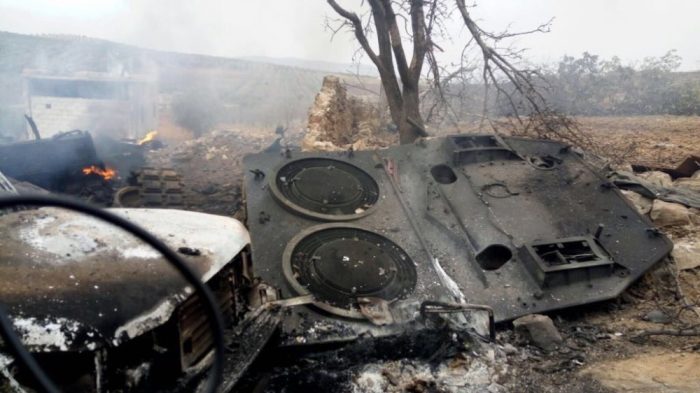
The article links to photographs of the destroyed Leopard 2 tanks, sometimes side by side Turkish infantry fighting vehicles and with at least two with their turrets completely blown off the hulls of the tanks, illustrating just how vulnerable any main battle tank is, Russian or Western, to modern anti-tank weapons. The National Interest lists AT-7 Metis and AT-5 Konkurs antitank missiles, both produced by the Soviet Union and now the Russian Federation, as the culprits in at least 5 of the destroyed Leopard 2 tanks.
While the most widely produced Western main battle tank is the M1 Abrams, because of its fuel-hungry turbine engine and exceptionally heavy weight, it is impractical to send in large numbers to Ukraine. The Leopard, produced in large numbers and used widely across NATO with its diesel engine makes it the most likely candidate to replace the bulk of Ukraine’s tank force, but considering its performance against even irregular forces on the battlefield, this leaves only bleak prospects for Ukraine.
The British Challenger 2 has fared no better on the battlefield. The myth that it has is owed to cover-ups and deliberate war propaganda as exposed by a 2007 Telegraph article titled, “MoD kept failure of best tank quiet,” which noted:
The Ministry of Defence had claimed that an attack last month that breached a tank’s armour was the first of its kind in four years of war in Iraq. But another Challenger 2 was pierced by a powerful rocket-propelled grenade in August last year during an attack that blew off part of a soldier’s foot and injured several others.
The article pointed out that the weapon that likely damaged the Challenger 2 was the Russian-made RPG-29. It notes:
The RPG-29 is a much more powerful weapon than the common type regularly used by insurgents to attack British troops. It is specifically designed to penetrate tank armour, although this is the first occasion on which it has managed to damage a Challenger.
And what of other Western main battle tanks which share similar design and doctrinal philosophies? Have they performed any better? It is a question worth considering both to assess the combat potential of Western armored vehicles in general and to get ahead of additional transfers to Ukraine that might include these other vehicles.
The M1 Abrams, like the Challenger 2, has a legendary reputation. However, the US itself had multiple M1 Abrams knocked out in Iraq from 2003 onward. A CBS New article from 2003 titled, “U.S. Tank Hit, 2 GIs Dead In Iraq,” noted that the knocked out M1 Abrams was damaged by either a bomb or an improvised explosive device.
The M1 Abrams has been transferred to US allies including Saudi Arabia. A 2016 Defense One article titled, “Saudi Losses in Yemen War Exposed by US Tank Deal,” would explain:
The U.S. State Department and Pentagon Tuesday OKed a $1.2 billion sale of 153 Abrams tanks to Saudi Arabia Tuesday. But that’s not the real news.
Turns out: 20 of those tanks, made in America by General Dynamics Land Systems, are “battle damage replacements” for Saudi tanks lost in combat.
Even though the formal announcement of the sales does not say where the tanks were fighting, the Saudi military is believed to have lost some of its 400-plus Abrams tanks in Yemen, where it is fighting Iranian-backed Houthi separatists.
It is very clear that far from invincible, despite the massive weight and heavy fuel consumption of the M1 Abrams, even irregular forces are capable of facing off and defeating the US main battle tank.
Pundits have claimed that heavy losses of Saudi M1 Abrams are owed to the fact that exported M1 Abrams lack key features including special armor and fire control elements responsible for their poor performance. However, it is unlikely the US would ever transfer M1 Abrams to Ukraine with classified armor or highly sophisticated fire control systems for precisely the same reasons the US has not sent any of its modern unmanned aerial vehicles like the Gray Eagle. The capture of either of these weapon systems by Russian forces – a very common phenomenon amid the special military operation – would mean these advanced features would quickly be under examination by Russian engineers.
And finally, while Israeli Merkava main battle tanks are highly unlikely to end up in the hands of Ukrainian forces, the Merkava is considered one of the best main battle tanks on Earth. They too, however, have not only performed poorly against modern anti-tank weapons, but anti-tank weapons produced by the Russian Federation.
Haaretz in its 2006 article, “Hezbollah Anti-tank Fire Causing Most IDF Casualties in Lebanon,” would report:
The Hezbollah anti-tank teams use a new and particularly potent version of the Russian-made RPG, the RPG-29, that has been sold by Moscow to the Syrians and then transferred to the Shi’ite organization.
The RPG-29’s penetrating power comes from its tandem warhead, and on a number of occasions has managed to get through the massive armor of the Merkava tanks.
It should be noted that in each case, whether it was Turkish forces in northern Syria, Saudi forces in Yemen, US and British forces in Iraq, or Israeli forces pushing into southern Lebanon, each military operation consisted of well-trained tank crews supported by large-scale logistical lines and as part of well-organized combined arms combat including infantry, artillery, and air support.
What will happen when Ukrainian tank crews given abbreviated training attempt to employ Western main battle tanks on the battlefield, only without the proper logistical or combined arms support Turkey, the US and UK, Saudi Arabia, and Israel were capable of? And what will happen when these Ukrainian tank crews go up against Russian-made anti-tank weapons proven over the years to be highly effective against the very best Western main battle tanks now that these anti-tank weapons are in the hands of Russian troops themselves?
It was Russian forces destroying hundreds upon hundreds of Ukrainian armored vehicles over the course of the special military operation, exhausting both Ukraine’s initial inventories and then NATO’s inventories of Soviet-era equipment that has prompted the West to consider sending their own armor in the first place.
Effective Russian-made anti-tank weapons like the guided AT-7 Metis and AT-5 Konkurs but also the newer 9M133 Kornet missile along with RPG-29 and now RPG-30 rocket propelled grenades will surely produce the same destructive results experienced by Turkish, US, British, Saudi, and Israeli tank crews. But Ukrainian forces will also face hundreds of Russia’s own main battle tanks including modernized T-72 and T-80 tanks, as well as the newer T-90 Proryv. Russian military aviation also has a variety of weapons capable of precision strikes on armored vehicles and Russian artillery is more than capable of destroying main battle tanks even on the move using laser-guided Krasnopol artillery rounds.
In other words, Ukrainian tank crews will be less prepared and fighting under less-than-ideal conditions than their Western counterparts and fighting against a much larger arsenal of anti-tank weapons both in terms of quantity and quality. Just as other Western “wonder weapons” had supposedly “turned the tide” including the M777 155mm howitzer and the HIMARS GPS-guided multiple launch rocket system, Ukraine finds itself in need of yet another “wonder weapon” to induce yet another badly needed “turning of the tide.” Western main battle tanks will help Ukraine prolong the conflict, but ultimately Kiev and its Western sponsors will find themselves right back to where they started.
Brian Berletic is a Bangkok-based geopolitical researcher and writer.
Featured Video

AIDS Inc. by Gary Null (2007)
or go to
Aletho News Archives – Video-Images
From the Archives
Clash of Civilization, Iran Part II
By Jamal Kanj – Intifada-Palestine.com – January 14, 2011
Israel’s survival kit is: perpetuate conflict, insecurity to rationalize collective hate and finally playing victim.
Devoid of conflict, Israel implodes internally; without hate, Zionism loses its justification; and playing eternal victim to continue blackmailing the West. Absence of this holy trinity, Israel ceases to exist.
From its inception, the house of Zion has mastered exploiting adversarial powers to advance Israel’s cause. For instance, their influence over the Democratic Party in the US began with President Truman’s bid for 2nd term election in 1948.
Responding to strong opposition from Secretary of State General George Marshall and Department experts urging against recognition of Israel, President Truman replied: “I’m sorry gentlemen but I have to answer to hundreds of thousands [Jewish voters] who are anxious for the success of Zionism. I do not have hundreds of thousands of [voting] Arabs among my constituents”
Zionists influence over liberal American politics was matched with the doctrinal school of Conservative theoreticians aligning the Republican Party’s platform with Israel’s objectives. The Neoconservative Zionists, coined Zioncons, invented the “Clash of Civilization” concept to fight Israel’s wars. … continue
Blog Roll
 Aletho News
- 12 Things Your Psychiatrist Was Trained Not to Tell You
- From Unipolar Universalism to Multipolar Civilizational Distinctiveness
- RSF military group defects, joins Sudanese army: State media
- Ireland goalkeeper refuses to play ‘Israel’ as squad weighs boycott
- China pushes back against US on Cuba, Iran
- Ukrainian Soldiers, Potential Mercenaries: Have Gun, Will Travel!
- Burnham’s UN debut… A masterclass in British disinformation
- Iran flights continue despite US aviation sanctions
- Global Tipping Points Lead the World Into a State of Entropy
- The day-after at the White House: USA and Xi Jinping
- If Americans Knew
- Israel forces Gazans to live in constant peril – Daily Update
- Deconstructing Netanyahu’s pants-on-fire UN rant – Daily Update
- Trump betrayed voters with his campaign lies and prioritized a foreign country once he took office
- Netanyahu calls Israel’s war in Gaza ‘opposite of genocide’ in UN speech to near-empty hall
- Settler Kidnappings: Torture, Sexual Abuse and Terrorisation of Palestinian Abductees as Israel Deepens Annexation of West Bank
- Gaza winter nears as 162,000 tents become unusable, raising fears of humanitarian crisis
- Netanyahu says, “It’s the opposite of genocide”; UN says Gaza economy is world’s ‘most severe crisis on record’ – Daily Update
- Israel’s US-Backed Assault on Gaza Has Created the ‘World’s Most Severe Economic Crisis on Record’: UN
- ‘Protecting U.S. Citizens’… From Israel
- ‘This is where I live now, the back of a truck’: a day in the life of a grandmother in Gaza
- No Tricks Zone
- New Study: Earth And Venus Surface Warmth Largely Explained By Convection And Lapse Rate, Not CO2 Or Radiation
- 2025 Nature Paper Claiming Worsening Global Drought Gets RETRACTED …Heavily Flawed
- New Study: ‘Global Drought Shows No Detectable Recent Acceleration Under Climate Warming’
- Economic Masterminds: German Socialists Suggest Taxing Productivity Gains Stemming From Using AI
- The South China Sea Has Not Been Cooperating With The Climate Change Narrative
- Energy Crisis: Germany Enters Heating Season With Historically Low Gas Reserve Fill Levels
- New Study: The Antarctic Ice Sheet Gained Mass From 2020-2024 Due To Staggering Snow And Ice Accumulation
- Study: Ocean Heating Rates From Thousands Of Years Ago ‘Dwarf’ Modern Ocean Heating Rates
- Climate Extremists Target, Attack Large-Scale Power Grid Infrastructure In Germany!
- New Study: Antarctic Ice Melt Has Contributed Less Than 1 Centimeter To Sea Level Rise In The Last 30 Years

