US vows to block new attempt by Palestine for full UN membership
Press TV – April 3, 2024
The United States has vowed to block a new attempt by the Palestinians for full membership in the United Nations.
Supporters of the Palestinian move asked the UN Security Council on Tuesday to revive an application for admission submitted in 2011.
But Robert Wood, the US deputy ambassador to the UN, was again almost certain to block the request. “Our position has not changed,” Wood told several reporters.
Wood said the issue of a full Palestinian membership is one of the final status issues to be decided in bilateral talks between the Palestinians and Israel.
At least 140 countries have recognized a Palestinian state. They include members of the 22-nation Arab Group at the United Nations, the 57-nation Organization of Islamic Cooperation, and the 120-member Nonaligned Movement.
Malta’s UN Ambassador Vanessa Frazier, who is the current president of the Security Council, said the Council’s standing committee for new members, which includes all the 15 members, is expected to meet behind closed doors to consider the application.
The monthly Security Council meeting on April 18 will also consider the issue of Palestine’s full membership.
After the initial bid for full UN membership was rejected in 2011, the Palestinians went to the 193-member UN General Assembly, where there are no vetoes. They succeeded by more than a two-thirds majority in having their status raised from a UN observer to a non-member observer state in November 2012.
That change opened the door for the Palestinian territories to join the UN and other international organizations, including the International Criminal Court (ICC).
Riyad Mansour, the permanent observer of Palestine to the United Nations, has repeatedly said in recent months that in the face of Israel’s brutal campaign of death and destruction in the besieged Gaza Strip, UN membership is a priority for the Palestinians.
Israeli Prime Minister Benjamin Netanyahu has long ruled out Palestinian statehood.
Is America a Rogue Superpower?
By Ted Snider | The Libertarian Institute | March 27, 2024
“Unipolar” used to mean that the United States was, at least in theory, alone in leading the world. Now “unipolar” means that the United States is alone and isolated in opposition to the world.
In global affairs, a hegemon is a nation that leads because it has the consent of the other nations who believe in its goals and values. The United States has recently demonstrated, though, that it has given up any pretense of using its leadership to pursue the goals of the global community, and instead is openly using the global community to pursue its own goals.
In his new book, The Lost Peace, Richard Sakwa explains the distinction between the pursuit of hegemony and the pursuit of primacy. Primacy “entails predominance and the conscious attempt to thwart the ambition of others.” In its recent performance at the United Nations, the United States is performing, not out of hegemony as it usually described, but out of primacy.
As a hegemon, the U.S. wields the power to veto in the Security Council. But in the exercise of primacy, it has recently used that veto to supress the clearly expressed voice of the international community.
After repeated American vetoes of measures calling for an immediate humanitarian ceasefire in Gaza, in a desperate and seldom used move, on December 12, the General Assembly invoked Resolution 377A in an attempt to circumvent U.S. leadership. It was the response to what was perceived as America’s irresponsible use of its veto power as a permanent member of the Security Council.
It does not matter that the vote was on the war in Gaza, nor on whether you agree with the United States. What is significant is the assumption by Washington of the role of roadblock and not leader of the international will.
Article 377A first reminds the permanent members of the Security Council that they are obliged to “to seek unanimity and exercise restraint in the use of the veto” in pursuit of the maintenance of international peace and security. It then gives the General Assembly the right to make “appropriate recommendations to Members for collective measures… to maintain or restore international peace and security” when the Security Council “because of a lack of unanimity… fails to exercise its primary responsibility.”
The world saw the United States, not as a hegemon leading the world in the pursuit of unanimity, but as failing “to exercise its primary responsibility” as a leader on the Security Council.
On March 25, the U.S. went one step further and took a step toward becoming a rogue state who has supplanted international law with its rules-based order. International law is grounded in the charter system and the United Nations and is universally applicable. The rules-based order is composed of unwritten laws whose source, consent, and legitimacy are unknown. To the global majority, those unwritten laws have the appearance of being invoked when they benefit the U.S. and its partners and not being invoked when they don’t.
On March 25, the Security Council passed a resolution demanding “an immediate ceasefire for the month of Ramadan respected by all parties leading to a lasting sustainable ceasefire.” The resolution was able to pass because the U.S. stood aside and let the other fourteen Security Council members pass it by abstaining instead of vetoing.
But in her explanation of the American abstention after the resolution passed, U.S. Ambassador to the UN Linda Thomas-Greenfield “surprisingly” said that “we fully support some of the critical objectives in this nonbinding resolution.”
Her claim that the Security Council resolution was nonbinding was not an off script, impromptu comment. It is the strategy of a country that enforces, not international law, but the U.S. led rules-based order.
In a March 25 press briefing following the vote and Thomas-Greenfield’s claim, White House National Security Communications Advisor John Kirby called the resolution “nonbinding” no less than four times. “Number one,” he said, “it’s a nonbinding resolution. So, there’s no impact at all on Israel and Israel’s ability to continue to go after Hamas.”
When asked by a reporter, “on the binding thing, is it binding, nonbinding?” Kirby answered, “It’s a nonbinding resolution.” When asked “a technical question” a second time to clarify if the resolution was nonbinding, Kirby again said, “My understanding is it’s a nonbinding resolation—resolution.”
At a State Department press briefing the same day, department spokesperson Matt Miller also called the resolution “nonbinding” three times.
All UN Security Council resolutions are legally binding and have the status of international law. That is why UN Secretary General António Guterres said, “This resolution must be implemented. Failure would be unforgivable.” UN deputy spokesperson Farhan Haq explained that, “All the resolutions of the Security Council are international law. They are as binding as international laws.”
Others responded the same way to the U.S. claim. On behalf of the ten elected members of the Security Council who drafted the resolution, Pedro Comissario, Mozambique’s envoy to the United Nations, said, “All United Nations Security Council resolutions are binding and mandatory.” He then added, “It is the hope of the 10 that the resolution adopted today will be implemented in good faith by all parties.”
The United Kingdom also did “not share” the U.S. claim, prompting their envoy to the UN to say, “we expect all Council resolutions to be implemented. This one is not any different. The demands in the resolution are absolutely clear.” China, too, did not share the U.S. evaluation. “China’s U.N. Ambassador Zhang Jun said Security Council resolutions are binding.”
By judging Security Council resolutions to be nonbinding and denying their status as being as binding as international law, the United States has taken the next step from hegemony to primacy to a rogue state that has undermined the foundational role of the Security Council in the international order.
UN Rapporteur Says Received Threats since She Started Mission on Palestine
Al-Manar | March 27, 2024
UN Special Rapporteur for Human Rights in Palestine Francesca Albanese said there are “reasonable grounds” to believe that ‘Israel’ is committing genocide against Palestinians in Gaza.
She was speaking at the UN Human Rights Council in Geneva on Tuesday, where she presented her latest report, entitled ‘Anatomy of a Genocide’, during an interactive dialogue with Member States.
“Following nearly six months of unrelenting Israeli assault on occupied Gaza, it is my solemn duty to report on the worst of what humanity is capable of, and to present my findings,” she said.
“There are reasonable grounds to believe that the threshold indicating the commission of the crime of genocide has been met.”
Citing international law, Albanese explained that genocide is defined as a specific set of acts committed with the intent to destroy, in whole or in part, a national, ethnic, racial or religious group.
“Specifically, Israel has committed three acts of genocide with the requisite intent, causing seriously serious bodily or mental harm to members of the group, deliberately inflicting on the group conditions of life calculated to bring about its physical destruction in whole or in part, and imposing measures intended to prevent birth within the group,” she said.
Albanese said denial of the reality and the continuation of Israeli impunity and exceptionalism is no longer viable, especially in light of the binding UN Security Council resolution, adopted on Monday, which called for an immediate ceasefire in Gaza.
Meanwhile the UN special rapporteur revealed that she has been attacked and received numerous threats since she began her mission.
UN Security Council passes Gaza resolution, Israel fumes at US for not using veto power
Press TV – March 25, 2024
With the United States abstaining, the United Nations Security Council has finally adopted a long-awaited resolution that demands an immediate ceasefire in the Gaza Strip.
The resolution was put forward by the 10 non-permanent members of the Security Council. It received unanimous support from the remaining 14 members on Monday.
Washington had already vetoed similar bids three times since Israel started its brutal campaign in Gaza in early October.
The resolution demands an immediate ceasefire for the Muslim holy month of Ramadan and the release of Israelis the resistance movement Hamas took captive during Operation Al-Aqsa Storm on October 7, 2023. It also underscores the “urgent need to expand the flow” of aid into Gaza.
The regime says 253 Israelis were taken captive during the operation.
Given the duration of Ramadan, the truce demanded by the resolution would last for about two weeks.
The draft, however, says the truce should lead to a “lasting, sustainable ceasefire.”
Failure to implement truce ‘unforgivable’: UN chief
Right after the vote, UN Secretary-General Antonio Guterres welcomed the resolution.
“This resolution must be implemented. Failure would be unforgivable,” Guterres posted on X.
The Palestinian Ambassador to the UN Riyad Mansour said in remarks to the Security Council that the resolution must be “a turning point” in ending hostilities in Gaza.
“This must signal the end of this assault, of atrocities against our people.”
Hamas also welcomed the prospective ceasefire, saying the resistance group is ready for a prisoner exchange.
Slamming ‘US retreat’ at UN
Benjamin Netanyahu, the prime minister of Israel, responded to Washington’s abstention.
He said the move, which allowed the resolution to pass, “hurts both the war effort” and the effort to release the captives, according to a statement by his office.
Netanyahu “made it clear last night that if the US withdraws from its principled position, he will not send the Israeli delegation to the US.”
“This is a clear retreat from the consistent position of the United States at the Security Council since the beginning of the war.”
President Joe Biden of the United States had asked Netanyahu to send a team for consultations over the regime’s plans to launch a full-scale ground invasion of Gaza’s southern city of Rafah, where more than 1 million Palestinians have sought shelter.
The UN Security Council’s call for a ceasefire comes as international fears have grown over the planned Israeli ground invasion.
Human rights groups say a ground invasion of Rafah would drastically worsen a heavy civilian death toll and humanitarian crisis in Gaza.
Russia explains stance on US-proposed Palestine “cease fire” resolution
Explanation of vote by Permanent Representative Vassily Nebenzia at the UNSC vote on US-proposed draft resolution on the situation in the Middle East, including the Palestinian question
Permanent Mission of the Russian Federation to the United Nations | March 22, 2024
Before the vote:
Mr. President,
For six months now, the UN Security Council has been unable to adopt a resolution demanding a ceasefire in Gaza. Time and again, the United States thwarted any attempt to do so by using a veto in cold blood as many as four times.
During that time, we have heard many different excuses from our American colleagues. For example, that it is premature to seek a ceasefire because it is necessary to give space “for Israel’s counter-terrorism efforts”; that the Council should not interfere with Washington’s “effective diplomacy on the ground”; that we should wait until Ramadan, when, they say, an agreement on a cessation of violence will definitely be made.
Now, six months later, when Gaza has been practically leveled with the ground, the US representative says without batting an eye that Washington finally starts to realize the need for a ceasefire.
This leisurely thinking process by Washington has cost the lives of 32,000 Palestinian civilians, two-thirds of them women and children.
And even now we see a typical hypocritical show, when in the wrapper of a “ceasefire” the United States is trying to sell to the members of the Security Council and the entire international community something else – a vague phrase about “defining the imperative of a ceasefire”. Such philosophy about moral imperatives looks naturally in the works of Immanuel Kant. But it is not enough to save the lives of Palestinian people. And that is not at all what the mandate of the UN Security Council suggests, which has a unique toolkit to demand a ceasefire and, if necessary, enforce it.
In an official interview to Al Hadath in Jeddah on 20 March, Secretary of State Blinken said, “Well, in fact, we actually have a resolution that we put forward right now that’s before the UNSC that does call for an immediate ceasefire tied to the release of hostages and we hope very much that countries will support that”. However, the US-proposed draft resolution does not make such call. It appears that either the US Permanent Representative to the United Nations or the US Secretary of State deliberately mislead the international community.
Colleagues,
From the very beginning, it was obvious that the “negotiations” on the draft resolution held by our American colleagues were only meant to delay time. All our comments and “red lines” were ignored, as well as the proposals of a number of other delegations. This was not a normal work on a document. It felt more like speaking into the void.
The US draft is a thoroughly politicized document, which only aims at pulling on voters’ heartstrings before the US elections by throwing them a “bone” in the form of at least some mention of a “ceasefire” in Gaza. The draft also seeks to consolidate US policy in the region through “terrorist labels” and to ensure impunity for Israel, whose criminal actions the draft gives no assessment to.
Let me also stress that the American draft contains a de facto green light for Israel to conduct a military operation in Rafah. At least, the sponsors have tried to make sure that nothing in their draft would prevent West Jerusalem from completing the deadly cleanup of southern Gaza.
That is actually what Washington wants. We already said that we will no longer pass meaningless resolutions that do not demand a ceasefire and lead us nowhere.
This draft must not pass with the majority of UNSC votes in order to send a message that Washington’s not even palliative but devious concepts are unacceptable. It will be extremely strange if those members of the Council (and they are the majority), who realize this and have been saying to us that the US draft is a flawed one, will now raise their hand in favor. If you do so, you will smear yourselves in disgrace.
Think what this will make you look in the eyes of the people of the Middle East and your own countries, if you support this hypocritical endeavor designed to disorient the international community and, in fact, undermine the authority of the Council by rendering it unable to influence the situation on the ground and making it “stay out of White House’s way”. Are you ready to play a part in this shameful show?
Russia will not do this. As a permanent member of the Security Council and one of the founders of the United Nations, we recognize the global historical responsibility for the maintenance of international peace and security and cannot allow the Council to become a tool of Washington’s destructive policy in the Middle East. If this resolution were adopted, it would definitively close the debate on the need for a ceasefire in Gaza, give Israel a free hand and condemn Gaza and its entire population to extermination or expulsion.
In our work, we are not guided by what pleases Washington or its satellites who are ready to cast a vote at the US behest, but by what is necessary for the Palestinians and what promotes peace.
We urge the members of the UN Security Council to prevent this and vote against the American draft resolution.
Mr. President,
In order for the UN Security Council to still be able to implement its mandate to maintain international peace and security, a number of non-permanent UNSC members have prepared an alternative draft resolution that spells out in black and white the requirements for both a ceasefire and the unconditional release of hostages. It is a balanced and depoliticized document.
We see no reason why members of the Security Council could refuse to support it, unless a ceasefire and the release of hostages are not part of their plans. This is an attempt to allow the Council to carry out the noble functions entrusted to it. We urge to not miss it.
Thank you.
After the vote:
Mr. President,
We have now listened to the hypocritical speeches of some Council members shedding crocodile tears over the Russian and Chinese vetoes. We have explained the reasons why we did not pass this resolution. It was not because it was put forward by the United States delegation, as the American Permanent Representative tried to assure us today. I told you – those of you who voted here today – that you would cover yourselves in disgrace by voting in favor of an American text that was unacceptable to you (including those of you who are now praising it).
Do you want me to say what really happened? Not hard to guess, the scenario is not complicated at all. Your American masters, in addition to “twisting the arms” of your leaders in the capitals, said, “Don’t you worry, Russia will veto anyways, so you won’t have to go against the American draft.” That’s it, that’s the whole scenario. So stop this hypocrisy about how upset you are that Russia and China vetoed the resolution. Once again, you have covered yourselves in disgrace today by voting in favor of a draft resolution that you did not and do not really support.
Thank you.
Israel ‘deliberately’ pursuing policy of destroying Palestine: Iran
Press TV – March 5, 2024
Iran’s foreign minister has condemned the “unprecedented” crimes Israel has committed in the besieged Gaza Strip over the past five months.
The Israeli hostilities prove the regime is “deliberately” pursuing the policy of destroying Palestine, Hossein Amir-Abdollahian stated.
The Iranian minister was addressing an emergency meeting of the Organization of Islamic Cooperation (OIC)’s foreign ministers in the Saudi city of Jeddah on Tuesday.
The meeting, requested by Iran and some other Islamic countries, was held to review the latest developments in Gaza and to discuss effective measures to halt the Israeli campaign of death and destruction in the besieged Palestinian territory.
“In a situation where we are once again witnessing the inability of the UN Security Council to deal with the oldest and most bitter humanitarian crisis in contemporary history, the consensus of Islamic countries to find practical ways and take more serious measures to support the Palestinian people and help find a way out of the status quo is absolutely urgent and necessary,” Amir-Abdollahian told the OIC meeting.
Warning that the dire humanitarian situation in Gaza as well as atrocities in the occupied West Bank have reached an “unprecedented” level, Iran’s top diplomat said Washington, through its unwavering support for Israel, is practically giving the regime a “green light” to go ahead with a planned military invasion of Rafah, where more than half of Gaza’s population is now crammed into the southern city bordering Egypt.
“It is unfortunate that senior officials of the United States, with their stances, are practically giving the Zionist regime a green light to launch a military attack on Rafah.”
The Iranian foreign minister said Washington’s blatant obstruction of UN Security Council measures to prevent the Israeli aggression in Gaza shows relying on the US to “prevent the ongoing genocide is an illusion and more of a diplomatic joke.”
The US is an accomplice and partner in the crimes of Israel, Amir-Abdollahian said, adding that the “crocodile tears” by certain US officials over the humanitarian situation in Gaza “do not change the reality.”
The foreign minister told the OIC that any economic and financial relations with the Israeli regime amounts to “facilitating the continuation of its heinous behavior” toward the Palestinians.
Calling for a broader boycott of products manufactured by Israeli companies, Amir-Abdollahian said under the current circumstances it is imperative for the OIC to “take decisive and effective practical measures to support the Palestinians.”
“This is our human and Islamic duty towards our Palestinian brothers and sisters. Preventing a new disaster against the Palestinian nation is an immediate necessity,” he said.
The Israeli regime launched the savage campaign in Gaza on October 7 after the Palestinian resistance movement Hamas carried out a surprise operation against the occupying entity in response to the regime’s never-ending atrocities against Palestinians.
The regime has since killed at least 30,600 Palestinians, mostly women and children. Thousands more are also missing and presumed dead under the rubble.
US, pushed by Israel, involved in widening war despite consequences: Iran FM
Press TV – February 28, 2024
Iran’s Foreign Minister Hossein Amir-Abdollahian says the United States is involved in the expansion of the scope of the Israeli war on Palestinians in the besieged Gaza Strip to other fronts across the West Asia region.
Amir-Abdollahian stressed that Israeli prime minister Benjamin Netanyahu is seeking to widen the Gaza war and involve the United States in a way that goes beyond the all-out support Washington and some of its allies have already provided for Tel Aviv.
“The Americans do not yet have the necessary will to stop the war, but at the same time, they are sending messages expressing their unwillingness to expand its scope because they are well aware of the danger of expanding its scope,” the top Iranian diplomat said.
“On the other hand, they are expanding the scope of the war through their joint aggression with the UK against Yemen.Today in Europe, everyone talks about the necessity of stopping the war, but Britain is playing a double game.”
He made the statement in an interview with Lebanon’s Arabic-language al-Mayadeen television news network in the Swiss city of Geneva on Tuesday,
Amir-Abdollahian added that Washington’s talk of reducing the intensity of the Gaza war, rather than stopping it, is a “mistake and malicious behavior that means giving the green light to Netanyahu” to press ahead with its months-long brutal aggression.
“I told the British foreign minister that the joint British-American aggression against Yemen is a strategic mistake that you are committing,” he said. Yemen has “proven that they do not trifle with any party regarding the security of their lands. They have been able to convey this message and clearly warned that ships carrying military cargo to Israel will be stopped.”
US hypocrisy on Gaza
The Iranian foreign minister also pointed to the US administration’s unswerving support to Israel in its brutal war on the besieged Palestinian territory and its continued supply of weapons and logistics to the occupying regime.
“Our information has it that the process of sending weapons from all American bases in the region and its warships to Tel Aviv is continuing,” he said, adding, “Islamic countries should not be turned into a place to supply weapons to the Israeli entity.”
Denouncing the US hypocrisy in dealing with the Gaza war, Amir-Abdollahian said, “Everyone agrees that if the United States abandons its military support for the occupying entity, Netanyahu will not be able to continue the war against Gaza for even an hour.”
The top Iranian diplomat also stressed that Israel did not achieve any of its declared goals in the war on Gaza, including the elimination of the Palestinian resistance movement Hamas, the group’s disarmament and the arrest of its Gaza-based leader Yahya Sinwar.
“The Lebanese and Palestinian resistance movements are at their best despite all the challenges and difficulties, and that they have the material and human resources and capabilities necessary to continue to withstand a longer war than what we have seen so far,” Amir-Abdollahian said.
Praising the morale and steadfastness of the residents of Gaza and the occupied West Bank, he underlined that the Israeli plans in Rafah “will not translate into reality and the occupation will not be able to forcibly displace people to the Egyptian Sinai.”
UN performance ‘unacceptable’
Elsewhere in his interview, the Iranian foreign minister censured as “unacceptable” the United Nations’ performance regarding the situation on the ground in Gaza and the occupied West Bank, saying the UN Security Council has not fulfilled its duty in light of the United States’ use of its veto.
“The Security Council did not fulfill its duty as the US continuously and unilaterally exploited its veto power. Every prospect and proposal of a Gaza ceasefire has been rejected by the American veto, exhibiting a contradictory behavior to the banners of primary human rights. Even at the UN Human Rights Council, we still have not seen any adequate mobilization in this regard,” he said.
“Does the UNHRC not want to create a special committee that relays the facts and investigations into war crimes, genocide, and human rights violations being committed in Gaza? So far, we have not witnessed a singular decisive measure taken by any of the organizations that fall under the UN.”
Amir-Abdollahian said UN Secretary-General Antonio Guterres had so far taken some good measures but had not been able to help the people of Gaza “in an effective and real way” through the existing mechanisms of the United Nations.
“In the Human Rights Council, we clearly see that everything is subject to the control of politicians and false human rights advocates,” he said.
Israel launched the campaign of death and destruction on October 7, after Hamas-led Palestinian resistance groups conducted the surprise Operation Al-Aqsa Storm against the occupying entity in response to the regime’s decades-long atrocities.
Israel has killed nearly 30,000 people and injured more than 70,000 others in Gaza since that October day.
UN experts: Inhumane Israeli troops sexually assault Palestinian girls
Press TV – February 19, 2024
In yet another shocking revelation, the Special Rapporteurs of the UN Human Rights Council say Palestinian women and girls are being sexually assaulted and raped by Israeli troops in the besieged Gaza Strip and the occupied West Bank.
During a public hearing at the International Court of Justice (ICJ) on Monday, the UN experts said they were “shocked by reports of the deliberate targeting and extrajudicial killing of Palestinian women and children in places where they sought refuge.”
According to information they received, they told the hearing that hundreds of Palestinian women and girls are being detained and subjected “to inhuman and degrading treatment.”
“On at least one occasion, Palestinian women detained in Gaza were allegedly kept in a cage in the rain and cold, without food.”
They said they were distressed by reports that the Palestinians in question have been “subjected to multiple forms of sexual assault, such as being stripped naked and searched by male Israeli army officers.”
“At least two female Palestinian detainees were reportedly raped while others were reportedly threatened with rape and sexual violence.”
They said Israeli forces took photos “of female detainees in degrading circumstances,” and shared them on social media platforms.
The experts said an unknown number of the Palestinians have gone missing after contact with the regime’s forces in Gaza.
“There are disturbing reports of at least one female infant forcibly transferred by the Israeli army into Israel, and of children being separated from their parents, whose whereabouts remain unknown.”
The Special Rapporteurs warned Israel that these inhumane acts could “amount to serious crimes under international criminal law that could be prosecuted under the Rome Statute.”
“Those responsible for these apparent crimes must be held accountable and victims and their families are entitled to full redress and justice.”
The Special Rapporteurs are independent experts – part of what is known as the Special Procedures of the UN Human Rights Council – whose mandate is to follow and report on the human rights situation of a specific country or thematic issues in all parts of the world.
The public hearings began at the ICJ in the Hague – at the request of the UN General Assembly – on Monday to examine the legal consequences of Israel’s occupation of the Palestinian territories.
US changes position on Gaza ceasefire – Reuters
RT | February 19, 2024
US President Joe Biden’s administration has reportedly dropped its opposition to a humanitarian ceasefire in the Gaza Strip and proposed a UN resolution calling for Israel to cancel its planned military offensive in the Palestinian enclave’s last refuge for displaced civilians.
The draft resolution noted that the planned storming of Rafah would harm civilians and displace more Gaza residents, potentially pushing many into Egypt, Reuters reported on Monday, citing a copy of the text.
Israel’s Rafah operation – targeting the last Hamas stronghold in the besieged enclave – “would have serious implications for regional peace and security, and therefore underscores that such a major ground offensive should not proceed under current circumstances,” according to the proposed resolution.
Washington’s UN delegation has previously opposed making demands for a ceasefire in the Israel-Hamas war and has twice vetoed UN Security Council resolutions since the conflict began in October. Its new proposal comes in response to a draft resolution from the Algerian delegation, which demanded an immediate humanitarian ceasefire.
US Ambassador to the UN Linda Thomas-Greenfield has said the Algerian resolution could undermine “sensitive negotiations” to broker a pause in the fighting. She indicated on Saturday that the US would veto the resolution if it came up for a Security Council vote on Tuesday.
About 1.4 million Gazans displaced by Israeli bombardments have been crammed into Rafah, a city on the strip’s southern border that normally has a population of around 280,000, according to the UN.
The UN has warned that Israel’s planned Rafah operation would have “dire humanitarian consequences.” Dozens of European countries issued a similar warning on Monday, following in the footsteps of such nations as Egypt, Saudi Arabia, Australia, Canada, and New Zealand.
Israeli Prime Minister Benjamin Netanyahu has vowed to completely eliminate Hamas in response to the deadly October 7 attacks by Palestinian militants that triggered the war. He has rejected international calls for a ceasefire and has insisted that only “total victory” will make Israel safe. “Those who want to prevent us from operating in Rafah are essentially telling us, ‘Lose the war,’” he told reporters on Saturday.
While publicly supporting Israel’s war effort – and providing US weaponry – Biden has reportedly clashed with Netanyahu behind the scenes. During a telephone call with Netanyahu on Thursday, Biden “reiterated his view that a military operation should not proceed without a credible and executable plan for ensuring the safety of, and support for, the civilians in Rafah,” according to a White House statement.
The UN resolution proposed by the Biden administration also would condemn any efforts to reduce Gaza’s territory or move Israeli settlers into the enclave, Reuters said.
Israeli military, intelligence bodies admit Hamas will survive onslaught on Gaza Strip
Press TV – February 18, 2024
Israeli military and intelligence institutions have warned the regime’s top-ranking authorities that the Palestinian Hamas resistance movement will survive the unrelenting ground and air strikes against the besieged Gaza Strip.
A document circulated from Israeli military leaders to senior politicians states that “authentic support remains” for Hamas among Gazans, according to a report published by the Hebrew-language Keshet 12 television channel.
The document, put together by the Israeli army’s research division, also warned that “Gaza will become an area in deep crisis”, given the lack of plan for the “day after” war.
The document was reportedly presented on Monday to leading Israeli officials following a week of senior military and intelligence talks about the findings, Keshet 12 noted.
Ilana Dayan, an investigative journalist at the broadcaster, said that the “bottom line” of the document was that the Hamas movement would inevitably survive Israel’s offensive.
The report comes as Israel prepares a ground offensive on Gaza’s southernmost city of Rafah.
The UN special rapporteur on Palestine has slammed Israeli prime minister Benjamin Netanyahu’s pledge to push on with the assault.
“Rafah stands as the last line of Palestinian existence in Gaza, amidst the relentless anguish faced by the people trapped therein,” Francesa Albanese wrote on X.
“How can we possibly allow another Nakba? Have we really lost our minds?”
According to diplomatic sources quoted by the AFP news agency, the UN Security Council is set to put to vote a new resolution put forth by Algeria that demands an “immediate” truce in Gaza.
The latest version of the text “demands an immediate humanitarian ceasefire that must be respected by all parties”, the agency said.
It also “rejects forced displacement of the Palestinian civilian population”, and it “demands the immediate and unconditional release of all hostages”, AFP reported.
Earlier, US Ambassador to the UN Linda Thomas-Greenfield issued a statement responding to reports that Algeria plans to put the resolution to a vote on Tuesday.
“Should it come up for a vote as drafted, it will not be adopted,” Thomas-Greenfield said.
The US has previously used its veto to prevent the UN Security Council from passing resolutions calling for a ceasefire in Gaza.
Meanwhile, Egypt’s President Abdel Fattah el-Sisi has reiterated his country’s “categorical rejection of the displacement of Palestinians to Egypt in any shape or form”.
During a phone conversation with his French counterpart Emmanuel Macron on Saturday, the two leaders agreed on the need to “stop the bloodshed” in the Gaza Strip and discussed advancing the establishment of an independent sovereign Palestinian state, a statement by the Egyptian presidency read.
Israel has been waging the war against Gaza since October 7, 2023, when the coastal sliver’s resistance groups staged an operation, dubbed Operation al-Aqsa Storm, against the occupied territories.
Nearly 29,000 Palestinians, mostly women, children, and adolescents, have been killed so far as a result of the brutal military onslaught.
Albanese: Israel is still practicing ethnic cleansing in the Gaza Strip, West Bank and Jerusalem
Palestinian Information Center – February 8, 2024
GAZA – The United Nations Rapporteur for Human Rights in the Palestinian Territories, Francesca Albanese, said on Wednesday that Israel has never respected the international law and has been allowed to violate it since 1967. It is still carrying out acts of ethnic cleansing in the Gaza Strip, the West Bank and Jerusalem.
The famine suffered by the residents of the Gaza Strip is unparalleled in the whole world, she said, stressing the necessity of taking all required measures to prevent genocide in Gaza.
Albanese said, in a press statement, “the more aid and ceasefire are delayed, the greater the number of casualties in the Gaza Strip will be.”
She accused Israel of ignoring the International Court of Justice’s ruling by killing more civilians everyday in Gaza, calling on world countries to put pressure on Israel by halting mutual commercial trades.
Albanese said she was shocked to know that member states of the International Court have recently attacked UNRWA, noting that the international community is capable of stopping the ongoing massacres carried out by Israeli occupation forces in the Gaza Strip.
The Israeli occupation’s ongoing aggression on the blockaded Gaza Strip has so far led to the martyrdom of 27,708 people and the injury of 67,147 others, in addition to the enforced displacement of more than 85 percent (about 1.9 million people) of the Strip’s population, according to official authorities and international bodies and organizations.
Featured Video
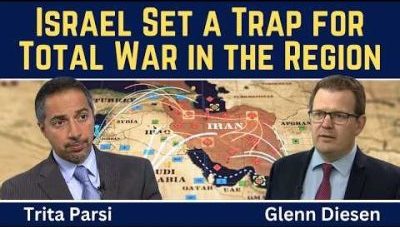
Trita Parsi: Israel Set a Trap for Total War in the Region
or go to
Aletho News Archives – Video-Images
From the Archive
Zionism’s Violent Legacy
By Donald Neff | Washington Report On Middle East Affairs | January 1996
On January 4, 1948, Jewish terrorists drove a truck loaded with explosives into the center of the all Arab city of Jaffa and detonated it, killing 26 and wounding around 100 Palestinian men, women and children.[1] The attack was the work of the Irgun Zvai Leumi – the “National Military Organization,” also known by the Hebrew letters Etzel – the largest Jewish terrorist group in Palestine. The Irgun was headed by Revisionist Zionist Menachem Begin and had been killing and maiming Arabs, Britons and even Jews for the previous ten years in its efforts to establish a Jewish state.
This terror campaign meant that at the core of Revisionist Zionism there existed a philosophical embrace of violence. … continue
Blog Roll
 Aletho News
- Trita Parsi: Israel Set a Trap for Total War in the Region
- Trump’s Iran war is on an Israeli leash
- Saudi oil boss issues global supply warning
- Riyadh Says Its Oil System Is Intact. The Numbers Say Otherwise.
- Trump and Netanyahu Want to “Finish the Job” on Iran
- US ‘one-sided dictation’ not Iran’s beliefs makes rational talks impossible: Baghaei
- Iran’s Next Strike May Not Explode. It Could Shut You Down /Col Doug Macgregor
- Iran: US political targets legitimate if assassinations return
- Iraq shuts key border crossing with Iran under US pressure: Report
- Undersea Internet cables could be targeted in retaliation for attacks on Iran: IRGC deputy chief
- If Americans Knew
- The Israel Lobby’s Changing Fortunes
- AIPAC has become such a political liability that it’s shifting to a more “nimble” approach to buying politicians
- At least 160 Israeli settler attacks in 2 weeks
- Will Gaza’s Ancient Christian Community Disappear Forever?
- Israel’s vision of regional security rests on keeping Arab states weak
- Heidi Levine recounts how Palestinian youths helped save her in settler attack
- DAILY UPDATE: Latest essential news on Palestine, Israel, & region
- Trump’s Intensifying Sabotage of the ICC, for Israel’s Sake
- Israeli military detain US and UK volunteers in West Bank including Democratic NY politician Brad Lander
- Americans at National Conservatism Conference held in Israel this year criticize Israel
- No Tricks Zone
- E-Cars Reduce CO2 Emissions By Only 41% Compared To Internal Combustion Engine Vehicles
- Predictions Made By Renowned Climate Professor Over Past Decades Have Been Proven To Be Poor
- New Study Suggests Large Regions Of The Pacific Ocean Have Been Cooling For The Last 80 Years
- Germany’s Green Energy Debacle: High Energy Costs Force Kahla Porzellan to Close After 182 Years!
- New Study: 50 Years Of The Most Aggressive ‘Net Zero’ Policies Can Only Affect The Global Climate By 0.03°C
- US September “Heat” Was No Record…Many Records Set Decades Ago
- Latest European Green Energy Debacle; Portugal’s Largest Flagship Solar Park Insolvent!
- Green Energy Debacle: German Expert Professor Fritz Vahrenholt Warns Of Severe Economic And Social Consequences
- Two More Paleo Reconstructions Affirm Meters-Higher Sea Levels Across Ireland, Brazil 7000-6000 Years Ago
- New Study: Earth And Venus Surface Warmth Largely Explained By Convection And Lapse Rate, Not CO2 Or Radiation

