Russia calls for reform of UN Security Council
Samizdat | August 3, 2022
The United Nations is in dire need of reform and the Security council must be “democratized” by expanding its representation, Russian foreign ministry official Alexey Drobinin has written in a keynote article published on Wednesday.
Drobinin, the Director of the Department of Foreign Policy Planning, commented on the current state of international relations and came to the conclusion that “more conscious effort and imagination is needed” to reform the UN.
He pointed out that the organization’s current agenda, which is primarily fueled by the West, is not necessarily in line with the interests of the majority of its international members.
Drobinin suggested that for most UN members the most important issues are things like access to cheap energy sources rather than the transition to “green” technologies, socio-economic development rather than human rights “in an ultra-liberal interpretation,” and security and sovereign equality rather than the artificial imposition of electoral democracy according to Western patterns.
He added that another topic that has once-again become relevant is the process of decolonization and ending the neo-colonial practices by transnational corporations in regards to the development of natural resources in developing countries.
However, international organizations such as the UN have essentially been “privatized” by the West, Drobinin points out. He suggests that the UN Secretariat and the offices of special envoys and special representatives of the Secretary General have all been saturated with the West’s own “tested” personnel, and that this also extended to non-UN organizations as well, such as the OPCW.
“The saddest thing is that this rust is eating away at the ‘holy of holies’ of the UN system – the Security Council,” Drobinin writes. “It devalues the meaning of the right of veto, which the founding fathers endowed to the permanent members of the Security Council with one single purpose: to prevent the interests of any of the great powers from being infringed, and thus save the world from a direct clash between them, which in the nuclear age is fraught with catastrophic consequences.”
While there are no “clear and simple recipes for correcting the situation here,” the diplomat continues, “clearly more conscious effort and imagination is needed when it comes to UN reform.” He goes on to suggest that the Security Council needs to be “democratized,” first of all by expanding the representation of African, Asian and Latin American countries.
Drobinin suggests that whatever the fate of international organizations such as the UN, WTO, IMF, World Bank or G20 is, the divisive policies of the West makes it “an absolute imperative for the coming years to form a new infrastructure of international relations.”
“After their frankly perfidious decisions and actions against Russia, its citizens and tangible assets, we simply cannot afford the luxury of not thinking about alternatives. Especially since many of our friends who have lost faith in Western benevolence and decency are thinking about the same thing,” the diplomat surmised.
Russia comments on UN Security Council expansion prospects
Samizdat | July 4, 2022
Moscow supports expanding the UN Security Council (UNSC), but not by admitting Germany and Japan, the Russian ambassador to China, Andrey Denisov, said on Monday.
Speaking during the plenary session of the UN World Peace Forum in Beijing, Denisov, whose key statements have been published on the embassy’s social media accounts, claimed that the Security Council has become a place where “the Western colleagues carry out propaganda, presenting their views as the ultimate truth.”
Therefore, he argued, there is a pressing need to reform the UN.
“Our country is in favor of expanding the composition of the UN Security Council on the basis of a broad consensus. To do this, it is necessary to increase the share of African, Asian and Latin American states,” Denisov said, explaining that this would make the council “more democratic.”
He added that Russia is open to the idea of membership for India and Brazil, but not Germany and Japan, “since this will not change the internal balance in any way.”
His remarks followed multiple calls from Ukrainian President Volodymyr Zelensky to strip Russia of its membership, amid Moscow’s military operation in his country. The US, however, has repeatedly made it clear that Russia will remain a permanent member of the UNSC, as there is no way to exclude the country.
There have been discussions about increasing the number of permanent Security Council members since the approval of the UN Charter in 1945. Brazil, Germany, India, and Japan have made the strongest demands.
The UNSC, whose primary responsibility is “the maintenance of international peace and security,” is the only UN body authorized to issue binding resolutions on member states.
Its five permanent members – China, France, Russia, the UK, and US – can block any resolution. The bloc of Western democratic and generally aligned permanent members – France, the UK, and US – is often called the ‘P3’.
Lavrov Regrets UN Missed Opportunity to Reach Political Solution on Ukraine
By Sofia Chegodaeva | Samizdat | May 11, 2022
Russian Foreign Minister Sergei Lavrov has said that he regrets that the UN has missed the opportunity to reach a political solution on the Ukraine crisis.
“To my great regret, the secretariat of this organisation, including its secretary-general, missed the opportunity to achieve a political settlement when for seven long years they did not react in any way to the open, outright sabotage by the Kiev regime of Security Council Resolution 2202, which approved the Minsk Agreements on the settlement in Eastern Ukraine”.
The top Russian diplomat made his statement during a joint press conference with his Omani counterpart Sayyid Badr Albusaidi in Muscat.
Lavrov stressed that the UN should call on the Kiev authorities to stop preventing the evacuation of civilians from the zone of the military operation in Ukraine.
“Taking into account the interest shown by [UN Secretary-General] Antonio Guterres, we advised him first of all to turn his appeals to the Kiev authorities, to demand that they stop preventing civilians from leaving the areas of the military operation”, Lavrov said.
He added that a UN representative “is currently on the ground” and is “trying to help in solving the issues we have raised”.
On 26 April, UN chief Antonio Guterres visited Moscow and had talks with Russian President Vladimir Putin. Guterres said the crisis in Ukraine was his main concern, adding that he had arrived with a pragmatic position and with the intention to first of all assist in solving humanitarian issues in the conflict zone. The secretary-general confirmed that the UN was ready to work with the Russian and Ukrainian militaries, as well as with the Red Cross, to evacuate civilians from the Azovstal steel works in Mariupol, where the last remaining stronghold of Ukrainian neo-Nazis remains.
When he was asked about the prospect of a war in Europe, Lavrov reiterated that Russia is not seeking a war.
“If you are concerned about the prospect of a war in Europe, we absolutely do not want this, but I draw your attention to the fact that it is the West that constantly insists that Russia must be defeated in this situation”, Lavrov told reporters in Muscat.
In a separate development, UN Secretary-General Antonio Guterres held a press conference following his meeting with Austrian President Alexander Van der Bellen on Wednesday. Speaking about the Ukraine crisis, Guterres said that the possibility of concluding peace or a general truce in Ukraine is not currently visible.
Russia and Ukraine have held several rounds of negotiations in the past two months, trying to hammer out an agreement that would result in a peaceful solution to the crisis. However, after some progress appeared to have been made during a Turkey-mediated meeting between Russian and Ukrainian delegations in Istanbul, Kiev suddenly backtracked on the previously agreed points, and the negotiations were stalled.
Klaus Schwab’s daughter wants governments to use COVID policies for climate change
By Keean Bexte | The Counter Signal | April 29, 2022
Nicole Schwab, the daughter of World Economic Forum founder Klaus Schwab and current WEF Co-Director of the Platform to Accelerate Nature-Based Solutions, wants governments to take advantage of COVID infrastructure and policies to fight climate change.
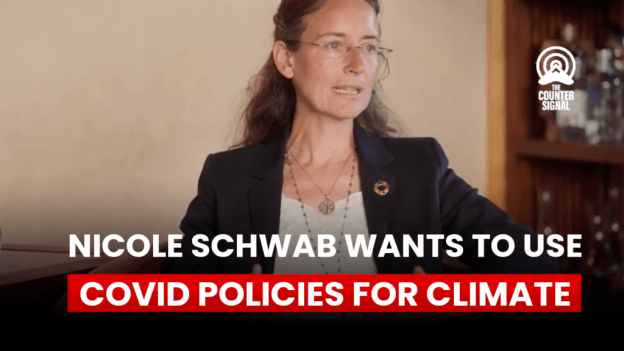
“Clearly, the system… is not sustainable,” began Nicole Schwab, speaking at an InTent roundtable. “So, I see it as a tremendous opportunity to really have this Great Reset and to use these huge flows of money, to use the increased levers that policymakers have today in a way that was not possible before to create a change that is not incremental, but that we can look back and we can say, ‘This is the moment where we really started to position nature at the core of the economy.’”
Schwab continues, saying that politicians and businesses have the opportunity to redesign the economies of the world with nature and “regenerative agriculture” in mind before pivoting into a discussion about “engaging youth” with climate change propaganda to create a “restoration generation” (i.e., indoctrinating an entire generation).
“And one of the key reflection points here is also around engaging youth,” Schwab continues. “And, for me, again, I come back to this shift in mindset of the restoration generation. Can we conceive of ourselves as humans — I mean, you talked about a new humanity… Can we conceive of ourselves as a restoration generation?”
“I think that’s where we need to go. I’m also hopeful that it’s possible, but I think it will take a lot of will, both political will but also in terms of the business actors, to break with business as usual… And this is about risk, and it’s about risk, and it’s about resilience because the shocks coming are going to be even worse if we don’t do it now. “
It appears the apple doesn’t fall far from the tree.
Nicole’s father, Klaus Schwab, has also spoken and written on redesigning society with climate policies at the fore.
In a WEF article entitled “Now is the time for a ‘great reset,’” Schwab senior lays out the three key components of the Great Reset, second of which is “equality and sustainability.”
“The second component of a Great Reset agenda would ensure that investments advance shared goals, such as equality and sustainability… Rather than using these funds… to fill cracks in the old system, we should use them to create a new one that is more resilient, equitable, and sustainable in the long run. This means, for example, building “green” urban infrastructure and creating incentives for industries to improve their track record on environmental, social, and governance (ESG) metrics,” writes Schwab.
The environmental, social, and governance (ESG) metrics that Schwab mentions sound benign but are truly radical.
As part of their ESG metrics and international dietary framework, the United Nations recommends that red meat consumption be reduced to 14 grams (one bite) per day per person in the name of sustainability and ‘saving the world.’
Climate change education, as mentioned by Nicole Schwab, is another crucial ESG metric in the overall agenda.
Another all-encompassing policy of the UN’s ESGs that’s become increasingly noticeable and disastrous in countries like Canada is a carbon tax on practically everything from food to gas to heating to private businesses that don’t conform to the new normal, which will lead to pricing the average person out of their ability to use private transportation and consumption of meat products.
If you want to read more on ESGs, digital IDs, and the Great Reset, you can do so by clicking here.
By redefining UNRWA, Washington destroys the foundation for a Just peace in Palestine
By Ramzy Baroud | MEMO | May 3, 2022
Palestinians are justifiably worried that the mandate granted to the United Nations Agency for Palestinian refugees, UNRWA, might be coming to an end. UNRWA’s mission, which has been in effect since 1949, has done more than provide urgent aid and support to millions of refugees. It was also a political platform that protected and preserved the rights of several generations of Palestinians.
Though UNRWA was not established as a political or legal platform per se, the context of its mandate was largely political, since Palestinians became refugees as a result of military and political events – the ethnic cleansing of the Palestinian people by Israel and the latter’s refusal to respect the Right of Return for Palestinians as enshrined in UN resolution 194 (III) of 11 December, 1948.
“UNRWA has a humanitarian and development mandate to provide assistance and protection to Palestine refugees pending a just and lasting solution to their plight,” the UN General Assembly Resolution 302 (IV) of 8 December, 1949 read. Alas, neither a ‘lasting solution’ to the plight of the refugees, nor even a political horizon has been achieved. Instead of using this realization as a way to revisit the international community’s failure to bring justice to Palestine and to hold Israel and its US benefactors accountable, it is UNRWA and, by extension, the refugees that are being punished.
In a stern warning on 24 April, the head of the political committee at the Palestinian National Council (PNC), Saleh Nasser said that UNRWA’s mandate might be coming to an end. Nasser referenced a recent statement by the UN body’s Commissioner-General, Philippe Lazzarini, about the future of the organization.
Lazzarini’s statement, published a day earlier, left room for some interpretation, though it was clear that something fundamental regarding the status, mandate and work of UNRWA is about to change. “We can admit that the current situation is untenable and will inevitably result in the erosion of the quality of the UNRWA services or, worse, to their interruption,” Lazzarini said.
Commenting on the statement, Nasser said that this “is a prelude to donors stopping their funding for UNRWA.”
The subject of UNRWA’s future is now a priority within the Palestinian, but also Arab political discourse. Any attempts at canceling or redefining UNRWA’s mission will pose a serious, if not an unprecedented challenge for Palestinians. UNRWA provides educational, health and other support for 5.6 million Palestinians in Jordan, Lebanon, Syria, the Gaza Strip and the West Bank, including East Jerusalem. With an annual budget of $1.6 billion, this support, and the massive network that has been created by the organization, cannot be easily replaced.
Equally important is the political nature of the organization. The very existence of UNRWA means that there is a political issue that must be addressed regarding the plight and future of Palestinian refugees. In fact, it is not the mere lack of enthusiasm to finance the organisation that has caused the current crisis. It is something bigger, and far more sinister.
In June 2018, Jared Kushner, son-in-law and advisor to former US President Donald Trump, visited Amman, Jordan, where he, according to the US Foreign Policy magazine, tried to persuade Jordan’s King Abdullah to remove the refugee status from 2 million Palestinians currently living in the country.
This and other attempts have failed. In September 2018, Washington, under the Trump administration, decided to cease its financial support of UNRWA. As the organization’s main funder, the American decision was devastating, because about 30 per cent of UNRWA’s money comes from the US alone. Yet, UNRWA hobbled along by increasing its reliance on the private sector and individual donations.
Though the Palestinian leadership celebrated the Biden Administration’s decision to resume UNRWA’s funding on April 7, 2021, a little caveat in Washington’s move was largely kept secret. Washington only agreed to fund UNRWA after the latter agreed to sign a two-year plan, known as Framework for Cooperation. In essence, the plan effectively turned UNRWA into a platform for Israel and American policies in Palestine, whereby the UN body consented to US – thus Israeli – demands to ensure that no aid would reach any Palestinian refugee who has received military training “as a member of the so-called Palestinian Liberation Army”, other organizations or “has engaged in any act of terrorism”. Moreover, the Framework expects UNRWA to monitor “Palestinian curriculum content”.
By entering into an agreement with the US Department of State, “UNRWA has effectively transformed itself from a humanitarian agency that provides assistance and relief to Palestinian refugees, to a security agency furthering the security and political agenda of the US, and ultimately Israel,” BADIL Resource Center for Palestinian Residency and Refugee Rights noted.
Palestinian protests, however, did not change the new reality, which effectively altered the entire mandate granted to UNRWA by the international community nearly 73 years ago. Worse, European countries followed suit when, last September, the European parliament advanced an amendment that would condition EU support of UNRWA on the editing and rewriting of Palestinian school text books that, supposedly, ‘incite violence’ against Israel.
Instead of focusing solely on shutting down UNRWA immediately, the US, Israel and their supporters are working to change the nature of the organization’s mission and to entirely rewrite its original mandate. The agency that was established to protect the rights of the refugees, is now expected to protect Israeli, American and western interests in Palestine.
Though UNRWA was never an ideal organization, it has indeed succeeded in helping millions of Palestinians throughout the years, while preserving the political nature of their plight.
Though the Palestinian Authority, various poltical factions, Arab governments and others have protested the Israeli-American designs against UNRWA, such protestations are unlikely to make much difference, considering that UNRWA itself is surrendering to outside pressures. While Palestinians, Arabs and their allies must continue to fight for UNRWA’s original mission, they must urgently develop alternative plans and platforms that would shield Palestinian refugees and their Right of Return from becoming marginal and, eventually, forgotten.
If Palestinian refugees are removed from the list of political priorities concerning the future of a just peace in Palestine, neither justice nor peace can possibly be attained.
Political West mulls reshaping UN and what’s left of international law
By Drago Bosnic | April 27, 2022
In order to understand the prelude to World War 2, one cannot ignore the failures of the long-defunct League of Nations, which was a UN-like structure aimed at being a forum of countries resolving disputes through dialogue rather than war. Although just another noble idea before World War 1, in the immediate aftermath of the sheer death and destruction resulting from that conflict, it became an urgent necessity. The League of Nations was supposed to make sure nothing of sorts ever happened again.
Sadly, as we all know, it failed miserably, with an even worse conflict erupting less than 20 years after the Paris Peace Conference was completed. Now, nearly 80 years since the horrors of WW2, we have reached a hauntingly similar point as we realize the UN didn’t just inherit the League of Nations flag, but also many of the same faults which ultimately led the world into yet another disaster of global proportions, one which resonates to this very day.
The United Nations Security Council (UNSC) is the pillar of the UN and its veto power mechanism serves as a balancing tool which takes into account the interests of world powers and thus provides the UN with relevance which no other international organization or forum of sovereign nations in known history ever had. Currently, the five permanent members of UNSC (China, France, Russia, the UK and the US) can veto any resolution put forth by the body. The council’s other 10 rotating members do not have such powers.
This veto power has especially been a source of frustration for the United States, NATO and the EU. Due to their dominance in the UN General Assembly (UNGA), where there is a swarm of Western client states and statelets, many of which were created through deliberate and oftentimes forceful disintegration of larger and more sovereign nations (for instance, Yugoslavia was split into 6 states and one illegal state-like entity), the political West wants this UN body to be more prominent than the UN Security Council.
By pushing the UN General Assembly to the forefront of decision making, the West could then simply force these countless vassal states and statelets to vote in a way which would be beneficial to the US, EU or NATO and give these decisions a sort of “international community” touch which the political West needs in order to build what they see as a much-needed facade of “international legitimacy”.
Because of this, Western political elites and the mainstream media often try to portray the UNGA as a “more democratic” body than the UNSC. How truly democratic is up for debate, given the sheer amount of US pressure and arm-twisting used to coerce countries into voting not just in line with Western interests, but oftentimes at the expense of their own. And in terms of population distribution, we see that these states and statelets, despite oftentimes being the majority or close to a majority in the UNGA, actually represent less than 20 or even 15 percent of the world’s population. This also explains the Western obsession with forceful fragmentation of larger nations into smaller ones, echoing the ancient Roman policy of divide et impera.
To meet this goal, the UNGA is now considering introducing a provision that would require permanent members of the UN Security Council to justify their use of veto powers. It was tabled by Liechtenstein in mid-April and presented at a closed-door discussion panel last Tuesday. The discussion supposedly “turned out to be quite positive” and the initiative “received additional co-sponsors”, the mission of the microstate to the UN said after the meeting.
“We had a strong turnout and positive engagement on the Veto Initiative in open format this afternoon. We will continue our work to get the strongest possible political support for our text which now has 57 cosponsors,” it stated.
If adopted, the initiative would mandate convening the UNGA within 10 days after a permanent member of the UNSC uses their veto power. At the meeting, the state would have to justify its decision to use the veto. According to Liechtenstein, adopting the provision would “empower the General Assembly and strengthen multilateralism.”
Quite unsurprisingly, so far, the initiative has been openly supported only by one permanent member of the UNSC – the United States. Washington co-sponsored the provision, openly acknowledging the drive is aimed at Moscow and its use of the veto power to block a resolution on the ongoing Russian special military operation in Ukraine. Announcing the co-sponsorship, the US envoy to the UN Linda Thomas-Greenfield accused Moscow of “misusing” its veto powers.
“We are particularly concerned by Russia’s shameful pattern of abusing its veto privilege over the past two decades,” she stated, adding that, in the latest alleged abuse, Moscow had used the veto power to “protect President Putin from condemnation over his unprovoked and unjust war of choice against Ukraine.”
Of course, it would require an entirely separate analysis to dissect US envoy’s statements, which are filled with “liberal interpretation” of facts. But the statement does confirm the assertion that the political West, and the US in particular, are trying to reshape the UN to their liking, which would result in sidelining US competitors. In doing so, the US might be successful in turning the UN into another footnote of its belligerent foreign policy and even use it to justify sanctions and wars of aggression anywhere in the world.
However, even though this may seem like a victory to the aggressive planners in Washington DC, it may spell a disaster for world peace. By sidelining countries like Russia, China or even India, Brazil, South Africa and many others in the foreseeable future, the US is incentivizing these countries to ignore or even leave the UN, which would bring about the de facto end of international law.
At best, it would result in the creation of another UN-style organization led by those same sidelined countries, bringing about a deeply divided world where there would be at least two blocks – the political West (plus its vassals) and the rest of the world composed of sovereign nations. The last time such a division happened, the world suffered up to 80,000,000 dead in just 6 years.
Drago Bosnic is an independent geopolitical and military analyst.
UN suspends Russia from Human Rights Council
Samizdat | April 7, 2022
The United Nations’ General Assembly voted on Thursday to suspend Russia from the UN Human Rights Council. The US-proposed resolution received 93 votes, with 24 countries opposed and 58 abstaining.
China, a fellow permanent Security Council member, was a prominent “no” vote. Among the abstentions, the most prominent were India, Brazil, Saudi Arabia and South Africa.
US Ambassador Linda Thomas-Greenfield had called for Russia to be expelled from the 47-nation body on Monday, calling its participation a “farce,” after videos and photos from the town near Kiev showed dead bodies of what appeared to be civilians. Ukraine and the US accused Russia of a massacre, which Moscow has vehemently denied.
“We believe that the members of the Russian forces committed war crimes in Ukraine, and we believe that Russia needs to be held accountable,” Thomas-Greenfield said Monday.
When Moscow called for an emergency Security Council session on the investigation of the alleged atrocities, the UK – currently presiding – refused. The US and its allies instead chose to ratchet up sanctions against Russia, based entirely on Ukrainian allegations as the presumption of Russian guilt.
Ukrainian Foreign Minister Dmitry Kuleba cheered Thursday’s vote. “War criminals have no place in UN bodies aimed at protecting human rights. Grateful to all member states which supported the relevant UNGA resolution and chose the right side of history,” he tweeted.
Moscow has said that attempts to expel Russia from the Human Rights Council are political and undertaken by countries who seek to continue “the politics of neo-colonialism of human rights” in international relations.
Gennady Gatilov, Russia’s ambassador to the UN mission in Geneva, called the US resolution “unfounded and purely emotional bravado that looks good on camera — just how the US likes it,” and accused Washington of “exploiting” the Ukrainian crisis for its own benefit.
Russia responds to Human Rights council expulsion threat
Samizdat | April 7, 2022
The possible suspension of Russia from the UN Human Rights Council threatens to destroy “the basement of current multilateral system,” First Deputy Permanent Representative to the UN Dmitry Polyanskiy said ahead of Thursday’s vote by the organisation’s General Assembly (UNGA) on the matter.
Polyanskiy wrote on Telegram that this is a “premeditated tactical move” which, in his opinion, has nothing to do either Russia’s attack on Ukraine nor with alleged human rights violations by Moscow, as these claims “are far from being verified and proven.” However, he warned, the motion, if accepted, “risks devastating consequences for the UN System.”
“Russia plays an important ballancing role, its removal from HRC will deprive developing countries of a vocal and powerful defender. That’s why Western countries are keen to do it and strike the ballance [sic] in their favor,” the official explained.
In Polyanskiy’s words, the West is trying “to undermine UN institutions behind the smokescreen of punishing Russia.” “By doing so they risk to destroy the basement of current multilateral system which emerged after WW2 and has been saving the world from WW3,” he underlined.
He also pointed out to the fact that in 2018, during Donald Trump’s presidency, the US withdrew from the council and “consistently belittled its role.”
Therefore, Polyanskiy argues, Washington “can’t be considered a champion of the body.
“And knowing the bleak US human rights record and the shameful practice [of] blackmailing [the] ICC (International Criminal Court ) for trying to make US soldiers accountable for their heinous crimes abroad, Washington is the last one to be moralizing others on Human Rights,” he wrote.
Moscow’s diplomat expressed hope that during the upcoming “extremely hypocritical” show Russia’s colleagues from, what he called, the “remaining independent countries” would remember about all these facts.
The move to expel Russia from the council came shortly after Kiev published images of dead bodies in the Ukrainian town of Bucha, northwest of the capital and called them evidence of genocide perpetrated by Russian troops. Moscow denied the allegations and said the Ukrainian government was manipulating public opinion with staged scenes.
The resolution which was endorsed by Western nations before any independent investigation could take place, expresses “grave concern at the ongoing human rights and humanitarian crisis in Ukraine, particularly at the reports of violations and abuses of human rights and violations of international humanitarian law by the Russian Federation, including gross and systematic violations and abuses of human rights.”
To suspend a state from the UN Human Rights Council a two-thirds majority vote by the 193-member General Assembly is needed. Russia’s envoy to the UN Vassily Nebenzia during a UN Security Council meeting on Tuesday called the suggestion to kick Russia out from the council “unbelievable” and expressed hope that “UN colleagues will not allow themselves to be manipulated and will not play along with Washington in its extremely dangerous undertaking.”
The Kremlin’s spokesperson Dmitry Peskov, in his turn, said that the work of the council and UN institutions is “unthinkable without the participation of Russia.”
Moscow attacked its neighbor in late February, following Ukraine’s failure to implement the terms of the Minsk agreements signed in 2014, and Russia’s eventual recognition of the Donbass republics of Donetsk and Lugansk. The German and French brokered protocols had been designed to regularize the status of those regions within the Ukrainian state.
Russia has now demanded that Ukraine officially declare itself a neutral country that will never join the US-led NATO military bloc. Kiev insists the Russian offensive was completely unprovoked and has denied claims it was planning to retake the two republics by force.
Russia willing to investigate Bucha’s tragedy
By Lucas Leiroz | April 5, 2022
The alleged massacre of civilians in Bucha is one of the most talked about topics around the world in recent hours. Russia has been repeatedly accused by Western governments and mainstream media, and there are already calls for Russian President Vladimir Putin to be prosecuted for war crimes and human rights violations. However, there is a series of controversies in the case, from possible falsifications in the images released by Ukrainian forces to incoherent information about the dates of the massacre, which demands a deep investigation.
According to the official Kremlin’s position, the Russian government categorically denies any involvement by its forces in operations that killed civilians in Bucha. Spokesperson Dmistry Peskov stated on Monday, April 4, about the case, making it clear that Moscow, in addition to denying participation in the massacre, supports the immediate launch of high-level investigations on the occurrence. The Russian authorities also committed to take the discussion forward to the UN Security Council in order conduct an international investigation in the grave tragedy.
Furthermore, Peskov made it clear that the Russian government does not trust the veracity of all the information contained in the videos and photos of dead civilians released by the Ukrainian government. There are reports from Russian experts pointing out possible forgeries and frauds in the content of the videos. Other Russian officials also commented on the case, pointing out that there is evidence that the videos were forged or performed. Russian Foreign Minister Sergei Lavrov, for example, claimed during a meeting with UN Under-Secretary-General for Humanitarian Affairs Martin Griffiths that the Ukrainian press had released fake videos about Russian operations in Bucha, and that there had been a staging organized by Kiev’s forces in the region days after the departure of Russian troops.
In the same vein, the official representative of the Russian Ministry of Foreign Affairs, Maria Zakharova, said that the videos and photos released by the Ukrainian press and the Western statements about them appear to be a “custom-made story”. Defense Minister Sergei Shoigu also spoke out, claiming that the case is a production by the Kiev regime for Western media that sounds like a provocation against Russia. Finally, the head of the Russian Investigative Committee, Alexander Bastrykin, also expressed distrust about the veracity of the material released by Kiev and requested a procedural assessment on the possible massacre of civilians.
Despite the distrust, which seems justified in the face of a long history of fake news and information warfare on the part of the NATO-Kiev axis, Moscow seems open to hearing contrary opinions, which is precisely why the government seems so interested in launching an investigation, both using its official experts and international agents convoked by the UNSC. It is possible that, in addition to the obviously fake and staged videos, there is also real material, with actual images of dead people. The Kremlin’s main point is that, regardless of whether the videos and photos are real or not, there is no Russian involvement in cases of massacre of civilians.
Considering the evident victory of the Special Operation in Bucha region, there would be no strategic advantage for the Russian military to shoot civilians, which would cause unnecessary harm to the country. Now, Zelensky, Biden and other Western leaders are calling for Putin to be condemned by international courts and planning an increase in sanctions. So, it does not seem at all reasonable that Russian forces would have deliberately planned and carried out a massacre of civilians, considering that these would be the obvious consequences of such acts.
Another point that needs to be mentioned is that there is an evident time lapse in the case. The Russians withdrew from Bucha on 30 March. The Ukrainians entered Bucha on March 31, and the “retake” of the city was announced by the mayor on the same day. Azov’s paramilitaries entered the city only on April 1. So how were the “bodies in the streets” found only on April 3?
If international society is really interested in the truth, it must heed the Russian request for an investigation at the UNSC. If Western governments refuse to cooperate with the investigation, it will be possible to conclude that they have something to hide. The UN must remain neutral and commit itself to the search for the truth of the facts, even if this truth is unpleasant for the West.
Lucas Leiroz is a researcher in Social Sciences at the Rural Federal University of Rio de Janeiro; geopolitical consultant.
UN Human Rights Council adopts resolutions against Israel’s human rights violations in Syria’s Golan
Press TV – April 2, 2022
The United Nations Human Rights Council has adopted a resolution denouncing Israel’s human rights violations against the people in Syria’s occupied Golan Heights, calling on the Tel Aviv regime to stop its repressive measures.
The Geneva-based council endorsed the resolution at its 49th regular session on Friday,urging Israel to comply with the relevant UN resolutions.
In a separate resolution, the council renewed its condemnation of illegal Israeli settlements in the occupied Palestinian territories, including East al-Quds, and Syria’s Golan Heights.
The UN body also called for an immediate end to Israel’s continued occupation and illegal settlement activities in the occupied Arab territories.
In another resolution on the right of the Palestinian people to self-determination, the council “reaffirmed the Palestinian people’s right to live in freedom, justice, and dignity and the right to their independent State of Palestine.”
During the session, Hussam Edin Aala, Syria’s permanent envoy to the UN in Geneva, said Israel continues its violations of international law and human rights with the full support of the United States.
He further called on the Human Rights Council to hold Israel responsible for these violations.
In 1967, Israel waged a full-scale war against Arab territories, during which it occupied a large swathe of Golan and annexed it four years later – a move never recognized by the international community.
In 1973, another war broke out; and a year later a UN-brokered ceasefire came into force, according to which Tel Aviv and Damascus agreed to separate their troops and create a buffer zone in the Heights. However, Israel has over the past several decades built dozens of illegal settlements in Golan in defiance of international calls for the regime to stop its illegal construction activities.
In a unilateral move rejected by the international community in 2019, former US president Donald Trump signed a decree recognizing Israeli “sovereignty” over Golan.
Last December, Israel announced that it intends to double the number of its illegal settlements in the Golan, despite an earlier resolution adopted by the UN General Assembly demanding the regime’s full withdrawal from the occupied territory.
Nevertheless, Syria has repeatedly reaffirmed its sovereignty over Golan, saying the territory must be completely restored to its control.
The United Nations has also time and again emphasized Syria’s sovereignty over the territory.
Israel also occupied East al-Quds, the West Bank and the Gaza Strip during the Six-Day Arab-Israeli War in 1967. It later had to withdraw from Gaza.
Nearly 700,000 Israelis live in illegal settlements built since the 1967 occupation of the Palestinian territories of the West Bank and East al-Quds.
All the settlements are illegal under international law. The United Nations Security Council has condemned the settlement activities in several resolutions.
Palestinians want the West Bank as part of a future independent state with East al-Quds as its capital.
Featured Video
Trita Parsi: Israel Set a Trap for Total War in the Region
or go to
Aletho News Archives – Video-Images
From the Archive
Zionism’s Violent Legacy
By Donald Neff | Washington Report On Middle East Affairs | January 1996
On January 4, 1948, Jewish terrorists drove a truck loaded with explosives into the center of the all Arab city of Jaffa and detonated it, killing 26 and wounding around 100 Palestinian men, women and children.[1] The attack was the work of the Irgun Zvai Leumi – the “National Military Organization,” also known by the Hebrew letters Etzel – the largest Jewish terrorist group in Palestine. The Irgun was headed by Revisionist Zionist Menachem Begin and had been killing and maiming Arabs, Britons and even Jews for the previous ten years in its efforts to establish a Jewish state.
This terror campaign meant that at the core of Revisionist Zionism there existed a philosophical embrace of violence. … continue
Blog Roll
 Aletho News
- Trita Parsi: Israel Set a Trap for Total War in the Region
- Trump’s Iran war is on an Israeli leash
- Saudi oil boss issues global supply warning
- Riyadh Says Its Oil System Is Intact. The Numbers Say Otherwise.
- Trump and Netanyahu Want to “Finish the Job” on Iran
- US ‘one-sided dictation’ not Iran’s beliefs makes rational talks impossible: Baghaei
- Iran’s Next Strike May Not Explode. It Could Shut You Down /Col Doug Macgregor
- Iran: US political targets legitimate if assassinations return
- Iraq shuts key border crossing with Iran under US pressure: Report
- Undersea Internet cables could be targeted in retaliation for attacks on Iran: IRGC deputy chief
- If Americans Knew
- The Israel Lobby’s Changing Fortunes
- AIPAC has become such a political liability that it’s shifting to a more “nimble” approach to buying politicians
- At least 160 Israeli settler attacks in 2 weeks
- Will Gaza’s Ancient Christian Community Disappear Forever?
- Israel’s vision of regional security rests on keeping Arab states weak
- Heidi Levine recounts how Palestinian youths helped save her in settler attack
- DAILY UPDATE: Latest essential news on Palestine, Israel, & region
- Trump’s Intensifying Sabotage of the ICC, for Israel’s Sake
- Israeli military detain US and UK volunteers in West Bank including Democratic NY politician Brad Lander
- Americans at National Conservatism Conference held in Israel this year criticize Israel
- No Tricks Zone
- E-Cars Reduce CO2 Emissions By Only 41% Compared To Internal Combustion Engine Vehicles
- Predictions Made By Renowned Climate Professor Over Past Decades Have Been Proven To Be Poor
- New Study Suggests Large Regions Of The Pacific Ocean Have Been Cooling For The Last 80 Years
- Germany’s Green Energy Debacle: High Energy Costs Force Kahla Porzellan to Close After 182 Years!
- New Study: 50 Years Of The Most Aggressive ‘Net Zero’ Policies Can Only Affect The Global Climate By 0.03°C
- US September “Heat” Was No Record…Many Records Set Decades Ago
- Latest European Green Energy Debacle; Portugal’s Largest Flagship Solar Park Insolvent!
- Green Energy Debacle: German Expert Professor Fritz Vahrenholt Warns Of Severe Economic And Social Consequences
- Two More Paleo Reconstructions Affirm Meters-Higher Sea Levels Across Ireland, Brazil 7000-6000 Years Ago
- New Study: Earth And Venus Surface Warmth Largely Explained By Convection And Lapse Rate, Not CO2 Or Radiation

