UN monitor on Palestine quits over Israel’s entry denial
Press TV – January 4, 2016
The United Nations expert on the human rights situation in the occupied Palestinian territories has resigned, complaining that the Tel Aviv regime continues to deny him access to the areas he is tasked with monitoring.
In a Monday statement, the UN said Makarim Wibisono submitted his resignation to President of the Human Rights Council Joachim Rucker earlier in the day.
It said Wibisono, who will effectively quit his job as of March 31, had “expressed deep regret that, throughout his mandate, Israel failed to grant him access to the Occupied Palestinian Territory.”
Wibisono has been in charge of monitoring rights violations in the occupied East al-Quds (Jerusalem), the occupied West Bank and the Gaza Strip. The Israeli regime has time and again prevented the UN official from visiting the areas.
In June 2015, Israel denied Wibisono access to the Gaza Strip, where he was to investigate the aftermath of Tel Aviv’s 2014 war that killed over 2,200 Palestinians in the blockaded coastal enclave. The regime said at the time that the mandate handed to the UN official’s team was “anti-Israel,” and that it was exclusively focused on cases of Israeli rights violations.
Last November, Wibisono, and the expert on summary executions, Christof Heyns, slammed Israel for using excessive force and carrying out summary executions against Palestinians amid a surge in tensions in the occupied territories, where Palestinians have held almost daily anti-Israel protests since early October.
The latest wave of tensions was triggered by Israel’s imposition in August of restrictions on the entry of Palestinian worshipers into the al-Aqsa Mosque compound in East al-Quds.
The restrictions have enraged Palestinians, who are also angry at increasing violence by Israeli settlers frequently storming the al-Aqsa Mosque, a place highly revered by the Muslims across the world.
The Palestinian protesters also say Israel has a covert plan for changing the status quo of the al-Aqsa Mosque.
At least 144 Palestinians have been killed since the violence erupted in various towns of West Bank and Gaza. Some of 25 Israelis have also died during the same period.
UN Supports Sovereignty for Palestine and Slams Israel
Resolution severely criticises the “Occupying Power”
By Stuart Littlewood | Dissident Voice | January 1, 2016
Can this be true?
Something important and, freedom lovers may think, rather wonderful seems to have happened at the United Nations, and it went largely unreported in mainstream media. The UN General Assembly approved a draft resolution ‘Permanent sovereignty of the Palestinian people in the Occupied Palestinian Territory, including East Jerusalem, and of the Arab population in the occupied Syrian Golan over their natural resources’ (document A/70/480).
It was adopted by 164 to 5 against (Canada, Israel, Marshall Islands, Federated States of Micronesia, United States), with 10 abstentions (Australia, Cameroon, Côte d’Ivoire, Honduras, Papua New Guinea, Paraguay, South Sudan, Togo, Tonga, Vanuatu).
What’s so wonderful? The draft resolution pulls no punches and must have thoroughly annoyed the insatiable state of Israel, which has evil designs on the natural resources – oil, gas and water – belonging to its neighbours. The resolution is long but nicely crafted, and is reproduced here pretty much in its entirety as an aide-memoire of Israel’s long history of contemptuous disregard for its obligations.
The General Assembly,
Recalling its resolution 69/241 of 19 December 2014, and taking note of Economic and Social Council resolution 2015/17 of 20 July 2015,
Recalling also its resolutions 58/292 of 6 May 2004 and 59/251 of 22 December 2004,
Reaffirming the principle of the permanent sovereignty of peoples under foreign occupation over their natural resources,
Guided by the principles of the Charter of the United Nations, affirming the inadmissibility of the acquisition of territory by force, and recalling relevant Security Council resolutions, including resolutions 242 (1967) of 22 November 1967, 465 (1980) of 1 March 1980 and 497 (1981) of 17 December 1981,
Recalling its resolution 2625 (XXV) of 24 October 1970,
Reaffirming the applicability of the Geneva Convention relative to the Protection of Civilian Persons in Time of War, of 12 August 1949, to the Occupied Palestinian Territory, including East Jerusalem, and other Arab territories occupied by Israel since 1967,
Recalling, in this regard, the International Covenant on Civil and Political Rights and the International Covenant on Economic, Social and Cultural Rights, and affirming that these human rights instruments must be respected in the Occupied Palestinian Territory, including East Jerusalem, as well as in the occupied Syrian Golan,
Recalling also the advisory opinion rendered on 9 July 2004 by the International Court of Justice on the legal consequences of the construction of a wall in the Occupied Palestinian Territory, and recalling further its resolutions ES-10/15 of 20 July 2004 and ES-10/17 of 15 December 2006,
Recalling further its resolution 67/19 of 29 November 2012,
Taking note of the accession by Palestine to several human rights treaties and the core humanitarian law treaties, as well as to other international treaties,
Expressing its concern about the exploitation by Israel, the occupying Power, of the natural resources of the Occupied Palestinian Territory, including East Jerusalem, and other Arab territories occupied by Israel since 1967,
Expressing its grave concern about the extensive destruction by Israel, the occupying Power, of agricultural land and orchards in the Occupied Palestinian Territory, including the uprooting of a vast number of fruit-bearing trees and the destruction of farms and greenhouses, and the grave environmental and economic impact in this regard,
Expressing its grave concern also about the widespread destruction caused by Israel, the occupying Power, to vital infrastructure, including water pipelines, sewage networks and electricity networks, in the Occupied Palestinian Territory, in particular in the Gaza Strip during the military operations of July and August 2014, which, inter alia, has polluted the environment and negatively affect the functioning of water and sanitation systems and the water supply and other natural resources of the Palestinian people, and stressing the urgency of the reconstruction and development of water and other vital civilian infrastructure, including the project for the desalination facility for the Gaza Strip,
Expressing its grave concern further about the negative impact on the environment and on reconstruction and development efforts of the thousands of items of unexploded ordnance that remain in the Gaza Strip as a result of the conflict in July and August 2014,
Recalling the 2009 report by the United Nations Environment Programme regarding the grave environmental situation in the Gaza Strip, and the 2012 report, “Gaza in 2020: A liveable place?”, by the United Nations country team in the Occupied Palestinian Territory, and stressing the need for follow-up to the recommendations contained therein,
Deploring the detrimental impact of the Israeli settlements on Palestinian and other Arab natural resources, especially as a result of the confiscation of land and the forced diversion of water resources, including the destruction of orchards and crops and the seizure of water well by Israeli settlers, and of the dire socioeconomic consequences in this regard,
Recalling the report of the independent international fact-finding mission to investigate the implications of the Israeli settlements on the civil, political, economic, social and cultural rights of the Palestinian people throughout the Occupied Palestinian Territory, including East Jerusalem,
Aware of the detrimental impact on Palestinian natural resources being caused by the unlawful construction of the wall by Israel, the occupying Power, in the Occupied Palestinian Territory, including in and around East Jerusalem, and of its grave effect as well on the economic and social conditions of the Palestinian people,
Stressing the urgency of achieving without delay an end to the Israeli occupation that began in 1967 and a just, lasting and comprehensive peace settlement on all tracks, on the basis of Security Council resolutions 242 (1967), 338 (1973) of 22 October 1973, 425 (1978) of 19 March 1978 and 1397 (2002) of 12 March 2002, the principle of land for peace, the Arab Peace Initiative and the Quartet performance-based road map to a permanent two-State solution to the Israeli-Palestinian conflict, as endorsed by the Security Council in its resolution 1515 (2003) of 19 November 2003 and supported by the Council in its resolution 1850 (2008) of 16 December 2008,
Stressing also, in this regard, the need for respect for the obligation upon Israel under the road map to freeze settlement activity, including so-called “natural growth”, and to dismantle all settlement outposts erected since March 2001,
Stressing further the need for respect and preservation of the territorial unity, contiguity and integrity of all of the Occupied Palestinian Territory, including East Jerusalem,
Recalling the need to end all acts of violence, including acts of terror, provocation, incitement and destruction,
Taking note of the report prepared by the Economic and Social Commission for Western Asia on the economic and social repercussions of the Israeli occupation on the living conditions of the Palestinian people in the Occupied Palestinian Territory, including East Jerusalem, and of the Arab population in the occupied Syrian Golan, as transmitted by the Secretary-General,
-
Reaffirms the inalienable rights of the Palestinian people and of the population of the occupied Syrian Golan over their natural resources, including land, water and energy resources;
-
Demands that Israel, the occupying Power, cease the exploitation, damage, cause of loss or depletion and endangerment of the natural resources in the Occupied Palestinian Territory, including East Jerusalem, and in the occupied Syrian Golan;
-
Recognizes the right of the Palestinian people to claim restitution as a result of any exploitation, damage, loss or depletion or endangerment of their natural resources resulting from illegal measures taken by Israel, the occupying Power, and Israeli settlers in the Occupied Palestinian Territory, including East Jerusalem, and expresses the hope that this issue will be dealt with within the framework of the final status negotiations between the Palestinian and Israeli sides;
-
Stresses that the wall and settlements being constructed by Israel in the Occupied Palestinian Territory, including in and around East Jerusalem, are contrary to international law and are seriously depriving the Palestinian people of their natural resources, and calls in this regard for full compliance with the legal obligations affirmed in the 9 July 2004 advisory opinion of the International Court of Justice and in relevant United Nations resolutions, including General Assembly resolution ES-10/15;
-
Calls upon Israel, the occupying Power, to comply strictly with its obligations under international law, including international humanitarian law, and to cease immediately and completely all policies and measures aimed at the alteration of the character and status of the Occupied Palestinian Territory, including East Jerusalem;
-
Also calls upon Israel, the occupying Power, to bring a halt to all actions, including those perpetrated by Israeli settlers, harming the environment, including the dumping of all kinds of waste materials, in the Occupied Palestinian Territory, including East Jerusalem, and in the occupied Syrian Golan, which gravely threaten their natural resources, namely water and land resources, and which pose an environmental, sanitation and health threat to the civilian populations;
-
Further calls upon Israel to cease its destruction of vital infrastructure, including water pipelines, sewage networks and electricity networks, which, inter alia, has a negative impact on the natural resources of the Palestinian people, stresses the urgent need to advance reconstruction and development projects in this regard, including in the Gaza Strip, and calls for support for the necessary efforts in this regard, in line with the commitments made at, inter alia, the Cairo International Conference on Palestine: Reconstructing Gaza, held on 12 October 2014;
-
Calls upon Israel, the occupying Power, to remove all obstacles to the implementation of critical environmental projects, including sewage treatment plants in the Gaza Strip and the reconstruction and development of water infrastructure, including the project for the desalination facility for the Gaza Strip;
-
Calls for the immediate and safe removal of all unexploded ordnance in the Gaza Strip and for support for the efforts of the United Nations Mine Action Service in this regard, and welcomes the efforts exerted by the Service to date;
-
Encourages all States and international organizations to continue to actively pursue policies to ensure respect for their obligations under international law with regard to all illegal Israeli practices and measures in the Occupied Palestinian Territory, including East Jerusalem, particularly Israeli settlement activities and the exploitation of natural resources;
-
Requests the Secretary-General to report to the General Assembly at its seventy-first session on the implementation of the present resolution, including with regard to the cumulative impact of the exploitation, damage and depletion by Israel of natural resources in the Occupied Palestinian Territory, including East Jerusalem, and in the occupied Syrian Golan, and decides to include in the provisional agenda of its seventy-first session the item entitled “Permanent sovereignty of the Palestinian people in the Occupied Palestinian Territory, including East Jerusalem, and of the Arab population in the occupied Syrian Golan over their natural resources”.
This is strong stuff. But given the UN’s record will the action ever suit the words?
Astonishingly, the Israel-adoring UK government voted for it. Let us make a mental note of those 5 countries – Canada, Israel, Marshall Islands, Federated States of Micronesia, United States – which claim to be freedom loving but are evidently bent on denying the poor Palestinians theirs. And the birdbrained 10 – Australia, Cameroon, Côte d’Ivoire, Honduras, Papua New Guinea, Paraguay, South Sudan, Togo, Tonga, Vanuatu – which are so lackadaisically uncommitted to the principle of universal human rights that they sat on the fence. Maybe international civil society would like to prod them with a sharp BDS stick to concentrate their minds.
At least one country, happily, is taking a tough line – Brazil, which, says the BBC, has yet to approve the appointment four months ago of Israel’s new ambassador. Not only is the new man, Dani Dayan, a former chairman of the Yesha Council which promotes illegal Israeli settlements on stolen Palestinian lands, but Israeli prime minister Netanyahu broke the news of the appointment on Twitter before telling Brazil, according to reports.
As even Netanyahu must know, the transfer by an occupier of part of its own population into territory it occupies is considered a war crime, so why should Brazil play host to a foreigner with such a vile record? Israel is threatening to downgrade relations to “secondary level” if Brazil does not give approval to the appointment. And Israeli deputy foreign minister Tzipi Hotovely says that Dayan would not be replaced if his appointment isn’t accepted.
Since Brazil is Israel’s largest trading partner in South America you’d think the Israelis would watch their manners. The Brazilians, hopefully, won’t allow themselves to pushed around by Tel Aviv’s insufferable thugs.
Stop unacceptable harassment of human rights defenders in Occupied Palestinian Territory – UN experts
UN Human Rights Council | December 18, 2015
GENEVA – United Nations independent experts today expressed grave concerns at continued reports that human rights defenders are being subjected to physical attacks, harassment, arrest and detention, and death threats, particularly in Hebron in the Occupied Palestinian Territory (OPT), in an apparent bid by Israeli authorities and settler elements to stop their peaceful and important work.
“Amidst a charged and violent atmosphere over past months in the OPT, Palestinian and international defenders are providing a ‘protective presence’ for Palestinians at risk of violence, and documenting human rights violations,” said the UN Special Rapporteur the situation of human rights defenders, Michel Forst.
“The continued harassment of human rights defenders in the OPT, who are exercising their rights to freedoms of expression and association, is simply unacceptable. It should cease immediately,” Mr. Forst stressed.
Earlier this month, a group of UN human rights experts urged the Israeli Government to ensure a protective environment where human rights defenders in the Occupied Palestinian Territory can work without unlawful restriction and without fear of retaliatory acts.
“We recently addressed concerns to the Israeli Government regarding retaliatory acts by Israeli authorities against members of one organisation based in Hebron, Youth Against Settlements, after its Centre was subjected to raids and settlers allegedly called for it to be closed,” noted the UN Special Rapporteur the situation of human rights in the OPT, Makarim Wibisono.
“The Centre has now effectively been shut down as a result of the Israeli military declaring the surrounding area a military zone,” Mr. Wibisono said. “We urge Israeli authorities to lift this military order.”
The experts’ statement has been endorsed by the Special Rapporteur on torture and other cruel, inhuman or degrading treatment or punishment, Mr. Juan E. Méndez, and by the Special Rapporteur on the rights to freedom of peaceful assembly and of association, Mr. Maina Kiai.
Italy’s Lega Nord Party Urges Sanctions on Ankara, Riyadh for Funding Daesh
By Svetlana Alexandrova – Sputnik – 18.12.2015
The European Union should impose sanctions on Turkey and Saudi Arabia for financing the Islamic State (IS or Daesh in Arabic) jihadist group, instead of extending its anti-Russia sanctions, the leader of Italy’s Eurosceptic Lega Nord party, Matteo Salvini, told Sputnik Wednesday.
A UN Security Council Resolution to counter the financing of terrorism, targeting in particular Daesh, an organization outlawed in a number of states including Russia, was adopted Thursday. The resolution specifies that Daesh derives its main source of income from smuggled oil and obliges all states to oppose this illicit oil trade in the strongest terms. Russian Ambassador to the United Nations Vitaly Churkin said that Turkish companies found to be involved in this illicit oil trade might be sanctioned by the UN Security Council.
“Europe needs to impose sanctions against Turkey and Saudi Arabia instead of extending sanctions against Russia,” Salvini said.
Salvini added that his party does not believe that the Islamic coalition against extremists that was announced by Saudi Arabia earlier this week “will serve its alleged goals because it is the state that supports terrorism.”
Daesh controls large swathes of land in oil-rich Syria, Iraq and Libya. Earlier this month, the Russian Defense Ministry presented evidence showing that Daesh has been smuggling oil across the porous Syria-Turkey border in large volumes.
Salvini is currently in Moscow and is set to meet on Friday with the head of Russia’s upper house of parliament’s International Committee, Alexei Pushkov, Deputy Chairman of the Federation Council Committee on International Affairs Andrey Klimov, as well as with the representatives of the United Russia Party.
UN passes Iranian-proposed nuclear disarmament resolution
Press TV – December 8, 2015
The United Nations General Assembly (UNGA) has passed a resolution proposed by Iran aimed at bringing about the disarmament of nuclear powers.
On Monday, the Assembly voted 121 against 48 in favor of the non-binding resolution, which had already been cleared by its First Committee, aka Disarmament and International Security Committee. The voting saw 12 abstentions.
The resolution demands practical action by all nuclear-armed countries toward disarmament and the promotion of international stability and security for all.
It also demands unilateral steps by such countries to scale down their nuclear arsenals as well as more transparency regarding their nuclear arms capabilities and implementation of international agreements.
The Islamic Republic had devised the resolution based on the ratifications of the Review Conferences of the Nuclear Non-Proliferation Treaty in 1995, 2000, and 2010.
The majority of the 120-member Non-Aligned Movement threw their support behind the resolution. The United States, Israel, Canada, Britain, Russia, France, and Germany were among those voting against it, while China, South Korea, Japan, India, and Italy, among others, abstained.
Speaking after the approval of the resolution, Iran’s Ambassador to the UN Gholam Hossein Dehqani (seen below) said, “It has been declared in Article VI of the Nuclear Non-Proliferation Treaty that these countries are obliged to initiate negotiations for the disarmament and have been asked to put into force step-by-step measures for decommissioning nuclear weapons and then destroying them. Unfortunately, though, no effective or serious step has been taken in this direction.”

“The international community is insistent upon nuclear disarmament and the nuclear-armed countries’ implementation of their obligations. The current trend suggests that slowly, nuclear-armed countries and the Zionist regime (Israel), which possesses nuclear weapons, will move toward isolation in the General Assembly’s First Committee and other assemblies, and will certainly end up in worse circumstances every day,” the Iranian official added.
Israel is regarded as the only possessor of nuclear weapons in the Middle East.
UN suspected of smuggling CIA agents into Yemen
thewallwillfall | November 2, 2015
[This is a translation of an article that recently appeared in Al Akhbar.]
Ansar Allah detain two Americans on Espionage Charges
Two Americans have been under surveillance who have regularly visited the site that is the current temporary residence of the UN team. The UN are based in the Sheraton Hotel in Yemen’s capital Sanaa.
This hotel had been used previously by the US diplomatic mission until it’s evacuation from Sanaa early 2015. The U.S. Diplomatic Mission allowed the UN to work from these premises temporarily until it could be considered safe for the Mission to return to Yemen once the hostilities had ceased.
The UN does not pay anything for the use of the facility and is not responsible for the maintenance of the premises that belong to the US Foreign Affairs Ministry but events over the last two weeks reveal that perhaps the UN repays Washington in more ways than one for the use of these premises.
The UN mission in Yemen operates with a very small staff, probably less than a hundred, consisting of Yemeni nationals, non Yemeni Arab nationals and foreign nationals.
These UN staff members travel between Yemen and Djibouti on UN-chartered private planes. Djibouti is now the only gateway to the world for Yemenis who are under an internationally supported blockade.
The two Americans who were under surveillance were transported using UN vehicles despite the fact that UN law prohibits the use of their vehicles for the transportation of any non-UN staff regardless of the situation, in order to maintain its neutral status.
On the evening of the 20th of October, a private UN plane arrived in Sanaa, from Djibouti. On board were two American citizens, Mark McAllister and John Hamen, who were ostensibly working for a maintenance company, Al Rafideen, contracted by the US Mission to provide services to their now vacated offices in the Sheraton Hotel, Sanaa.
At this point, Yemen National Security moved in and arrested the two men, taking them to an unknown location.
Attempts were made by the chief of staff of the UN mission in Sanaa to intervene and secure the release of the two Americans. The UN engaged in direct talks with the Yemeni government and Ansar Allah. The response from the Yemeni side was curt and to the point stating that this was not within the UN’s jurisdiction and the UN has nothing to do with the two men in question.
The UN official confirmed to the local government and AnsarAllah that the two men were working for a company now contracted by the UN and had been invited to Sanaa by the UN to maintain premises [that they do not pay for and where the UN is not responsible for maintenance – edit]. Unsurprisingly all UN efforts to secure the release of McAllister and Hamen have been unsuccessful.
The UN was then informed that one of the two men was recognised as a “security agent” who had been working with the U.S. Diplomatic Mission in Sanaa prior to their departure. The UN was informed by the relevant local Yemeni authorities that the UN’s involvement with any foreign intelligence is in direct violation of its fundamental principles and lawful activities in Yemen. This puts the UN in a very precarious and embarrassing position in Yemen.
Al-Akhbar asked the official spokesman on behalf of the UN Secretary General whether UN staff members were facing any hardships in Yemen:
“Yes, we face hardships due to the security situation and we are unable to distribute relief aid to Yemenis as we would be able to under normal circumstances.”
Responding to the question of whether or not the UN is in communication with the Saudi-led coalition, the UN official stated:
“As in the case of every war-torn area, the UN maintains communication with all factions involved in the conflict to guarantee UN convoy security.”
Al-Akhbar also asked the UN official why the UN had allowed two non UN operatives, now in Yemeni & AnsarAllah custody, to travel to Yemen in a UN privately chartered plane. This contravenes all internationally agreed upon protocols that strictly prohibit the use of UN transportation for non UN staff. The seriousness of the situation is intensified by the fact that Yemen authorities have accused both men of being Washington intelligence agents.
The UN official responded cautiously, stating that he is aware of the two men whom he believes to be UN contractors. He is aware of their situation but has no update on the incident. He added that the UN would not have transported any such operatives into or out of Yemen without using the proper channels of communication. He reiterated the official line that the two men are likely to be service contractors brought in to carry out maintenance on the adopted UN premises. [edit: despite the UN not being responsible for the premises]
The incident is highly sensitive. It does not only involve McAllister and Hamen, still in custody, but raises the uncomfortable question, what role is the UN playing in Yemen and for that matter, in other war torn countries in the region?
Yemeni citizens working for the UN have expressed their frustration at not being allowed to implement solutions to the dire humanitarian situation in their country, and have complained of having their movements and activities closely surveyed.
Yemeni security have informed the UN directly that this particular case violates the sovereignty of their country and its security.
A local security official informed the UN in Yemen that such actions will have serious repercussions upon their activities within Yemen. Initial investigations into the two Washington assets in custody have shown that both men are linked to activities suspected to be espionage and investigations have exposed one of the men as a Washington intelligence agent who had already worked with Yemeni agents and who was well known to Yemen’s security officials.
The second man is an officer in the US Marines who has served in Iraq, Afghanistan and Yemen.
The naturally concerned Yemeni authorities have informed the UN that the UN has no jurisdiction over these two men and should not interfere in Yemen’s security matters.
As a consequence, all UN vehicles are being carefully and systematically inspected in the capital Sanaa. UN drivers are being checked and all passenger passports demanded for verification. This is now routine both at the airport and on the streets of Sanaa.
The matter was further complicated when a shot was fired at a UN vehicle and the bullet penetrated the car on October 22, 2015 while it was travelling towards Sanaa airport. No casualties were reported but its quite possible that this was a warning shot across UN bows.
What is certain however, is that both Ansar Allah and the General People’s Congress party in Yemen are highly displeased with UN Peace Envoy Ismail Ould Cheikh’s recent role in siding with the Saudi-led coalition and disregarding all the points agreed upon in the Muscat talks.
Both parties are also understandably enraged by Washington’s role in supporting the Saudi-led coalition’s aggression on Yemen that is devastating the country. Washington has provided direct support to the Saudi coalition by supplying weapons, intelligence information, air surveillance and logistic support for air strikes. This support has been widely documented in the media.
Yemeni officials in Sanaa are on high alert regarding any intelligence network that could provide support to the Saudi-led coalition air strikes that have predominantly targeted civilians. This, despite continuous UN communications with the Saudi coalition’s operations room in the Saudi capital Al-Riyadh informing them of the co-ordinates of the UN location and areas of work.
Riyadh however, does not seem to be overly concerned with that information as was clearly seen when the Saudis directly targeted and bombed the UN Development Project in Aden. UN Secretary General Ban Ki Moon expressed criticism of Riyadh’s disregard and called for an investigation into the strikes but to date no such investigation has been initiated.
Riyadh came under criticism again for the disregard it showed by directly bombing the World Food Programmes’s storage facility, and several hospitals operating under international organizations directly affiliated with the UN.
The Preposterous Green Institute and the IPCC
The man now in charge at the IPCC belongs to a privileged, protected, secretive entity headed by the UN’s former top climate official.
By Donna Laframboise | No Frakking Consensus | October 19, 2015
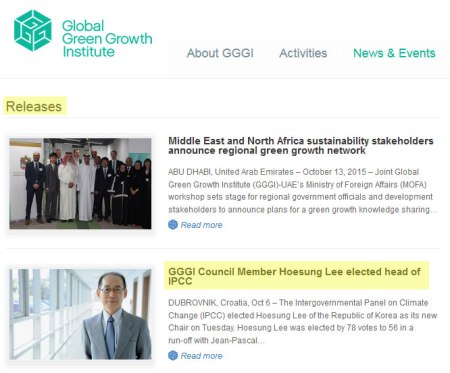
When Hoesung Lee was elected head of the Intergovernmental Panel on Climate Change (IPCC) recently, the Seoul-based Global Green Growth Institute (GGGI) issued a celebratory press release. Lee – who hails from South Korea – has a seat on one of the GGGI’s governing bodies.
But this little-known entity is no mere institute. In fact, it’s another creature of the United Nations. As a headline on the GGGI website makes clear, an international treaty was required to bring it into existence. Membership is restricted to UN-recognized countries. Its stated purpose is “the successful outcome of the United Nations process on sustainable development.” Its Director-General, Yvo de Boer, used to be the UN’s top climate official.
GGGI appears to have begun life in 2010 as a bona fide South Korean non-profit foundation, before throwing itself into the arms of the UN two years later. Documents connected to its 2012 transformation can be downloaded from its website (see this 33-page PDF). The GGGI immodestly claims to be devising “a new model of economic growth,” which it considers “essential for the future of humankind.” Some of the planet’s least developed nations have signed up to act as guinea pigs for projects administered by the GGGI and funded by Australian, Danish, Norwegian, and British taxpayers.
There are plenty of good people working on important issues, some of whom are employed by research institutes. But when it comes to perqs and privileges, the GGGI leaves everyone them in the dust. Calling the GGGI an institute is like calling Unilever – the multinational corporation that owns the Ben & Jerry’s, Lipton, Bertolli, Hellman’s, Becell, Knorr, and Dove brands – a soap company.
In actual fact, the GGGI enjoys a preposterous array of protections and immunities. We’re talking about the kinds of privileges normally reserved for nation states. Korea’s government has signed a document in which it has agreed to treat GGGI headquarters like an embassy. Korean authorities have no jurisdiction on its premises or over its records:
The Headquarters shall be inviolable. No person exercising any public authority within the Republic of Korea shall enter the Headquarters to perform any duties except with the express consent of the Director-General…The archives of the GGGI…shall be inviolable wherever located….The property of the GGGI…shall be immune from search, requisition, confiscation, expropriation and any other form of interference, whether by executive, administrative, judicial or legislative action. [pp. 1, 5, 6]
The GGGI and its staff enjoy “immunity from every form of legal process,” except in rare circumstances. The GGGI is exempt from taxation and customs duties, and may transfer funds in and out of Korea at will. The salaries of the roughly 100 people who comprise the GGGI staff are – drumroll, please – tax free.
People visiting the GGGI from outside Korea don’t need to produce passports as do mere mortals, since Korea’s government has agreed to treat GGGI-issued “travel certificates” as the equivalent of national passports. GGGI staff, their spouses, and their dependents are immune from “immigration restrictions” and baggage inspection “except in doubtful cases.” In the event of an international crisis, Korea will treat GGGI personnel and their families on a par with “diplomatic envoys.”

As if all of the above weren’t sufficiently bizarre, we read that:
The GGGI shall have the right to use codes and to dispatch and receive official communications by courier or in sealed bags, which shall have the same privileges and immunities as are accorded to diplomatic couriers and bags. [bold added, p. 6]
So the police can’t touch you. The courts can’t touch you. Customs officials have been instructed to treat you like royalty. Your pay cheque is tax free, and there’s almost no risk of being caught should you choose to smuggle items in or out of the country.
Pardon me, but I have a few questions:
- What’s really going on here?
- What is so special about these people that they warrant
requiresuch extraordinary protections and immunities? - What
unwholesome activitiesis the UN undertaking via the GGGI that it considers sealed diplomatic pouches remotely necessary?
Circling back to Hoesung Lee, the person now in charge of the IPCC also belongs to a secretive entity headed by the UN’s former top climate official.
Translation #1: Lee is a UN insider. There isn’t a chance in a thousand that he’ll institute meaningful reform.
Translation #2: The IPCC is merely one bauble in the UN’s burgeoning toy box.
UN Introduces New Feudalism Under Guise of Social Activism
“Global Goals” Is Lavishly-Funded Public Relations Endeavor “We the People” Never Voted For
By James Tracy | Memory Hole | September 30, 2015
This month delegates to the United Nations ratified the so-called “Global Goals For Sustainable Development.” This will  involve a radical, far-reaching social and economic transformation of everyday life that has been in the works for decades.
In true Hegelian dialectic style, the program is taking place as various black swans linger on the economic horizon, while some of the very interests involved in the “Global Goals” are likewise putting the finishing touches on the Trans-Pacific trade agreement, designed to (not coincidentally) crush the nation state.
Such an ambitious program will cost, by the UN’s own estimate, as much as $5 trillion annually. A social makeover of this scale requires enlistment of ideologically-motivated shock troops from all walks of life to act as change agents in their own spheres. Thus a portion of such finances will be apportioned to thought and behavioral modification toward ideational acceptance of continued corporate ascendance, wealth and resource redistribution, and the breakdown of traditional borders that for better or worse have defined the human condition since the feudal era–from gender and common morality to the nation state. As the “Global Goals” website declares, “We are not a generation of bystanders. We are global citizens.”
Below is the campaign’s slickly produced promotional video.
Truthstream Media has developed a clever interpretation of the UN’s “Global Goals.” Unfortunately, these are by no means exaggerations but rather illustrate the hypocrisy of this campaign, which in reality involves an accelerated privatization of the commons and even our own bodies combined with elaborate psychological warfare to disguise such endeavors as social activism.
What’s that you say? You’re not on board? See you in the gulag, comrade.
Goal 1: End poverty in all its forms everywhere
Translation: Centralized banks, IMF, World Bank, Fed to control all finances, digital one world currency in a cashless society
Goal 2: End hunger, achieve food security and improved nutrition and promote sustainable agriculture
Translation: GMO
Goal 3: Ensure healthy lives and promote well-being for all at all ages
Translation: Mass vaccination, Codex Alimentarius
Goal 4: Ensure inclusive and equitable quality education and promote lifelong learning opportunities for all
Translation: UN propaganda, brainwashing through compulsory education from cradle to grave
Goal 5: Achieve gender equality and empower all women and girls
Translation: Population control through forced “Family Planning”
Goal 6: Ensure availability and sustainable management of water and sanitation for all
Translation: Privatize all water sources, don’t forget to add fluoride
Goal 7: Ensure access to affordable, reliable, sustainable and modern energy for all
Translation: Smart grid with smart meters on everything, peak pricing
Goal 8: Promote sustained, inclusive and sustainable economic growth, full and productive employment and decent work for all
Translation: TPP, free trade zones that favor megacorporate interests
Goal 9: Build resilient infrastructure, promote inclusive and sustainable industrialization and foster innovation
Translation: Toll roads, push public transit, remove free travel, environmental restrictions
Goal 10: Reduce inequality within and among countries
Translation: Even more regional government bureaucracy like a mutant octopus
Goal 11: Make cities and human settlements inclusive, safe, resilient and sustainable
Translation: Big brother big data surveillance state
Goal 12: Ensure sustainable consumption and production patterns
Translation: Forced austerity
Goal 13: Take urgent action to combat climate change and its impacts*
Translation: Cap and Trade, carbon taxes/credits, footprint taxes
Goal 14: Conserve and sustainably use the oceans, seas and marine resources for sustainable development
Translation: Environmental restrictions, control all oceans including mineral rights from ocean floors
Goal 15: Protect, restore and promote sustainable use of terrestrial ecosystems, sustainably manage forests, combat desertification, and halt and reverse land degradation and halt biodiversity loss
Translation: More environmental restrictions, more controlling resources and mineral rights
Goal 16: Promote peaceful and inclusive societies for sustainable development, provide access to justice for all and build effective, accountable and inclusive institutions at all levels
Translation: UN “peacekeeping” missions (ex 1, ex 2), the International Court of (blind) Justice, force people together via fake refugee crises and then mediate with more “UN peacekeeping” when tension breaks out to gain more control over a region, remove 2nd Amendment in USA
Goal 17: Strengthen the means of implementation and revitalize the global partnership for sustainable development
Translation: Remove national sovereignty worldwide, promote globalism under the “authority” and bloated, Orwellian bureaucracy of the UN
Saudi Arabia sinks UN war crimes probe in Yemen, Washington stays silent
RT | October 2, 2015
 The Netherlands dropped their bid to establish an independent UN-led probe into alleged war crimes in Yemen, yielding to an alternative resolution proposed by Saudi Arabia, which stands accused of causing most of the civilian deaths in the conflict.
The Saudis are leading a coalition of countries, whcih since late March has been using their military to attack Houthi rebels in Yemen in an attempt to put ousted President Abd Rabbuh Mansur Hadi back into power. According to UN numbers published on Tuesday, at least 2,355 civilians have been killed during the six months of the conflict. The majority of them died in Saudi attacks.
The latest of alleged atrocities in the Yemen war is an apparent Saudi airstrike that killed 131 guests at a wedding party. The Saudis, who have air superiority in Yemeni airspace, denied any involvement.
According to Amnesty International, many civilian killings in Yemen can be considered war crimes. In September, UN human rights chief Zeid Ra’ad Al Hussein called for an independent, international inquiry into alleged war crimes in the country. The Netherlands submitted a draft resolution to the UN Human Rights Council (HRC) shortly after, which among other things called for UN experts to be sent to Yemen to investigate allegations of crimes committed by all parties involved. The proposal was backed by a number of European countries.
The document was opposed by Saudi Arabia and its Arab allies Qatar and the United Arab Emirates, all members of the council, as well as the Yemeni government in exile. The Saudis allegedly won their place at the council through a secret deal with the British government, according to the cables exposed by whistleblower website WikiLeaks.
The Saudis proposed an alternative resolution that doesn’t provide for an independent international inquiry and instead calls on the UN to support a probe led by the Hadi government. Human rights groups objected to the Saudi draft resolution, saying it would put a belligerent party in charge of the probe and would ultimately leave Saudi crimes obscured.
While the Saudis kept pushing for their draft resolution to be passed, the US kept mostly silent on the debate, and didn’t voice support for the Dutch proposal. Last week, American UN envoy Samantha Power released an ambiguously worded statement on the issue, which said Washington was “following the ongoing discussions in Geneva closely.”
“We do believe the Human Rights Council and OHCHR [Office of the High Commissioner for Human Rights] have an important role to play regarding the humanitarian situation, and look forward to working with our colleagues in Geneva,” Powers said.
The US helps its Arab ally Saudi Arabia in the Yemen bombing campaign with logistics and targeting. America is also the biggest provider of weapons for Saudi’s armed forces.
On Wednesday, the Netherlands announced they were dropping their draft resolution, leaving the Saudi document the only contestant for UN endorsement. Washington’s de facto opposition to the document played a significant role in its eventual demise, according to Vice News.
“It was terrible, the US was silent for a very long time,” Nicolas Agostini, Geneva representative for the International Federation For Human Rights, told Vice News. “The Dutch should have had public support from key partners including the US throughout the process.
“By the second week of negotiations, it became clear they wouldn’t get that kind of support. [America’s] very late public expression of support for the Dutch text, and emphasis on the need to reach consensus, de facto benefited the Saudis.”
Venezuela: UN Should Support Sovereignty in Syria and Palestine
teleSUR | September 30, 2015
 Venezuela called on the UN to do its job, Wednesday, and be a leader in enforcing international law and the right to sovereignty.
Venezuelan Foreign Minister Delcy Rodriguez, speaking at the UN Security Council as it discussed the situation in the Middle East and northern Africa, said that it was “concerning” that after decades, the UN was still talking about Palestine, and was not standing up to the attacks on Syria.
She condemned the “illegal occupation” of Palestine and stated that, “Venezuela is a country that has historically condemned terrorism.” If there is a two-state solution between Palestine and Israel, “it should be two states that are truly equal and sovereign, not where there is terrorism and discrimination … we have to put effort into making this happen. There is a situation where the Israeli state is promoting terrorism and violating Palestinian human rights,” she said.
Talking then about Syria, where the U.S. claims to be attacking the Islamic State, and where Russia has, after talks with the Syrian government, agreed to attack the Islamic State group, Rodriguez said, “Terrorist groups aren’t born spontaneously, we want to know who finances them … This is a multilateral organization that respects international law, or are we here hypocritically, not condemning unilateral interventions (such as that by the U.S). What is the cost in Iraq, Libya, Afghanistan? What do we want today for Syria? The same?”
“Why are we here if we don’t plan to respect international law?” she said.
“In Venezuela we call for abandoning hypocrisy and for real willingness to combat terrorism, and that it not be used to support a certain leader. The UN should assume its leadership and apply international law against aggressions against people. Syria should have sovereignty” over what occurs in its territory,” she concluded.
Featured Video
Trita Parsi: Israel Set a Trap for Total War in the Region
or go to
Aletho News Archives – Video-Images
From the Archive
Zionism’s Violent Legacy
By Donald Neff | Washington Report On Middle East Affairs | January 1996
On January 4, 1948, Jewish terrorists drove a truck loaded with explosives into the center of the all Arab city of Jaffa and detonated it, killing 26 and wounding around 100 Palestinian men, women and children.[1] The attack was the work of the Irgun Zvai Leumi – the “National Military Organization,” also known by the Hebrew letters Etzel – the largest Jewish terrorist group in Palestine. The Irgun was headed by Revisionist Zionist Menachem Begin and had been killing and maiming Arabs, Britons and even Jews for the previous ten years in its efforts to establish a Jewish state.
This terror campaign meant that at the core of Revisionist Zionism there existed a philosophical embrace of violence. … continue
Blog Roll
 Aletho News
- Trita Parsi: Israel Set a Trap for Total War in the Region
- Trump’s Iran war is on an Israeli leash
- Saudi oil boss issues global supply warning
- Riyadh Says Its Oil System Is Intact. The Numbers Say Otherwise.
- Trump and Netanyahu Want to “Finish the Job” on Iran
- US ‘one-sided dictation’ not Iran’s beliefs makes rational talks impossible: Baghaei
- Iran’s Next Strike May Not Explode. It Could Shut You Down /Col Doug Macgregor
- Iran: US political targets legitimate if assassinations return
- Iraq shuts key border crossing with Iran under US pressure: Report
- Undersea Internet cables could be targeted in retaliation for attacks on Iran: IRGC deputy chief
- If Americans Knew
- The Israel Lobby’s Changing Fortunes
- AIPAC has become such a political liability that it’s shifting to a more “nimble” approach to buying politicians
- At least 160 Israeli settler attacks in 2 weeks
- Will Gaza’s Ancient Christian Community Disappear Forever?
- Israel’s vision of regional security rests on keeping Arab states weak
- Heidi Levine recounts how Palestinian youths helped save her in settler attack
- DAILY UPDATE: Latest essential news on Palestine, Israel, & region
- Trump’s Intensifying Sabotage of the ICC, for Israel’s Sake
- Israeli military detain US and UK volunteers in West Bank including Democratic NY politician Brad Lander
- Americans at National Conservatism Conference held in Israel this year criticize Israel
- No Tricks Zone
- E-Cars Reduce CO2 Emissions By Only 41% Compared To Internal Combustion Engine Vehicles
- Predictions Made By Renowned Climate Professor Over Past Decades Have Been Proven To Be Poor
- New Study Suggests Large Regions Of The Pacific Ocean Have Been Cooling For The Last 80 Years
- Germany’s Green Energy Debacle: High Energy Costs Force Kahla Porzellan to Close After 182 Years!
- New Study: 50 Years Of The Most Aggressive ‘Net Zero’ Policies Can Only Affect The Global Climate By 0.03°C
- US September “Heat” Was No Record…Many Records Set Decades Ago
- Latest European Green Energy Debacle; Portugal’s Largest Flagship Solar Park Insolvent!
- Green Energy Debacle: German Expert Professor Fritz Vahrenholt Warns Of Severe Economic And Social Consequences
- Two More Paleo Reconstructions Affirm Meters-Higher Sea Levels Across Ireland, Brazil 7000-6000 Years Ago
- New Study: Earth And Venus Surface Warmth Largely Explained By Convection And Lapse Rate, Not CO2 Or Radiation

