Telephone calls between Biden and Poroshenko reveal Kiev’s submission to Washington
By Lucas Leiroz | May 25, 2020
Recently, several phone calls made four years ago between former Ukrainian President Petro Poroshenko and current Democratic presidential candidate Joe Biden were revealed. The content of the talks is profound and controversial and reveals the high degree of American influence in the coordination of Ukrainian domestic politics, showing the advanced state of submission of Kiev to Washington.
According to the deputy of the Ukrainian Parliament (Supreme Rada), Andrei Derkach, the audio recordings were received from an anonymous investigative journalist. Derkach revealed the content of the recordings and declared full confidence in his informant.
On audio recordings, we can hear the former US Vice President Joe Biden and former Secretary of State John Kerry demanding that the leader of a formally independent state make decisions that are convenient for them, as well as a totally submissive posture on the part of Poroshenko, who is absolutely oblivious to Ukrainian national interests.
The demands made during the talks are diverse and impressive by the American boldness to interfere so deeply in other states. In one of the recordings, dated from 2015, it is possible to hear John Kerry demanding the resignation of Ukrainian attorney general Viktor Shokin, for not meeting American expectations. In another record, Poroshenko communicates with Biden saying he has “good news for him.” In the recording, Poroshenko says that while there was no charge or complaint against Shokin, he managed to convince the attorney to resign. The interlocutor replies: “Excellent”. So, Poroshenko reports that the dismissal of the attorney general is yet another “step in fulfilling his obligations” to the US.
In another phone call, the topic of appointing a new attorney is discussed. After a conversation between Poroshenko and his American counterparts, Yuri Lutsenko is chosen to be appointed to the office. Washington’s interlocutors make it clear that Lutsenko’s appointment is an essential condition for Kiev’s receipt of a loan of one billion dollars. Totally submissive, Poroshenko agrees with the terms of the agreement and the fees imposed without any dispute, consolidating the “partnership”.
In Washington, assistants of the former Vice President and current candidate Joe Biden informed The Washington Post that the recordings have been edited and are being used improperly to put pressure on the parties involved in the talks. However, the veracity of the existence of such telephone conversations has not been contested, which in itself is enough to create an atmosphere of tension and distrust towards the figures involved.
The fact is that the matter is still far from over. Whether or not they were edited, the recordings are apparently real. And, although the content of the conversations is contested, in truth, one billion dollars were withdrawn from the American public coffers and handed over to the president of another country, without the American population being informed of anything. After all, what will be the reaction of the American people when they understand that this money comes from their taxes and, instead of being invested in improvements to the national infrastructure, it is being used in obscure political maneuvers with other countries?
This all tends to strengthen Donald Trump in the upcoming election. The current American president until recently had an absolute majority of voting intentions and is now starting to weaken due to the way he has been dealing with the new coronavirus pandemic in the US – the global epicenter of the infection. Biden, although much less popular, progresses little by little and is already showing the ability to become a real opponent to Trump. However, as the scandals spread, it is likely that there will be a drop in Biden’s supporters or, at least, a greater atmosphere of collective distrust for him.
Still, Joe Biden’s reliability is not the main issue that comes up with the revelations of these recordings, but the level of American interference in the domestic politics of other national states. With these telephone records, Kiev proved to be a zone of foreign interference, where a president is coerced by members of the government of another country to make decisions that he would not like to make. This is not just an extremely demoralizing fact for Ukraine, but it also deeply destroys the myth of “Ukrainian nationalism,” so defended by the militias involved in the Euromaidan coup in 2014. However, more than that, the case may bring Petro Poroshenko to court. The recordings are sufficient evidence to accuse the former president of national treason. If formally accused and condemned, Poroshenko will have ended his political career in the worst possible way for a former president: being remembered as a traitor to his own country.
Lucas Leiroz is a research fellow in international Law at the Federal University of Rio de Janeiro.
Iran surges in Venezuela in defiance of US sanctions
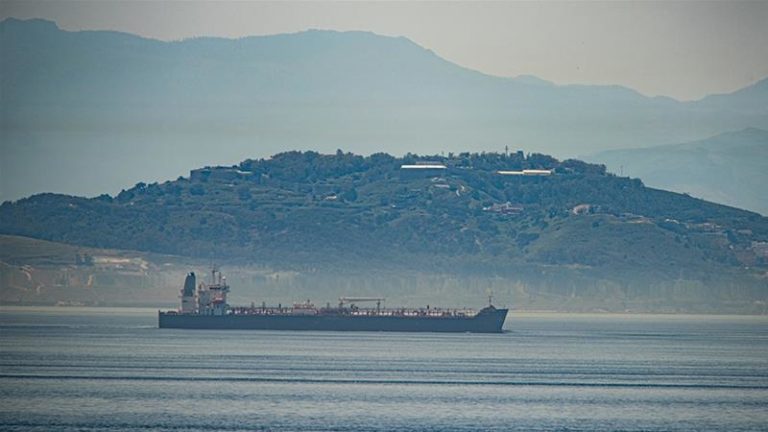
Iranian oil tanker Clavel crossing the Gibraltar stretch heading for Venezuela, May 20, 2020
By M. K. BHADRAKUMAR | Indian Punchline | May 25, 2020
Escorted by the Venezuelan navy and air force, an Iranian oil tanker named Fortune has entered that country’s waters on Sunday, amidst intense speculation whether the US would interfere with the delivery. The US has imposed oil sanctions against Venezuela and Iran and had said it is monitoring the Iranian tanker.
In fact, five Iranian tankers carrying about 1.5m barrels of fuel passed through the Suez Canal earlier this month, according to shipping data on Refinitiv Eikon, and were heading for Venezuela. The other four Iranian tankers — Forest, Petunia, Faxon and Clavel — are approaching the Caribbean en route to Venezuela.
A flotilla of US Navy and Coast Guard vessels is patrolling the Caribbean Sea on a mission to counter illicit drug trafficking. But the Pentagon has stated that there are no plans to stop the Iranian tankers.
At the same time, a Pentagon spokesman, Jonathan Hoffman, while saying on Thursday he was not aware of any operations related to the Iranian cargoes, also added, “We have continued to say that Iran and Venezuela – both two outliers in the international order – [are] clearly violating international sanctions on both nations with this transaction.”
The US sanctions on Venezuela are aimed at increasing pressure on President Maduro to step down. Thus, arguably, Iran is frontally challenging the Trump administration’s stated policy of ‘regime change’ in Venezuela. The Iranian move comes just three weeks after the abortive coup attempt masterminded by the White House on May 1 with the participation of two former US Green Berets aimed at capturing Maduro and transport him to the US in American helicopters to be put on trial on fake drug trafficking charges.
The coup attempt showed the extent of desperation in Washington to overthrow the Maduro government before the US presidential election in November, which President Trump hopes would help him garner Hispanic votes. Iran has now offered a lifeline to Venezuela.
In an historical context, this becomes a frontal assault by Iran on the Monroe Doctrine dating back to the 19th century, which in US foreign policy calculus regarded the Western Hemisphere as its sphere of influence. According to a Reuters report, the Trump administration said earlier this month it was “considering measures” it could take in response to the Iranian shipments, without providing specifics.
No doubt, this is a deliberate sanctions-busting enterprise by Iran. Venezuela desperately needs fuel for up to 1,800 gasoline stations that have been partially closed for weeks due to insufficient supply from state-run refineries.
Venezuela’s gasoline output is now limited to a single facility, the Amuay refinery, but most fuel produced is low octane as most of the country’s alkylation units are out of service. Imported alkylate could improve the quality of domestic gasoline. Venezuela’s refineries are in poor condition. Shipments of equipment in flights by Iran’s Mahan Air have arrived in Venezuela in recent weeks to start repair work.
It will be interesting to see whether the US Navy would interdict any of the other four Iranian tankers before they enter Venezuelan waters. Tehran has sternly warned the US that it would retaliate if any such attempt is made. On Saturday, Tehran raised the ante with President Hassan Rouhani explicitly warning, “If our oil tankers in the Caribbean Sea or anywhere else in the world get into trouble caused by the Americans, they (US) will run into trouble reciprocally.”
Washington is well aware of Iran’s capability to create big problems for the US Navy deployed in the Persian Gulf, especially the Strait of Hormuz. Last week, in a precautionary step, US Navy, via the Maritime Safety Office run by the National Geospatial-Intelligence Agency, alerted all international maritime traffic to maintain a safe distance of at least 100 meters from US naval vessels in international waters and straits. Pentagon officials separately confirmed that the stay-away warning to marine traffic in the Persian Gulf, the Arabian Sea and the Gulf of Oman was actually intended for Iran.
In geopolitical terms, Iran’s strategic defiance of the US in the Western Hemisphere makes an interesting case study not only of the decline in American influence in its backyard to the south but the entire efficacy of the “sphere of influence” concept in contemporary world politics. This is one thing.
More importantly, in the backdrop of the Iranian tanker reaching Venezuela, Caracas has described Iran as a “revolutionary partner” in the struggle against US imperialism. From the Iranian viewpoint, Venezuela becomes a part of the “axis of resistance” against the US. To be sure, the audacity of the two countries will irritate Washington to no end.
How far the Iran-Venezuela axis will deepen and expand will bear watch. Importantly, the UN Security Council embargo against Iran exporting arms to other countries is expiring in October. The US move to extend the timeline of the embargo is unlikely to succeed, given the strong negative reaction by Russia and China. It is entirely conceivable that a matrix of military cooperation may commence in a near future involving Iran and Venezuela.
Iran’s indigenously developed missile capability acts as a deterrent against US aggression. Iran has transferred missile technology to Hezbollah, which is estimated to have the capability today to inflict significant damage to Israel in the event of any aggression by the latter on Lebanon. Significantly, the deterrence is working and Israel no longer stages attacks on Lebanon.
A similar shift in the strategic balance with Iran’s help can create more space for Venezuela to push back at the US. All in all, Iran appears to be working on a strategy to help Venezuela to maintain its strategic autonomy. There is enormous potential for cooperation and coordination between Iran and Venezuela. If Venezuela has the largest known oil reserves in the world, Iran too has massive reserves of oil and gas.
The despatch of oil to lubricate the beleaguered Venezuelan economy may prove to be the harbinger of an assertive Iranian power projection elsewhere in Latin America too. Surely, in the near term, it is a rebuff to the Trump administration’s maximum pressure strategy against Iran. In a longer-term perspective, a concerted regional strategy in Latin America by Russia, China and Iran can seriously erode the US influence in the continent.
China, Russia can initiate probe of US bio-labs
Washington urged to be transparent with bio-weapons program

By Yang Sheng – Global Times – 2020/5/14
In order to hide the fact that the US is researching on biological weapons, the US will not respond to an international query on its bio-labs, Chinese military experts said, adding that China and Russia could initiate an investigation of bio-labs worldwide at the UN to pressure the US.
The US can’t just claim all reasonable inquiries to its bio-labs as “conspiracy theories,” and when US politicians keep accusing China’s lab in Wuhan as the origin of COVID-19 without providing any evidence, they should respond to the questions on US bio-labs, including the US Army Medical Research Institute of Infectious Diseases at Fort Detrick, analysts said.
China and Russia can initiate an international investigation of all P3 and P4 labs worldwide, including the ones run by the US, at the UN Security Council, and US antiwar groups and media can also pressure Washington to be transparent on the question of its bio-labs, Chinese analysts suggested.
Washington’s unwillingness to support the idea of a protocol to the Convention on the Prohibition of the Development, Production and Stockpiling of Bacteriological (Biological) and Toxin Weapons in order to create a verification mechanism makes one wonder what goals the US seeks to achieve through its overseas bio-labs, Russian Foreign Minister Sergey Lavrov told reporters on Wednesday, TASS reported.
Lavrov said at a news conference following an online meeting of foreign ministers of the Shanghai Cooperation Organization (SCO) on Wednesday that “These [US] laboratories are densely formed along the perimeter of the borders of the Russian Federation, and, accordingly, next to the borders of the People’s Republic of China,” the Xinhua News Agency reported.
Reasonable concerns
Song Zhongping, a military expert and TV commentator, told the Global Times on Thursday that “Russia has repeatedly voiced its concerns to the US about the labs in its neighbors like Ukraine and Georgia, but the US has ignored these concerns. The reason is simple – the US is hiding its bio-weapons program.”
The US has had a very advanced capability to develop chemical and biological weapons since the Cold War, and it had used them in Vietnam, like Agent Orange, which caused serious casualties and harm to Vietnamese civilians and even US soldiers, so it is reasonable for other countries to worry what the US is doing in those overseas bio-labs, said a military expert at a Beijing-based military academy who requested anonymity.
Jin Canrong, associate dean of School of International Studies, Renmin University in Beijing, said the questions that China and Russia raised about US labs are reasonable queries, which are totally different from the groundless accusations and conspiracy theories about the origin of COVID-19 made by some US congressmen and politicians. The US accusations were dismissed by US scientists, including Dr. Anthony Fauci, and intelligence agencies.
“The US must be transparent and respond to international concerns over its bio-labs,” Jin noted.
US self-isolation
In response to US Secretary of State Mike Pompeo’s previous groundless accusation of the Wuhan lab, Chinese Foreign Ministry spokesperson Hua Chunying said at a press conference on May 8 that “According to open records we have access to, China has only two P4 labs, the highest bio-safety level lab, while the US has 13 that are either in operation, under expansion or in planning, according to a February report by the Federation of American Scientists.”
“The US also has 1,495 P3 labs, not including many other labs it built in territories of the former Soviet Union, like in Ukraine and Kazakhstan, and in many other places around the world… the US has been the only country that has blocked the resumption of negotiations on a verification protocol to the Biological Weapons Convention,” she remarked.
Song said “biological weapons research needs to be carried out in the environment and the people that the weapons might be used for. So, Russia and China, as the major strategic competitors of the US, are the targets, and that’s why the US built these labs in countries neighboring its two major rivals.”
“Additionally, building bio-labs overseas can avoid (impact on US territory) in a potential leak accident, and to avoid the legal problems and pressure from US media and antiwar groups,” Song noted.
Song said “if the US wants to launch an international investigation into Wuhan P4 lab, China and Russia can also initiate an investigation at the UN Security Council on all labs capable of researching bio-weapons. Not surprisingly, the US will refuse as it knows it is the one who is really developing bio-weapons.”
If China and Russia, the two influential UN Security Council permanent members, propose the investigation at the UN of all P4 and P3 labs worldwide, most member states will vote for it except the US, and this will embarrass Washington, Chinese observers said.
The Russian foreign minister said at the conference that “For almost 20 years, Russia and most other countries, including China, have been calling for a protocol on the convention that would establish a mechanism to verify and check states’ commitment not to create biological weapons.”
“The US stands almost alone against this initiative. Tensions around the issue have escalated and Washington’s unwillingness to ensure transparency of its military biological activities in various parts of the world raises questions about what is really going on there and what the actual goals are,” The Russian Foreign Minister pointed out.
Lavrov said that the Shanghai Cooperation Organization is preparing an action plan to ensure sanitary and epidemiological safety – specifically bio-safety – with a summit to be held this year in St. Petersburg.
Song noted that “apart from putting pressure on the US, US civilian antiwar organizations and media can also contribute to pressuring Washington to be transparent on its bio-labs.”
North Korean leader pledges to increase ‘nuclear deterrence’ capabilities
Press TV – May 24, 2020
North Korean leader Kim Jong-un has outlined his policies for further boosting his country’s nuclear “deterrence” capabilities amid stalled denuclearization talks with the United States.
After a three-week-long absence from public view, the 36-year-old leader made the comments at a meeting of his party’s powerful Central Military Commission, after a previous absence that gave rise to intense global speculation that he might have health issues or even been brain-dead.
According to a report by North Korea’s state news agency KCNA on Sunday, the meeting revolved round measures to bolster the peninsular country’s armed forces and “reliably contain the persistent big or small military threats from the hostile forces.”
It also discussed “increasing the nuclear war deterrence of the country and putting the strategic armed forces on a high alert operation,” through adopting “crucial measures for considerably increasing the firepower strike ability of the artillery pieces,” the report added.
Kim’s rare outings during the past two months, with his absence from a key national anniversary, have coincided with North Korea’s intense measures against the coronavirus (COVID-19) pandemic. Pyongyang says it has recorded no confirmed cases so far, but South Korea’s intelligence agency claims that it cannot rule out that the North has had an outbreak.
North Korea is under crippling US sanctions for years over Pyongyang’s nuclear and ballistic missile programs.
US President Donald Trump has attempted to de-escalate tensions with Pyongyang, and although he has met with Kim three times, he has so far refused to relieve any of the harsh sanctions on the North over its military programs, and that has in turn hampered the so-called efforts to demilitarize the Korean Peninsula.
The Washington-Pyongyang nuclear talks have made little progress since late last year, particularly after the global fight to curb the pandemic, which has so far infected more than 5,434,600 people and killed over 344,500 others around the world.
Kim’s pledge to boost its nuclear capabilities comes at a time when Washington, according to some news reports, might conduct its first full-fledged nuclear test since 1992.
Last December, Kim ended a moratorium on the country’s missile tests and said North Korea would soon develop a “new strategic weapon.”
The ending of the moratorium came as the United States refused to relieve any of the sanctions on the North even though Pyongyang had taken goodwill steps in the course of the now-stalled diplomacy with Washington.
The North is also at loggerheads with South Korea over its “provocative” military drills with the US, stressing that Seoul’s war games demand an appropriate response from Pyongyang.
‘Don’t complain, toe the line’: US envoy snaps at Germany for criticizing Open Skies Treaty pullout
RT | May 24, 2020
Berlin should pile pressure on Moscow instead of criticizing America’s withdrawal from the Open Skies Treaty, a US envoy told the German foreign minister, as the two NATO allies clashed over Washington’s move to ditch the accord.
The US announced its intention to withdraw from the Open Skies Treaty (OST) earlier this week, unnerving its NATO allies in Europe.
Among those calling for the preservation of the 2002 multilateral deal, which allows for surveillance flights over the territories of its signatories, was German Foreign Minister Heiko Maas.
Germany’s top diplomat sounded the alarm that the looming US withdrawal would “significantly reduce” the scope of the treaty, adding that Berlin would “work intensively” with “like-minded partners” to talk the US out of leaving the treaty in the following six months.
The rhetoric from the European powerhouse did not sit well with the US ambassador to Germany, Richard Grenell, who has courted controversy in the past over his repeated attempts to lecture Berlin on a range of domestic issues, from its military spending to the construction of the Nord Stream 2 pipeline.
“Instead of complaining about the US reaction, Heiko Maas should have ramped up pressure on Russia in recent years so that it meets its obligations [under the Open Skies Treaty],” Grenell said in an interview with Rheinische Post on Saturday.
The ambassador reiterated Washington’s mantra that “Russia has not adhered to the Open Skies agreement for a long time,” lamenting that Germany still plans to abide by the OST despite the US concerns.
Germany is not the only country to have voiced its objections to the US move. In a joint statement, the foreign ministers of 10 EU countries, including Germany, France, Italy, Spain, Sweden and the Netherlands, called the pact “a crucial element of the confidence-building framework.”
Maas’ call was echoed by Brussels, with EU foreign policy chief Josep Borrell pointing out that the treaty, which has allowed for more than 1,500 observation flights over various countries since 2002, “provides transparency and predictability.”
“Withdrawing from a treaty is not the solution to address difficulties in its implementation and compliance by another party,” Borrell said in a statement.
Russia has repeatedly denied the US accusations of not fulfilling its obligations under the OST, insisting that it has restricted flights over its territory only as a tit-for-tat response to similar moves by the US and its allies.
Despite being dissatisfied with the United States’ own compliance, Moscow expressed readiness to negotiate with Washington and to “do everything possible to keep the treaty intact.”
Boss of ‘socialist themed vegan meat company’ filmed busting union drive
RT | May 23, 2020
The CEO of a socialist themed vegan meat company pleaded with workers not to join a union, arguing that it would hamper the firm’s efforts to “change the world.” Because nothing seasons fake meat quite like a dollop of hypocrisy.
No Evil Foods offers a range of socialist-themed vegan meats with names like Comrade Cluck, the Pit Boss and El Zapatista, a chorizo substitute whose name is a nod to the anarcho-socialist militant group in southern Mexico.
While the company readily embraces left-wing ideals for marketing purposes, that appears to be as far as their values stretch. The boss of the company, Mike Woliansky, has been filmed urging workers not to join a union during a compulsory gathering of workers.
The meeting came as No Evil Foods was seeking to fend off a union drive at its plant in Weaverville, North Carolina, and video footage of Woliansky’s appeal was published by the Motherboard news outlet this week.
In the video, Woliansky repeatedly urges workers to vote “no” in the union election and makes the grandiose claim that a union would get in the way of the company’s ability to “save lives” and “change the world.”
The CEO said joining the United Food and Commercial Workers (UFCW) union was akin to “hitching your wagon to a huge organization with high-paid executives and a history of scandal and supporting slaughterhouses.”
“I sincerely believe that right now a union would be a terrible thing for you and for No Evil Foods,” Woliansky told workers during the meeting, which took place earlier this year. “A union contact would only serve to lessen our impact at a time when it’s so important in the world… If there’s an election here, I ask you to vote ‘no’ on a union.”
Following a series of mandatory meetings, No Evil Foods workers voted against joining the union in a landslide vote. The Appeal news outlet reports that the company fired several workers who led the union drive in recent weeks.
No Evil Foods sells its faux-meat products in 5,500 stores across the United States and online.
Biden Condemns Pro Palestinian BDS Movement
teleSUR | May 21, 2020
Left-wing activists in the U.S. rejected assertions by the presumptive Democratic nominee for president, Joe Biden, who said criticism of Israel too often drifts towards anti-Semitism before he declared his opposition to the Boycott, Divest, and Sanctions movement (BDS).
“Criticism of Israel’s policy is not anti-Semitism,” Biden said during a phone call with donors earlier this week. “But too often that criticism from the left morphs into anti-Semitism.”
The call was part of a virtual fundraiser hosted by Dan Shapiro, a former ambassador to Israel, and Deborah Lipstadt, a professor of Jewish history and Holocaust studies at Emory University.
Biden was asked how to respond to anti-Semitism among progressive activists in both the U.S. and the United Kingdom.
“We have to condemn it, and I’ve gotten in trouble for doing that,” the former vice president said. “Whatever the source, right, left, or center.”
The Biden campaign later released a policy paper saying it “firmly rejects” the BDS movement, a nonviolent initiative launched by Palestinians in 2005 to pressure Israel to comply with international law and defend Palestinian human rights.
Biden said the movement “singles out Israel – home to millions of Jews – and too often veers into anti-Semitism while letting Palestinians off the hook for their choices”.
Leaders of the BDS movement replied that Democratic voters should be endorsing the movement instead of rejecting it.
“By rejecting BDS, Joe Biden endorses U.S. complicity in Israel’s decades-old regime of occupation, colonialism, and apartheid, and supports depriving Palestinians of our fundamental human rights,” the group said.
Biden has struggled to unite a Democratic Party deeply divided between moderates and younger progressives who gravitated towards Biden’s rival, Senator Bernie Sanders, who has withdrawn from the election.
The progressive wing has been outspoken in its opposition to Israel’s policies towards Palestinians in the West Bank and Gaza, particularly under right-wing Prime Minister Benjamin Netanyahu.
Russia, China won’t accept US nuclear superiority
By M. K. BHADRAKUMAR | Indian Punchline | May 23, 2020
Geopolitics has returned with a bang although Covid-19 is still very much around and a ‘second wave’ is also expected. The US President Donald Trump’s arms control negotiator, Special Presidential Envoy Marshall Billingslea said in an online presentation to a Washington think tank on Thursday that the United States is prepared to spend Russia and China “into oblivion” in order to win a new nuclear arms race.
As he put it, “The president has made clear that we have a tried and true practice here. We know how to win these races and we know how to spend the adversary into oblivion. If we have to, we will, but we sure would like to avoid it.”
We are back to the era of the Manhattan Project. The US is rebooting its 75-year old moribund chase of nuclear superiority over its adversaries. Its corollary also appeared on Thursday when the Trump administration announced that it will withdraw from the Open Skies Treaty of 1992 (which was first proposed by US President Dwight Eisenhower in 1955 and was ultimately pushed forward by President George H.W. Bush as a way of promoting stability in Europe after the Cold War ended.)
The Open Skies Treaty came into effect in 2002 with some 34 countries joining it, including Russia of course, which permits each party state to conduct unarmed reconnaissance flights over the others’ entire territories to collect data on military forces and activities under clearly defined rules of conduct as regards the type of monitoring equipment to be used, the procedures and so on.
The reconnaissance / surveillance flights could often be at short-notice so that the spying missions could be mounted faster than a satellite can be moved into position. Equally, the aircraft used are highly specialised and would have on-board observers of the states spied upon. The treaty retained many benefits for all sides and has a wider context insofar as it was a unique confidence-building measure that doubled up as critical underpinning to arms control agreements.
Washington is resorting to the by-now-familiar plea that it is withdrawing from the treaty due to repeated Russian violations of its terms, an argument the Trump administration had advanced last year also while scuttling the INF Treaty of 1987, which banned all of the US and Russia’s land-based ballistic missiles, cruise missiles, and missile launchers with ranges of 500–1,000 kilometers (short medium-range) and 1,000–5,500 km (intermediate-range).
The US will formally withdraw from the Open Skies accord in six months, American officials have said. The news was confirmed by Trump himself midday, followed by a special briefing by the US State Department, kicking off a six-month clock before a formal exit occurs. The move was not a surprise, as Washington had signalled to its European allies toward the end of last year that the US would consider withdrawing.
The Russian Foreign Ministry has reacted that it had not violated the treaty and that a US withdrawal would be “very regrettable”, adding that the Trump administration was working to “derail all agreements on arms control”. The statement said,
“This decision is a deplorable development for European security. This US-initiated treaty is a major component of European security… US security concerns will not improve either and its international prestige is bound to be hurt. The policy to discard the Open Skies Treaty calls into question Washington’s negotiability and consistency. This is a source of serious concern even for US allies. Russia’s policy on the treaty will be based on its national security interests and in close cooperation with its allies and partners.”
Indeed, this is not the first arms control agreement that the Trump administration has abandoned. What we are witnessing is the Trump administration dismantling systematically the entire fabric of arms control inherited from the Cold War era. The keystone of arms control, the New Strategic Arms Reduction Treaty or START agreement, expires in 2021, and there is little enthusiasm in the US for its extension.
The US’ dreams of attaining nuclear superiority over the former Soviet Union proved a chimera. The Trump administration’s enterprise can only meet a similar fate. In the Russian defence doctrine, global stability is riveted on strategic balance and there is no question of Moscow conceding nuclear superiority to the US, no matter what it takes.
A new dimension has now appeared in the pointed reference in the Russian statement to Moscow formulating its policy apropos the US decision on the Open Skies Treaty “in close cooperation with its allies and partners”. It hints at a Russian policy response in coordination with China. If so, the Russian-Chinese entente is being elevated to a qualitatively new level. It may be recalled that on the sidelines of an international affairs conference in Moscow last year, President Vladimir Putin had revealed that Russia is helping China build a system to warn of ballistic missile launches.
Putin added that “this is a very serious thing that will radically enhance China’s defence capability.” The seemingly inadvertent remark was calibrated to signal a new degree of defence cooperation between Russia and China at a juncture when Washington branded both as revisionist powers that challenge US interests globally and must be countered.
The period since October is characterised by growing belligerence in the US force projection toward Russia and China. The Chief of Staff of Russia’s North-Eastern Joint Command Mikhail Bilichenko said in December that US was boosting its activity near the Chukotka Peninsula, “increasing the grouping and practicing, among other things, the landing of an amphibious assault force.”
Earlier this month, a US Navy strike force of the 6th Fleet began operating in the Barents Sea, north of Russia, for the first time since the Cold War, further expanding its portfolio of Arctic operations by aircraft carriers and surface combatants in the past two years. Three Arleigh Burke-class Aegis destroyers – USS Donald Cook, USS Porter and USS Roosevelt along with fast combat support ship USNS Supply (T-AOE-6) are in the Barents Sea to “assert freedom of navigation and demonstrate seamless integration among allies,” according to a U.S. Navy news release.
Similarly, a longer-term struggle between the US and China is at a turning point, as the former rolls out new weapons and strategy in a bid to close a wide missile gap with China. Having got rid of the constraints under the INF Treaty, the Trump administration is planning to deploy long-range, ground-launched cruise missiles in the Asia-Pacific region. According to the White House budget requests for 2021 and Congressional testimony in March of senior U.S. military commanders, the Pentagon intends to arm its Marines with versions of the Tomahawk cruise missile now carried on US warships, It is also accelerating deliveries of its first new long-range anti-ship missiles in decades.
And, in a radical shift in tactics, the U.S. moves are aimed at countering China’s overwhelming advantage in land-based cruise and ballistic missiles. The US Navy maintains a powerful presence off the Chinese coast. The guided-missile destroyer USS Barry passed through the Taiwan Strait twice in April. And the amphibious assault ship USS America last month exercised in the East China Sea and South China Sea. A Reuters Special Report this month quoted a former senior Australian government defense official as estimating, “The Americans are coming back strongly. By 2024 or 2025 there is a serious risk for the PLA that their military developments will be obsolete.”
Beijing has been repeatedly warning that it will not stand by idly if the provocative US force projections continued. In an article last week in the Chinese Communist Party tabloid Global Times, the daily’s editor-in-chief Hu Xijin wrote that China should increase its nuclear warheads to 1,000 “in a relatively short time span”, and to procure at least 100 DF-41 strategic missiles, the country’s fourth-generation and latest solid-fuelled road-mobile intercontinental ballistic missile with an operation range up to 15,000 kilometres.
Hu, a hugely influential opinion maker, argued that it is not sufficient for China to develop adequate nuclear deterrent, since the US government has identified China as its largest strategic competitor, and Washington is “more likely to exert all its power at its disposal to suppress and intimidate China… it is highly likely that it could even take similar risks that led to the Cuban missile crisis.” Therefore, China needs to possess such power that prevents the US politicians from “gambling with its nuclear armament and harming China.”
In plain terms, Hu said, if the US tries to subdue China in the Taiwan Straits or the South China Sea, which are its core interests, to considerations that defeating China is necessary for perpetuation of its global hegemony, then “China must fix its nuclear gap with the US.” At a time when Washington sharply increases its investment in nuclear arsenal armament as the “cornerstone of American politics and psychology,” China needs a bigger depot of nuclear weapons.
The post-Covid era is destined to see an acceleration of strategic competition between the big powers. The existing strategic conventions are being jettisoned and new weapons systems are being developed, such as very high-speed, hypersonic missiles. Also undermining deterrence is Artificial Intelligence. To tamp down the intensifying geopolitical contestation, a bolstering of the old arms control order would have helped but the opposite is happening.
Senate Committee slips through $38 billion package to Israel
By Alison Weir | If Americans Knew | May 22, 2020
The Senate Foreign Relations Committee secretively passed a bill yesterday to give Israel a minimum of $38 billion over the next ten years despite the ongoing devastation to the US economy by coronavirus policies.
The bill – S.3176 – will now go before the full Senate. Since the legislation has already been passed by the House of Representatives, if the Senate passes the bill, it will then go to the president to be signed into law.
The bill was passed by the committee under two unusual circumstances and with almost no public awareness.
First, Senate Committee Chairman Jim Risch (R-Idaho) refused to allow a livestream of the meeting, despite the fact that the Senate Rules panel had recommended that extra efforts be taken to ensure public transparency while the Capitol is closed to the public and the presence of reporters is severely limited. The Senate’s Press Gallery Standing Committee of Correspondents had objected strongly to Risch’s decision.
Second, the bill was passed without being named, debated, or even discussed, even though it would set into law the largest such aid package in U.S. history. There has been no US mention of the bill by US mainstream media.
The massive package is particularly noteworthy in light of the current devastation to the American taxpayers who will be footing the bill – over $10 million per day. In recent months approximately 30 million Americans have lost jobs, 100,000 small businesses have already closed forever, and over seven million are at risk of doing so.
The bill was voted on as part of a package of 15 bills that were voted on “en bloc” (all together).
After Senator Kaine said he didn’t know what the list contained, Risch responded: “I’m not trying to pull anything here… this was circulated among the staff.”
Risch then rapidly listed the numbers, but did not give the titles. There was then a voice vote and the motion passed unanimously. (See video below.)
Democratic members of the committee had voiced strong objections to blocking a livestream of the meeting because of a different agenda item. After the meeting, Committee Ranking Member Robert Menendez (D-NJ) released a video of the meeting.
None, however, voiced any concern to giving a massive aid package to a country widely documented as a major violator of human rights.
Neither did any Democrats on the committee object to requiring American taxpayers to give Israel over $7,000 per minute when many Americans are suffering catastrophic financial difficulties.
Democratic committee members Menendez, Ben Cardin, Cory Booker, and Chris Coons, like many of the Republican members, are particularly known for being under the influence of AIPAC and the Israel lobby and receiving pro-Israel campaign donations. Many of the members are co-sponsors of the bill.
The bill, entitled “United States-Israel Security Assistance Authorization Act of 2020,” expands and sets into law a memorandum of understanding agreement signed by the Obama administration with Israel in 2016. This agreement is nonbinding and not required by law. It also set the $38 billion as a ceiling.
The legislation just passed by the committee would make this disbursal legally required, and, in addition, it would make the $38 billion a floor rather than a ceiling. In other words, the amount of money could legally go even higher.
Given the power of the pro-Israel lobby, combined with the fact that U.S. media are not informing Americans of this use of their tax money, the likelihood is that US money to Israel will go up in the future – possibly even this year.)
Most Americans say they feel the US is giving Israel too much money. Israel has received more US tax money than any other country – on average, about 7,000 times more per capita than others around the world.
The Council for the National Interest has posted a petition against this year’s installment, $3.8 billion. So far, it has been signed by close to 2,000 people.
The portion of the meeting that passed the bill:
Alison Weir is executive director of If Americans Knew, president of the Council for the National Interest, and author of Against Our Better Judgment: The Hidden History of How the U.S. Was Used to Create Israel.
Featured Video

Weaponized Journalism: 2021 Sayer Ji Interview with NPR
or go to
Aletho News Archives – Video-Images
From the Archives
How Rothschild Banking Clan Uses Its Vast Wealth to Influence World Events and Control Governments

By Ilya Tsukanov – Sputnik – 15.09.2024
How powerful is the Rothschild banking family? How did they amass their fortune? Just how rich are they? Do they secretly control the world? Sputnik explores. … continue
Blog Roll
 Aletho News
- Dockworkers launch global strike against Israeli and US military shipments
- Europe facing gas price shock – Gazprom chief
- Ukraine continues recruiting people with disabilities
- Weaponized Journalism: 2021 Sayer Ji Interview with NPR
- Beyond Netanyahu: what Israel’s election means for Palestinians
- Lithuania plans universal conscription
- Lies, Damn Lies, and Ukraine News
- Financial Times rejects Nordic demands to correct Putin call story – media
- The Case for Less Unity in Europe
- Ukraine expands minority rights under EU pressure – but Russians remain excluded
- If Americans Knew
- An error has occurred; the feed is probably down. Try again later.
- No Tricks Zone
- Germany’s Green Energy Transition Becoming Increasingly Expensive…Another 6 Trillion Euros!
- Sudden Stratospheric Warming, Powerful El Niño Combination May Lead To Extreme Europe Cold, Energy Crisis!
- Two New Studies Find Thwaites Glacier Melt Cannot Be Driven By Human Activity Or A Warming Ocean
- E-Cars Reduce CO2 Emissions By Only 41% Compared To Internal Combustion Engine Vehicles
- Predictions Made By Renowned Climate Professor Over Past Decades Have Been Proven To Be Poor
- New Study Suggests Large Regions Of The Pacific Ocean Have Been Cooling For The Last 80 Years
- Germany’s Green Energy Debacle: High Energy Costs Force Kahla Porzellan to Close After 182 Years!
- New Study: 50 Years Of The Most Aggressive ‘Net Zero’ Policies Can Only Affect The Global Climate By 0.03°C
- US September “Heat” Was No Record…Many Records Set Decades Ago
- Latest European Green Energy Debacle; Portugal’s Largest Flagship Solar Park Insolvent!

