Aletho News

ΑΛΗΘΩΣ

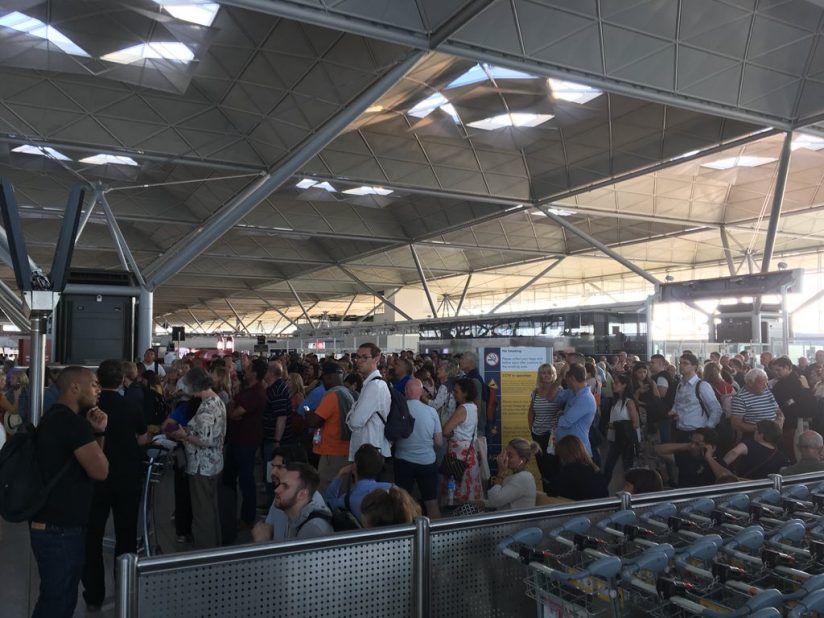
Airlines are in freefall amid Covid-19 pandemic, but why should taxpayers foot the bill?
RT | April 25, 2020

Airlines are turning to governments for rescue money – but bailing out the massive capitalist ventures makes about as much sense as leaving the middle row empty to avoid the virus.

With the world in a tailspin from Covid-19, airlines are in for a bumpy ride – and some of them are inevitably going to crash and burn. Everything may be up in the air but one thing is for certain: flying will never be the same again.

Air travel will be a much different beast when this lockdown nightmare is over. Some airlines and EU states now want to introduce in-flight social distancing with the middle seats left vacant, as part of a set of new rules to be announced next month. There’s also talk about airlines cancelling or reducing their in-flight food and beverages service to reduce interaction.

There will no doubt be some other regulations, such as compulsory facemasks, tedious longer queues when boarding, and temperature taking – which is almost pointless because some Covid-19 carriers will be asymptomatic.

But the middle seat rule is an “idiotic” proposal, as Ryanair chief executive Michael O’Leary quite rightly pointed out the other day.

It doesn’t make any sense when we’re all supposed to keep two meters apart, but the distance between seats is only 50cm wide on an average Ryanair plane. Sure, some scientists claim you can catch the virus once you’ve spent 15 minutes in its presence – which, if actually true, would mean it wouldn’t matter if you were sitting beside someone or three rows back.

Its only true effect here is a psychological one, to artificially restore confidence to get bums back on seats. I’m not a fan of the unpopular Irishman – who comes across like the Grinch who stole Christmas at the best of times – but O’Leary made a very valid point when he told the Financial Times: “Either the government pays for the middle seat or we won’t fly.”

The last time I checked, Ryanair was in the business of making money and not burning it, which is exactly what would happen if they’re forced to fly at only 66 percent capacity. Airlines need this like a hole in the head, especially since they’re already grappling with the daunting prospects of less routes and less frequency, which will hike up prices as well.

Some financial experts estimate ticket prices could increase by 50 percent – but I wouldn’t be surprised if they end up being even higher. One thing is certain: the days of cheap flash ticket sales are well and truly over for the foreseeable future.

There would be absolutely no appetite to bailout Ryanair if the airline that people love to hate found itself in troubled waters. Yet there’s a strong desire amongst some British commentators to rescue Virgin Atlantic, which can only be put down to blind patriotism for what would’ve been perceived as a Rule Britannia success story – up until now.

One of the first airlines to slump into administration this week was Virgin Australia and it looks like Virgin Atlantic could be next in line to wave goodbye.

Some airlines have already been bailed out in the US and EU, which is the most foolish move since the banks were rescued in the noughties. These capitalists’ enterprises should live and die by their own sword, which is why I’ve absolutely no sympathy for Richard Branson who sounds out-of-touch to me.

Considering he’s a tax exile, Branson insulted the British people when he went cap in hand – or rather with deeds-to-island in hand – to ask the UK government to bail out “his” airline (Delta owns 49 percent) to the tune of £565mn. The billionaire had some brass neck offering up Necker Island as the collateral as it’s reportedly “only” worth £80mn. But there’s definitely a nice little profit there, considering he purchased it for a low six figures in 1979.

Virgin Atlantic doesn’t appear to have very much in terms of assets, as far as I’m aware, which would make it a risky gamble for the British government if it went belly-up. Branson says his main goal is to save jobs, but in such turbulent times, Boris Johnson would get more of a return on the money by investing it elsewhere to create jobs in more sustainable industries. Surely anything is bound to be less risky than the airline business at the moment.

If Branson is genuinely concerned about saving jobs, as he claims, then his best – and certainly more honourable option – is to offer to sell his interest in Virgin Atlantic to the British government. At this point, it would make more sense to nationalise it.

It speaks volumes that Delta – despite receiving $5.4 billion from the Trump administration already and seeking an additional $4.6 billion loan from US taxpayers – is refusing to invest another dime in Branson’s baby. Talk about throwing the baby out with the bathwater!

The money Branson needs is a drop in the ocean compared to the $10 billion Delta is looking to get its grubby hands on, which makes you wonder if the American airline is either confident Boris Johnson will offer Branson a parachute, or has perhaps already accepted Virgin Atlantic will end up dead in the water sooner or later.

As we face what’s going to be the worst recession since the Great Depression, Transatlantic travel is going to be increasingly more of a luxury than ever before, and business trips will be curtailed, probably more frequently replaced with Zoom, which could eventually kill off Virgin Atlantic in the long run anyway – just like how video killed the radio star.

It’s going to be a hard landing for those airlines lucky enough to survive this crisis, but there’s little or no benefit in any government bailing out any of those that crash and burn now because the market will have significantly shrunk after the pandemic.

Jason O’Toole has worked as a senior feature writer for the Irish Daily Mail, a columnist with the Irish Sunday Mirror and senior editor of Hot Press magazine. He is also the author of several best-selling books.

April 25, 2020 Posted by | Economics | , | Leave a comment

Deception – Submarines against Olof Palme

thersites | April 22, 2020

Background:

In the early 1980s, Sweden was haunted by several hundred sightings of mysterious submarines, causing much panic in public opinion and greatly embarrassing the non-aligned Social Democrat government led by Olof Palme and its efforts to create detente in Europe.

In 1981, a Soviet submarine had run aground in Swedish territorial waters, and the Soviets consequently got blamed for every subsequent sighting over the nest half decade,

10 years later, high ranking US and British officials causally revealed in interviews that NATO had sent submarines into Swedish waters – with the Swedish Navy High Command being informed of the matter, but with neither the Swedish militar brass nor US/UK/NATO informing the elected Swedish government.

After the assassination of Olof Palme in 1986 and the end of the Cold War in the late 1980s, the sightings disappeared – only for the submarines turn up again in 2014, during the New Cold War.

(Director; Dirk Pohlmann)

April 25, 2020 Posted by | Deception, Fake News, Mainstream Media, Warmongering, Russophobia, Timeless or most popular, Video | , , , | Leave a comment

The bipartisan “small business” swindle: Billions for banks and corporations, pennies for workers and shopkeepers

By Barry Grey  | WSWS | April 23, 2020

Scores of multi-million- and billion-dollar corporations are receiving free handouts from the government under the “small business” relief fund grotesquely misnamed the “Paycheck Protection Program” (PPP). The program was launched last month as part of the $2.2 trillion CARES Act, with $349 billion in taxpayer funds.

Billed as a lifeline to small businesses and their employees, the program has been exposed as a cynical fraud. Multiple reports have emerged showing that it is first and foremost a cash cow for large businesses and the Wall Street banks. It is yet another example of how the corporate-financial elite is exploiting the coronavirus catastrophe to further enrich itself at the expense of society and at the cost of human lives.

The CARES Act was passed with the unanimous support of the Democrats in the Senate—including the votes of Bernie Sanders and Elizabeth Warren—and by voice vote in the House, with no effort by so-called “progressives” such as Democratic Socialists of America members Alexandria Ocasio-Cortez and Rashida Tlaib to stall, let alone defeat, its passage.

While big restaurant chains and other firms whose stock is traded on Wall Street gobbled up large portions of the “small business” relief money, and the major Wall Street banks pocketed $10 billion in loan fees, family-owned restaurants, barber shops, beauty salons, retail stores and other small firms were pushed to the back of the line or denied relief outright.

The program ran out of funds last Thursday, less than two weeks after it was launched, leaving hundreds of thousands of small businesses high and dry and their millions of laid-off employees facing destitution. Now the Trump administration and Congress are rushing to inject an additional $310 billion into the PPP.

On Wednesday, the Senate passed by unanimous consent a new $484 billion bailout bill, whose central component is the renewal of the PPP. At the urging of the Democrats, looking to provide a “progressive” fig leaf to the pro-corporate measure, and with the agreement of Trump, the bill tacked on a totally inadequate $75 billion for hospitals and a derisory $25 billion for COVID-19 testing.

Speaker of the House Nancy Pelosi has announced that the Democratic-controlled chamber will vote on the new bill on Thursday. On Tuesday, she hailed the passage of the bill in the Senate, declaring that the Republicans “have seen the light—and we had a great victory for the American people.”

Among the businesses that have received low-interest PPP loans, which are to be forgiven if the firms use 75 percent of the money to keep their workers employed for eight weeks, are:

  • The Ruth’s Chris steakhouse chain, with some 5,000 employees at over 100 locations in 2019 and $468 million in revenues. It received two PPP loans totaling $20 million. The total compensation for CEO Cheryl J. Henry was $6,105,629 in 2018. The stock price of the chain’s parent company, Ruth’s Hospitality Group, has risen by 112 percent over the past month.
  • The Potbelly Sandwich Shop chain, with around 6,000 employees at 474 locations in 2019 and revenues of $410 million. The company received a PPP loan for $10 million. Total compensation for CEO Alan Johnson in 2018 was $1,668,251. Potbelly stock has risen 70 percent over the past month.
  • The Shake Shack restaurant chain, with some 6,000 workers at 254 locations in the US and internationally and $595 million in revenues in 2019. It received $10 million in PPP loans. Total compensation for CEO Randy Garutti in 2018 was $3,805,410. Shake Shack stock has risen 40 percent over the past month. On Sunday, Shake Shack announced it was returning its PPP loan.
  • The J. Alexander’s restaurant chain, with 2,700 employees at 46 locations in 2019 and $304 million in revenues in 2016, received $15.1 million in PPP loans. Total compensation for CEO Mark Parkey was $591,000 in 2019. J. Alexander’s stock has risen by 2 percent over the past month.

Other large firms that received PPP loans include:

  • The Ohio-based biotech company Athersys, which raised almost $60 million in a stock offering on Monday. Its shares have nearly doubled in 2020.
  • Indiana-based coal operator Hallador Energy, which received $10 million after it laid off 60 workers in March.
  • Data storage company Quantum took $10 million.
  • Nicola Motor, backed by giant hedge funds and asset management firms and valued at $4 billion, received a loan of $4 million.

According to a Financial Times article published on Tuesday, 83 publicly traded companies received a combined $330 million in loans from the PPP program, an average of $4 million each. The combined stock value of these firms at the end of 2019 was $12 billion.

Other published figures show how the program is skewed to big companies. More than 25 percent of the $349 billion in loans went to fewer than two percent of the firms that got relief. And more than one out of every four dollars in the fund went toward big loans of $2 million and above.

Meanwhile, just eight percent of small businesses that have applied for aid under the CARES Act have received money.

JPMorgan Chase, the largest US bank, processed many of the biggest loans and cashed in the most on the program. Only six percent of its smaller customers got PPP loans, 18,000 out of the 300,000 that applied. But nearly all of the 5,500 larger companies that applied for PPP loans, customers of the bank’s commercial banking business, received them.

A class action lawsuit filed Sunday in federal court in Los Angeles alleges that four banks—Wells Fargo, Bank of America, JPMorgan Chase and US Bancorp—rushed loans to the biggest businesses to maximize their earnings. The suit alleges that the banks prioritized larger loans to bigger firms instead of processing applications in the order in which they arrived in order to generate bigger processing fees.

Sections of corporate media, prominent Democrats and even Trump are feigning shock and dismay over the funneling of “small business” loans to big corporations and the banks. On Tuesday, Trump, for fairly obvious political reasons, singled out Harvard University, which received bailout money under a different part of the CARES Act, and demanded that it return its loan.

These statements are utterly fraudulent. One is reminded of Captain Renault’s shock at discovering that gambling was taking place at Rick’s Casino in the film Casablanca.

As the media and both parties were well aware, restaurant and hotel chains, hedge funds and other corporate interests carried out intensive lobbying of their political servants in Congress prior to the passage of the CARES Act. One result was the insertion of a loophole allowing restaurant and hotel chains to evade the much trumpeted provision restricting the PPP loans to businesses with fewer than 500 employees. The bill that was passed on a fully bipartisan basis allows restaurant and hotel chains to receive loans so long as none of their individual units has more than 500 workers.

There is nothing in the measure renewing the PPP passed by the Senate on Wednesday that addresses this free pass for the chains.

Moreover, the law is written so as to facilitate self-dealing and corruption. There is not even a requirement that the federal Small Business Administration (SBA), which oversees the PPP, disclose to the public or to Congress the recipients of the loans.

Even if more small businesses eventually receive money from the program, the jobs of millions of workers will not be preserved, since the loans are designed to cover payroll for only eight weeks. The public health crisis and the economic disaster will last far longer. With no serious aid to the 22 million who have already lost their jobs and the millions more who will follow in the coming days and weeks, thousands of restaurants and other small businesses will go bankrupt and permanently shut their doors.

The response of the ruling classes in the US and around the world to the coronavirus outbreak has demonstrated the utter failure of the capitalist system. In every country, countless thousands of lives are being sacrificed to the insatiable drive of a tiny financial aristocracy for personal wealth, whatever the cost in death and human suffering.

The ruling classes are focused on devising ways to profit off of the pandemic. The absurdly named “Paycheck Protection Program”—an example of Orwellian Newspeak—is a case in point.

But the oligarchs, like the ancien regimes of old, are digging their own graves. Mass anger and opposition is growing by leaps and bounds. Strikes and protests by workers are taking place on virtually every continent. It is this international movement, made conscious of its revolutionary aims and tasks, that offers the way out for humanity from the nightmare of pandemics, poverty and war.

April 24, 2020 Posted by | Deception, Economics | , | Leave a comment

New US Health Spokesman Says Rothschild Family ‘Craves Control’, Blames Soros Over Virus

Sputnik – April 24, 2020

Last week, Michael Caputo, who worked on Donald Trump’s 2016 presidential campaign, was appointed by POTUS as Assistant Secretary for Public Affairs at the US Department of Health and Human Services.

The newly nominated spokesman for US the Department of Health and Human Services (HHS), Michael Caputo, has blamed George Soros and the Rothschild family for trying to exploit the coronavirus pandemic in order to promote their own agendas, according to CNN which managed to uncover more than 1,000 Caputo tweets he deleted before entering office.

In a now-scrapped tweet on 15 March, Caputo, who is infamous for his remarks on social media, responded to self-proclaimed China analyst Jack Prosobiec, who speculated on Twitter why billionaire investor and philanthropist Soros allegedly adheres to his favourite political causes rather anti-COVID-19 efforts.

“Are you kidding? Soros’s political agenda REQUIRES a pandemic”, Caputo claimed, in what was followed by another tweet, in which he posted a Soros photo captioned “The real virus behind everything”, also adding skulls and crossbones.

In a separate tweet last month, Сaputo slammed economist David Rothschild as “an inbred elitist sphincter whose family craves control”, adding, “that’s one reason why he constantly lies about President Trump”.

The economist, thought to be not related to the Rothschild gamily, is known for his fierce criticism of Trump who David Rothschild claims is seeking “to murder” people in a bid to stay in power.

Trump nominated Caputo as Assistant Secretary for Public Affairs at the HHS on 12 April, a decision that was reportedly in part due to POTUS’ frustration over the way department secretary, Alex Azar was dealing with communications during the COVID-19 crisis.

CNN, in turn, reported that ahead of entering office, Caputo had deleted more than 1,300 tweets and retweets on his Twitter page from late February to early April, including those pertaining to the coronavirus. CNN managed to unearth the tweet by using the Internet Archive’s “The Wayback Machine”.

April 24, 2020 Posted by | Aletho News | , | Leave a comment

Russia dismisses as ‘baseless’ US claims on IRGC satellite launch

Russian Foreign Ministry Spokeswoman Maria Zakharova
Press TV – April 23, 2020

Russia has dismissed as “baseless” claims by the United States that the recent launch of Iran’s first-ever military satellite by the Islamic Revolution Guards Corps (IRGC) violates a United Nations Security Council resolution endorsing the 2015 nuclear deal between Tehran and world powers.

On Wednesday, the IRGC Aerospace Force launched the Nour (Light) satellite via the Qassed (Carrier) carrier, a move US Secretary of State Mike Pompeo was quick to condemn as a violation of United Nations Security Council Resolution 2231.

“This would not be the first time that a nation that has flagrantly breached the norms of international law and violated UNSC resolution 2231 is trying to deflect international condemnation by baselessly accusing Iran of noncompliance with the requirements of the Security Council,” Russia’s Sputnik news agency quoted Foreign Ministry spokeswoman Maria Zakharova as saying at a briefing on Thursday.

She noted that neither the resolution nor the 2015 Iran nuclear deal restrict Iran’s right to explore space to peaceful ends.

She added that Iran has made it clear that it does not intend to develop nuclear weapons, unlike the US, which has over the past months unveiled several plans to expand its nuclear arsenal.

“There are no, there have never been, and hopefully there will never be nuclear weapons in Iran. Iran, adhering to the resolution, does not develop, test or use ballistic missiles capable of carrying nuclear weapons, unlike the United States, which surprises the world every single day with news about plans to develop their nuclear missile capabilities,” she said.

The remarks came after Pompeo said Iran needed “to be held accountable” for the launch, claiming that the move violated UNSC Resolution 2231.

This is while the resolution in question calls on Iran “not to undertake any activity related to ballistic missiles designed to be capable of delivering nuclear weapons, including launches using such ballistic missile technology.”

The Nour-1 is Iran’s first multi-purpose satellite with application in the defense industry, among other areas. It is also the first Iranian satellite with an expected operational life of more than a year in Earth’s orbit.

April 23, 2020 Posted by | Aletho News | , , | Leave a comment

Blair comeback is a terrible idea… unless the UK wants to join a US war on China

By Finian Cunningham | RT | April 23, 2020

For many observing the British government’s fiasco over the Covid-19 pandemic, it is like watching a rerun of the Dad’s Army sitcom. Then enters former PM Tony Blair and the mood quickly horrifies.

Blair, who has been out of office for nearly 13 years, suddenly made a comeback on certain media outlets this week and was treated by his hosts as if he were some kind of political paragon, offering his “sage” advice on how the government should handle the current crisis.

Careful to not sound too arrogant, the unctuous Blair prefaced his remarks as “constructive criticism” but then went on to propose sweeping reorganization of government strategy. The non-governmental “skill sets” that he advised no doubt is a pitch for private consultants like Blair to be contracted to Whitehall.

Understandably, a lot of the public were infuriated that Blair should be treated so royally, including as a guest on the taxpayer-funded BBC, to be fawned over by presenters seeking his presumed wisdom.

Regardless of the present government’s botched handling of the Covid-19 crisis, why is a has-been prime minister being given such a prime platform to lecture. Blair makes his advice sound like technocratic expertise when it’s a blatant bid for rehabilitating his credentials. Reorganizing government departments and civil servants? Many ordinary citizens could define the Covid-19 problem more accurately and simply as chronic underfunding of national health services from years of neoliberal austerity.

But the most galling thing about hearing Tony Blair’s smug and self-aggrandizing tone this week is the insult to basic morality. Blair should be serving time in jail for the war crimes he presided over in launching the US-led war on Iraq. That war left more than a million dead, with millions more wounded and ravaged by poverty. An ancient nation was destroyed, which spawned terrorism across the Middle East, a horrific legacy with which countries are still struggling. Blair was instrumental in launching the US and British war on Iraq and he aided and abetted war in Afghanistan, both of which have piled up the American and Britain’s national debts.

In a very real way, the burden of war debts on the public is a factor in why health services have been underfunded and why when a much-predicted pandemic finally did hit, the US and Britain have been singularly remiss in dealing with. Both are projected to have the worst death tolls in the world from the disease.

To see Blair offering his tuppence worth of crisis management is truly nauseating. That he can be indulged by British media without a hint of shame about his warmongering past really shows how morally and intellectually brain-dead the British political class is. The hypocrisy of such people is that they find fault with other world leaders, from China to Russia, Iran to Venezuela or North Korea, yet here they are sucking up to a man who has the blood of millions on his hands. It just shows the tacit arrogance of British imperialism. Supposedly smart or liberal media-types are oblivious to how shockingly unacceptable it is to have Tony Blair anywhere near the airwaves.

But hold on a cynical moment. Blair might find a new purpose after all. He was the guy who used his rhetorical “skill sets” to sell the war on Iraq to the American and British people, and indeed to the rest of the world. It was Blair and his barrister-like poise that elevated the lies and propaganda of weapons of mass destruction into something with a modicum of gravitas. His American counterpart President G.W. Bush was able to carry off an outrageous act of genocidal aggression largely on the rationale forged by Blair.

Which brings us to the present Covid-19 crisis. President Trump and deranged anti-China hawks in Washington want to turn this pandemic into a lynching of Beijing. “China has blood on its hands,” goes the mantra. “China must pay” for the deaths of Americans and the economic disaster that has fallen on Trump’s otherwise “success story.”

The narrative is building to blame China, which Washington accuses of “misinformation” and “deception” by “covering up” the initial outbreak, thereby leaving other nations vulnerable to the pandemic. This is of course audacious scapegoating by an American ruling class and dysfunctional economic system which betrayed the health needs of millions of Americans.

The propaganda assault underway against China has echoes of the earlier false narrative about weapons of mass destruction in Iraq. It is essentially about pushing claims and dubious “facts” to fit an outcome of conflict. War in the case of Iraq; and financial exploitation of China by making China take the rap for the Covid-19 pandemic. The latter scenario would most likely lead to war too.

What better person for the American agenda of falsifying the pandemic than Tony Blair? If he is rehabilitated into government as a private consultant, one can imagine how his remit will be easily extended to “corroborating” US claims that China is to blame for the pandemic.

If that seems a stretch then why are media presenters still giving Blair the time of day? If they can’t seem to understand how repugnant it is to have someone as vile as Blair on their comfy programs then it shows that anything is possible.

April 23, 2020 Posted by | Economics, Mainstream Media, Warmongering, Timeless or most popular, War Crimes | , , , | Leave a comment

How It All Began: The Belgrade Embassy Bombing

By Peter Lee | China Matters | May 24, 2015

When I was in Beijing during the protests in 1989, a middle-aged man came up to me and asked, “Couldn’t America send some B-52s here and…” and he made a swooping motion with his hand.

Ten years later, on May 7, 1999, the American bombers did show up.

Instead of showering freedom ordnance on China’s dictators, however, they dropped five bombs on the Chinese embassy in Belgrade.

As to why this happened, the United States has always declared it was an accident.

A lot of people in China believe otherwise and there is a good amount of evidence to support their view.

The bombing of the embassy was a wake-up call for the PRC leadership, which decided it urgently needed a doctrine and capabilities beyond its strategic nuclear deterrent to handle disagreements with the United States that might acquire a military dimension.

It was also a propaganda godsend for the regime.

Chinese demonstrators were back on the streets, but protesting against the United States instead of against the PRC regime’s deficiencies in Western democratic values.

Americans and the U.S. media had a hard time getting used to this unfavorable turn in some popular Chinese attitudes away from 1989 democracy-love, blaming the ill-feeling on the suppression of news of President Clinton’s apology.

In the July 2001 China Journal, Peter Hays Gries of Ohio State University analyzed letters and submissions to China’s Guangming Daily and characterized the protests as “genuine and understandable” and largely unrelated to unawareness of the presidential apology.

On the ten-year anniversary of the bombing, China Digital Times linked to an interview with a student who identified the bombing as the trigger for a sea-change in the worldview of at least some Chinese:

What do you believe has changed now in the attitude of young Chinese (like those who protested 10 years ago against the USA) towards America?

Over the past decade, I think the young Chinese have gradually dropped their illusion of the U.S. and begun to view it more objectively.

After reform and opening-up, to be more specific in the 1980s and 1990s, the Chinese people began to know more about the outside world. The prosperity of the west attracted the young people so much that all of a sudden everybody wanted to go abroad. At that time, we had a popular saying, “Moon of the west is even more beautiful than that of China.” Experiencing the sharp contrast between China and the west, many Chinese people became critical of China, perhaps in a cynical way.

However, when the Chinese embassy was bombed, many people began to think: is this the kind of democracy and human rights that we want to pursue?

Post Iraq-war, it is difficult to remember the years when the United States effortlessly claimed the moral high ground. But in 1999, I remember that I also discounted Chinese whinging about the Belgrade embassy accident.

Writing in 2001, Gries provides a reminder:

The demonstrations shocked the US media, which quickly pointed blame at the Chinese government for inflaming the protests. A brief review of major US newspaper editorials of 11 May reveals a consensus view: the Chinese people were not genuinely angry with (innocent) America; they were, rather, manipulated by Communist propaganda that the bombing was intentional… The Washington Post declared: “The Big Lie is alive and well in Beijing”… Such “state-supervised anger”, the Boston Globe declared, was neither genuine nor popular. The “brutes in Beijing” were responsible for the Chinese people’s mistaken belief that the bombing was intentional.

A contentious interview conducted by Jim Lehrer with the Chinese ambassador to the US, Li Zhaoxing, immediately subsequent to the attack, is enlightening for the cognitive dissonance provoked by Li’s refusal to share Lehrer’s confidence that the US would publicly and honestly sort out what was obviously just a regrettable goof. Looking back at the interview through the perspective provided by the shameless mendacity of the Bush administration over the Iraq War, it is Lehrer and not Li who looks delusional and out of touch.

LI ZHAOXING: I’m saying that the Chinese people and the Chinese government are requesting a thorough investigation of the NATO missile attack on our embassy in Yugoslavia.

JIM LEHRER: Yes, sir. But my question is: why would you think that it would not be an accident or a mistake? In other words, why would you think– to repeat my question, why would you think that the United States would intentionally kill Chinese citizens in downtown Belgrade?

LI ZHAOXING: Ask your own people. Ask your own officials. Ask your own experts. If they ask themselves, seriously, honestly, do they really believe that this is simply a kind of mistake?

…

JIM LEHRER: Are you suggesting that that is not the intention of the United States, to do exactly what you– in other words, to conduct a full investigation and hold the people responsible for this?

LI ZHAOXING: We attach more to facts, rather than words. No matter how eloquent one could be.

In addition to his encounter with Jim Lehrer, Li Zhaoxing received further instruction on American attitudes from another, less courtly source.

Gries passes on a report in the Washington Post in which Tom DeLay, the Republican whip in the House of Representatives, revealed to Li his own formula for managing US-PRC relations, one that did not depend on apologies:

I was on Meet the Press… right after the bombing of the Chinese Embassy in Kosovo [he meant Belgrade], and the [Chinese] ambassador was on before me. And if you remember, he’s kind of an obnoxious fellow and he’s screaming and yelling about how bad the Americans were, and I had had it up to about here. So he’s coming off the stage and I’m going onto the stage and I intentionally walked up to him and blocked his way… I grabbed [his] hand and squeezed it as hard as I could and pulled him a kind of little jerk like this and I said: “Don’t take the weakness of this president as the weakness of the American people.” And he looked at me kind of funny, so I pulled him real close, nose to nose, and I repeated it very slowly, and said, “Do-not-take-the-weakness-of this president as the weakness of the American people.”

I expect Li Zhaoxing recalled Mr. DeLay’s solicitude as well as Jim Lehrer’s amazed disbelief when he returned to Beijing to become China’s Minister of Foreign Affairs.

A tentative answer to Jim Lehrer’s query as to why the United States might take the dastardly step of bombing the Chinese embassy can be found in my articles from early 2007 on the Belgrade incident: the persistent rumor that attack was conducted to destroy wreckage of a US stealth fighter shot down over Serbia, which the Milosevic government had delivered to the PRC in gratitude for services rendered (or perhaps traded to the PRC in return for presumably safe and secure radio retransmission facilities from inside the Belgrade embassy for the Serbian military, whose communications network was a focus of NATO strikes).

The story that China might have acquired key Stealth technology from the crash in Yugoslavia acquired a lot of legs after China test-flew its first stealth fighter, the J20, in January 2011, as I wrote in Asia Times.

During the North Atlantic Treaty Organization (NATO) campaign against Serbia in 1999, an American F-117A stealth fighter was shot down. Some wreckage undoubtedly made it into Chinese hands. Slobodan Lekic and Dusan Stojanovic of the Associated Press (AP) reported on January 23:

“At the time, our intelligence reports told of Chinese agents crisscrossing the region where the F-117 disintegrated, buying up parts of the plane from local farmers,” says Admiral Davor Domazet-Loso, Croatia’s military chief of staff during the Kosovo war.

“We believe the Chinese used those materials to gain an insight into secret stealth technologies … and to reverse-engineer them,” Domazet-Loso said in a telephone interview.

A senior Serbian military official confirmed that pieces of the wreckage were removed by souvenir collectors, and that some ended up “in the hands of foreign military attaches”. [2]

The idea that the United States had not taken adequate steps to secure the F-117A wreckage and useful technology may have thereby found its way into enemy hands is apparently rather irksome to the Pentagon.

Elizabeth Bumiller transmitted the US official pushback in the January 26 New York Times article titled “US Doubts ’99 Jet Debris Gave China Stealth Edge”:

[I]t’s hard to imagine that a great deal of applicable and useful information could have been culled from the site,” said an Air Force official, who asked for anonymity because he was not authorized to speak publicly about military intelligence. [3]

Interestingly and perhaps not surprisingly, even as this narrative of PRC military espionage cum trashpicking was advanced, I didn’t see anybody pursue the logical corollary: that acknowledgment that China had possessed Stealth wreckage buttressed the allegation that the US government might have bombed the Chinese embassy in Belgrade in order to destroy the sensitive technology.

In reading my dissection of the Belgrade bombing, its myths and legends, the reader can draw his own conclusions about the context it provides for subsequent US-PRC confrontations and strategies and the attendant media hoopla.

A final prefatory note:

One element that contemporary readers might find hard to swallow is my assertion that the mission that destroyed the Chinese embassy was the only target selected by the CIA.

Well, that’s what George Tenet, Director of the CIA, said. It is a mystery to me why he considered this revelation in any way exculpatory.

From the July 23, 1999 New York Times :

“It was the only target we nominated,” the director, George Tenet, said at a rare public hearing of the House Intelligence Committee.

After the strike on May 7, which killed three Chinese and wounded at least 20 others, the CIA decided it better go back to its usual business of spying, a U.S. official said Thursday. Reeling from its error, the agency almost immediately suspended other preparations it was making to forward additional targets to help NATO.

The Bombing of the Chinese Embassy in Belgrade in 1999

China’s first direct experience with satellite-guided munitions occurred on the night of May 7, 1999, when at least five GPS-guided JDAM bombs slammed into the Chinese embassy in Belgrade, killing three Chinese nationals and wounding 20.

…
The JDAM used in the attack is a very successful and relatively inexpensive concept in ordnance by which dumb bombs are, as it were, sent to college, and equipped with a GPS-corrected guidance system that generates corrective adjustments to movable vanes after the bomb is dropped from a plane, enabling reported accuracy of within 13 meters.

The conventional, though implausible, narrative at the time of the embassy bombing was The Bomb was Smart… But We Goofed!

In testimony before Congress in July 1999, George Tenet explained how they meant to bomb some logistics office of the Yugoslavian army, they used an outdated map, somebody did catch the error but the message didn’t get through, the system broke down, sooooooo sorry.

On October 17, 1999, the Sunday Observer, in cooperation with a Danish paper, Politiken, came out with what would seem to be a blockbuster report: that the United States had deliberately targeted the embassy in order to remove a key rebroadcast station directing the military activities of Slobodan Milosevic’s forces in their struggle to resist NATO forces.

I am embarrassed to admit that my Googling skills haven’t turned up a direct link to the article, but the Observer’s sister publication, the Guardian, ran a story summarizing the article’s conclusions.

As to why the Chinese government dared to take the provocative step of hosting a Yugoslavian military radio facility, the article speculates that Beijing cooperated with Belgrade in order to acquire data on U.S. military capabilities:

Why the Chinese were prepared to help Milosevic is a more murky question. One possible explanation is that the Chinese lack Stealth technology, and the Yugoslavs, having shot down a Stealth fighter in the early days of the air campaign, were in a good position to trade. The Chinese may have calculated that Nato would not dare strike its embassy, but the five-storey building was emptied every night of personnel. Only three people died in the attack, two of whom were, reportedly, not journalists – the official Chinese version – but intelligence officers.

The Chinese military attache, Ven Bo Koy, who was seriously wounded in the attack and is now in hospital in China, told Dusan Janjic, the respected president of Forum for Ethnic Relations in Belgrade, only hours before the attack, that the embassy was monitoring incoming cruise missiles in order to develop counter-measures.

…

According to the Observer, the behind the scenes U.S. attitude to the embassy bombing was: Mission Accomplished.

British, Canadian and French air targeteers rounded on an American colonel on the morning of May 8. Angrily they denounced the “cock-up”. The US colonel was relaxed. “Bullshit,” he replied to the complaints. “That was great targeting … we put three JDAMs down into the (military] attache’s office and took out the exact room we wanted …

This story died the death in the U.S. media (I only saw references to it in the English papers at the time) and, to its everlasting credit, FAIR (Fairness and Accuracy In Reporting) took the matter up.

In an October 22, 1999 article, FAIR wrote:

So far, the reaction in the mainstream U.S. media has been a deafening silence. To date, none of America’s three major network evening news programs has mentioned the Observer’s findings. Neither has the New York Times or USA Today, even though the story was covered by AP, Reuters and other major wires. The Washington Post relegated the story to a 90-word news brief in its “World Briefing” (10/18/99), under the headline “NATO Denies Story on Embassy Bombing.”By contrast, the story appeared in England not only in the Observer and its sister paper, the Guardian (10/17/99), but also in their leading rival, the Times of London, which ran a follow-up article on the official reaction the next day (10/18/99). The Globe and Mail, Canada’s most prestigious paper, ran the full Reuters account prominently in its international section (10/18/99). So did the Times of India, the Sydney Morning Herald and the Irish Times (all 10/18/99). The prominent Danish daily Politiken, which collaborated with the Observer on the investigation, was on strike, but ran the story on its website.

FAIR and its supporters rattled a few media cages, and got dismissive replies from the New York Times and USA Today.

The Times’ Andrew Rosenthal characterized the Observer article as “not terribly well sourced”.

In its rebuttal, FAIR stated:

FAIR contacted journalists at both the Observer and Politiken. According to the Observer’s U.S. correspondent, Ed Vulliamy, its foreign editor, Peter Beaumont, and Politiken reporter Jens Holsoe, their sources included the following:

–A European NATO military officer serving in an operational capacity at the four-star level – a source at the highest possible level within NATO–confirmed three things: (1) That NATO targeted the Chinese embassy deliberately; (2) That the embassy was emitting Yugoslav military radio signals; and (3) That the target was not approved through the normal NATO channels but through a second, “American-only” track.

–A European NATO staff officer at the two-star level in the Defense Intelligence office confirmed the same story.–

Two U.S. sources: A very high-ranking former senior American intelligence official connected to the Balkans – “about as high as you can get,” according to one reporter — confirmed that the embassy was deliberately targeted. A mid-ranking current U.S. military official, also connected to the Balkans, confirmed elements of the story and pointedly refused to deny that the embassy had been bombed deliberately.

–A NATO flight controller based in Naples and a NATO intelligence officer monitoring Yugoslav radio broadcasts from Macedonia each confirmed that NATO’s signals intelligence located Yugoslav military radio signals coming from the Chinese embassy in Belgrade. When they informed their superiors, they were told that the matter would be handled further up in the chain of command. Two weeks later, the embassy was bombed.

–An official at the U.S. National Imagery and Mapping Agency told the reporters that NATO’s official explanation, which involves a faulty map of Belgrade, is a “damned lie.”

Finally, the Times, still coasting on its Pentagon Papers reputation in those halcyon, pre-Judy Miller days, replied to one correspondent:

“There is nothing in the distinguished history of the Times — where reporters have risked their lives, been threatened with jail and indeed gone to jail to protect the public’s right to know things the government does not want to get out — to suggest that we would withhold such a story.”

Hmmm.

…
When weighing the credibility of the Observer report, it is also worth recalling that, by CIA Director Tenet’s own admission, of the 900 targets struck during the Kosovo war, the CIA was responsible for only one targeting package—the bombing that was ostensibly meant to take out an insignificant Yugoslavian paper-shuffling operation and ended up destroying the Chinese embassy’s intelligence directorate instead.

Another investigative report confirmed that, not only was the target selected by the CIA, the entire mission was flown by the United States outside of standard NATO channels (NATO, of course, was the vehicle for European and American intervention in the Kosovo conflict; it was not a U.S.-directed war).

This is not my day for coming up with direct links to original reporting, but I found a posting on Venik’s Aviation of what looks like an accurate transcription of a May 2000 article from Air Forces Monthly, a European publication, detailing the mission.

It delivers the goods on what actually struck the Chinese embassy (not “guided missiles” or “laser guided munitions” as other outlets reported):

In the early hours of May 7, 1999, a USAF B-2 Spirit bomber, escorted by EA-6B defence suppression aircraft and F-15C fighters, dropped three GPS-guided Joint Defence Air Munition (JDAM) bombs on the Chinese Embassy in the Novi Beograd district of Belgrade.

As to how the targeting “error” slipped by NATO:

It should be noted that, in an interview with the author, NATO spokesman Lee McClenny confirmed that the targeting information did not go through JTF NOBLE ANVIL, or any other NATO structure, in contrast to Tennet’s [sic] official public statements. Instead, the co-ordinates were passed directly from the CIA to Whiteman Air Force Base, the home of the 509th Bomb Wing, where it was programmed into the JDAMs. Mr McClenny asserted that the entire process had remained ‘Stateside’, hence the failure of NATO staff to ‘scrub’ the target to check its accuracy, authenticity and location.
…

When asked, the CIA again asserted that the story given by Tennet [sic] to the House Committee was true, but claimed that the targeting information went from the CIA to the Pentagon to be processed. The Pentagon was only prepared to say that “some of the F-117 and B-2 missions were used as ‘national assets’ and therefore did not pass through NATO command structures”, despite the requirement under the NATO charter to clear all missions carried out under NATO auspices with the NATO general council…

We can now bring some more recent, first-hand information to the mix.

China’s Ambassador to Yugoslavia at the time, Pan Zhanlin, has written a Chinese-language memoir entitled My Encounter with War .…

Living in Belgrade during the NATO bombing campaign, Ambassador Pan became something of an expert on precision-bombing tactics, and he reports on the effect of the five bombs in detail:

The first bomb entered the side of the building at an angle near the roof and tore through to the first floor and detonated at a bottom corner at the dormitory, tearing a pit several meters deep. One of the fatalities and many of the injuries occurred here. The second bomb hit the middle of the roof and went through to the first floor auditorium, causing no fatalities but giving Ambassador Zhan food for thought by incinerating his office and melting the frame of his day bed. The third bomb hit the northwest corner and blasted through several floors, killing two people. The fourth bomb came in a window of the half basement, exploded, destroyed the embassy clubhouse and shattered the building’s structural members. The fifth bomb crashed through the roof of the ambassador’s villa. Fortunately for Ambassador Zhan, who was there at the time, it didn’t explode. Since B2s drop their bombs in even numbers to keep the plane balanced, there was speculation that perhaps a sixth bomb had also entered the basement; but it was never found.

…
I leave it to structural engineers and ordnance enthusiasts to assess whether this damage is consistent with an assault of five JDAMs meant to destroy the entire embassy; a surgical strike to take out the military attache’s office; or the aftermath of a dud-studded fiasco.

…
Ambassador Pan is anxious to characterize the American attack as intentional and motivated by pure cussedness: to break the back of the Milosevic regime by demonstrating to its allies that diplomatic support was not only useless but positively dangerous.

He carefully if awkwardly debunks the scenarios that the embassy was bombed because Milosevic was sheltering or visiting there, or that it was rebroadcasting Yugoslav military communications.

No reference is made to any electronic intelligence activities by China that might have provoked the strike.

Concerning the shootdown of the F117, Pan reports that the scuttlebutt in diplomatic circles was that the plane was located using the Czech Tamara anti-stealth system. His informants told him it couldn’t detect the Stealth aircraft, but that the passage of the plane through sensor coverage left a distinctive “hole” in the CRT display. The Yugoslavs noticed this anomaly and used it to unleash a barrage of 30 SAM missiles at the place where they guessed that the fighter would be, bringing it down.

…
There is a third possibility, in addition to the rebroadcast and Elint scenarios: the F-117 wreckage story.

And it has a radically different outcome.

The Chinese Internet is rife with urban legends concerning the Belgrade strike. Nobody regards it as accidental, and many Chinese seem willing to ascribe all sorts of shenanigans to the Chinese embassy that provoked the attack.

The most interesting scenario is one that the poster attributes to “a private encounter with a Chinese naval officer who was slightly tipsy”.

According to this informant, the Yugoslavian government had recovered the wreckage of the shot-down F-117 and sold key pieces of it to China. The navigation system, fuselage fragments with the Stealth coating, and high temperature nozzle components of the engine were spirited into the basement of the Chinese embassy. Unfortunately, there was a locator beacon inside the INU powered by a battery and, before the Chinese could discover and disable it, the U.S. military was alerted to the location of the F-117 fragments.

In this version of the story, at least, there is a happy ending for the Chinese. The U.S. attacked the embassy with a laser-guided bomb meant to penetrate to the basement and destroy the embassy and the F-117 prize, but it didn’t explode!

The wreckage made it to China (in the special plane Beijing dispatched to carry home the survivors and the bodies of the victims of the attack, according to other accounts).

In the reported words of the officer (“who spoke with tears in his eyes”):

“Although some of our people sacrificed their lives, we gained no less than ten years in the development of our Stealth materials. We purchased this progress with our blood and international mortification.”

“虽然我们有人牺牲了,但是我们隐型材料的研制进度一下提高了十年都不止,这种进步,是以血和国际上的屈辱换来的”–他流泪

This is an interesting story.

In certain respects—the laser-guided part and the basement stash—it conflicts with more credible reports.

The embassy’s sub-basement, which served as an all purpose cafeteria, recreation center, and bomb shelter—an unlikely hidey hole for F-117 parts–was hit once, possibly twice, and it seems unlikely that anything could have been recovered from there.

But conspiracy theorists can draw solace from Ambassador Pan’s description of the four cases of “important state materials” that two brave embassy workers ran up to the fifth floor of the burning embassy to extract. Pan stated:

他们知道,这东西比生命更重要

“They knew these materials were more important than life.”

Standard-issue cypher equipment and secret files?

Special Elint monitoring equipment?

Or the crown jewels of America’s Stealth program?

I lean toward the third explanation, because glomming onto some secret airplane parts and then sneaking them out of a burning building is the kind of low tech triumph that fits in with my sense of China’s capabilities and interests inside Yugoslavia at the time.

The United States may have felt that by purchasing the wreckage, China had crossed the line from diplomatic support for Milosevic and conventional military-attache espionage to a more overt intelligence alliance with Yugoslavia in a deeply sensitive area of U.S. military technology, and needed to be taught a lesson.

I also wish to explore a pyschological element, which perhaps affects China’s outlook to this day.

You can see hints of it in the F 117 in the basement story. It has a touching, almost child-like wish-fulfillment element: the evil empire destroyed our embassy but we escaped with the plans to the Death Star!

The embassy bombing was quite traumatic to China.

However, when the attack occurred, triggering official and popular anger within China, the West was disbelieving, dismissive—and defensive.

It was considered rather churlish of the Chinese to intrude their crude and manufactured nationalistic outrage into our “good war” narrative of the Kosovo conflict by trying to make political capital out of our honest mistake.

…

Today, with further information on the attack and the benefit of perspective, it is difficult to dismiss the shock the Belgrade bombing inflicted on the Chinese.

Post 9/11, Ambassador Pan’s description of the attack is depressing familiar, and more difficult to disregard.

Pan’s plodding prose reawakens dark memories of our own as he conveys the shock and fear as the embassy explodes into flames, “the loudest sound I ever heard”. Survivors found the stairwells blocked by rubble and fire and desperately improvised escapes down the exterior of the building using knotted drapes. Pan saw his friends and colleagues stagger from the ruins of the embassy dazed and bloody, crying out for help.

Amid the chaos everybody ducked in fear of a follow-up attack as NATO bombers thundered overhead (May 7 was one of the busiest nights for aerial bombing). Then came the frantic ad hoc attempts to rally the survivors, account for the living, and search for the missing.

First responders were at first unable to enter the compound because the electric gate was disabled when the bombing cut the power; ambulances race up to the shattered structure with sirens howling to rush away the injured willy-nilly; embassy staffers mounted a frantic search through the local hospitals for the injured.

Finally, there was the extraction of the dead, consoling of the wounded; the grieving; and the defiant patriotic oration.

Again viewed through a post-9/11 lens, Pan’s account also paints a picture of a privileged elite that has been stripped of the illusion that it is immune to attack, and realizing with anger, shame, and disgust that at that moment it is helpless, vulnerable, and unable to retaliate.

Regardless of U.S. motives for bombing the Belgrade embassy or what treasures of military intelligence the Chinese were able to save from the wreckage, if anything was needed to focus Chinese attention on its vulnerability to US attack, getting its embassy, intelligence directorate, and military attache blown up in Belgrade probably did it.

/plee/why-china-hates-satellite-guided-munitions-part-1-the-bombing-of-the-chinese-embassy-in-belgrade-in-1999/

Wednesday, January 31, 2007

The Belgrade Bombing, the F-117 Cake, and the Tears of Premier Zhu Rongji

In a previous post I explored the possibility that the U.S. bombing of the Chinese embassy in Belgrade in 1999 was intentional, with at least the partial objective of destroying wreckage of an F-117A Night Hawk Stealth fighter that Yugoslavia had shot down a few weeks previously.

I am indebted to Dr. Jeffrey Lewis for forwarding some news reports in which the fate of the wreck is discussed.

In 2001 (Fulghum & Wall, Russia Admits Testing F-117 Lost in Yugoslavia, Aviation Week & Space Technology, October 8, 2001), the Russian government acknowledged they had obtained access to F 117A wreckage and stated they used it primarily to improve the anti-Stealth performance of their anti-aircraft missiles.

In the hearsay department, an article in the September 27, 1999 issue of Aviation Week and Space Technology (ed. Bruce D. Nordwall, Earthly Remains) reported, “a Russian official said that some parts had made their way to Moscow, but that the bulk of the airframe was shipped to China.”, a claim that “Pentagon analysts” dismissed “because “China… doesn’t have the industrial capability to benefit from either the design or the systems.”

Contra the Pentagon analysts, simply because China’s Stealth programs were in their infancy at the time doesn’t mean that in 1999 China would not yearn for such a cool and potentially useful trophy as fragments of an American Stealth fighter.

As is now known, Yugoslavians did not turn the entire wreck over to the Russians.

Portions are on display in the Yugoslav Museum of Aviation today and I came across an unconfirmed traveler’s tale that tourists can even purchase souvenir fragments at the museum.

As to what could have been divvied up with the Chinese, the advanced targeting, sensor, and communications systems that the Russians were purportedly interested in neatly dovetail with the reported Chinese take of INU, engine nozzle, and fuselage chunks.

It certainly is plausible that the Yugoslavian government would seek to extract as much propaganda, financial, military, and geopolitical advantage as possible from the F-117A carcass, selling the biggest piece to the Russian Federation but also sharing a few juicy scraps with the PRC, the junior partner in the de facto anti-NATO alliance.

As to whether or not the United States would deem it necessary or desirable to bomb the Chinese embassy to flinders in order to destroy the F-117A wreckage, the Clinton administration suffered a certain amount of criticism for not bombing the wreckage in the wheat field where the plane had fallen in order to deny it to other unfriendly parties.

Analyzing the experiences of the Kosovo conflict, RAND opined:

Heated arguments arose in Washington and elsewhere in the immediate aftermath of the shootdown over whether USEUCOM had erred in not aggressively having sought to destroy the wreckage of the downed F 117 in order to keep its valuable stealth technology out of unfriendly hands and eliminate its propaganda value…Said a former commander of Tactical Air Command…”I’m surprised we didn’t bomb it because the standard operating procedure has always been that when you lose something of real or perceived value—in this case, real technology, stealth—you destroy it.”…Reports indicated that military officials had at first considered destroying the wreckage but opted in the end not to follow through with the attempt because they could not have located it quickly enough to attack it before it was surrounded by civilians and the media.

It’s also interesting to note that the stated reason for not ordering an attack on the crash site was that it was overrun not only with Yugoslavian military types but also local rubberneckers and international journalists.

Instead of obliterating a white, Western audience the Clinton administration might have turned to a measure it had employed in the past, after the USS Cole bombing, when it faced criticism for being insufficiently martial and excessively dilatory: knocking down a Third World asset, in this case the Chinese embassy instead of a Sudanese pharmaceutical plant.

Maybe the U.S. honestly believed that there was some top secret stuff in the Chinese embassy, or maybe the Clinton administration was eager to forestall G.O.P. criticism of its handling of the F-117A shootdown and decided to respond with a showy if meaningless foray against an adversary that was proving somewhat nettlesome, but was chosen because it was vulnerable and unlikely to retaliate.

As an object lesson in the perils of military and geopolitical weakness, the Chinese probably paid some attention to the fact that somehow it was their embassy, and not that of Serbian ally Numero Uno and Most Plausible and Afterwards Officially Certified F-117 Wreckage Holder, a.k.a. the Russian Federation, that got bombed.

For whatever reason—scientific countermeasures, espionage, or design flaws–it transpired that the F-117 was not as stealthy as the United States had consistently professed. In the aftermath of the Kosovo conflict, the Yugoslavians contended that its radar signature was only reduced by 50%. Chinese scuttlebutt claimed that the United States withdrew F-117s from South Korea because it was believed they could not effectively evade Chinese detection measures.

In any case, the Air Force is doing its best to consign the F-117 to the boneyard before the service life it originally promised to the U.S. Congress for this aircraft has expired, and replace it with the F22A Raptor.

My intention is not to evangelize the idea that there was F-117 wreckage in the basement of the Chinese embassy. Somebody in China knows what was really in the embassy, and I suppose one of these days they’ll go public and we’ll find out.

As the F-117 and its secrets fade into oblivion, what is worthy of further mulling over is the role that the Belgrade bombing seems to play as the creation myth of the birth of the 21st Chinese strategic military doctrine, founded on the assumption that the U.S. will unscrupulously use its military, diplomatic, and propaganda advantages not only to contain China but even to attack it when need, desire, and circumstances permit.

In this context, the Belgrade embassy is holy ground, and there are as many versions of the Truth as there are books in the Bible.

The recollections of China’s ambassador Pan Zhanlin, imbue a certain incident after the bombing with a heroic and close to mythic character.

The two comrades in charge of the embassy’s important assets were Little Wang and Little Zheng. One slept in the duty office on the fifth floor, one slept in the dormitory on the fourth floor. Little Wang pierced through the dust and smoke and by the light of the flames descended from the fifth floor to the fourth floor. At this time, Little Zheng emerged from the bedroom. Little Wang grabbed hold of Little Zheng and ran back upstairs. Little Zheng had already been injured and his face was flecked with blood. People who ran into them urgently asked: “Why are you going back up?” Little Wang replied: “There is something that needs doing. This is our job.” They picked up four cases of national important assets and battled through smoke and pierced through flames to get downstairs. The stairwell was cut off, they stumbled down to the third floor. Ahead of time, the embassy had made various preparations for an emergency, so these four cases of important things had already been prepared. If any untoward event had occurred, they could be picked up and moved immediately. They knew, these things were more important than life.

负责使馆重要资财的两位同志,小王和小郑,一个睡在五层的值班室,一个睡在四层的宿舍。小王透过烟尘,借助火光,从 五楼下到四楼。这时,小郑正从寝室出来。小王一把拉住小郑往楼上跑。小郑已经受伤,脸上淌着血。有人这时遇到他们,急忙问:“你们为什么还往上跑?”小王 回答说:“有事,咱们是干这一行的。”他们从五层拿起四箱国家重要资财,冒烟突火往下走。楼梯被阻断,他们跌跌撞撞地来到三楼。使馆事先做了各种应急准 备,这四箱重要的东西事先已准备好。一旦发生意外情况,可以拿起来立即转移。他们知道,这东西比生命更重要。

…
The active imagination of the reader is left to fill in the blanks.

On the Chinese Internet, there has been considerable speculation as to the nature of the intelligence coup that could have provoked the U.S. bombing.

In addition to F-117A parts, there are assertions that the Chinese embassy also had a Tomahawk cruise missile in the basement.

Some posters claim that the only piece of U.S. hardware that China was able to extract and ship back to Beijing was a dud JDAM dropped during the attack—a scenario that Pan contemptuously dismisses, and which seems completely unlikely given the wartime chaos surrounding the attack.

There was a dud JDAM, but it took a lengthy, delicate, and expensive excavation process in 2004 to extract it from where it had buried itself deep beneath the Chinese embassy.

There are darker versions, which imply the only harvest China reaped from the Yugoslavian war was a planeful of corpses.

The story is that at the onset of the Kosovo conflict, a thirty or so Chinese radar and materials specialists boarded an unmarked 737 plane to assist the Yugoslavian government in using multi-location radar to detect Stealth aircraft. After the F-117A was shot down, the U.S. government learned that China was supposed to receive F-117A wreckage for study and ordered the attack. After the embassy bombing a similar, unmarked plane returned to China and discharged its cargo of coffins. Depending on the poster, the airport at which this melancholy scene was acted out was either at Lanzhou or at Beijing’s Nanyuan military airport.
….

Global Views, a Chinese magazine, posted an interesting article (Global Views website hopeless; article posted on a Chinese bulletin board; written in 2006 according to internal evidence) containing interviews with several of the Yugoslavian officers involved in the shootdown, which confirms and amplifies the story that NATO Commander Wesley Clark was told.

1960s tube amplifier enthusiasts will be thrilled to learn that the Yugoslavian air force attributes the shootdown of the F117A to P-12 type vacuum tube-technology Russian radars so old the U.S. considered them obsolete.

According to their account, the F117A Stealth fighter was detectable by antique radar operating at wavelengths of 2 meters—a detail that had supposedly escaped the Stealth designers, who operated on the assumption that the plane would only have to be invisible to modern centimeter and millimeter wavelength radars.

On the evening of March 27, Yugoslavia’s anti-aircraft defenses detected an aircraft entering Yugoslavian airspace at a distance of 80 km. The radar was immediately shut off, since U.S. planes were armed with radar seeking missiles that would fire automatically within 20 seconds and track the signal to its source and destroy it. The Yugoslavian anti-aircraft crews had been rigorously trained to either acquire and fire on a target or turn off their radio within this 20-second window. The radar was switched on when the target was about 15 km away and a barrage of SA-2 SAM missiles were fired manually. The F117A fell to earth. Witnesses said, “It looked like a sparrow shot from the sky.”

The shootdown raised an important tactical and strategic issue for NATO. Bad weather had limited helicopter operations and the U.S. was relying on high-altitude bombing to advance its war objectives. Therefore, a great deal of attention was paid to identifying and disabling Yugoslavia’s anti-aircraft facilities.

The Global Vision article reports that the headquarters of the 126 Mid-Air Detection and Anti-Aircraft Battalion—which had detected the plane—was attacked 11 times, each time with 5 JDAM bombs. The 250th Battalion—which fired the offending SAMs–was attacked 22 times.

The Yugoslav asserts that the 3rd Brigade of the 250th Battalion, whose missiles actually brought down the plane, suffered no fatalities or casualties during the war, leading them to brag: “We’re the real Stealth”.

The F-117A shootdown provided a psychological boost to the Yugoslavs which lives on to this day.

Every year on March 27 the 250th Battalion, now part of the Serbian Air Force, holds a raucous party. The main event occurs when a large cake bedecked with candles is rolled out. On the top is a rendering of an F-117A Nighthawk in chocolate. At precisely 8:42 pm, the exact time of the shootdown, the first slice is cut—through the port wing, which is the one severed by the SAM barrage.

…
On the other hand, the U.S. was dismayed by the loss of its aircraft.

The RAND report states:

[The downing] meant not merely the loss of a key U.S. combat aircraft but the dimming of the F-117’s former aura of invincibility, which for years had been of incalculable psychological value to the United States.

For psychologists, anthropologists, and sociologists as well as political scientists, I think a fruitful field would be the study of compensatory psychological mechanisms of weaker countries that have endured American military attack.

As I’ve noted above, we don’t know if the Chinese were able to extract any intelligence treasures from the embassy, or even if the embassy was actually attacked on purpose, for that matter.

What we do know is that the embassy attack excited fears of anger and impotence within the Chinese elite, because they could not prevent or deter the attack, defend against the attack, or retaliate after the attack.

On the psychological level, the Chinese coped with the bombing both by venting their outrage and by fixating on theories that China was able to claim a victory by extracting something of enormous value—F 117-A parts, a Tomahawk missile, a JDAM—that mitigated the blow and “saved China ten years” in its military development.

The Shenyang poster writes:

Upon learning the this genuine picture, I believe that the U.S. attack on our embassy came from the fact that China’s accurate reporting of the Yugoslavia war provoked America to anger and retribution. At the very least we can say that China’s strength really was incapable of hindering America’s risky move. Now we know, and it causes us to appreciate even more profoundly that a nation, when it is poor and weak, is without recourse and pitiful (How helpless and evoking bitterness in people’s hearts were the tears of Premier Zhu Rongji as he wept at the airfield when the remains of the martyrs were transported back to China).

在 知道这个真相之前我只是认为美国轰炸我们使馆是处于中国对南战的真实报道激怒了美国而招致其报复,那至少说明了我们中国实力真的没到可以阻击美国冒险的地 步,现在知道了,然而使我更深刻的领会到一个国家在批贫弱时的命运是多么的无奈与悲哀(株容基总理在烈士遗体运回国内的机场上的眼泪是多么的无奈与令人心 酸)!

I might add that Zhu Rongji, while not a hard-case sociopath like some members of the CCP leadership, is no cupcake. As Premier he projected a tough git’er done persona that would make an emotional expression like crying at the airport a memorable and significant image.

On a more practical level… well, I’ll let the Shenyang poster describe the consequences for military planners—and military contractors—both in China and the United States.

Detailing a litany of high-tech armaments from fighters to cruisers to nuclear submarines funded with a RMB 50 billion allocation, he concludes:

Afterwards we learned that after the bombing China engaged in deep reflection and understood reality more clearly… all of these [developments] transmit this single message to the world—China yearns to be strong and great!

后来我知道了在那次事件之后中国从心底进行了反思,对现实的认识更清楚了……,都象世界传达了这样一个消息--中国渴望强大!

http://chinamatters.blogspot.com/2007/01/belgrade-bombing-f-117-cake-and-tears.html

April 23, 2020 Posted by | Deception, Timeless or most popular, War Crimes | , , , | Leave a comment

US main stumbling block to Iraq’s possession of advanced air defense systems: Lawmaker

Press TV – April 23, 2020

A member of the Iraqi parliament’s security and defense committee has blamed the United States for opposing Baghdad’s acquisition of sophisticated air defense missile systems to protect its airspace against any possible act of aggression.

“Since 2014, Americans have acted as the major stumbling block to Iraq’s procurement of an advanced air defense system. Repeated attempts to sign contracts with a number of countries, including Russia, have been unsuccessful because of Washington’s interference,” Kata’ al-Rikabi told Arabic-language al-Maalomah news agency in an exclusive interview on Wednesday night.

Rikabi added, “Americans installed Patriot [missile] systems in Ain al-Assad [air base] and other bases, where their forces are currently deployed in violation of [Iraq’s] national sovereignty and without the approval of the government. The presence of foreign forces [on Iraqi soil] is indeed an act of aggression, let alone the establishment of bases and deployment of systems and military hardware.”

Last week, the Iraqi parliament’s security and defense committee submitted an in-depth study to the country’s caretaker prime minister Adel Abdul-Mahdi, requesting the procurement of the Russian-built long-range, surface-to-air S-400 missile defense system.

“The committee has presented a comprehensive study to the prime minister, demanding approval for the purchase of the advanced S-400 air defense system. The issue has already been discussed with relevant figures at the General Command of Armed Forces, and now awaits the premier’s agreement,” Badr al-Ziyadi, a member of the committee, told Arabic-language al-Sabaah newspaper on April 18.

He emphasized that the purchase of the S-400 missile system, with the aim of boosting the country’s defense capabilities, will be finalized once the next Iraqi government is formed and it ratifies procurement of the system.

The United States has already warned Iraq of the consequences of extending military cooperation with Russia, and striking deals to purchase advanced weaponry, particularly S-400 missile systems.

Former US State Department spokeswoman Heather Nauert said on February 22, 2018 that Washington has contacted many countries, including Iraq, to explain the significance of the Countering America’s Adversaries Through Sanctions Act (CAATSA), and possible consequences that would arise in the wake of defense agreements with Moscow.

On August 2, 2017, US President Donald Trump signed into law the CAATSA that imposed sanctions on Iran, North Korea, and Russia.

April 23, 2020 Posted by | Illegal Occupation | , | Leave a comment

Monitoring the Public After Coronavirus

By Philip Giraldi | Strategic Culture Foundation | April 23, 2020

It is too early to say when or even whether the siege initiated by the coronavirus will end, but many Americans and Europeans are speculating over what kind of countries will emerge on the other side. National Security Agency (NSA) whistleblower Edward Snowden, who exposed illegal spying on American citizens, recently predicted that there would be a “slide into a less liberal and less free world,” that the surveillance systems being created to monitor the spread of the disease would become an “architecture of oppression.” To be sure he has a point in that governments have historically used crises to expand their powers. After the crisis is over, the emergency power granted to manage the activity of the people tends to be retained.

Much depends on the lessons learned from what is being done to contain the virus currently. If testing and “keep your distance” does not succeed in checking the spread of the disease and restoring a version of what once was normal life, harsher and more permanent measures might prevail. Alexander Dugin foresees a “military-medical” dictatorship developing.

The rapid spread of the virus has also spawned some unusual conspiracy theories. One claims that the virus was actually developed in the United States, stolen from a lab by Chinese scientists and then released in China before being allowed to propagate worldwide as part of a communist conspiracy to destroy the economy and political system in the U.S. Another has cast Bill Gates as the villain, claiming that he had a hand in the appearance of the virus as part of a nefarious plot to take over global health care. The megalomaniacal Gates certainly is to blame for using his wealth and status to promote a universal “health” surveillance system for the post-coronavirus world, but that he might have been behind the appearance of the virus itself is certainly a bit of a stretch. Still other theories connect the appearance of coronavirus to 5G telecommunications technology.

The reality of to what degree the national security state that already exists tightens its grip based on a continuing medical emergency pretty much depends on how the virus itself reacts to summer heat and the measures being taken to contain it. Meanwhile, there have been some decidedly extreme proposals about what the United States and other nations might consider doing to seize and maintain the high ground in the battle against a still proliferating, highly contagious and lethal disease.

The key to stopping the spread of the virus, most authorities would agree, is to test and monitor nearly all the public, to force them if needs be to maintain distance from individuals who are already infected. There have been several proposals for how to do that ranging from testing nearly everyone and issuing health ID cards based on the results, with those individuals considered contagious or especially vulnerable being subject to quarantine or some form of further isolation. One over-the-top plan would make the health status of individuals recorded and updated on a chip readable by government scanners that would be permanently embedded in everyone’s body.

The plan that appears to have the best possibly of being adopted is being promoted in a joint venture by Apple and Google that appears to have White House support. Bloomberg reports that “Apple Inc. and Google unveiled a rare partnership to add technology to their smartphone platforms that will alert users if they have come into contact with a person with Covid-19. People must opt in to the system, but it has the potential to monitor about a third of the world’s population.”

The monitoring would be done by central computers and once the principle is established that phones can be manipulated there are no technical or practical limits to what other tasks could be included. That means that the observation made by protagonist Winston Smith in George Orwell’s “1984” has finally been realized. Smith was doing the mandatory half hour of exercise daily in front of his television, but when he began to slack off a voice from the TV set admonished him. He then accepted that in theory the government was actually capable of surveilling everyone all the time and might in fact be doing so. Well, George and Winston, we have finally arrived at 1984.

Even if coronavirus fades into obscurity, government might plausibly exploit the fear created by it to push hard that a surveillance mechanism be continued and even expanded to prevent its recurrence or the development of future pandemics. That is what the “science” tells one is the right thing to do, at least according to some scientists, but it ignores individual liberty of association, guaranteed by the First Amendment of the Bill of Rights in the United States Constitution. The U.S. and other governments have long demonstrated that when it comes to individual freedom versus the ability of the state to impose a statist uniformity, the rules makers will always win out. 9/11, for example, produced the Patriot and Military Commission Acts that have considerably abridged personal liberty in America, even though the threat of terrorism was overstated at the time and has considerably receded ever since. Yet, unfathomably, the Patriot Act has survived and keeps getting renewed by Congress.

Predictably perhaps, presidential son-in-law and jack of all trades Jared Kushner, fresh from his failure to bring peace to the Middle East, has been placed in charge of a White House task force that will determine how and when to develop a pandemic surveillance system which will also link those ill to hospital centers for mandatory screening and treatment. The argument being made is that tracking nearly everyone would enable the identification and quarantining of those who are sick in nearly real time, controlling the spread of future viruses that has up until now been impossible. That the information would be collected into a national data base appears to be part of the program and it would, of course, include information on the patient’s location and activities.

As social media is already being manipulated and controlled by the government working hand-in-hand with the oligarchs who own and operate the sites, the ability to further isolate members of the public so as to preempt the development of any genuine resistance to state policies might well be seen as highly desirable. It would be a gift to a developing police state to be able to know where everyone is at any given time and be able to intuit what they might be doing. Real troublemakers could be further identified and singled out for special attention.

And one should note that it all comes at a time of great vulnerability to both revolution and repression, when representative government is under siege in many countries, unable to control the narrative as it once did. Donald Trump in a tweet barrage last Friday called on his followers to “liberate” Michigan, Minnesota and Virginia because he disapproved of the policies on coronavirus and gun control being advanced by their respective governors, all Democrats. Calling for the overthrow of state governments is illegal, a call to insurrection, but Trump apparently believes that having survived one impeachment attempt he is now untouchable. If many Americans begin to take Trump’s exhortations literally, it could be a sign that the admittedly dystopian political equilibrium in the U.S. is about to spin out of control.

April 23, 2020 Posted by | Civil Liberties, Full Spectrum Dominance | , | Leave a comment

Pompeo claims countries will ‘rethink’ Huawei partnerships after Covid-19

RT | April 17, 2020

US Secretary of State Mike Pompeo has predicted “many, many countries” will reconsider telecom partnerships with China’s Huawei after Covid-19, using Beijing’s supposed lack of “transparency” to take a whack at a favorite target.

Pompeo was “very confident” that the Chinese response to coronavirus would “cause many, many countries [to] rethink what they were doing with respect to their telecom architecture,” he told Fox Business Network on Friday.

“And when Huawei comes knocking to sell them equipment and hardware, they will have a different prism through which to view that decision,” he continued.

The diplomat denounced the Chinese Communist Party’s “fail[ure] to be transparent and open, and handle data in an appropriate way,” bolstering the narrative the Trump administration has kept up throughout the coronavirus pandemic. Washington accused China early on of hiding the spread of the disease – even as it dragged its feet preparing for the epidemic to hit US shores – and later insisted Beijing was covering up both deaths and new infections.

The government had briefly let up on hammering Huawei amid the chaos the outbreak unleashed, quietly granting the company another 45-day license extension before doing business with it becomes officially off-limits for US companies.

However, Pompeo’s comments appear to signal that Washington has refocused its diplomatic efforts on what’s really important: intimidating allies out of using Chinese equipment. The US threatened last year to cut Germany and the UK out of the loop on intelligence-sharing if they partnered with Huawei on building 5G infrastructure, insisting the equipment was backdoored and used by Beijing for spying – although failing to provide any proof of such security risks. Despite US protests, however, both countries have tentatively moved forward in their relationships with the company.

Pompeo went further toward blaming China for the coronavirus outbreak in an interview with Fox News on Thursday, hinting that “We know that there is the Wuhan Institute of Virology just a handful of miles away from where the wet market was. There’s still lots to learn.” While the ‘wet market’ in question was initially believed to be the origin site for the coronavirus epidemic that has taken the world by storm, several studies have since called that theory into question, revealing that the earliest infected patients actually had no exposure to the market.

Doubling down on his insistence that Beijing had been doomed by its failure to be “open and transparent,” Pompeo grew vague about what the State Department knew and if it had received, as reported, a set of lurid cables in 2018 from US officials describing lax security procedures at the Wuhan lab.

April 22, 2020 Posted by | Deception, Mainstream Media, Warmongering | | Leave a comment

First Covid-19 deaths in US occurred WEEKS EARLIER than previously thought

RT | April 22, 2020

People in the US were dying of the novel coronavirus weeks before authorities officially reported the first death linked to the disease, new data published in Santa Clara County, California reveals.

Autopsies performed on two people who died at home on February 6 and February 17 show that their tissues were infected with Covid-19, Santa Clara health authorities said in a statement, adding that another previously unreported death associated with the coronavirus had occurred on March 6.

The first coronavirus-linked death in America was originally believed to have occurred on February 29. At that time, the Centers for Disease Control and Prevention (CDC) confirmed that a man in his 50s had died in Washington state.

The California cases were not previously associated with the epidemic as these victims died at a time when “only individuals with a known travel history and who sought medical care for specific symptoms” were being tested, the statement said.

The news suggests that the virus may have been circulating in the US earlier than previously thought. Santa Clara County Executive Jeff Smith said the fact that several people were apparently infected “right around the beginning of February and late January” – and that two of them had passed away – meant “the virus has been around for a while.”

According to Mercury News, both of the fatal cases are believed to have originated in the community and were not associated with foreign travel. This also means that community transmission in America had started well before the first such case was officially reported on February 26.

The US has seen more than 800,000 confirmed coronavirus cases to date. More than 45,000 Americans died of Covid-19.

April 22, 2020 Posted by | Aletho News | , | Leave a comment