A Key FBI Photo Analysis Method Has Serious Flaws, Study Says
By Ryan Gabrielson | ProPublica | February 25, 2020
A study published this week casts doubt on the reliability of a technique the FBI Laboratory has used for decades to identify criminals by purporting to match their bluejeans with those photographed in surveillance images, potentially undermining evidence used to win numerous convictions.
The FBI’s method, used principally in bank robbery cases, matches denim pants by the light and dark patches along their seams, called wear marks. An FBI examiner’s scientific journal article on bluejeans identification in 1999 argued that wear marks create, effectively, a barcode that is unique on every pair. That article provided a legal foundation for the FBI to use an array of similar techniques to assert matches for clothes, vehicles, human faces and skin features.
After a ProPublica investigation raised questions about the technique, Hany Farid, a University of California, Berkeley, computer science professor and leading forensic image analyst, and Sophie Nightingale, a postdoctoral researcher in image science, tested the bureau’s method and found several serious flaws. Their study, published this week in the journal Proceedings of the National Academy of Sciences, is the first known independent research on the technique’s reliability, even though the courts have allowed bluejeans identifications as trial evidence for years.
The new study determined that seams on different pairs of bluejeans are often highly similar. Separately, multiple pictures of the same pant seam, taken under varying conditions, can appear starkly different from one another.
Taken together, the authors write, these deficiencies show “identification based on denim jeans should be used with extreme caution, if at all.”
The FBI declined to comment on the study.
In its articles last year, ProPublica revealed that FBI examiners have tied defendants to crimes in thousands of cases over the past half-century by using crime-scene pictures in unproven ways and, at times, have given jurors baseless statistics to say the risk of errors in their analyses was extremely low. In several cases, the FBI’s most prominent image examiner contradicted the original conclusions and results in his lab reports when presenting evidence to criminal courts, FBI records and legal filings show.
The FBI’s issues with image analysis echo earlier controversies over other forensic techniques. The bureau’s lab technicians and scientists had long testified in court that they could determine what fingertip left a print and which scalp grew a hair “to the exclusion of all others.” Research and exonerations by DNA analysis have repeatedly disproved those claims, and the U.S. Department of Justice no longer permits its forensic scientists to make such unequivocal statements.
ProPublica found that examiners on the Forensic Audio, Video and Image Analysis Unit, based at the FBI Lab in Quantico, Virginia, continue to use similarly flawed methods and to testify to the precision of these methods, according to a review of court records and examiners’ written reports and published articles. At ProPublica’s request, several statisticians and forensic science experts reviewed the unit’s methods. The experts identified numerous instances of examiners overstating their techniques’ precision and said some of their assertions defied logic.
In response to ProPublica’s reporting, Nightingale and Farid said they decided to test the FBI’s photo comparison techniques, starting with bluejeans identification.
The researchers purchased 100 pairs of jeans from local second-hand stores and collected images of more than 100 additional pairs of jeans through Mechanical Turk, the Amazon service that provides workers to complete tasks. The researchers used four high-resolution pictures of the seams on each pant leg.
They documented wear marks in the same manner FBI examiners do. But the researchers used what is known as signal analysis to digitally convert the patterns into numeric values and calculate how similar the jeans in different images were to each other.

Images of bluejeans seams showing wear collected by the researchers. (Courtesy of Sophie J. Nightingale and Hany Farid)
The authors were consistently able to mark the same features, suggesting the first step in the bureau’s process works as intended.
But then the analysis measured wear mark patterns and found the FBI Lab’s method struggled to match images of the same pant seam, which were frequently no more similar to one another than to seams from different pairs.
Nightingale and Farid hypothesize that denim jeans are too flexible, as the material easily stretches and shrinks, changing how wear marks appear, even moment to moment.
The technique failed to correctly match images of the same bluejeans in most cases unless they allowed for a high rate of false positives. When inaccurate matches were limited to one in 10,000, it identified less than 30% of the true matches.
Ultimately, comparing bluejeans seams is relatively useless, Farid said. “If you’re willing to tolerate that only one in four times this will be useful, OK, fine, use the analysis.”
Brandon Garrett, a Duke University law professor who studies the reliability of forensic science, agreed the study’s results cast serious doubt on the accuracy of jeans identifications, similar to the problems earlier research found in hair fiber and tool mark evidence.
“This is one of many studies uncovering non-trivial error rates for forensic techniques,” Garrett said. “Any lawyer or any judge in a case involving this discipline should, at minimum, hear about the error rates. Many people assume that these techniques are perfect.”
The error rates found in the study are probably the best-case scenario, the researchers said. Every image used in the study was taken in a controlled setting, under good lighting and with the pant seams flattened against a hard surface.
FBI examiners often analyze low-quality images from security cameras and “it is reasonable to expect that the reliability of this technique may degrade under real-world imaging conditions,” the authors wrote.
They argue that all image pattern analysis should undergo validation tests, performed by researchers independent of the FBI and other forensic laboratories. “Mistakes in these identifications are costly, resulting in an innocent person being accused or sentenced and a guilty person walking free.”
While further research is critical, Garrett argued that alone isn’t sufficient. He said this study and scores of others make clear the federal government should regulate the work of forensic scientists in the same manner they do clinical laboratories, setting rules and constantly testing their accuracy.
“We’ve known about the need for national regulation for over a decade now,” Garrett said, “and we haven’t seen it.”
Iraq’s parliament fails to approve cabinet, Prime Minister-designate resigns, rockets hit Green Zone
Press TV – March 1, 2020
Iraq’s Prime Minister-designate Mohammad Tawfiq Allawi has withdrawn his candidacy after the parliament failed to approve his new government.
Allawi asked the Iraqi presidency to excuse him from forming a new government in a speech on Sunday.
He added that he made the decision after seeing that “certain political factions are not yet ready reform” and that continuing his tenure under such circumstances would run contrary to his promises to the Iraqi people.
Allawi’s withdrawal comes a few hours after Iraq’s parliament failed to reach a quorum necessary to hold a vote-of-confidence session for Allawi’s new government for a third time in a week.
Allawi was tasked early February with forming a new government after former Prime Minister Adel Abdul Mahdi resigned in the wake of unprecedented anti-government protests which accused the former government of corruption and mismanagement.
The demonstrations, which started in early October last year, have since regularly turned violent amid reports of foreign intervention.
Several hundred people, including security forces, have lost their lives in the violence.
Rockets hit Green Zone
A few hours after the resignation was announced in the early hours of Monday, media reports claimed that two blasts were heard from rockets targeting “US assets” in the Iraqi capital’s “Green Zone”.
The Green Zone is home to several Western embassies and government offices including the parliament, the prime minister’s office, and the presidency.
In recent months the fortified zone has been repeatedly targeted by Katyusha rockets by unknown parties.
Israel Sends Condolences for Turkish “Martyrs”. Erdogan Expands War to Hezbollah, Iran
By Marko Marjanović | Anti-Empire | February 29, 2020
In the aftermath of the (probably Russian) strike that killed 33 Turkish soldiers in Syria late (10pm) Thursday Israel sent its condolences for the Turkish “martyrs”, ie using Islamic terminology:
Israel sends its condolences to Turkey over the killing of Turkish soldiers in Idlib.
“We are deeply saddened by the martyring of Turkish soldiers”
Interesting that they used “martyr” in Turkish https://t.co/X8SCOo3nWO
— Ragıp Soylu (@ragipsoylu) February 28, 2020
In fact, earlier that same day as Turkey was hitting the Syrian army heavily around Saraqib Israel snuck in two attacks on the other country:
Israeli helicopters struck Syrian military positions in the Quneitra province in the Syrian Golan Heights and wounded three Syrian soldiers, Syria’s official news agency SANA reported overnight Thursday.
Earlier Thursday, Syrian state TV reported that an Israeli drone fired a missile at a car in southern Syria, killing one person whom it named as a “civilian.” Several other media outlets aligned with Syrian President Bashar Assad’s regime said that the man was a local policeman.
Soon after Turkey expanded its Syria strikes to Hezbollah:
Turkish strikes using drones and smart missiles late on Friday that hit Hezbollah headquarters near Saraqeb killed nine of its members and wounded 30 in one of the bloodiest attacks on the Iran-backed group in Syria ever according to a commander in the regional alliance backing Damascus.
Sure the Shia Lebanese Hezbollah is fighting on the other side in Syria so hitting them would have some tactical value (at a great cost in other ways), but even at the time I wondered if that wasn’t really more a dog whistle to Tel-Aviv and the Israel supporters in DC and the US at large.
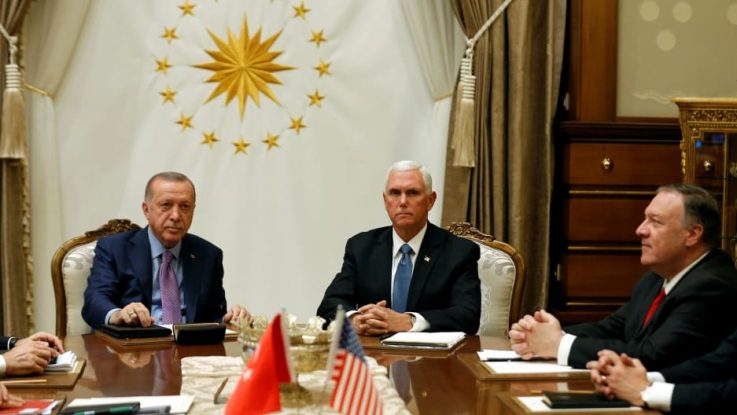
Apart from State Department apparatchiks and their hack boss Pompeo, Turkey had found itself very lonely in its new Syria adventure. The asked-for US-manned Patriot missiles to somehow wrestle the control of Idlib skies from Russia aren’t materializing.
But start hitting Hezbollah and suddenly you’ve got the attention of the powerful pro-Israel currents in the US, as well as of Israel itself.
My suspicion was confirmed Saturday when it became clear the Turks had hit Iranians as well:
Statement by Iran’s “advisory mission in Syria”: Turkish army is still shooting at our positions and bases. We call on Turkey to show rational behavior. The Turkish nation’s children are within range of our military forces.
(First statement by Iranian command in Syria, I guess)
— Reza Khaasteh (@Khaaasteh) February 29, 2020
The use of the word “children” above is a misleading translation, the Iranian communique spoke about “sons”, which naturally refers to Turkish troops.
Iranian embassy in Syria: “The Iranian government informed Erdogan that it would respond with full force to the Turkish points if it continued to bomb our forces and the Syrian army.”
— Rojava Network (@RojavaNetwork) February 29, 2020
Iran issued a warning to Erdogan to knock it off or his troops will face the consequences but you get the feeling that may be exactly what Erdogan is trying to provoke. Get the pathologically anti-Iranian Trump administration to see Turkey’s ‘safe-zone-for-bin-Ladenites’ Idlib invasion as an anti-Iranian enterprise and the prospects of American backing look quite a bit brighter.
#Turkey was informed in details of the position of Hezbollah and the Iranian brigades along with the Syrian army but decided to ignore the information and continued bombing these positions over and over again.
It is now clear that Turkey is in the battle with his army to stay.
— Elijah J. Magnier (@ejmalrai) February 29, 2020
Keep in mind that neither #Iran nor #Hezbollah ever attacked the Turkish army until this hour. It is #Turkey that took the initiative to bomb the Iranian-led forces and Hezbollah HQ and military hospital.
— Elijah J. Magnier (@ejmalrai) February 29, 2020
US Demands Russia ‘Immediately Ground Warplanes’ Over Syria
Sputnik – February 29, 2020
The situation in the northwestern Syrian renegade province of Idlib escalated again on Thursday after Syrian forces responding to a Nusra Front assault accidentally struck Turkish positions, killing 33 troops and injuring dozens more. The attack prompted the UN Security Council to call an emergency meeting on the situation in Syria.
The US “fully supports” Turkey’s right “to respond in self-defence” to the “unjustified” attacks on Turkish forces in Idlib, Syria which killed nearly three dozen troops Thursday, US Permanent Representative to the UN Kelly Craft has said.
“We call on the Russian Federation to immediately ground its warplanes. And we call for all Syrian forces and their Russian backers to withdraw to the ceasefire lines first established in 2018,” Craft said, speaking at the UN Security Council’s emergency meeting on Syria on Friday.
“The United States is not here today to listen and discuss. We are here to speak directly and without qualification,” Craft warned. “In the days ahead, the United States’ commitment to our NATO ally, Turkey, will not waver,” the ambassador added.
Calling the Astana format for Syrian peace talks “broken beyond repair,” Craft said that the US wants “an immediate, durable, and verifiable ceasefire in northwest Syria,” and urged the UN to “play a central, active role if we are to avoid even greater escalation.”
Responding to Craft, Russian Permanent Representative to the UN Vasily Nebenzya pointed out that the incident involving the deaths of Turkish military personnel took place outside Turkey’s observation post base, and stressed that Syria has the right to target terrorists. Nebenzya recalled that the Nusra terrorists in control of large swathes of Idlib have dramatically increased their attacks against civilians and the Syrian military in recent weeks, giving the Syrian Army the right to respond.
The Syrian Ambassador to the UN Bashar al-Jaafari, meanwhile, accused Turkey of aggression, and alleged that Ankara was using its observation posts to provide assistance to the terrorists. Al-Jaafari also accused the UK of calling Friday’s Security Council meeting to try to discredit the Astana format.
Black Thursday
Turkish and Syrian forces became engaged in a shooting war in the restive Idlib region earlier this month, after a Syrian artillery attack on one of Turkey’s dozen observation posts killed over half-a-dozen Turkish troops, resulting in a wave of Turkish attacks on Syrian forces. On Thursday, Nusra terrorists launched a large-scale offensive on Syrian Army positions, with Syrian forces responding, with 33 Turkish troops killed in Syria’s counterattack. Shortly thereafter, the Russian military’s Syrian monitoring mission reported that Turkish troops were mixed in among the Nusra militants as the latter came under artillery attack.
On Saturday, the Russian Foreign Ministry stated that Moscow and Ankara had committed to reducing tensions on the ground in Idlib. The same day, however, Turkish President Recep Tayyip Erdogan told reporters that he had asked Russian President Vladimir Putin to “get out of our way” and to leave Turkey “face to face” with the Syrian government.
The threat of a nuclear war between the US and Russia is now at its greatest since 1983
By Scott Ritter | RT | February 29, 2020
When the Commander of NATO says he is a fan of flexible first strike at the same time that NATO is flexing its military muscle on Russia’s border, the risk of inadvertent nuclear war is real.
US Air Force Gen. Tod D Wolters told the Senate this week he “is a fan of flexible first strike” regarding NATO’s nuclear weapons, thereby exposing the fatal fallacy of the alliance’s embrace of American nuclear deterrence policy.
It was one of the most remarkable yet underreported exchanges in recent Senate history. Earlier this week, during the testimony before the Senate Armed Services Committee of General Tod Wolters, the commander of US European Command and, concurrently, as the Supreme Allied Commander in Europe (SACEUR) also the military head of all NATO armed forces, General Wolters engaged in a short yet informative exchange with Senator Deb Fischer, a Republican from the state of Nebraska.
Following some initial questions and answers focused on the alignment of NATO’s military strategy with the 2018 National Defense Strategy of the US, which codified what Wolters called “the malign influence on behalf of Russia” toward European security, Senator Fischer asked about the growing recognition on the part of NATO of the important role of US nuclear deterrence in keeping the peace. “We all understand that our deterrent, the TRIAD, is the bedrock of the security of this country,” Fischer noted. “Can you tell us about what you are hearing…from our NATO partners about this deterrent?”
Wolters responded by linking the deterrence provided to Europe by the US nuclear TRIAD with the peace enjoyed on the European continent over the past seven decades. Fischer asked if the US nuclear umbrella was “vital in the freedom of NATO members”; Wolters agreed. Remarkably, Wolters linked the role of nuclear deterrence with the NATO missions in Iraq, Afghanistan and elsewhere outside the European continent. NATO’s mission, he said, was to “proliferate deterrence to the max extent practical to achieve greater peace.”
Then came the piece de resistance of the hearing. “What are your views, Sir,” Senator Fischer asked, “of adopting a so-called no-first-use policy. Do you believe that that would strengthen deterrence?”
General Wolters’ response was straight to the point. “Senator, I’m a fan of flexible first use policy.”
Under any circumstance, the public embrace of a “flexible first strike” policy regarding nuclear weapons employment by the Supreme Allied Commander in Europe should generate widespread attention. When seen in the context of the recent deployment by the US of a low-yield nuclear warhead on submarine-launched ballistic missiles carried onboard a Trident submarine, however, Wolters’ statement is downright explosive. Add to the mix the fact the US recently carried out a wargame where the US Secretary of Defense practiced the procedures for launching this very same “low yield” weapon against a Russian target during simulated combat between Russia and NATO in Europe, and the reaction should be off the charts. And yet there has been deafening silence from both the European and US press on this topic.
There is, however, one party that paid attention to what General Wolters had to say–Russia. In a statement to the press on February 25–the same date as General Wolters’ testimony, Sergey Lavrov, the Russian Foreign Minister stated that “We note with concern that Washington’s new doctrinal guidelines considerably lower the threshold of nuclear weapons use.” Lavrov added that this doctrine had to be viewed in the light “of the persistent deployment of US nuclear weapons on the territory of some NATO allies and the continued practice of the so-called joint nuclear missions.”
Rather than embracing a policy of “flexible first strike”, Lavrov suggested that the US work with Russia to re-confirm “the Gorbachev-Reagan formula, which says that there can be no winners in a nuclear war and it should never be unleashed.” This proposal was made 18 months ago, Lavrov noted, and yet the US has failed to respond.
Complicating matters further are the ‘Defender 2020’ NATO military exercises underway in Europe, involving tens of thousands of US troops in one of the largest training operations since the end of the Cold War. The fact that these exercises are taking place at a time when the issue of US nuclear weapons and NATO’s doctrine regarding their employment against Russia is being actively tracked by senior Russian authorities only highlights the danger posed.
On February 6, General Valery Gerasimov, the Russian Chief of Staff, met with General Wolters to discuss ‘Defender 2020’ and concurrent Russian military exercises to be held nearby to deconflict their respective operations and avoid any unforeseen incidents. This meeting, however, was held prior to the reports about a US/NATO nuclear wargame targeting Russian forces going public, and prior to General Wolters’ statement about “flexible first use” of NATO nuclear weapons.
In light of these events, General Gerasimov met with French General Fançois Lecointre, the Chief of the Defense Staff, to express Russia’s concerns over NATO’s military moves near the Russian border, especially the Defender 2020 exercise which was, General Gerasimov noted, “held on the basis of anti-Russian scenarios and envisage training for offensive operations.”
General Gerasimov’s concerns cannot be viewed in isolation, but rather must be considered in the overall historical context of NATO-Russian relations. Back in 1983, the then-Soviet Union was extremely concerned about a series of realistic NATO exercises, known as ‘Able Archer ‘83,’ which in many ways mimicked the modern-day Defender 2020 in both scope and scale. Like Defender 2020, Able Archer ‘83 saw the deployment of tens of thousands of US forces into Europe, where they assumed an offensive posture, before transitioning into a command post exercise involving the employment of NATO nuclear weapons against a Soviet target.
So concerned was Moscow about these exercises, and the possibility that NATO might use them as a cover for an attack against Soviet forces in East Germany, that the Soviet nuclear forces were placed on high alert. Historians have since observed that the threat of nuclear war between the US and the USSR was at that time the highest it had been since the Cuban Missile Crisis in 1962.
US and NATO officials would do well to recall the danger to European and world security posed by the “Able Archer ‘83” exercise and the potential for Soviet miscalculations when assessing the concerns expressed by General Gerasimov today. The unprecedented concentration of offensive NATO military power on Russia’s border, coupled with the cavalier public embrace by General Wolters of a “flexible first strike” nuclear posture by NATO, has more than replicated the threat model presented by Able Archer ’83. In this context, it would not be a stretch to conclude that the threat of nuclear war between the US and Russia is the highest it has been since Able Archer ’83.
Scott Ritter is a former US Marine Corps intelligence officer. He served in the Soviet Union as an inspector implementing the INF Treaty, in General Schwarzkopf’s staff during the Gulf War, and from 1991-1998 as a UN weapons inspector. Follow him on Twitter @RealScottRitter
Seth Rich, Julian Assange and Dana Rohrabacher – Will We Ever Know the Truth About the Stolen DNC Files?
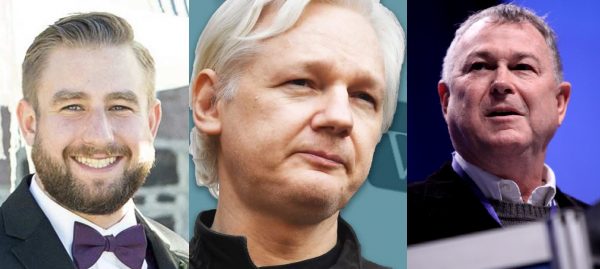
Seth Rich, Julian Assange and Dana Rohrabacher. Credit: Public domain/Gage Skidmore/ Flickr
By Philip Giraldi | American Herald Tribune | February 29, 2020
The media is doing its best to make the story go away, but it seems to have a life of its own, possibly due to the fact that the accepted narrative about how Rich died makes no sense. In its Iatest manifestation, it provides an alternative explanation for just how the information from the Democratic National Committee (DNC) computer somehow made its way to Wikileaks. If you believe that Jeffrey Epstein committed suicide and that he was just a nasty pedophile rather than an Israeli intelligence agent, read no farther because you will not be interested in Rich. But if you appreciate that it was unlikely that the Russians were behind the stealing of the DNC information you will begin to understand that other interested players must have been at work.
For those who are not familiar with it, the backstory to the murder of apparently disgruntled Democratic National Committee staffer Seth Rich, who some days before may have been the leaker of that organization’s confidential emails to Wikileaks, suggests that a possibly motiveless crime might have been anything but. The Washington D.C. police investigated what they believed to be an attempted robbery gone bad but that theory fails to explain why Rich’s money, credit cards, cell phone and watch were not taken. Wikileaks has never confirmed that Rich was their source in the theft of the proprietary emails that had hitherto been blamed on Russia but it subsequently offered a $20,000 reward for information leading to resolution of the case and Julian Assange, perhaps tellingly, has never publicly clarified whether Rich was or was not one of his contacts, though there is at least one report that he confirmed the relationship during a private meeting.
Answers to the question who exactly stole the files from the DNC server and the emails from John Podesta have led to what has been called Russiagate, a tale that has been embroidered upon and which continues to resonate in American politics. At this point, all that is clearly known is that in the Summer of 2016 files and emails pertaining to the election were copied and then made their way to WikiLeaks, which published some of them at a time that was damaging to the Clinton campaign. Those who are blaming Russia believe that there was a hack of the Democratic National Committee (DNC) server and also of John Podesta’s emails that was carried out by a Russian surrogate or directly by Moscow’s military intelligence arm. They base their conclusion on a statement issued by the Department of Homeland Security on October 7, 2016, and on a longer assessment prepared by the Office of the Director of National Intelligence on January 6, 2017. Both government appraisals implied that there was a U.S. government intelligence agency consensus that there was a Russian hack, though they provided little in the way of actual evidence that that was the case and, in particular, failed to demonstrate how the information was obtained and what the chain of custody was as it moved from that point to the office of WikiLeaks. The January report was particularly criticized as unconvincing, rightly so, because the most important one of its three key contributors, the National Security Agency, had only moderate confidence in its conclusions, suggesting that whatever evidence existed was far from solid.
An alternative view that has been circulating for several years suggests that it was not a hack at all, that it was a deliberate whistleblower-style leak of information carried out by an as yet unknown party, possibly Rich, that may have been provided to WikiLeaks for possible political reasons, i.e. to express disgust with the DNC manipulation of the nominating process to damage Bernie Sanders and favor Hillary Clinton.
There are, of course, still other equally non-mainstream explanations for how the bundle of information got from point A to point B, including that the intrusion into the DNC server was carried out by the CIA which then made it look like it had been the Russians as perpetrators. And then there is the hybrid point of view, which is essentially that the Russians or a surrogate did indeed intrude into the DNC computers but it was all part of normal intelligence agency probing and did not lead to anything. Meanwhile and independently, someone else who had access to the server was downloading the information, which in some fashion made its way from there to WikiLeaks.
Both the hack vs. leak viewpoints have marshaled considerable technical analysis in the media to bolster their arguments, but the analysis suffers from the decidedly strange fact that the FBI never even examined the DNC servers that may have been involved. The hack school of thought has stressed that Russia had both the ability and motive to interfere in the election by exposing the stolen material while the leakers have recently asserted that the sheer volume of material downloaded indicates that something like a higher speed thumb drive was used, meaning that it had to be done by someone with actual physical direct access to the DNC system. Someone like Seth Rich.
What the many commentators on the DNC server issue choose to conclude is frequently shaped by their own broader political views, producing a result that favors one approach over another depending on how one feels about Trump or Clinton. Or the Russians. Perhaps it would be clarifying to regard the information obtained and transferred as a theft rather than either a hack or a leak since the two expressions have taken on a political meaning of their own in the Russiagate context. With all the posturing going on, the bottom line is that the American people and government have no idea who actually stole the material in question, though the Obama Administration was extraordinarily careless in its investigation and Russian President Vladimir Putin has generally speaking been blamed for what took place.
The story currently bouncing around the media concerns an offer allegedly made in 2017 by former Republican Congressman Dana Rohrabacher to imprisoned WikiLeaks founder Julian Assange. According to Assange’s lawyers, Rohrabacher offered a pardon from President Trump if Assange were to provide information that would attribute the theft or hack of the Democratic National Committee emails to someone other than the Russians. He was presumably referring to Seth Rich.
Assange did not accept the offer, but it should be noted that he has repeatedly stated in any event that he did not obtain the material from a Russian or Russian-linked source. In reality, he might not know the original source of the information. Since Rohrabacher’s original statement, both he and Trump have denied any suggestion that there was a firm offer with a quid pro quo for Assange. Trump claims to hardly know Rohrabacher and also asserts that he has never had a one-on-one meeting with him.
The U.S. media’s coverage of the story has emphasized that Assange’s cooperation would have helped to absolve Russia from the charge of having interfered decisively in the U.S. election, but the possible motive for doing so remains unclear. Russian-American relations are at their lowest point since the Cold War and that has largely been due to policies embraced by Donald Trump, to include the cancellation of START and medium range missile agreements. Trump has also approved NATO military maneuvers and exercises right up to the Russian border and has provided lethal weapons to Ukraine, something that his predecessor Barack Obama balked at. He has also openly confronted the Russians in Syria.
Given all of that back story, it would be odd to find Trump making an offer that focuses only on one issue and does not actually refute the broader claims of Russian interference, which are based on a number of pieces of admittedly often dubious evidence, not just the Clinton and Podesta emails. Which brings the tale back to Seth Rich. If Rich was indeed responsible for the theft of the information and was possibly killed for his treachery, it most materially impacts on the Democratic Party as it reminds everyone of what the Clintons and their allies are capable of. It will also serve as a warning of what might be coming at the Democratic National Convention in Milwaukee in July as the party establishment uses fair means or foul to stop Bernie Sanders. How this will all play out is anyone’s guess, but many of those who pause to observe the process will be thinking of Seth Rich.
Philip M. Giraldi is a former CIA counter-terrorism specialist and military intelligence officer who served nineteen years overseas in Turkey, Italy, Germany, and Spain. He was the CIA Chief of Base for the Barcelona Olympics in 1992 and was one of the first Americans to enter Afghanistan in December 2001. Phil is Executive Director of the Council for the National Interest, a Washington-based advocacy group that seeks to encourage and promote a U.S. foreign policy in the Middle East that is consistent with American values and interests.
US, Taliban Sign Peace Agreement in Doha
Sputnik – February 29, 2020
Negotiators from the United States and the Taliban are meeting in Doha, Qatar to sign an accord that envisages the timetable of the US withdrawing some of its 13,000 troops. The Taliban, in turn, is expected to sever ties with all extremist groups and prevent the territories of Afghanistan from becoming havens for militants.
The United States and the Taliban movement have signed the long-awaited peace agreement in the Qatari capital of Doha on Saturday.
The troop withdrawal will be phased, with the US forces set to be slimmed down to 8,600 in the first 135 days since the deal’s announcement, while allied and coalition forces will be scaled down proportionately.
The residual US, allied and coalition forces will pull out within the remaining nine-and-a-half months, whereby all military bases will be abandoned.
Up to 5000 Taliban prisoners will be released from prisons by 10 March, the first day of intra-Afghan talks. The remaining prisoners will be freed within the next three months. The Taliban commits that its released prisoners will not pose a threat to the security of the US and its allies.
As soon as intra-Afghan talks begin, the US will start the review process of its sanctions on the Taliban and rewards lists issued for its members, with the goal of removing sanctions by 27 August. It will also engage with the UN Security Council and Afghan authorities to have national sanctions on the Taliban scrapped by 29 May.
The US pledges to seek economic cooperation for reconstruction with the new post-settlement Afghan Islamic government and will not intervene in its internal affairs.
In return, the Taliban will take steps to prevent terrorist groups, such as al-Qaeda, from using Afghan soil to threaten the security of the US and its allies.
They include sending a “clear message” that those posing such threat have no place in Afghanistan. The Taliban will instruct its members not to cooperate with such groups or individuals and prevent them from recruiting and fund-raising. It will only grant asylum to people who do not pose a security threat and will not issue visas or other documents to those considered a risk.
Following the signing of the deal, US State Secretary Mike Pompeo enumerated key conditions of the deal between the United States and the Taliban.
“Keep your promises, cut ties with Al-Qaeda. Keep up the fight against Daesh,” Pompeo said, addressing the Taliban.He added that the agreement was “a true test,” stressing that Washington will calibrate the pace of the troop withdrawal with the actions of the Taliban.
US President Donald Trump, for his part, welcomed the agreement as a move to put an end to the US most protracted war.
“We are working to finally end America’s longest war and bring our troops back home,” he said.The head of the militant group’s political office in Qatar said that the Taliban will adhere to the peace agreement signed in Doha on Saturday.
“The US and the Taliban movement have successfully concluded talks in Qatar. I congratulate everyone on this achievement. We will comply with the pact and, as a political force, we want it to be implemented by neighbouring countries,” Abdul Ghani Baradar said.In his turn, Afghan President Ashraf Ghani expressed hope that the long-awaited US-Taliban peace agreement would lead to a permanent ceasefire that in turn would bring stability to Afghanistan.
International Reactions to Historic Accord
NATO Secretary-General Jens Stoltenberg has said that the alliance supports the signing of the US-Taliban peace deal.
“This [deal] is a victory for peace, victory for Afghan people,” Stoltenberg said.The European Union has welcomed the long-awaited peace deal between the United States and the Taliban as a first step toward a negotiated peace process among all Afghans.
“The European Union considers today’s conclusion of the Afghanistan-US Joint Statement for Peace and the settlement between the US and the Taliban as important first steps towards a comprehensive peace process, with intra-Afghan negotiations at its core,” the declaration read.It urged the sides not to miss this opportunity for a lasting peace that could create an environment of security and stability in the war-torn country. Keeping up the reduction in violence is an important part of that process, it added.
“The EU calls on all stakeholders to put the interests of the nation above all other considerations, as the collective responsibility of all Afghan political forces,” it concluded.The UN Assistance Mission in Afghanistan (UNAMA) has called for the continuation of the reduced violence in Afghanistan and welcomed the commitment of the conflicting sides to further dialogue.
“Intra-Afghan negotiations are central to the peace efforts. The United Nations welcomes the commitment expressed by the parties to intra-Afghan negotiations; and urges them to move ahead expeditiously with their preparations to start the negotiations, including through forming a truly representative negotiation team,” UNAMA said in a statement.The United Nations also expressed its support to an inclusive Afghan-led process and called for concrete steps toward ending the war.
“The United Nations stresses the importance of continuing to reduce violence, especially violence that harms civilians, and urges all parties, in the period ahead, to redouble efforts to reduce violence on the way to a permanent ceasefire and a lasting political settlement,” the statement said.
Since 2018, Washington and the Taliban have been attempting to negotiate a peace deal that would ensure the withdrawal of foreign troops from Afghanistan in exchange for the movement’s guarantee that the country would not become a safe haven for terrorists. The parties’ representatives have been regularly meeting in Doha to address the issue.
The Media’s Deafening Silence on Mike Bloomberg’s Ties to Epstein and Other Criminals
By Whitney Webb | MintPress News | February 28, 2020
After his late jump into the Democratic primary and, as critics argue, purchasing his way into the primary debates, former Mayor of New York City Michael Bloomberg has received mixed coverage from corporate media, with many negative critiques of the current presidential contender’s history, conduct and connections.
Yet, despite efforts by other campaigns and more progressive-leaning media outlets to dampen Bloomberg’s chances at the nomination, one clear weakness of Bloomberg’s has thus far evaded meaningful media coverage: his ties to key players in the Epstein scandal, including Leslie Wexner, Ghislaine Maxwell and even Jeffrey Epstein himself.
Silence among outlets that largely oppose Bloomberg’s candidacy regarding his connections to Epstein and those in his close social orbit is odd, especially when reporting on an individual’s connections to the intelligence-linked pedophile are a sure-fire way to generate considerable negative attention and fodder for rival campaigns. This is particularly striking given that the numerous accusations that Bloomberg has long stoked a toxic culture of sexual harassment at his company, resulting in no small number of non-disclosure agreements over the years, have received some media attention. Yet, the fact that many of Bloomberg’s close friends have been accused of far, far worse has received hardly any coverage by comparison.
For instance, when it was announced last week that the controlling stake in the Leslie Wexner-owned lingerie company Victoria’s Secret would be sold to a private equity firm called Sycamore Partners, only one media outlet — The Intercept — revealed that Bloomberg has at least $136 million of his money in that firm. The Intercept noted in passing that Wexner — the source of most of Jeffrey Epstein’s supposed fortune, his close collaborator for decades and alleged rapist of many of his victims — had been pressured to step down following the scandal, which also hit Wexner-owned companies hard and had forced the Ohio-based billionaire to seek a buyer for his lingerie brand and its tarnished reputation. Yet, the outlet did not make the direct connection that Sycamore Partners-backer Bloomberg is a friend of Wexner’s and has attended Wexner’s personal social parties for years prior to the most recent scandal.
Here’s alleged-rapist Mike Bloomberg attending a fancy horse party at Les Wexner’s place (Wexner furthest right) in 2010, about a year before Wexner formally transferred ownership of his Manhattan townhouse to Jeffrey Epstein. Cheers to good friends 😊 pic.twitter.com/gS8wpUVF00
— ePal, Your Close Friend™-Enterprise Edition (@wash_cloth) February 17, 2020
Yet, even well before this recent opportunity to point out Bloomberg’s ties to Leslie Wexner, there have been plenty of opportunities for the media to question Bloomberg about his now-infamous picture with Ghislaine Maxwell, daughter of Mossad-connected Robert Maxwell and Epstein’s alleged madam and co-conspirator.
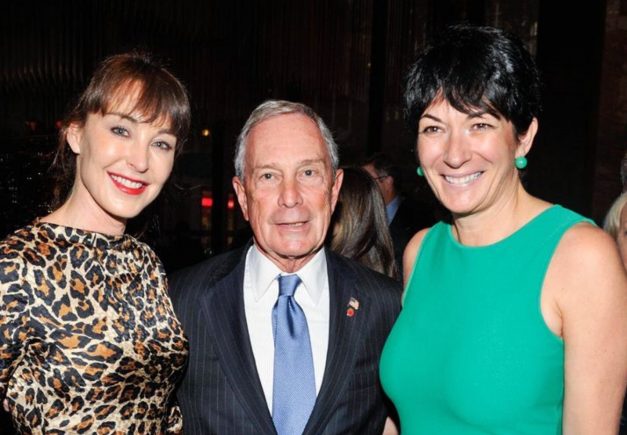
From left to right, Tamara Mellon, Mike Bloomberg and Ghislaine Maxwell
That picture, taken in 2013 at the Four Seasons restaurant in New York, has not been mentioned by mainstream media following the launch of Bloomberg’s candidacy late last November. Similarly, mainstream media have failed to question Bloomberg regarding why his name and five different telephone numbers for him appear in Jeffrey Epstein’s infamous list of contacts often referred to as his “little black book.”
Bloomberg and the Manhattan Swamp
The extent of the Maxwell-Bloomberg relationship is unknown, though Bloomberg’s deep ties to his former employer Salomon Brothers is a possible link, given that that firm served as one of the Maxwell family’s main investment bankers in the years prior to and following Robert Maxwell’s mysterious death in 1991. Similarly, Epstein had close ties to prominent figures on Wall Street, some dating back to his time at Bear Stearns, who are also close to Bloomberg.
Bloomberg and Epstein also shared close friendships with some of the same New York media executives like Mort Zuckerman. Media outlets have described Zuckerman, a former business partner of Epstein’s, as Bloomberg’s “long-time enabler.” In another example, Epstein’s former publicist Howard Rubenstein is a long-time supporter of Bloomberg and was reported to be the driving force behind Bloomberg’s controversial push to run around mayoral term limits and pursue a third term as Mayor of New York.
Another mutual Epstein-Bloomberg associate is disgraced media mogul Harvey Weinstein. Weinstein was part of an investment group with Epstein that sought to purchase New York magazine in 2003. Another member of that investment group was frequent MSNBC commentator Donny Deutsch, who has recently fervently backed Bloomberg’s candidacy.
Weinstein was recently convicted of rape and has dozens of accusers, whose decision to come forward about Weinstein’s sex crimes in recent years helped spark the “Me Too” movement. Weinstein also has ties to former Israeli Prime Minister Ehud Barak, who was a close friend and business associate of Epstein’s, and it was Barak who personally introduced Weinstein to former Mossad spies that Weinstein hired to intimidate his accusers. In addition to being Prime Minister, Barak is also the former head of Israeli military intelligence, the foreign intelligence agency that sponsored Epstein’s sexual blackmail operation involving underage girls in the United States.
Bloomberg’s candidacy has yet to be strongly challenged over his ties to Weinstein, which are considerable. For instance, Weinstein was a major backer of Bloomberg’s mayoral campaigns and even recorded robocalls on Bloomberg’s behalf to boost his election chances. Bloomberg, in turn, appointed Weinstein to a charity board and Weinstein later praised Bloomberg for aiding his film company. While Bloomberg’s ties to Wexner, Epstein and Maxwell have gotten the silent treatment, some outlets (mostly right-leaning) have covered the Bloomberg-Weinstein ties, but there has been little pressure on Bloomberg from mainstream media to address those ties directly.
Another close Bloomberg associate who recently has been accused by numerous women of sexual harassment is hedge fund manager Michael Steinhardt. Steinhardt is a long-time fixture in Bloomberg’s social circle and has long appeared at Bloomberg’s dinner parties. Steinhardt is also connected to Leslie Wexner through his membership in the so-called “Mega Group” — an exclusive group of organized-crime-linked “mega” donors to pro-Israel causes that Wexner co-founded in 1991. Steinhardt also boasts close ties to the now deceased founder of Glencore, the Mossad-linked Marc Rich, and Steinhardt — along with top Israeli politicians and spies — aggressively lobbied former President Bill Clinton to controversially pardon Rich before leaving office.
“Show me your friends and I’ll tell you who you are”
The oft-quoted saying “Show me your friends and I’ll tell you who you are,” seems to hold true for Bloomberg. For instance, his eponymous media conglomerate has received no small number of lawsuits over the years alleging rampant sexual harassment and even the rape of female workers, much of its allegedly egged on by Bloomberg’s long history of comments that have been derided as sexist. Many of those lawsuits ended in female accusers being asked to sign non-disclosure agreements (NDAs). More recently, The Nation reported that Bloomberg’s 2020 presidential campaign is making use of NDAs in such a way “that could prevent staffers from reporting workplace abuse.”
In addition, a 1999 profile of Bloomberg in Wired magazine quoted Bloomberg as saying “My daughter is tall and busty and blonde. We went to China together. And what’s a 16-year-old going to do on a business trip? So, I got her dates in every city in China.”
Bloomberg, not unlike Epstein and Wexner, also has a history of cozy ties to the CIA. For instance, during his tenure as Mayor of New York, Bloomberg actively promoted a controversial post-9/11 program that saw the CIA work directly with the NYPD to spy on the city’s Muslim communities. Even though the CIA is technically prohibited from spying on Americans not linked to criminal activity, one of the CIA officers working as part of the Bloomberg-backed program said he had “no limitations” on what he could do. Bloomberg has long defended this program and its merging of the CIA with local police.
In the case of Epstein and Wexner, as MintPress News reported in its viral series on the Epstein scandal last year, Epstein once claimed to have worked for the CIA during the 1980s and Epstein and Wexner were the key players behind the relocation of CIA front company Southern Air Transport to Ohio, where Wexner’s business interests have long been based.
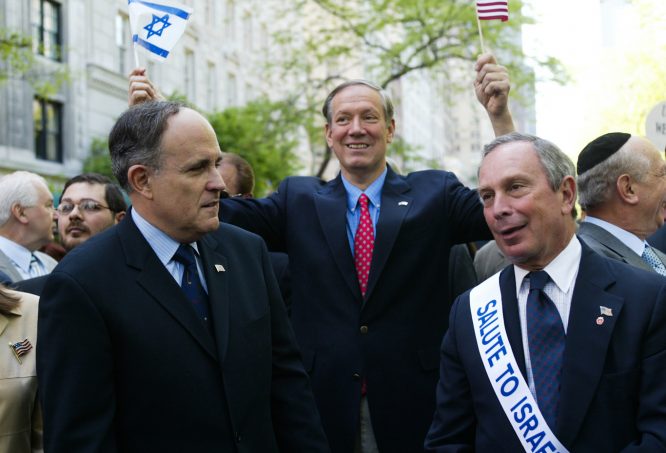
Rudy Giuliani, left, New York Gov. George Pataki, center, and Mike Bloomberg during a “Salute to Israel Parade, May 5, 2002, in New York. Shawn Baldwin | AP
In addition, Bloomberg was also a key player in a controversial initiative regarding Israel’s intelligence-linked technology sector. For instance, Bloomberg created a $2 billion project that involved opening a Manhattan campus called “Cornell Tech” that brought together Cornell University and Israel’s Technion, which has close ties to Israel’s national security state and military-industrial complex. Bloomberg personally gave over $100 million to facilitate completion of that project. That campus is now a partner in the recent creation of two Israeli-run “cybersecurity” centers in New York City that are tied to Israeli intelligence and were recently reported on by MintPress.
Jeffrey Epstein was also involved with Israeli military intelligence-linked technology companies and, as previously mentioned, Israeli military intelligence was also the sponsor of Epstein’s sexual blackmail operation that targeted mostly U.S. politicians and public figures for the benefit of the state of Israel, whose military currently receives $3.8 billion per year from U.S. taxpayers.
While these aspects of Bloomberg’s past have received considerable media attention as of late, these same outlets have failed to note that Bloomberg’s inner circle boasts many individuals accused of harassment, rape or worse. With his clear ties to the “Epstein network,” the fact that mainstream media has declined to even question Bloomberg about his social appearances with Ghislaine Maxwell or Leslie Wexner and having five different telephone numbers of his in Epstein’s list of high-profile contacts is a damning indictment of the current landscape of both American media and American politics.
Whitney Webb is a MintPress News journalist based in Chile. She has contributed to several independent media outlets including Global Research, EcoWatch, the Ron Paul Institute and 21st Century Wire, among others. She has made several radio and television appearances and is the 2019 winner of the Serena Shim Award for Uncompromised Integrity in Journalism
Featured Video
or go to
Aletho News Archives – Video-Images
Book Review
The Zeolite Book — First Edition, 2026, Paperback
The volcanic mineral medicine will not patent — for the toxic burden medicine will not name
Lies are Unbekoming – October 30, 2026
 Zeolite is old. It is in Roman concrete that has held for two thousand years. It’s in the water filters of ancient cisterns. It’s in the stomachs of Pacific livestock whose keepers knew, somehow, that this grey crumbling rock made the animals healthier. It’s in Soviet clinical protocols from the 1960s. It’s in the standard emergency response to the Chernobyl explosion.
In 1986, after the Chernobyl reactor failure, the Soviet Union manufactured and distributed natural zeolite at industrial scale — for soil remediation, for livestock feed, for human consumption, for the cleanup itself. Karl Hecht, who had been director of the Institute for Experimental and Clinical Pathophysiology at the Charité of Humboldt University Berlin, spent the six decades after that building the clinical research base — on silicon’s role in human health, on zeolite’s clinical safety, on its applications in ageing. In 2018, Pavelić and colleagues published a comprehensive clinical safety review of natural clinoptilolite in Frontiers in Pharmacology. In 2019, Mastinu analysed its binding affinities. In the Western medical literature, these works sit largely uncited.
What has not been treated at book length, until now, is how a volcanic mineral with six decades of Soviet clinical work behind it, two major peer-reviewed Western reviews, and ongoing clinical use across the former Eastern Bloc, remains almost entirely absent from Western medical practice — and what the toxic burden it’s meant to address actually is.
The Zeolite Book gathers the Soviet clinical record, the Western peer-reviewed studies, three contemporary practitioner voices, and three serious counterviews into one honest treatment. That’s why the book runs to seven appendices. 288 pages, four parts, three practitioner voices, three counterviews, seven appendices. The honest treatment is the argument.
Blog Roll
 Aletho News
- Wrong, AP and NPR: Europe’s 50,000 Heat Deaths Are a Computer-Model Estimate, Not a Real Body Count
- Questioning Your Doctor Is Now Considered A Psychological Problem (Seriously)
- London tourism expo promotes Israeli agency linked to theft of Palestinian land
- Dockworkers launch global strike against Israeli and US military shipments
- Europe facing gas price shock – Gazprom chief
- Ukraine continues recruiting people with disabilities
- Weaponized Journalism: 2021 Sayer Ji Interview with NPR
- Beyond Netanyahu: what Israel’s election means for Palestinians
- Lithuania plans universal conscription
- Lies, Damn Lies, and Ukraine News
- If Americans Knew
- 1,300 will gather in Palo Alto on Nov. 1 for Z3 Conference on Zionism
- DAILY UPDATE: Latest essential news on Palestine, Israel, & region
- The Long Arm of AIPAC
- Genocidal intent behind Hebron assault, rights group says
- This week, Israel killed 8-year-old who survived bombing that wiped out her family
- DAILY UPDATE: Latest essential news on Palestine, Israel, & region
- Israeli soldier poses at damaged Lebanon church, sparking anger
- New Report. Manufacturing the Great Replacement: Is Israel behind one of the largest racist influence campaigns ever documented?
- ‘Arab voice doesn’t count’: Jewish Israeli blocs reject Palestinian support
- Whether Bibi Stays or Goes, the ‘Special Relationship’ Must End
- No Tricks Zone
- Germany’s Green Energy Transition Becoming Increasingly Expensive…Another 6 Trillion Euros!
- Sudden Stratospheric Warming, Powerful El Niño Combination May Lead To Extreme Europe Cold, Energy Crisis!
- Two New Studies Find Thwaites Glacier Melt Cannot Be Driven By Human Activity Or A Warming Ocean
- E-Cars Reduce CO2 Emissions By Only 41% Compared To Internal Combustion Engine Vehicles
- Predictions Made By Renowned Climate Professor Over Past Decades Have Been Proven To Be Poor
- New Study Suggests Large Regions Of The Pacific Ocean Have Been Cooling For The Last 80 Years
- Germany’s Green Energy Debacle: High Energy Costs Force Kahla Porzellan to Close After 182 Years!
- New Study: 50 Years Of The Most Aggressive ‘Net Zero’ Policies Can Only Affect The Global Climate By 0.03°C
- US September “Heat” Was No Record…Many Records Set Decades Ago
- Latest European Green Energy Debacle; Portugal’s Largest Flagship Solar Park Insolvent!

