Sanctions on Iran, Others Facing Coronavirus Must Be Urgently Re-evaluated: UN
Al-Manar | March 25, 2020
The United Nations rights chief says any sanctions imposed on Iran, among other countries grappling with the coronavirus pandemic, should be “urgently re-evaluated” to support lives of millions of people worldwide.
“At this crucial time, both for global public health reasons, and to support the rights and lives of millions of people in these countries, sectoral sanctions should be eased or suspended,” Michelle Bachelet said in a statement on Tuesday.
She warned, “In a context of global pandemic, impeding medical efforts in one country heightens the risk for all of us.”
She stressed the importance of giving broad and practical effect to humanitarian exemptions from sanctions measures “with prompt, flexible authorization for essential medical equipment and supplies.”
Bachelet pointed in particular to the case of Iran, one of the hardest-hit countries by the pandemic, and said the COVID-19 outbreak was also spreading to neighboring Afghanistan and Pakistan.
She said even before the pandemic, human rights reports had repeatedly emphasized the impact of sectorial sanctions on Iran’s access to essential medicines and medical equipment, including respirators and protective gear for healthcare workers.
Nearly 500,000 people worldwide have been infected and over 17,000 have died of the viral disease, according to the latest tallies.
Iranian Health Ministry spokesman Kianoush Jahanpour said on Tuesday that the number of coronavirus deaths had risen to 1,934 and the total infections to 24,811 during the past 24 hours.
“There have been 122 new deaths and 1,762 new infections since Sunday,” he said. Jahanpour further put the number of patients who have recovered from the viral disease at 8,913.
US President Donald Trump reinstated Washington’s sanctions on Iran in May 2018 after he unilaterally left the 2015 nuclear deal, known as the Joint Comprehensive Plan of Action (JCPOA), signed between Iran and major world powers.
The International Court of Justice (ICJ) — known as the World Court — has ordered the White House to lift the sanctions it has illegally re-imposed on humanitarian supplies to Iran.
The US claims the bans do not get in the way of food and medicine exports to Iran, but the Islamic Republic says Washington has been working to make problems for a Swiss humanitarian channel launched to enable the transfer of commodities to Iran.
In a phone conversation with Tunisian President Kais Saied on Monday, Iran’s President Hassan Rouhani said the United States’ move to prevent the dispatch of medical and humanitarian aid and the facilitation of banking interactions to meet the Iranian people’s needs suffering from the deadly new coronavirus contravenes human and the United Nations regulations.
Rouhani said the US administration has intensified its cruel measures and sanctions against the Iranian people even under the current difficult conditions caused by the virus outbreak.
Suspending the Constitution: Police State Uses Crises to Expand Its Lockdown Powers
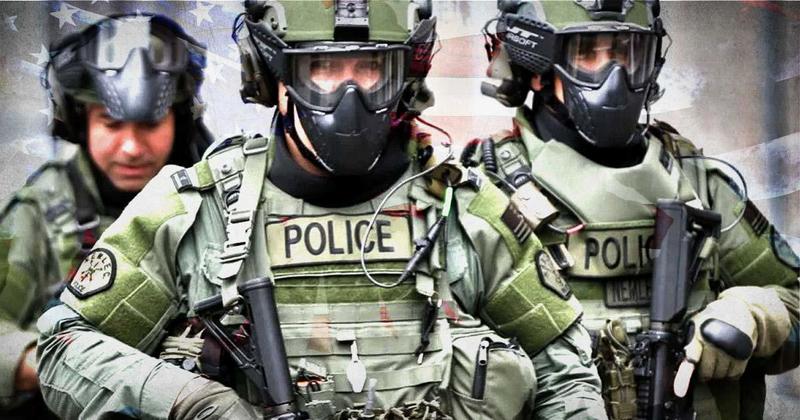
By John W. Whitehead | Rutherford Institute | March 24, 2020
You can always count on the government to take advantage of a crisis, legitimate or manufactured.
This coronavirus pandemic is no exception.
Not only are the federal and state governments unraveling the constitutional fabric of the nation with lockdown mandates that are sending the economy into a tailspin and wreaking havoc with our liberties, but they are also rendering the citizenry fully dependent on the government for financial handouts, medical intervention, protection and sustenance.
Unless we find some way to rein in the government’s power grabs, the fall-out will be epic.
Everything I have warned about for years—government overreach, invasive surveillance, martial law, abuse of powers, militarized police, weaponized technology used to track and control the citizenry, and so on—has coalesced into this present moment.
The government’s shameless exploitation of past national emergencies for its own nefarious purposes pales in comparison to what is presently unfolding.
It’s downright Machiavellian.
Deploying the same strategy it used with 9/11 to acquire greater powers under the USA Patriot Act, the police state—a.k.a. the shadow government, a.k.a. the Deep State—has been anticipating this moment for years, quietly assembling a wish list of lockdown powers that could be trotted out and approved at a moment’s notice.
It should surprise no one, then, that the Trump Administration has asked Congress to allow it to suspend parts of the Constitution whenever it deems it necessary during this coronavirus pandemic and “other” emergencies.
It’s that “other” emergencies part that should particularly give you pause, if not spur you to immediate action (by action, I mean a loud and vocal, apolitical, nonpartisan outcry and sustained, apolitical, nonpartisan resistance).
In fact, the Department of Justice (DOJ) has been quietly trotting out and testing a long laundry list of terrifying powers that override the Constitution.
We’re talking about lockdown powers (at both the federal and state level): the ability to suspend the Constitution, indefinitely detain American citizens, bypass the courts, quarantine whole communities or segments of the population, override the First Amendment by outlawing religious gatherings and assemblies of more than a few people, shut down entire industries and manipulate the economy, muzzle dissidents, “stop and seize any plane, train or automobile to stymie the spread of contagious disease,” reshape financial markets, create a digital currency (and thus further restrict the use of cash), determine who should live or die…
You’re getting the picture now, right?
These are powers the police state would desperately like to make permanent.
Bear in mind, however, that these powers the Trump Administration, acting on orders from the police state, are officially asking Congress to recognize and authorize barely scratch the surface of the far-reaching powers the government has already unilaterally claimed for itself.
Unofficially, the police state has been riding roughshod over the rule of law for years now without any pretense of being reined in or restricted in its power grabs by Congress, the courts or the citizenry.
The seeds of this present madness were sown several decades ago when George W. Bush stealthily issued two presidential directives that granted the president the power to unilaterally declare a national emergency, which is loosely defined as “any incident, regardless of location, that results in extraordinary levels of mass casualties, damage, or disruption severely affecting the U.S. population, infrastructure, environment, economy, or government functions.“
Comprising the country’s Continuity of Government (COG) plan, these directives, which do not need congressional approval, provide a skeletal outline of the actions the president will take in the event of a “national emergency.”
Mind you, that national emergency can take any form, can be manipulated for any purpose and can be used to justify any end goal—all on the say so of the president. Indeed, the U.S. military has reportedly already been given standby orders under COG for this present coronavirus pandemic.
So what is the bottom line here?
We are, for all intents and purposes, one crisis away from having a full-fledged authoritarian state emerge from the shadows, at which time democratic government will be dissolved and the country will be ruled by an unelected bureaucracy.
Thus far, we have at least pretended that the government abides by the Constitution.
The attempts by each successive presidential administration to rule by fiat merely plays into the hands of those who would distort the government’s system of checks and balances and its constitutional separation of powers beyond all recognition.
Remember, these powers do not expire at the end of a president’s term. They remain on the books, just waiting to be used or abused by the next political demagogue.
So, too, every action taken by Trump and his predecessors to weaken the system of checks and balances, sidestep the rule of law, and expand the power of the executive branch of government has made us that much more vulnerable to those who would abuse those powers in the future.
Think on this: the presidential election is right around the corner.
Suddenly, the improbable possibility of any incumbent president attempting to extend the police state’s stranglehold on power by using current events to justify postponing or doing away with an election—forfeiting the people’s rights to govern altogether—and establishing a totalitarian regime seems less far-fetched than it did even a few years ago.
The emergency state is now out in the open for all to see. Unfortunately, “we the people” refuse to see what’s before us. Most Americans, fearful and easily controlled, would sooner rouse themselves to fight for that last roll of toilet paper than they would their own freedoms.
This is how freedom dies.
We erect our own prison walls, and as our rights dwindle away, we forge our own chains of servitude to the police state.
Be warned, however: once you surrender your freedoms to the government—no matter how compelling the reason might be for doing so—you can never get them back.
As I make clear in my book Battlefield America: The War on the American People, no government willingly relinquishes power.
If we continue down this road, there can be no surprise about what awaits us at the end.
The America metamorphosing before our eyes is almost unrecognizable from the country I grew up in, and that’s not just tragic—it’s downright terrifying.
Riyadh’s “Oil War” on Russia has some Global Objectives
By Salman Rafi Sheikh – New Eastern Outlook – 24.03.2020
The on-going Saudi ‘oil war’ with Russia has its roots in the logic of increasingly using natural resources for geo-political and geo-economic purposes. While this is not something entirely new, the latest push comes against the backdrop of increasing competition between the US and Russia for global leadership roles and the former’s attempts at forcing the latter out, squeeze its share in the global oil market to increase that of the US shale oil, thus denting Russia’s economic capacity and its ability to project power in regions beyond its borders.
Whereas the Saudis blame Russia for the ‘oil war’ and Kremlin’s refusal to further cut oil production, the proposed cut, as it stands, would have ultimately meant a further decrease in Russia’s share of the global market and a significant increase in the US’ shale-oil production and exports. Ever since OPEC+ agreement of 2016 and the related cuts in oil production, the output of US shale oil has soared by 4.5 million barrels a day. Whereas the Western political pundits have been speaking and writing of Russia as the ‘malign’ player targeting the US’ ‘booming’ shale oil industry, the fact of the matter is that the US shale industry would not have grown in the first place if there had been no OPEC+ agreement. Russia, as it stands, has only refused to further cut its production, and is willing to extend the OPEC+ to continue a stable system of oil production.
How the OPEC+ benefited the US shale oil is evident from the fact that balanced production of crude oil meant stable and high prices, which made the US shale oil more profitable, further allowing the US to use the scenario to build its production and export infrastructure. As it stands, since 2016 when the OPEC+ deal was struck, US oil exports have increased five-fold and shale production increased from 8.9 million barrels per day to 13.1 million barrels per day. Thus, to a significant extent, by refusing the Saudi proposal of further cuts in oil production, Russia essentially refused to allow the US shale oil industry a further free-way for global expansion.
At the same time, Russia continues to stick with the OPEC+ deal. The Russian Prime Minister Mikhail Mishustin has said,
“We did not initiate the withdrawal from the agreement [OPEC+ deal]. On the contrary, we proposed to extend the agreement on the existing terms, at least until the end of the second quarter or for a year, so as not to complicate the situation that has developed with the spread of coronavirus.”
At the recent meeting between Russia’s Putin and energy officials, Putin reportedly said that:
“OPEC+ has “proved to be an effective instrument to ensure long-term stability on global energy markets. Thanks to that, we have obtained extra budget revenues and, what is important, provided a possibility for upstream companies to confidently invest in promising development projects.”
What becomes evident here is that the blame for reduced oil prices can hardly be put on the Russians. Its roots lie in the global struggle for market share. This struggle is taking place at two levels. The first is between the Russians and the Saudis whereby the latter, known for playing on the US side in every war, want to expand their share of the market to sustain their massively oil-dependent economy. The second level, linked as it is with the first, is again about reducing Russian share of the market and allowing for the shale-oil sector to expand. Since this expansion will theoretically come at the expense of Russian oil, the Saudis would still benefit.
There is as such a Saudi-US consensus behind the dropped oil prices. US President Donald Trump spoke on the phone to the Saudi Crown Prince Mohammed bin Salman on the eve of the Vienna meeting, and their subject of discussion, according to the White House, was the “energy market.”
That the US and Saudi Arabia have a deep interest in squeezing out Russia’s share of the global hydrocarbon market is evident from the way the US has been trying to block and even sanction the joint Russian-German Nord Stream-2 pipeline project.
Who will win this war? Unlike the Saudis, Russia’s economy does not solely depend on oil prices, although it still does play a significant role in enabling the Russian government to fulfil its budgetary commitments. The Saudis would be thus at a loss much sooner than the Russians. If the US president called the Saudi ruler to discuss the “energy market” and it was mainly about finding ways of squeezing Russia, it was equally about finding a way to stabilise oil prices because the continuously falling oil prices would only make shale-oil companies suffer losses. According to a Bloomberg report, “The US shale sector is getting completely killed. A complete bloodbath. Billions of dollars in equity wiped out.”
Whereas some in the West think that this is a Saudi-Russian project to destroy the US economy, this is not the case; for, if both oil producers had wanted this, they could have done this by doing a new OPEC+ deal in a way that would have allowed a cut in prices and still maintain production levels at agreed levels. This has not happened, and given the nature of deep Saudi interests in the US, it is difficult to conceive of a Saudi project to ‘kill’ the US economy. What it signifies is an attempt at squeezing the Russian share of the market. This explains the Saudi proposal for cutting oil production (and thus allowing that of the shale-oil grow further). The falling oil prices only indicate that the project is failing; Russia is resilient and has enough reserves to sustain itself for a decade.
Salman Rafi Sheikh is a research-analyst of International Relations and Pakistani foreign and domestic affairs.
Theodore Roosevelt Strike Group stricken in the Philippines

© Reuters / Kham
RT | March 24, 2020
Three US Navy sailors aboard aircraft carrier USS Theodore Roosevelt tested positive for coronavirus, the acting Naval Secretary has revealed. They will be airlifted off the ship, which hosts 5,000 troops in the Philippine Sea.
The three servicemembers are the first coronavirus cases discovered on board a deployed Navy ship, Acting Navy Secretary Thomas Modly told reporters at a Pentagon briefing on Tuesday. Currently in quarantine, the sick trio will be flown off the ship later today.
The USS Theodore Roosevelt was in Vietnam earlier this month. Last week, the Theodore Roosevelt Strike Group performed Expeditionary Strike Force maneuvers along with the America Expeditionary Strike Group and the 31st Marine Expeditionary Unit for three days in the South China Sea.
Pentagon officials diverged from President Donald Trump’s narrative during Tuesday’s briefing, which was conducted virtually, warning that the outbreak could occupy the nation for as long as three months. “I think we need to plan for this to be a few months long at least and we’re taking all precautionary measures to do that,” Defense Secretary Mark Esper told reporters. The Pentagon has reported 321 cases of coronavirus, including 174 active-duty personnel, 59 civilians, 61 dependents, and 27 contractors, as of Tuesday. A single contractor at the Defense Security Cooperation Agency died on Saturday after testing positive for the virus.
Trump, meanwhile, has declared he wants the US economy back up and running by Easter Sunday, less than three weeks away. The US has 50,206 confirmed cases of coronavirus, according to Johns Hopkins University, and 606 deaths.
Also on rt.com:
Collective punishment has always been the stated goal of Iran sanctions hawks
By Eli Clifton | Responsible Statecraft | March 23, 2020
The coronavirus pandemic’s impact in Iran, which already claimed over 1,800 lives and infected more than 23,000 people, is one of the world’s more troubling examples of widespread infection, with insufficient medical resources to treat the victims and a staggering anticipated death toll.
While public health experts and human rights advocates all point to the Trump administration’s “maximum pressure” sanctions regime against Iran as contributing to the public health crisis, sanctions advocates in the Trump administration and at two ultra hawkish think tanks claim that the “humanitarian trade” sanctions exemption is sufficient to address Iran’s medical needs.
But the reality is that advocates of an expansive sanctions campaign have been working to deny Iranians the staples of daily life in pursuit of bringing the regime to its knees or fomenting regime collapse. And it’s likely why to this day, the Trump administration, and its pro-Iran war/regime change allies are reluctant to relent to massive domestic and international pressure to relieve sanctions on Iran.
Indeed, remarks and actions from sanctions hawks in the State Department, the Foundation for Defense of Democracies (FDD), and United Against Nuclear Iran (UANI) illustrate their desire to inflict collective punishment on Iran as a means of generating political instability and state collapse.
Amid the crisis, on March 17, Secretary of State Mike Pompeo announced new sanctions against Iran, telling reporters, “We have an open humanitarian channel to facilitate legitimate transactions even while ensuring our maximum pressure campaign denies terrorists money.”
But that assessment of the humanitarian channel isn’t widely shared and, despite Pompeo’s repeated assertions that the Trump administration offered Iran help to deal with the coronavirus crisis, he hasn’t provided details of what those offers entail.
“Our research showed that in practice, humanitarian exemptions in the U.S. comprehensive sanctions regime have been ineffective in offsetting the strong reluctance of companies and banks to conduct trade with Iran, including the humanitarian trade that is presumably legal,” Human Rights Watch Iran researcher Tara Sepheri Far told Responsible Statecraft. “The Iranian healthcare system, both in terms of access to specialized medicine and also with regards to access to medical equipment, has taken a toll as a result of sanctions,” she added.
Even Pompeo acknowledged that collective punishment and threat of a humanitarian crisis were very much part of the sanctions strategy he was pursuing.
“The leadership has to make a decision that they want their people to eat,” said Pompeo in 2018. “They have to make a decision that they want to use their wealth to import medicine and not use their wealth to fund [Iran’s Quds Force commander] Qassem Soleimani’s travels around the Middle East, with causing death and destruction.”
Two of the most prominent groups advocating for “maximum pressure” against Iran, even in the face of the coronavirus epidemic, have repeatedly called for collective punishment against Iranians.
Mark Dubowitz, the CEO of FDD, a think tank that has regularly called for harsh sanctions and preventive military action against Iran, has repeatedly called for punitive measures against Iran’s entire population.
In a Wall Street Journal op-ed last April, Dubowitz urged lawmakers to “build a sanctions wall” with the goal of “crippl[ing] key sectors of the [Iranian] economy and lead to larger protests.” He added, “[T]he resulting economic and political instability could be leverage for a better, comprehensive deal.”
In a September Fox News appearance, Dubowitz again argued that widespread collective punishment of Iranians was a desirable strategy in bringing pressure on Iran’s leadership to negotiate with the Trump administration about their nuclear program.
“I think the Iranians are in a situation where they are running out of foreign exchange reserves, they’re not going to have the money to pay for imports that they need to run their factories, with factories closing they’re going to have massive unemployment, and so their situation is getting worse every day,” said Dubowitz. “And I think the administration, with a few moves, could actually bring about that kind of economic collapse which will then put the regime in a position where they’ll have to choose between negotiations and the survival of its regime.”
This mentality isn’t a recent phenomenon. Squeezing the Iranian people has been a goal for some time. FDD “freedom scholar” Michael Ledeen made this argument even more bluntly back in 2012 when he openly celebrated ordinary Iranians being unable to afford chickens, claimed this was largely the effect of sanctions, and applauded the fact that Iranians were blaming their leadership for hardships that were largely out of the government’s control.
“[T]here are a lot of very angry Iranians, who not surprisingly are blaming their government for this foul state of affairs,” wrote Ledeen. “In part, the government is blameless, since the cost of imports and the cost of feed grain have been driven up by the sanctions. But then again, the behavior of the government provoked the sanctions in the first place, and the singularly incompetent economic policies of the regime probably constitute the most important cause of the crisis.”
A U.S. senator at the time was even more explicit in promoting the strategy of denying Iranians basic foodstuffs. “It’s okay to take the food out of the mouths of the citizens from a government that’s plotting an attack directly on American soil,” said then-Sen. Mark Kirk (R-Ill.) in reference to sanctions that might impose food shortages on Iranians.
Kirk now serves on the advisory board of UANI, a group that has engaged in a lengthy campaign to pressure all companies, including those engaged in U.S. government licensed humanitarian trade with Iran, to halt their business with the Islamic Republic. (Kirk’s former foreign policy adviser, Richard Goldberg, later went to work at FDD where he promoted military options against Iran. And in an unusual arrangement, he later went to work in Trump’s National Security Council while FDD continued to pay his salary and travel expenses. There Goldberg advocated for an expansive sanctions regime against Iran.)
UANI applauded the Trump administration’s “maximum pressure” strategy for “wreaking maximum havoc on Iran’s economy” Its CEO Mark Wallace, endorsed “economic isolation … to the point of being unbearable.”
Indeed, both UANI and FDD’s fondness for imposing collective punishment on Iranian civilians in order to pressure Iran’s leadership to make concessions on its nuclear program is also reflected in statements from some of their biggest donors.
GOP and Trump megadonor Sheldon Adelson contributed at least $1.5 million to FDD by 2011 (FDD claims he is no longer a funder) and contributed nearly one-third of UANI’s 2013 budget, sending $500,000 to the group.
Adelson told an audience at Yeshiva University in October 2013 that Obama should launch a preventive nuclear attack on a swath of uninhabited Iranian desert and threaten that Iran will be “wiped out” if the country’s leadership doesn’t dismantle their nuclear program.
UANI’s top funder, billionaire Thomas Kaplan, is an investor whose companies have looked to profit from “political unrest” in the Middle East. At UANI’s 2018 conference, Kaplan was presented with a framed Iranian rial by Wallace to recognize his support of UANI and their shared efforts to devalue Iran’s currency.
The calls for economic collapse, military strikes, cheering food shortages, and demanding more “maximum pressure” come at a severe humanitarian cost. But for many in the Trump administration and their allies, that’s precisely the point, which explains why, up until now at least, that President Trump has refused to suspend U.S. sanctions on Iran.
“During last year’s nearly-nationwide flood relief, problems with licenses required for transferring funds to Iran slowed down the relief efforts,” said Far. “The COVID-19 outbreak is more of a serious threat by order of magnitude. There’s a collective responsibility to ensure Iran’s access to resources they need to protect the health of millions of Iranians.”
Afghan endgame enters the home stretch
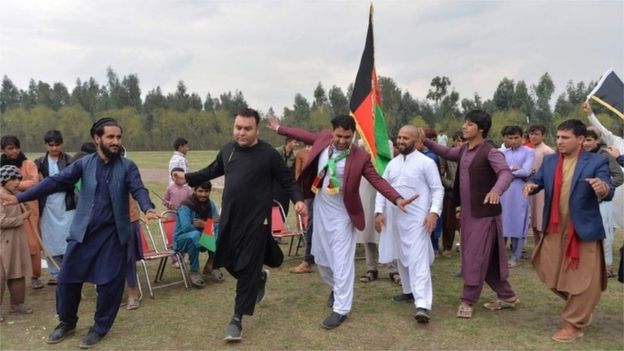
Afghans celebrating the US-Taliban agreement of 29th February 2020, Jalalabad, Nangarhar province, Afghanistan
By M. K. BHADRAKUMAR | Indian Punchline | March 24, 2020
In an extraordinary statement titled On the Political Impasse in Afghanistan, Washington has admitted the failure of Secretary of State Mike Pompeo’s mission to Kabul on Monday to heal the political rift among Afghan politicians and to urge them to form an inclusive government so as to implement the Doha pact of February 29.
In exceptionally strong words, Washington flagged its disappointment over the political rift between the factions led by Ashraf Ghani and Abdullah Abdullah respectively, which has “harmed U.S.-Afghan relations and, sadly, dishonours those Afghan, Americans, and Coalition partners who have sacrificed their lives and treasure” in the 18-year old war.
No sooner than the failure of Pompeo’s mission became clear, the state department disclosed that the Trump administration is cutting back its aid to the Afghan government — “a responsible adjustment to our spending in Afghanistan” by $1 billion immediately and another $1 billion next year — and will also “initiate a review of all of our programs and projects to identify additional reductions, and reconsider our pledges to future donor conferences for Afghanistan.” A calibrated Plan B with President Trump’s approval is unfolding, for sure.
Importantly, the state department statement added ominously, “We have made clear to the (Kabul) leadership that we will not back security operations that are politically motivated, nor support political leaders who order such operations those who advocate for or support parallel government.”
The reference is unmistakably to the the troika of hardliners surrounding Ghani, comprising “Vice-President” Amrullah Saleh, NSA Hamdullah Mohib and Defence Minister Asadullah Khalid.
However, the state department statement leaves the door open to “revisit the reviews initiated”, provided the Afghan leaders “choose to form an inclusive government that can provide security and participate in the peace process.”
The alacrity with which this statement has come implies that President Trump directed Pompeo to convey to the Kabul elite that his patience has run out and to reiterate that no matter the shenanigans of Afghan politicians, “We are proceeding with the conditions-based withdrawal of our forces in accordance with the U.S.-Taliban agreement.”
This is the nearest Trump has come to threatening that if push comes to shove, he may unilaterally end the war and wash his hands of it.
Evidently, Washington is calling Ghani’s bluff who bragged recently that Kabul has the necessary resources to carry on for at least two years even without any US assistance, signalling his grit to dissociate from the US’ peace talks with the Taliban.
On its part, Washington has put Ghani on notice that if the game plan of the hardliners in his circle is to precipitate security situations with a view to drag the US military into violent confrontations with the Taliban and thereby destroy the understanding forged painstakingly through the negotiations in Doha during the past year and more, that won’t happen.
Equally, Washington has distanced itself from the political rift between Ghani and Abdullah by making it clear that it has no favourites.
The startling development has three dimensions to it. First and foremost, will the Trump administration’s shock therapy have a sobering effect on the rival Afghan factions locked in a struggle for power?
The answer is, unfortunately, that such a probability is unlikely to happen as per current indications — given the vaulting ambitions of the protagonists. Both Ghani and Abdullah also have associates who would have their own agenda.
Having said that, Afghans also have a great tradition of reaching compromises and consensus at the last minute before an irrevocable break-up. Such a fortuitous turn of events can happen in the present circumstances only if Ghani accepts a coalition government with power-sharing of key security portfolios.
Arguably, the struggle may even take an ugly form and become “physical” unless great self-restraint is exercised. There are ominous reports that the warlords have come out of the woodwork and are marshalling their militia.
The government also commands shadowy militia groups beyond the pale of law who have been trained by the US to function as a state within the state. Indeed, Afghanistan has a violent history and its democratic temper is only skin-deep. Peaceful transfer of power is a recent phenomenon under the US diktat.
Second, what will be the impact on the security situation? The critical factor here is that, undeniably, there are ethnic undertones to the Ghani-Abdullah political rift and how they might impact the cohesion of the Afghan army and security forces is anybody’s guess. Of course, the US has been bankrolling the Afghan army.
To jog memory, it was Najib’s inability to pay the salaries of the Uzbek militia guarding Kabul city in the critical period since the Soviets withdrew aid that ultimately became a clincher for Rashid Dostum’s treacherous defection to the Mujahideen camp of Ahmed Shah Massoud that in turn resulted in the roof coming down on the communist regime.
Third, how will the Taliban react to these big shifts in the politico-military alignment? Clearly, the Taliban are already at peace with the US forces. Strict orders have been given to the commanders not to engage the US military.
Thus, the state department’s assurance that the US military will not be a party to any conspiracies by the hardliners in Kabul to precipitate confrontations with the Taliban becomes important. In good measure, Pompeo also flew to Doha to meet the Taliban leaders to discuss the current impasse. The Taliban will make careful note of Washington’s eagerness to stick to the Doha pact — and it will reciprocate.
Now, if Ghani resorts to delaying tactics much longer in releasing the Taliban, it may provoke the Taliban into ending the current (tacit) ceasefire and step up its operations against the Afghan security forces with a view to demoralise them.
There are also indications of the Taliban having infiltrated the Afghan army and police and security agencies.
Suffice to say, it will come as a surprise if the Taliban does not take advantage of a most conducive situation arising in Afghanistan — a rump administration ruling the roost in Kabul, lacking in political legitimacy (and the US distancing from it); the grim political struggle for supremacy amongst the Afghan factions that may take a violent form; the chain of command of Afghan forces coming under stress due to the ethnic fissures; and, the strong possibility of Trump unilaterally extricating the US out of the war at some point in a near future.
The big question is whether the Taliban will be savvy enough to wait for Kabul to fall like a rotten apple or will they hastily pluck it as a low-hanging fruit.
The bottom line is that the Taliban (and Pakistan which mentors it) would see that the political ascendance of the Taliban in Kabul, whenever it is due, happens with international legitimacy. The Trump administration’s stated preference still is to reach a negotiated peace settlement as envisaged under the Doha pact through intra-Afghan dialogue. And the Taliban too adheres to the Doha pact.
It is unlikely that the Taliban will opt for a decision to grab power through force. The preference at this stage will be to pitch for an interim government that is inclusive so as to carry as many Afghan factions as possible.
Make no mistake that time works in the Taliban’s favour. Unlike in the past, the Taliban has networked extensively with the international community in the recent years — especially with the major regional states — and its interest lies in securing world recognition for any future government under its leadership.
Yemen’s Ansarullah welcomes UN call for global ceasefire to tackle coronavirus pandemic
Press TV – March 24, 2020
Yemen’s Houthi Ansarullah movement has welcomed a call by United Nations Secretary General Antonio Guterres for a ceasefire in all conflicts worldwide amid a global fight against the coronavirus pandemic.
Mohammed Ali al-Houthi, the chairman of the Supreme Revolutionary Committee of Yemen, said in a tweet on Monday that Sana’a welcomes the UN chief’s call and supports a halt in attacks by the US, Britain, Saudi Arabia, the United Arab Emirates and their allies against Yemen.
The movement, he said, also seeks the lifting of an aerial and maritime blockade imposed on Yemen by the Saudi regime and its coalition allies since early 2015, to facilitate the adoption of preventive measures against the coronavirus outbreak.
The United States and Britain are not part of the Saudi-led alliance but have been providing all sorts of support to the bloody war.
Speaking to reporters from the UN headquarters in New York on Monday, Guterres called for “an immediate global ceasefire in all corners of the world,” adding, “It is time to put armed conflict on lockdown and focus together on true fight of our lives, pull back from hostilities and put aside mistrust & animosities.”
The United Nations has been trying to mediate an end to conflicts in countries including Syria, Yemen and Libya, while also providing humanitarian assistance to millions of civilians.
Guterres warned that in war-torn countries health systems have collapsed and the small number of health professionals left were often targeted in the fighting.
While Yemen has not recorded any COVID-19 cases to date, the possibility of an outbreak threatens the war-ravaged country’s already fragile healthcare system.
Last week, Houthi warned that the Saudi-led coalition of aggressors will be responsible for a possible spread of the virus to Yemen, citing the negative impacts of the siege.
Houthi’s comments come as Yemen is preparing to mark, on March 26, the fifth anniversary of the military campaign, which the Saudi regime and a number of its vassal states launched to reinstall a Riyadh-backed former regime in Yemen.
The Western-backed offensive, coupled with a naval blockade, has destroyed the country’s infrastructure.
The aggression has also led to the world’s worst humanitarian crisis in Yemen, where over 1,000 people, including many kids, were killed and hundreds of thousands afflicted by cholera, diphtheria, measles and dengue fever in 2019, according to the World Health Organization.
House of Mirrors: Justin Trudeau’s Foreign Policy – Book Review
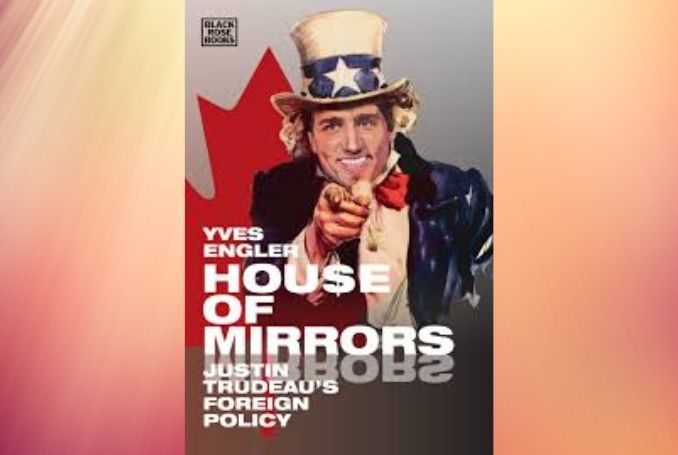
House of Mirrors, by Yves Engler. (Photo: Book Cover)
By Jim Miles | Palestine Chronicle | March 23, 2020
(House of Mirrors – Justin Trudeau’s Foreign Policy. Yves Engler. RED Publishing, Saskatoon/Black Rose Books, Montreal. 2020)
Some book covers are better than others, and that of Yves Engler’s House of Mirrors is beautifully expressive of the contents of his latest work. It shows a very friendly face and happy smiling Justin Trudeau in an iconic pose that says it all: America first.
This is Engler’s eleventh book exposing the downside of Canadian politics. It covers two main themes, the obvious first one is that of Canada’s involvement in the U.S. imperial-hegemonic demands around the world.
The second, more domestic, is that the Liberal’s and Conservatives, Canada’s two main parties, are essentially the same thing when it comes to foreign policy. Whereas the Conservatives are much more aggressive with their terminology while the Trudeau Liberals couch their words in a fancier more humanistic sounding language, the end results are the same: following the U.S. corporate-industrial-military complex and in certain cases being ahead of that curve.
With that as its underlying theme, Engler covers many topics concerning the Trudeau Liberals. The first long section deals with “The Canadian Monroe Policy” discussing how Canada fits into U.S. initiatives throughout Latin America with the overthrow, attempted overthrows, and manipulations of various organizations (OAS) in order to control the western hemisphere.
While paralleling U.S. interests, in terms of Venezuela, Canada, under Chrystia Freeland’ tutelage, has taken a leading interest with its support of the Lima Group (all sycophantic governments to U.S. corporate interests) against Venezuela.
A long essay on the Middle East, “Loving Monarchies, Hating Palestinians” discusses how Canada relates to the Arab countries, Israel, and the Palestinians. An earlier chapter, “The Sun Never Sets on the Canadian Military”, ties in with this chapter in exploring the numerous military sales and security contacts with Middle Eastern countries.
Large orders of military materials are sent to the likes of Saudi Arabia in support of its war on Yemen. Much information and technological information for security is exchanged between Canada and Israel (fun fact: Canada developed apartheid long before South Africa and Israel). The official position for Palestine is the stillborn two-state peace process while the actual position is more one of asking why the Palestinians do not acquiesce to Israeli demands.
Many other important topics are presented: around the world from China and North Korea through to Freeland’s favorite bogeyman, Russia, and on into Africa (military and mining interests); around the world from its domestic carbon dioxide/environmental policies; another hit on Canada’s mining interests in particular with South America; and the language of “Judge What I Say, Not What I Do”.
It is interesting how often Chrystia Freeland’s name rises in connection with Trudeau’s foreign policy. She is foremost in using the platitude about “international order based on rules” and the “rule of laws”. Whatever the foreign policy, as Foreign Affairs Minister and now as Deputy Prime Minister (a conveniently invented position), she carries considerable sway concerning Russia, Ukraine, Venezuela, Syria and other global hotspots (coronavirus notwithstanding). She inverts the colonial role, making Canada a victim rather than a colonizer and exploiter, “Canada has never been an imperialist power…we’ve been the colony.”
In his conclusion, Engler reprises comments about Canadian banks, the mining industry, Russia, Israel, Iran, the military, and business in general. He summarizes, “corporate Canada is highly international” with “segments… tied to extreme capitalism.” Extreme capitalism being capitalism dominated by and supported by the military-industrial complex with assistance from the financial community and the mainstream media.
As with all of Yves Engler’s books, House of Mirrors is tightly written, with little philosophizing, allowing the information to speak for itself, information that is highly notated and well referenced. The smiling man on the cover, Justin Trudeau, is essentially another true believer in an oligarchic world order (along with Ms. Freeland) supported by an international array of corporate and military liaisons.
– Jim Miles is a Canadian educator and a regular contributor/columnist of opinion pieces and book reviews to Palestine Chronicles. His interest in this topic stems originally from an environmental perspective, which encompasses the militarization and economic subjugation of the global community and its commodification by corporate governance and by the American government.
A Year after the North Korea–United States Hanoi Summit: Expectations for the Next One
By Konstantin Asmolov – New Eastern Outlook – 23.03.2020
Just over a year has gone by since US President Donald Trump met with Chairman of the DPRK State Affairs Commission Kim Jong-un in Hanoi. It was the second North Korean-American summit to be held, following on from the first 2018 North Korea–United States Singapore Summit. Many were surprised that the meeting ended without any concrete agreements being made, due to a variety of reasons. The primary disagreements between the two sides were made more difficult to resolve due to actions taken by American conservatives and domestic politics in the United States at the time, which prevented Trump from making any concessions.
The talks which followed between working groups and high-level officials also ended without any visible results. A brief meeting between the Supreme leader of the DPRK and the US President on the sidelines of Trump’s visit to South Korea was little more than a media photo op, and the working-level talks in Stockholm got off to a bad start: North Korea demanded that Washington come up with a new plan by the end of 2019 if the US wants denuclearization talks.
Towards the end of 2019, the North Korean leader gave a clear delineation of relations between the two countries, yet Kim Jong-un did not keep his promise to deliver a “Christmas gift”, by which he meant a demonstration of North Korea’s new strategic weapons. As it was put at the time, “the door is closed, but not locked.” There are several different explanations given for this. Pro-Pyongyang experts say Kim made a gesture of goodwill. Others believe that China used its leverage to make North Korea call off the demonstration and avoid exasperating the situation. We would like to add that given the increased attention the DPRK was receiving during this period (due to its satellites, constant use of reconnaissance aircraft, etc.), it would not have made sense for Pyongyang to “show its cards” at the time.
Failed efforts to impeach Donald Trump did not help them make any progress either, and the DPRK conducted a planned short-range missile launch which almost coincided with the anniversary of the summit. This missile test and others have yet to quell discussions over whether North Korea’s defense industry is modern, or whether its rusty missiles have been cobbled together using stolen technologies from Ukraine, China or Russia.
The outcome has been summed up in the South Korean media: “One year on since the meeting in Hanoi, the North Korean situation seems to have reverted back to its former state”. Given the current situation, I would like to discuss the prospects for this dialog between the United States and North Korea based on a series of quotes made on March 4-6, 2020.
Let’s start with Trump, who was posed a question on his 2020 presidential campaign trail about what he would do with North Korea if re-elected. The question sparked an enthusiastic response: the US President stressed that his relationship with Kim is “very good,” but insisted that he has not given anything to the communist regime and that sanctions have not been lifted. At the same time, Donald Trump reiterated that the policies being put forward by his opponents would lead to a big war with the DPRK, and also took credit for the beginning of inter-Korean rapprochement.
The US President actually dismissed the fact that a short-range missile was launched: “No reaction,” was what he had to say. Unlike at previous events, he did not even try to play this card in the UN Security Council. On March 5, the Security Council discussed this issue, but the North Korean issue was raised in a separate category for additional topics at a meeting about Syria. Immediately after the meeting, the United Kingdom, France, Germany, Belgium and Estonia adopted a joint statement condemning the actions of the DPRK and calling on Pyongyang to resume negotiations on denuclearization, but it should be noted that this statement is meaningless from a legal point of view, and the United States did not participate in it.
Interestingly, the South Korean authorities took a more right-wing position. During a speech at South Korea’s Air Force Academy on March 4, President Moon Jae-in pointed out the unpredictability of the security situation on the Korean Peninsula and underlined the importance of an impregnable defense. The South Korean media also rebuked Trump. They say the US President “brushed off North Korea’s missile tests, even though they are prohibited by U.N. Security Council resolutions” and instead took credit for Pyongyang’s suspension of its long-range missile tests and nuclear tests.
Meanwhile, US Secretary of Defense Mark Esper said North Korea’s ballistic missile capabilities pose an “increasingly complicated” threat, as the regime seeks to modernize its missile systems. When asked whether North Korea’s long-range ballistic missiles pose a threat to the United States, his answer was affirmative.
But on a tactical level, the United States “stands ready to resume denuclearization negotiations with North Korea as soon as possible and hopes to hear back from the regime.” Assistant Secretary of State for International Security and Non-Proliferation Christopher Ford made this comment on March 5: “From a State Department perspective, it remains true that we are ready and willing and prepared for the beginning of working-level discussions with North Korea – in which they will, one hopes, implement the commitments made in Singapore.”
Lastly, we will consider the public opinion on this issue in the United States. A recent poll conducted by the Chicago Council on Global Affairs found that 52% of Americans view North Korea’s nuclear weapons program as a critical threat. That is a large amount of people, but this figure had been 75% at the height of tensions in 2017.
When asked which country poses the greatest threat to the United States, 13% of respondents chose North Korea. The DPRK came in behind Iran (34%), Russia (28%) and China (16%). In 2017, North Korea ranked the highest among these four countries at 59%.
Out of the list of options on how to deal with the North’s nuclear program, tighter economic sanctions received the most support, with 73%.
According to Chicago Council on Global Affairs who conducted the poll, these results are not so much a reflection of the lack of progress that has been made on the diplomatic front, but rather stem from the prolonged absence of noticeable tension and a weakening of the perception of North Korea as a threat.
What can we expect? According to the information the Chicago think tank has gleaned from respondents, there is a sort of informal directive being followed in Washington: make no sudden movements in any direction before the November elections. Amid the race for the White House, fussing over the relations between the United States and North Korea would hardly have a positive effect on Trump’s approval ratings, and certainly should not see them fall.
It became clear to both sides during the working talks that with the time that has passed since Hanoi, the DPRK is prepared to make a certain number of concessions, but Pyongyang is demanding that they are met with proportionate actions in return. Washington is not prepared to take these steps, because the idea of easing sanctions flies in the face of American dogma, and according to this dogma, Kim Jong-un did not cooperate as a gesture of goodwill, but because he was pressured into doing so by an unprecedented level of sanctions. The belief is therefore that this is the main leverage America has to force North Korea into negotiations, and they cannot let up on it.
In the run-up to the election, it is therefore very important “not to get on Kim Jong-un’s nerves”, because any sort of tough response from North Korea will hurt Trump’s campaign, who is still selling his electorate the idea that relations between Washington and Pyongyang would be much worse under any other American president.
Of course, Trump could hardly say no to another photo-op meeting, but both sides know that they can only hold so many of these purely symbolic events, and they have already reached their limit, now they must have something to show for all those handshakes, posing in front of flashing cameras.
This is where we should note the debate among experts regarding the motives of each side. One theory is that Kim and Trump would both like to get more out of the talks, but are prepared to settle for a minor victory, where no answer can be found, but the search for one can continue once the process is put on pause. The view other experts take is that Trump believes the denuclearization of North Korea is a real possibility, but it has been put on hold while he is busy with his re-election campaign, and he is working according to his belief that during the next ten years, something could happen that could change North Korea’s position. However, we must not forget that nuclear weapons are seen in Pyongyang as an unambiguous guarantee of the regime’s survival. This is not only a lesson for Libya, but Iran should also take note (be it the American actions on the Iran nuclear deal or the assassination of General Soleimani).
The pause is likely to go on until the US presidential election is held, but then what? If Trump wins, American political analysts have two theories. One is that Kim will continue the “period of peaceful respite”, devoting his energy to making a few final arrangements so that the economy will be more prepared if it is hit with another round of sanctions. The moratorium will remain abandoned, especially given that it had only ever been a verbal promise, and it was the ultimate failure of the summit in Hanoi that prevented it from being transformed into a written commitment.
The second theory is that North Korea is truly disappointed with the strategic prospects of the dialog. Kim had hoped that it could lead to sanctions being lifted, but it turned out that the materials from the December 2019 plenum ruled this out as something he cannot even dream about, and he now sees the need to move as quickly as possible to increase the country’s military might with nuclear weapons and missiles, in order to ensure a guaranteed level of deterrence. In this context, we can expect to hear about ICBM launches with missiles fired on a flat trajectory, or the hypothetical Hwasong-20, which is said to have no problem reaching anywhere on US territory.
The long-awaited North Korean Navy’s Sinpo class submarine is no less likely to make an appearance, capable of carrying 3-4 missiles with nuclear warheads. We believe it could be revealed as North Korea’s “new strategic weapon”.
What if the Democrats win? There may not necessarily be a radical change of course under a slogan like “anything but what Trump did.” A large number of officials from the Democratic Party who write the bills that are then signed by politicians in government are gradually coming around to the idea that we will have to live with a nuclear North Korea.
Therefore, after weighing up the best and worst options in comparison with the current status quo, we hope that the dialog will continue after November 2020, or that the two sides will finally meet again by the next anniversary of the Hanoi summit.
Konstantin Asmolov, PhD in History, is a Leading Research Fellow at the Center for Korean Studies of the Institute of Far Eastern Studies of the Russian Academy of Sciences.
China censures US for ‘clumsy trick’ to smear others with rumors amid COVID-19 pandemic
Press TV – March 23, 2020
China censures the United States for playing a ‘clumsy trick’ on other countries by smearing them with rumors aimed at accusing those countries with having a hand in the global spread of the deadly coronavirus.
China’s Foreign Ministry spokesman Geng Shuang said on Monday that Washington “on the one hand required federal organizations to speak with one voice to smear China; and on the other hand criticized China, Russia and Iran for spreading false information.”
“I just want to ask, who on earth is spreading false information, misleading the public and calling white black? Such trick of smearing others with rumors and with the play of a thief crying ‘stop the thief’ are just too clumsy.”
China, he added, has always been “open, transparent and responsible.”
“In the past two months and more, the Chinese people have united as one to fight the epidemic and earned precious time for the rest of the world to take necessary precautionary measures. We have made great contribution. WHO has recently pointed out that countries like Singapore and South Korea made good use of the precious time earned by China and took measures. Their moves have curbed the epidemic spread. What has the US done during this period?”
The Chinese official also stated that since January 3 the government in Beijing had been providing “regular briefings” to the World Health Organization (WHO) and other countries, including the United States.
On January 23, he added, “China announced to shut down roads exiting Wuhan City. The US government on February 2 announced to ban entry of all foreigners who had been to China in 14 days before. By then the US just announced a dozen of confirmed COVID-19 cases.”
“Now 50 days have passed, the confirmed cases in the US have surged from less than 20 to more than 30,000. What kind of strong measures has the US taken in the 50 days? It had totally squandered the time China earned for the world.”
The Chinese official further noted that Washington is seeking to “defame” others and “find a scapegoat” instead of admitting its own mistake, “which is totally immoral and irresponsible, and will do nothing good to the US epidemic control work and to the international cooperation in fighting the epidemic.”
“All it should do is concentrating on its own business and play a constructive role in working with all countries to fight the epidemic and protecting global public health security,” the Chinese official said of the US government.
The COVID-19 disease, caused by the new coronavirus, emerged in Wuhan, the capital of China’s Hubei province, in December. It has been reportedly contained in China, but is spreading rapidly around the globe.
UN to set up global coronavirus fund: Norway
Meanwhile, Norway said on Monday that the United Nations will set up a fund to prevent the spread of coronavirus and support the treatment of patients worldwide.
The purpose of the fund, proposed by the Norwegian government, is to assist developing countries with weak health systems in coping with the pandemic as well as to tackle the long-term consequences.
The initiative is similar to a 2014 United Nations Ebola Response Fund.
“We want to make sure that the efforts are as unified as possible and as early as possible so that we can answer up to the demands that countries will have, especially the poorest countries,” Norwegian Foreign Minister Ine Eriksen Soereide told Reuters.
In Africa, Angola, Eritrea and Uganda have confirmed their first cases, while Mauritius recorded its first death as the virus spreads across the continent despite efforts by governments to hold it back.
Elsewhere in the Gaza Strip, the first two cases were confirmed on Sunday.
Coronavirus aid to Italy not a ploy to get EU sanctions lifted: Russia
The Kremlin said Monday that medical assistance Russia is providing to Italy is not part of an attempt to get Rome help lift EU sanctions on Moscow.
The Russian army on Sunday began flying medical help to Italy after receiving an order from President Vladimir Putin, a goodwill gesture that Moscow labeled “From Russia with Love.”
Italy is the European country hardest hit by the viral crisis.
When asked if Russia expected Italy to return the favor by trying to get EU sanctions imposed on Russia over Ukraine lifted, Kremlin spokesman Dmitry Peskov described the notion as absurd.
“We’re not talking about any conditions or calculations or hopes here,” Peskov said.
“Italy is really in need of much more wide scale help and what Russia does is manageable.”
Russia to use mobile phones to track people at risk
Prime Minister Mikhail Mishustin has given the authorities five days to develop a system to track people who have come into contact with anyone with coronavirus by using mobile phone geolocation data.
Under the new system, people would be sent information if they came into contact with someone who was infected and the same information would be passed on to special regional headquarters set up to fight the respiratory disease pandemic.
The Kremlin said the measure was legal and part of a raft of measures Russia is taking to try to halt the spread.
Postponement of Olympics should be considered: Japan
The head of the Japan Olympic Committee (JOC) said he had to consider postponing the Games among his options amid increasing calls from committees around the world to delay the Olympics due to the coronavirus outbreak.
“From the athletes’ point of view of safety and security, we have to come to a stage where we cannot help but consider things including postponement,” JOC President Yasuhiro Yamashita told reporters on Monday.
However, he said too long a delay would be a burden to athletes given the possibility of having to qualify again, for example.
Spain death toll tops 2,000 after 462 deaths in 24 hours
The coronavirus death toll in Spain has surged to 2,182 after 462 people died within 24 hours, the health ministry says.
The death rate showed a 27-percent increase on the figures released a day earlier, with the number of confirmed cases of COVID-19 rising to 33,089 in Spain, one of the worst-hit countries in the world after China and Italy.
Despite an unprecedented national lockdown which was put in place on March 14, the number of deaths and infections have spiraled in Spain, with the figures growing as the country steps up its capacity for testing.
And the lockdown, which was initially put in place for two weeks, will be extended until April 11 to try to curb the spread, Prime Minister Pedro Sanchez said — in a measure which will be put to parliament on Tuesday.
The rise in infections in this country of 46 million people has brought Spain’s healthcare system to the brink of collapse, particularly in Madrid, the worst-hit area, which has registered 10,575 cases, and where 1,263 people have died — accounting for 58 percent of the national death toll.
Some 3,910 healthcare workers have tested positive for the virus, or around 12 percent of those infected, the health ministry’s emergencies coordinator Fernando Simon said.
Officials have repeatedly warned that the number of deaths and infections would continue to rise this week and that the worst was yet to come.
Greece bans flights from UK, Turkey as coronavirus cases rise
Greece has suspended flights from Britain and Turkey to curb the spread of coronavirus, as a lockdown took effect in the country.
The ban came into effect at 0400 GMT — 6:00 a.m. in Athens — on March 23 and ends at 1300 GMT on April 15.
It was a temporary and preemptive measure, a ministerial decree said, as part of further efforts to combat the coronavirus pandemic.
Greece saw its largest single-day jump in confirmed coronavirus cases on Sunday, a rise of 94 infections which brought the total to 624, with fatalities increasing to 15.
The prime minister announced a curfew with few exceptions restricting the movement of people, the latest in a series of measures to fight the virus. Greece has already sealed its borders to non-EU citizens, and those from Italy and Spain.
Police officers were deployed on the streets of Athens on Monday to enforce the lockdown, which allows people out only with special permits. The lockdown order came into effect at 0400 GMT.
Two more doctors die from coronavirus in France
Two more doctors have died after contracting the coronavirus in France, officials said on Monday, a day after the country reported the first death of a doctor treating COVID-19 patients.
One of the doctors, a 66-year-old gynaecologist in Mulhouse near the border with Switzerland and Germany, was infected by a patient during a consultation, according to his clinic.
The other was a 60-year-old general practitioner at a hospital in Saint-Avold near Metz, further north along the German frontier, according to the town’s mayor.
Both died on Sunday when officials announced the death of a 67-year-old doctor who was among the first to treat coronavirus cases in the northern Oise department, which has been badly hit by the outbreak.
Health experts warn that many French hospitals are already overflowing with coronavirus cases even as the government races to set up military field hospitals to help cope with a shortage of beds.
Mulhouse has imposed its own nighttime curfew in addition to nationwide home-confinement rules seeking to curtail the virus, which has spread rapidly in France’s eastern regions.
France is also experiencing a shortfall of ventilators to care for seriously ill patients and face masks and other protective equipment for health workers.
France’s National Health Service reported Sunday that 674 people had died in the country so far — an increase of 112 in 24 hours.
Russiagate: The Sequel
Impervious to facts, the false historical narrative is back for more
By Jason Hirthler | American Herald Tribune | March 23 ,2020
Famous muckraker journalist and author of The Jungle, Upton Sinclair, once declared that, “It is difficult to get a man to understand something when his salary depends on his not understanding it.” He was talking about mainstream journalism. Few mainstream outlets better exemplify his maxim than The New York Times. It should then come as no surprise that the Times, the bible of the bourgeoisie, is at it again. The editorial board recently published a new article bringing the coronavirus and this year’s election under the sweeping banner of Russiagate, a tattered and discredited narrative that is being anxiously rehabilitated by the Washington establishment. But of course. The estimable “editorial board” tells us “conditions are ripe,” sending a shiver down the spine of every Biden liberal on either coast. But ripe for what? I think we all know the answer to that question by heart: “to sow discord”. Indeed that infamous epithet is sewn into the headline of the story, as though it had never left.
The first paragraph begins with the assumption that Russian disinformation in our election has been conclusively demonstrated, such that the question need not even be broached. To be clear: Russian disinformation at the express direction of the Kremlin. This whopping assumption taken as a foregone conclusion, we jump ahead to the next question: How will the Russians interfere this time around? Having established an unproven history as fact, the board then moves on to reupholster the sagging narrative from 2016. This time it won’t be the “bumbling” G.R.U., but rather the “more competent, stealthier” S.V.R. Now, with the SVR presumably involved (thought unconfirmed), we may expect “pernicious operational innovation and escalation” with the Russians descending to new lows to weaponize the coronavirus.
Look what’s already been accomplished. A false historical narrative has been posited as the context in which the latest news is shared. Then they introduced a tantalizing new security agency to the plot. Finally, they elevate the idea that “active measures” campaigns, resurrecting an old Soviet term, were not intended to elect Donald Trump, this having been effectively challenged, but rather to, one shudders to think, “weaken the United States.” This sweeping new storyline has been adumbrated in paragraph without providing a single piece of verifiable evidence.
And so, what to expect during this year’s “quadrennial extravaganza”, as Noam Chomsky drily described our electoral farce? Not having any solid evidence of any SVR plans, better to consult Soviet history for clues. The article then accuses the Soviets of a “racial engineering” campaign of anti-semitism in West Germany in 1959, in New York and the U.S. in 1960, and Africa shortly thereafter. Again, no evidence is provided. This is particularly strange that the German Democratic Republic (GDR) in East Germany would have launched an anti-semitic campaign in the West, given that it alone conducted a thoroughgoing purge of Nazis from its society, while the Federal Republic of Germany (FRG) in the West happily integrated the surviving Nazi braintrust into its power structures, and sent not a few off to the States to lend their dastardly talents to our ‘democracy promotion’ agendas.
It is then said, with resigned recognition, that one of the central problems with combatting devious active measures of this kind was that “the K.G.B. largely stuck to the facts.” Which continues to be an insidious feature of modern Russian ‘active measures’, like the channel RT, for example, which regularly hosts angry populist Americans who rattle off chains of facts one can’t find in the mainstream press. It often seems the establishment media is more irritated at the inconvenience of alternative narratives than their veracity. Another ‘throwback’ story is tossed into the pot, perhaps to conjure dormant nostalgia for the Cold War: cigar boxes packed with explosives are sent to a ritzy dinner party to kill a diplomat. Surely the cigars in question were Cohibas, perhaps autographed by Fidel himself?
Just as one is beginning to get excited about all these ‘active measures’, the authors draw us hastily back to sobering reality. We are now given an elementary lesson in amateur psychology: active measures are intended, it seems, to elicit “emotional” reactions and “corrode” the target. Evidently, the best way to do this is to drive a wedge between deeply democratic, multicultural societies in any of the major western utopias. Hence the racial engineering. It is also important to blame the U.S. for afflicting brown people abroad: such as spreading dengue fever in Cuba and malaria in Pakistan. The authors fail to unravel these charges since each is absurd on its face. Or such is the editorial board’s consensus, if not the reader’s. One imagines the board members chucking at the charges: As if the United States of America would ever attempt such a thing! But then again, since World War Two, the U.S. has tried to overthrow some 50 foreign governments, assassinate some 50 foreign leaders, either invade directly or by proxy or simply bomb 30+ countries, not to mention interfering in some 30 foreign elections, all this with the aim of destabilizing and disbanding populist movements around the world. Nobody embodies counterrevolutionary imperialism better than Washington and its vassals. But these facts are, as Sinclair would remind us, what the board and its authors are paid to forget.
But back to the true evildoers, Russia. According to anonymous sources with no evidence to share, the Russians will harness the coronavirus to divide Americans from each other. The authors reference a discord-sowing campaign being run out of Ghana by a group called ELBA, uncovered by Facebook and CNN. A modest single-story yellow house with stone-fronting is shown in the linked CNN article, the worldwide headquarters of the ghastly ELBA “Russian trolls” who, stunningly, were not even aware they were Russian trolls. Most were Ghanaians. But such is the surreptitious and artful Kremlin craft. Ghanaian security forces raided the small house and then darkly implied our worst fears when they attributed ELBA’s funding to a “European country.” CNN traced the Ghanaian man who ran the company back to Russia, where he worked as a translator. That manager, Seth Wiredu, was confused that Ghanaian security had raided his business. “I fight for black people,” he said. Indeed, the posts on Facebook were focused on repression of African-Americans, quite sensibly. Facebook quickly took down 71 associated accounts. Of course, our white authors at the Times, say the Russians have influenced African-Americans since 2016. CNN attempted to tie Wiredu to the Internet Research Agency (IRA) of 2016 fame, though he flatly denied the association.
And so, regarding the Russians supposed gameplan for 2020, we are left with little substantiated intelligence and much speculative fodder. The story itself is based merely on what “officials said.” Unnamed officials. Anonymous officials. Government agents. “They gave few details,” of course, but this, as you know, is all done in the name of national security. One can just imagine the Times deep throat hemming and hawing and biting his lip in some oil-stained underground parking deck, finally whispering, “I really can’t show you the evidence. It would compromise national security.” And then a conspiratorial and patriotic nod from the Times stenographer. “I understand completely,” he replies. “The safety of the American people is paramount.”
Manufacturing Consent, Consensus, and Fear
One of the filters that Noam Chomsky and Edward Hermann laid out in their classic Manufacturing Consent is to do with sources. Namely, “the reliance of the media on information provided by government, business, and ‘experts’ funded and approved by these primary sources and agents of power.” Voices of the establishment, in other words. This is precisely how the MSM has managed the deliberate expansion of Russiagate. Times journalists reflexively accept the pronouncements of their government sources. It has gotten to the point where sources must no longer provide evidence for their claims. They must merely claim that providing evidence would compromise national security. Any serious journalist would insist on evidence. But journalists do not do this because they recognize that if they did, the source would likely quit being their source and begin to break stories with competitor news outlets. The muckraker again: their salary depends on blind faith. There is no reasonable excuse for this journalistic stenography. Parroting government sources is exactly that.
Anonymous Sources Lack Credibility
Aside from the self-evident willingness of the press to print unsubstantiated and inflammatory claims, there are three other reasons to view such stories with skepticism. First, how many times must we be told that the military-intelligence community is not trustworthy? An infinite number, it seems. From the Church Commission to the National Endowment for Democracy (NED) and the invention of ‘perception management’ to a former CIA director’s naked admission that the organization lied, cheated, and stole as a business model. The government has lied to us about Iraq, the greatest war crime of this century. Before then it lied to us about Cuba, Nicaragua, Vietnam, among many other nations. Since then it has spread disinformation about Libya, Syria, Venezuela, Iran, North Korea, and Russia. Evidence was manufactured to support a foregone conclusion. The CIA has bought and paid for journalists at least since the Church Commission.
Second, aside from the perfidious track record of government sources, the mainstream media itself has been shown to be untrustworthy. The notion of journalistic impartiality is more mythic than substantiated. Not least because of its history of conspiracy and connivance with the government. The press hasn’t helped its cause by installing a surfeit of military and intelligence retirees as lead analysts.
Third, and critically for this particular topic, we now know that much of the supposed evidence for Russiagate has been debunked:
- The idea the GRU was definitively behind the supposed hacking of the DNC is errant on two counts: the evidence suggests it was a leak, not a hack; and the CIA is known to have technology that allows it to fake any source it chooses.
- The Mueller Report was an unmitigated disaster for conspiracy-pushing Democrats.
- We know that the infamous dossier author Christopher Steele was a DNC contractor, like CrowdStrike, which refused to turn over its servers to the FBI for investigation after claiming it was hacked, and that the Clinton campaign paid for part of Steele’s investigative work. The Russians were central to Clinton’s explanation of why she lost.
- We know that there has been no definitive proof that the Kremlin was behind any of the social media posts that were said to corrupt the election.
- Supposed spy Maria Butina was essentially entrapped, jailed, had her reputation destroyed, and was then banished back to Russia.
- That Donald Trump’s entire presidency has been largely hostile to Russia, an odd stance for a supposed puppet of the Kremlin.
- The Times itself launched and promoted the dissimulating sham known as the Intelligence Community Assessment of Russian interference. The newspaper repeatedly claimed the ICA was signed off on by all 17 intelligence agencies, a claim it later quietly retracted when it was shown that only four handpicked agencies had actually supported the assessment. Likely handpicked by John Brennan to legitimate suspicions invented by… John Brennan.
- The supposed Russian backing of Roy Moore’s Alabama Congressional campaign was a false flag run by a company that wrote the Senate report on Russian interference.
- We do know the Internet Research Agency was a for-profit clickbait agency that spent a comparative pittance ($100,000) compared to the hundreds of millions spent by the 2016 candidates. Neither have the IRA’s posts aligned with either candidate nor the election itself, with most posts occurring after the election.
- We know the MSM’s hysterical claims in reporting the supposed reach of 126 million people via social media posts have collapsed on examination. They actually represented four ten thousandths of the total number of posts on Facebook during the time period, a “miniscule” amount according to Facebook. They mostly occurred after the election, were not predominantly political in nature, and were based on the theoretical possibility that 29 million people may have gotten at least one post in their feed and shared the posts at the average sharing rate. All this setting aside that only 10 percent of Facebook posts in a feed are ever seen at all.
- A host of other ill-conceived stories, from Paul Manafort’s supposed clandestine meetings with Julian Assange, to Putin’s hacking of electricity grids, to sonic microwave attacks of U.S. diplomats, have all been exposed and treated with the contempt they deserved.
- The indictments against the 13 members of IRA are in the process of being dropped. The reason? You guessed it: national security.
Why Anti-Russian Disinformation?
Given the breadth of Russiagate’s failure, we now know that the MSM is happy to disseminate largely counterfactual content. Why? Cui bono? After it was launched in 2016, Russiagate quickly became a perfect storm in which the interests of three powerful Washington entities converged. The Clinton campaign used the story to rationalize its embarrassing defeat to a casino mogul. The Democratic Party used the tale to attempt to excuse its discredited centrist politics to re-energize its disillusioned base in the faux resistance of a supposed traitor in the White House. And, most importantly, the intelligence community leveraged the claims to constrain Trump’s foreign policy, steering him away from befriending Russia or thoroughly dismantling costly wars abroad. All three were happy to then harness the alternative media that was undermining their chosen narratives. The Democrats and the military intelligence community likely see benefits in extending this threadbare fiction through the 2020 electoral season, not to mention the pandemic. After all, Bernie Sanders populist campaign has given the establishment a real fright, as Trump’s campaign did four years ago. Much of this has to do with deteriorating conditions among the working class. But also it has to do with access to alternative sources of information. It is the internet that has destabilized the establishment’s control of the national discourse over the last 20 years. It reached a crescendo in 2016.
Since then, Russiagate has been leveraged to suppress alternative voices on the internet and insurgent contrarians in the mainstream. The censorship of left voices across the social media spectrum has been well noted, from Google algorithm changes to Facebook account deletion to demonetization on YouTube. Likewise, progressive voices in the mainstream, like Tulsi Gabbard, were smeared by MSM for their anti-war positions and marginalized in the national discourse. Gabbard correctly clarified in a Washington Post article that it was the intelligence community that was interfering in our elections by continually leaking Russiaphobic claims without evidence. This is precisely what the Times editorial board have long peddled. They are showing little sign of quitting their perfidy.
This is standard issue rollback by federal forces. The history of anti-communism, expertly unpacked by Alex Carey among many others, demonstrates that anti-communism has been used to suppress socialist thought in America. Chomsky and Herman said anti-communism was the fifth filter by which elites managed the flow of information to the public. They called it a “national religion.” Historically, nothing has encouraged self-censorship better than the fear of being called a communist. In the post-Soviet era, that nimble and dexterous label has now been simply repurposed into the charge that one is a ‘Putin stooge,’ or a ‘Russian bot’ if you challenge Washington claims about Moscow. Easily done since Russia was the home of the Bolshevik Revolution. But it isn’t actually communism or Russia that is the underlying target of establishment repression: it is independence. Independent media, independent nations, independent politicians.
Max Blumenthal, a stalwart of the anti-imperialist left, perhaps said it best when he summarized Russiagate as follows, “those responsible for this fake neocon intrigue got a new Cold War, record defense budgets, and a McCarthyite political atmosphere to denigrate opponents of permanent war. A waste of energy and a setback for peace.” Well put. We should thus remember, in a time of remarkable insecurity about our healthcare system and its ability to combat the pandemic, there has long been a media virus that has infected the nation’s understanding of foreign policy, ironically by sanitizing news of critical context, fact, and motive. Buyer beware.
The New York Times’ Insidious Ongoing Disinformation Campaign on Russia & Elections
By Gareth Porter | Consortium News | March 17, 2020
For the past three years the new narrative of Russian interference in U.S. elections has bound corporate news media more tightly than ever to the interests of the national security state. And no outlet has pushed that narrative more aggressively – and with more violence to the relevant facts — than The New York Times.
Times reporters have produced a series of stories that loudly proclaim the Russian election meddling narrative but offer no real facts in the body of the story supporting its most sensational claims.
The Times service to the narrative was introduced by its February 2017 story headlined, “Trump Campaign Aides Had Repeated Contacts with Russian Intelligence.” We now know from Justice Department Inspector General Michael Horowitz’s report on the FBI investigation of the Trump campaign that the only campaign aide who had contacts with Russian intelligence officials was Carter Page, and those had taken place years before in the context of Page’s reporting them to the CIA. The Horowitz report revealed that FBI officials had hidden that fact from the FISA Court to justify its request for surveillance of Page.
But the Times coverage of the Horowitz report in December 2019 failed to acknowledge that the calumny about Page’s Russian intelligence contacts, which it had published without question in 2017, had been an FBI deception.
Two more Times Russiagate stories in 2018 and 2019 featured spectacular claims that proved on closer examination to be grotesque distortions of fact. In September 2018 a 10,000-word story by Scott Shane and Mark Mazzetti sought to convince readers that the Russian Internet Research Agency (IRA) had successfully swayed U.S. opinion during the 2016 election with 80,000 Facebook posts that they said had reached 126 million Americans.
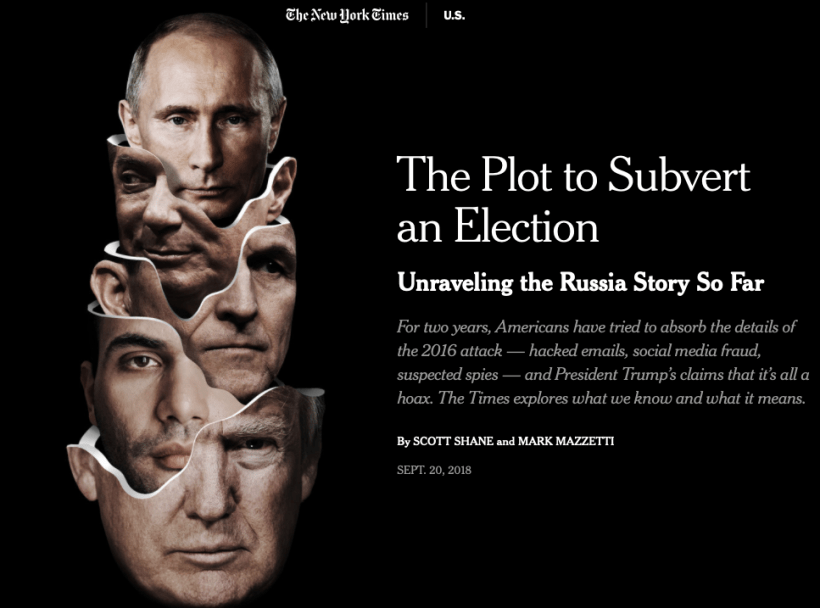
But that turned to be an outrageously deceptive claim, because Shane and Mazzetti failed to mention the fact that those 80,000 IRA posts (from early 2015 through 2017), had been engulfed in a vast ocean of more than 33 trillion Facebook posts in people’s news feeds – 413 million times more than the IRA posts.
In December 2019, senior national security correspondent David Sanger wrote a story headlined, “Russia Targeted Election Systems in All 50 States, Report Finds,” and Sanger’s lede said the Senate Intelligence Committee had “concluded” that all 50 states had been targeted. But the Committee report actually reaches no such conclusion. It quoted President Barack Obama’s cyber-security adviser Michael Daniel as recalling that he had “personally” reached that conclusion, but shows the only basis for his conclusion was remarkably lame: the “randomness of the attempts” and his conviction that Russian intelligence was “thorough.”
The Committee reported that some intelligence “developed” in 2018 had “bolstered” the subjective judgment by Daniel. But all but one of the eight paragraphs in the report describing that intelligence were redacted, and the one unredacted paragraph suggests that the redacted paragraphs provided no conclusive evidence that Russian intelligence had scanned any state election websites, much less those of all 50 states. The paragraph said, “However, IP addresses associated with the August 16, 2016 FLASH provided some indicators the activity might be attributable to the Russian government…. [emphasis added].”
The Committee report also contained summary statements from six states that the Department of Homeland Security has continued to include among the 21 states it insists were hacked by the Russians in 2016, denying any cyber threat to their systems. Another 13 states reported only that there was “scanning and probing” by inconclusive IP addresses the FBI and DHS had sent them. Sanger did not report any of those troublesome details.
In January 2020 the Times began its coverage of the theme of Russian interference in the 2020 election with a story headlined, “Chaos is the Point: Russian Hackers and Trolls Grow Stealthier in 2020.” The story, written by Sanger, Matthew Rosenberg and Nicole Perlroth, sought to heighten the existing U.S. climate of paranoia about a Russian attack in regard to the 2020 elections. Once again, however, nothing in the story supports the sinister tone of the headline.
It reported Department of Homeland Security officials’ anxiety about the ransom-ware attacks on 100 American towns, cities and federal offices during 2019, which are clearly criminal operations aimed at large-scale payoffs by cities. The story informed readers that DHS was investigating “whether Russian intelligence was involved in any of the attacks,” on the apparent theory that the criminals were being used by the Russians.
Since those ransom-ware attacks had been going on for years, the obvious question would have been why DHS would have waited until 2020 to reveal that it was investigating Russian involvement. Thus, the only fact underlying the story was the DHS desire to find evidence to support its accusations of Russian election hacking.
Still at it in 2020
The Times continued its advocacy journalism in a Feb. 26 report that U.S. intelligence officials had “warned” in a briefing for the House Intelligence Committee on Feb. 13 that “Russia was interfering in the 2020 campaign to get President Trump elected,” citing five people “familiar with the matter.”
The Times’ team of four writers proceeded to declare, “The Russians have been preparing – and experimenting – for the 2020 election… aware that they needed a new playbook of as-yet undetectable methods, United States officials said.” But instead of reporting actual evidence of any Russian action or decision for action, the Times writers again cited what their sources suspected could be done.
“Some officials,” they wrote, “believe that foreign powers, possibly including Russia, could use ransom-ware attacks…to damage or interfere with voting systems or registration databases.” The Times’ sources thus had no actual intelligence on the question and were merely speculating on what any foreign government might do to disrupt the election.
Three days after that report, moreover, the Times backed away from its previous lede after intelligence sources disputed its claim that Russia was intervening to reelect Trump, suggesting that the briefing officer, Shelby Pierson, had overstated the assessment. Sanger sought to limit the damage with a story labeling the problem one of “dueling narratives” in the intelligence community.
Then Sanger admitted, “It is probably too early for the Russians to begin any significant moves to bolster a specific candidate,” which obviously invalidated the Times’ previous speculation on the subject. But after The Washington Post published a story that the FBI had informed Senator Bernie Sanders that Russia had sought to help his campaign, Sanger quickly returned to the same narrative of Russian interference to advance its favorite candidates.
On the Times’ podcast “The Daily,” Sanger opined that the Russians were now supporting both Trump and Sanders – because Sanders, “like Donald Trump,” has “got a real aversion to interventions around the world.”
The most recent entry in the Times’ campaign to create anxiety about Russian interference in the election focused on race relations. On March 10, the Times headlined its story, “Russia Trying to Stoke U.S. Racial Tension before Elections, Officials Say.” In their lede Julian Barnes and Adam Goldman announced, “The Russian government has stepped up efforts to influence racial tensions in the United States as part of its bid to influence November’s presidential election, including trying to incite violence by white supremacist groups and stoke anger among Afro-Americans, according to seven American officials briefed on recent intelligence.”
But true to the modus operandi used routinely to push the Russian election threat narrative, the writers did not offer a single fact supporting such a story line. They even admitted that the officials who were making the claims provided “few details” about white supremacists and “did not detail how” blacks were being encouraged to use violence.
It turns out, in fact, that U.S. officials have found nothing indicating Russian support for violent white supremacists in America. The only fact that they could cite — based on a single source — was that the FBI is “scrutinizing any ties” between Russian intelligence and Rinaldo Nazzaro, the American founder of a “neo-Nazi group,” who lives with his Russian wife in St. Petersburg, Russia, but owns property in the United States. So, the Times’ single source had nothing but a suspicion for which the FBI was trying to find evidence.
The final touch in the piece was the accusation that RT had “fanned divisions” on race by running a story about a video of New York policemen attacking and detaining a young black man that Barnes and Goldman write “sparked outrage” and had also “posted tweets aimed at stirring white animosity.” But the RT article on the video merely reported accurately that the video depicted unprovoked police brutality and that it had already gone viral. The Times itself had published a much more detailed Associated Press story on the same incident that went into a discussion of the history of police brutality in New York City. By the Times’ own criterion, the AP was doing far more to stoke racial animosity than RT.
The opinion pieces that RT published attacking The New York Times for its coverage of a video at the University of Wisconsin that offended non-whites and for a Times opinion piece critical of the Apu character on “The Simpsons” echoed views on race and culture that most Americans find offensive. The idea that they were part of a Russian plot to generate racial animosity, however, is a very long stretch.
The descent of The New York Times into this unprecedented level of propagandizing for the narrative of Russia’s threat to U.S. democracy is dramatic evidence of a broader problem of abuses by corporate media of their socio-political power. Greater awareness of the dishonesty at the heart of the Times‘ coverage of that issue is a key to leveraging media reform and political change.
Gareth Porter is an independent investigative journalist and historian and winner of the 2012 Gellhorn Prize for Journalism. His latest book, with John Kiriakou, is “The CIA Insider’s Guide to the Iran Crisis: From CIA Coup to the Brink of War.”
Featured Video

John Mearsheimer: New World Order Arrived & Europe Is Left Behind
or go to
Aletho News Archives – Video-Images
Book Review
Sunset on Net Zero: A Heretic’s Guide to the Futile CO2 Target
By Ronald Paul Barmby (Author) – October 3, 2025
SUNSET ON NET ZERO describes in detail why Net Zero CO2 is pointless and unachievable. It explains in understandable terms the up-to- date thoughts of the greatest minds of today in physics, meteorology, economics, engineering, and the geosciences.
Net Zero CO2 is pointless because we have now confirmed by satellites that 90% of CO2 warming has already happened. CO2 is not an existential threat but clouds, El-Niño, and human habitation are significant drivers of global warming that are often ignored.
Net Zero CO2 is unachievable because the green technology alternatives are unreliable and unaffordable. Wind and solar power triple electricity costs, building fully electric vehicles produces at least one-half of CO2 emissions they are meant to avoid, and heat pumps will leave you dangerously cold in the winter. Green hydrogen, air capture CO2, and carbon capture and storage are prescriptions for national bankruptcy. The supply of key metals and minerals required to achieve Net Zero need to be at least doubled—some much more—and are often controlled by a very few. Net Zero comes with huge environmental and agricultural costs.
We have been through similar climatic temperature changes before, more recently than you think. Our efforts to control it are futile.
Blog Roll
 Aletho News
- Britain’s shadow security network expands into south Lebanon
- The ADL Has a Foreign Policy, and You Are Not Supposed to See It
- Former Qatari PM says ‘Israel’ has security ties with all Gulf states
- The Sound of Silence in the Strait of Hormuz
- Poland’s call for a no-fly zone in Ukraine means NATO direct war with Russia
- John Mearsheimer: New World Order Arrived & Europe Is Left Behind
- Naqab demolition notices top 1,000; settlers demolish Jaloud homes
- Israel is Using the ‘Gaza Ceasefire’ to Commit Ethnic Cleansing
- West’s ‘wrong expectations’ prolonged the Ukraine conflict – leader of top German party
- Israel kills three civilian officials in three days as Netanyahu widens Gaza assassination policy
- If Americans Knew
- An error has occurred; the feed is probably down. Try again later.
- No Tricks Zone
- Physicists: Doubling CO2 Has A Smaller Impact On Ocean ‘Acidification’ Than Existing Internal Variability
- Alarmist Climatologists In Shock! 2026 Atlantic Hurricane Season Sees Lowest Count In 101 Years
- New Study: Modern Temps Are Among The Coldest Of The Last 10,000 Years In East Central Europe
- Germany’s Renewable Energies Lead to 1.4 Billion Euro Electric Power Trade Deficit
- Argentina’s Perito Moreno Glacier Joins Antarctica and Arctic In Defying Doomsday Melt Claims
- New Study: Barents Sea Temperatures Were Warmer And Sea Ice Less Extensive In The 1700s Than Today
- German Authorities Start Initiative To Evaluate Public Register For Climate “Disinformation” Spreaders!
- Zonal Asymmetry of Temperature Change in the Antarctic Circumpolar Current
- New Study: The Net Fossil Fuel Contribution To Rising Atmospheric CO2 Has Been Zero For 500 Years
- Germany’s Green Energy Transition Becoming Increasingly Expensive…Another 6 Trillion Euros!

