WUHAN OUTBREAK: CHINA DEMANDS AN HONEST ACCOUNTING
By Thomas Hon Wing Polin | March 22, 2020
- It is now virtually certain that COVID-19 was brought to Wuhan by American troops taking part in the city’s World Military Games last Oct. 18-27.
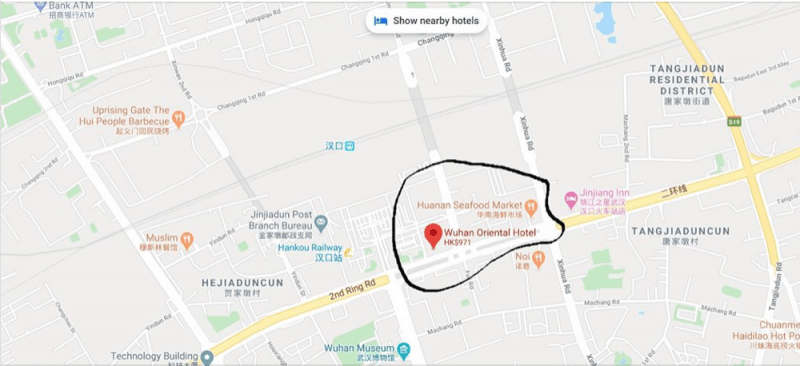
- The 300-strong US contingent stayed 300 meters from the Huanan Seafood Market where China’s outbreak began (see map below) at the Wuhan Oriental Hotel.
- Five of the US troops developed a fever on Oct. 25 and were taken to an infectious-diseases hospital for treatment.
- 42 employees of the Oriental Hotel were diagnosed with COVID-19, becoming the first cluster in Wuhan. At the time only 7 people from the market had been thus diagnosed (and treated before the hotel staff). All 7 had contact with the 42 from the hotel. From this source, the virus spread to the rest of China.
- The American Military Games team trained at a location near Fort Detrick, the military’s viral lab closed down by the CDC in July for various deficiencies.
- The big question now is whether the transmission was planned, or accidental.
- Chinese authorities are awaiting an explanation from US authorities.
- A few days ago, Mike Pompeo phoned Yang Jiechi, Chinese State Councillor for Foreign Affairs. Pompeo’s counterpart is actually Foreign Minister Wang Yi and Yang is Wang’s boss, so Pompeo wanted to talk about something urgent and important.
- Pompeo wanted the Chinese not to publicize what they had found.
- Yang’s reply: “We await your solemn explanation, especially about Patient Zero.”
China’s leaders have long suspected US military involvement in the Wuhan outbreak but were determined to stop the disease before pursuing the Americans for an honest accounting.
The War in Vietnam: John Wayne Was Wrong
By Marko | The Voluntaryist Reader | 12/10/2012
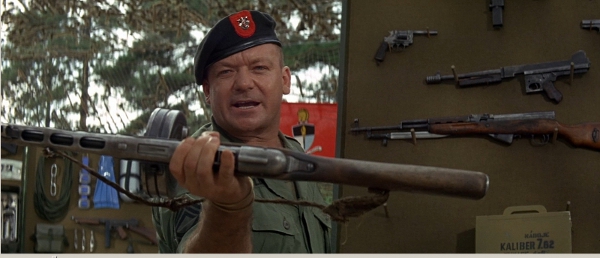
John Wayne’s Vietnam-era pro-war classic, The Green Berets opens with a scene of a press conference. It starts off with a group of Green Berets introducing themselves to the press, which is followed by a Q&A session with two Green Berets sergeants who have been assigned to answer questions. The scene reaches a crescendo when a reporter asks one of the sergeants if the war in Vietnam does not seem like a war between the Vietnamese and if the Americans should therefore stay out of it. Hearing this, the visibly irritated sergeant proceeds to pick up captured Vietnamese firearms from a display board nearby, and drops them in front of the reporter one by one, all the while explaining in a voice laden with hostile emotion that the weapons are Chinese-made, Soviet-made and Czechoslovakian-made respectively.
The implication is clear. The war in Vietnam is not merely an internal Vietnamese affair, because quite aside from the American factor in the war there is also the Soviet, the Chinese, even the Czechoslovakian factor. It is therefore on the account of this involvement of foreign Communist powers in Vietnam that the United States has to involve itself on the other side.
Now it is easy to see the inadequacy of that argument. Providing war material, even on a vast scale, is in no way comparable to a direct military intervention carried out with an occupation force of half a million soldiers, which is how many the United States had in Vietnam at the time The Green Berets aired in 1968.* Clearly the American involvement in Vietnam went far beyond what was necessary to balance out the involvement of the Soviets, the Chinese, or the Czechoslovaks, on the side of Hanoi.
But is it even true the American involvement was a reaction, perhaps an exaggerated reaction, to the Soviet, etc involvement? What were the actual cause and effect, in life rather than on film? Were the Americans in Vietnam because Soviet shipments of weaponry were going there, or were the Soviets shipping weaponry to Vietnam because the Americans had come there? How does this and other claims of war propagandists of the time stack up against what we know from the works of historians today?
In fact, where the Soviets are concerned their relationship with the Vietnamese before the American intervention in Vietnam was at its nadir precisely because the Soviet Union would not support DRV (North Vietnam) in reunifying Vietnam by military means. Soviet aid to DRV in this period, that is when the North was facilitating the struggle of the NLF (“Viet Cong”) in the South and before direct American involvement on a great scale, was relatively small and almost exclusively economic, not military.
When the unifying elections called for by the Geneva Accords of 1954 that had ended the French War in Vietnam did not come about, Hanoi gradually resolved to wage a military campaign to oust the American-backed government in the South. In this, however, it did not have the support of Moscow.
The Soviets feared American intervention which would have to result in an American-Soviet confrontation that would interfere with their policy line of “peaceful coexistence” with the Capitalist bloc. They made it clear to Hanoi they supported its struggle to reunify Vietnam only in as much as it was pursued by diplomatic means and encouraged Hanoi to pursue a peaceful strategy.
Vietnamese Communists shared many of the concerns being voiced by Moscow, but ultimately pressed on regardless. Both the Vietnamese and the Soviets were acutely aware that waging a violent struggle for reunification could result in an American invasion in Vietnam. They were both uneasy about this prospect and regarded it as highly undesirable, even disastrous. The difference was that the Vietnamese were ultimately willing to accept a confrontation with the Americans if they stood in the way of the reunification of their country, but the Soviets were not.
It was not until the time of the Gulf of Tonkin Resolution which marked the official entry of the United States into the war in Vietnam that the USSR begun to provide DRV with military assistance. The Soviets had held back on providing Vietnamese Communists with war material because this would encourage them to wage war in the South, which could in turn result in an American intervention. Now that Americans had intervened regardless, the Soviets no longer had a reason to continue to hold back. Whatever they did, the Americans were already in Vietnam. Now they would provide the Vietnamese with aid, because that was the only way these could hope to prevail against the Americans.
An additional reason for the Soviet reversal on the question of military assistance was to regain the influence they had lost with North Vietnam to China. In 1954 Moscow and Beijing had pressured the Vietnamese Communists into signing the Geneva Accords, which ended the French War in Indochina, but also split Vietnam in half.** Since then both China and the Soviet Union acted as a moderating force on Hanoi. They encouraged the Vietnamese to pursue the goal of reunification by peaceful means only, even after these had clearly shown themselves to be ineffectual when unifying elections called for by the Accords failed to materialize.
Following the Sino-Soviet split, however, Beijing gradually moved away from this position and came to see a military struggle could complement diplomatic and propaganda efforts. In time, the Chinese position would become further radicalized and they would reject the notion that negotiations could be of any use at all. It is important to understand, however, that Beijing came to approve of the armed struggle of the Vietnamese only in 1961, fully two years after the Vietnamese had gone ahead with it.
The change in the position of the PRC and the resultant increase in assistance to Vietnam enabled the Chinese-Vietnamese relationship to thrive. In the context of the Sino-Soviet confrontation within the Communist camp North Vietnam was now aligning ever more closely to China. That is, until the American intervention in the war caused the Soviets to launch a giant, Lend Lease-like program of military assistance to the DRV and regain their lost influence with Hanoi.
The key thing to take from here is that it was not the case that the Vietnamese fell under China’s influence which directed them to pursue the goal of unification of their country with military means. The Vietnamese were orienting themselves to that of the two Communist powers which would support them in their own policy line on South Vietnam. Chinese-Vietnamese relations could thrive precisely because China had come to adopt Hanoi’s view of peaceful means to reunify Vietnam as inadequate. The Soviet Union in turn could regain its influence over DRV and pull it back from the Chinese camp only when it had dropped its opposition to the military struggle of the Vietnamese.
The presence of Soviet and Chinese-made firearms in Vietnamese hands did not in fact point to the latter being simply the agents of monolithic Communism with designs over the entire globe as John Wayne wanted Americans to believe in 1968. In actuality, by going to war the Vietnamese Communists had defied the Kremlin and had frustrated its plans. It was precisely by opting for a military struggle that the DRV leadership had demonstrated its freedom of action. It was also the case that the USSR did everything it could to spare the US its calamitous war in Vietnam.
The Soviets attempted to dissuade the Vietnamese leadership from waging a military struggle even at the cost of losing nearly all its influence in Hanoi and seeing North Vietnam slide into the Chinese camp. If the mistake the Soviets committed was failing to appreciate just how important it was to the Vietnamese to reunify their country, it was a mistake the Americans tragically made as well. In part, due to propagandists like John Wayne who put out the idiotic drivel of the Vietnamese struggle for reunification as a matter of “world Communist domination”.
~ Marko
Source: Mari Olsen, Soviet–Vietnam Relations and the Role of China, 1949–64: Changing Alliances (New York: Routledge, 2006)
*Albeit by the time The Green Berets aired this was no longer the case, the Chinese also stationed troops in Vietnam, specifically in the Communist-run Democratic Republic of Vietnam (North Vietnam), but on a far smaller scale. In all 320,000 Chinese anti-aircraft and engineer troops served in Vietnam in comparison to 2.7 million Americans. The Chinese deployed in North Vietnam in mid 1965, in response to the Americans landing in the South. They evacuated in early 1968, having suffered about 1100 dead, mainly in the American bombing of the North.
**The two powers went as far as to signal the Viet Minh that rejecting the Accords may result in their ending their material assistance to the movement’s struggle.
COVID-USA: Targeting Italy and South Korea?
By Larry Romanoff | Global Research | March 21, 2020
A high-level Italian virologist, Giuseppe Remuzzi, has published papers in the Lancet and other articles in which he states facts not hitherto known. (1)
The doctor stated that Italian physicians now recall having seen:
“a very strange and very severe pneumonia, particularly in old people in December and even November [2019]. This suggests that the virus was circulating, at least in Lombardy, and before we were aware of this outbreak occurring in China.“(2)
Chinese medical authorities have determined the same underlying phenomenon, that the virus had been circulating among the population for perhaps two months before it finally broke out into the open.
Further, according to the Italian National Health Service (ISS):
“It is not possible to reconstruct, for all patients, the chain of transmission of infection. Most cases reported in Italy report an epidemiological link with other cases diagnosed in Lombardy, Emilia Romagna and Veneto, the areas most affected by the epidemic.” [translation from Italian] (3)
The above statement is of crucial importance since it supports in itself the assertion of several simultaneous infection clusters and several ‘patients zero’. There are cases in Lombardy that could not be placed in an infection chain, and this must also be true for other areas. (see below) Given that the virus broke out separately in disparate regions of Italy, we can expect the identification of independent infectious clusters in those regions as well. That would mean Italy was hit by at least several individual ‘seedings’ of the virus.
China’s outbreak of consequence was primarily in the city of Wuhan but with multiple sources in the city and multiple patients zero, with a minor outbreak in Guangdong that was easily contained. China had multiple clusters in Wuhan. There was no single source, and no patient zero has been identified which is similar to those of Italy.
The mystery of Italy’s “Patient No. 4”
Was the Italian outbreak caused by infections from China? Yes, and no.
Before February 20, 2020, there were only three cases of coronavirus infection in Italy, two tourists from Wuhan, China, confirmed on January 30th, and an Italian man who returned to Rome from Wuhan on February 6th. These were clearly imported cases with Italy experiencing no new infections during the next two weeks.
Then suddenly there appeared new infections that were unrelated to China. On February 19, the Lombardy Health Region issued a statement that a 38-year-old Italian man was diagnosed with the new coronavirus, becoming the fourth confirmed case in Italy. The man had never traveled to China and had no contact with the confirmed Chinese patients.
Immediately after this patient was diagnosed, Italy experienced a major outbreak. In one day, the number of confirmed cases increased to 20 and, after little more than three weeks, Italy had 17,660 confirmed cases.
The Italians were not idle in searching for their patient zero. They renamed the “patient 4” “Italian No. 1”, and attempted to learn how he became infected. The search was apparently fruitless, the article stating that “America’s pandemic of the century has become the subject of suspicion by Italians“.(4)
The mystery of South Korea’s “Patient No. 31”
South Korea’s experience was eerily similar to that of Italy, and also to that of China. The country had experienced 30 imported cases which began on January 20, I believe all of which were traceable to contact with Hubei and/or Wuhan.
But then South Korea discovered a “Patient No. 31”, a 61 year-old South Korean woman diagnosed with the new coronavirus on February 18. This ‘local’ patient had no ties to China, had had no contact with any Chinese, and no contact whatever with any of the infected South Koreans. Her infection was a South Korean source.
Just as with Italy, the outbreak in South Korea exploded rapidly after the discovery of Patient 31. By the next day, February 19 (Italy was February 21, for comparison), there were 58 confirmed cases in South Korea, reaching 1,000 in less than a week. After little more than three weeks, South Korea had 8,086 confirmed cases. It would now seem likely (yet to corroborated) that South Korea and Italy could have been ‘seeded’ at approximately the same time.
Like the Italians, South Korea performed a massive hunt for the source of the infection of their “Korean No. 1”, combing the country for evidence, but without success. They discovered the confirmed cases in South Korea were mainly concentrated in two separate clusters in Daegu and Gyeongsang North Road, most of which – but not all – could be related to “Patient 31”. As with Italy, multiple clusters and multiple simultaneous infections spreading like wildfire – and without the assistance of a seafood market selling bats and pangolins.
For both Italy and South Korea, I could also add that there is no supposed “bio-weapons lab” anywhere within reach (as was claimed for China), but that wouldn’t be accurate. There are indeed bio-weapons labs easily within reach of the stricken areas in both Italy and South Korea – but they belong to the US Military.
Korea is particularly notable in this regard because it was proven likely that MERS resulted from a leak at the American military base at Osan. The official Western narrative for the MERS outbreak in South Korea was that a Korean businessman became infected in the Middle East then returned to his home in Gyeonggi Province and spread the infection. But there was never any documentation or evidence to support that claim, and to my best knowledge it was never verified by the South Korean Government.
Pertinent to this story is that according to the Korean Yonhap News Service, at the onset of the outbreak about 100 South Korean military personnel were suddenly quarantined at the USAF Osan Air Base. The Osan base is home to the JUPITR ATD military biological program that is closely related to the lab at Fort Detrick, MD, both being US military bio-weapons research labs.
There is also a (very secretive) WHO-sponsored International Vaccine Institute nearby, which is (or at least was) managed by US military biological weapons personnel. At the time, and given the quarantine mentioned above, the event sequence accepted as most likely was that of a leak from a JUPITR biowarfare project. (5) (6)
The Korean path is similar with that of Italy. If we look at a map of the virus-stricken areas of Italy, there is a US military base within almost a stone’s throw of all of them. This is of course merely a case of circumstance arousing suspicion, and by no means constitutes proof of anything at all.
However, there is a major point here which cannot be overlooked, namely the fact of simultaneous eruptions of a new virus in three different countries, and in all three cases no clear epidemiology, and an inability to identify either the original source or a patient zero.
Multiple experts on biological weapons are in unanimous agreement that eruptions in a human population of a new and unusual pathogen in multiple locations simultaneously, with no clear idea of source and cases with no proven links, is virtually prima facie evidence of a pathogen deliberately released, since natural outbreaks can almost always be resolved to one location and one patient zero. The possibility of a deliberate leak is as strong in Italy and South Korea as in China, all three nations apparently sharing the same suspicions.
Larry Romanoff is a retired management consultant and businessman. He has held senior executive positions in international consulting firms, and owned an international import-export business. He has been a visiting professor at Shanghai’s Fudan University, presenting case studies in international affairs to senior EMBA classes. Mr. Romanoff lives in Shanghai and is currently writing a series of ten books generally related to China and the West.
He is a Research Associate of the Centre for Research on Globalization (CRG).
He can be contacted at: 2186604556@qq.com
Notes
(A) This is an aside, but Italy has experienced a fatality rate nearly twice that of Wuhan, but there may be an external contributing factor. Observations were made that, in most cases especially among the elderly in Italy, ibuprophen was widely used as a painkiller. The Lancet published an article demonstrating that the use of ibuprophen can markedly facilitate the ability of the virus to infect and therefore to increase the risk of serious and fatal infection. (YY)
https://www.thelancet.com/journals/lanres/article/PIIS2213-2600(20)30116-8/fulltext
(B) “The mean age of those who died in Italy was 81 years and more than two-thirds of these patients had . . . underlying health conditions, but it is also worth noting that they had acute respiratory distress syndrome (ARDS) caused by . . . SARS-CoV-2 pneumonia, needed respiratory support, and “would not have died otherwise.”
(3) https://www.iss.it/web/guest/primo-piano/-/asset_publisher/o4oGR9qmvUz9/content/id/5293226
(4) http://dy.163.com/v2/article/detail/F7N756430514G9GF.html
(5) https://www.21cir.com/2015/06/south-korea-mers-emerged-out-of-the-pentagons-biowarfare-labs-2/
(6) https://www.businessinsider.com/almost-200-north-korean-soldiers-died-coronavirus-2020-3
Copyright © Larry Romanoff, Global Research, 2020
Illinois goes on coronavirus lockdown days after holding ‘fine & safe’ Democratic primaries
RT | March 20, 2020
Having insisted on holding Democratic presidential primaries just days earlier, Illinois Governor J.B. Pritzker has now placed the state on “shelter-in-place” regime over the Covid-19 pandemic, following California and New York.
The measure will go into effect on Saturday evening, March 21. All non-essential businesses – not including hospitals, doctors’ offices and grocery stores – are to be closed indefinitely, Pritzker announced after consulting with experts. “To avoid the loss of tens of thousands of lives we must order an immediate shelter-in-place.”
Pritzker admitted the state does not have “the resources, the capacity, or the desire to police every individual’s behavior,” so the enforcement of the order will come down to “Illinoisans to be good members of their communities and good citizens,” he told the Chicago Tribune.
The statewide measure follows the order of Chicago Mayor Lori Lightfoot to close down the city, declaring that “now is not the time for half measures” but also that this is “not a lockdown, or martial law.”
Just three days prior, however, the state refused to cancel, postpone or enable mail-in voting in the Democrat presidential primary.
“I feel good about the decision to have the election go on tomorrow,” Pritzker had said Monday afternoon. “We do believe it’s safe. We’ve certainly consulted experts, and we think that the election will go on just fine.”
With many poll workers not showing up due to fears of contagion and numerous polling places closed, the voting involved large crowds clustering together for many hours – conditions ideal for spreading the coronavirus.
The primary was overwhelmingly carried by establishment favorite Joe Biden (924,771 votes, 59 percent), whereupon Pritzker and the experts appear to have suddenly changed their minds.
As of Friday, Illinois had 585 registered Covid-19 cases, with five fatalities.
US airlifts Lebanese-American accused of torture, murder from Lebanon
MEMO | March 20, 2020
Lebanese-American Amer Fakhoury, accused of torturing and murdering prisoners while serving in the Israeli-backed south Lebanon army, has been airlifted from Beirut by the US, Senator Jeanne Shaheen announced yesterday.
A US Marine Osprey was seen landing at the US Embassy in Beirut, hours before Fakhoury’s release was announced.
Shaheen said she had spoken with Fakhoury on the phone soon after his release, adding that “anytime a US citizen is wrongfully detained by a foreign government, we must use every tool at our disposal to free them”.
In a statement later yesterday, US President Donald Trump said that he was “very grateful to the Lebanese government. They worked with [the US]”.
Fakhoury was detained on 12 September when he arrived in the country to visit family after more than two decades.
The former member of the south Lebanon Army has been accused of being the “Butcher of Khiam” over allegations that he oversaw the torture and murder of detainees during his tenure as a prison guard.
Former detainee Abbas Qabalan told local media Naharnet that “not a single person held in Khiam was spared physical and psychological torture”. At least ten people died at the prison while Fakhoury was working there.
The charges against Fakhoury were initially dropped on Monday, when he was acquitted because the alleged offences took place more than ten years ago.
However, a military judge ordered a re-trial after Judge Ghassan Khoury asked the Military Court of Appeals to overturn the acquittal. A court order forbidding Fakhoury from travelling internationally for two months was announced later.
In the wake of Fakhoury’s release, the head of the Military Tribunal Brigadier General Hussein Abdallah announced his resignation from the post this morning, the Daily Star reported.
Abdallah said he resigned “out of respect for my oath and military honour” adding the military tribunal had become a place where “the application of the law equals to the release of an agent of pain”.
Tensions between the US and Lebanon have risen dramatically as a result of Fakhoury’s detention, with Senators Shaheen and Cruz tabling legislation in February which would invoke sanctions against Lebanese officials and associates which are deemed to have been involved in the illegal detention of a US citizen.
The Trump administration have threatened to withhold aid to the country and sanction the Lebanese military.
From Cluster Bombs to Toxic Waste: Saudi Arabia is Creating the Next Fallujah in Yemen

A collection of unexploded ordnance recovered by the UNDP’s YEMAC project in Yemen. Courtesy | YEMAC
By Ahmed AbdulKareem | MintPress News | March 20, 2020
AL-JAWF, YEMEN — As the world’s focus turns to the rapidly-spreading COVID-19 pandemic, Yemenis are reeling from their own brewing tragedy, contending with the thousands of cluster bombs, landmines and other exploded munitions that now litter their homeland. Just yesterday, a young child was killed and another was injured in the al-Ghail district of al-Jawf when a landmine left by the Saudi military exploded, witnesses told MintPress. Outraged and terrified by the presence of these unexploded ordnances, Ahmed Sharif, a father of 9 who owns a farm in the district called the unexploded ordnances “a significant threat to our children.”
Earlier this week, thousands of cluster bombs containing between dozens and hundreds of smaller submunitions were dropped by air and scattered indiscriminately over large areas near Ahmed’s farm. A large number of those munitions failed to explode on impact, creating a new threat to residents already reeling from 5 years of war, famine and an economic blockade. The use, production, sale, and transfer of cluster munitions is prohibited under the 2008 Convention on Cluster Munitions, an international agreement recognized by over 100 countries, but rejected by Saudi Arabia and the United States.
Saudi Arabia is estimated to have dropped thousands of tons of U.S.-made weapons in al-Jawf over the past 100 days alone. Al-Jawf is an oil-rich province that lies in Yemen’s north-central reaches along the Saudi border. The aerial campaign is likely a last-ditch effort to stem the tide of battlefield success by local volunteer fighters who teamed with Houthi forces to recapture large swaths of al-Jawf and Marib provinces. That campaign, for all intents and purposes, has failed.
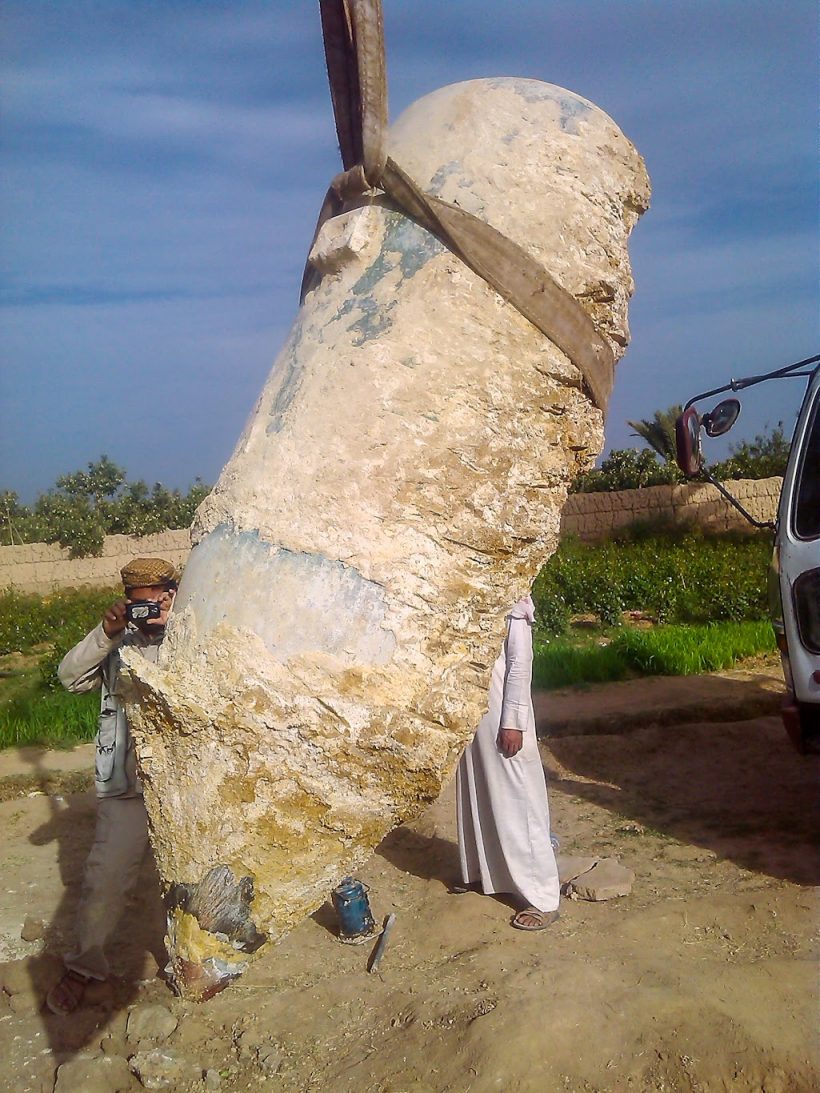
An unexploded bomb dropped by a Saudi warplane is recovered from a pomegranate farm in the Jamilah district in Sadaa. Courtesy | YEMAC
On Wednesday, the Houthis announced that their military operation – dubbed “God Overpowered Them” – was complete and that al-Jawf was free of Saudi occupation. According to Houthi sources, more than 1,200 Saudi-led coalition fighters were killed or injured during the operation and dozens of Saudi troops, including officers, were captured. The Houthis also struck deep into Saudi territory in retaliation for the more than 250 Saudi airstrikes that were carried out during the campaign. In multiple operations, ballistic missiles and drones were used to target facilities inside Saudi Arabia, according to officials.
Saudi losses haven’t been limited to al-Jawf either. Last week, Marib province, which lies adjacent to Yemen’s capital of Sana’a, was recaptured following heavy battles with Saudi forces. Local tribal fighters were able to clear strategic areas in the Sirwah District with the assistance of Houthi forces and take control of the town of Tabab Al-Bara and the strategic Tala Hamra hills that overlook Marib city. Both the Saudi-led coalition and its allied militants initially admitted defeat but later described their loss as a tactic withdrawal.
Marib is now the second Yemeni governorate adjacent to Saudi Arabia to fall under the control by Yemen’s resistance forces in the last month, al-Jawf being the first. Both provinces have strategic importance to Saudi Arabia and could serve as a potential launch point for operations into Saudi Arabia’s Najran province.
“Saudi [Arabia] and America have planted our land with death”
The highly populated urban areas of Sana’a, Sadaa, Hodeida, Hajjah, Marib, and al-Jawf have been subjected to incomprehensible bombing campaigns during the Saudi-led war on Yemen, which turns five on March 26. The sheer scale of that campaign, which often sees hundreds of separate airstrikes carried out every day, coupled with its indiscriminate nature, has left Yemen one of the most heavily contaminated countries in the world.
Since 2015, when the war began, coalition warplanes have conducted more than 250,000 airstrikes in Yemen, according to the Yemeni Army. 70 percent of those airstrikes have hit civilian targets. Thousands of tons of weapons, most often supplied by the United States, have been dropped on hospitals, schools, markets, mosques, farms, factories, bridges, and power and water treatment plants and have left unexploded ordnances scattered across densely populated areas.
A significant proportion of those ordnances are still embedded in the ground or amid the rubble of bombed-out buildings, posing a threat to both civilians and the environment. As Man’e Abu Rasein, a father who lost two sons to an unexploded cluster bomb in August of 2018 puts it: “Saudi [Arabia] and America have planted our land with death.” Abu Rasein’s sons, Rashid, ten, and Hussein, eight, were grazing their family’s herd of sheep in the village of al-Ghol north of Sadaa, far from any battlefield. They spotted an unusual looking object and like most curious young boys, picked it up to investigate. But the object they found was no toy, it was an unexploded cluster munition dropped by a Saudi jet. After hearing an explosion, the boys’ family went to investigate and found them lying dead, covered in blood.
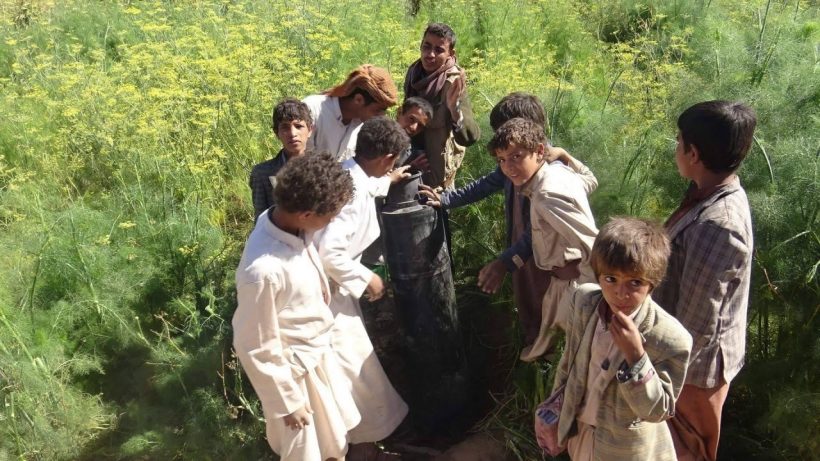
A group of children in Sahar district inspects a cluster bomb dropped by a Saudi warplane at a farm in Sadaa, March 18, 2019. Abdullah Azzi | MintPress News
Since March of 2015, Human Rights Watch has recorded more than 15 incidents involving six different types of cluster munitions in at least five of Yemen’s 21 governorates. According to the United Nations Development Program’s Emergency Mine Action Project, some of the heaviest mine and ERW (explosive remnants of war) contamination is reported in northern governorates bordering Saudi Arabia, southern coastal governorates and west-central governorates, all areas surrounding Houthi-dominated regions of Yemen. Since 2018 alone, the UNDP has cleared nearly 9,000 landmines and over 116,000 explosive remnants in Yemen.
From the Yemeni war of 1994 to the six wars in Sadaa, Yemenis have suffered several wars over the last three decades. Yet thanks to saturation of U.S. weapons, the ongoing war has brought death on a toll not seen in Yemen for hundreds of years. In Sadaa, the Saudi coalition has a significant legacy of unexploded ordinances, up to one million according to figures provided to MintPress by the Yemeni Executive Mine Action Center (YEMAC), an organization backed by the United Nations.
The Project Manager of YEMAC identified heavy cluster munition contamination in Saada, al-Jawf, Amran, Hodeida, Mawit, and Sanaa governorates, including in Sanaa city. Contamination was also reported in Marib. For the time being, YEMAC is the only organization working throughout the country during the ongoing war. Their teams are confronted with a very complex situation, disposing of both conventional munitions and bombs dropped from airplanes, including explosive remnants of war rockets, artillery shells, mortars, bombs, hand grenades, landmines, cluster bombs, and other sub-munitions and similar explosives.
Saudi Arabia’s toxic legacy
In addition to killing and injuring hundreds of civilians, American-made weapons have exposed Yemen’s people to highly toxic substances on a level not seen since the now-infamous use of radioactive depleted uranium by the United States in Fallujah, Iraq, which to this day is causing abnormally high rates of cancer and birth defects.
The hazardous chemicals from Saudi Coalition military waste, including radioactive materials, fuel hydrocarbons, and heavy metals, has already led to outbreaks of disease. Vehicles abandoned on battlefields, usually in various states of destruction, contain toxic substances including PCBs, CFCs, DU residue, heavy metals, unexploded ordnances, asbestos and mineral oils. Hundreds of these military scraps remain publicly accessible in Nihm, al-Jawf, Serwah, Marib and throughout Yemen.
Aside from the threat they pose to life and limb, unexploded ordnances contain toxic substances like RDX, TNT, and heavy metals which release significant levels of toxic substances into the air, soil and water. According to both the Ministry of Water and Environment and the Ministry of Health, which have undertaken environmental assessments on the impact of urban bombing, high levels of hazardous waste and air pollutants are already present in a populated areas.
Alongside the still unknown quantities of more conventional weapons remnants in Yemen, the waste from the cleanup of bombed-out buildings has been found to be especially contaminated with hazardous materials, including asbestos which is used in military applications for sound insulation, fireproofing and wiring among other things. Fires and heavy smoke billowing over heavily populated civilian areas following Saudi bombing runs also pose an imminent threat to human health. A common sight in many Yemeni cities since the war began, these thick clouds of toxic smoke sometimes linger for days and coat both surfaces and people’s lungs with hazardous toxins like PAHs, dioxins and furans, materials which have been shown to cause cancer, liver problems and birth defects.
Before the war began, most hazardous materials were trucked to Sanaa where they were separated and disposed of properly at the sprawling al-Azragein treatment plant south of the capital. But that plant was among the first targets destroyed by Saudi airstrikes after the war began. After it was bombed, puddles and heaps of toxic material were left to mix with rainwater and seep into surrounding areas. Yemeni researchers are still trying to grasp the scale of pollution from biohazardous chemicals at the site.
Although a comprehensive nationwide environmental assessment of the impact of urban bombing in Yemen has yet to be completed, high levels of hazardous waste and air pollutants have been recorded by many hospitals and environmental agencies. Some idea of the long-term effects can also be gleaned from studies carried out in areas where similar toxins have been used, particularly by the United States in Fallujah, Iraq and in Vietnam, where scientific assessments have shown increased cases of birth defects, cancer and other diseases, including in U.S. veterans.
In southern Yemen, where Saudi Arabia and the United Arab Emirates operate largely unchallenged, the coalition has been disposing of military waste in large trenches devoid of any measures to mitigate potential toxic fallout. Waste is dumped into large holes and either detonated or simply buried, inevitably contaminating soil and groundwater according to data from the UN Environment Program.
Yemen’s coastline hasn’t been immune either. The country’s General Authority for Environmental Protection said Wednesday that the Saudi-led coalition is dumping toxic and polluted waste on the shores of Yemen and in Yemeni regional waters, causing great damage to the marine environment, the deaths of fish and marine organisms, and in some cases, actually changing the color of the sea to a toxic green. The agency stated that in addition to dumping toxic waste, the coalition was allowing unsafe fishing practices such as marine dredging and the use of explosives by foreign ships, destroying the marine environment and coral reefs.
One hundred years to safety
Thousands of displaced Yemenis cannot fathom returning home due to the large number of explosives potentially hidden in and around their houses. Removing them all would require an end to the U.S.-backed war and economic blockade. Special equipment and armored machines such as armored excavators would need to be brought in, a slim prospect in a country unable to secure even the basic staples of life.

The remnants of a cluster bomb dropped by Saudi-led coalition warplanes inside a Yemeni home. March 18, 2020. Abdullah Azzi| MintPress News
Explosive remnants do not just impact lives and limbs, they prevent the use of potentially productive agricultural land and the rebuilding of important infrastructure. Like many border areas in Saada and Hajjah, fertile soil in al-Jawf and Marib has become so environmentally polluted since the war began that it could take decades to recover. Explosive remnants also prevent access to vital resources like water and firewood, cripples the movement of residents, including children traveling to school, and prevents aid from reaching those in need.
Even if the Saudi-led coalition were to stop the war immediately and lift the blockade, its legacy of indiscriminate bombing on such a massive scale will be felt for years to come. Due to the intensity of the bombing, experts at the United Nations Development Program’s Yemeni Executive Mine Action Center estimate that clearance could take at least 100 years in larger cities. Despite these dangers, desperate families with nowhere to go do not waste a lull in the barrage of Saudi airstrikes or a short-lived ceasefire to attempt to return home.
Ahmed AbdulKareem is a Yemeni journalist. He covers the war in Yemen for MintPress News as well as local Yemeni media.
Pompeo and Netanyahu paved a path to war with Iran, and they’re pushing Trump again
By Gareth Porter | The Grayzone | March 20, 2020
Though it narrowly averted war with Iran this January, the Trump administration is still pushing for all-out military conflict. The architects of the drive to war, Mike Pompeo and Benjamin Netanyahu, have relied on a series of cynical provocations to force Trump’s hand.
The US may escape the most recent conflict with Iran without war, however, a dangerous escalation is just over the horizon. And as before, the key factors driving the belligerence are not outraged Iraqi militia leaders or their allies in Iran, but Trump’s secretary of state, Mike Pompeo, and Israeli Prime Minister Benjamin Netanyahu, who has long sought to draw the US into a military confrontation with Iran.
Throughout the fall of 2019, Netanyahu ordered a series of Israeli strikes against Iranian allies in Iraq and against Lebanese Hezbollah units. He and Pompeo hoped the attacks would provoke a reaction from their targets that could provide a tripwire to outright war with Iran. As could have been expected, corporate US media missed the story, perhaps because it failed to reinforce the universally accepted narrative of a hyper-aggressive Iran emboldened by Trump’s failure to “deter” it following Iran’s shoot-down of a U.S. drone in June, and an alleged Iranian attack on Saudi oil facility in September.
Pompeo and John Bolton set the stage for the tripwire strategy in May 2019 with a statement by national security adviser John Bolton citing “troubling and escalatory indications and warnings,” implying an Iranian threat without providing concrete details. That vague language echoed a previous vow by Bolton that “any attack” by Iran or “proxy” forces “on United States interests or on those of our allies will be met with unrelenting force.”
Then came a campaign of leaks to major news outlet suggesting that Iran was planning attacks on U.S. military personnel. The day after Bolton’s statement, the Wall Street Journal reported that unnamed U.S. officials cited “U.S. intelligence” showing that Iran “drew up plans to target U.S. forces in Iraq and possibly Syria, to orchestrate attacks in the Bab el-Mandeb strait near Yemen through proxies and in the Persian Gulf with its own armed drones…”
The immediate aim of this campaign was to gain Trump’s approval for contingency plans for a possible war with Iran that included the option of sending as many as 120,000 U.S. troops into region. Trump balked at such war-planning, however, complaining privately that Bolton and Pompeo were pushing him into a war with Iran. Following Iran’s shoot-down of the U.S. drone over the Strait of Hormuz on June 20, Pompeo and Bolton suggested the option of killing Maj. Gen. Qassem Soleimani in retaliation. But Trump refused to sign off on the assassination of Iran’s top general unless Iran killed an American first, according to current and former officials.
From that point on, the provocation strategy was focused on trying to trigger an Iranian reaction that would involve a U.S. casualty. That’s when Israeli Prime Minister Benjamin Netanyahu interjected himself and his military as a central player in the drama. From July 19 through August 20, the Israeli army carried out five strikes against Iraqi militias allied with Iran, blowing up four weapons depots and killing as many Shiite militiamen and Iranian offcers, according to press accounts.
The Israeli bombing escalated on August 25, when two strikes on the brigade headquarters of a pro-Iranian militia and on a militia convoy killed the brigade commander and six other militiamen, and a drone strike on Hezbollah’s headquarters in south Beirut blew the windows out of one of Hezbollah’s media offices.
Netanyahu and Pompeo sabotage Trump and Macron’s attempt at diplomacy
Behind those strikes was Netanyahu’s sense of alarm over Trump toying with the idea of seeking negotiations with Iran. Netanyahu had likely learned about Trump’s moves toward detente from Pompeo, who had long been his primary contact in the administration. On August 26, French President Emanuel Macron revealed that he was working to broker a Trump-Rouhani meeting. Netanyahu grumbled about the prospect of U.S.-Iranian talks “several times” with his security cabinet the day before launching the strikes.
Two retired senior Israeli generals, Gen. Amos Yadlin and Gen. Assaf Oron, criticized those strikes for increasing the likelihood of harsh retaliation by Iran or one of its regional partners. The generals complained that Netanyahu’s attacks were “designed to prod [Iran] into a hasty response” and thus end Trump’s flirtation with talking to Iran. That much was obviously true, but Pompeo and Netanyahu also knew that provoking an attack by Iran or one of its allies might cause one or more of the American casualties they sought. And once American blood was spilled, Trump would have no means to resist authorizing a major escalation.
Kataib Hezbollah and other pro-Iran Iraqi militias blamed the United States for the wave of lethal Israeli attacks on their fighters. These militias responded in September by launching a series of rocket attacks on Iraqi government bases where U.S. troops were present. They also struck targets in the vicinity of the U.S. Embassy.
The problem for Netanyahu and Pompeo, however, was that none of those strikes killed an American. What’s more, U.S. intelligence officials knew from NSA monitoring of communications between the IRGC and the militias that Iran had explicitly forbidden direct attacks on US personnel.
Netanyahu was growing impatient. For several days in late October and early November, he met with his national security cabinet to discuss a new Israeli attack to precipitate a possible war with Iran, according to reports by former Israeli Ambassador Michael Oren. Oren hinted at how a war with Iran might start. ‘[P]erhaps Israel miscalculates,” he suggested, “hitting a particularly sensitive target,” which, in his view, could spark “a big war between Israel and Iran.”
But on December 27, before Netanyahu could put such a strategy into action, the situation changed dramatically. A barrage of rockets slammed into an Iraqi base near Kirkuk where U.S. military personnel were stationed, killing a U.S military contractor. Suddenly, Pompeo had the opening he needed. At a meeting the following day, Pompeo led Trump to believe that Iranian “proxies” had attacked the base, and pressed him to “reestablish deterrence” with Iran by carrying out a military response.
In fact, U.S. and Iraqi officials on the spot had reached no such conclusion, and the investigation led by the head of intelligence for the Iraqi federal police at the base was just beginning that same day. But Pompeo and his allies, Defense Secretary Mark Esper and Chairman of Joint Chiefs Gen. Mark A Milley, were not interested in waiting for its conclusion.
A deception brings the US and Iran to the brink of war
The results of a subsequent Iraqi investigation revealed that the rocket barrage had been launched from a Sunni area of Kirkuk with a strong Islamic State presence, and that IS fighters had carried out three attacks not far from the base on Iraqi forces stationed there in the previous ten days. US signals intercepts found no evidence that Iraqi militias had shifted from their policy of avoiding American casualties at all cost.
Kept in the dark by Pompeo about these crucial facts, Trump agreed to launch five airstrikes against Kataib Hezbollah and another pro-Iran militia at five locations in Iraq and Syria that killed 25 militiamen and wounded 51. He may have also agreed in principle to the killing of Soleimani when the opportunity presented itself.
Iran responded to the attacks on its Iraqi militia allies by approving a violent protest at the U.S. Embassy in Baghdad January 31. The demonstrators did not penetrate the embassy building itself and were abruptly halted the same day. But Pompeo managed to persuade Trump to authorize the assassination of Qassem Soleimani, Iran’s second most powerful figure, presumably by hammering on the theme of “reestablishing deterrence” with Iran.
Soleimani was not only the second most powerful man in Iran and the main figure in its foreign policy; he was idolized by millions of the most strongly nationalist citizens of the country. Killing him in a drone strike was an open invitation to the military confrontation Netanyahu and Pompeo so desperately sought.
During the crucial week from December 28 through January 4, while Pompeo was pressing Trump to retaliate against Iran not just once but twice, it was clear that he was coordinating closely with Netanyahu. During that single week, he spoke by phone with Netanyahu on three separate occasions.
What Pompeo and Netanyahu could not have anticipated was that Iran’s missile attack on the U.S. sector of Iraq’s sprawling al-Asad airbase in retaliation would be so precise that it scored direct hits on six U.S. targets without killing a single American. (The US service members were saved in part because the rockets were fired after the Iraqi government had passed on a warning from Iran to prepare for it). Because no American was killed in the strike, Trump again decided against further retaliation.
Towards another provocation
Although Pompeo and Netanyahu failed to ignite a military conflict with Iran, there is good reason to believe that they will try again before both are forced to leave their positions or power.
In an article for the Atlantic last November, former Israeli Ambassador Michael Oren, channeled Netanyahu when he declared it would be “better for conflict [with Iran] to occur during the current [Trump] administration, which can be counted on to provide Israel with the three sources of American assistance it traditionally receives in wartime,” than to “wait until later.”
Oren was not the only Israeli official to suggest that Israeli is likely to go even further in strikes against Iranian and Iranian allies targets in 2020. After listening to Israeli army Chief of Staff Aviv Kochavi speak in late December, Haaretz military correspondent Amos Harel reported that the Israeli army chief conveyed the clear impression that a “more serious confrontation with Iran in the coming year as an almost unquestionable necessity.” His interviews with Israeli military and political figures further indicated that Israel would “intensity its efforts to hit Iran in the northern area.”
Shockingly, Pompeo has exploited the Coronavirus pandemic to impose even harsher sanctions on Iran while intimidating foreign businesses to prevent urgently needed medical supplies from entering the country. The approaching presidential election gives both Pompeo and Netanyahu a powerful reason to plot another strike, or a series of strikes aimed at drawing the US into a potential Israeli confrontation with Iran.
Activists and members of Congress concerned about keeping the US out of war with Iran must be acutely aware of the danger and ready to respond decisively when the provocation occurs.
‘Utter contempt for human life’: Iranian FM Zarif slams US for hitting Tehran with new sanctions amid Covid-19 crisis
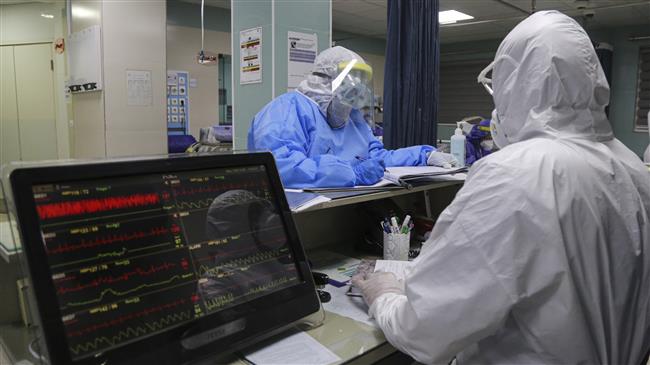
RT | March 20, 2020
Iranian foreign minister Javad Zarif accused the US of taking its policy of “maximum pressure” on Tehran to a “new level of inhumanity” by imposing new sanctions on Iran as it struggles to cope with a huge surge of Covid-19 cases.
Zarif tweeted on Friday that The Trump administration was “gleefully” taking pride in “killing Iranian citizens” on Nowruz, the Persian New Year, celebrated on March 20 this year. He said US policy betrayed an “utter contempt for human life.”
His rebuke comes shortly after the US blacklisted five companies based in the United Arab Emirates for trading in Iranian petrochemicals. Three companies in China, three in Hong Kong and one in South Africa were also added to the list this week, as Washington attempts to choke off Tehran’s oil revenues.
“Washington’s increased pressure against Iran is a crime against humanity… all the world should help each other to overcome this disease,” Reuters quoted an Iranian official as saying on Friday.
“Our policy of maximum pressure on the regime continues,” US special representative for Iran Brian Hook told reporters, even though Iran is the worst-hit country in the Middle East by the Covid-19 coronavirus outbreak and may face economic catastrophe as a result.
Secretary of State Mike Pompeo said on Friday that the US has imposed “no sanctions” on medication or humanitarian assistance going into Iran. However, US financial sanctions have in effect prevented Tehran from buying the necessary supplies, while shipping sanctions have interfered with humanitarian deliveries.
China has called on the US to offer sanctions relief to Iran, with the Ministry for Foreign Affairs in Beijing tweeting on Wednesday that the policy was “against humanitarianism and hampers Iran’s epidemic response,” as well as deliveries of aid by the UN and other organizations.
Iran has seen at least 1,400 deaths from Covid-19 so far, with more than 19,000 confirmed cases. A health ministry spokesperson said on Wednesday that one person in Iran was now dying “every 10 minutes” from the virus, with 50 new infections every hour.
US urged to explain military lab shutdown
By Leng Shumei – Global Times – 2020/3/15
Netizens and experts are calling for the US government to release information on the suspension of an infectious disease research lab under the US Army, as a petition on the White House website listed coincident events between the closure and the outbreak of COVID-19, urging the US government to clarify whether the lab was related to the deadly virus.
While the origin of the novel coronavirus is still unknown and conspiracy theories have caused widespread panic, experts said that timely information disclosure to the public would benefit global unity and cooperation against the pandemic, which had infected more than 150,000 people and killed 5,400 around the world as of Saturday.
The Fort Detrick laboratory that handles high-level disease-causing material, such as Ebola, in Fredrick, Maryland was shut after the US Centers for Disease Control and Prevention issued a cease and desist order to the organization in July, 2019 according to local media.
The suspension was due to multiple causes, including failure to follow local procedures and a lack of periodic recertification training for workers in the biocontainment laboratories. The wastewater decontamination system of the lab also failed to meet standards set by the Federal Select Agent Program, media reported.
The lab, which was closed more than half a year ago, recently caught public attention as a petition submitted to the White House website on March 10 listed some coincidences in time between the closure and the COVID-19 outbreak.
For example, “a large-scale ‘influenza’ killed more than 10,000 people” in the US in August 2019 following the closure; and the COVID-19 epidemic broke out globally in February 2020 after the US organized Event 201 – A Global Pandemic Exercise – in October 2019.
The petition also noted that many English-language news reports about the closure of Fort Detrick were deleted amid the worsening COVID-19 pandemic, raising suspicions over the lab’s relationship with the novel coronavirus.
Petitioners urged the US government to publish the real reason for the lab’s closure and to clarify whether the lab was related to the novel coronavirus and whether there was a virus leak.
The petition had received just more than 400 signatures as of Sunday.
Chinese netizens urged the US government to respond to the public’s appeals as soon as possible.
“It’s not a small issue, the truth should be published,” an internet user commented.
“The world deserves to know the truth,” said another.
Ni Feng, a deputy director of the Institute of American Studies of the Chinese Academy of Social Sciences, called on the US government to increase transparency in the COVID-19 pandemic related issues in response to wide-spread doubts.
The origin of the virus should be decided according to scientific research, but the urgent issue at the current stage is to cooperate in the global battle against the pandemic, Ni noted.
Wang Yiwei, a professor with the School of International Relations at Renmin University of China, agreed with Ni, noting that the US had behaved badly to China when the latter was struggling with the epidemic – accusing China of low transparency and blaming a Chinese lab for leaking the virus.
Now China has won the conviction of the world with practical efforts and improvements. The US should cooperate sincerely with China and the world against the virus, according to Wang.
Asleep at the wheel: Why didn’t Western politicians act quicker on Covid-19 spread?
By Neil Clark | RT | March 19, 2020
Western countries are in lockdown due to Covid-19, but if leaders, their advisers, and the political class in general had paid attention to what was going on in China at the turn of the year, the crisis might have been averted.
Imagine you’re a passenger on a ship. You’d expect, wouldn’t you, that the captain and his officers keep a very good look-out for dangers ahead? You’d expect them to have up-to-date weather information. You’d expect them to take corrective action before the ship hit an iceberg.
The sad truth – for Western citizens, the passengers of the ship – is that those whose job it was to watch out for gathering storms have let us down very badly.
The chronology is most important.
According to the South China Morning Post, the first case of someone suffering from what later came to be known as Covid-19 occurred in China on November 17. The number of cases grew in December, (the majority linked to the Huanan Seafood Market), but we didn’t know internationally what was going on until news began to come out that Wuhan had been hit by a new virus in very late December/early January. The Chinese informed the World Health Organization of new pneumonia cases of unknown etiology on December 31.
The Chinese delay in flagging up what was happening in Wuhan absolutely didn’t help, but there was still time – about a two-week window – for other countries to act.
As reported in the BMJ, on January 11 and 12, the Chinese authorities shared the virus’ genetic sequence for countries to use in “developing specific diagnostic kits.” 440 deaths had been confirmed by January 21. By the 22nd, seven cases had been confirmed OUTSIDE China, including one in the US. All were travelers from Wuhan.
That surely should have got alarm bells ringing in Western capitals, especially as Chinese New Year on January 25 was coming up. Western leaders, and their advisers, would surely know that many Chinese workers based in the West would return home to celebrate, greatly increasing the risk that the virus would be brought back to Europe and North America.
On January 22, the UK government announced that health teams would meet the three direct flights a week from Wuhan, China, the epicenter of the virus. At the same time, the risk level was raised from ‘very low’ to ‘low’. But as Neil Ferguson, director of the MRC Centre for Global Infectious Disease Analysis at Imperial College, London, pointed out, flight screening was no panacea.
“This measure will only identify people who have symptoms as they come off the plane. If someone was infected two days before they travelled, they will arrive without any symptoms at all.” He added, and I emphasize in bold: “It’s essential that the entire health system is alert to the possibility that there will be cases here.”
Lo and behold, the first British case was confirmed nine days later, on January 31, 2020, from Chinese nationals staying at a hotel in York. That very same day, the first cases were also confirmed in Italy. Guess what: they were two Chinese tourists in Rome. Italy is now the world’s number one coronavirus ‘hotspot’. Nearly 3,000 have died there and 60mn people are in quarantine.
Wouldn’t it have been better, if instead of ineffective flight screening, all flights to Western countries from China had been stopped in January – and all travelers who had recently visited China been quarantined? France, by the way, got its first three cases on January 24 (a week before Italy and the UK). All three people had just come back from China. You don’t have to be Sherlock Holmes to see the pattern, do you?
In the New Year, the number one priority of Western politicians should have been the new coronavirus and how best to protect their own populations from it. But their minds were clearly on other things.
Trump – egged on by Washington’s Endless War Lobby – was engaged in an utterly reckless escalation of tensions with Iran. While Covid-19 was spreading in China, the New Year began with the assassination of General Soleimani, a man who had been fighting ISIS, but who was now portrayed as the ‘worst terrorist in the world’. The ‘Iran crisis’ dominated the news cycle. Boris Johnson meanwhile began the year on holiday with his girlfriend in Mustique. The opposition Labour Party were focusing on a leadership election which needn’t have taken place for several months. Three of the four candidates declared on television on February 13 – a day after the UN had activated its WHO-led Crisis Management team to deal with a rapidly escalating problem –that their ‘number one priority’ was… tackling ‘anti-Semitism’ in the Labour Party. Yet after all the brouhaha about anti-Semitism being ‘rife’ in Labour, it was reported at the end of February that the police had ended up charging just one person, a former Labour member.
One person, that is, out of a membership of half a million.
It seemed in February that no one in the political class was very interested in Covid-19.
This is despite the publication in the leading medical journal The Lancet on January 24 of a report entitled ‘A novel coronavirus outbreak of global concern’.
Covid-19 only began to be taken with the seriousness it warranted when it was already too late to try and stop its entry.
By not acting in time to restrict travel to and from China – and later from other ‘hotspots’ like northern Italy and Madrid, Spain, the governments instead waited and waited, until the measures they did take were far more draconian that might otherwise have been the case. It’s true that Trump did bar foreigners who had recently visited China from entering the US on January 31, but as David Leonhardt pointed out in the New York Times, it was “not the sweeping solution that Trump portrayed it to be.”
The costs to the economies of the various lockdowns are incalculable. People’s livelihoods are going to be destroyed. Entire industries are threatened. Don’t forget lockdowns and ‘social distancing’ can actually cause deaths too. As John Pilger pointed out on Twitter, a 2012 study showed that isolation killed the elderly, but isolate is what they’re now being told to do.
We’re in a right old state at the moment, but how much of this could have been avoided if instead of dozing off, or looking elsewhere, those whose job it was to protect us had acted quickly, at the proper time?
COVID-19: All Truth Has Three Stages
By Larry Romanoff | Global Research | March 19, 2020
First, it is ignored.
Second, it is widely ridiculed.
Third, it is accepted as self-evident.
With COVID-19, we have now entered Stage 2. At first, the media ignored the claims and the analysis that the virus could have originated in the US. But the spread of information and restatements of evidence from all sides, including in the US itself, has become too intense and now the claims are being openly ridiculed in the Western media.
Briefly, Chinese virologists discovered conclusively that the original source of the virus was not China, nor Wuhan, nor the seafood market, but had been traced to the US, a possible scenario being that the virus might have originated at the US Military’s bio-weapons lab at Fort Detrick (which was shut down by the CDC in July, because of outbreaks), and brought to China during the World Military Games in October 2019.
Also, Japanese and Taiwanese virologists arrived independently at the conclusion that the virus could have originated in the US.
The Americans did their best from before the beginning to deflect culpability by crafting tales of bats, snakes, pangolins, the seafood market, the Wuhan University being a bio-weapons facility (which it is not), and the CIA tale leaked through the VOA and Radio Free Asia that the virus leaked from that university. They stated (factually) that Chinese researchers had participated (7 years ago) in similar virus research funded by the US NIH, thus somehow insinuating Chinese culpability, ignoring that the prior research was irrelevant to current events.
I must say the Americans have proven to be very skillful in grabbing the microphone first, to create an “official” narrative of a current event while flooding the media with sufficient finger-pointing to preclude a gullible public the time to logically assemble the pieces on their own.
They ignored the very real fact that few nations would either create or release a biological weapon that attacks primarily itself. They ignored too, the geopolitical likelihood of an ”end game” – that a virus is a powerful weapon of economic warfare, able to do to China’s economy what a trade war could not do.
Casual readers tend to ignore the fact that, in the American mentality, there are many solid geopolitical reasons to attack China, Iran, and Italy, the remaining countries merely constituting unfortunate collateral damage.
Many virus articles containing this and similar information had been published by second-tier internet news sites, some articles gaining enormous readership with hundreds of thousands of downloads and much re-posting. Many of these articles have been translated into 6 or 7 languages and published on websites all around the world. Simultaneously, many posts were made on Chinese social media speculating on the odd circumstances and long chain of unusual coincidences that led to the virus outbreak in Wuhan.
One of the articles referred to above, was translated and posted on Chinese social media and gathered 76,000 comments in the first 8 hours. Eventually, the major Chinese media outlets made the same claims – that the virus could have originated in the US and that the Americans were engaging in a massive cover-up.
Then, Zhao LiJian, a spokesman for China’s Foreign Ministry, made the story official, through a number of posts on US social media. One major media article, this in the NYT, noted that “Zhao’s remarks were spread on China’s most prominent social media platform, Weibo . . . [and] had been viewed more than 160 million times, along with screenshots of the original Twitter posts.
It seems LiJian’s Twitter posts, being essentially an official source that could not easily be ignored, claiming the virus was brought to China from the US during the Military Games, and demanding an explanation from the US, were receiving too much public attention to be ignored. All of the above created sufficient political pressure to force the Western media to respond. And of course they responded by ignoring the facts of the message and trashing the messenger.
On March 12, the UK Guardian ran a story claiming China was “pushing propaganda” about the virus coming from the US. (1) On March 13, the New York Times ran a similar story of a “China coronavirus conspiracy” of false claims about the source of the virus. (2) Then, on March 14, ABC News ran a story titled “False claims about sources of coronavirus cause spat between the US, China”, in which it ridiculed China and the claims of a US-virus. (3)
The Seattle Times published a version of the story, stating, “China is pushing a new theory about the origins of the coronavirus: It is an American disease . . . introduced by members of the U.S. Army who visited Wuhan in October. There is not a shred of evidence to support that, but the notion received an official endorsement from China’s Ministry of Foreign Affairs, whose spokesman accused American officials of not coming clean about what they know about the disease.” (4) The UK Independent published their own version of “China’s conspiracy theory” (5), as did CNN (6).
The ABC article claimed that “Assistant Secretary David Stilwell gave [Chinese] Ambassador Cui Tiankai a “very stern representation of the facts,” claiming Cui was “very defensive” in the face of this “official” American assault. The US State Department is quoted as having said, “We wanted to put the [Chinese] government on notice we won’t tolerate [conspiracy theories] for the good of the Chinese people and the world.”
Following that, the Washington Post, Bloomberg, and half a dozen other press wires and media outlets have contacted this author for interviews, eager for an opportunity to trash this ‘conspiracy theory’ at its source. The US Embassy in Beijing also “reached out” to the author “to talk about it”.
If the public information campaign and the resulting political pressure can continue, we will eventually enter stage three where the media will begin admitting first the possibility, then the likelihood, then the fact, of the US being the source of the “China” virus.
***
Larry Romanoff is a retired management consultant and businessman. He has held senior executive positions in international consulting firms, and owned an international import-export business. He has been a visiting professor at Shanghai’s Fudan University, presenting case studies in international affairs to senior EMBA classes. Mr. Romanoff lives in Shanghai and is currently writing a series of ten books generally related to China and the West. He can be contacted at: 2186604556@qq.com. He is a frequent contributor to Global Research.
Notes
(2) https://www.nytimes.com/2020/03/13/world/asia/coronavirus-china-conspiracy-theory.html
(3) https://abcnews.go.com/Politics/false-claims-sources-coronavirus-spat-us-china/story?id=69580990
(4) https://www.seattletimes.com/nation-world/china-spins-tale-that-the-u-s-army-started-the-coronavirus-epidemic/
https://www.ccn.com/did-coronavirus-originate-in-america-chinese-media-pushes-conspiracy/
(6) https://www.ccn.com/did-coronavirus-originate-in-america-chinese-media-pushes-conspiracy/
Copyright © Larry Romanoff, Global Research, 2020
Featured Video

John Mearsheimer: New World Order Arrived & Europe Is Left Behind
or go to
Aletho News Archives – Video-Images
Book Review
Sunset on Net Zero: A Heretic’s Guide to the Futile CO2 Target
By Ronald Paul Barmby (Author) – October 3, 2025
SUNSET ON NET ZERO describes in detail why Net Zero CO2 is pointless and unachievable. It explains in understandable terms the up-to- date thoughts of the greatest minds of today in physics, meteorology, economics, engineering, and the geosciences.
Net Zero CO2 is pointless because we have now confirmed by satellites that 90% of CO2 warming has already happened. CO2 is not an existential threat but clouds, El-Niño, and human habitation are significant drivers of global warming that are often ignored.
Net Zero CO2 is unachievable because the green technology alternatives are unreliable and unaffordable. Wind and solar power triple electricity costs, building fully electric vehicles produces at least one-half of CO2 emissions they are meant to avoid, and heat pumps will leave you dangerously cold in the winter. Green hydrogen, air capture CO2, and carbon capture and storage are prescriptions for national bankruptcy. The supply of key metals and minerals required to achieve Net Zero need to be at least doubled—some much more—and are often controlled by a very few. Net Zero comes with huge environmental and agricultural costs.
We have been through similar climatic temperature changes before, more recently than you think. Our efforts to control it are futile.
Blog Roll
 Aletho News
- Britain’s shadow security network expands into south Lebanon
- The ADL Has a Foreign Policy, and You Are Not Supposed to See It
- Former Qatari PM says ‘Israel’ has security ties with all Gulf states
- The Sound of Silence in the Strait of Hormuz
- Poland’s call for a no-fly zone in Ukraine means NATO direct war with Russia
- John Mearsheimer: New World Order Arrived & Europe Is Left Behind
- Naqab demolition notices top 1,000; settlers demolish Jaloud homes
- Israel is Using the ‘Gaza Ceasefire’ to Commit Ethnic Cleansing
- West’s ‘wrong expectations’ prolonged the Ukraine conflict – leader of top German party
- Israel kills three civilian officials in three days as Netanyahu widens Gaza assassination policy
- If Americans Knew
- An error has occurred; the feed is probably down. Try again later.
- No Tricks Zone
- Physicists: Doubling CO2 Has A Smaller Impact On Ocean ‘Acidification’ Than Existing Internal Variability
- Alarmist Climatologists In Shock! 2026 Atlantic Hurricane Season Sees Lowest Count In 101 Years
- New Study: Modern Temps Are Among The Coldest Of The Last 10,000 Years In East Central Europe
- Germany’s Renewable Energies Lead to 1.4 Billion Euro Electric Power Trade Deficit
- Argentina’s Perito Moreno Glacier Joins Antarctica and Arctic In Defying Doomsday Melt Claims
- New Study: Barents Sea Temperatures Were Warmer And Sea Ice Less Extensive In The 1700s Than Today
- German Authorities Start Initiative To Evaluate Public Register For Climate “Disinformation” Spreaders!
- Zonal Asymmetry of Temperature Change in the Antarctic Circumpolar Current
- New Study: The Net Fossil Fuel Contribution To Rising Atmospheric CO2 Has Been Zero For 500 Years
- Germany’s Green Energy Transition Becoming Increasingly Expensive…Another 6 Trillion Euros!

