Hung jury results in mistrial for former CIA tech accused of handing ‘Vault 7’ docs to WikiLeaks
Assange trial rehearsal?
RT | March 10, 2020
Federal prosecutors were unable to convince a jury on any of the spying-related charges against an ex-CIA engineer accused of stealing reams of classified material – in what may be a dry run for the case against Julian Assange.
In a significant blow to prosecutors on Monday, jurors failed to come to a verdict on eight central counts against former CIA software engineer Joshua Schulte, who was charged for stealing thousands of pages of classified information on the agency’s secret hacking tools and passing them to WikiLeaks – what later became its ‘Vault7’ release, the largest breach of classified material in CIA history.
While Schulte was found guilty of contempt of court and making false statements to investigators, a hung jury on the remaining eight charges – including illegal gathering and transmission of national defense information – prompted District Judge Paul Crotty to order a mistrial and dismiss the jurors on the case, who had deemed themselves “extremely deadlocked” in a note to the judge.
The split verdict came after nearly a full week of messy deliberations, which saw one juror removed for researching the facts of the case against Crotty’s orders. She was never replaced, however, leaving a short-handed panel to deliver a final decision.
The former technician left his job in the CIA’s Langley headquarters in 2016 and was charged some two years later for his alleged role in the Vault 7 leak. But prosecutors had difficulty tying Schulte to the disclosure throughout his four-week trial, with jurors often mystified by a complicated maze of technical evidence.
The case may offer parallels to that of WikiLeaks co-founder Julian Assange, who faces 17 charges under the World War I-era Espionage Act and up to 175 years in prison over his role in the publication of the Iraq and Afghan war logs in 2010. Assange is accused of helping leaker Chelsea Manning (then known as Bradley) “hack” into military computers to obtain classified material, but if extradited from the UK to stand trial in an American courtroom, prosecutors would likely produce similar technical forensics to prove his involvement, precisely what the government was unable to do in Schulte’s case.
Arguing that the CIA’s computer network had widely known vulnerabilities, including poor password protections, Schulte’s defense insisted prosecutors had failed to prove his role in the breach. They noted it was possible another actor gained access to his work station, pointing to another CIA employee identified only as “Michael” as a potential culprit.
The CIA later placed the employee on administrative leave for refusing to cooperate with the investigation, which suggested the government had “doubt about the case against Mr. Schulte,” defense attorney Sabrina Shroff said in her closing argument on Monday.
Prosecutors are likely to demand a retrial for Schulte, and he still stands accused of possessing child pornography, allegedly stored on devices found during a search of his home. He will be tried separately on those charges, facing a total of 15 counts.
Joe Biden: Father of the Drug War’s Asset Forfeiture Program
By Chris Calton – Mises Institute – 03/06/2020
In 1991, Maui police officers showed up at the home of Frances and Joseph Lopes. One officer showed his badge and said, “Let’s go into the house, and we will explain things to you.” Once he was inside, the explanation was simple: “We’re taking the house.”
The Lopses were far from wealthy. They worked on a sugar plantation for nearly fifty years, living in camp housing, to save up enough money to buy a modest, middle-class home. But in 1987, their son Thomas was caught with marijuana. He was twenty-eight, and he suffered from mental health issues. He grew the marijuana in the backyard of his parents’ home, but every time they tried to cut it down, Thomas threatened suicide. When he was arrested, he pled guilty, was given probation since it was his first offense, and he was ordered to see a psychologist once a week. Frances and Joseph were elated. Their son got better, he stopped smoking marijuana, and the episode was behind them.
But when the police showed up and told them that their house was being seized, they learned that the episode was not behind them. That statute of limitations for civil asset forfeiture was five years. It had only been four. Legally, the police could seize any property connected to the marijuana plant from 1987. They had resurrected the Lopes case during a department-wide search through old cases looking for property they could legally confiscate.
Asset forfeiture laws once applied only to goods that could be considered a danger to society—illegal alcohol, weapons, etc. But with the birth of the modern war on drugs, lawmakers pushed for something with more teeth, which they achieved with the 1970 passage of the Racketeering Influence and Corrupt Organizations (RICO) Act. Although many are familiar with the story of the steady expansion of civil asset forfeiture laws, many overlook the fact that presidential candidate Joe Biden helped put these laws on previously apathetic law enforcement agents’ radar and, worse, played a significant role in broadening their application. Biden has effectively aided and abetted the police state’s sustained assault on American subjects’ property rights.
Expanding Asset Forfeiture, Phase I: The RICO Act of 1970
In 1970, the targets of asset forfeiture were wealthy crime bosses. It was prosecutor G. Robert Blakey, who had worked under Attorney General Robert Kennedy and various congressmen, who set about broadening its scope. He helped draft a bill for a new legal concept, “criminal forfeiture,” which would allow police to seize the illegally acquired profits of a convicted criminal.
The assets that could be seized would now consist of anything that was funded with money connected to criminal activity. To appease those who were worried about abuses of power, Blakey assured them that prosecutors would have to prove beyond a reasonable doubt that the criminal was guilty of a crime before the assets could be seized. There was nothing to worry about; only legitimate bad guys would suffer.
The new policy was passed as part of the Racketeering Influence and Corrupt Organizations (RICO) Act in 1970. Blakey was a fan of the 1931 movie Little Caesar, and the acronym was crafted to honor Blakey’s favorite character from the movie, the gangster Rico Bandello.
The RICO Act wasn’t designed to be part of the war on drugs; it was just meant to target criminals. But when Richard Nixon took office, the RICO Act was one of a number of new tools that the members of his newly created Bureau of Narcotics and Dangerous Drugs (precursor to the Drug Enforcement Administration (DEA)) could use to fight his drug war. Combined with other legal innovations, such as no-knock raids and mandatory minimum sentences, Nixon and his administration would cure America of the drug menace.
Still, the pesky “conviction” requirement stood in the way of law enforcement’s ability to seize criminal assets. In 1978, Jimmy Carter’s director of the Office of Drug Abuse (the title “drug czar” is often retroactively applied), Peter Bourne, decided that the law needed to be changed. Bourne learned of an incident at the Miami International Airport in which a suitcase had been left on the baggage carousel for three hours before police picked it up and found $3 million inside. If drug kingpins could afford to abandon so much money, they must be flush with enough cash to hardly worry about criminal forfeiture laws.
So, at Bourne’s urging, Congress modified the RICO Act to allow the DEA to confiscate assets without a conviction. The burden of proof wasn’t entirely gone (yet), but the government only needed an indictment, rather than a full conviction, to justify asset seizure. After all, the government knew who a lot of these kingpins were, but the criminals continued to get rich while the DEA struggled to build cases against them.
Even then, though, real estate was off limits. Asset forfeiture had evolved from the seizure of dangerous items into criminal profit following a conviction, and now into criminal profit (and its “derivative proceeds”) without the conviction requirement. But real estate—such as the Lopes house—still couldn’t be touched.
But through the 1970s, the RICO Act was still largely ignored by prosecutors. Blakey was holding seminars out of Cornell University, which were attended by federal law enforcement agents and prosecutors, urging them to take advantage of the RICO Act in the war on drugs. He made few inroads. The law was unwieldy, and prosecutors were overworked. More often than not, it wasn’t worth their time. While Blakey was proselytizing the virtues of his law to little effect, he was unwittingly gaining an ally in Congress: Senator Joe Biden.
Expanding Asset Seizure, Phase 2: Biden and the Comprehensive Crime Control Act of 1984
Biden, a young Senator from Delaware, had to do something to show that despite his “liberal” reputation, he could be just as tough on crime as his Republican colleagues. He took notice of the RICO Act, and he realized that law enforcement agencies were not taking advantage of it, particularly in waging the drug war. He turned to the General Accounting Office and asked them to produce a study on the potential uses of RICO for drug enforcement.
The report showed that the RICO Act granted enormous powers to police to confiscate drug-related assets but that these powers were not being taken advantage of: “The government has simply not exercised the kind of leadership and management necessary to make asset forfeiture a widely used law enforcement technique,” the report stated. By the time the report came in, Ronald Reagan was settling into office and getting ready to renew the war on drugs.
Reagan brought the FBI into the drug war, and he gave the director, William Webster, a mission. His agents would use the powers of the RICO Act to find drug rings and take away their assets. Drug cartels must be rendered unprofitable. As the 1980s progressed, the war on drugs would be the country’s biggest political issue. Politicians from both parties would work to show that they could out–drug warrior their opponents. One Democratic representative from Florida, Earl Hutto, said, “In the war on narcotics, we have met the enemy, and he is the U.S. Code.”
Biden brought the RICO law to the attention of the federal government, Reagan enlisted the FBI to use it against drug traffickers, and both parties would now work to dismantle any limitations that the law might still impose.
The drug war became a contest of political one-upmanship. Reagan’s Justice Department fought for all kinds of new powers. Attorney General Edwin Meese and Assistant Attorney General William Weld (yes, that Bill Weld) railed against the limitations on their legal prerogative. Weld went so far as to argue in favor of the legality of using the Air Force to shoot suspected drug-smuggling planes out of the sky, a policy that even his boss was unwilling to endorse.
But Meese, Weld, and everyone else seemed to agree that forfeiture laws didn’t go nearly far enough. By requiring an indictment, the government still had to meet some standard of reasonable guilt before seizing property, which allowed far too many criminals that law enforcement knew to be guilty (but couldn’t build a case against) to keep their ill-gotten gains. To take things further, the Justice Department argued that law enforcement should be allowed to take “substitute” property: they knew that they wouldn’t be able to take everything that had been paid for with drug money, so it stood to reason that they should be able to take legally acquired assets of equal value (however that might be determined). And finally, with real estate off limits, the government was unable to seize marijuana farms, drug warehouses, and criminal homes.
The Comprehensive Forfeiture Act fixed all of these problems. Biden introduced the new bill in 1983, and its provisions became law the next year. Under this law federal agents had nearly unlimited powers to seize assets from private citizens. Now the government only needed to find a way to let local and state police join the party.
Biden’s bill was passed as part of the 1984 Comprehensive Crime Control Act. In addition to a slew of new powers for prosecutors, the burden of proof for asset seizure was lowered once again (agents had to only believe that what they were seizing was equal in value to money believed to have been purchased from drug sales). More significantly, the bill started the “equitable sharing” program that allowed local and state law enforcement to retain up to 80 percent of the spoils.
The law took effect in 1986, the year before Thomas Lopes pled guilty to charges of growing a marijuana plant in his parents’ backyard. In 1987, when Thomas faced the judge, the government had just made it so that his local police had an enormous incentive and unchecked authority to seize property from private citizens, so long as they could show any flimsy connection to drugs. By 1991, the Maui police were running out of easily seized property, so they started combing through case files within the five-year limit to find new sources of enrichment for their precinct using the expanded RICO powers. One such file brought the Lopes home to their attention.
But the Lopeses are only one example out of millions. In the year their home was confiscated by police for a minor, four-year-old drug charge, $644 million in assets were seized. In 2018 alone, the Treasury Department’s Forfeiture Fund saw nearly $1.4 billion in deposits . The Lopes story merely illustrates that criminals (regardless of how one might feel about drug laws) are hardly the only people falling victim to this policy.
The decades-long abuse of this policy has reached such extreme proportions that people on all sides of the political aisle have been turning against it. At this writing (February 20, 2019 for the original version of this article), the Supreme Court has unanimously voted in favor of Tyson Timbs , whose $42,000 Land Rover was seized in 2015 following a conviction for selling $400 in heroin. The court is asserting that asset forfeiture constitutes a fine and that the Eighth Amendment—which protects citizens from excessive fines—applies to both state and local governments. The consequences of the ruling remain to be seen, but it seems nearly certain that the unanimous decision was motivated by the increasing outrage against the civil asset forfeiture policies.
In the fight against the egregious violation of property rights that is asset forfeiture, Americans must not forget who promulgated these laws and birthed a new paradigm of government aggression against private persons that is proving difficult to overturn.
References
Baum, Dan. 1996. Smoke and Mirrors: The War On Drugs and the Politics of Failure. Boston: Little, Brown and Company.
Chris Calton is a 2018 Mises Institute Research Fellow and an economic historian. He is writer and host of the Historical Controversies podcast.
See also his YouTube channel here.
US marines arrive on Yemen’s Socotra to support UAE forces
MEMO | March 9, 2020
A new batch of US Marines arrived on the Yemeni island of Socotra on Saturday, according to local sources, installing Patriot defence systems.
Sanaa Post reported that the American soldiers were received by the “occupying” UAE forces at their headquarters on the island.
There is speculation that the US intends to establish its own military base amid reports that America had sent military experts to equip observation points to deploy radars and air defence points on the strategically located island overlooking the Arabian Sea and the Indian Ocean.
US forces had previously arrived on Socotra in December of last year and reportedly started installing a Patriot missile system in order to protect the Saudi and Emirati forces on the island at the time.
According to the sources, on 21 December of last year, Saudi Crown Prince Mohammed Bin Salman ordered the UN-recognised, exiled Yemeni government of President Abd Rabbuh Mansur Hadi to lease the entire island to the UAE for a period of about 95 years. Saudi and Emirati forces began to arrive on the island in April 2018, the Saudi deployment was reportedly coordinated with the Yemeni government, whilst the UAE arrived without prior coordination with the Saudi-backed Yemeni authorities.
Saudi arms imports increased by 130%
MEMO | March 9, 2020
The global arms industry has enjoyed a major boon period over recent years with the rise of tension and military conflict across the globe.
The US has seen the largest financial windfall from the sale of arms while Saudi Arabia continues to be the world’s largest importer of arms according to a new report released today by the Stockholm International Peace Research Institute (SIPRI).
According to SIPRI, which keeps the only publicly available database on the transfer of arms, “arms imports by countries in the Middle East increased by 61 per cent between 2010-14 and 2015-19, and accounted for 35 per cent of total global arms imports over the past five years.”
Saudi Arabia has seen a 130 per cent increase compared with the previous five-year period making it the world’s largest arms importer in 2015-19. The volume of weapons purchased by Riyadh accounted for 12 per cent of the global arms imports in that period.
The USA and the UK remain the main source of arms for the kingdom. A total of 73 per cent of Saudi Arabia’s arms imports came from America while 13 per cent of its arsenal were supplied by UK, despite major concerns in both countries over Riyadh’s military intervention in Yemen.
The United Arab Emirates (UAE), which has been militarily involved in Libya as well as Yemen over the past five years, was the eighth-largest arms importer in the world between 2015-19. The US supplied two-thirds of the arms imported by Abu Dhabi.
SIPRI noted that in 2019, when foreign military involvement in Libya was condemned by the United Nations Security Council, the UAE had major arms import deals ongoing with a number of other countries including, the UK, Australia, Brazil, Canada, China, France, Russia, South Africa, Spain, Sweden and Turkey.
Turkish arms imports were 48 per cent lower between 2015-2019 than in the previous five-year period, even though its military was fighting Kurdish rebels and was involved in the conflicts in Libya and Syria. The SIPRI report explained that the reason for this decrease was due to delays in deliveries of some major arms; the cancellation of a large deal with the USA for combat aircraft; and developments in the capability of the Turkish arms industry.
The main supplier of weapons worldwide is still the US, which has increased its arms exports by 23 per cent, according to SIPRI.
Anti-Interventionist Think Tank’s Debut is a Dud
By Gareth Porter | Consortium News | February 28, 2020
Given the current epochal political upheaval against entrenched political-economic elites driven in part by popular discontent over endless U.S. wars, the debut of the anti-interventionist Quincy Institute on Wednesday should have been an explosive event.
But it seemed more like a toy pop gun than a political bombshell.
Perhaps that was the intention of Quincy’s leadership. The organization, whose full name is the Quincy Institute for Responsible Statecraft, has eschewed an all-out attack on the national security elite in favor of the catch-phrase “realism and restraint.” That doesn’t raise the flag of political struggle against the existing policymaking system but rather suggests it will merely nibble at its edges.
So, one shouldn’t be shocked that Quincy’s first policy event was a partnership with Foreign Policy magazine, whose editorial slant is decidedly aligned with the interests of the dominant national security elite. It was Foreign Policy magazine that advanced the idea of having former CIA Director Gen. David Petraeus as the big name draw for the conference, according to people familiar with the origins of the conference.
Quincy needed a way to highlight the weaknesses of the status quo elite’s ideas and the power of its own alternative, and a debate between Petraeus and a highly articulate opponent of his position and argument would have done that. That was a talking point for the defense of Petraeus as a representative of the war system offered by one Quincy officer in advance of the conference.
But Petraeus was not about to agree to any such exercise. He is used to speaking from a position of power and not having to defend against sharp rebuttals and tough arguments. A one-on-one debate with an articulate opponent would have exposed him even more clearly as a vacuous windbag.
Softballs for Petraeus

Foreign Policy’s Editor-in-Chief Jonathan Tupperman. (Twitter)
Instead of witnessing such a riveting confrontation, the audience got Petraeus being fed softball questions from FP Editor-in-Chief Jonathan Tupperman and giving carefully memorized answers, including what he called “five big ideas we should have learned” (examples: “Ungoverned spaces will be exploited by Islamist extremists;” “The United State has to lead.”) [This from Petraeus who once said the U.S. was right to partner with al-Qaeda in Syria.]
That format allowed Petraeus to answer Tupperman’s question whether the United States can continue to use military force to maintain the “liberal world order” in light of the popular support for President Donald Trump and Democratic presidential contender Senator Bernie Sanders by claiming smugly, “I’m for restraint as well,” then adding the lamest line of the day (which he apparently thought was clever): “We should be for more restraint until we shouldn’t be.”
Then the Petraeus segment was over, with Tupperman observing that there was no time left for audience questioning of the man still venerated in a regime of worshipful media coverage of Iraq and Afghanistan as the man that had saved us from defeat in Iraq and had been successful in Afghanistan until he wasn’t successful. The mysterious failure of Tupperman to have left time for questions averted any possibility of someone in the audience recalling how Petraeus had played a crucial role in the unfolding of sectarian violence in Iraq by arming and training a sectarian Shiite militia — the Wolf Brigade — that was then sent into virtually every major Sunni population center in 2004-05.
Then Representative Ro Khanna, the smartest and most articulate congressional advocate for a non-interventionist viewpoint, laid out in an exchange with Cato Institute supporter Will Ruger a sharp critique of U.S. military interventions in the Middle East, starting with the enormous boost that U.S. interventions gave to the previously weak al Qaeda, which went from a presence in three countries before 9/11 to 23 countries today.
Debate Stifled
It was a thoughtful and persuasive case for a sharp turn in U.S. policy. But there was no real debate with Petraeus. In the absence of debate, the conference lacked any dramatic moment announcing the arrival of a powerful new voice for radical change in U.S. policy.
Much of the rest of the conference, moreover, had a tenor and pace reminiscent of many dozens of Washington think tank events on national security policy attended by this writer for years before giving them up a few years ago. That’s because it consisted of brief and almost always polite exchanges between advocates of new policies and representatives of centrist think tanks that are deeply enmeshed in those policies and the institutional interests underlying them.
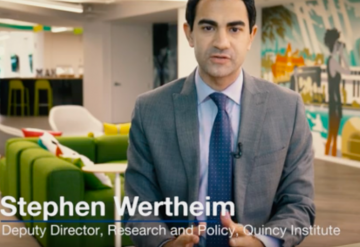 The closing session pitted Quincy Institute Deputy Director Stephen Wertheim against Rosa Brooks of New America and Tom Wright of the Brookings Institution, both of whom rejected the very idea of ending America’s existing wars. They argued that the U.S. troops in Iraq and Syria are really “counter-terrorism operations” rather than “wars.” Brooks even uttered the word identifying her as a member of the national security elite in good standing by calling for a “robust” policy.
The panel billed as “A New Vision for America’s Role in the World” didn’t actually offer that at all. That phrase turned out to be simply a convenient catch-all for the views of foreign policy advisers to both Bernie Sanders (Matt Duss) and former Vice President Joe Biden (former NSC official Julianne Smith), neither of whom articulated anything resembling a new policy vision.
Ironically, on the day that Politico’s “Morning Defense” reported Sanders’ clear lead in the Democratic race had triggered fears among military contractors of “an unprecedented threat to the status quo,” the most daring suggestion from Duss was that Sanders was for diplomacy with Iran.
Military ‘Wants Out’
There were a few moments that unexpectedly elevated the discussion well above the usual humdrum Washington think tank chatter. In a panel on the Middle East independent journalist Mark Perry, who has long had access to senior military officers on background, reported that his military contacts “want out” of the wars in the Middle East.
He added, moreover, that Trump has those officers’ trust, because they believe he wants out, too. But Perry’s most important contribution was to challenge the whole idea that the United States is capable of accomplishing anything positive with its serial military interventions in the Middle East. “We can’t do this,” said Perry, “so what are we doing?”
No Full, Unfettered Analysis
The lesson of Quincy’s debut seems reasonably clear: You can’t hope to disrupt the national security elite’s grip on policy by playing by the establishment’s rules. Foreign Policy was never going to agree to a format that would permit a direct confrontation over the key issues, much less, a full, unfettered analysis of the system of power that underlies that elite’s public role in defending America’s endless wars.
An organization devoted to attacking its illicit and increasingly unpopular policies can only gain traction by offering an analysis that will appeal to the anti-elite sentiments that have already shaken the U.S. political system to its foundations.
That would mean going beyond “realism and restraint” and talking about the need for fundamental change in the system of national security institutions themselves. Of course, taking that lesson on board might not be in line with the thinking of major funders. It could imply a major reorganization and even a much smaller staff. But if it doesn’t heed the lesson of its initial conference, Quincy is likely to find that the real action in bringing about change in U.S. foreign and policy is coming from political forces involved in the larger national power struggle.
Syria Debacles Epitomize Perpetual Perfidy of U.S. Foreign Policy
By James Bovard | Future of Freedom Foundation | March 6, 2020
Turkey is ratcheting up its invasion of Syria and trying to drag NATO into Erdogan’s personal rehabilitation scheme. Threats and counter-threats are flying as thickly as the bombs and bullets. It remains to be seen whether U.S. policymakers will blunder deeper into this quagmire.
Last October, the Washington establishment was aghast when President Trump appeared to approve a Turkish invasion of northern Syria. The U.S. was seen as abandoning the Kurds, some of whom had allied with the U.S. in the fight against ISIS and other terrorist groups. But the indignation over the latest U.S. policy shift in the Middle East is farcical considering the long record of U.S. double-crosses. Rather than the triumph of American idealism, recent U.S. policy has been perpetual perfidy leavened with frequent doses of idiocy.
Almost none of the media coverage of the Turkish invasion and flight of Kurdish refugees mentioned that President George H. W. Bush had urged the Kurds and other Iraqis to “take matters into their own hands and force Saddam Hussein, the dictator, to step aside” during the U.S. bombing campaign in 1991 in the first Gulf War. After it became clear that the U.S. military could not protect the Kurds from Saddam’s backlash, U.S. policymakers basically shrugged and moseyed along. As a CNN analysis noted in 2003, “Bush refrained from aiding Kurdish rebels in the north, although he finally sent troops and relief supplies to protect hundreds of thousands of fleeing Kurds who were in danger of freezing or starving to death. Bush has never regretted his decision not to intervene.” George H.W. Bush’s abandonment and betrayal of the Kurds did nothing to deter the media and political establishment from posthumously sainting him after he died in late 2018.
U.S. meddling in the Middle East multiplied after the 9/11 attacks. Even though most of the hijackers were Saudis who received plenty of assistance from the Saudi government, the George W. Bush administration seized the chance to demonize and assault Saddam Hussein’s Iraqi regime. President Bush portrayed his invasion of Iraq as American idealism at his best. In his May 1, 2003 “Mission Accomplished” speech abroad the USS Abraham Lincoln, Bush hailed “the character of our military through history” for showing “the decency and idealism that turned enemies into allies.” Speaking three weeks later at a Republican fundraiser, Bush bragged, “The world has seen the strength and the idealism of the United States military.” Washington Post columnist David Ignatius declared in late 2003 that “this may be the most idealistic war fought in modern times.” The torture scandal at Abu Ghraib and elsewhere in Iraq has not been permitted to deter the recent semi-canonization of George W. Bush by the establishment media.
The Bush administration and their media allies produced one smokescreen after another to sanctify the war. Almost all the pre-invasion broadcast news stories on Iraq originated with the federal government. PBS’s Bill Moyers noted that “of the 414 Iraq stories broadcast on NBC, ABC and CBS nightly news, from September 2002 until February 2003, almost all the stories could be traced back to sources from the White House, the Pentagon, and the State Department.” A 2008 report by the Center for Public Integrity found that “in speeches, briefings, interviews and other venues, Bush and administration officials stated unequivocally on at least 532 occasions that Iraq had weapons of mass destruction or was trying to produce or obtain them or had links to al-Qaida or both.” The report concluded that the “false statements – amplified by thousands of news stories and broadcasts” created “an almost impenetrable din for several critical months in the run-up to war.” Bush’s falsehoods on Iraq proved far more toxic than anything in Saddam’s arsenal. But the exposure of the official lies did not deter Defense Secretary Donald Rumsfeld from equating criticizing the Iraq war with appeasing Adolph Hitler in 2006.
The chaos from the 2003 invasion of Iraq was still spiraling out of control when the Bush administration began seeking pretexts to attack Iran, which Bush had designated part of the “Axis of Evil” in his 2002 State of the Union address. Bush officials and subsequent administration chose to champion the Iranian terrorist group, Mujahideen-e-Khalq (MEK). That organization sprang up in the 1960s and proceeded to kill Americans in the 1970s and to kill large numbers of Iranians in the subsequent decades. A 2004 FBI report noted that MEK continued to be “actively involved in planning and executing acts of terrorism.” NBC News reported in early 2012 that MEK carried out killings of Iranian nuclear scientists and that it “financed, trained and armed by Israel’s secret service.”
That was the same year that a stampede of Washington hustlers took huge payoffs to publicly champion de-listing the MEK as a terrorist organization. As Trita Parsi noted in the New York Review of Books, MEK “rented office space in Washington, held fundraisers with lawmakers, or offered US officials speaking fees to appear at their gatherings. But the MEK did this openly for years, despite being on the US government’s terrorist list.” Federal law prohibited taking money from or advocating on behalf of any designated terrorist group. But, as a 2011 Huffpost headline reported, “Former U.S. Officials Make Millions Advocating For Terrorist Organization.” Former FBI boss Louis Freeh, former CIA boss Porter Goss, co-chair of the 9/11 Commission Lee Hamilton, former attorney general Michael B. Mukasey, former Homeland Security Secretary Tom Ridge pocketing $30,000 or more for brief speeches to pro-MEK events. Glenn Greenwald rightly scoffed that the advocacy for MEK “reveals the impunity with which political elites commit the most egregious crimes, as well as the special privileges to which they explicitly believe they — and they alone — are entitled.” Greenwald pointed that average people were scourged by the same law the pooh-bahs brazenly trampled: “A Staten Island satellite TV salesman in 2009 was sentenced to five years in federal prison merely for including a Hezbollah TV channel as part of the satellite package he sold to customers.”
Thanks in part to the torrent of insider endorsements, the Obama administration canceled the MEK’s terrorist designation in 2012. While Washington poohbahs continue portraying the group as idealistic freedom fighters devoted to democracy, a simple online search shows that the Farsi translation of the group’s name is “holy warriors of the people,” as Ted Carpenter noted in his new book, Gullible Superpower. Trump administration officials have gurgled about MEK’s possible role in ruling Iran after the current government is toppled. But MEK remains odious to the Iranian people regardless of the group’s PR successes inside the Beltway.
The prior pratfalls of U.S. Middle East policy did nothing to stymie the outrage over Trump asserted that he was withdrawing U.S. troops from eastern Syria. Congress showed more indignation about a troop pullback than it had shown the loss of all the American soldiers’ lives in pointless conflicts over the past 18 years. The House of Representatives condemned Trump by a 354 to 60 vote, and Rep. Eliot Engel (D-NY), chairman of the House Foreign Affairs Committee, proclaimed, “At President Trump’s hands, American leadership has been laid low, and American foreign policy has become nothing more than a tool to advance his own interests.” Sen. Richard Blumenthal (D-Conn.) said he felt “horror and shame” over Trump’s action. Boston Globe columnist Stephen Kinzer aptly described Congress’s protest as “a classic example of ‘buffet outrage,’ in which one picks and chooses which horrors to condemn.”
President Barack Obama had promised 16 times that there would be no “U.S. boots on the ground” in Syria; when Obama betrayed that promise, Congress did nothing. Trump’s plans to have fewer U.S. boots on the ground in Syria — or at least in part of it — somehow became the moral equivalent of giving Alaska back to Russia. Pundits attacked politicians who supported the troop pullback as “Russian assets” – i.e., traitors.
Syria offers another reminder that “material support of terrorism” is a federal crime unless you work for the CIA, State Department, Pentagon, or White House. After President Barack Obama, former Secretary of State Hillary Clinton, and former Secretary of State John Kerry all publicly declared that Syrian president Assad must exit power, the U.S. armed terrorist groups to topple Assad. The Obama administration’s beloved, non-existent “moderate Syrian rebels” achieved nothing. The Kurdistan Workers’ Party, the PKK, a prime beneficiary of the U.S. occupation, has been considered a terrorist group by the U.S. government since 1997. Evan McMullin, a 2016 presidential candidate, admitted on Twitter: “My role in the CIA was to go out & convince Al Qaeda operatives to instead work with us.” Such absurdities spurred Rep. Tulsi Gabbard, D-Hawaii, to introduce The Stop Arming Terrorists Act in 2017 to prohibit any U.S. funding of terrorist groups. Gabbard’s bill was mostly ignored and never enacted though her outspoken criticism of U.S. policy did spur Hillary Clinton and others to vilify her.
Prominent politicians and much of the media blamed Trump for the attacks on civilians that followed the Turkish invasion, carried out mainly by groups allied with the Turkish government. U.S.-armed terrorist groups involved in the Turkish invasion have freed Islamic State prisoners. A Turkish think tank analyzed the violent groups committing atrocities in Syria after the start of the Turkish invasion; “Out of the 28 factions, 21 were previously supported by the United States, three of them via the Pentagon’s program to combat DAESH. Eighteen of these factions were supplied by the CIA.” A prominent Turkish journalist observed after his government invaded Syria: “The groups that were educated and equipped by the United States west of the Euphrates are now fighting against the groups east of the Euphrates that have been also educated and equipped by the United States.” This is nothing new: in 2016, Pentagon-backed Syrian rebels have openly battled CIA-backed rebels in Syria. A prominent Assad opponent who organized a conference of anti-Assad groups financed by the CIA was denied political asylum in 2017 because he provided “material support” to the Free Syrian Army, which meant he had “engaged in terrorist activity,” according to the Department of Homeland Security. A press backlash spurred a reversal on that decision but the media mostly ignored the other contradictions in U.S. policy in Syria.
Members of Congress were indignant that Syrian civilians suffered as the result of Trump’s troop pullback. But both Congress and most of the American media ignored the Syrian women, children, and men who died as a result of U.S. policies that intensified and prolonged that nation’s civil war. This is typical inside the Beltway scoring: the only fatalities worthy of recognizing are those that are politically useful.
Despite Trump’s sporadic declarations on Syria, the U.S. continues to have more than 50,000 troops deployed in the Middle East. The sooner those troops come home, the less likely that our nation will be dragged into another quagmire. The perennial follies and frauds of Middle East policy provide one of the strongest arguments for the United States to mind its own business.
Foreign Propaganda Interference Done Right: Brits in 1940s U.S.
By Steve Sailer – VDARE – 02/22/2020
From the Washington Post:
Bernie Sanders briefed by U.S. officials that Russia is trying to help his presidential campaign
By Shane Harris, Ellen Nakashima, Michael Scherer and Sean Sullivan
Feb. 21, 2020 at 1:16 p.m. PSTU.S. officials have told Sen. Bernie Sanders that Russia is attempting to help his presidential campaign as part of an effort to interfere with the Democratic contest, according to people familiar with the matter.
President Trump and lawmakers on Capitol Hill also have been informed about the Russian assistance to the Vermont senator, those people said, speaking on the condition of anonymity to discuss sensitive intelligence.
It is not clear what form that Russian assistance has taken.
So … that clears that up!
Let me guess, though: I bet some Russian … trolls … are posting … memes!
For example, here’s a high quality 2016 Russian interference effort:
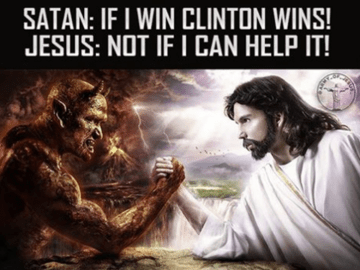
On the other hand, if you want an example of Foreign Interference done right, consider the 1941 Hollywood movie That Hamilton Woman starring Vivien Leigh as Emma Hamilton and Laurence Olivier as Admiral Horatio Nelson, victor over Napoleon’s navy at Trafalgar. From Wikipedia:
The film was a critical and financial success, and while on the surface the plot is both a war story and a romance set in Napoleonic times, it was also intended to function as a deliberately pro-British film that would portray Britain positively within the context of World War II which was being fought at that time. At the time the film was released France, Belgium, the Netherlands, Norway, Poland and Denmark had all surrendered to the Nazis and the Soviet Union was still officially allied to them, correspondingly the British were fighting against the Nazis alone and felt the need to produce films that would both boost their own morale, and also portray them sympathetically to the foreign world, and in particular, to the United States. …
Shot in the United States during September and October 1940,[10] That Hamilton Woman defines Britain’s struggle against Napoleon in terms of resistance to a dictator who seeks to dominate the world.[11] The film was intended to parallel the current situation in Europe and was intended as propaganda at a time before the attack on Pearl Harbor when the United States was still formally neutral. … Stars Vivien Leigh and Laurence Olivier were newlyweds at the time of filming and were considered a “dream couple.” …
While That Hamilton Woman was marketed as historical romance, its subtext falls into the “war propaganda” category.[16] In July 1941, the isolationist group America First Committee (AFC) targeted That Hamilton Woman and three other major Hollywood feature films (The Great Dictator, Chaplin/United Artists, 1940; Foreign Correspondent, Wanger/United Artists, 1940; The Mortal Storm, MGM, 1940) as productions that “seemed to be preparing Americans for war.” …
Critical sources usually point out that That Hamilton Woman was Winston Churchill’s favorite film.[19][Note 1] In her research on the subject, film historian Professor Stacey Olster reveals that at the time the film was made, Alexander Korda’s New York offices were “supplying cover to MI-5 agents gathering intelligence on both German activities in the United States and isolationist sentiments among makers of American foreign policy.”[20] According to Anthony Holden, Olivier’s biographer, That Hamilton Woman “became Exhibit A in a case brought against Korda by the Senate Foreign Relations Committee. The Committee had accused him of operating an espionage and propaganda center for Britain in the United States—a charge Korda only escaped by virtue of the fact that his scheduled appearance before the committee on December 12, 1941 was preempted by the Japanese bombing of Pearl Harbor five days earlier”.
From HistoryNet:
In one scene, whose significance was lost on no one who saw the film, Nelson declares, “You cannot make peace with dictators. You have to destroy them.” Korda always claimed that Churchill had written that line. More pro-British films poured out of Hollywood that year, among them A Yank in the R.A.F., starring Tyrone Power as an American flier who fights in the Battle of Britain, and a raft of melodramatic spy movies depicting sinister Nazi agents at work to undermine America.
The level of talent of British propagandists operating in America in the 1940s — e.g., besides movie stars like Olivier, Leigh, and Cary Grant, there were also Isaiah Berlin, C.S. Forester, Roald Dahl, Alfred Duff Cooper, Ian Fleming, and ad man David Ogilvy — was substantially higher than whatever Russia, Saudi Arabia, or China can muster today. For example, from Wikipedia:
In late March 1942, while in London, [fighter pilot Roald Dahl] met the Under-Secretary of State for Air, Major Harold Balfour, at his club. Impressed by Dahl’s war record and conversational abilities, Balfour appointed the young man as assistant air attaché at the British Embassy in Washington, D.C.
… As part of his duties as assistant air attaché, Dahl was to help neutralise the isolationist views still held by many Americans by giving pro-British speeches and discussing his war service; the United States had entered the war only the previous December, following the attack on Pearl Harbor.[58]
At this time [Roald] Dahl met the noted British novelist C. S. Forester [Horatio Hornblower, The African Queen], who was also working to aid the British war effort. Forester worked for the British Ministry of Information and was writing propaganda for the Allied cause, mainly for American consumption. The Saturday Evening Post had asked Forester to write a story based on Dahl’s flying experiences; Forester asked Dahl to write down some RAF anecdotes so that he could shape them into a story. After Forester read what Dahl had given him, he decided to publish the story exactly as Dahl had written it.
.. Later he worked with such other well-known British officers as Ian Fleming (who later published the popular James Bond series) and David Ogilvy [future author of Confessions of an Advertising Man], promoting Britain’s interests and message in the US and combating the “America First” movement.
The Brooklyn Yeshiva Anthem Protest: Why It’s Not Antisemitic
By Ira Glunts | CounterPunch | March 6, 2020
“An anti-Semite used to be a person who disliked Jews. Now it is a person who Jews dislike.”
– Hajo Meyer, Jewish German-born Dutch physicist and Auschwitz survivor.
“Antisemitism is a trick we always use.”
– Shulamit Aloni, Jewish Israeli, former Israeli Minister of Education, longtime member of the Israeli parliament.
On Sunday, February 23 before a match at Yeshiva University, two brave young Muslim Brooklyn College volleyball players “took a knee” during the playing of Hatikvah, the Israeli national anthem. Omar Rezika (Soph.) and Hunnan Butt (Fr.) following the example of NFL football player, Colin Kaepernick, who protested the police brutality in the US African-American community, were protesting the brutality of the Israeli occupation and its apartheid policies toward its non-Jewish residents. The Nation sports journalist Dave Zirin wrote me that he learned this was the reason for the protest from sources close to the team.
The Jewish press, Jewish organizations and social media were quick to cry antisemitism. The Simon Wiesenthal Center, The Algemeiner, and StopAntiSemitism.org (has short video of the protest) were just a few who rallied their readers against the protesting students. The antisemitism charges were easily refuted by the fact that the protest was a legitimate political protest against Israel and had not been directed at Jews, as Jews, nor specifically at the members of the Yeshiva community because of their ethnicity or religion. Of course just about every Yeshiva student, faculty member and administrator is a supporter of Israel and is also an active apologist for Israeli transgressions.
The Yeshiva University President, Ari Berman, boasted of the wide (some would add “mindless”) support Zionism has in the United States, and called the actions of Rizika and Butt “unfortunate.” In saying this he ignored the acceptance free speech and peaceful protest have in American culture and especially in academia. The Yeshiva University newspaper, The Observer, quotes Berman as saying:
It is unfortunate that some members of the opposing team disrespected Israel’s national anthem. We are proud to be the only university who sings both the American and Israeli national anthems before every athletic competition and major event. Nothing makes me prouder to be an American than living in a country where our religious freedom, our Zionism and our commitment to our people will never be impeded and always be prized.
One salient element that differentiates this protest from Kaepernick’s NFL anthem protests, and indeed most protests, is that it can be credibly argued that it was Yeshiva University, not the protesters themselves, that initiated the confrontation. What university makes the visiting team stand for a foreign national anthem? And this is not just any foreign national anthem. It is a national anthem whose words specifically exclude more than 20% of Israeli citizens and more than 50% of persons subject to Israeli rule because they are not Jewish. The anthem also celebrates what most Muslims and many progressives, backed by international law, consider to be a brutal, illegal occupation of Palestinian land.
Even the Zionist political lobby group, J Street, which supports a kinder, gentler and better-concealed Israeli occupation, featured an alternative, more democratic version of a possible Israeli anthem in the entertainment program of one of its recent conferences.
The American Jewish blogger, Richard Silverstein, who has tweeted about the anthem protest, sent me his reaction:
Unfortunately, the courageous act of dissent performed by these two young volleyball players has been transformed into a act of anti-Semitism, when it was nothing of the sort. They simply sought to engage in a cherished American tradition of free speech and standing up for the oppressed. No university that I know plays both the Star Spangled Banner and the national anthem of a foreign country before sporting events…except Yeshiva University.
A Brooklyn College spokesperson issued a brief statement which was quoted in the Yeshiva Observer that began by assuring those who took offense from the anthem protest that ““Brooklyn College strongly condemns all forms of anti-Semitism and hatred…. Their kneeling is protected by the First Amendment.” The spokesmen did not defend the students against the charges of antisemitism from the Jewish press, nor against the criticism of President Berman.
Interestingly, the Yeshiva University Observer did not bother to even mention the reason Rezika and Butt were protesting. However, its article copiously catalogs the consternation of the Yeshiva community at the temerity of two visiting students to disrespect the Israeli national anthem and the anguish that their kneeling caused in the Yeshiva community.
Conflating Judaism and Zionism is a staple in the bag of tricks of American Zionists. They claim that a vast majority of Jews are Zionists (something with which I concur and most pro-Palestinian activists strongly deny, especially Jewish pro-Palestinian activists). Thus they claim an attack against Zionism is an attack against the core beliefs of most Jews. It is hateful to them, and thus antisemitic. Yet the same people who justify their claim of antisemitism by the belief that most Jews are Zionists (in an almost religious sense) will also tell you, when it is in their interest to do so, that it is antisemitic to protest in front of a synagogue (or at a Jewish university) because Jews have very diverse opinions on Israel, and to generally assume the synagogue members support Israel is wrongly generalizing about Jews and is in itself antisemitic. This flawed but convenient logic makes any real criticism of Zionism equal to antisemitism.
In the United States there is a taboo in criticizing Israel in or around any place that is Jewish. Such protests get little or no mention even in the progressive press and on websites run by both activist Palestinians or Jews. What is surprising is that a number of sites and well-known activists did not run from this story. The story was carried by The Nation, Middle East Eye, and the PalestineChronicle. Yousef “Strange Parenthesis” Munayyer, the Executive Director of the US Campaign for Palestinian Rights, gave a statement of support for the anthem protest to Middle East Eye. All of this is both unusual and encouraging. Many others, as expected, avoided the story despite the fact that flashy protests against Israel are the bread and butter of their outlets.
In Amy Kaplan’s brilliant analysis of the “unbreakable bond” between the United States and Israel she asks the following question:
How did Zionism, a European movement to establish a homeland for a particular ethno-religious group, come to resonate with citizens of a nation based on the foundation, or at least the aspiration, of civic equality and ethnic diversity?
She states that her book, Our American Israel: The Story of an Entangled Alliance, “aims to recover the strangeness [emphasis mine, IG] in an affinity that has come to be seen as self-evident. … How in other words, did so many come to feel that the bond between the United States and Israel was historically inevitable, morally right, and a matter of common sense?”
Four Questions That May Be Difficult To Easily Passover
How strange is the received wisdom about Israel? Here are four examples that come to mind.
1) Why is it unthinkable to protest in front of a synagogue even when that synagogue openly supports Israeli occupation and apartheid, when it is acceptable to protest in front of a church? There have been numerous protests at Catholic churches over charges of priests sexually abusing young church members. My friends Ed Kinane and Ann Tiffany were accused of antisemitism when they protest against the siege of Gaza in a Jewish neighborhood, partly because the protest is at a busy intersection near a synagogue. However, when they protested in front of a Catholic Church, demanding the new bishop be more sensitive than his predecessor to the problems of American capitalism and empire, nobody complained that it was inappropriate to protest in front of a church.
2) Why have so many states passed anti Boycott, Divestment and Sanctions (BDS) legislation, when that legislation clearly violates the right of free speech?
3) Why is talking about the use of money in order to influence the US Congress by Jews or Jewish groups verboten when it is generally accepted as a simpe statement of fact? Remember, “It’s all about the Benjamins baby?” from the twitter feed of Representative Ilhan Omar? That tweet has been deleted, by the way.
4) “To raise a memorial to a European genocide on the secular but sacred space of the National Mall required enormous cultural work – nothing less than the transformation of the Holocaust into an element of American heritage” (from Our American Israel). How was this accomplished, especially considering there is no museum or even a memorial dedicated to American slavery or the genocide of Native Americans on the National Mall?
The answers to these questions, as the Jewish-American rock idol Bob Dylan sang, “is blowing in the wind.” Ironically, after living briefly on a kibbutz in northern Israel, he also sang Neighborhood Bully, which is an apologia for Israeli war crimes.
Just asking these questions is enough to get you accused of being an antisemite, even if you are Jewish, like I am. So I am going to stop here. One good thing about being old, though, is that no one can call my employer to “expose” me as an antisemite.
One last thing, if you want some answers about all of this, I strongly recommend you read Amy Kaplan’s book. It is brilliant.
IRA GLUNTS first visited the Middle East in 1972, where he taught English and physical education in a small rural community in Israel. He was a volunteer in the Israeli Defense Forces in 1992. Mr. Glunts is a Jewish American who lives in Madison, New York. He owns and operates a used and rare book business and is a part-time reference librarian. Mr. Glunts can be reached at gluntsi[at]morrisville[dot]edu.
Erdogan Smells a US Rat
By Finian Cunningham | Strategic Culture Foundation | March 7, 2020
Well, it takes one to know one. The foul scheming and intrigues over the past nine years of war in Syria by the foreign aggressors and their terror proxies will have proven one thing to all the criminal accomplices – none of them can be trusted, even when they claim to be “partners”.
Turkish leader Recep Tayyip Erdogan, who went to Moscow this week, wanted a deeper withdrawal of the Syrian army in Idlib province and he didn’t get it. The upshot is that more Syrian territory has been retaken by Syria’s state forces – despite all the bluster from Erdogan vowing victory and rollback.
What happened is that the Turkish president no doubt smelled a rat from Washington’s lack of military support. Erdogan knew if a military escalation occurred, his forces would be left out to hang and dry by its supposed NATO partner. All the American talk about “fully backing” Turkey failed to materialize beyond hot air.
Recall that when violence flared last month between Turkish and Syrian forces, US Secretary of State Mike Pompeo pledged on February 11 that Washington “would stand by its NATO ally”. As the violence increased along with the body count of Turkish troops, the US did not deliver – despite Ankara’s earnest requests two weeks ago for Patriot missiles. Requests that went unanswered.
Washington knew that Syria and its Russian ally were not backing down from the principle of defeating terror groups on Syrian soil regardless of whether the militants are being given cover by Turkish artillery. Syria has impeccable sovereign right to take back control over every square inch of its territory. Russia has stood full square behind its Syrian ally for that objective.
On March 5 when Erdogan flew to Moscow, he must have had that sinking feeling, knowing that Washington was firing rhetorical blanks. On the same day, Pompeo demanded that the Turkish leader should negotiate a withdrawal of Syrian army back to the Sochi ceasefire lines of 2018. But after six hours of negotiations with Putin, Erdogan settled for a lot less – a truce based on current territorial positions, including gains made in recent weeks by the Syrian army.
On his way to Moscow all that Erdogan was getting from Washington were more vague hints that the US was still “considering” supplying military ammunition to Turkey.
Probably the ominous sign for Erdogan that Washington was going soft was the PR stunt on March 3 when two relatively minor US envoys visited the White Helmets terrorist propaganda unit in Idlib offering “humanitarian aid”. That kind of media support doesn’t quite fit the bill for Patriot missiles and American warplanes that Ankara was really after.
Moreover one of the envoys, James Jeffrey, told a conference in Istanbul on March 5 that the US was “pressuring European NATO allies to give more support to Turkey”.
As Hurriyet Daily News reported, the US envoy was responding to a question regarding Washington’s views about concrete military support to Turkey.
“We are pressuring our European allies to make contribution to this issue,” said Jeffrey. “There’s a Spanish Patriot missile defense unit right now deployed in Turkey at the Incirlik airbase, that’s an example of things that NATO is actually doing, and we want to see more actions like that.”
This was being said as Erdogan flew to Moscow for his “face off” with Putin. In other words, the Turkish president knew that the US was all talk and no action.
Damascus and Moscow have called Erdogan and Washington’s bluff. There will be no escalation in Syria to an international conflict because Erdogan and his master in Washington don’t have the cojones.
Syria has every right to rid its land of terrorists and their NATO patrons. And Syria has Russia’s back. While Ankara knows all it can count on is a Washington rat.
US scraps plans to buy Israeli Iron Dome missile systems
Press TV – March 7, 2020
The United States has decided to scrap its plans to buy two more batteries of the Israeli-made Iron Dome missile system due to concerns about its compatibility with existing American technologies.
The main problem has been Israel’s refusal to provide the US military with Iron Dome’s source code which is needed to integrate the system into American air defenses, according to the army.
General Mike Murray, head of Army Futures Command, said Thursday that based on some cyber vulnerabilities and operational challenges, the army failed to integrate elements of Iron Dome with the US Army’s Integrated Battle Command System.
“It took us longer to acquire those [first] two batteries than we would have liked,” Murray said. “We believe we cannot integrate them into our air defense system based on some interoperability challenges, some cyber challenges and some other challenges.”
In August 2019, the US Defense Department finalized a deal to buy two batteries of the Israeli-made Iron Dome missile system for its interim cruise missile defense capability.
Soon thereafter, army officials repeatedly requested Iron Dome “source code”, according to sources. Israel supplied engineering information but ultimately declined to provide the source code.
“So what we’ve ended up having was two stand-alone batteries that will be very capable but they cannot be integrated into our air defense system,” Murray said.
Because Iron Dome will not be integrated with other elements of the US Army’s air- and missile-defense system, the service is cancelling plans to buy a second pair of Iron Dome batteries by 2023.
“So, we’re working on a path right now… on a way forward,” Murray said. “We anticipate a shoot-off open to US industry, foreign industry, to go after whatever is the best solution to provide that capability.”
The US military has already tested the system. In September 2017, Israel loaned the US an Iron Dome battery, which was flown to the missile range in White Sands, New Mexico.
The US Army has been working with Israeli weapons maker Rafael to develop an American version of the interceptor system since 2017.
In order to integrate the missile system, the US military was going to invest $289.7 million in the missile system in the current fiscal year and another $83.8 million for the next fiscal year.
In total, the US Army would spend $1.6 billion for Iron Dome’s full integration until 2024.
The Iron Dome has been co-developed by American company Raytheon and Israeli defense firm Rafael. It is partly manufactured in the United States.
The Iron Dome is claimed to be capable of detecting, assessing and intercepting a variety of shorter-range targets such as rockets, artillery and mortars.
The system was originally developed to counter small rockets that Hamas and other Palestinian resistance groups fired into Israeli occupied territories in retaliation for the regime’s crimes against Palestinians.
The Iron Dome has proven largely ineffective in serving that purpose.
Featured Video

John Mearsheimer: New World Order Arrived & Europe Is Left Behind
or go to
Aletho News Archives – Video-Images
Book Review
Sunset on Net Zero: A Heretic’s Guide to the Futile CO2 Target
By Ronald Paul Barmby (Author) – October 3, 2025
SUNSET ON NET ZERO describes in detail why Net Zero CO2 is pointless and unachievable. It explains in understandable terms the up-to- date thoughts of the greatest minds of today in physics, meteorology, economics, engineering, and the geosciences.
Net Zero CO2 is pointless because we have now confirmed by satellites that 90% of CO2 warming has already happened. CO2 is not an existential threat but clouds, El-Niño, and human habitation are significant drivers of global warming that are often ignored.
Net Zero CO2 is unachievable because the green technology alternatives are unreliable and unaffordable. Wind and solar power triple electricity costs, building fully electric vehicles produces at least one-half of CO2 emissions they are meant to avoid, and heat pumps will leave you dangerously cold in the winter. Green hydrogen, air capture CO2, and carbon capture and storage are prescriptions for national bankruptcy. The supply of key metals and minerals required to achieve Net Zero need to be at least doubled—some much more—and are often controlled by a very few. Net Zero comes with huge environmental and agricultural costs.
We have been through similar climatic temperature changes before, more recently than you think. Our efforts to control it are futile.
Blog Roll
 Aletho News
- Britain’s shadow security network expands into south Lebanon
- The ADL Has a Foreign Policy, and You Are Not Supposed to See It
- Former Qatari PM says ‘Israel’ has security ties with all Gulf states
- The Sound of Silence in the Strait of Hormuz
- Poland’s call for a no-fly zone in Ukraine means NATO direct war with Russia
- John Mearsheimer: New World Order Arrived & Europe Is Left Behind
- Naqab demolition notices top 1,000; settlers demolish Jaloud homes
- Israel is Using the ‘Gaza Ceasefire’ to Commit Ethnic Cleansing
- West’s ‘wrong expectations’ prolonged the Ukraine conflict – leader of top German party
- Israel kills three civilian officials in three days as Netanyahu widens Gaza assassination policy
- If Americans Knew
- An error has occurred; the feed is probably down. Try again later.
- No Tricks Zone
- Physicists: Doubling CO2 Has A Smaller Impact On Ocean ‘Acidification’ Than Existing Internal Variability
- Alarmist Climatologists In Shock! 2026 Atlantic Hurricane Season Sees Lowest Count In 101 Years
- New Study: Modern Temps Are Among The Coldest Of The Last 10,000 Years In East Central Europe
- Germany’s Renewable Energies Lead to 1.4 Billion Euro Electric Power Trade Deficit
- Argentina’s Perito Moreno Glacier Joins Antarctica and Arctic In Defying Doomsday Melt Claims
- New Study: Barents Sea Temperatures Were Warmer And Sea Ice Less Extensive In The 1700s Than Today
- German Authorities Start Initiative To Evaluate Public Register For Climate “Disinformation” Spreaders!
- Zonal Asymmetry of Temperature Change in the Antarctic Circumpolar Current
- New Study: The Net Fossil Fuel Contribution To Rising Atmospheric CO2 Has Been Zero For 500 Years
- Germany’s Green Energy Transition Becoming Increasingly Expensive…Another 6 Trillion Euros!

