Fourth OPCW whistleblower: Staff ‘frightened into silence’, watchdog brought into ‘shameful disrepute’ over Douma probe
RT | March 13, 2020
A fourth whistleblower has come forward to defend two senior OPCW inspectors who revealed the watchdog tried to cover up evidence in the Douma chemical weapons probe, saying that other employees were “frightened into silence.”
In a statement to the Grayzone, the latest whistleblower said they were “horrified” but “unsurprised” by recent events within the organization, describing the “mistreatment” of “two highly regarded and accomplished professionals” as “abhorrent.”
The employee wrote that he is “one of many who were stunned and frightened into silence by the reality how the organization operates,” and that the “threat of personal harm” to those who speak out is “not an illusion.”
The fourth whistleblower emerged after the OPCW leadership attempted to smear and discredit veteran inspector Ian Henderson and an individual known as ‘Alex’ who challenged the organization’s narrative on the alleged Syrian government attack on Douma in 2018. A third whistleblower has also previously defended the integrity of the first two who spoke out and expressed concern for the safety and security of those who dissent from the official narrative.
The Grayzone said it had independently verified the identity of the fourth whistleblower and their position at the OPCW, but granted them anonymity “to protect them from potential retaliation.”
Last week, Henderson and ‘Alex’ both wrote to OPCW Director-General Fernando Arias, accusing the organization of trying to “smear” their reputations and questioning why two top inspectors with “impeccable records” would suddenly “go rogue.” The letters followed an effort by the chemical weapons watchdog to discredit them, rubbish their serious concerns, and frame them merely as two disgruntled former employees.
“I fully support their endeavors, in that it is for the greater good and not for personal gain or in the name of any political agenda,” the fourth whistleblower wrote, adding that the inspectors are “trying to protect the integrity of the organization which has been hijacked and brought into shameful disrepute.”
After a detailed study, Henderson, who led the probe on the ground in Douma, concluded that gas cylinders found at the scene had likely been manually placed, which suggests the attack may have been a false flag staged by anti-government militants. The incident, however, was swiftly used to justify US, UK and French airstrikes on Syria before OPCW investigators had even arrived at the scene.
Yet, the OPCW disregarded Henderson’s evidence without explanation and in its official report implied that the gas cylinders were dropped by Syrian military planes – allegedly after “unacceptable pressure” was applied by the US government.
Corona & the Cost of Doing Nothing
By Anatoly Karlin • Unz Review • March 12, 2020
There is a three in a million chance that a Boeing 737 MAX won’t arrive at its destination in one piece. At the end of the day, this isn’t that big of a deal – as late as the 1980s, this was the average for the commercial airline industry, and risks were twice as high in 1970. But people don’t tolerate such numbers such risks these days, as the value attached to human life has gone up. As a result, this model has been grounded across the world, with attendant consequences for Boeing’s bottom line.
But while it may not be that big of a deal, it is still probably not a great idea to take 500 flights in a Boeing 737 MAX within a year if one can possibly help it. Why 500 Boeing 737 MAX flights? Because even though it is a disease that overwhelmingly affects the elderly, that happens to be the equivalent risk of dying from COVID-19 for people in their 30s. Moreover, when you board a plane, you are only risking your own life. People with a cavalier “iT’S JuSt lIkE ThE FlU” are presumably more likely to spread it to elderly people, for whom a brush with COVID-19 is equivalent to a round of Russian roulette (mortality is ~1/6 for over 80 year olds). Moreover, it would even be reasonable to pay money to avoid such risks, even if it involves some inconveniences.
For this novel coronavirus threatens to fundamentally degrade the global demographics of human mortality, the effects of which may last years or decades.
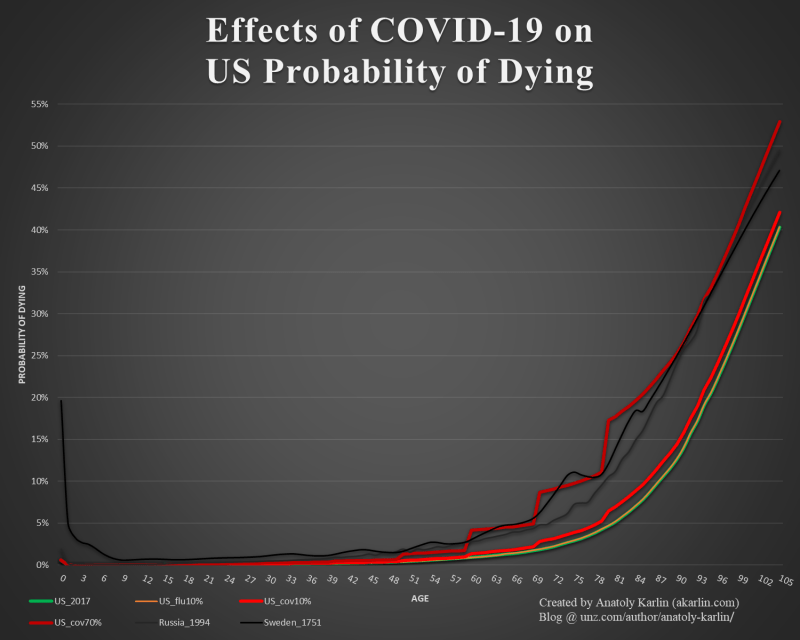
This graph shows q(x), or the probability of dying at any age “x”. It is calculated by taking a hypothetical cohort, usually fixed at 100,000 at the age of 0, and dividing the number of deaths by the number of survivors by age group.
The green line represents the probability of dying in the US as of 2017.
The other lines represent the effects of various epidemic shocks: An approximate doubling in severity of the average flu season (yellow); a 10% COVID-19 infection rate (orange); and a 70% COVID-19 infection rate (red).
These figures were obtained by taking the percentage chances of dying from the flu/COVID-19 and adding them to the q(x) percentages for the US in 2017 at the mortality.org database.
 The mortality stats for the flu were taken from the CDC, as reported in Business Insider. They also helpfully compare the age-specific death rates to COVID-19 mortality, as derived from an investigation earlier this month by Russell et al. based on numbers from the Diamond Princess cruise ship. The extrapolated total CFR (case fatality rate) was pegged at 1.1%, but note that this applied to situation where quality healthcare was readily available (ventilators, IV drops, antibiotics, etc.). In situations where the epidemic overwhelms the healthcare system, things are going to be much worse.
Note from the outset the near insignificance of flu as a cause of mortality; under 65’s are basically two orders of magnitude as likely to die from COVID-19 as from the flu. In other words, for the younger generations, “the flu” is just 2-3x Boeing 737 MAX flights per year, as opposed to 500x for COVID-19. While the absolute numbers for the elderly are horrific, the disparity between flu and COVID-19 mortality for them is actually considerably less – just about a single order of magnitude – though even so, that’s still the difference between a ride on the Space Shuttle (flu) versus a round of Russian roulette (COVID-19). I’d rather take the Space Shuttle, thank you.

In another study by Riou et al. 2020 analyzing data from Wuhan, a total CFR of 1.6% was estimated, with a larger sample allowing for a more precise breakdowns by age (see above). As such, I will be using the numbers from this study to adjust q(x) in the different COVID-19 scenarios. Apart from that, the Wuhan scenario is likely to be more typical than the Diamond Princess scenario, if we are talking about large-scale outbreaks that partially overwhelm the capacity of healthcare cities.
There isn’t much evidence that we can hope for substantially lower mortality rates, even in developed OECD countries; contra Western stereotypes, medical care in Wuhan seems to have been highly sophisticated, with dozens of people being ventilated in the average hospital, and complex procedures such as extracorporeal membrane oxygenation (“removing blood from a person’s body and oxygenating their red blood cells”) through ECMO machines being available in cases where ventilation didn’t work. Consequently, it can’t be excluded that mortality in most of the rest of the world – even in the OECD – may well end up higher than in China. For instance, England only has 28 and the US has 250 of these ECMO machines, whereas even provincial hospitals in China have been reported to have 5 of them each.
 The healthcare system in Lombardy – one of the most developed regions in the world – is already on the cusp of collapse. Unless there are draconian quarantines implemented right about now, most of the rest of Western Europe and the US seem set to join it in its misery in another 10 days to two weeks. Cost-cutting “optimization” in healthcare has drastically reduced the number of hospital beds per capita throughout the West in the past two decades. At this point, I would certainly not wager on “the West” mounting a better or more competent response to COVID-19 than the Chinese.
Another cardinal difference between “the flu” and COVID-19 is that the latter is far more contagious. The standard measure of how many other people each person with a given disease infects in turn, r0, seems to be ~4 under “normal” conditions, versus just 1.3 for the flu. Moreover, as a novel coronavirus, people do not have any preexisting immunity to COVID-19 that might mitigate its virulence, and it has far greater contagiousness. Consequently, professional epidemiologists have predicted that as much as 70% of the world population may eventually become infected with COVID-19, a number which has been repeated by Angela Merkel and the British government in recent days. As such, I will be modeling a 70% COVID-19 infection rate – which presupposes millions of deaths – as a “worst case” scenario.
One final “blackpill” about COVID-19 is that, should we fail to control it, many epidemiologists expect it to become a new seasonal disease – that is, a fifth endemic coronavirus, just like the common cold. But far deadlier. The flu infects about a tenth of the population every year. What would be the impact if COVID-19 was to reach similar intensities?
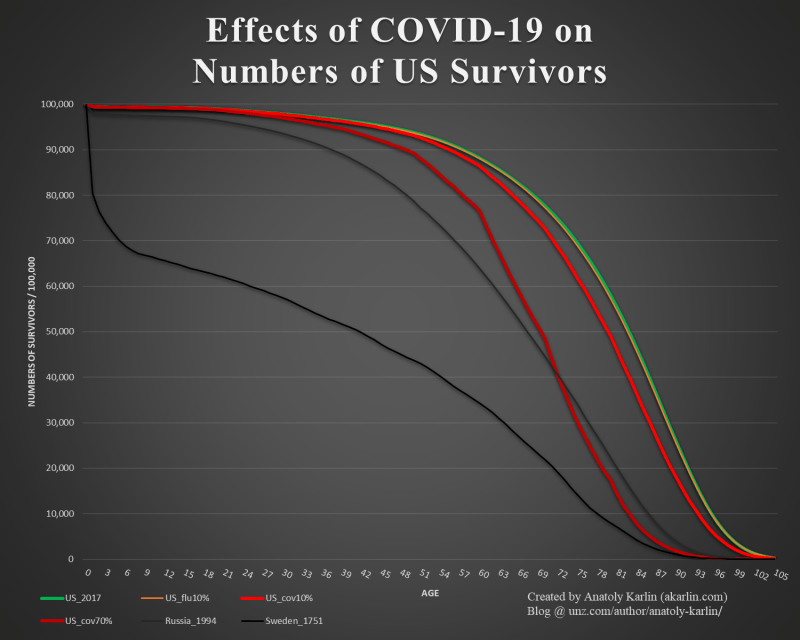
This graph shows l(x), or the number of survivors at any age “x”. It can be calculated by recursively applying the aforementioned q(x) to the initial, hypothetical cohort of 100,000 newborns.
As before, we can see that even doubling the flu season – adding mortality from an average flu season to the existing probability of dying – barely nudges the curve.
However, even a 10% COVID-19 infection rate moves the curve visibly left, and the change is extremely traumatic once you get to 70% infection rates – the sort of numbers that multiple European governments are now bandying about.

This graph shows the changes in life expectancy at different ages. It is calculated from two values derived from the above data: The total number of person-years lived by any particular cohort, or T(x), divided by the number of survivors, or l(x), in that cohort. T(x) is the sum total of person-years, or L(x), lived by any particular cohort up until all its members have died. That, in turn, is given by the following formula: L(x) = l(x+1)*d(x)*a(x), where l(x+1) refers to the quantity of that cohort’s survivors in the next year, d(x) refers to the number of deaths during that interval (or, in other words, l(x+1) – l(x) ), and a(x) is a constant that is usually equal to 0.5 (except in the very first and the very last year of life).
Here is a summary of the results:
- US life expectancy at birth was 78.86 years in 2017 (via mortality.org). There is a minor discrepancy with the official CDC figure of 78.6 years.
- Modeling a typical flu epidemic “on top” of that (so, in practice, a ~doubling of the flu season severity) would reduce US life expectancy to 78.63 years, translating to a reduction of ~0.25 years (three months).
- Modeling a 10% COVID-19 infection scenario with Riou et al. (2020) age-specific mortality rates – the sort of numbers we may expect should it become endemic – reduces US life expectancy to 76.15 years , translating to a reduction of ~2.5 years.
- Modeling a 70% COVID-19 infection scenario with Riou et al. (2020) age-specific mortality rates reduces US life expectancy to 66.79 years, translating to a reduction of a cool ~12 years.
Now this is not the end of the world, as I make sure to emphasize by including the historical mortality profiles for Russia in 1994 and Sweden in 1751 across all three of these graphs.
The year 1994 marked the single worst time for Russian mortality in its post-1956 history, when rampant alcohol abuse, violence, and the despair of the 1990s reduced life expectancy to a local minimum at 63.93 years; during that time, middle-aged male mortality was equivalent to that of Imperial Russia and Sub-Saharan Africa. This is probably the worst mortality profile ever observed in a major industrialized nation outside of wartime.
Mortality rates in the preindustrial world – Sweden has the earliest comprehensive records dating back to 1751 – jumped wildly year to year, depending on the state of the harvest and the virulence of the bugs going around in that particular year. The biggest difference relative to industrialized societies, though, even ones as collapsed as Russia in the 1990s, is that deaths during infancy and childhood were mundane, not freak occurrences. Hence why life expectancy actually goes up as children live through (survive) their infanthood.
As we can see, in terms of mortality, a serious COVID-19 epidemic should be broadly equivalent to living in 1990’s Russia – and for people under the age of 50, it would be notably safer than living in a preindustrial society, such as 18th century Sweden. It will be a shock relative to current expectations colored by more than a century of “Pinkerian” progress in safety and survivability, but there were people who lived their entire lives under similar or worse mortality profiles, and that didn’t prevent many of them from finding joy and meaning in them.

However, even though the pandemic “shock” will pass, if the epidemiologists are correct and COVID-19 becomes an endemic, seasonal disease, then we may permanently lose the equivalent of about 25 years worth of progress in raising life expectancy (American life expectancy was last below 76.15 years in 1996). In this scenario, the graph of future US life expectancy may look like something above, dipping sharply this year and stabilizing at a new, lower normal in subsequent years.
In the long-term, there may be even more years lost – perhaps 3 years – in many West European countries, and perhaps in developed East Asia as well, should this pandemic veer out of control and make it impossible for them to preserve their current achievements at checking COVID-19 (I assume that even disciplined East Asian societies cannot maintain Corona-suppressing “social distancing” behaviors indefinitely). That is because, thanks mainly to America’s opiates epidemic, the West European countries now have substantially better mortality profiles than the US, so the extra “shock” of COVID-19 will depress their life expectancy to a relatively greater extent. Though, curiously enough, most of these same countries will “lose” fewer years of progress relative to the US, since American life expectancy has basically stood still for the past decade due to the opioids epidemic.
Meanwhile, industrialized countries with worse mortality profiles, such as Russia, will not actually see as big of a drop in life expectancy as the US; as of 2014, the last year for which I can find life tables for Russia, a 10% COVID-19 infection scenario translates to a 1.7 year fall in Russian life expectancy (US: 2.5 years), and a 70% infection scenario translates into a drop of 8 years in life expectancy (US: 12 years). However, due to strong gains in Russian life expectancy since 2014 – it has risen from 70.9 years in 2014 to 73.4 years in 2019 – the effects of COVID-19 will actually now be stronger (if still not as strong as in the US).
(Reminder: This is all assuming that both infection rates and the age-specific mortality rates from COVID-19 are the same across these countries – this will almost certainly not be the case due to local specifics).
Moreover, there will be multiple other factors that will either ameliorate or depress the above estimates:
- COVID-19 is going to kill off the frailest people in this current wave, in which up to 70% of people may be infected; but this will soften its long-term impact, since you can only die once.
- In subsequent years, when ~10% annual infection rates may become the new norm, healthcare systems will adjust and everybody should receive adequate care, lowering CFR from the ~4% currently observed when healthcare systems are overwhelmed, to the 0.5%-1.0% rates seen in South Korea and Chinese provinces outside Hubei, which have managed to keep on top of cases.
- Conversely, people who are intubated now may suffer permanent, long-term insults on their health, making them more vulnerable to subsequent COVID-19 infections in future years.
- Needless to say, there may well be changes in COVID-19’s contagiousness and virulence in the future.
I am not even going to attempt to model any of this. But the bottom line stands. This virus has the capability to deal a traumatic shock to the world’s population, especially to the older societies of the Global North. In the longer term, it may also permanently depress global life expectancy by about 2 years, robbing millions of future people of their planned retirements and time with their grandchildren.
There are political factions that cynically, and unironically, pray for Corona-chan to do her magic. The Chapo Trap House folks bask in the idea of COVID-19 killing off Drumpf-voting boomers who are keeping them from electing Bernie, instituting M4A, and rescuing the planet, while elements of the Alt Right anticipate the West rediscovering its youthful vigor in the wake of the “boomerpox”. But I would caution both factions against premature Schadenfreude – political trends rarely work out the way anyone expects them to. They may get more than they bargained for.
OK, summing up: We should really, really try to avoid COVID-19 veering out of control and becoming endemic.
China has demonstrated that Corona-chan can be contained; its r0 has plummeted by an order of magnitude from 4 to just 0.32, even if it had to bring its economy to a near standstill to do it. As Steve Sailer notes, China hasn’t merely “flattened the curve”. It has crushed it. This means that its success should be replicable, at least in First World nations with epidemics on the scale of peak Hubei, as in Italy.
Even more encouragingly, the nations of East Asia – Japan, Taiwan, Singapore, Hong Kong, even middle-income Thailand – have all managed to bring COVID-19 under control at its earliest stages without resorting to China’s drastic measures. As Tomas Pueyo explains, they did this by carefully filtering infectees’ contacts at the earliest opportunity and putting them under quarantine. The main reason that South Korea failed is because its “Patient 31” happened to be a religious “super-spreader”, yet even so, even there, the epidemic is currently under control.
But all their efforts would be in vain if just a few (or even one) defeatist, incompetent, or plain stupidly-run countries decline to take the necessary steps, and thereby cut two years off global life expectancy into the indefinite future.
This stupidity and incompetence takes different forms. In Western Europe, it is the Left’s fundamentalist commitment to open borders, accompanied by bizarre claims that quarantines do not work. In the US, it is the Right’s fundamentalist commitment to free markets, as exemplified by $5,000 copays for coronavirus tests, lack of sick leave, and Trump’s “iT’S JuSt lIkE ThE FlU” mantras to appease Mammon. Meanwhile, in what is perhaps the most “powerful” move of them all, the United Kingdom has set up a cyber-unit to combat “Russian” Corona-chan shitposters while basically admitting that it has no interest in combating, like, the actual coronavirus. Hopefully the British boomers croaking in their deathbeds in another two months’ time will be understanding of HMG’s priorities.
One is almost tempted to wish a pox on all their houses.
Anyhow, while I still hope for the best, I do not expect it.
‘Where was your patient zero?’ Chinese official speculates AMERICANS may have infected Wuhan at army games & calls to ‘come clean’
RT | March 13, 2020
Chinese foreign ministry spokesperson Lijian Zhao has demanded US authorities reveal what they’re hiding about the origins of Covid-19, going as far as to suggest the coronavirus may have been brought to China by the US military.
Pointing to a video of Centers for Disease Control and Prevention (CDC) director Robert Redfield apparently admitting the US had several deaths from Covid-19 before they were able to test for it, Zhao called on the American watchdog to come clean in a tweet posted on Thursday.
“It might be US army who brought the epidemic to Wuhan,” Zhao suggested, calling for the CDC – and the US in general – to “be transparent” and share what they know about where and when “Patient Zero” was first diagnosed.
In the video, Redfield acknowledged that some cases of coronavirus were misclassified as influenza as the medics did not have an accurate test for the new epidemic at the time. He did not elaborate on when these misdiagnosed cases first appeared – saying only that “some cases have been diagnosed that way.”
In the absence of any patients’ details or chronology of deaths, speculation has swirled. Zhao’s “theory” in particular focused on the military delegation that traveled to Wuhan in October for the Military World Games, weeks before the city confirmed the outbreak in December. The delegation was part of the 300-member group of American athletes taking part in the multi-sport event held every four years.
Zhao is not the only high-profile political figure to voice suspicions about the timing of the Games and the introduction of the coronavirus in Wuhan. Former Malaysian PM Matthias Chang offered similar speculation back in January, zeroing in on the event as the launch point for what he deemed a biological war waged by the US against China.
The World Health Organization (WHO) states that what is now the Covid-19 pandemic was first reported as a coronavirus outbreak in Wuhan, China, on 31 December 2019. The search for the deadly disease’s origin has been ongoing, with conflicting versions blaming the Wuhan food market and bats – a local delicacy – sold there in particular, while others opined humans might have gotten the virus from pangolins, an endangered scaly mammal.
Less orthodox theories suggest malicious intent, with the head of Iran’s elite Revolutionary Guards sensationally claiming last week that Covid-19 could possibly be “a product of a biological attack by America which initially spread to China and then to Iran and the rest of the world.”
So far, the problem with all of those theories, blaming both animals and humans, is that no direct causal proof has been established, while the identity of China’s “patient zero” also remains unclear. And it’s not China alone: in Washington state – which seemingly identified and successfully isolated its first infected traveler, with dozens of contacts identified and monitored – the virus somehow began spreading anyway. Even Steve Wozniak, Apple’s co-founder, at one point claimed he and his wife may have been the US’ “patient zero” after developing a bad cough on return from China. It has since emerged his wife’s diagnosis was “a sinus infection,” however.
Also on rt.com
NATO and COVID-19: a Parasitical Disease in Europe
By Finian Cunningham | Strategic Culture Foundation | March 12, 2020
The decision to go-ahead with NATO’s biggest-ever war games in Europe at a time of heightened fears over the coronavirus sure raises questions about the military alliance’s stated purpose of maintaining security.
NATO secretary-general Jens Stoltenberg has said the Defender-Europe 20 exercises will not be cancelled due to the flu-like disease which has now spread to every country in the European Union causing hundreds of deaths so far.
Over the next five months some 17 allied NATO members will participate in military maneuvers across seven European states: in Belgium, Netherlands, Germany, Poland, Estonia, Latvia and Lithuania. All of the host nations have reported infections from the COVID-19 virus. “Host” being an operative word when it comes to also talking about the relationship with the U.S.-led NATO alliance.
Germany’s health minister Jens Spahn is quoted as saying that the coronavirus outbreak has “become a global pandemic” and the “worst has yet to come.”
In all, 37,000 troops are involved in the Defender-Europe 20 war games, the biggest contingency since the end of the Cold War nearly three decades ago. The U.S. is sending 20,000 personnel. Most of those troops will return to bases located in at least 20 American states. Thus, the risk factor of spreading the disease across Europe and the U.S. is significantly increased by the NATO events.
Going ahead with the European war games looks especially ill-advised given that U.S. forces in Asia-Pacific have cancelled similar military exercises that were scheduled in South Korea out of fears about coronavirus (COVID-19).
The Defender-Europe 20 events underway come amid reports that the U.S. Commander in Europe, Lt. General Christoper Cavoli, may have been infected after attending a recent military conference in Wiesbaden, Germany.
The top health advisor to the U.S. Joint Chiefs of Staff, Air Force Brig. General Paul Friedrichs has also admitted that the number of COVID-19 cases among the Pentagon’s armed forces may be far higher than is being reported.
The seeming lack of cautionary measures by the U.S.-led NATO alliance is in contrast to growing public concerns for containing the disease. Italy – which has recorded the second highest fatalities worldwide after China – has placed a total lockdown on public travel for its 60 million population. Airlines across Europe have cancelled thousands of flights as some carriers go out of business altogether.
Sporting events across Europe including major soccer matches are being cancelled or will be held without attendance by fans. The six-nations rugby tournament has been thrown into disarray from match fixtures being rescheduled; a big match between Ireland and France due this weekend is postponed until October.
In Britain there are calls for parliament to be suspended after health minister Nadine Dorries was reported to have been infected. Boris Johnson’s government has been accused of complacency in dealing with the virus.
U.S. President Donald Trump has also come under fire for not taking sufficient containment measures or providing adequate resources such as testing kits. The official number of U.S. cases of COVID-19 is relatively low so far, but that is thought to be due to limited testing.
It would therefore seem reasonable in this context of pandemic risk that such a multinational event like NATO’s Defender-Europe 20 be called off. As it proceeds, the war games appear to a perfect vector for accelerating disease spread between two continents and beyond. Indeed, not parking these war games seems the height of carelessness.
How fitting that NATO should be so unresponsive to real need. This lumbering 29-nation military organization which consumes a combined annual budget of $1 trillion is a creature of habit and slavish ideology. Nearly 30 years after the Cold War with the Soviet Union, the world has moved on. But not, it seems, NATO. It continues to hold its war games supposedly defending Europe from “Russian invasion”.
If NATO can’t adjust to such glaring world realities as the end of the Soviet Union three decades ago, then no wonder its response to coronavirus is hardly fleet-footed. It’s the military equivalent of a dinosaur whose functioning is no longer supported by its environment.
The irony is that NATO’s obscene military largesse is crushing public finances that would otherwise be more usefully spent, such as building up healthcare infrastructure that would help mitigate crises like the coronavirus. Many other societal needs are chronically neglected because of exorbitant military budgets among NATO members. Donald Trump brags that he has cajoled European allies to fork out hundreds of billions more dollars on military budgets.
The coronavirus is but a stress-test on whole societies that have become hollowed out by excessive militarism and the corporate capitalist super-structure it serves.
Even before the coronavirus problem emerged in China earlier this year, the NATO war games in Europe (and elsewhere) have been a cause for much criticism. The geopolitical tensions that this U.S.-led militarism is engendering towards Russia and China have been deplored. Moscow has denounced the Defender-Europe 20 event as a “rehearsal for war” which is completely disconnected from reality. The inveterate Cold War ideology that drives NATO is imposing insecurity and risk of war on Europe in a way that makes a mockery of NATO claims about being dedicated to “security and defense”.
The reckless risk-taking with regard to inflaming a coronavirus pandemic is typical of NATO’s obsolete purpose. Like the disease itself, NATO is a parasite on host nations draining vital public resources. This organization should be “self-isolating”… 30 years too late.
COVID-19: Further Evidence that the Virus Originated in the US
By Larry Romanoff | Global Research | March 11, 2020
It would be useful to read this prior article for background:
China’s Coronavirus: A Shocking Update. Did The Virus Originate in the US?
By , March 4, 2020
***
As readers will recall from the earlier article (above), Japanese and Taiwanese epidemiologists and pharmacologists have determined that the new coronavirus almost certainly originated in the US since that country is the only one known to have all five types – from which all others must have descended. Wuhan in China has only one of those types, rendering it in analogy as a kind of “branch” which cannot exist by itself but must have grown from a “tree”.
The Taiwanese physician noted that in August of 2019 the US had a flurry of lung pneumonias or similar, which the Americans blamed on ‘vaping’ from e-cigarettes, but which, according to the scientist, the symptoms and conditions could not be explained by e-cigarettes. He said he wrote to the US officials telling them he suspected those deaths were likely due to the coronavirus. He claims his warnings were ignored.
Immediately prior to that, the CDC totally shut down the US Military’s main bio-lab at Fort Detrick, Maryland, due to an absence of safeguards against pathogen leakages, issuing a complete “cease and desist” order to the military. It was immediately after this event that the ‘e-cigarette’ epidemic arose.
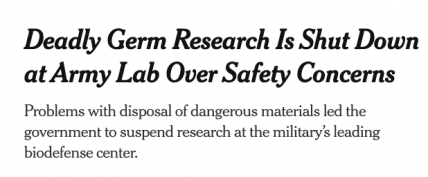
Screenshot from The New York Times August 08, 2019
We also had the Japanese citizens infected in September of 2019, in Hawaii, people who had never been to China, these infections occurring on US soil long before the outbreak in Wuhan but only shortly after the locking down of Fort Detrick.
Then, on Chinese social media, another article appeared, aware of the above but presenting further details. It stated in part that five “foreign” athletes or other personnel visiting Wuhan for the World Military Games (October 18-27, 2019) were hospitalised in Wuhan for an undetermined infection.
The article explains more clearly that the Wuhan version of the virus could have come only from the US because it is what they call a “branch” which could not have been created first because it would have no ‘seed’. It would have to have been a new variety spun off the original ‘trunk’, and that trunk exists only in the US. (1)
There has been much public speculation that the coronavirus had been deliberately transmitted to China but, according to the Chinese article, a less sinister alternative is possible.
If some members of the US team at the World Military Games (18-27 October) had become infected by the virus from an accidental outbreak at Fort Detrick it is possible that, with a long initial incubation period, their symptoms might have been minor, and those individuals could easily have ‘toured’ the city of Wuhan during their stay, infecting potentially thousands of local residents in various locations, many of whom would later travel to the seafood market from which the virus would spread like wildfire (as it did).
That would account also for the practical impossibility of locating the legendary “patient zero” – which in this case has never been found since there would have been many of them.
Next, Daniel Lucey, an infectious disease expert at Georgetown University in Washington, said in an article in Science magazine that the first human infection has been confirmed as occurring in November 2019, (not in Wuhan), suggesting the virus originated elsewhere and then spread to the seafood markets. “One group put the origin of the outbreak as early as 18 September 2019.” (2) (3)
Wuhan seafood market may not be source of novel virus spreading globally.
Description of earliest cases suggests outbreak began elsewhere.
The article states:
“As confirmed cases of a novel virus surge around the world with worrisome speed, all eyes have so far focused on a seafood market in Wuhan, China, as the origin of the outbreak. But a description of the first clinical cases published in The Lancet on Friday challenges that hypothesis.” (4) (5)
The paper, written by a large group of Chinese researchers from several institutions, offers details about the first 41 hospitalized patients who had confirmed infections with what has been dubbed 2019 novel coronavirus (2019-nCoV).
In the earliest case, the patient became ill on 1 December 2019 and had no reported link to the seafood market, the authors report. “No epidemiological link was found between the first patient and later cases”, they state. Their data also show that, in total, 13 of the 41 cases had no link to the marketplace. “That’s a big number, 13, with no link”, says Daniel Lucey . . . (6)
Earlier reports from Chinese health authorities and the World Health Organization had said the first patient had onset of symptoms on 8 December 2019 – and those reports simply said “most” cases had links to the seafood market, which was closed on 1 January. (7)
“Lucey says if the new data are accurate, the first human infections must have occurred in November 2019 – if not earlier – because there is an incubation time between infection and symptoms surfacing. If so, the virus possibly spread silently between people in Wuhan – and perhaps elsewhere – before the cluster of cases from the city’s now-infamous Huanan Seafood Wholesale Market was discovered in late December. “The virus came into that marketplace before it came out of that marketplace”, Lucey asserts.
“China must have realized the epidemic did not originate in that Wuhan Huanan seafood market”, Lucey told Science Insider. (8)
Kristian Andersen is an evolutionary biologist at the Scripps Research Institute who has analyzed sequences of 2019-nCoV to try to clarify its origin. He said the scenario was “entirely plausible” of infected persons bringing the virus into the seafood market from somewhere outside. According to the Science article,
“Andersen posted his analysis of 27 available genomes of 2019-nCoV on 25 January on a virology research website. It suggests they had a “most recent common ancestor” – meaning a common source – as early as 1 October 2019.” (9)
It was interesting that Lucey also noted that MERS was originally believed to have come from a patient in Saudi Arabia in June of 2012, but later and more thorough studies traced it back to an earlier hospital outbreak of unexplained pneumonia in Jordan in April of that year. Lucey said that from stored samples from people who died in Jordan, medical authorities confirmed they had been infected with the MERS virus. (10)
This would provide impetus for caution among the public in accepting the “official standard narrative” that the Western media are always so eager to provide – as they did with SARS, MERS, and ZIKA, all of which ‘official narratives’ were later proven to have been entirely wrong.
In this case, the Western media flooded their pages for months about the COVID-19 virus originating in the Wuhan seafood market, caused by people eating bats and wild animals. All of this has been proven wrong.
Not only did the virus not originate at the seafood market, it did not originate in Wuhan at all, and it has now been proven that it did not originate in China but was brought to China from another country. Part of the proof of this assertion is that the genome varieties of the virus in Iran and Italy have been sequenced and declared to have no part of the variety that infected China and must, by definition, have originated elsewhere.
It would seem the only possibility for origination is the US because only that country has the “tree trunk” of all the varieties. And it may therefore be true that the original source of the COVID-19 virus was the US military bio-warfare lab at Fort Detrick. This would not be a surprise, given that the CDC completely shut down Fort Detrick, but also because, as I related in an earlier article, between 2005 and 2012 the US had experienced 1,059 events where pathogens had been either stolen or escaped from American bio-labs during the prior ten years – an average of one every three days.
***
Larry Romanoff is a retired management consultant and businessman. He has held senior executive positions in international consulting firms, and owned an international import-export business. He has been a visiting professor at Shanghai’s Fudan University, presenting case studies in international affairs to senior EMBA classes. Mr. Romanoff lives in Shanghai and is currently writing a series of ten books generally related to China and the West. He can be contacted at: 2186604556@qq.com. He is a frequent contributor to Global Research.
Notes
(1) https://mp.weixin.qq.com/s/CjGWaaDSKTyjWRMyQyGXUA
(2) https://science.sciencemag.org/content/367/6477/492.full
(3) Science; Jon Cohen; Jan. 26, 2020
https://www.sciencemag.org/news/2020/01/wuhan-seafood-market-may-not-be-source-novel-virus-spreading-globally
(4) https://www.thelancet.com/journals/lancet/article/PIIS0140-6736(20)30183-5/fulltext
(5) https://www.thelancet.com/journals/lancet/article/PIIS0140-6736(20)30183-5/fulltext
(6) http://wjw.wuhan.gov.cn/front/web/showDetail/2020011109036
(7) http://wjw.wuhan.gov.cn/front/web/showDetail/2020011509040
(9) http://virological.org/t/clock-and-tmrca-based-on-27-genomes/347
(10) http://applications.emro.who.int/emhj/v19/Supp1/EMHJ_2013_19_Supp1_S12_S18.pdf
Copyright © Larry Romanoff, Global Research, 2020
Syria says will stand by allies on resistance axis to expel US from Western Asia
Press TV – March 12, 2020
A senior adviser to Syrian President Bashar al-Assad hails “constant coordination” between Damascus and its allies in the fight against terrorism, saying the Arab nation will stand by the resistance front to help drive the US out of not only Syria but the entire Middle East region.
Assad’s political and media adviser, Bouthaina Shaaban, made the remarks in an interview with Lebanon-based Arabic-language al-Mayadeen TV channel on Wednesday.
She said that Washington has been supporting the Takfiri al-Qaeda and Daesh terrorist groups, and that its sponsorship for the al-Qaeda-inspired al-Nusra Front terrorist outfit is of no surprise.
The Syrian people living east of the Euphrates River have been fighting against American occupation forces and enjoy the Damascus government’s backing for their resistance, she added.
Shaaban also stressed that the battle on eastern bank of the Euphrates is complicated and takes time, noting, however, that the Syrians will eventually expel US troops from their homeland.
The Syrian army has the backing of Iran, Russia and Lebanon’s Hezbollah resistance movement in its battle against a host of militant groups, which have been wreaking havoc on the country since 2011.
Thanks to that support, the Damascus government has managed to win back control of almost all regions from the foreign-sponsored militants.
Syria has been engaged in a liberation operation in Idlib Province, the last major bastion of terrorists in the country.
Shaaban further emphasized that her country supports its allies on the regional resistance axis to drive American military personnel out of the entire West Asia region.
Syria in constant coordination with Iran, Hezbollah
There is complete and constant coordination between Damascus on one side and Tehran and the Lebanese Hezbollah resistance movement on the other side in political and military spheres, the Syrian official pointed out.
She hailed Tehran-Damascus relations as historical and strategic, reiterating that both Iran and Russia prioritize Syria’s sovereignty and independence.
Taking advantage of the mayhem in Syria, the US has deployed troops to Syria under the guise of fighting Daesh. It has been running military bases in the eastern part of the country, which many reports have revealed serve as training camps for terrorists.
The US has also been supporting anti-Damascus Kurdish militants in the country’s northeastern regions, calling them allies in the so-called fight against Daesh, which lost its territorial rule in the Arab country in late 2017.
In recent months, Washington has also deployed more troops and military equipment near Syrian oil fields to “secure” them, in what Damascus, Tehran and Moscow have denounced as an attempt to steal Syria’s crude resources.
In turn, Turkey supports militants fighting to topple the Damascus government. Those elements continue to target Syrian troops and allied Russian personnel.
Last week, Russia and Turkey agreed on a ceasefire to stop clashes in Syria’s northwestern Idlib Province that brought the two countries close to direct confrontation amid a Moscow-backed Syrian counter-terrorism operation.
Idlib truce paves ground for more Syrian gains
Elsewhere in her interview, Shaaban said the Idlib truce has no confidential terms and paves the way for the liberation of the districts of Arihah and Jisr al-Shughur.
In recent weeks, she added, the Syrian army wrested control over 2,000 kilometers of the country and inflicted casualties on militants and Turkish forces.
Shabban also slammed Turkish President Recep Tayyip Erdogan for serving Israel’s interests in the region.
Erdogan, she added, uses the Palestine issue as a mere bargaining chip and dreams of occupying Syria.
A meeting between Assad and Erdogan is not possible as long as Turkey occupies parts of the Syrian territory, she said.
Syria keen to forge ties will all Arab states
Additionally, Assad’s aide stressed that Syria welcomes relations with all Arab countries, referring to recent visits by Egyptian and Libyan delegations.
She also hailed Algeria’s position on Syria, adding, however, that there are no exchanges between the two states.
This Isn’t a “Saudi-Russian” Oil War. It’s a Saudi & Russian War on Shale
MBS couldn’t get Russia to join him in aggressive cuts, so he forced it to join him in aggressive pumping — but Russia is not his target
By Marko Marjanović | Anti-Empire | March 11, 2020
The media is so eager to see Putin behind everything that it can’t see it is the Saudis who started this, and it’s US oil they’re targeting exactly as they already did once before.
At OPEC+ in Vienna Russia offered to extend the current cuts for another three months and then meet again. Saudi Arabia instead wanted to take another 1.5 million bpd from the market.
When Russia balked the Saudis made a 180-degree turn and declined the extension of existing cuts, slapped a big discount on their oil, and started warming up their spare capacity to start flooding the market come April 1st when the current OPEC+ quotas expire.
The 67-year old Putin wanted to continue the current neither here nor there approach. The 34-year old MBS wanted to try something radical and new. At least ostensibly he wanted more cuts that could lift all producers for which he needed Russia’s cooperation. When he couldn’t get it he instead went the flooding route for which he did not.
The media did MBS a huge favor by failing to notice it was he — the supposed US ally — who blew up the OPEC+ cuts and not Putin. (A typical headline: How Putin spurned the Saudis to start a war on America’s shale oil industry)
The media committed another mistake. It keeps deluding itself this is “Saudi-Russian” war where US energy is merely collateral damage:
- Saudi-Russian price war sends oil and stockmarkets crashing — The Economist
- How a Saudi-Russian Standoff Sent Oil Markets Into a Frenzy — The New York Times
- Putin just sparked an oil price war with Saudi Arabia — and US energy companies may be the victims — CNBC
- The U.S. Oil Industry Was Already Struggling Before Saudi-Russian Price War — NPR
This is silly. Just because MBS started flooding after talks with Russia didn’t go his way the media assumes his pumping is directed against Russia. When in fact every indication is that he wanted Russia as a partner, if not in radical cuts for which he needed its acquiescence, then at least in radical pumping for which he did not.
Whatever Russia’s previous preferred path it now has no choice but to fight for market share which will only increase the pressure on shale further. In other words, despite Moscow’s unwillingness the Saudis have in the end added Russian strength to their own, just for a different strategy.
Sure enough, Saudi Arabia is not in a great state to wage a long campaign, but it may not have to. Shale has never been weaker. The Saudis tried to drive it out before, between 2014 and 2017, and failed. Frackers found ways to slash cost and financial markets propped them up with even more loans.
Neither is likely this time around. Most cost-cutting that was possible has likely already been made, and with the next great recession and a drop in demand around the corner financial markets aren’t standing in line to get into energy that barely makes sense even now
Riyadh needs $85 oil to balance its budget. It can not hope to outlast Russia which can live on $40. But a 6-month flooding campaign to see if it can’t, together with Russia, collapse US shale isn’t the dumbest idea ever.
In fact, precisely the fact MBS needs oil at $85 is what would make him more desperate to try radical means to get there, whether they’re deep cuts or unrestricted production.
Call it the MBS stress test of the US oil bubble in an election year. Truly Trump has great friends…
US Army Cites Cybersecurity Concerns In Scrapping Planned Purchase of Israeli Military Tech
By Whitney Webb | MintPress News | March 11, 2020
After spending $373 million to buy two batteries of the Israeli-made Iron Dome missile defense system, the U.S. Army has announced that it is unable to integrate the batteries it purchased with its other air defense systems because Israel has refused to provide the Army with the source code. The Army asserted that without the source code, the system could not be integrated without causing grave cybersecurity vulnerabilities. As a result, the Army has now scrapped its plans to purchase an additional $600 million worth of Iron Dome components.
Adding insult to injury is the fact that the Iron Dome system itself was largely financed by U.S. taxpayers after Congress authorized over $1.5 billion in taxpayer funds to be used by Israel for the development and production of the Iron Dome system, which has suffered from a series of embarrassing failures since it entered the market.
It remains to be seen if the other countries that have signed deals with Israel to purchase Iron Dome, including Azerbaijan and India, will take notice of the U.S. Army’s decision and similarly scrap those plans given Israel’s apparent refusal to provide the source code to even its closest military ally following purchase.
News of the Army’s decision was made public last Thursday when Gen. Mike Murray, commander of Army Futures Command, spoke to the House Armed Services Tactical Air and Land Forces Subcommittee. “We believe we cannot integrate them into our air-defense system based upon some interoperability challenges, some cyber[security] challenges and some other challenges. So what we ended up having is two stand-alone batteries that will be very capable, but they cannot be integrated,” Murray told the subcommittee.
Murray further stated that it would prove “exceptionally difficult to integrate Iron Dome into our layered air-defense architecture [and] to get Iron Dome to talk to other systems [and] other radars, specifically the Sentinel radar.” “What you’re probably – almost certainly – going to see is two stand-alone systems. And if the best we can do is stand-alone systems, we do not want to buy another two batteries,” Murray added.
If future international purchases of Iron Dome are to be impacted by the U.S. Army’s decision, it will not only be a setback for Israel’s defense industry, but also that of the United States, given that U.S. weapons manufacturer Raytheon produces some of the system’s components and markets the systems within the United States. Notably, current U.S. Secretary of Defense Mark Esper is a former lobbyist for Raytheon, a company that closely collaborates with Israel’s defense industry on other systems as well, such as “David’s Sling.”
Esper’s history may be a factor in a potential reversal of the Army’s recent decision, which was urged by Israel’s Defense Ministry following Gen. Murray’s statements before Congress. Israel’s Defense Ministry asked the Army to reconsider their decision to halt future purchases and overlook the existing cybersecurity hurdles in integrating those already purchased “as it would express confidence and recognition of the system’s ‘exceptional capabilities’ and the quality of Israel’s defense industries,” the Jerusalem Post reported.
Israel’s decision to not reveal the source code of a system the U.S. helped finance and subsequently purchased is striking, particularly given that their refusal to do so has resulted in the loss of considerable revenue and the potential collapse of future international sales of the system. Israel’s history of using backdoors in software for intelligence and military purposes, including at sensitive U.S. government facilities, raise obvious concerns about the motive for such a decision.
Yet, while the U.S. Army has raised cybersecurity concerns about the lack of transparency regarding Iron Dome’s source code, the same company that creates Iron Dome’s software has its software running on critical infrastructure systems throughout the United States. Indeed, Iron Dome’s software was created by mPrest, whose largest stakeholder is Israeli weapons manufacturer Rafael Advanced Defense Systems, which in turn is a state-owned company. Rafael is also the principal developer of the Iron Dome system.
In just the past few years, mPrest has become a major provider of software to U.S. utility companies across the country — from California to New York — and has also entered the European and Australian markets. It remains to be seen if the scrutiny over mPrest’s code for the Iron Dome system and the motives behind it will lead to scrutiny of the software that is being used at critical points of the U.S. power grid, particularly at a time when government officials and private companies (including Israeli-American cybersecurity company Cybereason) are warning that “foreign actors” are targeting the U.S. power grid with malicious intent.
Whitney Webb is a MintPress News journalist based in Chile. She has contributed to several independent media outlets including Global Research, EcoWatch, the Ron Paul Institute and 21st Century Wire, among others. She has made several radio and television appearances and is the 2019 winner of the Serena Shim Award for Uncompromised Integrity in Journalism.
US now openly admits its goal in Syria is to make it ‘difficult’ for Moscow and Damascus to defeat terrorists
By Nebojsa Malic | RT | March 10, 2020
The State Department’s special envoy for Syria has just admitted that the US aims to defend jihadist militants in Idlib against ‘Russian aggression,’ proving once again that the swamp in Foggy Bottom is alive and well.
Russia and the Syrian government “are out to get a military victory in all of Syria,” Ambassador James Jeffrey told reporters on a conference call out of Brussels on Tuesday. “Our goal is to make it very difficult for them to do that by a variety of diplomatic, military, and other actions.”
To illustrate these methods, Jeffrey cited the US threat to respond “in a very savage military way” against any chemical attacks, which he described as “a favorite tactic of the Syrian regime in making advances.” This is factually untrue, since the alleged attacks always happen after Syrian Army victories, as a pretext for US intervention.
Jeffrey also noted that there are US and coalition troops in parts of Syria – officially there to fight Islamic State (IS, formerly ISIS), but in actuality “guarding” the oil fields. He tellingly described their presence as “a complication” for the Syrian government.
Jeffrey and US ambassador to Turkey David Satterfield were in Brussels after Turkish President Recep Tayyip Erdogan’s visit, to discuss ways the US and NATO can help Ankara protect its pet militants in their last remaining redoubt – Syria’s Idlib province.
But while Satterfield described Idlib as containing “three million-plus innocent civilians, the majority of whom are women and children,” and accused “Russian aggression” of seeking to displace them, listen to how Jeffrey chose to describe the situation, when asked by a CNN reporter if NATO was considering sending in ground troops:
“I think you can forget ground troops. Turkey has demonstrated ably that it and its opposition forces are more than capable of holding ground on their own.”
This is either appallingly ignorant or downright delusional, as the Syrian army had successfully rolled up the Turkish-backed militants and the ceasefire Ankara agreed to in Moscow last week confirmed that.
The real revelation here is that the militants are described as Turkey’s “opposition.” Contrast this with the words of Colonel Myles Caggins, spokesman for the anti-ISIS coalition’s military arm, just three weeks ago: “Idlib province seems to be a magnet for terrorist groups, especially because it is an ungoverned space in many ways,” Caggins told Sky News. “There are [a] variety of groups there — all of them are a nuisance, a menace and a threat to… hundreds of thousands of civilians who are just trying to make it through the winter.”
Bear in mind that Jeffrey doubles as Washington’s special envoy to the coalition against IS, that infamous Schroedinger entity that either doesn’t exist any more – when US President Donald Trump seeks to claim victory against the self-proclaimed caliphate – or is about to make a resurgence big time and requires US military presence in perpetuity to prevent that, as the State Department and the Pentagon prefer to see it.
Needless to say, this entrenched insistence on legacy policies doesn’t do much for Trump’s promise to pull out US troops from “endless wars” in the Middle East.
Neither Jeffrey nor Satterfield, nor any of the reporters asking them questions, mentioned even once the existence of Hayat Tahrir al-Sham – the latest incarnation of the notorious Al-Nusra, an Al-Qaeda affiliate whose fighters dominate the ranks of the militants in Idlib. Listening to them, one might think it doesn’t exist!
Jeffrey and Satterfield openly admit that an outright Syrian victory over these terrorists would deny the “international community” – as they style the US and its allies – the leverage to insist on regime change in Damascus. Which is incredibly rich in irony given that the sole legal pretext on which the US has any troops in Syria, in open violation of international law, is a congressional authorization to use force against… Al-Qaeda.
If You Like War, You’ll Love Joe
By Arshad Khan | CounterPunch | March 10, 2020
Like a cat with nine lives, Joe Biden keeps returning to the presidential race with a consistency akin to his votes for war — hard to find a war Joe did not like.
He voted for the Iraq war, still running in one form or another with American troops on the ground — despite a vote in the Iraqi parliament for their withdrawal. As Obama’s vice-president, his hands are soiled with the bombings and killings in Yemen; extending the Afghan war by increasing US force levels there; the airstrikes in Syria; and the death and destruction in Libya that included the wanton bombing of the hugely expensive system to transport water from the south to the capital, Tripoli.
It has been calamitous for these countries. They have suffered millions of dead and wounded, many, many more millions displaced, and a refugee problem that is straining EU ties and its policy of open borders. Economic migrants from Africa used to come to a previously prosperous Libya, work a while, then return home. With Libyan opportunities gone, they continue on to Europe from where it is difficult to return home, so they stay becoming permanent immigrants.
In fact, if we examine Europe’s refugee problem, a good portion of the blame rests with US wars. The migrants are from Afghanistan and its spillover in Pakistan; they come from Iraq, from Somalia, from Syria, from Libya, and from adjoining countries.
How much of all this included Joe Biden? Over 30 years practically everything, particularly for someone who proudly proclaims himself a ‘patriot’ … read support for every war. Yet during the Vietnam war he received student draft deferments, then asked to be reclassified because of asthma when he was a teen.
Accused of plagiarism in law school, he claimed he was confused about the rules for citation. He was given an F, and had to retake the course — the F later expunged from his transcript. He was also caught lifing phrases from others in his speeches causing him to drop out of the 1988 presidential nomination race. What is worrisome is that the last was carefully contrived to build a persona, as David Greenberg described in Slate (“The Write Stuff”, August 25, 2008). It is worth reading for it indicates a habit of mind that is lacking in ethics, perhaps just the kind corporate elites would prefer in the White House.
Poor Bernie. What chance does he have against the choice of corporate bulldozers and their associated media, the latter now painting him as a Russian agent? As propagandists maintain, the more ridiculous the story, the more believable it is in the public marketplace.
Before the current crop of Buttigiegs and the if-he-can-run-so-can-I types and, of course, Bernie and Warren splitting the progressive vote, Joe Biden had never won a presidential primary despite many, many attempts. South Carolina was the first, and now he has topped that with nine more on Super Tuesday this week.
In Joe’s dotage, unable to complete sentences or quotes, changing Super Tuesday into a ‘Super Thursday’, the onset of dementia has to be obvious. But then how many actually hear him speak or watch debates?
Nothing left but to hunker down and prepare ourselves for four more years of Trump. An addled, demented nominee is unlikely to be much of a challenge.
Arshad M. Khan is a former professor who has, over many years, written occasionally for the print and often for online media outlets.
All-star warmonger Lindsey Graham urges NATO to ‘get more involved’ in Idlib, Syria to stop ‘Syrian aggression’
RT | March 10, 2020
Veteran chickenhawk Lindsey Graham once again beat his over-used war drum, this time because he wants NATO to get involved in Idlib, Syria to stop “Syrian aggression.” Yes, when will Syria stop intervening in its own country?
The South Carolina senator said that he fully supports US President Donald Trump’s efforts to “get NATO more involved in Syria,” arguing that the defensive alliance should aid Turkey as it “defends Idlib against Russian/Syrian aggression.” He further argued that the “fall” of Idlib would result in a humanitarian crisis felt around the world, which is why NATO should be more “supportive” of its Turkish ally.
The senior statesman apparently doesn’t seem particularly fazed by the fact that Idlib is part of Syria – making accusations of “Syrian aggression” slightly nonsensical. The province is now home to the last bastion of extremist jihadist militias, some of which are directly affiliated with Al-Qaeda.
This is hardly the first time that the US hawk has demanded direct intervention in Idlib. In February, he called on the Pentagon to impose a no-fly zone over the Syrian province, claiming it would help stop the “destruction” of Idlib by Syrian, Iranian, and Russian forces.
As far back as September, Graham was issuing statements warning over “the wholesale massacre” of civilians in Idlib, insisting that “we either act now [in Syria] or pay a heavy price later.”
The senator’s melodramatic representation of a terrorist-infested Syrian province being under siege by the Syrian military shouldn’t come as a surprise to US political observers. Graham has been portrayed as part of former Arizona Senator John McCain’s “foreign policy club” – a euphemism for hardcore neocon interventionism.
Last week, Turkey and Russia brokered a ceasefire in the region, ending the fighting between Syrian and Turkish forces. But this hasn’t stopped the United States from trying to raise the stakes in northwestern Syria. The US reportedly offered to provide Turkey with ammunition to help in the conflict in Idlib. Turkish Foreign Minister Mevlut Cavusoglu said on Tuesday that Washington also offered land, sea, and air intelligence regarding the northwestern region. Although US “assistance” remains moderate at the moment and Graham’s fantasy of a NATO operation in Idlib seem unlikely, the warmongering section of US politics remains strong and its efforts to get Washington into more bloody conflicts with the blessings of the military-industrial complex are not likely to stop any time soon.
Intra-Afghan dialogue gets kickstarted
By M. K. BHADRAKUMAR | Indian Punchline | March 10, 2020
Three significant things about Ashraf Ghani’s swearing-in ceremony in Kabul on Monday augur well for the implementation of the US-Taliban pact signed in Doha on February 29.
One, the US officials, civilian and military, made a full court appearance at the ceremony in Kabul, affirming their reconciliation with Ghani. The US special representative for Afghan reconciliation Zalmay Khalilzad and US General Scott Miller, the commander of the US-led international force in Afghanistan, attended Ghani’s inauguration, apart from the EU, UN and western diplomats.
Two, Pakistan Prime Minister Imran Khan felicitated Ghani. He wrote on his Twitter page,“[I] look forward to working with him [Ghani]. Pakistan will do everything it possibly can to bring peace and stability in our region.”
Islamabad and Washington held back from congratulating Ghani when his election victory was formally announced last month. Now they are moving in tandem to engage with the Ghani presidency.
Three, Ghani announced in his speech at the ceremony that he will issue an order on Tuesday itself on the release of the Taliban prisoners. Ghani expressed the hope that the Taliban will reciprocate by significantly reducing violence. Thereby, Ghani is signalling that he will not block intra-Afghan dialogue.
Furthermore, he added that the government’s negotiating team for the intra-Afghan dialogue will also be finalised by Tuesday.
What may be even more significant than the above is that the Taliban is not creating a ruckus over Ghani’s inauguration. A senior figure in the Taliban leadership, Amir Khan Motaqi who is based in Qatar sounded optimistic that peace negotiations with the Afghan government will be “easier” than the Taliban’s marathon talks with the United States (which took around a year and a half).
“We will reach a conclusion with Afghans in a better way – of course with Afghans who consider other Afghans’ interests and do not consider foreigners’ interests,” Motaqi said. Another senior Taliban figure, Anas Haqqani, who was freed from Bagram prison last November, called the release of 5,000 Taliban prisoners important and urged the speedy formation of the negotiating team from Kabul so that the intra-Afghan dialogue can commence on March 10, as envisaged under the Doha pact of February 29.
In sum, Ghani’s induction or his change of heart — depending on how one views it — gives traction to the US-Taliban pact signed in Doha.
Contrary to doomsday predictions that the political rift in Kabul between Ghani and the former chief executive Abdullah over the disputed election results — Abdullah held his own inaugural ceremony in Kabul on Monday — would undermine the US-Taliban pact, the opposite seems to be happening.
Ghani’s brinkmanship in recent weeks served its real purpose, which was to get US support for his presidency and also carve out for himself an influential role in the inter-Afghan dialogue.
Pakistan and the Taliban have wisely kept away from getting embroiled in the Ghani-Abdullah rift and left it to Khalilzad to pacify Ghani.
Ghani apparently didn’t need much persuasion to do the two things that are Khalilzad’s top priority — release of the prisoners and the launch of the intra-Afghan dialogue. It is a fair guess that Khalilzad has struck some sort of deal with Ghani regarding the uncertain future role of the latter’s presidency.
The Taliban’s flexibility to hold talks with the Afghan government could be one factor here. Conceivably, Pakistan would have persuaded the Taliban to show flexibility.
If so, this is brilliant a tactic on the part of Islamabad and the Taliban. For, once the intra-Afghan dialogue begins, a new dynamic will appear in any case, and, given the fragmentation in the opposite camp, with so many cliques and factions jostling for position, Taliban would have the inherent advantage of being the only cohesive group at the negotiating table.
US President Donald Trump acknowledged these ground realities when he said on March 6 while talking to reporters at the White House that the Taliban could “possibly” overrun the Afghan government after foreign troops withdraw from the country as part of the Doha agreement.
As Trump put it, “Countries have to take care of themselves. You can only hold someone’s hand for so long.” Asked if the Taliban could eventually seize power from the current US-backed government, Trump said it is “not supposed to happen that way but it possibly will.”
This is of course a hypothetical scenario, since it will not be in Pakistan and Taliban’s interest to grab power forcibly in Kabul. It is useful to remember how much the Taliban hankered after US and UN recognition for its regime in Kabul in the nineties.
Significantly, the joint statement on the US-Taliban pact agreed by Special Envoys and Special Representatives of the European Union, France, Germany, Italy, Norway, the United Kingdom, the United Nations and the United States of America on the occasion of the signing of the U.S.-Taliban Agreement in Qatar spells out the expectations regarding the Afghan transition and it is quite obviously based on the understanding reached between Khalilzad and the Taliban.
The following paragraphs merit attention:
- “Reaffirmed that the Islamic Emirate of Afghanistan is not recognised by the international community, and furthermore, the international community will not accept or support the restoration of the Islamic Emirate of Afghanistan.”
- “Welcomed the Taliban committing to join a political process and their prospective role in a new post-settlement Afghan Islamic government as determined by the intra-Afghan negotiations.”
However, there is the “known unknown”— how far the fragile Afghan state structure will hold through the stresses and strains of the period ahead — negotiations with the Taliban and a period of profound transition to an entirely new beginning of state-building.
Importantly, Abdullah’s coalition which opposes Ghani is also a coming together of non-Pashtun groups — Tajik, Hazara and Uzbek. The ethnic overtone is ominous.
When asked whether the Afghan government had the ability to defend itself from fighters after foreign forces pull out, Trump was brutally frank: “I don’t know. I can’t answer that question. We’ll have to see what happens.”
Indeed, what happens next will also significantly depend on Abdullah’s future moves. He and his associates have thrown their weight behind the intra-Afghan dialogue but it is unlikely they will accept Ghani’s leadership to navigate the peace process.
To be fair, Khalilzad tried hard for a Ghani-Abdullah reconciliation, but it didn’t work. The bitterness lingers because this was a patently rigged election and Ghani doesn’t have a legitimate mandate to rule.
Meanwhile, the drawdown of the US troops has begun. Washington is unlikely to get entangled in Afghan domestic politics. To quote Trump, “We can’t be there for the next 20 years. We’ve been there for 20 years and we’ve been protecting the country but we can’t be there for the next – eventually, they’re going to have to protect themselves.”
Washington’s focus is going to be on the reduction in violence (ceasefire) and on verifiable evidence of the Taliban’s commitment to severe links with al-Qaeda.
The bottom line is, as the sensational report by New York Times on Sunday — A Secret Accord with the Taliban: When and How US Would Leave Afghanistan — confirms, the Doha pact is only the tip of the iceberg.
A matrix of understanding between the US, Pakistan and the Taliban provides the underpinning for the incoming Afghan peace process and the road map leading to a transition, based on their mutual recognition of the legitimate interests of all three protagonists.
Featured Video

John Mearsheimer: New World Order Arrived & Europe Is Left Behind
or go to
Aletho News Archives – Video-Images
Book Review
Sunset on Net Zero: A Heretic’s Guide to the Futile CO2 Target
By Ronald Paul Barmby (Author) – October 3, 2025
SUNSET ON NET ZERO describes in detail why Net Zero CO2 is pointless and unachievable. It explains in understandable terms the up-to- date thoughts of the greatest minds of today in physics, meteorology, economics, engineering, and the geosciences.
Net Zero CO2 is pointless because we have now confirmed by satellites that 90% of CO2 warming has already happened. CO2 is not an existential threat but clouds, El-Niño, and human habitation are significant drivers of global warming that are often ignored.
Net Zero CO2 is unachievable because the green technology alternatives are unreliable and unaffordable. Wind and solar power triple electricity costs, building fully electric vehicles produces at least one-half of CO2 emissions they are meant to avoid, and heat pumps will leave you dangerously cold in the winter. Green hydrogen, air capture CO2, and carbon capture and storage are prescriptions for national bankruptcy. The supply of key metals and minerals required to achieve Net Zero need to be at least doubled—some much more—and are often controlled by a very few. Net Zero comes with huge environmental and agricultural costs.
We have been through similar climatic temperature changes before, more recently than you think. Our efforts to control it are futile.
Blog Roll
 Aletho News
- Britain’s shadow security network expands into south Lebanon
- The ADL Has a Foreign Policy, and You Are Not Supposed to See It
- Former Qatari PM says ‘Israel’ has security ties with all Gulf states
- The Sound of Silence in the Strait of Hormuz
- Poland’s call for a no-fly zone in Ukraine means NATO direct war with Russia
- John Mearsheimer: New World Order Arrived & Europe Is Left Behind
- Naqab demolition notices top 1,000; settlers demolish Jaloud homes
- Israel is Using the ‘Gaza Ceasefire’ to Commit Ethnic Cleansing
- West’s ‘wrong expectations’ prolonged the Ukraine conflict – leader of top German party
- Israel kills three civilian officials in three days as Netanyahu widens Gaza assassination policy
- If Americans Knew
- An error has occurred; the feed is probably down. Try again later.
- No Tricks Zone
- Physicists: Doubling CO2 Has A Smaller Impact On Ocean ‘Acidification’ Than Existing Internal Variability
- Alarmist Climatologists In Shock! 2026 Atlantic Hurricane Season Sees Lowest Count In 101 Years
- New Study: Modern Temps Are Among The Coldest Of The Last 10,000 Years In East Central Europe
- Germany’s Renewable Energies Lead to 1.4 Billion Euro Electric Power Trade Deficit
- Argentina’s Perito Moreno Glacier Joins Antarctica and Arctic In Defying Doomsday Melt Claims
- New Study: Barents Sea Temperatures Were Warmer And Sea Ice Less Extensive In The 1700s Than Today
- German Authorities Start Initiative To Evaluate Public Register For Climate “Disinformation” Spreaders!
- Zonal Asymmetry of Temperature Change in the Antarctic Circumpolar Current
- New Study: The Net Fossil Fuel Contribution To Rising Atmospheric CO2 Has Been Zero For 500 Years
- Germany’s Green Energy Transition Becoming Increasingly Expensive…Another 6 Trillion Euros!

