Dresden Terror Bombing, Like Hiroshima, a Maniacal Warning to Moscow

By Finian Cunningham | Strategic Culture Foundation | February 17, 2020
This weekend 75 years ago, the German city of Dresden was razed to the ground by British and American aerial bombardment. At least 25,000 mainly civilians were destroyed in raid after raid by over 1,200 heavy bombers, indiscriminately dropping high explosives and incendiaries. It took seven years just to clear the rubble.
The destruction of Dresden, a world-famous cultural center of Baroque majesty, has been long dogged by controversy. Official British and American military accounts claim it was necessary to hasten the collapse of the Third Reich; with a reasoning that resonates with US claims for dropping the atomic bombs on the Japanese cities of Hiroshima and Nagasaki in August 1945.
Critics say, however, that the mass bombing of Dresden was immaterial in the effort to defeat Nazi Germany. It was a wanton act of terror – a war crime – carried out by the British and Americans. Critics point out that most of the industrial and military targets on the outskirts of the beautiful city were largely left untouched by the bombing. British wartime leader Winston Churchill is even said to have expressed misgivings about the morality of this and other indiscriminate bombing of German civilian centers.
Ardent advocates of the terror-bombing campaign said it would exhaust German morale. A classic case of ends justifying means, no matter how vile the means.
There were also claims at the time that the damage to Nazi communication and transport lines would aid the advancing Soviet Red Army.
But there is good reason to believe that the rationale for the obliteration of Dresden was for an altogether more sinister reason. It wasn’t so much an act of terror aimed at Nazi Germany, but rather a show of maniacal power to the Soviet Union.
A British Royal Air Force memo on the Dresden operation noted that it would “show the Russians when they arrive what Bomber Command can do.” (See caption 17 in this linked photo essay.)
By mid-February 1945, the front lines of the Western and Eastern allied forces were such that the American and British ground troops had not yet entered Germany territory, while the Soviet Red Army had crossed the Oder River and were a mere 70 kilometers from Berlin, the seat of the Third Reich. Such was the keen advance of the Soviets that the Western allies were concerned that the Red Army might take all of German territory.
Rather than aiding Soviet forces from the mass bombing of Dresden, Leipzig and other cities in the German east, it seems plausible that, as the above British RAF memo indicates, the Western allies were intent on demonstrating a shockingly brutal, raw power to Moscow. Not just military power, but a will power to use any means necessary to defeat enemies.
There is a direct analogy here with the subsequent atomic bombing of Japan. At the Potsdam conference in July 1945 following the defeat of Nazi Germany and the carve-up of Berlin, giving the Western allies shared control of the German capital way beyond their final front lines, the American president Harry Truman relished the ability to drop a sinister hint to Josef Stalin about a newly acquired secret weapon – the A-bomb.
As with the earlier British and American bombing of Dresden and other German cities, there was arguably little military justification for dropping the atomic weapons on Hiroshima and Nagasaki on August 6 and 9. Like Dresden, the military significance of those cities was dubious. The death of 200,000 civilians from the atomic inferno was not a military necessity for defeating imperial Japan, as Truman’s top generals MacArthur and Eisenhower were advising him against.
So if the bombing of Hiroshima or Nagasaki was unnecessary from a military point of view to end the Pacific War, why was it done?
As with Dresden, the point was a monstrous display of terror by Western powers to let the Soviet Union know that nothing would be off-limits in the postwar geopolitical stand-off that was anticipated and which became the Cold War.
When the A-bombs were dropped on Japan, Stalin was said to have been frozen by reports of the awesome new destructive power. The Soviet Union was not to develop its A-bomb until 1949.
The terror unleashed at Hiroshima and Nagasaki seems to have had the intended effect of halting Soviet Red Army advances that were being made into the Korean Peninsula and onwards to Japan. The American troop lines were relatively remote by comparison with their Soviet counterparts, yet after the A-bombing the US was catapulted to take over both Asian-Pacific territories in the postwar period. Not unlike the precocious territorial gains that were acquired by the Western allies in defeated Nazi Germany.
Thus the moral controversies about the British and American bombing of German and Japanese cities goes way beyond arguments about the right or wrong of mass murder for the supposed purpose of ending wars. That moral hazard is difficult enough. But even more fiendish is a bigger picture; one in which the cold, calculated use of terror and genocide is not about ending war, but rather to simply exert geopolitical power against a perceived rival in the postwar era. Terror for terror sake, evil for evil sake.
A final note: it has become fashionable to falsify the Soviet victory over Nazi Germany by claiming that the Red Army became an occupying tyranny in eastern Europe after the war’s end. Suffice to say that if the Soviets committed even a fraction of the crimes that were actually carried out by the Americans and British from their aerial bombing of civilians in both Germany and Japan, one would never hear the end of deafening Western condemnations against Moscow to this day, and for decades to come.
US openly paves way for INF-banned missiles to be placed in Europe & Asia – Lavrov
RT | February 17, 2020
Just out of a milestone nuclear missile accord, the US is about to deploy short- and intermediate-range missiles in Europe and Asia, prompting Moscow to engage France and other partners to preserve security on the continent.
“In order to agree on specific solutions, we need multilateral talks and multilateral consultations involving, of course, the United States, who destroyed the treaty,” Russian Foreign Minister Sergey Lavrov said on Monday, referring to the Intermediate-Range Nuclear Forces Treaty.
This pact saw Washington and Moscow eliminate entire classes of ballistic missiles, cruise missiles, and missile launchers capable of carrying nukes back in the 1980s.
Now, they are actively creating the prerequisites for the deployment of these previously banned weapons in Europe, and indeed in Asia, they don’t hide it.
Japan, South Korea and some “Pacific islands” are the likeliest locations for these deployments, Lavrov noted.
Meanwhile, the minister, who unexpectedly met with his American counterpart Mike Pompeo at the Munich Security Conference, said he felt “certain shifts” in how the US approaches arms control now.
“We discussed a number of issues relating to the whole range of problems that are on the agenda of our strategic dialogue, including those that are within the competence of the five permanent members [of the UN Security Council], and those relating to arms control issues,” he revealed.
Lavrov and Pompeo have agreed “to continue pointed professional conversation on it.” But until US-Russia relations thaw, Moscow will reach out to other partners in Europe concerned about the fate of the INF.
“Of course, we will talk about this with the French,” the foreign minister added. France seems to be particularly responsive to Russia’s concerns. This month, President Emmanuel Macron insisted the Europeans cannot sit idle as they “could rapidly face a new race for conventional weapons, even nuclear weapons, on their own soil.”
‘No shred of evidence’: Iran demands US presents proof of Saudi oil attacks claim after UN report release
RT | February 16, 2020
Tehran slammed the US for using a recent UN report to peddle its Saudi oil attack claims, accusing Washington of “clutching at every straw” to back up the allegations, while the report itself is based on shaky hypotheses.
“Just hours after the attack on Saudi oil facilities on 14 September 2019, the U.S. baselessly attributed it to Iran, but has failed so far to present any shred of evidence. Now, it clutches at every straw to seemingly prove its allegation,” the Iranian mission to the UN stated on Saturday, responding to the US mission doubling down on the White House’s claim that Iran was behind the 14 September twin attacks on Saudi oil giant Aramco facilities in Abqaiq and Khureys.
The attacks that briefly disrupted operations of Abqaiq oil plant – the largest oil processing facility in the world – were claimed by the Houthi rebels, embroiled in a 5-year-long war with the ousted President Abdrabbuh Mansur Hadi backed by the Saudi-led coalition. However, immediately after the attacks took place, the US pointed finger at Teheran, not waiting for any fact-finding mission to be sent to the sites.
Commenting on the recently released UN Yemen panel report, which concluded that Houthi forces were “unlikely” responsible for the bombing since the operation was too “complex” and the “estimated” range of weaponry the militants supposedly possess would not have allowed for such launches from the rebel-held territory, the US mission recycled its allegations framing the report’s findings as a foregone conclusion.
“Iran attacked Saudi Arabian oil facilities on September 14, 2019. It was an attack not only against a sovereign state but against the global economy as well,” the note bluntly states.
Firing back, Tehran pointed out that “nothing in that report validates the US allegation, which has already been rejected by Iran.”
The report does not name Iran as the culprit in the strikes. Moreover, the experts admitted that they did not have a chance to see the debris of the weapons that allegedly hit the facilities first-hand at the scenes as they had been partially cleaned up by Riyadh by the time they arrived.
“It should be noted that the Panel did not see any debris of the weapon systems on-site in Abqaiq and Khureys, as those had already been transported to Riyadh at the time of the visits on 20 and 21 September 2019,” the report states.
In addition to that, the experts furher acknowledged that while they believe that this particular attack was not carried out by Houthis, “other attacks using the same weapons do seem to have been launched from Yemen.”
The panel did not rule out either that Houthis could have been indeed behind the twin strike, noting that “in theory, the attacks could have also been launched by Houthi forces either from within Saudi Arabia, from the territory of other countries, or even from sea or airborne launch platforms,” but called this scenario “highly unlikely.”
The Iranian mission said that the US note “represents another disinformation campaign against Iran,” arguing that it’s the US massive build-up, undertaken under the pretext of the “Iranian threat,” together with Washington’s “military adventurism” and “the unprecedented flow of sophisticated American weaponry” to the region that has become the “main source of instability and insecurity” in the Middle East.
US names members of panel for West Bank annexation
PNN – February 16, 2020
The US government has appointed members of a committee tasked with mapping out areas of the occupied West Bank that Israel plans to annex as part of President Donald Trump’s self-proclaimed “Deal of the Century.”
A senior Trump administration official told the Israel Hayom daily that US ambassador to Israel David Friedman will lead the joint committee.
“Honored to serve on the Joint Committee,” tweeted Friedman Saturday. “Looking forward to getting started right away,” he said.
Other committee members will include Friedman’s senior adviser Aryeh Lightstone, and Scott Leith, a US National Security Council expert on Israel.
Israeli members will include tourism minister Yariv Levin and Israeli ambassador to the United States Ron Dermer.
The committee was announced by Trump last month during the unveiling of his scheme, which would see Israel control swathes of the West Bank in violation of the fundamental rights of the Palestinians.
Trump said the joint committee would be formed to “convert the conceptual map into a more detailed and calibrated rendering so that recognition can be immediately achieved.”
There is still no set timeline for when the committee will finish its work, but Israeli prime minister Benjamin Netanyahu has been pressured by right-wing lawmakers in recent weeks to announce the immediate annexation of all settlements before Israelis head to the polls.
Three weeks ago, both Netanyahu and Friedman said that Israel would be able to do so before the election, and Netanyahu planned to turn the issue into the cornerstone of his re-election campaign.
Trump’s son-in-law and adviser Jared Kushner, who is believed to be the architect of the so-called “Vision for Peace,” has said the US administration and Israel had decided to wait until a team was formed to examine the maps, and that he hoped Israel would wait until after the election.
On January 28, Trump unveiled his plan negotiated with Israel but without Palestinians, as one side of any agreement, being involved in the process.
Palestinian leaders immediately rejected the plan, with President Mahmoud Abbas saying it “belongs in the dustbin of history.”
They view the deal as a colonial plan meant to unilaterally control Palestine in its entirety and remove Palestinians from their homeland.
Sayyed Nasrallah: Trump’s Two Recent Crimes Usher Direct Confrontation with Resistance Forces
By Mohammad Salami – Al-Manar – February 16, 2020
Hezbollah Secretary General Sayyed Hasan Nasrallah stressed Sunday that the United States of America has recently committed two major crimes, the assassination of the head of IRGC’s Al-Quds Force general Qasem Suleimani as well as the deputy chief of Iraq’s Hashd Shaabi Abu Mahdi Al-Muhandis and the announcement of Trump’s Mideast plan.
Sayyed Nasrallah stressed that those two crimes had ushered a direct confrontation with the axis of resistance in Lebanon, calling for forming a comprehensive resistance front against the United States all over the world.
Delivering a speech during Hezbollah’s “Martyrdom & Insight” Ceremony which marks the anniversary of the martyrs Sheikh Ragheb Harb, Sayyed Abbas Al-Moussawi and Hajj Imad Mughniyeh and the 40th day after the martyrdom of General Suleimani and Hajj Al-Muhandis, Sayyed Nasrallah emphasized that in this confrontation with the United States, we have to trust God’s help, keep hopeful for a bright future and challenge our fear.
Sayyed Nasrallah pointed out that the so-called “deal of the century” cannot be described as a ‘deal’ because it refers merely to the plan of the US president Donald Trump’s plan to eradicate the Palestinian cause.
All the Palestinian forces have rejected and may never approve Trump’s scheme, according to Sayyed Nasrallah who considered that this is basic in frustrating the US plan.
Sayyed Nasrallah noted that consistency of stances which reject Trump’s plan is required to frustrate it, adding that the US will is not an inevitable destiny and citing previous cases of Washington’s failure when opposed by resistance.
No one approved the US plan except Trump and Netanyahu, according to Sayyed Nasrallah who underscored the Palestinian, Arab and international rejection of the scheme.
The Hezbollah leader hailed the consensus of the Lebanese political parties which have rejected Trump’s plan, attributing this attitude to the recognition of the dangers of the scheme to Lebanon and the entire region.
Sayyed Nasrallah noted that Trump’s plan affects Lebanon because it grants the occupied Shebaa Farms, Kfar Shuba hills and the Lebanese part of Al-Ghajar town to the Zionist entity, stipulates naturalizing the Palestinian refugees and impacts the border demarcation.
“The spirit of Trump’s plan will be decisive in the issue of demarcating the land and sea borders with occupied Palestine and will affect Lebanon’s oil wealth.”
Sayyed Nasrallah pointed out that what reassures the Lebanese about the rejection of the naturalization of the Palestinian refugees is the consensual attitude of all the parties in this regard, calling for respecting certain groups’ fears related to this issue.
Are House Republicans Undermining President Trump’s Climate Policies?
By Eric Worrall | Watts Up With That? | February 16, 2020
Are some House Republicans going soft on climate policy? The house defied President Trump on cutting wasteful R&D spending on renewables, R&D which cannot possibly deliver value for money. What else is happening behind the scenes?
What a Republican Climate-Change Agenda Might Look Like
By ALEX TREMBATH
February 13, 2020 6:30 AMRepublican leaders in Congress have started to hash out policies to address the problem. Here’s what they should focus on.
For the first time in a long time, Republicans seem engaged on climate change. As concern over the issue surges among younger Republicans and sweeping Democratic proposals demand an answer from the right, GOP lawmakers have come forward with bills of their own to address the problem. The top Republican in the House, Kevin McCarthy, recently sat down with Axios’s Amy Harder to outline the biggest goals of a Republican climate-change agenda, namely:
• Carbon capture, with a focus on natural solutions such as more trees and improved soil-management (what President Trump called the “trillion trees initiative” in his State of the Union Address);
• Clean-energy innovation; and
• Conservation and recycling, with a focus on plastic waste.…
Start with innovation: Republicans should demonstrate a commitment to it beyond “basic science,” backing carbon capture, nuclear energy, renewables, and other clean-energy technologies. And, by all accounts, they appear ready to do just that. They have reliably rejected President Trump’s proposals to slash clean-energy RD&D (research, design, and development) funding from the budgets of the Department of Energy and other federal agencies. In just the past two years, they have co-sponsored, introduced, and/or helped pass policies to accelerate demonstration and deployment of nuclear-energy and carbon-capture technologies, including the Nuclear Energy Leadership Act (NELA), the USE IT Act, and the Section 45Q tax credit for carbon removal.
…
An agenda resembling what I’ve laid out here would boost American investments in technology and enterprise, increase American exports, improve American energy independence, support the development of a domestic clean-energy industry that can compete globally, support the domestic agriculture sector, and eliminate one of the biggest and most widely hated of all subsidies. Add it all together and you have not only a credible package of climate policies but a credible Republican one.
Read more: https://www.nationalreview.com/2020/02/republican-climate-change-agenda-innovation-carbon-capture/
Obviously there is a lot of speculation in the article, so we can’t know for sure what is really happening in the heads of senior house republicans. But what a waste of resources the proposed policies would be.
- Carbon capture would make electricity far more expensive, and would potentially create terrifying new risks. Large concentrations of CO2 near inhabited areas are dangerous – a large natural CO2 release in Africa in 1986 killed most people and animals within 15 miles of the source, causing a loss of life comparable to the effects of a large nuclear explosion.
A release of this magnitude near a densely populated US city would be an unimaginable disaster. The sheer volume of CO2 which would have to be managed by a serious carbon capture scheme would create a substantial risk of a major accident.
Unbreathable concentrated CO2 is denser than air. After a large release the CO2 tends to hug the ground, displacing normal air and suffocating anyone unlucky enough to be caught in the cloud.
- Innovation won’t fix renewables, so innovation spending on renewables is a waste of money. Even 100% efficient renewables would not be a viable replacement for fossil fuel. They’re just too intermittent, require too much material to construct, and take up too much space. In 2014 a group of Google engineers discovered to their horror there is no viable path to 100% renewable energy.
- Conservation and recycling – why? I don’t think any of us have a problem with commercially viable recovery of material, funded by private companies. As a kid I used to make pocket money collecting soda cans, until the government messed up my pocket money business with taxpayer funded recycling bins. Money governments waste on taxpayer funded recycling schemes is money which cannot be spent on hospitals, police, roads or schools.
There is no route to pleasing everyone on this issue. If House Republicans openly make a break for bipartisan climate policies, their support in coal states and manufacturing centers will evaporate.
Worse, anything more than token climate action inevitably leads to economic hardship and job losses If there is one thing which will lose a politician votes, that thing is tanking the economy.
What about those young climate activist Republicans whose heads have been messed up by the education system? They exist, especially in universities. But the right thing to do is surely to try to help them get their heads straight, rather than promoting token climate policies in an effort to appease their global warming delusions.
Bolivia: An election in the midst of an ongoing coup

By Vijay Prashad | Globetrotter | February 12, 2020
On May 3, 2020, the Bolivian people will go to the polls once more. They return there because President Evo Morales had been overthrown in a coup in November 2019. Morales had just won a presidential election in October for a term that would have begun in January 2020. Based on a preliminary investigation by the Organization of American States (OAS) that claimed that there was fraud in the election, Morales was prematurely removed from office; the term for his 2014 presidential election victory did not end until January. Yet, he was told by the military to leave office. An interim president—Jeanine Áñez—appointed herself. She said she was taking this office only on an interim basis and would not run for election when Bolivia held another election. She is a candidate for the May 3 election. (For more information on what is happening in Bolivia, see this overview from Tricontinental: Institute for Social Research.)
Meanwhile, Morales has been in exile in Argentina. His party—the Movement for Socialism (MAS)—has candidates for the presidency and the vice presidency, but their party cadres and followers are facing a difficult time making their case to the people. Their radio stations have been blocked, their leaders arrested or exiled (or sitting in foreign embassies waiting for asylum), their cadre beaten up and intimidated.
The United Nations secretary-general’s personal envoy Jean Arnault released a statement on February 3 that expressed caution about the elections. The situation in Bolivia, Arnault said, is “characterized by an exacerbated polarization and mixed feelings of hope, but also of uncertainty, restlessness and resentment after the serious political and social crisis of last year.” This careful language of the UN needs to be looked at closely. When Arnault says there is “exacerbated polarization,” he means that the situation is extremely tense. When he asks that the interim government “outlaw hate speech and direct or indirect incitement to violence or discrimination,” he means that the government and its far-right followers need to be very careful about what they say and how much violence they use in this election.
On February 6, Morales spoke in Buenos Aires, where he urged an end to the violence so that the election could bring the fractured country together. He called for a national agreement between all sides to end the dangerous situation. In a pointed way, Morales called upon the government to respect diversity, noting that people wearing distinct clothes and wearing the signs of a certain political party were facing intimidation and violence. He meant the indigenous population of Bolivia, and the supporters of MAS; it is widely accepted that the violence has been coming from the far right’s paramilitary shock troops, and the intimidation has been coming from the government.
For instance, the Bolivian authorities have been routinely charging MAS leaders with sedition, terrorism, and incitement to violence. Morales faced these charges, along with dozens of important MAS leaders, most recently Gustavo Torrico who has been arrested. Matters are so bad that the UN’s special rapporteur on the independence of judges and lawyers, Diego García-Sayán, took to Twitter to express his concern at the “use of judicial and fiscal institutions for the purpose of political persecution. The number of illegal detentions grows.” This has not stopped Áñez, who says she will move her government to investigate at least 592 people who held high office in Morales’ 14 years in government. This means that the entirety of the MAS leadership will likely face harassment between now and the May 3 election.
U.S. Interference
In 2013, Morales expelled the U.S. government agency USAID; he accused USAID of working to undermine his elected government. Before that, Morales, as is his constitutional right, informed Salvador Romero—the head of the election agency (TSE)—that when his term ended in 2008, he would not be retained. This is a normal practice.
Romero went to the U.S. Embassy to complain. He met with U.S. Ambassador Philip Goldberg to complain about this and urged the U.S. to do something. It was clear that Romero and Goldberg knew each other well. When Romero left his post at the TSE, the U.S. establishment took care of him. He went to work at the National Democratic Institute in Honduras. The National Democratic Institute, based in Washington, is loosely affiliated with the U.S. Democratic Party, and is part of the universe that includes the National Endowment for Democracy. These are all U.S. government-funded agencies that operate overseas to “oversee” what is known as “democracy promotion,” including elections.
Romero essentially worked for the U.S. government in Honduras during the first election after the U.S.-instigated coup of 2009. During this election in 2013, violence against the supporters of Xiomara Castro, the candidate of the left-wing Libre Party, was routine. The day before the election, for instance, two leaders of the National Center of Farmworkers (CNTC)—María Amparo Pineda Duarte and Julio Ramón Maradiaga—were killed as they returned home from a training for Libre election workers. This was the atmosphere of this very tight election, which returned to power the U.S.-backed conservative candidate Juan Orlando Hernández of the National Party. Romero, at that time, was quite pleased with the results. He told the New York Times then that “despite ‘the general perception of fraud,’” the election was just fine.
Right after the coup in November, Áñez brought Romero back to La Paz as the head of the election court, the TSE. He has his old job back. This would have made Bruce Williamson, the U.S. charge d’affaires to Bolivia, very happy. The U.S. has its man at the helm of the May 3 election in Bolivia.
And then Trump said he is sending USAID to Bolivia to help prepare the ground for the election. On January 9, the USAID team arrived to “give technical aid to the electoral process in Bolivia.” Technical aid. The phrase should give a reasonable person pause.
Ten days later, Trump’s legal adviser Mauricio Claver-Carone arrived in La Paz and gave a series of interviews in which he accused Morales of terrorism and creating instability. This was a direct attack at MAS and interference with Bolivia’s electoral process.
If the U.S. intervenes in Bolivia, that is just “democracy promotion.”
But even with the violence from the government and its fascistic paramilitaries, even with Romero at the helm of the TSE, even with USAID on the ground, and even with the shenanigans of Claver-Carone, MAS is fighting to win. The candidates for MAS are Luis Arce Catacora (president) and David Choquehuanca Céspedes (vice president). Catacora was the minister of economy and public finance under Morales and the architect of the administration’s economic success. Céspedes was the foreign minister in that government. He managed Bolivia’s policy of international sovereignty and is an important person to Bolivia’s indigenous and peasant movements. Early polls show that the MAS ticket is in first place.
Vijay Prashad is an Indian historian, editor and journalist. He is a writing fellow and chief correspondent at Globetrotter, a project of the Independent Media Institute. He is the chief editor of LeftWord Books and the director of Tricontinental: Institute for Social Research. He has written more than twenty books, including The Darker Nations: A People’s History of the Third World (The New Press, 2007), The Poorer Nations: A Possible History of the Global South (Verso, 2013), The Death of the Nation and the Future of the Arab Revolution (University of California Press, 2016) and Red Star Over the Third World (LeftWord, 2017). He writes regularly for Frontline, the Hindu, Newsclick, AlterNet and BirGün.
Don’t Let Trump’s Budget Proposal Be Used to Distract You From the Real Spenders
By Thomas L. Knapp | Garrison Center | February 15, 2020
As a political junkie, I get lots of email pleas from politicians and political advocacy groups. Today, I got one from US Representative Alexandria Ocasio-Cortez (D-NY). Well, not exactly. That’s what the “from” header said, but the message was signed “Team AOC” and delivered via Daily Kos.
What does Team AOC want me to know? That “Donald Trump is robbing the working and middle class to give huge tax breaks to the wealthiest among us.” His latest budget proposal, they say, “is a classic right-wing plan that would gut our most critical social programs.”
I probably dislike Trump’s budget proposal as much as Alexandria Ocasio-Cortez does, if not more, and if not for all the same reasons. It asks Congress for way too much, and way too much of what it asks for is corporate welfare for arms manufacturers in the guise of “defense.”
But Team AOC wants me to do more than dislike it. They want me to take it seriously, so that I donate money to help them “fight” it.
I don’t take it seriously. I dislike it in the same way I like a bad movie or a poorly written novel. It’s fiction, and not particularly entertaining fiction.
As Peter Suderman writes at Reason, “[t]he president’s annual budget proposal has about as much impact on the budget process as the lunch menu in the Rayburn House Office Building cafeteria, possibly less, given that one actually impacts the disposition of sitting members of Congress.”
For nearly a century, under the Budget and Accounting Act of 1921, the president has been required by law to submit an annual budget request.
And for nearly a century, Congress has felt free to ignore that budget request.
In theory, Trump can ask for anything and everything he might, in his wildest dreams, want.
As a practical matter, since the Democrats control the US House of Representatives, he gets whatever the Democratic Party decides to let him have.
Yes, he can veto what they offer. Yes, the two sides can dig in, triggering a “government shutdown” that’s more dramatic production than true crisis.
But when the smoke clears, the president gets not one thin dime to spend unless Congress appropriates it. That was true when big-spending Republicans controlled Congress during the Obama years, and it’s true now.
Don’t let Congress con you. They, not the president, are responsible for government spending, deficits, and debt.
Thomas L. Knapp (Twitter: @thomaslknapp) is director and senior news analyst at the William Lloyd Garrison Center for Libertarian Advocacy Journalism (thegarrisoncenter.org).
But would anyone notice? CNN breaks ‘report’ of Syrian airstrikes… from 2018
RT | February 15, 2020
CNN readers anxious to get updates on the Syrian war have been treated with a fresh report on the “regime’s atrocities” citing the usual suspects… or it would only seem so, as the network reran a two-year-old story instead.
Citing the UK-based and rebel-linked Syrian Observatory for Human Rights, the story claims that forces loyal to Syrian President Bashar Assad killed at least 71 people and injured 325 others in a series of airstrikes on rebel-held Eastern Ghouta. Published this week, the report is featured on CNN website’s ‘World’ and ‘Middle East’ sections.
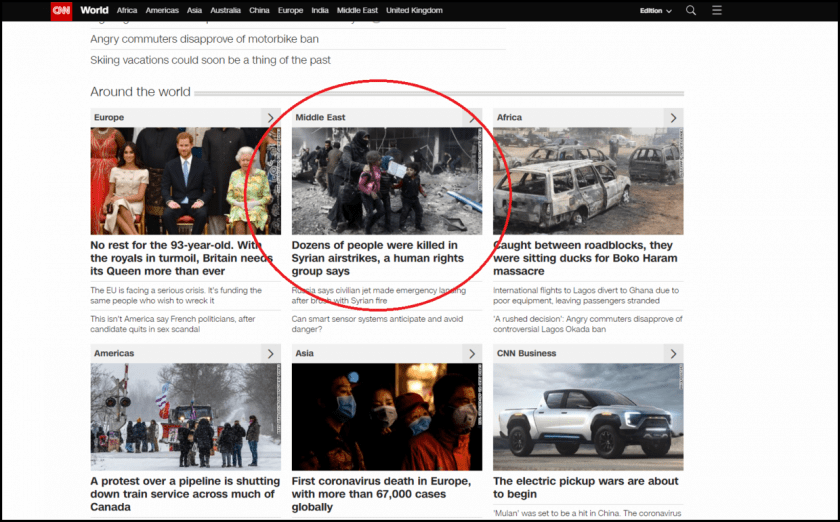
A screenshot from CNN’s ‘World’ page, February 15, 2020
The only problem is that Ghouta has been under the control of Assad’s government for nearly two years. Homes in the region are being rebuilt, not leveled by bombs.
In fact, CNN ran the same story, word for word, back in February 2018. The same paragraphs detailing the horrendous bombing appeared, along with a handy get-out-clause: “CNN could not independently verify the claim.”
So why tell old news again? Did the network feel the need to remind its readers again which side they should take in Syria’s eight-year civil war? Did its editors slip in an old story under the radar to bulk up its weekend coverage?
Whatever the reason, Saturday is often a slow news day, and clicks are clicks. After all, if it weren’t for the ad revenue generated by stories like this, CNN couldn’t send its reporters into the field to cover the stories that really matter, like when it revealed how President Trump eats “chicken with a fork.” Nor could it afford to pay its journalists to doxx pro-Trump meme makers and mock Trump supporters’ ‘yokel’ accents.
Perhaps CNN listened to its audience, one of whom complained on Sunday “how there’s still nothing about Syria on the CNN front page.” Perhaps in the rush to pump out Syria-related content for this one viewer, its editors figured anything was better than nothing.
CNN is sometimes accused of peddling ‘fake news,’ but the real reason for the Syria rerun was probably less sinister. The article’s URL features the same 2018 date as the original, meaning some overworked editor likely pressed the wrong button in the website’s backend.
Though its publication was likely a slip of the mouse, the article conveniently bolstered the pro-rebel coverage of Syria’s venerable conflict.
“Sure, CNN will claim there was a minor edit,” journalist Eva Bartlett wrote on Facebook. “But as a ‘professional news organization,’ if that were the strange case, they should remove the fake news article from the rest of their current fake news.”
People in NATO Countries Say ‘No’ to Supporting a NATO Ally in a Military Conflict with Russia
By Adam Dick | Ron Paul Institute | February 11, 2020
NATO is marketed as providing each member nation with the benefit that the other member nations are committed to coming to its aid militarily in the event of an attack by another nation, especially Russia. However, Pew Research Center poll results released Sunday indicate that the majority or plurality of people in 11 of 16 NATO countries where individuals were questioned oppose their respective governments meeting this commitment, at least if the military adversary were Russia.
These poll results indicate that serious thought should be given to disbanding NATO, an organization with a primary objective that appears to be at odds with public opinion in many NATO countries.
When asked if their respective countries’ governments should use military force to defend a NATO ally country neighboring Russia with which “Russia got into a serious military conflict,” people living in the 16 NATO countries tended to answer in the negative. “No” was the answer for the majority of polled individuals in eight countries — France, Germany, Greece, Italy, Spain, Bulgaria, Slovakia, and Turkey. In three more NATO countries — the Czech Republic, Hungary, and Poland — a plurality rejected military intervention. Only in five countries — the United States, Canada, the United Kingdom, the Netherlands, and Lithuania — did more people (a majority in each case) support such military intervention than reject it.
Read the poll results here.
American Citizens Killed and Tortured by Israel?
No one is ever held accountable

Palestinian-American Mahmoud Shaalan was shot five times by Israeli soldiers at a West Bank checkpoint
By Philip Giraldi | American Herald Tribune | February 15, 2020
One of the principal functions of a United States Embassy overseas is to provide citizen services, which includes coming to the assistance of Americans who are treated badly by the local government. It is a responsibility that most embassies take seriously, with the exception of the facility currently located in Jerusalem. One has to understand that that is so because the United States Embassy in Israel is like no other. In other countries, the American Embassy exists to support American travelers, businesses and a broad range of national interests. In Jerusalem the Embassy exists to support Israeli interests and to serve as an apologist every time the government of Prime Minister Benjamin Netanyahu goes on a killing spree or does something else that is similarly outrageous, to include bombing neighboring Syria every other day.
America’s current ambassador, former Trump bankruptcy lawyer David Friedman, has funded Israel’s illegal settlements, which did not in any way complicate his confirmation as nearly everyone in Congress and the White House does not believe that the Palestinians actually are human beings. Since taking up his position, Friedman has defended Israel when its army sharpshooters have shot down scores of unarmed Gazans, including children, and has both praised and endorsed out-and-out theft by the Israeli government in Jerusalem, on the West Bank and the Golan Heights.
What the U.S. Embassy under Friedman will not do is put any real pressure on the Israeli government if its security forces or rampaging settlers kill, beat, maim or torture an American citizen, especially if said citizen happens to be of Palestinian descent. Indeed, Friedman is only the latest manifestation of Israel-first-itis among U.S. Ambassadors, the rot having started inevitably with Bill Clinton, who appointed Australian citizen Martin Indyk as the first Jewish ambassador to Tel Aviv. The two most recent ambassadors, Friedman and Daniel Shapiro, both political appointees, have also been Jewish. Shapiro so enjoyed being an Israeli that he decided to remain in the country after his appointment as ambassador was completed. He now works for an Israeli government funded think tank.
The Israeli army and police have in fact killed a number of American citizens without any real pushback from the Department of State or White House. The unwillingness to confront Israel on any level stems from the formidable Jewish power in the United States, which uses money and media control to corrupt the political system at national, state and local levels. The media and the chattering political class worry about Russian interference while ignoring the implications of a Haaretz article that appeared on February 12th entitled “AIPAC Must Stop Bernie Sanders – At All Costs!” AIPAC is, of course, the American Israel Public Affairs Committee, widely regarded as the chief U.S. lobbying arm of the Jewish state.
And witness the fate of Congresswoman Betty McCollum from Minnesota, who fell afoul of the Israel Lobby when she introduced H.R.2407, legislation that prohibits American taxpayer money from being used by Israel to arrest and detain Palestinian children. She stated that “Israel’s system of military juvenile detention is state-sponsored child abuse designed to intimidate and terrorize Palestinian children and their families. It must be condemned, but it is equally outrageous that U.S. tax dollars in the form of military aid to Israel are permitted to sustain what is clearly a gross human rights violation against children.” She might have added that the estimated 10,000 Arab children who have been detained since 2000 are frequently tortured by the Israeli authorities. The bill currently has 23 cosponsors and is unlikely to attract more due to fear of the Lobby. It will never reach the House floor for a vote and will never become law.

Betty McCollum U.S. Representative for Minnesota’s 4th congressional district at a women’s roundtable at Hillary for Minnesota Headquarters in St Paul, MN. Credit: Lorie Shaull/ Flickr
McCollum’s courage was on display when she was viciously attacked by AIPAC, which posted Facebook ads that referenced “radicals in the Democratic party,” including a photo of McCollum, with the text stating that “It’s critical that we protect our Israeli allies especially as they face threats from Iran, Hamas, Hezbollah ISIS and — maybe more sinister — right here in the U.S. Congress.” McCollum stood her ground against being called “more sinister” than ISIS and released a statement that describes AIPAC as a “hate group,” which of course it is, but she will find few in the Democratic party brave enough to defend her.
Israel’s willingness to kill Americans in support of what it perceives as its own interests goes back nearly to the founding of the state in 1948. The Lavon Affair of 1954 was an Israeli plot to bomb the U.S. Embassy Information Agency libraries in Alexandria and Cairo Egypt, blaming the attacks on the Egyptians to draw the United States closer to Israel. The bombs were placed by Egyptian Jews acting for Israeli intelligence. They exploded, but fortunately no one was killed.
In June 1967 Israel was at it again, attacking the intelligence gathering U.S. naval vessel the U.S.S. Liberty in international waters, killing thirty-four American sailors, Marines and civilians in a deliberate air and sea onslaught that sought to sink the intelligence gathering ship and kill all its crew. It was the worst attack ever carried out on a U.S. Naval vessel in peace time. In addition to the death toll, 171 more of the crew were wounded in the two-hour assault. The Israelis, whose planes had their Star of David markings covered up so Egypt could be blamed, attacked the ship repeatedly from the air and with gunboats from the sea. When one Israeli pilot hesitated, refusing to attack what was clearly an American ship, he was instructed to proceed anyway.
The most disgusting part of the tale relates to how U.S. warplanes sent to the Liberty’s aid from an aircraft carrier in the Mediterranean were called back by Defense Secretary Robert McNamara acting under orders from President Lyndon Baines Johnson, who declared that he would rather see the ship go to the bottom of the sea than embarrass his good friend Israel. Ironically, the first ship to reach the Liberty and offer assistance was from the Soviet Union, an offer that was declined.
More recently there have been a number of killings of Americans. In a bizarre incident in August 1988, an elderly Palestinian-American with a heart condition died after being forced to climb stairs to paint over anti-Israeli graffiti on a school wall. Rebhi Barakat Kaid, 67, of Columbus, Ohio, was on the West Bank visiting relatives. He died of a heart attack after three Israeli soldiers ordered him and his 14-year-old Chicago-born grandson at gunpoint to climb the 22 steep steps that led from the house to the street above without his being allowed to take his heart medicine first.
Much better known is the March 2003 killing of Washington State’s Rachel Corrie, who was deliberately run over by an Israeli military bulldozer when she was protesting the destruction of a Palestinian village. A month later there was an incident in which Brian Avery, a 24-year-old from Albuquerque, New Mexico, was shot in the face in the occupied West Bank city of Jenin by Israeli soldiers in an armored personnel carrier firing machine guns at protesters.

Rachel Corrie lies on the ground fatally injured by an Israeli bulldozer driver. Rachel’s fellow activists are trying to keep her neck straight due to spinal injury. Photo by Joseph Smith. Credit: ISM
In March 2009 Tristan Anderson, a 37-year-old from Oakland, California, suffered permanent brain damage when Israeli soldiers shot him in the face with a tear gas canister as he watched a protest in the West Bank village of Nilin.
Another American citizen, Furkan Doğan, an 18-year-old born in Troy, New York, was killed aboard the Turkish flagged Mavi Marmara in the Mediterranean Sea in May 2010 as a flotilla of international activists attempted to break Israel’s illegal blockade of the Gaza Strip to deliver humanitarian supplies. The United Nations’ General Assembly Human Rights Council determined that Doğan had been killed by Israeli naval commandos through an “extra-legal, arbitrary and summary execution.” He was shot five times, including once in the face from “point blank range.”

Furkan Doğan
The same day that Israel murdered Furkan Doğan, 21-year-old Emily Henochowicz of Potomac, Maryland, was protesting the attack on the flotilla at the Qalandiya checkpoint near Jerusalem, when an Israeli soldier shot her in the face with a teargas cannister, resulting in the loss of an eye.
And then there was in October 2014 the shooting by Israeli soldiers of Orwa Hammad, a 14-year-old Palestinian-American from Louisiana. The Israeli army claimed that Hammad was throwing a Molotov cocktail at the time of his death, but witnesses stated that he was among a group of children throwing rocks at the heavily armed and armored soldiers.
And most recently, there is the case of Florida-born 16-year-old Palestinian-American Mahmoud Shaalan who was shot repeatedly at an Israeli check point on the West Bank on February 26, 2016 while he was walking to a nearby village to visit his aunt. He was still alive after the shooting, but Israeli soldiers denied him any medical treatment for three hours and he died before an ambulance was allowed to approach him.
Arrest of Palestinians and others without probable cause under “administration detention” guidelines followed by torture has also become a hallmark of Israel’s occupation of Arab land. Torture methods used by Israel include stress positions, severe beatings, sleep deprivation, emotional blackmail, threats of torture of family members and the transfer of detainees to secret prisons where torture is constant. In one case reported to a Human Rights Association “The harsh beating was committed with the intention to kill the detainee.”
In another reported case of torture, nineteen-year-old Mahmoud Zakarner’s testicles were smashed by soldiers in front of his uncle to force the man to provide the names of Palestinian resistance members. Mahmoud is now paralyzed and unable to speak as a result.
Israeli expertise in torture is in demand from authoritarian regimes worldwide, creating a growth industry for the specialized “advisers and technicians.” Many are currently working with right wing regimes in South and Central America. Several even showed up at Abu Ghraib as trainers for U.S. interrogators and were able to suggest refinements like the “Palestinian chair.”
Inside Israel torture of Palestinians is routine on the grounds of “necessity” and absurd “ticking-bomb” scenarios. The courts and the medical profession aid and abet the practice. Over 1,200 complaints regarding the torture of Palestinians in Israeli prisons have not resulted in even a single indictment of the torturers.
So, killing Americans as well as many others and torturing prisoners are all in a day’s work for the Jewish state. What is disgraceful, of course, is the fact that the United States government, which has the power to do something about it, instead chooses to do nothing to stop the bleeding or even to demand inquiries to find out who is to blame. Instead, Washington lavishes money and praise on Israel, reportedly America’s best friend and closest ally, while it also avoids looking at the horrors that are evident to most of the rest of the world.
Philip M. Giraldi is a former CIA counter-terrorism specialist and military intelligence officer who served nineteen years overseas in Turkey, Italy, Germany, and Spain. He was the CIA Chief of Base for the Barcelona Olympics in 1992 and was one of the first Americans to enter Afghanistan in December 2001. Phil is Executive Director of the Council for the National Interest, a Washington-based advocacy group that seeks to encourage and promote a U.S. foreign policy in the Middle East that is consistent with American values and interests.
Andrew McCabe’s case shows hypocrisy of Democrats claiming ‘No one is above the law’
By Nebojsa Malic | RT | February 15, 2020
After months of hearing that President Donald Trump must be impeached because “no one is above the law,” America found out that this talking point doesn’t actually apply to Democrats such as ex-FBI deputy director Andy McCabe.
As his lawyers triumphantly announced on Friday, the Department of Justice decided not to press criminal charges against McCabe “after careful consideration” of the inspector-general’s report that said he lied to investigators and leaked to the media.
“Based on the totality of the circumstances and all of the information known to the Government at this time, we consider the matter closed,” said the DOJ letter. It sent waves of glee through the ‘Resistance’ establishment, which set up and propagated for years the ‘Russiagate’ hysteria aimed at removing Trump from office.
One of the people who cheered “Andy” was Lisa Page, the FBI lawyer who famously discussed an “insurance policy” in case Trump gets elected in McCabe’s office with agent Peter Strzok, with whom she was carrying on an extramarital affair. Strzok, Page and McCabe’s fingerprints are all over the FISA scandal – in which the FBI spied on Trump’s campaign, fishing for dirt to tie him to Russia.
Though he was fired from the FBI, McCabe was hired by CNN back in August, joining former CIA Director John Brennan and former Director of National Intelligence James Clapper – two other ‘Russiagate’ pushers – in the lucrative land of political punditry.
In fact, precisely zero people involved with setting up and conducting the three-year “witch hunt” of Trump – unprecedented in the history of the American republic, by any measure – have suffered any adverse consequences for it. Even Michael Avenatti – the sleazy lawyer who has apparently defrauded and embezzled multiple clients in pursuit of political ambition – has only been convicted of attempting to extort Nike, rather than, say, lying to the Senate during the confirmation of Justice Kavanaugh.
Compare that to how anyone even remotely associated with Trump has been treated by the long arm of the law. Former campaign manager Paul Manafort was imprisoned over matters entirely unrelated to the 2016 election. Trump’s first national security adviser, General Michael Flynn, was fired after just two weeks on the job and bullied into pleading guilty for “lying to FBI agents” (one of whom turned out to be Strzok) – which he is now contesting. Campaign aide George Papadopoulos went to jail because he made a remark about Hillary Clinton’s private email server that was used to claim Trump was “colluding” with Russia. Political operative Roger Stone is currently facing the possibility of dying in prison for tripping into a perjury trap.
Trump has done little or nothing to help any of his former staff or associates. Admittedly, Democrats and the media both shrieked “abuse of power” when he merely tweeted about Stone’s proposed sentence being too harsh – showing once again that it’s never about the what, only about the who/whom.
Having come to Washington on a promise to “drain the swamp,” Trump has instead meekly submitted to the very same swamp’s endless lawfare. Yet that kind of restraint has not stopped his critics from declaring him a fascist, tyrant and dictator. In fact, the more he let them off the hook, the more they shrieked about how he seeks to subvert justice!
The case of Andrew McCabe – and his boss Jim Comey before him – is the perfect illustration that there are people effectively above the law. That there are in fact two sets of laws in America: one for Trump’s enemies, who have gotten away with a coup, and another for the “deplorables” who got punished for supporting him.
Justice must not only be done, it must be seen to be done. There is a point at which restraint turns into stupid magnanimity.
On more than one occasion, Trump has used ‘Game of Thrones’ memes. If he actually watched the show from the beginning, he might remember that Ned Stark’s naivete about the impartiality of King’s Landing law enforcement ended with his head on a pike outside the Red Keep.
Nebojsa Malic is a Serbian-American journalist, blogger and translator, who wrote a regular column for Antiwar.com from 2000 to 2015, and is now senior writer at RT. Follow him on Twitter @NebojsaMalic
Featured Video

or go to
Aletho News Archives – Video-Images
Book Review
The Zeolite Book — First Edition, 2026, Paperback
The volcanic mineral medicine will not patent — for the toxic burden medicine will not name
Lies are Unbekoming – October 30, 2026
 Zeolite is old. It is in Roman concrete that has held for two thousand years. It’s in the water filters of ancient cisterns. It’s in the stomachs of Pacific livestock whose keepers knew, somehow, that this grey crumbling rock made the animals healthier. It’s in Soviet clinical protocols from the 1960s. It’s in the standard emergency response to the Chernobyl explosion.
In 1986, after the Chernobyl reactor failure, the Soviet Union manufactured and distributed natural zeolite at industrial scale — for soil remediation, for livestock feed, for human consumption, for the cleanup itself. Karl Hecht, who had been director of the Institute for Experimental and Clinical Pathophysiology at the Charité of Humboldt University Berlin, spent the six decades after that building the clinical research base — on silicon’s role in human health, on zeolite’s clinical safety, on its applications in ageing. In 2018, Pavelić and colleagues published a comprehensive clinical safety review of natural clinoptilolite in Frontiers in Pharmacology. In 2019, Mastinu analysed its binding affinities. In the Western medical literature, these works sit largely uncited.
What has not been treated at book length, until now, is how a volcanic mineral with six decades of Soviet clinical work behind it, two major peer-reviewed Western reviews, and ongoing clinical use across the former Eastern Bloc, remains almost entirely absent from Western medical practice — and what the toxic burden it’s meant to address actually is.
The Zeolite Book gathers the Soviet clinical record, the Western peer-reviewed studies, three contemporary practitioner voices, and three serious counterviews into one honest treatment. That’s why the book runs to seven appendices. 288 pages, four parts, three practitioner voices, three counterviews, seven appendices. The honest treatment is the argument.
Blog Roll
 Aletho News
- Wrong, AP and NPR: Europe’s 50,000 Heat Deaths Are a Computer-Model Estimate, Not a Real Body Count
- Questioning Your Doctor Is Now Considered A Psychological Problem (Seriously)
- London tourism expo promotes Israeli agency linked to theft of Palestinian land
- Dockworkers launch global strike against Israeli and US military shipments
- Europe facing gas price shock – Gazprom chief
- Ukraine continues recruiting people with disabilities
- Weaponized Journalism: 2021 Sayer Ji Interview with NPR
- Beyond Netanyahu: what Israel’s election means for Palestinians
- Lithuania plans universal conscription
- Lies, Damn Lies, and Ukraine News
- If Americans Knew
- An error has occurred; the feed is probably down. Try again later.
- No Tricks Zone
- Germany’s Green Energy Transition Becoming Increasingly Expensive…Another 6 Trillion Euros!
- Sudden Stratospheric Warming, Powerful El Niño Combination May Lead To Extreme Europe Cold, Energy Crisis!
- Two New Studies Find Thwaites Glacier Melt Cannot Be Driven By Human Activity Or A Warming Ocean
- E-Cars Reduce CO2 Emissions By Only 41% Compared To Internal Combustion Engine Vehicles
- Predictions Made By Renowned Climate Professor Over Past Decades Have Been Proven To Be Poor
- New Study Suggests Large Regions Of The Pacific Ocean Have Been Cooling For The Last 80 Years
- Germany’s Green Energy Debacle: High Energy Costs Force Kahla Porzellan to Close After 182 Years!
- New Study: 50 Years Of The Most Aggressive ‘Net Zero’ Policies Can Only Affect The Global Climate By 0.03°C
- US September “Heat” Was No Record…Many Records Set Decades Ago
- Latest European Green Energy Debacle; Portugal’s Largest Flagship Solar Park Insolvent!

