US Demands Russia ‘Immediately Ground Warplanes’ Over Syria
Sputnik – February 29, 2020
The situation in the northwestern Syrian renegade province of Idlib escalated again on Thursday after Syrian forces responding to a Nusra Front assault accidentally struck Turkish positions, killing 33 troops and injuring dozens more. The attack prompted the UN Security Council to call an emergency meeting on the situation in Syria.
The US “fully supports” Turkey’s right “to respond in self-defence” to the “unjustified” attacks on Turkish forces in Idlib, Syria which killed nearly three dozen troops Thursday, US Permanent Representative to the UN Kelly Craft has said.
“We call on the Russian Federation to immediately ground its warplanes. And we call for all Syrian forces and their Russian backers to withdraw to the ceasefire lines first established in 2018,” Craft said, speaking at the UN Security Council’s emergency meeting on Syria on Friday.
“The United States is not here today to listen and discuss. We are here to speak directly and without qualification,” Craft warned. “In the days ahead, the United States’ commitment to our NATO ally, Turkey, will not waver,” the ambassador added.
Calling the Astana format for Syrian peace talks “broken beyond repair,” Craft said that the US wants “an immediate, durable, and verifiable ceasefire in northwest Syria,” and urged the UN to “play a central, active role if we are to avoid even greater escalation.”
Responding to Craft, Russian Permanent Representative to the UN Vasily Nebenzya pointed out that the incident involving the deaths of Turkish military personnel took place outside Turkey’s observation post base, and stressed that Syria has the right to target terrorists. Nebenzya recalled that the Nusra terrorists in control of large swathes of Idlib have dramatically increased their attacks against civilians and the Syrian military in recent weeks, giving the Syrian Army the right to respond.
The Syrian Ambassador to the UN Bashar al-Jaafari, meanwhile, accused Turkey of aggression, and alleged that Ankara was using its observation posts to provide assistance to the terrorists. Al-Jaafari also accused the UK of calling Friday’s Security Council meeting to try to discredit the Astana format.
Black Thursday
Turkish and Syrian forces became engaged in a shooting war in the restive Idlib region earlier this month, after a Syrian artillery attack on one of Turkey’s dozen observation posts killed over half-a-dozen Turkish troops, resulting in a wave of Turkish attacks on Syrian forces. On Thursday, Nusra terrorists launched a large-scale offensive on Syrian Army positions, with Syrian forces responding, with 33 Turkish troops killed in Syria’s counterattack. Shortly thereafter, the Russian military’s Syrian monitoring mission reported that Turkish troops were mixed in among the Nusra militants as the latter came under artillery attack.
On Saturday, the Russian Foreign Ministry stated that Moscow and Ankara had committed to reducing tensions on the ground in Idlib. The same day, however, Turkish President Recep Tayyip Erdogan told reporters that he had asked Russian President Vladimir Putin to “get out of our way” and to leave Turkey “face to face” with the Syrian government.
The threat of a nuclear war between the US and Russia is now at its greatest since 1983
By Scott Ritter | RT | February 29, 2020
When the Commander of NATO says he is a fan of flexible first strike at the same time that NATO is flexing its military muscle on Russia’s border, the risk of inadvertent nuclear war is real.
US Air Force Gen. Tod D Wolters told the Senate this week he “is a fan of flexible first strike” regarding NATO’s nuclear weapons, thereby exposing the fatal fallacy of the alliance’s embrace of American nuclear deterrence policy.
It was one of the most remarkable yet underreported exchanges in recent Senate history. Earlier this week, during the testimony before the Senate Armed Services Committee of General Tod Wolters, the commander of US European Command and, concurrently, as the Supreme Allied Commander in Europe (SACEUR) also the military head of all NATO armed forces, General Wolters engaged in a short yet informative exchange with Senator Deb Fischer, a Republican from the state of Nebraska.
Following some initial questions and answers focused on the alignment of NATO’s military strategy with the 2018 National Defense Strategy of the US, which codified what Wolters called “the malign influence on behalf of Russia” toward European security, Senator Fischer asked about the growing recognition on the part of NATO of the important role of US nuclear deterrence in keeping the peace. “We all understand that our deterrent, the TRIAD, is the bedrock of the security of this country,” Fischer noted. “Can you tell us about what you are hearing…from our NATO partners about this deterrent?”
Wolters responded by linking the deterrence provided to Europe by the US nuclear TRIAD with the peace enjoyed on the European continent over the past seven decades. Fischer asked if the US nuclear umbrella was “vital in the freedom of NATO members”; Wolters agreed. Remarkably, Wolters linked the role of nuclear deterrence with the NATO missions in Iraq, Afghanistan and elsewhere outside the European continent. NATO’s mission, he said, was to “proliferate deterrence to the max extent practical to achieve greater peace.”
Then came the piece de resistance of the hearing. “What are your views, Sir,” Senator Fischer asked, “of adopting a so-called no-first-use policy. Do you believe that that would strengthen deterrence?”
General Wolters’ response was straight to the point. “Senator, I’m a fan of flexible first use policy.”
Under any circumstance, the public embrace of a “flexible first strike” policy regarding nuclear weapons employment by the Supreme Allied Commander in Europe should generate widespread attention. When seen in the context of the recent deployment by the US of a low-yield nuclear warhead on submarine-launched ballistic missiles carried onboard a Trident submarine, however, Wolters’ statement is downright explosive. Add to the mix the fact the US recently carried out a wargame where the US Secretary of Defense practiced the procedures for launching this very same “low yield” weapon against a Russian target during simulated combat between Russia and NATO in Europe, and the reaction should be off the charts. And yet there has been deafening silence from both the European and US press on this topic.
There is, however, one party that paid attention to what General Wolters had to say–Russia. In a statement to the press on February 25–the same date as General Wolters’ testimony, Sergey Lavrov, the Russian Foreign Minister stated that “We note with concern that Washington’s new doctrinal guidelines considerably lower the threshold of nuclear weapons use.” Lavrov added that this doctrine had to be viewed in the light “of the persistent deployment of US nuclear weapons on the territory of some NATO allies and the continued practice of the so-called joint nuclear missions.”
Rather than embracing a policy of “flexible first strike”, Lavrov suggested that the US work with Russia to re-confirm “the Gorbachev-Reagan formula, which says that there can be no winners in a nuclear war and it should never be unleashed.” This proposal was made 18 months ago, Lavrov noted, and yet the US has failed to respond.
Complicating matters further are the ‘Defender 2020’ NATO military exercises underway in Europe, involving tens of thousands of US troops in one of the largest training operations since the end of the Cold War. The fact that these exercises are taking place at a time when the issue of US nuclear weapons and NATO’s doctrine regarding their employment against Russia is being actively tracked by senior Russian authorities only highlights the danger posed.
On February 6, General Valery Gerasimov, the Russian Chief of Staff, met with General Wolters to discuss ‘Defender 2020’ and concurrent Russian military exercises to be held nearby to deconflict their respective operations and avoid any unforeseen incidents. This meeting, however, was held prior to the reports about a US/NATO nuclear wargame targeting Russian forces going public, and prior to General Wolters’ statement about “flexible first use” of NATO nuclear weapons.
In light of these events, General Gerasimov met with French General Fançois Lecointre, the Chief of the Defense Staff, to express Russia’s concerns over NATO’s military moves near the Russian border, especially the Defender 2020 exercise which was, General Gerasimov noted, “held on the basis of anti-Russian scenarios and envisage training for offensive operations.”
General Gerasimov’s concerns cannot be viewed in isolation, but rather must be considered in the overall historical context of NATO-Russian relations. Back in 1983, the then-Soviet Union was extremely concerned about a series of realistic NATO exercises, known as ‘Able Archer ‘83,’ which in many ways mimicked the modern-day Defender 2020 in both scope and scale. Like Defender 2020, Able Archer ‘83 saw the deployment of tens of thousands of US forces into Europe, where they assumed an offensive posture, before transitioning into a command post exercise involving the employment of NATO nuclear weapons against a Soviet target.
So concerned was Moscow about these exercises, and the possibility that NATO might use them as a cover for an attack against Soviet forces in East Germany, that the Soviet nuclear forces were placed on high alert. Historians have since observed that the threat of nuclear war between the US and the USSR was at that time the highest it had been since the Cuban Missile Crisis in 1962.
US and NATO officials would do well to recall the danger to European and world security posed by the “Able Archer ‘83” exercise and the potential for Soviet miscalculations when assessing the concerns expressed by General Gerasimov today. The unprecedented concentration of offensive NATO military power on Russia’s border, coupled with the cavalier public embrace by General Wolters of a “flexible first strike” nuclear posture by NATO, has more than replicated the threat model presented by Able Archer ’83. In this context, it would not be a stretch to conclude that the threat of nuclear war between the US and Russia is the highest it has been since Able Archer ’83.
Scott Ritter is a former US Marine Corps intelligence officer. He served in the Soviet Union as an inspector implementing the INF Treaty, in General Schwarzkopf’s staff during the Gulf War, and from 1991-1998 as a UN weapons inspector. Follow him on Twitter @RealScottRitter
Seth Rich, Julian Assange and Dana Rohrabacher – Will We Ever Know the Truth About the Stolen DNC Files?
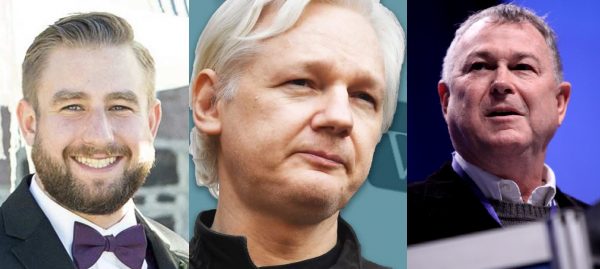
Seth Rich, Julian Assange and Dana Rohrabacher. Credit: Public domain/Gage Skidmore/ Flickr
By Philip Giraldi | American Herald Tribune | February 29, 2020
The media is doing its best to make the story go away, but it seems to have a life of its own, possibly due to the fact that the accepted narrative about how Rich died makes no sense. In its Iatest manifestation, it provides an alternative explanation for just how the information from the Democratic National Committee (DNC) computer somehow made its way to Wikileaks. If you believe that Jeffrey Epstein committed suicide and that he was just a nasty pedophile rather than an Israeli intelligence agent, read no farther because you will not be interested in Rich. But if you appreciate that it was unlikely that the Russians were behind the stealing of the DNC information you will begin to understand that other interested players must have been at work.
For those who are not familiar with it, the backstory to the murder of apparently disgruntled Democratic National Committee staffer Seth Rich, who some days before may have been the leaker of that organization’s confidential emails to Wikileaks, suggests that a possibly motiveless crime might have been anything but. The Washington D.C. police investigated what they believed to be an attempted robbery gone bad but that theory fails to explain why Rich’s money, credit cards, cell phone and watch were not taken. Wikileaks has never confirmed that Rich was their source in the theft of the proprietary emails that had hitherto been blamed on Russia but it subsequently offered a $20,000 reward for information leading to resolution of the case and Julian Assange, perhaps tellingly, has never publicly clarified whether Rich was or was not one of his contacts, though there is at least one report that he confirmed the relationship during a private meeting.
Answers to the question who exactly stole the files from the DNC server and the emails from John Podesta have led to what has been called Russiagate, a tale that has been embroidered upon and which continues to resonate in American politics. At this point, all that is clearly known is that in the Summer of 2016 files and emails pertaining to the election were copied and then made their way to WikiLeaks, which published some of them at a time that was damaging to the Clinton campaign. Those who are blaming Russia believe that there was a hack of the Democratic National Committee (DNC) server and also of John Podesta’s emails that was carried out by a Russian surrogate or directly by Moscow’s military intelligence arm. They base their conclusion on a statement issued by the Department of Homeland Security on October 7, 2016, and on a longer assessment prepared by the Office of the Director of National Intelligence on January 6, 2017. Both government appraisals implied that there was a U.S. government intelligence agency consensus that there was a Russian hack, though they provided little in the way of actual evidence that that was the case and, in particular, failed to demonstrate how the information was obtained and what the chain of custody was as it moved from that point to the office of WikiLeaks. The January report was particularly criticized as unconvincing, rightly so, because the most important one of its three key contributors, the National Security Agency, had only moderate confidence in its conclusions, suggesting that whatever evidence existed was far from solid.
An alternative view that has been circulating for several years suggests that it was not a hack at all, that it was a deliberate whistleblower-style leak of information carried out by an as yet unknown party, possibly Rich, that may have been provided to WikiLeaks for possible political reasons, i.e. to express disgust with the DNC manipulation of the nominating process to damage Bernie Sanders and favor Hillary Clinton.
There are, of course, still other equally non-mainstream explanations for how the bundle of information got from point A to point B, including that the intrusion into the DNC server was carried out by the CIA which then made it look like it had been the Russians as perpetrators. And then there is the hybrid point of view, which is essentially that the Russians or a surrogate did indeed intrude into the DNC computers but it was all part of normal intelligence agency probing and did not lead to anything. Meanwhile and independently, someone else who had access to the server was downloading the information, which in some fashion made its way from there to WikiLeaks.
Both the hack vs. leak viewpoints have marshaled considerable technical analysis in the media to bolster their arguments, but the analysis suffers from the decidedly strange fact that the FBI never even examined the DNC servers that may have been involved. The hack school of thought has stressed that Russia had both the ability and motive to interfere in the election by exposing the stolen material while the leakers have recently asserted that the sheer volume of material downloaded indicates that something like a higher speed thumb drive was used, meaning that it had to be done by someone with actual physical direct access to the DNC system. Someone like Seth Rich.
What the many commentators on the DNC server issue choose to conclude is frequently shaped by their own broader political views, producing a result that favors one approach over another depending on how one feels about Trump or Clinton. Or the Russians. Perhaps it would be clarifying to regard the information obtained and transferred as a theft rather than either a hack or a leak since the two expressions have taken on a political meaning of their own in the Russiagate context. With all the posturing going on, the bottom line is that the American people and government have no idea who actually stole the material in question, though the Obama Administration was extraordinarily careless in its investigation and Russian President Vladimir Putin has generally speaking been blamed for what took place.
The story currently bouncing around the media concerns an offer allegedly made in 2017 by former Republican Congressman Dana Rohrabacher to imprisoned WikiLeaks founder Julian Assange. According to Assange’s lawyers, Rohrabacher offered a pardon from President Trump if Assange were to provide information that would attribute the theft or hack of the Democratic National Committee emails to someone other than the Russians. He was presumably referring to Seth Rich.
Assange did not accept the offer, but it should be noted that he has repeatedly stated in any event that he did not obtain the material from a Russian or Russian-linked source. In reality, he might not know the original source of the information. Since Rohrabacher’s original statement, both he and Trump have denied any suggestion that there was a firm offer with a quid pro quo for Assange. Trump claims to hardly know Rohrabacher and also asserts that he has never had a one-on-one meeting with him.
The U.S. media’s coverage of the story has emphasized that Assange’s cooperation would have helped to absolve Russia from the charge of having interfered decisively in the U.S. election, but the possible motive for doing so remains unclear. Russian-American relations are at their lowest point since the Cold War and that has largely been due to policies embraced by Donald Trump, to include the cancellation of START and medium range missile agreements. Trump has also approved NATO military maneuvers and exercises right up to the Russian border and has provided lethal weapons to Ukraine, something that his predecessor Barack Obama balked at. He has also openly confronted the Russians in Syria.
Given all of that back story, it would be odd to find Trump making an offer that focuses only on one issue and does not actually refute the broader claims of Russian interference, which are based on a number of pieces of admittedly often dubious evidence, not just the Clinton and Podesta emails. Which brings the tale back to Seth Rich. If Rich was indeed responsible for the theft of the information and was possibly killed for his treachery, it most materially impacts on the Democratic Party as it reminds everyone of what the Clintons and their allies are capable of. It will also serve as a warning of what might be coming at the Democratic National Convention in Milwaukee in July as the party establishment uses fair means or foul to stop Bernie Sanders. How this will all play out is anyone’s guess, but many of those who pause to observe the process will be thinking of Seth Rich.
Philip M. Giraldi is a former CIA counter-terrorism specialist and military intelligence officer who served nineteen years overseas in Turkey, Italy, Germany, and Spain. He was the CIA Chief of Base for the Barcelona Olympics in 1992 and was one of the first Americans to enter Afghanistan in December 2001. Phil is Executive Director of the Council for the National Interest, a Washington-based advocacy group that seeks to encourage and promote a U.S. foreign policy in the Middle East that is consistent with American values and interests.
US, Taliban Sign Peace Agreement in Doha
Sputnik – February 29, 2020
Negotiators from the United States and the Taliban are meeting in Doha, Qatar to sign an accord that envisages the timetable of the US withdrawing some of its 13,000 troops. The Taliban, in turn, is expected to sever ties with all extremist groups and prevent the territories of Afghanistan from becoming havens for militants.
The United States and the Taliban movement have signed the long-awaited peace agreement in the Qatari capital of Doha on Saturday.
The troop withdrawal will be phased, with the US forces set to be slimmed down to 8,600 in the first 135 days since the deal’s announcement, while allied and coalition forces will be scaled down proportionately.
The residual US, allied and coalition forces will pull out within the remaining nine-and-a-half months, whereby all military bases will be abandoned.
Up to 5000 Taliban prisoners will be released from prisons by 10 March, the first day of intra-Afghan talks. The remaining prisoners will be freed within the next three months. The Taliban commits that its released prisoners will not pose a threat to the security of the US and its allies.
As soon as intra-Afghan talks begin, the US will start the review process of its sanctions on the Taliban and rewards lists issued for its members, with the goal of removing sanctions by 27 August. It will also engage with the UN Security Council and Afghan authorities to have national sanctions on the Taliban scrapped by 29 May.
The US pledges to seek economic cooperation for reconstruction with the new post-settlement Afghan Islamic government and will not intervene in its internal affairs.
In return, the Taliban will take steps to prevent terrorist groups, such as al-Qaeda, from using Afghan soil to threaten the security of the US and its allies.
They include sending a “clear message” that those posing such threat have no place in Afghanistan. The Taliban will instruct its members not to cooperate with such groups or individuals and prevent them from recruiting and fund-raising. It will only grant asylum to people who do not pose a security threat and will not issue visas or other documents to those considered a risk.
Following the signing of the deal, US State Secretary Mike Pompeo enumerated key conditions of the deal between the United States and the Taliban.
“Keep your promises, cut ties with Al-Qaeda. Keep up the fight against Daesh,” Pompeo said, addressing the Taliban.He added that the agreement was “a true test,” stressing that Washington will calibrate the pace of the troop withdrawal with the actions of the Taliban.
US President Donald Trump, for his part, welcomed the agreement as a move to put an end to the US most protracted war.
“We are working to finally end America’s longest war and bring our troops back home,” he said.The head of the militant group’s political office in Qatar said that the Taliban will adhere to the peace agreement signed in Doha on Saturday.
“The US and the Taliban movement have successfully concluded talks in Qatar. I congratulate everyone on this achievement. We will comply with the pact and, as a political force, we want it to be implemented by neighbouring countries,” Abdul Ghani Baradar said.In his turn, Afghan President Ashraf Ghani expressed hope that the long-awaited US-Taliban peace agreement would lead to a permanent ceasefire that in turn would bring stability to Afghanistan.
International Reactions to Historic Accord
NATO Secretary-General Jens Stoltenberg has said that the alliance supports the signing of the US-Taliban peace deal.
“This [deal] is a victory for peace, victory for Afghan people,” Stoltenberg said.The European Union has welcomed the long-awaited peace deal between the United States and the Taliban as a first step toward a negotiated peace process among all Afghans.
“The European Union considers today’s conclusion of the Afghanistan-US Joint Statement for Peace and the settlement between the US and the Taliban as important first steps towards a comprehensive peace process, with intra-Afghan negotiations at its core,” the declaration read.It urged the sides not to miss this opportunity for a lasting peace that could create an environment of security and stability in the war-torn country. Keeping up the reduction in violence is an important part of that process, it added.
“The EU calls on all stakeholders to put the interests of the nation above all other considerations, as the collective responsibility of all Afghan political forces,” it concluded.The UN Assistance Mission in Afghanistan (UNAMA) has called for the continuation of the reduced violence in Afghanistan and welcomed the commitment of the conflicting sides to further dialogue.
“Intra-Afghan negotiations are central to the peace efforts. The United Nations welcomes the commitment expressed by the parties to intra-Afghan negotiations; and urges them to move ahead expeditiously with their preparations to start the negotiations, including through forming a truly representative negotiation team,” UNAMA said in a statement.The United Nations also expressed its support to an inclusive Afghan-led process and called for concrete steps toward ending the war.
“The United Nations stresses the importance of continuing to reduce violence, especially violence that harms civilians, and urges all parties, in the period ahead, to redouble efforts to reduce violence on the way to a permanent ceasefire and a lasting political settlement,” the statement said.
Since 2018, Washington and the Taliban have been attempting to negotiate a peace deal that would ensure the withdrawal of foreign troops from Afghanistan in exchange for the movement’s guarantee that the country would not become a safe haven for terrorists. The parties’ representatives have been regularly meeting in Doha to address the issue.
The Media’s Deafening Silence on Mike Bloomberg’s Ties to Epstein and Other Criminals
By Whitney Webb | MintPress News | February 28, 2020
After his late jump into the Democratic primary and, as critics argue, purchasing his way into the primary debates, former Mayor of New York City Michael Bloomberg has received mixed coverage from corporate media, with many negative critiques of the current presidential contender’s history, conduct and connections.
Yet, despite efforts by other campaigns and more progressive-leaning media outlets to dampen Bloomberg’s chances at the nomination, one clear weakness of Bloomberg’s has thus far evaded meaningful media coverage: his ties to key players in the Epstein scandal, including Leslie Wexner, Ghislaine Maxwell and even Jeffrey Epstein himself.
Silence among outlets that largely oppose Bloomberg’s candidacy regarding his connections to Epstein and those in his close social orbit is odd, especially when reporting on an individual’s connections to the intelligence-linked pedophile are a sure-fire way to generate considerable negative attention and fodder for rival campaigns. This is particularly striking given that the numerous accusations that Bloomberg has long stoked a toxic culture of sexual harassment at his company, resulting in no small number of non-disclosure agreements over the years, have received some media attention. Yet, the fact that many of Bloomberg’s close friends have been accused of far, far worse has received hardly any coverage by comparison.
For instance, when it was announced last week that the controlling stake in the Leslie Wexner-owned lingerie company Victoria’s Secret would be sold to a private equity firm called Sycamore Partners, only one media outlet — The Intercept — revealed that Bloomberg has at least $136 million of his money in that firm. The Intercept noted in passing that Wexner — the source of most of Jeffrey Epstein’s supposed fortune, his close collaborator for decades and alleged rapist of many of his victims — had been pressured to step down following the scandal, which also hit Wexner-owned companies hard and had forced the Ohio-based billionaire to seek a buyer for his lingerie brand and its tarnished reputation. Yet, the outlet did not make the direct connection that Sycamore Partners-backer Bloomberg is a friend of Wexner’s and has attended Wexner’s personal social parties for years prior to the most recent scandal.
Here’s alleged-rapist Mike Bloomberg attending a fancy horse party at Les Wexner’s place (Wexner furthest right) in 2010, about a year before Wexner formally transferred ownership of his Manhattan townhouse to Jeffrey Epstein. Cheers to good friends 😊 pic.twitter.com/gS8wpUVF00
— ePal, Your Close Friend™-Enterprise Edition (@wash_cloth) February 17, 2020
Yet, even well before this recent opportunity to point out Bloomberg’s ties to Leslie Wexner, there have been plenty of opportunities for the media to question Bloomberg about his now-infamous picture with Ghislaine Maxwell, daughter of Mossad-connected Robert Maxwell and Epstein’s alleged madam and co-conspirator.
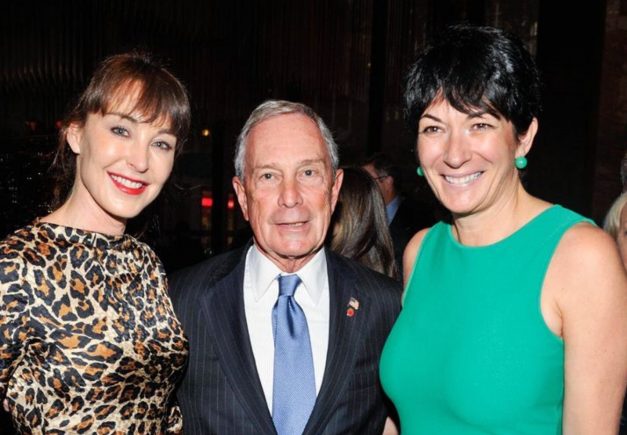
From left to right, Tamara Mellon, Mike Bloomberg and Ghislaine Maxwell
That picture, taken in 2013 at the Four Seasons restaurant in New York, has not been mentioned by mainstream media following the launch of Bloomberg’s candidacy late last November. Similarly, mainstream media have failed to question Bloomberg regarding why his name and five different telephone numbers for him appear in Jeffrey Epstein’s infamous list of contacts often referred to as his “little black book.”
Bloomberg and the Manhattan Swamp
The extent of the Maxwell-Bloomberg relationship is unknown, though Bloomberg’s deep ties to his former employer Salomon Brothers is a possible link, given that that firm served as one of the Maxwell family’s main investment bankers in the years prior to and following Robert Maxwell’s mysterious death in 1991. Similarly, Epstein had close ties to prominent figures on Wall Street, some dating back to his time at Bear Stearns, who are also close to Bloomberg.
Bloomberg and Epstein also shared close friendships with some of the same New York media executives like Mort Zuckerman. Media outlets have described Zuckerman, a former business partner of Epstein’s, as Bloomberg’s “long-time enabler.” In another example, Epstein’s former publicist Howard Rubenstein is a long-time supporter of Bloomberg and was reported to be the driving force behind Bloomberg’s controversial push to run around mayoral term limits and pursue a third term as Mayor of New York.
Another mutual Epstein-Bloomberg associate is disgraced media mogul Harvey Weinstein. Weinstein was part of an investment group with Epstein that sought to purchase New York magazine in 2003. Another member of that investment group was frequent MSNBC commentator Donny Deutsch, who has recently fervently backed Bloomberg’s candidacy.
Weinstein was recently convicted of rape and has dozens of accusers, whose decision to come forward about Weinstein’s sex crimes in recent years helped spark the “Me Too” movement. Weinstein also has ties to former Israeli Prime Minister Ehud Barak, who was a close friend and business associate of Epstein’s, and it was Barak who personally introduced Weinstein to former Mossad spies that Weinstein hired to intimidate his accusers. In addition to being Prime Minister, Barak is also the former head of Israeli military intelligence, the foreign intelligence agency that sponsored Epstein’s sexual blackmail operation involving underage girls in the United States.
Bloomberg’s candidacy has yet to be strongly challenged over his ties to Weinstein, which are considerable. For instance, Weinstein was a major backer of Bloomberg’s mayoral campaigns and even recorded robocalls on Bloomberg’s behalf to boost his election chances. Bloomberg, in turn, appointed Weinstein to a charity board and Weinstein later praised Bloomberg for aiding his film company. While Bloomberg’s ties to Wexner, Epstein and Maxwell have gotten the silent treatment, some outlets (mostly right-leaning) have covered the Bloomberg-Weinstein ties, but there has been little pressure on Bloomberg from mainstream media to address those ties directly.
Another close Bloomberg associate who recently has been accused by numerous women of sexual harassment is hedge fund manager Michael Steinhardt. Steinhardt is a long-time fixture in Bloomberg’s social circle and has long appeared at Bloomberg’s dinner parties. Steinhardt is also connected to Leslie Wexner through his membership in the so-called “Mega Group” — an exclusive group of organized-crime-linked “mega” donors to pro-Israel causes that Wexner co-founded in 1991. Steinhardt also boasts close ties to the now deceased founder of Glencore, the Mossad-linked Marc Rich, and Steinhardt — along with top Israeli politicians and spies — aggressively lobbied former President Bill Clinton to controversially pardon Rich before leaving office.
“Show me your friends and I’ll tell you who you are”
The oft-quoted saying “Show me your friends and I’ll tell you who you are,” seems to hold true for Bloomberg. For instance, his eponymous media conglomerate has received no small number of lawsuits over the years alleging rampant sexual harassment and even the rape of female workers, much of its allegedly egged on by Bloomberg’s long history of comments that have been derided as sexist. Many of those lawsuits ended in female accusers being asked to sign non-disclosure agreements (NDAs). More recently, The Nation reported that Bloomberg’s 2020 presidential campaign is making use of NDAs in such a way “that could prevent staffers from reporting workplace abuse.”
In addition, a 1999 profile of Bloomberg in Wired magazine quoted Bloomberg as saying “My daughter is tall and busty and blonde. We went to China together. And what’s a 16-year-old going to do on a business trip? So, I got her dates in every city in China.”
Bloomberg, not unlike Epstein and Wexner, also has a history of cozy ties to the CIA. For instance, during his tenure as Mayor of New York, Bloomberg actively promoted a controversial post-9/11 program that saw the CIA work directly with the NYPD to spy on the city’s Muslim communities. Even though the CIA is technically prohibited from spying on Americans not linked to criminal activity, one of the CIA officers working as part of the Bloomberg-backed program said he had “no limitations” on what he could do. Bloomberg has long defended this program and its merging of the CIA with local police.
In the case of Epstein and Wexner, as MintPress News reported in its viral series on the Epstein scandal last year, Epstein once claimed to have worked for the CIA during the 1980s and Epstein and Wexner were the key players behind the relocation of CIA front company Southern Air Transport to Ohio, where Wexner’s business interests have long been based.

Rudy Giuliani, left, New York Gov. George Pataki, center, and Mike Bloomberg during a “Salute to Israel Parade, May 5, 2002, in New York. Shawn Baldwin | AP
In addition, Bloomberg was also a key player in a controversial initiative regarding Israel’s intelligence-linked technology sector. For instance, Bloomberg created a $2 billion project that involved opening a Manhattan campus called “Cornell Tech” that brought together Cornell University and Israel’s Technion, which has close ties to Israel’s national security state and military-industrial complex. Bloomberg personally gave over $100 million to facilitate completion of that project. That campus is now a partner in the recent creation of two Israeli-run “cybersecurity” centers in New York City that are tied to Israeli intelligence and were recently reported on by MintPress.
Jeffrey Epstein was also involved with Israeli military intelligence-linked technology companies and, as previously mentioned, Israeli military intelligence was also the sponsor of Epstein’s sexual blackmail operation that targeted mostly U.S. politicians and public figures for the benefit of the state of Israel, whose military currently receives $3.8 billion per year from U.S. taxpayers.
While these aspects of Bloomberg’s past have received considerable media attention as of late, these same outlets have failed to note that Bloomberg’s inner circle boasts many individuals accused of harassment, rape or worse. With his clear ties to the “Epstein network,” the fact that mainstream media has declined to even question Bloomberg about his social appearances with Ghislaine Maxwell or Leslie Wexner and having five different telephone numbers of his in Epstein’s list of high-profile contacts is a damning indictment of the current landscape of both American media and American politics.
Whitney Webb is a MintPress News journalist based in Chile. She has contributed to several independent media outlets including Global Research, EcoWatch, the Ron Paul Institute and 21st Century Wire, among others. She has made several radio and television appearances and is the 2019 winner of the Serena Shim Award for Uncompromised Integrity in Journalism
Tulsi Gabbard: Presidential candidates must also condemn election interference by US intelligence agencies
By Tulsi Gabbard – The Hill – 02/27/20
Reckless claims by anonymous intelligence officials that Russia is “helping” Sen. Bernie Sanders (I-Vt.) are deeply irresponsible. So was former New York Mayor Mike Bloomberg’s calculated decision Tuesday to repeat this unsubstantiated accusation on the debate stage in South Carolina. Enough is enough. I am calling on all presidential candidates to stop playing these dangerous political games and immediately condemn any interference in our elections by out-of-control intelligence agencies.
A “news article” published last week in the Washington Post, which set off yet another manufactured media firestorm, alleges that the goal of Russia is to trick people into criticizing establishment Democrats. This is a laughably obvious ploy to stifle legitimate criticism and cast aspersions on Americans who are rightly skeptical of the powerful forces exerting control over the primary election process. We are told the aim of Russia is to “sow division,” but the aim of corporate media and self-serving politicians pushing this narrative is clearly to sow division of their own — by generating baseless suspicion against the Sanders campaign.
It’s extremely disingenuous for “journalists” and rival candidates to publicize a news article that merely asserts, without presenting any evidence, that Russia is “helping” Bernie Sanders — but provides no information as to what that “help” allegedly consists of.
The American people have the right to know this information, in order to put Russia’s alleged “interference” into proper perspective. It is a mystery why the Intelligence Community would want to hide these details from us. Instead they are relying on highly dubious and vague insinuations filtered through their preferred media outlets, which seem designed to create a panic rather than actually inform the public about a genuine threat.
All this does is undermine voters’ trust in our elections, which is what we are constantly told is the goal of Russia.
If the CIA, FBI or any other intelligence agency is going to tell voters that “Russians” are interfering in this election to help certain candidates — or simply “sow discord” — then they need to immediately provide us with the details of what exactly they’re alleging. Otherwise, all they are doing is fomenting a sense of powerlessness and paranoia in the voting public, which could suppress engagement in the electoral process. And, at least according to the anonymous officials speaking menacingly to the media, that is precisely what Russia wants.
If our political leaders and those in the media were really concerned with protecting the integrity of our elections from outside manipulation — instead of just making money from manufactured hysteria — they would presumably devote more coverage to proposals to institute backup paper ballots, which would ensure that no malicious actors can ever alter our votes or hack into our election infrastructure. The bill I reintroduced last year, the Securing America’s Elections Act, does exactly that — but the media has never shown much interest because it would not generate the so-called “bombshell” headlines they so desperately crave.
The FBI, CIA or any other intelligence agency should immediately stop smearing presidential candidates with innuendo and vague, evidence-free assertions. That is antithetical to their role in a free democracy. The American people cannot have faith in our intelligence agencies if they are pushing an agenda to harm candidates they dislike.
Any attempts to keep the American people quiet — with the threat that if they dare criticize the Democratic Party establishment, they will be labeled hostile foreign agents — are unacceptable and disgraceful.
This new McCarthyism must be renounced by every presidential candidate, otherwise we must conclude they lack the foresight and integrity required to lead our country. If candidates are too afraid to stand up against those who would suppress the voices of the American people with McCarthyist smears, they are not real leaders. They are just power-hungry, self-serving politicians whose goal is to play-act as president — rather than actually defend the freedoms enshrined in our Constitution.
It is now clear that the mainstream corporate media and the warmongering political establishment are seeking to do two things:
1) Create enough suspicion around Sanders, by falsely tarnishing him as a puppet of Russia, that he loses the election.
2) Or, at the very least, if Bernie wins the Democratic nomination, force him to engage in inflammatory anti-Russia rhetoric and perpetuate the New Cold War and nuclear arms race, which are existential threats to our country and the world.
That strategy worked very well with Trump. Trump has spent his entire presidency trying to “prove” to the media that he is not Putin’s puppet by carrying out extremely aggressive policies that have brought us closer to nuclear war with Russia than we have been in decades.
If Sanders is the Democratic nominee, the corporate media will do everything they can to turn the general election into a contest of who is going to be “tougher” on Russia. This tactic is necessary to propagandize the American people into shelling over their hard-earned tax dollars to the Pentagon to fund the highly lucrative nuclear arms race that the military-industrial complex craves. In the most recent appropriations bill last year, the Pentagon was handed $738 billion — which includes a blank check for dangerous new nuclear warheads and destabilizing missile systems that increase the likelihood of catastrophic war with Russia.
The question facing any potential Democratic nominee is this: Am I going to allow myself to be manipulated and forced into a corner by overreaching intelligence agencies and the corporate media where, in order for me to win the presidency, I’m going to have to do what I know is not in the interests of the American people and world peace?
Or will I stand up to the corrupt neocon and neoliberal establishment, condemn their lies and smears, and act with the integrity and foresight necessary to forge a rational policy that will serve all our interests?
The problem with President Trump is that he talks tough against the media and the intelligence agencies, but he was not strong enough to stand up to their pressure. He was cowed into trying to prove that he’s not a puppet of Russia, and as a consequence has brought us closer and closer to nuclear war. The Democratic nominee cannot make the same mistake; our country and the world are depending on it.
Don’t Hold Your Breath for ‘World War III’: World War IV Has Already Begun
By A. B. Abrams | The Saker Blog | February 27, 2020
“A. B. Abrams is the author of the book ‘Power and Primacy: A History of Western Intervention in the Asia-Pacific.’ His second book covering the history of the United States’ conflict with North Korea is scheduled for publication in 2020.
He is proficient in Chinese, Korean and other East Asian languages, has published widely on defence and politics related subjects under various pseudonyms, and holds two related Masters degrees from the University of London.”
 The world today finds itself in a period of renewed great power conflict, pitting the Western Bloc led by the United States against four ‘Great Power adversaries’ – as they are referred to by Western defence planners – namely China, Russia, North Korea and Iran. This conflict has over the past 15 years escalated to encompass the military, economic and information spheres with global consequences – and appears to be coming to a head as signs of peaking tensions appear in multiple fields from military deployments and arms races to harsh economic wars and a harsher still information war.
While the term ‘World War III’ has been common since the 1940s, referring to the possibility of a global great power war on a greater scale than the first and second world wars, the Cold War between the Western and Soviet Blocs was at its height as total, as global and as heated as the prior conflicts. As weapons technology has evolved, the viability of a direct shooting war has diminished considerably – forcing major powers to seek alternative means to engineer their adversaries’ capitulation and assert their own dominance. This has been reflected in how the Cold War, and the current phase of global conflict some refer to as ‘Cold War 2’ have been distinct from the first two world wars despite the final objectives of the parties involved sharing many similarities. I would thus suggest redefining what a ‘world war’ is and acknowledging that this current phase of global conflict is every part as intense as the great power ‘hot wars’ waged in the first half of the 20th century.
Had the intercontinental range ballistic missile and the miniaturised nuclear warhead been invented twenty years earlier, the Allied Powers may have needed to rely more heavily on economic and information warfare to contain and eventually neutralise Nazi Germany. The Second World War would have been very different in nature to reflect the technologies of the time. When viewed from this paradigm, the Cold War can be seen as a ‘Third World War’ – a total conflict more vast, comprehensive and international than its predecessors stretched out over more than 40 years. The current conflict, or ‘World War IV,’ is ongoing. An assessment of prior ‘great power wars,’ and the unique nature of the current conflict, can provide some valuable insight into how warfare is evolving and the likely determinants of its victors.
As of 2020 it is clear that great power conflict has become almost as heated as it can short of an all-out hot war – with the Western Bloc applying maximum pressure on the information, military and economic fronts to undermine not only smaller adversaries such as Venezuela and Syria and medium sized ones such as North Korea and Iran, but also China and Russia. When exactly this phase of conflict began – sometime after the Cold War’s end – remains uncertain.
The interval between the third and fourth ‘world wars’ was considerably longer than that between the second and the third. This was due to a number of factors – primarily that there was no immediate and obvious adversary for the victorious Western Bloc to target once the Soviet Union had been vanquished. Post-Soviet Russia was a shade of a shadow of its former self. Under the administration of Boris Yeltsin the country’s economy contracted an astonishing 45% in just five years from 1992 (1) leading to millions of deaths and a plummet in living standards. Over 500,000 women and young girls of the former USSR were trafficked to the West and the Middle East – often as sex slaves (2), drug addiction increased by 900 percent, the suicide rate doubled, HIV became a nationwide epidemic (3) corruption was rampant, and the country’s defence sector saw its major weapons programs critical to maintaining parity with the West delayed or terminated due to deep budget cuts (4). The possibility of a further partition of the state, as attested to multiple times by high level officials, was very real along the lines of the Yugoslav model (5).
Beyond Russia, China’s Communist Party in the Cold War’s aftermath went to considerable lengths to avoid tensions with the Western world – including a very cautious exercise of their veto power at the United Nations which facilitated Western led military action against Iraq (6). The country was integrating itself into the Western centred global economy and continuing to emphasis the peaceful nature of its economic rise and understate its growing strength. Western scholarship at the time continued to report with near certainty that internal change, a shift towards a Western style political system and the collapse of party rule was inevitable. The subsequent infiltration and westernisation was expected to neuter China as a challenger to Western primacy – as it has other Western client states across the world. China’s ability to wage a conventional war against even Taiwan was in serious doubt at the time, and though its military made considerable strides with the support of a growing defence budget and massive transfers of Soviet technologies from cash strapped successor states, it was very far from a near peer power.
North Korea did come under considerable military pressure for failing to follow what was widely referred to as the ‘tide of history’ in the West at the time – collapse and westernisation of the former Communist world. Widely portrayed in the early 1990s as ‘another Iraq’ (7), Western media initially appeared to be going to considerable lengths to prepare the public for a military campaign to end the Korean War and impose a new government north of the 38th parallel (8). Significant military assets were shifted to Northeast Asia specifically to target the country during the 1990s, and the Bill Clinton administration came close to launching military action on multiple occasions – most notably in June 1994. Ultimately a combination of resolve, a formidable missile deterrent, a limited but ambiguous nuclear capability, and perhaps most importantly Western certainty that the state would inevitably collapse on its own under sustained economic and military pressure, deferred military options at least temporarily.
The fourth of the states that the United States today considers a ‘greater power adversary,’ Iran too was going to considerable lengths to avoid antagonism with the Western Bloc in the 1990s – and appeared more preoccupied with security threats on its northern border from Taliban controlled Afghanistan. With a fraction of the military power neighbouring Iraq had previously held, the presence of an ‘Iranian threat’ provided a key pretext for a Western military presence in the Persian Gulf after the Soviets, the United Arab Republic and now Iraq had all been quashed. With the new government in Russia put under pressure to terminate plans to transfer advanced armaments to Iran (9), the country’s airspace was until the mid 2000s frequently penetrated by American aircraft, often for hours at a time, likely without the knowledge of the Iranians themselves. This combined with a meagre economic outlook made Iran seem a negligible threat.
While the Cold War ended some time between 1985 and 1991 – bringing the ‘third world war’ to a close – the range of dates at which one could state that the ‘fourth world war’ began and the West again devoted itself to great power conflict is much wider. Some would put the date in the Summer of 2006 – when Israel suffered the first military defeat in its history at the hands of the Lebanese militia Hezbollah. Using North Korean tunnel and bunker networks, command structures, weapons and training (10), and bolstered by Iranian funding and equipment, the shock of the militia’s victory, though underplayed in Western media, reverberated among informed circles across the world.
Others would place the date two years later in 2008 during the Beijing Summer Olympics, when Georgia with the full support of the West waged a brief war against Russia – and Moscow despite harsh warnings from Washington and European capitals refused to back down on its position. Post-Yeltsin Russia’s relations with the Western Bloc had appeared relatively friendly on the surface, with President George W. Bush observing in 2001 regarding President Vladimir Putin that he “was able to get a sense of his soul,” and predicting “the beginning of a very constructive relationship.” Nevertheless, signs of tension had begun to grow from Moscow’s opposition to the Iraq War at the UN Security Council to President Putin’s famous ‘Munich Speech’ in February 2007 – in which he sharply criticised American violations of international law and its “almost uncontained hyper use of force in international relations.”
It could also be questioned whether, in light of what we know about Western support for separatist insurgents in Russia itself during the 1990s, the war against the country ever ended – or whether hostilities would only cease with a more total capitulation and partition and with the presence of Western soldiers on Russian soil as per the Yugoslav precedent. As President Putin stated in 2014 regarding continuing Western hostilities against Russia in the 1990s: “The support of separatism in Russia from abroad, including the informational, political and financial, through intelligence services, was absolutely obvious. There is no doubt that they would have loved to see the Yugoslavia scenario of collapse and dismemberment for us with all the tragic consequences it would have for the peoples of Russia” (11). Regarding Western efforts to destabilise Russia during the 1990s, CIA National Council on Intelligence Deputy Director Graham E. Fuller, a key architect in the creation of the Mujahedeen to fight Afghanistan and later the USSR, stated regarding the CIA’s strategy in the Caucasus in the immediate post-Cold War years: “The policy of guiding the evolution of Islam and of helping them against our adversaries worked marvellously well in Afghanistan against the Red Army. The same doctrines can still be used to destabilize what remains of Russian power” (12). The U.S. Congressional Task Force on Terrorism and Unconventional Warfare’s director, Yossef Bodansky, himself also detailed the extent of the CIA’s strategy to destabilize Central Asia by using “Islamist Jihad in the Caucasus as a way to deprive Russia of a viable pipeline route through spiralling violence and terrorism” – primarily by encouraging Western aligned Muslim states to continue to provide support for militant groups (13).
Much like the Cold War before it, and to a lesser extent the Second World War, great powers slid into a new phase of conflict rather that it being declared in a single spontaneous moment. Did the Cold War begin with the Berlin Blockade, the Western firebombing of Korea or when the atomic bombs were dropped on Hiroshima and Nagasaki – which accelerated the move into a nuclear arms race. Equally, multiple dates were given for the opening of the Second World War – the German invasion of Poland in 1939, the beginning of the Sino-Japanese war two years prior, the Japanese Empire’s attack on Pearl Harbour and conquest of Southeast Asia which marked the first major expansion beyond Europe and North Africa in 1941, or some other date entirely. The slide into a new world war was if anything even slower than its predecessors.
The shift towards an increasingly intense great power conflict has been marked by a number of major incidents. In the European theatre one of the earliest was the Bush administration’s withdrawal from the Anti-Ballistic Missile treaty in 2002 and subsequent deployment of missile defences and expansion of NATO’s military presence in the former Soviet sphere of influence, which was widely perceived in Russia as an attempt to neutralise its nuclear deterrent and place the Western Bloc in a position to coerce Moscow militarily (14). This threatened to seriously upset the status quo of mutual vulnerability, and played a key role in sparking a major arms race under which Russia would develop multiple classes of hypersonic weapon. Their unveiling in 2018 would in turn lead the United States to prioritise funding to develop more capable interceptor missiles, a new generation of missile defences based on lasers, and hypersonic ballistic and cruise missiles of its own (15).
Another leading catalyst of the move towards great power confrontation was the Barak Obama administration’s ‘Pivot to Asia’ initiative, under which the bulk of America’s military might and considerable assets from the rest of the Western world would be devoted to maintaining Western military primacy in the Western Pacific. This was paired with both economic and information warfare efforts, the latter which increasingly demonised China and North Korea across the region and beyond and actively sought to spread pro-Western and anti-government narratives among their populations through a wide range of sophisticated means (16). These programs were successors to those sponsored by Western intelligence agencies to ideologically disenchant the populations of the Warsaw Pact and Soviet Union with their own political systems and paint Western powers as benevolent and democratising saviours (17). Economic warfare also played a major role, with efforts centred around the ‘Trans-Pacific Partnership’ trade deal – or ‘Economic NATO’ as several analysts referred to it – to isolate China from regional economies and ensure the region remained firmly in the Western sphere of influence (18). The military aspect of the Pivot to Asia would reawaken long dormant territorial disputes, and ultimately lead to high military tensions between the United States and China which in turn fuelled the beginning of an arms race. This arms race has more recently led to the American withdrawal from the Intermediate-Range Nuclear Forces treaty, which paves the way for deployment of American long-range missiles across the Western Pacific – all with China and North Korea firmly in their crosshairs (19).
It is arguably in the Middle East, however, where the new phase of global conflict has seen its most direct clashes so far. The nine-year conflict in Syria, although far less destructive or brutal, provides ‘World War IV’ with something of an analogue to the Korean War in the Cold War. The conflict has united the Western Bloc and a wide range of allies, from Turkey and Israel to the Gulf States and even Japan (which funds the jihadist-linked White Helmets) (20), in an effort to overthrow an independent government with close and longstanding defence ties to Russia, North Korea, Iran and China. The conflict has seen North Korean, Russian, Hezbollah and Iranian special forces (21) among other assets deployed on the ground in support of Syrian counterinsurgency efforts, with all of these parties providing considerable material support (the Koreans have built and fully staffed at least three hospitals as part of large medical aid packages and continue to be a major supplier of arms and training) (22). China too, particularly concerned by the presence of jihadist militants of Chinese origin in Syria, has played some role in the conflict – the exact details of which remain uncertain with much reported but unconfirmed (23).
Syria’s insurgency involving a range of jihadist groups, at times united only by their intent to end the secular Syrian government, have received widespread support from the Western Bloc and their aforementioned allies. This has involved both material support, which according to State Secretary Hillary Clinton included turning a blind eye to Gulf countries’ considerable assistance to the Islamic State terror group (24), and active deployments of special forces from a wide range of countries, from Belgium and Saudi Arabia to Israel and the U.S. The U.S., European powers, Turkey and Israel have at times directly attacked Syrian units in the field – while Russian reports indicate that close Western coordination with jihadist groups has been used to facilitate a number of successful attacks on Russian positions (25). The conflict in Syria arguably represents a microcosm of the macrocosm which is a new world war – one which pits the Western Bloc and those which support the Western-led order, both directly and through local proxies, against three of its four ‘great power adversaries’ in the field.
‘World War IV’ is unlikely to come to an end for the foreseeable future, and its final outcome remains difficult to predict. Much like in the Cold War, the Western Bloc retains considerable advantages – today most notably in the field of information war which allows it to extensively shape perceptions of the vast majority of the world’s population. This has included the demonization of Western adversaries, the whitewashing of Western crimes both domestically and internationally, and portraying westernisation and increased Western influence as a solution to people’s frustrations from corruption to economic stagnation. This has been a key facilitator of the pro-Western protests engulfing states from Sudan and Algeria to Ukraine and Thailand. Economically too, only China among the Western Bloc’s major adversaries has posed a serious threat to Western primacy. Indeed, it remains highly questionable whether the other three could survive economically under Western pressure without Chinese trade and economic support.
Russia has made a considerable economic recovery since the 1990s, but remains a shadow of its former self in the Soviet era. The country’s leadership has succeeded in reforming the military, foreign ministry and intelligence services, but the economy, legal system and other parts of the state remain in serious need of improvement which, over 20 years after Yeltsin’s departure, cannot come soon enough. Even in the field of defence, the struggling economy has imposed serious limitations – and in fields such as aviation and armoured warfare the country is only beginning to slowly go beyond modernising Soviet era weapons designs and begin developing new 21st century systems (26). On the positive side, the country does remain a leader in many high end technologies mostly pertaining to the military and to space exploration, while Western economic sanctions have undermined the positions of Europhiles both among the elite and within the government and boosted many sectors of domestic production to substitute Western products (27).
In the majority of fields, the ‘Eastern Bloc’ have been pressed onto the defensive and forced to prevent losses rather than make actual gains. While preserving Venezuelan sovereignty, denying Crimea to NATO and preventing Syria’s fall have been major victories – they are successes in denying the West further expansion of its own sphere of influence rather than reversing prior Western gains or threatening key sources of Western power. Pursuing regime change in Venezuela and Ukraine and starting wars in the Donbasss and in Syria have cost the Western Bloc relatively little – the Ukrainians and client states in the Gulf and Turkey have paid the brunt of costs for the war efforts. Material equipment used by Western backed forces in both wars, ironically, has largely consisted of Warsaw Pact weaponry built to resist Western expansionism – which after the Cold War fell into NATO hands and is now being channelled to Western proxies. Libyan weaponry, too, was transferred to Western backed militants in Syria in considerable quantities after the country’s fall in 2011 – again minimising the costs to the Western Bloc of sponsoring the jihadist insurgency (28). The damage done and costs incurred by the Syrians, Hezbollah, Russia and others are thus far greater than those incurred by the Western powers to cause destruction and begin conflicts.
Syria has been devastated, suffering from issues from a return of polio to depleted uranium contamination from Western airstrikes and a new generation who have grown up in territories under jihadist control with little formal education. The war is a victory only in that the West failed to remove the government in Damascus from power – but Western gains from starting and fuelling the conflict have still far outweighed their losses. In the meantime, through a successful campaign centred around information warfare, the Western sphere of influence has only grown – with further expansion of NATO and the overthrow of governments in resource rich states friendly to Russia and China such as Libya, Sudan and Bolivia. Commandeering the government of poor but strategically located Ukraine was also a major gain, with states such as Algeria and Kazakhstan looking to be next in the Western Bloc’s crosshairs. Thus while Syria was saved, though only in part, much more was simultaneously lost. The damage done to Hong Kong by pro-Western militants, ‘thugs for democracy’ as the locals have taken to calling them, who have recently turned to bombing hospitals and burning down medical facilities (29), is similarly far greater than the costs to the Western powers of nurturing such an insurgency. Similar offensives to topple those which remain outside the Western sphere of influence from within continue to place pressure on Russian and Chinese aligned governments and on neutral states seen not to be sufficiently pro-Western.
While the Western Bloc appears to be in a position of considerable strength, largely by virtue of its dominance of information space, which has allowed it to remain on the offensive, a sudden turning point in which its power suddenly diminishes could be in sight. From teen drug abuse (30) to staggering debt levels (31) and the deterioration of party politics and popular media, to name but a few of many examples, the West appears at far greater risk today of collapse from within than it did during the Cold War. A notable sign of this is the resurgence of both far right and far left anti-establishment movements across much of the Western world. Despite massive benefits from privileged access to third world resource bases, from France’s extractions from Francophone West Africa (32) to the petrodollar system propping up American currency (33), Western economies with few exceptions are very far from healthy. A glimpse of this was given in 2007-2008, and little has been done to amend the key economic issues which facilitated the previous crisis in the twelve years since (34). The West’s ability to compete in the field of high end consumer technologies, particularly with rising and more efficient East Asian economies, increasingly appears limited. From semiconductors to electric cars to smartphones to 5G, the leaders are almost all East Asian economies which have continued to undermine Western economic primacy and expose the gross inefficiencies of Western economies. The result has been less favourable balances of payments in the Western world, a growing reliance on political clout to facilitate exports (35), and increasing political unrest as living standards are placed under growing pressure. The Yellow Vests and the rise of Donald Trump and Bernie Sanders are all symptoms of this. With very real prospects of another economic crash in the coming decade, in the style of 2008 but likely much worse, Western economies are expected to bear the brunt of the damage. Their ability to survive remains in serious question. Effects of a crash on North Korea, Iran, Russia and even China will be far less severe. While the previous crash hit Russia particularly hard (36), an economic turnaround from 2014 and the insulation provided by Western sanctions leave it far less vulnerable to the fallout from a Western economic crisis.
Ultimately China appears to be setting itself up for an ‘Eastern Bloc’ victory – a coup de grace which could see Western gains over the past several decades reversed and the power of the West itself diminished to an extent unprecedented in centuries. While the United States reluctantly outsourced much of its high end consumer technologies to East Asian allies during the Cold War – namely Japan, South Korea and Taiwan – China is going for the jugular of the Western world’s economy with its ‘Made in China 2025’ initiative, which will see some critical remaining fields of Western technological primacy shift to East Asian hands. The Coronavirus, bombings in Hong Kong, the trade war, and the wide range of tools in the Western arsenal for destabilisation can at best slightly delay this – but cannot prevent it. In a globalised capitalist economy the most efficient producers win – and East Asia and China in particular, with its Confucian values, stable and efficient political systems and world leading education (37), are thus almost certain to take over the high end of the world economy.
Much as the key to Western victory in the Cold War was successful information warfare efforts and isolation of the Soviet economy from the majority of the world economy, the key to determining the victor of ‘World War IV’ is likely lie in whether or not Beijing succeeds in its attempt to gain dominance of high end technologies critical to sustaining Western economies today. This is far from the only determinant of victory. Efforts to undermine the effective subsidies to Western economies from Central and West Africa, the Arab Gulf states and elsewhere in the third world, and to ensure continued military parity – to deter NATO from knocking over the table if they lose the game of economic warfare – are among the other fields of critical importance. Based on China’s prior successes, and those of other East Asian economies, the likelihood that it will meet its development goals is high – to the detriment of Western interests. The result will be an end to world order centred on Western might – the status quo for the past several hundred years – and emergence in its place of a multipolar order under which Russia, Asia (Central, East, South and Southeast) and Africa will see far greater prominence and prosperity.
- Menshikov, S., ‘Russian Capitalism Today,’ Monthly Review, vol. 51, no. 3, 1999 (pp. 82–86).
- Yulia V. Tverdova, ‘Human Trafficking in Russia and Other Post-Soviet States,’
Human Rights Review, December 11, 2016.
- Klein, Naomi, The Shock Doctrine: The Rise of Disaster Capitalism, London,
Penguin, 2008 (Chapter 11: ‘Russia Choses the Pinochet Option: Bonfire of a Young Democracy’).
- ‘The Death of the MiG 1.44 Program; How the Collapse of the Soviet Union Derailed Moscow’s Fifth Generation Fighter Development,’ Military Watch Magazine, September 16, 2018.
‘Russia’s Sukhoi Unveils Images from Cancelled Next Generation Fighter Program,’ Military Watch Magazine, December 17, 2019.
- Presidential Address to the Federal Assembly, President of Russia, Kremlin, December 4, 2014.
Bechev, Dimitar, Rival Power: Russia’s Influence in Southeast Europe, New Haven, CT, Yale University Press, 2017 (Chapter 1).
- Kristof, Nicholas D., ‘WAR IN THE GULF: China; Beijing Backs Away From Full Support of the War,’ New York Times, February 1, 1991.
- ‘Thaw in the Koreas?,’ Bulletin of Atomic Scientists, vol. 48, no. 3, April 1992 (p. 16).
- ‘Time to End the Korean War,’ The Atlantic, February 1997.
- Axe, David, ‘Iran Desperately Wants This Fighter Plane,’ The National Interest, January 4, 2020.
- ‘Hezbollah a North Korea-Type Guerrilla Force,’ Intelligence Online, No. 529, August 25–September 7, 2006.
“North Koreans Assisted Hezbollah with Tunnel Construction,” Terrorism Focus, The Jamestown Foundation, vol. III, issue 30, August 1, 2006.
Dilegge, Dave and Bunker, Robert J., and Keshavarz, Alma, Iranian and Hezbollah Hybrid Warfare Activities: A Small Wars Journal Anthology, Amazon Media, 2016 (p. 261).
‘Bulsae-3 in South Lebanon: How Hezbollah Upgraded its Anti-Armour Capabilities with North Korean Assistance,’ Military Watch Magazine, September 3, 2019.
- Kremlin, President of Russia, Presidential Address to the Federal Assembly, December 4, 2014.
- Congressional Record, V. 151, PT. 17, U.S. Congress, October 7 to 26, 2005.
- ‘American political scientist: Western Intelligence used Azerbaijan to export terrorism into Russia,’ Panorama, May 30, 2015.
- Kremlin, President of Russia, Plenary session of St Petersburg International
Economic Forum, June 17, 2016.
- Gregg, Aaron, ‘Military Industrial Complex Finds a Growth Market in Hypersonic Weapons,’ Washington Post, December 21, 2018.
- Mullen, Mike and Nunn, Sam and Mount, Adam, A Sharper Choice on North Korea: Engaging China for a Stable Northeast Asia, Council on Foreign Relations, Independent Task Force Report No. 74, September 2016.
Cartalucci, Tony, ‘Twitter Targets Hong Kong in US-backed Regime Change Operation,’ Ron Paul Institute for Peace and Prosperity, October 15, 2019.
Park, Kyung-Ae, ‘Regime Change in North Korea?: Economic Reform and Political Opportunity Structures,’ North Korean Review, vol. 5, no. 1, Spring 2009 (p. 23-45).
- ‘Worldwide Propaganda Network Built by the C.I.A.,’ New York Times, December 26, 1977.
- Wu, S., ‘Why the TPP is an “economic NATO,”’ Huffington Post, October 19,
2015.
- Ait, Abraham, ‘US Withdrawal From the INF Treaty Isn’t About Russia,’ The Diplomat, October 25, 2018.
- al-Jablawi, Hosam, ‘The White Helmets Struggle Without US Funding,’ Atlantic Council, June 11, 2018.
- ‘North Korean Special Forces in Syria; A Look at Pyongyang’s Assistance to Damascus’ Counterinsurgency Operations,’ Military Watch Magazine, June 10, 2018.
- ‘DPRK Ambassador affirms his country’s readiness to support health sector in Syria,’ Syrian Arab News Agency, July 25, 2016.
- Pauley, Logan and Marks, Jesse, ‘Is China Increasing Its Military Presence in Syria?,’ The Diplomat, August 20, 2018.
Hemenway, Dan, ‘Chinese strategic engagement with Assad’s Syria,’ Atlantic Council, December 21, 2018.
- ‘We finally know what Hillary Clinton knew all along – U.S. allies Saudi Arabia
and Qatar are funding Isis,’ The Independent, October 14, 2016.
- ‘Inquiry Into Death of Russian Lt. Gen. Asapov Shows Data Leaks to Daesh –
Source,’ Sputnik, September 26, 2017.
‘Drones used by Syrian terrorists “require advanced training” – Russian MoD in response to US,’ Sputnik, January 9, 2018.
- ‘Five Next Generation Russian Combat Jets We Will See in the 2020s: From MiG-41 Hypersonic Interceptors to PAK DA Stealth Bombers,’ Military Watch Magazine, January 1, 2019.
- Twigg, Judy, ‘Russia Is Winning the Sanctions Game,’ National Interest, March 14, 2019.
- Hersh, Seymour, ‘The Red Line and the Rat Line,’ London Review of Books, vol. 36, no. 8, April 2014
Angelovski, Ivan and Patrucic, Miranda and Marzouk, Lawrence, ‘Revealed: the £1bn of weapons flowing from Europe to Middle East,’ The Guardian, July 27, 2016.
Chivers, C. J. and Schmitt, Eric and Mazzetti, Mark, ‘In Turnaround, Syria Rebels Get Libya Weapons,’ New York Times, June 21, 2013.
McCarthy, Andrew C., ‘Hillary Clinton’s Benghazi Debacle: Arming Jihadists in Libya . . . and Syria,’ National Review, August 2, 2016.
- ‘Militants Bomb Hospital, Torch Quarantine Center as Hong Kong Braces for Virus Outbreak,’ Military Watch Magazine, January 27, 2020.
- ‘Class A drug use “at record levels due to young people”,’ BBC News, September 20, 2019.
- Buchholz, Katharina, ‘Industrialized Nations Have Biggest Foreign Debt,’ Statista, February 7, 2019.
- ‘France’s Colonial Tax Still Enforced for Africa. “Bleeding Africa and Feeding
France,”’ Centre for Research of Globalization, January 14, 2015.
Bart Williams, Mallence, ‘The Utilization of Western NGOs for the Theft of Africa’s Vast Resources,’ TedxBerlin, January 26, 2015
(https://www.youtube.com/watch?v=AfnruW7yERA).
- Wong, Andrea, ‘The Untold Story Behind Saudi Arabia’s 41-Year U.S. Debt Secret,’ Bloomberg, May 31, 2016.
Spiro, David E., The Hidden Hand of American Hegemony: Petrodollar Recycling and International Markets, New York, Cornell University Press, 1999.
- ‘Banks have not learnt lessons of 2008 crisis, says Gordon Brown,’ Financial Times, October 31, 2017.
‘A decade after the financial meltdown, its underlying problems haven’t been fixed,’ The Guardian, August 6, 2017.
- ‘Fearing U.S. Sanctions Over Su-35 Purchase: What is Behind Indonesia’s Interest in New F-16V Fighters,’ Military Watch Magazine, November 6, 2019.
Rogan, Tom, ‘The very political reason Qatar buys different fighter aircraft from Britain, France, and the US,’ Washington Examiner, February 25, 2020.
Krishnan, Rakesh, ‘Countering CAATSA: How India can avoid American arm twisting,’ Business Today, March 6, 2019.
- Gaddy, Clifford G. and Ickes, Barry W., ‘Russia after the Global Financial Crisis,’ Eurasian Geography and Economics, vol. 51, no. 3, 2010 (pp. 281-311).
- Hobbs, Tawnell D., ‘U.S. Students Fail to Make Gains Against International Peers,’ The Wall Street Journal, December 3, 2019.
Turner, Camiilla, ‘Chinese students are two years ahead of their white British peers by age 16, report finds,’ The Telegraph, July 30, 2019.
US behind annihilation of Yemeni air defense missiles during Saleh’s reign: Report
Press TV – February 27, 2020
A Yemeni security source says the United States destroyed the country’s air defense missiles during the reign of slain Yemeni President Ali Abdullah Saleh over allegations that the weapons would fall into al-Qaeda hands in case the then Yemeni administration was toppled.
The unnamed source told Yemen’s official Saba news agency on Thursday that an American delegation consisting of Program Manager in the Office of Weapons Removal and Abatement (PM/WRA) with the Department of State’s Bureau of Political-Military Affairs, Dennis F. Hadrick, liaison officer Santo Polizzi, technical expert Niels Talbot, Deputy Director of Programs in the Bureau of Counterterrorism and Countering Violent Extremism at the US Department of State, Laurie Freeman, and the military attaché at the US embassy in Sana’a held meetings with Yemeni Ministry of Defense officials at the time to pressure them to hand over the missiles in preparation for their complete destruction. Their demands were initially turned down though.
The source added that Brigadier Ammar Mohammed Abdullah Saleh, a nephew of President Saleh and then deputy director of the National Security Bureau, was then tasked with persuading Yemeni military officials to agree with the surrender and annihilation of the air defense missiles in exchange for hefty sums of money.
The Yemeni security source highlighted that the American delegation began collecting and disabling the missiles in August 2004, and it agreed to continue negotiations through the National Security Agency since the Yemeni Ministry of Defense refused to deal with such talks at the time.
The source said two batches of the Yemeni air defense missiles were detonated in al-Jadaan and Wadi Halhalan areas of Yemen’s central province of Ma’rib on February 28, 2005 and July 27, 2009.
The munitions, which included shoulder-launched and surface-to-air SAM-7, SAM-14 as well as SAM-16 missiles, were destroyed with the assistance of the American company Ronco.
On Sunday, Yemeni armed forces unveiled four domestically-built long-range, surface-to-air missile defense systems, which could act as game changers and alter the course of battle in the face of the deadly campaign led by Saudi Arabia against Yemen.
The president of Yemen’s Supreme Political Council and commander-in-chief of the armed forces, Mahdi al-Mashat, who was speaking at a ceremony in the capital Sana’a identified the systems as Fater-1 (Innovator-1), Thaqib-1 (Piercer-1), Thaqib-2 and Thaqib-3.
The systems have entered service following successful tests, the official announced.
Mashat praised the efforts by the Yemeni Ministry of Defense as regards the development and modernization of the military systems in order to deter or, if need be, confront the enemy.
“The new defense systems will change the course of the battle against the coalition of aggression, and pave the ground for the introduction of more sophisticated systems in order to engage enemy targets,” Mashat stated.
Saudi Arabia and a number of its regional allies launched the devastating campaign against Yemen in March 2015, with the goal of bringing back to power the government of former President Abd Rabbuh Mansour Hadi and crushing the Ansarullah movement.
The US-based Armed Conflict Location and Event Data Project (ACLED), a nonprofit conflict-research organization, estimates that the war has claimed more than 100,000 lives over the past nearly five years.
Saudi Arabia and the United Arab Emirates have purchased billions of dollars’ worth of weapons from the United States, France and the United Kingdom in the war on Yemen.
The Saudi-led coalition has been widely criticized for the high civilian death toll from its bombing campaign. The alliance has carried out nearly 20,500 air raids in Yemen, according to the data collected by the Yemen Data Project.
The UN says over 24 million Yemenis are in dire need of humanitarian aid, including 10 million suffering from extreme levels of hunger.
US rejected key talks on extending soon-to-expire treaty that limits strategic nuclear arms – Russia
RT | February 27, 2020
The US has declined an invitation to hold a formal meeting to discuss the legal details of extending the Strategic Arms Reduction Treaty (START), which is due to expire in a year, a senior Russian diplomat has said.
Washington has decided to ditch important talks on the bilateral treaty’s fate, the Deputy Director of the Foreign Ministry’s Non-Proliferation and Arms Control Department, Vladimir Leontyev, told a strategic arms-themed event in the Russian parliament on Thursday.
“We offered a meeting between our legal experts to make sure that we’re on the same page and to negotiate a common understanding of the technical side of the extension [of the treaty], but a few days ago the Americans officially declined that offer.”
The START pact limits the number of nuclear warheads and the means of their delivery. The current iteration of the agreement – called New START – was signed by then-US President Barack Obama and his Russian counterpart Dmitry Medvedev in 2010. It is set to expire in February next year.
Moscow has argued that the treaty should be extended without preconditions. The US, meanwhile, hinted that it wants China to join the agreement, an idea Beijing has rejected.
On Tuesday, Russian Foreign Minister Sergey Lavrov criticized the US for its reluctance to extend the treaty, saying that “the lack of clarity with regards to the fate of START is concerning.”
Last year, the US left the landmark Intermediate-Range Nuclear Forces Treaty (INF Treaty) with Russia, after accusing Moscow of having secretly violated it. Russia, which denied these allegations, abandoned the agreement after the US did.
Anonymous sources and the guys and gals who made the Iraq war a reality are now claiming that the Kremlin is at it again!
By Philip Giraldi | Strategic Culture Foundation | February 27, 2020
Those hapless individuals who run the United States are again slipping into a fantasy world where Americans are besieged by imaginary threats coming from both inside and outside the country. Of course, it is particularly convenient to warn of foreign threats, as it makes the people in government seem relevant and needed, but one might recommend that the tune be changed as it is getting a bit boring. After all, there are only so many hours in the day and Russian President Vladimir Putin must pause occasionally to eat or sleep, so the plotting to destroy American democracy must be on hold at least some of the time.
Yes, anonymous sources and the guys and gals who made the Iraq war a reality are now claiming that the Kremlin is at it again! Hints over the past year that Putin might try to replay 2016 in 2020 only do it better this time have now been confirmed! Per one news report the enemy is already at the gates: “U.S. intelligence officials told lawmakers last week that Russia is interfering in the 2020 election campaign by aiming to cast doubt on the integrity of the vote and boost President Donald Trump’s re-election.”
And there’s more! In a New York Times article headlined “Same Goal, Different Playbook: Why Russia Would Support Trump and Sanders: Vladimir Putin is eager both to take the sheen off U.S. democracy and for a counterpart who is less likely to challenge his territorial and nuclear ambitions,” it was revealed that the Kremlin is intending to also help Bernie Sanders, so whichever way the election goes they win.
According to the Times Bernie has been “warn[ed]… of evidence that he is the Russian president’s favorite Democrat.” The article then goes on to explain, relying on its anonymous sources, that “…to the intelligence analysts and outside experts who have spent the past three years dissecting Russian motives in the 2016 election, and who tried to limit the effect of Moscow’s meddling in the 2018 midterms, what is unfolding in 2020 makes perfect sense. Mr. Trump and Mr. Sanders represent the most divergent ends of their respective parties, and both are backed by supporters known more for their passion than their policy rigor, which makes them ripe for exploitation by Russian trolls, disinformation specialists and hackers for hire seeking to widen divisions in American society.”
The Times article was written by David Sanger, the paper’s venerable national security correspondent. He is reliably wedded to Establishment views of the Russian threat, as is his newspaper, and strikes rock bottom in his assessment when he cites none other than “Victoria Nuland, who in a long diplomatic career had served both Republican and Democratic administrations, and had her phone calls intercepted and broadcast by Russian intelligence services.” Nuland, clearly the victim of a nefarious Russian intelligence operation that recorded her saying “fuck the EU,” opined that “Any figures that radicalize politics and do harm to center views and unity in the United States are good for Putin’s Russia.” Nuland is perhaps best known for her role in spending $5 billion in U.S. taxpayer money to overthrow the legitimate government of Ukraine. She is married to leading neoconservative Robert Kagan, which Sanger fails to mention, and is currently a nonresident fellow at the liberal interventionist Brookings Institution. She also works at former Clinton Secretary of State Madeleine Albright’s consultancy, presumably for the Benjamins. Albright, one might recall, thought that killing 500,000 Iraqi children through U.S. sanctions was “worth it.”
Given the fact that Russia will have very limited resources in their effort to corrupt American democracy, which is, by the way, doing a very good job of self-destruction without any outside help, how exactly will they do it? Sanger explains “As they focus on evading more vigilant government agencies and technology companies trying to identify and counter malicious online activity, the Russians are boring into Iranian cyberoffense units, apparently so that they can initiate attacks that look as if they originate in Iran — which itself has shown interest in messing with the American electoral process… And, in one of the most effective twists, they are feeding disinformation to unsuspecting Americans on Facebook and other social media. By seeding conspiracy theories and baseless claims on the platforms, Russians hope everyday Americans will retransmit those falsehoods from their own accounts. That is an attempt to elude Facebook’s efforts to remove disinformation, which it can do more easily when it flags ‘inauthentic activity,’ like Russians posing as Americans. It is much harder to ban the words of real Americans, who may be parroting a Russian story line, even unintentionally.”
So those wily Russians are making themselves look like Iranians and they are planning on “feeding disinformation” to “unsuspecting Americans” consisting of “conspiracy theories” and “baseless claims.” Sounds like a plan to me as the various occupants of the White House and Congress have been doing exactly that for the past twenty years. That we had a national election in 2016 in which a reality television personality ran against an unindicted criminal would seem to indicate that the effort to brainwash the American people has already been successful.
The usual bottom feeders are also piling on to the Russian interference story. Jane Harman, former congresswoman who once colluded with Israeli intelligence to lobby the Department of Justice to drop criminal charges against two employees of AIPAC in exchange for Israel’s support to make her chair of the House Intelligence Committee, warns “How dangerous it would be if we lose the tip of the spear against those who would destroy us.”
Former CIA Director John Brennan also has something to say. He is “very disturbed” by his conviction that Russia is actively meddling in the 2020 campaign in support of President Trump. He said “We are now in a full-blown national security crisis. By trying to prevent the flow of intelligence to Congress, Trump is abetting a Russian covert operation to keep him in office for Moscow’s interests, not America’s.” Brennan is best known for having orchestrated the illegal campaign to vilify Trump and his associates prior to, during and after the 2016 election. He also participated in a weekly meeting with Barack Obama where he and the president would add and remove names from a “kill list” of U.S. citizens residing overseas. He and his boss should both be in prison, but they are instead fêted as American patriots. Go figure.
Time to take a step back from the developing panic. As usual, the U.S. government intelligence agencies have produced no actual evidence that Moscow is up to anything, and there are already reports that the Office of National Intelligence briefer “overstated” her case against the Kremlin in her briefing of the House Intelligence Committee. Sure, the Russians have an interest in an American election and will favor candidates like Trump and Sanders that are not outright hostile to them, but to claim as the NY Times does that Russia has incompatible “territorial and nuclear interests” is a stretch. And yes, Moscow will definitely use its available intelligence resources to monitor the nomination and election process while also clandestinely doing what it can to improve the chances of those individuals they approve of. That is what intelligence agencies do.
In American Establishment groupthink there is one standard for what Washington does and quite a different standard for everyone else. Does it shock any American to know that the United States has interfered in scores of elections all over the world ever since the Second World War, to include those in places like France and Italy well into the 1980s? And in somewhat more kinetic covert actions, actually removing Mohammed Mossadeq in Iran, Salvador Allende in Chile, Jacobo Arbenz in Guatemala and Mohamed Morsi in Egypt just for starters, not even considering the multiple plots to kill Fidel Castro. And it continues to do so today openly in places like Iran and Venezuela while also claiming hypocritically that the U.S. is “exceptional” and also a “force for good.” That anyone should be genuinely worrying about Russian proxies buying and distributing a couple of hundred thousands of dollars’ worth of ads in an election in which many billions of dollars’ worth of propaganda will be on the table is ridiculous. It is time to stop blaming Russia for the failure of America’s ruling class to provide an honest and accountable government and one that does not go around the world looking for trouble. That is what the 2020 election should really be all about.
Featured Video

John Mearsheimer: New World Order Arrived & Europe Is Left Behind
or go to
Aletho News Archives – Video-Images
Book Review
Sunset on Net Zero: A Heretic’s Guide to the Futile CO2 Target
By Ronald Paul Barmby (Author) – October 3, 2025
SUNSET ON NET ZERO describes in detail why Net Zero CO2 is pointless and unachievable. It explains in understandable terms the up-to- date thoughts of the greatest minds of today in physics, meteorology, economics, engineering, and the geosciences.
Net Zero CO2 is pointless because we have now confirmed by satellites that 90% of CO2 warming has already happened. CO2 is not an existential threat but clouds, El-Niño, and human habitation are significant drivers of global warming that are often ignored.
Net Zero CO2 is unachievable because the green technology alternatives are unreliable and unaffordable. Wind and solar power triple electricity costs, building fully electric vehicles produces at least one-half of CO2 emissions they are meant to avoid, and heat pumps will leave you dangerously cold in the winter. Green hydrogen, air capture CO2, and carbon capture and storage are prescriptions for national bankruptcy. The supply of key metals and minerals required to achieve Net Zero need to be at least doubled—some much more—and are often controlled by a very few. Net Zero comes with huge environmental and agricultural costs.
We have been through similar climatic temperature changes before, more recently than you think. Our efforts to control it are futile.
Blog Roll
 Aletho News
- Britain’s shadow security network expands into south Lebanon
- The ADL Has a Foreign Policy, and You Are Not Supposed to See It
- Former Qatari PM says ‘Israel’ has security ties with all Gulf states
- The Sound of Silence in the Strait of Hormuz
- Poland’s call for a no-fly zone in Ukraine means NATO direct war with Russia
- John Mearsheimer: New World Order Arrived & Europe Is Left Behind
- Naqab demolition notices top 1,000; settlers demolish Jaloud homes
- Israel is Using the ‘Gaza Ceasefire’ to Commit Ethnic Cleansing
- West’s ‘wrong expectations’ prolonged the Ukraine conflict – leader of top German party
- Israel kills three civilian officials in three days as Netanyahu widens Gaza assassination policy
- If Americans Knew
- An error has occurred; the feed is probably down. Try again later.
- No Tricks Zone
- Physicists: Doubling CO2 Has A Smaller Impact On Ocean ‘Acidification’ Than Existing Internal Variability
- Alarmist Climatologists In Shock! 2026 Atlantic Hurricane Season Sees Lowest Count In 101 Years
- New Study: Modern Temps Are Among The Coldest Of The Last 10,000 Years In East Central Europe
- Germany’s Renewable Energies Lead to 1.4 Billion Euro Electric Power Trade Deficit
- Argentina’s Perito Moreno Glacier Joins Antarctica and Arctic In Defying Doomsday Melt Claims
- New Study: Barents Sea Temperatures Were Warmer And Sea Ice Less Extensive In The 1700s Than Today
- German Authorities Start Initiative To Evaluate Public Register For Climate “Disinformation” Spreaders!
- Zonal Asymmetry of Temperature Change in the Antarctic Circumpolar Current
- New Study: The Net Fossil Fuel Contribution To Rising Atmospheric CO2 Has Been Zero For 500 Years
- Germany’s Green Energy Transition Becoming Increasingly Expensive…Another 6 Trillion Euros!

