DHS Head Claims Russia Seeks to ‘Undermine American Way of Life’, Expects US 2020 Voter Interference
Sputnik – 18.01.2020
Acting Secretary of the US Department of Homeland Security (DHS) Chad Wolf has joined the ranks of US officials who observe the DC political creed that Russia interferes in US internal affairs.
Wolf, in his 17 January speech, most of which was dedicated to what he referred to as the “top threats facing the Homeland” – Iran, China and Russia, claimed that even though Moscow does not strive to diminish the US role in the international arena, the nation is nonetheless looking to disrupt and undermine the “American way of life”.
“Lastly, let me touch on Russia. Unlike China, Russia doesn’t seek to weaken our economy and surpass us on the world-stage; rather they focus on actions that disrupt and undermine the American way of life. As we saw in 2016, we fully expect Russia to attempt to interfere in the 2020 elections to sow public discord and undermine our democratic institutions”, Wolf, serving as DHS acting secretary since November 2019, said, during an event hosted by the Homeland Security Experts Group in Washington DC.The official claimed that the 2018 midterm elections were “the most secure elections in the modern era” as the US created “classified and unclassified election war rooms” that “connected election officials in all 50 states, political parties, social media companies and agencies across the US Government, including DOD, the FBI and the Intelligence Community”.
“Let me be clear: We are prepared,” Wolf said. “More importantly, the state and local officials who run our elections are prepared. We are working with our federal partners to make sure those officials on the front lines of our elections have the information and the tools they need to combat Russian interference.”
“In 2020, we’re doing this and more to prevent our adversaries from degrading faith in our democracy and election results”, Wolf said.The acting secretary acknowledged that “100 percent security is never realistic” and asserted that US federal government and intelligence agencies were “laser-focused” on securing the upcoming elections.
Russian Trail
US intelligence agencies and lawmakers have accused Moscow of meddling in US elections since Trump’s 2016 victory, a political event that provoked allegations of Trump’s cooperation with Moscow as a means spreading anti-opponent propaganda online.
The US Department of Justice at the time launched an investigation headed by US Special Prosecutor Robert Mueller but the report concluded that no sufficient evidence existed to prove the allegations.
Both Trump and Russian officials have together repeatedly denied claims that they worked together to influence the results of the election.
In December 2019, Russian Foreign Minister Sergey Lavrov said that he had not seen any proof in support of allegations that Russia interfered in US elections, arguing that “No one has given us this proof because simply it does not exist”, while noting that Moscow is prepared to exchange assurances with Washington on non-interference in each other’s domestic affairs.Besides the US, the narrative of Russian involvement in the internal affairs of other countries has been used by a variety of European nations, however, again, no proof has been furnished.
In November 2019, El Pais published several stories alleging Russian influence in Catalonia, according to Spanish intelligence officers, again without providing evidence. The Russian embassy in Spain responded by joking about the allegations.
“With regards to the tireless work of El Pais researchers on linking the source of the Catalan crisis to Russia, we would like to draw their attention to a revealing fact. There is a suspicious coincidence: the number of the alleged Russian unit, which is mentioned in the newspaper, ends with 155, which itself creates a new reality. So – [follow] the trail,” the embassy tweeted.Spain’s constitution contains Article 155, used by Madrid to suspend Catalonia’s autonomy and violently introduce direct rule in the wake of a 2017 independence declaration.
US, Russia Agree to Begin Expert-Level Engagement on Strategic Security – State Dept.
Sputnik – 16.01.2020
WASHINGTON – US and Russian delegations during their talks in Vienna decided to begin expert-level engagement on issues of strategic security and expand the dialogue beyond a bilateral format, the State Department said in a press release on Thursday.
“The delegations decided to continue the Strategic Security Dialogue and also to begin expert-level engagement on particular topics in the near future”, the release said. “The delegations discussed their respective national strategic policies as a means to reduce misunderstandings and misperceptions on key security issues. The US and Russian delegations discussed nuclear stockpiles and strategy, crisis and arms race stability, and the role and potential future of arms control, including the importance of moving beyond a solely bilateral format”.
Earlier, Russian Permanent Representative to International Organizations in Vienna Mikhail Ulyanov said in a statement on Twitter that the two sides discussed issues of strategic stability during the talks, which were led by Russian Deputy Foreign Minister Sergei Ryabkov and US Acting Undersecretary of State Chris Ford.
New START (Strategic Arms Reduction Treaty) is the last remaining arms control treaty in force between Russia and the United States. Signed in 2010, the pact stipulates that the number of strategic nuclear missiles launchers must be cut by half and limits the number of deployed strategic nuclear warheads to 1,550.
Russia has repeatedly stated its readiness to extend the New START without any preconditions, but the US is yet undecided about the extension.
Evidence suggests US lied about Iranian strikes on US facilities in Iraq
By Robert Inlakesh | Press TV | January 16, 2020
During the early morning hours of January 8, 2020, Iranian strategic missile units launched a precision attack, branded ‘Operation Martyr Soleimani’, against US forces at the American-operated section of the ‘Ain al-Asad’ air base in Iraq.
The response, coming in response to the illegal assassination of General Qassem Soleimani, was a high-observable attack using ballistic missile forces – as opposed to a low-observable attack using terrain-reading cruise missiles and suicide drones.
With US forces already having been in a heightened state of alert, American radar and satellite reconnaissance would have spotted the attack within a minute of it being launched (and a six hour pre-warning of an imminent attack before that), giving the US and other coalition troops present at the base time to seek cover in hardened shelter areas. This, however, did not prevent the success of the attack which, according to primary source evidence, destroyed highly-expensive US aviation assets.
THE RESULT – U.S. FORCES ASSET LOSSES
According to the evidence that has been made available to us at this point, it is obvious that the US is lying about the extent of the damage inflicted upon its assets and infrastructure at the Ain al-Asad base.
No American media group or official Pentagon report initially released the satellite pictures shown in this report, and probably for good reason. To downplay the event (as Trump did in his official address, as did the Pentagon in its later report), they simply dismissed the damaged equipment, referring to the destroyed assets as simple “tents, a parking lot and a damaged helicopter” (per the Department of Defense).
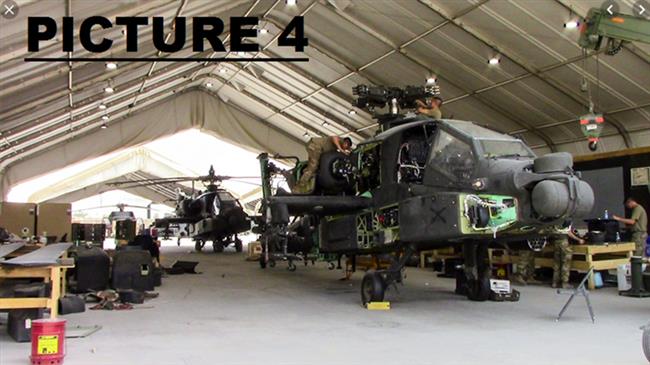
The Iranian missile attack for the most part targeted Apache (AH-64) attack helicopter shelters (refer to Picture 1). Refer to Picture 3 and Picture 4 to see what those “tent”-like Apache steel-frame shelters look like at ground level.
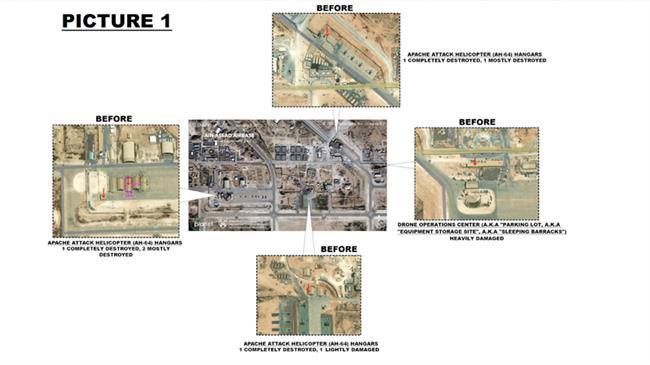
They are the standard steel-frame soft shelter design for US helicopter units based in overseas areas at second-rate airfields (such as the Ain al-Asad Base) – US helicopter units operating from old Afghan airfields are also housed in this kind of shelter design. Each one of those Apache attack helicopter shelters can house two such aircraft. With six structures of the type provably destroyed, demonstrated through the satellite images showing blackened scorch marks (suggesting assets inside them were destroyed with the shelter itself, refer to Picture 1) AND assuming each only had one Apache in them, it can be concluded that at least 6 Apache gunships were destroyed in the attack.
Recently, Danish media, citing a Danish coalition soldier who was present at the base at the time of the attack, admitted that multiple helicopters were destroyed to the point of being “split in half”.
Another Apache hangar (refer to Picture 2) was also directly struck, located to the far eastern end of the Ain al-Asad Base and destroyed. However, note that there is no scorch-blackened concrete underneath it, suggesting nothing was inside it that led to additional burning beyond the impact of the warhead itself.
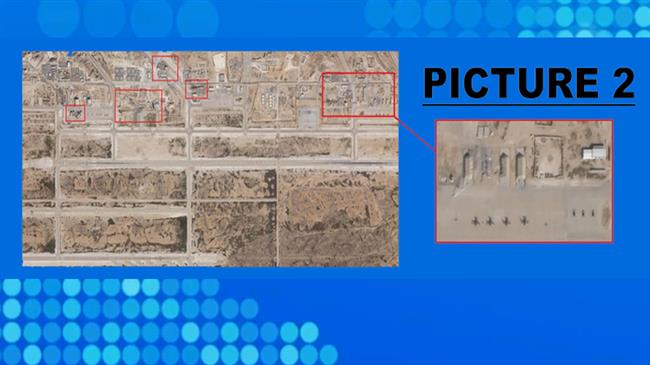
Indeed, just to the south of that destroyed hangar and the undamaged three hangars next to it, 4 Apache helicopters can be seen sitting out on the open tarmac. They were spared as they were, ironically, not being sheltered.
The official US story on the other structure targeted beyond the “tents” (i.e. Apache gunship hangars) has already changed twice – first it was called a parking lot, then an equipment storage area and now, apparently, a barracks for drone operators. Picture 1 (far right) shows the result of the attack on this structure.
It is hard to imagine that base zoning regulators within the US military would chose to place sleeping quarters right next to a strip alert (ready-to-go) aircraft parking area, itself right next to a major taxiway, given the constant noise that comes from these areas.
A more astute assessment would place this structure as an operations center, which lines up with the Iranian claim that the command site from which the Qassem Soleimani assassination operation had been coordinated, was targeted and destroyed in Iran’s retaliation strike.

Indeed, AFP recently released an exclusive report in which a US drone operator present at the Ain al-Asad Airbase, one First Sergeant Wesley Kilpatrick, admitted that airborne drones were rendered inoperable after a direct hit penetrated the base’s UAV operations center and destroyed the fiber lines which connect remote stations to satellite communication equipment(needed for drone control and visuals).
In all of this, one thing is obvious. US officials and media are stumbling over their own statements trying to cover up the extent of the damage dealt to the US-operated section of the Ain al-Asad base – in fact, going so far to cease calling the military site a US airbase (as it had been called for the last 16 years) to (all of a sudden) just an “Iraqi facility”.
THE WEAPONS USED BY IRAN
Short-range ballistic missiles (SRBM) of the upgraded Fateh-313 (range 500 km) and Qiam (range 800 km) types were launched from Western Iran towards the US-operated Ain al-Asad Base in Iraq.
Fateh-313s represent the majority of the missile type used for the attack. Their accuracy still seems to have been to within a matter of meters of their intended targets, except for two stray shots that hit the open tarmac area.
Whilst the Fateh-313 missiles use a combination of INS and electro-optical guidance, the Qiam missiles reportedly use a mix of INS, GPS and radar-mapping target acquisition. The latter method being the archaic predecessor version of DSMAC (imaging automatic target acquisition) terminal-phase guidance used in high-end ground-attack cruise missiles, such as the Tomahawk.
THE OPERATION –OTHER DETAILS
Satellite pictures show that some targeted sites were double-tapped (hit twice-over for good measure).
Initial reports from the Ain al-Asad Base claimed nearly 40 detonations in total despite the fact the number of actual warhead impacts was about fifteen, indicating that there were around two dozen cases of secondary explosions (fuel and ammo going off after being ignited).
In conclusion, according to the evidence we have available to us currently, there is no doubt that the United States has completely distorted the gravitude of Iran’s strikes. The mainstream media in the West have also seemingly refrained from acknowledging much of the damage, apart from on occasion.
Robert Inlakesh is a journalist, writer and political analyst, who has lived in and reported from the occupied Palestinian West Bank. He has written for publications such as Mint Press, Mondoweiss, MEMO, and various other outlets. He specializes in analysis of the Middle East, in particular Palestine-Israel. He also works for Press TV as a European correspondent.
Iraq denies report it has restarted joint military operations with US
Press TV – January 16, 2020
The Iraqi government has denied claims that the country’s military is resuming joint operations with the US-led coalition after Washington’s assassination of top Iranian and Iraqi commanders.
“The joint operations have not resumed and we have not given our authorization,” Major General Abdul Karim Khalaf, the spokesman for the commander-in-chief of the Iraqi armed forces, said on Thursday.
He added that the coalition did not have a permission from Baghdad to carry out any joint missions.
The remarks came after the New York Times, citing two American military officials, reported Thursday that the US had resumed the operations.
Khalaf said the Iraqi government had ordered the coalition to halt its joint operations following the US assassination of top Iranian anti-terror commander, Lieutenant General Qassem Soleimani, and Abu Mahdi al-Muhandis, the second-in-command of Popular Mobilization Units (PMU).
Last month, another US airstrike killed 25 members of PMU in the Arab country’s west.
On January 3, a US drone strike outside Baghdad airport killed General Soleimani and al-Muhandis.
Washington began the pause on January 5, two days after the strike, but furious Iraqi lawmakers voted to expel more than 5,000 US troops based in their country.
The Pentagon said it had no information with regard the the alleged resumption of joint operations with Iraqi troops.
The US-led coalition’s spokesman in Baghdad also declined to comment.
Iraq may defy Washington to buy the Russian S-400 missile defense system
By Paul Antonopoulos | January 16, 2020
With tensions mounting between Iran and the United States after the latter assassinated Iranian General Qassem Soleimani in Iraq, Baghdad has now been pushing to free itself from American domination by calling for foreign troops to leave the country and announcing its intensions in buying the Russian S-400 missile defense system. The complete destruction of the U.S. military base in Anbar province earlier this month demonstrated to Iraqi leaders that it certainly needs to strengthen its air defences since not even American air defense systems could protect their base from the barrage of Iranian missiles. The Iraqi government’s intention to buy the S-400 air defense systems from Russia has been talked about since May last year, when the country’s ambassador to Moscow said Baghdad had decided to buy the systems. However, no roadmap to purchase the systems has been made yet.
Karim Elaiwi, an Iraqi member of parliament who sits on the security and defense committee, said last week that “We are talking to Russia about the S-400 missiles but no contracts have been signed yet. We need to get these missiles, especially after Americans have disappointed us many times by not helping us in getting proper weapons.”
It appears the Iraqis will no longer tolerate U.S. occupation and demands in its country, with parliamentarian and security and defense committee member Abdul Khaleq Al Azzawi, defiantly saying “We authorized the prime minister to get air defense weapons from any country he wants and we authorized him to spend the money for it, from any country. From Russia or anyone.”
This comes as hostilities between Iraq and the U.S. increase, with U.S. President Donald Trump threatening to cut Baghdad’s access to its key account at the Federal Reserve Bank in New York if they follow through with the Iraqi Parliament’s decision to expel the U.S. military from their country. Not only has there been a threat to cut Iraq from its own money based in the U.S., but there are now threats of $250 million in military aid to Iraq being cut.
Although these are tactics to force Baghdad into maintaining ‘permission’ for the U.S. military to remain in Iraq, the clearest sign that this is an American occupation of the West Asian country was with White House National Security Adviser Robert O’Brien’s comments last week that the U.S. will leave Iraq on its “own terms.” The U.S. are not even trying to hide the fact that they are occupying Iraq and rebelling against the government.
Despite the clear occupation, Iraq continues to defy the U.S., and the willingness to purchase the S-400 system is a clear indication of this. It is for this reason that Joey Hood, the U.S. State Department’s principal deputy assistant secretary for Near Eastern Affairs, said on Tuesday in an appearance at the Middle East Institute, an extremely influential Washington think tank, that “A purchase [of the S-400] would probably trigger sanctions, so we advise our partners not to make such purchases.”
This was an expected response considering the continued threats of sanctions the U.S. has put against Turkey for its own acquisition of the S-400. Iraq wants to strengthen its air defense and the S-400 systems are considered the best in the world. It must also be remembered that Iraq is already buying modern weapons from Russia, such as the Mi-28 fighter helicopters and T-90 tanks. However, it is likely that Washington considers the purchase of the S-400 from Russia as an indication that the U.S. is losing political and military support in the country – but this was already consolidated by the assassination of Soleimani, an extremely popular figure in Iraq.
Baghdad is already in negotiations for the S-300, the older generation of the S-400. However, it is the S-400, the newest model available for foreign markets, that will provoke resistance in Washington, especially as the U.S.-made Patriot missile defense system has proven to be a failure by not being able to defend U.S. bases in Iraq or Saudi oil facilities, if we remember the Houthi-led Ansarullah Movement’s attack on the ARAMCO site in September last year.
The question then becomes how will Iraq will pay for Russian weapons if their accounts in the U.S. are frozen. Delivery is not so much of an issue despite the U.S. occupation, it is more a matter of how payments will be made. Although Iraqi parliamentarians are boldly declaring their intentions for the S-400 to be purchased, there are significant problems that Baghdad must first be able to overcome, including the extremely strong pressure being applied by the U.S. against Iraq not to buy them. If Baghdad did successfully defy Washington and purchase the systems, it will certainly weaken the U.S.’ image in the region, something the North American country will unlikely want to risk.
Will Iraq boldly defy the U.S.? This remains to be seen now.
Paul Antonopoulos is a Research Fellow at the Center for Syncretic Studies.
What’s the Point of NATO If You Are Not Prepared to Use It Against Iran?
By Philip Giraldi | Strategic Culture Foundation | January 16, 2020
Article 5 of the North Atlantic Treaty Organization (NATO) alliance commits all members to participate in the defense of any single member that is attacked. An attack on one is an attack on all. Forged in the early stages of the cold war, the alliance originally included most of the leading non-communist states in Western Europe, as well as Turkey. It was intended to deter any attacks orchestrated by the Soviet Union and was defensive in nature.
Currently NATO is an anachronism as the Soviet Union collapsed in 1991, but the desire to continue to play soldier on an international stage has granted it a measure of life support. Indeed, the alliance is regularly auditioning for new members. Its latest addition is Montenegro, which has a military consisting of 2,000 men and women, roughly one brigade. If Montenegro should be attacked, the United States is obligated to come to its assistance.
It would all be something like comic opera featuring the Duke of Plaza Toro but for the fact that there are certain things that NATO does that are not really defensive in nature but are rather destabilizing. Having expanded NATO right up to the border with Russia, which the U.S. promised not to do and then reneged, military exercises staged by the alliance currently occur right next to Russian airspace and coastal waters. To support the incursions, the myth that Moscow is expansionistic (while also seeking to destroy what passes for democracy in the West) is constantly cited. According to the current version, Russian President Vladimir Putin is just waiting to resume control over Ukraine, Georgia, Poland and the Baltic States in an effort to reconstitute the old Soviet Union. This has led to demands from the usual suspects in the U.S. Congress that Georgia and Ukraine be admitted into the alliance, which would really create an existential threat for Russia that it would have to respond to. There have also been some suggestions that Israel might join NATO. A war that no one wants either in the Middle East or in Europe could be the result if the expansion plans bear fruit.
Having nothing to do beyond aggravating the Russians, the alliance has gone along with some of the transnational abominations initially created by virtue of the Global War on Terror initiated by the loosely wrapped American president George W. Bush. The NATO alliance currently has 8,000 service members participating in a training mission in Afghanistan and its key member states have also been parts of the various coalitions that Washington has bribed or coerced into being. NATO was also actively involved in the fiasco that turned Libya into a gangster state. It had previously been the most developed nation in Africa. Currently French and British soldiers are part of the Operation Inherent Resolve (don’t you love the names!) in Syria and NATO itself is part of the Global Coalition to Defeat ISIS.
NATO will now be doing its part to help defend the United States against terrorist attack. Last Wednesday the alliance Secretary General Jens Stoltenberg spoke with President Donald Trump on the phone in the wake of the assassination of Iranian Major General Qassem Soleimani at the Baghdad International Airport. The killing was apparently carried out using missiles fired by a U.S. Reaper drone and was justified by the U.S. by claiming that Soleimani was a terrorist due to his affiliation with the listed terrorist Quds Force. It was also asserted that Soleimani was planning an attack on the U.S. Embassy in Baghdad and would have killed “hundreds” of Americans. Evidence supporting the claims was so flimsy that even some Republicans balked at approving the chain of events.
Nine Iraqis also died in the attack, including the Iraqi General who headed the Kata’Ib Hezbollah Militia, which had been incorporated into the Iraqi Army to fight against the terrorist group ISIS. During the week preceding the execution of Soleimani, the U.S. had staged an air attack that killed 25 Iraqi members of Kata’Ib, the incident that then sparked the rioting at the American Embassy in Baghdad’s Green Zone.
Bearing in mind that the alleged thwarted terrorist attacks took place seven thousand miles away from the United States, it is hard to make the case that the U.S. was directly threatened requiring a response from NATO under Article 5. No doubt the Mike Pompeo State Department will claim that its Embassy is sovereign territory and therefor part of the United States. It is a bullshit argument, but it will no doubt be made. The White House has already made a similar sovereignty claim vis-à-vis the two U.S. bases in Iraq that were hit by a barrage of a dozen Iranian missiles a day after the killing of Soleimani. Unlike the case of Soleimani and his party, no one was killed by the Iranian attacks, quite possibly a deliberate mis-targeting to avoid an escalation in the conflict.
In spite of the fact that there was no actual threat and no factual basis for a call to arms, last Wednesday, NATO Secretary General Jens Stoltenberg spoke by phone with President Donald Trump “on developments in the Middle East.” A NATO press release stated that the two men discussed “the situation in the region and NATO’s role.”
According to the press release “The President asked the Secretary General for NATO to become more involved in the Middle East. They agreed that NATO could contribute more to regional stability and the fight against international terrorism.” A tweet by White House deputy press secretary Judd Deere later confirmed that Trump had “emphasized the value of NATO increasing its role in preventing conflict and preserving peace in the Middle East.” Prior to the phone call, Trump had announced that he would ask NATO “to become much more involved in the Middle East process.”
As the Trumpean concept of a peace process is total surrender on the part of the targeted parties, be they Palestinians or Iranians, it will be interesting to see just how the new arrangement works. Sending soldiers into unstable places to do unnecessary things as part of a non-existent strategy will not sit well with many Europeans. It should not sit well with Americans either.
Burisma Hack Story: Attempt to Put ‘Trump’, ‘Russia’ & ‘Impeachment’ in the Same Headline?
Sputnik – January 16, 2020
The timing of the media fuss over the alleged “Russian hack” of Burisma coincides with the resumption of the impeachment process by the Senate, say American academics, suggesting that the story could be a mere distraction aimed at evoking the spectre of “Trump-Russia” collusion amid the 2020 election cycle.
Ukraine has kicked off an investigation into a suspected cyberattack by so-called “Russian military hackers” on the energy company Burisma requesting assistance from the FBI. As The New York Times claimed Monday, Fancy Bears or Advanced Persistent Threat (APT) 28, allegedly subjected the energy company to phishing attacks, citing a recent report by Area 1 Security, a California-based American cybersecurity firm.
Burisma entered the spotlight light during the Democrats-driven impeachment process against Donald Trump due to its connections with the son of presidential candidate and former Vice President Joe Biden, Hunter, who previously served on the company’s board of directors and is believed to have financially benefitted from the apparent nepotistic scheme.
Falling short of confirming whether the hackers obtained any information, the Area 1 report says that the timing of the alleged malicious activities in relation to the 2020 US elections “raises the spectre that this is an early warning of what we have anticipated since the successful cyberattacks undertaken during the 2016 US elections”, referring to unfounded allegations of Russia’s interference in the previous US presidential race and hacking of the Democratic National Committee (DNC).
Media Fuss Over Alleged Burisma Hack is ‘Distraction’
“The level of media attention given to this story in the United States is curious”, says Matthew Wilson, an associate professor of political science at Southern Methodist University. “Assuming that this hacking did, in fact, occur – and I have no reason to doubt that it did – nothing has yet come of it. No one in Russia (or elsewhere) has released anything about the Bidens gleaned from a hack of Burisma’s servers, and discussion of the motives behind the hack is entirely speculative”.
According to the professor, “one almost suspects that it is simply an attempt by some in the American media to get the words ‘Trump’, ‘Russia’, and ‘impeachment’ into the same headline” ahead of a Senate impeachment trial that is likely to commence very shortly.
For her part, Laura Wilson, a political science professor at the University of Indianapolis, does not rule out that the hacking allegations serve as distraction from two important events: the Trump impeachment and the US 2020 presidential elections.
“As the Senate takes up the question of removal of office after the House passed the impeachment resolution, and the parties and candidates prepare for the upcoming primary elections, these major events will undoubtedly play a significant role in shaping the future of our country and require attention and focus”, she says.
According to Wilson, “distractions in any way should be considered just that, distractions, and though other issues will come up, they need to be evaluated fairly and swiftly given their potential impact relative to the importance of the impeachment and election”.
It’s ‘Less Than Definitive’ That Fancy Bears Hacked Burisma
American monthly Wired noted Tuesday that “it’s still not entirely proven” that Fancy Bears did hack Burisma citing cybersecurity analysts who see Area 1’s evidence tying the alleged phishing campaign to the aforementioned hackers as “less than definitive”.
The media outlet quotes security firm ThreatConnect that shared its brief analysis of the phishing campaign’s features on Twitter concluding that “none of these characteristics are definitively indicative of APT28 activity” and that “we don’t have any specific information on how the domains have been operationalised”.
Wired added that in response to its request, Area 1 Security said it has more evidence to back up its findings but declined to share it publicly.
Area 1 Security’s belief that the hacking was conducted by “Russian military hackers” originates from earlier assumptions made by Crowdstrike, a former DNC contractor, that hacker group Fancy Bear, which supposedly broke into the DNC email servers in 2016, had something to do with Russia’s Main Intelligence Department (GRU). However, this connection has never been proven beyond a reasonable doubt. Furthermore, according to some cyber experts, the so-called “Fancy Bear” or Advanced Persistent Threat (APT) 28 could be nothing more than a collection of hacking tools originating from the dark web that can be used by virtually anyone.
On the other hand, Veteran Intelligence Professionals for Sanity (VIPS), a group of former officers from the United States Intelligence Community, has repeatedly stated that the leak of DNC files was an inside job and not an external breach into the committee’s system.
Red Flag Nation: Anti-Gun Laws, Sanctuary Cities and the Second Amendment
By John W. Whitehead | The Rutherford Institute | January 15, 2020
“A well regulated militia, being necessary to the security of a free state, the right of the people to keep and bear arms, shall not be infringed.” – The Second Amendment to the US Constitution
We never learn.
In the right (or wrong) hands, benevolent plans can easily be put to malevolent purposes.
Even the most well-intentioned government law or program can be—and has been—perverted, corrupted and used to advance illegitimate purposes once profit and power are added to the equation.
Mark my words: gun control legislation, especially in the form of red flag gun laws, which allow the police to remove guns from people suspected of being threats, will only add to the government’s power.
Seventeen states now have red flag laws on their books.
That number is growing.
As The Washington Post reports, these laws “allow a family member, roommate, beau, law enforcement officer or any type of medical professional to file a petition [with a court] asking that a person’s home be temporarily cleared of firearms. It doesn’t require a mental-health diagnosis or an arrest.”
While in theory it appears perfectly reasonable to want to disarm individuals who are clearly suicidal and/or pose an “immediate danger” to themselves or others, where the problem arises is when you put the power to determine who is a potential danger in the hands of government agencies, the courts and the police.
We’ve been down this road before.
Remember, this is the same government that has a growing list—shared with fusion centers and law enforcement agencies—of ideologies, behaviors, affiliations and other characteristics that could flag someone as suspicious and result in their being labeled potential enemies of the state.
For instance, if you believe in and exercise your rights under the Constitution (namely, your right to speak freely, worship freely, associate with like-minded individuals who share your political views, criticize the government, own a weapon, demand a warrant before being questioned or searched, or any other activity viewed as potentially anti-government, racist, bigoted, anarchic or sovereign), you could be at the top of the government’s terrorism watch list.
Moreover, as a New York Times editorial warns, you may be an anti-government extremist (a.k.a. domestic terrorist) in the eyes of the police if you are afraid that the government is plotting to confiscate your firearms, if you believe the economy is about to collapse and the government will soon declare martial law, or if you display an unusual number of political and/or ideological bumper stickers on your car.
Let that sink in a moment.
Therein lies the danger of these red flag laws, specifically, and pre-crime laws such as these generally where the burden of proof is reversed and you are guilty before you are given any chance to prove you are innocent.
Red flag gun laws merely push us that much closer towards a suspect society where everyone is potentially guilty of some crime or another and must be preemptively rendered harmless.
Where many Americans go wrong is in naively assuming that you have to be doing something illegal or harmful in order to be flagged and targeted for some form of intervention or detention.
Be warned: once you get on such a government watch list—whether it’s a terrorist watch list, a mental health watch list, a dissident watch list, or a red flag gun watch list—there’s no clear-cut way to get off, whether or not you should actually be on there.
Unfortunately, the U.S. government has adopted a “do what I say, not what I do” mindset when it comes to Americans’ rights overall. Nowhere is this double standard more evident than in the government’s attempts to arm itself to the teeth, all the while treating anyone who dares to legally own a gun, let alone use one, as suspicious and/or on the road to being an outlaw.
In Virginia, for instance, legislation has been introduced that would “require background checks on all firearms purchases, allow law enforcement to temporarily remove guns from individuals deemed a risk to themselves or others, let localities ban weapons from certain events and government buildings, and cap handgun purchases at one per month.”
To those who subscribe to George Orwell’s views about gun ownership (“That rifle hanging on the wall of the working-class flat or labourer’s cottage is the symbol of democracy. It is our job to see that it stays there”), these legislative attempts to regulate and control gun usage among the citizenry is nothing short of tyranny.
Not surprisingly, then, in Virginia and a growing number of states across the country, momentum is building for 2A “sanctuary” cities that adopt resolutions opposing any “unconstitutional restrictions” on the Second Amendment right to keep and bear arms.
Personally, I’m all for any attempt by the citizenry to nullify government actions that run afoul of the Constitution.
“We the people” have been so focused on debating who or what is responsible for gun violence—the guns, the gun owners, or our violent culture—and whether the Second Amendment “allows” us to own guns that we’ve overlooked the most important and most consistent theme throughout the Constitution: the fact that it is not merely an enumeration of our rights but was intended to be a clear shackle on the government’s powers.
When considered in the context of prohibitions against the government, the Second Amendment reads as a clear rebuke against any attempt to restrict the citizenry’s gun ownership.
As such, it is as necessary an ingredient for maintaining that tenuous balance between the citizenry and their republic as any of the other amendments in the Bill of Rights, especially the right to freedom of speech, assembly, press, petition, security, and due process.
Supreme Court Justice William O. Douglas understood this tension well.
“The Constitution is not neutral,” Douglas remarked, “It was designed to take the government off the backs of people.”
In this way, the freedoms enshrined in the Bill of Rights in their entirety stand as a bulwark against a police state.
To our detriment, as I make clear in my book Battlefield America: The War on the American People, these rights have been steadily weakened, eroded and undermined in recent years.
Yet without any one of them, including the Second Amendment right to own and bear arms, we are that much more vulnerable to the vagaries of out-of-control policemen, benevolent dictators, genuflecting politicians, and overly ambitious bureaucrats.
Constitutional attorney and author John W. Whitehead is founder and president of The Rutherford Institute. His new book Battlefield America: The War on the American People is available at www.amazon.com. Whitehead can be contacted at johnw@rutherford.org.
Facebook censors explainer clip recalling when western media liked Soleimani – and demonetizes popular account for sharing it
RT | January 15, 2020
Facebook is doubling down on censorship of anything less than villification of slain Iranian Major General Qassem Soleimani, deleting a clip showing his history of fighting terrorism – and demonetizing the account posting it.
The social media behemoth didn’t just remove independent journalist Dan Cohen’s ‘In the Now’ segment, “How ‘good guy’ Soleimani became US media’s ‘bad guy,” from the show’s page on Tuesday – it demonetized In the Now entirely, citing the typical unspecified violations of “community standards.” The move comes amid an alarming escalation in the platform’s crackdown on political speech that runs contrary to US foreign policy, a wave of censorship that has not been limited to Facebook.
Cohen’s video calmly and accurately explains how Soleimani “saved the region from falling to ISIS,” fighting the terrorist group alongside the US and its Kurdish allies before he was recast posthumously by a complicit western media as “actually a huge terrorist and a ticking time bomb who was born to kill Americans.” The video exposes the ideological inconsistency of the outlets currently depicting the Quds Force commander as the devil incarnate, showcasing clips from those same outlets in recent years praising Soleimani’s battlefield performance.
Rania Khalek, who runs In the Now, tweeted in shock that a video merely stating facts about Soleimani had gotten her page demonetized, asking “where is the outrage” now that Facebook was so explicitly deleting material for ideological reasons.
Facebook and its subsidiary Instagram have come under fire from independent journalists and media organizations like the International Federation of Journalists for embarking on a wholesale campaign to deplatform all support for Soleimani in the weeks following the US airstrike that killed him. The company has claimed the extensive US sanctions placed on Iran, including the designation of the Islamic Revolutionary Guard Corps as a terrorist organization, require it to censor such posts, though even legal experts quoted by CNN took a dim view of that rationale.
Facebook and Instagram not only remove accounts run by or for sanctioned individuals or groups, but also posts that (they claim) praise or seek to assist the people in question – making sanctions a convenient excuse for mass-deplatforming any user who holds a political view the US government has deemed heresy.
Iranians saw insult added to injury when over a dozen Iranian journalists, several state-run media organizations, and countless ordinary individuals and activists’ Instagram accounts were yanked entirely in the days following Soleimani’s assassination. Many more saw pro-Soleimani posts removed, even when they carefully avoided saying his name – one Lebanese researcher praised “Q*ssem S*leim*ni” for protecting Christians from ISIS and al-Qaeda, only to have his video removed anyway.
The rank ideological discrimination not only left them unable to publicly mourn for a leader beloved by the lion’s share of the people, but allowed pro-regime-change trolls to dominate the narrative. Facebook has recently taken flack from the US political establishment for refusing to “fact-check” political ads, but non-advertising content is more tightly controlled than ever.
Facebook and Instagram are far from alone in clamping down on the speech of Iranian users, however – YouTube briefly deleted state-backed PressTV’s channel earlier this week, only to reactivate it after an outpouring of popular support.
Twitter removed state-backed media outlet Al-Alam News’ account, as well as that of the popular Iran-backed Spanish-language media outlet HispanTV, only reinstating the latter after a massive public backlash. Dozens of individual Iranians who supported their government were also deplatformed on Twitter, while anti-government users – many linked to notorious exile terror group Mujahedin e-Khalq (MEK) – were allowed to continue slinging hate against Soleimani and his supporters. Twitter even dished out a ban to Syrian President Bashar Assad, but restored the account after a few days.
Who Targeted Ukraine Airlines Flight 752? Iran Shot It Down But There May Be More to the Story
By Philip Giraldi | American Herald Tribune | January 15, 2020
The claim that Major General Qassem Soleimani was a “terrorist” on a mission to carry out an “imminent” attack that would kill hundreds of Americans turned out to be a lie, so why should one believe anything else relating to recent developments in Iran and Iraq? To be sure, Ukraine International Airlines Flight 752 departing from Tehran’s Imam Khomeini International Airport on the morning of January 8th with 176 passengers and crew on board was shot down by Iranian air defenses, something which the government of the Islamic Republic has admitted, but there just might be considerably more to the story involving cyberwarfare carried out by the U.S. and possibly Israeli governments.
To be sure, the Iranian air defenses were on high alert fearing an American attack in the wake of the U.S. government’s assassination of Soleimani on January 3rd followed by a missile strike from Iran directed against two U.S. bases in Iraq. In spite of the tension and the escalation, the Iranian government did not shut down the country’s airspace. Civilian passenger flights were still departing and arriving in Tehran, almost certainly an error in judgment on the part of the airport authorities. Inexplicably, civilian aircraft continued to take off and land even after Flight 752 was shot down.
Fifty-seven of the passengers on the flight were Canadians of Iranian descent, leading Prime Minister Justin Trudeau to point the finger both at the Iranian government for its carelessness and also at Washington, observing angrily that the Trump Administration had deliberately and recklessly sought to “escalate tensions” with Iran through an attack near Baghdad Airport, heedless of the impact on travelers and other civilians in the region.
What seems to have been a case of bad judgements and human error does, however, include some elements that have yet to be explained. The Iranian missile operator reportedly experienced considerable “jamming” and the planes transponder switched off and stopped transmitting several minutes before the missiles were launched. There were also problems with the communication network of the air defense command, which may have been related.
The electronic jamming coming from an unknown source meant that the air defense system was placed on manual operation, relying on human intervention to launch. The human role meant that an operator had to make a quick judgment in a pressure situation in which he had only moments to react. The shutdown of the transponder, which would have automatically signaled to the operator and Tor electronics that the plane was civilian, instead automatically indicated that it was hostile. The operator, having been particularly briefed on the possibility of incoming American cruise missiles, then fired.
The two missiles that brought the plane down came from a Russian-made system designated SA-15 by NATO and called Tor by the Russians. Its eight missiles are normally mounted on a tracked vehicle. The system includes both radar to detect and track targets as well as an independent launch system, which includes an Identification Friend or Foe (IFF) system functionality capable of reading call signs and transponder signals to prevent accidents. Given what happened on that morning in Tehran, it is plausible to assume that something or someone deliberately interfered with both the Iranian air defenses and with the transponder on the airplane, possibly as part of an attempt to create an aviation accident that would be attributed to the Iranian government.
The SA-15 Tor defense system used by Iran has one major vulnerability. It can be hacked or “spoofed,” permitting an intruder to impersonate a legitimate user and take control. The United States Navy and Air Force reportedly have developed technologies “that can fool enemy radar systems with false and deceptively moving targets.” Fooling the system also means fooling the operator. The Guardian has also reported independently how the United States military has long been developing systems that can from a distance alter the electronics and targeting of Iran’s available missiles.
The same technology can, of course, be used to alter or even mask the transponder on a civilian airliner in such a fashion as to send false information about identity and location. The United States has the cyber and electronic warfare capability to both jam and alter signals relating to both airliner transponders and to the Iranian air defenses. Israel presumably has the same ability. Joe Quinn at Sott.net also notes an interested back story to those photos and video footage that have appeared in the New York Times and elsewhere showing the Iranian missile launch, the impact with the plane and the remains after the crash, to include the missile remains. They appeared on January 9th, in an Instagram account called ‘Rich Kids of Tehran‘. Quinn asks how the Rich Kids happened to be in “a low-income housing estate on the city’s outskirts [near the airport] at 6 a.m. on the morning of January 8th with cameras pointed at the right part of the sky in time to capture a missile hitting a Ukrainian passenger plane…?”
Put together the Rich Kids and the possibility of electronic warfare and it all suggests a premeditated and carefully planned event of which the Soleimani assassination was only a part. There have been riots in Iran subsequent to the shooting down of the plane, blaming the government for its ineptitude. Some of the people in the street are clearly calling for the goal long sought by the United States and Israel, i.e. “regime change.” If nothing else, Iran, which was widely seen as the victim in the killing of Soleimani, is being depicted in much of the international media as little more than another unprincipled actor with blood on its hands. There is much still to explain about the downing of Ukrainian International Airlines Flight 752.
Philip M. Giraldi is a former CIA counter-terrorism specialist and military intelligence officer who served nineteen years overseas in Turkey, Italy, Germany, and Spain. He was the CIA Chief of Base for the Barcelona Olympics in 1992 and was one of the first Americans to enter Afghanistan in December 2001. Phil is Executive Director of the Council for the National Interest, a Washington-based advocacy group that seeks to encourage and promote a U.S. foreign policy in the Middle East that is consistent with American values and interests.
Featured Video

John Mearsheimer: New World Order Arrived & Europe Is Left Behind
or go to
Aletho News Archives – Video-Images
Book Review
Sunset on Net Zero: A Heretic’s Guide to the Futile CO2 Target
By Ronald Paul Barmby (Author) – October 3, 2025
SUNSET ON NET ZERO describes in detail why Net Zero CO2 is pointless and unachievable. It explains in understandable terms the up-to- date thoughts of the greatest minds of today in physics, meteorology, economics, engineering, and the geosciences.
Net Zero CO2 is pointless because we have now confirmed by satellites that 90% of CO2 warming has already happened. CO2 is not an existential threat but clouds, El-Niño, and human habitation are significant drivers of global warming that are often ignored.
Net Zero CO2 is unachievable because the green technology alternatives are unreliable and unaffordable. Wind and solar power triple electricity costs, building fully electric vehicles produces at least one-half of CO2 emissions they are meant to avoid, and heat pumps will leave you dangerously cold in the winter. Green hydrogen, air capture CO2, and carbon capture and storage are prescriptions for national bankruptcy. The supply of key metals and minerals required to achieve Net Zero need to be at least doubled—some much more—and are often controlled by a very few. Net Zero comes with huge environmental and agricultural costs.
We have been through similar climatic temperature changes before, more recently than you think. Our efforts to control it are futile.
Blog Roll
 Aletho News
- FDA Ordered to Pay Over $570,000 in Fight Over Pfizer COVID Vaccine Records
- USAID turned to Facebook to drive demand for Covid vaccines in Global South – files
- Britain’s shadow security network expands into south Lebanon
- The ADL Has a Foreign Policy, and You Are Not Supposed to See It
- Former Qatari PM says ‘Israel’ has security ties with all Gulf states
- The Sound of Silence in the Strait of Hormuz
- Poland’s call for a no-fly zone in Ukraine means NATO direct war with Russia
- John Mearsheimer: New World Order Arrived & Europe Is Left Behind
- Naqab demolition notices top 1,000; settlers demolish Jaloud homes
- Israel is Using the ‘Gaza Ceasefire’ to Commit Ethnic Cleansing
- If Americans Knew
- An error has occurred; the feed is probably down. Try again later.
- No Tricks Zone
- Physicists: Doubling CO2 Has A Smaller Impact On Ocean ‘Acidification’ Than Existing Internal Variability
- Alarmist Climatologists In Shock! 2026 Atlantic Hurricane Season Sees Lowest Count In 101 Years
- New Study: Modern Temps Are Among The Coldest Of The Last 10,000 Years In East Central Europe
- Germany’s Renewable Energies Lead to 1.4 Billion Euro Electric Power Trade Deficit
- Argentina’s Perito Moreno Glacier Joins Antarctica and Arctic In Defying Doomsday Melt Claims
- New Study: Barents Sea Temperatures Were Warmer And Sea Ice Less Extensive In The 1700s Than Today
- German Authorities Start Initiative To Evaluate Public Register For Climate “Disinformation” Spreaders!
- Zonal Asymmetry of Temperature Change in the Antarctic Circumpolar Current
- New Study: The Net Fossil Fuel Contribution To Rising Atmospheric CO2 Has Been Zero For 500 Years
- Germany’s Green Energy Transition Becoming Increasingly Expensive…Another 6 Trillion Euros!

