Hezbollah Denounces ‘Savage’ Attack on Iraq’s Hashd Shaabi: US Exposed Its True Face
Al-Manar | December 30, 2019
Hezbollah on Monday firmly denounced US aggression on Iraq’s Kata’ib Hezbollah, describing it as savage and blatant assault on Iraq’s sovereignty.
“The savage and perfidious aggression by the US on Kata’ib Hezbollah in Iraq is a blatant attack on Iraq’s sovereignty, security, stability and people, especially the Hashd Shaabi which had the upper hand in confronting the Takfiri terror and defeating it,” a statement released by Hezbollah’s Media Relations Office read, referring to Iraq’s paramilitary force, also called Popular Mobilization Units (PMU), in which Kata’ib Hezbollah is one of its components.
“This aggression affirms again that the US administration wants to strike the power factors within the Iraqi people who are capable of confronting Daesh (ISIL) and other US-backed extremist and criminal groups.”
“The US administration exposes its true face as a hostile power to Iraq and Iraqis’ interests,” the statement added.
Hezbollah offered condolences to Iraqis on the martyrs of the attack, wishing speedy recovery for those who were wounded.
“Those who decided this criminal aggression will find out soon the idiocy of such decision as well as its repercussions,” the statement concluded.
Bolivian Vassals Are Merely Aping Their Imperial Masters
By Stephen Karganovic | Strategic Culture Foundation | December 30, 2019
A serious diplomatic row with significant international law implications has erupted between the government of Mexico and the Bolivian coup regime installed by foreign interests in November 2019. Readers will recall that the legal President of Bolivia, Evo Morales, notwithstanding his overwhelming electoral victory in October 2019, was made to resign shortly thereafter under the duress of traitorous elements of the police and military apparatus who were bribed by the ruling imperial power in the Western hemisphere and directed to remove him. The coup was, as usual in these situations, justified by alleged electoral fraud. Morales was replaced by a racist and quasi-fascist de facto regime. The President initially received political asylum in Mexico and since then has moved to Argentina, where he also was granted refuge. Several of his cabinet officials and parliamentarians of his party, Movement Toward Socialism (MAS), took refuge in the Mexican embassy in La Paz, where they still remain.
The coup regime, fearing a groundswell of popular support for Morales and his party, and seeking to detain potential candidates from the MAS leadership who might run in the new elections promised to take place a few months from now, demanded that Mexico hand over the officials (about 20 at the end of November) who had taken refuge in its embassy. They are being pursued on specious charges of “terrorism and corruption,” also fully consistent with the color revolution playbook. The intentions of the usurpers toward the officials of the legitimate government are rather plainly reflected in the ominous terminology they used to denounce Argentina for granting refuge to Morales and Mexico for doing the same for officials who were left behind in Bolivia. According to Roxana Lizarraga, the regime “minister of communication,” both countries “have become a refuge for criminals.” When the Mexican government refused to comply, coup regime forces proceeded to encircle the Mexican diplomatic compound in La Paz and to interfere with its normal operation, brazenly disregarding clear prescriptions of the Vienna Convention, which enshrines the absolute inviolability of diplomatic premises. Mexican President Lopez Obrador very pointedly condemned the conduct of the lawless Bolivian coup authorities as “something that it would not have occurred even to Pinochet to do.”
In Latin American terms, it should be pointed out, the terminology to which the Mexican President resorted is anything but hyperbole. Latin American countries have a long history of coups and revolutions and, quite apart from the prescriptions of the relatively recently adopted (1969) Vienna Convention, they have a lengthy tradition of respecting each other’s diplomatic premises as places of refuge where today’s rulers may end up seeking shelter tomorrow. The siege of Mexico’s diplomatic mission in La Paz is therefore doubly obnoxious. It is a crude infringement of a positive norm of international law, but at the same time also violates a deeply ingrained Latin American tradition.
At a press conference on December 26, Mexican Foreign Minister Marcelo Ebrard disclosed that at least 29 countries, most from Latin America but also member states of the European Union, have contacted the Mexican diplomatic mission in La Paz to express their concern for its safety and support for its inviolability. What followed was a truly bombshell announcement of the Mexican Foreign Minister that in response to the abuse and illegal conduct of Bolivian coup regime forces Mexico will file suit at the International Court of Justice to seek a cease and desist order against the Bolivian authorities (also here). To which the coup regime “interior minister” Arturo Murillo laconically responded: “See you in court.”
But it so happens that Murillo’s insolence is not entirely baseless. He is an official of an illegally installed puppet regime, and he is also a sharp student and very mindful of the atrocious example disseminated by his puppet-masters. He is following their obnoxious model to the smallest detail.
Murrillo’s nonchalance is quite understandable, for instance, in light of the 1986 ICJ case where tiny Nicaragua squared off against Murillo’s imperial puppet masters, who were charged with supporting a seditious proxy army and mining Nicaragua’s harbors. Amazingly, the Court ruled in Nicaragua’s favor and even awarded it damages. But the imperial cowboys simply brushed it off on the pretext that they had no obligation to abide by judgments that were “contrary to [their] national interest.” That was effectively the end of the matter, and who can blame Murillo today for being unconvinced that the breach of international law complained of by Mexico will ever be punished, regardless of the way the International Court of Justice might rule in the Mexican lawsuit?
Is there any particular need to recall a more recent outrage in London? Independent journalist Julian Assange was unceremoniously seized by the British police within the premises of the Ecuadorian embassy, with the full connivance of the Ecuadorian puppet regime, and in complete disregard of not just the fact that Assange was a political refugee fully protected by the Vienna Convention, but also of his status as an Ecuadorian citizen?
But for the ultimate model of these lawless operations, we need go no further than the sarcastically named “Operation Nifty Package,” by which Panamanian leader Manuel Noriega was extracted from the Vatican Nunciature in Panama City, where he had taken refuge following the armed invasion of his country by Murillo’s scofflaw imperial mentors. Just like their Bolivian acolytes, the invaders surrounded the Vatican diplomatic mission, resolving to “smoke out” their prey by making life inside it unbearable both for him and the diplomatic staff: “The plan involved music, mostly heavy metal and rock, with a few ballads thrown in. It was blasted on loudspeakers, at deafening volumes, around the clock.” A “nifty package,” indeed, and so in keeping with the dignity of a hyperpower, which impressionable Bolivian janissaries have now updated with dozens of drones intimidatingly overflying the Mexican compound in La Paz and armed goons harassing Mexican diplomatic personnel, including the ambassador, who venture outside.
The emerging pattern of lawlessness in virtually every segment of international affairs is acutely exemplified in this truly postmodern diplomatic row.
NATO: General Delawarde assesses final London Declaration

By Alexandra Kamyshanova | December 30, 2019
General Dominique Delawarde, the former head of the “Situation – Intelligence – Electronic Warfare 19” section at the joint operational planning staff and a cyberwarfare expert, provides insight into the nine articles of the final London Declaration, published on the NATO website.
Question: Can members of the Alliance really “reaffirm their adherence to the purposes and principles of the United Nations Charter”, as stated in Article 1?
Answer: A simple observation of how history has unfolded after the Cold War demonstrates that two important elements of Article 1 are erroneous, if not flat-out false. Since 1991, NATO actions have been aimed not at preventing conflicts and maintaining peace, but exactly the opposite. They do cause them themselves by their never-ending destructive interference in the affairs of sovereign countries. Over a quarter-century (1995-2019), its member states dropped more than a million bombs on our planet, which entailed, whether overtly or covertly, the death of several million people. The only objective was to establish hegemony over the “international community”. Alliance members cannot “reaffirm their adherence to the purposes and principles of the United Nations Charter” by violating or ignoring international rules established by the United Nations. The illegal occupation of part of the Syrian territory serves as evidence of this.
Q: Can we say that the funding efforts outlined in Article 2 fail to reflect the true situation?
A: This statement about efforts to increase funding for NATO members’ defense capabilities is virtually misleading. It loses sight of the fact that defense spending has halved since 1991 (peace dividends) and does not specify any deadline for reaching the 2% target. Finally, this statement is unfeasible and won’t be implemented in the short or medium term, given the economic and social complexities faced by all the key NATO member states. So this is mere verbiage.
Besides, NATO will not be able to compete with the SCO (Shanghai Cooperation Organization), because defense spending parity in PPP (purchasing power parity) dollars has almost been reached between NATO and the SCO; the cumulative defense budget of NATO member states accounts for 1000 billion dollars (PPP), and that of SCO member states is going to reach parity with the NATO budget in 2020 already. To date, the annual growth rate of defense spending in SCO countries is two to three times higher as compared to NATO countries. The SCO has a much wider scope for expansion (major countries like Iran and perhaps Turkey, why not) than NATO (North Macedonia, Georgia, Bosnia). Speaking of Turkey, an untrained eye should know that the SCO-NATO dual membership is not prohibited, since in 2005, the United States itself applied to join the SCO as nonmember state (the application was unanimously rejected by SCO members, guess why).
Q: Should we consider Russia as a threat, as stated in Article 3?
A: This list of universal threats and perpetual accusations against Russia, which is presented as a source of aggression and threat, are familiar pretexts to justify the very existence of NATO. As for anti-Russian statements, NATO is clearly resorting to an accusatory inversion. It is NATO members, not Russia, who have dropped over a million bombs and caused the death of several million people since 1995, and it is them who violate UN rules by continuing the military occupation of part of the Syrian territory. This is also the case of the coup organized in Ukraine, the division of the former Yugoslavia, and the constant advancing to the borders of Russia, which is in total disregard of the promises made to Gorbachev.
As for terrorism and instability observed beyond our borders, the Alliance forgets to remind that both arise from their omnidirectional interference in the affairs of sovereign states at the slightest pretext. They arise from their unlawful bombings, humiliations at Abu Ghraib and Guantanamo, the replacement of strong secular leaders with the chaos we observe today, and the wars waged under false pretexts (Serbia, Iraq, Libya, Syria). Migration is a blowback.
It should be recognized that state and non-state actors shattering the international order are mostly representatives of the West and NATO. The April 14, 2018 joint strike on Syria by the United States, France and the United Kingdom is yet another proof of this. Anglo-Saxon non-governmental NGOs, ostensibly independent but actually used by government agencies and / or their American sponsors (Soros), are wreaking havoc by promoting North Atlantic strategies. They use various useful idiots for their own purposes, who may inherently have good intentions. Finally, the main and only known cyber threat uncovered by Snowden, Assange and Manning is America, not Russia or China. The United States has installed wiretaps of all the political and economic Western leaders (NSA) and has pretty reliable bargaining chips to blackmail our heads of state and seize our businesses.
Q: Do you agree with the statement of Article 4: “NATO is a defensive alliance and poses no threat to any country”?
A: You need to ask the countries that have been bombed for 25 years.
The Alliance does not act “prudently and responsibly” in relation to Russia: the expansion to the East which runs counter to NATO promises of 1990, the coup in Ukraine, the unilateral withdrawal of the United States from the INF and other treaties, including the Iranian nuclear program. They pretend to be combating terrorism, even though many of its elements are funded by the West itself or some of its Arab allies – this is simply ridiculous. NATO members take us for perfect fools.
Q: What do you think about the phrasing of Article 5 that NATO seeks to “work to increase security for all, deepen political dialogue and cooperation with the United Nations”?
A: NATO provokes chaos, migration crisis, surge of terrorism and anti-Western hatred that have now pummelled Europe. You cannot drop a million bombs over 25 years on the countries that have never attacked a single member of the Alliance. Think about the five thousand soldiers from 11 NATO member states who died for nothing in Iraq, in a deceitful war unleashed in 2003. It is worth paying tribute to the memory of those who fell victim to American aggression supported by 10 European NATO member states that agreed to take part.
Q: What does NATO mean in Article 6 when mentioning “the resilience of our societies”, “our energy security” and “the need to rely on secure and resilient systems”?
A: This reflects the current US obsession: “to increase the resilience of our energy security” means ” NATO’s opposition to the construction of the Nord Stream 2 gas pipeline, to spite the vicious Russians and to the benefit of the goodу American gas market.” “Security of our telecommunications, including 5G” means “the rejection of the Chinese Huawei technology, to the detriment of the Chinese and in favor of American technologies.” The US has long been spying on our political and economic leaders’ telecommunications, while accusing China of “intending” to spy on the alliance members by means of its 5G system.
China poses “challenges that we need to address together”. So, NATO is embarking on a path of confronting China, which is beneficial to the United States alone.
Q: What is meant by “strengthening NATO’s political dimension” referred to in Article 7?
A: NATO’s ten-year strategy is now being updated, and the “relevant expertise” will be that of American and European neoconservatives. The essence of Article 7 is discernable: “strengthening NATO’s political dimension”. Since the end of the Cold War, the 1949 “military-defensive” alliance has been increasingly turning into a political and offensive one, often to accommodate certain economic interests.
Q: What do you think Article 8 is remarkable for?
A: For postponing the revision of the strategic concept from the year 2020 to 2021. Trump’s unpredictability scares Europe, with its people hopeful that he won’t be re-elected and that another President will bring the crisis-stricken Alliance back into the ranks.
Q: Is it serious that Article 9 stresses NATO’s greater protection for the peoples of its member states?
A: NATO has been sowing too much hatred and chaos on the planet since 1991 to be a security factor in Europe, and it has been so since the end of the Cold War. The North Atlantic Charter does not present NATO as an instrument of American hegemony. Therefore, the dissolution of NATO, or at least the withdrawal of France would be the best decision at the moment, unless NATO returns to the original principles of a defensive alliance with its activities covering only the territories of its member states, and ceases to invent new threats to serve as false pretexts to justify wars and intervention aimed at maintaining Western hegemony on the planet.
Q: What conclusion would you draw?
A: It is not just about a “brain death” in NATO. Can their solidarity survive the global economic crisis that experts predict, and the inevitable subsequent upheaval in the hierarchy of forces? Hardly probable. The prosperity of the West and the financing of its armed forces rest today on a whole ocean of debts.
The future will belong to those who keep ahead of the game. A long-term vision is needed to pursue foreign policy. Russia, China and India have long ago grasped this.
How Impeachment Is Escalating the New US-Russian Cold War
Stephen F. Cohen • Unz Review • December 27, 2019
Podcast of John Batchelor Show
Summary of Broadcast Produced by Yvonne Lorenzo:
As the New Cold War gathers up speed and escalates, we are entering a “fact free world” as allegations are made that are proved not to be true are promoted; for example, the allegation that the DNC was hacked by Russia has been officially debunked—no one could name the seventeen intelligence agencies, the Coast Guard was one. The notion of the hacking was cooked up by two agencies: by the DNI’s head James Clapper and Brennan at the CIA. Nevertheless, recently News Anchor Chuck Todd of NBC (the most pro-Russiagate network, the ones who shamelessly accused presidential candidate Tulsi Gabbard of being a Russian asset) took it one step further: ignoring the facts, Todd again stated that seventeen intelligence agencies agreed that the Russians not only interfered in the election but that they swung the election to Trump. While interference is one thing, no one has previously made that allegation. Consequently, we are now in a fact free discourse in America: no evidence is necessary to prove anything, falsehoods are taken up by the legacy media, what Professor Cohen would call a world of tabloid gossip media, except in their favor the tabloids, fearing lawsuits, will do some fact checking, which is conspicuous in its absence in the legacy media. And Professor Cohen noted that it’s hard to get traction and you can’t have a conversation with someone when you don’t agree upon the facts.
In conversation on a cruise with fellow liberals, Professor Cohen noted most take the view that where there is smoke there is fire and there is something to these allegations of Russiagate and Putin’s control over Trump; they state the media wouldn’t continue to promote these conspiracy theories, these allegations about Trump’s nefarious relations with the Kremlin, without reason and so there must be something to them. Yet while facts have become absolutely critical Cohen notes you can’t get people to focus on the facts; for that reason, he feels despair and observes that for the first time in his life in his public discussions of Russia there are no basic premises that people accept any more, for if you say “If there’s smoke, there’s fire,” that is just not a logical way of thinking: you either have the facts or you don’t.
Batchelor also points out in the impeachment charges there is a great deal of presumption; there are no facts regarding the president as well, and he cites Trump’s letter to Nancy Pelosi and poses this question: what does the Kremlin think about the impeachment?
Cohen answers that the Russian high policy class in the 1990s—the America worship period—they and not just the youth, strongly believed that Russia’s future was with the West and America in particular, and now what strikes Russians most is the role of Russian intelligence services in the Western allegations. Pro-America Russians thought that American intelligence services didn’t play the role that the Soviet ones did. In Russian history classes and as a staple of popular culture, the sinister role of the “secret police” goes back to the Czarist era but what distinguished America was that it didn’t have anything comparable in abuses by its intelligence services—or so it was believed. Consequently, for those who looked up to America, it’s a source of disillusion and shock to learn that the American special services “went off the reservation” for quite a long time, not unlike Russia’s, and so they have become disillusioned while for those who tried to get Russians to be more nationalistic, their perspective is to say with gratification, “We told you so. Now will you please grow up!”
Russians call the American agencies “the organs” perhaps not being clear on the difference between the CIA and the FBI and conflating them. For Russians, the role of such agencies is baked into the culture and this has resulted in rethinking not only about America but about their own special services. An Op-Ed piece in a Russian liberal newspaper the Russian liberal author wrote, after watching what’s unfolding in America, we used to beat up on our intelligence services for decades but now maybe we need them. Contrary to a “cult of the intelligence services,” Cohen thinks what must be determined is the role of the American intelligence services in creating Russiagate from the very beginning.
Yet what is critical is to know how Russiagate began in America, with the Barr-Durham probe into the origins of Russia and Russiagate will continue to be a major issue in the 2020 election. What struck Cohen about the letter from Trump to Pelosi—which was so eloquent he doubts Trump wrote it—was that he understands it will be an issue in the 2020 elections, and it was a campaign document. That aside, Trump is aware that Democrats are campaigning still on Russiagate; nothing has turned up that it factual. Therefore, despite the absence of facts, this will be a major issue. Ukraine has turned into a stand-in for Russia.
Jennifer Rubin of the Washington Post, once a quintessential conservative, published an article titled “Time to Call out and Remove Putin’s Propagandist in America.” While the article is slightly cagier than that headline, essentially she wants to shutdown and deprive access to media who aren’t espousing and promoting the Russiagate/Russophobic narratives. Cohen condemns that kind of behavior is that. On opposite side of Rubin, Cohen stated he himself has never advocated the silencing and removal of those who promote among other falsehoods the provably false Russiagate narrative. He asks where are things drifting and he answers discourse and relations are becoming ugly and awful.
Returning to the past, he notes there was an assumption that Russia under Yeltsin would emerge as a replica and junior partner of America; Cohen believes those who promote the Russiagate narrative and demonize Trump because their “impossible dream” failed—Russia is too old, too vast to ever be a replica of America. What took Professor Cohen aback in the testimony from Fiona Hill and others was how deep and wide the Russophobia runs in the Washington think tanks. Until she spoke and testified he had no idea how much she—and the other Russia experts—hate Russia.
Batchelor noted this is the language of civil war in Trump’s letter; Trump uses the term “Star Chamber of partisan persecution” and “coup” which are the language of a country torn in half and he asked the question whether the weakening of the civil contract to be an advantage to Putin and Russia. Cohen notes every newspaper and media source in America say Putin is delighted since it is his goal is to foment disarray in America.
The fact is, however, this chaos and dysfunction and enmity is one of the last things Putin wants. Putin’s purpose is to rebuild Russia from the economic and political catastrophes of the 1990s; Putin’s role is to reverse the demographic trend—men died in their fifties in the 1990s—and spend funds on modernization; that would be his legacy. Four hundred billion dollars has been saved to implement the modernization program. That attempt would be taken with modernizing partnerships with the West. Therefore, the last thing he wants is a new Cold War; the last thing he wants is political turmoil in America or in any Western nation. Cohen points out President Macron of France appears to understand that; he called for a rethinking of relations and said there could be no European security without Russia. Macron has broken with Washington and there will be a hell of fight because Washington is against it. But the notion that Putin wants to disrupt American society is wrong; Putin wants stability and partners.
Cohen still thinks that leadership—the new President of Ukraine, Trump and Putin—could make a difference.
UK accused of “crimes against humanity” for not allowing people to return to Chagos islands
MercoPress | December 28, 2019
The UK has been accused of committing “crimes against humanity” for refusing to allow people to return to their former homes on the Chagos Islands, despite a ruling earlier this year by the United Nation’s highest court.
Describing Britain’s behavior as stubborn and shameful, the prime minister of Mauritius, Pravind Jugnauth, told the BBC that he was exploring the possibility of bringing charges of crimes against humanity against individual British officials at the International Criminal Court (ICC).
“It is a violation of the basic principle of human rights. I fail to understand why Britain, this government, is being so stubborn,” said Mr Jugnauth.
Elderly Chagossians, living in Mauritius, have echoed that criticism and accused Britain of deliberately dragging its heels on the issue in the hope that the community will simply die out.
Earlier this year, Mauritius won a major victory against Britain when the International Court of Justice (ICJ) in The Hague ruled – in an advisory opinion – that the Chagos Islands should be handed over to Mauritius in order to complete its “decolonization.”
The United Nations General Assembly then voted to give Britain a six-month deadline to begin that process. Britain has steadfastly refused to comply.
It is half a century since Britain took control of the Chagos Islands from its then colony, Mauritius, and evicted the entire population of more than 1,000 people in order to make way for an American military base – part of a secret deal negotiated behind Mauritius’s back as it was seeking to secure independence from the UK.
“Britain has been professing, for years, respect for the rule of law, respect for international law… but it is a pity the UK does not act fairly and reasonably and in accordance with international law on the issue of the Chagos archipelago,” said Mr Jugnauth.
Philippe Sands, a lawyer representing the Mauritian government, said: “Britain is on the edge of finding itself as a pariah state.
”We now have a situation where Chagossians – a deported population, want to go back and have a right to go back. And the UK is preventing them from going back.
“Question – is that a crime against humanity? My response is that, arguably, it is.”
Britain continues to insist that the ICJ ruling is wrong. But it has apologized for its past treatment of the Chagossians and promised to hand the islands over to Mauritius when they are no longer needed for security purposes.
In a statement, Foreign & Commonwealth Office (FCO) told the BBC: “The defense facilities on the British Indian Ocean Territory help protect people in Britain and around the world from terrorist threats and piracy.
”We stand by our commitment to cede sovereignty of the territory to Mauritius when it’s no longer required for defense purposes.“
The FCO said Britain had pledged more than £40m to improve the livelihoods of Chagossians living in Mauritius, the Seychelles and the UK.
The UK has also begun to take small groups of Chagossians back to the archipelago for brief ”heritage“ visits. But in Mauritius, those tours have been condemned as a crude attempt to ”divide and rule“ the Chagos community.
”I boycott those trips. The British are trying to buy our silence. That’s why we say our dignity is not for sale,“ said Olivier Bancoult, who heads the Chagos Refugees Group.
In a graveyard in the Mauritian capital, Port Louis, the graves of several Chagossians are marked with headstones mourning their failure to return to the islands.
”I fear my wish will not come true before I die – to see my motherland again,“ reads the script beside the grave of Mr Bancoult’s mother, Marie Rita Elysee Bancoult.
”Every day, one by one, we’re dying. I believe the British are waiting for us to die so there will be no one to claim the islands,“ said Liseby Elyse, 66, who was 20 when she left the archipelago.
”We’re like birds flying over the ocean, and we have nowhere to land. We must keep flying until we die,” said 81-year-old Samynaden Rosemond
US strikes Kataib Hezbollah HQ in Iraq, Syria
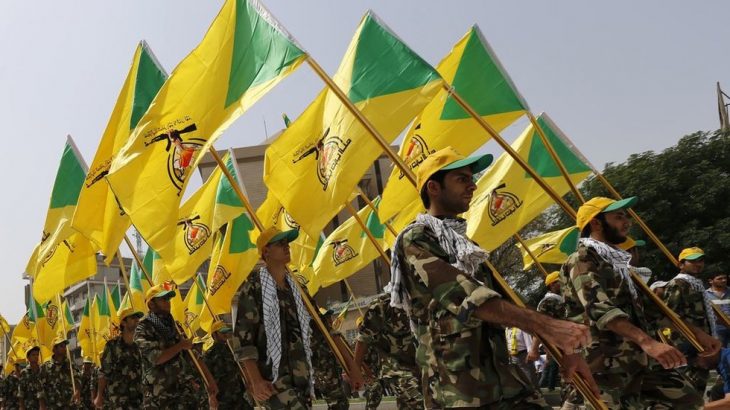
Kataib Hezbollah members wave the party’s flags during a parade in Baghdad. © Reuters / Thaier al-Sudani
RT | December 29, 2019
US airstrikes have pounded three Kataib Hezbollah military facilities near the town of Qaim, Iraq, as well as two targets in Syria, in response to the group’s alleged bombing of an Iraqi military base on Friday.
The US carried out “defensive strikes” against the supposed Kataib Hezbollah facilities on Sunday, US officials told Reuters. The targets included weapons storage locations and command and control stations, and F-15 fighter jets were used in the attack. Three locations near Qaim, on the Iraq/Syria border, and two locations in Syria were hit.
Chief Pentagon spokesman Jonathan Hoffman said in a statement that the strikes were a “response to repeated Kataib Hezbollah attacks on Iraqi bases that host Operation Inherent Resolve (OIR) coalition forces.”
Reuters’ military sources said that at least 18 militiamen were killed in the strikes, including at least four local Kataib Hezbollah commanders.
Two days earlier, the same Kataib Hezbollah fighters and their Iraqi Shia allies were blamed by US officials for a rocket attack on an Iraqi military base in Kirkuk, some 250 miles east of Qaim. The rocket barrage killed an American contractor and wounded several US troops.
Kataib Hezbollah is an Iraqi paramilitary group, but is financially supported by Iran. Its allies in the so-called Popular Mobilization Forces were first deployed by the Iraqi government to combat Islamic State (IS, formerly ISIS) jihadists in 2014, but the government has since struggled to bring them under the command of the Iraqi military.
The rocket attack inflamed anti-Iran sentiment in the US, with Republican Senator Tom Cotton (Arkansas) warning that “Tehran ought to face swift and severe consequences” for its alleged involvement. Responding to similar attacks, US Secretary of State Mike Pompeo threatened Iran earlier this month with a “decisive US response” should they continue.
Iran’s involvement, however, has not been conclusively established.
More Holocaust Reparations for 2020: the Gift That Keeps on Giving
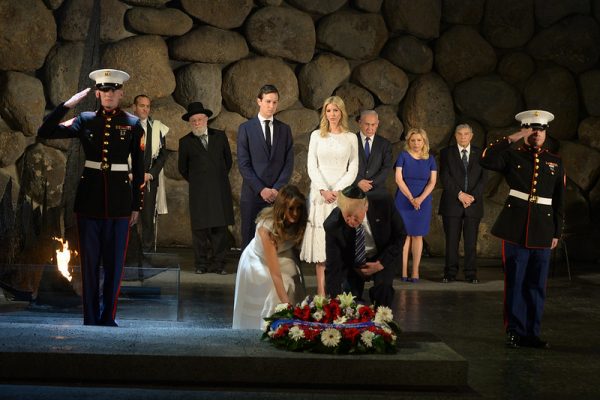
Yad Vashem – Benjamin and Sara Netanyahu, Donald Trump and Melania, Ivanka and Jared Kushner, Rabbi Yisrael lau. credit: Amos Ben Gershom GPO/ Israel Ministry of Foreign Affairs/ Flickr)
By Philip Giraldi • American Herald Tribune • December 29, 2019
Now that 2019 has ended, it is more than seventy-four years since the end of the Second World War. America’s “Greatest Generation” that actually fought the war and endured it on the home front, is dying off and the remembrance of the conflict is increasingly experienced second hand, if at all. The war has been relegated to the history books, one might think, but that would be to ignore one aspect of it which seems to never fade from sight. That would be the so-called holocaust, which has produced a host of taxpayer funded museums, is regularly featured in the media and also is part of mandatory public education in a growing number of states and school districts.
That the established holocaust narrative lives on in spite of its irrelevancy and obvious contradictions is a reflection of Jewish power in the United States. Since the 1970s, when the regular evocations of the holocaust began in earnest, Jews have come to wield considerable influence in American economic, cultural, intellectual and political life. Jews played a central role in American finance during the 1980s, and they were among the chief beneficiaries of that decade’s corporate mergers and reorganizations. Today, though barely two percent of the nation’s population is Jewish, close to half its billionaires are Jews. The chief executive officers of the three major television networks and the four largest film studios are Jews, as are the owners of the nation’s largest newspaper chain and the most influential single newspaper, The New York Times. The role and influence of Jews in American politics has also developed simultaneously, with Jews heavily over-represented in the Democratic Party and in Congress.
The rise to power on the part of American Jews coincided with the trajectory of Israel in the Middle East. Protecting Israel and Jewish privilege became two sides of the same coin, leading to creation of the holocaust narrative, which Professor Norman Finkelstein has aptly described as The Holocaust Industry. And promotion of the sanctity of the holocaust story has enabled the damnation of skeptics as holocaust-deniers while also increasing the exploitation of the charge of anti-Semitism for those who would dare to criticize either the Jewish tribe itself or Israel.
One of the singular manifestations of the Jewish power in both the U.S. and in Europe has been the creation of mechanisms to address the perceived needs of “holocaust survivors.” One might argue reasonably enough that there cannot be actually that many genuine survivors remaining after 74 years, but the term has proven to be extremely elastic. It has come to include not only the actual victims who were allegedly sent to labor or concentration camps but also any Jew who survived 1939 through 1945 in Europe or even in Asia living in ghettos. And it also includes their children, even if born after the war.
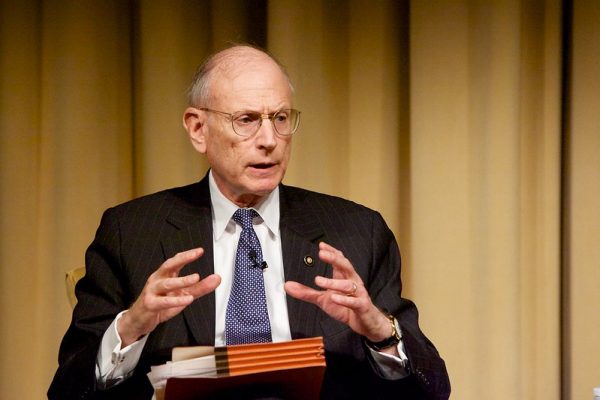
Stuart E. Eizenstat, former Special Representative of the President and Secretary of State on Holocaust-Era Issues. Credit: U.S. National Archives/ Flickr
As a result, the so-called holocaust survivors are now well into their second generation, receiving extra Social Security and Medicare benefits in the United States as well as a steady flow of reparations from Germany and other Europeans, to include France, where forty-nine people who made it out of the Holocaust alive are receiving around $400,000 each, helped by the State Department’s expert on holocaust issues Stuart Eizenstat. The U.S. State Department even has a Holocaust Deportation Claims Program which is always staffed by Jews like Eizenstat.
The reparations programs are generally structured in a way that the payments are limited to Jews, even though there were millions more non-Jews who were victims of the German camps and prisons. Recently there have even been claims that the traumatic holocaust experience might have caused genetic damage, meaning that the need to address the issue by extorting money from the German and other governments will conceivably extend into the foreseeable future.
When in doubt about where to find the money, it is only necessary to get in touch with a professional Zionist Zealot like Eizenstat or with one of the commercial firms that is into the holocaust reparations business. The International Center for Holocaust Reparations is one of them, a corporation registered in Israel with offices located in Jerusalem, Berlin and in Pompano Beach Florida. It was founded by Israeli Zachi Porath and the actual incorporation is in his name as Zachi Porath Ltd.
The organization website headlines that it is “Pursuing Rights of Holocaust Survivors.” It is indeed doing so in a manner of speaking, but it is also a business that makes money by taking a cut of what it obtains. Its website asks what it considers to be key screening questions: “Are you a Holocaust survivor who was interned in a Ghetto?” and “Are you a child of a Holocaust survivor who was interned in a Ghetto?” before getting to the crux of the matter, “You may be entitled to a large sum of money! Even if you are already receiving compensation from the Claims Conference or from the German authorities, including the German Pension Insurance you may be eligible to receive additional payments.”
According to the website “The pension is paid even to those who were interned for a short period of time in a Ghetto (including Ghettos in Poland, Romania, Czernowitz, Shanghai, Sofia, Thessaloniki, Transnistria, Amsterdam, Lithuania, Latvia and Belarus and many more). The possibilities are for a one-time retroactive compensation, as well as a monthly payment from the German Social Security… If you are an heir of a ghetto survivor, and the survivor or their spouse was alive on June 27th 2002, you may be entitled to a one-time payment… We will help you to file the claims for all the money you justly deserve… After you have received the restitution payment, we will charge a fee of 15% of the retroactive sum.”
The website also advises that even second-generation survivors whose parents were interned in a ghetto somewhere for even a short time “may be entitled to a one-time compensation payment… We have been aiding Holocaust survivors all over the world in exercising their rights and have successfully helped many survivors attain their rightful money.”
Some might object to the assertion that Jewish suffering in the war was somehow unique given the fact that far more Russians died than Jews. But the difference is one of perception, due to the effective marketing of a preferred narrative by a powerful and wealthy group that has easy access to the media, to the entertainment industry and to policy makers. And one should not be dismissive of the hard work that has gone into making holocaust reparations eternal. It takes a great deal of ingenuity to devise mechanisms that separate German, French and American taxpayers from their money in perpetuity on behalf of numerous people concentrated apparently in Israel and Florida who may not have suffered at all in the Second World War.
Hoax Confirmed: Honking on Hanukkah (2019)
Semitic Controversies | December 27, 2019
According to the ‘Times of Israel’ there has been an ‘anti-Semitic hate crime’ at Yeshiva University in Manhattan, New York city.
To wit:
‘A man was arrested and accused of setting fire to a Yeshiva University dormitory on Friday using matches set out for Hanukkah, authorities in New York said.
Peter Weyand, 33, is suspected of setting three fires in the Schottenstein Residence Hall dormitory in Midtown Manhattan as students slept, New York’s Fire Commissioner Daniel Nigro said in a statement.
Firefighters responded within five minutes and there were no injuries in the fires, he said.
Surveillance video released by the fire department shows the suspect kicking in a glass door to break into the building at about 3:50 a.m. Friday. The department said Weyand used matches that had been set out for lighting Hanukkah candles.
FDNY
✔
@FDNY
FDNY Fire Marshals have arrested Peter Weyand, age 33, for breaking into the Yeshiva University Schottenstein Residence and using matches intended for a Chanukah menorah to set three separate fires in the building.
“Attacking any religious institution is a serious crime and we have zero tolerance for acts of arson in this city. Thanks to the thorough investigative work of our Fire Marshals, a dangerous individual has been quickly apprehended,” Nigro said.
Weyand is being charged with arson, burglary with criminal intent, reckless endangerment of property, criminal mischief, criminal trespass and aggravated harassment, the fire commissioner said.
Authorities did not indicate if there was any hate crime motive in the incident.’ (1)
Going by the video that has been helpfully provided; Weyand broke in to the lobby of the Schottenstein residence, couldn’t find or get access to anything to steal and promptly began trying to light the place on fire instead. This is clearly not an ‘anti-Semitic hate crime’ by Weyand if we go by the video footage and this is further supported by the lack of any ‘hate crime’-related charge being made by the authorities in New York, which has subsequently been confirmed to be the case by the NYPD. (2)
We have also been informed that Weyand is the grandson of famous jewish physicist and creator of the Hydrogen Bomb Edward Teller (born Ede Teller in Budapest) and is therefore jewish himself. (3)
Go figure.
Regardless of this however; it was quite the attempt prank… no?
(1) https://www.timesofisrael.com/man-arrested-for-setting-fire-to-yeshiva-u-dorm-with-hanukkah-matches/; alternatively see https://www.nytimes.com/2019/12/20/nyregion/yeshiva-university-ny-fires.html
(2) https://forward.com/fast-forward/437220/yeshiva-univeristy-arson-dorm-edward-teller/
(3) Ibid.
Netanyahu Announces Six-Point Plan to Annex Palestinian Land, Defeat Iran

Palestine Chronicle | December 28, 2019
Following his triumph in the Likud party’s primary elections on December 26, Israeli Prime Minister Benjamin Netanyahu introduced a political plan aimed at securing US recognition of Israel’s annexation of West Bank settlements and rolling back Iran’s influence in the region.
Netanyahu’s plan, which is likely to play a major role in his desperate attempt to cling to power after yet another general election, slated for March, also proposes the normalization of ties between Tel Aviv and Arab countries, without ending Israel’s occupation of Palestine.
Israeli newspaper Times of Israel reported on Netanyahu’s six-point plan, which was revealed during the Israeli leader’s victory speech on Friday.
“First, we will finalize our borders; second, we will push the US to recognize our sovereignty in the Jordan Valley and the northern Dead Sea; third, we will push for US recognition of our extension of sovereignty over all the communities in Judea and Samaria, all of them without exception,” Netanyahu said.
“Fourth, we will push for a historic defense alliance with the US that will preserve Israeli freedom of action; fifth, stop Iran and its allies decisively; and sixth, push for normalization and agreements that will lead to peace accords with Arab countries”.
“Israeli officials have been preparing for this moment for more than half a century, since the West Bank, East Jerusalem and Gaza were seized back in 1967,” wrote Palestine Chronicle contributor Jonathan Cook last June.
“Annexation is not a right-wing project that has hijacked the benign intentions of Israel’s founding generation. Annexation was on the cards from the occupation’s very beginnings in 1967, when the so-called center-left – now presented as a peace-loving alternative to Netanyahu – ran the government,” Cook added.
“Ultimately, Israel wants the Palestinians gone entirely, squeezed out into neighboring Arab states, such as Egypt and Jordan. That next chapter is likely to begin in earnest if Trump ever gets the chance to unveil his deal of the century’.”
In his speech on Friday, Netanyahu promised his Likud supporters that he will “fight for them” as “they fought for me,” reported The Times of Israel.
“Opposing Interventionism In Nation X Means You Love Nation X’s Government!”
By Caitlin Johnstone | December 27, 2019
Every time you speak out against western imperialism in a given nation or question western propaganda narratives about that nation’s government, you will inevitably be accused of loving that nation’s government by anyone who argues with you.
When I say “inevitably”, I am not exaggerating. If you speak in any public forum for any length of time expressing skepticism of what we’re told to believe about a nation whose government has been targeted by the US-centralized empire, you will with absolute certainty eventually run into someone who accuses you of thinking that that government is awesome and pure and good.
I have never, ever had this fail to occur, even once. If I write an article about the mountain of evidence suggesting we were lied to about a chemical attack in Syria, I get people telling me I think Bashar al-Assad is a girl scout who’s never ever done anything wrong. If I express skepticism of the flimsy narratives we’re being fed in the escalating propaganda war against China, I get “If you love Beijing so much and think Xi is so innocent you should go and move to China!” It’s one of the only completely predictable things about this job.
Which is of course idiotic. Understanding that the US government and its allies lie constantly with the full-throated support of western news media in no way suggests a belief that the targeted government in question is wonderful, and there’s absolutely no legitimate reason to infer such a thing. The indisputable fact that US-led military interventionism is universally disastrous and based on lies has nothing to do with anyone’s level of emotional support for the governments targeted for destruction by the US-centralized empire. Yet everyone reading this who’s ever tried to speak out against US foreign policy has encountered the behavior I’m describing here.
Why is that? Why do establishment loyalists engage in such a weird, nonsensical behavior with such reliable consistency? Why do they literally always accuse anyone who questions any narrative about any empire-targeted government of having positive emotions toward that government, even though there is no rational reason for them to do so?
I’ll tell you why: Hollywood.
Well, not just Hollywood. Really the dynamic we’re about to discuss has been going on for as long as there have been war stories. But the dominant storytellers of today are in Hollywood, and that’s where the dominant war stories are told.
For as long as war stories have been told, those stories have been framed as a battle between good and evil. The good side is the side you identify with, and the evil side is the one you want to lose. You see this in almost all depictions of war coming out of Hollywood today, from movies based on actual wars to sci-fi and fantasy films like Star Wars and The Lord of the Rings. Over and over and over again from childhood we are trained to assume that mass military violence must have a Good side and an Evil side, so when we see a war being depicted anywhere we immediately start trying to sort out who are the Good Guys and who are the Bad Guys, usually without even thinking about it.
Obviously war isn’t actually about Good versus Evil; usually it’s nothing more noble than geostrategic agenda versus geostrategic agenda. But because people are conditioned from an early age to overlay any ideas about large-scale conflict with this false Good or Evil dichotomy, there’s an immediate assumption that if you’re suggesting that one side might not be Good, then the other side are the Good Guys. If you say the government pushing regime change in Iran is doing something immoral, then you’re saying they’re the Bad Guys, which means you think the Iranian government are the Good Guys.
Yes, the behavior in question really does boil down to something that stupid. This phenomenon where empire apologists will predictably accuse you of loving an empire-targeted nation just because you oppose imperialist agendas is primarily due to a combination of dumb binary thinking and watching too many Hollywood movies. In other words, it’s due to bad information meeting bad thinking.
All we can really do to address this dynamic is bring consciousness to it. When someone’s acting out the unexamined assumption that because you are critical of western imperialism you must necessarily believe that all of its targets are perfect and wonderful, you can point out the absurdity of this position and invite them to think a little harder about it. Or just link them to this article.
Beyond that, all you can really do is understand what you’re looking at, roll your eyes, and sigh.
US plans to conduct cyberwar against Russia in retaliation for unproven election meddling
By Scott Ritter | RT | December 28, 2019
Despite having provided no proof of Russian meddling in the 2016 or 2020 US presidential election, the Pentagon is preparing to launch a cyberwar against Russia in retaliation. Could the real reason be political?
From May 2017 until March 2019, a team of investigators and lawyers led by Special Counsel Robert S. Mueller engaged in a frenetic search for evidence sustaining allegations that individuals affiliated with the campaign of President Donald Trump—and even the president himself—had colluded and conspired with the Russian government to influence the outcome of the 2016 US presidential election in Trump’s favor. Numerous high-profile politicians, civil servants, and media personalities invested a tremendous amount of political and personal capital pursuing various allegations.
Among the most prominent of these held that hackers allegedly working on behalf of Russian Military Intelligence (the GRU) gained access to computer servers belonging to the Democratic National Committee (DNC) and the Democratic Congressional Campaign Committee (DCCC), extracted sensitive data, and then conspired to have this information released to the public in a manner designed to harm the presidential campaign of Hillary Clinton.
While the charges against Trump were subsequently shown to be unfounded, the American public was led to believe that the underlying facts of the case—especially the allegations concerning the hacking of the DNC server—were undisputed fact. Moreover, the same people who invested so heavily in the Mueller investigation are now claiming that Russia—with or without the knowledge and support of President Trump—is actively preparing for a similar intervention in the 2020 election. Prodded by these concerns, the US Cyber Command, a Department of Defense organization responsible for cyber warfare and computer security, has reportedly been tasked with developing a range of offensive operations to deter and, if necessary, punish Russia for engaging in such malign activity.
While the US preparations are real, the intelligence that underpins the justification for these planned cyber-attacks is highly speculative and, more importantly, unproven, creating a situation similar to that which occurred in Iraq back in 2003, when the US went to war on flawed and largely manufactured intelligence alleging Iraq retained significant stockpiles of weapons of mass destruction, when in fact none existed. As with Iraq, the case against Russia is mainly speculative in nature, full of specific allegations that are not backed up with any hard intelligence.
The foundation for the alleged Russian activities comes in the form of two documents. The first, an indictment of 12 named Russian intelligence officers allegedly employed by the GRU, was prepared by the Department of Justice (DOJ). Referred to as the Netyksho Indictment, after one of the named GRU officers, the document lays out a damning list of malign activities by the named individuals and the GRU units they belonged to. However, there is absolutely no sourcing provided, meaning that the allegations must be taken at face value.
The events alleged in the Netyksho Indictment are likewise contained in the body of the report prepared by Special Counsel Robert Mueller based upon his investigation into allegations of Russian interference in the 2016 US presidential election (Mueller’s team also prepared the Netyksho Indictment). The Mueller Report does provide sourcing, but only in a superficial way, either referring to the unsourced Netyksho Indictment, cryptic compilations of investigative reports, or heavily redacted passages. There is no indication as to how either the Indictment or the Mueller Report came to their conclusions.
There is a document, however, that mitigates against the conclusions reached by both the Netyksho Indictment and the Mueller Report. Entitled ‘Spear-Phishing Campaign TTP’s [tactics, techniques and procedures] used against US and Foreign Government Entities’, the document consists of a diagram attached to a classified National Security Agency (NSA) document leaked to the US press by whistleblower Reality Winner. This document serves as a Rosetta Stone, so to speak, for both the Mueller Report and the Netyksho Indictment. The document is derived from the various intelligence reports assembled by the NSA regarding the allegations against the GRU that underpin the Mueller Report and the Netyksho Indictment.
The document diagram contains three types of information—confirmed, analyst judgement, and contextual. While most of the specific cyber events are reported as confirmed, the connection between these events and Unit 74455 (one of two GRU units named in the Netyksho Indictment and the Mueller Report) are recorded as being based upon the judgement of the analysts, and not confirmed fact. Likewise, the linkage between the entity assessed as Unit 74455 and GRU Headquarters is listed as contextual, meaning that there is no fact-based data that links either Unit 74455 or GRU Headquarters to the events in question.
The Winner document makes it clear that the involvement of Unit 74455 is pure analytical supposition—i.e. guesswork. The attribution of blame to the unit and its named personnel isn’t derived from intelligence collection and analysis, but rather the case presented to a grand jury by the Mueller prosecution team.
There is a saying in the US that a grand jury can indict a ham sandwich—in short, because the prosecution controls the process through which evidence is presented, anyone can be indicted for anything, regardless of the lack of actual proof. In the present matter, Unit 74455 and its named personnel are the proverbial ham sandwich.
This does not mean that the Russians did or didn’t carry out a cyber-attack on the DNC and DCCC computers in 2016, or conspire to disseminate information thus gained to influence the 2016 US presidential election. It does mean, however, that the case against Russia is not nearly as conclusive as the Mueller Report and Netyksho Indictments would lead one to believe.
Mueller knew the Russians would not allow the GRU or its personnel to be subjected to a trial, regardless of innocence or guilt. As such, the DOJ could—and did—get creative in breathing life into allegations which, on their own volition, provided zero Russian attribution. All it took was a DOJ analyst to access a GRU organizational chart and start plugging in names and unit designations where they could be used to manufacture a narrative that would be presented to the Grand Jury.
Left unchallenged, the allegations set forth by the Netyksho Indictment and the Mueller Report morphed into unquestioned fact which was then used to justify the anti-Russian activities currently being undertaken by US Cyber Command. The scope and scale of the cyber-operations allegedly being planned appear to be more akin to juvenile retaliation than punitive deterrence, along the lines of “I’ll leak your private information if you leak mine.” But it is only a matter of a few keystrokes to transition from relatively harmless leaks of personal data to more nefarious offensive operations designed to impact economic and military targets.
The mere fact that the US is preparing to undertake military operations of any sort directed at Russia should send alarm bells ringing in the heads of all Americans. The planned activities of US Cyber Command are derived more from the frustration of those who invested so heavily in the outcome of the Mueller investigation, and who are now desperate to manufacture a narrative that somehow breathes life into the ‘Russia did it’ story line.
The use of false and misleading intelligence to justify a conflict should be familiar to anyone who followed the events of 2003 and the manufactured case for war in Iraq. The US and the world continue to pay a heavy price for that intelligence failure. Given the deteriorating state of US-Russian relations, the last thing the US, Russia or the world need is another avoidable conflict, cyber or otherwise, based upon similarly flawed intelligence, for no other reason than to prop up the reputations of those who had bet everything on the outcome of the Mueller Report, and failed.
Scott Ritter is a former US Marine Corps intelligence officer. He served in the Soviet Union as an inspector implementing the INF Treaty, in General Schwarzkopf’s staff during the Gulf War, and from 1991-1998 as a UN weapons inspector.
Featured Video
Thomas Fazi: NATO’s Hybrid Warfare – Deception & Permanent War
or go to
Aletho News Archives – Video-Images
Book Review
UAE tortured, killed journalist for opposing Israel normalization
The Cradle | October 31, 2026
UAE security officers detained, tortured, and killed Emirati poet and news editor Habib al-Sayegh in August 2019, shortly after he published a column opposing UAE normalization with Israel, according to a newly published book.
“Princes and Thieves,” a book by investigative journalist Matthew Cole published on 25 October, alleges that UAE security officers raided Sayegh’s Abu Dhabi home shortly after the publication of the column, hooded him in front of his wife and took him to a detention facility where he was tortured to death.
His interrogators reportedly pulled out several of his teeth with pliers and beat him repeatedly with a sharp metal object.
On 11 August 2019, Sayegh criticized the UAE’s plan to normalize relations with Israel as part of the Abraham Accords in his weekly column for Khaleej newspaper. The column was titled “Israel Is Our Real Enemy and A Dangerous Project.”
Sayegh described Israel as “a real and natural enemy” while questioning “who authorized the normalizers to speak on behalf of everyone?”
Nine days after the column was published, Emirati state media announced his death, without stating a cause. … continue
Blog Roll
 Aletho News
- Poland Is the Symptom and Europe Is the Patient
- UAE security forces tortured, killed journalist for opposing Israel normalization: Report
- They Compared the Spice to the Drug. The Spice Won — Again. (Part 2)
- Thomas Fazi: NATO’s Hybrid Warfare – Deception & Permanent War
- Wrong, AP and NPR: Europe’s 50,000 Heat Deaths Are a Computer-Model Estimate, Not a Real Body Count
- Questioning Your Doctor Is Now Considered A Psychological Problem (Seriously)
- London tourism expo promotes Israeli agency linked to theft of Palestinian land
- Dockworkers launch global strike against Israeli and US military shipments
- Europe facing gas price shock – Gazprom chief
- Ukraine continues recruiting people with disabilities
- If Americans Knew
- An error has occurred; the feed is probably down. Try again later.
- No Tricks Zone
- Germany’s Green Energy Transition Becoming Increasingly Expensive…Another 6 Trillion Euros!
- Sudden Stratospheric Warming, Powerful El Niño Combination May Lead To Extreme Europe Cold, Energy Crisis!
- Two New Studies Find Thwaites Glacier Melt Cannot Be Driven By Human Activity Or A Warming Ocean
- E-Cars Reduce CO2 Emissions By Only 41% Compared To Internal Combustion Engine Vehicles
- Predictions Made By Renowned Climate Professor Over Past Decades Have Been Proven To Be Poor
- New Study Suggests Large Regions Of The Pacific Ocean Have Been Cooling For The Last 80 Years
- Germany’s Green Energy Debacle: High Energy Costs Force Kahla Porzellan to Close After 182 Years!
- New Study: 50 Years Of The Most Aggressive ‘Net Zero’ Policies Can Only Affect The Global Climate By 0.03°C
- US September “Heat” Was No Record…Many Records Set Decades Ago
- Latest European Green Energy Debacle; Portugal’s Largest Flagship Solar Park Insolvent!

