The Pitfalls of a Pit Bull Russophobe
By Ray McGovern | Consortium News | November 22, 2019
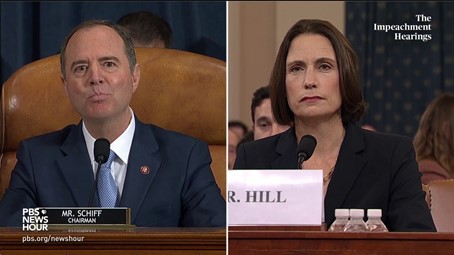
Fiona Hill’s “Russian-expert” testimony Thursday and her deposition on Oct. 14 to the impeachment inquiry showed that her antennae are acutely tuned to what Russian intelligence services may be up to but, sadly, also displayed a striking naiveté about the machinations of US intelligence.
Hill’s education on Russia came at the knee of the late Professor Richard Pipes, her Harvard mentor and archdeacon of Russophobia. I do not dispute her sincerity in attributing all manner of evil to what President Ronald Reagan called the “Evil Empire.” But, like so many other glib “Russia experts” with access to Establishment media, she seems three decades out of date.
I have been studying the USS.R. and Russia for twice as long as Hill, was chief of CIA’s Soviet Foreign Policy Branch during the 1970s, and watched the “Evil Empire” fall apart. She seems to have missed the falling apart part.
Selective Suspicion
Are the Russian intelligence services still very active? Of course. But there is no evidence — other than Hill’s bias — for her extraordinary claim that they were behind the infamous “Steele Dossier,” for example, or that they were the prime mover of Ukraine-gate in an attempt to shift the blame for Russian “meddling” in the 2016 US election onto Ukraine. In recent weeks US intelligence officials were spreading this same tale, lapped up and faithfully reported Friday by The New York Times.
Hill has been conditioned to believe Russian President Vladimir Putin and especially his security services are capable of anything, and thus sees a Russian under every rock — as we used to say of smart know-nothings like former CIA Director William Casey and the malleable “Soviet experts” who bubbled up to the top during his reign (1981 – 1987). Recall that at the very first meeting of Reagan’s cabinet, Casey openly told the president and other cabinet officials: “We’ll know our disinformation program is complete when everything the American public believes is false.” Were Casey still alive, he would be very pleased and proud of Hill’s performance.
Beyond Dispute?
On Thursday Hill testified:
The unfortunate truth is that Russia was the foreign power that systematically attacked our democratic institutions in 2016. This is the public conclusion of our intelligence agencies, confirmed in bipartisan Congressional reports. It is beyond dispute, even if some of the underlying details must remain classified. [Emphasis added.]
Ah, yes. “The public conclusion of our intelligence agencies”: the same ones who reported that the Communist Party of the Soviet Union would never surrender power peaceably; the same ones who told Secretary of State Colin Powell he could assure the UN Security Council that the WMD evidence given him by our intelligence agencies was “irrefutable and undeniable.” Only Richard-Pipeline-type Russophobia can account for the blinders on someone as smart as Hill and prompt her to take as gospel “the public conclusions of our intelligence agencies.”
A modicum of intellectual curiosity and rudimentary due diligence would have prompted her to look into who was in charge of preparing the (misnomered) “Intelligence Community Assessment” published on Jan. 6, 2017, which provided the lusted-after fodder for the “mainstream” media and others wanting to blame Hillary Clinton’s defeat on the Russians.
Jim, Do a Job on the Russians
President Barack Obama gave the task to his National Intelligence Director James Clapper, whom he had allowed to stay in that job for three and a half years after he had to apologize to Congress for what he later admitted was a “clearly erroneous” response, under oath, to a question from Sen. Ron Wyden (D-OR) on NSA surveillance of US citizens. And when Clapper published his memoir last year, Hill would have learned that, as Defense Secretary Donald Rumsfeld’s handpicked appointee to run satellite imagery analysis, Clapper places the blame for the consequential “failure” to find the (non-existent) WMD “where it belongs — squarely on the shoulders of the administration members who were pushing a narrative of a rogue WMD program in Iraq and on the intelligence officers, including me, who were so eager to help that we found what wasn’t really there.” [Emphasis added.]
But for Hill, Clapper was a kindred soul: Just eight weeks after she joined the National Security Council staff, Clapper, during an NBC interview on May 28, 2017, recalled “the historical practices of the Russians, who typically, are almost genetically driven to co-opt, penetrate, gain favor, whatever, which is a typical Russian technique.” Later he added, “It’s in their DNA.” Clapper has claimed that “what the Russians did had a profound impact on the outcome of the election.”
As for the “Intelligence Community Assessment,” the banner headline atop The New York Times on Jan. 7, 2017 set the tone for the next couple of years: “Putin Led Scheme to Aid Trump, Report Says.” During my career as a CIA analyst, as deputy national intelligence officer chairing National Intelligence Estimates (NIEs), and working on the Intelligence Production Review Board, I had not seen so shabby a piece of faux analysis as the ICA. The writers themselves seemed to be holding their noses. They saw fit to embed in the ICA itself this derriere-covering note: “High confidence in a judgment does not imply that the assessment is a fact or a certainty; such judgments might be wrong.”
Not a Problem
With the help of the Establishment media, Clapper and CIA Director John Brennan, were able to pretend that the ICA had been approved by “all 17 intelligence agencies” (as first claimed by Clinton, with Rep. Jim Himes, D-CT, repeating that canard Thursday, alas “without objection).” Himes, too should do his homework. The bogus “all 17 intelligence agencies” claim lasted only a few months before Clapper decided to fess up. With striking naiveté, Clapper asserted that ICA preparers were “handpicked analysts” from only the FBI, CIA and NSA. The criteria Clapper et al. used are not hard to divine. In government as in industry, when you can handpick the analysts, you can handpick the conclusions.
Maybe a Problem After All
“According to several current and former intelligence officers who must remain anonymous because of the sensitivity of the issue,” as the Times says when it prints made-up stuff, there were only two “handpicked analysts.” Clapper picked Brennan; and Brennan picked Clapper. That would help explain the grossly subpar quality of the ICA.
If US Attorney John Durham is allowed to do his job probing the origins of Russiagate, and succeeds in getting access to the “handpicked analysts” — whether there were just two, or more — Hill’s faith in “our intelligence agencies,” may well be dented if not altogether shattered.
Russia dials back peace talks with Japan
By M. K. BHADRAKUMAR | Indian Punchline | November 23, 2019
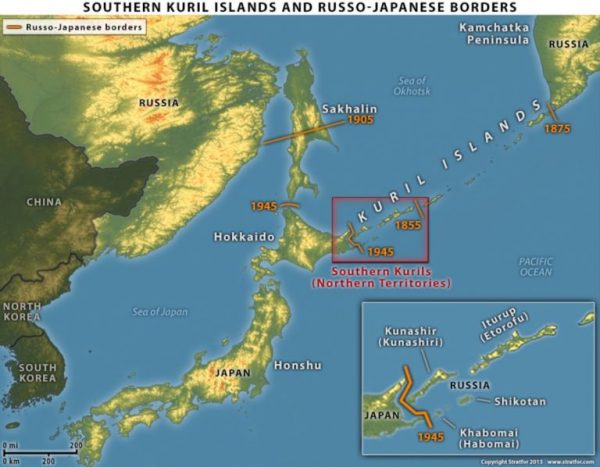
Russia-Japan territorial disputes surged at a meeting of foreign ministers of the two countries, Toshimitsu Motegi and Sergey Lavrov, at Nagoya, Japan, on November 22 on the sidelines of a G20 foreign ministers’ gathering.
Lavrov publicly threw cold water on the Japanese spin that Tokyo is engaged in “persistent talks” with Russia on a peace treaty bringing the two countries’ World War 2 hostility to a formal ending.
Lavrov emphatically stated that any forward movement on a peace treaty will have to be within the ambit of the Russia-Japan 1956 joint declaration, which, as he put it, “clearly states that first Russia’s territorial integrity and sovereignty over all our lands, including those territories, are recognised, thus recognising the results of World War II, and then everything else will possibly be discussed.”
In plain terms, according to Lavrov, Moscow may consider discussing a peace treaty only after Tokyo unequivocally recognises Russian sovereignty over Kuril islands and territories that came under Russian control in the Far East during World War 2.
Japan’s stance, on the contrary, can never converge on that point. Wouldn’t Moscow have known it already? Of course, Lavrov has only reiterated a consistent Russian stance.
Tokyo has been baiting Moscow with the proposition that a peace treaty will open the door to large-scale investments by Japanese companies for the development of the Russian Far East (which is a national priority for the Kremlin.)
Tokyo has also been smart, projecting Russian President Vladimir Putin as a strong but pragmatic statesman who is willing to make territorial concessions to attract Japanese investments.
But it takes two to tango and up to a point Moscow acquiesced with the Japanese enthusiasm that the two countries could be settling the Kuril issue — although making territorial concessions will be a highly emotive issue for the Russian public opinion.
Moscow probably pinned hopes that a relaxed climate of relations might wean Tokyo away from the US strategic orbit — although the likelihood of Japan shaking off the US security umbrella will remain zero for the conceivable future.
At any rate, that tango has ended and realism prevails, with the regional security climate in the Far East visibly darkening with the recent US cruise missile tests and the Pentagon’s plan to deploy new missiles in Japan following its exit from the INF Treaty (which had banned the intermediate-range missiles previously.)
Moscow is alert to the emergent threats to its strategic assets in the Russian Far East due to the US deployment. Importantly, Tokyo appears to be open to the proposed US missile deployments, which would further cement the US-Japan military alliance.
Unsurprisingly, Moscow has linked the regional security scenario to its territorial disputes with Japan. To quote Lavrov, “The military alliance with the US, of course, represents a problem when it comes to taking Russian-Japanese relations to another level. I will remind you that when the 1956 declaration was being coordinated, the USSR said back then that everything may be implemented, and this declaration may be fully implemented only in the context of discontinued US military presence on Japan’s territory.”
Lavrov added, “Japanese colleagues have received a list of Russia’s specific security concerns which emerge because of the increasing and strengthening Japanese-US military-political alliance. So our Japanese colleagues promised to react to those concerns. We will wait for their response and continue discussions.”
Lavrov also chose the G20 FMs’ forum at Nagoya to present Russian concerns over the security climate in the Far East. He said, “As for the US behaviour in the world, including in the Asia-Pacific region, in its relations with Japan, the United States does not hesitate to publicly acknowledge that Russia and China are the main threat to it and that all its military alliances with Japan, Australia and the Republic of Korea will be built proceeding from these threats and challenges.
“But, of course, we pointed out at a meeting with the Japanese foreign minister that this ran counter to the assurances, which Japan gives us that the Japanese-US military and political alliance is not aimed against the Russian Federation.” (TASS )
Meanwhile, Russia is speeding up the construction of military dormitories on the Southern Kuril Islands. A spokesman for Russia’s Eastern Military District said this week that military personnel would settle into the dormitories on Iturup and Kunashir by the end of 2018 and that more dormitories would be built and commissioned in 2019.
The Eastern Military District, which was formed in 2010 under a presidential decree, is headquartered at Khabarovsk in Siberia near the Chinese border and is one of the four operational strategic commands of the Russian Armed Forces.
The new US missile deployments in the Far East are of common concern to Russia and China. In August, Russia and China sought a meeting of the UN Security Council over “statements by US officials on their plans to develop and deploy medium-range missiles”.
Last month, Putin disclosed that Moscow is helping China build a system to warn of ballistic missile launches. Putin said “this is a very serious thing that will radically enhance China’s defence capability”. Since the cold war, only the US and Russia have had such systems, which involve an array of ground-based radars and space satellites. The systems allow for early spotting of intercontinental ballistic missiles.
China will find Lavrov’s remarks at Nogaya to be very reassuring. It is a safe bet that the Russia-Japan normalisation will be an excruciatingly slow process, which in turn works fine for China in geopolitical terms. Lavrov also had a meeting with Wang Yi, Chinese Councilor and Foreign Minister, at Nogaya.
US Federal Court Orders Tehran to Pay $180M to Washington Post Journalist – WaPo
Sputnik – 23.11.2019
Jason Rezaian, 43, the chief of The Washington Post’s Tehran bureau, was detained for over 18 months in Iran. along with his wife, who was released after two months of detention.
Washington DC federal Judge Richard Leon has ordered the government of Iran to pay Washington Post journalist Jason Rezaian and his family “compensatory damages” in the amount of $180 million, according to The Washington Post.
“Holding a man hostage and torturing him to gain leverage in negotiations with the United States is outrageous, deserving of punishment, and surely in need of deterrence”, the judge wrote in a 30-page ruling.
The federal judge distributed the amount between Rezaian and his family members as $23.8 million to the journalist in compensatory damages for pain, suffering, and economic losses; $2.7 million to his brother, Ali; $2.7 million to his mother, Mary; and $150 million for the whole family in punitive damages, according to WaPo.
Rezaian’s then-newlywed wife, fellow journalist and Iranian citizen Yeganeh Salehi, was not a plaintiff in the lawsuit against Iran, although she was detained together with her husband before being released after two months.
Rezaian, who served as The Washington Post’s Tehran bureau chief, was arrested on 22 July 2014 and was charged with espionage and three other security-related crimes, including “collaborating with hostile governments” and “propaganda against the establishment”. The administration of US President Barack Obama urged Tehran many times to free the journalist, accusing Iran of violating international law.
In 2015, Rezaian was sentenced to several years in jail after being indicted on all four charges, including espionage and propaganda against the establishment.
Rezaian, along with three other Americans, was released in January 2016 under a prisoner-swap deal with the United States, in exchange for seven Iranian-US nationals serving jail time in the US.
The swap agreement also envisaged that the international criminal police group Interpol would cease prosecuting 14 other Iranian nationals.
Following the prisoner swap exchange, The Wall Street Journal alleged that the US had paid a ransom for the US nationals, allegations that were denied by the Obama administration.
What Does PDVSA Have to Do with the Crisis in Haiti?
By Clodovaldo Hernandez – Supuesto Negado – November 7, 2019
Haiti has been on fire for weeks, without the so-called ‘international community’ or its associated press paying any attention.
Fuel shortages have plunged the Caribbean country back into social turmoil which borders on civil war. There are many causes behind this dramatic panorama, which has been exasperated by the decrease in production by Venezuelan state-run oil company PDVSA, corruption scandals in the Caribbean country and relentless US pressure on Venezuela, which have all damaged the PetroCaribe crude oil supply programme, which Haiti was reliant on.
PDVSA’s internal collapse, coupled with the labyrinth of obstacles placed by the US’ unilateral coercive measures (sanctions) against Venezuela, has forced the dismantling of what was one of Commander Hugo Chavez’s most powerful initiatives.
The project is a regional mechanism for selling oil at preferential prices with financing for the residents of the Antillean Basin. Local opposition groups and the Washington-led international coalition have, however, always branded the programme as a way for Venezuela to ensure support in the international arena based on the so-called ‘petro-chequebook.’
Internal corruption
Before the programme was damaged by PDSVA’s fall in production and the blockade [against Venezuela], there were already revelations of financial irregularities by unscrupulous Haitian civil servants and entrepreneurs who took advantage of Venezuelan aid to line their own pockets.
In Haiti, these crimes are particularly outrageous because the programme was conceived as a way of providing financial assistance to the government to address serious internal problems, exacerbated by the 2010 earthquake and five major hurricanes, including Hurricane Matthew in 2016.
Under the programme, PetroCaribe delivered crude oil to a state agency called the Monetisation Bureau of Development Aid Programmes, which proceeded to sell it to private Haitian companies. The resulting funds should have been used to rebuild infrastructure, especially in the areas of health, education, housing and roadways, however around US $2 billion is estimated to have been stolen.
The responsibility of Venezuelan officials in this and other Petro Caribe- related corruption cases remains to be seen.
The issue of corruption is so important in the Haitian political debate that in addition to demanding the resignation of pro-US President Jovenel Moise, the opposition and Haitian grassroots movements, which have led the wave of demonstrations in recent months, also demand the prosecution of those involved in irregularities that distorted the initial objectives of the programme. Opposition Deputies Youri Latortue, Moise Jean Charles and Shiller Louidor have been the flag-bearers of these demands.
The political reasons
In parallel, and in accordance with Washington’s instructions, the Haitian government of businessman Jovenel Moise, which is propped up by the US, has preferred to sever its relationship with PetroCaribe, supposedly to distance itself from the influence that revolutionary Venezuela exerted on previous Haitian presidents, such as René Preval and Michel Martelly.
Moise (whose name also appears amongst the list of alleged benefactors from the theft of PetroCaribe funds) was snared with promises that the US would supply the oil that Venezuela would no longer deliver. But that obviously hasn’t happened.
As the country ran out of fuel, what has been described as Haiti’s worst political crisis has erupted. The nation has lived in perennial instability due to, among other reasons, the continued interference of the US in its internal affairs.
Apart from Haiti, the PetroCaribe programme favoured Antigua and Barbuda, the Bahamas, Belize, Cuba, Dominica, Guatemala, Guyana, Grenada, St. Kitts and Nevis, St. Lucia, St. Vincent and the Grenadines, El Salvador, the Dominican Republic and Suriname. Guatemala and Belize abandoned the agreement in 2014 and 2017 respectively, and in June 2018 Venezuela announced that it was suspending shipments to all these nations due to a drop in production, with the notable exception of Cuba.
Denouncements of irregularities [in the programme’s funds] were well exploited by Venezuela’s opponents to discredit the project between 2016 and 2018. Simultaneously, the US toured the Caribbean offering to supply US oil extracted through fracking in exchange for support for its aggressive political moves against the Venezuelan government of Nicolas Maduro. Of course, in the US’ case, we aren’t talking about a social programme but rather winning the Caribbean market for its oil corporations, while continuing to strangle Venezuela economically.
In 2018, a Caribbean Energy Security Summit was held in Washington, which mentioned adopting sustainable renewable energy systems for the region. The political purpose, the true one, was later expressed by a spokesman for the US State Department: “That the Caribbean doesn’t increase its debt to the only energy supplier which has attended the region to date.”
PDVSA’s inability to continue honouring the programme, in addition to corruption scandals in countries like Haiti, allowed this goal to be achieved just as the US wished.
Now, the entire Caribbean region once again depends on the savage capitalism’s suppliers , and Haiti’s social protests are one of the first symptoms of this return to the harsh reality.
Clodovaldo Hernández is a Venezuelan journalist who has written for left leaning news sites Supuesto Negado and Aporrea.
Translation by Paul Dobson for Venezuelanalysis.
John Solomon responds to Lt. Col. Vindman about Ukraine columns … with the facts
John Solomon Reports | November 22, 2019
I honor and applaud Army Lt. Col. Alexander Vindman’s service to his country. He’s a hero. I also respect his decision to testify at the impeachment proceedings. I suspect neither his service nor his testimony was easy.
But I also know the liberties that Lt. Col. Vindman fought on the battlefield to preserve permit for a free and honest debate in America, one that can’t be muted by the color of uniform or the crushing power of the state.
So I want to exercise my right to debate Lt. Col. Vindman about the testimony he gave about me. You see, under oath to Congress, he asserted all the factual elements in my columns at The Hill about Ukraine were false, except maybe my grammar
Here are his exact words:
“I think all the key elements were false,” Vindman testified.
Rep. Lee Zeldin, R-N.Y, pressed him about what he meant. “Just so I understand what you mean when you say key elements, are you referring to everything John Solomon stated or just some of it?”
“All the elements that I just laid out for you. The criticisms of corruption were false…. Were there more items in there, frankly, congressman? I don’t recall. I haven’t looked at the article in quite some time, but you know, his grammar might have been right.”
Such testimony has been injurious to my reputation, one earned during 30 years of impactful reporting for news organizations that included The Associated Press, The Washington Post, The Washington Times and The Daily Beast/Newsweek.
And so Lt. Col. Vindman, here are the 28 primary factual elements in my Ukraine columns, complete with attribution and links to sourcing. Please tell me which, if any, was factually wrong.
Fact 1: Hunter Biden was hired in May 2014 by Burisma Holdings, a Ukrainian natural gas company, at a time when his father Joe Biden was Vice President and overseeing US-Ukraine Policy. Here is the announcement. Hunter Biden’s hiring came just a few short weeks after Joe Biden urged Ukraine to expand natural gas production and use Americans to help. You can read his comments to the Ukrainian prime minister here. Hunter Biden’s firm then began receiving monthly payments totaling $166,666. You can see those payments here.
Fact 2: Burisma was under investigation by British authorities for corruption and soon came under investigation by Ukrainian authorities led by Prosecutor General Viktor Shokin.
Fact 3: Vice President Joe Biden and his office were alerted by a December 2015 New York Times article that Shokin’s office was investigating Burisma and that Hunter Biden’s role at the company was undercutting his father’s anticorruption efforts in Ukraine.
Fact 4: The Biden-Burisma issue created the appearance of a conflict of interest, especially for State Department officials. I especially refer you to State official George Kent’s testimony here. He testified he viewed Burisma as corrupt and the Bidens as creating the perception of a conflict of interest. His concerns both caused him to contact the vice president’s office and to block a project that State’s USAID agency was planning with Burisma in 2016. In addition, Ambassador Yovanovitch testified she, too, saw the Bidens-Burisma connection as creating the appearance of a conflict of interest. You can read her testimony here.
Fact 5: The Obama White House invited Shokin’s prosecutorial team to Washington for meetings in January 2016 to discuss their anticorruption investigations. You can read about that here. Also, here is the official agenda for that meeting in Ukraine and English. I call your attention to the NSC organizer of the meeting.
Fact 6: The Ukraine investigation of Hunter Biden’s employer, Burisma Holdings, escalated in February 2016 when Shokin’s office raided the home of company owner Mykola Zlochevsky and seized his property. Here is the announcement of that court-approved raid.
Fact 7: Shokin was making plans in February 2016 to interview Hunter Biden as part of his investigation. You can read his interview with me here, his sworn deposition to a court here and his interview with ABC News here.
Fact 8: Burisma’s American representatives lobbied the State Department in late February 2016 to help end the corruption allegations against the company, and specifically invoked Hunter Biden’s name as a reason to intervene. You can read State officials’ account of that effort here
Fact 9: Joe Biden boasted in a 2018 videotape that he forced Ukraine’s president to fire Shokin in March 2016 by threatening to withhold $1 billion in U.S. aid. You can view his videotape here.
Fact 10: Shokin stated in interviews with me and ABC News that he was told he was fired because Joe Biden was unhappy the Burisma investigation wasn’t shut down. He made that claim anew in this sworn deposition prepared for a court in Europe. You can read that here.
Fact 11: The day Shokin’s firing was announced in March 2016, Burisma’s legal representatives sought an immediate meeting with his temporary replacement to address the ongoing investigation. You can read the text of their emails here.
Fact 12: Burisma’s legal representatives secured that meeting April 6, 2016 and told Ukrainian prosecutors that “false information” had been spread to justify Shokin’s firing, according to a Ukrainian government memo about the meeting. The representatives also offered to arrange for the remaining Ukrainian prosecutors to meet with U.S State and Justice officials. You can read the Ukrainian prosecutors’ summary memo of the meeting here and here and the Burisma lawyers’ invite to Washington here.
Fact 13: Burisma officials eventually settled the Ukraine investigations in late 2016 and early 2017, paying a multimillion dollar fine for tax issues. You can read their lawyer’s February 2017 announcement of the end of the investigations here.
Fact 14: In March 2019, Ukraine authorities reopened an investigation against Burisma and Zlochevsky based on new evidence of money laundering. You can read NABU’s February 2019 recommendation to re-open the case here, the March 2019 notice of suspicion by Ukraine prosecutors here and a May 2019 interview here with a Ukrainian senior law enforcement official stating the investigation was ongoing. And here is an announcement this week that the Zlochevsky/Burisma probe has been expanded to include allegations of theft of Ukrainian state funds.
Fact 15: The Ukraine embassy in Washington issued a statement in April 2019 admitting that a Democratic National Committee contractor named Alexandra Chalupa solicited Ukrainian officials in spring 2016 for dirt on Trump campaign manager Paul Manafort in hopes of staging a congressional hearing close to the 2016 election that would damage Trump’s election chances. You can read the embassy’s statement here and here. Your colleague, Dr. Fiona Hill, confirmed this episode, testifying “Ukraine bet on the wrong horse. They bet on Hillary Clinton winning.” You can read her testimony here.
Fact 16: Chalupa sent an email to top DNC officials in May 2016 acknowledging she was working on the Manafort issue. You can read the email here.
Fact 17: Ukraine’s ambassador to Washington, Valeriy Chaly, wrote an OpEd in The Hill in August 2016 slamming GOP nominee Donald Trump for his policies on Russia despite a Geneva Convention requirement that ambassadors not become embroiled in the internal affairs or elections of their host countries. You can read Ambassador Chaly’s OpEd here and the Geneva Convention rules of conduct for foreign diplomats here. And your colleagues Ambassador Yovanovitch and Dr. Hill both confirmed this, with Dr. Hill testifying this week that Chaly’s OpEd was “probably not the most advisable thing to do.”
Fact 18: A Ukrainian district court ruled in December 2018 that the summer 2016 release of information by Ukrainian Parliamentary member Sergey Leschenko and NABU director Artem Sytnyk about an ongoing investigation of Manafort amounted to an improper interference by Ukraine’s government in the 2016 U.S. election. You can read the court ruling here. Leschenko and Sytnyk deny the allegations, and have won an appeal to suspend that ruling on a jurisdictional technicality.
Fact 19: George Soros’ Open Society Foundation issued a memo in February 2016 on its strategy for Ukraine, identifying the nonprofit Anti-Corruption Action Centre as the lead for its efforts. You can read the memo here.
Fact 20: The State Department and Soros’ foundation jointly funded the Anti-Corruption Action Centre. You can read about that funding here from the Centre’s own funding records and George Kent’s testimony about it here.
Fact 21: In April 2016, US embassy charge d’affaires George Kent sent a letter to the Ukrainian prosecutor general’s office demanding that Ukrainian prosecutors stand down a series of investigations into how Ukrainian nonprofits spent U.S. aid dollars, including the Anti-Corruption Actions Centre. You can read that letter here. Kent testified he signed the letter here.
Fact 22: Then-Ukraine Prosecutor General Yuriy Lutsenko said in a televised interview with me that Ambassador Marie Yovanovitch during a 2016 meeting provided the lists of names of Ukrainian nationals and groups she did want to see prosecuted. You can see I accurately quoted him by watching the video here.
Fact 23: Ambassador Yovanovitch and her embassy denied Lutsenko’s claim, calling it a “fabrication.” I reported their reaction here.
Fact 24: Despite the differing accounts of what happened at the Lutsenko-Yovanovitch meeting, a senior U.S. official in an interview arranged by the State Department stated to me in spring 2019 that US officials did pressure Lutsenko’s office on several occasions not to “prosecute, investigate or harass” certain Ukrainian activists, including Parliamentary member Leschenko, journalist Vitali Shabunin, the Anti-Corruption Action Centre and NABU director Sytnyk. You can read that official’s comments here. In addition, George Kent confirmed this same information in his deposition here.
Fact 25: In May 2018, then-House Rules Committee chairman Pete Sessions sent an official congressional letter to Secretary of State Mike Pompeo asking that Yovanovitch be recalled as ambassador to Ukraine. Sessions and State confirmed the official letter, which you can read here.
Fact 26: In fall 2018, Ukrainian prosecutors, using a third party, hired an American lawyer (a former U.S. attorney) to proffer information to the U.S. government about certain activities at the U.S. embassy, involving Burisma and involving the 2016 election, that they believed might have violated U.S. law. You can read their account here. You can also confirm it independently by talking to the U.S. attorney’s office in Manhattan or the American lawyer representing the Ukrainian prosecutors’ interests.
Fact 27: In May 2016, one of George Soros’ top aides secured a meeting with the top Eurasia policy official in the State Department to discuss Russian bond issues. You can read the State memos on that meeting here.
Fact 28: In June 2016, Soros himself secured a telephonic meeting with Assistant Secretary of State Victoria Nuland to discuss Ukraine policy. You can read the State memos on that meeting here.
Lt. Col. Vindman, if you have information that contradicts any of these 28 factual elements in my columns I ask that you make it publicly available. Your testimony did not.
If you don’t have evidence these 28 facts are wrong, I ask that you correct your testimony because any effort to call factually accurate reporting false only misleads America and chills the free debate our Constitutional framers so cherished to protect.
Hezbollah: US major obstacle to government formation in Lebanon
Press TV – November 22, 2019
Hezbollah calls the US the most prominent obstacle lying in the way of formation of a government in Lebanon, which is direly in need of political stability.
The Lebanese resistance movement’s Deputy Secretary-General Sheikh Naim Qassem made the remarks in an interview with Reuters on Friday.
“The first obstruction in the formation of the government is America, because it wants a government that resembles it and we want a government that resembles the Lebanese people,” he said.
US officials had been in direct contact with Lebanese politicians and officials, the official noted, saying, “Let them leave us alone so we can reach an understanding among ourselves. The more they intervene the more they delay the solution.”
The country — where coexistence of various religious sects has turned unity into the leading means of preventing internal strife — would not be rid of its ongoing economic and political woes unless foreign vested interests stopped tugging away at it, Qassem said.
Prime Minister Sa’ad Hariri resigned in late October amid nationwide protests against corruption and economic adversity that had begun earlier that month.
On Tuesday, protesters blocked roads leading to the parliament in the capital Beirut, forcing the legislature to postpone what was supposed to be its first session in two months. Heavy clashes were reported later that day between security forces and a group of protesters attempting to make their way into the parliament.
Iraq invasion ‘Godfather’ berates Trump for not thinking of NEXT WAR in Syria
By Helen Buyniski – RT – November 22, 2019
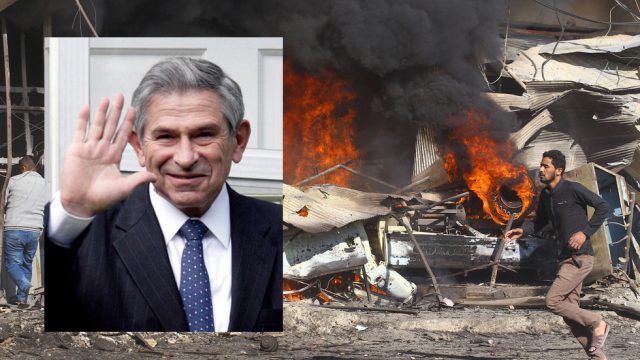
Unreconstructed neocon Paul Wolfowitz has slammed President Donald Trump for ‘abandoning’ the Kurds, insisting the US will need them next time there’s a war in Syria. Trump’s blunder, then, is thinking wars can “end.”
The man once described by CNN as “the heart and soul of the Iraq war” points out in an op-ed in the New York Times on Thursday that decades of meddling in the Middle East have made the US some friends in the region – namely, the Kurds. Casting them aside, he says, will make future meddling much more difficult.
The failed war’s mastermind reminds Trump that because the US’ Kurdish and Arab allies were gracious enough to serve as cannon fodder in the fight against the Islamic State (IS, formerly ISIS/ISIL) in Syria and Iraq, the US lost just six soldiers, compared to 11,000 from the US-backed opposition. A less belligerent mind might see this as exploitation, rather than alliance – but friendship means never having to say “sorry I turned your homeland into a hotbed of sectarian conflict.”
When the next war comes around – and Wolfowitz assures us there will be a next war – the US will be sorry it spurned its Kurdish friends, he warns. The inveterate warmonger calls Trump short-sighted for viewing all engagement in the Middle East through the lens of the Iraq and Afghanistan quagmires, and holds up a failed Shiite uprising against Iraqi leader Saddam Hussein as a cautionary tale of what happens when the US isn’t lurking in the shadows ready to play World Police at the drop of a shell – but glosses over the fact that every war Wolfowitz has backed in his lengthy career has ended with the “liberated” country all but turned to dust.
In Wolfowitz’s view, there is no “right” way to leave a war. “Walking away from [the Middle East] has a way of sucking America back in,” he warns – as if the power vacuum he warns will develop in the absence of a firm American hand to guide backward local politicos is an actual literal vacuum, capable of sucking American troops through space. The only way to prevent this is to prop up US “allies” at the helm of these countries and surround them with American “advisers” so they don’t make the mistake of listening to their people.
But even as he warns against allowing power vacuums to develop, he tears into former President Barack Obama for not backing the Syrian opposition’s efforts to overthrow President Bashar al-Assad, lamenting that a bit of support in the right place could have “toppled the regime… with little risk to Americans.” Apparently, some power vacuums are more dangerous than others.
Wolfowitz admitted in 2013 that the Iraq War was a disaster, but insisted this was only because he wasn’t actually its “architect,” all CNN plaudits aside – he had wanted Iraqi leadership from the start, rather than the embarrassingly colonialist look of having American “viceroy” Paul Bremer running the show. Americans would still be behind the scenes pulling the strings, however – he has bemoaned the lack of “leadership qualities” in Iraqi politicians as recently as 2017, insisting the US must maintain a presence in the country to keep it from “going to hell literally.” For a man who spends so much time mouthing platitudes about democracy, he is wildly allergic to self-rule by Middle Eastern peoples. Had the Bush Administration simply done things according to his plan – adopted the properly colonialist model of backing one group of Iraqis against the others – everything would have been peachy.
That complete lack of insight has made Wolfowitz one of the loudest cheerleaders for any and all wars since his tenure. He was a big fan of invading Libya, and wrote an op-ed in the Wall Street Journal begging Trump to bomb Syria (which Trump did). It’s astonishing that any serious politician still listens to the man who infamously promised in 2003 that the Iraqi people “would greet [American troops] as liberators,” obviating the need for a heavy troop presence in the country. Trump’s repeated attempts at leaving Syria have all crumbled in the face of opposition from the entrenched interests that Wolfowitz represents. But if he stops even trying to pull Americans out of the region, Wolfowitz will be right – these wars will keep happening.
The Umbrella Man, the Sins of the Father, and the Kennedy Curse
By Laurent Guyénot • Unz Review • November 22, 2019
I first heard of the so-called “Umbrella Man” from a commenter to my unz.com article “Did Israel Kill the Kennedys?” (thanks again). It is one of the most puzzling pieces in the JFK assassination file. An intriguing introduction to it is this short interview of Josiah Thompson filmed by Errol Morris for the New York Times, on the 48th anniversary of his death:
Or view on Vimeo.
This film is interesting because, besides presenting the facts accurately, it illustrates the kind of “cognitive dissonance” they can produce, leading reasonable people to believe an implausible but harmless and comforting explanation, rather than a more logical but deeply disturbing one. In that case, it seems that normally programmed brains will reject vigorously, as unspeakable and therefore unthinkable on the conscious level, the notion that John Kennedy’s assassination can possibly have anything to do with his father’s appeasement policy in 1938, despite the fact that that notion has been deeply ingrained in our subconscious mind through the twin Jewish mythemes of “The Sins of the Father” and “The Kennedy Curse”, as illustrated by those two books:
The “sins of the father” is a not-so-subtle reference to Exodus 20:5:
“I, Yahweh, am a jealous God, punishing the children for the sin of the parents to the third and fourth generation of those who hate me.”
Chief among Joe Kennedy’s sins was, of course, that “he was a documented anti-Semite and an appeaser of Adolf Hitler” (publisher’s presentation of Kessler’s book).
The “Kennedy Curse” is a quasi kabalistic attempt to explain how the Kennedys were “on a fatal collision course with reality” because they “made the fatal mistake of thinking of themselves as divine.” By implication, their assassinations are to be blamed on their “self-defeating behavior” (publisher’s presentation of Klein’s book).
Taken together, those twin hasbara refrains evoke a notion of divine punishment. JFK and RFK were punished for the sins of their Jew-hating, Nazi-loving father. Mind you, it was Yahweh who took vengeance, not Israel!
The Umbrella Man fits so perfectly in this mythic narrative! The problem is that myths are not supposed to incarnate themselves so patently in physical reality. The implications are here too disturbing: for no reasonable man can believe that Yahweh supernaturally inspired Louie Steven Witt his “bad joke” (as he called it when interviewed by the special House Select Committee on Assassinations in 1978). Then who inspired it?
Such a question is off-limit for Josiah Thompson’s mind. So he simply decided not to see anything “sinister” in the weird fact that he relates. He not only takes Witt’s explanation at face value (“this is just wacky enough, it has to be true!” in other words, credo quia absurdum), but assumes that the strange behavior of the Umbrella Man and JFK’s assassination are unrelated, and happened precisely at the same time and at the same spot by pure quantum physics coincidence.
By setting his mind on that explanation, Thompson obviously feels relieved not to have to get into “conspiracy theories”, because “everybody else got into the conspiracy theories,” and he is above the crowd. I find it hard to explain that this is the same Josiah Thompson who published in 1967 a book titled Six Seconds in Dallas: a micro-study of the Kennedy assassination proving that three gunmen murdered the President, for which he studied the Zapruder film and interviewed eyewitnesses in order to come up with a plausible line of fire, and the conclusion of a conspiracy and government cover-up. What happened to Josiah in between?
Russ Baker has posted on his website WhoWhatWhy a couple of articles in reaction to Thompson’s NYT interview: here and here. Contrary to Thompson, he finds Witt’s explanation literally unbelievable, and opts for the theory of the “signal man”: the Umbrella Man was “signaling the shooters, perhaps that JFK had been hit, perhaps that he still seemed to be alive, perhaps to keep shooting.” That theory, adopted by film director Oliver Stone for his 1991 movie JFK, is of course far more credible than the theory of the fléchette-shooting umbrella that Thompson chose to mention to his own satisfaction. But I must say I find it not entirely convincing. I cannot conceive that professional snipers would need such a conspicuous accomplice, standing almost in their line of fire (in the case of those shooting from the Grassy Knoll).
I also find no reason to doubt, as Baker does, that Witt was the real Umbrella Man. Witt was identified by neighbors and local newsmen before he came forward to the HSCA, and the photos of him on Dealey Plaza seem to match.
Baker borrows from John Simkin of Spartacus Educational the opinion that the umbrella was never the symbol of Chamberlain anyway, and so that Witt’s explanation makes no sense. Baker is wrong on that point, apparently. The umbrella was so much the iconic trademark of Prime Minister Neville Chamberlain that cartoonist David Low of the London Evening Standard, not only systematically drew him with his umbrella, but even drew him as an umbrella!

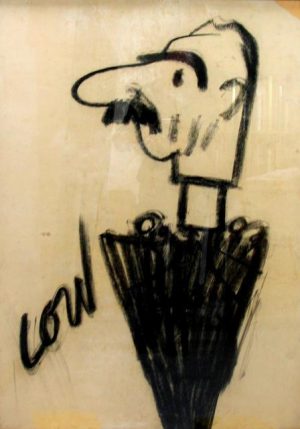
Chamberlain, who became a reviled symbol of appeasement (his biography bears the significant title, More Than Munich: The Forgotten Legacy of Neville Chamberlain) was the archetypal Umbrella Man.
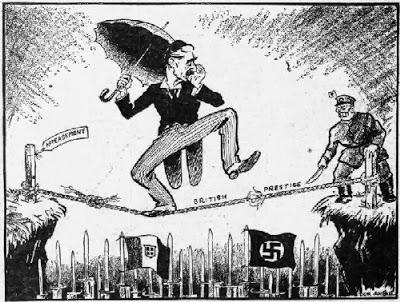
According to Edward Miller,
“Umbrella protests first began in England after Chamberlain arrived home from the [Munich] conference carrying his trademark accessory. Wherever Chamberlain traveled, the opposition party in Britain protested his appeasement at Munich by displaying umbrellas.”[1]
Louie Steven Witt declares in his testimony to the HSCA that he had heard that “some members of the Kennedy family” had once been offended in an airport by people brandishing umbrellas. I haven’t found any confirmation that Joseph Kennedy or any other Kennedy had been heckled by open umbrellas as a “silent protest” against their objectionable lack of love for the Jews, but I find it plausible that “the umbrella was a sore spot to the Kennedys,” as Witt put it in his HSCA testimony. So John Kennedy being heckled with Chamberlain’s umbrella at the same time as being assassinated under Ben-Gurion’s order does strike me as both plausible and significant, as a sort of cryptic signature by the Zionist-Irgun mafia.
In my view, summarized here, John Kennedy was assassinated by Israel for three major reasons:
Dimona: President Kennedy, who had made nuclear disarmament his grand mission on the international level, and was on the way to achieve it with Khrushchev (as shown by James Douglass in JFK and the Unspeakable), was determined to stop Israel developing its own nuclear bomb. According to Colonel Muammar Gaddafi’s interpretation, it was to plunge into the Israeli deep state and supervise Kennedy’s assassination that Ben-Gurion resigned in July 1963 before receiving Kennedy’s ultimatum letter demanding inspections of Dimona.
American Zionist Council: John Kennedy and his Attorney General Bobby Kennedy had infuriated Zionist leaders by supporting an investigation led by Senator William Fulbright (whom Kennedy had been prevented to name as Secretary of State) aimed at registering the American Zionist Council as a “foreign agent” subject to the obligations defined by the Foreign Agents Registration Act of 1938, which would have rendered its lobbying division, the AIPAC, near powerless. On October 11, 1963, the AZC received a formal demand from RFK’s office to register within 72 hours (details here).
Nasser: Kennedy unequivocally supported Arab nationalism in 1957 as a senator,[2] reversed Eisenhower’s foreign polity in a pro-Nasser way (as documented by Philip Muehlenbeck, Betting on the Africans: John F. Kennedy’s Courting of African Nationalist Leaders, Oxford UP, 2012), and committed the U.S. to support U.N. Resolution 194 for the right of return of Palestinian refugees. That was a major threat to Zionist interests, who had bet on making Nasser an enemy of the United States.
To these reasons for assassinating Kennedy, we must add the opposite reasons for putting Johnson instead in the Oval Office, for Johnson buried both the Dimona and the AZC proceedings, and cut U.S. support for Nasser’s in order to boost support to Israel. In 1967, he would commit high treason against his own country by allowing and covering-up Israel’s failed false-flag attack on the USS Liberty. No wonder Israel loved Johnson as much as they hated Kennedy.
In the Zionists’ view, JFK’s anti-Israel policies (discreet or secret) were part of a more general “Kennedy problem” that went back to his father’s attempt to prevent WWII by supporting Chamberlain’s appeasement with Hitler rather than Churchill’s appeasement with Stalin. According to German documents declassified in 1949, the German Ambassador in London, Herbert von Dirksen, after meeting U.S. ambassador Joseph P. Kennedy in 1938, wrote that he “understood our Jewish policy completely,” and was “Germany’s best friend” in London.[3] When Roosevelt entered the war, Joseph Kennedy resigned, and later complained privately that, “the Jews have won the war.”[4] According to biographer David Nasaw, Joseph was not an anti-Semite in the racial sense, but rather someone who believed in a Jewish conspiracy to push the United States into an unnecessary war with Germany (Nasaw insists he was mistaken, because “Jewish influence on American foreign influence was negligible, its influence on the State Department nonexistent”).[5]
Zionists had reasons to fear that Joseph Kennedy did “inject some poisonous drops of anti-Semitism in the minds of his children, including his son John’s” (as printed in September 1960 by the Herut, Menachem Begin’s political party).[6] In 1940, John had published a book titled Why England Slept, adapted from his Harvard thesis which was, as the title alluded, a response to Churchill’s 1938 book While England Slept, and a veiled support for his father’s pro-appeasement views. In his Pulitzer prize-winning book Profiles in Courage (1956), Kennedy had declared his admiration for Senator Robert Taft, who by calling the Nuremberg trials a shameful parody of justice had sacrificed his political career, including his chances for the presidency, rather than build it on hypocrisy. Although Zionists probably didn’t know it until recently, in 1945, JFK had written the following in his diary, as quoted here by Abigail Abrams:
“You can easily understand how that within a few years Hitler will emerge from the hatred that surrounds him now as one of the most significant figures who ever lived. He had boundless ambition for his country which rendered him a menace to the peace of the world, but he had a mystery about him in the way he lived and in the manner of his death that will live and grow after him. He had in him the stuff of which legends are made.”[7]

Joseph Jr., Joseph Sr., and John Kennedy in 1938
The Kennedys were a family of strong traditions and strong convictions. They had to be destroyed, politically as had Charles Lindbergh (1902-1974), and if necessary physically, before they extirpate America from Zionists’ clutches.
Dallas was an Israeli coup, ordered from Tel Aviv with Johnson’s support, and supervised by the local B’nai B’rith under the cover of the Dallas Citizens Council, who was sponsoring Kennedy’s visit, and of whom Abraham Zapruder himself was a member (watch his satisfaction when interviewed two hours after JFK’s assassination in the History Channel documentary JFK – 3 Shots That Changed America , at 43:34).
When trying to make sense of Dallas’ Umbrella Man, we are faced with a dilemma: should we believe Witt’s explanation of his strange behavior (as does Josiah Thompson), or should we consider him an accomplice to the assassination (as does Russ Baker)? Only in the framework of the Israeli theory pioneered by Michael Collins Piper is it possible to surmount the dilemma.
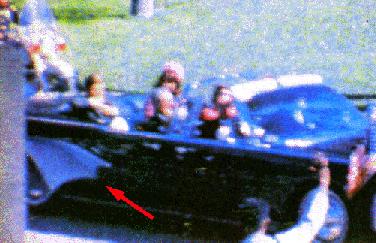
Let’s recap what we know for certain. Fact number 1: on the sunny day of November 22, 1963, one man was standing on the President’s motorcade route with an open umbrella, at the precise moment and place when JFK was shot. To assume that the Umbrella Man’s strange behavior and JFK’s assassination are unrelated is unreasonable. The coincidence is just too improbable.
Fact number 2: In 1978, Louie Steven Witt claimed in front of the HSCA that he was the Umbrella Man and explained that he wanted to heckle JFK about his father’s policy of appeasement of Hitler in 1938.
Although Thompson and Baker disagree about everything else, they agree that there can be no connection between John Kennedy’s assassination and Joseph Kennedy’s appeasement policy. That is where they are both wrong.
Was Louie Steven Witt a Zionist agent, a sayan? Not necessarily. Operations like the JFK assassination are planned on a strict need-to-know basis: no one knows more than he needs to know. Witt declared to the HSCA that he belonged to no organization whatsoever. He summarized his motivation for his “bad joke” in these words:
“In a coffee break conversation someone had mentioned that the umbrella was a sore spot with the Kennedy family. Being a conservative-type fellow, I sort of placed him in the liberal camp and I was just going to kind of do a little heckling.”
What would be interesting to know is: who inspired Witt during his coffee break? Did the coffee break take place in the office of Witt’s Jewish boss, director of the Rio Grande National Life insurance Co. in Dallas? Did Witt have insurmountable debts, like Jacob Rubenstein, aka Jack Ruby? Russ Baker mentions that the company wrote a lot of insurance for the military and was located in the same building that housed the local office of the highly negligent Secret Service.
Mr Witt, would you kindly come forward again and answer a few questions?
Notes
[1] Edward H. Miller, “Umbrella Man”, November 22, 2013, on The Historical Society, on
[2] “Remarks of Senator John F. Kennedy, ‘The New Dimensions of American Foreign Policy’,” University of Pennsylvania, Philadelphia, Pennsylvania, November 1, 1957”; Arthur Schlesinger, A Thousand Days: John Kennedy in the White House (1965), Mariner Books, 2002, p. 554.
[3] Edward Renehan Jr., “Joseph Kennedy and the Jews”, History News Network; Kellen Perry, – “The Dark Side Of Joe Kennedy Sr.” allthatsinteresting.com, April 17, 2017.
[4] Quoted in Herbert Druks, John F. Kennedy and Israel, Praeger Security International, 2005, p. 10
[5] David Nasaw, The Patriarch: The Remarkable Life and Turbulent Times of Joseph P. Kennedy, Penguin, 2015, p. 509.
[6] Alan Hart, Zionism: The Real Enemy of the Jews, vol. 2: David Becomes Goliath, Clarity Press, 2013, p. 252.
[7] Abigail Abrams, “Auction of Rare Diary Highlights What John F. Kennedy Really Thought About Hitler,” Time, March 23, 2017, on
Laurent Guyénot is the author of JFK-9/11: 50 years of Deep State , Progressive Press, 2014, and From Yahweh to Zion: Jealous God, Chosen People, Promised Land … Clash of Civilizations, 2018. (or $30 shipping included from Sifting and Winnowing, POB 221, Lone Rock, WI 53556).
Unspeakable Memories: The Day John Kennedy Died
By Edward Curtin | November 22, 2019
There is a vast literature on the assassination of President John F. Kennedy, who died on a November 22nd Friday like this in 1963. I have contributed my small share to such writing in an effort to tell the truth, honor him, and emphasize its profound importance in understanding the history of the last fifty-six years, but more importantly, what is happening in the U.S.A. today. In other words, to understand it in its most gut-wrenching reality: that the American national security state will obliterate any president that dares to buck its imperial war-making machine. It is a lesson not lost on all presidents since Kennedy.
Unless one is a government disinformation agent or is unaware of the enormous documentary evidence, one knows that it was the CIA that carried out JFK’s murder. Confirmation of this fact keeps arriving in easily accessible forms for anyone interested in the truth. A case in point is James DiEugenio’s recent posting at his website, Kennedys and King, of James Wilcott’s affidavit and interrogation by the House Select Committee on Assassinations, declassified by the Assassinations Record Review Board in 1998. In that document, Wilcott, who worked in the finance department for the CIA and was not questioned by the Warren Commission, discusses how he unwittingly paid Lee Harvey Oswald, the government’s alleged assassin, through a cryptonym and how it was widely known and celebrated at his CIA station in Tokyo that the CIA killed Kennedy and Oswald worked for the Agency, although he did not shoot JFK. I highly recommend reading the document.
I do not here want to go into any further analysis or debate about the case. I think the evidence is overwhelming that the President was murdered by the national security state. Why he was murdered, and the implications for today, are what concern me. And how and why we remember and forget public events whose consequences become unbearable to contemplate, and the fatal repercussions of that refusal. In what I consider the best book ever written on the subject, JFK and the Unspeakable: Why He Died and Why It Matters (2009), James W. Douglass explains this in detail, including the James Wilcott story.
Realizing what I am about to say might be presumptuous and of no interest to anyone but myself, I will nevertheless try to describe my emotional reactions to learning of John Kennedy’s murder so long ago and how that reverberated down through my life. I hope my experiences might help explain why so many people today can’t face the consequences of the tragic history that began that day and have continued to the present, among which are not just the other assassinations of the 1960s but the lies about the attacks of September 11, 2001 and the subsequent endless and murderous “war on terror” with its mind-numbing propaganda and the recent anti-Russia phobia and the blatant celebration of the so-called “deep-state’s” open efforts to overthrow another president, albeit a very different one.
On November 22, 1963 I was a college sophomore. I was going down three steps into the college dining hall for lunch. (Many of my most significant memories and decisions have taken place on steps, either going up or going down; memory is odd in that way, wouldn’t you say?) I remember freezing on the second step as a voice announced through a PA system that the president had been shot in Dallas, Texas. When I finally recovered and went down into the building, another announcement came through saying the president had died. The air seemed to be sucked out of the building as I and the other students with a few professors sat in stunned silence. Soon little groups on this Catholic campus joined together to pray for John Kennedy. I felt as if I were floating in unreality.
Later that day when I left the campus and drove home, I thought back to three years previously and the night of the presidential election. Everyone at my house (parents, grandparents, and the five sisters still at home) had gone to bed, but I stayed up past 1 A.M., watching the television coverage of the vote count. My parents, despite their Irish-Catholicism, were Nixon supporters, but I was for JFK. I couldn’t comprehend why anyone would vote for Nixon, who seemed to me to personify evil. When I finally went up the stairs to bed, I was convinced Kennedy would win and felt very happy.
It wouldn’t be for another tumultuous decade before I would hear Kris Kristofferson sing
Never knowin’ if believin’ is a blessin’ or a curse
Or if the going up is worth to coming down….
From the rockin’ of the cradle to the rollin’ of the hearse
The goin’ up was worth the coming down
and I would ask myself the same question.
In the meantime, the next few years would bring the Bay of Pigs, the Cuban Missile crisis, and the Nuclear Test Ban Treaty, among other significant events, and for a high school student interested in politics and world events it was a heady and frightening few years. It was a country of newspapers back then, and I would read perhaps 3-4 each day and sensed a growing animosity toward Kennedy, especially as expressed in the more conservative NYC papers. I can remember very little talk of politics in my home and felt alone with my thoughts. As far as I can remember, this was also true at the Jesuit high school that I attended. And of course nothing prepared me for the president’s murder and the feeling of despair it engendered in me, a feeling so painful that I couldn’t really acknowledge it. At nineteen, I felt traumatized but couldn’t admit it or tell anyone. After all, I was a scholar and an athlete. Tough.
Then on Sunday morning my family had the TV on and we watched as Jack Ruby shot Lee Harvey Oswald, the guy the government said had killed the president. The unreality was compounded manyfold, and when later it was reported that Oswald had died, I felt I was living in an episode of The Twilight Zone, a popular television show at the time, whose narrator would say we are now entering the weird world between shadow and substance.
The next day a friend and I went to the Fordham University campus to visit a Jesuit priest who was a mentor to us. He had the television on for JFK’s funeral and we sat and watched it for a while with him. After a few hours, it became too painful and the two of us went outside to a football field where we threw a football back and forth. Perhaps subconsciously we were thinking of Kennedy’s love of football; I don’t know. But I remember a feeling of desolation that surrounded us on that empty cold field with not another soul around. It seemed sacrilegious to be playing games at such a time, yet deep trauma contributes to strange behavior.
Then I went on with my college life, studying and playing basketball, until the day after Malcolm X was assassinated on February 21, 1965. Those New York newspapers that didn’t like Kennedy, hated Malcolm even more and were constantly ripping into him. I vividly remember talking to my college basketball teammate the next day. His sense of devastation as a young African American struck me forcefully. As we walked to basketball practice and talked, his sense of isolation and gloom was palpable. Visceral. Unforgettable. It became mine, even though I didn’t at the time grasp its full significance.
In 1968 when Dr. Martin Luther King was assassinated, I was driving to visit a girlfriend and remember hearing the news on the car radio and feeling deeply shocked. I felt immediately oppressed by the first warm spring evening in the New York area. It was as if the beautiful weather, usually so uplifting after winter and so joyously stimulating to a young man’s sexuality, was conspiring with the news of King’s death to bring me down into a deep depression.
Soon the country would awaken on June 5 to the surreal news that Senator Robert Kennedy was shot in Los Angeles the night before. Like so many Americans, when he died not long after, I felt his death was the last straw. But it was far from it. For all the while Lyndon Johnson had lied his way to election in 1964 and escalated the Vietnam war to savage proportions. Death and destruction permeated the air we were breathing. The year 1968 ended with the suspicious death in Thailand of a hero of mine, the anti-war Trappist Monk Thomas Merton. Subsequent research has shown that that too was an assassination. And while all of this was going on and my political consciousness was becoming radicalized, I became a conscientious objector from the Marines. I was 24 years old.
By the late 1970s, having been fired from teaching positions for radical scholarship and anti-war activities, and mentally exhausted by the unspeakable events of the 1960s, I retreated into the country where I found solace in nature and a low-key life of contemplation, writing literary and philosophical essays, a novel, book reviews, and becoming a part-time newspaper columnist. By the 1990s, I gradually returned to teaching and a more active political engagement, primarily through teaching and writing.
Then in 1991 Oliver Stone jolted me back in time with his film JFK. I found powerful emotional memories welling up within me, and growing anger at what had happened to the U.S. in the previous decades. Soon JFK Jr., who was investigating his father’s assassination and was about to enter politics and take up his father’s mantle, was killed in a blatantly rigged “accident.” A month before I had been standing in line behind his wife in the bakery in my little town while he waited outside in a car. Now the third Kennedy was dead. I called my old friend the Jesuit priest from Fordham, but he was speechless. The bodies kept piling up or disappearing.
When the attacks of September 11, 2001 happened, I realized from day one that something was not right; that the official explanation was full of holes. My sociological imagination took fire. All that I had thought and felt, even my literary writing, came together. The larger picture emerged clearly. My teaching took on added urgency, including courses on September 11th and the various assassinations.
Then in 2009 I read and reviewed James Douglass’s masterpiece, JFK and the Unspeakable, and my traumatic memories of 1963 and after came flooding back in full force. I realized that those youthful experiences had been so difficult for me to assimilate and that I therefore had to intellectualize them, for the emotional toll of re-experiencing them and what they meant was profound. The book really opened me to this, but so too did the awareness of how sensitive I was to John Kennedy’s death, how emotional I felt when reading about it or hearing him speak or listening to a song such as “The Day John Kennedy Died” by Lou Reed. It was as though a damn had burst inside me and my heart had become an open house without doors or windows.
I tell you all this to try to convey the ways in which we “forget” the past in order to shield ourselves from powerful and disturbing memories that might force us to disrupt our lives. To change. Certain events, such as the more recent attacks of September 11, have become too disturbing for many to explore, to study, to contemplate, just as I found a way to marginalize my feelings about my own government’s murder of President Kennedy, a man who had given me hope as a youngster, and whose murder had nearly extinguished that hope.
Many people will pretend that they are exposing themselves to such traumatic memories and are investigating the events and sources of their disquietude. It is so often a pretense since they feel most comfortable in the land of make-believe. What is needed is not a dilettantish and superficial nod in the direction of having examined such matters, but a serious in-depth study of the facts and an examination of why doing so might make one uncomfortable. A look outward and a look inward. Just as people distort and repress exclusively personal memories to “save” themselves from harsh truths that would force them to examine their current personal lives, so too do they do the same with political and social ones. When I asked two close relatives of mine, both of whom came close to death on September 11, 2001 at The World Trade Towers, what they have thought about that day, they separately told me that they haven’t really given it much thought. This startled me, especially since it involved mass death and a close encounter with personal death in a controversial public event, two experiences that would seem to elicit deep thought. And these two individuals are smart and caring souls.
What and why we remember and forget is profoundly important. Thoreau, in writing about life without principle, said, “It is so hard to forget what is worse than useless to remember.” This is so true. We are consumed with trivia, mostly by choice.
Perhaps a reason we remember so much trivia is to make sure we forget profound experiences that might shake us to our cores. The cold-blooded public execution of President John Kennedy did that to me on that melancholy Friday when I was 19, and by trying to forget it and not to speak of it, I hoped it would somehow go away, or at least fade to insignificance. But the past has a way of never dying, often to return when we least expect or want it.
So today, on this anniversary Friday, another November 22, I have chosen to try to speak of what it felt like once upon a time on the chance that it might encourage others to do the same with our shared hidden history. Only by speaking out is hope possible. Only by making the hidden manifest.
T. S. Eliot wrote in “Journey of the Magi” words that echo ironically in my mind on this anniversary of the day John Kennedy died:
All this was a long time ago, I remember
And I would do it again, but set down
This set down
This: were we led all that way for
Birth or Death? There was a Birth certainly,
We had evidence and no doubt. I had seen birth and
Death,
But had thought they were different; this Birth was
Hard and bitter agony for us, like Death, our death.
We returned to our places, these Kingdoms,
But no longer at ease here, in the old dispensation,
With an alien people clutching their gods.
I should be glad of another death.
Remembering in all its emotional detail the day John Kennedy died has been a long and cold journey for me. It has allowed me to see and feel the terror of that day, the horror, but also the heroism of the man, the in-your-face warrior for peace whose death should birth in us the courage to carry on his legacy.
Killing a man who says “no” to the endless cycle of war is a risky business, says a priest in the novel Bread and Wine by Ignazio Silone. For “even a corpse can go on whispering ‘No! No! No! with a persistence and obstinacy that only certain corpses are capable of. And how can you silence a corpse.”
John Kennedy was such a man.
Eliot was right: Sometimes death and birth are hard to tell apart.
President Kennedy’s courage in facing a death he knew was coming from forces within his own government who opposed his efforts for peace, nuclear disarmament, and an end to the Cold War – “I know there is a God-and I see a storm coming. I believe that I am ready,” he had written on a slip of paper, and his favorite poem contained the refrain, “I have a rendezvous with death” – should encourage all of us to not turn our faces away from his witness for peace.
We must stop being at ease in a dispensation where we worship the gods of war and clutch the nuclear weapons that our crazed leaders say they will use on a “first-strike” basis. If they ever do, Eliot’s question – “were we led all that way for Birth or Death?” – will be answered.
But no one will hear it.
The Kennedy Autopsy 2
By Jacob G. Hornberger | FFF | November 22, 2019
Fifty-six years ago today, President John F. Kennedy was shot dead on the streets of Dallas, Texas. The official story is that a lone nut named Lee Harvey Oswald, without any motive, committed the assassination. During the past several decades, however, the overwhelming amount of circumstantial evidence, much of which was intentionally kept secret, points to a national-security regime-change operation to oust Kennedy from office and elevate Vice President Lyndon Johnson to the presidency.
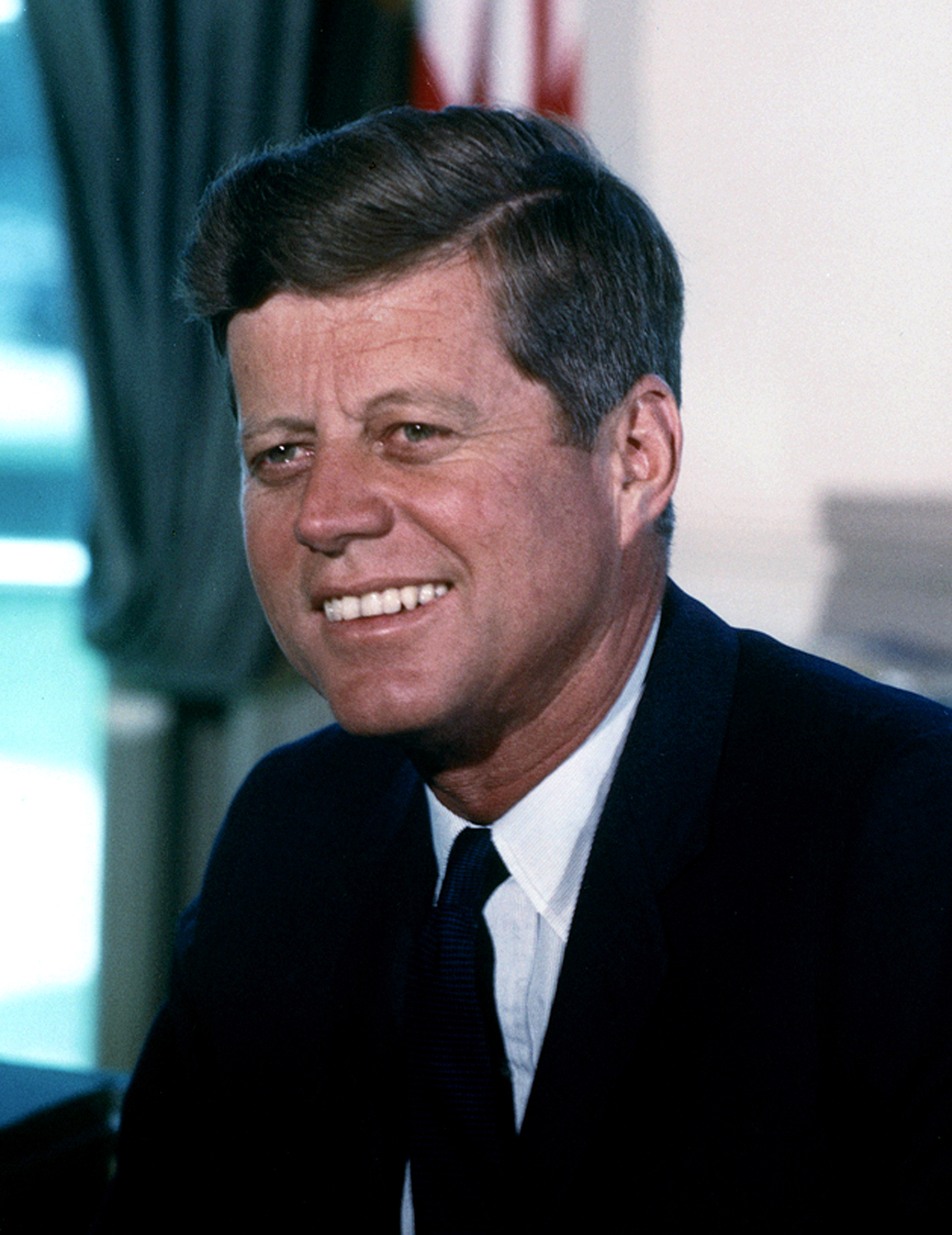 A key to understanding the assassination lies in a critically important event that occurred after the assassination. That event was the official autopsy that was conducted on the president’s body. By understanding the autopsy, one can gain a better understanding of the assassination itself.
That was the purpose of my best-selling book several years ago, The Kennedy Autopsy, which was a synopsis of a watershed five-volume assassination book entitled Inside the Assassination Records Review Board by Douglas P. Horne, who was a staff member of the ARRB in the 1990s.
The ARRB was the agency that Congress called into existence to enforce the President John F. Kennedy Records Collection Act of 1992, the law that required the CIA, the Pentagon, the Secret Service, and other federal agencies to disclose assassination-related records that such agencies had insisted on keeping secret since the day of the assassination. The law was enacted in response to the public outcry produced by Oliver Stone’s movie JFK, which posited that the assassination was a national-security regime-change operation carried out by the U.S. national-security establishment. At the end of the movie was a blurb pointing out the national-security establishment’s continued secrecy with respect to its assassination-related records.
The Future of Freedom Foundation recently published my new book The Kennedy Autopsy 2: Lyndon Johnson’s Role in the Assassination, which builds on the mountain of circumstantial evidence surrounding the president’s autopsy supporting the thesis developed by Oliver Stone in his movie and by Douglas Horne in his five-volume book. Specifically, my new book documents the circumstantial evidence pointing to the role that Lyndon Johnson played in the assassination.
Now, before anyone cries “Conspiracy theory!” which is the term that the CIA promoted early on to its assets in the mainstream press to dissuade people from questioning the official version of the assassination, consider the following:
The purpose of an autopsy is to determine the cause of death, which includes a determination of where the bullets were fired from. Since this was a state murder case, Texas law required that an autopsy be conducted on President Kennedy’s body. That duty fell to the Dallas County Medical Examiner, Dr. Earl Rose, who was one of the most competent pathologists in the country.
As soon as Kennedy was declared dead, however, a Secret Service team had the president’s body placed in an expensive, ornate casket and began taking it out of Parkland Hospital. Rose refused to permit them to do that, standing in their way, and declaring that he was required by state law to conduct an autopsy on the president’s body. In loud, screaming voices, the Secret Service team made it clear to Rose that they were operating under orders to take the body back to Washington without permitting Rose to conduct his autopsy. When Rose continued standing his ground, the Secret Service agents pulled back their suit jackets and brandished their guns. Screaming, yelling, and issuing a stream of profanities, they forced their way out of Parkland Hospital with Kennedy’s body, in direct violation of Texas law.
Waiting at Love Field was Lyndon Johnson, who was having seats removed from the back of Air Force One to make room for the casket. That meant that he knew that the casket was coming, which is virtually conclusive proof that he was the one who issued that order to that Secret Service team before he departed from Parkland Hospital.
Johnson himself was actually the very first conspiracy theorist in the Kennedy assassination. When he was at Parkland Hospital waiting to see if Kennedy would die and then later on the way to Dallas’s Love Field, Johnson raised the notion that the assassination might be the first step in a nuclear attack by the Soviet Union on the United States.
Yet, Johnson’s own actions establish that he knew that his conspiracy theory was bogus. When he arrived at Love Field, he had his personnel transfer everyone’s luggage from his plane — Air Force Two — to Air Force One, so that he could ride on the presidential plane rather than the vice-presidential plane. Yet, both planes were identical. He also took the time to find a federal judge to swear him in, despite the fact that the U.S. attorney general, Robert Kennedy, had advised him that no such swearing in was necessary. Johnson also took the time to wait for the casket to appear and be loaded onto Air Force One.
Does that sound like a man who was concerned that Soviet missiles might possibly be raining in on the United States, including one being aimed at Dallas, Texas? Wouldn’t a president who was genuinely concerned about such a possibility have gotten up into the air immediately in order to conduct America’s defenses to such an attack? Despite his words, Johnson’s actions indicate that he was certain that the Soviets played no role in the assassination. There could only be one reason for such certainty, even while promoting what he knew was a bogus conspiracy theory.
When Air Force One landed in Maryland, Johnson ensured that the president’s body be turned over to the military rather than to civilian authorities. Why? America isn’t a military nation. It’s a civilian nation. The United States wasn’t at war, and Kennedy hadn’t been killed on the field of battle. Why the military instead of a Maryland or Washington, D.C., medical examiner?
The reason is that a fraudulent autopsy was needed to disguise the fact that shots had been fired from the front of Kennedy. The accused killer, Lee Harvey Oswald, was in Kennedy’s rear and, therefore, could not have fired from the front.
Now, before anyone cries “Conspiracy theory!” consider the following:
After the House Select Committee Hearings on the Assassination, which reopened the investigation into the assassination, several enlisted men came forward and told a remarkable story. They said that they had secretly carried the president’s body into the Bethesda morgue in a cheap, military-style shipping casket similar to the ones being used to bring back bodies of U.S. soldiers being killed in Vietnam. They said that they carried the body into the morgue about 6:35 p.m., which was approximately 1 1/2 hours before the body was officially carried into the morgue at 8 pm in the expensive, ornate casket into which the body had been placed in Dallas. They said that military officials had sworn them to secrecy, forced them to sign written secrecy oaths, and threatened them with court martial and criminal prosecution if they ever told anyone what they had seen and done.
In the 1990s, the ARRB uncovered a written document prepared by a Marine sergeant named Roger Boyajean, which had been prepared soon after the autopsy. The document confirmed that the president’s body had in fact been secretly carried into the morgue at 6:35 p.m. Boyayean himself confirmed to the ARRB the authenticity of the document and the event itself.
Now, before anyone cries “Conspiracy theory!” consider the following:
One of the three autopsy physicians, Col. William Finck, later testified that on the evening of the assassination he received a telephone call from Commander James J. Humes, who was one of the other autopsy physicians. The purpose of the call was to request Finck to assist with the autopsy. The call was made at 8 p.m., which was the same time that the president’s body was officially being carried into the morgue in the expensive, ornate Dallas casket.
Finck testified that Humes told him in that call that they already had x-rays of the president’s body. The question naturally arises: How could they already have x-rays at 8 p.m. if the president’s body was first being carried into the morgue at 8 p.m.? Finck inadvertently confirmed the remarkable story that those enlisted men would disclose several years later.
Now, before anyone cries “Conspiracy theory!” consider the following:
The ARRB summoned a woman named Saundra Spencer to testify. On the weekend of the assassination, she was a U.S Navy petty officer working in the U.S. Navy’s photography lab in Washington, D.C. She had a top-secret security clearance. She worked closely with the White House on official photographs, including top-secret ones. No one has ever questioned the veracity, competence, and professionalism of Saundra Spencer. It would be virtually impossible to find a more credible witness.
Under oath, Spencer told the ARRB a remarkable story. On the weekend of the assassination, she was asked to develop photographs of the autopsy carried out by military officials on President Kennedy’s body. She was told that her role was a highly classified operation. For some 30 years, she had kept the secret.
The ARRB showed Spencer the military’s official autopsy photographs. She carefully examined them. She testified directly and unequivocally that the photographs were not the ones she developed on the weekend of the assassination. The ones she developed, she said, showed a massive exit-sized wound in the back of President Kennedy’s head, which implied a shot having been fired from the front.
Now, before anyone cries “Conspiracy theory!” consider the following:
After Kennedy was brought into Trauma Room One in Parkland Hospital, the treating physicians immediately began emergency treatment procedures. However, one of the treating physicians summoned the others to view the back of the president’s head. They saw a huge exit-sized hole in the lower back of President Kennedy head. At that point, they knew that there was no way that they could save his life. The statements of the treating physicians immediately after the assassination confirm what Saundra Spencer would tell the ARRB some 30 years later. See “RIP: Dr. Robert McClelland, the Most Important JFK Witness” by Jefferson Morley.
For much more on the events surrounding the autopsy as well as the events leading up to Lyndon Johnson’s dramatic announcement that he was dropping out of the 1968 presidential race, read my new book The Kennedy Autopsy 2: Lyndon Johnson’s Role in the Assassination.
Featured Video

John Mearsheimer: New World Order Arrived & Europe Is Left Behind
or go to
Aletho News Archives – Video-Images
Book Review
Sunset on Net Zero: A Heretic’s Guide to the Futile CO2 Target
By Ronald Paul Barmby (Author) – October 3, 2025
SUNSET ON NET ZERO describes in detail why Net Zero CO2 is pointless and unachievable. It explains in understandable terms the up-to- date thoughts of the greatest minds of today in physics, meteorology, economics, engineering, and the geosciences.
Net Zero CO2 is pointless because we have now confirmed by satellites that 90% of CO2 warming has already happened. CO2 is not an existential threat but clouds, El-Niño, and human habitation are significant drivers of global warming that are often ignored.
Net Zero CO2 is unachievable because the green technology alternatives are unreliable and unaffordable. Wind and solar power triple electricity costs, building fully electric vehicles produces at least one-half of CO2 emissions they are meant to avoid, and heat pumps will leave you dangerously cold in the winter. Green hydrogen, air capture CO2, and carbon capture and storage are prescriptions for national bankruptcy. The supply of key metals and minerals required to achieve Net Zero need to be at least doubled—some much more—and are often controlled by a very few. Net Zero comes with huge environmental and agricultural costs.
We have been through similar climatic temperature changes before, more recently than you think. Our efforts to control it are futile.
Blog Roll
 Aletho News
- FDA Ordered to Pay Over $570,000 in Fight Over Pfizer COVID Vaccine Records
- USAID turned to Facebook to drive demand for Covid vaccines in Global South – files
- Britain’s shadow security network expands into south Lebanon
- The ADL Has a Foreign Policy, and You Are Not Supposed to See It
- Former Qatari PM says ‘Israel’ has security ties with all Gulf states
- The Sound of Silence in the Strait of Hormuz
- Poland’s call for a no-fly zone in Ukraine means NATO direct war with Russia
- John Mearsheimer: New World Order Arrived & Europe Is Left Behind
- Naqab demolition notices top 1,000; settlers demolish Jaloud homes
- Israel is Using the ‘Gaza Ceasefire’ to Commit Ethnic Cleansing
- If Americans Knew
- An error has occurred; the feed is probably down. Try again later.
- No Tricks Zone
- Physicists: Doubling CO2 Has A Smaller Impact On Ocean ‘Acidification’ Than Existing Internal Variability
- Alarmist Climatologists In Shock! 2026 Atlantic Hurricane Season Sees Lowest Count In 101 Years
- New Study: Modern Temps Are Among The Coldest Of The Last 10,000 Years In East Central Europe
- Germany’s Renewable Energies Lead to 1.4 Billion Euro Electric Power Trade Deficit
- Argentina’s Perito Moreno Glacier Joins Antarctica and Arctic In Defying Doomsday Melt Claims
- New Study: Barents Sea Temperatures Were Warmer And Sea Ice Less Extensive In The 1700s Than Today
- German Authorities Start Initiative To Evaluate Public Register For Climate “Disinformation” Spreaders!
- Zonal Asymmetry of Temperature Change in the Antarctic Circumpolar Current
- New Study: The Net Fossil Fuel Contribution To Rising Atmospheric CO2 Has Been Zero For 500 Years
- Germany’s Green Energy Transition Becoming Increasingly Expensive…Another 6 Trillion Euros!

