Survey claims Americans want government-imposed press restrictions & curbs on free speech

© Reuters / Michael Dadler
RT | October 24, 2019
Some Americans are having second thoughts about the First Amendment, a new survey has found. Over half are calling for it to be rewritten, and some 61 percent believe there should be limits on freedom of speech.
The First Amendment, which guarantees Americans freedom of speech, should be overhauled to reflect current cultural norms, according to 51 percent of the respondents to a survey published on Wednesday by the Campaign for Free Speech. The campaign is hoping to call attention to the dire state of Americans’ preeminent civil right with the poll, which breaks down opposition along gender, race, class, and educational lines.
The younger respondents were, the more they supported overhauling the law to restrict speech. However, college graduates were the least likely of all educational groupings to support the restrictions, indicating that the increasingly regulated speech environment at American universities may be backfiring in some cases and producing adults who cherish their rights because they know what it’s like to be deprived of them.
Over half of millennials believe “hate speech” should be against the law, though no definition of “hate speech” was given (and indeed the definition tends to vary given the time and place). Most of those who want a ban on such speech consider jail time an appropriate penalty – though female respondents were the least supportive of such draconian sentencing.
And it isn’t just ordinary speech that Americans want restricted – 57 percent support government action against “newspapers and TV stations that publish content that is biased, inflammatory, or false,” with nearly half of those agreeing such offenses should carry a jail sentence. The media is not particularly well-liked in 2019, with the average American trusting the press less even than lawyers and members of Congress, and people over 65 years-old were the only group in which the majority opposed punitive government regulation.
Alternative media were the only outlets that escaped the scorn of the majority – just 36 percent agreed that the government should review online content. Even Facebook, hardly expected to be a bastion of openness, saw just 49 percent agree that the platform should censor “offensive speech.” Interestingly, millennials and Generation Z were the most supportive of a censor-free Facebook, with some 47 percent of 18 to 34 year-olds telling CEO Mark Zuckerberg to get his hands off their content.
The survey did some digging into what people believe constitutes the kind of hate speech that the government should regulate, and the results were illuminating. “Racists” were the least popular group, with 52 percent calling for a government crackdown on their utterances, followed closely by neo-Nazis, who were loathed by half the respondents. Radical Islamists were not a priority for anyone but the middle class and those with just a high school education. Holocaust deniers rankled just 35 percent, while anti-vaccine advocates and climate-change deniers were an issue for a fifth or less of the population. Some 37 percent of respondents didn’t think any of those groups should be banned from speaking – a figure that climbed to 42 percent among college graduates.
The 1,004 respondents were not categorized politically, though that might have provided an explanation for some of the more intriguing statistics that suggested college graduates oppose restrictions on so-called hate speech.
College conservatives are crying foul at what they believe are the stifling speech restrictions enacted on modern campuses. In Connecticut, a coalition of Republicans at 22 schools is demanding political ideology be added to the list of protected attributes in schools’ discrimination codes after two allegedly racist incidents at the University of Connecticut sparked calls for stricter ‘hate speech’ codes on campus.
Meanwhile, state schools in Idaho, Michigan and Tennessee are urging professors not to grade writing on its quality, lest they somehow impose “white language supremacy” on their students. Controversial speakers have sparked riots at the University of California at Berkeley, while Evergreen College’s notorious “no whites on campus” day has made headlines two years in a row. The drive to avoid racial hate has inadvertently given rise to its own form of hate, in which any view that deviates from social justice orthodoxy is demonized.
“Hate speech” has also become a cudgel for internet platforms to censor political views they dislike, from slamming criticism of mass immigration as racism to attacking critics of the Israeli government as anti-Semites. YouTube recently enraged its users by proclaiming its devotion to hosting unpopular opinions at the same time it kicked a number of popular but controversial creators off its platform.
Prison-State USA

By Vladimir Odintsov – New Eastern Outlook – 24.10.2019
Washington is incessantly trying to inspire the whole world with this myth that the United States is the most democratic country on the planet, and that only Americans, the chosen nation, have the right to interfere in the internal affairs of other countries and establish their own preferred forms of governance there. Unfortunately however, this “American-style democracy” is the cause of growing resentment on many issues.
Let’s take a look at just one of the many reasons why people find this American exceptionalism so outrageous. There are currently more than 2.3 million people behind bars in the United States, which means the US holds more people in prison than any other country in the world. This is a quarter of all the world’s prisoners! When you consider the fact that there are more than 750 prisoners for every 100,000 US nationals, this makes the United States the world’s largest prison state. If we also add the number of Americans who have been released on probation and on parole to the overall sum of prisoners, it turns out that there is actually a total of 7.3 million people in the US prison system! That is, roughly one out of every forty people living in this “democratic country” is under some form of correctional supervision, or one out of every twenty adults!
American prisons are now overcrowded — the number of inmates is at about 200 percent of capacity. In October 2007 for example, there were 170,600 people incarcerated in California prisons with a capacity of 83,000. This has resulted in a large category of so-called “domestic inmates” living outside prisons (and this is about 5 million people), i.e. people living under house arrest, waiting for a bunk to be freed up in prison cell. Their “home confinement” is controlled by an electronic bracelet worn around the ankle, which keeps track of the prisoner’s movements, who have to keep within a 30-meter radius of the house. There is no fixed waiting time for prisoners doing time “at home”.
There are more prisoners than there are students in a number of federal states, and the “Champions” in this category include the states of California, Florida and Arizona. The American media have highlighted that there are now more prisons in the US than schools (there are over 5,000 prisons). More than 2.7 million children in the United States have a parent in prison, and the prison population has quadrupled nationwide since 1980.
The government spends a total of over $ 70 billion per year on the Federal Bureau of Prisons.
Every second American convict returns to prison within three years of their release. This is a very depressing figure. According to a 2017 report, having done time in a prison, which seeks to profit from inmate labor, increases the risk of incarceration by nearly 20 percent.
This situation with prisoners in the United States has long been more than just a law enforcement problem, there are inherent social and even racial problems. For example, although African Americans make up only 13% of the US population, they make up 40% of US prisoners, and 42% of those on death row. African Americans are sentenced to an average of one year more than white Americans for violent crimes.
Raw Story has previously explicitly stated that the US prison system is clear proof of the existence of institutionalized racism in the country, and has reinforced this argument with a number of examples. To put this in context, there are now more black prisoners than there were black male slaves in the southern states before the start of the Civil War. An African-American man has a 32% chance of spending time in prison at some point in his life, while white men only have a 6% chance. Due to felony convictions, 2.2 million African Americans have had their right to vote taken away from them, i.e. 7.7% of this adult population has been deprived of suffrage, deprived of civil rights, and in three states (Florida, Kentucky and Virginia), one in five African Americans falls into this category.
But the US prison system is also a form of perpetuated “prison slavery” in this country. Believe it or not, this practice is actually legal, given that the Thirteenth Amendment to the US Constitution, which outlawed forced labor, contains a loophole: “Neither slavery nor involuntary servitude, except as a punishment for crime whereof the party shall have been duly convicted, shall exist within the United States, or any place subject to their jurisdiction.”
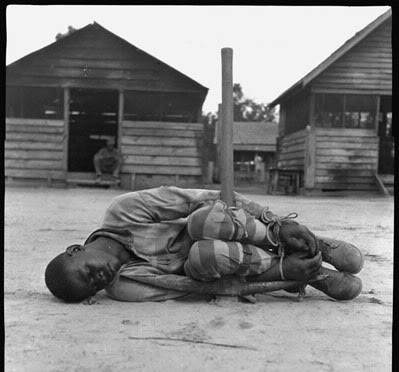 Forced Labor Camp, Georgia, 1930s
American researcher Vicky Peláez writes about the business of “prison slavery”, which usually occurs when state prisons hire out prisoners to private companies to perform labor. This type of business “partnership” does indeed have obvious benefits for private corporations: they pay “hired out” slaves the minimum legal wage set by the state where the labor is performed. And in some places they are even paid below the minimum wage. In the state of Colorado for example, prisoners are paid about $2 per hour, which is significantly lower than the minimum wage. “Prison slaves” are actively exploited by leading American corporations such as IBM, Boeing, Motorola, Microsoft, AT&T, Wireless, Texas Instrument, Dell, Compaq, Honeywell, Hewlett-Packard, Nortel, Lucent Technologies, 3Com, Intel, Northern Telecom, TWA, Nordstrom’s, Revlon, Macy’s, Pierre Cardin, Target Stores and many others. The popularity of this form of exploitation can be measured by the profits generated from inmate labor, which increased from $392 million to $1.031 billion between just 1980 and 1994.
At some point, the American authorities realized that the federal prison system could no longer cope with its overflowing number of prisoners, and turned to services offered by private firms. It turned out that private firms are able to turn a considerable profit by exploiting this labor force, which they are willing to do for the extra profits, just like what people used to do back in the bad old days of slavery. As a result, private prisons began appearing in the United States in the 1980s under President Ronald Reagan, and then state prisons continued to be privatized under presidents George Bush Sr. and Bill Clinton.
The idea of a cost-effective prison is nothing new — the state of Louisiana turned one of its prisons into a business back in 1844. This “industry” began to develop rapidly in the years that followed.
Private prisons are a multibillion-dollar industry, and it is growing. For instance, CoreCivic (formerly Corrections Corporation of America), the largest owner of for-profit prisons and immigration detention facilities in the United States, has seen its revenue increase by over 500 percent in less than 20 years, from about $280 million in 2000 to $1.77 billion in 2017. The three main private prison companies in the US — CoreCivic, the GEO Group and MTC — generate about $5 billion in revenue each year.
By 2018, the combined turnover of these three key business for-profit prisons along with several smaller prison corporations exceeded $7.4 billion. About 10 percent of the estimated 2.3 million people incarcerated in the United States are in private prisons. Private prisons receive a fixed sum from the state for each prisoner, regardless of the real incarceration costs. Thus, the prison business aims to cut costs by organizing a system and security regime that requires a minimal amount of work to be performed by guards. In one of CoreCivic’s ultra-modern prisons, there are only five employees guarding 750 prisoners.
It has come to light that there is a very high rate of profit in the US prison industry. This has not gone unnoticed, transnational corporations (TNCs) have reduced and even scrapped the incentive to transfer their production from the United States to less economically developed countries. The prison industry is one of the fastest growing industries, supported by investors on Wall Street.
Private prisons certainly make a bigger profit when they have more inmates, so they inevitably try to lobby policymakers in their own interest to legislate for longer sentences, such as the 1994 “three strikes laws”, which prescribe mandatory life sentences for anyone who is convicted of a severe violent felony and two other previous convictions. It therefore comes as no surprise that between 1992 and 2003, the number of people serving life sentences shop up by more than 80 percent. When President Trump was elected in 2016, the stock prices of private prison companies CoreCivic and GEO soared. And in 2018, private prison companies donated $1.6 million to campaign committees in the midterm elections.
This private prison lobbying, donating money to political campaigns to push for legislation that would allow the prisons to receive more prisoners with longer sentences and squeeze as many taxpayer dollars as possible, is a clear perversion of the American judicial system. Apart from this, we must not forget that the system is often abused in terms of the collusion that goes on between the administration of state prisons and private companies, as production labor is organized by the prison authorities, and prisoners produce products on the basis of contracts with private companies for a price that is usually far lower than that of the regular labor market. It is difficult to determine exactly how many prisoners are employed indirectly by private companies in the United States. That is what makes this underground economy, the prison industry, a “shady business”.
US Renews Chevron License as European Refiner Cuts Venezuela Ties over Sanctions
By Lucas Koerner | Venezuelanalysis | October 23, 2019
The US Treasury Department has allowed Chevron to continue its operations in Venezuela for a further 90 days.
One of the few remaining US petroleum companies still in Venezuela, Chevron currently produces around 200,000 barrels per day (bpd) in several joint ventures with Venezuelan state oil company PDVSA. The California-based energy giant had its Treasury-issued sanctions waiver extended on Monday.
The Trump administration imposed an oil embargo in January, barring dealings with Venezuela’s oil sector, including US imports of Veneuzelan crude, which then stood at 586,000 bpd. At the time, Chevron was issued a six-month license to wind down its Venezuela operations, which was renewed in a last-minute late July decision after months of lobbying. Other beneficiaries of the renewal are Haliburton, Schlumberger, GE’s Baker Hughes, and Weatherford International.
The license does not cover sales of diluents to PDVSA, which were outlawed by the Treasury Department in June. Venezuela relies on imports of diluents to blend its heavy crude into exportable grades, as well as produce gasoline and diesel for internal consumption.
Venezuela’s oil production has plummeted over the past two years since the US began imposing economic sanctions. According to OPEC secondary sources, output fell to just 644,000 bpd in September, down from an average of 1.911 and 1.354 million bpd in 2017 and 2018, respectively.
Caracas has scrambled to find new crude buyers, reportedly selling shipments to Russian state energy company Rosneft which then reroutes them to other customers. PDVSA has also moved to convert its heavy petroleum upgraders into blending facilities so as to produce lighter Merey grade crude favored by Asian markets.
In August, Washington upgraded its sanctions regime to a general embargo, prohibiting all US dealings with the Venezuelan state and its associated entities as well as authorizing secondary sanctions against third party actors.
The Trump administration has been reluctant to renew Venezuela operating licences, insisting on the need to deprive the Maduro government of export revenues in the hope of removing it from power. Venezuela depends on oil sales for over ninety percent of its hard currency earnings, which it uses for vital imports of food, medicine, and all classes of inputs.
Despite opting to greenlight Chevron’s operations for three additional months, the Treasury Department moved last week to modify the license of a European refining company prohibiting new purchases of Venezuelan crude.
Jointly owned by PDVSA and Finland’s Neste Oil, Nynas AB operates speciality refineries in Sweden, Germany, and the UK geared mainly towards asphalt production.
Under the terms of the new license, Nynas is authorized to sell Venezuelan oil or petroleum products already in inventory but is barred from making new purchases.
Nynas is one of only two remaining buyers of PDVSA’s lighter, Western-sourced crudes following Washington’s ratcheting up of sanctions this year, which have led most cash-paying customers to cut ties with the Venezuelan state oil firm.
Reuters reports that the move could lead Petrozamora, a Venezuelan-Russian joint venture in the western border state of Zulia, to cut production by 50,000 bpd in order to avoid overflowing oil stocks.
With additional reporting by Ricardo Vaz from Caracas.
Trump seeks grand bargain with Erdogan
By M. K. BHADRAKUMAR | Indian Punchline | October 24, 2019
The morning after a summit meeting often holds surprises. Turkey lost no time to follow up on President Recep Erdogan’s hugely successful but “difficult” talks with his Russian counterpart Vladimir Putin in Sochi on Tuesday.
On Wednesday itself, Ankara formally conveyed to Washington Erdogan’s decision that the Turkish military is stopping combat and is ending the offensive in Syria, codenamed Peace Spring, and making the ceasefire agreed with the United States last week during the visit by Vice-President Mike Pence to be permanent.
President Trump promptly reciprocated by lifting the US sanctions against Turkey imposed on October 14 in response to Peace Spring. Trump, characteristically enough, claimed credit for “an outcome created by us, the United States, and nobody else, no other nation.”
The Turkish intimation comes handy for Trump to scatter critics who predicted apocalypse now in Syria. Trump sounded confident that the ceasefire will hold.
Enter General Mazloum. Trump disclosed that he spoke to the general who is the military supremo of the YPG (Syrian Kurdish militia), before making his announcement on the lifting of sanctions against Turkey.
Trump hailed the Kurdish chieftain’s “understanding and for his great strength and for his incredible words today to me.” The optics works just perfect for Trump to push back at critics who allege that he’s thrown the Kurds under the bus.
But Trump also disclosed that he is on to something bigger. One, that Gen. Mazloum has assured him that “ISIS is under very, very strict lock and key, and the detention facilities are being strongly maintained.” The Kurdish-held regions have detention camps holding thousands of ISIS cadres and their families.
Two, Trump recalled, “We also expect Turkey to abide by its commitment regarding ISIS. As a backup to the Kurds watching over them, should something happen, Turkey is there to grab them.” Interestingly, Trump also called on European countries to accept the ISIS prisoners.
In the infamous “undiplomatic” letter to Erdogan a few days ago, Trump had voiced an audacious idea that Gen. Mazloum could be a potential negotiator with Erdogan. To quote Trump, “General Mazloum is willing to negotiate with you (Erdogan), and he is willing to make concessions that they would never have made in the past. I am confidentially enclosing a copy of his letter to me, just received.”
Yet, General Mazloum is Turkey’s most wanted terrorist who worked in the ranks of the separatist PKK for nearly 3 decades and it is necessary to connect some dots at this point.
Looking back, when Erdogan came to power as prime minister in 2003, he had unfolded a bold vision on the Kurdish problem via a negotiated political reconciliation. His approach was encouraged by the US. But he ran into headwinds and eventually lost his sense of direction.
To recap further, in late 2012 Erdogan went public with a dramatic announcement that top Turkish officials had begun negotiations with the PKK leader Abdullah Öcalan who was captured in 1998 and is undergoing life imprisonment on Imrali island in the Sea of Marmara off Istanbul.
Öcalan responded in March 2013 to Erdogan’s overture by calling for a cease-fire, and PKK guerrillas actually began to withdraw from Turkey. As peace talks faltered, however, the cease-fire collapsed in July 2015.
But, significantly, Öcalan has continued to advocate for a negotiated agreement to bring about Kurdish autonomy within Turkey. Now, isn’t it an interesting coincidence that Gen. Mazloum, Trump’s interlocutor among the Syrian Kurdish leadership, also happens to be the adopted son of Öcalan?
Gen. Mazloum is likely to visit Washington in a near future; so is Erdogan. Trump is promoting Kurdish reconciliation with Turkey. The last fortnight’s developments on the diplomatic front have removed the single biggest source of tension in the US-Turkey relations — US’ alliance with YPG and the presence of Kurdish fighters along Syria’s border with Turkey.
Curiously, Trump also said in his announcement yesterday, “We’ve secured the oil, and, therefore, a small number of U.S. troops will remain in the area where they have the oil. And we’re going to be protecting it, and we’ll be deciding what we’re going to do with it in the future.”
Most of Syria’s oil comes from Eastern Syria, which is now under the control of the US-backed Kurdish militia or YPG. (Before the war, Syria produced 387,000 barrels per day of which 140,000 bpd were exported.)
In February last year, Syrian forces backed by Russian mercenaries made a serious incursion in the area but retreated in disarray after suffering heavy casualties following merciless US air strikes. Relative calm prevailed in the region since then.
Evidently, in the geopolitics of Syrian oil, US, Turkey and the Kurds can have “win-win” partnership, which in turn can also provide underpinning for an enduring political reconciliation between Turks and Kurds.
Trump said Washington is mulling over Syria’s oil reserves. Meanwhile, he’s put across a tantalising proposition for Erdogan to ponder over. It demands a leap of faith on Erdogan’s part, but it could be rewarding.
Erdogan has allowed Öcalan access to his family and lawyers and even to relay messages to Kurdish activists. Erdogan knows that if ever he is to solve the 30-year-long conflict with the PKK, he may have to do so with the involvement of Öcalan.
In December 2017, Erdogan had deputed Turkey’s spy chief and trusted aide Hakan Fidan to Imrali island for talks with Öcalan. Two Kurdish MPs were also allowed to visit the PKK leader.
No doubt, Öcalan is a bridge between the Kurds and Turks. And in today’s circumstances, Öcalan can as well become a bridge between his adopted son Gen. Mazloum and Erdogan.
While accompanying Pence to Ankara last week, state secretary Mike Pompeo had hinted that the US is looking for an expanded regional partnership with Turkey and if Erdogan works “alongside” Trump, it “will benefit Turkey a great deal.”
Countering Iran’s influence / presence in Syria and Iraq is the US policy. The decision to transfer the US troops from Syria to Iraq and the continued stationing of troops in Al-Tanf base highlights that cutting off Iran’s land route to Syria and Lebanon continues to be a priority.
Broadly, many challenges lie ahead in Syria and the US realises that Turkey is irreplaceable as regional partner. Trump always thought of Erdogan as someone he can do business with.
Ankara will welcome a grand bargain between Erdogan and Trump and regards the US’ backing for a Turkey-led “safe zone” on Syrian territory as a step in the right direction. In the final analysis, however, for all of this to happen, one way or another, Turkey’s tensions with Kurds should ease.
Kurdish-led SDF militant group thanks Russia for defusing Turkey’s Syria incursion
Press TV – October 24, 2019
The Kurdish-led Syrian Democratic Forces (SDF) militant group has thanked Moscow for striking a deal with Ankara, which ended a Turkish offensive against Kurdish militants in northern Syria, welcoming the deployment of Russian and Syrian troops to the border regions as part of the agreement.
During talks with Russian Defense Minister Sergei Shoigu and Chief of General Staff Valery Gerasimov via video-link on Wednesday, SDF head Mazloum Abdi said Moscow had saved the Kurds from the “scourge” of war through the recent agreement with Ankara.
According to a SDF statement, Abdi “expressed his thanks to President Vladimir Putin and the Russian Federation for their keenness on defusing the war in our region and sparing civilians its scourge.”
“Currently, units of the Russian military police and regular Syrian troops are being deployed into many locations. We are providing them with all kind of help and assistance,” Abdi said.
Abdi, however, expressed “reservations about some points of the agreement,” which he said need to be put to further discussions.
The Ankara-Moscow deal put an end to the Turkish offensive, which had been launched on October 9 with the aim of cleansing the regions near its border of US-backed Kurdish militias — whom it views as terrorists linked to local autonomy-seeking Kurdistan Workers’ Party (PKK) militants — and establishing a “safe zone” there.
The 10-point memorandum of understanding was unveiled following lengthy talks between Putin and Turkish President Recep Tayyip Erdogan in Sochi.
Under the deal, which took effect at noon on Wednesday, Russian military police and Syrian border guards entered the northern border regions to facilitate the removal of YPG militants and their weapons to a depth of 30 kilometers (19 miles) from Syria’s frontier with Turkey.
Once the process is complete, within 150 hours, Turkish and Russian soldiers will begin joint patrols of the entire border area to a depth of 10 kilometers (six miles) with the exception of the border city of Qamishli in Hasakah Province.
The Turkish invasion of Syria came with the green light of the US, which was once a staunch supporter of the Kurdish militants. Prior to the incursion, Washington abruptly pulled its forces out of Syria’s northern regions, effectively moving aside for NATO ally Ankara to attack the Kurds.
Feeling betrayed by the US, the Kurdish militants turned to Damascus for help, inking a Russia-brokered deal with the Syrian government, under which the Kurds allowed army troops to deploy along the Turkish border to stave off Ankara’s offensive.
More on the Quincy Institute: Don’t Mention Israel
By Philip Giraldi | American Herald Tribune | October 21, 2019
I have written frequently about how the overwhelming deference to Israeli perceptions not only distorts U.S. foreign policy, it also corrupts discourse regarding genuine national interests at all levels. The mainstream media, where Zionist journalists and editors exist in grossly disproportionate numbers, has long been a source of fake news about the Middle East, successfully obscuring Israel’s abominable record of war crimes and ethnic cleansing. The media lies overlap and often become self-propagating, with one lie from the likes of Rachel Maddow on MSNBC being employed to confirm the veracity of another similar lie being floated by someone like Jake Tapper on CNN.
So, the media, which is part of the Establishment and has a vested interest in promoting the status quo, is part of the “intellectual” underpinning of the government policies that it prefers. And it is joined by a more powerful and secretive ally in the form of the numerous think tanks that have sprung up in Washington like diseased mushrooms over the past twenty years. It is the think tanks that send ideologically driven “experts” to testify in front of congressional committees regarding policy, that draft legislation for lazy legislators, and that host well-funded panel discussions in which they air their biased views on the state of the nation.
I have written several times about the new think tank kid on the block the Quincy Institute, which is currently planning on “launching” during the month of November. Quincy, which claims to represent “Responsible Statecraft,” is largely funded by George Soros and the Charles Koch, both of whom have considerable negative baggage, and one is scarcely ever wrong when positing that compromising one’s views in exchange for money and celebrity is what Washington is all about.
My most recent rant on Quincy involved an article by the organization’s president, Professor Andrew Bacevich, whose books I have previously admired. His piece was entitled “President Trump, Please End the American Era in the Middle East.” The article appeared as one of Bacevich’s regular weekly contributions to The American Conservative (TAC) website under the rubric “Realism and Restraint.” I cited it as a good example of how self-censorship by authors works.
The article particularly focused on the foreign policy pronouncements of Bret Stephens, the resident neocon who writes for The New York Times. Stephens, per Bacevich, has been urging constant war in the Middle East and worrying lest “we may be witnessing the beginning of the end of the American era in the Middle East.”
Bacevich wrote the article without once mentioning Israel in spite of the fact that Stephens is an arch-propagandist for the Jewish state, a clearly deliberate omission that was noted not only by me but also by a number of comments from other readers. As the TAC site where the article appeared is heavily moderated, one suspects that additional, more vitriolic comments were not allowed to appear.
Bacevich is clearly on a roll. He followed up the piece on TAC with a stunningly ridiculous propaganda piece entitled “Foreign governments are messing with our elections the old-fashioned way” that appeared last week in the Boston Globe.
The article begins: “President Trump’s record as a unifier is spotty at best. Yet on at least one issue, he has helped forge a solid consensus: Americans are not going to tolerate further outside meddling in their politics. In discussing next year’s elections, Senate majority leader Mitch McConnell recently put it this way: ‘Any foreign country that messes with us is going to have a serious problem in return.’ The integrity of our electoral system is sacrosanct. Consider yourself warned, Mr. Putin. The Mueller report showed conclusively that in the run-up to the 2016 presidential election Russian hackers had done plenty of messing. Republicans and Democrats alike (if not President Trump himself) are now intent on preventing any recurrence of such interference, whether by Russia or other mischief-making interlopers such as Iran or China. Patriotic citizens must hope that those efforts will succeed.”
Let’s pause right there. Any article that pretends to be a serious discussion of America’s relationship with foreign powers should avoid quoting Mitch McConnell, who is possibly one of the slimiest politicians currently on display in the Senate. All his judgments are conditioned not by the national interest but rather by political considerations that relate to advancing his own personal agenda as well as the agenda of establishment Republicans. If the “integrity” of the U.S. electoral system is truly threatened, nearly all of the damage comes from inside the system, where corruption is rampant at all levels.
And, one might also note that the Mueller report may have demonstrated that in 2016 there were certain intrusions and manipulations by entities that may or may not have been connected to the Russian government, but it never revealed any plan by the Kremlin to influence voters in any serious way or change the results. It has not even been conclusively demonstrated that the Russians hacked anyone as the FBI has never been able to examine the Democratic National Committee computers. In fact, it is widely recognized that the Russian click-bait efforts on social media were insignificant and had no influence on the outcome. Overturning election results is called “regime change” and it is something that the United States does regularly, not the Russians.
Bacevich continues, “Yet those same citizens would do well to consider the other ways in which foreign governments, many of them ostensible friends, have habitually interfered in our politics. To do so, those governments do not employ the latest innovations in information warfare, waged via social media. No, they mess with our politics the old-fashioned way, distributing vast sums of money to buy influence.”
The professor makes a good point, that money in politics can create access and buy influence, but he then goes on to cite Saudi Arabia as a prime example of that specific form of corruption. He claims that the Saudis spent in 2018 alone “$33 million in their attempts to influence US policy” and wonders “… why the pervasive use of Saudi money to influence U.S. policy is any more tolerable than Moscow’s campaign to tilt the outcome of a presidential election in favor of its preferred candidate.”
Bacevich concludes with “Interested in salvaging the remnants of integrity that survive in American democracy? Well, it won’t be enough to stop the hackers employed by Moscow or Beijing or Tehran (even assuming that it’s possible to do so). To prevent foreign governments from mucking around where they are not wanted will require a concerted effort to get outside money out of American politics altogether. The moneychangers need to be ousted from the temple.”
With this recent series of somewhat related articles Professor Bacevich, unfortunately, defines himself as just another run-of-the-mill American hack propagandist. The enemies list includes Russia, China, Iran and Saudi Arabia but it deliberately avoids mentioning that country the more than any other interferes in U.S. politics. That country is, of course, Israel.
The $33 million that the Saudis allegedly spend on lobbying the U.S. is little more than chump change for the Israel Lobby, which is awash with money donated by Jewish oligarchs like casino magnate Sheldon Adelson, who came up with three times that much and more in 2016 to insure that America would have a solidly pro-Israel foreign policy. The Lobby plays with hundreds of millions of dollars annually, costs the U.S. taxpayer billions in various free rides for the Jewish state and has hundreds of full-time employees in groups like the American Israel Public Affairs Committee (AIPAC) and the Foundation for Defense of Democracies (FDD).
Andrew Bacevich is a smart man and he knows well that what I have written about above is correct. He knows first-hand that Israel’s interference in U.S. politics is highly organized, generously funded and ongoing at every level of government to obscure what Israel actually represents while also inter alia making it illegal to criticize the Jewish state in any way. Professor Bacevich fully well knows those things even as he pontificates about Americans not tolerating foreign influence in our politics, so why doesn’t he tell the truth for a change? Is it all about the Quincy Institute’s Benjamins?
Has climate change jumped the shark?
Climate Discussion Nexus | October 23, 2019
You might not think so, with time running out for deniers (again) except perhaps as psychiatric patients. But there are signs of fatigue with it in the political system. In Australia, a senior Labour figure has caused turmoil in his party by suggesting they not run in the next election on the hugely ambitious plans that cost them the last one. And when CNN and the New York Times sponsored the 4th, 3-hour debate among contenders for the Democratic nomination, the moderators didn’t ask a single question about climate and the candidates didn’t make it an issue. You might think it’s because everyone agrees. But what if it’s because nobody has anything useful to suggest and most people secretly don’t care?
Voters claim to be anti-global-warming, of course. But as we learned including from the Yellow Vest upheaval in France, and Canadians’ views on carbon taxes, and any number of similar issues in other countries, citizens aren’t willing to pay any significant price to take action against greenhouse gases, suggesting they don’t really think there’s a problem.
Except when all-in politicians push the agenda too far. For instance deep blue California’s governor is now in big political trouble over high gas prices and unreliable power. And remember, high prices for less available energy is a feature not a bug of the climate alarmist movement, soothing talk of wind power notwithstanding.
The problem isn’t really the cost of alternative energy, because except by accident politicians are not willing to raise the price of energy to levels that would discourage its use. There was some kerfuffle over a study finding that green energy policies cost Britain £9 billion per year, or £340 per household. But while an increase in energy bills means hardship to the poor, Britain is rich, and most households may resent the extra cost but are not unable to pay it. The problem is how much more it’s going to cost to try to get renewables up from their current trivial share… or what happens when you just can’t. (Wind farms, like solar farms, have thus far been cherry-picking sites.) On which politicians have little to say that is not both stale and unconvincing.
The hardcore believe that if voters are not willing to pay high carbon taxes and otherwise do without the conveniences of modern life, they are short-sighted idiots and democracy itself must give way in this climate emergency. Meanwhile most voters are happy just to virtue-signal, if only to avoid fights with their grade-schoolers trained to correct their pronunciation of Thunberg (it’s Toon-BUIY not THUN-berg). But they simply aren’t convinced that it’s the end of the winter and the world as we know it because out their window things are going pretty much as they always have. And since politicians are repeating implausible mantras about what’s supposedly happening and how to fix it painlessly, a lot of them just tune it out and go about their business.
Passionate opposition to climate change coupled with timid or nonexistent proposals to fight it must inevitably become a stale punchline.
US DOJ Refuses To Cooperate With Colombia In Uribe Trial
teleSUR | October 22, 2019
The United States Department of Justice has told the Colombian judiciary that they will not cooperate with them in their investigation into disgraced former right wing President Alvaro Uribe. This is despite Colombia believing that the DOJ hold information about Uribe’s contact with paramilitaries and drug traffickers.
Supreme Court magistrate Cesar Augusto Reyes requested that the DOJ hand over records they have about such calls and visits that Uribe held.
Reyes believes that the US could hold key information that would either corroborate or disprove central claims made by Uribe’s defense attorneys.
According to the magazine La Semana, Reyes has written letter to the DOJ condemning them as ‘disrespectful’ for refusing his “appropriate request.”
Among the charges he must answer to is that he paid for false testimonies to “politically finish off” left-wing lawmaker Ivan Cepeda, who had been exposing his links to paramilitarism. Congress threw out the case against Cepeda and pursued an inquiry into Uribe instead.
Another one of the serious charges he faces is that he bribed former paramilitaries huge amounts to testify that Uribe was not involved in the death squad known as ‘Bloque Metro’.
During Uribe’s time in power, he was a close ally of then president George Bush, and of US interests in the region.
YouTube suppressed Tulsi Gabbard search results during Hillary Clinton ‘foreign asset’ row
RT | October 23, 2019
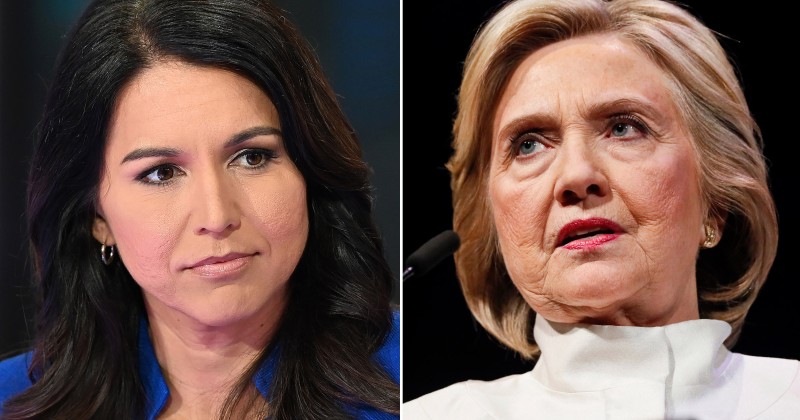
Conservative internet personality Steven Crowder has accused YouTube of suppressing search results for 2020 Democratic hopeful Tulsi Gabbard during her recent spat with former Secretary of State Hillary Clinton.
Following Clinton’s suggestion last Friday that Gabbard (D-Hawaii) was being “groomed” by foreign election-meddlers, the dovish congresswoman shot back with a harsh rebuttal labeling Clinton the “queen of warmongers,” but in a lengthy video posted on Tuesday, Crowder says YouTube concealed her content amid the dispute.
Using a virtual private network (VPN) to observe search results in different countries, Crowder claims to have found evidence the platform demoted Gabbard’s official campaign videos for searches conducted in the US.
The first VPN test was carried out last Friday and compared search results from the US and Spain, showing Gabbard’s channel and videos were buried far below other content in American queries at the height of her feud with Clinton.
A second test two days later, after the Clinton quarrel had calmed down, had a much different outcome, showing similar results between searches attempted in the two countries.
Crowder, who ran afoul of YouTube earlier this year and had his own channel demonetized, claims the platform deliberately throttled Gabbard’s content to limit her message in an attempt at “election meddling.”
Over the summer, Gabbard filed a lawsuit against YouTube’s parent company, Google, alleging the tech giant intentionally blocked her campaign ads on the heels of a Democratic presidential debate that – as shown by Google’s own search analytics – generated intense interest in her candidacy.
A number of conservative commentators weighed in on the allegation, noting the “chilling effect” such suppression could have on anyone challenging “establishment politicians” and the Washington swamp.
“We all knew, now we have proof,” another commenter said.
Some in Crowder’s camp took issue with the claim, however, with New York congressional candidate Joey ‘Salads’ Saladino arguing the comedian failed to prove what he alleged.
Another critic similarly challenged Crowder’s accusation, stating his tests did not show any manipulation of search results, but rather a new feature on YouTube which prioritizes news items curated by its partner “fact checkers” over other videos. While YouTube says the feature was rolled out to combat “misinformation,” it nonetheless raises questions about how the platform chooses which stories to serve up to viewers, at the expense of other content.
Ankara says ‘no need to start new Syria offensive’ after Erdogan-Putin talks
RT | October 22, 2019
Turkey will not be launching a new offensive against Kurdish militias in northern Syria, following a five-day pause in hostilities and high-level talks in Moscow, Ankara’s Defense Ministry said.
Following lengthy talks on Tuesday, Russian President Vladimir Putin and Turkish President Recep Tayyip Erdogan agreed that Russian military police and Syrian servicemen will be deployed to northeastern Syria, targeted by Turkey in their ‘Operation Peace Spring.’
The Turkish Defense Ministry then said in a statement that there was “no need to carry out a new operation at this stage,” adding that the creation of a “peace corridor” in the border area would ensure the safe return of millions of displaced Syrians.
Turkey’s latest incursion into the north began earlier this month, directed at Kurdish militias it says are linked to terrorism and its own domestic Kurdish separatist movement.
Until recently, around 1,000 American soldiers were stationed with the Kurdish fighters near the border, insulating them from a Turkish offensive, but a sudden US withdrawal last week cleared the way for Ankara’s operation, which it had threatened for months. Washington’s retreat paved the way for a deal between the Kurds and Damascus, allowing Syrian forces to regain control of territories in the northeast after over 7 years of war.
Even on Tuesday Ankara questioned if the US held its end of the deal and facilitated the withdrawal of Kurdish forces, but the Turkish ministry then said Washington told Ankara the Kurdish groups had all left the area by the end of the 120-hour ceasefire pause.
US President Donald Trump also weighed in on the development, calling it “good news” in a tweet on Monday night.
The deal struck between Ankara and Moscow on Tuesday will ensure the territorial integrity of Syria; allow the government to regain control over towns and cities in the northeast; establish Turkish-Russian patrols along the border; and revitalize the Adana Accord, a security pact struck between Damascus and Ankara in 1998. Dealing with captured Islamic State militants was also addressed in Tuesday’s agreement, which the Syrian government has endorsed.
The agreement underscores Washington’s waning sway in the region and represents a positive step toward winding down a bloody years-long conflict, independent political analyst Ali Demidras told RT.
“The Sochi agreement has cemented the Russian-Turkish cooperation in Syria also effectively reducing the American influence in the country,” Demidras said. “United Syria has been secured.”
A House of 12: Debate Four Shows Dems Have No Platform – Biden Stands No Chance
By Joaquin Flores | Strategic Culture Foundation | October 22, 2019
The DNC continues to promote Biden despite his not resonating with likely voters, undecideds, and swing-staters. Gabbard shone bright, but appears to have earned her place back by putting in work for Biden. The DNC must focus on fully socialized healthcare, as Trump’s foreign policy record is strong in the eyes of anti-war voters actually paying attention. But the DNC can’t, and so Trump will likely win.
It was Round Four of the Democratic debates on Tuesday, with 12 candidates squaring off in Westerville, Ohio.
Staged in the critical swing-state of Ohio, the small town of Westerville hosted Round Four of the Democratic Party primary race debates on October 15th. Democrats obviously are pinning hopes on being able to win a few of the swing states they lost to Trump.
The Democratic Party continues its strategy of maintaining a very high number of contenders in the race. In short, the party realizes that the front runner it wants to win – Biden – really lacks the grass roots support, big ideas, and mobilizing capacity that interesting candidates like Sanders, Yang, and Gabbard in fact have. So they keep these more interesting candidates in the race, so that potential voters are more invested in the process for longer. The idea is to try to transfer some of that Yang and Gabbard excitement and support, onto Biden. If that seems like a Herculean task and a strategy not likely to succeed, you would be right. But bear in mind that this is the same Clinton controlled DNC that came to believe that Hillary would win by a landslide.
Gabbard was no doubt the real-winner of this debate – because a victory in 2019 is whatever meme, soundbite, or viral clip you can produce from this sort of event. And Gabbard’s slicing and dicing of Warren was absolutely the highlight of the debate.
By European standards, the Democratic Party is a center-right liberal-austerity party, engaged in an abusive tactic of working against the mandate handed to them by their own more social-democratic constituency. Their programmatic aim is to reduce and tame the real demands of most of their voters, and present ‘pragmatic’ candidates with a ‘chance to win’. In reality, they force their own voters to bargain against themselves. The much weakened and diluted program that the pragmatic candidates take with them into office, is then in turn ‘bargained down’ in their negotiations with law-makers on the other side of the aisle. The result are candidates that no one really likes, going in and beginning negotiations with the position that one ought to arrive at in the end, and absolutely not begin with.
Healthcare
For example, on healthcare – as we saw again in debate number four – Biden promotes only nominal tweaks to Obamacare, which is a non-starter for the activist base of the party which knows that other developed countries consider healthcare both a right and a necessary foundation that makes all other profitable and industrious parts of socio-economic life possible and significantly more robust.
This base is required to generate excitement and launch candidates to wider audiences.
This is an entirely foolish position for many reasons, for nearly 60% of the general public according to recent Gallup polling, also believe that government must provide healthcare. Assuming that every voting Democrat supports a government mandate on healthcare, then nearly 60% means that about 20% of those are Trump voters, making this something of a non-partisan issue.
Interestingly, that polling data also shows that Obamacare ruined the public’s perception of government involvement in healthcare, and support for some kind of intervention dropped from all time pre-Obama high in 2006 of 69% in 2007, all the way down to some 46% in the time period that the travesty of Obamacare was passed into law in 2010. It would take another nine years for the support number to rise to where it is now, still 12 points below its 2007 high.
No Alternative to Trump’s Dovishness
The candidates in the Ohio debate took turns posturing tough on the need to beat Trump, but the DNC seems bent on backing any candidate who seems the least likely to. The reason that Trump will win if this continues – and win ‘big league’ – is that this is not only another ‘change’ election in the eyes of progressive and independent voters, but in fact a larger change paradigm.
Trump’s biggest weakness is his generally conservative position on social programs and healthcare, which is generally unpopular, even though his nominal trade wars with Europe and China were aimed at raising the position of the American worker.
The reality is that even during the administration of Bush 43, the Republican base was growing and voters were trending Republican. The victory of Obama was made possible around three factors: the unpopularity of the wars, which he promised to end, but did not; the massive new-voter registration campaign that was done through the back-door of ostensible labor organizing campaigns by SEIU in swing-states like Colorado; the massive energy at the base created around the prospect of a paradigm-shifting president, African-American no less, that would open the door to larger social-democratic movement – this also was spelled out in new-voter registration and turn-out.
Clinton attempted to use what the Obama energy had built, despite the 2016 election also having been a change election. But this need for ‘change without hope’ was absolutely at odds with the ‘hope + change’ campaign of 2007. Clinton was in the position of not being particularly inspiring to anyone, and needing to use the Obama energy and Obama machine to win an election which in all reality was a mandate against many of Obama’s actual policies and failings.
Without new voter turn-out, and without a genuinely populist campaign from the Democrats, Trump doesn’t have a serious contender to deal with.
Democrats have no real alternative program to offer to Trump, appealing instead to Trump Derangement Syndrome and the ‘Orange-Man-Bad’ mantra. But none of their supposedly front-runner candidates have anything of substance to counterpoise to Trump, with the exception of Warren on healthcare. But Warren will never escape the tag of being Pocahontas, and like Gabbard and Sanders, her anti-war positions may resonate against some of Trump’s rhetoric – if cherry-picked – but voters really concerned about war as a priority are more or less informed that it is Trump, and none other, that has been the first U.S president since perhaps Ford that has not begun a fresh U.S military campaign abroad.
We live in times where the entire U.S Empire is being dismantled, and being dismantled much to the chagrin of vested interests who may know better, but nevertheless insist on policies that stretch out the inevitable in the most short-term profitable way, to the extreme detriment of long-term thinking along strategic and national security/sovereignty lines. These ‘neoconservatives/neoliberals/whatevers’ have been using the vehicle of the Oval Office to see their plans through since the end of the Cold War. The policies of Clinton and Obama were practically indistinguishable from their Republican ‘opponents’ from the same era. All Trump will have to do is continue to run against the past Obama administration on foreign policy, deep state and all, since they’ve been so adamant about controlling and owning the process up to and until now. The numerous times he’s been threatened with impeachment was explicitly aimed at steering him back on track on aggressiveness on Syria, despite that their strategy failed nonetheless.
That means that what differentiates progressives from Trump is not the actual foreign policy positions as such – in this sense Trump feels and acts more like a dove than a hawk – but rather domestic policy on healthcare. Given the real state of inequality, costs, employment, and so forth, healthcare costs are simply out of hand, and too many Americans who have fallen ill have had to mortgage their homes, sell whatever earthly possessions they may have, wind up homeless, or simply die in hospice care.
This is the reality that Americans are facing, and it is therefore strategically ‘insane’, also being unconscionable as an aside, that Democrats continue to push characters like Biden and Harris who oppose single payer along ‘tax increase’ lines. Warren, as was on display in the debate, continues to support some kind of Medicaid for all, and rightly points out that any tax increases will be easily off-set by the end of insurance premiums. Everyone apparently knows this but Biden and Harris, so insurance companies and HMO’s continue to bankroll significant parts of the Biden and Harris campaigns.
We live in a ‘punishment’ paradigm, not a ‘lesser of two evils’ paradigm. Democrats on the fence are not ‘centrists’ as Biden backers insist, but rather ‘to the left’ of Democrats on foreign policy and healthcare, and will simply vote against any Democrat to punish them the way they themselves have been punished by Democrats for hitherto voting for said Democrats until now. Democrats in swing states will vote against Democrats, not vote, or vote for Trump for the very teachable moment that such a move creates.
For that reason, we continue to see 12 candidates all on one stage. Most of what is being written and read this week on the subject has a relatively transparent method and goal: to give a blow by blow of the debate and focus on the ‘horse-race’ angle of it, instead of how the candidates’ positions reflect things that actually matter to voters, and to promote Biden, Warren, and Harris as ‘front-runners’ simply by promoting this idea and repeating it until it becomes a matter of fact as a result. This, despite the fact that these three are among the least likeable candidates, and are indeed very uninspiring people with very little of substance to say.
It has to be said, and must be said again, that it is Sanders, Gabbard, and Yang that motivate and inspire the base. The DNC has no intention in allowing any of them to get the nomination, but need them in the running.
Nobodies like Buttigieg, whose political experience constitutes being a homosexual mayor of a town of three-hundred thousand folks, are in this race for no apparent reason. Except as some sort of latent insult to gay voters, implying that gay voters are interested in a gay candidate for their gayness alone, despite not having any political experience in state-wide, let alone national politics. That, and attempting to keep some sort of Democratic Party interest in Indiana, a state that Obama won in 2008, lost in 2012, and that Trump won in 2016. No wonder Buttigieg, in his ‘tremendous’ political experience at 37 years old and mayor of some place no one has heard of even in Indiana, wants to abolish the electoral college. Why is Buttigieg still in this race? This campaign has to be ‘fake news’ as nobody on the ground is excited about this lad.
Gabbard was the highlight, and she’s still in it
In our simulated and scripted reality, Gabbard ‘made a come-back’ after being excluded from the third debate, and qualified for the fourth. She has shown real utility on numerous occasions for being one of the three most interesting candidates on the one hand, but showing a particular acumen for landing punches on Biden’s opponents – punches that Biden himself can’t seem to land. She’s showing herself to be a very important part of this race, because our Kshatriya warrior princess keeps grass-roots Democrats engaged. The most interesting part of this debate was Gabbard taking aim directly at Warren’s inexperience militarily, that she has no experience to serve as Commander-in-Chief. Moderators cut her off right as she landed this punch, a punch which everyone heard nonetheless, and received an audible ovation from the audience. That clip will no doubt be viral for the coming weeks.
Featured Video

John Mearsheimer: New World Order Arrived & Europe Is Left Behind
or go to
Aletho News Archives – Video-Images
Book Review
Sunset on Net Zero: A Heretic’s Guide to the Futile CO2 Target
By Ronald Paul Barmby (Author) – October 3, 2025
SUNSET ON NET ZERO describes in detail why Net Zero CO2 is pointless and unachievable. It explains in understandable terms the up-to- date thoughts of the greatest minds of today in physics, meteorology, economics, engineering, and the geosciences.
Net Zero CO2 is pointless because we have now confirmed by satellites that 90% of CO2 warming has already happened. CO2 is not an existential threat but clouds, El-Niño, and human habitation are significant drivers of global warming that are often ignored.
Net Zero CO2 is unachievable because the green technology alternatives are unreliable and unaffordable. Wind and solar power triple electricity costs, building fully electric vehicles produces at least one-half of CO2 emissions they are meant to avoid, and heat pumps will leave you dangerously cold in the winter. Green hydrogen, air capture CO2, and carbon capture and storage are prescriptions for national bankruptcy. The supply of key metals and minerals required to achieve Net Zero need to be at least doubled—some much more—and are often controlled by a very few. Net Zero comes with huge environmental and agricultural costs.
We have been through similar climatic temperature changes before, more recently than you think. Our efforts to control it are futile.
Blog Roll
 Aletho News
- FDA Ordered to Pay Over $570,000 in Fight Over Pfizer COVID Vaccine Records
- USAID turned to Facebook to drive demand for Covid vaccines in Global South – files
- Britain’s shadow security network expands into south Lebanon
- The ADL Has a Foreign Policy, and You Are Not Supposed to See It
- Former Qatari PM says ‘Israel’ has security ties with all Gulf states
- The Sound of Silence in the Strait of Hormuz
- Poland’s call for a no-fly zone in Ukraine means NATO direct war with Russia
- John Mearsheimer: New World Order Arrived & Europe Is Left Behind
- Naqab demolition notices top 1,000; settlers demolish Jaloud homes
- Israel is Using the ‘Gaza Ceasefire’ to Commit Ethnic Cleansing
- If Americans Knew
- An error has occurred; the feed is probably down. Try again later.
- No Tricks Zone
- Physicists: Doubling CO2 Has A Smaller Impact On Ocean ‘Acidification’ Than Existing Internal Variability
- Alarmist Climatologists In Shock! 2026 Atlantic Hurricane Season Sees Lowest Count In 101 Years
- New Study: Modern Temps Are Among The Coldest Of The Last 10,000 Years In East Central Europe
- Germany’s Renewable Energies Lead to 1.4 Billion Euro Electric Power Trade Deficit
- Argentina’s Perito Moreno Glacier Joins Antarctica and Arctic In Defying Doomsday Melt Claims
- New Study: Barents Sea Temperatures Were Warmer And Sea Ice Less Extensive In The 1700s Than Today
- German Authorities Start Initiative To Evaluate Public Register For Climate “Disinformation” Spreaders!
- Zonal Asymmetry of Temperature Change in the Antarctic Circumpolar Current
- New Study: The Net Fossil Fuel Contribution To Rising Atmospheric CO2 Has Been Zero For 500 Years
- Germany’s Green Energy Transition Becoming Increasingly Expensive…Another 6 Trillion Euros!

