‘One possible conclusion’: US banned-missile test apparently in works long before leaving INF
RT | August 20, 2019
It took the US just 17 days after it was no longer officially bound by the INF Treaty to conduct a missile test that would have breached its rules. And it probably was breaching the treaty, given how long preparation takes.
On Sunday, the Pentagon fired a Tomahawk cruise missile from a truck-mounted Mark 41 Vertical Launching System to a distance of over 500km. The test was hardly unexpected. Both the missile and the launcher are time-tested, and their capabilities are publicly known. The only novelty was that the Mk41 was placed on a ground vehicle as opposed to a warship.
If anything, the test was a demonstration of intent and attitude. It would have been legally impossible just a month ago, when the Intermediate Nuclear Forces (INF) Treaty still forbade not only deploying but even developing weapon systems like the ground-based Tomahawk.
The INF kicked the bucket this year after years of bickering between the US and Russia over who was the worst at sticking to the spirit of the deal. Washington said the Russians had secretly developed a missile that was in violation. There was even secret intelligence to support the accusations – or at least to convince NATO allies not to question the US’ justification for withdrawal.
At the same time, the US developed and fired missiles banned by the treaty, saying it was OK since they were just target missiles and not actual missiles meant to kill and destroy. A similar explanation somehow didn’t work for North Korea with its satellite launch, which was instantly branded a clandestine ballistic missile test by the US. But when the US used one, Russia was expected to just go along.
Washington also deployed the Mk41 VLS in Europe, claiming that they could only fire interceptor missiles to stop Iran from obliterating the Europeans, rather than directing Tomahawks at Russia. What a big surprise this new test must have been for every expert and defense official who said Moscow was overreacting to those missile defenses in Romania and Poland!
There is a notable pattern in Washington’s attitude to international relations, whereby it spots every speck on the record of others, while finding sensible-sounding solutions for any blemishes on its own. How is that work on destroying your chemical weapons going, by the way? For this test to come on such short notice is the latest example.
“In two weeks, one can prepare and get a green light for a test program, and even that would take extra effort,” RT’s defense expert Mikhail Khodarenok remarked. “The rest of it, including bringing the tested weapon system to the range, training the crew in its use, preparing the target, putting sensors in place – that cannot be done in two weeks.”
There is only one possible conclusion – the test was designed, organized, prepared and financed long before the US officially withdrew from the INF.
Now it turns out that all the while Washington was telling the world how the treaty could still be salvaged – if only Russia pled guilty and destroyed its stockpiles of missiles that supposedly violated the INF – it was also developing a weapon system that breached the very same treaty.
The work has been ongoing since at least February this year, according to a Department of Defense spokesperson quoted by RIA Novosti. This is right after the US announced its formal withdrawal and long before the expiration of the six-month grace period stipulated in the treaty. Who could have seen this one coming?
‘We don’t fall for provocations’: Moscow won’t jump the gun after US missile test, says deputy FM
RT | August 20, 2019
Russia will not fall for US “provocations” and be dragged into an “expensive arms race,” a senior diplomat said. Washington had earlier test-fired a cruise missile that was banned under the now-defunct INF Treaty.
The Pentagon’s recent cruise missile test is “regretful” as it shows that “the US has clearly embarked on a path of inciting military tensions,” Russian Deputy Foreign Minister Sergey Ryabkov said.
Over the weekend, the US test-fired a ground-based cruise missile that hit a target more than 500km away. Such weapons would have been banned under the 1987 Intermediate-Range Nuclear Forces (INF) Treaty, which outlawed all ground-based missiles with the range of 500km to 5,500km, as well as their launchers. Washington officially withdrew from the agreement earlier this month, citing alleged violations by Russia, and Moscow followed suit.
Ryabkov said that the new test by the US proves that it was actually the Pentagon that has been secretly violating the INF Treaty. “There can’t be more striking and obvious proof that the US has been developing such systems for a long time,” he told reporters, adding that Moscow will not jump the gun in response.
“We have been assuming this turn of events. We will not allow ourselves to be dragged into an expensive arms race.”
“We don’t fall for provocations.”
The diplomat reiterated that if Russia ever obtains missiles that were previously banned under the INF Treaty, it will not deploy them unless the US does so first.
During his trip to France on Monday, President Vladimir Putin had said that if short- and mid-range missile systems are “produced by the US,” Moscow will do the same. Defense Minister Sergey Shoigu said that Russia will deploy such missiles only if Washington does so in Europe or Asia-Pacific.
Turkey faces quagmire in Syria
By M. K. BHADRAKUMAR | Indian Punchline | August 20, 2019
The three-year old Russian-Turkish tango in Syria has been incisive, exciting and provocative, but the inability of the two partners to trust each other or surrender to the care and needs of the other has deprived the relationship of the energies to work symbiotically.
If tango serves as a metaphor of relationship, an overall imbalance of energy on both sides is apparent in the Russian-Turkish moves on the Syrian turf.
There was always the suspicion that the endgame being played out in Idlib province in northwest Syria on the Turkish border would ultimately put to test the mettle of the Russian-Turkish axis in Syria. That is happening.
The major Russian-backed offensive by the Syrian government forces last week to recover the strategic town of Khan Sheikhoun that has been in rebel hands since 2014 and is the opposition’s last major stronghold has prompted Turkey to come to the aid of the rebel forces supported by it.
A Turkish military convoy sent to keep open supply routes for the opposition fighters was halted by an air attack on Monday by Syrian and Russian war planes. According to Iranian reports, the Turkish convoy comprised 28 military vehicles, including tanks and trucks carrying weapons and military equipment destined for Tahrir al-Sham al-Hay’at (read the Al-Nusra Front affiliated with al-Qaeda) terrorists holed up in Khan Sheikhoun.
A war of words has erupted. The Defence Ministry in Ankara squarely blamed Russia in a statement on Monday. Foreign Minister Mevlut Cavusoglu warned today at a press conference in Ankara that Damascus is “playing with fire.”
Turkey argues that the convoy was only ferrying supplies for its military observation post in Idlib, which was established in terms of an agreement with Russia last September.
The crux of the matter is that the September agreement obliged Turkey to neutralise the extremist groups ensconced in Idlib but in reality the terrorists since expanded their presence in the province and began attacking the Russian base nearby and the Syrian forces in the vicinity.
Russia put up with Turkey’s doublespeak for a year but patience has run out, especially as its Hmeymim air base is facing constant threat from terrorist attacks.
As for Damascus, capturing Khan Sheikhoun is an important gain in military terms not only for President Assad’s bid to recover “every inch” of Syria, but also since a highway running through that town connects Aleppo city.
Moscow has snubbed the Turks. While on a visit to France on Monday, President Putin said at a press conference that Russia supports the Syrian government forces’ on-going campaign against terrorists in Idlib.
Putin repeated that before the establishment of a demilitarised zone in Idlib by Turkey, the terrorists had controlled fifty percent of the province’s territory, but now 90% of Idlib’s territory is under the terrorist groups’ control.
Turkey has overreached in Syria. But then, there is more to it. To be sure, Turkey is paying a high price for its wrong policies. It should never have got involved with the US-led project to overthrow the regime in Syria; its dalliance with terrorist groups was (and continues to be) incomprehensible; its projection of power into Syria is violative of international law; and worst of all, it is still unwilling to reconcile with the established government in Damascus although it is clear that the Assad regime will remain in power for the foreseeable future.
Meanwhile, the deterioration of relations with the US is hitting Turkey hard. Washington is not in a mood to accommodate Turkey’s concerns and vital interests vis-a-vis the Kurdish issue.
Things have come to a point where, paradoxically, a US-Russia tacit understanding seems to exist in regard of northeast Syria.
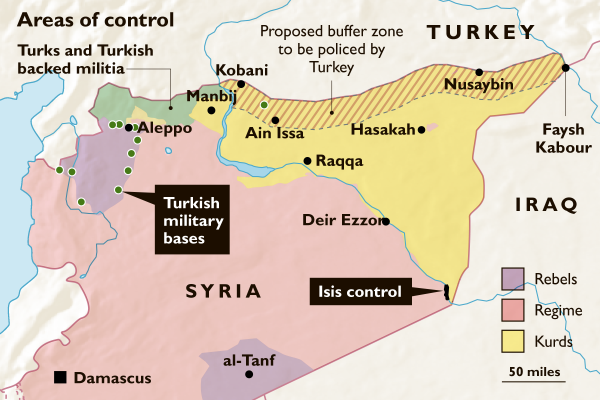
There is a growing perception that the US and Russia are acting on an overall consensus in Syria, with Moscow having the say largely over the area on the western part of the Euphrates River, while the eastern side of the river where the Kurdish forces are present remains under US control. That is to say, the US retains its presence to the east of Euphrates, while the territories to the west of Euphrates come under Russian ‘sphere of influence.’
Conceivably, there could be a Russian-American congruence to keep Turkey out of northeastern Syria. The Iranian media reported on Monday that for the first time, Russian infantry units are being deployed in Bukamal region in Eastern Deir Ezzur province near the Iraqi border where Russia plans “to build military centres”.
On the other hand, Turkey’s partnership with Russia has become increasingly one-sided. Turkey cannot afford to antagonise Russia anymore, whereas, Russia no longer has to wear kid gloves while dealing with Ankara, although Turkey still is a NATO power.
In November 2015, when Turkey shot down a Russian Sukhoi Su-24M attack aircraft, Moscow was ultra-sensitive while reacting. But there is no apology for Monday’s air attack on the Turkish military convoy in Idlib.
The Russian Foreign Minister Sergey Lavrov asserted today that any attacks carried out by Islamist militant groups (which Turkey harbours) in the de-escalation zone in Idlib will be “forcefully suppressed”.
All in all, Russia has concluded that this is an opportune moment to clean up Idlib. Turkey’s proposal to establish a safe zone in northern Syria isn’t getting anywhere. The Turkish demand — a 30 to 40 kilometre deep safe zone stretching 430 kilometres all along the border up to Iraq — is not going to be acceptable to the US. But the US keeps Turkey engaged in talks to buy time while the US-backed Kurdish militia will retain their control of northeast Syria bordering Turkey.
In essence, Turkey risks a quagmire with two fronts — Idlib, where the Syrian offensive backed by Russia will trigger a massive refugee flow into Turkey, and a border with Syria that is dominated by well-armed, battle-hardened Kurdish groups.
US, Turkey must end illegal military presence on Syria soil: Damascus envoy to UN
Press TV – August 21, 2019
Syria’s UN Ambassador Bashar al-Ja’afari has called on the United States and Turkey to end their “illegal military presence” in the Arab country and crimes against civilians.
Speaking at a United Nations Security Council (UNSC) session on Middle East peace and security challenges in New York on Tuesday, Ja’afari urged Washington and Ankara to respect the UN Charter’s principle of non-interference in the internal affairs of other countries and refrain from using force against them.
“The United States and its allies, including the Turkish occupation forces, must be obliged to end their illegal military presence on Syrian territory and to stop their aggressive practices in support of terrorism and their crimes against Syrians, civilian installations and infrastructure,” he said.
He also criticized Turkey for sending a military convoy carrying ammunition into Syria’s Idlib Province in support of the militants holed up in the embattled region.
The Syrian envoy further highlighted the need for the world body to stay focused on the real root causes of the Middle East conflict, including occupation, acts of aggression and destructive interventions in countries’ domestic affairs — such as those aimed at overthrowing governments by force, investing in terrorism and fabricating crises.
“Success in dealing with the challenges facing the region requires upholding the principles of international law and the provisions of the UN Charter and stopping attempts to distort and manipulate its provisions,” he said.
Ja’afari also described Israel’s occupation of Arab territories as the main reason for the crisis in the region.
“The main cause of the conflicts in the Middle East and the inability to achieve peace and stability has been and continues to be the Israeli occupation of Arab territories, including the occupied Syrian Golan,” he said.
Ja’afari further expressed concerns about Israel’s accumulation of weapons of mass destruction, saying the regime should join the Non-Proliferation Treaty (NPT) without delay and subject its facilities to the International Atomic Energy Agency (IAEA)’s safeguards regime.
NPR Mocks Cancer Survivor in Drumbeat of Syria Propaganda

Asma al-Assad, First Lady of Syria (from released Syrian Presidency Facebook page)
By Rick Sterling | Dissident Voice | August 20, 2019
It may be a new low in propaganda. National Public Radio (NPR) used the news that Syrian First Lady Asma al-Assad had overcome breast cancer to mock her and continue the information war against Syria. They interviewed a Human Rights Watch staffer named Lama Fakih who is an American from Michigan now based in Beirut.
Do you believe Ms. Fakih in Beirut or do you believe people who live in Syria who say we are being lied to? Lilly Martin is such a person. Although she is American from Fresno California, Lilly has lived in Syria for nearly 25 years. She is married to a Syrian and has two Syrian sons. Dr. Nabil Antaki is another such person. He is a medical doctor in Aleppo, fluent in English and French as well as his native Arabic.
While NPR snorts about Asma al-Assad “sporting a chic blonde pixie cut”, Lilly Martin points out that she was recently bald while fighting for her life.
While Ms. Fakir in Beirut says that there is “quite a lot of anger” because Asma al-Assad has conquered cancer, Dr. Antaki says that Syrians are happy at the news. Asma al-Assad is First Lady, mother to three children, and known for her compassion. Lilly Martin says that even while she battled cancer Mrs. al-Assad continued her charitable work.
While Ms. Fakih says that the “Assad government has been systematically targeting medical facilities and medical personnel”, Dr. Antaki, who has remained in Aleppo throughought the conflict, says this is not true. While there are many western accusations that the Syrian government attacks hospitals, the evidence is remarkably thin. One of the most highly publicized cases was regarding “Al Quds Hospital” in east Aleppo. In April 2016 there was a media blitz about this hospital having been destroyed by the Syrian Army. Following the departure of the “rebels”, it was discovered that “Al Quds Hospital” was an unmarked portion of an apartment building, that it had NOT been bombed and was the LEAST damaged building in the area. It was determined that the nearby Nusra (Al Qaeda) headquarters and ammunition depot was the Syrian army target. Accusations that “Al Quds Hospital” was bombed were false. It was a media stunt.
Ms. Fakih says that “Syrians have not been able to benefit from medical care in Syria since the beginning of the uprising in 2012”. Lilly Martin simply says “This is factually untrue. The Syrian system of national hospitals, free services to the public, are in every area of Syria and have run continuously throughout the war.” Dr. Antaki is an example; he is one of THOUSANDS of doctors working at HUNDREDS of hospitals throughout Syria. But you would never know it from NPR or Ms. Fakih.
It is true that there have been disruption and damage to many hospitals, as demonstrated in this jihadi assault on Al Kindi Hospital. These are the “rebels” supported by Ms. Fakih and Human Rights Watch. They effectively supported them in east Aleppo until they were expelled from the city. Now Ms. Fakih and HRW are supporting the “rebels” in their last redoubt in Idlib. There are countless videos demonstrating the cruelty and fanaticism of the “rebels”. For example, the aftermath of the above assault on Kindi Hospital and the execution of the Syrian soldiers who defended the hospital. Those who are cheerleading for the “rebels” and trying to prevent the Syrians reclaiming Idlib should look at the execution video to see what they are supporting.
The West has provided weapons and other support to the “rebels”. In parallel, there has been a campaign to whitewash the “rebels” and demonize the Syrian government. On top of this, the USA has imposed crushing sanctions on Syria which make it difficult or impossible to get critical medicines and replacement parts for western medical equipment. Dr. Antaki says it took him 1.5 years to obtain a replacement part for a Japanese medical instrument. I had my own experience with the draconian and inhumane sanctions. It took one year and endless hassle to send hearing aid batteries to help a deaf child in Syria.
This is one among hundreds of Syria “regime change” propaganda pieces broadcast on NPR. Behind a facade of authority and objectivity, there is bias and misinformation along with crocodile tears. As Lilly Martin says, “While the Syrian government medical system has tried to meet all the needs of Syrian civilians during 8 years of armed conflict, still there are numerous cases where the needs were not met and Syrians have suffered, and that blame must be shouldered by every person who held a gun against Syria and their foreign supporters who have succeeded in bringing the Syrian people into the depths of destruction and despair.”
As to Asma al-Assad and her integrity, it is best to listen and judge for yourself. At about 5:30 of the interview she speaks of the families of 100 thousand Syrian martyrs who died defending their country. “On a personal level, I am humbled by their determination, by their resilience, and by their love of Syria. They are my biggest source of strength and hope for the future.”
The sneers, misinformation, unverified accusations and de facto defense of Nusra/Al Qaeda by NPR and Lama Fakih stand in stark contrast.
Rick Sterling is an investigative journalist who grew up in Canada but currently lives in the San Francisco Bay Area of California. He can be reached at rsterling1@gmail.com.
Australia joins US-led anti-Iran flotilla… in the name of national security & economic interests
RT | August 21, 2019
Australia will send a frigate and a spy plane in support of Washington’s dubious initiative to boost security in the Straits of Hormuz by filling it with foreign warships, increasing the risk of miscalculations and provocations.
“The government has decided that it is in Australia’s national interest to work with our international partners to contribute,” Prime Minister Scott Morrison said on Wednesday morning. “Our contribution will be limited in scope and it will be time-bound.”
Following the US and UK lead, the former British colony will reinforce the sparse coalition with a P-8A Poseidon maritime surveillance plane this year and will dispatch a frigate next January for at least six months’ patrol, foreign affairs minister Marise Payne and defense minister Linda Reynolds said in a statement.
Besides this ‘limited’ contribution, Canberra also agreed to provide intelligence and other assistance, as the US faces an uphill battle trying to muster support for its “maritime policing” initiative. Previously, only the UK and Israel had volunteered to battle the much-hyped Iranian threat, following a series of mysterious attacks on oil tankers that were pinned on Tehran and reciprocal vessel seizures by Iran and the UK.
The Islamic Republic, meanwhile, believes the US is simply trying to enforce its unilateral oil sanctions through military pressure after failing to do it via political extortion.
US praises sanctions for killing Iran’s economy, then blames Tehran for people’s suffering
RT | August 20, 2019
The US State Department can’t seem to make up its mind about the cause of Iran’s economic woes, claiming Tehran’s “Marxist economy” is to blame even as it celebrates the devastation US sanctions have wrought on the country.
Speaking to reporters in New York on Tuesday, US special envoy for Iran Brian Hook assailed the Islamic Republic, demanding an end to its “lethal assistance…to terrorist organizations,” and running down a list of economy-ruining American sanctions currently imposed on the country.
“We have effectively zeroed-out Iran’s export of oil,” Hook said. “We have sanctioned Iran’s export of petro-chemicals, industrial metals, precious metals.”
“We have collapsed foreign direct investment. We have seen significant asset flight leaving the country. Iran is in a recession. Inflation is creeping up near 50 percent.”
However, Hook went on, it would be wrong to suggest that Washington is behind Iranian people’s struggles – despite having just argued precisely that. Instead, the fault was with Iran’s “Marxist economy” and ideological fervor, the envoy said. Sanctions? What sanctions?
Secretary of State Mike Pompeo also weighed in on the effects of US sanctions on Tuesday, but was more willing to take credit for their ruinous effects on Iran’s oil-dependent economy. Pompeo bragged to MSNBC that the sanctions continue to remove 2.7 million barrels of Iranian oil from the global market on a daily basis.
Unlike oil, Washington insists its sanctions do not target Iran’s healthcare system. In a propaganda video created by the State Department last month and addressed to the Iranian people, Hook claimed the idea was a “myth” pushed by the government. That is not to say the sanctions are not having a devastating effect, however. A recent report by Abbas Kebriaeezadeh, professor of pharmacology at the Tehran University of Medical Sciences, found that US sanctions “are killing cancer patients in Iran” indirectly, creating dire drug shortages and skyrocketing prices.
Tension between Iran and the United States has soared in recent months, with US sanctions ratcheted back up after US President Donald Trump abrogated Washington’s part of a nuclear pact signed between Iran and world powers in 2015. The US sought to pin on Iran a series of suspicious attacks on commercial shipping in the Persian Gulf earlier this summer, while the shootdown of an American spy drone over Iranian airspace in June nearly triggered a US military response. Washington has since deployed a veritable arsenal to Iran’s doorstep – purely for ‘defensive’ reasons, of course.
US demands that Turkey should cease all activity in Cyprus waters
MEMO | August 20, 2019
The US State Department has called on the Turkish authorities to remove its drilling vessels from the territorial waters around Cyprus and to cease immediately any “unlawful activities”.
The demand comes as Turkey has established a significant presence in the waters off the Mediterranean island; Turkey’s Yavuz, Fatih and Barbaros research vessels are drilling in search of natural gas and energy reserves. Yesterday, Turkish Foreign Minister Mevlut Cavusoglu announced that a fourth Turkish ship, the Oruc Reis research vessel, is en route to the area.
In response to questions from the Greek-language news outlets Hellas Journal and Cyprus News Agency, the State Department said that, “This provocative step raises tensions,” and that only the government of Southern Cyprus can consent to the drilling and any other activities within its Exclusive Economic Zone (EEZ). Turkey claims that the EEZ also belongs to the northern administration of the island, the Turkish Republic of Northern Cyprus (TRNC), which it supports.
The State Department added that the development of natural resources in the Mediterranean should promote cooperation and lay the foundation for sustainable economic prosperity and energy security. The comments echo those made by the US Ambassador to Cyprus, Judith Garber, in early June, in which she expressed her deep concerns over Turkey’s drilling operations and urged it to halt the exploration for energy reserves in the surrounding waters. “Resources should be equitably shared between both communities in the context of an overall settlement,” the ambassador insisted. “It is our earnest hope that such resources will soon benefit a united Cyprus.”
The US demand follows increasing tensions in the eastern Mediterranean region over the past couple of months, after the Turkish vessels were sent in retaliation for a deal struck by Greece, Southern Cyprus and Israel in early June, in which the three states agreed to build a pipeline harnessing the reserves of natural gas off the southern shores of the island. The “EastMed” pipeline, which is estimated will produce a profit of $9 billion over eighteen years, will supply gas from the eastern Mediterranean region all the way to countries in Europe.
The tripartite deal, backed by the US, angered Turkey and prompted it to demand equal access to the resources, a share of the reserves for itself and the TRNC, and a stake in the deal, which was rejected. Turkey then insisted that it will continue its drilling activities off the shores of Cyprus until its offer has been accepted, and that it is determined to protect the rights of the island’s Turkish population and northern Cypriots.
Since Turkey’s seizure of the northern part of Cyprus in 1974 for the protection of its Turkish inhabitants, the two sides have faced disputes and tensions, as well as an attempt to hold talks. In 2017, these talks collapsed but, despite this, the Greek Cypriot side has continued to explore energy resources around the island.
READ:
Turkey to establish naval and air bases in Northern Cyprus
The EastMed pipeline is another front in the encirclement of Turkey
End Foreign Aid to Israel and Everyone Else
By Jacob G. Hornberger | FFF | August 20, 2019
Democratic Congresswomen Ilhan Omar and Rashida Tlaib are calling on the U.S. Congress to reevaluate U.S. foreign aid to the Israeli government. Their reason? Israel’s prime minister, Benjamin Netanyahu, denied entry into Israel for the two of them, owing to their public support of the Boycott, Divestments, and Sanctions movement, a global protest against the Israeli government’s longtime mistreatment of Palestinians.
Omar stated:
“We give Israel more than $3 [billion] in aid every year. This is predicated on them being an important ally in the region and the only democracy in the Middle East. But denying a visit to duly elected members of Congress is not consistent with being an ally, and denying millions of people freedom of movement or expression or self-determination is not consistent with being a democracy.”
Unfortunately, however, Omar and Tlaib, like the rest of their Democratic counterparts, just don’t get it. In fact, neither does their nemesis, President Trump, and his Republican cohorts. Not only should the U.S. government stop foreign aid to the Israeli regime, it should stop it for every other regime in the world.
For one thing, consider that the Trump administration is spending $1 trillion this year more than it is bringing in with taxes. The difference? He’s borrowing it, thereby adding another trillion dollars to the $22 trillion dollars in federal debt that is already hanging over American taxpayers.
In fact, just recently Trump and his Democratic cohorts in Congress struck a mutually beneficial deal in which they agree to lift the debt ceiling to permit them to saddle American taxpayers with even more debt and, even worse, agreed to extend the debt ceiling until after the presidential election so that it would not be an issue for either party.
What better place to slash spending than by ending U.S. foreign aid to every regime that is on the U.S. dole? Yet, not one single Democrat or Republican thinks on that level. They just want to use foreign aid as a way to force foreign regimes to bend to the will of the U.S. Empire.
After all, let’s face it: U.S. foreign aid has nothing to do with helping the “poor, needy, and disadvantaged” in foreign countries. Instead, it has everything to do with bribery, blackmail, and extortion. The money or military armaments (or both) is given to foreign regimes with the aim of making them dependent on U.S. foreign-aid largess, sort of like when a heroin dealer hands out free samples to prospective customers.
Then, once the regime becomes dependent on the dole, it is expected to do what the U.S. Empire wants it to do. If it refuses to do it, there is a threat of an immediate cutoff of its dole. That usually is enough to get the foreign regime in line, especially because many foreign officials use the money to line their pockets and Swiss bank accounts as well as those of their bureaucratic and military-intelligence cohorts within the regime.
A good example of this phenomenon occurred in 1990. Yemen, which was one of the Empire’s dole recipients, voted in the UN against the Empire’s request of the UN to authorize the use of military force to oust Iraqi dictator Saddam Hussein from power. U.S. Secretary of State James Baker told Yemeni officials that their vote would be the most expensive vote they had ever cast. The Empire then proceeded to cut off its foreign aid to Yemen.
If Netanyahu suddenly relented and permitted Omar and Tlaib to be allowed to enter Israel without restrictions, there is little doubt that the two congresswomen would cease calling for a reexamination of foreign aid to Israel. And even if they persisted in calling for such a reexamination, all that they would want to do is redirect the money to their favorite regimes.
The most important argument against foreign aid is the moral one. The Empire forcibly takes money from Americans — the people who have earned it — and gives it to foreign government officials, to whom it does not belong. Americans, like everyone else in the world, have the moral right to keep their own money and decide for themselves what to do with it.
Abolish foreign aid to Israel and to everyone else. It’s the morally right and fiscally responsible thing to do.
Why the World Is Watching the Fate of an Iranian Tanker in the Mediterranean
Will the Greeks seize it on a US warrant?
By Vijay Prashad – Monthly Review – August 19, 2019
At 11:30 p.m. on August 18, the Iranian tanker Adrian Darya 1 left the shores of Gibraltar at the mouth of the Mediterranean Sea. This ship had been detained 46 days ago by British Royal Marines and Gibraltar’s officials. The British claimed that the ship—then named Grace 1—was taking its cargo of 2.1 million barrels of oil to Syria. There are European Union sanctions against trade with the Syrian government. It is based on these sanctions that the British seized the Iranian vessel.
Last Thursday, on August 15, Gibraltar’s Chief Minister Fabian Picardo ordered the release of the ship after the Iranian authorities said it would not be going to Syria. The immediate destination for Adrian Darya 1 is the Greek port of Kalamata.
Sanctions on Iran
The British, it is clear, seized the Iranian tanker at the urging of the United States. There was no previous British warning that it might enter in such a muscular way into the U.S. attempt to suffocate Iran. Even the location of the seizure unnecessarily raised tensions for the United Kingdom. The waters around Gibraltar are contested between Britain and Spain, with the latter making noises about a formal complaint about the British action.
Gibraltar’s government has been trying to find a middle course between the claims of Britain and Spain. It seeks some form of independence, although with close ties with both its large neighbor and its formal occupant. When the UK asked Gibraltar’s authorities to get involved in the seizure of the Iranian tanker, Gibraltar’s government complied because the request was in line with European Union sanctions against trade with the Syrian government.
In Gibraltar’s courts, the British were largely silent. The case against the Iranian vessel was made by the United States, which changed the basis for the seizure. The U.S. argued that the vessel had to remain impounded as part of its new and harsh sanctions regime against Iran. When Gibraltar was preparing to release the ship, the U.S. District Court in Washington, D.C., issued a warrant for the ship. This emergency warrant alleged that the ship was owned by the Iranian Revolutionary Guards and therefore must not be allowed to sail.
Gibraltar did not agree. The U.S. tried to use its 1977 International Emergency Economic Powers Act, and the new sanctions regime by the Trump administration. None of this appealed to the judiciary in Gibraltar. The government of Gibraltar said that it did not accept the new U.S. sanctions regime on Iran. It had held the vessel based on the European Union sanctions on Syria, not on any EU sanctions on Iran. Therefore, it has allowed Adrian Darya 1 to sail.
Iran’s Reaction
New statistics show that Iran’s economy has been decelerating at a rapid pace. The numbers from the Statistical Center of Iran show that Iran’s GDP shrank by 4.9 percent in 2018-19. Economic growth is slipping backwards, as the sectors of oil, industry, and agriculture post negative numbers. Inflation continues, with the inflation rate now at the highest it has been in a quarter of a century. Iranian traders have been moving their goods to Iraq, which results in the rise of prices within Iran. Most stunningly, the prices of non-trade goods and services—such as health and housing—are rising. All this has put enormous pressure on the government of Hassan Rouhani, although his spokesman Ali Rabiei said on Monday that Iran’s economy is experiencing “positive signs.”
Confidence from the Iranian government is remarkable. Officials in Tehran refuse to be cowed by the pressure from Washington, D.C. When the Adrian Darya 1 left Gibraltar, senior Iranian parliamentarian Alaeddin Boroujerdi said that its release was a result of “the revolutionary diplomacy of resistance.” He pointed to the seizure by Iran of the British ship Stena Impero, which continues to be detained in Iran. The British ship, Boroujerdi said, was being held for its violation of basic maritime rules in the Strait of Hormuz. The seizure of the Iranian ship—he pointed out—“was an act of piracy by England.”
Based on this assessment that the UK had indulged in piracy at the urging of the United States, Iran’s chief judge Ebrahim Raeisi said that the release of Adrian Darya 1 is not sufficient. Compensation must be paid to Iran. What compensation will be demanded from the UK is not clear, and it is further unclear where Iran will formally raise the issue of compensation. Iranian diplomats say that they might approach the United Nations based on the 1982 UN Convention on the Law of the Sea.
Will Greece Hold the Tanker?
Within the Trump administration there is appetite to further block the passage of Adrian Darya 1, and make it a flashpoint toward war. That is what Trump’s adviser John Bolton indicated when Gibraltar held the ship. Make your move, he seemed to suggest to Tehran. Iran told the U.S.—through the Swiss authorities—that it must allow the ship free passage. If the Adrian Darya 1 is blocked, it would set a terrible precedent for international shipping.
When the tanker enters Kalamata, it will likely take on a new crew and then set its next destination. There is no indication as to what the ship will do with its 2.1 million barrels of crude oil. It is likely that it will unload its cargo onto another ship in international waters.
Last week, the U.S. government asked Greece to contribute to its naval force in the Persian Gulf. Greece, with its new conservative prime minister, declined—as did France and Germany—to this new U.S. initiative. The Greek government, led by Kyriakos Mitsotakis, is eager for a close relationship with Washington, but it is not willing to enter a frontal clash with Iran. Greece is already in a heated situation with Turkey. To rattle Iran would only further complicate Greece’s fragile dance in the eastern Mediterranean. *
Greece, unlike the U.S., has taken the position that Iran has “the right to develop nuclear technology for peaceful purposes alone.” This is Iran’s position. The United States, as Professor Seyed Mohammad Marandi told Tricontinental: Institute for Social Research, opposes even a peaceful nuclear project for Iran. This is why Trump walked out of the 2015 nuclear deal. This is precisely why the U.S. has been putting immense pressure on Iranian shipping. And this is what led us to the story of the Adrian Darya 1.
*[Actually it is because of its “heated situation with Turkey” that Greece has sought US support at a high cost.]
Russia Warns US Against Economic Blockade on Venezuela – Deputy Foreign Minister
Sputnik – August 20, 2019
Russia has warned the United States against any attempts to impose an economic blockade on Venezuela, the Russian Deputy Foreign Minister Sergey Ryabkov said in a statement.
“We will certainly study the situation related to Washington’s boosting of illegal, illegitimate sanctions pressure and attempts to impose blockade [on Venezuela]. We warn Washington against incautious steps in this sphere”, Ryabkov said.
According to the diplomat, the issue of US sanctions against the Latin American nation will be discussed during the course of talks between Russian Foreign Minister Sergei Lavrov and Venezuelan Vice President Delcy Rodríguez scheduled for 21 August.
Ryabkov said that Rodríguez has already held several rounds of talks and will continue to communicate with Russian officials on various subjects.
Speaking about the bilateral ties between Russia and Venezuela, the diplomat said that the two nations will boost economic cooperation, including in mining and machine engineering.
“We are not discussing economic assistance, but economic cooperation”, Ryabkov said, when asked whether Russia possibly increasing its aid to the Latin American country was on the agenda during Venezuelan Vice President Delcy Rodriguez’s visit to Moscow. “We’re continuing work on a range of projects. New possibilities have emerged in some areas, such as the mining industry and … machine engineering. We’re continuing work on Russian grain deliveries to Venezuela in quite significant amounts. As I see it, the government already started … such discussions yesterday”.
Earlier this month, Washington imposed a new round of sanctions on Venezuela with National Security Adviser John Bolton saying that the pressure sent a direct signal to all enablers of “Maduro’s dictatorship”. Caracas decried the sanctions as “another serious aggression by the Trump administration through arbitrary economic terrorism against the Venezuelan people”.
Venezuela has suffered a political crisis since the beginning of this year when opposition figure Juan Guaido proclaimed himself interim president of the country just days after legitimate President Maduro was inaugurated for a second term.
Washington as well as other nations immediately recognised Guaido as Venezuela’s leader. However, Russia among several other nations refused to recognise the legitimacy of the self-styled president’s claim.
President Maduro, for his part, slammed the opposition leader as a US “puppet”, saying Guaido’s recognition by global leaders was a coup attempt staged by the United States.
Iran official calls for compensation for tanker seizure
Press TV – August 20, 2019
Judiciary chief Ebrahim Raisi says Iran should be compensated for the seizure of an oil supertanker off the coast of Gibraltar after it was released on Thursday.
Britain’s naval forces seized the Grace 1 and its cargo of 2.1 million barrels of oil in the Strait of Gibraltar on July 4 under the pretext that the vessel might be carrying crude oil to Syria in violation of EU sanctions on Damascus.
Iran says the UK’s reason for confiscation is not valid because Tehran is not a member of the EU and therefore its sanctions do not apply to the country. Moreover, the tanker was never headed to Syria, according to Iranian officials.
The tanker, renamed the Adrian Darya 1, left anchorage off Gibraltar on Sunday after being released.
Raisi, however, said the release is not enough and Iran has to be compensated by those behind the seizure which Iranian officials have described as “state piracy”.
“The amount of time that it was seized will not be compensated just by it being freed,” the judiciary chief was quoted as saying Monday. “Damages must be paid so that it becomes a lesson for all those who act contrary to international regulations,” he added.
Reports said the vessel was heading to Greece after the release which Washington called unfortunate and warned Mediterranean ports against receiving it.
Iran has warned the US against trying to seize the vessel again. Since Gibraltar released the tanker on Thursday, Washington had launched a flurry of efforts to keep the tanker from leaving.
The US Justice Department even issued a warrant on Friday to seize the tanker, claiming that it had links to Iran’s Islamic Revolution Guards Corps (IRGC), which the US has designated a terrorist organization.
The Gibraltar government ignored the warrant, noting that the IRGC is not blacklisted in Gibraltar, the UK or in most of the EU generally.
“It’s unfortunate that that happened,” US Secretary of State Mike Pompeo told Fox News Channel about the ship’s release.
The US State Department said Washington had conveyed its “strong position” to the Greek government, as well as to all ports in the Mediterranean about facilitating the tanker.
Iran’s Navy commander Rear Admiral Hossein Khanzadi said on Sunday his force is ready to send a flotilla to escort the tanker.
Iranian Foreign Ministry spokesman Abbas Mousavi also warned of “heavy consequences” if the United States renewed its seizure request.
“Such an action, and even the talk of it would endanger shipping safety in open seas,” he said.
“Iran has issued the necessary warnings through official channels, especially the Swiss embassy, to American officials not to commit such an error because it would have heavy consequences,” Mousavi added.
The Swiss embassy in Tehran represents US interests in the Islamic Republic in the absence of diplomatic relations between Iran and the United States after the 1979 Islamic Revolution.
Tensions have escalated since US President Donald Trump pulled out of a 2015 nuclear deal with Iran in May last year. Washington wants to reduce Iran’s oil exports to zero under unilateral sanctions which it imposed on Tehran.
The tanker’s seizure is seen in line with Washington’s “maximum pressure” campaign to bend Iran. When the ship was originally seized, Spanish and even Gibraltar officials admitted that it had come on the US request.
Iran’s Foreign Minister Mohammad Javad Zarif said on Monday because of US sanctions, Iran could not disclose where the oil would go.
Iranian MP Heshmatollah Falahatpisheh called on Britain to help the tanker reach its destination.
Iran still holds in its custody a British-flagged tanker which the IRGC impounded on July 19 for “violating international maritime law” in the Persian Gulf.
“The crisis with Britain is not over. Britain has the primary responsibility for ending the oil tanker crisis,” said Falahatpisheh who is the head of the Iranian parliament’s national security and foreign affairs committee.
“Until the Iranian oil tanker arrives at its destination the British must help end the crisis,” he said.
Featured Video

Broke Princes: Saudi Arabia’s Powder Keg
or go to
Aletho News Archives – Video-Images
From the Archives
A sample of vaccine and injectable medication tragedies during my lifetime
This is what happens when you demand speedy production in an era of politicized regulation
By Meryl Nass, MD | February 12, 2022
All these tragedies have been due to failures of testing or failures in manufacturing processes. Most occurred before vaccine manufacturers were given virtually complete protection from liability in 1987.
With the duration of patent exclusivity determining how much new products earn, products are rushed to market as quickly as possible, most using a shortened path for FDA review. Recalls and market removals of approved products are much more common than they used to be. We can only expect more of these disasters in the future, especially if the products are mandated for everyone. … continue
Blog Roll
 Aletho News
- Broke Princes: Saudi Arabia’s Powder Keg
- Albania’s Crisis: Rama, Israeli Investments and the Demand for Accountability
- Hezbollah Categorically Denies Syrian Accusations: We Aim at Confronting Israeli Enemy, Not Undermining Syria’s Stability
- Trump claims funding to Israel ending in 2026 as merger of Israeli–US armies looms
- Iran Weathering The Storm, But Saudi Arabia Is Sinking
- Sunk Ships Don’t Sail Home: Why Peace Won’t Save the Oil Market and War Will Wreck It
- No Cossacks at the gates, fix Italy instead – opposition leader to Meloni
- The Pits: Zelensky’s torture chamber network in the public eye
- Moscow mocks Kiev’s language hypocrisy exposed by ‘torture chamber’ scandal
- Military ‘torture chamber’ triggers new scandal in Kiev
- If Americans Knew
- An error has occurred; the feed is probably down. Try again later.
- No Tricks Zone
- New Study: The Net Fossil Fuel Contribution To Rising Atmospheric CO2 Has Been Zero For 500 Years
- Germany’s Green Energy Transition Becoming Increasingly Expensive…Another 6 Trillion Euros!
- Sudden Stratospheric Warming, Powerful El Niño Combination May Lead To Extreme Europe Cold, Energy Crisis!
- Two New Studies Find Thwaites Glacier Melt Cannot Be Driven By Human Activity Or A Warming Ocean
- E-Cars Reduce CO2 Emissions By Only 41% Compared To Internal Combustion Engine Vehicles
- Predictions Made By Renowned Climate Professor Over Past Decades Have Been Proven To Be Poor
- New Study Suggests Large Regions Of The Pacific Ocean Have Been Cooling For The Last 80 Years
- Germany’s Green Energy Debacle: High Energy Costs Force Kahla Porzellan to Close After 182 Years!
- New Study: 50 Years Of The Most Aggressive ‘Net Zero’ Policies Can Only Affect The Global Climate By 0.03°C
- US September “Heat” Was No Record…Many Records Set Decades Ago

