This is what gloating looks like… NY Times distorts war-torn Syria
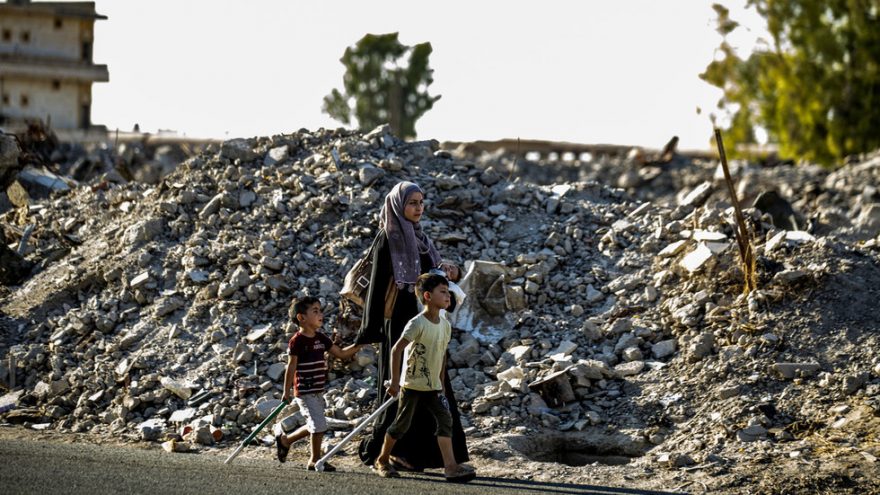
A woman and two children walk past debris in the northern Syrian city of Raqa, the former Syrian capital of the Islamic State group, on August 21, 2019. © AFP / Delil SOULEIMAN
By Finian Cunningham | RT | August 22, 2019
A supposed survey of war-torn Syria by America’s so-called “newspaper of record” was not merely shoddy journalism; it was a cynical attempt to rewrite the history of the eight-year war.
The meandering report of more than 2,700 words was headlined: “What ‘Victory’ Looks Like: A Journey Through Shattered Syria.” It would have been more accurate to have used the title, “What Gloating Looks Like.”
Even the sly way the word ‘victory’ is put in quotation marks indicates, from the outset, the insidious purpose of the article. To pour scorn on how Syria and its people have in actual fact defeated a foreign-sponsored criminal war for regime change. The regime-change plot goes back to at least 2005 as this old CNN interview clumsily admits.
With mawkish words, the New York Times reporters effect to lament the rubble and grief among the Syrian population. But all the while, the implication conveyed is that President Bashar Assad “presided over the destruction.”
Bashar al-Assad’s image is everywhere, making it impossible to forget who presided over the destruction and who will preside over what comes next. Banners reading “Assad Forever” hang over many Syrian roads. https://t.co/0DfANqUmSGpic.twitter.com/hYqnOi1Frz
— The New York Times (@nytimes) August 20, 2019
It would be easy to dismiss the article for the ropey, agenda-led “journalism” that it is. But since journalism is reputed to be the “first draft” of writing history, it is therefore important that the distortion presented by the NY Times is repudiated for the outright falsification that it is.
We can’t go into every erroneous, obnoxious detail. And readers would be advised to go to alternative reports by independent journalists like Eva Bartlett and Vanessa Beeley for accurate accounts of how Syrians are dealing with the aftermath of war and what the people actually think about who caused their war-torn fate.
But suffice to say that three salient distortions or omissions can be cited to condemn the NY Times as a purveyor of propaganda. First is the staggering assertion that Syria’s lunar landscape of destruction was brought about by warplanes and artillery deployed by the state’s armed forces.
Secondly, there is not a single mention of US and other NATO states carrying out – and continuing to carry out – air strikes on Syrian infrastructure for the past five years, which have resulted in thousands of civilian deaths. Probably the most infamous episode was the American obliteration of the city of Raqqa two years ago during which an estimated 1,600 people, including women and children, were buried under rubble from indiscriminate bombing.
The NY Times would have us believe that Assad callously and gratuitously inflicted a pyrrhic victory on his people, instead of telling readers that the country was targeted covertly for regime change by the US, its NATO allies, and regional partners.
A third astounding distortion is the apparent absence of terror groups in Syria’s war. Not once is it mentioned that the militants who served as proxies for their foreign sponsors were mostly composed of Al Qaeda-linked terrorists recruited for their barbaric dirty work from all over the world and infiltrated into Syria by NATO operatives. Former urban areas like eastern Aleppo and Douma held siege under a reign of terror are referred to as “rebel-held” districts. The liberation of those hell-holes by Syrian government forces, supported by Russian airpower, is not reported as “liberation” but as something sinister, in complete disregard for how the Syrian people relate the events to the smarmy NY Times journalists. The latter presume to know better about what really happened, and consequently routinely infer that “regime minders” accompanying them are coercing the civilian interviewees to mouth pro-Assad propaganda.
Imagine the feat of mental gymnastics. In a supposed in-depth survey of war-ravaged Syria, there is not one reference to the army of jihadists belonging to Islamic State (IS, formerly ISIS/ISIL), Nusra Front, Jaish Al Islam, and dozens of other alphabet soup names used to conceal the fact that all were terrorist proxies weaponized by the US and NATO military intelligence.
What we have instead is the NY Times affecting a kind of grief and condescension towards the Syrian people who have been, it is claimed, plunged into misery by their government and its Russian ally. It is inconceivable, according to this narrative, that the Syrian people and their armed forces may have perhaps won the most dramatic, heroic battle in modern times against a behemoth of US-backed enemies whose terror tactics plumbed the depths of depravity.
Rather amusingly, if it weren’t so sickening, was a separate report by the NY Times only the day before which proclaimed that, “ISIS [Islamic State] Is Regaining Strength in Iraq and Syria”.
So, in the previous screed masquerading as a detailed survey of Syria, there is no mention of terror groups. Yet, in the second report the reader is told that the “Islamic State is on the rise again”. How is such a colossal contradiction entertained by the editors?
That other report kicks off with this laughable claim: “Five months after American-backed forces ousted the Islamic State from its last [sic] shard of territory in Syria, the terrorist group is gathering new strength, conducting guerrilla attacks across Iraq and Syria, retooling its financial networks and targeting new recruits at an allied-run tent camp, American and Iraqi military and intelligence officers said.”
Yes, that’s right, we are being told that US forces vanquished Syria’s terrorist tormentors from their “last shard of territory”. But now they are resurgent and “well-equipped” numbering about 18,000 fighters. We might indeed wonder how this change of good fortune happened for the militants. Could it be that powerful foreign sponsors are aiding and abetting once again? The NY Times never hints at such an obvious possibility.
The point of the article seems to be an attempt to undermine President Trump’s drawdown of US troops from Syria. The NY Times and its military intelligence sources are arguing for more American forces to be deployed in Syria and Iraq. “The resurgence [of terrorists] poses a threat to American interests and allies, as the Trump administration draws down American troops in Syria,” the report editorializes.
While the NY Times is cynically exploiting Syria for its own agenda-driven story-telling, the real task of defeating foreign-backed terror groups was continuing this week in Idlib province, northwestern Syria. The Syrian Arab Army captured the town of Khan Sheikhoun from militants affiliated to Hayat Tahrir al Sham (formerly Nusra Front, formerly Al Qaeda.) That is in spite of credible claims of armed support from NATO member Turkey whose military incursion into Syrian territory was pushed back. The US is also allegedly implicated in covertly arming the last redoubt of terror groups in Idlib.
Eight years of hideous war in Syria are coming to an end as Syrian state forces push on to claim every last inch of the nation’s territory from foreign intruders. The plain truth is that the Syrian people won a formidable victory against implacable malign powers, led by the US.
The systematic distortion and lies told by Western corporate-controlled media about Syria continues, even when victory against Washington’s infernal imperialist crimes is staring them in the face.
World on verge of ‘uncontrolled arms race’ because of US – Russia’s UN envoy
RT | August 22, 2019
The US ambitions have put the world on the brink of a new arms race that can easily spiral out of control, warned the Russian envoy to the UN. Washington responded by blaming Moscow for the INF treaty’s collapse.
“Are you aware of the fact that all of us have found ourselves just one step away from an uncontrolled arms race, because of the US geopolitical ambitions?” Dmitry Polyanskiy, Russia’s deputy ambassador to the UN, said at the emergency session of the Security Council that Moscow and Beijing convened on Thursday, in the wake of the US missile tests.
This a source of great concern for us, but apparently not for the US.
Washington apparently planned to leave Intermediate-Range Nuclear Forces (INF) Treaty long before announcing its withdrawal from the 1987 agreement back in February, Polyanskiy added, since this is the only way it could have tested a new ground-launched cruise missile that violated the accord mere weeks after it officially expired.
The launcher used in the test was the same one installed in Aegis Ashore missile defense batteries in Romania and Poland. When the first of those systems was placed in 2016, Moscow expressed its concerns over their capability to launch Tomahawk cruise missiles in violation of the INF treaty. The US assured Russia at the time the Aegis systems did not have such features.
“Now these suspicions are confirmed,” Polyanskiy said,
The Russian diplomat also rebuked US allies in Europe for their reluctance to support Moscow’s efforts in strengthening the treaty, back when it could have still been saved. In December 2018, Russia introduced a draft resolution to the UNSC that sought to enhance international support for the treaty, without any no criticism of the US. Yet, the western nations did not back it.
“Are you happy that you pressed the red button at that time?” the Russian diplomat said, addressing the European nations. Their inaction, he argued, has thrown back the security situation in Europe to the times before the INF, when short- and mid-range nuclear missiles were stationed on the continent.
Washington maintained its was Russia that “materially breached” the treaty by developing and allegedly deploying “multiple battalions” of missile systems the US allege are violating the INF. Moscow has repeatedly denied the accusations and even invited international inspections of the system in question – but no one took it up on the offer.
The acting US envoy to the UN, Jonathan Cohen, called the latest missile test a “prudent response” to the “aggressive strategies” pursued by Russia and China, which he blamed for the “deteriorating security environment” in the world.
After withdrawing from the INF treaty, Washington hinted it would like to re-negotiate the deal and include China into it. Beijing’s envoy to UN said it has “no interest in participating in trilateral disarmament talks” right now and insisted that the primary responsibility for the arms control rests with the powers possessing the largest nuclear arsenals.
U.S. To “Drown The World” In Oil
By Nick Cunningham – Oilprice.com – August 21, 2019
The U.S. could “drown the world in oil” over the next decade, which, according to Global Witness, would “spell disaster” for the world’s attempts to address climate change.
The U.S. is set to account for 61 percent of all new oil and gas production over the next decade. A recent report from this organization says that to avoid the worst effects of climate change, “we can’t afford to drill up any oil and gas from new fields anywhere in the world.” This, of course, would quickly cause a global deficit, as the world continues to consume around 100 million barrels per day (bpd) of oil.
Global Witness notes that the industry is not slowing down in the United States, notwithstanding recent spending cuts by independent and financially-strapped oil and gas firms. If anything, the consolidation in the Permian and other shale basins, increasingly led by the oil majors, ensures that drilling will continue at a steady pace for years to come.
It isn’t as if the rest of the world is slowing down either. The global oil industry is set to greenlight $123 billion worth of new offshore oil projects this year, nearly double the $69 billion that moved forward last year, according to Rystad Energy. In fact, while shale drilling has slowed a bit over the past year amid investor skepticism and poor financial returns, offshore projects have begun to pick up pace.
But that trend might turn out to be just a blip. The U.S. is still expected to account of the bulk of new drilling and the vast majority of new production, with much of that coming from shale. Already, the U.S. is the world’s largest producer of both oil and natural gas. And the pace has accelerated in recent years. In 2018, U.S. oil and gas production increased by 16 and 12 percent, respectively. According to the EIA, the U.S. surpassed Russia in terms of gas production in 2011, claiming the top spot, and it surpassed Saudi Arabia in oil production last year.
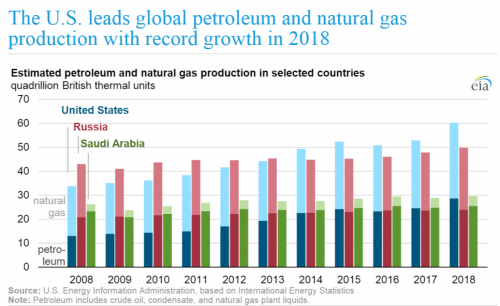
Going forward, new production from the U.S. will be eight times larger than the next largest source of growth, which is Canada. In fact, the U.S. will add 1.5 times more oil and gas than the rest of the world combined, according to Global Witness.
But because so much drilling in the U.S. is concentrated in a few areas, individual U.S. states on their own tower over the rest of the world. If Texas were a country, it would account for the most new oil and gas production in the world. Between 2020 and 2029, Texas could account for 28 percent of all additional output, Global Witness says.
Canada and Pennsylvania tie for second and third with 7 percent each. Then comes New Mexico at 5 percent of the growth and North Dakota at 4 percent. Oklahoma, Brazil, Colorado, Russia and Ohio are all tied at 3 percent a piece.
In other words, 7 out of the top 10 sources of new oil and gas production globally over the next decade are U.S. states.
“If things don’t change, by the end of the next decade, new oil and gas fields in the US will produce more than twice what Saudi Arabia produces today,” Global Witness said in its report.
This presents a massive challenge. “To avoid the worst impacts of climate change, our analysis shows that global oil and gas production needs to drop by 40% over the next decade. Yet, instead of declining, US oil and gas output is set to rise by 25% over this time, fueled by expansion in new fields,” the report warned.
Turkey, US agree to launch 1st phase of so-called safe zone plan in northern Syria
Press TV – August 22, 2019
Turkey and the United States have reached an agreement to immediately launch the first phase of a so-called safe zone plan in northern Syria, irrespective of the Damascus government’s strong opposition that the scheme amounts to “blatant aggression” against Syria’s territorial integrity.
Turkish Defense Minister Hulusi Akar and his US counterpart Mark Esper discussed the plan during a telephone conversation late on Wednesday, and decided to implement the measure from Thursday.
The two defense chiefs also agreed that military delegations from the two countries will meet in Ankara soon to discuss next stages of the plan.
Akar said the safe zone east of the Euphrates River in Syria should be established within the framework of the principles set out in the calendar without losing time, according to a Turkish Defense Ministry statement.
On August 7, Turkey and the US reached an agreement on the establishment of a joint operation center in the northern part of Syria, in the wake of Ankara’s threats to launch an operation against Kurdish militants from the People’s Protection Units (YPG) to push them away from the Turkish border.
Turkey views the YPG as the Syria branch of the homegrown Kurdistan Workers’ Party (PKK) militant group, which has been seeking an autonomous Kurdish region in Turkey since 1984.
Turkey expects the creation of a 32-kilometer (20-mile) safe zone in northern Syria, and has stressed that it wants the YPG cleared from the region.
An unnamed source at the Syrian Ministry of Foreign Affairs and Expatriates told the official SANA news agency on August 8 that the US-Turkey agreement over the establishment of a so-called safe zone in Syria amounted to “blatant aggression” against the Arab country’s territorial integrity and was a “flagrant violation” of international law and the UN Charter.
“This agreement has very clearly exposed the US-Turkish partnership in the aggression against Syria, which serves the interest of the Israeli occupation entity and the Turkish expansionist ambitions,” the source said.
He also urged Kurdish militants to reconsider their position and stand by the Syrians in defending their country.
“Syria calls on the international community and the UN to condemn the US-Turkish flagrant aggression which constitutes a dangerous escalation and poses a threat to peace and security in the region and the world and hinders all positive efforts for finding a solution to the crisis in Syria,” he said.
Michael Lane, founder of the American Institute for Foreign Policy, told Press TV on August 13 that the US plan to set up a joint command center with Turkey to coordinate a so-called safe zone in Syria is aimed at blocking the Syrian army’s advances on the battlefield against foreign-backed militants.
“The United States is trying to disrupt the consolidation of the Syrian government over its country so that it keeps it distracted by that particular task,” and prevent it from working with its allies, namely Iran and Russia, in the battle against terrorism, he said.
“The United States purpose or vision is to keep Syria from becoming part of a triangle of Iran, Russia and Syria,” Lane commented.
Lindsey Graham’s Blank Check. Why a Defense Agreement With Israel Would Be a Disaster for Americans
By Philip Giraldi | Strategic Culture Foundation | August 22, 2019
Two world wars began because of unconditional pledges made by one country to come to assistance of another. On July 5, 1914, Kaiser Wilhelm II of Germany pledged his country’s complete support for whatever response Austria-Hungary would choose to make against Serbia after the June 28th assassination of Archduke Franz Ferdinand of Austria by a Serbian nationalist during an official visit to Sarajevo, Bosnia. This fatal error went down in history as Germany’s carte blanche or “blank check,” assurance to Austria that led directly to WW I.
In September 1939, World War II began when Great Britain and France came to the assistance of Poland after the German Army invaded, fulfilling a “guarantee” made in March of that year. What was a regional war, and one that might have been resolved through diplomacy, became global.
One would think that after such commitments were assessed by historians as the immediate causes of two world wars, no one would ever consider going down that road again. But that would be reckoning without Republican Senator Lindsey Graham who has been calling for a “defense treaty” with Israel since last April. In his most recent foray, Graham announced late in July that he is seeking bipartisan support for providing “blank check” assurances to Israeli Prime Minister Benjamin Netanyahu and is hoping to be able to push a complete defense treaty through the Senate by next year.
In making his several announcements on the subject, Graham has been acting as a front man for both Israeli Prime Minister Benjamin Netanyahu and also for The Jewish Institute for the National Security of America (JINSA), which wrote the basic document that is being used to promote the treaty and then enlisted Graham to obtain congressional support.
Speaking to the press on a JINSA conference call, Graham said the proposed agreement would be a treaty that would protect Israel in case of an attack that constituted an “existential threat”. Citing Iran as an example, Graham said the pact would be an attempt to deter hostile neighbors like the Iranians who might use weapons of mass destruction against Israel. JINSA President Michael Makovsky elaborated on this, saying, “A mutual defense pact has a value in not only deterring but might also mitigate a retaliatory strike by an adversary of Israel, so it might mitigate an Iranian response (to an attack on its nuclear facilities).”
JINSA director of foreign policy Jonathan Ruhe added that “An Israeli strike on Iran’s nuclear program would not activate this pact, but a major Iranian retaliation might. – An Israeli unilateral attack is not what the treaty covers, but rather massive Iranian retaliation is what we are addressing.”
Israel has long been reluctant to enter into any actual treaty arrangement with the United States because it might limit its options and restrain its aggressive pattern of military incursions. In that regard, the Graham-JINSA proposal is particularly dangerous as it effectively permits Israel to be interventionist with a guarantee that Washington will not seek to limit Netanyahu’s “options.” And, even though the treaty is reciprocal, there is no chance that Israel will ever be called upon to do anything to defend the United States, so it is as one-sided as most arrangements with the Jewish state tend to be.
As the agreement between the two countries would be a treaty ratified by the Senate, it would be much more difficult to scrap by subsequent administrations than was the Iran nuclear deal, which was an executive action by President Obama. And clearly the statements by Graham, Makovsky and Ruhe reveal this treaty would serve as a green light for an Israeli attack on Iran, should they opt to do so, while also serving as a red light to Tehran vis-à-vis an ironclad US commitment to “defend” Israel that would serve to discourage any serious Iranian retaliation. Given that dynamic, the treaty would be little more than a one-way security guarantee from Washington to Jerusalem.
Furthermore, in outlining what circumstances would trigger US intervention on Israel’s behalf, the JINSA/Graham document cites, inter alia, “the threat or use of weapons of mass destruction.” It also allows Netanyahu to call for assistance after defining as threatening any incident or development “that gives rise to an urgent request from the Government of Israel.” It appears then that Netanyahu could demand that the US attack Iran should he only perceive a threat, however vague that threat might in reality be.
Israeli Prime Minister Benjamin Netanyahu has been claiming Iran is “three to five years” and “possibly weeks” away from a nuclear weapons capability since 1992 and pushing Washington to attack Iran so he obviously would welcome such a treaty for strategic reasons as well as to shore up his upcoming re-election bid. President Trump, with whom Graham has discussed how the agreement would work, has a similar interest in appearing strong for Israel to help his own campaign in 2020.
It is worth noting that in 2010 Netanyahu ordered the Israel Defense Force (IDF) to prepare to strike Iran but ‘Israel’s security chiefs refused: Gabi Ashkenazi, the head of the IDF, and Meir Dagan, the head of the Mossad at the time, believed that Netanyahu and the Defense Minister Ehud Barak were trying to “steal a war” and the order was not carried out. The attacks were also rejected by two ministers, Moshe Yaalon and Yuval Steinitz, which left Netanyahu without the necessary majority to proceed.
Ashkenazi claimed in a 2012 interview about the episode that he was convinced that an attack would have been a major strategic mistake. Meir Dagan said in 2012, after leaving his role as Mossad chief, that a strike would be “a stupid thing” as the entire region would undoubtedly be destabilized, requiring repeated Israeli and American interventions.
And there are other issues arising from a “defense treaty.” Defense means just that and treaties are generally designed to protect a country within its own borders. Israel has no defined borders as it is both expansionistic and illegally occupying Palestinian land, so the United States would in effect be obligated to defend space that Israel defines as its own. That could mean almost anything. Israel is currently bombing Syria almost daily even though it is not at war with Damascus. If Syria were to strike back and Graham’s treaty were in place, Washington would technically be obligated to come to Israel’s assistance. A similar situation prevails with Lebanon and there are also reports that Israel is bombing alleged Iranian supply lines in Iraq, where the US has 5,000 troops stationed.
The real problem is that the Trump administration is obsessed with regime change in Iran, but it has so far been unable to provoke Iran into starting a conflict. Graham’s proposed treaty just might be part of a White House plan to end-run Congress and public opinion by enabling Israel to start the desired war, whereupon the US would quickly follow in to “defend Israel,” obliged by treaty to do so. What could possibly go wrong? The correct answer is “everything.”
The Saker Interviews Professor Marandi

The Saker • Unz Review • August 22, 2019
Introduction: first, several friends recently suggested that that I should interview Professor Seyed Mohammad Marandi; then I read this most interesting text on Moon of Alabama and I decided to ask Professor Marandi to share his views of the current situation in Iran, the Persian Gulf and the rest of the Middle-East who very kindly agreed to reply to my question in spite of his most hectic and busy schedule. I am most grateful to Prof. Marandi for his time and replies. Crucially, Prof. Marandi debunks the silly notion that Russia and Israel are allies or working together. He also debunks that other canard about Russia and Iran having some major differences over Syria. Prof. Marandi, who is currently in Iran, is superbly connected and informed, and I hope that with this interview some of the more outlandish rumors which were recently circulated will finally be seen for what they are: utter, total, nonsense. Enjoy the interview!
The Saker: It is often said that there is an “axis of resistance” which comprises Syrian, Hezbollah, Iran, Russia and China. Sometimes, Venezuela, Cuba or the DPRK are added to this list. Do you believe that there is such an “axis of resistance” and, if yes, how would you characterize the nature of this informal alliance? Do you think that this informal alliance can ever grow into a formal political or military alliance or a collective security treaty?
Professor Marandi: I definitely believe there is an Axis of Resistance that currently includes Iran, Syria, Iraq, Gaza, Lebanon, parts of Afghanistan, and Yemen. I do not think that we can include the DPRK in any way or form. I believe that Russia could be considered to a certain degree as aligned or affiliated to this resistance, but that this is not something many would feel the need to acknowledge. At certain levels, there is a lot of overlap between Russian and Chinese policy and the policies of the countries and movements in this region that are affiliated to this Axis of Resistance. The same is true with countries such as Venezuela, Bolivia, and Cuba, which I do not consider to be similar to North Korea at all. Just as almost everywhere else, American policy in the Korean Peninsula is ugly, hegemonic and malevolence, but the nature of the DPRK government is fundamentally different from that of Venezuela or Cuba, whether the Americans or Europeans like to acknowledge that or not. Others can interpret the Axis of Resistance to include or exclude certain countries, but it is pretty clear that Iran and Russia have similar policy objectives when it comes to certain key issues. Nevertheless, Russia has a close relationship with the Israeli regime whereas Iran considers it to be an apartheid state, almost identical to that of apartheid South Africa. Or for example the Syrian government position regarding Israel is different from that of Iran’s. The official Syrian position is that the West Bank and Gaza Strip must be returned to the Palestinians, in accordance with UN Security Council resolutions, and that the occupied Golan Heights have to be handed back to the Syrian people, which are legitimate demands. But the Iranian position is different, Iran firmly believes that Israel is a colonial and apartheid regime and that it is morally unacceptable for it to exist in its present form. Therefore, at least officially, there are substantial differences. So people can interpret the Axis of Resistance in different ways. It is important to keep in mind that despite Syria, Iran, Turkey and Qatar are also moving closer together partially thanks to US, Saudi, and UAE hostility towards the Muslim Brotherhood. What is important is that there is a growing consensus about key issues in this region and what the major problems are, and I think that as time goes on this loose alliance of countries and movements is growing more influential and more powerful. I cannot say whether there will be a formal or open collective security treaty or military alliance created by any of these countries in the near or foreseeable future and I do not see such a necessity. However, I think this convergence of ideas is very important and I think that the formal and informal links that exist between these countries is in many ways more important and more significant than formal political or military alliances or security treaties.
The Saker: In recent months a number of observers have stated that Russia and Israel are working hand in hand and some have gone as far as to say that Putin is basically a pawn of Netanyahu and that Russia is loyal to Israel and Zionists interests. Do you agree with this point of view? How do Iranian officials view the Russian contacts with the Israelis, does that worry them or do they believe that these contacts can be beneficial for the future of the region?
Professor Marandi: That is nonsense. The US and Israeli regimes are culturally and ideologically bound to one another, whereas the Americans have a deep antipathy towards Russia. That is why the Russians have a very different position on Syria than do the Americans and Israelis. The Israelis alongside the US, the EU, the Saudis, and some of Syria’s neighboring countries, supported ISIS, Al Qaeda, and other extremist entities and attempted to tear Syria apart. As explained earlier, the Russian view of Israel is different from Iran. There are many Russian Jewish immigrants in Israel and they constitute a large segment of the colonists in Palestine and they are largely utilized for the further subjugation of the Palestinian people and ethnic cleansing. Generally speaking, Russian interests are in sharp conflict with those of the United States, Israel’s strongest ally. In addition, Russia’s close relationship with Syria dates back to the cold war and the relentless US pressure on China and Russia has also acted as a strong catalyst to quicken their convergence with one another as well as with Iran on key issues. The Chinese and Russians know quite well that the United States, the Europeans, and regional countries have extensively used extremists in Syria to undermine the state and that those forces could later be used to undermine security in Central Asia, Russia, and China. A large number of Russian, Chinese, and Central Asians have been trained to fight in Syria, and this is a major threat to their collective security. The United States could use these and other extremists in an attempt to impede the potential success of the Belt and Road Initiative or other plans for Asian integration. Thus, there is a sharp and growing conflict between the Russians and the Americans.
The Israeli regime constantly tells the Russians and the Chinese that they are the gateway to Washington and that if they maintain strong ties with Israel, the Israelis can help them solve their problems with the United States. I do not think there is much truth to that, because this growing conflict is about the fate of US global dominance and there is nothing the Israelis can do to change that. Nevertheless, this has been used as an incentive for the Russians and the Chinese to maintain better relations with the Israeli regime.
In any case, Russia does not have to maintain identical views with Iran, Syria, Hezbollah, Lebanon, Iraq, or Yemen. Differences exist, but strong relationships exist nevertheless. All of these countries recognize that if the Americans are able to undermine any of them, whether it is Syria, Iran, Russia, or China, then that would only encourage the United States to be more aggressive towards the remaining countries that impede US foreign policy objectives or exist as potential rivals whether regionally or globally. So even though their political structures are different, even though their foreign policies are different, the similarities that exist are quite striking as well as the common threats. Again, to a large degree this coalition is a result of US and Western foreign policy, which has strong undercurrents of Eurocentricism, tribalism, and racism.
Not only has this pressure brought these countries and movements closer to one another, but it has also created a deeper understanding among them. The Russians understand Iran better today than they did 5 years ago, partially as a result of their cooperation in Syria. This greater understanding enhances the relationship, and helps to dispel many of the misunderstandings or myths that may exist about one another due to Eurocentric narratives and orientalism.
Hence, Iran is not concerned about Russian-Israeli relations. Obviously, in an ideal world Iran would like Russia to break relations with the Israeli regime for its apartheid nature. But reality is reality, and Iranian relations with Russia are very good and at times I am sure the Iranians send certain warnings to the Israelis through the Russians.
The Saker: How is Russia viewed in Iran? Are most Iranians still suspicious of Russia or do they believe that they have a viable and honest partner in Russia? What are the main reservations/concerns of patriotic Iranians when they think of Russia?
Professor Marandi: Historically, the Iranians have had serious problems with the Russians. The Russians and the Soviet Union interfered extensively in Iranian internal affairs and they undermined Iran’s sovereignty. But ever since the collapse of the Soviet Union the image of Russia has changed. Especially since Russia began fighting alongside Iran in Syria in 2015, Russia’s image has improved significantly. When we look at polls, Russia’s image is pretty good compared to Western countries.
Western governments own or fund dozens of Persian language media outlets These outlets, such as VOA and BBC Persian among others, are constantly spouting anti-Russian propaganda. Obviously they have an impact and that couples with historical Iranian concerns about Russia, but despite all that, the Russian image is relatively favorable and that says a lot.
The Saker: How about Turkey? Iran and Turkey have had a complex relationship in the past, yet in the case of the AngloZionist war against Syria, the two states have worked together (and with Russia) – does that mean that Turkey is seen as a viable and honest partner in Iran?
Professor Marandi: Iran’s relationship with the Turkish government is complicated, especially, because of the constant policy changes that have occurred IN TURKEY over the past few years. This has made the government seem unreliable in the eyes of many. Having said that, Turkey is very different from Wahhabi influenced regimes in the Arabian Peninsula. Turkish Islamic tradition has striking similarities with Iran’s Islamic culture and because of its strong Sufi tradition, Turkey is much closer to Iran than it is to, for example,Wahhabi Saudi Arabia.
The global Wahhabi menace has grown as a result of Saudi financial support, as well as the support of other countries in the Persian Gulf region. Turkish society has been more resistant, although ever since the military conflict in Syria and due to extensive funding from the Persian Gulf, there has been growing concern about growing sectarianism in Turkey, not unlike what happened in Pakistan in the 1980s.
Ironically, before the conflict in Syria President Erdogan had a closer personal relationship with President Assad than did the Iranians. They and their families would spend vacations together.
In any case, Turkey has a very strong economic, political, and cultural relationship with Iran, and some of the rising anti-Shia and takfiri sentiments that have been on the rise in Turkey were stunted by the Saudi and Emirati support for the attempted coup in Turkey. Subsequently, their open antagonism towards the Muslim Brotherhood and Qatar, their support for the coup in Egypt, their policies in Sudan and Libya, and of course the murder of Jamal Khashoggi, have all had a beneficial impact on Iranian-Turkish relations. As a result, Turkey has grown much more distant from Iran’s regional antagonists, while Turkish support for the Palestinian cause is another element that brings Iran and Turkey closer together. American support for PKK terrorists in Syria has also angered the Turks adding push to Turkish-Iranian convergence. Even Turkish policy towards Syria is evolving, although it is impossible for the government to make a radical change, because of years of attempts at regime change.
The Saker: Next, turning to Iraq, how would you characterize the “balance of influence” of Iran and the USA in Iraq? Should we view the Iraqi government as allied to Iran, allied to the USA or independent? If the Empire attacks Iran, what will happen in Iraq?
Professor Marandi: The relationship between Iraq and Iran is significantly more important than the relationship between Iraq and the United States. Iran and Iraq are allies, but this alliance does not contradict the notion of Iraqi independence. Iraq’s regional policy is not identical to Iran’s. But the two countries have very similar interests, a very close relationship, many Iraqi leaders have spent years in Iran, and the bulk of the Iraqi population lives close to the shared border of over 1,200 km between the two countries. So trade, pilgrimage, and tourism are key to both countries. The religious similarities and the holy sites that exist in Iran and Iraq are a huge incentive for interaction between the two countries. There are many Iraqi students studying in Iran and many Iranian’s working in Iraq. The fact that Iranians made many sacrifices when fighting ISIS in Iraq and many Iraqis were martyred in the war against ISIS and Al Qaeda in Syria is a strong indication of where things stand despite US pressure.
The Arba’een pilgrimage that takes place every year where millions of Iranians and Iraqis make the walk towards Karbala, side by side, with tens of thousands of Iraqi and Iranian volunteers helping pilgrims along the way is, I think, a further sign of the close relationship.
While the U.S presence in Iraq continues to be hegemonic, Iran has not sought to prevent Iraq from having normal relationships with other countries. However, the U.S continues to seek control over Iraq through the world’s largest embassy, its military presence, and its influence over the bureaucracy. The United States continues to have much say over how the country’s oil wealth is spent.
Still, despite the US colonial behavior, its continued theft of Iraqi oil wealth, and its thuggish behavior, the Iraqis have been able to assert a great deal of independence. In the long run, this continued US behavior is only going to create further resentment among Iraqis. The empire rarely takes these realities into account, they seek to accumulate influence and wealth through brute force, but in the long term it creates deep-rooted anger and hostility which, at some point, will create great problems for the empire, especially as this anger and unrest is growing across the region, if not across the globe.
It is highly unlikely that the regime in Washington will attack Iran, if it does it will bring about a regional war, which will drive the United States out of Iraq, Afghanistan, Lebanon, and Syria. Saudi Arabia and the Emirates would, swiftly collapse and the price of oil and natural gas would go through the roof, leading to a global economic meltdown even as millions of people will be streaming towards Europe.
The Saker: It is often said that Russia and Iran have fundamentally different goals in Syria and that the two countries regularly have tensions flaring up between them because of these disagreements. Is that true? In your opinion, how are Russian and Iranian goals in Syria different?
Professor Marandi: The news that we sometimes hear about serious tensions existing between the Iranians and the Russians in Syria is often nonsense. There are clear reasons for people to exaggerate small incidents or to fabricate them altogether, but the relationship is quite good. Iran does not intend to have any military bases in Syria, whereas the Russians do feel the need to preserve their military presence in Syria through long-term agreements.
But ultimately, Iran would like to help enable Syria to acquire the military capability to retake the occupied Golan Heights. Iran does not intend to initiate any conflict with the Israeli regime inside Palestine. That is not an objective in Lebanon and that is not an objective in Syria. As in Lebanon, where the Iranians supported Hezbollah to restore the country’s sovereignty and to drive out the Israeli aggressors and occupiers, the Iranians have the same agenda in Syria. They want to support the Syrians so that they will be able to restore full sovereignty. I don’t believe the Golan Heights is a priority for the Russians.
The Saker: For a while, Iran let the Russian Aerospace Forces use an Iranian military airfield, then when this became public knowledge, the Russians were asked to leave. I have heard rumors that while the IRGC was in favor of allowing Russian Aerospace Forces to use an Iranian military airfield, the regular armed forces were opposed to this. Is it true that there are such differences between the IRGC and the regular armed forces and do you think that Iran will ever allow the Russian military to have a permanent presence in Iran?
Professor Marandi: That is a myth. The Russians were not asked to leave. There were no differences between the IRGC and any other part of the armed forces. This was a decision made by the Supreme National Security Council and the President and all the major commanders in the military were involved in this decision. Actually, the airbase does not belong to the guards it belongs to the air force and a part of the base was used for Russian strategic bombers that were flying to Syria to bomb the extremists. This cooperation ended when the Russians were able to station adequate numbers of aircraft in Syria, because the flights over Iran were long and expensive, whereas the air campaign launched from bases inside Syria was much less expensive and much more effective. Iran was very open about its relationship with the Russians, and openly permitted the Russians to fire missiles over Iranian airspace. There were those who were opposed to the Russian presence in the Iranian airbase. A small segment of Iranian society that is pro-Western and pro-American complained about it in their media outlets, but they had absolutely no impact on the decision-making process. According to polls, an overwhelming majority of Iranians supported Iran’s activities in Syria, and the Supreme National Security Council was under no pressure to its decision. However, Iran does not plan to allow any country to have permanent bases in the country and that is in accordance with the constitution of the Islamic Republic of Iran. The revolution in Iran was about independence, dignity, sovereignty and indigenous values, and the removal of American hegemony over Iran was very much a part of that. The Iranians will not give any bases to foreign powers in future, and neither the Russians nor the Chinese have ever made such requests. There are absolutely no differences regarding Iran’s regional policies between the IRGC and the rest of the military, both were a part of the decision-making process when the Russians were allowed to fire missiles over Iranian territory and both were part of the process in allowing Russian aircraft to use Iranian airspace. The Russian bombers were providing air support for Iranian troops and Iranian affiliated troops on the ground.
The Saker: Both Ayatollah Ali Khamenei and Hezbollah Secretary General Hassan Nasrallah have made repeated statements that the days of the racist ZioApartheid regime in occupied are numbered. Do you agree with their point of view and, if yes, how do you see such a regime change actually happening? Which of the One State solution or a Two State solution do you believe to be more realistic?
Professor Marandi: I do not believe the two-state solution is possible because the Israeli regime has colonized too much of the West Bank. Actually, through acts of selfishness and petty short-term gain, the regime has damaged itself enormously. As a result of the colonization of the West Bank, even the European elites and diplomats who would privately admit that the Israeli regime pursues apartheid policies and who would always speak of hope for a two-state solution, admit that the two state solution is dead. All Palestinians are treated as sub humans, whether they reside in the West Bank or not. They are a subjugated nation, whether they are Israeli citizens or not. However, there is no longer any hope that those who live in the occupied West Bank will gain freedom, even though we predicted the Israelis would never voluntarily relinquish the West bank. This is the most important challenge that the regime faces in the future. By colonizing the West Bank and despite official western media and government narratives, it is increasingly seen by the international community as the apartheid regime that it is. It is delegitimizing itself in the eyes of larger numbers of people.
In addition to that, it can no longer behave with impunity. The 2006 war in Lebanon where the Israeli armed forces were defeated by Hizbullah was a turning point. Before then, the Israelis had created an image that they were invincible. But now even in Gaza, they are unable to carry out their objectives when they periodically attack the territory and its civilians. The Israelis are now more easily contained especially since the Syrian government has been able to restore order and expel ISIS and al-Qaeda from areas neighboring Israeli forces on the occupied Golan Heights, despite the Israelis supporting the extremists. The Israelis have been contained regionally, at home they are increasingly seen as an apartheid regime. Its regional allies are also on the decline and regionally. Saudi Arabia and the UAE are the only countries that can be considered as effective allies and they are facing a potential terminal decline. Therefore, regionally the regime is becoming more isolated. I do not believe that under such circumstances, the Israeli regime can last for very long. Just as the apartheid regime in South Africa collapsed under the burden of its own immoral existence, the Israeli regime will not last. There will be no two-state solution, the only realistic and moral solution is for Palestine to be united and for the indigenous population to have its rights restored, whether they are Palestinians, Jews or Christians or anyone else who is indigenous to the land.
The Saker: Iran is an Islamic Republic. It is also a majority Shia country. Some observers accuse Iran of wanting to export its political model to other countries. What do you make of that accusation? Do Iranian Islamic scholars believe that the Iranian Islamic Republic model can be exported to other countries, including Sunni countries?
Professor Marandi: I do not think that there is any validity to that accusation. Iran has a very excellent relationship with Iraq, but it has not imposed its model on the country. In fact, Iran helped create the current constitution of that country. The same is true for Lebanon and Yemen. Iran is constantly accused by its antagonists, but in the most inconsistent ways. Elsewhere they claim that Iran is afraid of their model being exported because they are fearful of rivals. Iran has always been attacked from all sides often using self-contradictory arguments. On the one hand, the so-called regime is allegedly immensely unpopular, it is corrupt, it is falling apart, and it is incapable of proper governance. Yet on the other hand, Iran is a growing threat to the region and even the world. This is paradoxical, how can Iran be incompetent and collapsing on the one hand, yet a growing threat to the whole world on the other hand? This simply does not make sense. Nevertheless, I have seen no evidence that Iran has tried to impose its model on other countries or on movements that are close to it. If it was not for Iran’s support, ISIS and al-Qaeda would have overthrown Syria with its secular government and secular constitution. Iranians firmly believed that the terrorist forces supported by Western intelligence services as well as regional regimes were the worst case scenario for the Syrian people. Did they impose their model?
The Saker: thank you for all your answers!
Law Enforcement To Flag & Spy On Future Criminals
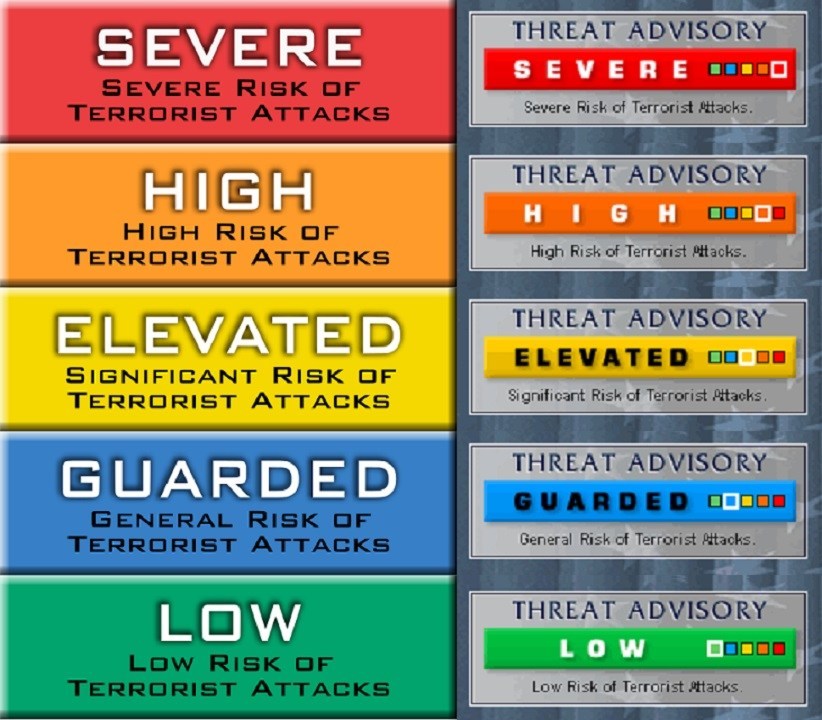
DHS’s (old) Risk Assessment Chart
MassPrivateI | August 20, 2019
America’s fear of mass-shootings is about to take a truly bizarre turn. That’s because our law enforcement will soon be used as fortune tellers to spy on future criminals.
How will law enforcement be used as fortune tellers?
A recent Albuquerque Journal article revealed that law enforcement will flag people that they think might pose a potential risk.
“Gov. Michelle Lujan Grisham directed state Homeland Security and Emergency Management Secretary Jackie Lindsay to start enrolling all 33 county sheriffs in a data-sharing program so that individuals deemed a potential risk could be flagged and monitored.”
What types of things could Americans do that law enforcement would consider threatening?
Inside Sources revealed that police would be looking for “certain indicators.”
State Police Chief Tim Johnson said, “I think it’s obviously important for all of the citizens of New Mexico to be on the lookout for certain indicators of these types of folks that would do this. And part of our job as government officials is to ensure that the citizens of the community understand what those indicators are so they can report them.”
The Tampa Bay Times reports that police are looking for “certain critical threat indicators” on students social media posts and have even created their own FortifyFL app that allows anyone to secretly report suspicious behavior.
What these “indicators” are is anyone’s guess.
Johnson also said that it was “important for law enforcement and other social services to follow up” on reports of possibly dangerous citizens “in the hopes of preventing” acts of domestic terrorism.
Law enforcement and other agencies are being encouraged to report on and flag anyone that they deem a “potential risk.”
What could possibly go wrong?
It was only a couple of months ago, when I warned people about the “Threat Assessment, Prevention and Safety Act” that basically allows law enforcement to label anyone a potential threat.
“The TAPS Act would encourage law enforcement to give everyone a personal threat assessment (kids and adults) and single out those that they deem as future threats.”
Police across the country are already using “red flag” laws to take weapons away from people they deem a potential threat. So why is Homeland Security creating a whole new class of suspicious people?
Because the War on Terror constantly needs new enemies if it is to keep Americans living in fear.
The Albuquerque Journal revealed how law enforcement plans to use the red flag bill to allow law enforcement and other agencies to give people secret threat ratings.
“Sheriffs had been working with the Democratic sponsor of a proposed red flag bill toward a possible compromise. In its original form, the bill would have allowed courts to order the temporary taking of guns from someone deemed an immediate threat, “San Juan County Sheriff Shane Ferrari said.
From Homeland Security spying on everyone’s social media posts to the FBI, it seems like no one is safe from Big Brother’s prying eyes.
Reason.com warned that the FBI’s “red flag” social media spying tool is “a meme-illiterate Facebook-stalking precog from the Minority Report.”
Reason also warned that spying on everyone’s social media posts could spiral out of control.
“There are operations centers and watch floors, which monitor news and events to create reports for the relevant FBI team. These would spur the activation of fusion center, tactical teams which use early notification and accurate geo-locations. Which could allow law enforcement to target and even disenfranchise social media users whose posts may have been misinterpreted.”
Placing people on a secret risk chart is a disaster waiting to happen, just ask those people on the no-fly list or terror watch list.
There are no law enforcement risk rating charts yet.
Based on DHS’s old risk advisory chart we could expect law enforcement to use something similar to Canada’s workplace risk assessment ratings chart:

Canada’s workplace risk assessment ratings chart is a disturbing example of how DHS could give everyone a personal risk assessment.
Asking law enforcement to guess who might become a criminal is at best fortune telling; and at worst, an excuse to incarcerate more people.
First they came for the bots: US academics make case for 1984-style silencing of any dissent
By Helen Buyniski | RT | August 21, 2019
With the “Russian meddling” theory of Trump’s victory on life support heading into 2020, US academic researchers have heeded the patriotic call and put forth a new definition of “disinformation” that includes inconvenient truths.
Social media platforms must expand their definitions of “coordinated inauthentic behavior” beyond the usual bots-and-trolls model to include conversations about topics harmful to the state if they hope to curb the spread of disinformation on their platforms, a trio of University of Washington researchers insist in a paper released ahead of the 2019 Conference on Computer-Supported Cooperative Work. To help in this quest, the researchers have redefined “disinformation” to include truths arranged to serve a purpose.
“Evaluating disinformation is less about the truth value of one or more pieces of information and more about how those pieces fit together to serve a particular purpose.”
Such an Orwellian redefinition would include the lion’s share of journalism, especially opinion journalism, and sure enough, the researchers have their knives out for those who become “unwitting agents” in the spread of disinfo by writing based on anonymous tips – otherwise known as “reporting.”
All it takes is one article on a “conspiracy theory” to cause a rift in society, the researchers warn, as a single story spreads to multiple outlets and then throughout the social media infosphere. But governments may spend billions of dollars on manipulating public opinion over social media, because it’s OK to lie, as long as you’re helping your country.
The paper tiptoes around propaganda campaigns run by the “good guys” – acknowledged US operations like the notorious pro-Clinton Correct the Record, while New Knowledge, rather than being called out for its fake Russian bot campaign to influence the 2017 Alabama senate election, is cited as an academic source!
Understanding that bot- and troll-hunting has limited use, the researchers focus on “actors who are not explicitly coordinated and, in some cases, are not even aware of their role in the campaign” – i.e. ordinary social media users with opinions the researchers don’t like.
One “case study” examines content “delegitimizing” the White Helmets while neglecting to mention that the group and the publicity surrounding it are, themselves, part of a well-funded western influence operation against the Syrian government (with a sideline in terrorism and head-chopping). The researchers complain that anti-WH voices were not the expected bots and trolls but included “western journalists” and overlapped with “‘anti-war’ activism” – as if “anti-war” was an artifact of a bygone era when one could, realistically, be against war. They complain that not enough accounts retweeted pro-White Helmets articles and videos – essentially that the problem here was not enough of the right kind of propaganda.
Conspiracy theories especially get under the researchers’ skin, as they have trouble untangling “conspiracy pushers” from those following mainstream news and seem incapable of realizing that people looking for answers in the aftermath of a tragedy are inclined to look in multiple places.
The researchers warn their peers not to minimize the effects of Russian “influence operations” in 2016, even if their analysis shows them to be minimal – clearly, they aren’t looking hard enough (i.e., if you don’t see the effects, it’s not that they aren’t there, it’s that you aren’t using sophisticated enough instruments. May we interest you in this fine Hamilton68 dashboard?).
Scientists are cautioned never to allow their hypothesis to color the way they report the results of their experiments. If the lab doesn’t show something, it isn’t there. But these researchers are not scientists – they, like the New Knowledge “experts” they so breathlessly cite, are propagandists. They are the droids they are looking for. At one point, they even admit that they “wrestl[ed] with creeping doubt and skepticism about our interpretations of [operations promoting progressive values] as problematic – or as operations at all.” Skepticism, it seems, lost.
Social media platforms are warned that their current model of deplatforming people based on “coordinated inauthentic behavior” leaves much to be desired. If they truly want to be ideal handmaidens of the national security state, they must “consider information operations at the level of a campaign and problematize content based on the strategic intent of that campaign.” It’s not whether the information is true, it’s where it came from – and what it might lead to – that matters. Such a model would complete the transformation of platforms into weapons in the state’s arsenal for suppressing dissent, and the researchers acknowledge they might be at odds with “commonly held values like ‘freedom of speech'” (which they also place in quotes), but hey, do you want to root out those Russian influence operations or not? We’ve got an election to win!
When at first you don’t succeed, redefine success. None have heeded this maxim better than the Russiagate crowd and their enablers in the national security state, and academic researchers have long provided the grist for these propaganda mills. But the cheer chutzpah of expanding the definition of disinformation to include truths arranged to have an effect – a definition that could include most of journalism, to say nothing of political speeches and government communications – is unprecedented.
Helen Buyniski is an American journalist and political commentator, working at RT since 2018
Trump fine-tunes peace deal with Taliban
By M. K. BHADRAKUMAR | Indian Punchline | August 22, 2019
The US President Donald Trump’s remarks at the Oval Office in the White House on August 20 regarding the Afghan peace talks and related issues exuded an overall sense of satisfaction that the “endless war” is finally ending —although issues still remain to be sorted out before the deal is closed.
This was also Trump’s first public assessment of the meeting he took last week with top officials, including the secretaries of state and defence, CIA director and US special representative on Afghanistan Ambassador Zalmay Khalilzad who leads the American team of negotiators at the Doha talks with the Taliban.
Trump said more than once during his remarks to the media on Tuesday that the talks with the Taliban are going well, and he made it a point to acknowledge publicly that the Taliban genuinely want to stop fighting with the US troops. As he put it,
“I will say this: The Taliban would like to stop fighting us. They would like to stop fighting us. They’ve lost a lot.”
Trump threw light on what to expect. Clearly, the status quo is untenable and Trump intends to withdraw troops. But he is also convinced that the US should “always have somebody there.” Trump left it vague. Is Eric Prince preparing to walk in through that door?
On the other hand, Trump didn’t mince words about the US having a a strong intelligence presence in Afghanistan. That is because, as he put it, “Nobody can be trusted. Nobody can be trusted. In my world — in this world, I think nobody can be trusted.”
Trump has bought into the US military and security establishment’s plea that for ensuring that 9/11 type attacks do not repeat, a total American withdrawal from Afghanistan will be far too risky.
Interestingly, Trump taunted Russia (or any other country) to try to replace the US and NATO in Afghanistan, the graveyard of empires. He flagged that USSR shrunk to Russian Federation following its Afghan intervention. That was the nearest Trump came to admitting that the Afghan war cannot be won.
Significantly, in Trump’s estimation, Taliban does have the capability to prevent Afghanistan becoming a revolving door for international terrorists if it has the political desire to ply such a role. He seemed to imply that a peace deal that accommodates Taliban’s interests and concerns could incentivise the latter to be an ally in the fight against terrorism.
Trump never once disparagingly referred to the Taliban. On the contrary, Trump feels no particular commitment anymore to protect the Ashraf Ghani government. He even let it be known that he could “understand” why the Taliban has no respect for the Afghan government.
Does this mean that Trump may pull the plug on Ghani’s set-up? Most certainly, Trump’s remarks suggest that the US is distancing itself from the Kabul government and is gravitating toward neutral middle ground in the Afghan fratricidal strife.
This works fine for the Taliban and Ghani’s political opponents who have been demanding an interim government. Equally, the tenor of Trump’s remarks would suggest that the US no longer makes a fetish of “Afghan-led, Afghan controlled” dialogue between the Taliban and the Ghani government.
Trump carefully sidestepped any reference to Pakistan. But it goes without saying that Pakistani role is of crucial importance to his efforts in the coming weeks to reach a final agreement with the Taliban.
Looking ahead, it is inevitable that the US’ dependency on Pakistan is only going to increase, given the long-term American military and intelligence presence in Afghanistan and the imperative need to preserve good US-Taliban equations at the working level to counter terrorist threats.
Clearly, in Trump’s scheme of things, the US can learn to live with a Taliban government in Afghanistan.
In this backdrop of a US-Pakistan-Taliban triangle taking shape on the Afghan political chessboard, Pakistan is the big winner. No doubt, Pakistan will go the whole hog to install a friendly government in Kabul. The US is unlikely to put roadblocks.
Conceivably, Pakistan’s agenda includes a settlement of the Durand Line question. The US and western allies as well as China and Russia (and Iran) will be supportive of the resolution of the dispute over Durand Line, without which the lawless Pakistan-Afghan border regions would continue to be a sanctuary for terrorist groups.
Pakistan can hope to leverage the preponderant hold of the Taliban in the southern and eastern provinces of Afghanistan. In turn, friendly, cooperative local governments in the Afghan border regions can be a factor of stability.
All in all, a favourable situation is at hand for Pakistan for the first time since independence in 1947. A big improvement in Pakistan’s internal security situation can be expected once a friendly government in Kabul stops promoting cross-border terrorism.
While big-power rivalries are a fact of life in world politics, the great game also allows convergence of interests between protagonists. The chances of China or Russia torpedoing the implementation of an Afghan peace settlement piloted and negotiated by the US under Trump’s watch are virtually zero.
In fact, Trump expressed no misgivings whatsoever on that score. On the other hand, the US is well aware that both China and Russia have direct links to the Taliban. The bottom line is that Afghanistan’s stabilisation is in everyone’s interests. Trump’s optimism is well-grounded that the endless war in Afghanistan is actually ending.
Why No Congressional Investigation into Epstein’s Intelligence Connections?
By Jacob G. Hornberger | FFF | August 21, 2019
With convicted sex offender Jeffrey Epstein now dead, the Justice Department has launched an investigation into prison procedures that allowed him to commit suicide. Meanwhile, women who were sexually abused or raped by Epstein when they were minors are continuing civil actions against Epstein’s estate.
But why no congressional investigation into Epstein’s relationship, if any, to intelligence agencies, including the CIA, the Mossad, or any others? Have we gotten to the point where everyone is so scared to be labeled a “conspiracy theorist” that Congress is precluded from conducting a legitimate investigation into the CIA or other intelligence agencies?
Such an investigation would not come out of the blue. It would revolve around the undeniably sweetheart deal that the U.S. Attorney in Florida, Alexander Acosta, gave to Epstein and the reasons that he gave that sweetheart deal to him.
The plea deal enabled Acosta to escape federal charges for sex trafficking and allowed him to plead guilty at the state level to the much lesser crime of soliciting prostitution, which enabled him to serve one year in a local jail, sort of. During that year, officials permitted him to leave the jailhouse on a daily basis to attend to business matters, after which he would return to spend the night in jail.
It would be extremely difficult to find a more sweetheart deal than that. But the question is, Why? We all know how tough federal prosecutors can be. We also know that sex trafficking is not something that is ordinarily countenanced at the federal level, especially when it involves underaged girls.
So, why did Acosta do it? Why did he agree to that sweetheart deal rather than prosecute Epstein in federal court for sex trafficking?
That’s what a congressional investigation would be intended to determine. And Acosta’s sworn testimony could well lead to an answer to that question.
An article that appeared in the August 19, 2019, issue of the Daily Beast by an investigative reporter named Vicky Ward points out the reason why such a congressional investigation would be warranted:
Epstein’s name, I was told, had been raised by the Trump transition team when Alexander Acosta, the former U.S. attorney in Miami who’d infamously cut Epstein a non-prosecution plea deal back in 2007, was being interviewed for the job of labor secretary. The plea deal put a hard stop to a separate federal investigation of alleged sex crimes with minors and trafficking.
Is the Epstein case going to cause a problem [for confirmation hearings]?” Acosta had been asked. Acosta had explained, breezily, apparently, that back in the day he’d had just one meeting on the Epstein case. He’d cut the non-prosecution deal with one of Epstein’s attorneys because he had “been told” to back off, that Epstein was above his pay grade. “I was told Epstein ‘belonged to intelligence’ and to leave it alone,” he told his interviewers in the Trump transition, who evidently thought that was a sufficient answer and went ahead and hired Acosta. (The Labor Department had no comment when asked about this.)
Okay, all that is hearsay. Nonetheless, it clearly provides the basis for a congressional investigation.
All that a congressional committee has to do is subpoena Acosta and ask he if actually made that statement. If he acknowledges that he did, then he can be asked who said it to him and whether that was what motivated him to give Epstein the sweetheart deal.
Then, a subpoena could issue to the person who made that statement to Epstein. When that person arrives to testify, he could be asked about the source of his information. The investigation could then proceed accordingly.
Moreover, the director of the CIA could be summoned to testify as to whether Epstein was a CIA asset, operative, or agent. If Epstein did fall into one of those categories, it is certainly possible that the CIA director would lie about it, just as CIA Director Richard Helms lied to Congress back in the 1970s when he was asked about CIA involvement in Chilean regime-change operations. Nonetheless, he would at least know that he would be subject to a perjury indictment if it were later discovered that he had lied about Epstein’s involvement in the CIA.
Moreover, the CIA could be subpoenaed to produce all of its files and records relating to Epstein, which might indicate Epstein’s possible involvement with foreign intelligence agencies, such as the Mossad.
Why would the CIA, Mossad, or other intelligence agency have been involved with Epstein and why would an intelligence agency have gone to bat for him in a federal criminal prosecution for sex trafficking? That’s something an investigation would be intended to answer.
Of course, the press could continue investigating whether Acosta actually did make that statement and, if so, whether it was true. But the ability of the press to get to the truth is limited given its inability to force people to testify under oath and then have them prosecuted for perjury if they lie. A congressional committee could both subpoena people to testify under oath and have them indicted for perjury if they lie.
Given the possibility of corruption in the federal judiciary at the hands of the CIA or other intelligence agency, the American people are entitled to such an investigation. If sex offenders are being accorded favorable treatment in the federal criminal justice system simply because they happen to work for the CIA or some other intelligence agency, then what does that say for the entire federal criminal justice system?
If Epstein did have a relationship with the CIA or other intelligence agency, then, unfortunately, there are only two chances that Congress would initiate an investigation into the matter: slim and none. That’s because an intelligence agency that is powerful enough to corrupt the judicial branch of the federal government is sufficiently powerful to do the same to the legislative branch.
Getting Real With the US Foreign Policy Establishment Realists
By Michael Averko | Strategic Culture Foundation | August 21, 2019
On Russia-related matters, the more sane among us can perhaps be forgiven for becoming sedated by the kind of absurdities regularly spewed by some high profile individuals. The realist wing of the US foreign policy establishment has at times held back in rebuking this reality. We all have our biases, with the ideal to nevertheless be reasonably fair and balanced – a point which leads to a detailed critical overview of some trends among US foreign policy establishment realists.
The realist leaning National Interest, exhibits a different choice of words, relative to actions taken by the Russian and US governments. At that venue, George Beebe’s August 12 piece “How Trump Can Avoid War With Russia,” states: “Reducing Russian cyber aggression will require agreeing on rules to govern US as well as Russian involvement in the affairs of other states. Punishing Moscow’s transgressions must be complemented by rewards for good behavior, or we will simply reinforce perverse incentives for Russia to defy American policies, deepen security cooperation with China, and subvert NATO and the EU.”
In comparison, Beebe is tame in his prose dealing with post-Soviet US actions (in Yugoslavia, Iraq, Libya and Syria), which within reason can be considered as unnecessarily aggressive and deserving of condemnation. The aforementioned “Russian cyber aggression“, is something continuously brought up with a lack of conclusive evidence. Beebe’s use of “punishing” versus “rewards” towards Russia is along the lines of treating a child.
Dmitri Simes’ August 8 National Interest article “Delusions About Russia,” begins with “Russia is a dangerous adversary.” Neocons and neolibs will find little, if any disagreement with his opening comment. In conjunction with that thought, the second sentence in Simes’ piece is somewhat contradictory in saying “But treating it as an outright enemy could result in a self-fulfilling prophecy, triggering mortal threats to its neighbors which otherwise might not be in the cards.”
Enemy (whether outright or otherwise) is a synonym of adversary. In the post-Soviet era, Russia and America haven’t fought each other. With that in mind, the use of enemy and adversary is in line with tabloid sensationalist inaccuracies, as opposed to a realist seeking a more balanced overview. (The National Interest has had its tabloid moments, like Michael Peck’s April 3, 2016 article “How Poland Saved the World From Russia,” which I took some pleasure in answering.)
Putting aside the attempt to accommodate neolib and neocon biases, here’s an alternative to Simes’ opening salvo: “Russia could be a dangerous adversary. This can unnecessarily occur by incessantly disregarding legitimate Russian concerns.” Thereafter, a litany of fact based examples can be provided.
Categorizing Russia as a “formidable geopolitical rival” to America (and vice versa) arguably serves as a better characterization than “dangerous adversary”. In line with a pragmatic approach, this suggestion is in sync with the foreign policy realist, who second guesses the extent to which these two countries should be at odds with each other.
From a non-establishment realist perspective seeking improved US-Russian ties, the rest of Simes’ piece is for the most part agreeable. Not too long ago, the US based mass media journalist Natasha Bertrand (who the Johnson’s Russia List promoted blogger “Yalensis” has called a “whore”) suggested in so many words that Simes might be, or is, a Kremlin flack. It’s that kind of mass media portrayal which might compel Simes to express himself in the beginning of his article at issue. (Bertrand has ties to MSNBC, Politico and The Atlantic.)
Regardless of whether that’s the case, there’s a basis for the US foreign policy establishment to broaden itself with other sources. BTW, Simes has been at the forefront in having the likes of the Atlantic Council’s John Herbst and former Obama administration official Charles Kupchan, appear on Russian national television, where he co-hosts a show on Channel 1. Comparatively speaking, the major US TV news networks don’t (in overall terms) do a better job in getting diverse views on issues concerning US-Russian relations.
This very point leads to the matter of projection. A US mass media elite saying that Russian media is restricted comes to mind. Projecting some negative US behavior to Russia relates to the suspect claim that the Russian government is looking to promote racial division in the US. That demonic image of the Kremlin was spun by NBC’s Richard Engel this past May. A couple of months later on NBC, US Democratic Party presidential candidate Kamala Harris, flippantly presented this claim as fact, minus any conclusive proof.
Upon further review, Engel’s “proof” includes a subtle acknowledgement of lacking conclusive evidence – an underhanded way of covering his butt if the claim gets completely demolished. Russia is by no means a monolithic country. As is true with many, if not most other nations, individual Russians can pursue agendas on their own, without the approval of the Russian government. The US comedian Dave Chappelle aptly noted that Russia isn’t responsible for bigoted instances in the US. In Russia, the US and elsewhere, there’ve been features on intolerance in the US, with some of that coverage being inaccurate.
Regarding a foreign government seeking to sow ethnic discord in another country, consider the comments of the US State Department’s George Kent at a one-sided Capitol Hill discussion on Crimea, hosted this past March by the Atlantic Council, US Institute of Peace and Ukrainian Embassy. At about the 45 minute mark of this taped event, Kent pointedly said that “Crimea is Ukrainian” in the Ukrainian and Crimean Tatar languages – never minding the majority ethnic Russian population in Crimea and the fact that Russian is the most preferred language there. In addition, Kent made no mention that the majority of Crimea’s ethnic Ukrainian population support Crimea’s reunification with Russia.
Kent’s suggestive advocacy to pit non-Russians in Crimea opposed to Russia/Russians was propagandistically presented by Nick Schifrin in an Al Jazeera segment around the time of Crimea’s reunification with Russia in 2014 – something I had previously noted. Upon being reunited with Russia, Crimea has been spared the level of nationalist violence that has existed in some other parts of the former Ukrainian SSR. Within Crimea, there’s no noticeable call to leave Russia and rejoin Ukraine.
Over the years, Doug Bandow has expressed views which generally put him in the realist wing of the US foreign policy establishment. His comments on Crimea further highlight some of the limits within US foreign policy establishment realist circles. Bandow’s August 30, 2018 National Interest article and August 1, 2019 American Conservative piece, advocates an internationally supervised referendum in Crimea.
It’s crystal clear that a well over 2/3 majority in Crimea support their area being reunited with Russia. It’s a high point of hypocrisy to dwell on Crimea having another referendum, while not advocating a referendum for Kosovo. Such an inconsistency jives with the anti-Russian biases regularly presented in US mass media without much of a rebuttal.
On the subject of Russia and Ukraine, I’m reminded of a September 5, 2014 PBS NewsHour segment, where noted foreign policy realist John Mearsheimer said: “The Russians have made it very clear that they’re not going to tolerate a situation where Ukraine forms an alliance with NATO, the principle reason that Russia is now in Ukraine and trying to wreck Ukraine.
And let’s be clear here. Why Russia is trying to wreck Ukraine, is because Russia doesn’t want Ukraine to become part of the West. It doesn’t want it to be integrated into NATO or the EU. And if we follow the prescriptions that Bill and I know Mike favors as well, what we are going to end up doing is further antagonizing Putin. He is going to play more hardball. And the end result is that Ukraine is going to be wrecked as a country, and we’re going to have terrible relations between Russia and the West, which is not in Russia’s interest and not in our interest.”
At a University of Chicago event, Mearsheimer also singles out Russia as seeking to “wreck” Ukraine. He doesn’t use that word to characterize Western actions. Hence, his usage comes across as disproportionate and puzzling. (Offhand, I don’t recall Mearsheimer using a word like “wreck” to describe US actions in Yugoslavia, Iraq and Libya.) When compared to Russia, Mearsheimer has said that he finds more fault with the Western stances taken on Ukraine.
All of the following highlighted points have been agreeably acknowledged by Mearsheimer:
– A good deal of Ukraine’s problems pertain to some internal dynamics in Ukraine, which don’t specifically involve Russia or the West.
– The leading Western governments took a casual approach to the overthrow of Ukraine’s democratically elected President Viktor Yanukovych, shortly after he signed an internationally brokered power sharing arrangement with his main opponents.
– Following Yanukovych’s overthrow, there were a series of increased anti-Russian acts in Ukraine.
– Russia (prior to Yanukovych being overthrown) was if anything more open than the leading Western nations to a jointly negotiated Russian-Ukrainian and Western agreement on how Ukraine’s economy should develop.
– Forget about Russia for a moment. Like it or not, there’re pro-Russian elements in Ukraine who’ve opposed some key aspects of the Euromaidan. The overwhelming majority of the Donbass situated rebels are from the territory of the former Ukrainian SSR. For its part, the Russian government can’t be seen as being too oblivious to the concerns of Russian speaking pro-Russians just outside Russia’s border.
I’ll add that it’s ultimately not in Russia’s interest to have on its border, a relatively large country like Ukraine, with considerable socioeconomic problems. Such a scenario can lead to a negative spillover effect. On the other hand, there’re anti-Russian elements who (whether they admit to it) seek to make propaganda points out of increased tensions with Russia. A good number of these folks reside safely beyond Russia and Ukraine.
Banned missile test reveals all you need to know about US foreign policy
By Darius Shahtahmasebi | RT | August 21, 2019
A recent missile test confirmed by the Pentagon is stoking fears of a newly established arms race which would include, among others, Russia and China.
On August 18, North Korea tested a previously banned ground-launch missile with a range of over 500km, sending the entire world into an enormous, frenzied panic. Oh no, it was the United States which in fact tested the missile to the sound of crickets over Western media discourse.
The missile in question was likely a Tomahawk missile (at a cost of at least $1.4 million per missile, but then again you can’t put a price on wanton death and destruction), which is typically launched from ships and submarines – as we saw in Trump’s infamous April 2017 Syria strike.
It sounds like a waste of money (to me, anyway) but there’s a reason why Tomahawks cost a fortune. According to Popular Mechanics, a modern-day Tomahawk is guided by GPS and has the capacity to store coordinates for several targets. If a primary target was destroyed by friendly strikes, it can “take a picture of the damage done and loiter nearby until planners decide to re-attack the target or send the missile to attack an alternate.”
I think this is what some commentators are referring to when they speak of US weapons systems as being more “humanitarian” than its adversarial counterparts. One day it may even wait while you finish your meal before it decides to rain down on you and your family.
Under the Intermediate-Range Nuclear Forces (INF) Treaty signed by Ronald Reagan and Mikhail Gorbachev, weapons with a range between 500km (310 miles) and 5,500km (3,417 miles) were banned. As we know, the US ripped up the treaty in spectacular fashion and within weeks began escalating tensions right across the geopolitical chessboard. Analysts are right to fear that these events are kick-starting a new cold war and arms race.
Despite nonsensical claims that Donald Trump was elected to represent Russian President Vladimir Putin’s interests in the United States, this move is a colossal slap in the face of Russia-US relations. This is in part due to the use of the Mark 41 Vertical Launching System, as these launchers are positioned at US missile defense sites in Poland and Romania.
This positioning was already seen as a violation of the INF Treaty. In 2016, Putin issued a direct warning against the sequence of events which continues to unfold before our eyes, saying at the time:
“They say [the missile systems] are part of their defense capability, and are not offensive, that these systems are aimed at protecting them from aggression. It’s not true… the strategic ballistic missile defense is part of an offensive strategic capability, [and] functions in conjunction with an aggressive missile strike system.”
“How do we know what’s inside those launchers? All one needs to do is reprogram [the system], which is an absolutely inconspicuous task,” Putin added, claiming that essentially, a ‘defensive’ missile system can very quickly become an offensive system.
This is further compounded by the fact that the Pentagon claimed the missile was “conventionally configured” – in other words, not nuclear-equipped. But it wouldn’t take a genius to see how the US military could eventually begin firing nuclear-equipped missiles at similar length.
And don’t get me started on the hypocrisy of Washington’s actions. While repeatedly denouncing North Korea for launching missiles, the US (and it’s media arm) are seemingly quiet about the fact that the US not only is testing missiles that could pulverise North Korea, but that the US is one of the only nations in the world that actively tests missiles and deploys them for practical use in a number of theatres. North Korea – currently bombing no one – is branded as a rogue threat to global security, while the US, which, generally speaking, bombs more countries than can be counted on one hand, is allowed to exit treaties and test intermediate range missiles all with free reign.
Of course, Russia was not naïve enough to think that these events were not going to unfold. Russia had already suspected that the US would quit the INF Treaty, and the speed with which it has begun testing banned missiles seems to give Russian officials the impression that these tests were in the pipeline for some time.
It is difficult to see how all of this fits in with Trump’s view of himself as the world’s best dealmaker, and the extent to which these are all just ploys for him to create new deals. Just as Trump has used maximum pressure on Iran to try to forcibly drag Tehran to the negotiating table (presumably, to establish a new deal which includes, for example, Iran’s missile tests), there are more than enough indications that one of Trump’s aims is to draw up a new treaty which would include Beijing, as well. Beijing, of course, is not having any of this proposal.
As I wrote two weeks ago, the US likely abandoned the INF Treaty because it placed no constraints on China, examining statements such as this one from Defense Secretary Mark Esper, that “80 percent plus of their [Beijing’s] inventory is intermediate range systems, so that shouldn’t surprise them that we would want to have a like capability.”
At the time, a Sydney-based think tank released a pretty damning report concluding that China’s “growing arsenal of accurate long-range missiles poses a major threat to almost all American, allied and partner bases, airstrips, ports and military installations in the Western Pacific.”
As if the US required further support for the idea that it needs to boost its missile capabilities, the report further stated that: “As these facilities could be rendered useless by precision strikes in the opening hours of a conflict, the PLA [People’s Liberation Army] missile threat challenges America’s ability to freely operate its forces from forward locations throughout the region.”
I imagine some of you are by now growing tired of listening to me blaming most geopolitical problems on the United States, but in all honesty, it simply becomes too easy after a while. North Korea is a perfect example. According to Trump himself, Kim Jong-un has said he will stop missile-testing if the US stops its joint military drills with South Korea. This is something many of us have said countless times, but no one will listen.
So, in most cases, you have the US instigating the problem, the US continuing the problem, and most importantly, the US reneging on its word multiple times and exiting agreements left and right, and the rest of the world is left to its own devices to determine how best to move forward.
Recently revealed documents have quite clearly established that the US made multiple promises to the Soviet Union that NATO would expand “not one inch eastward.” NATO not only continues to expand, but so too might its intermediate range missile capabilities as happily provided by the US directly on Russia’s border.
Also on rt.com:
‘One possible conclusion’: US banned-missile test apparently in works long before leaving INF
Featured Video

Broke Princes: Saudi Arabia’s Powder Keg
or go to
Aletho News Archives – Video-Images
From the Archives
A sample of vaccine and injectable medication tragedies during my lifetime
This is what happens when you demand speedy production in an era of politicized regulation
By Meryl Nass, MD | February 12, 2022
All these tragedies have been due to failures of testing or failures in manufacturing processes. Most occurred before vaccine manufacturers were given virtually complete protection from liability in 1987.
With the duration of patent exclusivity determining how much new products earn, products are rushed to market as quickly as possible, most using a shortened path for FDA review. Recalls and market removals of approved products are much more common than they used to be. We can only expect more of these disasters in the future, especially if the products are mandated for everyone. … continue
Blog Roll
 Aletho News
- Broke Princes: Saudi Arabia’s Powder Keg
- Albania’s Crisis: Rama, Israeli Investments and the Demand for Accountability
- Hezbollah Categorically Denies Syrian Accusations: We Aim at Confronting Israeli Enemy, Not Undermining Syria’s Stability
- Trump claims funding to Israel ending in 2026 as merger of Israeli–US armies looms
- Iran Weathering The Storm, But Saudi Arabia Is Sinking
- Sunk Ships Don’t Sail Home: Why Peace Won’t Save the Oil Market and War Will Wreck It
- No Cossacks at the gates, fix Italy instead – opposition leader to Meloni
- The Pits: Zelensky’s torture chamber network in the public eye
- Moscow mocks Kiev’s language hypocrisy exposed by ‘torture chamber’ scandal
- Military ‘torture chamber’ triggers new scandal in Kiev
- If Americans Knew
- An error has occurred; the feed is probably down. Try again later.
- No Tricks Zone
- Germany’s Green Energy Transition Becoming Increasingly Expensive…Another 6 Trillion Euros!
- Sudden Stratospheric Warming, Powerful El Niño Combination May Lead To Extreme Europe Cold, Energy Crisis!
- Two New Studies Find Thwaites Glacier Melt Cannot Be Driven By Human Activity Or A Warming Ocean
- E-Cars Reduce CO2 Emissions By Only 41% Compared To Internal Combustion Engine Vehicles
- Predictions Made By Renowned Climate Professor Over Past Decades Have Been Proven To Be Poor
- New Study Suggests Large Regions Of The Pacific Ocean Have Been Cooling For The Last 80 Years
- Germany’s Green Energy Debacle: High Energy Costs Force Kahla Porzellan to Close After 182 Years!
- New Study: 50 Years Of The Most Aggressive ‘Net Zero’ Policies Can Only Affect The Global Climate By 0.03°C
- US September “Heat” Was No Record…Many Records Set Decades Ago
- Latest European Green Energy Debacle; Portugal’s Largest Flagship Solar Park Insolvent!

