Smearing Paul Findley: Jonathan Schanzer Only Confirms That the Former Illinois Congressman Was Right
By Philip Giraldi | American Herald tribune | August 25, 2019
Former Republican congressman from Illinois Paul Findley died at age 98 on August 9th. Most obituaries and remembrances of him were respectful, but one that appeared in the American Jewish Committee founded neoconservative magazine Commentary written by Jonathan Schanzer of the Foundation for Defense of Democracies (FDD) was particularly vile. Paul was one of the first in Congress to decry the Israeli grip over U.S. foreign policy in the Middle East and beyond and for that unpardonable sin the Israel Lobby has condemned him to a modern version of damnatio memoriae, the ancient Roman practice whereby the very memory of bad leaders would be condemned and expunged from the record.
I know Paul, not as well as I would have liked, as I am now executive director of the Council for the National Interest, which he co-founded more than thirty years ago. As the name suggests, the Council “advocates for Middle East policies that serve the national interest; that represent the highest values of our founders and our citizens; and that work to sustain a nation of honor, decency, security and prosperity.” In particular, Paul was concerned about how Israeli interests in particular, cynically promoted by a powerful and wealthy domestic lobby, have continued to dominate all discussions of policy in the Middle East.
Paul was seen as a threat to the Jewish state’s control of congress and the Lobby worked to replace him. As Schanzer put it, “By 1980, the pro-Israel community in Washington had clearly identified Findley as a problem. In 1982, he lost his seat…” In fact, establishing what was to become a familiar pattern in dealing with recalcitrant legislators, in 1982 Israeli partisans put up and funded generously a candidate against Findley while also engaging in a smear campaign directed at him through its extensive contacts in the media.
It should be pointed out that Paul has not been alone in his one-issue defeat for reelection. Senator William Fullbright, Senator Chuck Percy, Congressman Pete McCloskey, and Congresswoman Cynthia McKinney have all found themselves on the losing end of electoral campaigns because they dared to criticize Israel and its seemingly all-powerful Lobby. Say the right things about Israel and donors and favorable media coverage will follow. Criticize Israel, and the reverse is true. Recently elected Palestinian American congresswoman Rashida Tlaib is already being confronted by an organized campaign by Detroit Jews to raise money and garner political support to replace her for “Jewish reasons.”

The Schanzer article, which runs to just under 1,900 words, is a perfect example of what used to be called “poison pen.” FDD, it should be noted, is a neocon outfit funded by the usual Jewish oligarchs that is dedicated to having the United States attack Iran. It works very closely with the Israeli government in shaping and delivering its message, but oddly, like all other Jewish/Israeli advocacy organizations, it has never been required to register under the Foreign Agents Registration Act of 1938.
Schanzer’s article is entitled “The Congressman who hated Israel” and begins with “Consider this scenario: A legislator from the Midwest targets Israel with a passion and vitriol that smacks of anti-Semitism. The legislator alleges that Israel’s supporters in Washington are bought off with Jewish money and that they have too much influence over our politics. When many Americans express their outrage at such comments, the legislator invokes the right to free speech and insists that the sentiments expressed were all for the just cause of getting American policy on a more reasonable and moral path.”
Well, pausing right there, it might well be reasonably suggested that Israel’s sheeple in congress and the media are indeed bought off with Jewish money and few would doubt these days that Israel and its friends have too much influence over America’s politics, most particularly its foreign policy. In fact, a majority of Democratic Party voters now have more sympathy with the Palestinians than with the Israelis while the Party leadership is firmly aligned with Israel. That’s called corruption of the political process and the corruption comes from money.
Schanzer then notes that “This has been the dynamic surrounding Democratic Representative Ilhan Omar’s disturbing comments about Israel and America’s relationship with the Jewish state. But Omar’s false accusations and the outrage they’ve generated are not without precedent. She is not the first U.S. representative to give public voice to vicious anti-Israel (and anti-American) bigotry and claim the mantle of righteousness. Before Omar, there was the Republican congressman Paul Findley, who died August 9 at the age of 98.”
That’s called killing two birds with one stone. Findlay’s critique that Israel has too much power, echoed by Omar, is far from a fiction. That anti-Israeli criticism is “bigotry” is a lie and that it is also anti-American is complete nonsense, attempting to sustain the fiction that Israel and the U.S. share common interests and values. They do not.
More smearing of Findley follows, with claims that he was a terrorist supporter expressed by “concerned professionals from the pro-Israel community…” And he is condemned for having written with complete accuracy how “scores of times over the years, I have sat in committee and in the chamber of the House of Representatives as my colleagues behaved, as an undersecretary of state once described them, like ‘trained poodles’ jumping through hoops held for them.” Schanzer observes that the “them” referred to pro-Israel organizations.
Schanzer continues “After Findley left office, however, things got far uglier. The seeming gentleman from Illinois dropped all pretense. In 1985, he authored They Dare to Speak Out: People and Institutions Confront Israel’s Lobby. In the book, updated and republished twice, Findley unleashed a torrent of venom toward Israel and its supporters, and lionized Israel’s detractors. He spoke disapprovingly of Jewish money, Jewish groups in Washington, Jewish groups on campus, Jewish congressmen, and Jewish influence. Findley claimed that the pro-Israel community had a stranglehold on congressional politics and American foreign policy… There were few realms of public life behind which Findley couldn’t detect the purported presence of Zionist manipulators. In 1990, amid the lead-up to the first war with Iraq, he asserted that Israel’s ‘zealous supporters occupy influential positions throughout U.S. society—not just in the media—and are employed by the U.S. government in every office that has any important relationship to the making of U.S. policy in the Middle East. Relentlessly, step by step, they have assiduously developed over the years a tight grip on America’s Middle East policy.’”
Thank you, Jonathan for providing the evidence that Paul Findley really nailed it. It doesn’t take much Googling to learn that everything he claimed about the many tentacles of Jewish power in the United States and its ability to corrupt our institutions from top to bottom is absolutely true. And he is correct in asserting that Zionists control every office in the United States government that has anything to do with foreign policy in the Middle East. An Israeli woman Sigal Mandelker even serves as the Department of the Treasury’s Under Secretary for Terrorism and Financial Intelligence, which is in charge of handing out sanctions against the Iranians and other Muslim groups that Israel believes to be threatening.
Well Paul Findley is dead, and so what? The Israel Lobby operating under the cover provided by President Donald Trump reigns supreme. But the fact that Schanzer felt compelled to do a hit piece on Findley suggests that there is another agenda. To be sure there is, as Schanzer reveals the real object of his anger towards the end of his article, returning to the subject of Omar, writing that “Findley’s example shows how the vitriol exhibited today by Ilhan Omar or her co-freshman congresswoman Rashida Tlaib is nothing new. These controversial legislators are Findley’s progeny.” And they are even worse, per Schanzer as “Findley, malign as his anti-Israel animus was, didn’t have the effect on public discourse that Omar and Tlaib now enjoy.”
So Schanzer objects to what Omar and Tlaib or saying but he is more troubled that there might be an audience out there listening. He wants a country where dual loyalty and “thou shall speak no ill of Israel” prevail in the belief that what is good for the Jewish state is good for the United States. It is not. Paul Findley was one of the first to challenge that notion and Omar and Tlaib have benefitted their country by opening up discussion of a subject that has long been considered off limits. Thank you Paul, may you rest in peace, and thank you also Rashida and Ilhan.
US-Israeli attacks on PMU meant to revive Daesh in Iraq: Kata’ib Hezbollah
Press TV – August 24, 2019
An Iraqi resistance group says the recent airstrikes on the positions of pro-government Popular Mobilization Units (PMU) are an attempt by the US and Israel to revive the Daesh Takfiri terrorist group in the Arab country.
In an interview with Lebanon’s Arabic-language al-Ahed news website published on Friday, Kata’ib Hezbollah spokesman Mohammed Muhyee said the air raids on Hashd al-Sha’abi positions are actually meant to weaken Iraqi resistance factions, empty their weapons stores and end their role in maintaining security in Iraq.
He added that the next stage, which has been planned by the US, is to return thousands of foreign-backed Daesh terrorists to the Iraqi-Syrian border.
The recent attacks “were not accidental,” but rather planned in advance after continued monitoring operations by Israeli and American drones, Muhyee pointed out.
He also accused Washington of trying to get Israel to conduct the strikes in a bid to prevent reactions from Iraqi resistance groups.
Muhyee further warned of a tough response to any future attack on Iraqi forces.
Earlier this week, a PMU ammunition depot was exploded in Iraq, the fourth in recent months. The attacks began on July 19 when a drone dropped explosives onto a PMU base near the town of Amerli, in Salahuddin Province, killing at least one resistance fighter and injuring four others.
Unnamed American officials confirmed that Israel had been behind the attacks.
Israeli Prime Minister Benjamin Netanyahu hinted on Thursday at possible Israeli strikes in Iraq.
“We are operating – not just if needed, we are operating in many areas against a state (Iran) that wants to annihilate us. Of course I gave the security forces a free hand and instructed them to do anything necessary to thwart Iran’s plans,” he said when asked whether Tel Aviv was considering operations in Iraq.
Daesh unleashed a campaign of death and destruction in Iraq in 2014, overrunning vast swathes in lightning attacks. Iraqi army soldiers and allied fighters then launched operations to eliminate the terror outfit and retake lost territory.
The PMU had a prominent role in flushing Daesh out of the areas it had occupied in Iraq.
In December 2017, Iraq declared the end of the anti-Daesh campaign. The group’s remnants, though, keep staging sporadic attacks across Iraq.
Long Before Epstein: Sex Traffickers & Spy Agencies
By Elizabeth Vos | Consortium News | August 23, 2019
The alleged use of sexual blackmail by spy agencies is hardly unique to the case of Jeffrey Epstein. Although the agencies involved as well as their alleged motivations and methods differ with each case, the crime of child trafficking with ties to intelligence agencies or those protected by them has been around for decades.
Some cases include the 1950s -1970s Kincora scandal and the 1981 Peter Hayman affair, both in the U.K.; and the Finders’ cult and the Franklin scandal in the U.S. in the late 1980s. Just as these cases did not end in convictions, the pedophile and accused child-trafficker Jeffrey Epstein remained at arms’ length for years.
“For almost two decades, for some nebulous reason, whether to do with ties to foreign intelligence, his billions of dollars, or his social connections, Epstein, whose alleged sexual sickness and horrific assaults on women without means or ability to protect themselves… remained untouchable,” journalist Vicky Ward wrote in The Daily Beast in July.
The protection of sex traffickers by intelligence agencies is especially interesting in the wake of Epstein’s death. Like others, Epstein had long been purported to have links with spy agencies. Such allegations documented by Whitney Webb in her multi-part series were recently published in Mintpress News.
Webb states that Epstein was the current face of an extensive system of abuse with ties to both organized crime and intelligence interests. She told CNLive! that: “According to Nigel Rosser, a British journalist who wrote in the Evening Standard in 2001, Epstein apparently for much of the 1990s claimed that he used to work for the CIA.”
Vicky Ward, who wrote on Epstein for Vanity Fair before his first arrest, and claimed the magazine killed one of her pieces after Epstein intervened with editor Graydon Carter, said in a Tweet that one of Epstein’s clients was Adnan Khashoggi, an arms dealer who was pivotal in the Iran Contra scandal and was on the Mossad (the Israeli intelligence agency) payroll. This was also noted in a book “By Way of Deception” by former Mossad agent Victor Ostrovsky.
A former Epstein friend reported in @Salon last week that Epstein claimed “he worked for governments to recover money looted by African dictators. Other times those dictators hired him to help them hide their stolen money.” https://t.co/pYkOlFGoyY
— Vicky Ward (@VickyPJWard) July 16, 2019
The Times of Israel reported that Epstein was an “active business partner with former prime minister Ehud Barak” until 2015, adding: “Barak formed a limited partnership company in Israel in 2015, called Sum (E.B.) to invest in a high-tech startup…. A large part of the money used by Sum to buy the start-up stock was supplied by Epstein.”
Webb wrote he “was a long-time friend of Barak, who has long-standing and deep ties to Israel’s intelligence community.” On the board of their company sat Pinchas Bukhris, a former commander of the IDF cyber unit 8200.
Epstein’s allegedly protected status was revealed by Alexander Acosta, the former U.S. attorney in Miami who gave Epstein an infamously lenient plea deal in 2007. Acosta, who was forced to resign as President Donald Trump’s labor secretary because of that deal, reportedly said of the case: “I was told Epstein ‘belonged to intelligence’ and to leave it alone.”
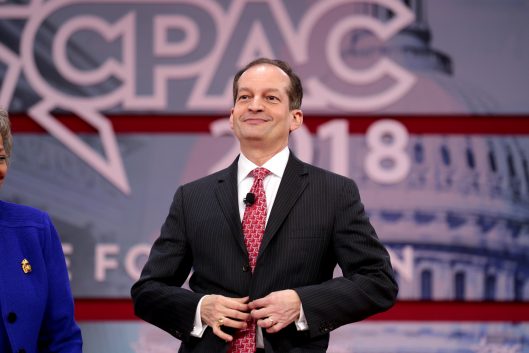
Alexander Acosta: “Told to leave it alone.” (Flickr/Gage Skidmore)
Kincora Boy’s Home
Several cases in the unsavory history linking intelligence agencies and sex scandals put the allegations against Epstein in context. Among these was the U.K. Kincora Boy’s Home, where at least 29 boys were reported to have been targeted at the Belfast, Northern Ireland, facility from the mid-1950s until the late 1970s, until it was shut in 1980. It also involved the alleged protection of child sexual abusers at the home and among their clients.
The Irish Times wrote that “destitute boys were systematically sodomised by members of Kincora staff and were supplied for abuse to prominent figures in unionist politics. The abusers – among them MPs, councillors, leading Orangemen and other influential individuals – became potentially important intelligence assets.”
The Belfast Telegraph also quoted former Labour Party MP Ken Livingstone, who said: “MI5 weren’t just aware of child abuse at Kincora Boys’ Home – they were monitoring it. They were getting pictures of a judge in one case, politicians, a lot of the establishment of Northern Ireland going in and abusing these boys.”
Three staff were eventually convicted of sexually abusing minors, which included the housemaster William McGrath, a loyalist “Orangeman” and allegedly an MI5 agent, according to the Belfast Telegraph in July 2014.
Although the U.K.’s Historical Institutional Abuse inquiry ultimately found “no credible evidence” to support the allegations, two former U.K. intelligence officers maintained their claim of MI5’s involvement: Brian Gemmell says he alerted MI5 to the abuse at Kincora and was told to stop his investigation; and a former army intelligence officer, Colin Wallace, “consistently claimed that MI5, RUC special branch and military intelligence knew about the abuse at Kincora and used it to blackmail the pedophile ring to spy on hardline loyalists,” according to The Guardian.
The Irish outlet, An Phoblacht, wrote: “The systematic abuse of young boys in the Home and the part played by the British intelligence organisations to keep the scandal under wraps ensured that one side of the murky world of Unionist paramilitarism and its links to the crown forces was kept out of the public domain for years.”
In the U.S., the New York State Select Committee On Crime in 1982 investigated nationwide networks of trafficking underage sex workers and producing child pornography. Dale Smith, a committee investigator, noted that call services using minors also profited from “sidelines,” besides the income from peddling prostitution. Smith said they sold information “on the sexual proclivities of the clients to agents of foreign intelligence.” Presumably, this information could be used to blackmail those in positions of power. Smith added that one call service sold information to “British and Israeli intelligence.”
The Hayman Affair
Another U.K. scandal included allegations that Sir Peter Hayman, a British diplomat and deputy director of MI6, was a member of the Pedophile Information Exchange (PIE).
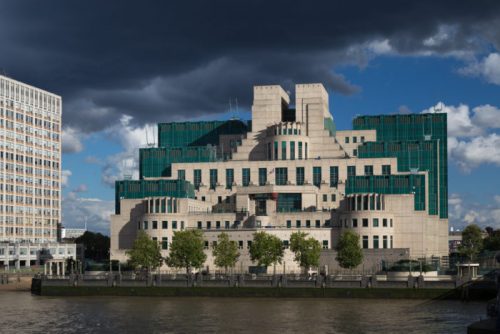
London headquarters of British Secret Intelligence Service.
(Laurie Nevay, CC BY-SA 2.0, Wikimedia Commons)
Police discovered that two of the roughly dozen pedophiles in his circle had been writing to each other about their interest in “the extreme sexual torture and murder of children,” according to the The Daily Mail.
In 2015, The Guardian reported that former Prime Minister Margaret Thatcher had been “adamant that officials should not publicly name” Hayman, “even after she had been fully briefed on his activities…. formerly secret papers released to the National Archives shows.”
Still, Hayman was unmasked as a subscriber to PIE in 1981 by M.P. Geoffrey Dickens, who also reportedly raised the national security risk of Hayman’s proclivities, implying they were a potential source of blackmail sought by intelligence agencies.
The British tabloid The Mirror reported that intelligence agencies, including the KGB and CIA, kept their own dossiers on U.K. establishment figures involved with PIE and the abuse of minors, to blackmail the targets in exchange for information.
Hayman was never charged for his association with PIE: The U.K. attorney general at the time, Sir Michael Havers, defended the decision and denied claims that Heyman was given special treatment.
Labour Party MP Barbara Castle allegedly gave a dossier she compiled on pedophiles in positions of power to U.K. journalist Don Hale in 1984 when he was editor of the Brury Messenger. Hale alleged that soon afterward, police from the “Special Branch, the division responsible for matters of national security,” raided his office and removed the Castle dossier. They then threatened him with a “D-notice,” which prevented him from publishing the story on the threat of up to 10 years in prison.
The Finders Cult
Another group accused of trafficking children, which had links to intelligence agencies, was the “Finders” cult. In 1987, The Washington Post reported that two members were arrested in connection with the alleged abuse of six children. Investigators found materials in Madison County, Virginia, which they said linked to a “commune called the Finders.”
Besides nude photographs of children, a Customs Service memo written by special agent Ramon Martinez refers to files “relating to the activities of the organization in different parts of the world, including “London, Germany, the Bahamas, Japan, Hong Kong, Malaysia, Africa, Costa Rica, and Europe.”
Martinez’s memo notes that a Finders’ telex ordered the purchase of two children in Hong Kong. Another expressed interest in “bank secrecy situations.” The memo also documents high-tech transfers to the U.K., numerous properties under the Finders’ control, the group’s interest in terrorism, explosives, and the evasion of law enforcement.
Martinez describes the swift end to his investigation. He wrote that on April 12, 1987, he arrived at the Metropolitan Police Department and was told that all the data was turned over to the State Department which, in turn, advised MPD that “all travel and use of passports by the holders was within the law and no action would be taken. Then he was told that the investigation into the Finders had become a CIA internal matter. The MPD report was classified, not available for review” and “No further action will be taken.”
Martinez was not the only person with unanswered questions. The U.S.News & World Report wrote that N. Carolina Rep. Charlie Rose (Dem.), chair of the House Administration Committee, and Florida’s Rep. Tom Lewis (Rep.) asked “Could our own government have something to do with this Finders organization and turned their backs on these children? That’s what the evidence points to,” says Lewis, adding that “I can tell you that we’ve got a lot of people scrambling, and that wouldn’t be happening if there was nothing here.”
The leniency shown by the State Department and the fact that the CIA would designate the investigation of the Finders group as “an internal matter” raises serious questions. What motive might have driven the CIA to associate with or protect a child abuse ring?

Harry S. Truman State Department building. (Paco8191, CC BY 3.0, Wikimedia Commons)
The Franklin Scandal
The Franklin Scandal erupted in 1988, centering on a child-trafficking ring operating in Omaha, Nebraska, by Lawrence E. King Jr., a former vice chairman of the National Black Republican Council: It was alleged that children were provided to politicians in Washington, D.C., and elsewhere, among other illegal activities.
The late former state Sen. John Decamp alleged in his book “The Franklin Coverup” that a special committee of the Nebraska Legislature launched a probe to investigate the affair, which involved King being indicted for embezzling money from the Franklin Credit Union. The committee hired former Lincoln, Nebraska, police officer Jerry Lowe, whose reports suggested that King was involved in “guns and money transfers to Nicaragua,” and was linked with the CIA.
James Flanery, an investigative reporter at The World Herald who reported on the scandal, told associates that King was “running guns and money into Nicaragua,” and that the CIA was heavily involved.”
Like many scandals before and since, the Franklin case ended with no prosecution of the perpetrators. However, Paul Bonacci, one of the alleged victims, was indicted for perjury. He had alleged that he was sexually abused as a minor in Nebraska and around the country where he was flown by Lawrence King.
In 1999, the Omaha World Herald reported Bonacci was awarded $1 million in damages due to his lawsuit against King and other alleged perpetrators. Decamp, who was Bonacci’s attorney, told the newspaper “Obviously, you don’t award $1 million if you don’t think he (Bonacci) was telling the truth.”
Given the history of child trafficking rings that were allegedly connected with or enjoyed the protection of intelligence services, it is possible that similar claims about Jeffrey Epstein are something the authorities, though unlikely given these other instances, should investigate.
Elizabeth Vos is a freelance reporter and regular contributor to Consortium News.
Will the DNC Snatch Defeat from the Jaws of Victory Yet Again?
By Thomas L. Knapp | Garrison Center | August 23, 2019
President Donald Trump faces an exceedingly narrow path to re-election in 2020. In order to beat him, the Democratic nominee only needs to pick up 38 electoral votes. With more than 100 electoral votes in play in states that Trump won narrowly in 2016 — especially Wisconsin, Michigan, Pennsylvania, and Florida — all the Democrats have to do is pick a nominee ever so slightly more popular than Hillary Clinton.
That’s a low bar that the Democratic National Committee seems determined, once again, to not get over. As in 2016, the DNC is putting its finger on the scale in favor of “establishment” candidates, the sentiments of the rank and file be damned.
Last time, the main victim was Bernie Sanders. This time, it’s Tulsi Gabbard.
Michael Tracey delivers the gory details in a column at RealClearPolitics. Here’s the short version:
By selectively disqualifying polls in which Gabbard (a US Representative from Hawaii) performs above the 2% threshold for inclusion in the next round of primary debates, the DNC is trying to exclude her while including candidates with much lower polling and fundraising numbers.
Why doesn’t the DNC want Gabbard in the debates? Two reasons come to mind.
Firstly, her marquee issue is foreign policy. She thinks the US should be less militarily adventurous abroad, and as an army veteran of the post-9/11 round of American military interventions in the Middle East and Central Asia, she’s got the credentials to make her points stick.
Foreign policy is a weak spot for the increasingly hawkish Democratic establishment in general and the front-runner and current establishment pick, former vice-president Joe Biden, in particular. As a Senator, Biden voted to approve the ill-fated US invasion of Iraq. As vice-president, he supported President Barack Obama’s extension of the war in Afghanistan and Obama’s ham-handed interventions in Libya, Syria, and other countries where the US had no business meddling. The party’s leaders would rather not talk about foreign policy at all and if they have to talk about it they don’t want candidates coloring outside simplistic “Russia and China bad” lines.
Secondly, Gabbard damaged — probably fatally — the establishment’s pre-Biden pick, US Senator Kamala Harris, by pointing out Harris’s disgusting authoritarian record as California’s attorney general. Gabbard knows how to land a punch, and the DNC doesn’t want any more surprises. They’re looking for a coronation, not a contest.
If the DNC has its way, next year’s primaries will simply ratify the establishment pick, probably a Joe Biden / Elizabeth Warren ticket, without a bunch of fuss and argument.
And if that happens, the Democratic Party will face the same problem it faced in 2016: The rank and file may not be very motivated to turn off their televisions and go vote.
Whatever their failings, rank and file Democrats seem to like … well, democracy. They want to pick their party’s nominees, not have those nominees picked for them in advance. Can’t say I blame them.
Nor will I blame them for not voting — or voting Libertarian — if the DNC ignores them and limits their choices yet again.
Thomas L. Knapp (Twitter: @thomaslknapp) is director and senior news analyst at the William Lloyd Garrison Center for Libertarian Advocacy Journalism (thegarrisoncenter.org).
‘Crime does pay’: CNN hires disgraced ex-FBI director Andrew McCabe
RT | August 23, 2019
What does one get for leaking to the media, lying to federal investigators about it, and allegedly participating in a plot to derail an American election? If you answered jail time, too bad. The correct answer is a job at CNN.
That is at least the case for Andrew McCabe, the former acting FBI director and one of the people deeply involved in the ‘Trump-Russia’ investigation before it was taken over by Special Counsel Robert Mueller. CNN announced on Friday it was hiring McCabe as a contributor.
Just a day earlier, however, the network was in full meltdown over former White House press secretary Sarah Sanders getting hired by Fox News, and her predecessor Sean Spicer appearing on Dancing With the Stars – arguing that both were liars who did not deserve gainful employment.
Yet they have no problem with McCabe, who was fired from the FBI in March 2018 – just days before he could claim a $60,000 annual federal pension – because an internal report found that he “made an unauthorized disclosure to the news media and lacked candor – including under oath – on multiple occasions.”
“Lacking candor” is the federal government euphemism for lying.
McCabe going to CNN is “truly a match made in FakeNews heaven,” declared Donald Trump Jr., the president’s son, adding that CNN has long stopped being a news organization. “They’re now a fully integrated anti-Trump propaganda network and they don’t even try hiding it anymore.”
A number of Republican lawmakers, including Senators John Cornyn (Texas), Josh Hawley (Missouri), and Representatives Lee Zeldin (New York) and Mark Meadows (North Carolina) also weighed in on CNN’s employment choice and journalistic standards.
“I guess crime does pay,” added Matt Wolking, a spokesman for the Trump2020 campaign.
Meanwhile, left-wing journalist Aaron Mate offered a reminder that the gullible #Resistance raised over half a million dollars on GoFundMe for McCabe after he was fired.
McCabe joins nine other former national security officials already on CNN’s payroll, including ex-top spy James Clapper. MSNBC has hired five more, including former CIA chief John Brennan. The one thing they all have in common is outspoken opposition to President Trump.
As James Comey’s right hand at the Bureau, McCabe was intimately involved with investigating both Hillary Clinton’s private email server and the so-called ‘Trump-Russia collusion’ that later spawned a special counsel probe – as well as spying on the Trump campaign under questionable pretexts. His name was brought up on several occasions in text messages between agent Peter Strzok and attorney Lisa Page, including the exchange about an “insurance policy” in case Trump got elected.
The president and his supporters have long argued that this was the real scandal about the 2016 election, calling it ‘Spygate,’ and demanding a reckoning. However, no charges have been leveled – yet – against any of the officials involved, including McCabe and his boss Comey.
Yet it is McCabe who is demanding a reckoning in court, arguing that his firing was politically motivated and part of Trump’s “ongoing war on the FBI and the efforts of the Special Counsel” to investigate his ties with Russia. That Robert Mueller delivered his report months ago and found nothing doesn’t seem to faze him in the slightest.
In other words, he’ll fit right in at CNN.
Turkey’s Syria Convoy Stopped in Its Tracks
By Jeremy Salt | American Herald Tribune | August 23, 2019
On August 19 Turkey sent a military convoy across the border in the direction of Khan Shaikhun, in southern Idlib province. It informed Russia beforehand of what it intended to do. From what followed, it can be assumed that Russia warned Turkey not to go ahead, but it did and suffered the consequences.
South of the town of Ma’arrat al Nu’man, 20 kilometres north of Khan Shaikhun, the lead vehicle in the convoy was destroyed from the air in a Syrian missile strike. The action had the clear support of the Russian government. The destruction of the lead vehicle was a warning that if the convoy went any further it also would be bombed. It was brought to a halt and remains parked somewhere north of Khan Shaikhun.
The convoy included tanks being carried on transporters, ammunition and personnel carriers as well as an unknown number of soldiers. Turkey claimed that three civilians were killed in the attack. In fact, from reports, the ‘civilians’ in the destroyed vehicle included the commander of Faylaq al Sham, a faction integrated into the Turkish-backed ‘National Liberation Front.’
Syrian military units were already infiltrating Khan Shaikhun, held since 2014 by Hayat Tahrir al Sham (HTS), formerly Jabhat al Nusra, formerly Al Qaida in Syria, and by August 21 they had fully liberated the city. Turkey said the convoy was bound for its military observation post near the town of Murek. Syria claims the weaponry was being sent to the beleaguered takfiris in Khan Shaikhun.
As the M5 highway runs through Murek all the way from Aleppo to Damascus, Turkey’s access to its observation post is now cut off and can only be restored through Russian mediation. The M5 runs north to Saraqib before branching off to Idlib city, which has been occupied by HTS since 2015.
Turkey has another observation post near Ma’arrat al Nu’man, which it claims has come under harassing fire from the Syrian army. It insists, however, that all its 12 observation posts in Idlib will remain open.
Further Syrian advances south of Khan Shaikhun have scattered takfiris from northern Hama, which borders southern Idlib. Others remain trapped. The Syrian military has opened a humanitarian corridor around the village of Suran for civilians to leave the region. Many are already pouring out of Idlib and northern Hama.
Turkey claims the attack on the convoy breached the understanding it had reached with Russia and Iran on the ‘de-escalation’ of conflict in Idlib, which it was supposed to manage. However, as Vladimir Putin pointed out after the aerial attack, when Turkey signed the ‘de-escalation’ agreement in August, 2018, HTS controlled 50 per cent of Idlib but within months it had taken control of 90 per cent.
Even by the US and Turkey HTS is designated as a terrorist group. Nevertheless, in the fighting for Khan Shaikhun, units from the ‘National Liberation Front’ and the ‘National Army’, founded in January, 2018, and also backed by Turkey, formed a common front with HTS against the Syrian army’s advance.
The liberation of Khan Shaikhun has been a major victory for the Syrian army, which is now positioned for an offensive north towards Ma’arrat al Nu’man, held by the ‘Syrian Liberation Army’ (SLF), originally an amalgam of two terrorist groups, Ahrar al Sham and Nur al Din Zinki, but eventually expanded to include numerous other takfiri factions.
Early in 2018 heavy fighting between the SLF and HTS took the lives of hundreds of takfiris, but the SLF captured Ma’arrat al Nu’man and has held it ever since. In August, 2018, the SLF joined the ‘National Front for Liberation,’ which is also backed by the Turkish government.
While the Syrian army is now positioned to move rapidly northwards from Khan Shaikhun, its advances in the past have been frequently stymied by ceasefires called as part of the chess game played under the heading of ‘diplomacy.’
Russia has yet to respond to Turkey’s request for a ceasefire in Idlib but this time, with its air base at Khmeimim coming under frequent attack and with Putin remarking that the takfiris in Idlib are spreading out globally, it may prefer to see the province cleared without any further delay.
The compartmentalization of interests on both sides suggest that neither Russia nor Turkey will allow developments in Idlib, including the attack on the military convoy, to jeopardize the overall relationship. Apart from diplomatic and trade considerations, Turkey is now purchasing Russian weaponry, with the delivery of the second batch of S400 missiles expected in September. On September 18 Putin, Rouhani and Erdogan will discuss Syria at a conference in Ankara.
Nevertheless, however many twists and turns ‘diplomacy’ takes, Russia stands firmly behind the Syrian government in its drive to liberate Idlib and restore its authority over all territory held by the takfiris and foreign forces, Turkish in the northwest and American in the northeast.
At odds over the status of the Syrian Kurds, Turkey and the US have now agreed to cooperate in the establishment of a ‘safe zone’ along the Syrian side of the Syrian-Turkish border. Erdogan wanted to establish a ‘safe’ or ‘buffer’ zone inside Syria from the moment he decided to intervene in 2011 by supporting the so-called Syrian National Council and the so-called Free Syrian Army against the Syrian government.
The decision to intervene in Syria is unprecedented in the history of the Turkish republic. While a Turkish government intervened in Cyprus in 1974 to forestall the annexation of the island by the Greek military junta, and while the Turkish military has frequently campaigned against the PKK (Kurdistan Workers’ Party) in northern Iraq, no Turkish government has ever actively intervened to bring about the downfall of another government, let alone one in a neighboring country, let alone one with which it had good ‘brotherly’ relations at the very moment it decided to intervene.
Apart from other dire consequences, the destruction of the Syrian government’s authority in the north created the very problem which Erdogan is now determined to solve, the perceived ‘national security’ threat from the YPG (People’s Protection Units), the Kurdish militia.
Before 2011 the Syrian government had supported Turkish military action against the Kurds in northern Iraq. It had also cracked down on the YPG’s parent political organization, the PYD (Democratic Union Party), breaking up demonstrations and sending leading activists for trial before security courts. Syria was just as strongly opposed to Kurdish separatism as the government of Turkey.
It was the US, Turkey’s partner in the collective calling itself ‘The Friends of the Syrian People,’ which enhanced opportunities for the Syrian Kurds, irrespective of Turkey’s interests. It established military bases in the predominantly Kurdish northeast and created a largely Kurdish militia, the Syrian Democratic Forces. It refused to accept Turkey’s designation of the YPG as a ‘terrorist’ group and by all of its actions, it fostered Kurdish attempts to set up autonomous enclaves along the Turkish border. Had the Syrian government not come under such a ferocious attack from 2011, none of this would have happened.
Apart from the widespread destruction in Syria caused by foreign intervention, the consequences for Turkey have included an influx of 3.6 million refugees. According to opinion polls, the Turkish public now regards their presence as a problem second only to the faltering state of the economy.
The ‘safe zone’ or ‘peace corridor’ as it is now being called allows Turkey to aim at two targets simultaneously. One is the YPG, whose presence Turkey is determined to remove from the border area. The second is rising public disquiet inside Turkey at the visible presence of so many Syrians, the cost of maintaining them and their impact on daily life. According to press reports, large numbers of the refugees will now be resettled in this ‘safe zone’, easing domestic pressure on the Turkish government. Whether Syrians who come from other parts of their country will want to stay, if conditions in their home towns and villages are safe, is doubtful. The influx of so many Syrian Arabs into this strip of territory would water down the Kurdish population and inevitably lead to accusations of demographic engineering.
How Turkey and the US will ‘police’ this safe zone is far from clear. They have been wrangling over it for months. The ‘safe zone’ would run from Jarabulus in the west to the Iraqi border. Turkey wants (or wanted) a zone 32 kms deep, while the US argued for 14 kms, the first five kilometres a DMZ, patrolled jointly by Turkish and US forces, the remaining nine kilometres only to be cleared of heavy weaponry and not necessarily the YPG. The two sides say they have now agreed and have launched the first phase of this operation but no details apart from air coordination are known.
Joint patrols would take Turkish troops deep into the Syrian Kurdish heartland, just across the border from the Kurdish heartland in Turkey’s southeast and not far from Kurdish northern Iraq. This latest initiative is fraught with many dangers, including the likelihood of Kurdish resistance to the Turkish presence. How the US intends to balance out its strategic support for the Kurds against its strategic relationship with Turkey is only one of many unknowns.
In the domestic Turkish background the ruling Justice and Development Party (AKP) suffered a major blow in the March local elections when it lost control of Istanbul and Ankara as well as other major cities. Its situation since then has only deteriorated. Senior figures in the party, including former Foreign Minister and Prime Minister Ahmet Davutoglu and Ali Babacan, a co-founder of the AKP and former Economy Minister and Deputy Prime Minister, have broken away and are forming their own political parties. These are certain to make inroads into the AKP inside and outside parliament. In short, Tayyip Erdogan’s domestic base, for the first time in 18 years, is beginning to fracture.
The recent dismissal of Kurdish mayors in the southeast – the latest in a long line of such dismissals – and their replacement by government trustees has attracted widespread public criticism, well beyond the ranks of the predominantly Kurdish People’s Democracy Party (HDP). The domestic political climate is changing rapidly and the arrests are being openly criticized as further blows to an already severely weakened democratic base. The opposition Republican People’s Party (CHP) is totally opposed to Turkey’s intervention in Syria, where the Syrian army is now encircling Turkey’s observation posts in Idlib, heightening the danger of direct clashes.
Were the CHP to take government, it could be counted on to withdraw from Syria without delay. However, elections are not due until 2023 and while there have been unfavourable shifts on the domestic landscape, Erdogan is wily and resilient and perfectly capable of reversing these setbacks. Syria is a different picture. It is full of dangerous variables which he can neither avert nor necessarily control but it is not his style to back off. Rather, he is more likely to double down and seek victory in his public’s eyes, whatever the risks this will involve.
Jeremy Salt has taught at the University of Melbourne, Bosporus University (Istanbul) and Bilkent University (Ankara), specialising in the modern history of the Middle East. His most recent book is “The Unmaking of the Middle East. A History of Western Disorder in Arab Lands” (Berkeley: University of California Press, 2008.)
US officials confirm Israel behind Iraq air strikes
MEMO | August 23, 2019
US officials have confirmed that Israel was behind recent airstrikes on alleged weapons depots in Iraq, which were ostensibly being used by Iran to transfer arms to Syria.
Senior US officials yesterday told the New York Times that Israel has carried out “several strikes [in Iraq] in recent days”, the most recent of which took place on Monday near the Balad Airbase, north of Iraqi capital Baghdad.
The US-based newspaper also quoted a “senior Middle Eastern intelligence official” who said that Israel had struck a separate base north of Baghdad on 19 July. The official claimed that the base was being used by Iran’s Revolutionary Guards Corp (IRGC) to transfer weapons to Syria, where Iranian-backed groups are engaged in the country’s protracted civil war.
He added that a “cargo of guided missiles with a range of 125 miles” was destroyed during the attack.
The same official also revealed that the 19 July strike was launched from “within Iraq”, raising questions as to how Israeli aircraft were based in a country with which they currently have no formal diplomatic relations.
The US officials’ comments confirm weeks of speculation that Israel was responsible for the multiple attacks on Iraqi targets which have taken place in recent months.
In the past three months, four attacks on weapons depots have taken place. Three of these bases were being used by the Popular Mobilisation Forces (PMF), an umbrella organisation of Shia paramilitary groups technically under the authority of the Iraqi Security Forces, though many operate semi-autonomously.
Meanwhile the fourth was being used by Iraq’s federal police, the New York Times explained.
On Wednesday the PMF blamed the US and Israel for attacking its bases in Iraq, saying in a statement that the US had allowed four Israeli drones to enter Iraq. The statement added that the group has “accurate information” which proves the US brought the Israeli drones into Iraqi territory to work as part of the US fleet stationed in the country.
The US Pentagon, however, strenuously denied its involvement in the affair, dismissing the PMF’s statement entirely.
Israeli Prime Minister Benjamin Netanyahu further added to speculation of US-Israeli involvement yesterday, saying that he had given the armed forces a “free hand” to deal with the alleged Iranian threat.
In an interview with Israel’s Russian-language outlet Channel 9, Netanyahu was asked whether Israel would operate against Iranian targets in Iraq if needed. The prime minister replied: “We are operating – not just if needed, we are operating in many areas against a state that wants to annihilate us. Of course, I gave the security forces a free hand and instructed them to do anything necessary to thwart Iran’s plans.”
The attacks represent a new front for Israel, having previously focused on targeting Iranian positions in Syria. Though Israel has maintained an official policy of non-intervention in the Syrian civil war and often remained silent in the face of air strike accusations, in January then Chief of Staff of the Israeli army Gadi Eisenkot admitted Israel had in fact struck Syria “thousands of times”.
Israel’s military intelligence threatened in February to expand its operations to Iraq, claiming “Iran may use Iraq as a launching pad to target Israel” after its positions in Syria were destroyed. This, Israel claimed, “would call for a response from Tel Aviv”. US President Donald Trump also expressed similar ideas, telling American news station CBS that he would keep US personnel in Iraq to “keep an eye” on Iran.
Former Iraqi prime minister Haider Al-Abadi slammed these suggestions, stressing that “Iraqi sovereignty must be respected [since] we are not proxies in conflicts outside the interests of our nation”. Iraq’s President Barham Salih echoed this sentiment, calling on the US not to pursue its own policy priorities because “we live here”.
READ ALSO:
USS Liberty Veterans Association BANNED FOREVER From the American Legion National Convention
By Joe Meadors | USS Liberty Veterans Association | August 22, 2019
“You will not discuss the attack with anyone. Once the Court of Inquiry findings are released you will not contradict them. This order will remain in effect after you are discharged from the Navy. If you violate this order you will be prosecuted and will spend a considerable amount of time in a Federal Prison.”
This order was repeated every day at quarters while we were in drydock in Malta.
If anyone tells of witnessing the deliberate machine gunning of our life rafts in the water, he runs the risk of doing time in a Federal prison.
If anyone tells of witnessing the use of unmarked aircraft or of the jamming of our radios on both US Navy tactical and international maritime distress frequencies, he runs the risk of doing time in a Federal prison.
We cannot talk about this among ourselves. We cannot talk about this with our family. We cannot talk about this with any counselor. We cannot talk about this at a meeting of any veterans group we may become involved with. We cannot talk about this with our Congressional Delegation. We cannot talk about this at The American Legion National Convention.
We cannot talk about this with anyone.
If we do, we risk Federal prison.
But we defy the Federal Government and speak about the attack anywhere we can.
But now we cannot talk about it at The American Legion National Convention.
In an email to the USS Liberty Veterans Association, Kevin J. Bartlett, J.D., National Judge Advocate of The American Legion (and US Navy Veteran) writes:
I understand that your organization would like to submit an application for a booth at The American Legion National Convention in August.
The USS Liberty Association is not allowed to rent a booth at national conventions and have them staffed because one of your members committed assault and battery on one of our staff and was convicted of his crimes. In addition, members of your organization have attempted to set up in the national convention exhibit hall without renting a booth.
The American Legion has a 100-year track record of helping veterans and their families. Unfortunately, we’ve had a long and unpleasant history with the USS Liberty Veterans Association, and we have chosen not to do business with them.
The American Legion has known for decades the constraints we have had place on us. Do they care? No.
Instead of offering us the honor, support and compassion they routinely offer their members, they have chosen to take a relatively minor issue that was largely of their making, blow it all out of proportion, accuse someone they claim to be a USS Liberty survivor of trying to set up an unauthorized booth and ban us from their National Convention forever.
All without the opportunity of appealing their decision. And without any reference to their Constitution and bylaws or Resolution that allows them to take the action they did.
This action by the hired help of The American Legion National Headquarters wasn’t taken in a vacuum. The National Organization has a long record of trying to stifle USS Liberty survivors in our effort to tell the story of what happened on a US Navy ship. Given the tremendous support we have from the rank and file of The American Legion, it is clear that The American Legion National Headquarters is governing by fiat instead of by the rule of its membership as reflected in Resolutions initiated by its local posts.
An extensive and heavily footnoted telling of the history between The American Legion and the USS Liberty Veterans Association is available here. We are indebted to If Americans Knew for the effort they made to so expertly outline the history between the two veterans groups.
IAK writes:
Legion bigwigs have torpedoed American Legion members’ resolutions supporting the Liberty; prevented dissemination of information about the attack; refused to allow a booth by the Liberty Veterans Association at its 2013 national convention; and privately attempted to convince the Veterans of Foreign Wars to similarly prohibit a Liberty booth at its national convention.
In 2002 the Washington DC Legion delegation introduced a resolution calling for an investigation of the attack to a foreign relations subcommittee at the national convention. This was the first step towards procuring an American Legion resolution.
I was present at this convention and witnessed most of what subsequently transpired. I had begun to investigate Israel-Palestine in fall 2000, a topic I had never previously studied. I was astonished at much of what I discovered, including the Israeli attack on the Liberty, which I had never heard about despite growing up in a military family.
When I heard that a resolution was going to be introduced at the national convention, I went with the delegation to observe what happened.
When the DC group introduced the resolution to the subcommittee, every American Legion delegate who addressed it spoke in favor of it. Delegate after delegate from diverse parts of America supported the resolution, and it was passed without objection.
The DC delegates were jubilant. When a resolution is passed at this level, they explained, it is virtually assured of adoption. Typically, the resolution is then rubber-stamped by the next committee, and passed along to the general membership, which then normally passes all such committee recommended resolutions by one simple voice vote.
This resolution, however, was to be different.
The next day, American Legion staff told the Convention Committee on Foreign Relations that there was no need for such a resolution since the Legion already had passed resolutions on the Liberty. The staff and chair neglected to state that not a single resolution on the USS Liberty was live, and that therefore it was both necessary and appropriate to pass this one.
This communication succeeded in killing the resolution. The main staff member for this committee had served in Israel; it is possible he is an Israeli citizen. The Committee chairman was Thomas Bock, of Colorado.[29] Three years later Bock was American Legion National Commander.
That evening, back in D.C., Admiral Thomas Moorer (USN retired) heard about the scuttling of the resolution. Outraged, he wrote an open letter to the American Legion Commander requesting that the resolution be put before the general membership.
Admiral Moorer was chairman of an association of admirals and generals who want the US government to conduct a hearing on the USS Liberty. He was also the former Chairman of the Joint Chiefs of Staff — the highest ranking military officer in the U.S. military — and a retired 4-star admiral who was once in charge of both the Pacific and Atlantic fleets. He was a Naval aviator and World War II hero; the Navy’s Tomcat fighter jet was named after him.
Moorer had long been outraged at the cover-up on the Liberty attack. In a 1997 memo, he called it a “wanton, sneak attack,” writing: “What is so chilling and cold-blooded, of course, is that they could kill as many Americans as they did in confidence that Washington would cooperate in quelling any public outcry.” Many of the crewmembers, Moorer wrote, were from “small country towns, probably a lot like Eufaula, Alabama, where I grew up, and they represent the basic core of America …. “
One has only to look to their reference to the USS Liberty in their Leadership FAQ to learn that they have chosen to support a Revisionist version of the attack instead of one supported by evidence and facts.
What is The American Legion doing about the USS Liberty tragedy?
The tragic mistaken identity attack by Israelis on the USS Liberty on June 8, 1967 provoked a great deal of controversy among surviving members of the crew and family members. Though residual anger and suspicions remain, the incident was the subject of ten US investigations and three by the Israelis. In the American investigations, the full weight of the US Government allowed access to all of the relevant security information. Though some accusations were made suggesting the reports sought to hide facts or protect Israel, no credible evidence for these charges has been produced at the US Government level.
The Foreign Relations Convention Committee of The American Legion reviewed the action taken by OSD and Congress on this incident and they voted to reject Resolution 235 submitted by the Department of District of Columbia at the 84th Annual National Convention in Charlotte, North Carolina, August 2002.
This position is a gross misrepresentation of the evidence currently available – a fact that we have made The American Legion aware of but they are obviously not interested in acknowledging.
In the first place, there is no “controversy among surviving members of the crew and family members.”
Second, the incident was NOT “the subject of ten US investigations and three by the Israelis.” Prove that for yourself by emailing your Congressional Delegation and ask them to send you a copy of the Congressional investigation of the attack. They won’t be able to send you one because it doesn’t exist.
Third, Congress hasn’t taken any action on this “incident” so what the Foreign Relations Convention Committee reviewed is in question. A question The American Legion refuses to (i.e., cannot) answer.
Why would the leaders of a Federally chartered veterans association claiming a mission “To uphold and defend the Constitution of the United States of America,” “To foster and perpetuate a one hundred percent Americanism,” and “To make right the master of might” ban a group of American veterans who are the victims of War Crimes committed by our “best ally and only friend in the Middle East” from attending any American Legion National Convention forever?
Did I just answer my own question?
Are the leaders of The American Legion afraid that their members will learn about the War Crimes Israel committed during the attack and are blowing up this relatively minor event to prevent our relating the history of the attack during their National Convention?
This unilateral action by The American Legion was not taken in a vacuum. The American Legion and the USS Liberty Veterans Association have a long history. That history, in our opinion, shows a concerted, illegal and borderline treasonous effort by The American Legion National Organization to deny its members the right of hearing first-hand accounts of the attack on the USS Liberty.
To be perfectly clear, no one is denying the seriousness of a charge of assault and battery. Nobody is denying the fact that a USS Liberty survivor was convicted of assault and battery on a staff member of The American Legion.
What happened that resulted in the assault and battery being committed? It all takes place as we were attempting to register at the 2012 National Convention.
Due to a communications error on our part, our delegation intending to staff our booth at the 2012 American Legion National Convention was unaware that payment for that booth and information about the requisite insurance had not been submitted to The American Legion prior to their arrival.
Upon learning that the payment had not been made, our representatives inquired if payment could be made while they were there.
Instead of responding to the inquiry, the registration desk called their security personnel who asked that our delegation be removed from the premises. The security personnel were obviously expert in intimidation – which was in full flower during the one-sided confrontation.
Having survived not only the attack and the US government’s disinterest in investigating that attack, but the history the USS Liberty Veterans Association has had with the higher-ups of The American Legion, one of our representatives out of frustration, took out his American Legion membership card and flicked it to no one in particular. He just wanted to be rid of it.
As luck would have it, it landed softly on the blouse of one of the ladies manning the registration desk. So soft that I doubt she felt a thing.
The American Legion called the police and had our representative arrested for assault and battery. He was taken to jail and released after receiving a court date.
When the date arrived to face the judge, our guy showed but The American Legion victim was nowhere to be found.
No doubt out of embarrassment that the very people The American Legion was established to help were being treated so poorly.
Which brings up the question, “What is the purpose of The American Legion” and why in the past 52+ years has The American Legion treated the survivors of the USS Liberty as an exception to that purpose?
Why has The American Legion National Organization shown more concern for the forces who attacked the USS Liberty than it has for their own countrymen?
Why has The American Legion National Organization felt it so important to stifle USS Liberty survivors that they have acted illegally to do so?
Let me suggest some reasons:
- We were attacked by Israel.
- We have insisted that The American Legion live up to its obligations as described in the Preamble to their Constitution.
- We were attacked by Israel.
- We have highlighted the hypocrisy of The American Legion in allowing its 1967 Resolution 508 to be ignored and unimplemented until it is finally rescinded in the 1990’s.
- We were attacked by Israel.
- During the many times we were allowed to purchase a booth at The American Legion’s National Convention we were welcomed with enthusiasm and support by the general membership of The American Legion.
- We were attacked by Israel.
- At their 2018 National Convention, the membership of The American Legion ignored the recommendation of The American Legion’s leaders and approved a resolution calling on the Congress of the United States to investigate the attack on our ship.
- We were attacked by Israel.
If you find the actions of The American Legion National Organization as disconcerting as we do, we urge you to submit two resolutions through your Post.
If nothing else, it will educate you on what The American Legion National Organization feels about the USS Liberty and USS Liberty resolutions.
US Reprehensibly Inciting New Global Arms Race
Strategic Culture Foundation | August 23, 2019
Russia and China are right to condemn the testing this week of an INF-busting new missile by the US. Washington is brazenly jeopardizing global security under the usual cynical guise of “defense”.
Washington launched a ground-based cruise missile off the coast of California. It was reportedly a Tomahawk-type nuclear-capable warhead, but the Pentagon said it was conventionally armed. The projectile apparently succeeded in hitting its target after more than 500 kilometers of flight. The testing of such a missile would have been banned by the Intermediate-range Nuclear Forces (INF) treaty which the US officially withdrew from on August 2.
The INF, first signed in 1987, banned the testing and deployment of missiles within the range of 500-5,500 kms.
It is inconceivable that the latest weapon could not have been in the long-term works for development prior to the three-week period since the INF was abandoned. In others words, the abrogation of the treaty was long-anticipated by Washington, which belies US claims over recent months that it was crashing out of the INF due to alleged Russian violations. The US wanted out of the treaty. Now that it is freed from restriction, the prompt deployment of the cruise weapon off California seems to confirm the ulterior agenda.
Previously, Pentagon chief Mark Esper indirectly admitted this ulterior agenda when he told Senate hearings that the purpose for scrapping the INF was for the US to be able to confront China.
This week Esper said the missile testing was aimed at sending Beijing a message that the “US is capable of deterring China’s bad behavior”.
So, let’s have some honesty here. Washington just ripped up an important arms-control treaty for global security, not because of alleged Russian violations, but rather because the US wants to give itself a free hand to expand its short and medium-range arsenal to challenge China.
Indeed, Esper also remarked during a recent trip to Australia that the US intends to deploy INF-type ground-based missiles in Asia.
Admittedly, China is reckoned to have an arsenal of short and medium-range missiles. Beijing was not a party to the INF, so technically it is not in breach of its restrictions. But a crucial distinction is that such Chinese weapons do not pose a threat to the US mainland. Whereas US intentions of moving similar ballistic warheads to land bases in Asia do pose an imminent threat to China, as well as to Russia.
The US and its NATO allies claim they do not want to start a new global arms race. Washington says it is not planning to deploy INF-type warheads in Europe. However, the type of launcher used this week and which is already deployed in Romania and, it is believed, in Poland as well, could be used sometime in the near future to fire nuclear-capable missiles at Russia.
Washington is thus recklessly shifting the balance of power and undermining the global architecture for security against nuclear war.
Both Russia and China have deplored the risk of a new arms race being incited by the US.
Perhaps this kind of arms race is exactly what Washington is seeking, despite claims to the contrary. The nefarious calculation is that Russia and China will be diverted from economic development by being forced into responding in kind to new threats from the US.
After all, with its presumed license to rack up never-ending national debt, American strategic planners may feel that they can impose crippling economic costs on geopolitical rivals Russia and China.
The Chinese government said it best this week when it commented that the US “must give up its Cold War mentality”.
The endemic premise in Washington is that Russia, China and other states are mortal threats to the US. The official American view of the world is relentlessly paranoid about enemy states, which are allegedly harboring malign designs to the destroy the US.
Of course such cynical, nihilistic thinking is necessitated by the fundamental operating need of US capitalism and its addiction to the military-industrial complex. War is good, peace is bad, so goes the Orwellian American credo, albeit never outrightly stated as such. If the US were to somehow make peace with the world and enter into normal friendly international relations, then its $700-billion-plus annual spending on the military would cease to exist from lack of “justification”, and with that would follow the calamitous implosion of its militarized capitalist economy.
An arms race for the US state planners is like finding a drug-fix for a junkie. It is damnable that Washington is tearing up arms control treaties and jeopardizing global security in order to gratify its dysfunctional systematic dependence on insecurity, tension, conflict and ultimately war.
The undoing of arms controls treaties by the US, first the ABM in 2002, then the INF this year, next perhaps the New Start treaty expiring in 2021, is reprehensible. But what is more reprehensible is the underlying ideology that impels that. American citizens have to address that root ideological disease, otherwise the world will continually be in peril of war.
Featured Video

Broke Princes: Saudi Arabia’s Powder Keg
or go to
Aletho News Archives – Video-Images
From the Archives
A sample of vaccine and injectable medication tragedies during my lifetime
This is what happens when you demand speedy production in an era of politicized regulation
By Meryl Nass, MD | February 12, 2022
All these tragedies have been due to failures of testing or failures in manufacturing processes. Most occurred before vaccine manufacturers were given virtually complete protection from liability in 1987.
With the duration of patent exclusivity determining how much new products earn, products are rushed to market as quickly as possible, most using a shortened path for FDA review. Recalls and market removals of approved products are much more common than they used to be. We can only expect more of these disasters in the future, especially if the products are mandated for everyone. … continue
Blog Roll
 Aletho News
- Broke Princes: Saudi Arabia’s Powder Keg
- Albania’s Crisis: Rama, Israeli Investments and the Demand for Accountability
- Hezbollah Categorically Denies Syrian Accusations: We Aim at Confronting Israeli Enemy, Not Undermining Syria’s Stability
- Trump claims funding to Israel ending in 2026 as merger of Israeli–US armies looms
- Iran Weathering The Storm, But Saudi Arabia Is Sinking
- Sunk Ships Don’t Sail Home: Why Peace Won’t Save the Oil Market and War Will Wreck It
- No Cossacks at the gates, fix Italy instead – opposition leader to Meloni
- The Pits: Zelensky’s torture chamber network in the public eye
- Moscow mocks Kiev’s language hypocrisy exposed by ‘torture chamber’ scandal
- Military ‘torture chamber’ triggers new scandal in Kiev
- If Americans Knew
- An error has occurred; the feed is probably down. Try again later.
- No Tricks Zone
- Germany’s Green Energy Transition Becoming Increasingly Expensive…Another 6 Trillion Euros!
- Sudden Stratospheric Warming, Powerful El Niño Combination May Lead To Extreme Europe Cold, Energy Crisis!
- Two New Studies Find Thwaites Glacier Melt Cannot Be Driven By Human Activity Or A Warming Ocean
- E-Cars Reduce CO2 Emissions By Only 41% Compared To Internal Combustion Engine Vehicles
- Predictions Made By Renowned Climate Professor Over Past Decades Have Been Proven To Be Poor
- New Study Suggests Large Regions Of The Pacific Ocean Have Been Cooling For The Last 80 Years
- Germany’s Green Energy Debacle: High Energy Costs Force Kahla Porzellan to Close After 182 Years!
- New Study: 50 Years Of The Most Aggressive ‘Net Zero’ Policies Can Only Affect The Global Climate By 0.03°C
- US September “Heat” Was No Record…Many Records Set Decades Ago
- Latest European Green Energy Debacle; Portugal’s Largest Flagship Solar Park Insolvent!


