What the new arms race will look like in a post-INF world
RT | August 27, 2019
Washington ending the INF arms control treaty has raised fears of a new “arms race.” This time it will be about more than just missiles, with China presenting strong competition to the US and Russia, a military expert tells RT.
Last week’s test of a ground-launched Tomahawk cruise missile showed that the US is eager to field a system banned by the Intermediate-Range Nuclear Forces Treaty, even as it accused Russia – without offering evidence – of being in violation as a pretext to rip up the 1987 pact.
Russian President Vladimir Putin has ordered a “symmetrical response” to this threat, citing the presence of US launchers in Poland and Romania. Meanwhile, the Russian delegation to the UN has warned that the US actions have brought the world “just one step away from an uncontrolled arms race.”
Unlike the Cold War contest, however, the race to develop revolutionary military technology will have multiple contestants, retired Aerospace Force Colonel Mikhail Khodarenok told RT.
He sees three possible vectors of development for new technology, all of which go beyond intermediate-range missiles: artificial intelligence (AI), space, and hypersonic weapons.
AI would be the biggest step in military advancement since gunpowder and atomic weapons, Khodarenok says, and hundreds of thousands of scientists in the US and China are already working on it.
Whoever masters its use first will be the master of the world.
“The militarization of space is inevitable,” Khodarenok adds. Treaties currently prohibit the deployment of weapons in space, but this is unlikely to remain true for long, as the US has already moved to create a space force.
Whoever can field a maneuverable “space plane” will dominate that sphere, Khodarenok argues, noting that satellites and other space assets are crucial for intelligence, navigation, communications and early-attack warnings.
There is no engine – yet – that could make such a plane a reality, but whoever successfully designs one will be ahead of the competition, the colonel noted.
The same technology could provide the edge in developing hypersonic airplanes and missiles, but also solutions that could enable drones and other robot vehicles to stay airborne for weeks or longer.
China is currently pouring massive resources into research and development, while the US has drastically increased its military budgets in order to rebuild a force President Donald Trump claimed was “depleted” from decades of constant warfare. Russia’s military budget is quite modest in comparison, though its weapons systems appear on par or even more effective than their US counterparts, at a fraction of the cost.
Numerous US military experts have also cautioned that no amount of money and technology can make up for problems with the Pentagon’s doctrine and strategy that will not work against new Russian and Chinese strategies.
Washington’s Nord Stream 2 Sanctions May Have Boomerang Effect on US Interests – German Media Reports
By Svetlana Ekimenko – Sputnik – 27.08.2019
The US Congress has moved forward with legislation to impose sanctions on the Nord Stream 2 pipeline project in defiance of criticism from Washington’s allies in Europe, as the joint venture brings together Russia’s Gazprom, Germany’s Uniper and Wintershall, Austria’s OMV, France’s Engie, and Anglo-Dutch Royal Dutch Shell.
Possible US sanctions against companies involved in the construction of the Nord Stream 2 pipeline could potentially harm US oil and gas projects in the Gulf of Mexico, writes the German business newspaper Handelsblatt.
“From the point of view of Germany, the name of the US proposed sanctions bill, ‘Protecting Europe’s Energy Security Act’, is in itself an insolence”, writes the author.
The US is pushing to impose sanctions against Nord Stream 2 despite likely consequences that such restrictions may have.
Thus, European companies involved in laying the pipeline and targeted by Washington’s sanctions play a key role in the global energy market.
For a long time, these companies worked in the Gulf of Mexico as subcontractors of the American corporations Chevron and Exxon Mobil, recalls Handelsblatt.
Therefore, if they are included in the sanctions lists, projects in the Gulf of Mexico will be disrupted, since it is impossible to quickly replace such highly specialised firms.
Overall, the US economy views the proposed sanctions against Nord Stream 2 critically, the author points out. Such restrictions would also be likely to harm US gas exporters, prompting European buyers to reduce LNG imports from the United States and increase supplies from other countries.
Proposed US Sanctions on Nord Stream 2
The Nord Stream 2 project has long drawn opposition from a number of countries, with the United States, which is trying to sell more of its own liquefied natural gas to overseas allies, insisting that the project will make Europe dependent on Moscow – claims that Russia has repeatedly rebuffed.
Moscow has insisted that the pipeline project is strictly commercial, ultimately seeking to boost Europe’s energy security.
Nevertheless, in early August, the US Senate Foreign Relations Committee approved a bill on sanctions against companies providing vessels for the Nord Stream 2 pipeline project.
The document prohibits entry into the US for anyone involved in the “sale, lease, provision or assistance in providing” ships for laying Russian offshore pipelines at a depth of 30 metres or more, as well as the freezing of their assets in US jurisdiction.
Companies from Austria, Germany, the Netherlands, France, Finland, and Sweden may fall under the sanctions.
The project is being implemented by Nord Stream 2 AG, with Gazprom investing half of the funds, and the remainder being contributed by European partners: Germany’s Uniper and Wintershall, Austria’s OMV, France’s Engie, and Anglo-Dutch Royal Dutch Shell.
Germany has been strongly behind Nord Stream 2, emphasizing the commercial focus of the project.
German Chancellor Angela Merkel said that she supported the BDI’s (Federation of German Industries) stance that the Nord Stream 2 pipeline for delivering Russian natural gas to Europe is necessary given the German initiative to stop using nuclear and coal energy.
Austria, which is interested in reliable supplies of fuel, and Norway, whose government owns 30 percent of the shares of Kvaerner, one of the gas pipeline construction contractors, also spoke in favor of the project.
Nord Stream 2 Project
The 745-mile-long (1,200 km) Nord Stream 2 twin pipeline is set to run from Russia to Germany through the territorial waters or exclusive economic zones of Denmark, Finland, Germany, Russia, and Sweden to deliver Russian gas to European consumers.
The completed project will double the capacity of the existing Nord Stream pipeline network, allowing a total of up to 110 billion cubic metres of Russian natural gas to be transported to Western Europe via pipelines at the bottom of the Baltic Sea.
According to a statement made by project operator Nord Stream 2 AG on 26 August, the pipeline is 75 percent complete.
Iraq would face ‘wrath of US’ if oil pipeline projects with Iran go ahead
RT | August 27, 2019
Washington would do anything to prevent an Iran-Iraq oil pipeline from ever being built, even if the Europeans were in favor, policy researchers told RT.
“Iraq would feel the wrath of the US” should it pursue a cross-border pipeline project with its neighbor Iran, believes the head of the British-based consultancy firm Alfa Energy, John Hall.
According to a recent report, Tehran talked with Baghdad about building an oil pipeline through Iraq into Syria. The sides have also reportedly discussed reviving the existing pipeline connecting Kirkuk in Iraqi Kurdistan with the city of Baniyas on Syria’s Mediterranean coast. The pipeline was heavily damaged by US airstrikes in 2003 and has remained defunct since. The proposed project is said to be aimed at providing an alternative route for Iranian oil should the Strait of Hormuz be closed in case of a direct conflict with the US.
Hall said Washington would be “upset” by this idea and will do all it can to dissuade Baghdad, as well as the EU, from participating.
Although European countries would be happy to buy oil from Iran, they won’t do so because of the threat of retribution from the United States. When you’ve got someone like Donald Trump as the president of the US, it’s very difficult knowing what may follow if Europeans try to engage with Iran across the sanctions.
The situation in civil war-torn Syria “has somewhat stabilized,” Iran and Iraq see “serious opportunities” to explore their energy ties, said Irina Fyodorova, a senior Middle East researcher at the Institute of Oriental Studies at the Russian Academy of Sciences.
“It is not the US’ interest to have a pipeline that would be independent from them and their allies in the Persian Gulf,” she told RT.
It is also against US interests to have an Iran-Iraq cooperation that is outside of their control. So there will be actions aimed at hampering the implementation of this project.
One of the steps Washington and its allies could take is boosting their support for anti-government groups in Syria, she said. The researcher added that another problem for the pipeline would be the US-backed Kurdish forces, should it go from Kirkuk.
EU countries, on the other hand, would like to see new ways to bypass US sanctions on Iranian oil, Fyodorova noted, as “getting the oil through a pipeline would be cheaper than having it delivered by tankers.”
“The Europeans love balancing the books. Moreover, it would be a wonderful alternative to the oil the EU is buying from the US.”
New Jersey Event Canceled After Threats From Anti-Free Speech Groups
By Jonathon Turley | August 22, 2019
We have been discussing the rising attacks on free speech across the country, including students and faculty who support the silencing of speakers who hold opposing views. What is most concerning is that these attacks are working. The latest example can be found in New Jersey where the Broadway Theater in Pitman cancelled an event because anti-free speech organizations and individuals threatened protests and some even threatened to burn down the theater. Among the speakers was journalist Andy Ngo, who suffered a brain hemorrhage after being beaten by Antifa supporters at an event in Oregon. My concern is not with planned protests but the coordinated effort to have the event cancelled to prevent others from hearing opposing views.
The one-day conference was set to discuss “combating racism, violence, and authoritarianism.” Sponsored by Minds.com, there were 20 speakers planning to discuss a variety of issues. They included speakers who had once support but later became disillusioned with some leftist groups. This included im Tim Pool, who calls himself a “disaffected liberal” and Josephine Mathias, who has opposed sexual orientation as not equal to race or ethnicity. Mathias was the only black speaker in the line up. It also included Lauren Chen, a conservative blogger.
It also included British YouTuber Carl Benjamin, who has been accused of sexist comments about rape, and Mark Meechan, a Scottish YouTuber who became a global figure when he taught a dog to give Nazi salutes (which he insisted was a joke with his girlfriend’s pug). He was convicted of a hate crime after the court deemed his motivation immaterial to the fact that it was offensive under hate speech laws. I have previously written critically of these laws in France, Germany, England and other countries.
Daryle L. Jenkins, executive director of One People’s Project, an activist group based in New Brunswick, N.J., called the lineup of speakers “the worst of the worst.” Holding such an event, he said, “is like picking a fight.” The statement was classic for the rising anti-free-speech movement. Allowing opposing views to be heard is now considered a provocation. Most of us would support Jenkins’ right to protest outside and contest the views of these people. However, the pressure was to get the theater to cancel the event so others could not hear the opposing views.
No Hate NJ, a coalition of organizations, insisted that the “hateful” event could not be held. In a statement right out of the Antifa handbook, the group said “The event is advertised as a ‘discussion,’ but it’s really just an echo chamber for far-right rhetoric that will bring hateful and violent people to Pitman.” In other words, no such discussion could be allowed between these speakers.
I know nothing about any of speakers beyond Meechan, but their specific views are immaterial if you truly believe in free speech. What Antifa wanted to do (and succeeded in doing) was to prevent opposing views from being heard.
I have previously discussed how Antifa and other college protesters are increasingly denouncing free speech and the foundations for liberal democracies. Some protesters reject classic liberalism and the belief in free speech as part of the oppression on campus. The movement threatens both academic freedom and free speech — a threat that is growing due to the failure of administrators and faculty to remain true to core academic principles. Dartmouth Professor Mark Bray, the author of a book entitled “Antifa: The Anti-Fascist Handbook” is one of the chief enablers of these protesters. Bray speaks positively of the effort to supplant traditional views of free speech: “At the heart of the anti-fascist outlook is a rejection of the classical liberal phrase… that says I disapprove of what you say but I will defend to the death your right to say it.” He defines anti-fascists as “illiberal” who reject the notion that far right views deserve to “coexist” with opposing views.
It only took a couple days for the campaign, No Hate NJ, to intimidate the theater owners. The venue’s Twitter account was also hacked. There was also a threat to burn the theater to the ground.
Once you declare opposing views to be a provocation and an attack, it is easy to mobilize to silence people on the other side. dam Sheridan of Cooper River Indivisible declared “We don’t want South Jersey being used as a platform for these far-right extremists. For us this is about community self-defense.” See? It is that easy. It is not censorship or intimidation. It is self-defense.
Once again, this is about the campaign to cancel the event and not to protest the event.
New Jersey cops turn citizens’ phones into surveillance devices – for their own good, of course
RT | August 27, 2019
A New Jersey police department has unveiled technology that allows 911 operators to stream video from callers’ smartphones. Sounds like a good idea, at first – but where does the surveillance stop?
Gloucester Township police’s new 911eye emergency dispatch system lets emergency service operators see video live streamed from a caller’s phone, giving first responders an idea of what they’re getting into before anyone is sent to the scene. For now, the caller has to activate the livestream with a link sent by the 911 dispatcher, which allows operators to operate the phone’s camera and microphone. But this is the first step down a very slippery slope.
911eye, developed by Capita Secure Solutions and Services in conjunction with West Midlands Fire Service in the UK, represents a step toward a frankly terrifying surveillance infrastructure that can turn any internet-capable device into a remote-activated surveillance tool. West Midlands Police were the first to embrace “pre-crime” technology in the UK, developing the National Data Analytics Solution to sniff out potential offenders and divert them with ostensibly therapeutic “interventions.”
If the fact that it was developed by the people behind the real-life version of Minority Report isn’t enough of a reason to give 911eye a wide berth, take a look at Carbyne911, one of its competitors. Funded by deceased pedophile Jeffrey Epstein through former Israeli PM Ehud Barak, Carbyne911 markets itself as the solution to mass shootings. The program – founded by current and former Israeli intelligence personnel, which isn’t at all worrisome given that country spies on the US so extensively it scares Congress – lets emergency dispatchers commandeer the camera and microphone of any internet-capable device within a certain range of the person who made the call.
Investors include Peter Thiel, whose company Palantir has been described as “using war on terror tools to track American citizens,” and its advisory board includes Patriot Act co-author Michael Chertoff, the former Department of Homeland Security chief. At least two US counties have reportedly adopted Carbyne911, despite obvious privacy issues (and the fact that while most of its employees and personnel have military-intelligence connections, few have a background in emergency services).
Of course, bad actors don’t need an “emergency services” app to turn your phone into a spying device. Israeli spyware manufacturer NSO Group’s Pegasus software has been wielded against human rights campaigners, journalists, and even politicians by governments including Saudi Arabia and the United Arab Emirates, according to Amnesty International, which has sued the company for allowing its software to be weaponized against peaceful activists.
And how does Pegasus work? The hacker sends the target a link, and as soon as they click on it, the hacker can use the target’s smartphone camera and microphone as surveillance devices. Which sounds an awful lot like 911eye’s business model – but you can trust them. They’re the police, and they’re here to help.
Will Bibi’s War Become America’s War?
By Pat Buchanan • Unz Review • August 27, 2019
President Donald Trump, who canceled a missile strike on Iran, after the shoot-down of a U.S. Predator drone, to avoid killing Iranians, may not want a U.S. war with Iran. But the same cannot be said of Bibi Netanyahu.
Saturday, Israel launched a night attack on a village south of Damascus to abort what Israel claims was a plot by Iran’s Revolutionary Guards’ Quds Force to fly “killer drones” into Israel, an act of war.
Sunday, two Israeli drones crashed outside the media offices of Hezbollah in Beirut. Israel then attacked a base camp of the Popular Front for the Liberation of Palestine-General Command in north Lebanon.
Monday, Israel admitted to a strike on Iranian-backed militias of the Popular Mobilization Forces in Iraq. And Israel does not deny responsibility for last month’s attacks on munitions dumps and bases of pro-Iran militias in Iraq.
Israel has also confirmed that, during Syria’s civil war, it conducted hundreds of strikes against pro-Iranian militias and ammunition depots to prevent the transfer of missiles to Hezbollah in Lebanon.
Understandably, Israel’s weekend actions have brought threats of retaliation. Hezbollah Secretary-General Hassan Nasrallah has warned of vengeance for the death of his people in the Syria strike.
Quds Force General Qassem Soleimani reportedly tweeted from Tehran, “These insane operations will be the last struggles of the Zionist regime.” Lebanese President Michel Aoun called the alleged Israeli drone attack on Beirut a “declaration of war.”
Last Friday, in the 71st week of the “Great March of Return” protests on Gaza’s border, 50 Palestinians were wounded by Israeli live fire. In 16 months, 200 have died from gunshots, with thousands wounded.
America’s reaction to Israel’s weekend attacks? Secretary of State Mike Pompeo called Netanyahu to assure him of U.S. support of Israel’s actions. Some Iraqi leaders are now calling for the expulsion of Americans.
Why is Netanyahu now admitting to Israel’s role in the strikes in Lebanon, Syria and Iraq? Why has he begun threatening Iran itself and even the Houthi rebels in Yemen?
Because this longest-serving prime minister in Israeli history, having surpassed David Ben-Gurion, is in the battle of his life, with elections just three weeks off. And if Netanyahu falls short — or fails to put together a coalition after winning, as he failed earlier this year — his career would be over, and he could be facing prosecution for corruption.
Netanyahu has a compelling motive for widening the war against Israel’s main enemy, its allies and its proxies and taking credit for military strikes.
But America has a stake in what Israel is doing as well.
We are not simply observers. For if Hezbollah retaliates against Israel or Iranian-backed militias in Syria retaliate against Israel — or against us for enabling Israel — a new war could erupt, and there would be a clamor for deeper American intervention.
Yet, Americans have no desire for a new war, which could cost Trump the presidency, as the war in Iraq cost the Republican Party the Congress in 2006 and the White House in 2008.
The United States has taken pains to avoid a military clash with Iran for compelling reasons. With only 5,000 troops left in Iraq, U.S. forces are massively outmanned by an estimated 150,000 fighters of the pro-Iran Popular Mobilization Forces, which played a critical role in preventing ISIS from reaching Baghdad during the days of the caliphate.
And, for good reason, the aircraft carrier Abraham Lincoln, with its crew of 5,600, which Trump sent to deter Iran, has yet to enter the Strait of Hormuz or the Persian Gulf but remains in the Arabian Sea off the coast of Oman, and, at times, some 600 nautical miles away from Iran.
Why is this mighty warship keeping its distance?
We don’t want a confrontation in the Gulf, and, as ex-Admiral James Stavridis, former NATO Supreme Allied Commander, says:
“Anytime a carrier moves close to shore, and especially into confined waters, the danger to the ship goes up significantly. … It becomes vulnerable to diesel submarines, shore-launched cruise missiles and swarming attacks by small boats armed with missiles.”
Which is a pretty good description of the coastal defenses and naval forces of Iran.
Netanyahu’s widening of Israel’s war with Iran and its proxies into Lebanon and Iraq — and perhaps beyond — and his acknowledgement of that wider war raise questions for both of us.
Israel today has on and near her borders hostile populations in Gaza, Syria, Lebanon, Iran and Iraq. Tens of millions of Muslims see her as an enemy to be expelled from the region.
While there is a cold peace with Egypt and Jordan, the Saudis and Gulf Arabs are temporary allies as long as the foe is Iran.
Is this pervasive enmity sustainable?
As for America, have we ceded to Netanyahu something no nation should ever cede to another, even an ally: the right to take our country into a war of their choosing but not of ours?
Copyright 2019 Creators.com.
Does Israel Interfere in American Elections?
Ask Congresswoman Rashida Tlaib
By Philip Giraldi • Unz Review • August 27, 2019
Does anyone remember what the Mueller investigation was all about? It was to determine whether the team surrounding candidate and then president-elect Donald Trump had colluded with a foreign power, presumed to be Russia. It did not discover any such collaboration to get Trump elected president, but it did discover a foreign nation that had directly intervened with key players surrounding president-elect Trump to get them to do it a favor. That country was Israel, but somehow the media never quite managed to pull it all together even if leading public intellectual Noam Chomsky was able to, saying “… if you’re interested in foreign interference in our elections, whatever the Russians may have done barely counts or weighs in the balance as compared with what another state does, openly, brazenly and with enormous support. Israeli intervention in US elections vastly overwhelms anything the Russians may have done, I mean, even to the point where the prime minister of Israel, Netanyahu, goes directly to Congress, without even informing the president, and speaks to Congress, with overwhelming applause, to try to undermine the president’s policies…”
This is how Jewish power works on behalf of the Jewish state. It is done right out in the open, at least if one knows where to look, and it operates by what the intelligence community would refer to as misdirection. That means that you never talk about Israel itself, except in a positive, laudatory fashion, you never mention Jewish power in America, and, finally, you have in reserve some fabricated threats that can be surfaced to dominate discussion and render Israel’s malign activity invisible.
Currently, the Russian threat is the enemy du jour. Even though we now know that “Russiagate” never existed in any serious form, it continues to be hyped by both the Democratic Party and by the accommodating media as the over-the-horizon threat to American democracy. It is now being claimed, minus any real evidence, that the Kremlin has a plan to ruin the upcoming 2020 election by way of nationwide tampering with the voting machines and the electronic tallying procedures. Oddly enough, the states, where the voting actually takes place, have not noticed any attempted Russian interference. As the story goes, if the Russians are successful, no one will have any confidence in the results and the American republican experiment will collapse in ruins.
No one is, of course, asking why Moscow would want to change a United States that, for all its power, is so politically inept and corrupt from top to bottom that it found itself unable to stage a coup in Venezuela. If the U.S. government collapses, it might well be replaced by something more authoritarian and, dare I say, more efficient, that would certainly pose a greater threat to Russia, so why would Putin want that?
Nevertheless, many people who should know better are hyping the threat. I sometimes peruse the Defense One website, a warmhearted place funded by defense contractors where all those people who want to blow up the world can share bon mots and grin about all the money they are making.
Last week I noted a particularly loathesome article on the site “Here’s what foreign interference will look like in 2020,” written by one Uri Friedman, who I presume to be – inevitably – an Israeli. Uri is very upset about all those evil countries that will be/might be interfering in the election, to include Russia, China, Saudi Arabia, Iran, Venezuela, Syria, North Korea and the United Arab Emirates – though he does exclude the one country that is most likely to interfere, which is, of course, Israel. Uri is described as a “a senior associate editor at The Atlantic, where he oversees the Global Channel.” The Atlantic is in fact a media black hole, where all semi-literate journos of a globalist persuasion go to die.
Uri begins with the sub-headline, “The incentives for foreign countries to meddle are much greater than in 2016, and the tactics could look dramatically different” followed by:
“Russia is ‘doing it as we sit here.’ This stray line, buried in seven hours of testimony on Capitol Hill, wasn’t just Robert Mueller’s way of rebutting the charge that his investigation into the Kremlin’s interference in the 2016 presidential election amounted to a two-year, $32 million witch hunt. It was also a blunt message to the lawmakers arrayed before him, the journalists hunting for a bombshell, and the millions of Americans monitoring the proceedings: We’re all here fighting the last war, when we really should be bracing ourselves for the coming one. The Russians ‘expect to do it during the next campaign,’ the special counsel continued, and ‘many more countries are developing capability to replicate’ Moscow’s model.”
Friedman states that “It’s unclear whether the Russian government will reprise most infamous and innovative act in 2016: the hacking and leaking of emails from the Democratic Party and Hillary Clinton’s campaign” before moving on to the details of Moscow’s alleged subversion. He considers all allegations about Russia to be truthful even when they were never proven. The Democratic National Committee never cooperated with the FBI after their supposed hack, but instead used their own very suspect firm to do the investigation. And the Mueller investigation took that report at face value in spite of the company’s very clear conflict of interest.
That about sums up Friedman’s rather lengthy and convoluted argument, though he does omit any consideration of how many foreign elections the United States government acting through its intelligence agencies interferes in each year. Or indeed how much CIA Director John Brennan and the FBI’s James Comey themselves interfered in the 2016 election on behalf of Hillary Clinton. But he does speculate that “This is the shoe that didn’t drop in 2016. A Senate Intelligence Committee report released in July found that while there’s no evidence that votes were altered or vote tallies manipulated during the past U.S. presidential election, the Russians likely targeted election systems in all 50 U.S. states, including research on ‘election-related web pages, voter ID information, election system software, and election service companies.’ In a couple of cases, the Russians succeeded in breaching state election infrastructure. Among the theories aired in the report about Moscow’s motivations is that it was cataloging ‘options or clandestine actions, holding them for use at a later date.’”
In other words, Friedman actually concedes that Russia didn’t do anything and the evidence that it is planning an attack for 2020 is thin to non-existent. But here in the United States, other foreign agents are hard at work to remove the two Muslim women elected to the House of Representatives in 2018 “for Jewish reasons.”
Philip Weiss of Mondoweiss reports how the tale of powerful Detroit region-based Jews raising money and pulling in political markers to try to defeat Rep. Rashida Tlaib has been circulating on the web. Per Weiss, Ron Kampeas of the Jewish Telegraphic Agency reported on a gathering of Jewish power brokers in Detroit three weeks ago, arranged by a leading Jewish organization, at which they vowed to raise money to get rid of Tlaib because she supports a boycott of Israel. Tlaib is a Muslim woman and is a U.S. born and raised Palestinian-American.
Tlaib responded to the story on twitter: “This type of hate never succeeds when the truth is on our side. Palestinians *are* dehumanized. Those who want to suppress the truth by trying to discredit me can #bringit. My sidy [grandmother in Palestine] taught me of the days where everyone lived side by side in peace & that is what I will fight for.”
The meeting was held at Bloomfield Hills Michigan branch office of the Jewish Federation, the largest Jewish group in the United States. It included many local Jewish leaders and potential political donors who are clearly not bothered by dual loyalty, but it did not appear to include anyone who actually lives in Tlaib’s district. Nevertheless, consensus was quickly established that “the Palestinian-American freshman in the 13th District [Tlaib] has got to go.”
One participant declared “We in this community will go against Rashida Tlaib” while another described how there had already been an approach to Brenda Jones, the Detroit City Council president, who had been defeated in 2018 by Tlaib. Money was being raised for her campaign, according to another participant.
The thinking in the room was that the African-American community in the 13th Congressional District would support a single black candidate — likely Jones — and that candidate would also be able to draw on considerable pro-Israel support for funding and favorable media coverage.
There was some pushback, with a rabbi telling Kampeas that a Jewish organized effort to remove Tlaib would be “catastrophic.” He observed that it would be such an open and blatant demonstration of Jewish power that it would be a major setback to the effort to keep younger, more liberal Jews, who are suspicious of power politics, engaged.
The rabbi was being naïve. Removing politicians who are not fully on board with the Israel agenda is normal practice and has been for many years. Just ask Senators William Fulbright and Chuck Percy or Congressmen Paul Findley, Pete McCloskey, and Cynthia McKinney. Criticizing Israel means not being reelected to Congress next time around, and it is not because Israel is greatly loved by voters. It is because Jewish-American citizens who are protective of Israel are willing to organize and collect money to support alternative candidates in any congressional district in the country, even where they do not reside, just as they plan on doing to Tlaib. Their goal is to defeat anyone who dares to say anything against Benjamin Netanyahu and his gang of war criminals or, even worse, suggest that Palestinians just might be human beings and might actually have rights.
Israel has the most powerful foreign policy lobby in Washington but it operates as freely as it does by pretending that it has no power at all, that American involvement in the Middle East is driven by U.S. interests. That is complete nonsense and has been so for over fifty years as the Lobby has tightened its grip. Until more congressmen like Rashida Tlaib get elected and begin to speak out, the corrupt status quo will, unfortunately, continue to prevail.
Philip M. Giraldi, Ph.D., is Executive Director of the Council for the National Interest, a 501(c)3 tax deductible educational foundation (Federal ID Number #52-1739023) that seeks a more interests-based U.S. foreign policy in the Middle East. Website is councilforthenationalinterest.org, address is P.O. Box 2157, Purcellville VA 20134 and its email is inform@cnionline.org.
US and Israeli Collectors Buy Up What Remains of Yemen’s Ancient Heritage
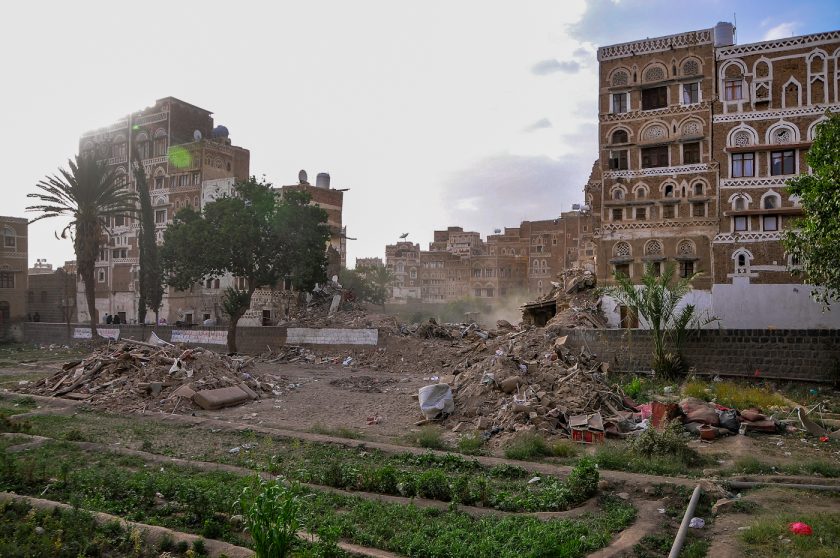
Four historic buildings in Sana’a’s old quarter, including the home of Saleh Ali al-Aeini, were destroyed by U.S. bombs dropped by Saudi warplanes in June, 2015. Photo – MintPress News
By Ahmed AbdulKareem – MintPress News – August 26, 2019
SANA’A, YEMEN — Yemen was once described as a living museum, but U.S. made bombs dropped by the Saudi-led Coalition’s jets have not only killed thousands of civilians and led to famine and the spread of disease but also pulverized the country’s rich architectural history and left its inimitable heritage at the mercy of the highest bidder.
“I remember how light filtered through the stained glass of the patterned crescent window (qamarias) onto the white gypsum plaster in the resting room (Deirmanah) on the top floor. At night, lights tossed dapples of color into the sky,” Saleh Ali al-Aeini recounted to MintPress from his partially destroyed high-rise apartment, continuing, “Now, only scattered glass remains amid a mound of dust and mud, thanks to American bombs.”
Saleh’s ancient tower-house was one of four historic buildings in the old quarter of Sana’a that were destroyed by U.S. bombs dropped from Saudi warplanes in June, 2015. The buildings’ many-storied tower-houses, three of them rising to 110 feet, were more than 2,500 years old. The newest of them was more than 1,000 years old, built long before the United States even existed as a nation.
The effects of airstrikes on the UNESCO-listed Old City, perched on a highland plateau more than 7,200 feet above sea level, can be noticed at a glance. Cracks show on the more than 1,975 densely-packed homes, threatening them with collapse. Labyrinths, hidden gardens, steam baths, busy markets and streets have all been affected by airstrikes on the city that was said to have been founded by Shem, the son of Noah. In fact, the ancient city has been targeted at least four times with over 30 airstrikes according to the General Authority for the Preservation of Historic Cities.
Yet Saudi airstrikes extend far beyond Sana’a’s historic sites — to Sadaa, Shibam Hadramout, Zabid in Hodeida, Shibam Kuban, east of Sana’a, Shabwa, Aden, Amran, Taiz, and other areas of the country’s history that have also fallen victim to coalition bombing. Airstrikes and shelling have destroyed at least 66 historic sites according to Muhannad al-Sayani, chairman of the Yemeni General Authority for Antiquities
Coalition raids have targeted ancient castles and forts, museums, religious shrines housing cultural treasures; and ancient dams, including the world-famous Great Marib Dam.
Al-Sayani told MintPress that targeting of the country’s historic sites by the Saudi-led Coalition is deliberate: “These are open sites, mostly in desert areas where weapons cannot be stored.” Following many of the attacks, the Coalition often accuses the Houthis of using archaeological sites as weapons depots; however, no evidence has been provided to substantiate these allegations.
The undersecretary of the General Authority for the Preservation of Historic Cities, Amat al-Razzaq Jahaf, told MintPress that most of the monuments or sites have been damaged or destroyed by Saudi airstrikes since the Saudi-led campaign began without any justification.
The United States says it does not make targeting decisions for the Coalition. But it does support Coalition operations through arms sales, the refueling of Saudi combat aircraft, and the sharing of intelligence. Just last Thursday, a U.S. MQ-9 Reaper drone was downed in the city of Dhamar near the historic Dhamar Museum, which was leveled by a direct Saudi airstrike in June 2015.
Nothing can bring these back
Al-Aeini’s wife, who told MintPress than an American-made bomb had destroyed her home and killed her sons, accused international aid organizations of neglecting their suffering. “Lots of organizations visited us and provided only [promises] without doing anything,” she went on, “We rebuilt a part of the house by ourselves, just to have shelter for me and my husband, without any help.” Yemen’s General Authority of Antiquities complained to MintPress that the country’s heritage has been neglected by international organizations and communities.
Now, the buildings — which have stood tall for thousands of years in the historic city that surrounds the remnants of al-Aeini family home — are subject to eroding foundations and ominous cracks that line their ancient walls built of mud and stone, as a result of repeated Saudi attacks and the inability of Yemen’s government to address the deterioration amid four years of Saudi bombardment.
To make matters worse, Yemen is in the midst of its rainy season, adding to the challenges in rebuilding archaeological sites that have been targeted. “Of course, what has been destroyed is still devastating and every day the dangers [to those sites] is multiplied due to our inability to carry out operations to reduce the aggravation of damage because of the costs of rebuilding,” Jahaf told MintPress. Al-Qasimi’s house in Sultan’s orchard in ancient Sana’a, which was destroyed in another Saudi airstrike, is an example of this.
“If peace is brought to Yemen — and with it, compensation is provided — infrastructure, roads, schools, and hospitals could all be rebuilt; but nothing can bring back the historic architecture that has been destroyed,” Mohaned al-Sayani, chairman of the Yemeni General Authority for Antiquities, told MintPress.
Centuries in building, seconds in destroying
“Here, generations of my grandparents lived; why is it that the Coalition can so easily destroy it?” Hashem Ali, who fled to Sana’a after airstrikes leveled his family home in the historic Rahban area of Saada, asked MintPress. “This is the first time in nearly 600 years that my family is without a home.”
The attack on ancient Sana’a was the first of many violent assaults on Yemen’s architectural history, but the worst hit historic area has been Yemen’s northern province of Saada, the hub of the ancient Minaean Kingdom of Ma’in, founded before the fourth century B.C.
Saada’s old city, which is among the world’s oldest human-carved landscapes, once consisted entirely of historic, centuries-old multi-story homes. Now, it has been wiped out, after Saudi Arabia declared it a military zone — even the city’s hand-carved wooden doors have been reduced to ashes.
Just hours after the Coalition issued a warning on May 10, 2015, dozens of airstrikes rained down on the historic city, including on the ancient al-Hadi Mosque, which was founded nearly 1,200 years ago and is the final resting place of Imam al-Hadi ila’l-Haqq Yahya, the Zaydi imam of Yemen.
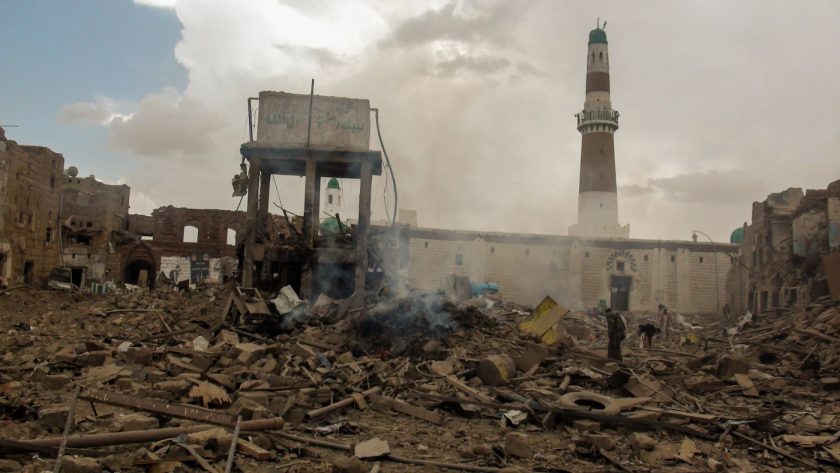
Built c. 897, al-Hadi Mosque is the final resting place of Imam al-Hadi ila’l-Haqq Yahya, the Zaydi imam of Yemen. It has been targeted several times. Ali al-Shurqbai – MintPress News
To understand Saudi Arabia’s motivation to essentially exterminate Yemen’s heritage, one must understand Yemen’s history as well as that of Saudi Arabia and the United Arab Emirates and the Saudi-based Wahhabi faith, which provides religious justification for targeting heritage sites under the guise of eradicating polytheism.
In ancient times, Yemen was home to several flourishing civilizations — including Ma’in, Qataban, Hadramaut, Ausan, Himyar and Saba (Sheba), which lasted for 11 centuries and was mentioned in the Quran and other ancient holy books. The Saban civilization was marked by its distinctive architecture, based almost entirely on local building materials, a style unique in the Middle East.
In contrast to Yemen’s rich and ancient history, civilization did not make its way to the Arabian Gulf until the 1930s. The United Arab Emirates, Saudi Arabia’s fellow coalition war partner, didn’t take root until 1971.
Many Yemenis, including Saleh Ali al-Aeini, believe that Saudi Arabia harbors severe jealousy over Yemen’s history and heritage and the unique role that it has played in human history. According to some historians, that history spans 60,000-70,000 years, when the country received its first Homo sapiens who migrated across the Red Sea from Africa to the Middle East before traveling west to Europe and east to Asia and Australia.
Moreover, Wahhabism — the official state religion of Saudi Arabia, based on a puritanical and widely rejected interpretation of Islam — sees the preservation of historic and religious sites as tantamount to idolatry. The Wahhabi establishment in Saudi Arabia has not even spared the Kingdom’s own tombs and monuments in Mecca and Medina and shows special disdain for Yemen’s historic sites, especially those located in northern Yemen, the seat of the Shia Zaydis for over a thousand years.
Looting what was not destroyed
Yemenis see their historic sites as a social-cultural fabric linking generations to their early ancestors. “I’ve lived here for dozens of years but now I have no house; there are no more gatherings of my ones-loved on the weekend,” al-Aeini said. He continued: “Another thing to worry about is our remaining legacy being looted.”
Destruction from the air is not the only threat to Yemen’s ancient legacy. During their war in Yemen, Saudi Arabia and the UAE have established smuggling networks in the country to loot historic sites.
A.M.M., who asked to be identified only by his initials, worked as an antiquities smuggler for a security outfit based in the UAE. A.M.M. told MintPress that his team sold four 2,500-year-old mummies, a gilded Torah scroll, and dozens of bejeweled daggers from the early Islamic era. “They always stressed the importance of keeping [the items] from being damaged so that they will be accepted by their American friends,” he said.
The smuggling of Yemeni antiquities is often carried out by diplomats operating out of Yemeni embassies from Saudi Arabia, the UAE, Bahrain and Egypt in return for lucrative sums of money allegedly provided by patrons from the United States and Israel. Yemen is the cradle to many civilizations and home to multiple faiths — particularly Judaism, Christianity and Islam, which all thrived in Yemen for millennia. For the Israelis, many of Yemen’s antiquities are seen as the rightful property of the Jewish people and there is reason to believe that Israel is also involved in the looting of Yemen’s heritage.
Officials in Sana’a say they have strong evidence that Yemeni artifacts are being sold off to American and Isreali buyers. “Artifacts featuring the Star of David or Jewish names are our priority; they often fetch a higher price than the other artifacts,” A.M.M told MintPress. “I sold one Hebrew manuscript to a UAE officer for $20,000,” he added.
Aden, in the eastern province of Marib, is favored by smugglers for shuttling stolen artifacts abroad. Here — according to the testimonies of a number of smugglers arrested by Houthi forces and now serving their sentences Sana’a’s Central Prison — smugglers are able to work in broad daylight in facilities provided to them by high-ranking officials in the ousted government of President Abdrabbuh Mansur Hadi, with direct coordination of both Emirati and Saudi officials.
More weapons to destroy what remains?
“We want compensation to rebuild our house again,” al-Aeini said, perched atop the stone rubble of his destroyed ancient home. “We should get compensation from the Americans. American bombs have killed more of us than were killed in the September 11 attacks.”
Al-Aeini was sardonically referring to the duality of moral attitudes in the United States, where on one hand Saudi Arabia is asked to pay compensation to the families of victims of the September 11 attacks, yet do nothing for victims of the war in Yemen, who are often killed with U.S. weapons sold to Saudi Arabia. “If there hadn’t been an American bomb, I would be at home now with my children and grandchildren, but they took everything,” al-Aeini said.
Many Yemenis are pessimistic about the future of their heritage. They say President Donald Trump’s recently-announced sales of U.S. weapons to Saudi Arabia and the United Arab Emirates will destroy what remains of their country’s legacy. The sale includes precision-guided missiles manufactured by Raytheon as well as precision guidance parts for Paveway IV bombs used on Eurofighter and Tornado warplanes — the same type that have been blamed for much of the destruction of Yemen’s historic sites and civilian casualties alike in the Saudi-UAE air campaign in Yemen.
An old Yemeni proverb used for generations to encourage the preservation of the country’s rich heritage reads Eli maluh awal maluh taley (Whoever has no first, has no second). Many Yemenis, al-Aeini among them, fear that Yemen is already losing its heritage, much like al-Aeini lost his home, to American weapons.
Ahmed AbdulKareem is a Yemeni journalist. He covers the war in Yemen for MintPress News as well as local Yemeni media.
Featured Video

Broke Princes: Saudi Arabia’s Powder Keg
or go to
Aletho News Archives – Video-Images
From the Archives
A sample of vaccine and injectable medication tragedies during my lifetime
This is what happens when you demand speedy production in an era of politicized regulation
By Meryl Nass, MD | February 12, 2022
All these tragedies have been due to failures of testing or failures in manufacturing processes. Most occurred before vaccine manufacturers were given virtually complete protection from liability in 1987.
With the duration of patent exclusivity determining how much new products earn, products are rushed to market as quickly as possible, most using a shortened path for FDA review. Recalls and market removals of approved products are much more common than they used to be. We can only expect more of these disasters in the future, especially if the products are mandated for everyone. … continue
Blog Roll
 Aletho News
- Broke Princes: Saudi Arabia’s Powder Keg
- Albania’s Crisis: Rama, Israeli Investments and the Demand for Accountability
- Hezbollah Categorically Denies Syrian Accusations: We Aim at Confronting Israeli Enemy, Not Undermining Syria’s Stability
- Trump claims funding to Israel ending in 2026 as merger of Israeli–US armies looms
- Iran Weathering The Storm, But Saudi Arabia Is Sinking
- Sunk Ships Don’t Sail Home: Why Peace Won’t Save the Oil Market and War Will Wreck It
- No Cossacks at the gates, fix Italy instead – opposition leader to Meloni
- The Pits: Zelensky’s torture chamber network in the public eye
- Moscow mocks Kiev’s language hypocrisy exposed by ‘torture chamber’ scandal
- Military ‘torture chamber’ triggers new scandal in Kiev
- If Americans Knew
- An error has occurred; the feed is probably down. Try again later.
- No Tricks Zone
- Germany’s Green Energy Transition Becoming Increasingly Expensive…Another 6 Trillion Euros!
- Sudden Stratospheric Warming, Powerful El Niño Combination May Lead To Extreme Europe Cold, Energy Crisis!
- Two New Studies Find Thwaites Glacier Melt Cannot Be Driven By Human Activity Or A Warming Ocean
- E-Cars Reduce CO2 Emissions By Only 41% Compared To Internal Combustion Engine Vehicles
- Predictions Made By Renowned Climate Professor Over Past Decades Have Been Proven To Be Poor
- New Study Suggests Large Regions Of The Pacific Ocean Have Been Cooling For The Last 80 Years
- Germany’s Green Energy Debacle: High Energy Costs Force Kahla Porzellan to Close After 182 Years!
- New Study: 50 Years Of The Most Aggressive ‘Net Zero’ Policies Can Only Affect The Global Climate By 0.03°C
- US September “Heat” Was No Record…Many Records Set Decades Ago
- Latest European Green Energy Debacle; Portugal’s Largest Flagship Solar Park Insolvent!

