“… Israel is a strong ally and an important friend to the United States. Good friends can disagree and a candid expression of concerns does not diminish our friendship…”
Probe says ‘state actor’ likely behind attack on tankers off UAE, doesn’t mention Iran – report
RT | June 7, 2019
After the US put the blame squarely on Iran for sabotaging four oil tankers off the coast of the United Arab Emirates, a preliminary probe concluded that a ‘state actor’ was likely behind the raid, but made no mention of Iran.
According to reports by Reuters and Bloomberg, preliminary findings from the investigation jointly conducted by the UAE, Saudi Arabia and Norway and presented at an informal UN briefing on Thursday, describe the attack as a complex effort that required significant resources.
The investigators argue that the attackers, who inflicted damage on the tankers, but did not cause casualties or an oil spill, required “high degree sophistication”, precise intelligence and “expert navigation of fast boats” to pick the targets, get in and get out undetected. All of this, they claim, are signs a ‘state actor’ was likely responsible.
This wording allows the countries behind the report, two of which are among the US’ main allies and arms sales clients in the Middle East, to maintain a neutral image without actually contradicting Washington, which accused Iran out of hand.
US President Donald Trump’s National Security Adviser John Bolton said last month that the attacks were “almost certainly” perpetrated by Iran, accusing it of planting “naval mines” under the ships. It’s unclear if Bolton’s assertion relied on any intelligence.
The UAE emirate of Fujairah, off the cost of which the attack took place, lies outside the Strait of Hormuz, a narrow waterway that separates the Persian Gulf and the Gulf of Oman. The strait is immensely important for oil transportation, with tankers carrying crude from the oil-rich Gulf countries must pass through it.
Previously, Iran threatened to block the oil shipments through the waterway in response to the US’ intent to bring Tehran’s oil exports to ‘zero.’
In a series of sharply escalating moves, the US recently declared Iran’s elite Revolutionary Guards a terrorist organization, then sent an aircraft carrier group to the Gulf, while signaling a possible massive boost to the number of American troops in the region.
The May 12 attack came at the height of the latest round of tension and targeted four commercial tankers, including two Saudi, one Emirati and one Norwegian ship. Iran has dismissed the accusations against it, calling the Bolton’s statement “ridiculous.”
Glacier National Park Quietly Removes Its ‘Gone by 2020’ Signs
Glaciers Appear to be Growing, not Melting in Recent Years
By Roger I. Roots, J.D., Ph.D.,
Founder, Lysander Spooner University
May 30, 2019. St. Mary, Montana. Officials at Glacier National Park (GNP) have begun quietly removing and altering signs and government literature which told visitors that the Park’s glaciers were all expected to disappear by either 2020 or 2030.
In recent years the National Park Service prominently featured brochures, signs and films which boldly proclaimed that all glaciers at GNP were melting away rapidly. But now officials at GNP seem to be scrambling to hide or replace their previous hysterical claims while avoiding any notice to the public that the claims were inaccurate. Teams from Lysander Spooner University visiting the Park each September have noted that GNP’s most famous glaciers such as the Grinnell Glacier and the Jackson Glacier appear to have been growing—not shrinking—since about 2010. (The Jackson Glacier—easily seen from the Going-To-The-Sun Highway—may have grown as much as 25% or more over the past decade.)
The centerpiece of the visitor center at St. Mary near the east boundary is a large three-dimensional diorama showing lights going out as the glaciers disappear. Visitors press a button to see the diorama lit up like a Christmas tree in 1850, then showing fewer and fewer lights until the diorama goes completely dark. As recently as September 2018 the diorama displayed a sign saying GNP’s glaciers were expected to disappear completely by 2020.
Video of the diorama two years ago.
But at some point during this past winter (as the visitor center was closed to the public), workers replaced the diorama’s ‘gone by 2020’ engraving with a new sign indicating the glaciers will disappear in “future generations.”
Almost everywhere, the Park’s specific claims of impending glacier disappearance have been replaced with more nuanced messaging indicating that everyone agrees that the glaciers are melting. Some signs indicate that glacial melt is “accelerating.”
A common trick used by the National Park Service at GNP is to display old black-and-white photos of glaciers from bygone years (say, “1922”) next to photos of the same glaciers taken in more recent years showing the glaciers much diminished (say, “2006”). Anyone familiar with glaciers in the northern Rockies knows that glaciers tend to grow for nine months each winter and melt for three months each summer. Thus, such photo displays without precise calendar dates may be highly deceptive.
Last year the Park Service quietly removed its two large steel trash cans at the Many Glacier Hotel which depicted “before and after” engravings of the Grinnell Glacier in 1910 and 2009. The steel carvings indicated that the Glacier had shrunk significantly between the two dates. But a viral video published on Wattsupwiththat.com showed that the Grinnell Glacier appears to be slightly larger than in 2009.
The ‘gone by 2020’ claims were repeated in the New York Times, National Geographic, and other international news sources. But no mainstream news outlet has done any meaningful reporting regarding the apparent stabilization and recovery of the glaciers in GNP over the past decade. Even local Montana news sources such as The Missoulian, Billings Gazette and Bozeman Daily Chronicle have remained utterly silent regarding this story.
(Note that since September 2015 the author has offered to bet anyone $5,000 that GNP’s glaciers will still exist in 2030, in contradiction to the reported scientific consensus. To this day no one has taken me up on my offer. –R.R.)
US hands over former Palestinian presidential candidate, university prof. to Israel

Abdelhalim al-Ashqar standing in his home in Virginia, the United States. (Photo by Getty Images)
Press TV – June 6, 2019
US officials have handed over a former Palestinian presidential candidate and university professor to Israel after keeping him 11 years in prison on charges of racketeering and collecting funds for the Hamas resistance movement.
The Council on International Relations – Palestine, in a statement released on Thursday, denounced American authorities for extraditing Abdelhalim al-Ashqar to Israel, stressing that US officials bear full responsibility for the fate of Ashqar, who is now in the hands of the “criminal” Tel Aviv regime.
The Council noted that the move attests to the US administration’s hostility towards the Palestinian nation and stability and peace in the Middle East region as well as its blatant bias in favor of the unjust Israeli regime and its ongoing crimes.
The statement further argued that American authorities had unfairly sentenced Ashqar to 11 years in prison after placing him under house arrest for nearly two years. He wore an ankle monitor on his right leg in his home in Alexandria, Virginia.
The Council called on the international community and human rights groups around the world to press for the release of Ashqar, stressing the need for the US administration to review its Middle East policies, which run contrary to its claim of being an honest broker in the so-called peace process between the Palestinians and Israelis.
Ashqar was a professor at Howard University, Washington, the United States. Between 1998 and 1999, he was detained for several months by American officials under allegations of fundraising for certain US-based Islamic organizations.
He was discharged from his teaching position at Washington University in August 2004. He was subsequently arrested, charged with racketeering and illegally collecting funds for Hamas, and put under house arrest.
Ashqar nominated himself as an independent presidential candidate in the January 9, 2005, Palestinian election. He was one of the 10 contenders seeking to succeed Yasser Arafat, who died on November 11, 2004 as head of the Palestinian Authority.
In November 2007, he was sentenced to 135 months in prison.
Tulsi Gabbard Pushes No War Agenda – and the Media Is out to Kill Her Chances
By Philip Giraldi | Strategic Culture Foundation | June 6, 2019
Voters looking ahead to 2020 are being bombarded with soundbites from the twenty plus Democratic would-be candidates. That Joe Biden is apparently leading the pack according to opinion polls should come as no surprise as he stands for nothing apart from being the Establishment favorite who will tirelessly work to support the status quo.
The most interesting candidate is undoubtedly Congresswoman Tulsi Gabbard, who is a fourth term Congresswoman from Hawaii, where she was born and raised. She is also the real deal on national security, having been-there and done-it through service as an officer with the Hawaiian National Guard on a combat deployment in Iraq. Though in Congress full time, she still performs her Guard duty.
Tulsi’s own military experience notwithstanding, she gives every indication of being honestly anti-war. In the speech announcing her candidacy she pledged “focus on the issue of war and peace” to “end the regime-change wars that have taken far too many lives and undermined our security by strengthening terrorist groups like Al-Qaeda.” She referred to the danger posed by blundering into a possible nuclear war and indicated her dismay over what appears to be a re-emergence of the Cold War.
In a recent interview with Fox News’s Tucker Carlson, Gabbard doubled down on her anti-war credentials, telling the host that war with Iran would be “devastating,” adding that “I know where this path leads us and I’m concerned because the American people don’t seem to be prepared for how devastating and costly such a war would be… So, what we are facing is, essentially, a war that has no frontlines, total chaos, engulfs the whole region, is not contained within Iran or Iraq but would extend to Syria and Lebanon and Israel across the region, setting us up in a situation where, in Iraq, we lost over 4,000 of my brothers and sisters in uniform. A war with Iran would take far more American lives, it would cost more civilian lives across the region… Not to speak of the fact that this would cost trillions of taxpayer dollars coming out of our pockets to go and pay for this endless war that begs the question as a soldier, what are we fighting for? What does victory look like? What is the mission?”
Gabbard, and also Carlson, did not hesitate to name names among those pushing for war, one of which begins with B-O-L-T-O-N. She then asked “How does a war with Iran serve the best interest of the American people of the United States? And the fact is it does not,” Gabbard said. “It better serves the interest of people like [Israeli Prime Minister Benjamin] Bibi Netanyahu and Saudi Arabia who are trying to push us into this war with Iran.”
Clearly not afraid to challenge the full gamut establishment politics, Tulsi Gabbard had previously called for an end to the “illegal war to overthrow the Syrian government,” also observing that “the war to overthrow Assad is counter-productive because it actually helps ISIS and other Islamic extremists achieve their goal of overthrowing the Syrian government of Assad and taking control of all of Syria – which will simply increase human suffering in the region, exacerbate the refugee crisis, and pose a greater threat to the world.” She then backed up her words with action by secretly arranging for a personal trip to Damascus in 2017 to meet with President Bashar al-Assad, saying it was important to meet adversaries “if you are serious about pursuing peace.” She made her own assessment of the situation in Syria and now favors pulling US troops out of the country as well as ending American interventions for “regime change” in the region.
In 2015, Gabbard supported President Barack Obama’s nuclear agreement with Iran and in 2016 she backed Bernie Sanders’ antiwar candidacy. More recently, she has criticized President Donald Trump’s withdrawal from the Iran nuclear deal. Last May, she criticized Israel for shooting “unarmed protesters” in Gaza, a very bold step indeed given the power of the Israel Lobby.
Tulsi Gabbard could well be the only genuine antiwar candidate that might truly be electable in the past fifty years, and that is why the war party is out to get her. Two weeks ago, the Daily Beast displayed a headline: “Tulsi Gabbard’s Campaign Is Being Boosted by Putin Apologists.” The article also had a sub-headline: “The Hawaii congresswoman is quickly becoming the top candidate for Democrats who think the Russian leader is misunderstood.”
The obvious smear job was picked by ABC’s George Stephanopoulos, television’s best known Hillary Clinton clone, who brought it up in an interview with Gabbard shortly thereafter. He asked whether Gabbard was “softer” on Putin than were some of the other candidates. Gabbard answered: “It’s unfortunate that you’re citing that article, George, because it’s a whole lot of fake news.” Politico reported the exchange and wrote: “’Fake news’ is a favorite phrase of President Donald Trump…,” putting the ball back in Tulsi’s court rather than criticizing Stephanopoulos’s pointless question. Soon thereafter CNN produced its own version of Tulsi the Russophile, observing that Gabbard was using a Trump expression to “attack the credibility of negative coverage.”
Tulsi responded “Stephanopoulos shamelessly implied that because I oppose going to war with Russia, I’m not a loyal American, but a Putin puppet. It just shows what absurd lengths warmongers in the media will go, to try to destroy the reputation of anyone who dares oppose their warmongering.”
Tulsi Gabbard had attracted other enemies prior to the Stephanopoulos attack. Glenn Greenwald at The Intercept described how NBC news published a widely distributed story on February 1st, claiming that “experts who track websites and social media linked to Russia have seen stirrings of a possible campaign of support for Hawaii Democrat Tulsi Gabbard.”
But the expert cited by NBC turned out to be a firm New Knowledge, which was exposed by no less than The New York Times for falsifying Russian troll accounts for the Democratic Party in the Alabama Senate race to suggest that the Kremlin was interfering in that election. According to Greenwald, the group ultimately behind this attack on Gabbard is The Alliance for Securing Democracy (ASD), which sponsors a tool called Hamilton 68, a news “intelligence net checker” that claims to track Russian efforts to disseminate disinformation. The ASD website advises that “Securing Democracy is a Global Necessity.”
ASD was set up in 2017 by the usual neocon crowd with funding from The Atlanticist and anti-Russian German Marshall Fund. It is loaded with a full complement of Zionists and interventionists/globalists, to include Michael Chertoff, Michael McFaul, Michael Morell, Kori Schake and Bill Kristol. It claims, innocently, to be a bipartisan transatlantic national security advocacy group that seeks to identify and counter efforts by Russia to undermine democracies in the United States and Europe but it is actually itself a major source of disinformation.
No doubt stories headlined “Tulsi Gabbard Communist Stooge” are in the works somewhere in the mainstream media. The Establishment politicians and their media component have difficulty in understanding just how much they are despised for their mendacity and unwillingness to support policies that would truly benefit the American people but they are well able to dominate press coverage. Given the flood of contrived negativity towards her campaign, it is not clear if Tulsi Gabbard will ever be able to get her message across. But, for the moment, she seems to be the “real thing,” a genuine anti-war candidate who is determined to run on that platform. It might just resonate with the majority of Americans who have grown tired of perpetual warfare to “spread democracy” and other related frauds perpetrated by the band of oligarchs and traitors that run the United States.
US Senators meet with Jewish leaders in semi-secret annual event
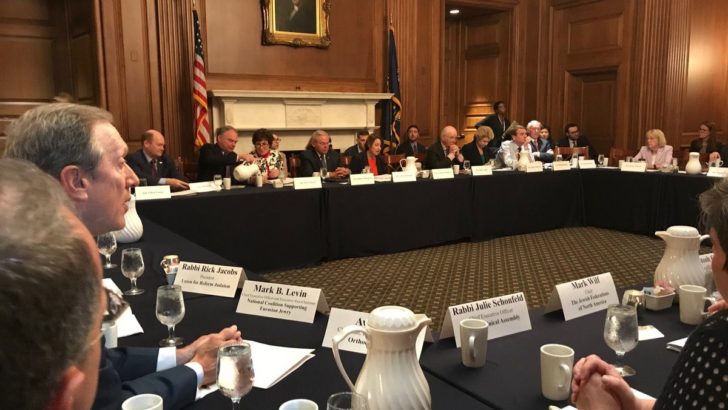
Jewish leaders meeting with Senate Democrats. Photo from a tweet by Nathan Diament featured by Jewish Insider.
By Alison Weir | If Americans Knew | June 5, 2019
An article in the Times of Israel reports that “Jewish leaders are meeting with Senate Democrats today.” According to the report, this is an annual event.
All except one of the organizations represented by the Jewish leaders at the meeting advocate for Israel.
Several of the organizations participating are focused on preventing the erosion of support for Israel among Democratic voters. Recent polls show that the large majority of progressive Americans now support Palestinian human rights.
Many of the meeting participants, both Senators and Jewish leaders, are particularly known for their pro-Israel work. Senate Minority Leader Chuck Schumer calls himself a “guardian of Israel.”
The meeting does not seem to have been announced publicly ahead of time, and staffers at Senate offices contacted for this article were not aware of it.
The chair for the meeting is Democratic Senator Amy Klobuchar of Minnesota, a 2020 presidential candidate.
Klobuchar is a strong Israel supporter and announces on her website that she supported the $38 billion package to Israel.
Klobuchar’s office would not reveal the location or time of the meeting. It also would not provide the agenda.
The offices of other Senators reportedly participating in the meeting that were contacted for this article – Tim Kaine, Patty Murray, and Chris Koons – also refused to provide this information to the American public.
Jewish Insider terms the event “Meeting of Machers” (wheeler dealers).
Nathan Diament, Executive Director for Public Policy for the Jewish Orthodox Union, posted a photo about the meeting on his Twitter account (see above), but didn’t clarify when the photo was taken.
Senators & Leaders participating
In addition to Klobuchar, the Senators reported to be participating in the meeting include Sens. Chuck Schumer (D-NY), Ben Cardin (D-MD), Tim Kaine (D-VA), Chris Coons (D-DE), Bob Menendez (D-NJ), Patty Murray (D-WA), Jacky Rosen (D-NV), Ed Markey (D-MA), and Michael Bennet (D-CO).
The Jewish leaders attending the meeting reportedly include:
AIPAC’s Howard Kohr
J Street’s Jeremy Ben Ami
ADL’s Jonathan Greenblatt,
JNFA’s Mark Wilf
Conference of President’s Arthur Stark
Democratic Majority for Israel’s Mark Mellman
Jewish Democratic Council of America’s Ron Klein
Israel Policy Forum’s Susie Gelman
The Rabbinical Assembly’s Rabbi Julie Schonfeld
Union for Reform Judaism’s Rabbi Rick Jacobs
Orthodox Union’s Avi Katz
Hebrew Immigrant Aid Society’s Mark Hetfield
National Coalition Supporting Eurasian Jewry’s Mark B. Levin
Jewish Women International’s Loribeth Weinstein
Jewish Council for Public Affairs’ David Bernstein
Bend the Arc’s Stosh Cotler (Unlike the other organizations represented at the meeting, Bend the Arc has not taken a public stand on Israel-Palestine. A member of Bend the Arc’s executive board, Howard Welinsky, is active in AIPAC and chairs Democrats for Israel, Los Angeles. Stosh Cotler, on the other hand, once demonstrated against Israeli policies.)
Seating chart
Below is a chart of the seating arrangement for the meeting provided by Jewish Insider:
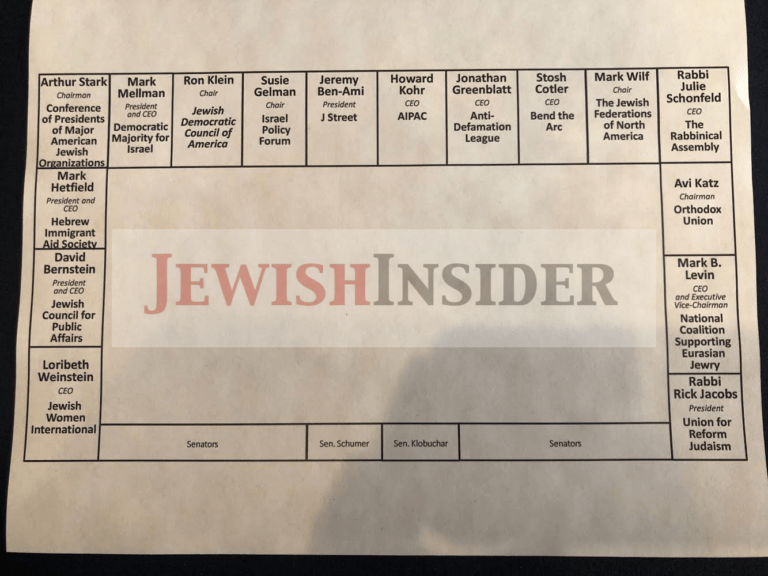
Chart of the seating arrangement for the June 5, 2019 meeting.
Alison Weir is executive director of If Americans Knew, president of the Council for the National Interest, and author of Against Our Better Judgment: The Hidden History of How the U.S. Was Used to Create Israel.
The New York Times Tries to Get Itself Out of the Duckgate Hole Using a Spade
By Rob Slane | The Blog Mire | June 5, 2019
A number of people, including myself, wrote to the New York Times journalist, Julian Barnes, to point out that the piece he and his colleague, Adam Goldman, published on 16th April 2019 about the CIA Director, Gina Haspel, contained a part which unwittingly showed that she had misled President Trump into expelling 60 Russian diplomats in March 2018. Here were the paragraphs of interest:
“During the discussion, Ms. Haspel, then deputy C.I.A. director, turned toward Mr. Trump. She outlined possible responses in a quiet but firm voice, then leaned forward and told the president that the “strong option” was to expel 60 diplomats.
To persuade Mr. Trump, according to people briefed on the conversation, officials including Ms. Haspel also tried to show him that Mr. Skripal and his daughter were not the only victims of Russia’s attack.
Ms. Haspel showed pictures the British government had supplied her of young children hospitalized after being sickened by the Novichok nerve agent that poisoned the Skripals. She then showed a photograph of ducks that British officials said were inadvertently killed by the sloppy work of the Russian operatives.
Ms. Haspel was not the first to use emotional images to appeal to the president, but pairing it with her hard-nosed realism proved effective: Mr. Trump fixated on the pictures of the sickened children and the dead ducks. At the end of the briefing, he embraced the strong option.
The outcome was an example, officials said, of how Ms. Haspel is one of the few people who can get Mr. Trump to shift position based on new information.”
I pointed out to the authors in an (unanswered) email that this was an extraordinary claim, because no children became sick due to poisoning by a toxic chemical, and nor did any ducks die. And so unless they were prepared to correct or retract their piece, there could only be two possibilities:
- Ms Haspel unwittingly showed false images to no less a person than the President of the United States, supplied to her by the British Government who knew them to be false, which persuaded him to embrace the “strong option”.
- Ms Haspel knowingly showed false images to no less a person than the President of the United States, which persuaded him to embrace the “strong option”.
It seems that the two journalists have not ignored mine and the many other emails they received about this issue, and they have today corrected their story. The paragraphs of interest now read as follows:
“During the discussion, Ms. Haspel, then deputy C.I.A. director, turned toward Mr. Trump. She outlined possible responses in a quiet but firm voice, then leaned forward and told the president that the “strong option” was to expel 60 diplomats.
To persuade Mr. Trump, according to people briefed on the conversation, officials including Ms. Haspel tried to demonstrate the dangers of using a nerve agent like Novichok in a populated area. Ms. Haspel showed pictures from other nerve agent attacks that showed their effects on people.
The British government had told Trump administration officials about early intelligence reports that said children were sickened and ducks were inadvertently killed by the sloppy work of the Russian operatives.
The information was based on early reporting, and Trump administration officials had requested more details about the children and ducks, a person familiar with the intelligence said, though Ms. Haspel did not present that information to the president. After this article was published, local health officials in Britain said that no children were harmed.
Ms. Haspel was not the first to use emotional appeals to the president. She and Mr. Pompeo showed Mr. Trump images of children sickened by chemical weapons attacks in Syria, in an earlier presentation. But Ms. Haspel’s strategy in the March briefing was to pair emotional appeals with her hard-nosed realism and it proved effective. At the end of the briefing, Mr. Trump embraced the strong option. [my emphasis]”
Below is Mr Barnes’s explanation on Twitter for the error and the correction:
“I made a significant error in my April 16 profile of Gina Haspel. It took a while to figure out where I went wrong. Initially, I reported that in March 2018, Gina Haspel, then the future CIA director, briefed President Trump about the Skirpal nerve agent attack, showing pictures of sickened children and dead ducks. That was wrong. There are—so far as we know—no pictures of dead ducks or sickened kids. Haspel did show pictures to Trump, but they were about the effects of nerve agents in general, they were not specific to the attack in the UK.
British officials did brief the Trump administration about early reports of dead ducks & sick children. Officials sought more info, believing such intel would be persuasive to Trump, who was skeptical of the proposed expulsion of 60 Russians in response to the attack. But Haspel did not brief the president on that intelligence.
Local UK health officials deny that any animals or children were sickened, as British officials pointed out soon after our story published. (In response to good reporting by @haynesdeborah, @guardian and others.) (link: https://www.theguardian.com/uk-news/2019/apr/18/no-children-ducks-harmed-novichok-attack-wiltshire-health-officials)
The intelligence about the ducks and children were based on an early intelligence report, according to people familiar with the matter. The intelligence was presented to the US in an effort to share all that was known, not to deceive the Trump administration. This correction was delayed because conducting the research to figure out what I got wrong, how I got it wrong and what was the correct information took time.
I regret the error and offer my apology. I strive to get information right the first time. That is what subscribers pay for. But when I get something wrong, I fix it.”
Here is my response on Twitter to Mr Barnes:
Dear Julian,
Thanks for taking the time to correct your report. However, it unfortunately raises just as many questions as the initial report.
Firstly, you say British officials briefed the Trump administration about early reports of dead ducks & sick children.
Really? Which early reports were these? There were none. The parents of the children who had tests to see if they had been contaminated were only contacted 2 weeks after the incident, and none of them was found to be ill. This is the first report on it, and it confirms the children were given the all clear. And there were never any dead ducks in Salisbury nor any reports of them.
Secondly, you say that “Officials sought more info, believing such intel would be persuasive to Trump, who was skeptical of the proposed expulsion of 60 Russians in response to the attack.” But the fact is that any further (truthful) info could not have persuaded Mr Trump, for the simple reason that no other people were harmed in Salisbury than the three people who were initially harmed. How, then, was he persuaded?
Thirdly, you presumably give the answer to the second point, when you say “Haspel did show pictures to Trump, but they were about the effects of nerve agents in general, they were not specific to the attack in the UK.” So in other words, Ms Haspel couldn’t show any pictures from Salisbury to persuade the sceptical Mr Trump, because there weren’t any to show. So she showed him pictures from other nerve agent attacks, which were presumably sufficiently bad to turn him from his scepticism, to expelling 60 diplomats. Even though nothing like that happened in Salisbury.
Thank you for clarifying that Ms Haspel did indeed wilfully mislead the President.”
Despite NYT’s correction, the question it poses is this: Which is worse:
- The deputy director of the CIA showing a sceptical President some fake pictures of dead ducks and sick children to persuade him to take the strongest action?
- Or the deputy director of the CIA, knowing full well that there weren’t any pictures of the effects of nerve agent on the population of Salisbury because only three people were ever affected, showing some pictures of actual nerve agent victims who were never anywhere near Salisbury to persuade him to take the strongest action?
The answer is they’re both as bad. In both scenarios, an utterly false picture of what happened in Salisbury was given to the sceptical President to twist his arm into taking action he didn’t want to take.
As they say, when in a hole, better stop digging.
Hillary Clinton’s Russia collusion IOU: The answers she owes America
By John Solomon – The Hill – 06/03/19
During the combined two decades she served as a U.S. senator and secretary of State, Hillary Clinton’s patrons regularly donated to her family charity when they had official business pending before America’s most powerful political woman.
The pattern of political IOUs paid to the Clinton Foundation was so pernicious that the State Department even tried to execute a special agreement with the charity to avoid the overt appearance of “pay-to-play” policy.
Still, the money continued to flow by the millions of dollars, from foreigners and Americans alike who were perceived to be indebted to the Clinton machine or in need of its help.
It’s time for the American public to call in their own IOU on political transparency.
The reason? Never before — until 2016 — had the apparatus of a U.S. presidential candidate managed to sic the weight of the FBI and U.S. intelligence community on a rival nominee during an election, and by using a foreign-fed, uncorroborated political opposition research document.
But Clinton’s campaign, in concert with the Democratic Party and through their shared law firm, funded Christopher Steele’s unverified dossier which, it turns out, falsely portrayed Republican Donald Trump as a treasonous asset colluding with Russian President Vladimir Putin to hijack the U.S. election.
Steele went to the FBI to get an investigation started and then leaked the existence of the investigation, with the hope of sinking Trump’s presidential aspirations.
On its face, it is arguably the most devious political dirty trick in American history and one of the most overt intrusions of a foreigner into a U.S. election.
It appears the Clinton machine knew that what it was doing was controversial. That’s why it did backflips to disguise the operation from Congress and the public, and in its Federal Election Commission (FEC) spending reports.
Clinton and the Democratic National Committee (DNC) used the law firm of Perkins Coie to hire Glenn Simpson’s research firm, Fusion GPS, which then hired Steele — several layers that obfuscated transparency, kept the operation off the campaign’s public FEC reports and gave the Clintons plausible deniability.
But Steele’s first overture on July 5, 2016, failed to capture the FBI’s imagination. So the Clinton machine escalated. Steele, a British national, went to senior Department of Justice official Bruce Ohr — whose wife, Nellie, also worked for Fusion — to push his Trump dirt to the top of the FBI.
Nellie Ohr likewise sent some of her own anti-Trump research augmenting Steele’s dossier to the FBI through her husband. Perkins Coie lawyer Michael Sussmann used his connection to former FBI general counsel James Baker to dump Trump dirt at the FBI, too.
Then Steele and, separately, longtime Clinton protégé Cody Shearer went to the State Department to get the story out, increasing pressure on the FBI.
In short, the Clinton machine flooded the FBI with pressure — and bad intel — until an investigation of Trump was started. The bureau and its hapless sheriff at the time, James Comey, eventually acquiesced with the help of such Clinton fans as then-FBI employees Peter Strzok and Lisa Page.
To finish the mission, Simpson and Steele leaked the existence of the FBI investigation to the news media to ensure it would hurt Trump politically. Simpson even called the leaks a “hail Mary” that failed.
Trump won, however. And now, thanks to special counsel Robert Mueller, we know the Russia-collusion allegations relentlessly peddled by Team Clinton were bogus. But not before the FBI used the Clinton-funded, foreign-created research to get a total of four warrants to spy on the Trump campaign, transition and presidency from October 2016 through the following autumn.
The Clinton team’s dirty trick was as diabolical as it was brilliant. It literally used house money and a large part of the U.S. intelligence apparatus to carry out its political hit job on Trump.
After two years of American discomfort, and tens of millions of taxpayer dollars spent, it’s time for the house to call in its IOU.
Hillary Clinton owes us answers — lots of them. So far, she has ducked them, even while doing many high-profile media interviews.
I’m not the only one who thinks this way. Longtime Clinton adviser Douglas Schoen said Friday night on Fox News that it’s time for Clinton to answer what she knew and when she knew it.
Here are 10 essential questions:
- In January 2018, the Senate Judiciary Committee sent a formal investigative request for documents and written answers from your campaign. Do you plan to comply?
- Please identify each person in your campaign who was involved with, or aware of, hiring Fusion GPS, Glenn Simpson and Christopher Steele.
- Please identify each person in your campaign, including Perkins Coie lawyers, who were aware that Steele provided information to the FBI or State Department, and when they learned it.
- Describe any information you and your campaign staff received, or were briefed on, before Election Day that was derived from the work of Simpson, Steele, Fusion GPS, Nellie Ohr or Perkins Coie and that tried to connect Trump, his campaign or his business empire with Russia.
- Please describe all contacts your campaign had before Election Day with or about the following individuals: Bruce Ohr, Nellie Ohr, Glenn Simpson, Christopher Steele, former Australian diplomat Alexander Downer, former foreign policy scholar Stefan Halper and Maltese academic Joseph Mifsud.
- Did you or any senior members of your campaign, including lawyers such as Michael Sussmann, have any contact with the CIA, its former Director John Brennan, current Director Gina Haspel, James Baker, Peter Strzok, Lisa Page or former FBI Deputy Director Andrew McCabe?
- Describe all contacts your campaign had with Cody Shearer and Sidney Blumenthal concerning Trump, Russia and Ukraine.
- Describe all contacts you and your campaign had with DNC contractor Alexander Chalupa, the Ukraine government, the Ukraine Embassy in the United States or the U.S. Embassy in Kiev concerning Trump, Russia or former Trump campaign chairman Paul Manafort.
- Why did your campaign and the Democratic Party make a concerted effort to portray Trump as a Russian asset?
- Given that investigations by a House committee, a Senate committee and a special prosecutor all have concluded there isn’t evidence of Trump-Russia collusion, do you regret the actions by your campaign and by Steele, Simpson and Sussmann to inject these unfounded allegations into the FBI, the U.S. intelligence community and the news media?
Hillary Clinton owes us answers to each of these questions. She should skip the lawyer-speak and answer them with the candor worthy of an elder American stateswoman.
Refreshing the Dossier: New Report Portrays Venezuela as a Criminal Organization
Mision Verdad | June 3, 2019
The Center for International and Strategic Studies (CSIS, its acronym in English) on May 26 in Washington DC presented a report entitled The Last Defense of Maduro: The Survival of Venezuela through the Bolivarian Joint Criminal Enterprise, written by Douglas Farah and Caitlyn Yates, who are part of IBI Consultants, LLC and are “visiting fellows” of the National Defense University (INSS).
The event consisted in the presentation of the document and in a subsequent discussion with a panel composed of Farah himself, José Cárdenas (former assistant secretary for Latin America and the Caribbean of USAID and director of think tank Vision Americas), among others, and moderated by Venezuelan Moisés Rendón (Associate Director for CSIS Americas), known for his active role in the siege of the Venezuelan embassy in Washington, between April and May.
The CSIS, of unquestionable neo-conservative tendency can be remembered in recent times for hosting a discussion and round table (in Washington DC a few weeks ago) evaluating the possibility of an invasion of Venezuela.
There are clear indications to consider the entire performance (the preparation of the report and its institutional presentation) as a new information operation, a multipurpose intelligence action.
DETAILS AND SHADOWS OF THE REPORT
According to a review by IBI Consultants, Farah is a national security consultant and analyst who worked for nine months with the Intelligence Study Consortium, studying armed groups and intelligence reform, during the past two decades, a foreign correspondent and investigative journalist for the Washington Post and other publications, covering Latin America and West Africa.”
He is also one of the “specialists” consulted to highlight trends around the link between Hezbollah and Latin America or why Bolivia is supposedly a narco-state.
IBI Consultants is what is known as a private intelligence firm, which contracts directly or indirectly with governments and corporations linked to armed or political conflicts of medium and high intensity.
This purported investigation, although in its initial statement reaffirms that “it does not necessarily represent the position of the National Defense University, the Department of Defense, or any other body of the US government,” it is logical to think that the Trump Administration has used this firm to justify the next step of the sanctions cycle of 2019: designate the government of Nicolás Maduro as a “transnational criminal organization” or the inclusion of the country in the list of states that sponsor terrorism. Two turns of the screw.
Farah and Yates affirm that “the alliance of the Bolivarian states (ALBA) together with the FARC has merged into what we define as the Bolivarian Joint Criminal Enterprise.”
In this endeavor they unite several actors who are linked by the confrontation with the United States, specifically the guerrillas (inspired by the Cuban doctrine of asymmetric warfare) of the Farabundo Martí Front and the Sandinista Front, which later came to power in El Salvador and Nicaragua respectively, the former guerrilla of FARC (accused of drug trafficking since the 1980s by the US and Colombian authorities) and Venezuela under the governments of Hugo Chávez and Nicolás Maduro.
The report classifies as “criminal acts” actions that have not been proven and that in the first phase of the text does not lead to any specific fact. They take as a basis, for example, an accusation about PDVSA’s diversion of money by the District Attorney’s Office of the Southern District of Florida, in an attempt to project that this accusation corresponds to a plot related to terrorist acts and other crimes that place at risk the security of the Western Hemisphere. A propaganda maneuver consisting of half-truths, deceptive links and misinformation about the scope of the investigation of the Prosecutor’s Office of the Southern District of Florida.
Elsewhere it says that “the financial sum of these criminal acts is not known exactly, but a recent investigation conducted by a consortium of Latin American journalists found that Venezuela diverted US $ 28 billion from PDVSA, we have located at least US $ 10 billion in funds linked to Venezuela that moved between 2007 and 2018. ”
On the one hand, IBI Consultants affirms that it has made findings of funds, without any evidence, but on the other, it establishes a justification base for the United States government to extend the radius of confiscations and looting against Venezuelan assets.
Similarly, they try to convince that “in several oil subsidiaries of the region, through its branch PDV Caribe”, and the legitimate movements of funds made by PDVSA through that subsidiary, constitute an illegality. They condemn the agreements of PDVSA with the ALBA organization (specifically with the governments of Nicaragua and El Salvador) and show that the profits that come from this agreement represent “illicit funds”. Again, the report does not show evidence to support this claim.
Relying on press reports and interviews that can not be verified or contrasted through public sources, the report argues that from the company Alba Petróleo and Albanisa (Nicaragua) resources were diverted to tax havens, generating facade companies through frontmen in these countries
In this way, Douglas Farrah and Caitlyn Yates bet on the credibility of IBI Consultants to lie about Venezuela. They pay themselves and pocket the change.
Likewise, they center their accusations on the ALBA agreement and Nicaragua, countries that were declared by John Bolton as the “troika of evil”, specifically on Venezuela, Cuba and Nicaragua as targets of the unconventional international war being carried out by the Trump Administration, with the purpose of undermining the ALBA alternative within the framework of international relations in the Western Hemisphere.
The report places special emphasis on the figure of the Venezuelan businessman in the media and insurance branch, Raúl Gorrín. According to the text, “it is estimated that this scheme would have laundered between US $ 1.2 and 2.4 billion, using the US financial system, over four years”. Gorrín’s participation in this scheme would total approximately US $ 159 million”.
Farrah and Yates are not only (deliberately) inaccurate when it comes to handling data and accusations, but they also try to link Raúl Gorrín with the Venezuelan government. The report does not show this relationship that it insists on projecting, but only in the reference and the aprioristic sentence.
In addition, the authors use press reports and Bloomberg reports to construct a plot where, supposedly, the Venezuelan government would be in a relationship with the Kaloti Suriname Mint House company, in which not only does it not prove that this is true, but it also endorses criminal charges for the president of Suriname, Desi Bouterse, relying on biased reports from digital media.
On that same topic, “given that Venezuelan Central Bank gold reserves grew by 11 tons in 2018, despite the massive sale underway, everything suggests that a significant amount of merchandise was obtained illegally by the dissident groups of the FARC and the ELN”. Although there is no proof that this is the case, or that the aforementioned Colombian guerrilla groups are linked to the country’s gold activities, the report passes as unobjectionable truth what is a partial and biased opinion, impossible to verify or contrast, on the part of the “researchers“.
They accuse the Venezuelan government of laundering funds through “banco a banco” and with “fake infrastructure projects.” However, they emphasize, in the first part, that they do not have consistent information that supports their complaints.
Finally, the report attempts to link the deprivation of Venezuelan society in access to medicines, among other variables that affect the full development of their human rights, with the set of data and biased information they present throughout the purported investigation. In this sense, it tries to project the Venezuelan government as a “criminal state”, while it whitens and omits the blockade via sanctions as the most important factor in the violation of the human rights of the Venezuelan population.
In this sense, the positioning of the Venezuelan government as a “criminal state” or “joint criminal enterprise” is inconsistent. Venezuela is the victim of a high voltage operation against its economy, political system and national stability, so it seems illogical that a state victim of these hybrid war operations can be classified as a “criminal state”.
The report concludes that the result of this process of structuring the Bolivarian Joint Criminal Enterprise “is a complex criminal operation that undermines the rule of law, democratic governance and US alliances throughout the Western Hemisphere.”
It is worth mentioning and highlighting in extenso the second paragraph of the three that make up the conclusion:
“The Bolivarian structure has proven to be adaptable and resilient, with multiple redundant capacities, operatively, when one of the facets of the criminal network is under pressure, the Bolivarian Joint Criminal Enterprise is able to move its operations to new areas or find new allies, in general, by nurturing different strengths and connections of the shared history and the common objectives of the Enterprise, the US government has recently made a more unified and holistic effort to confront these criminal actors, offering significant results. The efforts to channel the funds that flow from PDVSA and the Bolivarian banking structure to the legitimately recognized Guaidó government – and out of the hands of the Maduro regime – are innovative and necessary as the former head of the Southern Command, Admiral James Stavridis, said: ‘A network is needed to fight a network’ “.
The report ends highlighting the need to confront the “Bolivarian structure” in a joint manner combining “resources and authorities … to face the multiple nodes of the Enterprise”.
But these combined actions between Defense, Treasury and State, for example, have already become evident in the maneuvers against Venezuela. However, the authors insist: “Now that the ideological impulses of the Bolivarian Revolution have been widely contested, this is an opportunity for the United States to boldly confront the region and confront the scope and complexity that this criminal enterprise encompasses.”
FINAL CONSIDERATIONS
- The multi-purpose: the structure of the report seeks to justify some categories that cover the criminal / judicial as the moral / informative. In the first case it offers an express characterization that would seek to move the next steps of the US power to fulfill the objective of “resolving the Venezuelan issue”, no longer as a problem within the framework of international legislation, forcing its discussion and resolution as something of an ordinary legal case (within the US system) closing the treatment of Venezuela as a domestic issue, returning to track the “unusual and extraordinary threat.” The Noriega method.
- In the plane here called “moral / informative” the distribution apparatus of the fake news against Venezuela is oxygenated, now moving the justification of the intervention and control over the story (which has suffered notable blows especially after 30A, preventing consolidation of the informational fence) to a moral issue. From the same logic, morality would also supplant the mediocre success of the attempt to sustain sanctions and the blockade as something legitimate and protected in a high cause. In that direction, it also works as a damage control.
- To exhibit the method more than the content: these kind of information aggressions are designed fundamentally so that it is difficult to take them to argumentation, of the ideas and their sustenance. Technically, it recalls the Gish Galop a lot, a specific tactic of debate that seeks to saturate the debate space with seemingly related particles of discourse that prevent a direct confrontation, and that, in the arena of discussion, seeks to win by attrition. Therefore, rather than focusing directly on the content, it is convenient to approach it from the use of the forms: how it is put together, what is the benefit in saying it (sources, data treatment, political orientation and / or interested in them), at what time it is said, who reacts and finally who wins with this operation. It can not be lost to sight, already under the reflexive logic of the intelligence services, that this set of elements produces the effect of plausible denial, the CIA’s motto: “We can not deny or confirm this information”.
- Deactivate the sources of enunciation: along with what was said about the meeting in early April promoted by the CSIS on a possible military invasion in Venezuela, we suggest evaluating the possibility of legal actions against these entities and their authors, which establish a line of defense elementary in the matter of false and delicate accusations made by private entities. This, within the American justice system itself, could have a precedent among its main variables.
- This type of accusation is not new, made, in addition, by the usual [actors]. If we take the case of Senator Marco Rubio, his marked insistence on the hashtag #MaduroCrimeFamily to refer to the president and the government in general, especially as of January 23 of the current year and the Guaidó cycle, is best seen in context from where it is coming to give form to the concept, and how now it aspires to fill the void that, by itself, represents the verbiage tweeted by Rubio.
- This maneuver reveals two elements to consider: 1) the degree of proactivity of a specific ideological sector with projections within the executive and operational power regarding the case of Venezuela (the Bolton-Pompeo-Pence-Rubio quartet) that needs to further accentuate the imperative of direct and expeditious intervention (pressing against the inertia and the vagaries of its president?), and 2) in addition to that process, the establishment of a new category at the same time “judicial” and “moral” (in the neoconservative key) to move, as we said, the penal institutions against a “mafia and corrupt” structure, and in its media projection to insert the concept as a “mobilizing” idea that provides another degree of encouragement to a regime change operation that has not reached its objectives in the short and medium term.
Edmund Burke Rides Again
But this time the horse is paid for by Israel
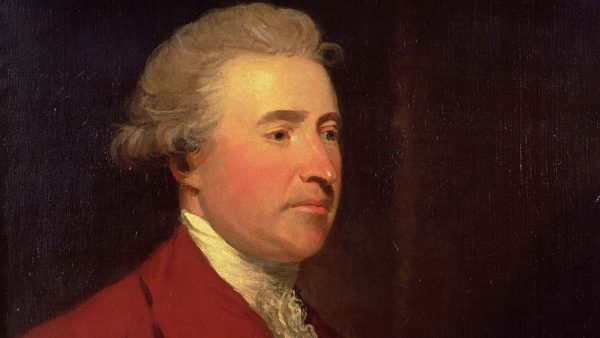
Portrait of Edmund Burke (1729-97); Anglo-Irish politician, orator and political thinker; anti-French Revolution; by Northcote, James; Royal Albert Memorial Museum
By Philip Giraldi • Unz Review • June 4, 2019
A new pro-Israel group that is pretending to be a standard bearer for conservative opinion in the United States was founded in January, a fortuitous bit of timing as it will not have to reveal its sources of income until next year. The Edmund Burke Foundation describes itself as “a new public affairs institute” having “the aim of strengthening the principles of national conservatism in Western and other democratic countries. The Foundation will pursue research, educational and publishing ventures directed toward this end.”
The Foundation’s launch will be at an open-to-the-public conference that will be held at Washington’s Ritz-Carlton on July 14-16, 2019. So as not to confuse the possible audience unduly over who Edmund Burke was or what he stood for, the conference is being advertised somewhat lamely as “National Conservatism: A Conference in Washington D.C.” on its website nationalconservatism.org. Note that neither the name of the foundation nor the promotion of its stellar cast of speakers includes the word “Israel,” but the Jewish state is really what it is all about.
The conference website explains that
“Politics in America, Britain, and other Western nations have taken a sharp turn toward nationalism—a commitment to a world of independent nations. This has been disorienting to many, not least the American conservative movement, which has, since the fall of the Berlin Wall in 1989, grown increasingly attached to a vision of a global ‘rules-based liberal order’ that would bring peace and prosperity to the entire world while attenuating the independence of nations.
“The return of nationalism has created a much-discussed ‘crisis of conservatism’ that may be unprecedented…The conference on ‘National Conservatism’ will bring together public figures, journalists, scholars, and students who understand that the past and future of conservatism are inextricably tied to the idea of the nation, to the principle of national independence, and to the revival of the unique national traditions that alone have the power to bind a people together and bring about their flourishing.”
It is obvious to most actual conservatives that nationalism has never really gone away, but what the conference organizers are really getting at is a revival of unabashed nationalism as the excuse for countries when they behave badly while promoting their own interests without regard for the interests of others. Israel and the United States are the prime examples of such behavior and the argument that they have a special entitlement to justify their actions is frequently made, most notably by other Israel-firster groups like the Foundation for Defense of Democracies (FDD). FDD argues that democracy promotion by force is a legitimate foreign policy of powerful countries like the United States, while threatened democracies like Israel must be protected. That, of course, is a complete misrepresentation regarding just how democratic the two countries actually are and the idea that being democratic empowers some sort of leadership role or exempt status is in itself ridiculous.
Why do I suggest that the Edmund Burke Foundation is just another pro-Israel puppet? Look at the people running it. Its President is David Brog, who is also the executive director of the Maccabee Task Force, “an effort launched in 2015 to combat the anti-Israel BDS movement. He also sits on the Board of Directors of Christians United for Israel (CUFI), where he served as executive director for its first ten years. Before CUFI, Brog worked in the United States Senate for seven years, rising to be chief of staff to Senator Arlen Specter and staff director of the Senate Judiciary Committee. He has also worked as an executive at America Online and practiced corporate law in Tel Aviv, Israel and Philadelphia, PA. Brog is the author of Standing with Israel: Why Christians Support the Jewish State (2006) and In Defense of Faith: the Judeo-Christian Idea and the Struggle for Humanity (2010). In 2007, the Forward newspaper listed Brog in its ‘Forward 50’ most influential Jews in America.”
The Edmund Burke Foundation’s Chairman is an Israeli Yoram Hazony, who describes himself as a “Jewish philosopher.” He resides in the Jewish state and is a well-known Israeli nationalist, having written that nationalism empowers “the collective right of a free people to rule themselves.” He declares that “We should not let a hairbreadth of our freedom be given over to foreign bodies under any name whatsoever, or to foreign systems of law that are not determined by our own nations.” He adds “My first concern is for Israel.”
In other words, for Hazony all external criticism of what Israel is and does is illegitimate while Brog is what might be described as someone who has made a career out of being Jewish, along the way advancing what he perceives as Israeli interests. So why are they heading an ostensibly American foundation?
Indeed, it doesn’t require a Trumpean level of genius to see what this is all about and where it is going. If there is an unfortunate development arising from the National Conservative conference it is the inclusion as speakers of some genuine conservatives among the crowd of usual Zionist hacks, with National Security Bloviator John Bolton leading the dark side of the list. The real conservatives, who are invited to give the event credibility, should know better and ought to avoid the Edmund Burke Foundation like the plague. I will not call them out by name here and now but they can be identified from the speakers’ list. One has to wonder if they are being paid for their services…
In fact, new organizations dedicated to defending and promoting Israel are not exactly unusual. They tend to pop up in the United States and Western Europe like wild mushrooms in the spring time. By one estimate, there are 600 such organizations in the U.S. alone, running the gamut from the liberal left to the conservative right. They exist because there is a certain paranoia on the part of prominent Jews and leading Jewish organizations due to fear that the American people are finally waking up to the fact that they have been getting used and abused by a vast Zionist conspiracy for the past 70-plus years.
Why do some American Jews betray the interests of their own country to support another nation that is manifestly a pariah due to its own behavior? It might just be because to do so is painless and can, on the contrary, lead to personal advancement. Brog’s career demonstrates how it works, particularly if one can latch on to a Jewish Zionist Senator like Arlen Specter along the way. And the benefits for Israel are enormous, amounting to hundreds of billions of U.S. Treasury dollars as well as a de facto commitment for American soldiers to fight and die for Israel even if Israeli Prime Minister Netanyahu starts a war for no reason whatsoever.
Taken together, all of the pro-Israel groups constitute a veritable political juggernaut that seeks to advantage Israel and benefit it directly without regard for the damage done to American democracy and to actual U.S. interests. They should rightly be seen as organizations that regard their loyalty to the United States as negotiable, but they try to obfuscate the issue by claiming, wrongly, that there exist compelling reasons why Israel and the U.S. should continue to be best friends due to “shared values.” And, as self-defined leading democracies, the Israel-apologists argue that both are immune to criticism because they are acting on the basis of legitimate nationalist interests. It is a compelling argument for some, but ultimately false in that it suggests that there are no restraints on the behavior of either government. The Israelis have, for example, used the argument to justify the killing by army sniper fire hundreds of unarmed Palestinian demonstrators.
Promoting “democratic nationalism” to pander to Israel without any real understanding of actual interests has led the United States into a seemingly bottomless Middle Eastern quagmire. And, the sense of invulnerability that America’s uncritical support has encouraged among some Israelis also will not benefit the Jewish state in the long term. The creation of the Edmund Burke Foundation is just one more card in a losing hand and it hopefully will run out of steam as abruptly as it was created.
Philip M. Giraldi, Ph.D., is Executive Director of the Council for the National Interest, a 501(c)3 tax deductible educational foundation (Federal ID Number #52-1739023) that seeks a more interests-based U.S. foreign policy in the Middle East. Website is councilforthenationalinterest.org, address is P.O. Box 2157, Purcellville VA 20134 and its email is inform@cnionline.org.
Bipartisan Support for Trump’s Aggressive Iran Policy Reveals the Hollowness of Russiagate
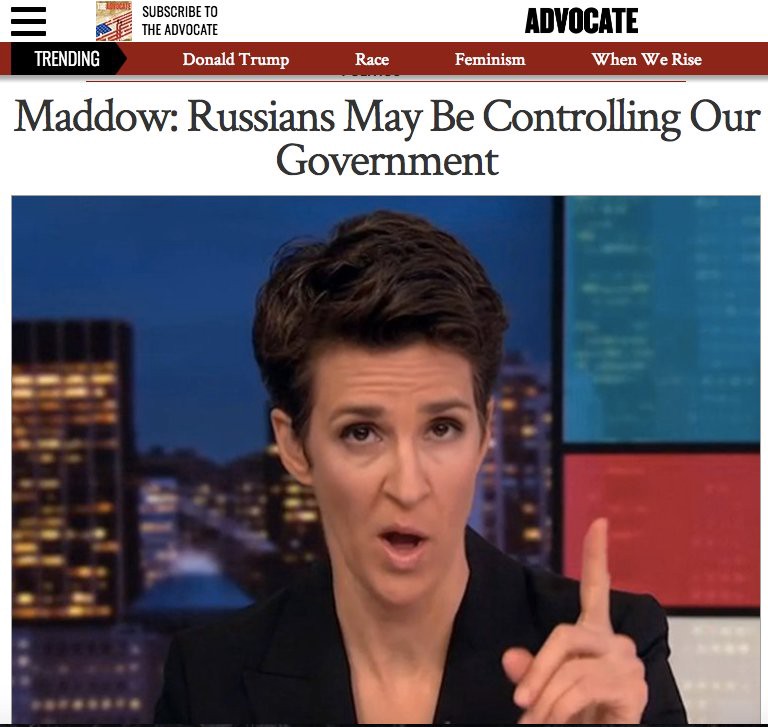
By Whitney Webb | MintPress News | June 3, 2019
In early May, MSNBC news host Rachel Maddow — known as one of the top promoters of the new Cold War and Russiagate in American media — emphatically endorsed regime change in Venezuela after she claimed that President Donald Trump’s hawkishness towards the South American country had changed, all because of a single phone call with his Russian counterpart Vladimir Putin.
Though Maddow’s claims were arguably the most extreme in suggesting that Trump was “taking orders” from Putin on Venezuela, she wasn’t alone in making them. For instance, Cenk Uygur of the Young Turks also made the claim that the Trump-Putin phone call on Venezuela was “direct evidence that he is literally taking orders from Putin.” In addition, several corporate media outlets supported this narrative by suggesting that Trump “echoed” Putin’s Venezuela stance after the phone call and directly contradicted his top staffers and even himself in doing so.
Yet now, strangely, those same corporate media voices remain silent on the Trump administration’s other regime-change project — in Iran — despite the fact that the Putin-led Russian government is set to be the biggest winner as tensions between the U.S. and the Islamic Republic boil over and threaten to send the Middle East into a fresh bout of destruction and chaos.
How Russia wins
As tensions between the U.S. and Iran have grown in recent months, analysts in both corporate and independent media have speculated about what country is set to benefit the most from the U.S.’ campaign of “maximum pressure” and regime change against the Islamic Republic. Of the many analyses, two countries have stood out as likely beneficiaries: Russia and China.
The cases for China and Russia’s benefit are somewhat similar given that the Trump administration’s focus on Iran results in less pressure on both Russia and China. This is despite the fact that, officially, the U.S.’ current National Defense Strategy explicitly calls for focusing attention on preparing for a “long war” against Russia and China to prevent either from superseding the U.S. as a global superpower. Yet, with the U.S. focused on regime change in Iran and Venezuela, Russia and China can avoid bearing the brunt of U.S. military adventurism, either directly or by proxy, while the U.S. wears itself thin by trying to do it all at once.
Several U.S. military analysts have been warning against war with Iran for precisely this reason. Nikolas Gvosdev, a professor of national security affairs at the U.S. Naval War College, recently wrote in The Hill that the U.S. faces a lose-lose scenario by pursuing a militaristic, aggressive Iran policy:
To gear up for a major conflict with Iran, the U.S. would be forced to de-emphasize Europe’s eastern flank, allowing Russia more time and breathing space to consolidate its position. On the other hand, a U.S. campaign that is defined more by bellicose rhetoric and less by action will buttress Russia’s claim, already seemingly validated in Syria and in Venezuela, that the U.S. talks a good game but has no real stomach for projecting its power.”
Both countries also stand to benefit from Iran’s increasing desperation for trading partners unwilling to bow to the U.S. Currently, China represents 30 percent of Iran’s international trade and the current U.S. sanctions on Iran have pushed Tehran to rely more heavily on Russia, especially for weapons purchases, than it had while the Iran nuclear deal (officially the Joint Comprehensive Plan of Action, JCPOA) was in force.
However, upon closer examination, it becomes clear that China, though it benefits to some degree, is not a clear winner amid current tensions, while Russia stands to gain the most. The reason for this is the effect of current and future U.S.-Iran tensions on the oil market. While China trusts Iran to be a key oil supplier even if there is a breach in U.S.-China relations, any shock to the oil market and any jump in oil prices — both of which are likely to occur if U.S.-Iran tensions continue to escalate — will spell disaster for the Chinese economy, given that China is now the world’s largest importer of oil.
Russia, on the other hand, stands to benefit massively from the chaos that U.S.-Iran tensions are set to unleash on the oil market and, by extension, oil prices. With the U.S. seeking to starve Iran of any and all oil export revenue, all countries that had been purchasing Iranian oil must seek new suppliers. Yet, with the prospect of a U.S-Iran conflict still ever-present, it will be those oil producers outside of the Middle East that will come out on top, since oil supply routes that do not pass through the Middle East do not risk supply disruptions that would be caused by a war in the region. Thus, Russia, owing to its location, will emerge as an oil producer of extreme importance. Furthermore, given that such instability in the Middle East will lead to a surge in global oil prices, Russia will be able to export more oil at a higher price and will see its economy and geopolitical clout benefit greatly as a result.
A potential geopolitical killing
In addition to a great boost to its oil sector, Russia also stands to make unique geopolitical gains, particularly in the Middle East and beyond. For instance, in Syria, Russia is increasingly seeking to use its pull with Syria’s government as a major bargaining chip with Israel and the U.S., as made clear by the upcoming trilateral summit on the Middle East between Russia, Israel and the U.S. The main focus of that summit will likely be the fate of the presence of foreign militaries in Syria, particularly Iranian and U.S. forces.
The summit will likely be dominated by Russia and Israel, given Israel’s influence over the U.S., and particularly over National Security Adviser John Bolton, who will represent the U.S. at the summit. Israel’s key interest in Syria at this stage of the conflict is the removal of Iranian forces from Syria. Russia is likely to oblige that request, as doing so would allow Russia to dominate a post-war Syria at Iran’s expense. This seems to be a current Russian objective in Syria, given recent reports of in-fighting among Russian and Iranian forces in Northern Syria.
However, Russia is unlikely to help reduce Iran’s Syria presence if doing so would favor the United States’ occupation of Syrian territory or threaten to upset Russia’s own interests in Syria. Thus, in this case, Russia is counting on Israel’s influence on the Trump administration to ensure that, if Iranian forces vacate Syria, it will be Russia that will dominate the country post-conflict.
Russia also stands to gain geopolitically from the isolationism being forced on Iran by the Trump administration. Indeed, U.S. pressure on Iran has already served Russian interests by pushing Iran further towards Russia, giving Moscow the status of an increasingly important economic partner of Tehran. While benefiting the Russian economy, closer economic ties between Moscow and Iran would also give Russia a leg up in discussions with the U.S., as Washington may then need to make concessions to or coordinate with Russia in future efforts to pressure Iran.
Meanwhile, Russia stands to reap major profits by selling more weapons to Iran, and to gain geopolitical clout by further cementing its role as a mediator of conflict by promoting compliance with the JCPOA and opposing regime change. Iran’s dwindling options for strategic alliances with non-U.S. aligned countries will make it difficult for Tehran to resist Russian demands on key issues, including the Syria conflict.
Another major geopolitical win for Russia that has resulted from the U.S.’ current Iran policy is the tension that that policy has engendered between the U.S. and its European allies. When the U.S. unilaterally withdrew from the JCPOA, it began the development of a rift between the U.S. and its key European allies who are also JCPOA signatories — particularly France, Germany and the United Kingdom. As a signatory, Russia’s stance on Iran has revolved around the JCPOA, with Russia having urged Iran to remain in the deal “no matter what,” advice that Iran does not now seem keen to follow.
Russia’s stance on JCPOA is likely aimed just as much at Europe as it is at Iran, since promoting the agreement amid the U.S. unilateral withdrawal paints Russia as more predictable and stable in terms of its political stances and diplomacy in comparison to the U.S. If nothing else, Putin is known for excelling at taking advantage of the missteps made by his geopolitical adversaries.
This is all part of a careful public image that Russia is seeking to cultivate with European countries as it hopes to attract them to do business with Russian oil and gas companies as the Middle East now seemingly approaches another era of extreme instability. By promoting the JCPOA alongside Europe, Russia makes increased Russo-European cooperation seem more attractive.
As U.S.-Iran tensions mount, particularly if armed conflict breaks out, importing goods from Russia, especially oil and gas, will appear more attractive and safer in comparison to goods that originate from or pass through the Middle East before arriving in Europe. Depending on how the situation plays out, Europe — driven by concerns about stability and reliability — may be willing to risk angering the U.S. to pursue increased economic cooperation with Russia, even though doing so would run counter to current U.S. and NATO objectives.
Putin plays Netanyahu
While it is often difficult to find accurate, honest reporting on Vladimir Putin –reporting that is neither too biased against him nor too much in his favor — it is generally acknowledged that Putin, above all else, is interested in advancing Russia’s national interest and is a cunning strategist who often thinks several steps ahead of both his allies and his adversaries.
In viewing the ratcheting up of tensions between the U.S. and Iran, Putin’s modus operandi remains unchanged and, upon closer examination, it is clear that he is giving the hotheads driving this still-escalating situation just enough rope to hang themselves. Meanwhile, Russia is waiting in the wings to pick up the pieces and further cement its already acknowledged role as the new foreign “peacemaker” in the Middle East while gaining economic and geopolitical clout in the process.
Prior to the Israeli election earlier this year, Israeli media noted on several occasions that Putin was backing the reelection of Israeli Prime Minister Benjamin Netanyahu, including when Putin hosted Netanyahu at a sudden pre-election summit. Israeli newspaper Haaretz described Putin’s decision to host Netanyahu at the time as aimed at helping Netanyahu secure the “crucial Russian vote” among Russian-Israeli Jews in order to “outflank” his competitors. In another instance, Putin was alleged to have further helped Netanyahu’s reelection odds by having Russian special forces find and deliver the remains of Zachary Baumel — an Israeli soldier who had gone missing in Lebanon in 1982 — to Israel just ahead of the election.
Putin’s direct support of Netanyahu may seem odd to observers of geopolitics, given that the two have often been at odds over Syria. However, Putin and Netanyahu have developed an effective working relationship and Russia and Israel enjoy relatively strong bilateral ties and economic agreements.
Yet, beyond the ties that have been forged between the two countries in recent years, Putin likely knows that he can play Netanyahu’s weaknesses to his advantage. For instance, Putin is acutely aware of the benefits to be reaped from increasing tensions between the U.S. and Iran and is also aware of the key role that Netanyahu has played and continues to play in driving the Trump administration’s Iran policy. Netanyahu’s near-obsession with regime change in Iran and the practical likelihood that a U.S.-Iran war would be “unwinnable” for the U.S. and would leave its military weakened and distracted are points that Putin is likely eager to exploit in pursuance of Russian geopolitical goals.
Russia seeks to play the role of mediator but only to a certain extent and has kept its attitude towards Iran intentionally vague when dealing with the Israeli government, so much so that Israeli officials have cited Russia’s unknown stance towards Iran as a major difficulty in negotiating the deconfliction of Russian and Israeli forces in Syria. This is likely because Russia doesn’t seek to aid either side amid escalating tensions, instead waiting for the current tensions to play out, as it stands to make gains in either case.
That Russia stands to gain from current U.S.-Iran tensions hasn’t been lost on all Israeli officials, however. Earlier this month, a former Israeli intelligence official, Yakkov Kedmi, openly stated that not only is a war against Iran “unwinnable” for the U.S. and its regional allies, but further that Russia would be the only major country to benefit from any military conflict pitting the Americans against the Iranians. Appearing on Russian television program Evening with Vladimir Solovyov, Kedmi stated that, if war does break out, the U.S. “won’t remain whole” after the conflict and that “if anyone wins, it’ll be Russia.”
“If the price of oil exceeds $100 per barrel, it hits the Chinese economy. Most of all, it hits the European and American economies,” Kedmi stated. “If you double the price,” he added, “[global] industry will be ruined. First of all, it will happen in the U.S.” To that, the program’s host, Vladimir Solovyov, asserted that “Their [American] industry will be [ruined]. It’ll be the opposite in our country. Our economy will begin to develop. We’ll feel like kings with golden diamond-studded wheels on our cars.”
Why the Russiagaters are silent on Iran
Given Russia — and Putin’s — clear benefit from the continuing U.S. escalation with Iran and a potential military conflict, it is striking that Putin’s fiercest critics in the American media have remained silent about this clear pay-off as the Trump administration continues to pursue an aggressive, hawkish Iran policy that hardly benefits the U.S. and instead benefits its supposed adversary. This is especially notable in light of the fact that these same American critics of Russia and Putin’s leadership were recently accusing Trump of “taking orders” from Putin by altering his Venezuela policy in a way that was perceived to benefit Russian over American interests.
This dichotomy is most easily deconstructed by noting that top promoters of Russiagate and news personalities known for their hyperfocus on Putin rarely call for any policy that would involve a reduction in tensions or less militarism abroad. Indeed, all too often, the “solutions” offered by these journalists involve sending weapons to U.S. proxy forces, shooting missiles at Russian allies, sanctioning Russia and its allies, and other “useful reminders of the military strength of the Western alliance” between the U.S. and NATO.
Without fail, the suggested solutions of how to counter Putin from the U.S. media and political establishment almost always involve “pushing back” with force equal to or greater than the perceived aggression. Rarely do they involve backing down or unwinding tensions, even in the cases where doing so would clearly challenge key geopolitical objectives of the Russian government.
In the case of Russia’s benefit from Trump’s Iran policy, the benefit is so clear that it has been voiced in several mainstream media outlets — including CNN, The Hill, Forbes and Bloomberg — with most of those reports focusing exclusively on the oil angle. However, while Russia’s advantage has been noted, it is also clear that Trump’s current Iran policy has avoided inflaming the Russiagate hysteria that has marked media coverage of other Trump policies and statements that were perceived as being “pro-Putin” for the past few years.
One reason that the media has skipped a prime opportunity for another Russiagate frenzy is the fact that many of the driving forces behind Russiagate are also supportive of regime change in Iran. Indeed, while Russiagate has recently been cast by Trump and prominent Republicans as a “hoax” narrative exclusive to Democrats, prominent neoconservatives have long been pivotal in creating and fomenting Russigate for over five years.
For instance, the origins of the infamous Steele dossier — which was used to assert that Russia’s government had a litany of salacious blackmail on Trump that it would use to manipulate him as president — trace back to top neoconservative Republican donor Paul Singer. That dossier was subsequently circulated within the Obama administration during the 2016 campaign by neoconservatives Victoria Nuland and the late Senator John McCain.
Many of the same neoconservative figures who have helped stoke Russiagate and pounced on the resulting climate of hysteria to promote increased militarism as the solution, also support regime change in Iran. Michael McFaul — U.S. Ambassador to Russia during the Obama administration — is both a strong advocate for aggressive U.S. measures to counter Putin and also a vocal proponent of U.S.-led regime change in Iran. Similarly, on the supposed other side of the political spectrum, Bill Kristol — well-known neoconservative writer, an icon of the establishment “resistance” to Trump, and a promoter of Russiagate — also strongly supports hawkish measures to contain Russia and is a long-time, vocal supporter of regime change in Iran.
While the tense situation between the U.S. and Iran is undeniably troubling, the relative silence among figures in U.S. media and politics who claim to be Putin’s fiercest critics with regard to Trump’s aggressive Iran policy reveals a stark truth about Russiagate. The goal of Russiagate is not actually about “countering” Putin or Russian geopolitical influence; it is about promoting the expansion and widespread adoption of hyper-militarism by both the establishment left and establishment right in the United States.
While Russia often serves as a useful “boogeyman” in service to this agenda of promoting militaristic policies, the odd moments when those same policies actually benefit Russia and do not run into hysterical opposition from the political and media establishment provide a rare glimpse into the real motivations behind Cold War 2.0 and the dubious validity of the media-driven narratives upon which current anti-Russian hysteria is based.
Whitney Webb is a MintPress News journalist based in Chile. She has contributed to several independent media outlets including Global Research, EcoWatch, the Ron Paul Institute and 21st Century Wire, among others. She has made several radio and television appearances and is the 2019 winner of the Serena Shim Award for Uncompromised Integrity in Journalism.
Featured Video
False Flags and the Dawn of Bioterrorism
or go to
Aletho News Archives – Video-Images
From the Archives
How 1960’s French Nuclear Tests Are Still Claiming Lives in Algeria
Sputnik – 15.02.2018
On February 13, 1960, France carried out its first nuclear test in Algeria’s southern Reggane region. According to official statistics, 17 nuclear tests were carried out in total over the next 6 years. The area remains affected, and local scientists say that radioactive contamination has caused genetic mutations and irreversibly changed the region.
There are no official statistics on the number of victims. The only figures can be found in the records kept by the French representative of the local church, which lists 42,000 victims of nuclear tests. Three years ago, the French Ministry of Defense issued a statement, putting the number at 27,000 people. The victims include French soldiers as well as local Algerians who lived in the surrounding areas. … continue
Blog Roll
 Aletho News
- Sunset on the Quality of Western Propaganda: Arrival of the Dr Strangelove Moment
- Ukrainian general accused of protecting crime bosses
- US-‘Israel’ alliance faces growing rupture after midterms
- GOP’s Crushing Midterm Loss Could Reshape US Political Landscape – Analyst
- Midterm loss gives Congress power to rein in US war on Iran
- Midterms Were ‘Vote of No Confidence’ in GOP, But Iran Has No Illusions About Democrats – Marandi
- Israeli Soldiers Inadvertently Prove Their Own Genocidal Guilt
- Ukraine arrests woman who exposed Azov battalion’s ‘torture chamber’
- Did Israel lose the midterms?
- How Iran defeated Trump’s Israel First GOP
- If Americans Knew
- An error has occurred; the feed is probably down. Try again later.
- No Tricks Zone
- New Study: The Net Fossil Fuel Contribution To Rising Atmospheric CO2 Has Been Zero For 500 Years
- Germany’s Green Energy Transition Becoming Increasingly Expensive…Another 6 Trillion Euros!
- Sudden Stratospheric Warming, Powerful El Niño Combination May Lead To Extreme Europe Cold, Energy Crisis!
- Two New Studies Find Thwaites Glacier Melt Cannot Be Driven By Human Activity Or A Warming Ocean
- E-Cars Reduce CO2 Emissions By Only 41% Compared To Internal Combustion Engine Vehicles
- Predictions Made By Renowned Climate Professor Over Past Decades Have Been Proven To Be Poor
- New Study Suggests Large Regions Of The Pacific Ocean Have Been Cooling For The Last 80 Years
- Germany’s Green Energy Debacle: High Energy Costs Force Kahla Porzellan to Close After 182 Years!
- New Study: 50 Years Of The Most Aggressive ‘Net Zero’ Policies Can Only Affect The Global Climate By 0.03°C
- US September “Heat” Was No Record…Many Records Set Decades Ago

