Google’s Empire: The Science Fiction of Power

By Maximilian C. Forte | Zero Anthropology | June 28, 2019
“For as long as I can remember, I always wanted to make a film about libraries,” explains Ben Lewis, the director of Google and the World Brain (2013). About libraries, he says, “they are my favourite places to be. Serene, beautiful repositories of the best thoughts that men and women have ever had”. Political economy, and the rights of citizens in a democracy, also loom large in Lewis’ estimation of the importance of libraries. As he states, libraries are: “Free to use. Far from the din of modern capitalism, libraries are the epitome of the public institution. There is simply nothing bad about a library. It is my paradise”. While praising the value of the Internet, Lewis warns, “the Internet also takes things from us, without asking”. Marrying the Internet and libraries raises hugely problematic issues, especially in the case of Google’s book-scanning project—problems surrounding copyright, national cultures and surveillance.
The political economy of knowledge production is one of the central areas of research interest that constitute the Zero Anthropology Project. This documentary was a good match for that interest, especially as it provokes a number of “big questions”: What are the social and political consequences of knowledge centralization? How, or when, is the digitization of knowledge problematic, and for whom? What role do libraries play in contemporary society? Does copyright protect much more than just authors’ rights and publishers’ profit-making activities? How is the digitization of knowledge linked to surveillance and governance? Should private corporations play any part in creating and/or controlling a universal library? Is a universal library even possible?
Google and the World Brain (2013)
If you were looking for a documentary that was not just another evangelical tract about how “information wants to be free,” spoken by wide-eyed zealots of “open access,” then this is the film for you. While beginning with enthusiasm for open access, for nearly a decade now Zero Anthropology has been warning about the dangers of open access, especially when it comes to facilitating the flow of information to the imperialist military of the US, or bolstering US academic hegemony. Ben Lewis’ Google and the World Brain shows us that we are on the right track. Yet some will argue that there are questionable aspects of Lewis’ critiques and the way they are presented in the film.
Directed by Ben Lewis, Google and the World Brain (2013) runs for 89 minutes. A trailer is included below, but the film in its entirety can be seen online, for free, on Archive.org and on the website of Polar Star Films. If you have 89 minutes to spare, please view it and then let us know if the following analysis was either flawed or unfair.
A trailer for the film is available below:
Polar Star Films, which produced Google and the World Brain, provided a detailed synopsis of the film which forms the basis for the following overview of the film.
Overview
Google and the World Brain is the story of “the most ambitious project ever attempted on the Internet: Google’s project to scan every book in the world and create not just a giant digital global library, but a higher form of intelligence”. The film’s critique draws from the dystopian warnings of H.G. Wells who in his 1937 essay “World Brain” predicted the creation of a universal library that contained all of humanity’s written knowledge, and which would be accessible to all of humanity. However, this would not just be a library in the sense of a static holding of inventoried contents, rather it would form the foundation for an all-knowing entity that would eliminate the need for nation-states and governments. With every increase in the quantity of information that it possessed, the globalist World Brain would be better able to rule over all of humanity, and would thus monitor every human being on the planet.
Supposedly Wells’ dystopian vision of technological progress (has progress ever really produced anything other than a succession of dystopias?) was just science fiction. However, this film shows how a World Brain is being brought into existence on the Internet: “Wikipedia, Facebook, Baidu in China and other search engines around the world are all trying to build their own world brains—but none had a plan as bold, far-reaching and transformative as Google did with its Google Books project”.
Starting in 2002, Google began its project of scanning the world’s books. To do so, they entered into legal agreements with major university libraries in the US, most notably those of Harvard, Stanford, and Michigan, and then expanded to include deals with the Bodleian Library at Oxford in the UK and the Catalonian National Library in Spain. The goal was not simply the collection of all books—instead, as Lewis’ film argues, there was “a higher and more secretive purpose” which was to develop a new form of Artificial Intelligence.
Of the 10 million books scanned by Google by the time this documentary was made, six million of them were under copyright. This fact provoked authors, publishers, and some librarians around the world to not only protest Google, but also to take legal and political action against it. In the fall of 2005 the Authors Guild of America and the Association of American Publishers filed lawsuits against Google. That resulted in a 350-page agreement negotiated with Google, which was unveiled in October of 2008.
However, that agreement which involved Google paying a settlement of $125 million, also granted Google Books huge new powers. The result was that Google would become the world’s biggest bookstore and commercialized library. Google now had the exclusive right to sell scans of all out-of-print books that were still in copyright. What this meant is that Google had a monopoly over the majority of books published in the 20th-century.
Reacting against this settlement, Harvard University withdrew its support for Google’s project. Authors in Japan and China joined a worldwide opposition to Google’s book-scanning. The governments of France and Germany also condemned the agreement. In the US, the Department of Justice launched an anti-trust investigation. Starting in late 2009, US Judge Denny Chin held hearings in New York to assess the validity of the 2008 Google Book Settlement, and in March of 2011 he struck it down.
Google altered its plan in order to continue with a version of its book-scanning project. Google signed deals with many individual publishers that would allow Google to show parts of their books online. Google also continued to scan books out-of-copyright. What Google was not able to do was carry out its master plan for an exclusive library that it controlled alone. The Authors Guild also persevered with suing Google for up to $2 billion in damages for scanning copyrighted books.
In this documentary, Google occupies the spotlight. Issues of copyright, privacy, data-mining, downloading, surveillance, and freedom come to the fore as a result.
The key figures interviewed in this film include some of the leading Internet analysts such as Evgeny Morozov, Jaron Lanier, Kevin Kelly, Clay Shirky, and Pamela Samuelson. Librarians in charge of some of the world’s leading libraries are also interviewed, including Robert Darnton (Harvard), Reginald Carr and Richard Ovendon (Bodleian), Jean-Noel Jeanneney (French National Library). In addition, authors involved in the struggle against Google Books such as Charles Seife, Roland Reuss, and Mian Mian (a best-selling Chinese author), are also key figures in the film.
The filmmakers challenge utopian visions of the Internet as the hoped for means of spreading democracy, freedom, and culture around the globe. Instead, the film argues that the Internet has enabled practices contrary to those ideals by, “undermining our civil liberties, free markets and human rights, while concentrating power and wealth in the hands of powerful new monopolies over which we have little influence”.
Polar Star Films ends its synopsis with this very important warning and urgent call for action:
“Humanity now stands at a crossroads. We can either take action to ensure that all the information and knowledge that the Internet is providing serves us, or we can remain passive consumers, and wait for all that information to take control over us. Whatever we do in the next few years will shape society for centuries to come”.
Contemporary Globalization as Science Fiction
H.G. Wells has to be one of the most prescient thinkers of the past two centuries. It is astounding just how far his supposed science “fiction” was in fact an outline discerning what would soon become reality. He had a particularly keen sense of the patterns taking shape around him, and just as keen a vision of the direction in which forces would move the world.
This is not the first time that we resort to the work of H.G. Wells which, under the guise of “fiction,” seemed to provide what global leaders would then adopt as a plan of action. In “The Shape of Things to Come in Libya,” we witnessed the applicability of Wells’ The Shape of Things to Come with its domineering figures, the “United Airmen”—progressivist autocrats who proclaimed themselves “freemasons of science”. Precursors to the neoliberal globalist mode of governance, the United Airmen came to vanquish local warlords and end all national governments, declaring independent sovereign states at an end, even if it meant war to erase them from the face of the earth.
Google and the World Brain opens with these words from the 1937 essay, “World Brain,” by H.G. Wells:
“There is no practical obstacle whatever now to the creation of an efficient index to all human knowledge, ideas and achievements. To the creation, that is, of a complete planetary memory for all mankind”.
Wells’ depiction of the World Brain was of a new kind of empire: a global dictatorship of technologists and intellectuals. Managers would become the new de facto politicians. This tyranny of expertise sits very well with the current neoliberal world order which sees its future in jeopardy.
It is a peculiar way to start, accompanied by an eerie soundtrack, since one might think that there is nothing especially scary about an “index,” about efficient organization of information, or a complete memory. However, given the mood of the film’s opening, we are immediately invited by the filmmaker to consider these aims in a different light—a much dimmer one.
The film also ends with Wells—all is bad that ends Wells. Quoting from his 1945 book, Mind at the End of its Tether, Wells predicted that this progressivist new world order would come crashing down:
“It is like a convoy lost in darkness along an unknown rocky coast with quarrelling pirates in the chart room and savages clambering up the sides of the ship to plunder and do evil as the whim may take them. That is the rough outline of the more and more jumbled movie on the screen before us. There is no way out. Or round. Or through”.
What is at Stake?
Wells also seemed to predict the Internet as making this world brain possible—this complete database of all human knowledge, past and present, could “be reproduced exactly and fully in Peru, China, Iceland, Central Africa or wherever else”. One of the analysts interviewed in the film, Kevin Kelly, is of the opinion that having instantaneous access to all human knowledge, “changes your idea of who you are”. Some will inevitably ask: “Is that a bad thing?” Kelly himself seems to think not, and he appears in this film as an evangelist for AI, the Internet, and the wonders of the screen.
The film thus turns its attention to the Google book-scanning operation, described by one analyst as, “clearly the most ambitious World Brain scheme that has ever been invented”. Still, some will wonder, what is the problem? How is the scanning of books something that should alarm anyone?
The film focuses further, and becomes a story about Google trying to achieve a monopoly over the digitization of books. Some will ask: “Is the real problem the total digitization of printed knowledge (which is quite distinct, and often separate from all knowledge as such, since not all human knowledge is published), or is the problem that of corporate monopoly?” In its early minutes, the documentary can be confusing about its intended aims.
The third focus comes next: the argument becomes that Google could track everything, and as Pamela Samuelson (law professor, Berkeley) explains, Google “could hold the whole world hostage”. Some viewers might balk: “this is just alarmism”.

Robert Darnton, Director, Harvard Library
What are the stakes? Speaking of the continued importance of libraries, Robert Darnton (Director, Harvard University Library) says in the film that libraries are, “nerve centres, centres of intellectual energy”. Lewis Hyde adds: “Libraries stand for an ideal, which is an educated public. And to the degree that knowledge is power, they also stand there for the idea that power should be disseminated and not centralised”. Are centralization and dissemination opposed and mutually exclusive? Even as he calls for dissemination, Darnton himself utilizes the concept of “centres”.
(Ironically, Darnton calls for the knowledge held by libraries to be opened up and shared—yet when I tried to gain access to some of Harvard’s library collections myself during research visits in 2004 and 2005, I required special written permission just to gain entry into the buildings.)
Expanding and Centralizing the Control of Knowledge
Google was initially successful in seducing a few of the world’s largest libraries, including those of Harvard and Oxford, whose chief librarians interpreted Google’s book-scanning project as a logical extension of a long history of attempts at centralizing knowledge. Among the earlier attempts were encyclopaedias; plans for a catalogue of all knowledge; and, microfilming.
More recently, and since the advent of the World Wide Web, Project Gutenberg became the first digital library, one which scholars have used and will continue to use regularly. Project Gutenberg, founded by Michael Hart, actually started in the early 1970s with the simple act of typing and distributing the Declaration of Independence.
Ray Kurzweil’s invention of the scanner clearly represented the one key advance needed to proceed towards digitizing knowledge. In 1975, Kurzweil created the first omni-font optical character recognition device, which went commercial in 1978. As Kurzweil admits, “we talked about how you could ultimately scan all books and all printed material”.
In the late 1990s the book, the scanner, and the Internet were combined in an effort to create what was hoped would be gigantic digital libraries. The Internet Archive, an indispensable tool for both myself and likely many readers of this review, was established in 1996. Significantly, the director of the Internet Archive, Brewster Kahle, speaks in this film and indicates that he refused collaboration with Google because of the secrecy surrounding the nature of its agreements with libraries, and the fact that Google appeared to be on track to create something exclusive and separate.
Wikipedia, and arguably YouTube, are also massive attempts at acquiring and centralizing knowledge.
Google = Hegemony
Sergey Brin, co-founder of Google with Larry Page, says that Page first conceived of Google Books in 1999. Google Books was then initiated in 2004. In “A Library to Last Forever,” published in The New York Times on October 9, 2009, Brin explained that Google’s digitization effort would be history’s largest-scale effort, primarily because Google invested significantly in the resources needed for the project. In that article, Brin also is clear that Google was zeroing in on out-of-print but in-copyright books, and commercializing them, while also seeking to create new regulations that would allegedly serve the interests of rights holders. Brin argues that Google’s motivation was to preserve “orphan books” against physical destruction and disappearance. Commenting on Google’s supposedly lofty goals, Evgeny Morozov says the following in this film:
“I don’t think that Google is aware of the fact that it’s a corporation. I think Google does think of itself as an NGO that just happens to make a lot of money. And they think of themselves as social reformers who just happen to have their stock traded on stock exchanges and who just happen to have investors and shareholders, but they do think of themselves as ultimately being in the business of making the world better”.
Google, while claiming to be laying the path for others to follow and which says it has aided other digitization efforts, is highly secretive about its scanning operation. It refused the filmmakers access to any of its (secret) scanning locations, and the film thus relies on six seconds of footage—the only such footage in existence—that was leaked out. Google’s secrecy extends to the total number of books it has scanned, and to how much it costs to scan them on average (one estimate is between $30 and $100 per book). Google also worked to prevent any one of its partner libraries from communicating with other partner libraries about the nature of their individual contracts with Google. According to Sidney Verba, former director of Harvard Library, Google “bent over backwards” to make sure that each library would not tell the others what kind of contract they had and how they were working with Google.
How did Google benefit from book-scanning? Five explanations are offered by interviewees in the film.
(1) Lawrence Lessig introduces the point that one of the benefits of massive book-scanning, is that it pumps information into Google’s core, allowing it to develop more sophisticated algorithms that depend on knowing more and more.
(2) Sidney Verba offers a different explanation: by having lots of information in Google, more people would use Google, which would increase the prospective advertising landscape, thus enriching Google by selling advertising space.
(3) Pamela Samuelson, narrowing Google down to a search engine, offers a third viewpoint: having more data (from books, for example), allows Google to perfect its search technology.
(4) Jaron Lanier argues that there is a competition between all sectors of the modern economy (whether healthcare, information and communications technology, finance, criminality, etc.) for more and more data, because data—and specifically data differentials—is a measure of power. Then the data hoarders can in some cases claim that their work is for the common good, by increasing efficiency.
(5) Lanier, Lessig, and Kevin Kelly together make the point that feeding all these books into Google’s servers leads to the creation of something akin to a life-form, a transformative force, a mass of memories that empowers an artificial intelligence system. As the reader will have noted, there is nothing about these five theories that renders them mutually exclusive—they can all be true, at the same time.
The head of Google Books Spain, Luis Collado, the only company official willing to speak to the filmmakers about Google Books, offered a comparatively milder and more innocent explanation. Collado says that Google’s motivation was to amplify the richness of online knowledge. Until it started adding books to the Internet’s offerings, the Internet only consisted of materials that were specifically created for it. For example, in late 1994 in the SUNY-Cortland library I surfed the entire World Wide Web as it then existed, in just one afternoon (at the time I rushed to the conclusion that the Internet was “useless”). For a few years, it was actually practical for me to print everything I found interesting online, because there was so little worth printing. So Collado has a point, even if it does not exhaust the range of plausible explanations.
For Father Damià Roure, Library Director at the Monastery of Montserrat in Spain, Google’s book-scanning was a means of “diffusing our culture” to the rest of the world, while helping to preserve the knowledge contained in its vast library. What he was simply unable to answer was why the monastery had not asked Google to pay for the privilege of scanning the monastery’s collection. As Google turned its operation into a business, from which it would profit, was it fair to get the materials for free? Father Roure went completely silent at this point in the film, in one of the longest, most awkward silences I have ever seen on the screen. He brought it to an end by saying that he was not in a position to comment on anything other than digitization. Reginald Carr, former director of the Oxford’s Bodleian Library, simply downplayed the point: Google, in his view, was fully entitled to make a profit—having invested so much in the scanning—even if the Bodleian’s ethos was to make knowledge available for free.
These two library directors serve a useful purpose: they are a reminder to us that willing collaboration on the part of intermediary local elites is often essential to any grant project of hegemony-building. When it comes to the Internet, and Google in particular, readers of this article are also collaborators—collaborators that, at a minimum, feed Google with content with each search they perform. By continuing to use Google, you make it more powerful.
Assisted Intelligence or Artificial Intelligence?

Jaron Lanier
Speaking of collaboration, the film specifically addresses how Internet users are themselves used. To the extent that this is done unknowingly, unthinkingly, and without compensation, we move from collaboration to exploitation. Jaron Lanier makes this argument forcefully:
“AI is just a religion. It doesn’t matter. What’s really happening is real world examples from real people who entered their answers, their trivia, their experiences into some online database. It’s actually just a giant puppet theatre repackaging inputs from real people who are forgotten. We are pretending they aren’t there. This is something I really want people to see. The insane structure of modern finance is exactly the same as the insane structure of modern culture on the Internet. They’re precisely the same. It’s an attempt to gather all the information into a high castle, optimise the world and pretend that all the people the information came from don’t deserve anything. It’s all the same mistake”.
An absolutely unctuous and all too precious spokesperson for Google, Amit Singhal, actually confirms Lanier’s point when he says the following in the film:
“Google Search is going to be assisted intelligence and not artificial intelligence. In my mind I think of Search as this beautiful symphony between the user and the search engine and we make music together”.
Singhal confirms what Lanier argued, that Google is powered by its users, but then makes the false analogy to a symphony. Musicians performing in an orchestra are clearly instructed on their roles, they perform willingly, and they perform in accordance with known rules and by reading codified music sheets. In other words, the musicians are willing, aware, and informed. Most of Google’s users do not know they are performing in any “symphony”. Google emphasizes harmony where there is in fact concealment, deceit, and exploitation. If there is any music, it is music only to Google’s ears.
Google and Copyright: The Essence of the Confrontation
The film takes a turn into questions of copyright at this stage, when Harvard’s library director, Robert Darnton, points out that its agreement with Google only allowed for the scanning of books in the public domain. However, Google’s agreements with other libraries allowed it to scan all books, including those in copyright. Mary Sue Coleman, president of Michigan University, openly stated that her university allowed Google to scan copyrighted books, claiming that it was “legal, ethical, and noble” to do so (meanwhile universities warn students not to photocopy more than 10% of any given work). Copyright violation is where the legal problems exploded in Google’s face.
However, one of the outcomes of the lawsuits against Google was that the settlement agreement allowed Google to become the world’s biggest bookstore, specializing in out-of-print but in-copyright books. The settlement in fact granted Google an exclusive right to sell such books, without sharing the profits with authors. Google would also not respect the privacy of readers: the company would instead track what readers read, and for how long they read it.
One of the features of copyright that stands out in this film, is that copyright on the Internet takes the place of national borders. Thus we hear from Angela Merkel in this film, asserting that the German government would defend the rights of German authors, by making sure that copyright had a place on the Internet. Likewise, the former President of France, Nicolas Sarkozy, declares in footage shown in this film that France would not allow a large private corporation to seize control of French national heritage, “no matter how nice, important, or American it may be”. Standing against the imperial ambitions of Google therefore was the seemingly old-fashioned principle of copyright. It reached the extent that when the Google book settlement was taken to court in 2009, representatives of foreign authors and foreign governments, accused the US of violating various treaty obligations which could force foreign parties to go to the WTO—and in the likely event of the US losing a case before the WTO, other nations would then have a right to impose trade sanctions on the US.
The outcome is that Google remains the target of publishers’ and authors’ lawsuits, while it continues to scan both out-of-copyright books as well as in-copyright books (in agreement with major libraries, and then offering only “snippets” of the book online). Rivalling Google, various governments and major libraries have undertaken their own library digitization, thus defeating Google’s attempt at becoming an exclusive monopoly. The Digital Public Library of America is one such example of a project that took off in response to the threat posed by Google, as is the case of Europeana.
Google as Empire
The film quotes from William Gibson’s 2010 article in The New York Times, “Google’s Earth,” as part of its argument that Google is building an artificial intelligence entity of a grander scale and sophistication than was even imagined in science fiction. As Gibson explains in that article, Google is “a central and evolving structural unit not only of the architecture of cyberspace, but of the world,” and he adds that this was, “the sort of thing that empires and nation-states did, before,” only now Google’s empire is one that also becomes an organ of “global human perception”. In Google, we are citizens, but without rights.

French National Library

Jean-Noël Jeanneney
Jean-Noël Jeanneney, the former director of the Bibliothèque Nationale de France (the French National Library), represents the voice of the library of the nation-state, that which Google ultimately seeks to erase. He recounts in the film his first encounter with two young Google representatives who came to meet him—he points out that what struck him was their “arrogance” and “brutal commercialism”. These “salesmen,” as he calls them, badly miscalculated his psychology when they brought as a gift a thermo-flask, for which he had no use and which he cast aside. Following his meeting with Google’s representatives, and the company’s announcement that it alone would build a universal digital library, Jeanneney announced to his staff a plan for what he emphatically calls a “counter-offensive”. He criticized the Google book-scanning project as incorporating an Anglo-American cultural bias, and in a noteworthy critique published by Le Monde in 2005 titled “When Google Challenges Europe,” he argued that, “what I don’t want is everything reflected in an American mirror. When it comes to presenting digitized books on the Web, we want to make our choice with our own criteria”. Jeanneney pointed to “the risk of a crushing domination by America in the definition of the idea that future generations will have of the world”. Google suddenly appears not so much as a “new” empire, as in Gibson’s piece, but rather a part of the American empire in a new extension of itself. We are thus back to the familiar problems of Americanization and cultural imperialism.
As Sidney Verba explains in the film, there were two additional sides to the French critique of Google: one had to with the dominant language of Google search results—English—which thus acted as a force undermining French, and the second had to do with who got to decide what would be digitized, its order of priority, and who would get to do the digitization. Who are the Americans at Google who get to digitize France’s books?
Conclusion
While sometimes striking an alarmist tone that was not warranted by the empirical substance that was presented, one could also conclude that the film is only guilty of erring on the side of caution. When dealing with Google in particular, we are well past the point of being cautious: it is a monopolistic entity that for years had a large revolving door between itself and the State Department and the Democratic Party, while also striking deals with the Pentagon and engaging in political censorship. There is nothing innocent about Google, and to the extent that it swallows the Internet, there is little about the Internet that is innocent.
One of the possible lapses of the film is that it does not direct as much attention to China’s Baidu, which has its own extensive book-scanning project that might even rival Google’s. The film presents an interview with Baidu’s communications director, and provides some useful statistics from Baidu employees about the extent of its own book-scanning project—but the bulk of the criticism is reserved for Google.

A book scanning unit in China
However, it has to be said that Ben Lewis does us all an essential service with this film that, ostensibly, appears to be about the simple act of scanning library books, and becomes instead a much larger story about democracy, rights, nation-states, cultures, corporatization, political economy, international law, and the future of globalization.
It was not surprising to see that, once again, one of the top documentaries we have had the privilege of reviewing was produced by Europe’s Arte television company.
This documentary, with all of its thought-provoking questions and careful detail, would be suitable for a wide range of courses in fields such as Information and Communication Studies, Librarianship, Media Studies, Sociology, Anthropology, and Political Science. The film earns a score of 8.75/10.
(This documentary review forms part of the cyberwar series of reviews on Zero Anthropology. This film was viewed four times before the written review was published.)
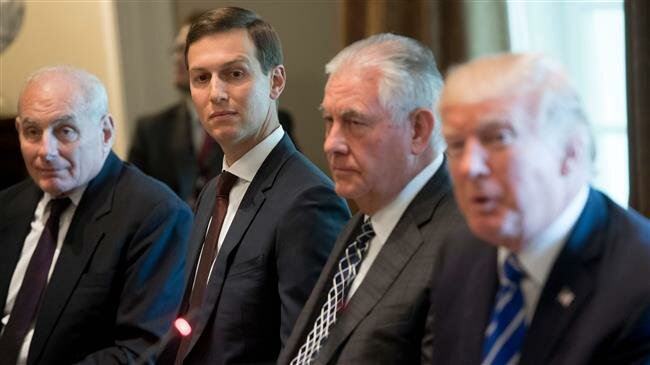
Kushner behind Trump’s withdrawal from Iran nuclear deal: Writer
Press TV – June 28, 2019
Donald Trump’s son-in-law and advisor Jared Kushner represents Jewish interests in the United States that basically caused the US president to withdraw Washington from the Iran nuclear agreement, says an American writer and former professor.
E Michael Jones, the current editor of Culture Wars magazine, made the remarks in an interview with Press TV on Friday while commenting on a statement by former US Secretary of State Rex Tillerson who said that Kushner conducted diplomacy without his knowledge when he was in the administration, leading to several embarrassing incidents.
Tillerson, who was fired by Trump in March 2018, recounted the incidents during a testimony last month at the US House of Representatives Foreign Affairs Committee, according to a transcript of a congressional hearing released on Thursday.
The former top US diplomat and CEO of ExxonMobil described his frustration with Kushner conducting his own diplomacy from the White House, at times without informing the US State Department and the Pentagon.
“This is illegal according to American political system. It violates – I believe – a Logan Act. But in this instance it is going to go unpunished because the part of the story that’s not reported here is Jared Kushner is representing Jewish interests here,” Jones said.
“And no one is allowed to question Jewish interests, if you bring it up you will be called an anti-Semite. There are Jewish interests. It is obvious but no one is allowed to talk about them,” he added.
“So the real significance of the story will be covered over by the mainstream media who were limited to the two areas of insignificance. This of course has direct relevance to Iran because it was Jewish interests that basically caused Donald Trump to abandon the Iran nuclear agreement,” the analyst noted.
“It’s Jewish interests that are once again pushing America into war in the Middle East this time with Iran,” he said.
“Donald Trump I think — recent events have shown – that he does not want war with Iran. He is using the military power to threaten Iran,” Jones noted.
Can You Say “Exorbitant Privilege?” You Can Write for the New York Times
By Dean Baker | Beat the Press | June 26, 2019
Ruchir Sharma again used a New York Times column to complain about plans put forward by Elizabeth Warren and Donald Trump (more the former than the latter) to lower the value of the dollar to make U.S. goods and services more competitive in the world economy. While he raises a number of geopolitical arguments, the gist of his economic argument is that the U.S. is able to run large and persistent trade deficits because the dollar is the leading reserve currency in the world. (Hence the “exorbitant privilege.”)
This ability to run large trade deficits could be a good thing, if we had an economy that was generally near full employment. In that case, the deficit on trade allows us to consume and invest more than would otherwise be possible. However, few serious economists would argue that we have been at or near full employment in the last decade.
Many, if not most, mainstream economists have embraced the idea of “secular stagnation.” This is a more complicated way of saying insufficient demand. In other words, the U.S. economy has not been at or near full employment for the last decade because it has not had enough demand.
A big part of the “not enough demand” story is the trade deficit. If we had balanced trade instead of a deficit of 3.0 percent of GDP, it would have roughly the same impact on aggregate demand as a $600 billion annual stimulus program, all of it in the form of government spending. In other words, the “exorbitant privilege” has been the privilege of having an economy that has been operating well below full employment, with lots of excess capacity.
But wait, there’s more. Because manufacturing goods account for the overwhelming majority of traded items, the large trade deficit translates into a loss of millions of manufacturing jobs. Since manufacturing jobs have historically been a source of relatively high-paying employment for workers without college degrees, the trade deficit has been a big factor in the rise in inequality, especially in the last two decades as the over-valued dollar caused it to explode.
So, “exorbitant privilege” translates into secular stagnation and increased inequality. And Elizabeth Warren wants to jeopardize this with her plans to lower the value of the dollar.
Memo to Trump: Trade Bolton for Tulsi
By Pat Buchanan • Unz Review • June 28, 2019
“For too long our leaders have failed us, taking us into one regime change war after the next, leading us into a new Cold War and arms race, costing us trillions of our hard-earned tax payer dollars and countless lives. This insanity must end.”
Donald Trump, circa 2016?
Nope. That denunciation of John Bolton interventionism came from Congresswoman Tulsi Gabbard of Hawaii during Wednesday night’s Democratic debate. At 38, she was the youngest candidate on stage.
Gabbard proceeded to rip both the “president and his chickenhawk cabinet (who) have led us to the brink of war with Iran.”
In a fiery exchange, Congressman Tim Ryan of Ohio countered that America cannot disengage from Afghanistan: “When we weren’t in there they started flying planes into our buildings.”
“The Taliban didn’t attack us on 9/11,” Gabbard replied, “Al-Qaida attacked us on 9/11. That’s why I and so many other people joined the military, to go after al-Qaida, not the Taliban.”
When Ryan insisted we must stay engaged, Gabbard shot back:
“Is that what you will tell the parents of those two soldiers who were just killed in Afghanistan? ‘Well, we just have to be engaged.’ As a solider, I will tell you, that answer is unacceptable. … We are no better off in Afghanistan that we were when this war began.”
By debate’s end, Gabbard was the runaway winner in both the Drudge Report and Washington Examiner polls and was far in front among all the Democratic candidates whose names were being searched on Google.
Though given less than seven minutes of speaking time in a two-hour debate, she could not have used that time more effectively. And her performance may shake up the Democratic race.
If she can rise a few points above her 1-2% in the polls, she could be assured a spot in the second round of debates.
If she is, moderators will now go to her with questions of foreign policy issues that would not have been raised without her presence, and these questions will expose the hidden divisions in the Democratic Party.
Leading Democratic candidates could be asked to declare what U.S. policy should be — not only toward Afghanistan but Iraq, Syria, Yemen, Saudi Arabia, Israel, Jared Kushner’s “Deal of the Century,” and Trump’s seeming rejection of the two-state solution.
If she makes it into the second round, Gabbard could become the catalyst for the kind of globalist vs. nationalist debate that broke out between Trump and Bush Republicans in 2016, a debate that contributed to Trump’s victory at the Cleveland convention and in November.
The problem Gabbard presents for Democrats is that, as was shown in the joust with Ryan, she takes positions that split her party, while her rivals prefer to talk about what unites the party, like the terribleness of Trump, free college tuition and soaking the rich.
Given more airtime, she will present problems for the GOP as well. For the foreign policy Tulsi Gabbard is calling for is not far off from the foreign policy Donald Trump promised in 2016 but has since failed to deliver.
We still have 2,000 troops in Syria, 5,000 in Iraq, 14,000 in Afghanistan. We just moved an aircraft carrier task force, B-52s and 1,000 troops to the Persian Gulf to confront Iran. We are about to impose sanctions on the Iranian foreign minister with whom we would need to negotiate to avoid a war.
Jared Kushner is talking up a U.S.-led consortium to raise $50 billion for the Palestinians in return for their forfeiture of sovereignty and an end to their dream of a nation-state on the West Bank and Gaza with Jerusalem as its capital.
John Bolton is talking of regime change in Caracas and confronting the “troika of tyranny” in Cuba, Nicaragua and Venezuela.
Rather than engaging Russia as Trump promised, we have been sanctioning Russia, arming Ukraine, sending warships into the Black Sea, beefing up NATO in the Baltic and trashing arms control treaties Ronald Reagan and other presidents negotiated in the Cold War
U.S. policy has managed to push our great adversaries, Russia and China, together as they have not been since the first Stalin-Mao decade of the Cold War.
This June, Vladimir Putin traveled to Beijing where he and Xi Jinping met in the Great Hall of the People to warn that in this time of “growing global instability and uncertainty,” Russia and China will “deepen their consultations on strategic stability issues.”
Xi presented Putin with China’s new Friendship Medal. Putin responded: “Cooperation with China is one of Russia’s top priorities and it has reached an unprecedented level.”
At the end of the Cold War, we were the lone superpower. Who forfeited our preeminence? Who bled us of 7,000 U.S. lives and $6 trillion in endless Middle East wars? Who got us into this Cold War II?
Was all this the doing of those damnable isolationists again?
Copyright 2019 Creators.com.
Globalism has failed US middle class, Trump saw it – Putin on MAGA
RT | June 27, 2019
US President Donald Trump’s election victory should be attributed not to some foreign influence but to the fact that many Americans were left behind by globalization and Trump saw it, Russia’s President Vladimir Putin said.
“The middle class in the US has not benefited from globalisation; it was left out when this pie was divided up,” Putin told the Financial Times ahead of the G20 summit when asked to comment on the US president’s policies.
“Trump looked into his opponents’ attitude to him and saw changes in American society, and he took advantage of this,” he explained, while calling the perceived Russian influence on the US 2016 election “mythical.”
Putin also assumed that globalization could have divided US society – at least in an economic sense. “In the US, the leading US companies — the companies, their managers, shareholders and partners — made use of these benefits. The middle class hardly benefited from globalization.”
“The Trump team sensed this very keenly and clearly, and they used this in the election campaign. It is where you should look for reasons behind Trump’s victory, rather than in any alleged foreign interference,” Putin said. Trump’s “extravagant” policies might be a sign of the US president’s attempts to right some wrongs in accordance with his own “distinct world outlook.”
“He seems to believe that the results of globalization could have been much better for the US than they are. These globalization results are not producing the desired effect for the US, and he is beginning this campaign against certain elements of globalization.”
Putin argued, one of the major problems in the US, but in Europe as well, is that the “ruling elites have broken away from the people.” The elites continue to entertain so-called liberal ideas and seem to be quite happy with the ongoing developments while people are increasingly concerned by such issues as mass immigration, the Russian president believes.
“The liberal idea has become obsolete. It has come into conflict with the interests of the overwhelming majority of the population.”
Democratic candidates on Israel/Palestine
By Kathryn Shihadah – If Americans Knew – June 27, 2019
Overwhelmed by the crowd of candidates for President? The issue of justice for Palestinians – in which almost everyone bows to the Israel lobby – is the ultimate litmus test for integrity. Find out where everyone stands. (This guide will be updated often.)
Keep in mind that since Palestinians in Gaza began weekly unarmed demonstrations for their internationally recognized rights on March 30, 2018 through March 22, 2019, Israeli forces killed over 271 demonstrators and injured 29,187 Gazans (6,000 of them children). During that time 2 Israelis were killed and 56 injured. A Timeline of Palestinian and Israeli deaths is here
Democratic Candidates 1-24
1. Michael Bennet (D)
(New York Times interview question, Do you think Israel meets international standards of human rights? 6/19/19) Yes. I’ve said this before and I believe it: Israel is the one essential country on the planet. I say that because of my family’s history during the Holocaust, and that doesn’t mean Israel’s perfect. Where we have disagreements, we should be able to articulate those disagreements, and I do articulate the disagreements I’ve had with Benjamin Netanyahu over the years.
(Twitter 5/6/19) “We stand behind Israel’s right to self-defense against rocket attacks by terror groups inside Gaza,” he said on Twitter. “Launching rocket attacks against innocent civilians is unacceptable and we mourn the lives lost. A cessation in violence is a necessary step toward de-escalation and stability.”
2. Joe Biden(D)
(Remarks at Saban Forum, 12/7/14)“Send a message to Bibi. I love him.” Even if he drives me crazy, Biden said. The love message came in 2014 a few months after the Gaza slaughter, in which Israel killed 500 children.
(Remarks at Yeshiva Beth Yehuda 75th Anniversary Dinner 11/15/11) About 18, 20 years ago, I was speaking to the Zionist Organization of Baltimore. And I said, I am a Zionist, for I learned you do not have to be a Jew to be a Zionist…[I]t was no surprise to my friends when I was elected to the Senate in a state less than 1 percent of the Jewish — less than 1 percent of the population is Jewish, that I got so deeply involved early on in the Senate with the business of Israel.
(Remarks at AIPAC Policy Conference 3/4/13) We opposed the unilateral efforts of the Palestinian Authority to circumvent direct negotiations by pushing for statehood and multilateral organizations like UNESCO. We stood strongly with Israel in its right to defend itself after the Goldstone ReportGaza flotillain 2010, [I spent a lot of time] going to the United Nations directly by telephone, speaking with the Secretary General, making sure that one thing was made clear, Israel had the right — had the right — to impose that blockade.
3. Bill de Blasio (D)
(New York Times interview question, Do you think Israel meets international standards of human rights? 6/19/19) I believe in the state of Israel…the one true democracy in the Middle East, and they do respect the rights of all people. There’s always more work to be done…it begins with a strong commitment to Israel…I’ve been to Israel 4 times, I’ve spent a lot of time seeing the threats that Israel faces. I firmly believe that we have to defend the state of Israel, and we have to fight against the movements that would undercut Israel, like BDS…The current administration has made a lot of mistakes that have hindered the peace process…
(Remarks at Hampton Synagogue in Westhampton Beach, 8/20/16) I think [BDS – Boycott, Divest, and Sanction is] one of the most ahistorical things I’ve ever seen…Defending Israel is a matter — from my point of view as a progressive — is a matter of being consistent with progressive values.
(Remarks at AIPAC Policy Conference, 3/25/19) As a progressive, here’s what I see when I’m in Israel. I see a multi-racial democracy. I see universal healthcare, free college, a strong labor movement. You’ve often heard it said that Israel’s America’s closest ally in the Middle East and a great center of innovation, and although that is true, I’m moved by something more than that. Israel at its core is there to shelter an oppressed people. That is why I am here to make a simple, clear, progressive case for the state of Israel. So here’s a straightforward definition for you. Progressives fight oppression. Progressives shelter those in danger. We embrace inclusion. We fight against exclusion.
4. Cory Booker (D)
(New York Times interview question, Do you think Israel meets international standards of human rights? 6/19/19) We have a problem right now in America with the way we are debating issues surrounding Israel and Israel’s security…My commitment right now is affirming Israel’s right to exist and affirming Israel’s right to defend itself against enemies which they have virtually surrounding them, but also to affirm the dignity and self-determination of the Palestinian people.
(Senate floor speech 11/29/18) Mr. President, today I wish to add myself as a cosponsor of S. 720, the Israel Anti-Boycott Act, and urge my colleagues to support this important legislation in its modified form. I have long and staunchly opposed the BDS movement and associated efforts to unfairly isolate Israel in international forums.
[Secretly recorded meeting with New Jersey AIPAC members 3/26/19) Israel is not political to me. It’s not political. I was a supporter of Israel well before I was a United State Senator. I was coming to AIPAC conferences well before I knew that one day I would be a federal officer. If I forget thee, o Israel, may I cut off my right hand. [Applause]
[Booker assured a questioner he’s always been for more money to Israel:] Unequivocally 100 percent absolutely [yes] to the 3.3 billion [a year]. I have been on the front lines every time an MOU is up to make sure Israel gets the funding it needs. I even pushed for more funding.
5. Steve Bullock (D)
(New York Times interview question, Do you think Israel meets international standards of human rights? 6/19/19) I think that Israel’s a trusted partner, a trusted friend to our country, and will continue to. I think that there have been certainly in the territories there have been challenges with decisions that currently Netanyahu has made…we could get things back on track, work with our allies, and get to a 2-state solution.
(Signatory of Governors Against BDS, an initiative of the American Jewish Committee, 12/17/17, which reads in part:) We, the undersigned Governors, reject efforts to demonize and delegitimize Israel—America’s democratic ally in the Middle East— through the boycott, divestment and sanctions (BDS) movement. The goals of the BDS movement are antithetical to our values and the values of our respective states…They malign a trusted ally that, while forced to defend itself against repeated and ongoing attempts to annihilate it, has consistently extended its hand in peace to its Palestinian neighbors and to states across the Middle East and around the world. Significantly, the BDS movement would also undermine peacemaking by suggesting that economic and political pressure on Israel can replace real negotiation…
6. Pete Buttigieg (D)
(Comment on American Jewish Committee podcast after returning from an AJC Mayors’ trip to Israel – recorded 4 days after 60 mostly unarmed Palestinians were killed by Israeli sharpshooters, 5/18/18) “Seeing the way that a country can be on the one hand very intentional, very serious, and very effective when it comes to security and on the other hand not allowing concerns about security to dominate your consciousness,” he said, “I think that’s a very important lesson that hopefully Americans can look to when we think about how to navigate a world that unfortunately has become smaller and more dangerous for all of us.”
(Remark in speech at Indiana University, 6/11/19) “If Prime Minister Netanyahu makes good on his threat to annex West Bank settlements, he should know that a President Buttigieg would take steps to ensure that American taxpayers won’t help foot the bill,”
(New York Times interview question, Do you think Israel meets international standards of human rights? 6/19/19) Israel’s human rights record is problematic and moving in the wrong direction under the current rightwing government…I’m very worried, especially with some of the latest talk about annexation of the West Bank, that their government is moving away from peace…
7. Julián Castro (D)
(New York Times interview question, Do you think Israel meets international standards of human rights? 6/19/19) I believe that Israel, like a lot of countries, wants to do the right thing, that they can get better. I do believe that we need to recognize and respect the human rights of Palestinians…Israel has to choose: it’s going to be a Jewish state or a democratic state…I recognize that [a 2-state solution] has been made harder over the years through the increase in settlements…
(Remark at Castro’s Conversations About America’s Future, Austin TX, 3/10/19) Support Israel, remain strong allies, but recognize the value of Palestinians and that they should be treated in a way that we can support on behalf of the country.
(Tweet 4/8/19) In abandoning our position as a good faith partner in the Middle East peace process, the Trump admin has enabled reckless actions like [West Bank annexation] from Netanyahu. US support for a two-state solution is on the line in November 2020.
8. John Delaney (D)
(New York Times interview question, Do you think Israel meets international standards of human rights? 6/19/19) I think Israel does meet international standards of human rights. I think Israel’s in a very difficult situation, when they’re surrounded by countries who are effectively threatening their existence, and don’t believe they have a right to exist. So I think that puts them in an exceedingly difficult situation in many respects. It’s always in the best interest of Israel to make sure their response to people who are threatening them is as measured and appropriate as possible.
(Remark before a trip to Israel as a candidate for Congress, 7/27/12. The visit included holy sites, Israeli officials and business leaders) After speaking with community leaders, faith leaders, and voters, across the District during my campaign, I came to understand that visiting Israel was necessary to obtain a full and proper perspective on our relationship with our strongest ally in the Middle East. I felt that it was vital to gain a first-hand understanding of the issues. Israel is a force for greater democracy and stability in the Middle East, and we must support its right to exist in peace and security…As a member of Congress, I will work to ensure that the US-Israel partnership remains strong” said Delaney.
9. Tulsi Gabbard (D)
(New York Times interview question, Do you think Israel meets international standards of human rights? 6/19/19) I think that there are some challenges with Israel that need to be addressed. I think that ongoing issues that we continue to see in the conflict between Israel and Palestine are complicated, but there needs to be progress made, ultimately to make sure that both the Israeli people and the Palestinian people are able to live in peace and security.
(Tweet following Gaza protest on 5/14/19, in which 60 mostly unarmed Palestinians were killed by Israeli sharpshooters) Israel needs to stop using live ammunition in its response to unarmed protesters in Gaza. It has resulted in over 50 dead and thousands seriously wounded.
(Statement after declining to condemn UN Security Council resolution critical of Israeli settlements, 1/3/17) I know how important our enduring alliance with Israel is,” she wrote. “My vote upholds my commitment to maintaining and strengthening this alliance, as well as my long-held position that the most viable path to peace between Israel and Palestine can be found through both sides negotiating a two-state solution. While I remain concerned about aspects of the UN resolution, I share the Obama administration’s reservation about the harmful impact Israeli settlement activity has on the prospects for peace.”
10. Kirsten Gillibrand (D)
(Statement released after more than 200 rockets were fired into Israel from the Gaza Strip, which were in retaliation for Israel’s breaking a ceasefire and killing 14 Palestinians in one night, 11/12/18)The escalation in violence on the Israel-Gaza border is deeply disturbing, and I am relieved that Israel’s missile defense programs were able to avert civilian fatalities from this disgraceful terror attack. I urge calm so the situation does not further escalate, and I still remain hopeful for a long-term, peaceful solution to this tragic conflict. But the only way we will accomplish that is through negotiations that create conditions for safety and economic security — not through rocket attacks or any other acts of terrorism.
(Statement, 1/11/16) Last week, I led a trip with seven of my Senate colleagues to meet with top government officials and military leaders about security concerns in Israel and our other partners in the Middle East. We heard from Israel’s leaders about the constant threat of terrorism they face, and we reaffirmed to them our commitment to supporting and protecting our closest ally and the only democracy in the Middle East.
11. Mike Gravel (D)
(In a piece for Mondoweiss, 6/19/19) [T]he two-state solution is dead, and we have killed it. The signs of its expiration are all around us. More than half a million Israeli settlers live (illegally) in Palestinian territory, and it would be politically, and logistically, impossible for them to be removed peacefully. The increasingly entrenched Israeli hard right—led by toxic figures like Ayelet Shaked and Naftali Bennett—openly advocates annexing “Area C,” which constitutes most of the West Bank…It is also apparent that a two-state solution would likely not be worth the bloodshed and chaos it would cause. So why keep up the charade?
The most obvious and humane path forward is the creation of a secular, democratic, binational state with equal rights for all. That is the model the U.S. government, with its partners in the region, should work toward and publicly highlight as the ideal outcome. This, like any real solution, would disappoint many, both those who want an official Palestinian national homeland and those who want an official Jewish homeland. But this is necessary.
Of course, the sheer power of the Israel lobby in the United States is the main hurdle to such a radical departure from traditional blind support for Israel. Thus the Israel lobby should be restricted; it is time to free American policy from the shackles of AIPAC (American Israel Public Affairs Committee), ZOA (Zionist Organization of America), and other groups…The first step should be mandating that AIPAC register as a foreign lobby under the Foreign Agents Registration Act (FARA).
Next, the U.S. should end military aid to Israel, citing the Israeli military’s complicity in crimes against the Palestinian people. It should call for a gradual demilitarization of Israel and Palestine, and should be clear with the Israeli government that the days of Israel-right-or-wrong are over.
And the U.S. should refuse to take unconstitutional steps to stifle BDS.
It’s time for a mature relationship with Israel, free of the cloying sentimentalities and tired banalities (“Israel is the only democracy in the Middle East”) that infest our political discourse surrounding it. America’s wanton indulgence of the whims of Benjamin Netanyahu and his fellow rightists will only redound to the harm of Israelis and Palestinians years down the line.
12. Kamala Harris (D)
(Statement 1/1/16)The people of the Middle East need a durable peace, and one that protects Israel’s security and interests. In the U.S. Senate, Kamala will be a staunch supporter of Israel.
(1/11/19) So having grown up in the Bay Area, I fondly remember those Jewish national fund boxes that we would use to collect donations to plant trees for Israel,” she said at the American Israel Public Affairs Committee in 2017. “Years later when I visited Israel for the first time, I saw the fruits of that effort and the Israeli ingenuity that has truly made a desert bloom.”
(New York Times interview question, Do you think Israel meets international standards of human rights? 6/19/19) Overall, yes. I think Israel as a country is dedicated to being a democracy and is one of our closest friends in that region, and that we should understand the shared values and priorities that we have as a democracy, and conduct foreign policy in a way that is consistent with understanding the alignment between the American people and the people of Israel.
13. John Hickenlooper (D)
(Comment after flareup in border violence, 5/7/19) The random rocket fire by Hamas into Israel must stop. My heart goes out to the families of the Israelis killed, and those wounded in these grievous attacks. I call on all parties to show restraint and de-escalate this situation immediately.
(New York Times interview question, Do you think Israel meets international standards of human rights? 6/19/19) Again, there are instances when you can find in almost every country places where there is disagreement for how they treat people or how they resolve internal conflicts. I continue to look at Israel as one of our strongest allies, they have been partners with the United States for a long time. Our challenge is to build on that foundation and help them be able to move towards that two-state solution that, which again, I think almost every Israeli believes is the ultimate goal.
(Interview with Jewish Insider, 6/25/19) We don’t always approve of the decisions of [the] Israeli government but most of us recognize Israel is ally of long standing, one of our strongest allies and even when someone criticizes certain activities of [the] Israeli government, it doesn’t mean we are in anyway diminishing our presence and long term support of the country.
14. Jay Inslee (D)
(New York Times interview question, Do you think Israel meets international standards of human rights? 6/19/19) I’m a longtime supporter of a democratic Israel, and I believe we have to have a two-state solution. And I would work with all parties to make sure we have that we have that; of justice for people in Palestine and democracy in Israel. And that depends on a two-state solution and I would work with everyone to achieve that. I think that all countries can improve in all respects. Certainly our ability to foster a future for the Palestinian people needs all of us to up our game. I do not believe that the present government of Israel has followed policies, and those policies can improve to encourage the ability and maintain the access of the future to a two-state solution, and we all need to be dedicated to that.
(Signatory of Governors Against BDS, an initiative of the American Jewish Committee, 12/17/17, which reads in part:) We, the undersigned Governors, reject efforts to demonize and delegitimize Israel—America’s democratic ally in the Middle East— through the boycott, divestment and sanctions (BDS) movement. The goals of the BDS movement are antithetical to our values and the values of our respective states…They malign a trusted ally that, while forced to defend itself against repeated and ongoing attempts to annihilate it, has consistently extended its hand in peace to its Palestinian neighbors and to states across the Middle East and around the world. Significantly, the BDS movement would also undermine peacemaking by suggesting that economic and political pressure on Israel can replace real negotiation…
15. Amy Klobuchar (D)
In February, The Times of Israel called Klobuchar “the candidate most closely aligned with AIPAC.”
New York Times interview question, Do you think Israel meets international standards of human rights? 6/19/19) Yes [Israel meets human rights standards]. I think Israel, however, under Prime Minister Netanyahu has been doing things that are not helpful to bringing peace to the Middle East. The way that he came out in favor of annexing the Golan Heights, what he has done when it comes to the settlements, the fact that we are not engaging in serious discussions for a two-state solution, our country and the Palestinians and the Israelis, I think that this is setting us back. And so what I would do is to reach out to restart those negotiations again. I think that President Trump has politicized this issue and has not helped in terms of American support for Israel. Israel is our beacon of democracy in the Mideast, and we have a role to play here that is very important and it shouldn’t be politicized the way the Trump administration has politicized it. And when Israel does things that I think are against public policy and international policy, I will call them out on it and I will work with them.
(Tweet following the announcement of Netanyahu’s rightwing coalition, which included radical racists, 2/27/19)This is wrong and has been rightly condemned. To quote the American Jewish Committee, ‘[The views of Otzma Yehudit] do not reflect the core values that are the very foundation of the State of Israel.
16. Wayne Messam (D)
(After returning from an independent trip to the Middle East, 4/8/19) I just recently returned from an independent fact-finding mission to Jerusalem, Ramallah, Hebron, and Tel-Aviv, meeting with top leaders from both sides of the Israeli-Palestinian conflict. I met with the Israeli Ministry of Foreign Affairs, the Deputy Speaker of the Knesset, a mayor of one of the largest settlements, and the executive director of B’Tselem – a leading human rights organization. I also met with the top negotiator on the Palestinian side who negotiated the Oslo Accords and the first woman elected to the Palestinian National Council…Over and over again, Israeli and Palestinian leaders made clear to me their desire to negotiate directly for peace. And it’s not just high-profile figures like the Deputy Speaker of the Knesset or the top negotiator for the PLO. It’s also the everyday Israeli and Palestinians – the people I met in Ramallah, Jerusalem and Tel Aviv – who quietly shared their hopes for a two-state resolution and fears of what would happen if the region were to disintegrate into an all-out religious war.
There was the Israeli cab driver, so overcome with emotion that he had to pull over, swearing his love for his Palestinian neighbors and describing how their families care for each other. Then there was the Palestinian shopkeeper, who despite living under harsh conditions in the occupied territories, displayed both compassion and understanding towards Israelis. Regular people are suffering and deserve American leadership, not misguided ideology and partisan talking points. The actions of the United States in resolving this conflict should not just reflect the interests of a small minority of right-wing, ideological voices.
We are not truly secure when our long-time friend and dear ally, Israel, feels threatened to the point of occupying and securing land as a permanent solution, instead of peace. We are not secure when the Palestinians – have been fully disenfranchised, undermining effective diplomacy, yet this is what happens when a real estate developer leads an insular negotiations process that prioritizes right-wing voices over all others…We are not secure when 53 percent of Palestinians live in poverty, including over 400,000 children.
17. Seth Moulton (D)
(New York Times interview question, Do you think Israel meets international standards of human rights? 6/19/19) Israel often does but not always [meet international standards of human rights]. And it’s incumbent on us as an ally to hold them accountable. And I have done that in Congress. I have signed legislation that is sometimes controversial, to say that we will not supply Israel with weapons and goods if they do not uphold standards for the treatment of Palestinian kids in prison for example. Now it’s not that hard for them to do this, and Israel is our most important ally in the Middle East. Now they’re a democracy that we have sworn to protect and we should. But we also have to hold our friends and allies to the same standards that we should uphold ourselves.
(Remark on HR4391, No Way To Treat A Child, 5/27/19) For decades, the Israeli-Palestinian conflict has endured despite efforts by leaders within the region and throughout the world to find peace…Despite the challenges, I still believe peace is achievable if parties recommit to negotiations towards a two-state solution that allows both nations to safely live side-by-side.
H.R. 4391 would express a Sense of Congress that any abusive or unnecessarily harsh conditions or treatment of Palestinian children during their detention by the Israeli military is a violation of international law and counter to U.S. and international human rights standards.
H.R. 4391 also prohibits the use of U.S. funds to support any abusive or inhumane detention of children…A 2013 UNICEF report showed that Israeli forces arrest, interrogate, and detain approximately 700 Palestinian children a year. While experiences vary, the Israeli military has been documented subjecting children to harsh and sometimes abusive interrogation methods, without an attorney present, that often include forced confessions signed in Hebrew. America should not support these undemocratic practices. That is why I support H.R. 4391, and I believe it will contribute towards a peaceful resolution to this complex conflict and a lasting two-state solution.
18. Beto O’Rourke (D)
(Explaining why he voted against a House resolution to refute U.N. Security Council Resolution 2334, condemning illegal Israeli settlements, 1/5/17) We should be aware of the fact that the U.N. is dangerously preoccupied with Israel…That is of great concern to me—as are other manifestations of this bias, including the Boycott Divest and Sanction (BDS) movement. There is not enough pressure applied to the Palestinian Authority and those who have leverage with its leadership to refrain from acts of terror, incitement to terror, and the cultural context (including in textbooks) that provides part of the moral underpinning for terror to thrive.
However, the settlement problem is putting at risk the very viability of the two-state solution. And I think that it is in our interest and in Israel’s interest for those settlements to cease if there is to be any hope for lasting peace; and that if settlement construction does not stop, a two-state solution will be unobtainable and Israel will lose the ability to be both a democratic and Jewish state.
19. Tim Ryan (D)
(New York Times interview question, Do you think Israel meets international standards of human rights? 6/19/19) You know I think it’s a very complicated relationship that Israel obviously has with Hamas and dealings with the Gaza Strip and the West Bank. And I think the United States needs to play a much bigger role in trying to resolve that problem. I think the president has been very disengaged and we need to be a neutral broker, but recognizing the importance of Israel and the relationship we have with them for all of the other relationships we have in that region. Well, I think they could do a better job, and I think we all need to participate in the discussion. The United States needs to maintain in some its ability to broker these peace agreements. The problem today is we are not even really trying.
(After traveling to Israel as part of a House Defense Appropriations Subcommittee delegation, 3/30/16) I was honored to have the opportunity to meet with Prime Minister Benjamin Netanyahu to discuss and reaffirm the important strategic relationship between our two nations. I remain committed to using my position on the House Appropriations Defense Subcommittee to strengthen partnerships with our allies around the globe, including our most steadfast ally in the Middle East, Israel. Touring the Iron Dome battery further emphasized the importance of this relationship, the need for increased collaboration moving forward, and the value of close friends in the region.
20. Joe Sestak (D)
(Interview with Philadelphia Jewish Exponent, 5/19/10) I strongly support Israel’s security, having visited Israel more than half a dozen times during my naval career. I believe that Israel serves as a vital ally to the United States and that the unique U.S.-Israeli friendship must be preserved and strengthened for generations to come. It is also my firm belief that the successful negotiation of a two-state solution will advance Israel’s security in the region.
The settlements dispute [details here] should not have occurred between the United States and Israel, two stalwart allies. The way it was handled by both nations has not helped bring about a positive engagement. The United States must keep in mind that if Israel does not feel secure, then it is less willing to take risks for peace, and we must continue to ensure that Israel’s security in the region is our No. 1 goal.
Sestak, a retired Navy admiral and 2-term Democratic Pennsylvania congressman, criticized Israel’s blockade of Gaza. He then ran in a Senatorial primary bid against Arlen Specter, the Israel partisan who had just switched from Republican to Democrat. The Dem establishment, including Obama, backed Specter, but Sestak won the primary. Conservative pro-Israel groups spent millions targeting Sestak, who then narrowly lost the general election to Republican Pat Toomey…
(2/24/08) I am proud to have visited Israel at least five times and to have seen firsthand the courage and steadfast resolve of its people. Throughout Israel’s nearly 60-year history, Israelis have fought overwhelming odds to reestablish the birthplace of the Jewish People, and today it remains the only democracy in the Middle East. Surrounded by challenges on all sides, Israel is steadfastly working towards its goals of peace and security.
21. Eric Swalwell (D)
(New York Times interview question, Do you think Israel meets international standards of human rights? 6/19/19) Israel is a country that needs to work with the Palestinian people to find a two-state solution. I support putting the US back into the UN Commission on Human Rights. I support increasing aid to the Palestinian people. And I’m going to fire Jared Kushner on day one, because he has no business being on the job of seeking a two-state solution or finding peace in the Middle East. It requires serious scholars and a serious leader committed to making it happen. That’s what I’m going to do on day one.
I would like to see Israel not conduct any further settlements into the West Bank. I don’t oppose any geographical changes in either region, Israel and the Palestinian area, until we have a two-state solution. So I would press both sides; for the Palestinians to sort out who speaks for them, whether it is the PA or Hamas, and for the Israelis to negotiate and have a partner on the other side to seek that two-state solution. But I’m more interested in the future, I’m not going to go back into the past, because the future depends on a stable and secure Middle East.
22. Elizabeth Warren (D)
(New York Times interview question, Do you think Israel meets international standards of human rights? 6/19/19) I think that Israel is in a really tough neighborhood. I understand that. They face enormous challenges, and they are our strong ally. We need a liberal democracy in that region and to work with that liberal democracy. But it is also the case that we need to encourage our ally, the way we would any good friend, to come to the table with the Palestinians and to work toward a permanent solution. I strongly support the two-state solution, and I believe that a good friend says to the Palestinians and to the Israelis: come to the table and negotiate. The United States cannot dictate the terms of a long-term settlement for the Palestinians and the Israelis, but what it can do is urge both of them to go there and to stay out of the way — to let them negotiate the pieces that are most important to them for a lasting peace.
(Remark after 2nd week of Great March of Return, 4/12/18. Over 30 mostly unarmed Palestinians had been killed by Israeli sharpshooters.) I am deeply concerned about the deaths and injuries in Gaza. As additional protests are planned for the coming days, the Israel Defense Forces should exercise restraint and respect the rights of Palestinians to peacefully protest.
(Letter from Warren and 9 other Senators to PM Netanyahu, 11/29/17) We write today to urge your government not to demolish the Palestinian village of Susiya and the Bedouin community of Khan al-Ahmar. The displacement of entire communities would be an irreversible step away from a 2-state solution, and we urge your government to abandon its efforts to destroy these villages.
(Also read this – Warren voted $225 million to Israel while it was in the midst of its 2014 invasion of Gaza. This year she cosponsored legislation to give Israel $38 billion.)
23. Marianne Williamson (D)
(New York Times interview question, Do you think Israel meets international standards of human rights? 6/19/19) I think there are many countries including the Untied States that behaves in ways that don’t always meet international standards of human rights. As president of the United States I would have an equally robust commitment to both the legitimate security concerns of Israel and the human rights of the Palestinians and the economic hopes and opportunities and dignity of the Palestinian people.
(Remarks during CNN interview, 4/14/19) With me as president, they will know that they have in the United States a president who listens deeply and totally hears; the leaders of the Palestinian authority will know I listen very deeply. In me, you would have a president who says those settlements are illegal. I would rescind the president’s affirmation of sovereignty of Israel over the Golan Heights…[My] love for Israel is second only to my love for the United States…The alliance of the United States with Israel is extremely important. It should be extremely important to all of us. If I’m president of the United States, the world will know, our greatest ally is humanity itself.
24. Andrew Yang (D)
(New York Times interview question, Do you think Israel meets international standards of human rights? 6/19/19) Israel is a very very important ally of the US. Certainly, some of the actions that are being taken there are deeply problematic and run afoul of some of the standards we’d like to see countries meet. I’d hesitant to say they are in violation of those standards.
… and one lone Independent
Bernie Sanders (I)
The killing of Palestinian demonstrators by Israeli forces in Gaza is tragic. It is the right of all people to protest for a better future without a violent response. I’m extremely concerned by reports that President Trump plans to recognize Jerusalem as the capital of the state of Israel. There’s a reason why all past U.S. administrations have avoided making this move, and why leaders from all over the world, including a group of former Israeli ambassadors, have warned Trump against doing it: It would dramatically undermine the prospects for an Israeli-Palestinian peace agreement, and severely, perhaps irreparably, damage the United States’ ability to broker that peace. What the U.S. should be doing now is bringing adversaries in the Middle East together to seek common solutions, not exacerbating tensions in this highly volatile region.
Israel is not, cannot, just simply expand when it wants to expand with new settlements. I think if the expansion was illegal, moving into territory that was not their territory, I think withdrawal from those territories is appropriate. I happen to think that those expansions were illegal.
I think most international observers would say that the attacks against Gaza were indiscriminate and that a lot of innocent people were killed who should not have been killed. Look, we are living, for better or worse, in a world of high technology, whether it’s drones out there that could, you know, take your nose off, and Israel has that technology. And I think there is a general belief that, with that technology, they could have been more discriminate in terms of taking out weapons that were threatening them.
(3/21/16) To my mind, as friends — long term friends with Israel — we are obligated to speak the truth as we see it. That is what real friendship demands, especially in difficult times…But it is important among friends to be honest and truthful about differences that we may have…I am here to tell the American people that, if elected president, I will work tirelessly to advance the cause of peace as a partner and as a friend to Israel. But to be successful, we have also got to be a friend not only to Israel, but to the Palestinian people, where in Gaza unemployment today is 44 percent and we have there a poverty rate which is almost as high. So when we talk about Israel and Palestinian areas, it is important to understand that today there is a whole lot of suffering among Palestinians and that cannot be ignored. You can’t have good policy that results in peace if you ignore one side.
(5/06/17) If a two-state solution fails, Takruri asked Sanders, would he support “one-state with equal rights for Israelis and Palestinians alike, and equal citizenship?” “No, I don’t,” he said. “I mean, I think if that happens, then that would be the end of the state of Israel, and I support Israel’s right to exist.”
Sanders has gone back and forth on Palestine. Unless his progressive base pushes him, he may continue to straddle the fence.
Kathryn Shihadah is staff writer for If Americans Knew. She blogs at Palestine Home.
RELATED READING:
WATCH: Elizabeth Warren supports Israel during its 2014 invasion of Gaza
JTA: Klobuchar’s meeting with Jewish Dem funders, Dear Abby grandson
Joe Sestak, early Democratic critic of Israel, announces presidential run
Presidential candidate offers a bold plan for Israel/Palestine
Tulsi Gabbard Pushes No War Agenda – and the Media Is out to Kill Her Chances
WATCH: Candidates pledge support for Israel in AJC Global Forum videos
US Approach to Palestine-Israel Peace Unveiled at Manama Workshop ‘Counterproductive’ – Moscow
Sputnik – June 27, 2019
Bahrain hosted a two-day forum on 25-26 June, which sought to encourage rich Arab countries to invest in Palestinian projects as part of US President Donald Trump’s “deal of the century”.
Russian Foreign Ministry on Thursday lambasted the US approach to the Palestine-Israel settlement presented at a workshop in Manama, Bahrain.
According to the ministry, the US stance on the issue appears ‘counterproductive’.
The ministry lamented the fact that the issues of relaunching direct Palestine-Israeli negotiations as well as the creation of an independent Palestinian state within its 1967 borders were excluded from the talks in Manama.
On Wednesday, the two-day meeting concluded in Bahrain’s capital Manama. The forum focused on the economic aspects of the initiative developed by the United States to resolve the Middle East conflict, which the media dubbed the “deal of the century”.
Representatives of the Palestinian Authority boycotted the forum, viewing it as an attempt to bribe them.
The Palestinians have been seeking diplomatic recognition for their independent state on the territories of the West Bank, including East Jerusalem, which are partially occupied by Israel, and the Gaza Strip.
The steal of the century: stolen land, stolen water, stolen images
By Bill Law | MEMO | June 27, 2019
Jared Kushner and Benjamin Netanyahu must have considered it the longest of long shots but what if the Palestinians by some wild stretch of the imagination had called their bluff on the “deal of the century”; what if they had suddenly decided to turn up in Bahrain for the “Peace to Prosperity” workshop this week?
To guard against any such thing happening, Israel’s Ambassador to the United Nations, Danny Danon, wrote a deliberately offensive and insulting opinion piece on 24 June that the New York Times was happy to publish. “What’s wrong with Palestinian surrender?” mused Ambassador Danon. “Surrender is the recognition that in a contest, staying the course will prove costlier than submission.” Having backed the Palestinians into a corner from which they could only say no, Kushner then had Danon stick the knife in.
The message, in all its arrogance, was clear: if you don’t take what is on offer, it is going to get a hell of a lot worse. However, we know we have made it impossible for you to take what is on offer, so guess what? The two state solution is well and truly dead; the path to a greater Israel is secured; welcome to the new reality of Palestinian Bantustans in the West Bank and Gaza. And, oh yes, we promise to throw cash at you, $50 billion; that’s a lot of dosh, if you do what is commanded of you. If you don’t, well that money is off the table.
While many commentators have rightly attacked the New York Times for publishing an openly racist and hate-mongering piece, they may have missed the larger significance of what is happening at speed in the killing of the two-state solution. The day before the Danon article, US National Security Advisor John Bolton accompanied the Israeli Prime Minister to land overlooking the Jordan Valley, the most fertile region of the West Bank. Nearly 90 per cent of the valley has been allocated to Israeli settlements and agriculture, in violation of UN Security Council Resolution 242 and international law.
A smiling and nodding Bolton, wearing a baseball cap bedecked with the US and Israeli flags, looked on as Netanyahu argued that the Jordan Valley offered what he called “the minimal strategic depth and height for the defence of our country,” whatever that means. Those who said that restoring the valley to the Palestinians was a prerequisite to peace just didn’t get it, the Israeli Prime Minister argued. No, restoring land to its rightful owners was not going to bring peace; “It will bring war and terror.” So, according to Netanyahu, a just and fair settlement that righted an historic wrong would lead to war. Yet another example of truth turned on its head and a lie declared as truth.
Bolton, resembling one of those bobble-head figures that are given out at American sports events, said that he wished more Americans could come and see for themselves how the Jordan Valley “affects Israel’s critical security position.” He was keen to assure Netanyahu that, “President Trump will take the concerns you have expressed so clearly very much into account.”
It was all eerily reminiscent of another visit that happened in March of this year. On that occasion, Netanyahu was accompanied to the occupied Syrian Golan Heights by the senior Republican senator and Trump ally Lindsey Graham. Graham promised to return to the Senate and “start an effort to recognise the Golan as part of the state of Israel, now and forever.” And so it came to pass, with Netanyahu unveiling a large plaque on the Golan on 16 June announcing the site of a new settlement to be built: in Hebrew and in English it proclaimed that this is now “Trump Heights”.
One could say that it was tacky beyond all belief or you could take the view that in the Trumpian age of impunity, if you are Benjamin Netanyahu you can get away with just about anything. No doubt the Israeli leader was emboldened to massage the presidential ego by the statement made a week earlier by the US Ambassador to Israel, David Friedman. A bankruptcy lawyer who in a previous career had worked for the Trump Organisation (and presumably knows a thing or two about dodgy real estate deals), Friedman had declared that, “Under certain circumstances I think Israel has the right to retain some, but unlikely all, of the West Bank.”
There you have it: in the eyes of Kushner, Netanyahu, et al, the path to peace lies through the annexation of what is left of most of the West Bank, including its most valuable agricultural asset, the Jordan Valley. It goes without saying, therefore, that Kushner’s Peace to Prosperity document has something to say about real estate and the settling of land claims. It is right there on page 19: “Project one, Property Ownership Resolution: Enhance court capacity to quickly and effectively resolve property disputes and contested-ownership claims.”
So the game is this: annex as much as possible using the guise of pursuing a peace deal; declare those lands and buildings already annexed as legally belonging to Israel; and then go to court to decide who gets whatever is left over. And, of course, you can guess whose courts and whose judges. Peace to Prosperity doesn’t say anything about it, but I think we know the answer.
Read the document a little further on and it gets worse. There is a whole section devoted to agriculture. It sounds wonderful until you reflect that the most valuable agricultural asset is already off the table. True, there is a water irrigation project to help sustain Palestinian farmers, but guess what? The Israelis already control West Bank aquifers including those in the Jordan Valley where they have drilled deep bores circumventing and cutting off Palestinian wells and requiring the Palestinians to buy their own water back from Israel.
Meanwhile, back in Manama, the Israelis had broken through longstanding taboos and met with senior and some not so senior representatives of Arab states. Bahrain’s Foreign Minister told an Israeli interviewer, “We do believe that Israel is a country to stay, and we want better relations with it, and we want peace with it.” That is something that would have been unthinkable before the arrival of Donald Trump in the White House. It is the Israelis and not the Palestinians who are being embraced, and Arab protestations in public about support for a two state solution sound increasingly feeble and unconvincing.
Reading Kushner’s document I was struck by the illustrations and photos of smiling Palestinians, and I wondered if these people give permission for their images to be used. Odd if they had, given the awful way that Kushner and his father-in-law have treated them. Not surprisingly, though, it turns out that no such permission was given; the pictures were lifted from, among other sources, USAid videos about an agricultural project several years ago and from a joint Palestinian-Israeli reconciliation project. USAid to the Palestinians has, of course, been cancelled by Trump, but that didn’t stop the lifting of the photographs.
Stolen land, stolen water, stolen images. The steal of the century. And the world sits back and lets it all happen. No wonder Jared Kushner is looking smug.
Monsters Walk the Earth. Why These Three Countries Are the Real Troika of Evil
By Philip Giraldi | Strategic Culture Foundation | June 27, 2019
There are monsters among us. Every day I read about an American “plan” to either invade some place new or to otherwise inflict pain to convince a “non-compliant” foreign government how to behave. Last week it was Iran but next week it could just as easily again be Lebanon, Syria or Venezuela. Or even Russia or China, both of whom are seen as “threats” even though American soldiers, sailors and marines sit on their borders and not vice versa. The United States is perhaps unique in the history of the world in that it sees threats everywhere even though it is not, in fact, threatened by anyone.
Just as often, one learns about a new atrocity by Israelis inflicted on the defenseless Arabs just because they have the power to do so. Last Friday in Gaza the Israeli army shot and killed four unarmed demonstrators and injured 300 more while the Jewish state’s police invaded a Palestinian orphanage school in occupied Jerusalem and shut it down because the students were celebrating a “Yes to peace, no to war” poetry festival. Peace is not in the Israeli authorized curriculum.
And then there are the Saudis, publicly chopping the heads off of 37 “dissidents” in a mass display of barbarity, and also murdering and dismembering a hapless journalist. And let’s not forget the bombing and deliberate starving of hundreds of thousands innocent civilians in Yemen.
It is truly a troika of evil, an expression favored by US National Security Advisor John Bolton, though he was applying it to Cuba, Venezuela and Nicaragua, all “socialist” nations currently on Washington’s “hit list.” Americans, Saudis and Israelis have become monsters in the eyes of the rest of the world even if in their own minds they are endowed with special privilege due to their being “Exceptional,” “Chosen by God” or “Guardians of Mecca and Medina.” All three countries share a dishonest sense of entitlement that supports the fiction that their oppressive and often illegal behavior is somehow perfectly legitimate.
To be sure not all Americans, Saudis or Israelis are individually monsters. Many are decent people who are appalled by what their respective governments are doing. Saudi citizens live under a despotism and have little to say about their government, but there is a formidable though fragmented peace movement in slightly less totalitarian Israel and in the United States there is growing anti-war sentiment. The discomfort in America is driven by a sense that the post 9/11 conflicts have only embroiled the country more deeply in wars that have no exit and no end. Unfortunately, the peace movement in Israel will never have any real power while the anti-war activists in America are leaderless and disorganized, waiting for someone to step up and take charge.
The current foreign policy debate centers around what Washington’s next moves in the Middle East might be. The decision-making will inevitably involve the US and its “close allies” Israel and Saudi Arabia, which should not surprise anyone. While it is clear that President Donald Trump ordered an attack on Iran before canceling the action at the last minute, exactly how that played out continues to be unclear. One theory, promoted by the president himself, is that the attack would have been disproportionate, killing possibly hundreds of Iranian military personnel in exchange for one admittedly very expensive surveillance drone. Killing the Iranians would have guaranteed an immediate escalation by Iran, which has both the will and the capability to hit high value targets in and around the Persian Gulf region, a factor that may also have figured into the presidential calculus.
Trump’s cancelation of the attack immediately produced cries of rage from the usual neoconservative chickenhawk crowd in Washington as well as a more subdued reiteration of the Israeli and Saudi demands that Iran be punished, though both are also concerned that a massive Iranian retaliation would hit them hard. They are both hoping that Washington’s immensely powerful strategic armaments will succeed in knocking Iran out quickly and decisively, but they have also both learned not to completely trust the White House.
To assuage the beast, the president has initiated a package of “major” new sanctions on Iran which will no doubt hurt the Iranian people while not changing government decision making one iota. There has also been a leak of a story relating to US cyber-attacks on Iranian military and infrastructure targets, yet another attempt to act aggressive to mitigate the sounds being emitted by the neocon chorus.
To understand the stop-and-go behavior by Trump requires application of the Occam’s Razor principle, i.e. that the simplest explanation is most likely correct. For some odd reason, Donald Trump wants to be reelected president in 2020 in spite of the fact that he appears to be uncomfortable in office. A quick, successful war would enhance his chances for a second term, which is probably what Pompeo promised, but any military action that is not immediately decisive would hurt his prospects, quite possibly inflicting fatal damage. Trump apparently had an intercession by Fox news analyst Tucker Carlson, who may have explained that reality to him shortly before he decided to cancel the attack. Tucker is, for what it’s worth, a highly respected critic coming from the political right who is skeptical of wars of choice, democracy building and the global liberal order.
The truth is that all of American foreign policy during the upcoming year will be designed to pander to certain constituencies that will be crucial to the 2020 presidential election. One can bank on even more concessions being granted to Israel and its murderous thug prime minister Benjamin Netanyahu to bring in Jewish votes and, more importantly, money. John Bolton was already in Israel getting his marching orders from Netanyahu on the weekend and Pence was effusive in his praise of Israel when he spoke at the meeting in Orlando earlier in the week launching the Trump 2020 campaign, so the game is already afoot. It is an interesting process to observe how Jewish oligarchs like Sheldon Adelson contribute tens of millions of dollars to the politicians who then in turn give the Jewish state taxpayer generated tens of billions of dollars in return. Bribing corrupt politicians is one of the best investments that one can make in today’s America.
Trump will also go easy on Saudi Arabia because he wants to sell them billions of dollars’ worth of weapons which will make the key constituency of the Military Industrial Complex (MIC) happy. And he will continue to exert “maximum pressure” on Iran and Venezuela to show how tough he can be for his Make America Great audience, though avoiding war if he possibly can just in case any of the hapless victims tries to fight back and embarrass him.
So, there it is folks. War with Iran is for the moment on hold, but tune in again next week as the collective White House memory span runs to only three or four days. By next week we Americans might be at war with Mongolia.
UAE says no proof Iran hit tankers in clear rebuttal to US-Saudi claims
Press TV – June 26, 2019
The United Arab Emirates says there is no “clear, scientific and convincing” evidence to assign blame for the recent tanker attacks off its coast in the Sea of Oman, splitting with the United States and Saudi Arabia, which hold Iran responsible for the suspicious acts.
UAE Foreign Minister Sheikh Abdullah bin Zayed Al Nahyan said Wednesday that his country was not able to pin the attacks on any country because an investigation had failed to find enough proof.
“Honestly we can’t point the blame at any country because we don’t have evidence,” bin Zayed said during a joint press conference with his Russian counterpart, Sergey Lavrov, in Moscow.
“If there is a country that has the evidence, then I’m convinced that the international community will listen to it. But we need to make sure the evidence is clear and precise and scientific and convincing for the international community,” he added.
Last month, four tankers were subjected to what Abu Dhabi called “acts of sabotage” outside the tiny Persian Gulf sheikhdom’s territorial waters near the Strait of Hormuz.
A joint investigation by the three countries concluded that a “state actor” was most likely behind the incident in May but stopped short of singling out any country.
Another pair of tankers — one of them Japanese — were attacked in the Sea of Oman earlier this month.
Bin Zayed’s statements indicate the UAE’s break from the official standpoint of the US and Saudi Arabia, both publicly blaming Iran for the two instances of tanker attacks without providing any evidence.
The claims by Riyadh and Washington come amid heightened tensions in the Persian Gulf region as a direct result of America’s interventionist policies.
Tensions have been running high between the two countries since Trump’s decision in May last year to abandon the 2015 Iran nuclear deal and reimpose sanctions on Tehran as part of a “maximum pressure” campaign aimed at forcing it to renegotiate a new deal that addresses its ballistic missile program and regional influence as well.
The US has also sent warships, bombers and additional troops to the region in the wake of the suspicious tanker attacks in the Sea of Oman, which it has similarly blamed on Iran without providing evidence.
Iran, however, has remained steadfast on its position. The Islamic Revolution Guards Corps shot down a US spy drone last week, prompting Trump to consider and quickly back out of retaliatory strikes.
Lavrov said that Moscow would try to persuade the US and Iran to start dialogue. Iran has made it clear that it would not negotiate with the US under pressure.
‘UAE wants tensions to be dialed down’
The Emirati foreign minister said that he discussed the US-Iran tensions with Lavrov to see how the maritime routes can be kept open in the wake of such “subversive operations.”
“Expanding international cooperation to protect ships in waterways was discussed,” the UAE official said.
He asserted that the UAE did not want “more turbulence and … more worries” in the region.
“We are in a region that is tense and important for the world and we don’t want more tension,” said Sheikh Abdullah.
The Emirati top diplomat said his country was still working with the US and other regional countries to build what he said was going to be a global coalition to protect oil shipping lanes in the region.
The remarks came a day after US Secretary of State Mike Pompeo set off on a tour of the Middle East, which included a stop in Abu Dhabi, to form a “global coalition” against Iran.
A senior State Department official said Monday that the US Navy was building a “proactive deterrence” program that would be funded by a coalition of nations that want to protect their oil tankers in the region.
Bin Zayed said the project was going to involve regional and other “(oil) exporting and importing” countries.
NSA Again Exposed For Unauthorized Collection Of Americans’ Phone Records
By Tyler Durden – Zero Hedge – 06/26/2019
Yet again, the National Security Agency has been exposed for “accidentally overcollecting” call-record metadata of millions of Americans. According to a WSJ report that relied on documents obtained by the ACLU, the NSA received metadata records from an unnamed phone company that the agency hadn’t been authorized to collect.
According to the report, it’s unclear how the overcollection occurred, but the incident took place after the NSA said it had purged hundreds of millions of metadata records it had amassed since 2015 in a separate overcollection episode.
For those who aren’t familiar with the concept, “Metadata” include the numbers called or texted and the associated time stamps, but not the contents of the conversation.

The documents didn’t make clear how many records had been collected by the NSA since October. The NSA’s media relations chief, Greg Julian, refused to comment on this specific episode, but referred to the prior overcollection episode – which resulted in the NSA deleting an entire database of collected metadata – where the NSA had collected information it hadn’t been authorized to collect.
Essentially, the agency blamed the incident on service providers who incorrectly interpreted the NSA’s request.
“While NSA lawfully sought data pertaining to a foreign power engaged in international terrorism, the provider produced inaccurate data and data beyond which NSA sought,” Julian said.
The company began delivering those records to the NSA on Oct. 3, 2018 through Oct. 12, when the agency asked it investigate the “anomaly.”
Exposure of the incident has predictably provoked outrage from lawmakers, who have been railing against the NSA’s surveillance programs since they were first exposed by former contractor Edward Snowden in 2013. Former lawmaker Pat Toomey, now an ACLU staff attorney, said the incident is just the latest reason why the NSA metadata-collection program, launched in the aftermath of 9/11 as part of the Patriot Act, should be discontinued.
“These documents only confirm that this surveillance program is beyond redemption and should be shut down for good,” Patrick Toomey, an ACLU staff attorney, said in a statement. “The NSA’s collection of Americans’ call records is too sweeping, the compliance problems too many, and evidence of the program’s value all but nonexistent. There is no justification for leaving this surveillance power in the NSA’s hands.”
The House Judiciary Committee has already started weighing which expiring Patriot Act provisions will be renewed, and according to several lawmakers, the phone surveillance program likely won’t be reauthorized.
“Every new incident like this that becomes public is another reason this massive surveillance program needs to be permanently scrapped,” said Sen. Ron Wyden, a longtime critic of the program. “But it is unacceptable that basic information about the program is still being withheld from the public.”
Featured Video

or go to
Aletho News Archives – Video-Images
Book Excerpt
Clinical Trials Relied Upon to License the MMR Vaccine
They insist we must rely on the data, well here it is…
Informed with Aaron Siri | November 24, 2026
Adding to my last post about the MMR vaccine, this one reviews the clinical trials relied upon for its licensure.
Here is an excerpt from my book, Vaccines, Amen, summarizing the clinical trials relied upon to license this vaccine… continue
Blog Roll
 Aletho News
- Kremlin Aide Slams Top German Diplomat for ‘Confrontation Against Russia’ Remark
- Canada stripped of World Cup events over Russian athletes ban
- Guatemala arrests ex-colonel over 1982 killings of Maya Ixil civilians
- Clinical Trials Relied Upon to License the MMR Vaccine
- FDA Ordered to Pay Over $570,000 in Fight Over Pfizer COVID Vaccine Records
- USAID turned to Facebook to drive demand for Covid vaccines in Global South – files
- Britain’s shadow security network expands into south Lebanon
- The ADL Has a Foreign Policy, and You Are Not Supposed to See It
- Former Qatari PM says ‘Israel’ has security ties with all Gulf states
- The Sound of Silence in the Strait of Hormuz
- If Americans Knew
- An error has occurred; the feed is probably down. Try again later.
- No Tricks Zone
- Physicists: Doubling CO2 Has A Smaller Impact On Ocean ‘Acidification’ Than Existing Internal Variability
- Alarmist Climatologists In Shock! 2026 Atlantic Hurricane Season Sees Lowest Count In 101 Years
- New Study: Modern Temps Are Among The Coldest Of The Last 10,000 Years In East Central Europe
- Germany’s Renewable Energies Lead to 1.4 Billion Euro Electric Power Trade Deficit
- Argentina’s Perito Moreno Glacier Joins Antarctica and Arctic In Defying Doomsday Melt Claims
- New Study: Barents Sea Temperatures Were Warmer And Sea Ice Less Extensive In The 1700s Than Today
- German Authorities Start Initiative To Evaluate Public Register For Climate “Disinformation” Spreaders!
- Zonal Asymmetry of Temperature Change in the Antarctic Circumpolar Current
- New Study: The Net Fossil Fuel Contribution To Rising Atmospheric CO2 Has Been Zero For 500 Years
- Germany’s Green Energy Transition Becoming Increasingly Expensive…Another 6 Trillion Euros!

