US to Sanction Implementation of UN Security Council Resolution
By Peter Jenkins | LobeLog | May 6, 2019
On May 3, the U.S. Department of State announced:
Starting May 4, assistance to expand Iran’s Bushehr Nuclear Power Plant beyond the existing reactor unit could be sanctionable. In addition, activities to transfer enriched uranium out of Iran in exchange for natural uranium could be sanctionable. Iran must stop all proliferation-sensitive activities, including uranium enrichment, and we will not accept actions that support the continuation of such enrichment. We will also no longer permit the storage for Iran of heavy water it has produced in excess of current limits; any such heavy water must no longer be available to Iran in any fashion.
This latest U.S. diktat amounts to a frontal assault on UN Security Council Resolution 2231 of July 20, 2015, which reads in part:
[The Security Council] Calls upon all member states…to take such actions as may be appropriate to support the implementation of the JCPOA, including by taking actions commensurate with the implementation plans set out in the JCPOA and this resolution, and by refraining from actions that undermine implementation of commitments under the JCPOA.
The Security Council adopted this resolution six days after Iran, the United States, the United Kingdom, France, Germany, Russia, China, and the European Union agreed to the Joint Comprehensive Plan of Action (JCPOA). This agreement was designed to restrict Iran’s nuclear activities while International Atomic Energy Agency (IAEA) inspectors look systematically into whether Iran’s nuclear program is “exclusively peaceful.”
Not content with ceasing to implement the JCPOA after the United States pulled out a year ago, the Trump administration is seeking to undermine the implementation of JCPOA commitments by threatening to punish others with sanctions.
The other state most clearly targeted by the diktat is Iran. Paragraph A.7 of the JCPOA stipulates:
During [a] 15 year period Iran will keep its uranium stockpile under 300 kg of enriched uranium hexafluoride…. The excess quantities are to be sold and delivered to [an] international buyer in return for natural uranium delivered to Iran.” And paragraph B.10 requires: “There will be no accumulation of heavy water in Iran for 15 years. All excess heavy water will be made available for export to the international market.
But the U.S. statement of May 3 leaves open the possibility that other states engaging in “activities to transfer enriched uranium” and activities that “support the continuation of enrichment” in Iran could be sanctionable, and that the storage of heavy water on Iran’s behalf will be punished. In other words, henceforth other states run the risk of attracting U.S. sanctions if they “support the implementation” of paragraphs A.7 and B.10 of the JCPOA.
It would be interesting to know whether this is a post-1945 “first.” On several occasions, the United States has turned a blind eye to a client state’s failure to implement the provisions of UN Security Council resolutions. But could this be the first time that the United States has threatened to sanction states for implementing such provisions?
On May 4, the EU High Representative and the Foreign Ministers of France, Germany, and the U.K. issued a statement:
We.…. take note with regret and concern of the decision by the United States not to extend waivers with regards to trade in oil with Iran. We also note with concern the decision by the United States not to fully renew waivers for nuclear non-proliferation projects in the framework of the JCPoA. The lifting of nuclear-related sanctions is an essential part of the JCPoA – it aims at having a positive impact not only on trade and economic relations with Iran, but most importantly on the lives of the Iranian people. We deeply regret the re-imposition of sanctions by the United States following their withdrawal from the JCPoA.
It may be that the reference to non-proliferation projects is intended to encompass the May 3 diktat. If so, this expression of concern is better than silence. But it is hardly commensurate with a frontal assault on the implementation of UN Security Council obligations.
What the situation requires is a Security Council debate and forthright condemnation of U.S. contravention of Resolution 2231.
Iran says not doing anything in breach of JCPOA
Press TV – May 7, 2019
Iran says the countermeasures it has vowed to unveil Wednesday are all within the framework of the 2015 nuclear deal, and the country is not leaving the Joint Comprehensive Plan of Action (JCPOA).
The remarks were made by Foreign Minister Mohammad Javad Zarif upon his arrival in the Russian capital Moscow, where he plans to hold talks with his Russian counterpart on the Iran nuclear deal, among others.
Speaking to reporters on Tuesday night, he said Iran’s “strategic patience” with the US’ violations of the nuclear accord during the past year is over.
“Unfortunately, the European Union and other members of the international community were not capable of standing up to the US’ pressures,” Zarif said.
Therefore, he added, Iran has decided to stop implementing some of the JCPOA commitments it used to fulfill voluntarily “for now”.
The Iranian top diplomat said the right to stop implementing commitments partially or in full in case of violation by other parties has been preserved for Iran in the JCPOA.
So Iran is not doing anything against JCPOA now; rather, it is acting totally within the framework of Articles 26 and 36 of the deal, Zarif noted.
He described the move as “an opportunity for other parties to the deal to take required measures, and not just issue statements.”
Zarif also noted that the decision has been passed by the Supreme National Security Council, and its details will be announced on Wednesday.
Iran said on Monday it seeks to unveil its countermeasures in response to the US’ 2018 withdraw from the landmark 2015 nuclear agreement signed between Tehran and six major world powers.
The plans will be announced on Wednesday, which marks the first anniversary of the US withdrawal from the nuclear deal.
US President Donald Trump withdrew Washington in May 2018 from the landmark Iran nuclear agreement, reached between Iran and the P5+1 group of countries — the US, Britain, France, Russia and China plus Germany — in July 2015. He also decided to re-impose unilateral sanctions against Tehran.
France threatens to re-impose bans
Sources at the French presidency said on Tuesday international sanctions could be re-imposed on Iran if it reneges on commitments under its nuclear deal.
A French presidential source said the European countries did not yet know precisely what steps Iran was now planning, but they could have to re-impose sanctions on Iran if those steps amount to reneging.
“We do not want Tehran to announce tomorrow actions that would violate the nuclear agreement, because in this case we Europeans would be obliged to re-impose sanctions as per the terms of the agreement,” the source said.
“We sent messages to Tehran to say that we were determined to implement the agreement, that we really wanted them to stay in this agreement even though we took into account the complexity of the situation and passed on the same messages to our American allies.”
A second French official later said that if Tehran failed to comply with the deal, the issue would be treated through a dispute mechanism under the accord itself, which could lead to the re-imposition of UN Security Council sanctions.
Letters to P4+1
Iranian President Hassan Rouhani is expected to write letters to the countries still signed up to the deal – Britain, France and Germany as well as Russia and China – on Wednesday to give them details about plans to “diminish its commitments” under the deal, ISNA quoted a source as saying.
The letters would be handed over to the ambassadors of the five countries by Deputy Foreign Minister Seyyed Abbas Araqchi. A separate letter would also be written to EU Foreign Policy Chief Federica Mogherini.
Offended By What Someone Said? Now You Can Report Them To Law Enforcement
MassPrivateI | May 7, 2019
Soon free speech will be a thing of the past in paranoid America.
DIGIT Lab’s “Hate Incident Reporting” app promises to turn complete strangers into secret, hate speech/bias spies.
Watch what you say, because the person sitting next to you could be reporting you to law enforcement.
Gone are the days when Americans were unafraid to voice their opinions or make snide comments in public. Because DIGIT Labs will turn smartphones into bias reporting devices.
According to a PHYS.org article, DIGIT LAB’s new app allows strangers to report someone for exercising their first Amendment rights.
“The first of its kind, the app accepts reports beyond crimes captured in police records. Users from around the country can document all incident types, from derogatory epithets written in bathrooms to slurs yelled from a car window in addition to violent assaults.”
This app will make swearing at a fellow motorist or flipping someone off: hate speech.
Where in our Constitution does it say that it is acceptable to report someone who has not committed a crime?
Since 9/11, Homeland Security has tried to turn the entire country into home-grown spies with their “See Something, Say Something” campaign that essentially does the same thing as DIGIT LAB’s Hate Reporting app. If someone see’s something or see’s someone acting suspiciously they are encouraged to report it to law enforcement.
But the University of Utah’s, Hate Incident Reporting app, promises to create a Federal free speech blacklist.
“The major problem we’re dealing with is that hate crimes are so underreported, not only to police, but from police to the federal government,” said Emily Nicolosi, researcher, and Richard Medina, professor of geography. (Nicolosi helped develop the app.)
Creating a national blacklist of people who use derogatory epithets and slurs will turn this country into a mirror image of China.
“We’d like to see it used nationally to get better hate incident statistics, and to understand why, how, and where people are active in hateful incidents, and how that offends or hurts people,” said Medina.
Although the PHYS article claims that all reporting is confidential and anonymous, the amount of detailed information a person is asked to provide would make it easy for law enforcement to identify someone.
US sanctions against Iran, Cuba, Venezuela breach human rights: UN expert
Press TV – May 7, 2019
A UN rights expert has slammed unilateral US sanctions against Iran, Cuba and Venezuela, saying the use of economic measures for political purposes violates human rights and international law.
In a statement released on Monday, Idriss Jazairy, UN special rapporteur on the negative impact of the unilateral coercive measures, warned that the US bans against the trio might precipitate man-made humanitarian catastrophes.
“Regime change through economic measures likely to lead to the denial of basic human rights and indeed possibly to starvation has never been an accepted practice of international relations,” he said.
“Real concerns and serious political differences between governments must never be resolved by precipitating economic and humanitarian disasters, making ordinary people pawns and hostages thereof,” he added.
Jazairy also voiced worries about Washington’s termination of sanctions waivers for major Iranian crude buyers, saying the move harms not only the Iranian nation, but also their trade partners.
“The extraterritorial application of unilateral sanctions is clearly contrary to international law,” he said.
“I am deeply concerned that one State can use its dominant position in international finance to harm not only the Iranian people, who have followed their obligations under the UN-approved nuclear deal to this day, but also everyone in the world who trades with them,” he noted, referring to the landmark 2015 agreement — officially called the Joint Comprehensive Plan of Action (JCPOA).
Recently, the US ended six months of waivers which allowed Tehran’s eight largest customers to continue importing limited volumes. It also threatened the buyers of Iranian oil with sanctions if they fail to stop their purchases.
The anti-Iran American sanctions had been lifted under the JCPOA, but they returned in place last year when the US abandoned the multilateral accord.
Elsewhere in his statement, the UN rights expert denounced the economic hardship caused by the US sanctions in Cuba and questioned Washington’s claim that its sanctions against Venezuela were aimed at “helping” its people.
He further called on the international community to “challenge” Washington’s restrictive measures against sovereign countries which amount to “a threat to world peace and security.”
“I call on the international community to engage in constructive dialogue with Venezuela, Cuba, Iran and the United States to find a peaceful resolution in compliance with the spirit and letter of the Charter of the United Nations before the arbitrary use of economic starvation becomes the new ‘normal’,” Jazairy said.
Iran to even the nuclear score with US
By M. K. BHADRAKUMAR | Indian Punchline | May 7, 2019
It is going to be 30 years in another six months since the USS Abraham Lincoln, named in honour of the 16th US President, was commissioned on Nov. 11, 1989 as the 5th Nimitz-class aircraft carrier of the American Navy. Now, as it leaves Croatia and heads toward the Persian Gulf, the carrier would have mixed emotions.
Its finest moment in all of these thirty years came on a sunny day off the coast of San Diego on May 1, 2003, when the then commander-in-chief President George W. Bush landed on its deck in the co-pilot’s seat of a Navy fighter jet to give a “thumbs-up” sign and declare victory in the war in Iraq.
“Major combat operations in Iraq have ended,” Bush said, the infamous “Mission Accomplished” banner hovering over him. “In the battle of Iraq, the United States and our allies have prevailed,” the C-in-C declared.
Sixteen years later, USS Abraham Lincoln is going back to the Persian Gulf in atonement — to confront the real winner of the Iraq War and US’ number one enemy, Iran. The irony of this improbable moment cannot be lost on the 5,000-odd men and women on board the carrier when the US National Security Advisor John Bolton announced their new deployment at 9.30 pm on Sunday. The statement said,
“In response to a number of troubling and escalatory indications and warnings, the United States is deploying the USS Abraham Lincoln Carrier Strike Group and a bomber task force to the U.S. Central Command region to send a clear and unmistakable message to the Iranian regime that any attack on United States interests or on those of our allies will be met with unrelenting force. The United States is not seeking war with the Iranian regime, but we are fully prepared to respond to any attack, whether by proxy, the Islamic Revolutionary Guard Corps, or regular Iranian forces.”
Bolton didn’t go into specifics. To be sure, the sudden announcement — unusual for a Sunday and extraordinary for its timing at 9.30 pm — has triggered speculation. However, Tehran has taken Bolton’s words in its stride, dismissing them as “psywar”. One plausible explanation seems to be that 8th May happens to be the first anniversary of the announcement by President Trump on the US’ withdrawal from the Iran nuclear deal and the fact of the matter is that the anniversary highlights three things.
First, the US and a clutch of Middle Eastern allies aside, the international community has continued to support the Iran nuclear deal. The US’ stark isolation is visible. Second, the US’ punitive sanctions against Iran have taken a heavy toll on the latter’s economy. Growth has stagnated while people face numerous privations in day-to-day life. Three, notwithstanding the above, there are no signs of Tehran changing its policies to compromise with the US’ regional strategies.
Importantly, Tehran has also let it be known that on the anniversary date on May 8, President Hassan Rouhani will announce its retaliatory actions against the US withdrawal from the nuclear deal. The Tehran Times, which reflects establishment views, quoted “sources” to the effect Iran proposes to jettison some of the limitations on its nuclear activities (which had been suspended under the 2015) agreement. Specifically, the report goes to explain, that while Tehran as of now does not intend to quit the nuclear deal (although discarded by Washington), it will take measured steps within the ambit of articles 26 and 36 of the 2015 agreement.
Tehran has already notified the European Union (which, along with UK, France and Germany, is a signatory of the agreement) of its intention. An urgent meeting of the so-called Joint Commission (E3+EU3) is due to take place in Brussels today with Iran’s deputy foreign minister and chief negotiator Abbas Araghchi. This is as per article 36 of the nuclear deal, which prescribes the modalities of arbitration. (The Tehran Times report is here.)
Meanwhile, Tehran is mulling over the options available to it. An influential Iranian strategic thinker who is close to the power circles in Tehran and used to be a spokesman for Iran’s nuclear negotiators in the past, Seyed Hossein Mousavian, wrote in the Middle East Eye on Monday about the growing perception in Tehran that the White House is “laying siege to Iran in ways similar to the way the Bush administration did as it prepared to wage an illegal war against Iraq.
Mousavian warned, “With the US constantly increasing sanctions and pressures, with other world powers failing to provide assurances for the JCPOA’s (Iran nuclear deal) economic benefits, Iran’s patience is running out. It is left with two options: A gradual withdrawal from the JCPOA or an immediate departure from Non-proliferation Treaty and the JCPOA simultaneously.”
Mousavian concludes: “Both options are risky. The possibility of military confrontation exists in both options, but the latter is more effective because the United States will no longer be able to use the NPT as an instrument against Iran. In return, withdrawing from the NPT will bolster Iran’s position on the negotiation table more than ever by giving it more bargaining power.” (Ambassador Mousavian’s opinion piece is here.)
Significantly, there have also been reports recently that Iran’s Foreign Minister Javad Zarif is planning to visit North Korea.
Of course, with its back pushed against the wall, Trump administration is leaving Iran with no choice but to retaliate. (The question of capitulation to US bullying simply does not arise.)
Now, if Iran quits the NPT, it has nothing to lose in the prevailing circumstances where its integration into the international community is in any case blocked by US sanctions. On the other hand, without Iran’s inclusion, the roof over the nuclear non-proliferation architecture will collapse overnight.
Suffice to say, Tehran is forcing the international community to push back at the Trump administration and restore the status quo ante in regard of the 2015 deal. But the Europeans have neither the political will nor the capacity or grit to measure up to Iran’s expectations.
The US knows it. Thus, a flashpoint is arising. Clearly, Iran will not precipitate any military confrontation. But then, Israel is also waiting in the wings to cook up some dirty tricks that leads to a US-Iran conflict. Herein lies the risk.
Having said that, Tehran is betting that Trump himself doesn’t want war with Iran. Possibly, Bolton who works for Israeli interests is punching above his weight. But the brinkmanship itself is incredibly dangerous. A US-Iran war is unthinkable, as the consequences will be disastrous not only for both and regionally but also for the world economy and international security. Worse still, Iran does not even threaten US interests directly.
It is highly unlikely that Trump would ever contemplate a replay of the infamous George W. Bush moment aboard the USS Abraham Lincoln. Simply put, Iran is not Saddam’s Iraq. In Syria, Iraq and Afghanistan alone, there are 20,000 American troops deployed within Iran’s missile range.

Besides, Hezbollah has comprehensively targeted Israel. Israeli estimates put the number of Hezbollah rockets at anywhere up to 200,000. Read a thoughtful analysis by the Atlantic magazine entitled The Many Ways Iran Could Target the United States, here.
Iraq rebuffs US demand to stop Iran energy imports
Press TV – May 7, 2019
Iraq’s Electricity Minister Luay al-Khateeb says his country brushed aside US demands that Baghdad stop gas and power imports from neighboring Iran.
Khateeb, whose remarks were quoted by Iraqi media on Monday, did not say whether the Americans had made the demand after ending waivers for exports of crude oil from Iran this month.
US pressures on Iraq to wean itself off Iran has become a major point of conflict between Washington and Baghdad. A lightening rod in their spat is Iraq’s reliance on Iranian gas imports to generate electricity consumed daily in the country.
Washington is pressing Baghdad to source them from other countries or develop its own energy self-sufficiency. Iraqi leaders say the country cannot stop Iranian gas imports without serious electricity shortages.
In their latest back and forth, Iraq told the Americans that it needed Iran gas imports for at least three more years, Khateeb said.
“Iraq now imports nearly 1,200 megawatts of electricity from Iran. It also imports gas from Iran to produce another 2,800 megawatts of electricity,” the Iraqi minister said.
“If in the next two to three years, large projects are implemented in the field of electricity generation, we can reach self-sufficiency and need no more imports,” he added.
Iraq has signed agreements with General Electric and Siemens over potential deals to develop the country’s power infrastructure.
Siemens had been favorite to win a contract to supply 11 gigawatts of power-generation equipment in a possible $15 billion deal, but the German group has to share the work with US rival after pressure from the Trump administration.
Washington is also pushing for Saudi Arabian and Kuwaiti investment in Iraqi power infrastructure in order to reduce Iran’s trade share.
Without Iran, however, Iraq could lose around a third of its power overnight. The Arab country faces sweltering months ahead when the electricity shortage becomes acute.
The shortage sparked violent protests in southern Basra last September, which spread to other cities, including Baghdad.
Iran is also Iraq’s third-largest trading partner, with an estimated $12 billion in cross-border trade per year, and the countries share strong cultural, religious and geographic ties.
Last month, Iraqi Prime Minister Adel Abdul-Mahdi visited Iran for his first official visit since he took office and the two countries pledged to raise trade to $20 billion in two years.
Head of the National Iranian Gas Company (NIGC) Hassan Montazer Torbati said this month that Iran is about to raise gas exports to neighboring Iraq to 35 million cubic meters a day this year.
“Last year we exported gas to Turkey, Baghdad and Basra with an average of over 40 million cubic meters a day, and this year, gas exports to Iraq will reach more than 35 million cubic meters per day,” he told a news conference in Tehran.
US violating NPT, ignoring Israeli regime’s breaches of accord: Syrian UN envoy

Press TV – May 7, 2019
Syria’s UN Ambassador Bashar al-Ja’afari has slammed the United States for flagrantly violating the nuclear Non-Proliferation Treaty (NPT) and turning a blind eye to the Israeli regime’s breaches of the international accord.
“Syria took the initiative in 1968 to join the treaty, and signed the agreement of guarantees with the International Atomic Energy Agency (IAEA) in 1992 … It also presented a draft resolution in 2003 aimed at the establishment of a (Middle East) region free from weapons of mass destruction (WMD); but the US blocked the measure,” Ja’afari said at the the Preparatory Committee for the 2020 Review Conference of the Parties to the Treaty on the Non-Proliferation of Nuclear Weapons (NPT) in New York on Tuesday.
The Syrian diplomat also lambasted certain Western states for helping Israel establish the Dimona nuclear center and offering it related substances, experience and technology – a step that enabled the Tel Aviv regime to possess hundreds of nuclear heads.
Israel is estimated to have 200 to 400 nuclear warheads in its arsenal. The regime, however, refuses to either accept or deny having the weapons.
It has also evaded signing the Non-Proliferation Treaty (NPT) amid staunch endeavor by the United States and other Western states on international levels in favor of its non-commitment to the accord.
The clandestine nuclear activities were uncovered when whistle-blower Mordechai Vanunu, originally a technician at the Dimona nuclear facility, handed overwhelming evidence of Israel’s nuclear program to Britain’s Sunday Times in 1986.
It is believed that the nuclear site is home to Israel’s nuclear weapons.
In September 2017, then-Iranian Ambassador to the IAEA Reza Najafi denounced the West’s double standard approaches on the possession and development of atomic technology, urging a complete end to any nuclear cooperation with the Israeli regime.
Addressing a quarterly meeting of the IAEA’s 35-member Board of Governors in Vienna, Najafi warned that the Israeli regime’s nuclear program is negatively impacting security of the Middle East.
How GMO Seeds and Monsanto/Bayer’s “RoundUp” are Driving US Policy in Venezuela
By Whitney Webb | MintPress News | May 6, 2019
CARACAS, VENEZUELA — As the political crisis in Venezuela has unfolded, much has been said about the Trump administration’s clear interest in the privatization and exploitation of Venezuela’s oil reserves, the largest in the world, by American oil giants like Chevron and ExxonMobil.
Yet the influence of another notorious American company, Monsanto — now a subsidiary of Bayer — has gone largely unmentioned.
While numerous other Latin American nations have become a “free for all” for the biotech company and its affiliates, Venezuela has been one of the few countries to fight Monsanto and other international agrochemical giants and win. However, since that victory — which was won under Chavista rule — the U.S.-backed Venezuelan opposition has been working to undo it.
Now, with Juan Guaidó’s parallel government attempting to take power with the backing of the U.S., it is telling that the top political donors of those in the U.S. most fervently pushing regime change in Venezuela have close ties to Monsanto and major financial stakes in Bayer.
In recent months, Monsanto’s most controversial and notorious product — the pesticide glyphosate, branded as Roundup, and linked to cancer in recent U.S. court rulings — has threatened Bayer’s financial future as never before, with a litany of new court cases barking at Bayer’s door. It appears that many of the forces in the U.S. now seeking to overthrow the Venezuelan government are hoping that a new Guaidó-led government will provide Bayer with a fresh, much-needed market for its agrochemicals and transgenic seeds, particularly those products that now face bans in countries all over the world, including once-defoliated and still-poisoned Vietnam.
U.S.-Backed Venezuelan opposition seeks to reverse Chavista seed law and GMO ban
In 2004, then-president of Venezuela, Hugo Chávez, surprised many when he announced the cancellation of Monsanto’s plans to plant 500,000 acres of Venezuelan agricultural land in genetically modified (GM) soybeans. The cancellation of Monsanto’s Venezuela contract led to what became an ad hoc ban on all GM seeds in the entire country, a move that was praised by local farmer groups and environmental activists. In contrast to anti-GM movements that have sprung up in other countries, Venezuela’s resistance to GM crops was based more on concerns about the country’s food sovereignty and protecting the livelihoods of farmers.
Although the ban has failed to keep GM products out of Venezuela — as Venezuela has long imported a majority of its food, much of it originating in countries that are among the world’s largest producers of genetically modified foods — one clear effect has been preventing companies like Monsanto and other major agrochemical and seed companies from gaining any significant foothold in the Venezuelan market.
In 2013, a new seed law was nearly passed that would have allowed GM seeds to be sold in Venezuela through a legal loophole. That law, which was authored by a member of the Chavista United Socialist Party of Venezuela (PSUV), was widely protested by farmers, indigenous activists, environmentalists, and eco-socialist groups, which led to the law’s transformation into what has been nicknamed the “People’s Seed Law.” That law, passed in 2015, went even farther than the original 2004 ban by banning not just GM seeds but several toxic agrochemicals, while also strengthening heirloom seed varieties through the creation of the National Seed Institute.
Soon after the new seed law was passed in 2015, the U.S.-backed Venezuelan opposition led by the Roundtable of Democratic Unity (MUD) — a group comprised of numerous U.S.-funded political parties, including Guaidó’s Popular Will — took control of the country’s National Assembly. Until Venezuela’s Supreme Court dissolved the assembly in 2017, the MUD-legislature attempted to repeal the seed law on several occasions. Those in favor of the repeal called the seed bill “anti-scientific” and damaging to the economy.
Despite the 2017 Supreme Court decision, the National Assembly has continued to meet, but the body holds no real power in the current Venezuelan government. However, if the current government is overthrown and Guaidó — the “interim president” who is also president of the dissolved National Assembly — comes to power, it seems almost certain that the “People’s Seed Law” will be one of the first pieces of legislation on the chopping block.
The AEI axis
Some of the key figures and loudest voices supporting the efforts of the Trump administration to overthrow the Venezuelan government in the United States are well-connected to one particular think-tank, the American Enterprise Institute (AEI). For instance, John Bolton — now Trump’s national security advisor and a major player in the administration’s aggressive Venezuela policy — was a senior fellow at AEI until he became Trump’s top national security official. As national security adviser, Bolton advises the president on foreign policy and issues of national security while also advising both the Secretary of State and the Secretary of Defense. As of late, he has been pushing for military action in Venezuela, according to media reports.
Another key figure in Trump’s Venezuela policy — Elliott Abrams, the State Department’s Special Representative for Venezuela — has been regularly featured at AEI summits and as a guest on its panels and podcasts. According to Secretary of State Mike Pompeo, Abrams’ current role gives him the “responsibility for all things related to our efforts to restore democracy” in Venezuela. Other top figures in the administration, including Vice President Mike Pence and Secretary of State Mike Pompeo, were featured guests at the AEI’s “secretive” gathering in early March. As MintPress and other outlets have reported, Guaidó declared himself “interim president” of Venezuela at Pence’s behest. Pompeo is also intimately involved in directing Trump’s Venezuela policy as the president’s main adviser on foreign affairs.
Other connections to the Trump administration include Secretary of Education Betsy DeVos who was previously on AEI’s board of trustees.
AEI has long been a key part of the “neoconservative” establishment and employs well-known neoconservatives such as Fred Kagan — the architect of the Iraq “troop surge” — and Paul Wolfowitz, the architect of the Iraq War. Its connections to the George W. Bush administration were particularly notable and controversial, as more than 20 AEI employees were given top positions under Bush. Several of them, such as Bolton, have enjoyed new prominence in Trump’s administration.
Other key Bush officials joined the AEI soon after leaving their posts in the administration. One such was Roger Noriega, who was the U.S. representative to the Organization of American States (OAS) during the failed, U.S.-backed 2002 coup and went on to be assistant secretary of state for Western Hemisphere affairs from 2003 to 2005, where he was extremely influential in the administration’s policies towards Venezuela and Cuba.
Since leaving the Bush administration and promptly joining the AEI, Noriega has been instrumental in pushing claims that lack evidence but aim to paint Venezuela’s current President Nicolas Maduro-led government as a national security threat, such as claiming that Venezuela is helping Iran acquire nuclear weapons and hosts soldiers from Lebanon’s Hezbollah. He also lobbied Congress to support Venezuelan opposition leader Leopoldo López, Guaidó’s political mentor and leader of his political party, Popular Will.
Not only that, but Noreiga teamed up with Martin Rodil, a Venezuelan exile formerly employed by the IMF, and José Cardenas, who served in the Bush administration, to found Visión Américas, a private risk-assessment and lobbying firm that was hired to “support the efforts of the Honduran private sector to help consolidate the democratic transition in their country” after the U.S.-backed Honduran coup in 2009. In recent months, Noriega and his associates have been very focused on Venezuela, with Cardenas offering Trump public advice about how “to hasten Maduro’s exit,” while Rodil has publicly offered “to get you a deal” if you have dirt on Venezuela’s government.
While the AEI is best known for its hawkishness, it is also a promoter of big agricultural interests. Since 2000, It has hosted several conferences on the promise of “biotechnology” and genetically modified seeds and has heavily promoted the work of former Monsanto lobbyist Jon Entine, who was an AEI visiting fellow for several years. The AEI also has long-time connections to Dow Chemical.
The most likely reason for the AEI’s interest in promoting biotech, however, can be found in its links to Monsanto. In 2013, The Nation acquired a 2009 AEI document, obtained through a filing error and not intended for public disclosure, that revealed the think tank’s top donors. The form, known as the “schedule of contributors,” revealed that the AEI’s top two donors at the time were the Donors Capital Fund and billionaire Paul Singer.
The Donors Capital Fund, which remains a major contributor to the AEI, is linked to Monsanto interests through the vice chairman of its board, Kimberly O. Dennis, who is also currently a member of the AEI’s National Council. According to AEI, the National Council is composed of “business and community leaders from across the country who are committed to AEI’s success and serve as ambassadors for AEI, providing us with advice, insight, and guidance.”
Dennis is the long-time executive chairwoman of the Searle Freedom Trust, which was founded in 1988 by Daniel Searle after he oversaw the sale of his family pharmaceutical company — G.D. Searle and Company — to Monsanto in 1985 for $2.7 billion. The money Searle had made from that merger was used to fund the trust that now funds the AEI and other right-wing think tanks. Searle was also close to Donald Rumsfeld, who led G.D. Searle and Co. for years and was Secretary of Defense under Gerald Ford and George W. Bush. Searle was also a trustee of the Hudson Institute, which once employed Elliott Abrams.
After the family company — which gained notoriety for faking research about the safety of its sweetener, aspartame or NutraSweet — was sold to Monsanto, G.D. Searle executives close to Daniel Searle rose to prominence within the company. Robert Shapiro, who was G.D. Searle’s long-time attorney and head of its NutraSweet division, would go on to become Monsanto’s vice president, president and later CEO. Notably, Daniel Searle’s grandson, D. Gideon Searle, was an AEI trustee until relatively recently.
Why is a top donor to Marco Rubio increasing his stake in Bayer while others flee?
Yet, it is AEI’s top individual donor noted in the accidental “schedule of contributors” disclosure who is most telling about the private biotech interests guiding the Trump administration’s Venezuela policy. Paul Singer, the controversial billionaire hedge fund manager, has long been a major donor to neoconservative and Zionist causes — helping fund the Foreign Policy Initiative (FPI), the successor to the Project for a New American Century (PNAC); and the neoconservative and islamophobic Foundation for the Defense of Democracies (FDD), in addition to the AEI.
Singer is notably one of the top political donors to Senator Marco Rubio (R-FL) and has been intimately involved in the recent chaos in Venezuela. He has been called one of the architects of the administration’s current regime-change policy, and was the top donor to Rubio’s presidential campaign, as well as a key figure behind the controversial “dossier” on Donald Trump that was compiled by Fusion GPS. Indeed, Singer had been the first person to hire Fusion GPS to do “opposition research” on Trump. However, Singer has largely since evaded much scrutiny for his role in the dossier’s creation, likely because he became a key donor to Trump following his election win in 2016, giving $1 million to Trump’s inauguration fund.
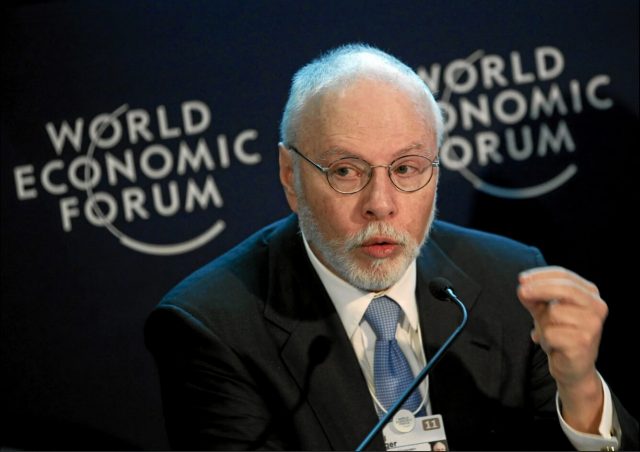
Hedge fund manager Paul Singer has raised millions for a pro-Marco Rubio super PAC. Moritz Hager | World Economic Forum
Singer has a storied history in South America, though he has been relatively quiet about Venezuela. However, a long-time manager of Singer’s hedge fund, Jay Newman, recently told Bloomberg that a Guaidó-led government would recognize that foreign creditors “aren’t the enemy,” and hinted that Newman himself was weighing whether to join a growing “list of bond veterans [that have] already begun staking out positions, anticipating a $60 billion debt restructuring once the U.S.-backed Guaidó manages to oust President Nicolas Maduro and take control.” In addition, the Washington Free Beacon, which is largely funded by Singer, has been a vocal advocate for the Trump administration’s regime-change policy in Venezuela.
Beyond that, Singer’s Elliott Management Corporation gave Roger Noriega, the former assistant secretary of state for Western Hemisphere affairs under Bush, $60,000 in 2007 to lobby on the issue of sovereign debt and for “federal advocacy on behalf of U.S. investors in Latin America.” During the time Noriega was on Singer’s payroll, he wrote articles linking Argentina and Venezuela to Iran’s nonexistent nuclear program. At the time, Singer was aggressively pursuing the government of Argentina in an effort to obtain more money from the country’s prior default on its sovereign debt.
While Singer has been mum himself on Venezuela, he has been making business decisions that have raised eyebrows, such as significantly increasing his stake in Bayer. This move seems at odds with Bayer’s financial troubles, a direct result of the slew of court cases regarding the link between Monsanto’s glyphosate and cancer. The first ruling that signaled trouble for Monsanto and its new parent company Bayer took place last August, but Singer increased his stake in the company starting last December, even though it was already clear by then that Bayer’s financial troubles in relation to the glyphosate court cases were only beginning.
Since the year began, Bayer’s problems with the Monsanto merger have only worsened, with Bayer’s CEO recently stating that the lawsuits had “massively affected” the company’s stock prices and financial performance.
Forcing open a new market for RoundUp
Part of Singer’s interest in Bayer may relate to Venezuela, given that Juan Guaido’s “Plan País” to “rescue” the Venezuelan economy includes a focus on the country’s agricultural sector. Notably, prior to and under Chavismo, agricultural productivity and investment in the agricultural sector took a backseat to oil production, resulting in under 25 percent of Venezuelan land being used for agricultural purposes despite the fact that the nation has a wealth of arable land. The result has been that Venezuela needs to import much of its food from abroad, most of which originate in Colombia or the United States.
Under Chávez and his successor, Maduro, there has been a renewed focus on small-scale farming, food sovereignty and organic agriculture. However, if Maduro is ousted and Guaidó moves to implement his “Plan País,” the opposition’s coziness with foreign corporations, the interests of U.S. coup architects in Bayer/Monsanto, and the opposition’s past efforts to overturn the GM seed ban all suggest that a new market for Bayer/Monsanto products — particularly glyphosate — will open up.
South America has long been a key market for Monsanto and — as the company’s problems began to mount prior to the merger with Bayer — it became a lifeline for the company due to less stringent environmental and consumer regulations than many Western countries. In recent years, when South American governments have opened their countries to more “market-friendly” policies in their agricultural sectors, Monsanto has made millions.
For instance, when Brazil sought to expand biotechnology (i.e. GM seed) investment in 2012, Monsanto saw a 21% increase in its sales of GM corn seed alone, generating an additional $1 billion in profits for the company. A similar comeback scenario is needed more than every by Bayer/Monsanto, as Monsanto’s legal troubles saw the company’s profits plunge late last year.
With countries around the world now weighing glyphosate bans as a result of increased litigation over the chemical’s links to cancer, Bayer needs a new market for the chemical to avoid financial ruin. As Singer now has a significant stake in the company, he — along with the politicians and think tanks he funds — may see promise in the end of the anti-GM seed ban that a Guaidó-led government would bring.
Furthermore, given that Guaidó’s top adviser wants the Trump administration to have a direct role in governing Venezuela if Maduro is ousted, it seems likely that Singer would leverage his connections to keep Bayer/Monsanto afloat amid the growing controversy surrounding glyphosate. Such behavior on the part of Singer would hardly be surprising in light of the fact that international financial media have characterized him as a “ruthless opportunist” and “overly aggressive.”
Such an outcome would be in keeping with the increased profit margins for Monsanto and related companies that have followed its expansion into countries following U.S.-backed coups. For instance, after the U.S.-backed coup in Ukraine in 2014, the loans given to Ukraine by the International Monetary Fund and the World Bank forced the country to open up and expand the use of “biotechnology” and GM crops in its agricultural sector, and Monsanto, in particular, made millions as the prior government’s ban on GM seeds and their associated agrochemicals was reversed. If Maduro is ousted, a similar scenario is likely to play out in Venezuela, given that the Guaidó-led government made known its intention to borrow heavily from these institutions just days after Guaidó declared himself “interim president.”
Feature photo | Luis Arrieta inspects a freshly planted coffee field that used to be a peach orchard in the coastal area of Carayaca on the outskirts of Caracas, Venezuela, Oct. 10, 2018 . Fernando Llano | AP
Whitney Webb is a MintPress News journalist based in Chile. She has contributed to several independent media outlets including Global Research, EcoWatch, the Ron Paul Institute and 21st Century Wire, among others. She has made several radio and television appearances and is the 2019 winner of the Serena Shim Award for Uncompromised Integrity in Journalism.
Kieran Barr contributed to the research used in this report.
Israeli Intelligence Warned White House Of “Iran Plot” To Strike US Troops
By Tyler Durden – Zero Hedge – 05/06/2019
On Sunday night US national security advisor John Bolton threatened Iran with “unrelenting force” while announcing the deployment of the USS Abraham Lincoln Carrier Strike Group and a bomber task force to the Persian Gulf region, saying further it sends a “clear and unmistakable” message to the Iranian regime.
Bolton’s statement also cited a “number of troubling and escalatory indications and warnings” from Iran, which later on Monday morning CNN Pentagon correspondent Barbara Starr described based on unnamed US defense officials as including “specific and credible” Iranian threats against US assets in Syria, Iraq, and at sea.
CNN’s Starr reported the following:
US officials tell me the threats from Iran included “specific and credible” intelligence that Iranian forces and proxies were targeting US forces in Syria, Iraq and at sea. There were multiple threads of intelligence about multiple locations, the officials said.
It turns out, perhaps predictably, that the ultimate source of these claims is none other than Israeli intelligence.
Axios White House correspondent Barak Ravid reports:
Israel passed information on an alleged Iranian plot to attack U.S. interests in the Gulf to the U.S. before national security adviser John Bolton threatened Iran with “unrelenting force” last night, senior Israeli officials told me.
This also comes as some high level Israeli defense officials have claimed Iran ordered the Palestinian Islamic Jihad to initiate a conflict in Gaza in order to distract Israel from stopping supposed Iranian expansion inside Syria.
Thus it appears an entire US carrier strike group is now responding to what the White House believes is credible intelligence provided by the Israelis. Or, it could simply fit with Prime Minister Benjamin Netanyahu’s long stated intent to convince Washington to take preemptive military action against Iran.
Axios reports the Israeli intelligence is “not very specific at this stage” but that the “intelligence gathered by Israel, primarily by the Mossad intelligence agency, is understood to be part of the reason for Bolton’s announcement.” The threats against US interests also reportedly include locations in Saudi Arabia and the UAE.
But the most obvious question must be asked: could Tel Aviv be setting up its more powerful ally in a “wag the dog” scenario to initiate war against Israel’s archenemy Iran?
“Just A Human Being”: Rachel Maddow’s Latest Resistance Hero
By Tyler Durden | Zero Hedge | May 6, 2019
This is where three years of failed Russiagate conspiracy theorizing and fixation leads you — into the arms of fanatical endless war proponent John Bolton: “John Bolton God bless you, good luck..” one can now hear on “resistance” network MSNBC prime time.
MSNBC’s Rachel Maddow is now championing neocon national security adviser John Bolton’s “humanity” given he apparently went loose cannon this past week, vowing to confront Russia over Venezuela even as his boss President Trump downplayed Moscow’s role in the crisis after a Friday phone call with Putin.
“This is what John Bolton, human being, thought his job was this week,” Maddow said on her show Friday night. Both Pompeo and Bolton had clearly gone a bit rogue with their overly bellicose Venezuela comments, while Trump appeared to be more restrained — and for Maddow this was of course cause for championing the neocon interventionist line: “Hey, John Bolton, hey, Mike Pompeo, are you guys enjoying your jobs right now?” she questioned.
On Friday Trump had said following the phone call, Putin is “not looking at all to get involved in Venezuela other than he’d like to see something positive happen in Venezuela, and I feel the same way.”
Maddow, who once prided herself on slamming and deconstructing Bush-era regime change wars, now finds Trump not jingoistic enough. She stridently questioned:
“How do you come to work anymore if you’re John Bolton? Right, regardless of what you thought about John Bolton before this, his whole career and his track record, I mean, just think of John Bolton as a human being. This is what John Bolton, human being, thought his job was this week.”
She further cut to a clip of Bolton criticizing Russia’s alleged military involvement in Venezuela to prop up Maduro, because apparently uber-hawk Bolton is now a “fearless truth-teller” in Maddow’s world.
“You thought that was your job,” Maddow said. “But it turns out not at all, not after Vladimir Putin gets done with President Trump today.”
It bears repeating that among the loudest right-leaning voices who joined the chorus of leading establishment Democrat Russiagaters included previously forgotten about neocons who were quickly rehabilitated by the “Resistance” — David Frum, Max Boot, Robert Kagan, Bill Kristol among them.
And then there was the nauseating phenomenon of watching liberals lionizing Trump-skeptical Republican Congressional leaders like Lindsey Graham, Jeff Flake, and the late Sen. McCain.
Because it’s awful, just awful! – that Trump might actually prefer peace to waging war in multiple places…
Restraint vs. war in multiple places? Maddow apparently advances the humanity of those advocating the latter.
It amounted to, at times, a picture of a President at odds with the officials who this week have called vociferously for a change in power in Caracas and have consistently declined to rule out a US military intervention.
Trump has become frustrated this week as national security adviser John Bolton and others openly teased military options and has told friends that if Bolton had his way he’d already be at war in multiple places. — CNN
And now, months into 2019, we get to hear Maddow waxing eloquent about the innocent “human side” of none other than John Bolton.
Of course, Maddow should first consider whether Bolton or his neocon ilk ever once paused to consider whether those they advocate dropping bombs on — from Iraq to Syria to Libya to Yemen to Gaza to Venezuela — are themselves actually human beings who simply wish to live out their daily lives in peace.
Google Bans Press TV
What’s Next?
By J. Michael Springmann and Edward C. Corrigan | Dissident Voice | May 5, 2019
What?
On April 19, 2019 (the date of the original Patriots’ Day in New England), American tech giant Google disabled the accounts of Press TV, an Iranian news service, and its sister channel Hispan TV, an outlet in Spain. Google denied their access to all its services, including its popular video streaming platform YouTube and its E-mail service Gmail. The company’s move took place without prior notice or subsequent explanation.
The action’s date is particularly significant to Americans. That day marked the beginning of the American Revolution. It saw the first armed engagement between British soldiers and colonial militiamen at the Battles of Lexington and Concord in Massachusetts on April 19, 1775. Patriots’ Day was intended to commemorate the colonists’ fight to win freedom from British rule.
But, nearly 250 years later, it observes the loss of that freedom to invisible, uncontrollable organizations.
Google and Facebook, and other social media giants, have been accused of altering search algorithms to slant or even hide information that departs from the government or corporate agenda. Independent media sources on the right and on the left have complained that searched results are tainted and being secretly manipulated on a grand scale. Now the censorship is being imposed openly in the name of political correctness and social harmony. There is a clear campaign to de-legitimize critics of US Government policy.
Target: Iran.
According to the April 22, 2019 edition of MintPress, “Iran has been on the receiving end of more than its share of censorship. Facebook has repeatedly banned “networks” it believes are “tied to Iran.” Meanwhile, both Press TV and HispanTV have faced prior crackdowns from Google. Recently, Instagram banned a number of Iranian officials following the U.S. designation of Iran’s military as a foreign terrorist organization. In some cases, Facebook has even worked with CIA-funded cybersecurity firms to target accounts. The State Department later trumpeted those findings in a report on Iran’s cybersecurity threat to the U.S., but opted to omit the source of the evidence.”
Additionally, MintPress noted: “Google’s crackdown on Iran is multifaceted, not just singling out its media for censorship, but also shutting down the accounts of its officials. Indeed, Google is on a path to destroy Iran’s ability to independently communicate its message to the world.”
What’s the issue?
Quoting Yasha Levine, journalist and author of Surveillance Valley: The Secret Military History of the Internet… “American Internet companies,” such as Google and Facebook, “are not abstract global platforms, but privatized instruments of American geopolitical power.”
And that’s the real issue.
And it’s not only Press TV, the “Voice of the Voiceless” that’s censored. The American Herald Tribune has been under attack, it says, by Zionist gatekeepers. In August 2018, it wrote one of the authors: “Dear Michael, Google has disabled all of the services we were using.” Then, the next month, it wrote: “Dear Friends/Colleagues: We were unable to retrieve our Facebook page after it was taken down without any prior notice. We have created a new Facebook page.”
Protection from bigots?
The attacks on Press TV, American Herald Tribune, and others are always couched in terms of suppressing the malign influence of the “far-right” and/or “anti-Semitic figures and organizations.” On May 3, 2019, the Washington Post used those words to headline an article celebrating Facebook’s action in permanently banning “several far-right and anti-Semitic figures and organizations, including Nation of Islam leader Louis Farrakhan, Infowars host Alex Jones, Milo Yiannopoulos [a former Breitbart editor] and Laura Loomer [a right-wing American political activist] , for being ‘dangerous’…” The paper saw this as “a sign that the social network is more aggressively enforcing its hate-speech policies at a moment when bigoted violence is on the rise around the world.”
While the 1st Amendment to the United States Constitution states: “Congress shall make no law … abridging the freedom of speech, or of the press…,” it seems that “The People” can do as they please, as long as they have large Internet organizations behind them and lots of money. And if there is pressure from supposedly liberal governments influencing them.
The Post went on to say, “Governments around the world are pushing Facebook to take town [sic] bigoted and other harmful content more quickly–or risk being banned themselves.” Germany heavily fines social media if they run afoul of “The Enforcement on Social Networks Act” (Netzwerkdurchsetzungsgesetz). Although it came into force October 1, 2017, social networks were given a three-month grace period to change their policies. If criminal content, which can include hate speech, defamation, and fake news, isn’t removed within 24 hours of its being reported, social networks can face fines reaching €50 million (US$60 million).
Like in the United States, “hate speech” is in the eye (or ear) of the beholder, especially if it deals with illegal aliens, a sore subject in some countries. This concept is probably the reason why Facebook and Twitter refused to advertise J. Michael Springmann’s book, Goodbye, Europe? Hello, Chaos? Merkel’s Migrant Bomb, an analysis of forced migration into Europe from American wars in the Middle East.
Conclusion
This all boils down to “political correctness” and lack of common sense. And governmental power. Allegedly liberal societies now engage in censorship–in the name of freedom of speech and political correctness. But it’s really censorship and control of information that is the real objective.
The Encyclopedia Britannica notes “our perception of reality is determined by our thought processes, which are influenced by the language we use. In this way language shapes our reality and tells us how to think about and respond to that reality. Language also reveals and promotes our biases. Therefore, according to the [Sapir-Whorf] hypothesis, using sexist language promotes sexism and using racial language promotes racism.”
Clever people in well-placed governmental positions and their cats-paws in large corporations evidently have taken note of this linguistic mind control and are now implementing it on a grand scale.
Michael Springmann is a lawyer, author, political commentator, and former diplomat based in Washington, D.C. While abroad with the U.S. Department of State, he served in Germany, India, and Saudi Arabia. He can be contacted at attorney@springmannslaw.net or at 202-256-3878. Edward C. Corrigan is certified as a specialist by the Law Society of Ontario (formerly the Law Society of Upper Canada) in Citizenship, Immigration and Immigration and Refugee Law. He is an author and political commentator based in London, Ontario, Canada and can be contacted at corriganlaw@edcorrigan.ca or at 519-439-4015.
Featured Video

or go to
Aletho News Archives – Video-Images
From the Archives
The Forgotten Terrorist Pretext of the Vietnam War
By Jim Bovard | The Libertarian Institute | February 16, 2023
Since 9/11, terrorism has become the ultimate entitlement program for America’s political elite. Whether it is illegally spying on Americans or blowing Somali dissidents to pieces, invoking terrorism provides all the cover needed for Washington policymakers. But the disastrous results of granting politicians a blank check to fight terrorism should have been undeniable almost 60 years ago.
Back in the 1960s, terrorism was what the communists did. Anti-terrorist moral fervor and ideological blinders propelled the U.S. into its biggest foreign policy blunder since World War II. … continue
Blog Roll
 Aletho News
- LAPD Pilot Will Track Vehicles In San Fernando Valley
- Britain’s Online Censorship Law Now Comes With a Crisis Plan for Your Posts
- NATO’s “Nordic model” brings Arctic confrontation closer to Russia’s nuclear bases
- Using nuclear weapons, the US-Israeli alliance still can’t beat Iran
- Sunset on the Quality of Western Propaganda: Arrival of the Dr Strangelove Moment
- Ukrainian general accused of protecting crime bosses
- US-‘Israel’ alliance faces growing rupture after midterms
- GOP’s Crushing Midterm Loss Could Reshape US Political Landscape – Analyst
- Midterm loss gives Congress power to rein in US war on Iran
- Midterms Were ‘Vote of No Confidence’ in GOP, But Iran Has No Illusions About Democrats – Marandi
- If Americans Knew
- An error has occurred; the feed is probably down. Try again later.
- No Tricks Zone
- New Study: The Net Fossil Fuel Contribution To Rising Atmospheric CO2 Has Been Zero For 500 Years
- Germany’s Green Energy Transition Becoming Increasingly Expensive…Another 6 Trillion Euros!
- Sudden Stratospheric Warming, Powerful El Niño Combination May Lead To Extreme Europe Cold, Energy Crisis!
- Two New Studies Find Thwaites Glacier Melt Cannot Be Driven By Human Activity Or A Warming Ocean
- E-Cars Reduce CO2 Emissions By Only 41% Compared To Internal Combustion Engine Vehicles
- Predictions Made By Renowned Climate Professor Over Past Decades Have Been Proven To Be Poor
- New Study Suggests Large Regions Of The Pacific Ocean Have Been Cooling For The Last 80 Years
- Germany’s Green Energy Debacle: High Energy Costs Force Kahla Porzellan to Close After 182 Years!
- New Study: 50 Years Of The Most Aggressive ‘Net Zero’ Policies Can Only Affect The Global Climate By 0.03°C
- US September “Heat” Was No Record…Many Records Set Decades Ago

