Florida cites Poway shooting to pass controversial anti-Semitism bill
RT | April 30, 2019
Just days after the fatal shooting at a California synagogue, the Florida Senate passed an anti-Semitism bill that critics say will criminalize any criticism of Israel.
The bill prohibits anti-Semitism in Florida public schools and universities, and defines it broadly as any speech that makes stereotypical depictions of Jews, Holocaust denial, inciting of violence or explicit expressions of racial hatred – as well as “criticizing the collective power of the Jewish community.”
Such a broad definition could be used to outlaw the pro-Palestinian Boycott, Divestment and Sanctions (BDS) Movement, critics have pointed out, arguing that the bill violates the freedom of speech guaranteed by the First Amendment of the US Constitution.
BDS campaigns for businesses to desist from enterprise with Israeli companies until certain demands are met by the Israeli government in regards to rights and territories for Palestinians.
The Senate bill has been sent to the desk of Governor Ron DeSantis, a Republican who was elected in the 2018 mid-terms.
One woman was killed and three other people injured in the Saturday attack at the Chabad of Poway, a suburb of San Diego, California. The 19-year-old gunman targeted the synagogue during the week of Passover, and was arrested after his AR-15 jammed during the attack.
The shooting came six months after the attack on the Tree of Life synagogue in Pittsburgh, Pennsylvania, that killed 11 and injured seven.
Both attacks have been cited by gun control advocates and pro-Israel activists in support of their respective causes. Last week, a federal judge blocked a 2017 Texas law that would have prohibited state employees and contractors to engage in BDS, saying it “threatens to suppress unpopular ideas” and would “manipulate the public debate through coercion rather than persuasion.”
‘Too much money invested in war’: US defense industry drives global military spending spree
RT | April 30, 2019
Global military expenditures reached their peak in 2018, and the driving force behind this increase is the growing appetite of the US military-industrial complex rather than real threats, analysts say.
The world spent $1.8 trillion on its military in 2018, the latest report by the acclaimed Stockholm International Peace Research Institute (SIPRI). The US and its NATO allies – the self-proclaimed defenders of freedom and democracy – account for more than half of this whopping amount.
Washington’s other close friend Saudi Arabia is the third largest military spender, coming ahead of India.
“A lot of this spending, particularly in the case of Saudi Arabia and India, is for political reasons,” Michael Maloof, a former senior security policy analyst at the Pentagon, told RT. New Delhi and Riyadh seek to “curry favor” with Washington by purchasing the US weapons in hope for concessions in other areas, he explained.
Washington’s NATO allies have seen pressure from the US related to their military spending ever since Donald Trump came to power in the White House. Maloof believes it has less to do with security of the alliance and more with the interests of the US arms manufacturers.
“A lot of that is aimed at trying to help the US defense industry to stay ahead [of their competitors] and hire more people,” he explained, adding that the issue of the military expenditures has a “clear economic dimension.”
In its desire to sate the always-hungry domestic military industrial complex, the US risks escalating tensions on the international arena, analysts warn. Washington’s hawks typically justify the need for ever-increasing military expenditures with some perceived threats from Russia or China, portraying them as war mongers.
“There is no good reason” for larger defense budgets, Ted Seay, a former US diplomat and senior policy consultant with the British American Security Information Council (BASIC), told RT. It is the West’s fear of the perceived ‘Russian threat’ that has in fact led to destabilization on the European continent, he noted.
“There are military provocations taking place between NATO and Russia where there should not be any far in the 21th century when there is no logical reason for any confrontation between Europe and Russia,” Seay said.
The former US diplomat also denounced as senseless the NATO “formula” demanding that member states spend two percent of their GDP on defense.
There is not a military situation that necessitates [the likes of] Latvia or Poland to find a solution in greater military spending. It simply does not exist in this age. But there are people who seem to be intent on creating confrontation and encouraging the NATO countries to spend more money with no good reason.
Yet, it is precisely Poland and the Baltic States that top the list of nations with the highest annual defense spending increases in Europe over the recent years.
Poland’s military budget rose by 8.9 per cent in 2018 to $11.6 billion, according to SIPRI, while Latvia upped its military expenditures by staggering 24 percent over the same period. Bulgaria and Ukraine – which is not in NATO – followed closely, increasing their spending by 23 and 21 percent respectively.
Meanwhile, the US and its allies grossly outspend all the nations they perceive as alleged threats. The US expenditures alone accounted for 36 percent of global defense spending while exceeding the expenditures of the next eight largest-spending countries combined in 2018. NATO’s total military spending accounted for 53 percent of the global defense expenditures.
China was the only Washington’s perceived rival that made it into top 5 military spenders in 2018. However, Beijing’s defense budget amounted to only a fraction of the US one and accounted for 14 percent of the global military spending.
Russia, meanwhile, came it at number six by spending some $61.4 billion on the military in 2018, following consecutive defense budget cuts in the last two years. However, these facts do not stop the biggest military spender in the world to accuse Moscow of somehow initiating an “arms race.”
Anyway, the latest trends show that the world is unlikely to see easing of tensions on the international arena anytime soon, Seay warns.
Must The US Save Synagogues at the Expense of The Constitution?
By Eve Mykytyn | April 29, 2019
Jane Eisner wrote an editorial in the Forward yesterday entitled “Spare Me your Thoughts and Prayers. The US Has Betrayed Its Jews.” Her thesis is that by abiding by a “perverted, outdated, self-serving view” of the constitution, the government has failed in its “oblig[ation] to ensure that citizens have the freedom to live lives of dignity, equality and security.”
Specifically she blames the Second Amendment right to bear arms which she claims “was not meant to turn America into a killing field,” and the freedom of speech clause of the First Amendment which she opines, “was not meant to allow a few powerful, private corporations to ignore their civic responsibilities to prevent incitement and promote social harmony.”
Ms Eisner dismissively allows that “scholars” have noted that the Constitution was drafted to define rights as “negative rights.” She bemoans the lack of emphasis on “positive rights,” that would make it the duty of the “government to ensure that citizens have the freedom to live lives of dignity, equality and security.”
Perhaps Ms Eisner has failed to read the Constitution which sets forth the various powers of the federal government and then in its amendments makes clear its intent that the government interfere with its citizens to the least extent possible. The Ninth and Tenth Amendments specifically grant nonenumerated rights and powers to the States or the people. Importantly, even the 14th Amendment which has expanded certain rights of citizens is phrased in the negative. “No State shall make or enforce any law which shall abridge the privileges or immunities of citizens… ; nor … deprive any person of life, liberty, or property, without due process of law; nor deny to any person … the equal protection of the laws.”
Nowhere is there a positive obligation placed on the government to ensure that its citizens “live lives of dignity, equality and security.” Instead the constitution prescribes equality under the law and protection from government interference. Understanding this makes axiomatic the right to own a gun or to allow speech that Ms Eisner does not like.
Yet, Eisner claims the federal government has totally failed in its “central” job to “protect its people.” From what constitutional or other law does Eisner derive this “central job?” Would a government attempt to prevent attacks on what Eisner calls “vulnerable minorities (her list – Jews, African Americans or Muslims or gays and lesbians or random children in a school.) by eliminating guns and free speech deprive all of us of liberties?
The United States has existed for 240 years with our constitution and its particular blend of rights and obligations. Ms Eisner’s apparently seeks to add additional restrictions in order to ensure the safety of the Jews. This is a dangerous route. The framers (of the Constitution and its Amendments) were wise enough to understand that positive obligations placed on the government must be balanced by the burdens they place on individual freedom. If we were to enact some version of Eisner’s ‘dignity and security’ we would be inviting the government to control more aspects of our lives.
Neither private citizens nor corporations are obliged to let everyone speak nor to police other’s speech. Of course some may plan nefarious deeds on Facebook, but information canned is published in other ways. The shooter in Poway, John Ernest, posted his manifesto on pastebin. In addition, allowing speech that Ms Eisner does not like may defuse anger rather than cause shootings. Christopher Poole, creator of 4chan, said he was often thanked for providing an outlet to vent frustrations, “an outlet to say what they can’t say in real life.”
Perhaps the constitution Eisner wants might be more appropriate for Israel. After all, Rabbi Yosef Berger, has said that “[the shooting] is clearly Hashem telling the Jews to come home, to return to Jerusalem because “the sanctity of Israel can protect the Jews.” Israel has made clear that it considers itself the homeland of the Jewish people. Jews who want safety at the expense of the United States’ cherished constitutional rights might be happier in a country not committed to the US Constitution.
Blame Palestinians for Gaza
Israel is the perpetual victim
By Philip Giraldi • Unz Review • April 30, 2019
If you have read a recent New York Times op-ed entitled “Care about Gaza? Blame Hamas” written by none other than the White House “special representative for international negotiations” Jason Greenblatt you would understand that the misery being experienced by Palestinians in Gaza is all their own fault. Greenblatt, who is Jewish of the Orthodox persuasion, just happens to be a strong supporter of Israel’s settlements, which he claims are “not an obstacle to peace.” He is very upset because some naysayers are actually putting some of the blame for the human catastrophe in Gaza on Israel, which we Americans all know is our best friend in the whole world and our most loyal ally. If that were not so, the New York Times and those fine people in Congress and the White House would surely inform us otherwise. And anyway, what are a few lies and war crimes between friends?
Greenblatt, who knows nothing about foreign policy and diplomacy apart from advising Donald Trump on Israel while serving as the Trump Organization chief legal officer, is supposed to be working hard with Trump son-in-law Jared Kushner negotiating “deal of the century” peace between Israel and the Palestinians. Betting is that the arrangement on offer in June will consist of American acquiescence in Israel declaring sovereignty over nearly all of land that the Arabs still hold on the West Bank with the remaining local population being bribed heavily to either move to Jordan or stay in designated non-Jewish sectors and stop complaining.
Jason Greenblatt is a perfect example of the type of “dual” loyalist who cannot appreciate that his overriding religious and ethnic allegiances are incompatible with genuine loyalty to the United States. Willingness to subordinate actual American interests to a those of a foreign nation means that he and others like him are contributing to the decline and fall of the country he was born in and which has made him wealthy. If he had any real integrity, when presented by Trump with the opportunity to benefit Israel at the expense of the United States he should have declined the offer knowing that he would inevitably be biased, making it impossible for him to fairly consider either American interests or those of the Palestinians.
Greenblatt knows that whatever lies he tells it will not matter in the least because no one will ever hold him accountable and it is all done for a great cause, which is Israel, to include anything that Prime Minister Benjamin Netanyahu wants. And what could be better than to hold down a job that pays in the neighborhood of $200,000 a year plus a full benefits package for doing nothing but “creating facts on the ground” for the country that one loves best?
The Greenblatt op-ed includes some really choice “analysis” that does not correspond with the reality of what is going on in what remains of Palestine. He begins immediately with a heavy dose of Israeli propaganda, asserting that “Hamas has left Gaza in shambles,” before providing a partially accurate but morally neutral assessment of the sorry state of the enclave: “Life there is difficult, sad and abnormal. Only buildings with generators actually maintain steady power. The lack of power affects everything from preserving fresh food to treating sewage. If a person in Gaza falls ill, he is likely to find trained medical professionals unable to help because of the lack of equipment and medicines. The people there — even the talented and educated — can’t find jobs. The store shelves are empty. The shoreline, which in many other places in the Mediterranean would be filled with beach resorts, is covered in the raw sewage and debris from successive wars. The cost of conflict is seen in all aspects of life in Gaza.”
The dismal picture of conditions in Gaza, largely true, does not admit to any Israeli role in the suffering, or, at least, Greenblatt is blind to it. Israel controls both the land border and the seafront. It manages the enclave as if it were an outdoor concentration camp and military free-fire zone for its 2 million Arab inhabitants. Lack of power is caused by Israeli bombing of power plants, which also makes it impossible to treat sewage. Proliferating sewage appears to be a preferred weapon for Israelis as settlers on the West Bank are also fond of letting it flow onto Palestinians farms and villages.
Food in Gaza is limited only to what can be grown locally or to what the Israelis allow in. Likewise medicines are only available when Israel permits. Gazans cannot leave without Israeli permission and on the seafront, fisherman who are brave enough to go out are frequently shot dead by Israeli gunboats if they go too far.
Israel bombs hospitals, schools and places of worship indiscriminately, always claiming that they are being used by terrorists even when United Nations observers are on site and declare that the allegations are palpably untrue. And then there are isolated incidents , to include the deliberate murder by naval gunfire of four young boys innocently playing soccer on a beach and the killing by missiles of nine other children who were watching television. An American military attache stationed in Israel once observed soldiers on the Israel side engaging in target practice by shooting at women hanging out their laundry on the Gaza side of the fence and Israeli snipers have proudly worn t-shirts showing a graphic of a pregnant Arab woman in a gunsight with the text “two for one” underneath.
Currently, protests by unarmed Gazans along the Israel-Gaza fence have resulted in 260 Palestinian deaths, mostly by Israeli sniper fire. Nearly 7,000 others have been shot and wounded. Those killed include 32 medical workers and 50 children. Twenty-one children have had their limbs amputated and many more have been permanently disabled.
Thousands more Palestinians have died from Israeli bombs, rockets and artillery shelling since 2009. In 2014 alone, more than 2,000 Gazans were killed and more than 10,000 were wounded, including 3,374 children, of whom over 1,000 were left permanently disabled. More than 7,000 homes were destroyed. The grossly disproportionate carnage in Gaza initiated by Israel was so outrageous that even many Americans began to wake up to what their tax dollars were buying. After 2014’s death toll, support for Israel began to wane. Currently 51% of Americans view the Israeli government unfavorably in spite of relentless pro-Israel propaganda by the U.S. media.
Jason Greenblatt goes on to claim that “The Arabs in Israel generally live normal lives and, in many cases, thrive. In fact, Arab citizens of Israel live freely compared with Arabs in many other countries in the region… Why are others moving forward while Gaza sinks further into despair and disrepair? Because Hamas, the de facto ruler of the Gaza Strip, has made choices… Hamas is to blame for Gaza’s situation.”
Greenblatt is wrong about the claimed happy lot of Palestinians living in Israel. Israel has recently declared itself a Jewish State. In practice, there are more than fifty laws and regulations that make Christians and Muslims second class citizens. Churches and Mosques are regularly vandalized and Christian and Muslim holy sites are regularly destroyed by the authorities while a prominent Rabbi has recently declared in the wake of Sri Lanka that proposals that all churches should be destroyed inside Israel should be considered but are “complicated.” Arab Israelis cannot get building permits, their schools are underfunded and they are discriminated against or ignored in nearly all their interactions with the government. Local communities can declare themselves Arab-free zones and they can refuse to sell houses to Palestinians.
The fundamental problem with Greenblatt and others like him is that they have a very selective moral compass and choose not to recognize apartheid even when it is right in front of them. Israel is a fundamentally racist occupying power with a colonial-settler mindset, which sees the Arabs as ignorant savages that have to be ideally removed, but if not, restrained by force or even killed if necessary. And, like all purveyors of war crimes, the Israelis and their diaspora cheerleaders blame the victims for their plight. Greenblatt will have an excuse for any atrocity committed by Israel. The Israel Defense Force is shooting Palestinians individually now but if it starts doing them in groups he would no doubt come up with a good rationalization justifying the practice.
Israel is a Middle Eastern superpower, heavily armed and unconcerned over the consequences for starting wars and killing Arabs. To argue as Greenblatt does that there is some kind of “fighting” going on with Hamas “instigating” wars against Israel is ludicrous given the disparity in power between the two sides. It is largely retaliatory Hamas homemade bottle rockets, which kill or injure very few, against fighter jets, snipers and artillery barrages that kill thousands. And the really sad part for Americans is that the United States is deeply complicit in what goes on, sending “special representatives” like Greenblatt into the region on the taxpayer’s dime to argue Israel’s case.
Philip M. Giraldi, Ph.D., is Executive Director of the Council for the National Interest, a 501(c)3 tax deductible educational foundation that seeks a more interests-based U.S. foreign policy in the Middle East. Website is councilforthenationalinterest.org, address is P.O. Box 2157, Purcellville VA 20134 and its email is inform@cnionline.org.
Why is Maria Butina in Prison?
By Ron Paul | April 29, 2019
Russian gun rights activist and graduate exchange student Maria Butina was sentenced to 18 months in prison last week for “conspiracy to act as a foreign agent without registering.” Her “crime” was to work to make connections among American gun rights activists in hopes of building up her organization, the Right to Bear Arms, when she returned to Russia.
She was not employed by the Russian government nor was she a lobbyist on Putin’s behalf. In fact the Putin Administration is hostile to Russian gun rights groups. Nevertheless the US mainstream media and Trump’s Justice Department are treating her as public enemy number one in a case that will no doubt set the dangerous precedent of criminalizing person-to-person diplomacy in the United States.
The Foreign Agent Registration Act (FARA) was passed in 1938 under pressure from the FDR Administration partly to silence opposition to the US entry into World War II. While a handful of cases were prosecuted during the war, between 1966 and 2015 the Justice Department only brought seven FARA cases for prosecution.
Though very few cases have been brought on FARA violations, one of them was against Samir Vincent, who was paid millions of dollars by Saddam Hussein to lobby for sanctions relief without registering. He got off with a fine and “community service.”
Millions of dollars in unregistered payments from Saddam Hussein gets no jail time, while Butina gets 18 months in prison for privately promoting a cause most Americans support! How is this justice? The US Justice Department is not even as tough on illegals who commit capital crimes in the US!
Unfortunately Maria Butina was in the wrong place at the wrong time. With the rise of the “Russiagate” hysteria, Butina’s case was seen as a useful tool by Democrats to push the idea that President Trump was put into office by the Russians. Plus, many of them are also hostile to our Second Amendment and to the National Rifle Association. So it was a perfect storm for Butina.
Sadly, conservatives are mostly silent on this miscarriage of justice. They are also caught up in the idea that America can only be great if it goes abroad seeking monsters to destroy.
Also, a new Cold War is very profitable to the military industrial complex and Butina serves an important propaganda purpose. The media is an all-to-willing participant in this farce.
Even though Trump has been exonerated by a Mueller investigation that didn’t even view the Butina case as worth investigating, the President has been silent on her persecution. This is similar to his sudden silence on Wikileaks now that Julian Assange may be facing an eternity in a US supermax prison.
As author James Bamford wrote recently in an excellent New Republic article on the Butina case, the national security agencies are also eager to get another notch in their belts and the Russian gun activist was low-hanging fruit for their ambitions.
Non-interventionists believe strongly in citizen-to-citizen diplomacy as a way of avoiding war and conflict overseas. Exchange students, international business ventures, tourism, and just communicating with others is such an important way to thwart the plotting of the warmongers who lurk in all governments.
I am saddened to see that the United States has made such a hostile move toward peaceful foreign citizens seeking friendship with Americans. When citizens are no longer allowed to engage in diplomacy we are left with only the state. And the state loves war.
The US-NATO Alliance Has Georgia on Its Mind
By Brian Cloughley | Strategic Culture Foundation | April 29, 2019
Britain’s Daily Express newspaper is a bizarre publication that specialises in sensationalist raving. Some of its reports are weird beyond imagination, and it went even further than usual into fogs of delusion on April 21 when one of its headlines announced “World War 3: UK CONFRONTS Russia by sending warship to Black Sea.”
The vessel despatched on a “freedom of navigation manoeuvre” by the UK’s Royal Navy is HMS Echo, which cannot be described as a warship. It is “designed to carry out a wide range of survey work, including support to submarine and amphibious operations” and it carries a few cannon and machine guns, but it is difficult to see how it could confront anything more deadly than a prawn-boat. It is, however, part of the grand plan of the US-NATO military alliance which on April 4 “agreed a package of measures to improve NATO’s situational awareness in the Black Sea region and strengthen support for partners Georgia and Ukraine.”
HQ NATO much regrets that its encirclement of Russia does not yet include Georgia or Ukraine. The Brussels sub-office of the Pentagon is trying hard to formally enlist both countries and announced on March 26 that “Georgia is one of the Alliance’s closest partners. It aspires to join the Alliance. The country actively contributes to NATO-led operations and cooperates with the Allies and other partner countries in many other areas. Over time, a broad range of practical cooperation has developed between NATO and Georgia, which supports Georgia’s reform efforts and its goal of Euro-Atlantic integration.”
The day before NATO’s declaration the globe-trotting head of the organisation, Jens Stoltenberg, was in Georgia to attend military exercises. At a meeting with Prime Minister Mamuka Bakhtadze he declared it had been “clearly stated that Georgia will become a member of NATO” and “We will continue working together to prepare for Georgia’s NATO membership,” which was first mooted in 2008 but somehow has never come about.
Non-US NATO military spending totals $264 billion a year, four times that of Russia, and the US will splurge $750 billion next year, so Georgia’s 37,000 military personnel, ten Su-25 combat aircraft and military budget of $380 million are not going to make much of a contribution to NATO, but that’s not the point. What the US-NATO grouping wants is to deploy its armed forces even closer to Russia than at present. When Georgia joins, there will be an opportunity to base tanks, aircraft and missiles right up against the Russian border, as in the Baltic states.
The most interesting observation about Georgia by Radio Free Europe in its account of the Stoltenberg visit was that “The country of some 3.7 million people fought a brief war with Russia in August 2008, and Moscow’s continued military presence on the country’s territory adds to tensions in the region.”
It is never mentioned by the Pentagon, Brussels or the Western media that the “brief war” was entirely the fault of Georgia. Nor is it admitted that if Russia had wished to do so, it could have swept through and occupied the whole of Georgia in a few days without interference by NATO or anyone else.
The European Union decided to conduct an inquiry into the conflict, and in 2009 produced a report which, deep down in its 1,000 pages, states that Georgia initiated the war. This was not at all what the Western world wanted to be told, and the paper is full of observations intended to disguise or excuse Georgia’s military antics. The UK’s Independent online newspaper reported that “The first authoritative study of the war over South Ossetia has concluded that Georgia started the conflict with Russia with an attack that was in violation of international law,” but there are very few people in the Western Establishment who will admit that Georgia was to blame, and they steadfastly support Georgia’s foolhardy aggression.
The EU noted that “There were reportedly more than a hundred US military advisers in the Georgian armed forces when the conflict erupted in August 2008, and an even larger number of US specialists and advisors are thought to have been active in different branches of the Georgian power structures and administration. Considerable military support in terms of equipment and to some extent training was provided by a number of other countries led by Ukraine, the Czech Republic and Israel.” In other words, Georgia was considered a prime ally because it opposed Russia, and the US and its allies helped it prepare for its futile attack.
This is not surprising, given the speech by President George W Bush in Georgia’s capital, Tbilisi, in May 2005. The man who ordered the invasions of Afghanistan in 2001 and Iraq in 2003 was eloquent about Georgia’s military contribution to these disastrous conflicts, and observed that “last year, when terrorist violence in Iraq was escalating, Georgia showed her courage. You increased your troop commitment in Iraq fivefold. The Iraqi people are grateful and so are your American and coalition allies.” Indeed Washington is so grateful to the Georgian government for contributing to its wars (which involved the needless deaths of 32 Georgian soldiers in Afghanistan and five in Iraq), it provides generous aid packages, both civil and military.
A US Congressional Research Service Report of April 2019 notes that in this financial year Congress approved $89 million in civil aid and that in 2018 military aid was $40 million. These amounts don’t seem much at first glance, especially when compared to the mega-billions doled out to Afghanistan, Israel and Iraq — but given that its population is only 3.7 million, Georgia is doing very nicely.
In June 2018, the US Assistant Secretary of State for European and Eurasian Affairs said US policy is to “check Russian aggression,” including by “building up the means of self-defence for those states most directly threatened by Russia militarily: Ukraine and Georgia,” which repay US financial patronage not only by sacrificing their soldiers in Washington’s wars (18 Ukrainian soldiers were killed in Iraq), but in more intriguing ways, including in UN forums.
For obvious reasons it has long been thought by most countries that there should be international agreement to ban weapons in space, and a Russian-Chinese draft treaty proposing such legislation was submitted to the UN in February 2008. Washington refused to consider it, and when an amended version was presented at the UN’s First Committee in 2015 it was voted against by the US — along with its well-paid puppets, Israel, Georgia and Ukraine.
The US-NATO alliance is determined to encircle Russia more tightly, and Georgia wants to help it do so. Such provocative cooperation in these endeavours heightens tension between Georgia and Russia, which in the eyes of the western media serves to justify yet more NATO expansion. It is reminiscent of the 1930 song whose last verse is “Whoa, Georgia, Georgia, No peace, no peace I find; Just this old sweet song, Keeps Georgia on my mind…”
Butina Case Creates ‘Pretty Dangerous Situation’ for All Foreign Nationals
Sputnik – April 27, 2019
On Friday, 30-year-old Russian national Maria Butina was sentenced in a US federal court to 18 months in prison for conspiring to act as a “foreign agent.” However, even though the government agreed with Butina’s case, it twisted her sentencing in such a way as to nullify her plea deal and give her more time behind bars.
Judge Tanya Chutkan gave Butina 18 months in a US prison for actions she said were “sophisticated and penetrated deep into political organizations,” threatening US national security. In practice, this means that Butina will serve another nine months, having been imprisoned since her July arrest.
The former American University grad student pleaded guilty last month to one count of conspiring to act as an unregistered foreign agent as part of a plea deal negotiated late last year. She sought immediate deportation to Russia following her sentencing, but the Daily Beast reported that won’t happen until her prison sentence is completed.
“She looked shocked the whole time,” Sputnik News analyst Nicole Roussell told Radio Sputnik’s Loud and Clear Friday, noting that most people, including Butina’s attorneys, expected her to be sentenced to time served and be expelled. “She’s served nine months, and a lot of that has been in solitary confinement. This is for someone who — as the judge noted — never had any [prior convictions], is clearly hard-working, intelligent, had 24 letters of character and recommendation on her record. The judge noted a ton of positive stuff about her during the sentencing hearing, so it was definitely a little bit of a shock to see that [the judge] went entirely with the side of the prosecution and gave the full 18 months, meaning she has nine more in prison.”
Butina spoke before the court Friday, saying, “My parents discovered my arrest on the morning news they watch in their rural house in a Siberian village,” she said. “I love them dearly, but I harmed them morally and financially. They are suffering from all of that. I destroyed my own life as well. I came to the United States not under any orders, but with hope, and now nothing remains but penitence.”
Butina’s charge stems from her political lobbying work with the National Rifle Association — work the government says required her to register under the Foreign Agents Registration Act (FARA), an obscure measure dating to the 1930s that’s been revived in recent years in the interests of prosecuting foreign nationals and repressing alternative news sources. Sputnik, as well as RT, Xinhua and CGTN, have all been required to register under FARA due to their associations with the governments of other countries.
However, Butina isn’t associated with the Russian government and didn’t act on its behalf. She noted in a February interview that she never attempted to conceal her actions because she didn’t believe she was doing anything wrong.
“Anyone who thinks that someone who wasn’t Russian would be in this situation is fooling themselves,” Butina’s lawyer, Robert Driscoll, told Roussell Friday.
Roussell recalled Judge Chutkan saying to Butina in the courtroom: “No doubt you have suffered greatly due to the national atmosphere, including salacious details proven to be untrue.”
“So she noted these things, and yet, went ahead and just agreed” with the prosecution, ignoring that those “salacious details” had been given to reporters by the prosecution, the most notorious of which was that she’d traded sex for information and political connections, Roussell said. Becker noted that such a charge would never be levied against a male suspect.
“I think it would apply very broadly to very large numbers of people,” Driscoll told reporters Friday. “The government’s theory that you act as an agent whenever you do anything for a foreign official — I think that is an extremely broad interpretation that can apply not only to people like Maria, but to other people. I think it’s something that should be looked at. I think anyone who is a foreign national in this country should be exceedingly concerned by the government’s position in this case and what they did here.”
“This is a little bit different than some of the cases we’ve seen,” Roussell told hosts Brian Becker and John Kiriakou. “When some of these FARA regulations started to be prosecuted, what, two years ago, we were all a little bit shocked — very shocked, actually — because this was a statute that had not really ever been regulated, hadn’t really been criminally prosecuted. But even when they started to prosecute those FARA charges, it was for people who… there was a real case against them, even if it was something that was clearly politically motivated.”
“In this case, she never lied; she never stole documents; she never funnelled money to the NRA; she cooperated; she was an extroverted student interested in political discourse,” Roussell noted.
“The irony of this case is, the government believed her,” Roussell said.
“When we look at the record, when we look at what was said, she wasn’t a spy. She was not an agent of the Russian government, in the sense of ‘secret agent.’ She was more of an agent in the sense of a principal agent,” Driscoll said, noting that “if I buy you some opera tickets, I’m your agent.”
“When we entered into the plea agreement, the understanding was that if she cooperated she would get a downward departure motion, but the government’s decision not to try to apply guideline, and then jack up a base offense level, essentially took away the departure motion with their left hand while offering it with their right,” Driscoll said. “So, the substantive effect of the departure motion was probably nil.”
In other words, while promising Butina it would decrease the amount of time she would be sentenced to serve, the federal government chose to charge her with a more serious crime, increasing the amount of time she could possibly serve and then applying the deal from there, resulting in more time in prison for Butina than before.
Roussell said the precedent set by the case has “far-reaching implications.”
“Maria could not have been prosecuted under civil FARA, which is the one that everyone knows about through [Paul] Manafort and other cases, because she had no knowledge of the statute,” Driscoll explained to Roussell. “In order to be criminally prosecuted under FARA, you need to have a willful violation.”
“So, because of her lack of knowledge, she ended up being charged with a more serious crime under the foreign agent statute. I think it’s an area that’s ripe for reform. If you take it seriously and literally, the government’s position in this case, and applied it to other circumstances, you really end up in a pretty dangerous situation. Not only for foreign nationals here, but I think for Americans abroad doing similar activities, I think would not be thrilled with this,” Driscoll explained.
Butina’s lawyer also noted that, while Judge Chutkan invoked special counsel Robert Mueller’s Russiagate investigation, his client was wholly unconnected to any events described in that report.
“She had nothing to do with the Mueller investigation. The Mueller team was aware of Maria, they were aware of this case, they interviewed her as part of her cooperation, and obviously she didn’t appear anywhere in the Mueller report. I found it curious that that was mentioned, that what she did was during the time of Russian election interference, it was alleged by the judge, when in fact, had she been involved in any of that, I would imagine that special counsel Mueller would have mentioned it somewhere in his 400 pages if she had anything to do with it,” Driscoll said. “But he did not.”
Third Federal Court Blocks Anti-BDS Law as Unconstitutional
ACLU | April 25, 2019
AUSTIN — A federal court in Texas today blocked a state law requiring government contractors to certify that they are not engaged in boycotts of Israel or companies that do business in Israel or territories controlled by Israel, ruling that the law violates the First Amendment. The ruling came in a case brought by the American Civil Liberties Union and the ACLU of Texas on behalf of four Texans, as well as a separate case brought by the Council on American-Islamic Relations.
“This is now the third time a federal court has blocked an anti-BDS law on First Amendment grounds,” said Brian Hauss, staff attorney with the ACLU’s Speech, Privacy, and Technology Project. “Whatever their views on the BDS movement, members of Congress and state legislators should heed this strong message from the courts: The right to boycott is alive and well in the United States and any attempt to suppress it puts you squarely on the wrong side of the Constitution.”
The ACLU’s lawsuit was brought on behalf of four people who were forced under the law to choose between signing the certification or forgoing professional opportunities and losing income: John Pluecker, a freelance writer who lost two service contracts from the University of Houston; George Hale, a reporter for KETR who was forced to sign the certification against his conscience in order to keep his job; Obinna Dennar, a Ph.D. candidate at Rice University, who was forced to forfeit payment for judging at a debate tournament; and Zachary Abdelhadi, a student at Texas State University, who has had to forego opportunities to judge high school debate tournaments.
In his ruling, United States District Judge Robert Pitman stated that the law “threatens ‘to suppress unpopular ideas’ and ‘manipulate the public debate through coercion rather than persuasion’” and that “no amount of narrowing its application will cure its constitutional infirmity.”
Federal courts in Arizona and Kansas also blocked similar state anti-boycott laws in First Amendment challenges brought by the ACLU and ACLU affiliates in the respective states. In January 2018, a federal district court preliminarily enjoined an anti-boycott law in Kansas, holding that the First Amendment protects citizens’ right to “band together” and “express collectively their dissatisfaction with the injustice and violence they perceive, as experienced both by Palestinians and Israeli citizens.” In September, a district court enjoined a similar anti-boycott law in Arizona.
The ACLU takes no position on boycotts of Israel or of any other foreign country, but it has long defended the right to boycott, which is protected under the First Amendment.
The court’s opinion can be found here: https://www.aclutx.org/sites/default/files/4-25-19_bds_order.pdf.
FBI Director hypes ‘365-days-a-year threat’ from election-meddling Russia
RT | April 27, 2019
FBI Director Christopher Wray has confirmed the anti-Russian hype is not going anywhere, claiming Moscow will try to interfere in the 2020 US presidential election, and has been ‘spinning up’ Americans every day.
“What has continued pretty much unabated is the use of social media, fake news, propaganda, false personas, et cetera, to spin us up,” Wray told the Council on Foreign Relations Friday.
Russian intelligence agencies seek to “pit us against each other, sow divisiveness, discord, undermine Americans’ faith in democracy,” the Bush Jr. assistant attorney general added.
He said the 2020 election would be a repeat of both the 2016 race as well as 2018’s congressional election, where US intelligence agencies have alleged Russian interference.
Cutting against Wray’s dire warnings, however, are two Senate-commissioned studies published last year examining the actual impact of the alleged Kremlin meddling. Both studies found that the social media activities of the Russian Internet Research Agency’s (IRA), an alleged “troll factory” Washington is accusing of being an internet warfare outfit of the Russian government, had negligible impact on the 2016 election, and that only 11 percent of the IRA’s online content had anything to do with the race at all.
The studies also found the IRA spent microscopic amounts of money on social media ads, about half of one percent of the combined $81 million spent on Facebook ads by candidates Hillary Clinton and Donald Trump.
The alleged conspiracy between Kremlin and Donald Trump, which Clinton and her supporters have blamed at least partially for her loss in 2016, was also disproved by the nearly two-year-long investigation by Special Counsel Robert Mueller.
Still, the hardcore Russia-blamers refuse to let go, with Democratic National Committee Chair Tom Perez among the latest with his announcement that the US is at a cyberwar with Russia – and now, with the FBI chief.
Wray’s hyped up counterintelligence threat is sure to do some ‘spinning up’ of its own, amid ongoing demands for additional investigation into President Trump and his alleged Russian ties.
Ukraine Tapped By Obama Admin To Hurt Trump, Help Clinton And Protect Bidens
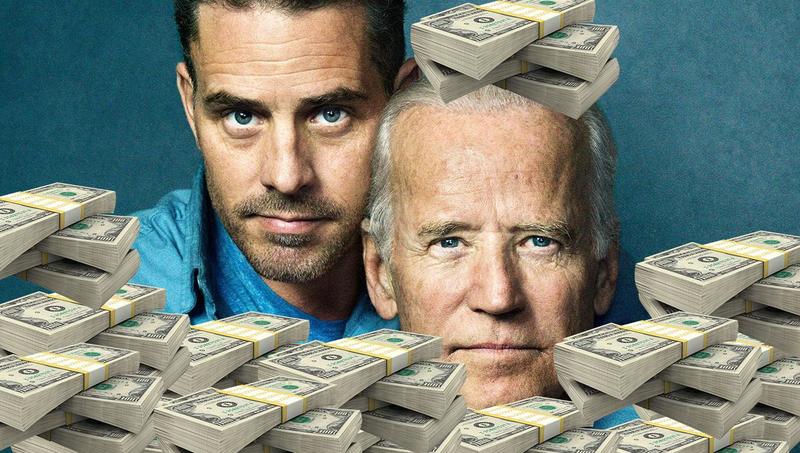
By Tyler Durden – Zero Hedge – 04/27/2019
In January, 2016, the Obama White House summoned Ukrainian authorities to Washington to discuss several ongoing matters under the guise of coordinating “anti-corruption efforts,” reports The Hill’s John Solomon.
The January 2016 gathering, confirmed by multiple participants and contemporaneous memos, brought some of Ukraine’s top corruption prosecutors and investigators face to face with members of former President Obama’s National Security Council (NSC), FBI, State Department and Department of Justice (DOJ).
The agenda suggested the purpose was training and coordination. But Ukrainian participants said it didn’t take long — during the meetings and afterward — to realize the Americans’ objectives included two politically hot investigations: one that touched Vice President Joe Biden’s family and one that involved a lobbying firm linked closely to then-candidate Trump. –The Hill
The Obama officials – likely knowing that lobbyist Paul Manafort was about to join President Trump’s campaign soon (he joined that March), were interested in reviving a closed investigation into payments to US figures from Ukraine’s pro-Russia Party of Regions – which both Paul Manafort and Tony Podesta did unregistered work for, according to former Ukrainian Embassy political officer Andrii Telizhenko.
The 2014 investigation focused heavily on Manafort, whose firm was tied to Trump through his longtime partner and Trump adviser, Roger Stone.
Agents interviewed Manafort in 2014 about whether he received undeclared payments from the party of ousted Ukrainian President Viktor Yanukovych, an ally of Russia’s Vladimir Putin, and whether he engaged in improper foreign lobbying.
The FBI shut down the case without charging Manafort
Telizhenko and other attendees of the January, 2016 meeting recall DOJ employees asking Ukrainian investigators from their National Anti-Corruption Bureau (NABU) if they could locate new evidence about the Party of Regions’ payments to Americans.
“It was definitely the case that led to the charges against Manafort and the leak to U.S. media during the 2016 election,” said Telizhenko – which makes the January 2016 gathering in DC one of the earliest documented efforts to compile a case against Trump and those in his orbit.
Nazar Kholodnytskyy, Ukraine’s chief anti-corruption prosecutor, told me he attended some but not all of the January 2016 Washington meetings and couldn’t remember the specific cases, if any, that were discussed.
But he said he soon saw evidence in Ukraine of political meddling in the U.S. election. Kholodnytskyy said the key evidence against Manafort — a ledger showing payments from the Party of Regions — was known to Ukrainian authorities since 2014 but was suddenly released in May 2016 by the U.S.-friendly NABU, after Manafort was named Trump’s campaign chairman.
“Somebody kept this black ledger secret for two years and then showed it to the public and the U.S. media. It was extremely suspicious,” said Kholodnytskyy – who specifically instructed NABU not to share the “black ledger” with the media.
“I ordered the detectives to give nothing to the mass media considering this case. Instead, they had broken my order and published themselves these one or two pages of this black ledger regarding Paul Manafort,” he added. “For me it was the first call that something was going wrong and that there is some external influence in this case. And there is some other interests in this case not in the interest of the investigation and a fair trial.”
Manafort joined Trump’s campaign on March 29, 2016 and became campaign manager on May 19, 2016. The ledger’s existence leaked on May 29, 2016, while Manafort would be fired from the Trump campaign that August.
NABU leaked the existence of the ledgers on May 29, 2016. Later that summer, it told U.S. media the ledgers showed payments to Manafort, a revelation that forced him to resign from the campaign in August 2016.
A Ukrainian court in December concluded NABU’s release of the ledger was an illegal attempt to influence the U.S. election. And a member of Ukraine’s parliament has released a recording of a NABU official saying the agency released the ledger to help Democratic nominee Hillary Clinton’s campaign.
Ignoring others, protecting Bidens
Kostiantyn Kulyk – deputy head of the Ukraine prosecutor general’s international affairs office, said that Ukraine also had evidence of other Western figures receiving money from Yanukovych’s party – such as former Obama White House counsel Gregory Craig – but the Americans weren’t interested.
“They just discussed Manafort. This was all and only what they wanted. Nobody else,” said Kulyk.
Another case raised at the January 2016 meeting involved the Bidens – specifically Burisma Holdings; a Ukrainian energy company which was under investigation at the time for improper foreign transfers of money. Burisma allegedly paid then-Vice President Joe Biden’s son Hunter more than $3 million in 2014-15 as both a board member and a consultant, according to bank records.
According to Telizhenko, U.S. officials told the Ukrainians they would prefer that Kiev drop the Burisma probe and allow the FBI to take it over. The Ukrainians did not agree. But then Joe Biden pressured Ukrainian President Petro Poroshenko to fire Ukraine’s chief prosecutor in March 2016, as I previously reported. The Burisma case was transferred to NABU, then shut down.
The Ukrainian Embassy in Washington on Thursday confirmed the Obama administration requested the meetings in January 2016, but embassy representatives attended only some of the sessions.
Last Wednesday on Fox and Friends, Trump attorney Rudy Giuliani said “I ask you to keep your eye on Ukraine,” referring to collusion to help Hillary Clinton in the 2016 election.
What’s more, DOJ documents support Telizhenko’s claim that the DOJ reopened its Manafort case as the 2016 election ramped up – including communications between Associate Attorney General Bruce Ohr, his wife, Nellie, and ex-British spy Christopher Steele, as Solomon writes.
Nellie Ohr and Steele worked in 2016 for the research firm, Fusion GPS, that was hired by Clinton’s campaign and the Democratic National Committee (DNC) to find Russia dirt on Trump. Steele wrote the famous dossier for Fusion that the FBI used to gain a warrant to spy on the Trump campaign. Nellie Ohr admitted to Congress that she routed Russia dirt on Trump from Fusion to the DOJ through her husband during the election.
DOJ emails show Nellie Ohr on May 30, 2016, directly alerted her husband and two DOJ prosecutors specializing in international crimes to the discovery of the “black ledger” documents that led to Manafort’s prosecution.
“Reported Trove of documents on Ukrainian Party of Regions’ Black Cashbox,” Nellie Ohr wrote to her husband and federal prosecutors Lisa Holtyn and Joseph Wheatley, attaching a news article on the announcement of NABU’s release of the documents.
Politico reported previously that the Ukrainian Embassy in Washington assisted the Hillary Clinton campaign through a DNC contractor, while the Ukrainian Embassy acknowledges that it got requests from a DNC staffer to find dirt on Manafort (though it denies providing any improper assistance.”
As Solomon concludes: “what is already confirmed by Ukrainians looks a lot more like assertive collusion with a foreign power than anything detailed in the Mueller report.”
Butina’s sentence ‘criminalizes what thousands of international students abroad do’
RT | April 26, 2019
The politically motivated sentence of Russian gun activist Maria Butina, brought on by the anti-Russian agenda in the US, makes anyone going to study abroad – including Americans – look like a criminal, analysts have told RT.
The 18-month prison sentence for Butina “is a horrific miscarriage of justice,” belives Daniel McAdams, executive director of the Ron Paul Institute. “The only thing she’s guilty of is being a Russian in America at a time that America is under a spell of some kind of anti-Russian hysteria.”
“This woman was held in maximum security solitary confinement for ten months for a crime for which an average person would get a small fine and be sent off,” McAdams added.
Butina, who arrived in the US on a student visa in 2016 and became active in pro-gun circles, was sentenced on Friday for acting as a foreign agent on behalf of the Kremlin without a proper registration.
“What she did is what thousands and thousands of other foreign international students do in the US. They come to the US to get to know the country; to get to know how the political system works; to make friends… The idea that she is some sort of Russian spy is absolutely absurd,” McAdams told RT.
Thousands of American students abroad do the same as well, and the ruling against Butina “criminalized” them all, he added.
“There’s danger that there could be a tit-for-tat response from Russia,” said independent political commentator Anthony Webber.
“I don’t think it helps relationships on the world stage. What’s needed is for Russia is to be calm and not overreact,” he told RT, adding that the history of Russian-American relations shows that Moscow is actually “good at not overreacting to over-the-top provocations.”
After being held in solitary confinement for months, Butina pleaded guilty to being a de facto lobbyist, saying that she was unaware that a registration was needed.
“Going to jail for that seems really over the top,” Webber said. “I don’t think it makes the democratic process or the judicial process look very good either.”
Her whole case “has been blown out of proportion to fit the anti-Russian agenda, which has been going on in the US since the 2016 presidential election… She’s just being made use of as a pawn,” the analyst said.
The entire affair has been “political from the beginning,” said Patrick Henningsen, editor at 21st Century Wire. “Some of the media stories that have been circulating about her early on have been proven to be false, like that she was exchanging sexual favors for information and somehow trying to corrupt the democratic system through her activities. This is all mainly in the wake of the 2016 election.”
The prison sentence handed to the 30-year-old might have been “a face-saving exercise” on the part of the US, Henningsen suggested.
“To have her going free and speaking to the media, telling her story – it’s going to be hugely embarrassing” for Washington, he told RT, adding that the ruling means that Butina will be released “in the thick of the 2020 US presidential election. So this should be very interesting.”
International attorney Douglas McNabb believes that 18 months is an appropriate sentence for Butina, however, considering that “the statutory maximum for the crime that she pleaded guilty to is five years.”
With Butina receiving credit for her pretrial custody of 9 months and good time credit cutting the sentence by another two months, she’ll actually spend seven more months in federal custody, McNabb pointed out.
Accused ‘spy’ Maria Butina wouldn’t be in jail if she ‘wasn’t Russian’ – attorney
RT | April 26, 2019
After gun activist Maria Butina was sentenced to 18 months in jail for failing to register as a foreign agent, her lawyer stated that things would be completely different if she wasn’t guilty of the crime of being Russian.
“Anyone who thinks that someone who wasn’t Russian would be in this situation is fooling themselves,” attorney Robert Driscoll told reporters on Friday. Butina had just been sentenced to 18 months in prison, with nine served already, and will be deported to Russia after serving her time.
From the moment of her arrest, right up to her sentencing, Butina’s treatment at the hands of the US justice system and in the court of public opinion has been tainted by the cloud of Russian hysteria hanging over Washington DC.
A gun rights activist who wanted to make Russia’s restrictive gun laws more like the US’, Butina landed in the US in 2016 on a student visa. As the founder of a pro-gun group in Russia, Butina hobnobbed with National Rifle Association and Republican figures in America.
However, Butina was arrested last year for failing to register as a foreign agent, a requirement that the 30-year-old didn’t even know she had to meet. Curiously, as she was unaware of the requirement, Butina was charged with a more serious offense that former Trump campaign manager Paul Manafort, who knew the law but didn’t follow it.
Given the timing of Butina’s arrest, the media and prosecution went into overdrive. Here, at long last, was a Russian agent caught meddling in American affairs. Assistant US Attorney Erik M. Kenerson claimed she was offering an individual “sex in exchange for a position within a special interest organization.”
Kenerson later backtracked his statement, which he said was based on a “mistaken” understanding of text messages between Butina and a romantic partner.
The media took the bait though. “Sex and schmoozing are common Russian spy tactics. Publicity makes Maria Butina different,” read a USA Today headline. Butina, Time Magazine wrote at the same time, “lived a double life by using sex and a love of guns to infiltrate American political organizations…in order to advance Moscow’s agenda.” Journalists didn’t question Butina’s operation in the open, with USA Today concluding her transparency about her agenda is “evidence the Russians have grown bolder in their spy efforts.”
Would the same low-grade Cold War spy erotica have graced the pages of national news outlets if Butina were, say, a French gun activist?
With the outrage machine at full steam, Butina spent much of the past nine months stewing in a Virginia jail. There, she was allegedly subjected to conditions described by Russian Foreign Minister Sergey Lavrov as “normally reserved for dangerous repeat offenders.”
The Russian embassy in Washington DC, which sent staff to meet with Butina frequently, described the conditions of her detention as “borderline torture,” and detailed a litany of abuses against the Russian activist. Butina was strip searched, denied medication and hygiene items, kept in solitary confinement, and regularly had her sleep disrupted, the embassy claimed.
Lavrov stated that such treatment was designed to poke Butina into accepting a plea deal with prosecutors, which she eventually did in December.
But why were American authorities so desperate to prove sinister Russian activity?
“There’s no allegation of espionage, there’s no allegation of classified information, there’s no allegation she was paying anyone off, there’s no allegation she was recruiting spies. None of the things you would typically see in an espionage case,” Driscoll told RT last year.
“I think this was a political gambit to deal with bigger geopolitical issues to try to ruin the outcome of the summit between Trump and Putin,” human rights lawyer Dan Kovalik told RT at the time, noting that Butina was arrested one day before Presidents Trump and Putin met in Helsinki. As long as the case against Butina dragged on, the US government had human proof that the specter of ‘Russian meddling’ in US politics was alive and well.
In court on Friday, prosecutors did their best to keep the narrative alive. Prosecutor Erik Kenerson told the judge that Butina was concocting a plan to establish communications between the Trump White House and Russia, an issue he said was ‘of extreme importance to the Russian Federation.”
“Her conduct shows how easy it can be for a foreign government to target Americans in the US,” he added.
Butina’s treatment, meanwhile, shows how easy it can be for an innocent student to be targeted by a justice system bent on finding Russians meddling in everything.
Featured Video

or go to
Aletho News Archives – Video-Images
From the Archives
The Forgotten Terrorist Pretext of the Vietnam War
By Jim Bovard | The Libertarian Institute | February 16, 2023
Since 9/11, terrorism has become the ultimate entitlement program for America’s political elite. Whether it is illegally spying on Americans or blowing Somali dissidents to pieces, invoking terrorism provides all the cover needed for Washington policymakers. But the disastrous results of granting politicians a blank check to fight terrorism should have been undeniable almost 60 years ago.
Back in the 1960s, terrorism was what the communists did. Anti-terrorist moral fervor and ideological blinders propelled the U.S. into its biggest foreign policy blunder since World War II. … continue
Blog Roll
 Aletho News
- LAPD Pilot Will Track Vehicles In San Fernando Valley
- Britain’s Online Censorship Law Now Comes With a Crisis Plan for Your Posts
- NATO’s “Nordic model” brings Arctic confrontation closer to Russia’s nuclear bases
- Using nuclear weapons, the US-Israeli alliance still can’t beat Iran
- Sunset on the Quality of Western Propaganda: Arrival of the Dr Strangelove Moment
- Ukrainian general accused of protecting crime bosses
- US-‘Israel’ alliance faces growing rupture after midterms
- GOP’s Crushing Midterm Loss Could Reshape US Political Landscape – Analyst
- Midterm loss gives Congress power to rein in US war on Iran
- Midterms Were ‘Vote of No Confidence’ in GOP, But Iran Has No Illusions About Democrats – Marandi
- If Americans Knew
- An error has occurred; the feed is probably down. Try again later.
- No Tricks Zone
- New Study: The Net Fossil Fuel Contribution To Rising Atmospheric CO2 Has Been Zero For 500 Years
- Germany’s Green Energy Transition Becoming Increasingly Expensive…Another 6 Trillion Euros!
- Sudden Stratospheric Warming, Powerful El Niño Combination May Lead To Extreme Europe Cold, Energy Crisis!
- Two New Studies Find Thwaites Glacier Melt Cannot Be Driven By Human Activity Or A Warming Ocean
- E-Cars Reduce CO2 Emissions By Only 41% Compared To Internal Combustion Engine Vehicles
- Predictions Made By Renowned Climate Professor Over Past Decades Have Been Proven To Be Poor
- New Study Suggests Large Regions Of The Pacific Ocean Have Been Cooling For The Last 80 Years
- Germany’s Green Energy Debacle: High Energy Costs Force Kahla Porzellan to Close After 182 Years!
- New Study: 50 Years Of The Most Aggressive ‘Net Zero’ Policies Can Only Affect The Global Climate By 0.03°C
- US September “Heat” Was No Record…Many Records Set Decades Ago

