US, Iran tiptoeing toward engagement
By M. K. BHADRAKUMAR | Indian Punchline | April 26, 2019
Winston Churchill has been often quoted as saying that Russian politics is comparable to a bulldog fight under a rug. “An outsider only hears the growling, and when he sees the bones fly out from beneath it is obvious who won.” The metaphor comes handy while fathoming the vicissitudes of the US-Iranian temper tantrums.
The only difference is that the bones never fly out and the growling keeps going on and on. It’s four decades already. Succinctly put, while the detail might be hard to unravel, the general pattern is not so difficult to understand.
On the face of it, the Trump administration is growling ominously. The US has taken two major steps within the recent weeks to advance the “maximum pressure” strategy against Iran — first, by designating Iran’s elite Islamic Revolutionary Guards as a “foreign terrorist organisation” and, second, by deciding to end the so-called sanctions waivers for 8 countries that import Iranian oil.
Iran growled back. Tehran retaliated by declaring the US Central Command, headquartered in Doha, as a terrorist organisation. As for US sanctions on Iran’s oil exports, Tehran simply shrugged it off, with Ayatollah Khamenei saying that Iran will export “as much crude as it needs and wishes” in defiance of American sanctions. Foreign Minister Javad Zarif said Iran will be resilient in the face of US sanctions. As he put it, “there are always ways of going around the sanctions. We have a PhD in that area.”
Meanwhile, the Trump administration is already backtracking on the issue of IRGC designation. The US state department issued two notices on Wednesday in the nature of making exemptions to the earlier designation. According to these waivers, foreign governments and businesses that have dealings with the IRGC and its affiliates will not be subject to a ban on US travel. State Secretary Mike Pompeo clarified that he decided to waive the travel bans in the US foreign policy and national security interests.
The fact of the matter is that the US sees the folly of embargoing contacts with the IRGC in countries such as Iraq, Lebanon (or Afghanistan) where Iran has a compelling presence in the security sphere. Arguably, the US policies in these countries will suffer grievously if there are to be no dealings with the IRGC under American law. Washington is well aware that the IRGC played a pivotal role in the defeat of the Islamic State in both Iraq and Syria.
However, what is even more stunning is the report that the US might, after all, change its mind and grant waivers to those countries that import Iranian oil beyond May 2. A report by Associated Press quoting congressional aides and outside advisers familiar with the matter said Washington might still reconsider the decision to do away with waivers.
According to the AP report, one scenario being considered by the Trump administration is that “buyers of Iranian oil could be allowed to place and pay for future orders before May 2, essentially front-loading continued imports. Washington could then grant waivers from sanctions to transport and refine the oil under a 2012 law.” The US State Department declined to comment on the possibility that Iranian oil imports might continue without sanctions.
Increasingly, it seems that the growling sounds from Washington and Tehran may be deceptive. Zarif who is currently visiting the US ostensibly to attend a UN conference, made a proposal at the Asia Society on Wednesday that Iran is willing to have a “serious dialogue” with the US on a possible swap of prisoners held by both countries.
Trump is known to be exercised over the imprisonment of American citizens in Iranian jails who have been convicted of espionage charges. But Washington is insisting on the unilateral release of American prisoners by Iran.
Zarif has since disclosed that his proposal is that Tehran is “ready to take action on the exchange of individuals convicted and imprisoned in Iran by the country’s Judiciary on specific charges” reciprocally for the release the release of all Iranians jailed in the US and the granting of “nolle prosequis” (dropping prosecution) to all those detained in different countries on charges of violating American sanctions against Iran, often under pressure from Washington.
Interestingly, Zarif acknowledged today that he had received a letter from Robert C. O’Brien, US special presidential envoy for hostage affairs, asking for the release of detained US citizens. Zarif divulged in this connection that he had had his deputy write a letter to Secretary of State Mike Pompeo, apparently proposing a prisoner exchange, or raising the issue of Iranians arrested for alleged violations of US sanctions laws. Zarif’s comments about the limited correspondence between his office and the Trump administration comes after he publicly proposed a prisoner swap on Wednesday
Any longtime observer of US-Iran relations would know that a “serious dialogue” between Washington and Tehran on the swap of prisoners means a constructive engagement that would hold the potential to reduce the tensions in the overall relationship and might even open channels of communication leading to a better understanding of each other’s intentions on a host of other issues as well.
Significantly, Zarif has since used an exclusive interview with Reuters on Friday to convey some meaningful signals to the Trump administration. The interview was recorded in Iran’s Permanent Mission to the UN in New York. Zarif signalled that:
- In Iran’s assessment, Trump has no intentions to wage a war against Iran. But then, there is the ‘B Team’ — Israeli PM Benjamin Netanyahu and National Security Security Advisor John Bolton who are determined to scuttle peaceful resolution of US-Iran differences. These 2 hawks might precipitate some incident that may escalate into a crisis in which Trump may get entangled.
- Iran does not seek confrontation with the US but make no mistake that it will defend itself.
- Iran has been acting with great restraint as is evident from the fact that US Navy continues to operate in the Strait of Hormuz. The signal from the Pentagon commanders to Iran too is that the IRGC’s designation does not mean any change in the “rules of behaviour” involving the US and Iranian militaries. Tehran is satisfied with that understanding. However, Tehran will react to any change in the “rules of behaviour, or rules of engagement” (involving the two militaries).
- Put differently, Iran expects Washington to stick to the “rules of engagement (which have been) guiding how it interacts with Iran’s forces.”
Of course, Zarif is a seasoned diplomat who was educated in the US, assigned for long years to work in the Iranian mission in New York as a career diplomat and has extensive networking at personal level with the American elite. To be sure, his measured words in the Reuters interview are meant for Trump. Evidently, he is tamping down tensions, while testing the waters to commence a constructive engagement.
Iran has always been pragmatic. And it is entirely conceivable that back channels exist. As for Trump, most certainly, he’d know that the “maximum pressure” strategy has not resulted in any shift in the Iranian policies — in Syria, Iraq or Yemen. On the contrary, this week Zarif for the first time openly criticised the US-Taliban talks and voiced support for Afghan President Ashraf Ghani’s grievance that Washington bypasses him. It is a subtle hint that if push comes to shove, Tehran can make things very difficult for the US. But then, equally, it is a stark reminder that Tehran has been a responsible power through the period of the 18-year “endless war” and stakeholder in regional security and stability.
US troops kill Iraqi policeman, injure two others while ‘transferring’ Daesh terrorists: Report

Police vehicle belonging to Iraqi police forces that were targeted by US forces in the country’s northern province of Kirkuk on April 25, 2019. (Photo via Alahad)
Press TV – April 26, 2019
American troops have killed an Iraqi policeman and injured two others while allegedly transferring a group of Daesh Takfiri terrorists in the country’s northern province of Kirkuk.
The incident happened after American troops were deployed to the region by helicopter in an attempt to airlift the terrorists to an undisclosed region, Iraq’s Alahad television network reported on Friday.
The operation turned deadly after US forces opened fire on an Iraqi police unit nearby. Iraqi forces had been monitoring the Daesh elements but were not informed of the US operation.
Iraq’s Joint Operations Command (JOC) later issued a statement announcing the formation of a committee investigating the incident.
During an interview with the Alahad, Iraqi law expert Ali al-Tamimi claimed the incident was a case of intentional murder that should be dealt with according to Iraqi law.
Tamimi stressed that based on mutual agreements, the military immunity of US forces expired after the 2011 withdrawal from Iraq.
The Asa’ib Ahl al-Haq group, a main component of Iraq’s Popular Mobilization Units (PMU), later issued a statement describing the incident as a violation of Iraq’s sovereignty.
The statement said that despite Washington’s claims that US military presence in the country is to provide military and logistical assistance to Iraqi forces, American forces have operated in the country at will and without coordination with Iraqi forces.
While circumstances surrounding the incident remain unclear, this is not the first incident where US forces have ‘airlifted’ Daesh terrorists to undisclosed locations. Many similar cases have also been reported in Syria.
US aircraft reportedly airlifted Daesh commanders from a northwestern town before the Syrian army staged an offensive to liberate it.
Daesh overran large swaths of Syria and Iraq in offensives beginning in 2014. The group was, however, militarily defeated by the governments of the two countries in the course of some four years.
Speculations have been made about Washington’s direct or indirect support for the terrorist group in the past years.
Numerous accounts have emerged alleging airlifts, weapon airdrops and aerial support for the group, especially as its strength gradually diminished in the region.
Coming Clean on Washing Machine Tariffs
By Dean Baker | CEPR | April 23, 2019
Jim Tankersley had a piece in the NYT yesterday on the cost per job saved of Trump’s tariffs on Chinese washing machines. According to the study, the cost per job saved was $817,000. While that is a steep tab, there are a few points that should be added to this sort of analysis.
First, if the point of the tariffs is to benefit workers, part of this $817,000 cost is going to higher pay to workers who would have jobs with or without the tariff. The study doesn’t look at the impact on wages of workers in the industry, but if the goal is to help workers who make washing machines, then this should be factored into the assessment.
The second point is that this is a partial equilibrium analysis. It doesn’t look at the overall effect on the economy of a reduction in the money we spend on importing washing machines. While this can be hard to assess, since imports of washing machines from China are a very small part of the total economy, other things equal we would expect that less money spent on imported washing machines would translate into a higher-valued dollar. (We are reducing the supply of dollars on world markets, thereby raising the price of dollars.)
This effect is almost certainly very small, but suppose that the reduced payments for imported washing machines raised the value of the dollar by just 0.01 percent. If this rise in the dollar were fully passed on in lower import prices (it isn’t), that would translate in a reduction in the cost of imports to US consumers of $320 million, more than 20 percent of the cost of the tariffs estimated in this study. Even if it would be hard to get any sort of precise numbers, the point is that this is an offsetting effect which could be large relative to the estimated cost of the tariffs.
The third point is that tariffs can sometimes make sense if they allow an industry breathing space to reorganize and regain competitiveness or serve some other goal (e.g. persuading a country to raise the value of its currency). In 1983, Ronald Reagan imposed tariffs on Japanese motorcycles in order to help out Harley Davidson. In 2006, when President George W. Bush wanted to tout the virtues of free trade, he visited a Harley Davidson factory in Pennsylvania which was a major producer of motorcycles for exports. It is unlikely that Harley Davidson would have been exporting motorcycles in 2006 without the tariffs that allowed it some breathing space in 1983.
Of course, none of this means that Trump’s washing machine tariffs are a good idea. If they are in fact part of a well-crafted trade and industrial policy strategy, he is managing to keep this strategy secret from just about everyone. It looks mostly like the main effect will just be that we pay more for washing machines, even if the story may not be quite as bad as advertised.
Trump’s Arms Proposal Is Really All About The Space Race
By Andrew Korybko | EurasiaFuture | 2019-04-26
There’s nothing that anyone can argue about in principle concerning the spirit behind Trump’s arms proposal, but peel back a few strategic layers and it becomes clear that it’s really all about the Space Race and weakening the Russian-Chinese Strategic Partnership.
Trump’s arms proposal is making waves all across the world after officials in his administration told the media that “he thinks that arms control should include Russia and China and should include all the weapons, all the warheads, all the missiles”, suggesting a comprehensive global military pact that could in theory change the course of International Relations in the 21st century. On the surface, there’s nothing that anyone can argue about in principle concerning the spirit behind this idea, but peel back a few strategic layers and it becomes clear that it’s really all about the Space Race and weakening the Russian-Chinese Strategic Partnership.
The US evidently believes that its much-touted “Space Force” gives it a noticeable edge over its competitors and will eventually neutralize Earth-based weapons platforms, something that Russia already suspects is the case after First Deputy Chief of the Russian General Staff’s Main Operations Department Lt. Gen.Viktor Poznikhir told the Moscow Conference on International Security (MCIS) earlier this week that “the US had developed a concept of pre-launch interception and planned to destroy intercontinental ballistic missiles of Russia, China and other countries while they are still in launchers”, strongly hinting at its strategic adversary’s impressive space-based military capabilities.
It’s likely for this reason why Deputy Foreign Minister Sergey Ryabkov cautiously welcomed this proposal but qualified his country’s support for it by saying that “further steps towards nuclear disarmament will require creating a number of prerequisites and taking into account many factors that have a direct impact on strategic stability – from the emergence of a missile defense system and the possibility of weapons deployment in space to fundamental changes in the sphere of conventional weapons, the emergence of cyber weapons and many other factors.” Evidently, Russia senses a trap, and not without good reason.
Trump knows that his proposal is misleading but will probably generate a lot of positive coverage in the global press, which not only boosts his re-election prospects next year but also improves the US’ international image to an extent. In addition, his strategists are aware that the proposal is more attractive to Russia than it is to China, which experts interviewed by CNN about this noted when they described the People’s Republic as not “even in the same ballpark” with those other two Great Powers and “not even playing the same game” when it comes to the weapons that Washington wants to limit.
Knowing that his proposal will probably flounder, Trump likely intends to use it for short-term soft power purposes and to exploit its likely failure as the long-term pretext for doubling down on the US’ military-industrial complex and specifically its missile defense and space-based component that will greatly offset the strategic stability that relatively stabilized International Relations up until this point. In the event that Russia plays along with the US for appearance’s sake in entering into some degree of negotiations about this topic while China predictably stays away, then Washington might seek to exploit this divergence between its two Great Power rivals in order to divide them further.
That, however, will probably only be as successful as Trump’s arms proposal (which is to say, that it’ll likely also fail) because President Putin just proudly proclaimed that Russia and China’s supercontinental integrational projects of the Eurasian Economic Union and the Belt & Road Initiative (BRI) will begin the process of merging into a multipolar megastructure during the speech that he gave at the ongoing BRI Forum in Beijing. Despite the occasional differences between these two strategic partners and their underwhelming real-sector economic cooperation so far, neither of them wants the US to get its way in dividing and ruling Eurasia at their expense.
Twenty Years Since NATO Massacred 16 Employees of Serbian State Television
By Grey Carter | Big ‘N’ Mighty Nose | April 23, 2019
Today marks 16 years since US-led NATO coalition struck Serbian state television – Radio and Television of Serbia (RTS), murdering 16 of its employees. There was 16 employees and staff who were brutally massacred one night. Someone somewhere decided that those people had to die. Nineteen more were wounded.
In mid-April, NATO Air Commander, David Wilby, announced that NATO was sick of the Serb ‘propaganda’ televised to every household and warned that unless Serb Television broadcast three hours of US programming in the daytime and another three hours in the evening, the TV station would be blown-up. Even pro-war TV reporters phrased the announcement as an outlandish question. The idea didn’t go over. When Belgrade offered to accept the six hours in exchange for six minutes of Yugoslav news on Western networks, NATO backtracked, saying it had only meant it would bomb transmitters also used for military communications. NATO also explicitly assured the International Federation of Journalists it would not target media workers.5 Even so, against the wishes of other NATO leaders, General Wesley Clark gave orders to bomb.
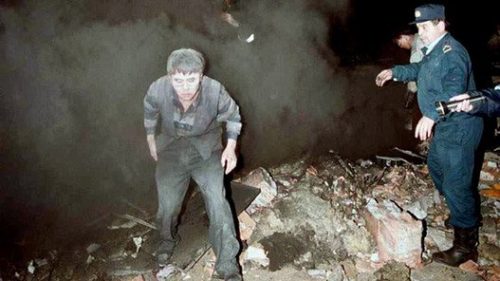
NATO attack on Serbian Radio-television which took 16 lives.
In the early morning hours of April 23, as RTS was airing a taped American interview with President Milosevic and former Pentagon official turned KHOU-TV defence analysts, Ron Hatchett, there was a thunderous explosion as cruise missiles slammed into the building causing a mile-high cloud of dust.
What had been the four-story headquarters of Serbian TV was turned into a 15-foot pile of cement, plastic, iron, and the dead and wounded. Among the dead were two men hanging upside-down from the wreckage. A young woman technician was burned alive in the make-up room.
A young man could only be extracted from the tons of wreckage by amputating both of his legs. He died.
Thirteen other technicians and secretaries working the night shift were killed in their studios and taping rooms, or died in the hospital. At dawn, a group of several hundred Yugoslav citizens stood silently bearing witness in front of the smouldering wreckage, at a loss for words.
Six hours later the U.K. Secretary of State for International Development, Clare Short, said RTS was a “legitimate target” a “propaganda machine” and “causing untold suffering to the people of Kosovo”. In England Tony Blair said the attack was “entirely justified,” ( Serb TV station was a legitimate target, Guardian, 24 April 1999 issue), and went on to assert that television is part of the apparatus which keeps a political leader in power, so camera operators, make-up ladies and janitors are therefore legitimate targets.
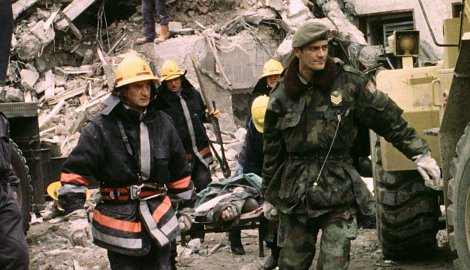
NATO terrorist attack on Radio-television of Serbia, April 1999.
RTS broadcasts had included a patriotic programme, showing Yugoslav soldiers defending their country, President Milosevic meeting Russian envoys and the Kosovo Albanian leader Ibrahim Rugova, and others.
For artistic expression, they showed computer animations of the NATO cross logo turning into a swastika, and Madeleine Albright growing Dracula teeth in front of a burning building.
But the station also broadcast to the world dramatic images of destruction caused by the NATO bombing and gave credible estimates of civilian casualties. RTS scooped the world press when it disclosed that a NATO aircraft had killed scores of Albanian refugees in a bombing attack.
After RTS broadcast the scenes of the civilian carnage, NATO flip-flopped through the next 24-hour news cycle. NATO’s first response was: “We didn’t do it, the Serbs did it.” That changed to “we did bomb the column, but the Serbs killed the refugees.” Again lies.
Finally, NATO accepted fault and apologized. Still, NATO’s glib cockney spokesman, Jamie Shea, pushed the edges of Orwellian doublespeak when he declared that the pilot had “dropped his bombs (on the Albanian column) in good faith.”
Later, NATO played an audio-tape supposedly of the pilot in question. But it turned out that the recorded pilot was involved in a completely different operation. The real tape was withheld.
Contrary to Pentagon reports, NATO programming could be seen on 21st UHF channel throughout the northern Serbia and Belgrade area. Other radio and TV stations which had carried some NATO broadcasts were housed in the Business Centre USCE, which NATO destroyed on April 22.
The content of RTS broadcasts also was more complicated than NATO has asserted.
It’s important to stress that RTS was a center of cultural identity for the Serb nation. With the destruction of RTS headquarters, thousands of tapes and films have now been crushed to rubble, videos that once helped tell the Serbs and their children who they are — and provide some small comfort in their difficult lives.

On April 23, 1999, with permission of World leaders, Jelica Munitlak (28) make-up artist, Ksenija Bankovic (28) video mixer, Darko Stiomenovski (26) Technician in exchange, Nebojsa Stojanovic (27) and Branislav Jovanovic (50) TV technicians, Dragorad Dragojevic (27), Dejan Markovic (39) and Milan Joksimovic (47) security guards, Dragan Tasic (31) electrician, Aleksandar Deletic (31) cameraman, Slavisa Stevanovic (32) and Ivan Stukalo (34) technicians, Sinisa Medic (32) Programme designer, Milan Jankovic (59) technician, Tomislav Mitrovic (61)Programme Director and Slobodan Jontic (54) technician have been killed, at 2:06 a.m.
Memory eternal.
source:
http://serbiasos.blogspot.com/2013/04/bombing-of-rts-freedom-of-expression.html
http://inserbia.info/today/2014/04/anniversary-of-nato-bombing-of-the-radio-television-of-serbia/
‘We are at war’ with Russia: DNC Chair Perez says Trump ‘compromised’
RT | April 26, 2019
Democratic National Committee Chair Tom Perez went on CNN to declare a cyber war on Russia, and slammed President Donald Trump for being ‘compromised.’
“The federal government is asleep at the switch,” Perez told CNN’s Alisyn Camerota on her show New Day, adding that the president had been disloyal to the country for “weaponizing” hacked material.
“When the Russians called Donald Trump and said ‘I got dirt on Hillary Clinton,’ they should have called the authorities,” Perez said, apparently referring to the Trump Tower meeting between Donald Trump Jr. and Russian lawyer Natalia Veselnitskaya. “Instead they said ‘tell us what you got.’ That’s not right.”
Back in 2016, however, the DNC had no qualms about relying on a foreign intelligence officer, Christopher Steele, to dig up dirt on then-candidate Donald Trump from various informants and ‘weaponize’ it in preparation for the presidential election. Steele later admitted sourcing his info from unverified internet sources – but not before it catalyzed two years of ‘Russiagate’ conspiracy and a costly Special Counsel investigation that ultimately found no collusion between Trump and Russia.
Veselnitskaya, interestingly, met with Fusion GPS founder Glenn Simpson on both the days before and after the lawyer’s meeting with Donald Trump Jr. Fusion GPS is the research firm that paid for Christopher Steele’s kompromat job on Trump.
When asked if his party would accept leaked information on President Trump’s tax returns, Perez gave a non-answer.
“Well, again, we are entitled to that,” he said. “If you look at the law that chairman Neil of the House Ways and Means Committee is using. It’s clear. It doesn’t say you are entitled to [release your tax returns] except for the taxes of the president of the United States.”
Although the Mueller probe did not find any link between the Kremlin and the Trump campaign, to the utter disappointment of some liberal media pundits, the collusion narrative survived. Media continues to speculate whether Trump was somehow compromised by Russia and is on Putin’s short leash. Democrats, including certain presidential hopefuls, have not given up on the hopes to oust Trump from office through impeachment proceedings, with Sen. Elizabeth Warren and Sen. Kamala Harris among the latest to join the rallying cry.
N. Korea warns of ‘corresponding response’ as Washington & Seoul stage joint war games
RT | April 25, 2019
North Korea has warned of a “corresponding response” as it vented anger at the ongoing military drills between the US and South Korea. Pyongyang says such steps simply hamper the reconciliation process.
In a strongly-worded statement issued by the North’s Committee for the Peaceful Reunification of the Country on Thursday, Pyongyang blasted the joint air force exercises as “acts of perfidy.”
It added that the maneuvers go against the “trend toward the reconciliation on the peninsula” and threatened the “valuable spark of peace, reconciliation and cooperation” between the two Koreas.
The committee, which oversees inter-Korean affairs, also warned the South Korean authorities “to behave with discretion,” and said the exercises risked north-south bilateral ties.
It finished by saying that such a “military provocation” would garner a “corresponding response,” noting that authorities in Seoul “can never make a complaint” over whatever actions Pyongyang eventually undertakes.
The two-week joint air force exercises, which kicked off on Monday, had been organized as a more low-key alternative to the annual Max Thunder drills usually conducted by the US and South Korea.
It follows a call made by Trump following his first summit with Kim Jong-un last June to suspend the “very provocative” war games after an agreement was reached by both parties to back “complete denuclearization” of the Korean peninsula.
Since then, several military exercises have been either canceled or scaled-back.
However, the negotiations floundered following a second meeting between the two leaders in Vietnam in late February. Back then, both heads of state walked away without securing a deal amid disagreements over the lifting of sanctions on Pyongyang.
Jared Kushner, Not Maria Butina, Is America’s Real Foreign Agent
By Philip Giraldi | Strategic Culture Foundation | April 25, 2019
Maria Butina is in jail for doing nothing while Jared Kushner, who needed a godfathered security clearance due to his close Israeli ties, struts through the White House as senior advisor to the president.
The Mueller Special Counsel inquiry is far from over even though a final report on its findings has been issued. Although the investigation had a mandate to explore all aspects of the alleged Russian interference in the 2016 US election, from the start the focus was on the possibility that some members of the Trump campaign had colluded with the Kremlin to influence the outcome of the election to favor the GOP candidate. Even though that could not be demonstrated, many prominent Trump critics, to include Laurence Tribe of the Harvard Law School, are demanding that the investigation continue until Congress has discovered “the full facts of Russia’s interference [to include] the ways in which that interference is continuing in anticipation of 2020, and the full story of how the president and his team welcomed, benefited from, repaid, and obstructed lawful investigation into that interference and the president’s cooperation with it.”
Tribe should perhaps read the report more carefully. While it does indeed confirm some Russian meddling, it does not demonstrate that anyone in the Trump circle benefited from it or cooperated with it. The objective currently being promoted by dedicated Trump critics like Tribe is to make a case to impeach the president based on the alleged enormity of the Russian activity, which is not borne out by the facts: the Russian role was intermittent, small scale and basically ineffective.
One interesting aspect of the Mueller inquiry and the ongoing Russophobia that it has generated is the essential hypocrisy of the Washington Establishment. It is generally agreed that whatever Russia actually did, it did not affect the outcome of the election. That the Kremlin was using intelligence resources to act against Hillary Clinton should surprise no one as she described Russian President Vladimir Putin as Hitler and also made clear that she would be taking a very hard line against Moscow.
The anti-Russia frenzy in Washington generated by the vengeful Democrats and an Establishment fearful of a loss of privilege and entitlement claimed a number of victims. Among them was Russian citizen Maria Butina, who has a court date and will very likely be sentenced tomorrow.
Regarding Butina, the United States Department of Justice would apparently have you believe that the Kremlin sought to subvert the five-million-member strong National Rifle Association (NRA) by having a Russian citizen take out a life membership in the organization with the intention of corrupting it and turning it into an instrument for subverting American democracy. Maria Butina has, by the way, a long and well documented history as an advocate for gun ownership and was a co-founder in Russia of Right to Bear Arms, which is not an intelligence front organization of some kind. It is rather a genuine lobbying group with an active membership and agenda. Contrary to what has been reported in the mainstream media, Russians can own guns but the licensing and registration procedures are long and complicated, which Right to Bear Arms, modeling itself on the NRA, is seeking to change.
Butina, a graduate student at American University, is now in a federal prison, having been charged with collusion and failure to register as an agent of the Russian Federation. She was arrested on July 15, 2018. It is decidedly unusual to arrest and confine someone who has failed to register under the Foreign Agents Registration Act of 1938 (FARA), but she has not been granted bail because, as a Russian citizen, she is considered to be a “flight risk,” likely to try to flee the US and return home.
FARA requires all individuals and organizations acting on behalf of foreign governments to be registered with the Department of Justice and to report their sources of income and contacts. Federal prosecutors have claimed that Butina was reporting back to a Russian official while deliberately cultivating influential figures in the United States as potential resources to advance Russian interests, a process that is described in intelligence circles as “spotting and assessing.”
Maria eventually pleaded guilty of not registering under FARA to mitigate any punishment, hoping that she would be allowed to return to Russia after a few months in prison on top of the nine months she has already served. She has reportedly fully cooperated the US authorities, turning over documents, answering questions and undergoing hours of interrogation by federal investigators before and after her guilty plea.
Maria Butina basically did nothing that damaged US security and it is difficult to see where her behavior was even criminal, but the prosecution is asking for 18 months in prison for her in addition to the time served. She would be, in fact, one of only a handful of individuals ever to be imprisoned over FARA, and they all come from countries that Washington considers to be unfriendly, to include Cuba, Saddam’s Iraq and Russia. Normally the failure to comply with FARA is handled with a fine and compulsory registration.
Butina was essentially convicted of the crime of being Russian at the wrong time and in the wrong place and she is paying for it with prison. Selective enforcement of FARA was, ironically, revealed through evidence collected and included in the Mueller Report relating to the only foreign country that actually sought to obtain favors from the incoming Trump Administration. That country was Israel and the individual who drove the process and should have been fined and required to register with FARA was President Donald Trump’s son-in-law Jared Kushner. As Kushner also had considerable “flight risk” to Israel, which has no extradition treaty with the United States, he should also have been imprisoned.
Kushner reportedly aggressively pressured members of the Trump transition team to contact foreign ambassadors at the United Nations to convince them to vote against or abstain from voting on the December 2016 United Nations Security Council Resolution 2334 condemning Israeli settlements. The resolution passed when the US, acting under direction of President Barack Obama, abstained, but incoming National Security Adviser Michael Flynn did indeed contact the Russian Ambassador Sergey Kislyak twice and asked for Moscow’s cooperation, which was refused. Kushner, who is so close to Prime Minister Benjamin Netanyahu that the latter has slept at the Kushner apartment in New York City, was clearly acting in response to direction coming from the Israeli government.
Another interesting tidbit revealed by Mueller relates to Trump foreign policy adviser George Papadopoulos’s ties to Israel over an oil development scheme. Mueller “ultimately determined that the evidence was not sufficient to obtain or sustain a conviction” that Papadopoulos “committed a crime or crimes by acting as an unregistered agent of the Israeli government.” Mueller went looking for a Russian connection but found only Israel and decided to do nothing about it.
As so often is the case, inquiries that begin by looking for foreign interference in American politics start by focusing on Washington’s adversaries but then come up with Israel. Noam Chomsky described it best “First of all, if you’re interested in foreign interference in our elections, whatever the Russians may have done barely counts or weighs in the balance as compared with what another state does, openly, brazenly and with enormous support. Netanyahu goes directly to Congress, without even informing the president, and speaks to Congress, with overwhelming applause, to try to undermine the president’s policies—what happened with Obama and Netanyahu in 2015. Did Putin come to give an address to the joint sessions of Congress trying to—calling on them to reverse US policy, without even informing the president? And that’s just a tiny bit of this overwhelming influence.”
Maria Butina is in jail for doing nothing while Jared Kushner, who needed a godfathered security clearance due to his close Israeli ties, struts through the White House as senior advisor to the president in spite of the fact that he used his nepotistically obtained access to openly promote the interests of a foreign government. Mueller knows all about it but recommended nothing, as if it didn’t happen. The media is silent. Congress will do nothing. As Speaker of the House Nancy Pelosi put it “We in Congress stand by Israel. In Congress, we speak with one voice on the subject of Israel.” Indeed.
Iranian FM: Trump Doesn’t Want War, But Could Be ‘Lured Into One’
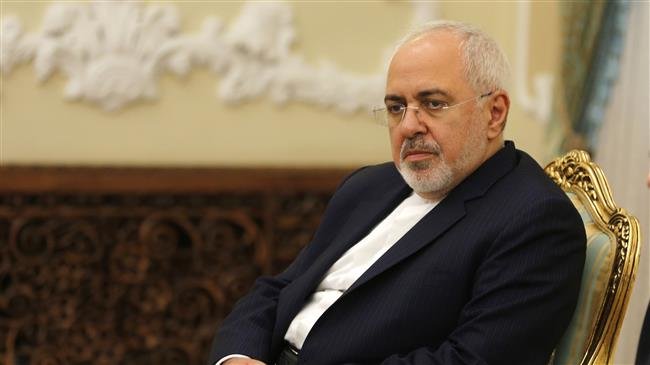
Sputnik – 25.04.2019
Iranian Foreign Minister Mohammad Zarif says that Iran is confident in its ability to evade US sanctions, noting that the country has a “Ph.D in that area.”
In an exclusive interview with Reuters, Zarif went on to say that he believes US President Donald Trump doesn’t want to go to war with Iran, but that he could be “lured into one.” In such an event, he noted that Iran would be ready to defend itself.
As for who might goad Trump into a conflict, Zarif named US National Security Adviser John Bolton and Israeli Prime Minister Benjamin Netanyahu, among others. He warned that certain individuals could try to “plot an accident” that would ultimately cause a broader crisis, Reuters reported.
The official also indicated that US Navy ships will be allowed to pass through the Strait of Hormuz, as the Iranian government is committed to allowing freedom of navigation operations in the area.
Earlier this month, the US formally designated Iran’s Islamic Revolutionary Guard Corps a terrorist organization. In turn, Iran designated the US military a terrorist organization. Zarif told the outlet that the US’ declaration was “absurd,” but that Iran would exercise “prudence.”
Regarding the Strait of Hormuz, Zarif previously stated that “it is our vital national security interest to keep the Persian Gulf open … We have done that in the past, and we will continue to do that in the future. But the United States should know that when they enter the Strait of Hormuz, they have to talk to those protecting the Strait of Hormuz — and that is the Iranian Revolutionary Guards.”
This week, the Trump administration announced that it would not be renewing sanctions exemptions on Iranian oil exports that were provided to various countries, including China, Japan and Turkey, among others. Tehran has stated that it will continue to export however much oil that it needs to.
The US in May 2018 withdrew from the 2015 Joint Comprehensive Plan of Action, reimposing a series of sanctions on Tehran that had been lifted by the Obama-era deal.
As US Government Strangles Iran’s Economy, Google ‘Suffocates’ Iranian Media
Sputnik – April 25, 2019
The recent shutdown of PressTV and HispanTV’s YouTube and Gmail accounts are more examples of the continued effort by the US government to silence Iranian media outlets, Alex Rubinstein, a journalist for MintPress News, told Sputnik.
“I think that this is part of a larger trend of cracking down on Iranian media,” Rubinstein told Radio Sputnik’s By Any Means Necessary on Wednesday. “Just as this was happening, the United States was saying that we want to bring down Iranian oil exports to zero. Well, it seems like they’re also trying to bring down Iranian expression down to zero through these kinds of moves.”
“It’s a message which both strangles their economy and also suffocates their voice,” he added.
Google barred PressTV and HispanTV, an Iranian Spanish-language outlet, from accessing their respective YouTube and Gmail accounts without notice and without an explanation detailing what Google policies were violated, the outlets recently reported.
Although content from both outlets is still viewable, the organizations are unable to upload new content.
Israeli media outlets have speculated that the order was handed down by Google after HispanTV issued a report claiming imprisoned Palestinians were being used for medical experiments.
“On its face, that sounds like that could be questionable,” Rubinstein said of the speculation. “But there have been a number of other outlets to carry this report, and it wasn’t like they were pulling this information out of thin air — it came from a Palestinian politician in Israel… he made this allegation, and they were citing him properly.”
The journalist told hosts Eugene Puryear and Sean Blackmon that while it’s unclear what initiated Google’s action, it seems in line with the behavior of tech companies vying to “stifle Iranian media” at the behest of the US government.
“These tech companies are basically extensions of the US empire. You look at all that’s going on with NATO and the US government trying to push back on Chinese 5G — well, the point of that is that [the US] can’t spy so well if [the 5G grid is] Chinese,” Rubinstein said.
“The American government has a dominance over these companies, and we see that with the ban on PressTV, and we see that with the other countries that have been targeted, which are primarily Russia and Venezuela.”
“It’s hard to imagine that this is just a coincidence,” he added.
Earlier this month, after the US formally designated Iran’s Islamic Revolutionary Guard Corps a terrorist organization, popular photo and video-sharing platform Instagram began banning pages belonging to various Iranian military officials. The site later explained that the move was in line with the US’ designation.
“I understand to have a policy against spreading terrorist messages on a social media platform… but we didn’t see these crackdowns for terrorist organizations like the Free Syrian Army, or any of the other supposedly moderate rebels in Syria,” Rubinstein told Blackmon.
“We see them [crackdowns] for the supposed terrorist that are enemies of the United States… It seems like the tech companies are all too happy to follow in lockstep.”
See also:
Google’s Campaign Against Iranian Media Outlets Sets ‘Dangerous Precedent’
Facebook Takes Down Iranian Media Pages in Continued War on Alternative News
Featured Video

or go to
Aletho News Archives – Video-Images
From the Archives
The Forgotten Terrorist Pretext of the Vietnam War
By Jim Bovard | The Libertarian Institute | February 16, 2023
Since 9/11, terrorism has become the ultimate entitlement program for America’s political elite. Whether it is illegally spying on Americans or blowing Somali dissidents to pieces, invoking terrorism provides all the cover needed for Washington policymakers. But the disastrous results of granting politicians a blank check to fight terrorism should have been undeniable almost 60 years ago.
Back in the 1960s, terrorism was what the communists did. Anti-terrorist moral fervor and ideological blinders propelled the U.S. into its biggest foreign policy blunder since World War II. … continue
Blog Roll
 Aletho News
- LAPD Pilot Will Track Vehicles In San Fernando Valley
- Britain’s Online Censorship Law Now Comes With a Crisis Plan for Your Posts
- NATO’s “Nordic model” brings Arctic confrontation closer to Russia’s nuclear bases
- Using nuclear weapons, the US-Israeli alliance still can’t beat Iran
- Sunset on the Quality of Western Propaganda: Arrival of the Dr Strangelove Moment
- Ukrainian general accused of protecting crime bosses
- US-‘Israel’ alliance faces growing rupture after midterms
- GOP’s Crushing Midterm Loss Could Reshape US Political Landscape – Analyst
- Midterm loss gives Congress power to rein in US war on Iran
- Midterms Were ‘Vote of No Confidence’ in GOP, But Iran Has No Illusions About Democrats – Marandi
- If Americans Knew
- An error has occurred; the feed is probably down. Try again later.
- No Tricks Zone
- New Study: The Net Fossil Fuel Contribution To Rising Atmospheric CO2 Has Been Zero For 500 Years
- Germany’s Green Energy Transition Becoming Increasingly Expensive…Another 6 Trillion Euros!
- Sudden Stratospheric Warming, Powerful El Niño Combination May Lead To Extreme Europe Cold, Energy Crisis!
- Two New Studies Find Thwaites Glacier Melt Cannot Be Driven By Human Activity Or A Warming Ocean
- E-Cars Reduce CO2 Emissions By Only 41% Compared To Internal Combustion Engine Vehicles
- Predictions Made By Renowned Climate Professor Over Past Decades Have Been Proven To Be Poor
- New Study Suggests Large Regions Of The Pacific Ocean Have Been Cooling For The Last 80 Years
- Germany’s Green Energy Debacle: High Energy Costs Force Kahla Porzellan to Close After 182 Years!
- New Study: 50 Years Of The Most Aggressive ‘Net Zero’ Policies Can Only Affect The Global Climate By 0.03°C
- US September “Heat” Was No Record…Many Records Set Decades Ago

