A Stumble at Hanoi, but Negotiations Remain on the Agenda
By Gregory Elich | Zoom in Korea | March 4, 2019
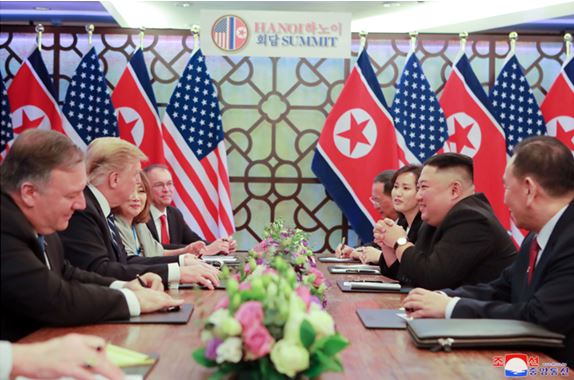
President Trump’s hasty decision to pull the plug on the Hanoi Summit ahead of schedule came as a stunning surprise. The feeling of disappointment in those who were hoping for success contrasted with the sense of relief in the U.S. foreign policy establishment, which remains steadfastly opposed to any improvement in relations.
The widespread assumption going into the summit was that the Trump administration would be able to buy off North Korea with diplomatic trinkets. It was thought that among these would be limited sanctions exemptions, such as allowing humanitarian organizations greater latitude to operate in North Korea. It was also anticipated that a document would be signed which would recognize that the Korean War had ended in 1953. While a peace declaration would have a symbolic “feel good” value, it would change no facts on the ground, and leave the North Koreans essentially empty-handed.
By all accounts, the North Koreans have been more clear-eyed about what they need in talks with U.S. negotiators than they had been given credit. Symbolic measures will not suffice. The North Koreans have serious and well-founded security concerns, given the various wars and military interventions the United States has launched around the world and its decades-long hostility to North Korea.
The Trump administration’s current campaign to destabilize Venezuela and substitute its handpicked lackey as that country’s president can only have further clarified thinking on security matters for the North Koreans.
A more immediate concern for North Korea is the impact of economic sanctions, which have as their aim the collective punishment of the entire population. According to a senior U.S. State Department official, during discussions on sanctions relief with their North Korean counterparts, U.S. negotiators “did our own calculations, and [the damage] tallies up to the tune of many, many billions of dollars.” North Korea’s GDP may be difficult to assess with precision, but it is estimated at around $30 billion. That places it below Vermont, which ranks dead last among U.S. states in terms of GDP. Given the economic damage/GDP ratio, it is obvious that the sanctions war is inflicting enormous hardship on the North Korean people.
According to North Korean Foreign Minister Ri Yong-ho, “Our proposal was that, if the U.S. lifts some of the UN sanctions, or in other words those aspects of the sanctions that impede the civilian economy and the people’s livelihood, we will completely and permanently dismantle the production facilities of all nuclear materials, including plutonium and uranium, in the Yongbyon complex, through a joint project by technicians from our two countries, in the presence of American experts”
“They were willing to give everything, including all the facilities at Yongbyon,” revealed an unnamed source. “Not just one physical reactor, but the whole complex. They were also willing to present their willingness to fully dismantle in the form of an official document. They were getting down to business pretty seriously. And then Mr. Trump and the American side turned down the proposal and left,” to the dismay of the North Koreans.
U.S. Secretary of State Mike Pompeo urged the president to reject the North Koreans’ proposal, as facilities outside of Yongbyon were not included, and nuclear weapons and missiles would remain untouched. National Security Advisor John Bolton may have added objections as well, given his well-known aversion to anything other than unilateral disarmament by North Korea.
“The President in his discussions challenged the North Koreans to go bigger,” a State Department official announced. “The President encouraged Kim to go all in, and we were… prepared to go all in as well.” Trump wanted the North Koreans to put their entire program on the table in exchange for relief on economic sanctions.
From the North Korean standpoint, complete dismantlement of its nuclear program cannot come without a security guarantee. According to Foreign Minister Ri, that guarantee is “even more important” than lifting sanctions. After all, it was for security reasons that North Korea developed its nuclear program, and its security will need to be assured through other means if it denuclearizes. “Given the current level of trust between our two countries,” Ri explained, the dismantlement of the Yongbyon facility is “the biggest step toward denuclearization that we can take at the present moment.” Trump’s proposed grand bargain failed to provide a secure basis for the North Koreans to abandon their nuclear program. Also unaddressed is the concept of denuclearization of the Korean Peninsula, which is habitually interpreted in a one-sided manner in the West as applying solely to North Korea. The meaning of that term needs to be clarified through further negotiations.
The U.S. side, however, remains wedded to the idea of maximum punishment as a negotiating tool and is unwilling to grant relief on economic sanctions without North Korea’s complete denuclearization. That is the essence of the current impasse between the two sides. In an interview broadcast on Fox News, Trump said, “The sanctions are there, and I didn’t want to give up the sanctions unless we had a real program.”
It seems clear that if both parties can agree on timing and sequencing, the possibilities for progress are there, starting with a partial lifting of economic sanctions in exchange for partial denuclearization.
Although the Hanoi Summit failed to produce a concrete result, it would be incorrect to say that it failed. Diplomacy is a process, not a single event. The summit did not end in rancor, and both sides have pledged to continue negotiations. KCNA, the North Korean news agency, reported that the summit “offered an important occasion for deepening mutual respect and trust,” and it noted that President Trump and Chairman Kim Jong Un “agreed to keep in close touch” and “continue productive dialogues for settling the issues discussed at the Hanoi Summit.”
“They were constructive discussions,” points out a State Department official. “There’s room to continue talking.” In Mike Pompeo’s assessment, “There have been lots of things that we’ve moved forward on, and I think we have a set of shared common understandings. I’ve seen enough congruence between what the two sides are trying to accomplish. I saw the goodwill between the two leaders.”
Despite the lack of agreement, Kim reiterated his commitment to maintain a freeze on nuclear and ballistic missile testing, while the U.S. is renaming and reducing the scope of its annual Foal Eagle and Key Resolve military exercises.
The main impediment to progress is U.S. bi-partisan opposition to dialogue and any reduction of tensions in East Asia. An often-repeated charge is that last year’s Singapore Summit produced no tangible result. However, the Singapore Summit was a short meeting meant to establish an agreement on intent, in which not only did North Korea promise to work toward denuclearization, but both sides committed to improve relations and build a peace regime on the Korean Peninsula. After decades of hostility and confrontation, the summit redirected the relationship to one of dialogue. That is no small thing. Critics who argue that detailed steps should have been drawn up in that initial meeting are, of course, intentionally distorting the nature of the meeting in an attempt to discredit the concept of U.S.-North Korea negotiations.
Similarly, those who wish to block progress can be expected to argue that the lack of an agreement at Hanoi proves that it is a mistake to meet with the North Koreans and talks must come to a halt. Nevertheless, U.S. and North Korean leaders remain invested in the process, and the less influence opponents have on U.S. negotiating strategy, the more chance of success. Moreover, although there is internal opposition from conservative forces in South Korea, the detente process between the two Koreas has developed its own momentum, which can be expected to exert a positive influence on the U.S. position. For now, there is certainly more reason for hope than despair.
Gregory Elich is a Korea Policy Institute associate and on the Board of Directors of the Jasenovac Research Institute. He is a member of the Solidarity Committee for Democracy and Peace in Korea, a columnist for Voice of the People, and one of the co-authors of Killing Democracy: CIA and Pentagon Operations in the Post-Soviet Period, published in the Russian language. He is also a member of the Task Force to Stop THAAD in Korea and Militarism in Asia and the Pacific.
His website is https://gregoryelich.org
Follow him on Twitter at @GregoryElich
Guaido returns to Venezuela to the welcome of foreign ‘bodyguard’ envoys
RT | March 4, 2019
Self-declared “interim president” of Venezuela, Juan Guaido, returned from his South American tour on Monday, arriving into the loving (and protective) arms of ambassadors from the foreign governments backing him.
Despite Venezuelan authorities making it clear he could face 30 years in prison for attempting to overthrow the government and violating a travel ban, Guaido chose to arrive directly to an airport in Caracas.
The risk of arrest was notably mitigated by the presence of ambassadors from Germany, France, Spain, the Netherlands and several other countries which gathered at the arrival gate to huddle around him like a high-profile human shield. While Guaido was all smiles, his Western-world entourage seemed a bit on edge.
While the media fretted that Maduro might make good on threats to arrest Guaido, the opposition leader passed through customs without incident and headed straight to a rally in central Caracas.
Meanwhile, Vice President Mike Pence warned the Venezuelan government that Washington protects its investments, stressing how important Guaido is to them, and threatening a “swift response” if anyone tries to bully him.
Shortly after moving unhindered through the airport, Guaido arrived at a demonstration he called for on Twitter the week before. Addressing crowds in the country’s capital city, he called on his supporters to take to the streets for continued demonstrations next Saturday.
While Guaido toured South America and met with his most critical support base – foreign governments – the US ramped up pressure on Maduro’s government, imposing intensified sanctions and revoking visas for state actors.
US Deploys THAAD Missile System to Israel
Sputnik – 04.03.2019
WASHINGTON – The United States military deployed a Terminal High Altitude Area Defense (THAAD) anti-ballistic missile battery to Israel, European Command (EUCOM) said in a statement on Monday.
“At the direction of the Secretary of Defense, US European Command deployed a THAAD system to Israel in early March,” the statement said.
The move is intended to demonstrate the United States’ ongoing commitment to Israel’s security, the statement added.
As part of the deployment, US service members will work in different locations in Israel to help local military forces align their existing air and missile defence architecture with the THAAD system.
The exercise will allow the US military to incorporate key capabilities stationed in the country and Europe with its partners in the Israeli military, EUCOM said.
The THAAD system, considered one of the most advanced in the world, will be added to the existing Israeli air defence. The latter currently includes the Iron Dome, designed to shoot down short-range rockets and the Arrow system.
Commenting on the exercise, IDF Spokesperson Brig.-Gen. Ronen Manelis specified the US anti-ballistic missile battery would be deployed in the south of the country and that about 200 American servicemen would participate in the drills.
CNN analyst claims Trump’s speech sounded like HITLER’s, but script was written by… PUTIN?!
RT | March 3, 2019
A CNN analyst and adviser at the Biden Institute has showcased her unmatched skill to roll all in one by comparing Donald Trump to Hitler for using a turn of phrase once shouted by Joe Biden and at the same time written by Putin.
Offering her thoughts on the president’s speech at the 2019 Conservative Action Conference (CPAC), Sam Vinograd told her CNN colleagues that she was horrified that Trump had spoken about “reclaiming our nation’s priceless heritage.”
For Vinograd, this was clearly a message lifted straight from Mein Kampf.
“His statement makes me sick, on a personal level, preserving your heritage, reclaiming our heritage, that sounds a lot like a certain leader that killed members of my family and about six million other Jews in the 1940s,” she said.
She went on to lament how Trump had used his CPAC address to “spread misinformation and conspiracy theories,” and that certain things he said “really” made it seem as if “Vladimir Putin scripted his speech.”
It wasn’t long before her eyebrow-raising remarks caught the attention of social media users – who found some glaring problems with her logic.
For starters, former vice president Joe Biden made a nearly verbatim declaration in 2011, when he told the Florida Democratic Party Convention that “it’s time to reclaim our heritage.” He yelled it, too – which seems like something Hitler might do.
To add salt to the open hypocrisy wound, Vinograd is a former Obama administration official who currently serves as an adviser to the Biden Institute, a think tank named in honor of – yes, you guessed it – Joe Biden.
Then, of course, there’s the inconvenient reality that Trump’s daughter converted to Orthodox Judaism in keeping with her husband’s Jewish faith. Others pointed out that the US Commission for the Preservation of America’s Heritage Abroad – a government agency that uses that scary Hitler word! – is chaired by an Orthodox Jew.
Vinograd’s comments about Putin also didn’t quite add up, with Twitter pundits expressing regret that she had failed to elaborate on which parts of Trump’s speech were allegedly written by the Russian president.
Twitter users were especially impressed by Vinograd’s lack of self-awareness, after she accused the president of “pretending that there are foreign people trying to influence our country in a way that just isn’t accurate.” Seconds later, she suggested Vladimir Putin wrote Trump’s speech.
The televised train wreck also got two thumbs down from radio host and former CIA analyst Buck Sexton, who summed up his feelings about the segment with a perceptive observation.
“CNN is a joke. Just not a funny one,” he mused.
US & South Korea agree to scrap major military drills to foster denuclearization – Seoul
RT | March 3, 2019
Washington and Seoul will no longer be conducting large-scale Foal Eagle and Key Resolve war games, the South Korean defense ministry said Sunday. It comes several days after US President Trump complained about the drills’ cost.
The cancellation of the annual wargames, initially scheduled to kick off in spring, was announced by the South Korean military, as it made public the details of a call between Acting US defense chief Patrick Shanahan and his South Korean counterpart, Jeong Kyeong-doo, Yonhap reported.
Seoul said that the move to call off the exercises was in support of the diplomatic efforts to pursue a nuclear-free Korean peninsula. The drills have been paired since 2001 and traditionally take place in February-March. North Korea saw the allies’ annual saber-rattling as preparation for invasion.
“The minister and secretary made clear that the alliance’s decision regarding the adjustment of the exercise and drills reflects both countries’ expectation to back diplomatic efforts to reduce tensions and achieve the complete denuclearization of the Korean Peninsula through a final, full verified method,” the ministry said in a statement.
By ditching the costly wargames the US and South Korea are not eliminating joint exercises completely, though: they are planning new command post drills and will continue to carry out field maneuvers. However, these are expected to be conducted on a significantly lower scale. In the run-up to the announcement, unnamed officials told CNN that Washington and Seoul might instead carry out drills “at a small unit level” that would feature “virtual training.” NBC News reported, also citing officials, that the large-scale war games would be replaced by “mission-specific training.”
The scaling-down was widely expected, since Trump has repeatedly bemoaned the drills’ hefty price tag the US has to cover. Following the first Trump-Kim summit in June 2018, Trump said that the US would halt joint drills with South Korea, while calling them “quite provocative,” stirring unease among his own military.
Shortly after that, Washington and Seoul suspended large-scale Ulchi Freedom Guardian exercises scheduled for August.
In November, then Pentagon chief James Mattis stated that the Foal Eagle drills were “being reorganized a bit to keep it at a level that will not be harmful to diplomacy.”
Speaking in the wake of his Hanoi summit with North Korean leader Kim Jong-un this week, Trump said the drills with South Korea were “fun and nice” but a “very, very expensive thing,” and that he “gave that up quite a while ago.”
Foal Eagle typically sees some 11,500 US troops taking part alongside 290,000 South Korean military forces in the drills that include air, ground and naval field operations. Key Resolve is a computer-simulated exercise that also used to draw in a large number of troops from both sides, including about 12,200 Americans and 10,000 South Koran servicemen.
Lavrov to Pompeo: We can talk Venezuela, but US must stop threatening its legitimate government
RT | March 2, 2019
The US attempts to threaten Venezuela and meddle in the country’s affairs under the guise of supplying humanitarian aid have nothing to do with democracy, Russian FM Sergey Lavrov told his American counterpart, Mike Pompeo.
The top diplomats talked on the phone on Saturday on the initiative of Washington, the Russia Foreign Ministry said.
During the conversation, Lavrov blasted the American threats against the government of Nicolas Maduro, calling them “blatant interference in the internal affairs of a sovereign state and a flagrant violation of international law.”
He also grilled the US Secretary of State over Washington’s attempts to influence the situation in Venezuela under the “hypocritical guise” of providing humanitarian aid to the crisis-hit country. Such actions “have nothing to do with democratic process,” Lavrov said.
Earlier this week, Venezuelan Foreign Minister, Jorge Arreaza, has labeled the US aid to the country “a Trojan horse.” He said that nails and barbed wire to build barricades were seized from the supply trucks on the border with Colombia and provided photos to back his words.
As for Washington’s proposal to hold consultations on Venezuela, Lavrov said that Moscow was ready for such talks. However, he reminded Pompeo that “the principles of the UN Charter must be followed strictly as only the people of Venezuela have the right to decide the future of their country.”
The situation in Venezuela escalated after opposition leader, Juan Guaido, declared himself interim president of the country in late January. He was swiftly backed by the US, which never made a secret out of its desire to see socialist president Maduro removed from power.
However, all the American backing and increased sanction pressure on Caracas have so far been insufficient to cement Guaido’s claim to power as the man fled to neighboring Colombia to lead the coup from there, while promising to return.
Kushner’s new ideas are Netanyahu’s old ones
By Oraib Al-Rantawi | MEMO | March 2, 2019
Kushner’s new ideas are not different from Netanyahu’s old ones. The inexperienced US president’s son-in-law, with poor charisma, who, as a result of family connections, jumped to the top of the American leadership hierarchy and took over a handful of the most complex foreign policy files (the Palestinian issue and US-Saudi relations) has moved a step ahead in the “deal of the century”, according to his interview with Sky News Arabia in which he said he was getting closer to revealing its details.
The four main components of the deal are: freedom, respect, dignity and security, but for Kushner, freedom does not mean getting liberated from the occupation and exercising the right to self-determination and national independence. To Kushner, freedom only means freedom of movement, goods and worship. He keeps referring to the uniqueness and creativity that characterise his plan, but his plan has not come up with anything new, they are ideas and initiatives that have been discussed in the circles of the Israeli right-wing as final status solutions for the Palestinian issue. They are all ideas that reflect American positions adopted by previous Republican and Democratic administrations.
The most recent and dangerous statement made by Kushner was when he talked about setting the borders. He did not mention the two-state solution and he did not refer to the right of the Palestinians to self-determination and the establishment of an independent, viable and sovereign state. He considered the long-term goal of setting the borders would mean getting rid of them, which can only be interpreted as an offer to establish a Palestinian entity, less than a state and more than self-rule. This is the same term long used by Netanyahu and Israeli right-wing leaders in their definition of a two-state solution and their vision for a future Palestinian state.
We are now closer to understanding Trump’s position on the Palestinian state project. Kushner’s recent clarifications confirmed our worst fears: The United States is finishing off the national project with its three pillars: refugee return, self-determination and independent statehood, and Jerusalem as the capital of this state.
Washington has taken Jerusalem out of the negotiations by recognising the city as the capital of Israel and moving its embassy from Tel Aviv to Jerusalem. The US targeted the refugee file through two parallel tracks: dismantling UNRWA and redefining who a refugee is. It has given a green light to settlement expansion in all areas of Jerusalem and the West Bank. It adopted the economic peace theory launched by Netanyahu in the 1990s which was later adopted by Tony Blair and General Dayton and became the core of what Friedman called “Fayyadism” in reference to former Palestinian prime minister Salam Fayyad.
Today, Kushner comes up with the theory of setting the borders without linking them to an end of the occupation or the establishment of a Palestinian state, as if the man is trying to define the borders of a local self-rule which will soon disappear. To him, such borders are not international borders and should not be regarded as such.
Kushner is touring rich capitals in the region, and has put Turkey on the list for his current tour. The man is looking for funds for a plan he refuses to reveal; it’s like asking buyers to pay for goods they don’t know anything about. This is a clear disregard to all leaders in the region he is meeting. The man is asking Arab and Islamic countries to fund a deal that calls for keeping Jerusalem, Al-Aqsa Mosque and Islamic and Christian sanctities under Israeli control and sovereignty, resting assured that the ghost of the Iranian threat will enable him to pass the most serious deal that has ever been presented to Palestinians and Arabs.
But the good news amid this rubble of bad news is that no one out of all those who met with Kushner or those yet to meet him would dare to stand in front of the cameras to announce that they will support a deal that is filled with all these political and ideological concessions. The young envoy will also not find one Palestinian who can accept his offer or go along with it, or show an understanding of it.
This article first appeared in Arabic in Arabi21 on 28 February 2019
Chlorine ‘likely’ used in alleged Douma chemical attack, no nerve agent – OPCW‘s final report
RT | March 1, 2019
Chlorine was likely used in a chemical attack in Syria’s Douma last April, the OPCW said. The chemical arms watchdog refrained from identifying the party responsible for the incident, despite earlier being granted such powers.
There are “reasonable grounds” to believe that “the use of a toxic chemical as a weapon [took] place on 7 April 2018,” the Fact-Finding Mission (FFM) of the Organization for the Prohibition of Chemical Weapons (OPCW) said.
“This toxic chemical contained reactive chlorine. The toxic chemical was likely molecular chlorine,” according to the report.
The FMM also stated that it “did not observe any major key precursors for the synthesis of chemical weapons agents, particularly for nerve agents such as sarin, or vesicants such as sulphur or nitrogen mustard.”
The OPCW experts came to these conclusions after on-site visits to collect environmental samples, interviews with the witnesses, and analysis of other data.
The chemical incident in Douma just over a year ago was reported by the infamous Western-backed group, the White Helmets, which had been caught red-handed cooperating with terrorists on numerous occasions.
The activists blamed the Syrian government for the attack on its own people, as videos emerged online allegedly showing doctors trying to rescue those affected by toxic substances. Moscow had for weeks issued repeated warnings that the militants were preparing provocations with chemical weapons in the area.
The unverified claims were swiftly picked up by the mainstream media. The US, UK, and France used the alleged attack as a pretext to launch a large-scale missile attack on Syrian government targets, which they said were involved in the production of toxic agents.
They opted to act days before the OPCW was due to arrive in Douma for a fact-finding mission, just one week after the alleged chemical incident.
Chlorine containers from Germany that belonged to militants were later found by the Russian military in the liberated parts of Douma. This was followed by the discovery of a laboratory operated by terrorists, which contained all the equipment needed to produce deadly chemicals.
Corporate and “Progressive” Democrats Threaten Medicare Itself
Sanders, Jayapal, and more…

By Charles Andrews | Dissident Voice | March 1, 2019
The Democratic Party won a majority in the House of Representatives in the November 2018 elections by making health care one of its top “messages.” Yet events from Bernie Sanders’ bill of 2017 to legislation that “progressive” Representative Pramila Jayapal introduced on February 27, 2019 show that the Party is on its way to destroy Medicare.
For decades activists identified the prize as “single payer health care.” The program would issue a Medicare card to everyone, like the one senior citizens get now. The card would be good at any doctor’s office, clinic, hospital, laboratory, and prescription pharmacy. These largely private businesses would be reimbursed from a public single-payer fund. The fund would receive broadly collected tax revenues; the patient would pay little or nothing at the reception desk, and no monthly premium. This is guaranteed, comprehensive health care.
In other words, single payer is Medicare for all, carried to completion by eliminating Part B premiums and by more comprehensive coverage including prescribed drugs.
Health care activists always agonized over the colorless name “single payer.” A few years ago many of them began to speak of Improved Medicare for All. Actually, it had been in the title of the benchmark bill, H.R. 676, when congressperson John Conyers introduced it in 2003. A few years later he shortened the title to The Expanded and Improved Medicare for All Act. The text remained stable, and although the bill went nowhere in Congressional committees, H.R. 676 became the centerpiece of organizing. It is readable, only thirty pages of double-spaced large type. Hundreds of trade union locals and councils endorsed this model legislation in a steady stream year after year.
The health care industry has enjoyed a long-term phase of expansion, like railroads in the latter half of the nineteenth century. Back then, the new way of moving heavy goods and people was amazing and useful; today, new biological and biochemical understanding makes possible longer life, survival from a heart attack, restored clarity of vision, and so on. In both situations, capital has had strong pricing power and taken fat profits. And just as anger at railroads swelled into a populist revolt against The Octopus (Frank Norris’ novel about the Southern Pacific railroad corporation), people today are angry at insurance corporations, pharmaceutical monopolies, and hospitals, whether or not they call themselves “non-profit.”1
Opinion polls measure growing support for single payer health care for all. Employers continue to raise the employee cost of coverage, or simply not provide a health benefit. Health insurance purchased individually on the so-called exchanges of the Affordable Care Act (“Obamacare”) turns out to be full of exceptions like a slice of Swiss cheese.
Sanders Promotes Health Care for All Then Undercuts Conyers
Popular support erupted into a political force when Bernie Sanders launched his presidential campaign at the end of April 2015. Record-breaking crowds filled his rallies around the country. The top three issues in a Sanders speech rotated – sometimes including inequality of wealth and income, sometimes climate change – but he always revved up on health care for all. It had been the cause of a few thousand health care activists. Now Improved Medicare for All became a challenge to the neoliberal establishment. For the first time in forty years, people were on the verge of a mass campaign for a major gain in their quality of life and their security.
It did not happen. Sanders did not win the Democratic presidential nomination. He returned to the Senate, making an implicit or private deal with the party: he would speak as a independent progressive, but he will act on all serious matters as an unannounced Democrat.
Doing something about health care for people largely fell out of public view. Health care activists carried on. Policy aficionados spun proposals. Sanders had used the issue in his campaign, but sustained mass organizing for it did not happen.
Then in September 2017, senator Sanders introduced his “Medicare for All Act.” S. 1804 is three times as long as H.R. 676, and the reader must unravel cross-references within the text. Sanders made no mention of Conyers’ H.R. 676 at his press conference. Since then, no one has asked him the obvious question: Why didn’t Sanders simply introduce the text of H.R. 676 in the Senate?
The “Buy-In” Trap
Sanders’ bill would actually undermine Medicare. It would set up a “Transitional Medicare Buy-in Option and Transitional Public Option.” Sanders portrayed it as a four-year period (longer if necessary) to bring people of age 55 or over into Medicare, then down to age 45, then down to age 35, then everyone. This scheme is the very opposite of guaranteed single-payer health care for all.
How is Medicare financed today? Most of the money comes from payroll and income tax revenues, not enrollees’ Part B premiums, by a ratio of 3½ to one.2 We all pay into Medicare. At the moment when someone needs care, she gets it, period – without financial worry. That is the single-payer principle, and Medicare implements it, although not entirely, since enrollees must keep up-to-date on their Part B monthly premiums, and there are some co-payments for services.
Expanded and Improved Medicare for All would eliminate premiums and co-pays. That is what H.R. 676 declared, but in Sanders’ S. 1804 people younger than 65 could “join” Medicare by paying fat monthly premiums (a “buy-in”). People who want to sign up this way would use the notorious Obamacare exchanges.
Trade union campaigners for genuine Medicare for all, H.R. 676, wrote in a December 11, 2018 letter:
Unlike HR 676, S 1804 inserts supposedly incremental steps of public options and Medicare buy-ins for four years prior to arriving at a real single payer plan. Because S 1804 expands care while maintaining the private insurance companies, costs will skyrocket before the savings of single payer kick in. The incremental steps will become a roadblock rather than a path to single payer. Perhaps the worst part of this inclusion of the public option and the Medicare buy-in is the reinforcement of the false notion that there should or must be transitional steps to single payer. Neither the public option nor the Medicare by-in are based on sound policy. To place them in the bill for even a short period of time endangers the single payer goal.
— All Unions Committee for Single Payer Health Care, HR 676, Kay Tillow, coordinator
It is a neat trick: under the guise of expanding Medicare, you make it more dependent on premiums. You change it from a public good, like the neighborhood fire station, into a commodity insurance product that individuals buy. You make health care dependent on the patient’s finances.
This perversion of Medicare is not only a fraud upon people of age 55, 45, or 35. It is a threat to Medicare itself. Whenever Medicare seems headed for a financial crunch, real or conjured, the pressure in Congress will be to shift more and more toward a premium- and co-pay-financed program rather than one supported by general and progressive tax revenues – and to take chunks of medicine out of Medicare.
An independent in name but a Democrat, in fact, senator Sanders at his press conference happily introduced several corporate Democrat co-sponsors of his bill. Behind closed doors he had let them write sections of S. 1804! The public option section was written by senator Kirsten Gillibrand of New York. “One part of the bill that I worked with my colleagues to put in was the ability for every American to buy into a nonprofit public option as part of a four-year transition…,” she said during the news conference introducing the bill.
A public option is a competition with insurance corporations rigged in their favor. They know how to repel potential enrollees who are likely to need expensive care. A government health plan cannot and, of course, should not play that game. It can either raise premiums, or it can turn the program into something like its poor cousin Medicaid. Either way, it cannot become improved Medicare for all.
Democratic Party: “Death to H.R. 676!”
Two important bills stood in contradiction to each other: one for Expanded and Improved Medicare for All (H.R. 676), the other a threat to Medicare itself (S. 1804). Conyers’ bill has been the acknowledged model legislation since 2003; Sanders introduced his in 2017.
But words do not move on their own. The corporate Democratic Party soon put H.R. 676 on the chopping block. Representative John Conyers was pushed out of Congress in a #MeToo incident, resigning from a hospital bed, denying the charges but not up to the rigor of a fair hearing if he could get one.
Somehow, sponsorship of H.R. 676 went to new congressperson Pramila Jayapal. 3 She immediately announced that she was in consultations to rewrite it. In the meantime, she surrendered the number 676 that had been reserved for Conyers’ bill since 2003. It was issued to military legislation on January 17, 2019.
After the Democrats won control of the House of Representatives in the November 2018 elections, it became more urgent for them to gut single payer health care for all. Otherwise, they might have to deliver. Representative Nancy Pelosi, during a post-election whirlwind of bargaining to make sure she became Speaker of the House, agreed to help advance the same scheme that senators Sanders and Gillibrand had put into S. 1804: a buy-in to a premium-based option for people age 50 to 64. Jayapal, who also praised Pelosi during her run for Speaker, spoke out of both sides of her mouth. “I would prefer to have a reduction of the age of Medicare so that more people could qualify but not a buy-in, because that continues the problems that we have right now.” She said lowering the eligibility age “would be an appropriate way to go where we’re taking a step forward towards a system that will ultimately cover everybody.”
The Buy-in Trick Again
Representative Jayapal introduced H.R. 1384, her replacement for the Conyers’ model, on February 27, 2019. The 119-page bill is a masterful card trick. On one hand, it maintains the ban on premiums and co-payments, and it specifies a broad list of covered medical services, including some never proposed before in such legislation.
On the other hand, Jayapal copied Sanders’ big step backward – an optional “buy-in” transition period with premiums, only shortened from his four years to two. (After the first year, minors up to age 18 and people 55 and older would move automatically into the new system.) H.R. 1384 states:
The Administrator shall determine the premium amount for enrolling in the Medicare Transition buy-in, which may vary according to family or individual coverage, age, and tobacco status,… (H.R. 1384, Title X, Subtitle A, Sec. 1002 (e)(A))
Since Conyers introduced H.R. 676 in 2003, his bill never had a premium-based buy-in. Why does Rep. Jayapal think a buy-in period is necessary?
With a buy-in transition, the first experience people would have with the new system would be yet another commodity insurance plan with monthly premiums. This is a recipe for political failure. During those two years the tentative new system would soon be under attack as financially unworkable and just not popular enough.
People could buy in if they wished as individuals through the notorious Affordable Care Act exchanges (“Obamacare”). Because of the extensive benefits, the plan would be one of the most costly choices. Unaffordable for most as an individual premium plan, trying to compete in an unreformed health care system with its bloated costs, the buy-in would attract few enrollees. Enemies of genuine universal health care will pounce on the result, demanding that genuine Medicare for All be postponed and turned into a supplement of one kind or another to corporate health insurance.
Only H.R. 676 delivers guaranteed healthcare for all, the equal care for all of which our advanced society is capable. Bernie Sanders and Pramila Jayapal, just like openly corporate yet arguably less devious Democrats, cower before insurance capital, pharmaceutical capital, hospital capital, etc. These parasites demand that healthcare be a set of commodities that some can afford and others cannot. The people or the dollar – that is the inescapable choice.
- A nominally “non-profit” hospital today is not the church-run charity that it might have been a hundred years ago. Non-profit simply means that the corporation is tax-exempt. It does not pay dividends to stockholders, but it still makes a profit. Banks share in the loot, and layers of executives are paid millions of dollars. Affiliated for-profit clinics and labs may suck profits out under cover. Examine the Sutter Health and Kaiser hospital chains in California, for example.
- Medicare trust fund trustees’ report, 2018, pp. 45 and 78.
- Jayapal went to elite Georgetown University, got an MBA after that, worked on Wall Street on leveraged buyouts, switched to executive positions in several nonprofits, sat a mere two years in the Washington state senate, and won election to the House in 2016.
Charles Andrews is the author of The Hollow Colossus.
Remember the Maine? CIA Intervention in Venezuela

Photograph Source National Museum of the U.S. Navy
By David Rosen | CounterPunch | March 1, 2019
In January 1897, Frederic Remington, a 19th-century painter famous for his depictions of the Old West, was on assignment in Havana for William Randolph Hearst’s New York Journal to illustrate Spanish atrocities against Cubans. He sent a telegram to Hearst, noting: “Everything is quiet. There is no trouble. There will be no war. I wish to return.” Hearst replied: “Please remain. You furnish the pictures and I’ll furnish the war.”
One year later, on February 15, 1898, the battleship USS Maine mysteriously exploded in Havana Harbor. Pres. William McKinley ordered the battleship sent to Havana on January 25th to observe the growing tension between the U.S. and Spain. The explosion killed 268 of the crew’s 354 men and shocked the American public.
The U.S. press went wild with headlines proclaiming, “Spanish Treachery!” and “Destruction of the War Ship Maine Was the Work of an Enemy!” Hearst and the Journal offered a $50,000 award for the “detection of the Perpetrator of the Maine Outrage.” “Remember the Maine, to Hell with Spain!” became a rallying cry.
To this day, no one knows what caused the explosion. Initial reports claimed the ship was sunk by a naval mine. Later investigations, one in 1911 and another in 1974, hypothesized that it was a coal dust fire. Still others believed it was due to sabotage, some speculating it was a covert Hearst operation to increase his newspaper’s readership.
While McKinley sought to maintain peace with Spain, Theodore Roosevelt, the Sec. of the Navy, led the war faction. He insisted, “Let the fight come if it must. I rather hope that the fight will come soon. The clamor of the peace faction has convinced me that this country needs a war.”
On April 21, 1898, the U.S. declared war on Spain. The sinking of the Maine climaxed pre-war tensions, a provocation that accelerated the breakdown in diplomatic relations between the U.S. and Spain. The war last 10 weeks and the U.S. was victorious; it took temporary control of Cuba (although it still controls Guantanamo Bay), control of the Philippines (until 1946) and ongoing control of Puerto Rico and Guam. Provocations can work.
***
Americans will likely never know the complete role the CIA has played – and likely continues to play — in the campaign to overthrow the Maduro government in Venezuela. (Claims of “national security” are used to hide the truth.) The Trump administration’s Troika of Evil – VP Mike Pence, Sec. of State Mike Pompeo and National Security Advisor John Bolton – seem to be plotting the overthrow of the Maduro government. One can well assume that the CIA, along with other agencies of the U.S. military-industrial complex, have been recruited to destabilize Venezuela, if not worse. Given this, one can wonder if another provocative act like the sinking of the Maine will be orchestrated to legitimize a domestic coup – or U.S. military intervention — in Venezuela.
Since Pres. James Monroe proclaimed what became known as the “Monroe Doctrine” in 1823, the U.S. has actively intervened in the affairs of innumerable countries across the globe. Since its establishment in 1946, the CIA has played a key role in U.S. interventions, whether through destabilization campaigns or an outright coups, especially in Latin and South America and the Caribbean.
A review of a dozen or so CIA interventions between 1954 and 2002 is suggestive as to what might be playing out in Venezuela.
Guatemala,1954 – the CIA launched the so-called Operation PBSuccess against president Jacobo Arbenz in support of United Fruit Company and bombed Guatemala City.
Haiti, 1959 – the CIA intervened to halt a popular movement to overthrow the puppet dictator, Francois Duvalier; according to one report, “over 100,000 people were murdered.”
Brazil 1964 – the CIA backed a coup against the democratically-elected president Joao Goulart who threatened to tax U.S. multinational corporations.
Uruguay, 1969 – CIA agent Dan Mitrione trained security forces in torture as part of Operation Condor; the agency pushed a coup that installed a military dictatorship led by Juan Maria Bordaberry.
Cuba, 1961 – the CIA-backed Cubanexiles and oversaw the failed Bay of Pigs invasion in the wake of the Cuban revolution of 1959; repeated CIA attempts to kill Fidel Castro failed.
Bolivia, 1971– the CIA orchestrated a coup against Gen. Juan Jose Torres, installing Gen. Hugo Banzer who imposed a violent dictatorship.
Chile, 1973– the CIA backed Gen. Augusto Pinochet’s coup against Pres. Salvador Allende, imposing a dictatorship that last 17 years.
Argentina, 1976 – the CIA installed Gen. Jorge Rafael Videla in a coup as part of the Dirty War to overthrow the Peronists.
El Salvador, 1979 – the CIA supported a 1979 coup fearing a popular insurgency that culminated in the assassination of Archbishop Oscar Romero (February 1980) and four American nuns (December 1980); in 1984, it financed Jose Durate’s campaign.
Grenada, 1983 – the CIA began efforts to destabilize the Marxist government in 1981 that led to the U.S. Marines invading in the country in ‘83 allegedly to protect about 1,000 American students on the island.
Panama, 1989 – the CIA orchestrated Operation Just Cause to overthrow its long-time operative, the drug trafficker Manuel Noriega, that left 3,500 civilians dead.
Peru, 1990 – the CIA backed Alberto Fujimori presidential election who renamed himself National Intelligence Service director, dissolved Congress and locked up the justices of the Supreme Court.
Venezuela, 2002 – the CIA backed mutinous army officers who briefly deposed Pres. Hugo Chávez in a coup attempt.
The CIA has also been involved in numerous other political and military campaigns in the region.
***
On February 15th, the U.S. celebrated the 121st anniversary of the sinking of the USS Maine. Since then, the U.S. has engaged in numerous military and political interventions in countries across the globe. Since its founding in 1947, the CIA has been the lead federal entity in foreign interventions and is likely playing a key role in the destabilization of Venezuela. Little information about the agency’s role in Venezuela has been reported, but suggestive rumors are circulating.
Earlier this month, a 21 Air cargo flight from Miami International Airport was seized by government authorities in Valencia, Venezuela, transporting 19 assault rifles, telescopic sights, radio antenna and other materiel likely for anti-Maduro forces. The flight company denied all knowledge of what it was shipping. The company that chartered the flight, GPS-Air, flatly rejected any claim that it had shipped weapons. As McClatchy reported, “Only a fool would try sending guns out of the [Miami] airport,” said Cesar Meneses, GP-Air’s cargo shipping manager.
Last year, a rumor circulated that the CIA was involved in an attempted assassination of Pres. Maduro. While giving a TV broadcast speech in February 2018, an explosion disrupted the event and Maduro blamed Colombia for the attack, saying later on, “I have no doubt that the name [Colombian president] Juan Manuel Santos is behind this attack.” Trump advisor Bolton denied any U.S. involvement, insisting on Fox News, “I can say unequivocally there is no US government involvement in this at all.”
It’s unlikely that the American public will know the role the U.S. military-intelligence apparatus, especially the CIA, is playing in the attempted overthrow of the Venezuelan government. A direct military intervention in the grand old sense of Cuba, Panama or Grenada seems unlikely. Unfortunately, the Troika of Evil – Pence, Pompeo and Bolton – are likely scheming for a provocative incident similar to the sinking of the Maine.
Featured Video

or go to
Aletho News Archives – Video-Images
From the Archives
How the CIA Spawned Google
By Svetlana Ekimenko – Sputnik – 05.02.2025
American tech giant Google has faced regulatory scrutiny on numerous occasions amid accusations of antitrust violations. Google’s relationship with the CIA, ranging from early financial support to collaborative efforts have been decried as undermining privacy rights and free speech in the digital landscape.
Google’s creation played a crucial role in the US intelligence community’s scheme to attain global dominance by controlling information. … continue
Blog Roll
 Aletho News
- Would President Vance really ditch Israel?
- LAPD Pilot Will Track Vehicles In San Fernando Valley
- Britain’s Online Censorship Law Now Comes With a Crisis Plan for Your Posts
- NATO’s “Nordic model” brings Arctic confrontation closer to Russia’s nuclear bases
- Using nuclear weapons, the US-Israeli alliance still can’t beat Iran
- Sunset on the Quality of Western Propaganda: Arrival of the Dr Strangelove Moment
- Ukrainian general accused of protecting crime bosses
- US-‘Israel’ alliance faces growing rupture after midterms
- GOP’s Crushing Midterm Loss Could Reshape US Political Landscape – Analyst
- Midterm loss gives Congress power to rein in US war on Iran
- If Americans Knew
- An error has occurred; the feed is probably down. Try again later.
- No Tricks Zone
- New Study: The Net Fossil Fuel Contribution To Rising Atmospheric CO2 Has Been Zero For 500 Years
- Germany’s Green Energy Transition Becoming Increasingly Expensive…Another 6 Trillion Euros!
- Sudden Stratospheric Warming, Powerful El Niño Combination May Lead To Extreme Europe Cold, Energy Crisis!
- Two New Studies Find Thwaites Glacier Melt Cannot Be Driven By Human Activity Or A Warming Ocean
- E-Cars Reduce CO2 Emissions By Only 41% Compared To Internal Combustion Engine Vehicles
- Predictions Made By Renowned Climate Professor Over Past Decades Have Been Proven To Be Poor
- New Study Suggests Large Regions Of The Pacific Ocean Have Been Cooling For The Last 80 Years
- Germany’s Green Energy Debacle: High Energy Costs Force Kahla Porzellan to Close After 182 Years!
- New Study: 50 Years Of The Most Aggressive ‘Net Zero’ Policies Can Only Affect The Global Climate By 0.03°C
- US September “Heat” Was No Record…Many Records Set Decades Ago

