Guantánamo Bay victim sues Ottawa for $50 million

Rehmat’s World | November 13, 2017
Djamel Ameziane, an Algerian-born technician, who took refuge in Canada in 1995, has sued the Canadian government for $50 million as compensation for the detention, and physical abuse he suffered during his eleven years imprisonment (2002-2013) at the Guantánamo Bay Zionist torture camp.
Djamel Ameziane was deported to his native country by US authorities in 2013. Ameziane, 50, was never charged or prosecuted for the alleged terrorist activities by US authorities during his eleven years at Guantánamo Bay.
Nate Whitling, an Edmonton lawyer filed the petition in Ontario Superior Court on Monday last week – claiming $50 million in damages, alleging the Canadian government co-operated with the United States while his client was being arbitrarily detained without cause in the notorious American military prison in [occupied] Cuba.
The lawsuit alleges that after being tortured and detained in Kandahar, he was transferred to Guantanamo Bay in February 2002, and that the Americans’ decision to transfer Ameziane was based on information and intelligence obtained in part from the Canadian government.
The lawsuit also alleges that while being held at Guantanamo Bay, Ameziane was subjected to horrific physical and psychological abuses.
It also alleges that Canadian officials arrived at Guantanamo and interrogated Ameziane multiple times, despite being aware of reports of abuse and mistreatment of detainees, and being aware that Ameziane was being held with no charges and no access to legal counsel.
Whitling has said that Ameziane’s case calls for a full-scale public inquiry into Canada’s alleged role in the treatment of innocent detainees held in Guantanamo Bay.
Earlier Whitling represented Omar Khadr, Canadian teenage prisoner at Guantanamo Bay for 15 years, who was paid Canadian $10 million out-of-court by the Canadian government and given a written apology earlier this year.
Listen below to the experiences of three British Muslims kept at Guantanamo Bay for years without prosecution in court for alleged terrorist activities.
Trump holds the line on foreign policy
By M K Bhadrakumar | Indian Punchline | November 13, 2017
For the first time since US President Donald Trump took office, a reality check is possible on the foreign policy platform he espoused during the 2016 campaign. Most of the key elements of that platform faced the litmus test one way or another during his 11-day Asian tour, which concludes today. How does the scorecard look?
On a scale of 10, one can say it stands at 8-9. Trump’s performance through the tour of the 5 Asian states – Japan, South Korea, China, Vietnam and the Philippines – shows that there has been a remarkable consistency in terms of the foreign policies he pledged to deliver if elected as president.
The first key element in the Asia-Pacific context has been Trump’s total rejection of the Trans-Pacific Partnership agreement, which the Obama administration had negotiated. The Asian tour put to test whether he’d hold the line to scrap the TTP. The pressure was immense, led by Japan and Australia, that the TTP should be revived in some form.
But Trump stuck to his ‘Nyet’. In his speech at the APEC summit in Da Nang on Friday, he reiterated that his administration would only seek bilateral trade agreements with the Asian countries. In fact, he let loose a volley on the WTO as well. That leaves Japan to lead a coalition of 11 countries originally a part of TPP – Japan, Australia, Canada, Mexico, Singapore, Malaysia, Vietnam, Chile, Peru, New Zealand and Brunei – to make their own deal.
It is unlikely that the effort to revive the TPP will go very far after Trump made it clear that the US has no interest in it. In any case, the latest development – Canada’s decision last week to pull out as well – virtually means that the efforts to revive the TPP in some form are unraveling.
Now, the TPP was supposed to have provided the vital underpinning for the Obama administration’s containment strategy against China (known as ‘pivot to Asia’.) This brings us to another Trump platform. During the 2016 campaign, it was apparent that Trump had no interest in pursuing a containment strategy against China.
Of course, candidate Trump was highly critical of China. But that was for other reasons – over the issue of trade deficit, currency manipulation, breach of intellectual property rights, market access, taking away US jobs and so on. The criticism continues. But then, Trump intends to sort out the issues directly with the Chinese leadership.
The point is, a containment strategy against China is unviable and unsustainable sans the TPP, but Trump couldn’t care less. The Asian tour has further confirmed his panache for transactional diplomacy, which he thinks is the optimal approach from the perspective of ‘America First’.
Trump is not a grand strategist; nor is he professorial like Barack Obama. He has no time or patience for geopolitics woven onto the tapestry of a comprehensive Asia-Pacific strategy. The Asian tour brings this out very clearly.
Nonetheless, it has been a most productive tour for ‘America First’. In Japan and South Korea he pushed arms exports. He got South Korea to increase its share of the financial cost of maintaining the big US military bases. He has lifted the cap on South Korea’s missile development program. These are in line with his approach to the importance of cost sharing and burden sharing by the US’ allies.
The “state visit-plus” to China was of course the high noon of the Asian tour. Trump wrapped up deals worth $235 billion, which ought to translate as tens of thousands of new jobs in the US economy.
Was he perturbed that China is overshadowing the US as the region’s principal driver of growth in Southeast Asia? Trump’s APEC speech showed no signs of it. He never once berated China’s Belt and Road Initiative. Ironically, he complimented the Chinese leadership for serving the national interests effectively! He didn’t show signs of competing with China for the ASEAN’s friendship, either.
Candidate Trump had shown an aversion toward US interventions in foreign countries except when American interests are directly involved. Indeed, North Korea was the only ‘talking point’ in his agenda.
Incredibly enough, Trump didn’t even mention the territorial disputes in the South China Sea in his remarks at the US-ASEAN summit in Manila earlier today. Instead, Trump’s focus was on economics. He said in the speech:
- We have the highest stock market we’ve ever had. We have the lowest unemployment in 17 years. The value of stocks has risen $5.5 trillion. And companies are moving into the United States. A lot of companies are moving. They’re moving back. They want to be there. The enthusiasm levels are the highest ever recorded on the charts. So we’re very happy about that, and we think that bodes very well for your region because of the relationship that we have. (Transcript)
The most controversial part of Trump’s tour came on Thursday when he was expected to meet Russian President Vladimir Putin but didn’t – apparently due to scheduling difficulties. (Putin later told the Russian media that functionaries will be ‘disciplined’ for the botch-up.) But what stood out was the Trump-Putin joint statement on Syria that was eventually issued on Friday, reflecting Trump’s intention to take Putin’s help in ending the war.
Trump is unwavering that it is in the US’ interests to engage with Putin. This is despite the civil war going on back home where critics are braying for his blood for being ‘soft’ on Russia. We get a glimpse of the classic Trump in his dogged persistence all through that the US and Russia ought to have a productive relationship and Russia’s help is necessary for solving regional and global issues. He rubbed it in in while speaking to the White House press party aboard Air Force One.
Indeed, Trump’s remarks have raised a furious storm in the US with Senator John McCain leading the pack of wolves. Read the transcript of Trump’s remarks on Russia here.
Former Afghan President Karzai Says US Responsible for ISIS

teleSUR | November 12, 2107
During an interview with Al Jazeera television, former Afghan President Hamid Karzai linked the emergence of Islamic State group in the region to U.S. interventions.
“In my view, under the full (United States) presence, surveillance, military, political, intelligence, Daesh has emerged,” he said.
Karzai also noted that that the United States is colluding with Islamic State group in Afghanistan in order to allow the terrorist group to thrive in the war-torn country, according to PressTV.
“And for two years, the Afghan people came, cried loud about their suffering, of violations. Nothing was done,” Karzai said.
A year after securing control over large swaths of territory in Iraq and Syria in 2014, Islamic State group began to establish itself in the eastern province of Nangarhar in Afghanistan. From there the group has carried major attacks on the Central Asian country.
Karzai went on to assert that after the U.S. military dropped the GBU-43/B MOAB — the largest non-nuclear bomb detonated since World War II — in Nangarhar’s Achin District, Islamic State group fighters seized control of “the next district.” It was the first time the U.S. military dropped the 21,600 pound bomb, which contains an Australian made explosive called H6 and has an explosive equivalent to 11 tons of TNT, according to Inverse.
The incident “proves to us that there is a hand” aiding the emergence of Islamic State group and “that hand can be no one else but them (the United States) in Afghanistan,” Karzai concluded.
He condemned the U.S. government for using Afghanistan as a “testing ground for new and dangerous weapons” and welcomed a recent call by Fatou Bensouda, the chief prosecutor of the International Criminal Court, to open an inquiry into war crimes committed in Afghanistan.
“She’s right to open an investigation,” Karzai said, adding that he will cooperate with the investigation, even if it probes his own complicity in such crimes.
Democratic Party oligarchs already scheming for the 2020 nomination
By Greg Felton | November 12, 2017
To this day, establishment Democrats are in denial about their party’s role in causing the election of Donald Trump. Rather than support the candidacy of the popular, progressive Sen. Bernie Sanders, who would have defeated Trump handily, the Democratic National Committee sabotaged his campaign so that it could nominate the loathesome and unelectable Hillary Clinton. Why would a U.S. political party knowingly commit electoral suicide? Essentially, the Democratic Party hierarchy is more loyal to a foreign government (Israel) than it is to the U.S. For these “Clintoncrats,” installing a warmongering Israeli satrap in the White House was more important than nominating a candidate who cared about the U.S. national interest and American lives.
For obvious reasons, the DNC’s corruption and Clinton’s moral and intellectual unfitness cannot be admitted, so to explain how a bombastic amateur won an election that was essentially rigged against him the Clintoncrats have to invent excuses. One that is still flogged by mainstream media and Internet trolls is that the Russian government “hacked” the election to help Trump. Mentioned as far back as April 2016, this fiction serves four purposes.
First, it allows the Clintoncrats to link Trump to the alleged hacking, thereby imputing impeachable misconduct and painting his victory as illegitimate. Second, it reinvents Hillary Clinton as a victim to deflect attention from her bankster/Israel-first servility and war-criminal past, both of which were largely responsible for making Democratic voters run to Trump. Third, the exclusive external focus on Russia and Trump distracts the public from rampant internal corruption within the Democratic Party and its repression of the surging progressive movement that Sanders leads. Fourth, the invention of Russian hacking, as well as anti-Trump/anti-Sanders blamecasting, gives the Clintoncrats a device to reimpose its authority on the party and the Berniecrats.
Although the election is more than three years away, any opportunity to attack Trump and score points against the progressives must be seized, and it is in that spirit that the Charlottesville riot takes on a deeper meaning than we are being led to believe.
Charlottesville—A Political Contrivance
In a world of universal deceit, crises are staged by those in power or those who hope to seize power. If these “decepticons” can inflame public opinion to serve their interests, especially when a targeted group is set up to take the blame, the public and the media are effectively co-opted since those who are enraged or terrified are too busy reacting emotionally to the crisis to question its validity much less perceive that they are being manipulated. We saw this tactic employed successfully, for example, in the World Trade Center/Pentagon attack, the Boston Marathon bombing and the Charlie Hebdo and Bataclan bombings in Paris. It also worked for the Clintoncrats in Charlottesville.
A crisis that casts white southerners in a maliciously violent light while inflaming black anger and sense of racial victimhood can help bring defectors back to the Democratic Party and enlist the party’s confederates in the media to vilify Trump. This is why the dominant images of the August 12 riot are emotional and reactive: white violence against “anti-racist” counter-protesters, a car driven by a white man into a crowd of pro-black counter-protesters, a beatified victim of the driver’s impact and scathing denunciations of Trump for his equivocal ascription of blame for the violence.
The inflammatory depictions of the riot have succeeded because, like all propaganda, they generated an artificial moralized causality. From these images it was easy to infer that they were deliberate, willful acts of violence by white racist protesters, and so preclude the possibility of any intelligent, critical analysis. Such a rational approach would imply either that the white protesters were not entirely reprehensible or that the images as presented did not depict the whole truth. Because the riot was moralized from the outset, anyone who tried to appeal to objectivity could expect to be vilified as an apologist for white racism. This is what happened to Trump.
The most egregious example of this propaganda is a piece written by Helena Cobban, a writer and researcher on international affairs who unfortunately opted for ranting over research. Here is how she began:
This weekend, for the third time this year, our home-city of Charlottesville has been the target of a campaign by leaders of the hate-filled “Alt-Rights” and their associates to claim the space of this city as their own. Yesterday, one of their apparent supporters, who had driven here from Ohio, plowed his car into a group of anti-hate protesters very near to the downtown mall that is the heart of our city, killing one woman (32-year-old Heather Heyer) and injuring more than a dozen others.
Another, more indirect, result of the haters’ provocative convergence on Charlottesville was that a state police helicopter that had been circling over downtown for many hours later crashed a little east of town, killing two state troopers.…
Cobban uses “hate” or “hater” 22 times to stigmatize the protesters, but such lazy name-calling speaks to the prejudice of the writer, not to any alleged negative characteristics of the protesters. Cobban also wrapped the “anti-hate” protesters in sanctimonious, religious verbiage, not bothering to mention that many came armed with chemical irritants, baseball bats, wooden clubs and helmets. There is no possible way the Antifa/BLM crowd could be depicted as “peaceful” or “anti-hate.” In fact, these counter-protesters were the ones spoiling for a fight. Even if one were to accept that the white protesters started the riot, the Antifa/BLM crowd did much to escalate it.
Finally, Cobban manages to praise the police and politicians, and it is here that that the riot proves its political worth for the Clintoncrats. As I showed last time, Terry McAuliffe, Virginia’s Democratic governor, bears most of the responsibility because he did nothing to keep the factions apart even though he said he had put the National Guard on stand-by in the name of public safety:
“Men and women from state and local agencies will be in Charlottesville to keep the public safe, and their job will be made easier if Virginians, no matter how well-meaning, elect to stay away from the areas where this rally will take place.”
He never used them because he said that the armed militias, better equipped than the state police, were adequate to keep order. “Not a shot was fired—zero property damage,” he said. Business Insider reporter Harrison Jacobs, as I wrote earlier, deftly captures the perversity of this statement:
“McAuliffe’s response that law enforcement’s handling of the violence was successful because there were no bullets fired and “zero property damage” would appear to ignore that dozens were left injured and a 32-year-old woman, Heather Heyer, was killed…”
Cobban’s screed, although laughably prejudiced, accurately betrays the essence of the official effect-to-cause narrative that serves the Clintoncrats’ larger objective: condemn white protesters not for what they did, but for who they are and by extension condemn Trump and his southern voter base. Cobban’s title, “Charlottesville confronting white supremacy and hate,” depicts the sort of pro-black/anti-Trump, good-vs-evil hysteria. However, if the riot is viewed from cause to effect as honesty demands, an entirely different picture emerges, one that exposes the political machinations behind it.
First, those who objected to the decision to move the Robert E. Lee statue had a valid permit to stage a protest in Emancipation Park. An attempt had been made to have the permit quashed and the protest relocated to a smaller park, but the original permit was upheld in court. After 15 minutes or so the Charlottesville police, in violation of the permit, dispersed them. The dispersal brought the protesters into direct contact with Antifa/Black Lives Matter counter-protesters, and from there violence ensued. Had the police left the protesters alone and kept the two sides apart, there would have been no violence, but it was necessary to provoke white southerners into looking like the aggressors.
Second, the narrative about the death of Heather Heyer is based on a fabrication that begs allusion to the false-flag Boston Marathon bombing, in which two Chechen brothers were set up to take the blame, and crisis actors were hired to sell the story.
James Alex Fields, a 20-year-old from Ohio, is alleged to have driven the car that hit and killed Heyer, but there is no evidence that he was even behind the wheel or that the car in question hit her. Video footage of the event clearly shows “his” car striking another car, not Heyer, but that still does not answer all questions. One thing we do know: Heather Heyer, who was overweight and taking medication, died on a sidewalk from a heart attack, not a car impact.
From different angles and in different videos, different numbers of cars are involved, and people that were allegedly injured in one version turn up in other scenes unharmed, thus inviting reasoned speculation that this was yet another staged event complete with crisis actors.

CRISIS ACTOR: On the left, a man being struck by the car falsely attributed to James A. Fields as it was being backed away sharply from the site of impact. On the right, that same man sitting uninjured on a parked Toyota while the same impact car is visible next to it on the right. Note the red sneakers.
Indeed, there were conveniently placed “witnesses” to provide the rhetorical spin needed to fix the official narrative in our minds. One conspicuous person was Brennan Gilmore, a former State Department operative in Africa and manager of Virginia Democrat Tom Perriello’s failed campaign for governor. About Heyer’s death, Gilmore told MSNBC:
It was clearly perpetrated by one of these racist Nazis who came to Charlottesville to spread their vile ideology. And he targeted this crowd very clearly. There is no question of anyone who witnessed it that his intent was to cause a mass casualty incident, a domestic terrorist incident as far as what I witnessed.
Gilmore gives himself away by not so much giving evidence but by overselling the absolute certainty of it: “clearly perpetrated,” “very clearly,” there is no question… that his intent was,” “a domestic terror incident.” Gilmore was in no position to make such dogmatic assertions. Also, in the video his intonation is flat and robotic, and he looks unnaturally stiff, as one might be if asked to read lines.

MISSING VEHICLE: The Toyota van with the crisis actor in the above picture is missing in this long shot of the path the impact car took. The Toyota should be somewhere under the red arrow. These inconsistencies strongly suggest that this scene was staged and more than once.
Fields’s part in Heyer’s death had to be invented to make the incident look like an act of deliberate violence by a white racist because that’s what the Clintoncrats wanted. Fields, who was in the crowd and could not have been driving the infamous car, ends up libeled as a “terrorist.” In fact Gilmore wasn’t alone in his labelling of Fields; McAuliffe read from the same script: “You can’t stop some crazy guy who came here from Ohio and used his car as a weapon. He is a terrorist.”
It’s uncertain if the Charlottesville propaganda will still have credibility come Election Day 2020, assuming Trump survives in office that long, but no matter how often its imagery and contrived morality are flogged it won’t mean squat if the Democratic establishment can’t come up with a candidate who is credible, likeable and electable—“an un-Hillary Clinton.” That person looks like it might be McAuliffe, the man most responsible for the riot. Understanding how he fits into the Clintoncrats long-term political ambitions can give a more coherent explanation of the riot and why he did nothing to stop it.
Charlottesville and the ‘Third Clinton’
At 59, McAuliffe is youngish, energetic and comes with an impeccable Clinton loyalist pedigree.
- 2001 to 2005, chairman of the Democratic National Committee
- 1996, co-chairman of Bill Clinton’s re-election campaign,
- 2008, chairman of Hillary Clinton’s presidential campaign.
In addition, McAuliffe guaranteed the $1.35 million mortgage on the Clintons’ Chappaqua, NY, house and went into business with Tony Rodham, Hillary Clinton’s brother. McAuliffe speaks with Bill Clinton every day and is a fundraiser extraordinaire. If there’s Democratic money to be donated, he knows how to get it. The political and financial propinquity between McAuliffe and the Clintons/Rodhams is so conspicuous that McAuliffe might as well be considered a Clinton, with all the mutual backscratching that that term connotes.
In October 2016, The Daily Mail reported that Hillary Clinton helped raise funds for Common Good VA, McAuliffe’s Political Action Committee (PAC), which then donated $500,000 to the congressional campaign of Clinton’s friend Jill McCabe, the wife of Andrew McCabe, who would later be promoted to FBI deputy director and responsible for investigating Clinton for her use of a private e-mail server. The investigation was dropped. Three years earlier, Clinton had endorsed McAuliffe for governor of Virginia.
In 2009, as chairman of the start-up GreenTech Automotive, McAuliffe needed Chinese investment capital, so he formed a business relationship with Hillary Clinton’s brother Tony Rodham, CEO of Gulf Coast Funds Management. Gulf Coast was in the business of procuring visas for foreigners under the federal EB-5 program for investing at least $500,000 in a rural or impoverished area and created at least 10 jobs. GreenTech qualified because it was set up in a rundown corner of Mississippi.
The GreenTech/Gulf Coast venture ran into serious problems because visa applications were held up over qualification criteria and other legal matters, so Rodham and McAuliffe made personal appeals to government officials to expedite matters, all of this while Clinton was Obama’s secretary of state. One of these officials was Alejandro Mayorkas, director of United States Citizenship and Immigration Services, whom they personally asked to fast-track the applications. Mayorkas did so, and the Department of Homeland Security’s Office of the Inspector General would later determine that Mayorkas gave Rodham and McAuliffe unethical, preferential treatment.
Mr. Mayorkas, now Deputy Secretary of DHS, [but who resigned in October 2016 over this matter] communicated with stakeholders on substantive issues outside of the normal adjudicatory process, and intervened with the career USCIS staff in ways that benefited the stakeholders. Mr. Mayorkas’ conduct led many USCIS employees to reasonably believe that specific individuals or groups were being given special access or consideration in the EB-5 program. (p. 52)
The political favouritism afforded Rodham and McAuliffe can be seen in this timeline excerpt from the DHS report about Gulf Coast’s activities. McAuliffe ended his role in GreenTech in 2012 before running for governor in 2013.
The Establishment Man
On June 13, 2017, two months before the Charlottesville riot, McAuliffe gave an interview to the on-line news source Politico This interview is significant because in it McAuliffe pushes the Clintoncrats’s electoral game plan and in so doing telegraphs his future, passive response in Charlottesville.
Russian to judgment
Within a span of fewer than three minutes during the first quarter of the interview, McAuliffe repeatedly pushed the Russia-hacking line using the same pat phrases and the same delivery, as if he had memorized them from a script:
“trying to destabilize our government,”
“wanted to destabilize the presidency,”
“detabliizing our democracy.”
“a direct assault on the democracy of the United States.”
The segment ended with this categorical summation at 12 minutes 19 seconds: “Clearly, Russia was involved in trying to destabilize our government.”
Just like Brennan Gilmore later at Charlottesville, McAuliffe had no first-hand proof of what he was talking about. He only had a prefabricated narrative to work from. He read his part dutifully, although, like Gilmore, he did not appear to appreciate that pat repetition of boilerplate is a defining characteristic of propaganda.
Further proof that McAuliffe was lying comes from his less-than-dogmatic certainty on the subject of evidence for Russian involvement:
“Somebody had to give these people a road map”;
“I believe somebody was directing the Russians”;
“Something was going on.”
Using subjective or vague claims to back up dogmatic assertions is standard in fabricated effect-to-cause narratives, but a logical, cause-to-effect narrative proves the opposite of what McAuliffe claimed. The best evidence comes from WikiLeaks, which in March this year debunked the Russian hacking story in its Vault 7 release:
Another program described in the documents, named Umbrage, is a voluminous library of cyber-attack techniques that the CIA has collected from malware produced by other countries, including Russia. According to the WikiLeaks release, the large number of techniques allows the CIA to mask the origin of some of its attack and confuse forensic investigators.… What this means is that current efforts by Democratic Party leaders and Deep State leakers in the government intelligence sector to pin the blame on Russia for hacking the election or for trying to help elect Trump as president, now must confront the counter-argument that the Deep State itself, in the form of the CIA, may have been behind the hacks, but is making it look like the Russians did it. (emphasis added)
In December 2016, The Intercept refuted the Russian-hacking dogma, and CNBC reported that DHS tried 10 times to hack Georgia‘s election database. Given all this prior evidence of domestic hacking, McAuliffe stuck to the script. As if to make the point crystal clear, on September 28, 2017, California Secretary of State Alex Padilla accused DHS of lying about Russian hacking.
Moral high ground
Pandering to voter emotion and prejudice is a necessary distraction mechanism to preclude rational debate; thus, one of the buttons McAuliffe repeatedly pushed was “values”: moral Democrats have them; immoral “Trumpublicans” don’t:
Leadership is… moral based, value based, and that’s what the Trump administration is lacking (26m40s)
“Values” is one of those vacuous, undefined terms that can be filled with subjective bias and then be made to stand as a definitional truth. For example, “terrorism,” which specifically refers to a government’s use of coercion, violence and fear to intimidate people into obedience, is now an epithet that can be hurled at anyone who uses violence to defy Israeli or American authority. There is no coercive element to such an act, but that no longer matters, any rational analysis of “terrorism” is virtually unthinkable.
McAuliffe may not like the Trump administration, but to say it has no morals or values is inane. Trump does have morals and values, just not the same ones. One doesn’t have to like Trump or agree with him to see that McAuliffe is denying him the essential humanity that he lavishes on the much less deserving Hillary Clinton.
How does McAuliffe think Clinton and the Democratic Party have any claim to morality and “values” when they are responsible for the devastation of Libya and the murder of its leader. Why isn’t McAuliffe troubled that Clinton sold herself to Goldman Sachs banksters while she was a senator? Is being a war criminal and a bankster prostitute the sign of high moral standing? Clearly not, which is why generic terms like “values,” are only ever asserted, never explained, and why they are such good weapons for propagandists.
Liberal poster boy
McAuliffe may be embarrassingly predictable when he runs down Trump and flails at Russia, but on domestic policy he is on solid ground. He has bona fide liberal credentials, and these will be essential selling points if the Clintoncrats hope to crush the democratic wing of the party.
In the interview, McAuliffe boasted that he vetoed legislation against abortion, homosexuals, transsexuals, the environment and voting rights. He proudly told of his reforms to the juvenile detention system, which cut the number of inmates by half and ended maximum security sentences for 14 year-olds. He also made points by noting that he stared down the gun lobby and in the home state of the National Rifle Association no less.
McAuliffe achieved all this and more despite having to work with a Republican-led state legislature. He attributed this success to common values—there’s that word again—which also allowed him to pass legislation to improve jobs, education, transportation and health care. Given that the Republican Party is largely in thrall to god, guns, and greed, McAuliffe’s boasting of “common values” is perhaps not the wisest thing to do.
The Clintoncrats will need to play up McAuliffe’s liberal credentials for all their worth because as is stands the progressive Berniecrats show every sign of capturing the anti-Trump vote. As Salon reported in late May, Berniecrats won districts in state elections in New York and New Hampshire that had voted strongly for Trump in the last election: Christine Pellegrino on Long Island, and Edie DesMarais in Wolfeboro, respectively. Meanwhile, in Montana’s congressional race, Berniecrat Rob Quist openly called for a revolution against the Democratic establishment. He lost, but he forced the Republicans to spend millions of dollars for what should have been an easy victory.
Much of the Berniecrats’ overall success can be attributed to their rational understanding of the last election: not a vote for Trump over Clinton but a vote for populism over the political establishment. As Salon reporter Conor Lynch wrote:
No matter how unpopular Trump gets… Democrats would be foolish to think they can revert to business as usual and still lead a successful resistance. If there is anything more anathema to the American electorate than the boorish president, it is the corrupt and arrogant Washington establishment.
This penetrating analysis is, of course, lost on the Clintoncrats, who are planning to refight their last failure by continuing to treat voters as mindless inputs in some abstract numbers game. For the 2018 mid-term elections they intend to use Hillary Clinton’s 2016 results as a starting point in hopes of mimicking the 2010 mid-terms, when the Republicans surged to majority status.
As Politico reported on May 22, 2017, the Clintoncrats’ chief strategist is none other than Rahm Emanuel—dual Israeli/U.S. citizen, Mossad agent, and former White House Chief of Staff. This epitome of the corrupt and arrogant Washington establishment is in regular contact with the Clintoncrat hierarchy and holds frequent strategy sessions with Senate Minority Leader Chuck Schumer. If the electorate sees through the propaganda, the Clintoncrats will be in trouble in 2020, when McAuliffe will be the new face of the party.
Technically, McAuliffe has not formally committed. In the Politico interview he denied any interest in the presidency and fell back on his duty to serve the people of Virginia. This declaration of political modesty, though, was entirely predictable and can be discounted. First, it would be unseemly for McAuliffe to appear to be ambitious so early. Second, a declaration would draw unwanted media attention to his business dealings. Third, the decision might already have been made in secret.
It might be significant or it might just be coincidence, but from June 1-4, a little more than a week before the Politico interview, McAuliffe was invited to attend his first Bilderberg meeting, which happened to take place in Virginia. Bilderbergers are a group of the world’s most powerful plutocrats and power brokers who hold annual meetings behind closed doors. What they discuss is not reported, but they are thought to be the real power behind world governments. McAuliffe’s invitation could signal that his appointment as Clinton’s successor has received official establishment sanction. We might infer this because in 1991, Bill Clinton, then governor of Arkansas, attended his first Bilderberg meeting; the next year he went on to win the Democratic nomination and the presidency.
Charlottesville in perspective
McAuliffe’s contradictory behaviour during the Charlottesville riot makes sense only if it is understood as serving the Clintoncrats’ political motives. There was no political advantage to preventing a racial confrontation that would help the Democratic establishment, demonize the president and stigmatize one of his significant electoral constituencies. As Emanuel infamously told the Wall Street Journal on Nov. 19, 2008, soon after Barack Obama’s election:
“You never want a serious crisis to go to waste. And what I mean by that it’s an opportunity to do things that you think you could not do before.”
Emanuel was referring to the Lehman Brothers banking scandal, but his quote has taken on a life of its own. For example, it was cited by Hillary Clinton on March 6, 2009, in a speech to the European Parliament. McAuliffe never used the quote but he followed its spirit.
The Clintoncrats will need many episodes like Charlottesville if they hope to stampede Democratic voters into propping up the crumbling establishment.
A different version of this essay appears in Charlottesville: A Political Theatre in Three Acts…, edited by Dr. James Fetzer available from Moon Rock Books
Palestinian elected as Rapporteur of UNESCO Cultural Committee
MEMO | November 11, 2017
Palestine’s Ambassador to UNESCO, Mounir Anastas, has won the election for the post of Rapporteur for the organisation’s Cultural Committee, Quds Press has reported. The result was announced on Thursday.
An Italian official has been elected as President of the Committee, with representatives of Venezuela, Albania, the Philippines and Zambia taking positions as members.
During its meeting, the Committee agreed unanimously, without the need for a vote, on a resolution to maintain the cultural heritage of Jerusalem’s Old City. The resolution called for an interactive monitoring delegation to be sent to the Old City in order to evaluate the situation and carry out a work plan and prepare advice on the measures needed to be taken in cooperation with all interested parties.
Members of the committee expressed their concern about official procrastination over the implementation of UNESCO’s executive council decisions regarding Jerusalem’s Old City, which is still under Israeli occupation.
In October 2017, UNESCO’s largest donor, the US, confirmed that it would be withdrawing, explicitly citing the reason as UNESCO’s anti-Israel resolutions. It will instead establish an observer mission at the Paris-based organisation to replace its representation.
Propaganda for Regime Change in Syria
By Susan Dirgham | Dissident Voice | November 10, 2017
 The book Dear World: A Syrian Girl’s Story of War and Plea for Peace was published in October 2017. It is purportedly written by a Syrian girl, Bana Alabed, with the help of her mother and an editor. The book is being prominently promoted in the US and UK and is anticipated to be a big seller this coming Holiday Season.
Background
Bana Alabed is an 8-year-old Syrian girl who rose to fame in 2016 when a Twitter account was set up in her name and she started tweeting in fluent English from east Aleppo as it was under bombardment by Syrian and Russian forces trying to dislodge insurgents.
The first tweet in Bana’s name appeared on 24 September 2016. It simply read, ‘I need peace’. The Twitter account soon had tens of thousands of followers, among them J. K. Rowling, the author of Harry Potter. It was later observed in a video that 7-year-old Bana knew very little English and was being prompted or told what to say.
Bana and Anne Frank?
The book begins with a quote from The Diary of Anne Frank, thus inferring that there are parallels between Bana and the famous Dutch Jewish girl who was forced to hide from the Nazis in the Second World War. If Bana is meant to represent Anne, then presumably the Syrian and Russian governments are meant to represent the Nazis. This is misleading. Several brave Dutch people hid the young Anne and her family from the Nazis. In Syria, Islamist militants, such as those in east Aleppo have targeted Syrians simply because they belonged to minorities. Australian anthropologist Dr. Fiona Hill described how her adoptive Syrian brother, a Sunni, risked his life to rescue three Alawi families from the Free Syrian Army and ‘inevitable summary murder’ at their hands.
Bana and Malala?
Dear World is published by Simon & Schuster, part of the CBS media empire. It was edited or perhaps ghost written by senior editor Christine Pride who sees Bana Alabed “as a heroine reminiscent of Pakistan’s Malala Yousafzai”. This is misleading to the point of being bizarre. Before a Taliban gunman shot her, Malala wrote a blog detailing life under Taliban rule. Bana may be a brave and good child, but Dear World does not take a stand against extremist forces. On the contrary, Bana’s father was active with the extremist insurgents.
Jabhat al-Nusra, a group linked to both the Taliban and Al-Qaeda, was the strongest of the militia groups in east Aleppo at the time Bana was sending her tweets. Former Australian soldier Mathew Stewart’s story points to these links. Soon after the start of the war in Afghanistan, Stewart joined the Taliban, and then in 2015 he worked ‘as a trainer with Jabhat al-Nusra, al-Qaida’s proxy militia in Syria’.
Those who tweet and write in Bana Alabed’s name seem unconcerned about the enforcement of harsh punishments by Jabhat al-Nusra, such as the execution of women. Nor are they concerned about the group’s violence or terror tactics, which are detailed on the Australian National Security webpage.
Ironically, although peace is a word used liberally in Dear World, one tweet since deleted from Bana’s Twitter account read,
Dear world, it’s better to start 3rd world war instead of letting Russia & Assad commit #HolocaustAleppo
The book portrays the young narrator and her mother as courageous and compassionate. According to this narrative the only militants in east Aleppo were the FSA and they were good guys fighting against the evil Syrian government forces. This is public relations propaganda, very far from the reality which American journalists James Foley and Stephen Sotloff documented before being assassinated.
A Western, not Syrian Readership
Dear World is not directed at readers in Syria who are aware of the war’s complex nature and “rebel” reality. Most Syrians grieve the loss of loved ones in the war, want women to maintain freedoms and minorities to be able to worship without fear. Most Syrians do not want their country to be partitioned and made a haven for extremists. The book is written for a western audience, conditioned by the simplistic mainstream media narrative of ‘heroic revolutionaries’ fighting the ‘dictator Assad’.
In January 2017, Bana implored Donald Trump to stop the bombs in Syria and ‘save the children’. But in April 2017, Bana expressed support for Donald Trump’s airstrikes on a Syrian airfield after it was claimed the ‘regime’ had dropped a bomb containing sarin. There were no calls for a thorough impartial investigation, just a call to bomb. Four children were killed in the U.S. airstrikes. It seems clear there is political manipulation guiding the social media messages of a photogenic sweet girl.
Jesus, King, Ghandi … and the FSA?
Dear World champions Jesus, Martin Luther King Jr, and Gandhi, while extolling fighters in the ‘Free Syrian Army’. To the extent that it exists at all, the FSA is made up of armed groups that fly the ‘opposition flag’ rather than al-Qaeda or ISIS ones. This allows them to receive weapons and supplies from western governments even as they defect and turn over these weapons to Syria’s version of Al Queda, Jabhat al Nusra.
James Foley, the American journalist beheaded by ISIS, interviewed an FSA commander in east Aleppo who ‘promised Aleppo would burn.’ In this commander’s opinion, ‘the people of Aleppo were only concerned about their barbecues’ and deserved punishment for not supporting the armed ‘revolution’.
Dear World distorts the truth, abusing the trust of its readers. The book is a weapon in the covert and overt efforts of Syria’s enemies to effect ‘regime change’ by any means. Despite the narrator’s plea for peace, the book’s depiction of the ‘regime’ as the personification of evil could lead a generation of young readers in the West to uncritically support war against Syria and its people for years to come.
As a beautifully packaged children’s book that includes the endorsement of the author of Harry Potter, Dear World could conceivably encourage some impressionable readers to take up arms against a government. Some young readers may believe Syria is an uncivilized wasteland and a battlefield that even they could potentially enter one day, flying a flag, trying to be a hero, killing locals who don’t support the ‘revolution’. For an attractive looking children’s book, Dear World is a potentially dangerous package.
British PR Firm Created “Bana”: the Brand
Could there be any significance in the fact that the PR firm, The Blair Partnership, which handles J. K. Rowling’s publicity also handles Bana’s? The Blair Partnership has transformed ‘Bana’ from a little girl into a brand that represents opposition to the Syrian government and, in effect, support for British foreign policy.
Lies and Omissions in War
Though J .K. Rowling endorses Dear World, it can be assumed that Peter Ford, the former UK ambassador to Syria would not. According to him the British Foreign Office has lied about the war and “it was not the case” that the opposition was dominated “by so-called moderates”.
Apart from mentioning the kidnapping of two of Bana’s uncles, the book hardly refers to the well-documented violence of the Islamist factions operating in east Aleppo at the time Bana was supposedly there. Nor is there mention in Dear World of the civilians killed in west Aleppo when insurgents fired rockets into residential areas or detonated car bombs. In October 2016, the mother of 20-year-old Mireille Hindoyan recounted how a ‘rebel’ missile had killed Mireille and her 12-year-old brother. They had been standing in the street waiting for their mother to finish her shopping. Mireille’s body was dismembered. An online search indicates that the BBC, ABC and the American PBS did not present this story. They surely would have if this had happened in a western country: it was an act of terror, the victims were young and innocent, and Mireille was a local swimming star. Like most of the mainstream western media, those behind the Bana phenomenon seem to have no regard for the victims of ‘rebels’.
Likewise, the beheading of a young boy in July 2016 by an Islamist group in east Aleppo that received funding from the United States is not referred to in Dear World.
Investigating Claims
Dear World presents a long list of claims against the ‘regime’. They include the bombing of schools and hospitals, the random shooting of civilians from a helicopter, and the dropping of cluster bombs, phosphorous, and chlorine on people in east Aleppo.
However, these claims almost invariably originated from media outlets and ‘activists’ linked to the ‘rebels’. The unverified claims have been promoted by western media and some prominent Non-Governmental Organizations while refutations have been ignored. Detailed examinations in case after case have shown the accusations to be exaggerated if not false. It seems this book is actually written by an adult with a political motive.
Bana and Turkish President Erdogan
In December 2016, the extremists controlling east Aleppo were finally forced out of the city. Most surviving civilians rushed into the government controlled west Aleppo and described their “liberation” from the terrorists who had dominated east Aleppo since 2012. In an agreement with the Syrian government, remaining extremists and their families were taken from Aleppo to Idlib province while some others, including Bana and her family, went to Turkey.
Even US Vice President Biden admitted that Turkey supported violent extremists including Al Qaeda (al-Nusra) in Syria. Turkey’s pivotal role and complicity in the violence was confirmed in a video produced by American Lebanese journalist Serena Shim, who died for her work.
Thus it is ironic and a measure of the distortions that Bana told President Erdogan at a meeting in the presidential palace, “Thank you for supporting the children of Aleppo and helping us to get out from war. I love you.”
This is not to suggest that Bana Alabed does not deserve our sympathy. She does, especially since it appears that nefarious forces, which stretch from Syria to Turkey to Britain, are exploiting her. With consummate cynicism, they are using her cute face and demeanor to promote a vicious invasion and war.
Bana Alabed’s Dear World is a book that tugs on the heartstrings as it misleads readers. It is actually propaganda for “regime change” in a small sweet package.
Susan Dirgham is an English as a Second Language Teacher. Beginning in September 2003, she taught at the British Council in Damascus for two years and has subsequently visited Syria several times. With a team that includes Syrian women on humanitarian visas in Australia, she edits the magazine ‘Beloved Syria – Considering Syrian Perspectives’. She can be reached at Susan.dirgham51@gmail.com. Read other articles by Susan.
Manipulation: The US State Department’s New Program to Take On Hungarian Media
By Daniel McAdams | Ron Paul Institute | November 10, 2017
Hypocrisy may be the only consistent guiding principle of US foreign policy. Here’s a prime example of the “do as we say, not as we do” that is the core of how Washington does business overseas: In the same week that the the US Justice Department demanded that the Russian-backed RT America network register as a foreign propaganda entity or face arrest, the US State Department’s Bureau of Democracy, Human Rights and Labor (DNL) has announced that it is launching a program to massively interfere in NATO-partner Hungary’s internal media.
So the US Justice Department is cracking down on RT America for what it says is manipulation of US domestic affairs while the US State Department announces a new program to manipulate Hungary’s domestic affairs.
The State Department’s new program would send three-quarters of a million dollars to Washington-selected Hungarian media outlets to “increase citizens’ access to objective information about domestic and global issues in Hungary.” On what authority does the United States pick winners and losers in Hungary’s diverse media environment? Since when does one government have the right to determine what news is “objective” in another country? Hungary is not a country to be “regime-changed” — it is a full democracy where the will of the people is regularly expressed at the ballot box and where the media competes freely in the marketplace of ideas.
Washington’s Hungarian media project is clearly meant to interfere in that country’s domestic political environment. Here are the stated objectives of the US government’s Hungary program:
The program should improve the quality of local traditional and online media and increase the public’s access to reliable and unbiased information.
…
Projects should aim to have impact that leads to democratic reforms, and should have the potential for sustainability beyond DRL resources. (emphasis added)
The State Department’s Bureau of Democracy, Human Rights, and Labor identifies its mission in this call for grantees as “promoting democracy and protecting human rights globally.” So what is it doing in Hungary? Hungary has had nearly three decades of democracy since 1989 and hardly needs the United States to tell it what kind of media is allowed (subsidized) and which kind should be suppressed.
In reality this is a US government program to ensure that the Hungarian media follows Washington’s policy line. Hungarians are all too familiar with this kind of toxic interference from an outside superpower: it was called the Soviet Union. Does Washington really seek to take on that role?
Stab in the back
This US government intervention in Hungary’s internal affairs must feel like a stab in the back to Orban and his government. Orban was an early — and rare — supporter of candidate Donald Trump among his European colleagues. Indeed, where Brusssels saw Trump as a gauche loudmouth, Orban openly admired the soon-to-be-president’s position on immigration and particularly on the mass immigration of mostly Muslim “refugees” that has proven to be disastrous for so many European countries. Likewise, Viktor Orban’s Fidesz party has managed to retain a high level of popularity through two election cycles by embracing and promoting the kind of nationalism that characterized Trump’s successful campaign.
Orban’s early support for Trump appeared to have paid off. Where Fidesz had struggled to make any headway at all under GW Bush or Obama’s State Departments, both of which were openly hostile, one of President-elect Trump’s first moves was to invite Orban to the White House. Orban, for his part, hailed Trump on inauguration day, welcoming in an era where national interest takes precedent over multilateralism.
As recently as last month, President Trump praised Viktor Orban, saying that the “strong and brave” Hungarian Prime Minister is “on my guest list.”
Then Trump’s State Department launched a program to undermine Hungary’s national sovereignty by interfering in the Hungarian media market. It seems national sovereignty is a one-way street for Washington no matter who occupies the Oval Office.
Hypocrisy…or policy consistency?
But perhaps it’s inaccurate to accuse the US government of hypocrisy in this case. After all, pressuring RT America with the intent of silencing the news network and spending our tax dollars propping up US-friendly media outlets in the Hungarian countryside are actually two sides of the same coin: the US government will tell you what kind of media you are allowed to consume. If you are a media network in the United States that allows voices who oppose Washington’s neocon-dominated foreign policy they will shut you down. If you are a news outlet in the Hungarian countryside that spews the US party line, they will prop you up. Both cases are the same: your media will toe the US government official line or else.
Note to Washington: This is not 1950. Hungary has been a fully free and democratic country with plenty of free elections under its belt. It does not need you to come in and attempt to manipulate its newspapers and broadcast media. What would you do if China sent in a few million dollars to prop up US publications who agreed to push the Beijing line? What about if Tehran sent some money to publications pushing the Ayatollah party line? You cannot even tolerate RT America — which is largely staffed by Americans but dares to feature prominent Americans who challenge the neocon foreign policy line. Hands off Hungary!
Note to Viktor Orban: You risked arrest — and worse — in June, 1989 when you directly confronted the communists who were occupying your country. Now that Hungary’s freedom has been won — in no small way due to your efforts — do not allow Washington’s neocons to take it away from you! If you do not confront this violation of Hungarian sovereignty, the neocons will continue to increase the pressure. The neocons want you out! Just this week, neocon commentator Anne Applebaum wrote that you are a “neo-Bolshevik” who has “little to do with the right that has been part of Western politics since World War II, and…no connection to existing conservative parties.” Do a little research and you will notice that Applebaum is a member of the International Advisory Council of the Center for European Policy Analysis — the organization your own government funded for a big conference this summer! Neocon knives are out for you. You’d be smart to make a better assessment of who are your friends and enemies in the United States…before it’s too late.
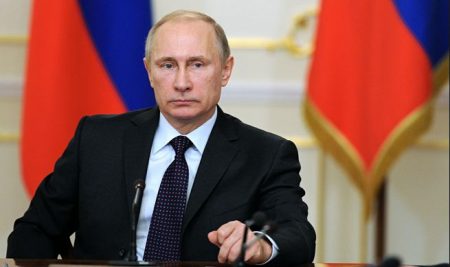
Putin says claims of Russian intervention in US presidential election mere ‘fantasies’
Press TV – November 11, 2017
Russian President Vladimir Putin has once again strongly rejected claims that Moscow interfered in the 2016 US presidential election in favor of Donald Trump, saying these allegations are mere “fantasies.”
The Russian leader made the remarks at a news briefing on the sidelines of the annual summit of the Asia-Pacific Economic Cooperation (APEC) in the Vietnamese city of Da Nang on Saturday, less than a year after US intelligence agencies made the allegations against the Kremlin, which has since vehemently denied the charges.
“Everything about the so-called Russian dossier in the US is a manifestation of continuing domestic political struggle,” Putin told reporters at the Asia-Pacific summit in the Southeast Asian country, adding that he was well “aware” of the increasing probe regarding contacts between Trump’s team members and Russians, including a woman who has claimed to be Putin’s niece.
“Regarding some sort of connections of my relatives with members of the administration or some officials, I only found out about that yesterday from (spokesman Dmitry) Peskov,” the Russian president further said, asserting that he does not know anything about it. “I think these are some sort of fantasies,” Putin added.
Back in January, American intelligence agencies claimed that Russia interfered in the 2016 election to try to help Trump, the current president of the United States, defeat Democratic nominee Hillary Clinton. They alleged at the time that Moscow’s interference included a campaign of hacking and releasing embarrassing emails, and disseminating propaganda via social media to discredit Clinton’s campaign.
Special counsel Robert Mueller, appointed by the US Justice Department, is tasked with investigating Russia’s alleged meddling in the election.
Trump, for his part, has long denied any collusion between his campaign and Russian operatives during last year’s White House race, which led to his rival Hillary Clinton’s loss.
On Saturday, after briefly meeting with Putin at the summit, Trump said that the Russian leader felt insulted by persisting allegations of Moscow’s meddling in the US vote.
“You can only ask so many times… he (Putin) said he absolutely did not meddle in our election,” the US president said, adding that Putin was “very insulted by it, which is not a good thing for our country.”
As he was heading to the Vietnamese capital, Hanoi, Trump also told reporters that President Putin had personally told him that “he didn’t meddle.”
“He said he didn’t meddle. I asked him again,” Trump said.
Elsewhere in his remarks, the Russian president vowed that Moscow would adopt “reciprocal” measures in response to US steps against RT America, which he called an “attack on freedom of speech.”
His comments came a day after the US Department of Justice ordered that by Monday, the company that provides all services for RT America in the US has to register under the Foreign Agents Registration Act (FARA), adding that in case of any disobedience, the news channel’s head may be held in police custody and its accounts could be frozen.
The so-called US legislation was passed in 1938 to counter Nazi propaganda on the American soil. More than 400 entities, but no media outlet, are currently registered under the act.
“I want to draw your attention to the fact that there wasn’t and could not be any confirmation of our media’s meddling in the [US] election campaign,” Putin said, adding that the latest probe in US Congress showed that the Russian ads amounted merely to “some tenths or hundredths of a percent” in comparison to those carried by the US media in the course of the 2016 election.
The annual APEC summit is one of the largest gatherings on the annual diplomatic calendar, bringing together scores of world leaders and more than 2,000 CEOs. APEC represents 21 Pacific Rim economies, the equivalent of 60 percent of global GDP and covering nearly three billion people, and has pushed for freer trade since its inception in 1989.
‘America First!’ AWOL from Beijing, War with North Korea Looms
By James George JATRAS | Strategic Culture Foundation | 11.11.2017
There’s no indication that President Donald Trump’s summit with China’s Xi Jinping achieved any breakthrough on North Korea. But why didn’t it? After all, Trump said that China could “fix” the North Korea problem “easily and quickly” and it was just a matter of Xi’s making up his mind to do so.
No less divorced from reality was Trump’s half-hearted pitch on the US trade imbalance with China. The problem, he said, was not the Chinese – whom he complimented on their cleverness in exploiting our stupidity – but on the flaccid policies of prior American administrations. Quite true! But what will he do differently? Not much it seems, except maybe give a big tax cut with no strings attached to fat corporations that are thrilled to keep moving their operations overseas. Global market über alles! And here we all thought Hillary Clinton lost the election . . .
All in all, Trump’s China visit was characterized by putting his “America First!” campaign principles on ice in favor of the globalist agenda of his economic advisers and subordination of trade to the geopolitical concerns of the military Junta that runs his administration for him. Sure, there might some tinkering here and there, like the recent hit against Chinese aluminum foil dumping. But plutocrats worried about a “trade war” with China can sleep easy.
On North Korea – the overwhelming US preoccupation at the Trump-Xi summit – Trump came up empty. For months observers have fretted over Trump’s oscillating rhetoric from fire and destruction one day to let’s-make-a-deal the next. He’s his own good cop, bad cop act.
In principle there’s nothing wrong with bluster and unpredictability. The art of the deal, you know. Despite the claims of Trump’s detractors, the President’s supposed irresponsibility and impulsiveness aren’t the problem. Trump’s personal style hasn’t yet resulted in war, and if war comes, that wouldn’t be the reason for it. Rather the real danger comes from the ostensible experts who set the parameters within which Trump operates, to whom he’s unwisely outsourced his foreign and security policies. The following articles of faith are baked into the cake:
- First, It’s nice that there has evidently been a back channel for direct US talks with North Korea, but from Washington’s perspective there is nowhere for negotiations to go past demands for denuclearization. Any kind of concession to Pyongyang is out of the question, as it would mean “rewarding aggression” and “showing weakness.” There are no evident contours for a deal when only one side is expected to make concessions.
- Second, because Washington has defined North Korea’s nukes as ipso facto a vital threat to the US, the minimum acceptable US goal is Pyongyang’s dumping its weapons.. (Regime change would be better, since it would also mean denuclearization.) The fact that Pyongyang is unlikely to give up its nukes under any circumstances means there can be no deal.
- Third, in Washington’s collective mind the crisis is 100 percent the fault of North Korea, zero percent the result of our presence in Korea, of our threats against Pyongyang, or of our actions elsewhere. How can you blame us – we tried diplomacy for 20 years and all it did was lead to a bomb! Any suggestion that Kim Jong-un is responding to threats from George W. Bush’s 2002 Axis of Evil speech or to the disposal of Muammar Qaddafi and Saddam Hussein (who, unlike Kim, were foolish enough not to have WMDs) would be “blaming America!” Taking responsibility for past mistakes is not our forte. The prospect that the US mainland might in a few months be targetable by a nuclear-tipped North Korean ICBM has nothing at all to do with anything the US has said or done.
- Fourth, we know China can solve this at will – easily and quickly, as the President said. As former US ambassador to the UN John Bolton says: “That’s why you say to China: ‘we’re gonna see reunification here. Do you want to do it the hard way or the easy way?” This means China can do the job for us, or we’ll do it. The notion that Beijing will not take an action fundamentally inconsistent to China’s national security because of American flattery or threats is almost inconceivable. But if they fail to do as we demand, what comes next will be their fault, not ours.
- Fifth, the military option is still very much on the table. The Junta are not strategic thinkers but they are very, very certain of their technique. If worse comes to worst, and they are “forced to act” (from their point of view) they are supremely (and dangerously) confident that good execution can minimize the damage. Preparations for a preemptive strike continue apace. In Seoul Trump touted the prowess of the three US carrier groups off the peninsula. Maybe it’s all just a bluff to get the Chinese to act (as we know they can; see the preceding paragraph). But if worse comes to worst, and it turns out horribly for a lot of people: We had no choice in light of China’s inaction. Does this mean the planners are sitting around scheming to sacrifice Seoul so as not to look weak? No, but they are prepared to risk that outcome because they are boxed in by all the other elements of their approach. Worse, they are sure they call pull it off. After all, look at how well our other recent wars have gone!
- Sixth, Trump has made it clear that his instincts are on hold and he’ll be guided by “the professionals.” (Compare Afghanistan, where his “new” same-old non-strategy was dictated by the Junta against what he admits were his own inclinations.) On Korea, the “experts” mainly refers to the Junta but also Nikki Haley (!!!!) and probably John Bolton. (There’s also a possibility that David Petraeus, the genius advocate of arming al-Qaeda in Syria, has a thumb in the pie as well.) Plus, keep in mind that Trump isn’t a neoconservative but he is an Andrew Jackson, or perhaps Teddy Roosevelt, nationalist. “Do not underestimate us,” Trump warned Kim. “And do not try us.” When the “experts” tell him that North Korea is “trying” us, what else can he do but act? After all, in April the “experts” told him that al-Assad gassed children in Syria – and boom! – he launched cruise missiles to the applause of both the Swamp critters and much of his populist base that has no idea where Syria is.
- Seventh – and here’s the fun part – if it does all turn into a huge disaster involving hundreds of thousands of deaths, who will take the fall? Not McMaster or Haley. No, it will all be blamed on Trump and the “America First!” path he failed to follow. The establishment on both sides of the aisle, including many who prodded him toward a more aggressive policy, will rush to denounce him: See, we told you he’s nuts! The professionals gave him good advice but he messed everything up! In that case, they wouldn’t have to wait for impeachment, the 25th Amendment would be invoked. Talk about a “win-win” for the Deep State warmongers: getting rid of Kim and Trump!
‘Coup d’Etat’: As RussiaGate Probe Staggers On, Legal Fees Drown Trump Advisers
Sputnik – November 10, 2017
Many key figures in Donald Trump’s presidential campaign have incurred sizeable legal fees as a result of ongoing investigations into allegations of Russian meddling in the 2016 US election. Adviser Roger Stone has gone so far as to email supporters asking for financial assistance.
Roger Stone, longtime adviser to US President Donald Trump, is allegedly facing almost US$460,000 in legal fees incurred, since landing in the cross hairs of federal and congressional investigations into alleged Russian interference in the 2016 US election.
In a 1,600 word statement emailed to press and supporters, Stone called special counsel Robert Mueller a “deep state vigilante” and “executioner” who was “busy casting about for anything he can latch onto.”
He is “certain” Mueller intends to “remove” the president from office, in collusion with Democrats, “many of whom are openly plotting a literal coup d’etat against the President of the United States.”
”I am not a wealthy man, by any means. Such crushing expense, with nothing to show for it except my vindication against a juggernaut of political dirty tricks and lies, threatens to destroy me and my family financially — all because I fought to elect Donald Trump. All because the deep state partisans know I will continue fighting for his agenda,” Stone wrote.
Stone, whose contact with hacker Guccifer 2.0 and WikiLeaks founder Julian Assange before the election has come under scrutiny in the investigations, said it cost him U$400,000 in legal fees to prepare for his September testimony before the House Intelligence Committee — a probe he called at the time a “political exercise.”
Stone admitted to speaking to both, but argued his communications were entirely proper and legal, and not part of any effort to collude with a foreign power. While he refused to name the person who connected him with Assange, he said it was a journalist, who he couldn’t name a their conversation was “off record.”
Stone is also a “person of interest” to Senate Intelligence Committee investigators, but they are yet to formally invite Stone to testify.
“I’ve yet to testify before the US Senate Intelligence Committee and anticipate the legal representation I require for that exchange will easily put my legal bills even closer to the million dollar mark. I hope you will consider contributing anything you can. If you can do so, your contribution of $25, $50, $100, $250, $500, $1000 or more would be a Godsend,” Stone added.
Wide Net
Stone is not the only individual in the president’s circle of trustees facing sky-high legal fees as a result of the investigation.
JD Gordon, national security official on the Trump campaign, told Business Insider while Trump’s reelection campaign and the Republican National Committee were “taking care” of the president and his son Donald Trump Jr., “the rest of us who aren’t billionaires must fend for ourselves.” Federal Election Commission filings showed the Trump campaign spent over US$1.1 million on legal fees July — October.
“In my case, representing the campaign to speak to a group of over 50 foreign ambassadors during the RNC in Cleveland, combined with ensuring our campaign’s national security policies were reflected in the GOP platform the week prior, have led to nearly five-figure personal legal bills,” he said.
Gordon in particular has been quizzed about the watering down of an amendment to Republican policy on Ukraine in July 2016 — originally, it proposed the GOP commit to sending “lethal weapons” to the Ukrainian army, but the wording was altered to “appropriate assistance” in the party’s official platform.
Another Trump campaign adviser, Michael Caputo, has been forced to take US$30,000 out of his children’s college fund to pay for lawyers — he is a person of interest apparently due to his Ukrainian wife, and previous work as a media consultant in Russia during the 1990s.
The family of former national security adviser Michael Flynn has also set up a defense fund in September, to pay legal fees that may exceed US$1 million.
Coup D’etat
Republican Matt Gaetz of Florida has introduced legislation pressuring Mueller to resign — and in a speech on the House floor November 8, he suggested the US was “at risk of a coup d’etat.”
“We are at risk of a coup d’etat in this country if we allow an unaccountable person [Mueller] with no oversight to undermine the duly-elected president of the United States. That is precisely what is happening right now with the indisputable conflicts of interest that are present with Mueller and others at the Department of Justice,” he said
Gaetz has also called for a special prosecutor to investigate the Uranium One scandal, the Clinton Foundation, and research firm Fusion GPS, which produced the “dodgy dossier” alleging Trump-Russia collusion, which was paid for by Obama for America’s law firm, the Democratic National Committee (DNC), and the Hillary Clinton presidential campaign.
NATO Defense Chiefs and US Lawmakers Take New Steps to Fuel Arms Race
By Andrei AKULOV | Strategic Culture Foundation | 10.11.2017
For the first time since the end of the Cold War, NATO is expanding its command structure. A plan to establish two new military headquarters designed to improve the movement of troops across the Atlantic and within Europe to counter Russia was endorsed at the November 8-9 meeting of NATO defense ministers in Brussels. One of the planned new NATO command centers will be tasked with ensuring the security of “sea lines of communication” between North America and Europe. The other command will “improve the movement of military forces across Europe” and strengthen logistical functions across NATO. Military commanders would “flesh out the details” and present them to defense ministers in February 2018.
“This is not only about commands,” said Secretary General Jens Stoltenberg. According to him, it is vital that European roads, bridges and rail networks are able to carry tanks and heavy military equipment. “We are now much more focused on moving heavy equipment across Europe,” he explained.
The locations are due to be chosen next year. Germany has expressed interest in hosting the logistics base. Portugal, Spain, France, and the United States could be potential hosts for the new Atlantic command. The ministers also agreed on the creation of a new Cyberoperations Center to strengthen cyberdefenses and help integrate cybercapabilities into NATO planning and operations at all levels.
NATO nations deployed about 4,000 troops this year across Estonia, Latvia and Lithuania, and Poland – the alliance members which share borders with Russia.
The NATO event coincided in time with the United States House and Senate Armed Services Committees’ approval (Nov.8) of the National Defense Authorization Act (NDAA) for Fiscal Year 2018. The NDAA supports a topline of $692 billion for national defense—a $26 billion increase above the President’s combined initial and amended budget requests. The NDAA also authorizes $4.6 billion for the European Deterrence Initiative (EDI) to boost military capability to counter Russia, including accelerating procurement of Army prepositioned equipment and munitions stocks in Europe. The bill limits military-to-military cooperation with Moscow.
The legislation authorizes $350 million to provide security assistance to Ukraine, including defensive lethal weapons. $100 million will be spent on military aid to the Baltic States.
The bill includes the allocation of $58 million to counter Russia’s alleged non-compliance with the Intermediate-Range Nuclear Forces (INF) Treaty, including a research and development program on a ground-launched intermediate-range missile, “which would not place the United States in violation of the treaty.” Section 1635 of NDAA allows the Pentagon to establish “a research and development program for a dual-capable road-mobile ground-launched missile system with a maximum range of 5,500 kilometers.” This is the first step to jettison the treaty. True, the development of a ground-based mid-range missile is not yet a violation but rather a demonstration of intent to do so. But once allocated, money cannot be wasted.
The deployment of NATO ground-based nuclear-tipped intermediate forces in the Old Continent is a European problem as NATO allies will become targets for Russia’s retaliatory strikes. Then why should the US tackle it if Europeans don’t ask it to do so? After all, the pretext for development of the missile is the need to defend European allies but no European NATO member has asked the US for protection. Why should the US take the initiative into its hands without European nuclear powers, such as the UK and France, participating in the program? Perhaps, the situation when Europeans fully depend on the US to protect them from “Russia’s nuclear threat” serves the American interests boosting Washington’s influence over European affairs.
With the INF Treaty effective no more, Moscow will be free to deploy intermediate-range missiles without restriction. No European NATO member has given consent to have the weapons on its territory. The decision to develop a ground-based mid-range missile may spark a backlash from European allies. The deployment of US intermediate-range weapons on the Old Continent will hit them in the same way the extension of American sanctions on European energy companies runs counter to their economic interests.
The fact that the NDAA authorizes the development of the weapon banned by the treaty will inevitably impact Russia’s military planning.
True, Russia and the US have problems with the INF Treaty. Each side accuses the other of non-compliance at the time the general state of the bilateral relations hinders the attempts to find common language on any issue. Expanding the European Deterrence Initiative is also not the best way to ease tensions with Russia.
Despite that, opportunities offered by the Special Verification Commission (SVC) envisioned by the INF Treaty are far from being exhausted. The parties could use the SVC venue to consider additional confidence-building measures and information exchanges. Contemporary technical means of verification make violations impossible to conceal. Evidence can be presented and differences can be ironed out. But, if signed by President as it is, the NDAA will include first practical steps to tear up the INF Treaty.
The violation of the treaty will negatively affect the prospects for strategic offensive forces (SOF) control. The INF and New START are the only two remaining nuclear arms control treaties in force. The capability of the US to knock out elements of command and control structure as well as at least some ground-based Russian strategic nuclear assets from Europe without using its intercontinental capability will influence the balance of SOF. One thing will lead to another eroding the entire nuclear arms control regime. Looks like the views of Heritage Foundation calling for withdrawal from the treaty prevail in the US Congress.
The NATO defense chiefs and US lawmakers have just taken new steps on the way to making the probability of war an uncomfortably real prospect.
Featured Video
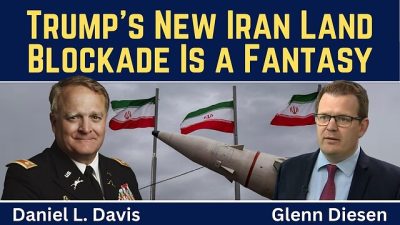
Daniel Davis: Trump’s New Iran Land Blockade Is a Dangerous Fantasy
or go to
Aletho News Archives – Video-Images
New Book
The Vaccine Mafia: Pfizer’s Former Chief Toxicologist Proves How Toxic Substances Were Unlawfully Sold to Us as a Solution for COVID-19
By Helmut Sterz
Former Pfizer chief toxicologist Helmut Sterz presents a critical examination of the development, approval, and global rollout of mRNA COVID-19 vaccines—particularly those produced by Pfizer/BioNTech. The Vaccine Mafia details the failure of pharmaceutical companies, regulatory authorities, politicians, and international organizations to follow established scientific and ethical standards during the pandemic. Drawing on the author’s decades of experience in pharmaceutical toxicology, Sterz reveals the many ways the vaccines’ inadequate or omitted preclinical safety testing put the world’s population at risk.
Sterz demonstrates how “emergency” approvals allowed manufacturers to bypass long-standing international guidelines governing toxicity testing, especially with regard to reproductive and cancer risks. They also allowed governments and health authorities to ignore or conceal evidence of serious adverse effects that occurred, including myocarditis, reproductive harm, and other long-term health risks.
Blog Roll
 Aletho News
- Why Iran designated British MI6, Royal Navy, and RAF as hostile, terrorist organizations
- Armenian opposition politician dies in custody
- US still trying to recycle failed hypersonic missile programs
- France’s ‘Cold War’: Paris blames Tehran for supermarket fridge hacks
- Psywar no more? 77th Brigade’s sudden death
- Ukraine Already Carved Up… Before Talks Begin? /Prof. Richard Sakwa
- The vindication of Marjorie Taylor Greene
- Nearly 80% of Britons consider Israel a threat to world peace and security: Survey
- Rhode Island Staffer Could Be Reinstated After Firing Over Ceasefire Post
- Will Republicans Learn Their Lesson from the ‘Disastrous’ Midterms?
- If Americans Knew
- An error has occurred; the feed is probably down. Try again later.
- No Tricks Zone
- German Authorities Start Initiative To Evaluate Public Register For Climate “Disinformation” Spreaders!
- Zonal Asymmetry of Temperature Change in the Antarctic Circumpolar Current
- New Study: The Net Fossil Fuel Contribution To Rising Atmospheric CO2 Has Been Zero For 500 Years
- Germany’s Green Energy Transition Becoming Increasingly Expensive…Another 6 Trillion Euros!
- Sudden Stratospheric Warming, Powerful El Niño Combination May Lead To Extreme Europe Cold, Energy Crisis!
- Two New Studies Find Thwaites Glacier Melt Cannot Be Driven By Human Activity Or A Warming Ocean
- E-Cars Reduce CO2 Emissions By Only 41% Compared To Internal Combustion Engine Vehicles
- Predictions Made By Renowned Climate Professor Over Past Decades Have Been Proven To Be Poor
- New Study Suggests Large Regions Of The Pacific Ocean Have Been Cooling For The Last 80 Years
- Germany’s Green Energy Debacle: High Energy Costs Force Kahla Porzellan to Close After 182 Years!

