New Sanctions Against Russia ‘Part of a Deal Between Trump, US Establishment’
Sputnik – March 29, 2017
Last week, the United States imposed sanctions against eight Russian companies in connection with the Iran, North Korea and Syria Nonproliferation Act (INKSNA).
In particular, the sanctions have been imposed against the 150th Aircraft Repair Plant, Aviaexport, Bazalt, Kolomna Design Bureau of Machine-Building, Rosoboronexport, Ulyanovsk Higher Aviation Academy of Civil Aviation, Ural Training Center for Civil Aviation, and the Zhukovskiy and Gagarin Academy.
Commenting on the move, a representative of the US State Department told Sputnik that the decision was made during the final days of Barack Obama’s presidency.
“These determinations to sanction this group of individuals and entities were made by the State Department on January 17, 2017 […] and subsequently reviewed by the incoming administration prior to transmission to Congress,” the official said.
He noted that the sanctions decisions were then delivered to Congress on March 21 as part of a report related to violations of the INKSNA.
According to Vladimir Batyuk, a senior expert at the Institute for American and Canadian Studies at the Russian Academy of Sciences, the new sanctions against Russian companies were a consensual decision.
“Taking into account the statement by the State Department official, probably, he wanted to say that the sanctions were not a voluntary decision, but the result of a bipartisan consensus,” Batyuk told Radio Sputnik.
According to the analyst, this is an example of the Trump administration continuing the policy of its predecessors.
“The decision was made by the Obama administration and implemented by the Trump administration. Then it was delivered to Congress, and after that the sanctions came into force,” he pointed out.
According to Batyuk, for the new US presidential administration, foreign policy issues are of secondary importance and this is why they could serve as a bargaining chip.
“The Trump administration has faced serious resistance from the establishment. On the one hand, it is trying to counter this resistance. But on the other hand, it’s trying to reach a compromise on matters of secondary importance,” Batyuk said.
He elaborated that for the Trump administration, high priority problems include domestic policy, the US economy, social issues, energy and healthcare.
“Meanwhile, foreign policy is of secondary importance, including anti-Russian sanctions. Possibly, the new sanctions were part of some kind of a deal,” he suggested.
Commenting on the new sanctions, the Russian Foreign Ministry stated that they aren’t in the security interests of the US and disagree with Washington’s statements about fighting terrorism being a top priority.
“This step isn’t consistent with the statements we’ve heard from Washington on the priority of the fight against terrorism, including the [announcement that the US would build] a nest on Syrian territory. On the contrary, it completely contradicts this line and undermines the perspectives of building a broad multilateral cooperation aimed at destroying the IS [Daesh],” Foreign Ministry spokesperson Maria Zakharova said in a statement.
SEE ALSO:
US threatens Russia, Iran with more sanctions for Syria’s support
Press TV – April 10, 2017
The United States has threatened Russia and Iran with tougher sanctions over their support for Syria, saying nothing “is off the table” in this regard.
“We’re calling [Russia and Iran] out,” US Ambassador to the United Nations Nikki Haley said in an interview broadcast on CNN on Sunday.
“But I don’t think anything is off the table at this point. I think what you’re going to see is strong leadership. You’re going to continue to see the United States act when we need to act,” she added.
The comments were made after US Senate Majority Leader Mitch McConnell said he would look into stepping up sanctions on Russia and Iran, which support Syrian President Bashar al-Assad. The two countries are already under various types of US sanctions.
Washington has alleged that the government of President Assad is responsible for the last week’s suspected chemical attack in Idlib province which killed more than 80 people.
Moscow and Damascus have denied that the Syrian government had anything to do with the attack. The Russian Defense Ministry said the US had no proof of chemical weapons at al-Shayrat airbase, where it fired 59 Tomahawk missiles, killing several people and reportedly destroying a number of Syrian aircraft.
Iran has condemned both the alleged chemical attack and the US missile strike on Syria, saying Washington’s illegal action will embolden terrorist groups in the Middle East region.
‘US has evidence that Assad was behind attack’
In her interview with CNN, Haley insisted that the US administration has evidence that the Syrian government was behind the April 4 chemical attack
“What we’ve seen is, you know, in our meetings this week, we were told of the evidence,” she said. “We saw the evidence. The President saw the evidence. All of that is naturally classified. And I’m sure when they can declassify that, they will.”
On Sunday, Haley once again threatened Syria with further military action, saying President Donald Trump could order more strikes if necessary. She issued a similar threat hours after the April 7 missile strike.
“I was trying to give warning and notice to the members of the Security Council and the international community that (Trump) won’t stop here,” she said, adding. “If he needs to do more, he will do more.”
‘US strike intended to send message to Russia’
In a separate interview NBC News on Sunday, Haley said the US missile attack in Syria was intended to send a message to the Russian government.
“The entire administration was in agreement that this was something that had to be done. This was something that needed to tell Assad, ‘Enough is enough,'” she said.
“And this is something to let Russia know, ‘You know what? We’re not going to have you cover for this regime anymore. And we’re not going to allow things like this to happen to innocent people.'”
She went on to say that the United States will not allow Russian President Vladimir Putin to “have Assad’s back anymore.”
Tillerson asks Russia to drop support for Assad
Meanwhile, US Secretary of State Rex Tillerson, who is set to visit Moscow this week, on Sunday demanded that Moscow stop supporting the Assad government.
“I hope Russia is thinking carefully about its continued alliance with Bashar al-Assad, because every time one of these horrific attacks occurs, it draws Russia closer into some level of responsibility,” Tillerson told ABC News.
The United States and its allies have repeatedly used chemical weapons as a pretext to pressure the Syrian government, despite the fact that Damascus volunteered to destroy its chemical stockpile in 2014 following a poisonous attack outside the capital. The deal was brokered by the US and Russia in 2013.
Tillerson accused Moscow of failing to enforce the 2013 agreement meant to get Syria rid of its chemical arsenal.
“I’m disappointed because I think the real failure here has been Russia’s failure to live up to its commitments under the chemical weapons agreements that were entered into in 2013,” he said.
“Both by the Syrian government and by Russia as the guarantor to play the role in Syria of securing chemical weapons, destroying the chemical weapons and continuing to monitor that situation,” he added.
‘Russia also responsible for April 4 chemical incident’
The top US diplomat said the April 4 chemical incident happened because of Russia’s failure “to achieve its commitment to the international community.”
“I hope Russia is thinking carefully about its continued alliance with Bashar al-Assad,” he added, “because every time one of these horrific attacks occurs, it draws Russia closer into some level of responsibility.”
The allegations of chemical arms use are still made against Syria even as the dismantling of the country’s entire stockpile of chemical weapons as well as relevant production facilities was supervised by the United Nations.
Foreign-backed militants have repeatedly used chemical weapons against Syrian troops, some of which have been verified by UN officials, but the attacks have often been ignored by Western governments.
In December 2015, a cousin of former Libyan ruler Muammar Gaddafi said that chemical weapons used in Ghouta which were blamed on the Syrian government were in fact stolen from Libya and later smuggled into Syria via Turkey.
G7 ‘Unlikely to Support’ US-UK Push to Slap More Sanctions on Russia
Sputnik – April 10, 2017
In an interview with Sputnik, Russian political analyst Alexey Zudin expressed doubt over the G7 countries’ willingness to agree with the UK Foreign Secretary’s latest demand to inflame the sanction war with Russia.
The interview came after The Times reported that during the upcoming G7 foreign ministers’ meeting in Italy, British Foreign Secretary Boris Johnson will urge the G7 member states to tighten sanctions against Russia following the latest developments in Syria.
The newspaper said that “Britain is pushing western nations to impose new sanctions on Russia if it fails to cut ties with President Assad as the conflict over Syria escalates.”
According to The Times, the document was prepared ahead of the G7′ ministerial meeting which kicks off in Lucca, Italy, later on Monday. The newspaper said that Johnson wants the G7 to issue a joint statement after an alleged chemical attack in Syria, according to which Russia should stop supporting Syrian President Bashar Assad and withdraw its troops from Syria.
In case of Moscow’s refusal, new sanctions will follow in addition to those already slapped on Russia in connection with the situation in Ukraine, according to The Times.
Alexey Zudin, of the Moscow-based Institute for Social, Economic and Political Studies think tank, said that this move, initiated by Washington and London, is unlikely to be supported by other G7 countries.
“It is unlikely G7 members will agree to this, at least for now. It seems that the absence of proof [pertaining to the Syria chemical attack] has not put off the main initiator, the US, and its closest ally Britain, which is not the case with other G7 countries who are hardly likely to support the American position,” Zudin said referring to “clear collaboration between Washington and London on the issue.”
According to him, this move is timed to coincide with the visit of US Secretary of State Rex Tillerson to Moscow, which begins on April 11.
“It would be pointless for Tillerson to start his visit with a direct threat to his Russian colleagues, about the US preparing a new package of anti-Russian sanctions, which is why this role was delegated to UK Foreign Secretary Boris Johnson,” Zudin concluded.
Meanwhile, Kremlin spokesman Dmitry Peskov said that Moscow is not aware of any possible new US sanctions against Russia over Syria, as neither President Donald Trump or his administration have made any statements.
“Not knowing what is at issue, and we really do not know what is at issue, it is difficult to talk about any reaction,” Peskov told reporters.
US Ambassador to the United Nations Nikki Haley said on Sunday that Trump and members of his team “have started to have” conversations related to imposing sanctions on Russia and Iran in connection to their support for Damascus.
“Yes, there was a statement by the US ambassador, but we have not heard about any statements to this effect from President Trump or his representatives,” Peskov said.
Last Thursday night, at least five people were killed and seven others injured after the United States launched 59 Tomahawk cruise missiles at the Syrian military airfield in Ash Sha’irat, located about 40 kilometers (25 miles) from the city of Homs.
US President Donald Trump said the attack was a response to the alleged use of chemical weapons in Syria’s Idlib province on Tuesday, which Washington blames on the Syrian government.
Syrian President Assad argued that his government has no chemical weapons left, and never used the stockpile Syria used to maintain.His government handed over this stockpile, which included precursors to the nerve gases sarin and VX as well as hydrogen fluoride, to the Organization for the Prohibition of Chemical Weapons (OPCW), a global chemical weapons watchdog, in 2013 amid international pressure.
All of the weapons were then destroyed by the OPCW, which completed this task in January 2016.
SEE ALSO:
Trump Considering Sanctions Against Russia, Iran for Supporting Syria
New Sanctions Against Russia ‘Part of a Deal Between Trump, US Establishment’
New Book Offers Timely Rejoinder to Hugo Chavez Bashing in Media
By Joe Emersberger – teleSUR – April 6, 2017
Right from the opening pages of Eirik Vold’s “Hugo Chavez: The Bolivarian Revolution from Up Close” there was no doubt that the book was going to be very lively and readable, but I had a concern. Would the author make himself the hero of his own book? Was this going to be really heavy on what it felt like (to him) to be in Venezuela while Chavez was in office, but very light on analysis? Fortunately not. He provides a fair and very insightful assessment of the Chavez years.
Vold is from Norway. His book was translated from Norwegian by Paul Russell Garrett. Vold lived mainly in Venezuela during Chavez’s time in office which was from 1999 until his death in 2013. Vold arrived in Venezuela for the first time fours months after Chavez had been briefly overthrown in a U.S.-backed military coup in 2002. Out of journalistic curiosity, and practical necessity, Vold established enduring friendships with people who loathed Chavez and others who adored him.
Vold’s friend Omaira, a middle-aged working mom from the Caracas slum known as the 23 de Enero, illustrates better than graphs of economic data ever could the immense gamble the poor took on Chavez. The early years of the Chavez presidency made life harder, not easier for Omaira. Vold’s book allows readers to appreciate how excruciatingly long those years must have felt, but Omaira blamed the opposition and trusted Chavez to eventually deliver. She was right on both counts. The combination of the 2002 coup and management-led sabotage did immense damage to the economy. But after those efforts to force him from office were defeated, Chavez rewarded millions of people like Omaira who had stuck by him through those battles. By 2004, Omaira and her daughter were able to continue their long interrupted education thanks to government support (through a program named Mission Ribas).“Omaira was almost offended,” Vold writes “when I admitted that I had not heard of all the social reforms and all the things that had happened in her barrio over the past few months. ‘Maybe you are watching too much opposition TV’ she commented.”
Wildly dishonest Venezuelan (and international) media, NGOs and pollsters are prominent in Vold’s book. Constantly lying in front of millions of Venezuelans like Omaira – whom the elite had long grown accustomed to ignoring – was not a wise opposition strategy considering the poverty rate was 50 percent when Chavez first took office and rose to 60 percent by the end of the infamous “oil strike” in 2003. One reason Chavez expanded state media was to inform the poor of what was now available to them: “How do poor, pregnant women make use of the new birth centers if they do not know where they are or that their services are free? And what if they believed in the media’s claims that the Cuban doctors were killers?” asked Vold.
He describes various changes in Omaira’s barrio that had taken place by 2006 that a journalist from a rich country, if willing to venture out of wealthy neighborhoods, would miss even if political bias were not a problem. Vold did the work and built the long-term relationships that enabled him to grasp why Chavez was beloved by millions who were effectively marginalized before he transformed Venezuelan politics.
Vold’s friend Antonio, a businessman from East Caracas, had a completely different perspective. Much of Antonio’s hatred was fueled by consuming opposition media and talking to friends and neighbors who did the same. Vold’s first friendships and experiences in Venezuela were in East Caracas. His opinion, in the midst of the chaos and violence during the “oil strike” taking place when he had very recently arrived, was that Chavez should resign to prevent some kind of civil war from breaking out.
Vold quickly broke out of the East Caracas bubble. However, Vold believes that one of Antonio’s accounts of corruption within Chavista ranks rang true, about being offered overpriced contracts in exchange for money under the table. Vold argues that Chavista opponents, particularly the private media, were caught lying and exaggerating so often that it actually helped corrupt officials evade accountability.
Vold is blunt in addressing what he sees as the failures of the Chavez years: violent crime increased mainly because the judiciary was never effectively reformed and poor planning and execution of infrastructure projects was a factor, but he ridicules the western establishment’s assessment of the Chavez years: “Presumably Venezuela is the only country in the world where turning a falling GDP into growth, and reducing inflation and unemployment by half, is considered an economic catastrophe by media and experts.”
He discussed an incident that shows how much more broad the Western imperial establishment is than is often understood. WikiLeaks exposed the activity of Statoil, “a legitimate child of Norway’s own oil nationalization,” in Venezuela where it conspired with U.S. diplomats and others to try to organize an illegal secret boycott of Venezuelan oil. Vold remarked that “many millions spent on marketing the ‘kinder’ Statoil brand went up in smoke on the day the WikiLeaks documents were released.”
In discussing U.S. support for efforts to topple Chavez by any means, it is much to Vold’s credit that he explains the numerous similarities with U.S. attacks against Aristide’s government in Haiti during the early 2000s. Aristide was eventually kidnapped by U.S. troops in February 2004, but the groundwork was laid through economic sanctions and through the funding of the opposition through USAID and NED (the National Endowment for Democracy).
Of course, the economic depression Venezuela is going through today is eagerly blamed on Chavez by the same outfits that lied about and distorted his years in office relentlessly. Vold’s book would have been even better with a chapter devoted to assessing that claim: that the Chavez years made the present crisis inevitable and that the only answer is to discard Chavismo. The root causes of the present crisis, as most effectively explained by UNASUR’s special economic team, are technical though there is certainly a political component – including a component of domestic and international sabotage. Would Chavez have had the political capital to make the required adjustments? I wish Vold had addressed that question.
I can only hope that Vold is correct in concluding that as long as “the echo of ‘Hurricane Hugo’ continues to resound through the hillsides of Caracas and the villages and the barrios in the rest of Venezuela, never again will the majority quietly accept being forced into degradation.”
US Spent $4.2M in 2015 to Destabilize Venezuelan Government
teleSUR | April 8, 2017
In 2015, the United States government earmarked at least US$4.26 million for Venezuela through the U.S. Agency for International Development, or USAID, with much of this going to organizations undertaking anti-government work.
Almost US$2 million of these funds were funneled through the National Endowment for Democracy (NED), an organization created in 1982 purportedly “dedicated to the growth and strengthening of democratic institutions around the world.” Of these funds, US$849,223 were allocated for “civic” or electoral purposes including the creation of an “interactive online platform connecting citizens to National Assembly candidates,” along with US$160,813 for the promotion of “free market” reforms.
Some US$505,796 were disbursed for media purposes including funds to “radio programs”, “alternative channels to generate and disseminate news and information”,”local independent journalists and alternative media outlets in defending freedom of expression and democracy” as well as for training “journalists on investigative journalism and the use of social media in disseminating news.”
With more than US$170 million in annual funding from the U.S. State Department through USAID, the NED provides 1,000 more grants to support organizations that promote U.S. foreign policy objectives in more than 90 countries. In addition to the NED, USAID also partners with Freedom House, The International Republican Institute, The National Democratic Institute and The Pan-American Development Foundation of the Organization of American States.
The U.S. Congress also provides some US$777.8 million for the Broadcasting Board of Governors, which runs the Voice of America, as well as the anti-Cuban government outlets Radio Marti and TV Marti, while also providing millions in funds to media organizations and journalists who opposed governments that are at odds with U.S. interests.
The NED also boasted about the impacts of its funding on the outcomes of elections in Argentina
“In Argentina and Venezuela, NED grantees played key roles to promote free and fair elections,” the NED’s 2015 report states.
“Mauricio Macri won Argentina’s presidential election, an outcome that symbolized the end of the Kirchner imposed, populist and authoritarian political model. In Venezuela, legislative elections in December 2015 gave the political opposition a supermajority in the National Assembly for the first time in 18 years of Chavista rule. A strong opposition presence in the legislative branch may help reverse Venezuela’s devastatingly anti-democratic government.”
While the government-funded NED does specify grant recipients in certain countries, neither the report nor the organization’s website names the organizations that received funding in the case of Venezuela.
In 2015, the NED also spent some US$1,047,818 in Ecuador and US$883,620 in Bolivia to support organizations working against those left-wing governments.
Since winning a majority of the National Assembly in 2015, Venezuela’s MUD opposition has been accused of attempting to create an institutional crisis between branches of government through repeatedly attempting to pass laws in direct contravention to the country’s constitution, such as a law that attempted to retroactively reduce the presidential term.
Opposition leaders, who have been increasingly calling for street demonstrations to oust the Maduro government, have cited the impasse as grounds for foreign intervention.
Venezuela Arrests Opposition Lawyer, Partner of Source in Iraq Passport Controversy: Reports
By Ryan Mallett-Outtrim | Venezuelanalysis | April 7, 2017
A lawyer for one of Venezuela’s most prominent right-wing politicians was detained Tuesday in Caracas, after allegedly being found with materials used in counterfeiting, according to unconfirmed reports.
The lawyer, Ana Teresa Argotti, was allegedly taken into police custody after a routine traffic stop. From her vehicle, police reportedly uncovered 17 identity cards, six passports, more than 30 official government stamps and raw materials used in the counterfeiting. The story was originally published by online news blog La Tabla. Along with the statement of an anonymous source, the blog also published photos that appeared to show Argotti in police custody. In one of the photos, Argotti appeared to be shown with her seized property, including the six passports, ID cards and both US and Venezuelan currency.
Argotti is reportedly the lawyer of Lilian Tintori. Tintori is the wife of Leopoldo Lopez, an opposition leader sentenced to over 13 years imprisonment for his role in leading violent anti-government protests in 2014.
The blog also claimed Argotti is the partner of former Venezuelan diplomatic staffer Misael Lopez. Lopez has accused Venezuelan diplomatic officials in Iraq of fraudulently selling hundreds of passports. The Venezuelan government has denied the claims and accused Lopez of acting as an agent of the US.
Venezuelanalysis cannot confirm the authenticity of the La Tabla report, though similar stories have been picked up by state media outlet teleSUR and Russia’s RT – both seemingly based on La Tabla’s piece.
Right-wing newspaper El Nacional has also reported on the story, including allegations police falsified evidence against Argotti.
“A source close to El Nacional Online confirmed that Argotti, adviser to Lilian Tintori, is under arrest,” the newspaper reported.
“However, they clarified that the items seized from the lawyer were ‘planted’,” El Nacional reported.
59% of Germans disapprove of US strike on Syrian airbase – poll
RT | April 9, 2017
Almost 60 percent of the people in Germany say the US strike on a Syrian airbase earlier in the week was the wrong thing to do, according to a poll commissioned by Bild am Sonntag newspaper.
The poll, ordered by the media outlet and conducted by Emnid-TNS company, asked respondents about Washington’s decision to launch Tomahawk missiles at the Syrian airfield.
The survey revealed that 26 percent approved, and 59 percent disapproved of the attack on the military site.
The majority of the respondents, 80 percent, also think that no more strikes should be made on Syrian territory. Only nine percent would welcome further US attacks on the country.
The US said the bombardment was in response to a suspected chemical gas attack in Idlib, which Washington claims Syrian President Bashar Assad and his government were responsible for.
A total of 59 Tomahawk missiles launched from American warships hit Shayrat airfield, where it is alleged that Syrian planes with chemical weapons took off.
The Bild am Sonntag survey also found that 40 percent of Germans fear that the strike can provoke military conflict between Russia and the US, while 53 percent do not believe it is a possible outcome.
Meanwhile, German Foreign Minister Sigmar Gabriel has voiced concerns over the escalation of tensions between Moscow and Washington, Bild reports, citing the minister.
Gabriel also called for international experts to help conduct an investigation into the alleged chemical weapons assault.
“It is important that the UN and experts from the Organization for the Prohibition of Chemical Weapons (OPCW) gain immediate access and can carry out their investigation without hindrance,” – he told Bild newspaper in the interview.
Russia has also advocated sending professionals to investigate, saying that it is “the only way to receive and present to the whole international community any objective evidence on the alleged presence of poisonous substances.”
The German foreign minister said that the alleged chemical attack was a “barbaric act” and that it was plausible that the Syrian president was behind it, though he did not provide any evidence to support the allegations.
Damascus has denied all allegations, saying that the Syrian military hit a warehouse where terrorists could have produced and stored chemical materials.
Moscow also pointed out that Syria has eliminated its stockpiles of chemical weapons, which was confirmed by the Organization for the Prohibition of Chemical Weapons (OPCW).
READ MORE:
Mainstream Media: the Indispensable Pre-War Preparations
By Greg Simons | Sputnik | April 9, 2017
The recent bombing of a Syrian airbase by American Tomahawk missiles was preceded by several days of heavy media coverage centered on the presumed “chemical attack” against the Khan Sheikhun community.
In fact, this press coverage was the only justification for the bombing, since the Organization for the Prohibition of Chemical Weapons (OPCW) and other international bodies simply had no time to properly investigate the circumstances.
This situation imposes additional responsibility on journalists, but were they up to the task? Unfortunately, just like in many previous cases, there were many immediate assumptions and immediate categorical statements that have been made concerning the presumed guilty party. The current situation is a vivid demonstration of the dilapidated state of the so-called fourth estate that is mixing, without any distinction, information and opinion in the news of this event.
If the hype and opinion are removed from the equation, what are the solid facts that are known about this really cruel act? The attack occurred on April 4, 2017 in the Khan Shaykhun area in the south of the Idlib province of Syria. This fact was recorded by OPCW and reflected in its press release.
For the Western mainstream media (MSM), at this point, the facts ended and allegations started. What is worse, these allegations bore all the hallmarks of propaganda. The MSM quickly assigned guilt and in many cases suggested a military course of action. In retrospective, the press coverage looks like a hasty justification for the US government’s position on the matter, which resulted in the bombing.
Here is the press statement of the US secretary of state, Rex Tillerson, issued immediately after the attack in Khan Shaykhun: “While we continue to monitor the terrible situation, it is clear that this is how Bashar al-Assad operates: with brutal unabashed barbarism. Those who defend or support him, including Russia and Iran, should have no illusions… Anyone who uses chemical weapons to attack his own people shows a fundamental disregard for human decency and must be held accountable.”
The first and the most frequently used technique of propaganda is assertion. It consists of presenting a disputed sequence of events or a debatable idea as a fact, with no further explanation. It reflects the public’s longing for a quick and easy explanation of events. Even Tillerson’s statement contains a lot of categorical and emotionally laden assertions, but offers very little in terms of hard evidence to back those claims. The guilt is also personalized (another typical element of propaganda), with Assad proclaimed guilty without any sort of trial or investigation.
Unfortunately, the MSM follow this tactic of distributing guilt by assertion. The MSM also adds to its guilt by association — a propaganda technique, in which previous misdeeds of some (possibly very different) actors are somehow associated with the demonized person. The scale of the blame is deliberately exaggerated or left unclear.

Syrian President Bashar al-Assad and his wife Asma al-Assad meeting in Damascus with families of Syrians who have lost relatives while fighting with terrorists in the country’s ongoing unrest.
The MSM did not busy itself with any sort of balanced contextual understanding, what was being projected and promoted was the notion of a massive scale crime immediately associated with Assad. A New York Times headline read “Worst Chemical Attack in Years in Syria; US Blames Assad“.
This headline is deceptive and misleading as it can be deduced that this is the worst single act in six years of the Syrian civil war, even though a bigger attack took place just recently — in 2013, near Damascus. Many other attacks, some of them possibly coming from the opposition groups fighting Mr. Assad, were also recorded since then. The authors have not seen the scene of the attack, but they rush to dramatize what they have not seen: “One of the worst chemical bombings in Syria turned a northern rebel-held area into a toxic kill zone on Tuesday, inciting international outrage over the ever-increasing government impunity shown in the country’s six-year war.” This one sentence contains a number of different elements of propaganda. One of them is bandwagoning — in this case the entire international community’s reaction is represented as aligning itself with the US’ position, without the authors specifying the positions of individual countries. In addition, the implication is that the Syrian government must abide by the NYT’s representation of what the international opinion and reaction is. Assertion propaganda also appears, where there is little to no evidence provided to support the assertion (in this case concerning the ever-increasing impunity and the assigned guilt of Mr. Assad in person). The headline and the very end of the article also differ in terms of the strength of the assigned guilt. The headline contained “US blames Assad” (certainty is projected), but the last paragraph notes that “a chemical weapons attack, if carried out by the government…” denotes much less certainty of the guilty party.
Fox News, while representing a different, “illiberal” wing of the American MSM, is involved in the same kind of propaganda as the New York Times. The simplest technique is exaggeration. Here is the headline: “At Least 100 Dead in a Suspected Chemical Attack in Syria, Hospital Reportedly Hit“.
Very soon we shall read that even by the most pessimistic accounts there were less than 90 victims, and not “at least 100” offered to us by Fox News. But Fox News never apologized or corrected itself. In the article they present a slideshow with “heartbreaking images of gas attack victims.” This particular statement contradicts the headline that points to “a suspected chemical attack” and not a definite one. As to the “hospital reportedly hit”, once again there is no certainty or due diligence concerning the verification of information, which should be a standard journalistic good practice. Fox’s sources of information include the MSM standard source, the Syrian Observatory for Human Rights, which is a shadowy organization that has been actively campaigning for regime change in Syria. In addition to this source, they use the White Helmets, which are in fact a Western-funded organization that is called by some as “al-Qaeda’s civil defense.”
The last, but certainly not the least effective means of propaganda is an emotional attack on the audience. The reader (or the viewer) is put face to face with such unbearable cruelty, that it spurs him to justify any military action (in this case — from the US government) that would remove the terrible descriptions from a newspaper page or the unbearable images from the screen before his eyes. A headline appearing in Vox certainly is among the most emotionally-based ones — “Bashar al-Assad Just Gassed His Own People, Then Bombed the Clinic Treating Victims”
This article also uses a personalized form of character assassination against Assad, lacking any proof to back up the claims, and hypes the level and scale of the alleged atrocities committed. The information that is published in the article is not even verified, as it is admitted on the first page. Once more a great deal of stress is placed on the deaths of children. As with Reuters, some quotes by Syrian government and Russian sources are published, but hidden in the middle of the article. The end of the article confirms the conspiracy theory of the Syrian government’s guilt in this matter, using selective historical accounts to try and create the picture of a pattern (as opposed to an isolated incident) of atrocities by the ‘bad’ character of this story.
All in all, these practices of the MSM media should be remembered and in due time used against it. Not only politicians justifying war should be held to account, if we are allowed to use MSM’s favorite formula. Journalism once more found itself in the situation of not only supporting war, but enabling it, war journalism at its very worst and supporting a narrow set of destructive political interests that are very far from the public interest of starting yet another war of choice.
See also:
What US Officials Fail to Mention When Blaming Assad for Idlib Chemical Attack
US State Senator Says ‘Zero Probability’ Assad Government Launched Gas Attack
Where Was CIA’s Pompeo on Syria?
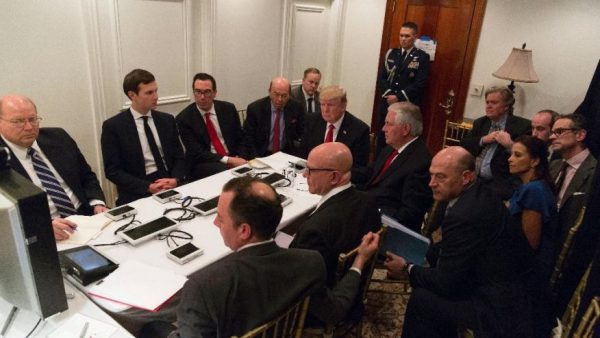
President Trump meeting with his advisers at his estate in Mar-a-Lago on April 6, 2017
By Robert Parry | Consortium News | April 8, 2017
There is a dark mystery behind the White House-released photo showing President Trump and more than a dozen advisers meeting at his estate in Mar-a-Lago after his decision to strike Syria with Tomahawk missiles: Where is CIA Director Mike Pompeo and other top intelligence officials?
Before the photo was released on Friday, a source told me that Pompeo had personally briefed Trump on April 6 about the CIA’s belief that Syrian President Bashar al-Assad was likely not responsible for the lethal poison-gas incident in northern Syria two days earlier — and thus Pompeo was excluded from the larger meeting as Trump reached a contrary decision.
At the time, I found the information dubious since Trump, Secretary of State Rex Tillerson and other senior U.S. officials were declaring quite confidently that Assad was at fault. Given that apparent confidence, I assumed that Pompeo and the CIA must have signed off on the conclusion of Assad’s guilt even though I knew that some U.S. intelligence analysts had contrary opinions, that they viewed the incident as either an accidental release of chemicals or an intentional ploy by Al Qaeda rebels to sucker the U.S. into attacking Syria.
As strange as the Trump administration has been in its early months, it was hard for me to believe that Trump would have listened to the CIA’s views and then shooed the director away from the larger meeting before launching a military strike against a country not threatening America.
After the strike against Syria by 59 Tomahawk missiles, which Syrian officials said killed seven people including four children, Trump gave a speech to the American people declaring flatly:
“On Tuesday, Syrian dictator Bashar al-Assad launched a horrible chemical weapons attack on innocent civilians. Using a deadly nerve agent, Assad choked out the lives of helpless men, women, and children. It was a slow and brutal death for so many. Even beautiful babies were cruelly murdered in this very barbaric attack. No child of God should ever suffer such horror.”
As much as Trump stood to benefit politically by acting aggressively in attacking Syria — and thus winning praise even from his harshest critics — the idea that he would ignore the views of the U.S. intelligence community on an issue of war or peace was something that I found hard to believe.
So, I put aside what I had heard from the source about the discordant Pompeo-Trump meeting as the sort of tidbit that may come from someone who lacks first-hand knowledge and doesn’t get all the details right.
After all, in almost every similar situation that I had covered over decades, the CIA Director or the Director of National Intelligence has played a prominent role in decisions that depend heavily on the intelligence community’s assessments and actions.
For instance, in the famous photo of President Obama and his team waiting out the results of the 2011 raid to kill Al Qaeda leader Osama bin Laden, CIA Director Leon Panetta is the one on the conference screen that everyone is looking at.
Even when the U.S. government is presenting false information, such as Secretary of State Colin Powell’s 2003 speech laying out the bogus evidence of Iraq hiding WMDs, CIA Director George Tenet was seated behind Powell to lend credibility to the falsehoods.
At the Table
But in the photo of Trump and his advisers, no one from the intelligence community is in the frame. You see Trump, Secretary of State Tillerson, National Security Adviser H.R. McMaster, White House chief of staff Reince Priebus, strategic adviser Steve Bannon, son-in-law Jared Kushner and a variety of other officials, including some economic advisers who were at Mar-a-Lago in Florida for the meeting with Chinese President Xi Jinping.
However, you don’t see Pompeo or Director of National Intelligence Dan Coats or any other intelligence official. Even The New York Times noted the oddity in its Saturday editions, writing: “If there were C.I.A. and other intelligence briefers around, … they are not in the picture.”
That made me wonder whether perhaps my original source did know something. The claim was that CIA Director Pompeo had briefed Trump personally on the analysts’ assessment that Assad’s forces were not responsible, but – then with Pompeo sidelined – Trump conveyed his own version of the intelligence to his senior staff.
In other words, the other officials didn’t get the direct word from Pompeo but rather received a second-hand account from the President, the source said. Did Trump choose to rely on the smug certainty from the TV shows and the mainstream news media that Assad was guilty, rather than the contrary view of U.S. intelligence analysts?
After the attack, Secretary of State Tillerson, who is not an institutional intelligence official and has little experience with the subtleties of intelligence, was the one to claim that the U.S. intelligence community assessed with a “high degree of confidence” that the Syrian government had dropped a poison gas bomb on civilians in Idlib province.
While Tillerson’s comment meshed with Official Washington’s hastily formed groupthink of Assad’s guilt, it is hard to believe that CIA analysts would have settled on such a firm conclusion so quickly, especially given the remote location of the incident and the fact that the initial information was coming from pro-rebel (or Al Qaeda) sources.
Thus, a serious question arises whether President Trump did receive that “high degree of confidence” assessment from the intelligence community or whether he shunted Pompeo aside to eliminate an obstacle to his desire to launch the April 6 rocket attack.
If so, such a dangerous deception more than anything else we’ve seen in the first two-plus months of the Trump administration would be grounds for impeachment – ignoring the opinion of the U.S. intelligence community so the President could carry out a politically popular (albeit illegal) missile strike that killed Syrians.
Investigative reporter Robert Parry broke many of the Iran-Contra stories for The Associated Press and Newsweek in the 1980s.
Featured Video

Spain train disaster raises questions over Israeli-linked security contractors
or go to
Aletho News Archives – Video-Images
From the Archives
Are There 50,000 ‘Israeli-born’ Individuals Living in the UK?
By Professor David Miller | August 18, 2026
Recent disclosures by the Zionist regime show that some 2,069 British nationals were serving in the IDF as of March 2025, according to Freedom of Information (FoI) requests submitted to the occupation forces (1,686 dual British-Israeli, plus 383 multinational). We cannot tell from the figures how many of these were already settler colonists and intend to stay in the colony, and how many will return or have returned to the UK. Presumably, those returning to the UK will number far fewer than 2,000, since many are known to have become permanently residents of the colony.
Additionally, the IDF figures only provide a snapshot, and do not tell us how many have served in the Jewish supremacist military either before or after March 2025. One way into the question of how many genocidaires are living in Britain is to ask how many current British residents were born in the Zionist colony. There is data on that, as we shall see. … continue
Blog Roll
 Aletho News
- Zelensky spent over 740 days outside Ukraine while West serves as his real home
- Indian captain of Russian ‘shadow fleet’ tanker faces 10-year jail term in UK
- Europe, US face higher heating bills amid Iran war fallout
- The Leak That Arrived Right on Cue
- No, New York Times, California’s Climate Has Always Been a Land of Flood, Drought, and Fire
- Are There 50,000 ‘Israeli-born’ Individuals Living in the UK?
- German CDU MPs Seek Climate “Misinformation” List
- The ‘Gaza Treatment’: How Media Headlines Obscure Who is Bombing Yemen
- Ro Khanna urges Democrats to strip Israel ‘integration’ provision from defense bill
- Why Iran designated British MI6, Royal Navy, and RAF as hostile, terrorist organizations
- If Americans Knew
- An error has occurred; the feed is probably down. Try again later.
- No Tricks Zone
- German Authorities Start Initiative To Evaluate Public Register For Climate “Disinformation” Spreaders!
- Zonal Asymmetry of Temperature Change in the Antarctic Circumpolar Current
- New Study: The Net Fossil Fuel Contribution To Rising Atmospheric CO2 Has Been Zero For 500 Years
- Germany’s Green Energy Transition Becoming Increasingly Expensive…Another 6 Trillion Euros!
- Sudden Stratospheric Warming, Powerful El Niño Combination May Lead To Extreme Europe Cold, Energy Crisis!
- Two New Studies Find Thwaites Glacier Melt Cannot Be Driven By Human Activity Or A Warming Ocean
- E-Cars Reduce CO2 Emissions By Only 41% Compared To Internal Combustion Engine Vehicles
- Predictions Made By Renowned Climate Professor Over Past Decades Have Been Proven To Be Poor
- New Study Suggests Large Regions Of The Pacific Ocean Have Been Cooling For The Last 80 Years
- Germany’s Green Energy Debacle: High Energy Costs Force Kahla Porzellan to Close After 182 Years!

