Pentagon conducts 20 airstrikes in Yemen, first since botched raid
Press TV – March 3, 2017
The Pentagon has carried out its first major military operation in Yemen since a botched raid in January that killed women and children as well as an American commando.
US forces conducted more than 20 airstrikes involving a mix of manned and unmanned aircraft early on Thursday, the Pentagon said.
Navy Captain Jeff Davis said the airstrikes targeted al-Qaeda in the Arabian Peninsula in three south-central provinces of Abyan, Shabwah and al-Bayda.
“The strikes will degrade the AQAP’s ability to coordinate external terror attacks and limit their ability to use territory seized from the legitimate government of Yemen as a safe space for terror plotting,” the Pentagon spokesman said.
The US military did not share a casualty estimate, but local officials said at least nine suspected al-Qaeda militants were killed.
Davis said the operation was coordinated with resigned president, Abd Rabbuh Mansur Hadi, a strong ally of Saudi Arabia that has been engaged in its own military campaign against Yemen.
Troops engage al-Qaeda on the ground
Military helicopters and drones launched a flurry of fresh airstrikes in Shabwah province early on Friday, witnesses said, according to Reuters.
The raids targeted the residence of Sa’ad Atef, an al-Qaeda leader, as well as other suspected militant positions in the area.
The unidentified aircraft, believed to be American, also deployed troops to the al-Saeed area of the southern province, who engaged suspected al-Qaeda militants on the ground for nearly half an hour.
The military operations came more than a month since a January 29 raid, the first of its kind authorized by President Donald Trump, in al-Bayda which residents said left as many as 25 civilians dead.
An ongoing investigation by the US Central Command has also determined that civilians, including possibly children, lost their lives during the botched raid.
The White House hailed the operation as a success, but critics said it was a failure since it resulted in the death of civilians and 36-year-old Navy SEAL Ryan Owens.
Three other Americans were also wounded in the Navy SEAL Team Six mission and a military aircraft worth $75 million was destroyed after it crash-landed at the raid site.
Trump blames generals for botched raid
President Trump has tried to distance himself from the raid by emphasizing that the operation had been in the works long before he took office. “This was a mission that was started before I got here,” he said in an interview with Fox News this week.
“This was something that, you know, they wanted to do. They came to see me and they explained what they wanted to do, the generals, who are very respected,” the president said. “And they lost Ryan.”
During his address to a joint session of Congress on Tuesday, Trump paid tribute to the fallen SEAL, and insisted that the operation yielded valuable intelligence that would “lead to many more victories in the future.”
Some US officials, however, have disputed that claim, saying the raid gathered little, if any, workable intelligence.
The United States conducts drone strikes in Yemen and several countries. Washington claims the airstrikes target members of al-Qaeda and other militants, but according to local officials and witnesses, civilians have been the victims of the attacks in many cases.
Al-Qaeda in Yemen has grown in weapons and number since the start of the Saudi military campaign in March 2015, which was launched to bring back Hadi to power and undermine the Houthi Ansarullah movement.
1 Year After Berta Caceres’ Murder, Activists Demand US Stop Funding Abusive Honduran State Forces

Photo: EFE
teleSUR | March 2, 2017
One year after the assassination of Honduran Indigenous leader Berta Caceres, human rights organizations and Indigenous communities continue to demand justice in the case, while the international branch of the struggle pressures to an end of U.S. funding for police and military forces accused of human rights abuses in the Central American country.
Caceres’ family sent a letter Thursday to U.S. Representative Norma Torres to ask for her support for the Berta Caceres Human Rights in Honduras Act, which was reintroduced the same day to the House of Representatives after stalling without adequate support since last year. The bill seeks the suspension of Washington’s security aid to Honduras until the country fulfills more rigorous human rights conditions — including an end to abuses by the police and military and justice in cases like Berta Caceres’ murder.
“It is increasingly clear that the government of Juan Orlando Hernandez is unwilling to act decisively to stop the killings of social activists in Honduras and to conduct honest and thorough investigations of killings and attacks,” Caceres’ family members state in the letter to Torres, urging her to “stand with” them and with Honduras. “In addition, the government has consistently failed to respect basic indigenous land rights, as it is required to do under its international treaty obligations.”
The original U.S. bill inspired by Caceres’ murder paints a grim picture of Honduras’ grave human rights situation, including the lack of justice in cases like Caceres’ murder. “Impunity remains a serious problem, with prosecution in cases of military and police officials charged with human rights violations moving too slowly or remaining inconclusive,” it states, adding that the U.S. State Department itself reported in 2015 problems of “corruption, intimidation, and institutional weakness of the justice system” in Honduras.
Caceres’ family addressed the letter to Torres to ramp up individual pressure for support of the bill. Torres, the first and only Central American in Congress and the founder of the bipartisan Central American Caucus, has faced criticism for aligning herself with the Honduran government, backing Washington’s controversial Alliance for Prosperity security aid package for Central America’s Northern Triangle and for refusing to support the Berta Caceres bill.
“We believe that your support for the Berta Caceres Human Rights Act will further strengthen your standing as an advocate for Central Americans and human rights, both in the U.S. and Honduras,” the family wrote in its letter to Torres, imploring her endorsement of the bill.
Caceres’ family also highlighted in the letter the involvement of active and former members of the military — including suspects trained at the infamous U.S. School of the Americas — in her murder, underlining the urgent need for more rigorous conditions on security aid to Honduran state forces. A former member of the military police in Honduras revealed to the Guardian that her name had been at the top of a “hit list” that a U.S.-trained unit received.
“A government that fails to protect its citizens and whose security forces are implicated in attacks and killings of activists should not be receiving security funding and training from the U.S. government,” the letter stressed, adding that Caceres’ murder is only one example among scores of assassinations, attacks and other forms of intimidation targeting activists in the country.
According to a recent report by the international rights organization Global Witness, 120 land and environmental defenders have been killed in Honduras since 2010 after an increase in state-sanctioned abuses in the wake of the 2009 U.S.-backed military coup.
Meanwhile, in Honduras, members of the organization that Caceres founded — the Civic Council of Popular and Indigenous Organizations of Honduras or COPINH — held a march Wednesday in the capital city Tegucigalpa demanding justice one year after her death.
They blasted Honduran authorities over the fact that, to this day, the motive for her assassination has not been identified and perpetrators in the killing not brought to justice. Demonstrators with banners shouted slogans demanding that authorities arrest the masterminds behind Caceres’ murder.
Caceres rose to international prominence for leading the Indigenous Lenca people in a struggle against a controversial hydroelectric dam project in the community of Rio Blanco that was put in motion without consent from local communities. She was also a key leader in the post-coup resistance movement that demanded a constituent assembly to rewrite the Honduran Constitution.
For her environmental and land defense work, she was awarded the prestigious 2015 Goldman Environmental Prize, while at the same time suffering dozens of death threats and other forms of harassment. Berta Caceres was shot dead just before midnight March 2, 2016, when gunmen stormed her house and attacked her.
Caceres’ family claim that the Honduran company behind the hydroelectric project she fought against, Desarrollos Energeticos or DESA, and the Honduran government hired contract killers to murder her and other activists.
Her family and fellow activists insists that her legacy will continue to inspire a movement for rights and justice.
In a statement ahead of the anniversary of her murder, Caceres’ COPINH reiterated calls for justice and an end to unwanted corporate projects on Indigenous land and vowed to forge on in the struggle that Caceres championed in the name of a “just society where life is respected.”
“One year after Berta’s murder, she continues teaching us that ideas cannot be killed and the processes of the people cannot be stopped,” the organization said. “May she continue to be present and our task continue with her legacy of resistance and struggle against injustice.”
RELATED:
Honduras Is the Deadliest Country for Environmental Activists
House bill would slash US lethal military aid to Ukraine by half
RT | March 3, 2017
Amid a recent spike in violence in eastern Ukraine, a new bill to be introduced in the US House of Representatives proposes dramatically cutting military aid to Kiev, including lethal weapons, as well as logistical and intelligence support.
Reducing military-related costs inherited from the Obama administration is said to be the bottom line of the new 2017 Defense Appropriations bill, according to the House Appropriations Committee’s press release published on Thursday. The bill is due to be heard in the House next week.
Among other cost-saving measures, the bill proposes allocating only $150 million for “training, equipment, lethal weapons of a defensive nature, logistics support, supplies and services, sustainment, and intelligence support to the military and national security forces of Ukraine.”
While still sizeable, the figure is only half that transferred to Ukraine by the US last year. Under the 2016 National Defense Authorization Act, the US paid out $300 million to assist Kiev “in defending itself against actions by Russia and Russian-backed separatists.”
Notably, the use of funds “to procure or transfer man-portable air defense systems” is prohibited in the 2017 bill.
Low-intensity violence in eastern Ukraine quickly escalated in early February after Ukrainian government forces shelled the town of Avdeevka, which lies just 10 kilometers from Donetsk. Tanks, heavy armor, artillery, and multiple-launch rocket systems were used in what Ukrainian Deputy Defense Minister Igor Pavlovsky called a “meter-by-meter, step-by-step” advance towards Donetsk.
Reports from the OSCE’s Special Monitoring Mission (SMM) also confirmed that heavy weapons, which have long been banned under the landmark Minsk agreement, had been moved closer to the disengagement line.
Kiev has blamed the escalation on the rebels, while the OSCE says both sides of the conflict have violated the truce. In its latest report on Wednesday, the SMM said it had recorded “more ceasefire violations in both Donetsk and Luhansk regions, including more than twice as many explosions compared with the previous reporting period.”
In a February interview with Ukrainian and Russian media outlets, including RT, Ukrainian President Viktor Yanukovich, who was toppled in the 2014 Euromaidan coup, said that Kiev’s crackdown on eastern Ukraine amounted to a declaration of war on its own people.
“Of course, everyone who took part in this decision must be held responsible. This is a crime against their own people,” Yanukovich said. “The current authorities did not make a single attempt to talk to the people, who were against the coup,” he argued, adding that, instead, Kiev simply “divided the country into winners and losers,” prompting the alienation of the eastern regions.
Despite the rising civilian death toll in eastern Ukraine, the US and its NATO allies have been actively integrating Kiev’s forces into Western military structures. US Army-run exercises dubbed ‘Rapid Trident’ have been held in western Ukraine annually since 2014, while Ukrainian soldiers are often seen at various NATO-led war games in the Baltics and eastern Europe.
Read more:
‘Jewish Power Never Sleeps’–Another Billboard Taken Down

Fig Trees and Vineyards | March 2, 2017
The following is an email sent out recently by Deir Yassin Remembered announcing the take-down of one of their billboards.
The taken-down DYR “America First” billboard, the Southern Poverty Law Centre and a quote from Elie Wiesel – what could they have in common? Henry Herskovitz tells us more:
Jewish Power Never Sleeps
Like Michigan rust on vehicles, Jewish Power remains relentless at getting its way. Just when Witness for Peace was to announce the installation of a local billboard – sponsored by sister organization Deir Yassin Remembered and carrying our message “America First, Not Israel” – we get “the call”. The billboard pictured was taken down by Adams Outdoor Advertising one week after installation, effectively terminating a three-month contract.
That’s how long it took for Jewish Power to pressure Adams’ executives into seeing things their way. The call came from General Manager Mike Cannon, who admitted to receiving phone calls asking that the billboard be taken down. Mike claimed he was not the one who made the decision, and provided the phone number of Vice President of Human Resources
Brian Grant to field my questions.Brian developed a mantra for the conversation we shared: “the decision to remove the billboard was a collective decision and was made because the message did not meet Adams’ company standards. We removed the billboard and refunded your money. And that’s all I can say.” Brian fell back on this mantra at least a half dozen times during our 20-minute discussion. And reminded me that, since a clause in the contract allowed Adams to terminate at any time, there was no “breach of contract”.
Q: What were the company standards?
A: [Brian was not going to go into that.]
Q: How do you square the fact that the message was initially approved by Adams?
A: It should not have been approved; due diligence was not applied.
Q: Who were the people complaining about the billboard?
A: [Would not answer that.]
Q: What were the organizations calling for the billboard to be taken down?
A: [See above.]
Q: Would the decision to pull the billboard have been the same had the message been simply America First?
A: Well, you’re asking a hypothetical.
Q: You mean Adams would NOT run a billboard saying America First?
A: [No answer.]And so it goes. By deception shall you make war. DYR and WfP lose the round; Jewish Power wins. We move on.
Ann Arbor placed on SPLC “Hate” Map
The Southern Poverty Law Center exercises its own brand of Jewish Power by placing Deir Yassin Remembered (and its satellite office in Ann Arbor) on its “hate” map. This information came to us, not by direct communication from the SPLC, but through an article appearing in the Rochester, NY Democrat and Chronicle, entitled: “Rochester area makes SPLC Hate Map”
Defining “hate” proves difficult. A friend asks if forming a group which hates “hate” groups is in itself a “hate” group? Hmmm. The only clear example of hate speech that has come across this writer’s desk belongs to Holocaust icon Elie Wiesel:
“Every Jew, somewhere in his being, should set apart a zone of hate — healthy, virile hate — for what the German personifies and for what persists in the German.”
Henry Herskovitz
Deir Yassin Remembered / Witnesses for Peace
Christian Zionists Target US Aid to Palestinian Authority
By Richard Edmondson | Fig Trees and Vineyards | March 2, 2017
A few days ago, We Hold These Truths posted a podcast entitled “Christian Zionism is a War Based Religion,” which includes a discussion on the so-called “just war” theological doctrine often used by Christian leaders to justify their support for US wars.
I am referring, of course, to Christian leaders such as John Hagee, of Christians United for Israel, or CUFI.
Back in 2003, Hagee supported the US war in Iraq, and even later, after it became glaringly apparent there never had been any weapons of mass destruction and that Bush had lied about the war, he continued to be a vocal supporter of the US aggression.
“Christian Zionism is a war based, political religion wrapped around the notion that the modern state of Israel is a fulfillment of Biblical prophecy,” reads the podcast description put up by We Hold These Truths. You can go here to listen to the podcast. It’s a fairly interesting discussion.
I mention it because just today CUFI, which is the largest Christian Zionist organization in America, sent out an appeal to its email subscribers calling for an end to US financial aid to the Palestinian Authority. A friend of mine who is on their email list forwarded it to me.
What exactly has the PA done that has so upset the CUFI? You’ll read about it in the text of the email, which I reproduce below, but basically it comes down to support for the families of Palestinians who have been either killed or imprisoned by Israel–people the CUFI views as “terrorists.”
Of course, anyone who gets killed by an Israeli soldier automatically has to be labeled a “terrorist,” and there have been reports of soldiers planting knives on the bodies of their victims. Apparently this is of no concern to CUFI, however. It isn’t mentioned in their email.
The illegal settlements, the ongoing 50-year occupation of the West Bank, the targeting of residential buildings and hospitals in Israel’s periodic attacks upon Gaza–all these things, too, go unmentioned.
Another key point is that under international law people have a right to resist occupation. By this measure, attacks by Palestinians against Israeli soldiers are not acts of terrorism. To make the assertion that they are would be the equivalent of branding the founding fathers of America as terrorist leaders.
But perhaps the main thing to keep in mind is that this appeal is being made by an organization that supported the US war in Iraq, and which has yet to apologize or concede that the war was fought under false pretenses or that Christian support for it was a terrible mistake. Another thing you might also want to reflect upon, just as a matter of interest, is that the executive director of Christians United for Israel, David Brog, is not in fact a Christian–he is Jewish.
The CUFI communique includes the following graphic at the top of the email:

The text then reads as follows:
Dear _______,
Since September of 2015, the beginning of the so-called “stabbing intifada,” Palestinian terrorists have murdered more than 50 innocent people and wounded hundreds more.
The media often describes these terrorists as “lone wolves” completely disconnected from Mahmoud Abbas and his Palestinian Authority (PA). But the fact is that the Palestinian Authority makes generous lifetime payments to every Palestinian imprisoned for killing Israelis. And if the terrorist dies during his attack, his family receives these payments. This financial support for terrorism is actually required under legislation passed by the Palestinian legislature.
The United States provides the PA with approximately $300 million in aid each year. The PA makes approximately $300 million in payments to terrorists and their families every year. There is no way around this troubling reality: our taxpayer dollars are being used to fund terrorism. This must end!
Earlier this week, Sen. Lindsey Graham re-introduced a critical piece of legislation–the Taylor Force Act. Representatives Lamborn and Zeldin introduced similar legislation in the House of Representatives. This bill requires that we cut all U.S. aid to the PA until it stops funding terrorism.
This bill is named after Taylor Force, a West Point graduate who who survived tours of duty in Iraq and Afghanistan only to be murdered in Israel by a Palestinian terrorist.
Today we ask you to stand up for Taylor Force. We ask you to stand up for Israel. And we ask you to take a stand against terrorism.
Click here now to ask your members of Congress to co-sponsor the Taylor Force Act.
Help us end the PA’s Pay to Slay policy today!
Blessings to you and those you love,
Pastor John Hagee
National ChairmanDavid Brog
Director
The appeal ends with the following words written in large white letters on a red background:
“NO MONEY FOR MURDER”
While I am not a big fan of the PA, one thing that might be said in their favor is that they do not have a lobby in Washington to speak of, and that we have never fought a war on their behalf. I have my doubts as to whether this bill will be passed or signed into law, however. It is necessary for Israel to maintain the diplomatic pretense that Palestinians in the Occupied Territories exercise some measure of self-determination, no matter how small. It is the PA that provides this fig leaf. Take away the fig leaf and Israel stands exposed as an apartheid state for all the world to see. My guess is this is probably one of the only reasons aid to the PA was ever begun in the first place.
US Lawmakers Pass Resolution Demanding Trump Act on Venezuela
By Ryan Mallett-Outtrim | Venezuelanalysis | March 1, 2017
US Senators unanimously passed a resolution Wednesday urging President Donald Trump to take further action against Venezuelan officials.
The bill also expressed support for a controversial move by Organisation of American States (OAS) head Luis Almagro to invoke the Democratic Charter. If invoked, Venezuela would be suspended from the OAS. When Almagro first announced the move in 2016, he also demanded President Nicolas Maduro be “immediately” removed from office, prompting many Latin American leaders to accuse the OAS head of overreach.
Despite the controversy, the Senate bill called on Trump to “provide full support for OAS efforts in favour of constitutional and democratic solutions to the political impasse and to instruct federal agencies to hold officials of the Venezuelan government accountable for violations of US law and abuses of internationally recognised human rights.”
The bill will now head to the House of Representatives.
One of the main supporters of the bill, Senator Marco Rubio, thanked both Republicans and Democrats for supporting the move.
“I thank my Senate colleagues for supporting this bipartisan resolution calling for the government of Venezuela to respect the constitutional and democratic processes and release all political prisoners,” Rubio said in a statement.
The bill was co-sponsored by prominent Democrats including Senators Bob Menendez and Bill Nelson, along with Hillary Clinton’s 2016 presidential running mate Tim Kaine.
Venezuela has already been hit by numerous US sanctions. One of former president Barack Obama’s last acts in office was the renewal of an executive order in January, declaring Venezuela an “unusual and extraordinary threat” to national security.
The executive order wasn’t set to expire until March, though White House officials said Obama went ahead with renewal early to ensure a “a smooth transition” for the Trump administration.
Since then, the Trump administration has slapped Venezuelan Vice President Tareck El Aissami with sanctions, including a travel ban and an asset freeze targeting one of his alleged close confidants, the entrepreneur Samark Lopez. Both Aissami and Lopez have been accused of involvement in international drug trafficking. Aissami has denied the allegations, stating in February that he was the victim of anti-Venezuela hardliners in Washington “ “whose fundamental interest is to prevent Venezuela and the United States from restoring their political and diplomatic relations on the basis of mutual recognition and respect”.
“These interest groups not only lack any evidence to demonstrate the extremely serious accusations against me, but they also have built a false-positive case in order to criminalise –through me– the Government of the Bolivarian Republic of Venezuela, a country that is decidedly waging a war on transnational drug trafficking business,” he said.
NATO’s scaremongering about ‘Russia threat’ to Baltic States ‘is all about money’
RT | March 2, 2017
The US security establishment is trying to justify its existence, says Daniel McAdams of the Ron Paul Peace Institute, commenting on a new report which lists how NATO can help the Baltic States counter Russian ‘hybrid warfare.’
The American global policy think-tank, the RAND Corporation, published a report that claims NATO should do more to counter the potential Russian threat and strengthen the Baltic countries’ forces. The US government-funded body issued a report titled “Hybrid Warfare in the Baltics: Threats and Potential Responses.”
The document raises concern over “Russian use of “hybrid warfare” best understood as covert or deniable activities, supported by conventional or nuclear forces, to influence the domestic politics of target countries.”
The author of the report, Andrew Radin claims “these tactics are of particular concern in the Baltic countries of Estonia and Latvia, which have significant Russian-speaking minorities.” He warns that there is concern Russia will seek to use these minorities to gain influence in the region, “use covert action to seize territory, use subversion to justify a conventional attack, or otherwise use deniable or covert means to gain influence in the Baltics and undermine the EU and NATO.”
RT discussed the report with McAdams and asked him why potential “Russian aggression” is in the spotlight again. Is there a real threat?
In his view, what we are seeing is just another example of the national security establishment in the US “having to justify its existence.”
“The report itself outlines many things that NATO has to do to help the Baltics. The Baltics are absolutely irrelevant to the security of NATO. Their only relevance is geographic. They are close to Russia. Therefore, NATO can hold exercises on Russia’s border to provoke Russia. As far as the Baltics, look at Latvia, for example, if it is so concerned about Russian warfare or hybrid warfare, why do they spend 0.9 percent of their GDP on defense? They are clearly not worried. It really is just a ploy to get more free things from NATO. And for NATO to keep itself alive after it should have been shut down,” McAdams said.
In his opinion, “hybrid warfare” – the report refers to – is a term used when there’s no evidence that Russia has done anything wrong.
It was hybrid warfare when Russia “invaded Ukraine.” And that is just because we didn’t see any Russian military in Ukraine. It was hybrid warfare with “the little green men” in Crimea. Well, those little green men in Crimea were already there legally as part of the leased base in Sevastopol. All of these things are made up, it’s part of NATO’s ongoing aggression toward Russia, provocation of Russia and it is desperate to keep itself alive, to keep its budgets rising,” the analyst said. “And sadly, unfortunately, we are seeing that the US president who was rightly critical of NATO, calling it outdated, said in his recent speech to Congress that he loves NATO and thinks it’s great. So, unfortunately, it looks like it is going to be propped up for a while longer. And yes, it is about money,” he added.
Trump Retreats on Detente with Russia
By Gilbert Doctorow | Consortium News | March 1, 2017
Donald Trump’s speech on Tuesday to a joint session of Congress was a reasonably well-crafted and well-delivered exercise in communicating his case to the nation. The President opened with a description of the flurry of executive orders in his first 30 days in office, implementing promises made during the electoral campaign.
He then went on to describe the contours of legislation that his administration will send to Congress, starting with the budget and its scrapping of the cap on military spending, which is to enjoy a 10 percent rise in appropriations while domestic and other government spending is slashed. Then there was a review of his plans to repeal and replace Obamacare and a preview of his proposals for cutting taxes and regulations with the goal of creating more well-paying jobs.
In an emotional highpoint, Trump drew attention to the widow of a Special Forces soldier killed in a raid inside Yemen. He also presented a more compassionate – less combative – tone, calling on Democrats and Republicans to put aside their differences and work together. His 60-minute address was interrupted 93 times by applause, often standing ovations from Republicans but also some applause from the Democratic side, too.
Trump seemed to bask in the enthusiastic show of support, although such State of the Union speeches typically draw the same sort of surface adulation, with the members from the party in power cheering robustly and those from the other side offering sparser shows of support. Still, the televised images contrasted with the portrayal from the mainstream U.S. news media of an embattled leader caught in a Watergate-like scandal over supposedly illicit contacts with Russia, a narrative Trump mistakenly fed with the hasty firing of National Security Adviser Michael Flynn on Feb. 13 during a media frenzy about Flynn talking with the Russian ambassador during the transition.
Flynn became the target of elements inside the U.S. government and the press who opposed Trump’s plans for détente with Russia. Those anti-détente forces are now flexing their muscles, with U.S. Ambassador to the United Nations Nikki Haley sounding much like her hawkish predecessor Samantha Power, insisting that the United States will not recognize Russia’s takeover of Crimea and then, this week, co-sponsoring a resolution in the U.N. Security Council condemning the Assad regime in Syria for allegedly using chemical weapons, a move that provoked angry protests and a veto from Russia’s envoy.
Meanwhile, Vice President Mike Pence, Secretary of State Rex Tillerson and Defense Secretary James Mattis carried messages to Europe reaffirming the U.S. commitment to NATO allies and blaming Russia for the failure of the Minsk Accords to resolve the crisis in Ukraine (although a major obstacle was created by the Ukrainian government when it insisted that ethnic Russian rebels in the Donbass region effectively surrender before other steps would be taken). The U.S. statements could have been delivered by neoconservative and liberal-interventionist diplomats from the past several U.S. administrations.
Only the last five minutes of Trump’s address to Congress dealt with foreign relations. And his own words were consonant with what his cabinet officers had been saying. Trump’s campaign opinions about NATO’s obsolescence had disappeared. Russia was not mentioned by name once in the speech, while America’s allies in NATO and in the Pacific were reassured that “America is ready to lead.” That statement was a rare instance when the entire congressional audience rose to its feet in applause.
Back on His Words
Those who had feared that Trump’s populism and “America First” rhetoric spelled isolationism were reassured that “Our foreign policy calls for a direct, robust and meaningful engagement with the world.”
In fact, in the entire speech, there were only a few lines toward the end that might give heart to those who hoped that Trump might pursue a dramatically new foreign policy that drew back from America’s vast network of military bases and the tendency to intervene in other countries’ affairs.
Though sounding not unlike boiler-plate language that Presidents George W. Bush and Barack Obama might have used, those words did contain the possible seeds of a less warlike strategy. Trump said: “America is willing to find new friends and to forge new partnerships where shared interests align. We want harmony and stability, not war and conflict. America is friends today with former enemies. We want peace, wherever peace can be found. America is friends today with former enemies. Some of our closest allies decades ago fought on the opposite side of these terrible, terrible wars.”
Depending on the strength of one’s powers of self-delusion, those last words might be construed as a hint: just wait, allow me to get my footing and establish my popularity in Congress and in the broad public and I will come back and deliver on my détente aspirations.
But it is an inescapable reality that the firing of Flynn and Trump’s retreat from his foreign policy intentions were precipitated by the powerful collusion between the intelligence services, particularly the CIA, and the mainstream media with a clear intent to either neuter Trump by forcing a policy reversal on Russia détente or remove him through some form of impeachment. The phoniness of the McCarthyite charges of Russian connections used to smear Trump and his entourage has been well explained in recent articles by Professor Stephen Cohen in The Nation and by Gareth Porter at Consortiumnews.com.
Those with a more conspiratorial turn of mind have long spoken of the Deep State, which ensures continuity of policy whatever the results of U.S. elections with this subterranean power residing largely in the intelligence services, especially the CIA and FBI, in the Pentagon, and in the State Department.
State is said to have been purged in its policy-making “seventh floor” during the week of Secretary Tillerson’s European travels. But the text that was placed before the inexperienced Ambassador Haley for delivery in the Security Council shows that not all the old actors have been sent packing. Any purge of the CIA and Pentagon has not even begun.
The ability of neocons and hardliners at the Pentagon to sabotage presidential policy was demonstrated last September when a promising collaboration between Secretary of State John Kerry and Russian Foreign Minister Sergey Lavrov over a cease-fire in Syria was torn to shreds by an “accidental” attack by U.S. and Allied fighter jets on a Syrian government outpost at Deir ez-Zor that killed nearly 100 Syrian soldiers.
If these recalcitrant Cold Warriors in America’s “power ministries” remain untouched, they will be in a position to create provocations at any time of their choosing to override Trump’s planned détente policies. To do so would be child’s play, given the close proximity of U.S. and Russian forces in Ukraine, in Syria, in the Baltic States, on the Baltic Sea and on the Black Sea.
Given the poor state of relations and the minimal trust between Russia and the U.S.-led West, any accident in these areas could quickly escalate. And then we might see the side of Donald Trump’s personality that his Democratic opponents warned us about, his short temper and alpha-male nature which could bring us into an armed clash the outcome of which is unforeseeable but surely not good.
There is another troubling issue for those who hoped Trump would rein in military spending to finance his promised domestic infrastructure investments. Instead, Trump has focused on expanding military spending even more, financed by cuts in domestic spending. There has not been a word to suggest he is considering restructuring the $600 billion military appropriations, for example by cutting the military bases abroad, which are configured to support precisely the global hegemony and American imperialism that he has denounced.
What is at issue is not only the tens of billions of dollars in savings that would come from slashing this overseas base structure but also removing an American presence from countries where it only serves to foster anti-Americanism and to embroil us either in defending hated regimes or intervening in regional conflicts where we have no vital interests.
Without restructuring and reducing the gargantuan network of foreign military bases, the U.S. will be condemned to a never-ending succession of wars abroad and the entire plan of investment in America is doomed to failure. These are not issues that allow for tactical retreats but rather must be addressed head-on. But who will explain this to a headstrong President with the fawning applause of Congress ringing in his ears?
Gilbert Doctorow is a Brussels-based political analyst. His latest book, Does Russia Have a Future? was published in August 2015.
How the Press Serves the Deep State
By Daniel Lazare | Consortium News | March 1, 2017
The New York Times has made it official. In a Sunday front-page article entitled “Trump Ruled the Tabloid Media. Washington Is a Different Story,” the paper gloats that Donald Trump has proved powerless to stop a flood of leaks threatening to capsize his administration.
As reporters Glenn Thrush and Michael M. Grynbaum put it: “This New York-iest of politicians, now an idiosyncratic, write-your-own-rules president, has stumbled into the most conventional of Washington traps: believing he can master an entrenched political press corps with far deeper connections to the permanent government of federal law enforcement and executive department officials than he has.”
Thrush and Grynbaum add a few paragraphs later that Trump “is being force-fed lessons all presidents eventually learn – that the iron triangle of the Washington press corps, West Wing staff and federal bureaucracy is simply too powerful to bully.”
Iron triangle? Permanent government? In its tale of how Trump went from being a favorite of the New York Post and Daily News to fodder for the big-time Washington news media, the Times seems to be going out of its way to confirm dark paranoid fears of a “deep state” lurking behind the scenes and dictating what political leaders can and cannot do. “Too powerful to bully” by a “write-your-own-rules president” is another way of saying that the permanent government wants to do things its way and will not put up with a president telling it to take a different approach.
Entrenched interests are nothing new, of course. But a major news outlet bragging about collaborating with such elements in order to cripple a legally established government is. The Times was beside itself with outrage when top White House adviser Steve Bannon described the media as “the opposition party.” But one can’t help but wonder what all the fuss is about since an alliance aimed at hamstringing a presidency is nothing if not oppositional.
If so, a few things are worth keeping in mind. One is that Trump was elected, even if only by an Eighteenth-Century relic known as the Electoral College, whereas the deep state, permanent government, or whatever else you want to call it was not. Where Trump gave speeches, kissed babies, and otherwise sought out the vote, the deep state did nothing. To the degree this country is still a democracy, that must count for something. So if the conflict between president and the deep state ever comes down to a question of legitimacy, there is no doubt who will come out ahead: The Donald.
A second thing worth keeping in mind is that if ever there was a case of the unspeakable versus the inedible (to quote Oscar Wilde), the contest between a billionaire president and billionaire-owned press is it.
Both sides are more or less correct in what they say about the other. Trump really is a strongman at war with basic democratic norms just as innumerable Times op-ed articles say he is. And giant press organizations like the Times and the Washington Post are every bit as biased and one-sided as Trump maintains – and no less willfully gullible, one might add, than in 2002 or 2003 when they happily swallowed every lie put out by the George W. Bush administration regarding Iraqi WMDs or Saddam Hussein’s support for Al Qaeda.
Riveting TV
Trump’s Feb. 16 press conference – surely the most riveting TV since Jerry Springer was in his prime – is a case in point. The President bobbed, weaved, and hurled abuse like a Catskills insult comic. He threw out pseudo-facts, describing his victory, for instance, as “the biggest Electoral College win since Ronald Reagan” when in fact George H. W. Bush, Bill Clinton and Barack Obama all got more votes. But commentators who panned the display as a “freak show” or simply “batshit crazy” didn’t get it. It wasn’t Trump who bombed that afternoon, but the press.
Why? Because reporters behaved with all the intelligence of a pack of Jack Russell terriers barking at a cat up a tree. Basically, they’ve been seized by the idée fixe that Russia is a predator state that hacks elections, threatens U.S. national security, and has now accomplished the neat trick of planting a Kremlin puppet in the Oval Office. It doesn’t matter that evidence is lacking or that the thesis defies common sense. It’s what they believe, what their editors believe, and what the deep state believes too (or at least pretends to). So the purpose of the Feb. 16 press conference was to pin Trump down as to whether he also believes the Russia-did-it thesis and pillory him for deviating from the party line.
More than half the questions that reporters threw out were thus about Russia, about Mike Flynn, the ex-national security adviser who got into trouble for talking to the Russian ambassador before the new administration formally took office, or about reputed contacts between the Trump campaign staff and Moscow. One reporter thus demanded to know if anyone from Trump’s campaign staff had ever spoken with the Russian government or Russian intelligence. Another asked if Trump had requested FBI telephone intercepts before determining that Flynn had not broken the law.
“I just want to get you to clarify this very important point,” said a third. “Can you say definitively that nobody on your campaign had any contacts with the Russians during the campaign?” A fourth wanted to get the President’s reaction to such “provocations” as a Russian communications vessel floating 30 miles off the coast of Connecticut (in international waters). “Is Putin testing you, do you believe, sir?” the reporter asked as if he had just uncovered a Russian agent in the Lincoln Bedroom. “… But do they damage the relationship? Do they undermine this country’s ability to work with Russia?”
When yet another journalist asked yet again “whether you are aware that anyone who advised your campaign had contacts with Russia during the course of the election,” Trump cried out in frustration: “How many times do I have to answer this question?” It was the most intelligent query of the day.
The press played straight into Trump’s hands, all but providing him with his best lines. “Well, I guess one of the reasons I’m here today is to tell you the whole Russian thing, that’s a ruse,” he responded at one point. “That’s a ruse. And by the way, it would be great if we could get along with Russia, just so you understand that. Now tomorrow, you’ll say, ‘Donald Trump wants to get along with Russia, this is terrible.’ It’s not terrible. It’s good.”
The prose may not be very polished, but the sentiments are unassailable. Ditto Trump’s statement a few minutes later that “false reporting by the media, by you people, the false, horrible, fake reporting makes it much harder to make a deal with Russia. … And that’s a shame because if we could get along with Russia – and by the way, China and Japan and everyone – if we could get along, it would be a positive thing, not a negative thing.”
If the Washington Post and the Times do not agree that bogus assertions about unauthorized contacts with Russia are not poisoning the atmosphere, they should explain very clearly why not. They should also explain what they hope to accomplish with a showdown with Russia and why it will not be a step toward World War III.
But they won’t, of course. The media (with encouragement from parts of the U.S. government) are working themselves into a fit of outrage against Vladimir Putin just as, in past years, they did against Daniel Ortega, Manuel Noriega, Saddam Hussein, Slobodan Milosevic, Saddam Hussein (again), Muammar Gaddafi, Bashar al-Assad, and Viktor Yanukovych. In each instance, the outcome has been war, and so far the present episode shows all signs of heading in the same direction as well.
Reporters may be clueless, but working-class Americans aren’t. They don’t want a war because they’re the ones who would have to fight it. So they’re not unsympathetic to Trump and all the more inclined to give the yapping media short shrift.
This is a classic pattern in which strongmen advance on the basis of a liberal opposition that proves to be weak and feckless. Today’s liberal media are obliging Trump by behaving in a way that is even sillier than usual and well ahead of schedule to boot.
A Fragile Meme
The anti-Russia meme, meanwhile, rests on the thinnest of foundations. The argument that Russia hacked the Democratic National Committee and thereby tipped the election to Trump is based on a single report by CrowdStrike, the California-based cyber-security firm hired by the DNC to look into the mass email leak. The document is festooned with head-spinning techno-jargon.
It says of Cozy Bear and Fancy Bear, the hackers who allegedly penetrated the DNC in behalf of Russian intelligence: “Their tradecraft is superb, operational security second to none, and the extensive usage of ‘living-off-the-land’ techniques enables them to easily bypass many security solutions they encounter. In particular, we identified advanced methods consistent with nation-state level capabilities including deliberate targeting and ‘access management’ tradecraft – both groups were constantly going back into the environment to change out their implants, modify persistent methods, move to new Command & Control channels, and perform other tasks to try to stay ahead of being detected. Both adversaries engage in extensive political and economic espionage for the benefit of the government of the Russian Federation and are believed to be closely linked to the Russian government’s powerful and highly capable intelligence services.”
Impressive? Not to independent tech experts who have already begun taking potshots. Sam Biddle, The Intercept’s extremely smart tech writer, notes that CrowdStrike claims to have proved that Cozy Bear and Fancy Bear are Russian because they left behind Cyrillic comments in their “metadata” along with the name “Felix Edmundovich,” also in Cyrillic, an obvious reference to Felix Edmundovich Dzerzhinsky, founder of the Cheka, as the Soviet political police were originally known.
But, Biddle observes, there’s an obvious contradiction: “Would a group whose ‘tradecraft is superb’ with ‘operational security second to none’ really leave behind the name of a Soviet spy chief imprinted on a document it sent to American journalists? Would these groups really be dumb enough to leave Cyrillic comments on these documents? … It’s very hard to buy the argument that the Democrats were hacked by one of the most sophisticated, diabolical foreign intelligence services in history, and that we know this because they screwed up over and over again.”
Indeed, John McAfee, founder of McAfee Associates and developer of the first commercial anti-virus software, casts doubt on the entire enterprise, wondering whether it is possible to identify a hacker at all. “If I were the Chinese,” he told TV interviewer Larry King in late December, “and I wanted to make it look like the Russians did it, I would use Russian language within the code, I would use Russian techniques of breaking into organizations. … If it looks like the Russians did it, then I can guarantee you: it was not the Russians.” (Quote starts at 4:30.)
This may be too sweeping. Nonetheless, if the press really wanted to get to the bottom of what the Russians are doing, they would not begin with the question of what Trump knew and when he knew it. They would begin, rather, with the question of what we know and how we can be sure. It’s the question that the press should have asked during the run-up to the 2003 invasion of Iraq, but failed to. But it’s the question that reporters should be asking now before the conflict with Russia spins out of control, with consequences that are potentially even more horrendous.
It’s not easy making Donald Trump seem like a peacenik, but that’s what the billionaire’s press has done.
Israel’s Anti-Semitism Smears Backfire
By Ann Wright | Consortium News | March 1, 2017
An often-used tactic to squelch criticism of Israeli state policies toward the Palestinians is to call the criticism anti-Semitic. The sponsors of the event become afraid of the label, anti-Semitism, false as it is, and cancel the event to avoid any controversy. The tactic is used widely across Europe and the United States.
This week, the talk that I was to give in a room at the Rome City Hall about the Women’s Boat to Gaza and the conditions in Gaza was cancelled 24 hours before the event by the council member who had agreed to arrange for the room. His staff revealed that he had gotten intense pressure from the Israeli Embassy and Rome’s Jewish Community Association to stop the presentation.
But that was not the end of the story. In a fast-moving media blitz, organized by Italy’s Boycott, Divestment and Sanctions program, two of Rome’s newspapers wrote of the cancellation and several radio stations reported on it. BDS Italy scheduled a press conference about the cancellation in the plaza in front of the City Hall at the time the talk was scheduled. About 20 representatives of the news media attended, a much larger number than would have attended the talk itself.
Due to the number of media and the questions concerning the cancellation, Marcello de Vito, President of the Rome City Council, invited three of us to come into the City Hall to discuss the cancellation. This invitation provided us with the opportunity to discuss the conditions in Gaza and the West Bank and the nonviolent tactics such as BDS and Boats to Gaza to bring international attention to the harmful policies of the State of Israel.
From the questions, it was apparent that the President, another City Council member and their staff knew little about the Israeli blockade of Gaza, the illegal settlements, the apartheid wall, the numbers of Palestinian children and youth held in Israeli jails, and the theft of Palestinian resources by Israeli companies.
Something similar happened last year in Bayreuth, Germany, when the prize for Tolerance and Peace, which had been awarded to CODEPINK: Women for Peace, was cancelled by the Mayor after two reporters, known for writing spurious articles, alleged that CODEPINK was an anti-Semitic organization. Following an extensive letter-writing campaign from members of the German Parliament and others who know that CODEPINK’s actions challenging the policies of the State of Israel are not anti-Semitic, the Bayreuth City Council voted to reinstate the award amid much publicity.
Also, last year, a conference in which grandmothers who had been through World War II were to speak was cancelled because of similar allegations. Defenders of Israeli policies targeted 90-year old Hedie Esptein, a vocal critic of Israeli treatment of Palestinians, although her parents had been killed in the Holocaust and she had survived by being sent to England as a part of the Kindertransport,
Responding quickly to false allegations of anti-Semitism is key to blunting the Israeli government’s offensive toward those who challenge the illegal and inhumane policies toward Palestinians. In the case of the Rome cancellation, the pushback from BDS Italy created more publicity about the plight of the Palestinians than the event itself would have.
Ann Wright served 29 years in the U.S. Army/Army Reserves and retired as a Colonel. She was a U.S. diplomat and served in U.S. embassies in Nicaragua, Grenada, Somalia, Uzbekistan, Kyrgyzstan, Sierra Leone, Micronesia, Afghanistan and Mongolia. She resigned from the U.S. government in March, 2003 in opposition to President Bush’s war on Iraq.
2nd Jewish Cemetery Vandalized; But Those Shedding Tears Seem to have Short Memories
By Richard Edmondson | Fig Trees and Vineyards | February 28, 2017
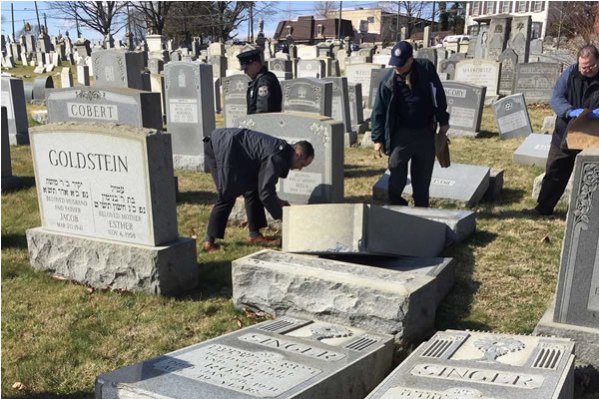
Another Jewish cemetery has been vandalized. According to news reports, some 75-100 headstones were knocked over at the Mount Carmel cemetery in Philadelphia sometime either Saturday night or early Sunday morning.
It is the second vandalization of a Jewish cemetery in a week. The previous one took place at the Chesed Shel Emeth Cemetery, near St. Louis, an incident I reported on in a post several days ago.
“We are horrified by the desecration at Mount Carmel Cemetery,” said Nancy K. Baron-Baer, a regional director for the ADL, in commenting on the latest attack.
Other Jews seem to be equally horrified. The Anne Frank Center, headquartered in New York with an additional office just opened in Los Angeles, issued a statement similarly impassioned–if not more so.
“WE ARE SICKENED, SICKENED, SICKENED,” read read the group’s rather unrestrained outpouring posted on Twitter. “More Jewish gravestones were found vandalized today, this time in Philadelphia.”
Jewish graves in Philadelphia now vandalized. Stop this incubator of #Antisemitism and other hate. WE BEG YOU @POTUS @realDonaldTrump pic.twitter.com/RHuIjdE2Yg
— AnneFrankCenter(US) (@AnneFrankCenter) February 26, 2017
//platform.twitter.com/widgets.js
In its mission statement, the Anne Frank Center “calls out prejudice, counters discrimination and advocates for the kinder and fairer world of which Anne Frank dreamed.”
And as for the ADL, so horrified and sickened are its officials by recent events they have even put up a $10,000 reward for information leading to the arrest and conviction of the vandals.
“This act is cowardly and unconscionable, and is all the more despicable coming on the heels of a similar vandalism at another Jewish cemetery in St. Louis last week,” said Baron-Baer. “We urge anyone with information on this crime to report it immediately to the Philadelphia Police Department at 215-686-TIPS.”
“I’m so upset,” said Millard Braunstein, who went to the cemetery Monday morning and discovered his mother’s headstone is one of those that had been knocked down.”This is such a terrible thing.”
“It’s just very disheartening that such a thing would take place,” said Aaron Mallin, another man with a relative buried in the cemetery.
And a Philadelphia rabbi who has also visited the cemetery and seen the damaged grave sites seems particularly heavy of heart.
“After you start walking from row to row it quickly moves from a random act of vandalism to something with larger intentions and a systematic approach to things,” said Shawn Zevit, the rabbi at the Mishkan Shalom synagogue.
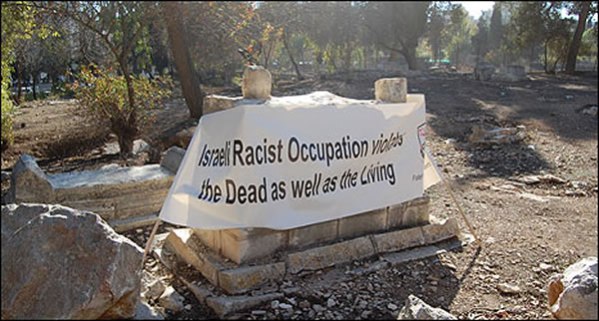
While desecration of a cemetery is a despicable act, one wonders if any of these people bothered to voice their concerns over the desecration and paving under of a Muslim cemetery in Jerusalem. And if Zevit is concerned about the “systematic approach” taken by the vandals in Philadelphia (who damaged a mere 100 graves) he should stop and reflect that it doesn’t even begin to hold a candle to the “systematic approach” taken by the Israelis at the Mamilla Cemetery. Here is a bit from Wikipedia:
Mamilla Cemetery is a historic Muslim cemetery located just to the west of the walls of the Old City of Jerusalem, Israel.[1][2]The cemetery, at the center of which lies the Mamilla Pool, contains the remains of figures from the early Islamic period,[3]several Sufi shrines and Mamluk-era tombs.[1] The cemetery grounds also contain the bodies of thousands of Christians killed in the pre-Islamic era, as well as several tombs from the time of the Crusades.
Its identity as an Islamic cemetery is noted by Arab and Persian writers as early as the 11th century.[4] It was used as a burial site up until 1927 when the Supreme Muslim Council decided to preserve it as a historic site.[1]
Following the 1948 Arab–Israeli War, the cemetery and other waqf properties in West Jerusalem fell under the control of Israeli governmental bodies.[5] A number of buildings, a road and other public facilities, such as a park, a parking lot and public lavatories have since been constructed on the cemetery grounds, destroying grave markers and tombs. A plan to build a Museum of Tolerance on part of the cemetery grounds, announced in 2004, aroused much controversy and faced several stop work orders before being given final approval in July 2011.
The “Musem of Tolerance” mentioned by Wikipedia is a facility the Simon Wiesenthal Center is seeking to build in Jerusalem as a companion to its museum of the same name in Los Angeles. Ironically the Simon Wiesenthal Center is among those now expressing concern over the vandalization of Jewish cemeteries in the US.
“Attacking a cemetery, especially one that is all-Jewish, all-Catholic, or whatever it is, is basically an attack on the culture, the identity of the people that cemetery represents,” Aaron Brietbart, a Simon Wiesenthal researcher, told the Washington Post following the attack on the Jewish cemetery in Missouri.
Compare Brietbart’s remarks to those of another Simon Wiesenthal official, Rabbi Marvin Hier, who insisted to the BBC in 2008 that construction of the Museum of Tolerance–on top of the Mamilla Cemetery–was an appropriate use of “derelict land.”
“Jerusalem is a city built on top of thousands of bones – Jewish and Muslim,” Hier said. “If we declared the whole of Jerusalem one huge cemetery, we’d never be able to build anything.”
The Museum of Tolerance seems to be rather aptly named–since what we are being ordered to show tolerance for in large part is the Simon Wiesenthal Center’s hypocrisy.
You’ll also note–in the tweet above–that the Anne Frank Center demands President Trump “deliver a prime-time nationally televised speech, live from the Oval Office, on how you intend to combat not only #Antisemitism and #Islamophobia and other rising forms of hate.”
All well and good perhaps, but why doesn’t the Anne Frank Center seem concerned about the Islamophobia running rampant in the state of Israel? Surely apartheid, walls, occupation, home demolitions, and cemetery desecrations are not part of the “kinder and fairer world of which Anne Frank dreamed.”
Perhaps instead of delivering a live speech from the Oval Office on anti-Semitism or Islamophobia, Trump should call his advisors together to develop a national strategy for dealing with the Jewish inability to self-reflect.
And finally, one other point before closing: the fact that Muslims in America have raised money to help pay for damage done by vandals at Jewish cemeteries is, in light of attacks upon the Mamilla Cemetery in Jerusalem, ironic to say the least. After the destruction at the cemetery in Missouri, US Muslims rallied with a very successful crowdfunding campaign. Now it seems they are doing it again. Here is what is being reported by CNN:
Once again, dozens of Jewish headstones have been vandalized, stoking fears of heightened anti-Semitism. And once again, members of the Muslim community are rallying to help.
The latest spate of destruction came over the weekend at the Mount Carmel Cemetery in Philadelphia, where 75 to 100 tombstones were toppled over. A week earlier, at least 170 headstones were damaged at a Jewish cemetery in St. Louis.
Muslim activist Tarek El-Messidi, who had started a fund-raising campaign to help clean up the St. Louis cemetery, sprung to action again after the Philadelphia attack.
“I want to ask all Muslims to reach out to your Jewish brothers and sisters and stand together against this bigotry,” he wrote on Facebook.
“Last week, our Muslim community raised money for the vandalized Jewish Cemetery in St Louis. Since we raised well above the goal, we can now use extra funds to help here in Philadelphia.”
As of Tuesday morning, the campaign had raised $138,000 — nearly seven times the original goal of $20,000.
El-Messidi said he immediately visited the Philadelphia Jewish cemetery and offered his support after hearing the news. After all, Muslims can relate to the feeling of racial intolerance.
And here is a little more from the Wikipedia article on Mamilla Cemetery:
At the time of Israel’s assertion of control over West Jerusalem in 1948, the cemetery, which contained thousands of grave markers, came under the administration of the Israeli Custodian of Absentee Property and the Muslim Affairs Department of Israel’s Ministry of Religious Affairs.[1][5][28] By the end of the 1967 war that resulted in the Israeli occupation of East Jerusalem, only a handful of broken grave markers remained standing.[1] A large part of the cemetery was bulldozed and converted into a parking lot in 1964 and a public lavatory was also built on the cemetery grounds.[19][29][30]
In the 1950s, the Ministry of Foreign Affairs, sensitive to how the treatment of waqf properties would be viewed internationally, criticized government policy towards the cemetery.[28] A ministry representative described the vandalism to tombstones, including their use by the guard appointed by the Religious Ministry to build a henhouse beside his shelter in the cemetery, and the destruction of ancient tombs by bulldozers cleaning the Mamilla Pool.[28] Noting the site constituted waqf property and lay within sight of the American Consulate, the ministry said it viewed the situation, which included plans for new roads and the parceling out of portions to private landowners as compensation for other properties confiscated by the state, with deep regret.[28]
Israeli authorities bulldozed several tombs in the cemetery, including some of those identified as Frankish by Clermont-Ganneau, to establish Mamilla Park (or Independence Park) in 1955.[22] Two of the largest and finest tombs survived, though the lid of one was overturned when it moved from its original spot.[22] The other is the Mamluk era funerary chapel known as al-Kebekiyeh (or Zawiya Kubakiyya), now located in the eastern end of Independence Park.[22][23]
Besides Independence Park, other parts of downtown Jerusalem erected on the cemetery grounds include the Experimental School, Agron Street, Beit Agron, and Kikar Hahatulot (Cats’ Square), among others.[18] Government buildings on the cemetery grounds include the main headquarters of the Israeli Ministry of Trade and Industry,[1] and the Customs Department building, which is said to be located on what was once the site of the chapel dedicated to St. Mamilla.[31]
In 1992, the Custodian of Absentee Property sold the cemetery grounds to the Jerusalem Municipality, a sale the Mufti of Jerusalem, Ikrema Sabri, said they had no right to make.[32] The Israeli Electricity Company destroyed more tombs on 15 January 2005 in order to lay some cables.[1]
A major protest against attacks upon the cemetery took place in Jerusalem in 2008. Here is what the BBC reported:
Earlier this week hundreds of Muslims – young and old – marched through the centre of Jerusalem towards the city’s Mamilla cemetery.
Police helicopters flew overhead and security was tight. The focus of the march, and of increasing Muslim anger, was the Israeli Supreme Court decision to sanction a controversial new building on part of the Muslim cemetery.
And finally a bit more from Wikipedia:
On 9 August 2010, 300 Muslim gravestones in the cemetery were bulldozed by the Israel Lands Administration (ILA) in an area US Jewish human rights activists said was very close to the planned site for the Museum of Tolerance.[41][42] A reporter from Agence France Presse witnessed the destruction of 200 graves until the work was briefly suspended while the court heard a stop work petition it rejected, allowing demolitions to continue that same day.[41] The judge later issued an order prohibiting harm to ancient graves and mandating that the ILA coordinate work with the Israel Antiquities Authority and representatives of the Islamic Movement.[42]
The Jerusalem city council issued its first official response in a written statement on 12 August, saying that, “The municipality and the (Israel Lands) Authority destroyed around 300 dummy gravestones which were set up illegally in Independence Park on public land.” It said these “fake” gravestones were not erected over any human remains and were placed in the park in an effort to “illegally take over state land.”[41]
Mahmud Abu Atta, a spokesman for the Al-Aqsa Foundation, denied the city council’s claim that new tombs were added illegally. He said that between 500 and 600 tombs had been renovated in total “with the municipality’s agreement,” that “some of the tombs had to be totally rebuilt,” but that “all the tombs that we built or renovated contain bodies.”[41]
Twenty graves were completely destroyed or had their tombstones removed by vandals in January 2011.[43] On the night of 25–26 June 2011, about 100 gravestones in an intact part of the cemetery were destroyed by Israeli bulldozers.[19][44] Footage filmed by local media and activists appeared on Al Arabiya and Al Jazeera and showed the bulldozers pulling out quickly after realizing they were being filmed; Israeli officials made no comment on the incident.[45]
Later that same year, fifteen gravestones in the cemetery were spray painted red with racist slogans reading “Death to the Arabs”, as well as “price tag” and “Givat Asaf“, the name of an Israeli outpost slated for demolition.

The Mamilla graveyard (shown in the background) as it appeared in 1948
Though the statements from the Anne Frank Center and some of the other Jews quoted in this article are rather amazing, perhaps the Academy Award for hypocrisy goes to an Israeli official by the name of Emmanuel Nahshon. A spokesperson for the Israeli Foreign Ministry, Nahshon tweeted the following in response to the attack on the cemetery in Philadelphia:
#Philadelphia Jewish cemetery desecration is shocking and a source of worry . Full confidence #US authorities catch and punish culprits .
— Emmanuel Nahshon (@EmmanuelNahshon) February 26, 2017
Featured Video

Spain train disaster raises questions over Israeli-linked security contractors
or go to
Aletho News Archives – Video-Images
From the Archives
Are There 50,000 ‘Israeli-born’ Individuals Living in the UK?
By Professor David Miller | August 18, 2026
Recent disclosures by the Zionist regime show that some 2,069 British nationals were serving in the IDF as of March 2025, according to Freedom of Information (FoI) requests submitted to the occupation forces (1,686 dual British-Israeli, plus 383 multinational). We cannot tell from the figures how many of these were already settler colonists and intend to stay in the colony, and how many will return or have returned to the UK. Presumably, those returning to the UK will number far fewer than 2,000, since many are known to have become permanently residents of the colony.
Additionally, the IDF figures only provide a snapshot, and do not tell us how many have served in the Jewish supremacist military either before or after March 2025. One way into the question of how many genocidaires are living in Britain is to ask how many current British residents were born in the Zionist colony. There is data on that, as we shall see. … continue
Blog Roll
 Aletho News
- Zelensky spent over 740 days outside Ukraine while West serves as his real home
- Indian captain of Russian ‘shadow fleet’ tanker faces 10-year jail term in UK
- Europe, US face higher heating bills amid Iran war fallout
- The Leak That Arrived Right on Cue
- No, New York Times, California’s Climate Has Always Been a Land of Flood, Drought, and Fire
- Are There 50,000 ‘Israeli-born’ Individuals Living in the UK?
- German CDU MPs Seek Climate “Misinformation” List
- The ‘Gaza Treatment’: How Media Headlines Obscure Who is Bombing Yemen
- Ro Khanna urges Democrats to strip Israel ‘integration’ provision from defense bill
- Why Iran designated British MI6, Royal Navy, and RAF as hostile, terrorist organizations
- If Americans Knew
- An error has occurred; the feed is probably down. Try again later.
- No Tricks Zone
- German Authorities Start Initiative To Evaluate Public Register For Climate “Disinformation” Spreaders!
- Zonal Asymmetry of Temperature Change in the Antarctic Circumpolar Current
- New Study: The Net Fossil Fuel Contribution To Rising Atmospheric CO2 Has Been Zero For 500 Years
- Germany’s Green Energy Transition Becoming Increasingly Expensive…Another 6 Trillion Euros!
- Sudden Stratospheric Warming, Powerful El Niño Combination May Lead To Extreme Europe Cold, Energy Crisis!
- Two New Studies Find Thwaites Glacier Melt Cannot Be Driven By Human Activity Or A Warming Ocean
- E-Cars Reduce CO2 Emissions By Only 41% Compared To Internal Combustion Engine Vehicles
- Predictions Made By Renowned Climate Professor Over Past Decades Have Been Proven To Be Poor
- New Study Suggests Large Regions Of The Pacific Ocean Have Been Cooling For The Last 80 Years
- Germany’s Green Energy Debacle: High Energy Costs Force Kahla Porzellan to Close After 182 Years!

