US seeking to diminish Iran’s deterrent power: Kaveh Afrasiabi
Press TV – February 4, 2017
The United States has highlighted a recent missile test by Iran and imposed new sanctions against the Islamic Republic. Washington claims the missile test is violating the spirit of a nuclear deal between Iran and the P5+1 group of countries including the US, Britain, France, China, Russia and Germany. Iran ruled out the allegation explaining that the test has nothing to do with the nuclear agreement. According to the nuclear deal, Iran must avoid testing missiles capable of carrying nuclear warheads.
America is worried about Iranian military might because it sees Iran as a regional power whose deterrent might can be a big hurdle in the way of the United States’ hegemonic intervention in the Middle East, said Kaveh Afrasiabi, an author and political scientist.
The US is not genuinely concerned about the Iranian missile being nuclear capable, “their real concern is Iran’s military strength that’s deterrent vis-à-vis America’s intrusive force in the region,” Afrasiabi told Press TV’s Top 5.
The American officials are “doing whatever they can in order to diminish the Iranian power in the region,” he said on Friday night.
Since Tehran is facing a lot of security threats from the United States, Iran has the right to enhance its defensive capabilities to confront any potential American aggression when needed, the analyst argued.
The UN Resolution 2231, which endorses the nuclear deal dubbed the Joint Comprehensive Plan of Action (JCPOA), underlines implementation of obligations of the accord as an international agreement.
Afrasiabi went on to say that “Iran’s missile technology is for deterrent purposes” and there is no evidence to support Americans’ allegations against Iranian missile program.
Russia and other world powers do not believe in what the United States says about Iran’s missiles, because they are aware the Islamic Republic does not have any nuclear weapons program that could be connected to its missile technology, he noted.
The commentator also expressed hope some rational figures among the Trump administration would prevent hawkish American elements from pushing the US into another war in the Middle East.
A Reprise of the Iraq-WMD Fiasco?
By James W Carden | Consortium News | February 3, 2017
The controversy over Russia’s alleged interference in the 2016 presidential election shows no sign of letting up. A bipartisan group of U.S. senators recently introduced legislation that would impose sanctions on Russia in retaliation for its acts of “cyber intrusions.”
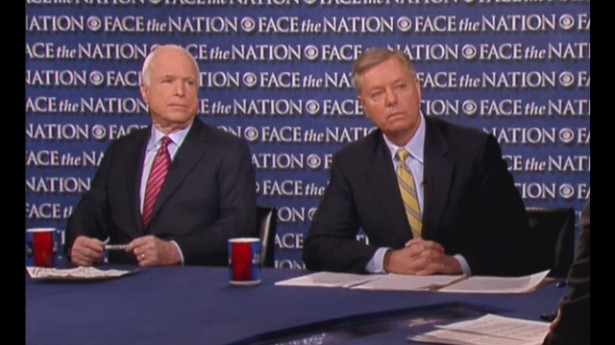
Senators John McCain and Lindsey Graham
At a press event in Washington on Tuesday, Sen. Dick Durbin, D-Illinois, called Election Day 2016 “a day that will live in cyber infamy.” Previously, Sen. John McCain, R-Arizona, called the Russian hacks of the Democratic National Committee “an act of war,” while Sen. Lindsey Graham, R-South Carolina, has claimed that there is near unanimity among senators regarding Russia’s culpability.
Despite all this, the question of who exactly is responsible for the providing WikiLeaks with the emails of high Democratic Party officials does not lend itself to easy answers. And yet, for months, despite the lack of publicly disclosed evidence, the media, like these senators, have been as one: Vladimir Putin’s Russia is responsible.
Interestingly, the same neoconservative/center-left alliance which endorsed George W. Bush’s case for war with Iraq is pretty much the same neoconservative/center-left alliance that is now, all these years later, braying for confrontation with Russia. It’s largely the same cast of characters reading from the Iraq-war era playbook.
It’s worth recalling Tony Judt’s observation in September 2006 that “those centrist voices that bayed most insistently for blood in the prelude to the Iraq war … are today the most confident when asserting their monopoly of insight into world affairs.”
While that was true then, it is perhaps even more so the case today.
The prevailing sentiment of the media establishment during the months prior to the disastrous March 2003 invasion of Iraq was that of certainty: George Tenet’s now infamous assurance to President Bush, that the case against Iraq was a “slam drunk,” was essentially what major newspapers and television news outlets were telling the American people at the time. Iraq posed a threat to “the homeland,” therefore Saddam “must go.”
The Bush administration, in a move equal parts cynical and clever, engaged in what we would today call a “disinformation” campaign against its own citizens by planting false stories abroad, safe in the knowledge that these stories would “bleed over” and be picked up by the American press.
WMD ‘Fake News’
The administration was able to launder what were essentially “fake news” stories, such as the aluminum tubes fabrication, by leaking to Michael R. Gordon and Judith Miller of The New York Times. In September 2002, without an ounce of skepticism, Gordon and Miller regurgitated the claims of unnamed U.S. intelligence officials that Iraq “has sought to buy thousands of specially designed aluminum tubes … intended as components of centrifuges to enrich uranium.” Gordon and Miller faithfully relayed “the intelligence agencies’ unanimous view that the type of tubes that Iraq has been seeking are used to make centrifuges.”
By 2002, no one had any right to be surprised by what Bush and Cheney were up to; since at least 1898 (when the U.S. declared war on Spain under the pretense of the fabricated Hearst battle cry “Remember the Maine!”) American governments have repeatedly lied in order to promote their agenda abroad. And in 2002-3, the media walked in lock step with yet another administration in pushing for an unnecessary and costly war.
Like The New York Times, The Washington Post also relentlessly pushed the administration’s case for war with Iraq. According to the journalist Greg Mitchell, “By the Post’s own admission, in the months before the war, it ran more than 140 stories on its front page promoting the war.” All this, while its editorial page assured readers that the evidence Colin Powell presented to the United Nations on Iraq’s WMD program was “irrefutable.” According to the Post, it would be “hard to imagine” how anyone could doubt the administration’s case.
But the Post was hardly alone in its enthusiasm for Bush’s war. Among the most prominent proponents of the Iraq war was The New Yorker’s Jeffrey Goldberg, who, a full year prior to the invasion, set out to link Saddam Hussein and Al Qaeda. Writing for The New Yorker in March 2002, Goldberg retailed former CIA Director James Woolsey’s opinion that “It would be a real shame if the C.I.A.’s substantial institutional hostility to Iraqi democratic resistance groups was keeping it from learning about Saddam’s ties to Al Qaeda in northern Iraq.”
Indeed, according to Goldberg, “The possibility that Saddam could supply weapons of mass destruction to anti-American terror groups is a powerful argument among advocates of regime change,” while Saddam’s “record of support for terrorist organizations, and the cruelty of his regime make him a threat that reaches far beyond the citizens of Iraq.”
Writing in Slate in October 2002, Goldberg was of the opinion that “In five years . . . I believe that the coming invasion of Iraq will be remembered as an act of profound morality.”
Likewise, The New Republic’s Andrew Sullivan was certain that “we would find weapons of mass destruction in Iraq. I have no doubt about that.” Slate’s Jacob Weisberg supported the invasion because he thought Saddam Hussein had WMD and he “thought there was a strong chance he’d use them against the United States.”
Even after it was becoming clear that the war was a debacle, the neoconservative pundit Charles Krauthammer declared that the inability to find WMDs was “troubling” but “only because it means that the weapons remain unaccounted for and might be in the wrong hands. The idea that our inability to thus far find the weapons proves that the threat was phony and hyped is simply false.”
Smearing Skeptics
Opponents of the war were regularly accused of unpatriotic disloyalty. Writing in National Review, the neoconservative writer David Frum accused anti-intervention conservatives of going “far, far beyond the advocacy of alternative strategies.” According to Frum, “They deny and excuse terror. They espouse a potentially self-fulfilling defeatism. They publicize wild conspiracy theories. And some of them explicitly yearn for the victory of their nation’s enemies.”
Similarly, The New Republic’s Jonathan Chait castigated anti-war liberals for turning against Bush. “Have Bush haters lost their minds?” asked Chait. “Certainly some have. Antipathy to Bush has, for example, led many liberals not only to believe the costs of the Iraq war outweigh the benefits but to refuse to acknowledge any benefits at all.”
Yet of course we now know, thanks, in part, to a new book by former CIA analyst John Nixon, that everything the U.S. government thought it knew about Saddam Hussein was indeed wrong. Nixon, the CIA analyst who interrogated Hussein after his capture in December 2003, asks “Was Saddam worth removing from power?” “The answer,” says Nixon, “must be no. Saddam was busy writing novels in 2003. He was no longer running the government.”
It turns out that the skeptics were correct after all. And so the principal lesson the promoters of Bush and Cheney’s war of choice should have learned is that blind certainty is the enemy of fair inquiry and nuance. The hubris that many in the mainstream media displayed in marginalizing liberal and conservative anti-war voices was to come back to haunt them. But not, alas, for too long.
A Dangerous Replay?
Today something eerily similar to the pre-war debate over Iraq is taking place regarding the allegations of Russian interference in the U.S. presidential election. Assurances from the intelligence community and from anonymous Obama administration “senior officials” about the existence of evidence is being treated as, well, actual evidence.
State Department spokesman John Kirby told CNN that he is “100% certain” of the role that Russia played in U.S. election. The administration’s expressions of certainty are then uncritically echoed by the mainstream media. Skeptics are likewise written off, slandered as “Kremlin cheerleaders” or worse.
Unsurprisingly, The Washington Post is reviving its Bush-era role as principal publicist for the government’s case. Yet in its haste to do the government’s bidding, the Post has published two widely debunked stories relating to Russia (one on the scourge of Russian inspired “fake news”, the other on a non-existent Russian hack of a Vermont electric utility) onto which the paper has had to append “editor’s notes” to correct the original stories.
Yet, those misguided stories have not deterred the Post’s opinion page from being equally aggressive in its depiction of Russian malfeasance. In late December, the Post published an op-ed by Rep. Adam Schiff and former Rep. Jane Harmon claiming “Russia’s theft and strategic leaking of emails and documents from the Democratic Party and other officials present a challenge to the U.S. political system unlike anything we’ve experienced.”
On Dec. 30, the Post editorial board chastised President-elect Trump for seeming to dismiss “a brazen and unprecedented attempt by a hostile power to covertly sway the outcome of a U.S. presidential election.” The Post described Russia’s actions as a “cyber-Pearl Harbor.”
On Jan. 1, the neoconservative columnist Josh Rogin told readers that the recent announcement of sanctions against Russia “brought home a shocking realization that Russia is using hybrid warfare in an aggressive attempt to disrupt and undermine our democracy.”
Meanwhile, many of the same voices who were among the loudest cheerleaders for the war in Iraq have also been reprising their Bush-era roles in vouching for the solidity of the government’s case.
Jonathan Chait, now a columnist for New York magazine, is clearly convinced by what the government has thus far provided. “That Russia wanted Trump to win has been obvious for months,” writes Chait.
“Of course it all came from the Russians, I’m sure it’s all there in the intel,” Charles Krauthammer told Fox News on Jan. 2. Krauthammer is certain.
And Andrew Sullivan is certain as to the motive. “Trump and Putin’s bromance,” Sullivan told MSNBC’s Chris Matthews on Jan. 2, “has one goal this year: to destroy the European Union and to undermine democracy in Western Europe.”
David Frum, writing in The Atlantic, believes Trump “owes his office in considerable part to illegal clandestine activities in his favor conducted by a hostile, foreign spy service.”
Jacob Weisberg agrees, tweeting: “Russian covert action threw the election to Donald Trump. It’s that simple.” Back in 2008, Weisberg wrote that “the first thing I hope I’ve learned from this experience of being wrong about Iraq is to be less trusting of expert opinion and received wisdom.” So much for that.
Foreign Special Interests
Another, equally remarkable similarity to the period of 2002-3 is the role foreign lobbyists have played in helping to whip up a war fever. As readers will no doubt recall, Ahmed Chalabi, leader of the Iraqi National Congress, which served, in effect as an Iraqi government-in-exile, worked hand in hand with the Washington lobbying firm Black, Kelly, Scruggs & Healey (BKSH) to sell Bush’s war on television and on the op-ed pages of major American newspapers.
Chalabi was also a trusted source of Judy Miller of the Times, which, in an apology to its readers on May 26, 2004, wrote: “The most prominent of the anti-Saddam campaigners, Ahmad Chalabi, has been named as an occasional source in Times articles since at least 1991, and has introduced reporters to other exiles. He became a favorite of hard-liners within the Bush administration and a paid broker of information from Iraqi exiles.” The pro-war lobbying of the American Israel Public Affairs Committee has also been exhaustively documented.
Though we do not know how widespread the practice has been as of yet, something similar is taking place today. Articles calling for confrontation with Russia over its alleged “hybrid war” with the West are appearing with increasing regularity. Perhaps the most egregious example of this newly popular genre appeared on Jan. 1 in Politico magazine. That essay, which claims, among many other things, that “we’re in a war” with Russia comes courtesy of one Molly McKew.
McKew is seemingly qualified to make such a pronouncement because she, according to her bio on the Politico website, served as an “adviser to Georgian President Saakashvili’s government from 2009-2013, and to former Moldovan Prime Minister Filat in 2014-2015.” Seems reasonable enough. That is until one discovers that McKew is actually registered with the Department of Justice as a lobbyist for two anti-Russian political parties, Georgia’s UMN and Moldova’s PLDM.
Records show her work for the consulting firm Fianna Strategies frequently takes her to Capitol Hill to lobby U.S. Senate and Congressional staffers, as well as prominent U.S. journalists at The Washington Post and The New York Times, on behalf of her Georgian and Moldovan clients.
“The truth,” writes McKew, “is that fighting a new Cold War would be in America’s interest. Russia teaches us a very important lesson: losing an ideological war without a fight will ruin you as a nation. The fight is the American way.” Or, put another way: the truth is that fighting a new Cold War would be in McKew’s interest – but perhaps not America’s.
While you wouldn’t know it from the media coverage (or from reading deeply disingenuous pieces like McKew’s) as things now stand, the case against Russia is far from certain. New developments are emerging almost daily. One of the latest is a report from the cyber-engineering company Wordfence, which concluded that “The IP addresses that DHS [Department of Homeland Security] provided may have been used for an attack by a state actor like Russia. But they don’t appear to provide any association with Russia.”
Indeed, according to Wordfence, “The malware sample is old, widely used and appears to be Ukrainian. It has no apparent relationship with Russian intelligence and it would be an indicator of compromise for any website.”
On Jan. 4, BuzzFeed reported that, according to the DNC, the FBI never carried out a forensic examination on the email servers that were allegedly hacked by the Russian government. “The FBI,” said DNC spokesman Eric Walker, “never requested access to the DNC’s computer servers.”
What the agency did do was rely on the findings of a private-sector, third-party vendor that was brought in by the DNC after the initial hack was discovered. In May, the company, Crowdstrike, determined that the hack was the work of the Russians. As one unnamed intelligence official told BuzzFeed, “CrowdStrike is pretty good. There’s no reason to believe that anything that they have concluded is not accurate.”
Perhaps not. Yet Crowdstrike is hardly a disinterested party when it comes to Russia. Crowdstrike’s founder and chief technology officer, Dmitri Alperovitch, is also a senior fellow at the Washington think tank, The Atlantic Council, which has been at the forefront of escalating tensions with Russia.
As I reported in The Nation in early January, the connection between Alperovitch and the Atlantic Council is highly relevant given that the Atlantic Council is funded in part by the State Department, NATO, the governments of Latvia and Lithuania, the Ukrainian World Congress, and the Ukrainian oligarch Victor Pinchuk. In recent years, it has emerged as a leading voice calling for a new Cold War with Russia.
Time to Rethink the ‘Group Think’
And given the rather thin nature of the declassified evidence provided by the Obama administration, might it be time to consider an alternative theory of the case? William Binney, a 36-year veteran of the National Security Agency and the man responsible for creating many of its collection systems, thinks so. Binney believes that the DNC emails were leaked, not hacked, writing that “it is puzzling why NSA cannot produce hard evidence implicating the Russian government and WikiLeaks. Unless we are dealing with a leak from an insider, not a hack.”
None of this is to say, of course, that Russia did not and could not have attempted to influence the U.S. presidential election. The intelligence community may have intercepted damning evidence of the Russian government’s culpability. The government’s hesitation to provide the public with more convincing evidence may stem from an understandable and wholly appropriate desire to protect the intelligence community’s sources and methods. But as it now stands the publicly available evidence is open to question.
But meanwhile the steady drumbeat of “blame Russia” is having an effect. According to a recent you.gov/Economist poll, 58 percent of Americans view Russia as “unfriendly/enemy” while also finding that 52 percent of Democrats believed Russia “tampered with vote tallies.”
With Congress back in session, Armed Services Committee chairman John McCain is set to hold a series of hearings focusing on Russian malfeasance, and the steady drip-drip-drip of allegations regarding Trump and Putin is only serving to box in the new President when it comes to pursuing a much-needed detente with Russia.
It also does not appear that a congressional inquiry will start from scratch and critically examine the evidence. On Friday, two senators – Republican Lindsey Graham and Democrat Sheldon Whitehouse – announced a Senate Judiciary subcommittee investigation into Russian interference in elections in the U.S. and elsewhere. But they already seemed to have made up their minds about the conclusion: “Our goal is simple,” the senators said in a joint statement “To the fullest extent possible we want to shine a light on Russian activities to undermine democracy.”
So, before the next round of Cold War posturing commences, now might be the time to stop, take a deep breath and ask: Could the rush into a new Cold War with Russia be as disastrous and consequential – if not more so – as was the rush to war with Iraq nearly 15 years ago? We may, unfortunately, find out.
James W Carden is a contributing writer for The Nation and editor of The American Committee for East-West Accord’s eastwestaccord.com. He previously served as an advisor on Russia to the Special Representative for Global Inter-governmental Affairs at the US State Department.
Zionist Regime Plays down White House Comments on Settlements
Al-Manar – February 3, 2017
A senior Israeli official played down Friday remarks from the White House that building new or expanding existing settlements in the occupied Palestinian territories “may not be helpful” in securing peace.
In an apparent break from President Donald Trump’s previously full-throated support of settlements building, White House spokesman Sean Spicer told reporters on Thursday that the new administration hadn’t yet taken an official position on settlements.
Responding Friday, Israeli ambassador to the United Nations Danny Danon said Spicer’s comments didn’t amount to “a U-turn”.
“The statement is very clear and essentially means: wait for the meeting with (Israeli) Prime Minister (Benjamin) Netanyahu, who is arriving in Washington in less than two weeks to meet President Trump, and then we’ll determine our policy,” Danon told Israeli public radio.
The Zionist entity has now approved more than 6,000 settler units since Trump took office having signaled a softer stance on settlement construction than predecessor Barack Obama.
“While we don’t believe the existence of settlements is an impediment to peace, the construction of new settlements or the expansion of existing settlements beyond their current borders may not be helpful,” Spicer said on Thursday.
Trump is scheduled to welcome Netanyahu to the White House on February 15.
US senators seek additional sanctions against Iran
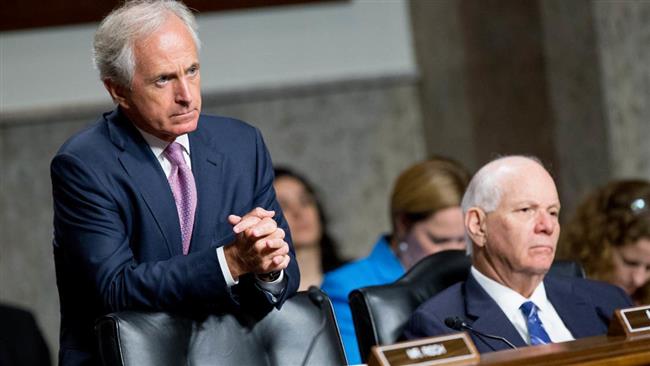
US Republican Senator Bob Corker (left) and Democratic Senator Ben Cardin in the US Senate (file photo)
Press TV – February 3, 2017
A number of US senators have backed additional sanctions against Iran over the country’s missile program, arguing that Tehran “must feel sufficient pressure.”
Twenty-two senators, including Bob Corker (Republican from Tennessee) and Ben Cardin (senior Democrat from Maryland) pronounced their support in a letter they sent to US President Donald Trump on Thursday. Corker is the chairman of the US Senate Committee on Foreign Relations.
“Full enforcement of existing sanctions and the imposition of additional sanctions on Iran for its ballistic missile program are necessary,” the senators wrote.
They added that “we look forward to supporting your Administration’s efforts to hold Iran accountable.”
The Reuters news agency reported on Thursday that the Trump administration is expected to announce new sanctions against Iran on Friday to ratchet up pressure on the Islamic Republic.
This is while the US president said on Thursday that “nothing is off the table” in terms of a response to Iran’s latest ballistic missile test.
Hours earlier, Trump said the White House has formally put Tehran on notice over its recent ballistic missile test.
“Iran has been formally PUT ON NOTICE for firing a ballistic missile. Should have been thankful for the terrible deal the U.S. made with them!” Trump tweeted, echoing his national security adviser’s comments a day earlier.
‘Iran Non-Nuclear Sanctions Act of 2017’
Also on Thursday, a group of Republicans in the US House of Representatives introduced a bill for new sanctions on Iran as the Trump administration is mulling anti-Iran measures.
The measure, called the Iran Non-Nuclear Sanctions Act of 2017, seeks sanctions against Tehran for “supporting terrorism, abusing human rights, and testing ballistic missiles.”
It was presented by New York Representative Lee Zeldin, Illinois Representative Peter Roskam, New Jersey Representative Leonard Lance and Colorado Representative Doug Lamborn.
The proposed legislation comes after US House Speaker Paul Ryan said he would support imposing additional sanctions on Iran over its recent missile test.
“I would be in favor of additional sanctions on Iran,” Ryan told reporters on Thursday at a weekly press conference.
“We need to have a tough-on-Iran policy … We should stop appeasing Iran,” he said.
Washington has said Sunday’s ballistic missile test was in violation of the 2015 nuclear deal between Iran and the P5+1 group of countries.
Tehran insists its missile tests do not breach any UN resolution because they are solely for defense purposes and not designed to carry nuclear warheads.
Arms control experts have also said that Iran’s missile tests are not banned under the nuclear agreement and the Security Council resolution, because Iran’s missiles are not meant to deliver nuclear warheads.
Resolution 2231 calls on Iran “not to undertake any activity related to ballistic missiles designed to be capable of delivering nuclear weapons, including launches using such ballistic missile technology.”
Iran sanctions: US Treasury lists 13 individuals, 12 business entities
RT | February 3, 2017
The US government has blacklisted 13 individuals and a dozen businesses under the Iran sanctions authority, a day after President Donald Trump’s administration threatened a response over Tehran’s ballistic missile tests.
The Treasury Department posted a listing on Friday, naming the individuals and the companies added to the sanctions list. Eight of the individuals are listed as Iranian citizens, three appear to be Chinese, and two Arab.
Most of the businesses listed in the announcement are based in Iran, though one of the entities is located in the United Arab Emirates, two are in China, and three are in Lebanon.
“Today’s action is part of Treasury’s ongoing efforts to counter Iranian malign activity abroad,” said John E. Smith, acting director of the Treasury Department’s Office of Foreign Assets Control.
“Iran’s continued support for terrorism and development of its ballistic missile program poses a threat to the region, to our partners worldwide, and to the United States,” Smith said. “We will continue to actively apply all available tools, including financial sanctions, to address this behavior.”
Meanwhile, the guided missile destroyer USS Cole arrived in the waters off the coast of Yemen on Friday, where it will conduct patrols to “protect waterways” from the Houthi rebels, unnamed US officials told reporters.
“Iran is unmoved by threats as we derive security from our people,” Iran’s foreign minister Mohammad Javad Zarif said ahead of the announcement. “We will never use our weapons against anyone, except in self-defense,” he added later.
The New Trump Administration – a New Strategy or a New Paradigm? The View from Russia – 1
By Dmitry MININ | Strategic Culture Foundation | 02.02.2017
The first moves by the new US president, Donald Trump, have demonstrated that he is taking his campaign promises seriously and is working to fundamentally restructure the American economic system.
Changes that were seen immediately after Trump’s inauguration: the official White House website deleted its pages that formerly proclaimed support for sexual minorities and the fight against climate change, instead reaffirming its commitment to the goals of energy independence, increased economic growth, and bringing jobs back to the US.
An executive order was signed to withdraw from the Trans-Pacific Economic Partnership. This presidential decision received the immediate and unqualified support of the biggest American labor unions – the AFL-CIO and the Teamsters – once considered Democratic strongholds and which had previously been wary of Trump. Geopolitics is giving way to geoeconomics.
On Jan. 24 Trump met with the heads of the three largest US automakers: General Motors; Ford; and Fiat Chrysler, urging them to expand production in the US rather than abroad. He warned that he would attempt to introduce a 35% import tariff on any company that moved its manufacturing overseas and then imported its products back into the US. But if they agreed to his demands, he promised «big league» regulatory and tax relief in order to give American companies an incentive not to move their plants abroad.
All of these actions are evidence of Trump’s determination to limit the expansion of the virtual economy and to begin the country’s reindustrialization. The transformations he has envisioned are so sweeping that it is more fitting to speak of a whole new stage of technological evolution, rather than merely a new approach. It appears that herein lies the root causes of the fierce resistance to Trump found among the ranks of the «global elite».
It would be an oversimplification to think that the new president is bent on taking America backward. His logic is the logic of a new industrialism, in which material production retains its innovative features, but produces tangible, rather than virtual assets. It is, in any case, a move away from a «bubble economy». According to Trump, the economy of a powerful country like the US should be deeply diversified, not one-dimensional as it has become.
There is currently quite a popular school of thought that claims that our society is at a particular stage of technological evolution (some consider this the «third», while others – the «fifth»), which is based on the development of digital technology. A transition to the next phase should be in the offing, which will be dominated by nano- and biotechnology. And the first to make the transition wins. The US has structured its development since the 1970s in accordance with this linear blueprint. It seemed attractive to focus on the high value-added information business, relegating dirty and labor-intensive manufacturing to other countries. The prevailing view – supported by the ideology of globalism – held that since IT-technology originated in the US, Americans would always call the shots.
This self-confidence has undermined the economic foundations of US power. The rest of the human race has risen to meet the Americans’ challenge successfully. A plurality of economic «poles» is appropriate for a politically multipolar world, but the fact that other economic «power centers» are banking on building more multifaceted economic systems is even more important.
Many years ago the US lost its position as a world leader in the production of material goods, and it survives mainly as a broker of financial and technological services, and also thanks to its virtual economy. Manufacturing and agriculture make up only 20% of US GDP – approximately $3.6 trillion out of $18 trillion. In China, those sectors are responsible for half of GDP, or $5.5 trillion out of $11 trillion. In this respect, the Chinese are already seriously outpacing the Americans – and that is according to the current exchange rate, without adjusting to take into account purchasing power parity, which would show that China is even further ahead of the US.
Liberal economists will say that in today’s economy, national wealth depends not so much on material output as on the development of the tertiary sector – the provision of services to final consumers or to other businesses, as well as the securing of patents, standards, etc. And this is true when speaking of the prosperity of the general public, but sovereign power is predicated upon quantities of material goods. And that low output affects, for example, export figures, and consequently – a nation’s ability to maintain an economic presence in the world. America’s total foreign-trade numbers now lag behind those of China, but even those indices are mainly based on imports – when it comes to exports the US is not even in second place. The EU exported $2.26 trillion worth of goods in 2014 (excluding intra-EU trade), China (in 2016) – $2.02 trillion (plus exports to Hong Kong – $0.49 trillion), and the US – $1.47 trillion. The global leader, which is only the third-largest exporter, is condemned to rely on military force to preserve its status, which is in turn detrimental to its ability to remain competitive.
There was an assumption that the decline in material production would be offset by the IT sector, but that is not happening. The Chinese company Lenovo became the global leader in PC sales in 2012, overtaking its biggest rival – America’s Hewlett-Packard. And in 2014, Lenovo took top honors for its sales of laptops as well. The world’s largest manufacturer of telecommunications equipment is also a Chinese company – Huawei, beating out the international giant Ericsson in 2012. And India is on its way to dominating the global software industry.
The emphasis on the virtual economy has also had unforeseen political consequences. For example, the concept of «soft power» is widely believed to be able to offset certain weakened or absent elements of a state’s traditional economic power. But conversely, the enthusiasm for «soft power» has evolved into an ideologization of foreign policy, replacing standard diplomatic tools with ubiquitous manipulation. As a result, US foreign policy is now faced with an even larger number of problems and conflicts. Paradoxically, despite its proclaimed «softness», Washington has increasingly been forced to resort to «hard» interventions abroad in order to maintain its global hegemony.
Trump’s answer to this appears quite reasonable. A country that is fully developed does not need additional proof of its power in the form of interventions. The rest of the world will recognize its real power and always take that into account. As international politics become less ideological, they will also become less prone to conflict.
But it is still too early to judge whether Trump is up to this task. Given the global dissemination of information technologies, it would hardly be possible, for example, to completely «reverse» financial globalization. Trump’s America needs partners, but they should not be chosen with the idea of «teaming up against someone», but with the goal of «teaming up for the sake of something». And there can be no question that Russia has its own interests and its own niche in that.
See also:
Trump Administration’s Policy on Ukraine?
By Stephen Lendman | February 3, 2017
It’s not encouraging based on Nikki Haley’s Thursday UN Security Council remarks – sounding like neocon Samantha Power never left.
Her maiden voyage appearance as US envoy outrageously “condemn(ed) Russian actions” in Ukraine – ignoring flagrant Kiev aggression, including willful shelling of Donetsk civilian areas.
“The United States stands with the people of Ukraine, who have suffered for nearly three years under Russian occupation and military intervention,” Haley ranted.
“Until Russia and the separatists (sic) it supports respect Ukraine’s sovereignty and territorial integrity, this crisis will continue.”
Shocking stuff! Haley speaks for Trump. Her disgraceful misrepresentation of hard facts didn’t go down well in Moscow.
Russia’s lower house State Duma International Affairs Committee chairman Alexey Pushkov blasted her, saying “(i)t looks like the new US representative at the UN came with remarks…written by (Samantha) Power.”
“How can Russia be blamed when (Ukrainian forces) are firing at Donbass?” Moscow’s UN envoy Vitaly Churkin condemned Kiev’s escalation, saying its regime “desperately, frantically” needs money so it provoked conflict to “swindle (it from) the European Union, certain European countries and from the United States and from international financial institutions by pretending to be the victims of aggression.”
He accused Kiev of trying to use the armed clashes that it provoked as a pretext for a complete rejection of the February 12, 2015” Minsk II agreement.
He called for deescalation “to prevent disaster and to return the situation to the political track (so) the situation in (Donbass won’t) develop (into a) worse-case scenario.”
Kiev’s UN ambassador Volodymyr Yelchenko turned truth on its head blaming “the Russian army and Russian-backed separatists (sic)” of starting the latest escalation.
Militantly anti-Russia European Council president Donald Tusk issued a statement, saying “we are reminded again of the continued challenge from Russia’s aggression in eastern Ukraine.”
In her remarks, Haley continued her anti-Russia rant, saying “Eastern Ukraine… is not the only part of the country suffering because of Russia’s aggressive actions.”
“The United States continues to condemn and call for an immediate end to the Russian occupation of Crimea. Crimea is a part of Ukraine. Our Crimea-related sanctions will remain in place until Russia returns control over the peninsula to Ukraine.”
Fact: Crimeans voted overwhelmingly to return to Russia, wanting no part of Kiev’s putschist regime. Putin accommodated them. The Republic of Crimea is Russia’s Southern Federal District. That won’t change!
Fact: Haley’s remarks suggest improving Russia/US ties won’t come easily at best, perhaps wishful thinking at worst.
Fact: Donbass freedom fighters decisively smashed Kiev’s earlier aggression, while its forces resort to shelling alone so far this time around.
They can’t win militarily. Aggression was launched for political and economic reasons. The regime wrecked the country. It’s a financial deadbeat, in default on its debt, unable to function without foreign aid.
Conditions are deplorable. Waging war on Donbass distracts attention from state-inflicted misery. How long it can work is uncertain.
In 2004 and 2014, US-instigated color revolutions replaced sitting governments with illegitimate pro-Western puppet regimes.
Will another uprising follow, this time internally generated, replacing US-installed putschists with leadership looking east, not west? It’s unlikely soon, maybe longer-term.
Stephen Lendman can be reached at lendmanstephen@sbcglobal.net. His new book as editor and contributor is titled Flashpoint in Ukraine: How the US Drive for Hegemony Risks WW III.
Gareth Porter: Trump may continue Obama legacy of supporting Saudi war against Yemen
RT | February 2, 2017
We have witnessed big payoffs to the Pentagon in the form of the ability to sell arms to the Saudis – at least to $200 billion estimated over two decades – to American arms makers, Gareth Porter, investigative journalist, told RT.
US House Democrat leader Nancy Pelosi lashed out at the Trump administration’s handling of the conflict in Yemen on CNN, after a Yemeni refugee in one of the programs told the tragic story of her family.
Pelosi said that girl’s family is suffering because the US president “is reckless and his administration is incompetent.”
However, Pelosi failed to acknowledge the Obama administration’s own contribution to the humanitarian disaster unfolding in Yemen due to arms contracts and other forms of cooperation with Riyadh.
RT: Why did US Democrat leader Nancy Pelosi focus on Trump’s travel ban and not the real reasons for the suffering of the girl’s family?
Gareth Porter: Well, Nancy Pelosi is the Democratic leader in the House, the minority leader in the House of Representatives. She is going to support the partisan position on this question of policy toward Yemen, which means that she’s going to be unwilling to acknowledge the responsibility of the Obama administration for the war that has afflicted the population of Yemen, and is now a humanitarian catastrophe, as far as I know, the worst in the world, or at least in that part of the Middle East.
It seems to be much more serious than the crisis in Syria in terms of the actual danger to millions of people; in terms of their access to food. Therefore, we have a situation where there is a great deal of famine already or, at least close to famine-like conditions in Yemen, because of the bombing carried out by the US ally, Saudi Arabia.
RT: In December, just a month before Obama left office, his administration decided to limit military support to Saudi Arabia on concern over civilian casualties. What do you make of the timing of that decision?
GP: Well, I think the point about that decision by the Obama administration is that it was far too little, far too late. It was merely a reduction in US support for the war that is direct support by the US personnel taking part in the assistance to the Saudis in Riyadh. It did not end the really crucial aspects of the Obama administration’s assistance to the Saudis and their allies, which was primarily to provide the refueling for the planes that have carried out the air attacks, which have so completely destroyed the society in large parts of Yemen – in more than half of Yemen. This is the crucial issue, which the Obama administration has never been willing to deal with in terms of its complicity with the war crimes of the Saudi government and its allies.
In addition to that, after months of this bombing which Amnesty International regards as filled with war crimes, because of the deliberate targeting of cities that were regarded as supportive of the Houthis, the US then renewed the agreement to provide bombs to the Saudi government for carrying out this war. So it was in effect a sort of public support for the Saudi war. The US still remains completely complicit in this war…
RT: Critics are branding the US approach to Yemen, one of ‘cautious approval,’ on the one hand, keep supplying the Saudis with arms, on the other staying silent on the country’s growing humanitarian catastrophe. What’s your take on that approach?
GP: Well, my take is that what is happening here – the Obama administration has been essentially tied to the Saudi interests in Yemen, as they have been in Syria to a great extent of the past by the degree to which the permanent government in the US – the Pentagon, the CIA, the NSA – all have very, very close relations with their counterparts in Saudi Arabia. Arrangements which have provided big payoffs to the Pentagon and these other agencies in the form of the ability to sell arms to the Saudis – at least to $200 billion estimated over two decades – to American arms makers, and the contracts with the Saudis to provide intelligence services by the CIA and NSA, which are very lucrative for those agencies.
So these war powers in the US are very unwilling to have any US policy that would criticize, much less take away, support for the Saudi war so that these arrangements can continue. I am very much afraid that the Trump administration will be subject to the same logic, the same political forces that have kept the Obama administration from taking any responsibility for what is going on in Yemen.
Featured Video

Spain train disaster raises questions over Israeli-linked security contractors
or go to
Aletho News Archives – Video-Images
From the Archives
Are There 50,000 ‘Israeli-born’ Individuals Living in the UK?
By Professor David Miller | August 18, 2026
Recent disclosures by the Zionist regime show that some 2,069 British nationals were serving in the IDF as of March 2025, according to Freedom of Information (FoI) requests submitted to the occupation forces (1,686 dual British-Israeli, plus 383 multinational). We cannot tell from the figures how many of these were already settler colonists and intend to stay in the colony, and how many will return or have returned to the UK. Presumably, those returning to the UK will number far fewer than 2,000, since many are known to have become permanently residents of the colony.
Additionally, the IDF figures only provide a snapshot, and do not tell us how many have served in the Jewish supremacist military either before or after March 2025. One way into the question of how many genocidaires are living in Britain is to ask how many current British residents were born in the Zionist colony. There is data on that, as we shall see. … continue
Blog Roll
 Aletho News
- US-Israeli war on Iran cost Persian Gulf states nearly $1T in damage, lost growth: Report
- Congress probe could put ‘Israel’ in dock over Iran war: Israeli media
- Spanish public prosecutor backs US demand to extradite pro-Palestine philanthropist Fergie Chambers
- Zelensky spent over 740 days outside Ukraine while West serves as his real home
- Indian captain of Russian ‘shadow fleet’ tanker faces 10-year jail term in UK
- Europe, US face higher heating bills amid Iran war fallout
- The Leak That Arrived Right on Cue
- No, New York Times, California’s Climate Has Always Been a Land of Flood, Drought, and Fire
- Are There 50,000 ‘Israeli-born’ Individuals Living in the UK?
- German CDU MPs Seek Climate “Misinformation” List
- If Americans Knew
- An error has occurred; the feed is probably down. Try again later.
- No Tricks Zone
- German Authorities Start Initiative To Evaluate Public Register For Climate “Disinformation” Spreaders!
- Zonal Asymmetry of Temperature Change in the Antarctic Circumpolar Current
- New Study: The Net Fossil Fuel Contribution To Rising Atmospheric CO2 Has Been Zero For 500 Years
- Germany’s Green Energy Transition Becoming Increasingly Expensive…Another 6 Trillion Euros!
- Sudden Stratospheric Warming, Powerful El Niño Combination May Lead To Extreme Europe Cold, Energy Crisis!
- Two New Studies Find Thwaites Glacier Melt Cannot Be Driven By Human Activity Or A Warming Ocean
- E-Cars Reduce CO2 Emissions By Only 41% Compared To Internal Combustion Engine Vehicles
- Predictions Made By Renowned Climate Professor Over Past Decades Have Been Proven To Be Poor
- New Study Suggests Large Regions Of The Pacific Ocean Have Been Cooling For The Last 80 Years
- Germany’s Green Energy Debacle: High Energy Costs Force Kahla Porzellan to Close After 182 Years!

