US evaluating nuclear attack on Russia, China

This file photo shows LGM-30 Minuteman nuclear missile being test fired from Vandenberg Air Force Base, California.
Press TV – January 31, 2017
US intelligence agencies are working with the country’s military forces to update previous assessments about a possible nuclear attack against Russia and China.
Conducted by the Pentagon’s Strategic Command and the Office of the Director of National Intelligence, the study is trying to find out whether the Russian and Chinese leadership could survive a nuclear strike and keep operating, Stars and Stripes reported on Monday.
Championed by Republican Representative Michael Turner, the study drew bipartisan support in Congress and was passed before the inauguration of US President Donald Trump, who has expressed willingness to reshape ties with both China and Russia.
The findings of the study, which was one of the little-noticed provisions of the 2017 Pentagon budget, would provide a complete evaluation of Moscow and Beijing’s “leadership survivability, command and control and continuity of government programs” in case of an attack.

A US Air B-52 Stratofortress nuclear-capable bomber
The information is critical for the US Strategic Command, which is tasked with planning and carrying out such strikes.
The study is also aimed at finding “the location and description of above and underground facilities important to the political and military” leadership and the facilities that they use “to operate out of during crisis and wartime.”
Navy Captain Brook DeWalt, a spokesman for the Strategic Command, confirmed that the study was ongoing but said it was “premature” to release any details.
Trump says he would expand ties with Moscow and might even lift US sanctions against Russia if the country agrees to dramatically cut the size of its nuclear arsenal.
This is while the Republican head of state has also shown great interest in “rebuilding” the US military and upgrading the country’s vast nuclear arsenal.
“The United States must greatly strengthen and expand its nuclear capability until such time as the world comes to its senses regarding nukes,” he said in a tweet in December.
Unlike with Russia, the Trump administration has spared no effort in attacking China over a range of issues.
After talking to Taiwanese leaders and undermining the “One China” policy, the Trump administration further angered China by pledging to stop its “island-building” in the South China Sea.
The claim stirred much outrage, to the point that Chinese media said the only way Washington could achieve that objective was through war.
Washington has been planning a reported modernization of its nuclear weapons which is expected to cost hundreds of billions of dollars over 30 years.
Go figure: Soros-funded watchdog says populist politicians ‘undermine fight against corruption’
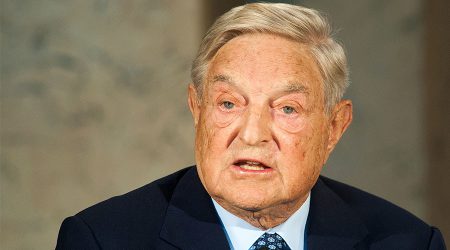
George Soros Image © Maurizio Gambarini / http://www.globallookpress.com
By Robert Bridge | RT | January 30, 2017
With the EU elite threatened by a populist insurgency aiming to end free and easy immigration programs and promote nationalism over globalism, an influential think tank says populism will only – wait for it – fuel the fires of corruption.
Transparency International, a Berlin-based anti-graft group, warned in its annual Corruption Perceptions Index about the purported perils of populism, a political animal that on occasion rolls through nations like a force of nature to contend with the excesses of an out-of-touch, elitist minority.
“Populism is the wrong medicine,” stated TI chair Jose Ugaz, without offering any alternative prescriptions. “In countries with populist or autocratic leaders, we often see democracies in decline and a disturbing pattern of attempts to crack down on civil society, limit press freedom, and weaken the independence of the judiciary.”
“Instead of tackling crony capitalism, those leaders usually install even worse forms of corrupt systems,” Ugaz continued.
With regards to corruption, the watchdog attempts mind-reading by asserting that populist politicians “have no intention of tackling the problem [of corruption] seriously.”
The report takes to task some firebrand politicians, including Donald Trump (USA), Marine Le Pen (France), Jaroslw Kaczynski (Poland) and Victor Orban (Hungary), among others, who are currently topping the popularity charts among their constituents by declaring open season on the moribund establishment.
Transparency International sounded the alarm over these political “con artists” who are “reactive, nativist and often right-wing…” while alleging that these disruptive newcomers “have been able to exploit the disenchantment of people with ‘the corrupt system’ and present themselves as the only ‘way out’ of the vicious cycle described… ”
While deliberating upon the potential risks associated with the new agitators on the block, the report conspicuously failed to mention the reasons why so many voters today are disaffected with the same old run-of-the-mill politicians, who are guilty, it must be said, of far worse crimes than mere corruption.
In all too many cases we are talking about complicity in actual atrocities, from bloody regime change in places like Iraq, Libya, Afghanistan, with efforts underway in Syria, to the wholesale destruction of Western civilization due to the unchecked immigration of war refugees without the consent of the governed. If NATO member states are feeling pangs of guilt over their direct complicity in the serial murders of nation states, forcing the refugees of these war zones onto the territory of their people is undoubtedly not the answer.
In light of these unsavory actions on the part of many NATO countries, concerns over high level corruption may seem a bit exaggerated and misplaced. At the risk of sounding cynical, separating corruption from the world of politics is tantamount to separating the chicken from the egg, and, as the popular riddle reminds us, very difficult to say what came first.
And speaking of corruption. The scale of corruption in the Clinton camp, revealed by WikiLeaks in the run up to the 2016 presidential election, is simply astounding and should be enough to preclude any lectures on good behavior by the folks at Transparency International.
For starters, it was revealed in November that the Clinton Foundation received a $1 million ‘gift’ from Qatar without telling the State Department, thereby breaking an agreement requiring it to reveal all foreign donations. The check was reportedly a gift to former President Bill Clinton in 2011 for his 65h birthday. A meeting was to take place between him and Qatari officials at some point, according to an email published last month, but it is not clear if this ever happened.
At the same time, it was also established that Saudi Arabia and Qatar were not only donating heavily to the Clinton Foundation but were also arming and funding the militants of Islamic State. Now if that isn’t the worst case of political corruption then I don’t know what is.
It is, therefore, no coincidence that populist politicians, simply responding to the market demand for fresh leadership, appeared around the world at just about the same time. The fact that France has its own version of Donald Trump in the form of Marine Le Pen would only come as a surprise to those people who don’t follow world events, or who are not told the truth about them.
Now that so many Western politicians and their affiliated parties are facing the threat of eviction this year (The most influential EU member states are witnessing a fierce struggle in the ranks amid the spectacular rise of anti-establishment, far-right politicians, like Le Pen in France, Geert Wilders in Holland and Frauke Petry in Germany), it is somewhat ironic that Transparency International would release a report warning voters that they are about to be hoodwinked by rabble-rousing, right-wing demagogues.
But there is a simpler explanation for the one-sided nature of this report, and it is due to a massive conflict of interest on the part of its sponsors.
Take it away, George
If you were doing consumer research on a particular product, would you trust the manufacturer of that product to carry out the research, or would you prefer some independent body to handle the job? I think most people would agree that the most reliable, trustworthy method would be to commission some third party with no connections to the company to provide its consensus. That would dramatically reduce the chances of inaccurate results due to something called ‘self-interest.’
And therein lies the glaring problem not only with this report but with Transparency International as a watchdog group.
A brief perusal of its supporter list should remove any doubt as to why Transparency International is extremely wary about populist politicians rocking the European boat of power.
Aside from receiving from a number of foreign governments (Germany, United Kingdom, United States, Ireland, Estonia and Finland, to name a few), TI is sponsored by the some of the most dubious names in democracy today, brought to you by none other than investor and philanthropist George Soros himself.
The Open Society Institute (OSI) and Open Society Initiative for West Africa (OSIWA) ranks just behind the National Endowment for Democracy (NED), a soft power non-profit sponsored by the US government, on the list of TI’s supporters.
Clearly, this is the last organization one should trust for providing an objective look at the rise of new political parties across the world. Indeed, George Soros himself has been largely responsible for the massive influx of refugees to the European Union, going so far as to offer cash incentives to refugees who wish to make the long, dangerous journey from the Middle East to the European continent.
Never mind that none of these displaced peoples, who have every right to our sympathy, will live in the same neighborhood as Mr. Soros, who can well afford all the personal protection that is certainly desirable when embracing such reckless policies. But for the average European citizen, who must accommodate these millions of new people who do not share the same religious, social and cultural predilections, nor in many cases the same high level of education, this social experiment carried out on the whim of a billionaire is the epitome of reckless behavior.
In fact, it should come as no surprise that the TI report singled out Hungarian Prime Minister Victor Orban. Just this month, Szilard Nemeth, a vice president of the ruling Fidesz party, said it would use “all the tools at its disposal” to “sweep out” NGOs funded by the Hungarian-born financier, which “serve global capitalists and back political correctness over national governments.”
But all that pales in comparison to an award that Transparency International bestowed upon none other than former US Secretary of State Hillary Clinton in 2012 for “her emphasis on the importance of increasing transparency and countering corruption as part of US foreign policy, with the award addressed solely to those contributions.” Needless to say, that award drew a lot of raised eyebrows around the world.
There is a breathtaking degree of conflict of interest in this TI report, which, like so many closed halls of power in the EU today, is just begging for the transparent light of day.
Robert Bridge, an American writer and journalist based in Moscow, Russia, is the author of the book on corporate power, “Midnight in the American Empire”, released in 2013.
US soldiers shoot and kill 8-year-old girl in Yemen
MEMO | January 30, 2017
 While the media attention has been focused on the death of one US serviceman who was killed during a raid in Yemen, one of the most tragic casualties of the assault ordered by President Donald Trump was an eight-year-old girl.
The raid took place over the weekend, as US forces attempted a “site exploitation” attack that attempted to gather intelligence on Al-Qaeda in the Arabian Peninsula (AQAP), the extremist group behind several high-profile terror attacks, including the Charlie Hebdo attack in Paris in two years ago.
Though the United States hailed the operation as a success, reports from Yemen would seem to indicate that the price paid by Yemeni civilians and non-combatants was extraordinarily high.
‘Don’t cry mama, I’m fine’
According to medical sources on the ground cited by Reuters, 30 people were killed by US soldiers, at least ten of them women and children in what appeared to be a case of disproportionate force utilised by the American commando unit who were sent in to retrieve intelligence.
Amongst the casualties was eight-year-old Nawar Al-Awlaki. Nawar is the daughter of US-born preacher Anwar Al-Awlaki who was the first American citizen to be assassinated in a US drone strike in 2011, decried by civil rights groups as an extrajudicial execution that denied him his right to a fair trial.
Two weeks after Anwar’s assassination, his 16-year-old son Abdulrahman was killed in another US drone strike. Abdulrahman was a US citizen said to have been born in Denver, Colorado and was a child at the time he was killed on the authority of the Obama administration.
With Nawar’s murder, it appears that no relative of Anwar Al-Awlaki is safe, regardless of whether they are children or not, or even involved in terrorism or not.
In a Facebook post, Nawar’s uncle and former Yemeni Deputy Minister of the Environment and Water Resources, Ammar Al-Aulaqi said: “[Nawar] was shot several times, with one bullet piercing her neck. She was bleeding for two hours because it was not possible to get her medical attention.”
“As Nawar was always a personality and a mind far older than her years, she was reassuring her mother as she was bleeding out; ‘Don’t cry mama, I’m fine, I’m fine’,” Ammar’s emotional post continued.
“Then the call to the Dawn prayer came, and her soul departed from her tiny body.”
Trump’s fight against ‘Islamic terrorism’
Nawar’s violent death came as a result of the Trump administration’s fight against so-called “radical Islamic terrorism”. In his inaugural speech, Trump vowed to wipe it off the face of the Earth. Trump made no similar vow against other forms of terror, including state terrorism.
“She was hit with a bullet in her neck and suffered for two hours,” Nasser Al-Awlaki, Nawar’s grandfather, told Reuters.
“Why kill children? This is the new [US] administration – it’s very sad, a big crime.”
In a statement, the Pentagon did not refer to any civilian casualties, although a US military official, speaking on condition of anonymity, said they could not be ruled out. Instead, the US was preoccupied with the death of one US serviceman who was killed during the operation that ended up with Nawar and many other children dead.
Hailing the operation as a success, Trump said: “Americans are saddened this morning with news that a life of a heroic service member has been taken in our fight against the evil of radical Islamic terrorism.”
Two more US servicemen were injured when an American V-22 Osprey military aircraft was sent to evacuate another wounded commando, but came under fire and had to be “intentionally destroyed in place,” the Pentagon said.
Social media reacts
Social media was awash with anger at the death of Nawar, blaming the US for “assassinating children”.
Mohammad Alrubaa, an Arab journalist and television show host, tweeted: “This is Nawar Al-Awlaki that the American marines came to Yemen to kill…#American_terrorism.”
Mousa Alomar, a Syrian journalist, tweeted “[US] marines killed Nawar Al-Awlaki and tens of women and children in Yemen. #US_terrorism_kills_Yemenis.”
Commenting on the fact that many civilian fatalities are justified as “collateral damage” by US military and political officials, Yemeni politician Ali Albukhaiti tweeted: “Nawar Al-Awlaki was not killed in an airstrike, but by a bullet fired by a marine and at close range. It is terrorism beyond terrorism, but it is defended and justified by a media that markets [such attacks].”
Though raids like this one in the rural Al-Bayda province in Yemen’s south are rare, the United States habitually utilises drone strikes to target individuals in what many deem to be extrajudicial killings, especially of its own citizens. Civilians are routinely killed in such drone strikes that are largely indiscriminate, but justified as a “legal act of war” by the US Justice Department.
Hamas and Al-Sisi: A new page?
Al-Araby Al-Jadid | January 30, 2017
Spokespersons for the Palestinian Islamic Resistance Movement — Hamas — have given the impression that their movement’s relationship with Egypt is on the verge of dramatic shifts that will put an end to the tense relations between the two since the coup that deposed President Mohamed Morsi in 2013. Hamas has indicated that the recent visit to Cairo by the Deputy Head of the movement’s political bureau, Ismail Haniyeh, has paved the way to turning a new page in these relations. Hamas officials have attributed this “radical” change to a “strategic” shift in the position of Abdel Fattah Al-Sisi’s government towards the movement. They believe that this shift will manifest itself in the improvement of the economic and living conditions in the Gaza Strip.
However, what the Hamas officials are promising contradicts with the voices in Cairo, as media mouthpieces linked to Al-Sisi’s government have attributed the rapprochement between Egypt and Hamas to a deal which stipulates that Hamas should take measures on the border that the Egyptian government view as necessary to improve its ability to deal with the growing security challenges in northern Sinai. This will be in exchange for Egypt reducing the impact of the blockade on the Gaza Strip as well as taking measures to improve the economic and living situation in the besieged territory.
It is clear that if the purpose of these measures is to restrict the ability of members of Salafist jihadi groups to move across the border separating Gaza and Sinai, then this would also serve Hamas’s interests, as it is the target of hostility from these groups, a number of which have “excommunicated” the movement. In addition, Hamas is facing the consequences of what was a catastrophic mistake in trying to combine government of the enclave with resistance to the occupation, which gave Israel, as well as regional and international parties, another justification for imposing the suffocating siege on Gaza. The Islamic movement is concerned about improving the economic situation in Gaza, which has deteriorated so much that there could be an explosion of public anger against it.
However, in the event that a positive change does occur in the Egyptian government’s position towards Gaza, the rationale for this transformation will go beyond all considerations regarding the security situation in Sinai. Important circles in the Egyptian security institution have acknowledged the failed strategy adopted by Cairo towards Hamas in the form of the siege, security measures aiming to dry out the sources of its military strength, political boycott, demonisation in the media, and delegitimising the movement by means of pushing the Egyptian judiciary to consider its military wing to be a terrorist entity. According to Palestinian figures who have visited Cairo recently, some officials from the security institution in Cairo are pushing for a new approach to be adopted that aims to contain Hamas by alleviating the siege and improving the economic situation, while using the shift in Egypt’s position to influence the balances of power within the movement. This is especially due to the fact that Hamas is on the verge of holding critical internal elections, and therefore Egypt may influence one side over the other.
We can’t imagine that Al-Sisi’s government would make any change in their policies towards Gaza without coordinating with Israel, since it relies on the extremist, right-wing Israeli government in Tel Aviv to continue to provide it with international legitimacy. The Israeli position on Hamas is also subject to its own interests, and it seems apparent from the recent internal discussions that Tel Aviv’s interests currently lie in improving the economic situation in Gaza out of fear that Hamas might engage in a military confrontation as a means of preventing a popular outburst due to the deteriorating economic situation. Such fears were clearly evident in the last meeting of the Ministerial Committee on National Security Affairs, during which Intelligence Minster Yisrael Katz once again proposed the idea of establishing a floating harbour off the coast of Gaza.
Another motivation for the shift in Cairo’s position towards Gaza is Egypt’s angry reaction to Palestinian Authority President Mahmoud Abbas’s rejection of the pressure from Al-Sisi to restore Mohammed Dahlan to Fatah’s ranks and allow him to play a leading role in Palestinian affairs.
In any case, contrary to what some Hamas officials believe, the promised shift in the Al-Sisi government’s position on Hamas and Gaza will be tactical and not strategic. This is due to the fact that working on accumulating international legitimacy by getting involved in the war on “Islamic terrorism” is at the top of the list of strategic constants for the current regime in Cairo. Al-Sisi’s delight at his recent phone call with US President Donald Trump and his boast that they are both on the same page in terms of the war on “terrorism” reflects the rooting of this strategy within the government as a means of security legitimacy.
As such, regardless of Hamas’s behaviour towards Egypt, Al-Sisi can turn against the movement very easily if he believes that the new resident of the White House would welcome such a move. If we take into account the general agreement between the Trump administration and the Israeli government, then we can understand that Al-Sisi’s sensitivity to the Israeli considerations, including those regarding Hamas, will grow. If Israel believes at some time in the future that it is in its best interest to wage a war on Gaza, then Al-Sisi would most likely adopt the same position that he did during the 2014 military offensive.
Gaza is eager to get rid of the unlawful blockade imposed on it, and so any shift in the Egyptian position that reduces the effects of the siege will be considered as a positive and important development. However, it is important to be aware of the environment surrounding this expected shift in Egypt’s position and not to rely too much upon it, just in case there is a painful disappointment.
Translated by MEMO
‘Focus on ISIS, not starting WWIII’: Trump blasts Senators McCain & Graham
RT | January 30, 2017
The latest targets of US President Donald Trump’s ire are fellow Republican Senators John McCain & Lindsey Graham, who Trump says should focus on important issues “instead of always looking to start World War III.”
The president tweeted the rebuke in response to a joint statement by veteran GOP legislators who criticized Trump’s executive order placing a temporary travel ban on seven predominantly Muslim countries. McCain and Graham said the move was hasty and “not properly vetted,” and may ultimately work contrary to the stated goal of improving national security.
“This executive order sends a signal, intended or not, that America does not want Muslims coming into our country. That is why we fear this executive order may do more to help terrorist recruitment than improve our security,” the statement said.
The Republican hawks joined the loud chorus of largely left-wing condemnation of the executive order, commonly known as the ‘Muslim ban’ by critics. McCain and Graham have criticized Trump on a number of issues, including his plans to work alongside Russia in fighting terrorism in Iraq and Syria. The senators consider Russia a major threat to America.
In addition to accusing McCain and Graham of being warmongers, Trump issued a statement defending his decision to impose the travel ban.
“The seven countries named in the Executive Order are the same countries previously identified by the Obama administration as sources of terror. To be clear, this is not a Muslim ban, as the media is falsely reporting,” the statement said.
“This is not about religion – this is about terror and keeping our country safe. There are over 40 different countries worldwide that are majority Muslim that are not affected by this order. We will again be issuing visas to all countries once we are sure we have reviewed and implemented the most secure policies over the next 90 days,” it added.
Critics accuse President Trump of hypocrisy for citing the 9/11 terrorist attacks as an example of what he hopes to prevent with the travel ban. The perpetrators of the plane hijackings were nationals of Saudi Arabia, the United Arab Emirates, Egypt, and Lebanon, but none of the countries were affected by the executive order.
Clinton Gang Push for War with Iran
By Craig Murray | January 30, 2017
So what are the Clinton gang doing while Trump introduces anti-Muslim immigration discrimination? Oh, they are pushing for war with Iran, which might give pause to some who think the world would have been less awful had Hillary won.
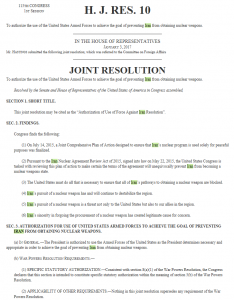 Here is the front page of the resolution introduced into the House of Representatives by Democrat Alcee L Hastings, an extremely close ally of Debbie Wasserman Schultz, who had to resign in disgrace as chair of the Democratic National Committee after WikiLeaks published emails establishing her corrupt endeavours to fix the primary elections for Hillary against Bernie Sanders.
The Resolution reads “To authorize the use of the United States Armed Forces to achieve the goal of preventing Iran from obtaining nuclear weapons.”
There is in fact no evidence that Iran is continuing a covert programme to produce nuclear weapons. British, French and Russian intelligence all assess that Iran is sticking to its agreements and – here is a key point – so do the CIA. But when did politicians ever let facts stand in their way?
Trump’s mad visa ban, which excludes Saudi Arabia and the Gulf States which are the main financiers, armers, ideologues and exporters of Salafist terrorism, turns out to be imposed on the countries which were on Obama’s watchlist. As the Hastings resolution shows, the anti-Iranian and pro-Saudi madness is bipartisan. To include Iran but exclude Saudi Arabia is further evidence of the twisting of US foreign policy to serve the interests of Saudi Arabia and its ally Israel. […]
These are dangerous times. And with the Democrats vying for “dumb patriot” support and seeking to outflank Trump to the right by roaring him on to a military attack on Iran, and seeking to push through legislation to promote that, there appear few influential voices of reason in the USA at present. – Full article
King Salman has no issues with Trump
By M K Bhadrakumar | Indian Punchline | January 30, 2017
The US President Donald Trump must be a man with a queer sense of humour. He kept the call to King Salman of Saudi Arabia pending for his announcement on Friday to fully sink in – to the effect that the Saudi citizens will be subject to “extreme vetting” before being allowed to enter America.
Trump singled out Saudi Arabia as the only GCC country to be treated badly like this, on par with Afghanistan and Pakistan. Finally, Trump made the call to Salman on Saturday. One would have liked to be a fly on the wall in the Oval Office. From all accounts, neither side showed fluster. The conversation was smooth as silk.
Salman is the Custodian of the Two Holy Places, and yet he didn’t raise the issue of Trump’s Muslim ban, which has created a world-wide uproar, including among non-believers.
Not only that, the accounts of the conversation suggest that Trump’s main purpose was to demand that Saudi Arabia should fund the ‘safe zones’ in Syria and Yemen – yes, Yemen, too, where the Saudis have been involved in a war of destruction. Simply put, Trump pricked the Saudi pride and 24 hours later asked Riyadh for money. Apparently, Salman agreed.
Thereupon, Trump and Salman agreed on the importance of making ‘joint efforts’ to erase the Islamic State from the face of the earth. The White House readout says,
- The president requested, and the King agreed, to support safe zones in Syria and Yemen, as well as supporting other ideas to help the many refugees who are displaced by the ongoing conflicts.
The Saudi press agency initially omitted any reference to Salman’s commitment on the ‘safe zones’, but later put out an amended version to say, “The custodian of the Two Holy Mosques had confirmed his support and backing for setting up safe zones in Syria.” It nonetheless did not mention Yemen, where a Saudi alliance is waging a bloody military campaign against the Houthi group.
The Saudi version emphasised that Salman and Trump affirmed the “depth and durability of the strategic relationship” between the two countries. For Salman, it is crucially important to proclaim that Trump intends to continue with the strategic ties with Saudi Arabia. His main worry would be that without Trump’s support, Iran will steal a march over Saudi Arabia as the dominant Muslim power in the Middle East.
Curiously, Salman went on to invite Trump “to lead a Middle East effort to defeat terrorism and to help build a new future, economically and socially.” Plainly put, Saudi Arabia is petrified about a US retrenchment from the Middle East and is willing to overlook anything – even the humiliating blow of Trump’s Muslim ban – if only the American troops stayed on.
Salman’s fawning attitude in the face of Trump’s Muslim ban will put the Ummah in a quandary. Logically, Saudi Arabia ought to have reacted strongly in the same unequivocal manner in which Iran has reacted. No sooner than Trump announced a travel ban on Iranian nationals, Tehran imposed a reciprocal ban on US citizens. A foreign ministry statement said in Tehran on Saturday,
- While respecting the American people and distinguishing between them and the hostile policies of the U.S. government, Iran will implement the principle of reciprocity until the offensive U.S. limitations against Iranian nationals are lifted.
Herein lies the secret of the western hegemony over Muslim Middle East. The bizarre truth is that the Gulf Arab regimes relish criticizing the US’s policies but cannot live without US military support because without that support they would collapse like a pack of cards. Besides, the Saudi elites keep their illegal private wealth in western banks and they own vast properties and business interests in the US. They travel to the US for fun as a permissive home away from their Wahhabi environs. In sum, they simply cannot afford to uphold self-respect and dignity as norms in their dealings with the Americans.
To be sure, Trump has put fear into the Saudi mind. What worries Salman most is Trump’s earlier stance that if the families of the victims of 9/11 attacks seek compensation from Saudi Arabia, he wouldn’t stand in the way. The finger has been pointed at important figures in the House of Saud for complicity in the 9/11 attacks.
But the Iranians have no such problem. They can insist on equal relationship and mutual respect from Washington because they owe Trump nothing. I can only echo Pakistani politician Imran Khan’s stirring call: “’Iran is an independent nation and other (Muslim) nations need to follow Iran against foreign pressures.” But then, Khan Saheb is asking too much.
‘No legitimate military objectives’: UN panel finds Saudi strikes in Yemen may amount to war crimes
RT | January 29, 2017
An expert UN panel investigating ten separate airstrikes by the Saudi-led coalition in Yemen – in which at least 292 civilians died – has found that most were the result of an ‘ineffective targeting process’ or deliberate attacks on peaceful targets.
“In eight of the 10 investigations, the panel found no evidence that the airstrikes had targeted legitimate military objectives,” the 63-page report presented to the UN Security Council on Friday stated, which has been obtained by Reuters. “For all 10 investigations, the panel considers it almost certain that the coalition did not meet international humanitarian law requirements of proportionality and precautions in attack.”
“The panel considers that some of the attacks may amount to war crimes,” the experts said, echoing statements repeatedly made by independent observers since conflict broke out in the country two years ago.
The small subset of attacks, which took place between March and October last year, resulted in the deaths of over 100 women in children. Earlier this month, the UN humanitarian coordinator for Yemen, Jamie McGoldrick, estimated that more than 10,000 people have been killed in the war so far, with many of them the victims of air strikes.
Saudi Arabia’s UN Ambassador, Abdallah Al-Mouallimi, flatly denied responsibility, saying the coalition – which includes Gulf states such as Qatar and Kuwait – was “exercising maximum restraint and rigorous rules of engagement.”
The panel also stated that the alliance admitted that some of their airstrikes resulted in severe casualties, which was not the desired outcome.
“In some cases errors were acknowledged and responsibility accepted. Corrective measures including compensation to victims were taken,” the authors of the report wrote.
The UN panel said that although it was unable to travel to the bombing sites, it still “maintained the highest achievable standard of proof,” and insisted the specific cases studied were part of a wider trend.
“The panel finds that violations associated with the conduct of the air campaign are sufficiently widespread to reflect either an ineffective targeting process or a broader policy of attrition against civilian infrastructure,” proclaimed the report. “All coalition member states and their allies also have an obligation to take appropriate measures to ensure respect for international humanitarian law by the coalition.”
The UN group also dismissed Saudi explanations that the devastating naval blockade of Yemen had been imposed because Iran was supplying Shia Houthi rebels with weapons.
“The panel has not seen sufficient evidence to confirm any direct large-scale supply of arms from the Government of the Islamic Republic of Iran, although there are indicators that anti-tank guided weapons being supplied to the Houthi or Saleh forces are of Iranian manufacture,” said the report, which said 2,064 weapons seized on boats off the coast, had possible “direct” links with Iran.
The UN criticized the blockade for its “disproportionate impact” on civilians, saying the country, 90 percent of whose food supplies are imported, is on the verge of famine. Yemen was already one of the region’s poorest states before the current crisis, but according to the UN, 14.1 million people – over half of the population – are “food insecure,” and over two-thirds require humanitarian assistance, due to internal displacement, lack of medical supplies and clean drinking water.
Despite the devastating conclusions of the latest UN report, the US and UK, which are not directly taking part in the bombardment and blockade of Yemen, have avoided directly criticizing Riyadh, a longtime ally.
“We urge all sides to take steps to prevent harm to civilians. Ending the conflict in Yemen requires a durable cessation of hostilities and a comprehensive political solution,” the US State Department said in a statement.
The British mission to the UN, while refusing to comment on the specific incidents mentioned in the report said, “We take reports of alleged violations of international humanitarian law by actors in the conflict very seriously.”
Both the US and the UK have been major suppliers of arms to the Saudis. In September 2016, Reuters reports, the US Senate cleared the way for a $1.15 billion sale of tanks and other military equipment to kingdom. Saudi Arabia has also been buying arms from the UK – with estimated purchases at some 3.3 billion pounds. That includes more than 2.2 billion worth of warplanes, helicopters and drones.
Read more:
Severely malnourished Yemeni children in urgent need of help filmed by RT Arabic (DISTURBING IMAGES)
US commandoes attack Yemen’s Bayda, kill 57: Reports
Press TV – January 29, 2017
US forces have carried out a series of ground and air raids against a village in the Yemeni province of Bayda, killing a total of 57 people, among them civilians.
US paratroopers parachuted in Bayda’s Qifah district and raided the Yakla village there, with some 30 aircraft such as Apache helicopters and drones taking part in the operations.
Saudi media said 16 civilians, among them women and children, lost their lives in the US assault.
Reports said the rest of those killed were militants with the al-Qaeda terror group, including three of its ringleaders.
“The operation began at dawn when a drone bombed the home of Abdulraoof al-Dhahab and then helicopters flew up and unloaded paratroopers at his house and killed everyone inside,” an unnamed local told AFP.
The Lebanese al-Mayadeen television channel reported that a US soldier was also killed during clashes with militants.
Two years ago, US troopers conducted a similar operation in Yemen’s Hadhramaut Province to allegedly save an American reporter who was held captive by al-Qaeda. However, the operation was unsuccessful and left the correspondent dead.
Separately on Sunday, Saudi fighter jets mistakenly bombarded positions held by Riyadh’s own mercenaries in Bayda Province.
Arabic-language al-Masirah television network quoted an informed military source as saying that the Saudi warplanes had also targeted homes in Bayda’s al-Quraishyah and Sharyah neighborhoods.
Similar Saudi air raids were also carried out in the districts Harad and Nasim in Hajjah Province as well as the Sirwah neighborhood of Ma’rib Province.
The Saudi jets further targeted al-Amri district of Ta’izz Province with cluster bombs.
Elsewhere, in Shabwah Province, a large number of Saudi mercenaries were killed and injured in the Yemeni army’s rocket attacks.
Additionally, 50 Saudi mercenaries, among them foreign nationals, were killed and injured in clashes with the Yemeni army forces in the port city of Mokha and Dhubab district, both situated in Ta’izz Province.
Three rocket attacks also hit downtown Zanzibar in Abyan Province.
The Riyadh regime has been incessantly pounding Yemen since March 2015 in a bid to reinstall the country’s ex-government and crush the Houthi Ansarullah movement.
The Houthis and the Yemeni army have been defending Yemen against the Saudi offensive for almost two years.
The military aggression has claimed the lives of over 11,400 Yemenis, including women and children, according to the latest tally by a Yemeni monitoring group.
Trump’s Muslim ban is insulting but sheikhs will adapt
By M K Bhadrakumar | Indian Punchline | January 29, 2017
The US President Donald Trump has hit Pakistan and Saudi Arabia hard where it hurts most – making things difficult for their elites to travel to America or get a Green Card — by subjecting the visa applicants to ‘extreme vetting’.
To societies such as Pakistan (or India for that matter), the ultimate insult that Washington can give is to deny the elites the privilege to visit America. Pakistani elites were willing to eat grass if necessary for making atom bomb, but if restrictions are put on their travel to America, it hurts. The bottom line is seamless freedom to criticize America and alongside unhindered right to visit America. Unsurprisingly, the Pakistani elites are livid with anger. The reaction ranges from embarrassment to indignation. In an editorial comment, the Pakistani newspaper The Nation advised the government that “its attempts to befriend the Trump administration might be altogether pointless.”
But Trump won’t retract. He knows it is an immensely popular move, as the average American thinks that the Muslim is a troublemaker and best kept away at arm’s length.
How do the European countries see Trump’s move? Will they emulate him? The fact of the matter is that anti-Muslim feelings are widespread in the countries of western and central Europe too. However, Europe may dither, because it damages their self-esteem as the ‘civilized world’ if primeval passions mutate as state policies. Besides, western companies make a lot of money in the CGG markets.
How will India look at Trump’s Muslim ban? The government will probably find it expedient to take an evasive stance by keeping mum or choosing to take a stroll on the sidewalk. A ‘senior MEA official’ probably did that by observing,
- India is not really worried at the moment as the religious radicalization has not been a big problem in the country and it has not been a source of refugees. So far no Indians have been arrested abroad for being involved in acts of terror.
Will India’s political parties voice opinions? This is, after all, election time in Uttar Pradesh. Indeed, the hardliners among our elites may (quietly) draw some vicarious satisfaction. One of them has blamed Trump for being not hard enough on Pakistan and Saudi Arabia.
Trump’s detractors in America allege that he made an exception of those Muslim countries where he has business interests. Bloomberg illustrated the point with graphics. Take a look, here. In reality, though, it is a weak argument. With the solitary exception of the UAE, whose sheikhs have had a dismal record of promoting radical Islamist groups as instruments of foreign policies, Trump’s business empire overwhelmingly spans the non-Muslim world – Argentina, Brazil, Bermuda, Canada, China, Ireland, UK and US.
Will this sort of discriminatory attitude of viewing Muslim countries as plague-ridden regions colour Trump’s policies toward the Muslim Middle East? These are early days. Trump is courting Israel, but then, he could be calculating that it pays to keep the Jewish lobby in America (which controls the Congress, media and think tanks) happy. In Secretary of State Rex Tillerson, Trump has a cabinet minister who extensively cultivated Middle eastern elites. But the US has no more reason to covetously eye the Middle East’s oil. The US is not only energy self-sufficient but will likely be a major exporter in a conceivable future. Having said that, petrodollar recycling still continues to be of relevance to US industry and banking system.
Trump could be betting that the sheikhs have no option but to swallow the humiliation. A trace of contempt was probably discernible in his pugnacious remark calling for ‘safe zones’ for Syrian refugees, during a post-election thank-you trip in December:
- We’ll build safe zones in Syria. When I look at what’s going on in Syria, it’s so sad. It’s so sad. And we’ve got to help people. And we have the Gulf States. They have nothing but money. We don’t have money. We owe $20 trillion. I will get the Gulf States to give us lots of money, and we’ll build and help build safe zones in Syria, so people can have a chance. So they can have a chance.
So, in the mother of all ironies, Trump is bullish he’d get King Salman to cough up the money to put up Syrian refugees who have been rendered stateless in a bloody conflict that Saudi Arabia in the first instance promoted. And, furthermore, he now expects that Salman would counsel his princes and princesses to patiently queue up for ‘extreme vetting’ to get American visas. It’s no more possible for them to succumb to the sudden itch to board their private jets and head for America to do shopping or indulge in fun and frolic.
To add insult to injury, Saudi Arabia has been bracketed with Pakistan and Afghanistan. Trump promised: “We’re going to have extreme vetting in all cases. And I mean extreme. And we’re not letting people in if we think there’s even a little chance of some problem… we’re gonna have extreme vetting. It’s going to be very hard to come in. Right now it’s very easy to come in. It’s gonna be very, very hard. I don’t want terror in this country.” By the way, Trump’s Muslim ban is not applicable to any country other than Saudi Arabia within the Gulf Cooperation Council.
The wheel has come full circle since the Faustian deal between FDR and King Abdul Aziz at their fateful meeting in 1945 in Egypt whereby in lieu for secure access to supplies of Saudi oil, US guaranteed the military security of the Wahhabi regime.
Featured Video

Spain train disaster raises questions over Israeli-linked security contractors
or go to
Aletho News Archives – Video-Images
From the Archives
Are There 50,000 ‘Israeli-born’ Individuals Living in the UK?
By Professor David Miller | August 18, 2026
Recent disclosures by the Zionist regime show that some 2,069 British nationals were serving in the IDF as of March 2025, according to Freedom of Information (FoI) requests submitted to the occupation forces (1,686 dual British-Israeli, plus 383 multinational). We cannot tell from the figures how many of these were already settler colonists and intend to stay in the colony, and how many will return or have returned to the UK. Presumably, those returning to the UK will number far fewer than 2,000, since many are known to have become permanently residents of the colony.
Additionally, the IDF figures only provide a snapshot, and do not tell us how many have served in the Jewish supremacist military either before or after March 2025. One way into the question of how many genocidaires are living in Britain is to ask how many current British residents were born in the Zionist colony. There is data on that, as we shall see. … continue
Blog Roll
 Aletho News
- US-Israeli war on Iran cost Persian Gulf states nearly $1T in damage, lost growth: Report
- Congress probe could put ‘Israel’ in dock over Iran war: Israeli media
- Spanish public prosecutor backs US demand to extradite pro-Palestine philanthropist Fergie Chambers
- Zelensky spent over 740 days outside Ukraine while West serves as his real home
- Indian captain of Russian ‘shadow fleet’ tanker faces 10-year jail term in UK
- Europe, US face higher heating bills amid Iran war fallout
- The Leak That Arrived Right on Cue
- No, New York Times, California’s Climate Has Always Been a Land of Flood, Drought, and Fire
- Are There 50,000 ‘Israeli-born’ Individuals Living in the UK?
- German CDU MPs Seek Climate “Misinformation” List
- If Americans Knew
- An error has occurred; the feed is probably down. Try again later.
- No Tricks Zone
- German Authorities Start Initiative To Evaluate Public Register For Climate “Disinformation” Spreaders!
- Zonal Asymmetry of Temperature Change in the Antarctic Circumpolar Current
- New Study: The Net Fossil Fuel Contribution To Rising Atmospheric CO2 Has Been Zero For 500 Years
- Germany’s Green Energy Transition Becoming Increasingly Expensive…Another 6 Trillion Euros!
- Sudden Stratospheric Warming, Powerful El Niño Combination May Lead To Extreme Europe Cold, Energy Crisis!
- Two New Studies Find Thwaites Glacier Melt Cannot Be Driven By Human Activity Or A Warming Ocean
- E-Cars Reduce CO2 Emissions By Only 41% Compared To Internal Combustion Engine Vehicles
- Predictions Made By Renowned Climate Professor Over Past Decades Have Been Proven To Be Poor
- New Study Suggests Large Regions Of The Pacific Ocean Have Been Cooling For The Last 80 Years
- Germany’s Green Energy Debacle: High Energy Costs Force Kahla Porzellan to Close After 182 Years!

