Billions in Taxpayer Money to Israel: How the NYT Hides Unsavory Facts from View
By Barbara Erickson | TimesWarp | September 15, 2016
Thanks to American taxpayers, Israel has been receiving $3.1 billion in direct military aid each year, and under a new agreement signed this week that amount is set to rise to $3.8 annually. This is a hefty package and major news, but The New York Times has been oddly reticent about it, running a story on page 6 of the print edition and without fanfare online.
This is not a new phenomenon at the Times. Over the past year, as the United States and Israel have negotiated a new 10-year memorandum of understanding concerning military aid, readers have seen few references to the topic, and even with the signing of a new agreement this week, the newspaper maintains its minimalist approach.
The article by Peter Baker and Julie Hirschfeld Davis gives few details of the deal, instead proving a great deal of space to the state of U.S.-Israeli relations. The story reports that the present aid package (signed in 2007 and due to expire next year) amounts to “about $3 billion a year” with additional funds of up to $500 million a year authorized by Congress for missile defense.
We also learn that Israel made some concessions in negotiations, that this week’s deal is “the largest of its kind” and that Israel receives more U.S. money than any other country. But much is missing.
In fact, Israel gets more than half of all U.S. military aid ($3.1 billion out of a total of $5.9 billion), and Israel together with Egypt receives 75 percent of American foreign military assistance. Since the large allotment for Egypt is aimed at maintaining a non-threatening neighbor on Israel’s border, this could also be counted as indirect aid to Israel.
In fact Israel has been receiving well over $3.1 billion. By a conservative estimate, the United States has been giving the country $3.7 billion in direct aid annually with funds for immigrants to Israel, grants for American hospitals and schools, “joint defense projects” with the Department of Defense, and an early disbursement of aid.
The last item on that list refers to a special arrangement: In contrast to other recipients, Israel receives all its funds from the United States in one lump sum within the first month of the fiscal year. The money is then transferred to a Federal Reserve Bank interest-bearing account, allowing Israel to accrue some $15 million annually in interest.
Then there are other perks, such as loan guarantees, “cash flow financing,” and the right to purchase arms directly from companies rather than going through a Department of Defense review.
In addition, donations sent by Jewish and Christian groups to support settlements are tax-exempt. So every dollar donated to support the colonization of Palestinian land means the loss of at least 20 cents that should go into the U.S. treasury. This is an indirect subsidy to Israel that has cost American taxpayers an incalculable amount, at least some tens of millions of dollars.
The Times, however, has shown no interest in revealing the full extent of aid or of pursuing the arguments against pouring so much money into Israel. This week’s story mentions criticism of the aid agreement not until about three quarters into the text, and then it is reduced to three bland paragraphs with quotes from the representative of an anti-occupation organization.
In fact, the opposition goes well beyond such groups. A member of Congress, Rep. Betty McCollum (D-MN), has asked the State Department to investigate Israeli military units for possible violations of the Leahy Act, which prohibits the dispersal of U.S. funds to groups that violate human rights with impunity.
In 2012, 15 leaders of major religious organizations wrote to Congress asking that military aid be made contingent on compliance with American law. Other groups have sponsored billboards in various areas of the country highlighting the incredible largesse the United States provides for Israel.
Moreover, a poll of Americans taken in 2014 revealed that 60 percent believed the United States gives too much aid to Israel, and of that group 34 percent said it received “much too much.” The percentage claiming that our aid package was excessive was even higher (65 percent) among Americans under 34.
Other commentators have noted that Israel is a wealthy country, with universal health care, and is less in need of help than American citizens who struggle to fund their schools, pay for prescription drugs and meet medical fees.
None of this debate appears in the Times, which seems determined to keep the subject well below the radar. Thus we find a lightweight story on the inside pages of the print edition, well behind a more prominent one about Syrian and Israeli skirmishes in the Golan Heights, and an uninformative one-minute video of the signing ceremony on the Middle East page.
Times readers are to remain ignorant of the full, unsavory story about U.S. aid to Israel. If the facts were fully reported, this might inspire unwelcome questions and pushback. Better to say as little as possible and allow Israel to keep collecting its yearly billions from American taxpayers.
Follow @TimesWarp on Twitter.
He may have insulted Obama, but Duterte held up a long-hidden looking glass to the US
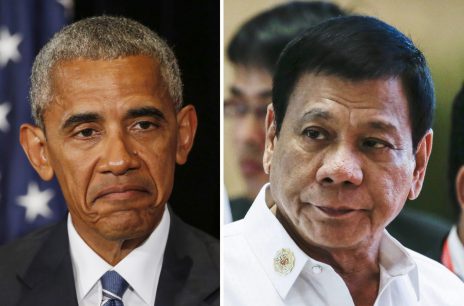
Insulting Barack Obama made the headlines, but Rodrigo Duterte’s remarks referred to a long and dark history of US interference in the Philippines.
Narendra Shresthma, Mast Irham/EPA
By Adele Webb | The Conversation | September 8, 2016
Philippine President Rodrigo Duterte has taken his “bad manners” – having gained global notoriety with his election campaign insults earlier this year – to a new level.
At a press conference at Davao International Airport on Monday, on his way to meet US President Barack Obama and other leaders attending the ASEAN summit, Duterte muttered a few short words in tagalog at the end of a lengthy and irritated reply to a local journalist. With those words, he again made international headlines.
What did Rodrigo Duterte call Barack Obama?
If that were all there was to it, we could rightly roll our eyes and move on. After all, Duterte’s language is vulgar; his slander of people and groups is liable to incite violence; and his determination to kill drug pushers (to fight “crime with crime”) an abuse of power. He should not be defended for any of this.
But as someone who has spent a long time studying US-Philippine relations, I think there’s something more for us to see here. And if we want to judge the Philippine president (and, by default, the nation for electing him) from high moral ground, I think we have a responsibility to pay attention to it.
Restoring an invisible history
Who is he to question me about human rights and extrajudicial killings?
So asked Duterte on Monday. It’s actually a very good question, and one long overdue from a Philippine president. The extent to which the violence of US relations with the Philippines has been made invisible by a history written predominantly by Americans themselves cannot be overstated.
It began with a three-year war (1899-1902) that most Americans have never heard of. The war overthrew a newly independent Philippine republic and cost between 250,000 and a million Filipino lives – only to be called “a great misunderstanding” by American colonial writers.
After all, the US had chosen the Philippines to be its great Asian “showcase of democracy”. The invasion was a benevolent act. Hence the complete erasure of acts of American violence from the Philippine national story.
 The 20th Kansas Volunteers march through Caloocan after the battle of February 10, 1899, early in the war that toppled the first Philippine republic. G.W. Peters/Internet Archive

You don’t need to be a conspiracy theorist to smell something rotten. Since the 1950s Philippine writers, academics, journalists and so on have been trying to reframe the historical narrative to point out this fact: to be invaded by a military power, told you don’t possess the character or capability for self-government, and then controlled by another nation for four decades, to the occupier’s lucrative commercial benefit, was not to be the recipient of a benevolent act.
Even at the time the war was taking place, one of America’s best-loved authors was writing just as much. Mark Twain was prolific in writing about the paradox of the “democratising mission” to the Philippines.
Penned in 1901, but still stunningly poignant, is this extract from his essay, To the Person Sitting in Darkness:
The Person Sitting in Darkness is almost sure to say: ‘There is something curious about this – curious and unaccountable. There must be two Americas: one that sets the captive free, and one that takes a once-captive’s new freedom away from him, and picks a quarrel with him with nothing to found it on; then kills him to get his land.’
In America, these remain Twain’s least-known works.
Before his (now regretted) distasteful remark, Duterte had much to say in response to the question about being confronted over human rights in an upcoming meeting with Obama. He was responding to murmurs from critics that, if he wouldn’t listen to anyone else about the extrajudicial killings in the Philippines, just wait until he meets the US president.
No-one seems to have listened to or cared much about the other six minutes of Duterte’s reply. So let me tell you something about it. It was a reclaiming of the historical narrative of Philippine-US relations, a holding up to the US of the hidden “looking glass” Mark Twain had written about 100 years earlier.
 The Macabebe Scouts were a native Filipino force of the US Army during the Spanish–American War. The Ardvaark/Wikipedia Commons
An assertion of independence
Calling out the hidden insinuations, as Duterte did, that the US continues to have authority over the politics of the Philippines, is bold and brazen, but reasonable. Consider his statement:
I am a president of a sovereign state. And we have long ceased to be a colony. I do not have any master but the Filipino people.
These words are less evidence of his demagoguery or an intention to personally disparage Obama than a reference to history, and are more accurately read as such.
After the second world war, colonies of any sort, even the so-called “democratic” US one in the Philippines, were on the nose. But this didn’t stop Washington officialdom from continuing to claim the right of access to the Philippines’ political and economic realms.
When the US finally granted the Philippines its (second) independence in 1946, it required the new republic to amend its constitution so a bill could be passed that, as well as legislating preferential trade conditions for the US, would grant American citizens equal rights with Filipinos to Philippine natural resources. It was the beginning of a new phase: neocolonialism.
It was not just a matter of political interference and the power to make or break Philippine presidents with endorsement and strategic financial support. In a visceral sense, the nation was always being watched and judged by its democratic “teacher”.
 School Begins: Uncle Sam lectures his class in Civilisation (the pupils are labelled Philippines, Hawaii, Puerto Rico and Cuba). Puck Magazine 1899
Asked about being confronted with human rights concerns by Obama, Duterte said:
You must be kidding. Who is he to confront me? America has one too many to answer for the misdeeds in this country … As a matter of fact, we inherited this problem from the United States. Why? Because they invaded this country and made us their subjugated people … Can I explain the extrajudicial killing? Can they explain the 600,000 Moro massacred in this island [Mindanao]? Do you want to see the pictures? Maybe you ask him. And make it public.
I’m reminded of a comment by Alicia Garza, a founder of the Black Lives Matter movement ignited by police killings of black Americans. Speaking in Sydney last weekend at the Festival of Dangerous Ideas, she related how, when civil rights protests get uncomfortably heated, she is often asked: “Why are they so angry?” She paused. Then softly giggled, giving the audience time for the ludicrousness of the question to sink in.
Why is the Philippines president so angry about the prospect of the US president confronting him about human rights abuses? History. As Duterte said himself on Monday, violent acts of the past don’t stay in the past. They get passed on from generation to generation, especially when the injustice goes unacknowledged and unaddressed.
It is difficult to stomach Duterte’s style. It certainly is difficult to look past the serious issues raised by his administration’s “war on drugs”. We should condemn his misuse of power.
But if we condemn the president for his recent remarks because we claim to be concerned about the rights of Filipinos while showing no interest in acknowledging the past crimes and injustices against the Philippines, we fall into our own sort of hypocrisy.
Let’s be honest, if Duterte didn’t curse and swear and offend our sensibilities, would we be paying so much attention to the Philippines? For once, I heard a Philippine president holding the US to account for all its doublespeak and hypocrisy in US-Philippine relations. And I couldn’t help but appreciate that.
Adele Webb, PhD Researcher, Department of Government and International Relations / Sydney Democracy Network, University of Sydney
Disclosure statement
Adele Webb does not work for, consult, own shares in or receive funding from any company or organization that would benefit from this article, and has disclosed no relevant affiliations beyond the academic appointment above.
Duterte’s Power Play: Rocking the US-Philippines Alliance
By Binoy Kampmark | Dissident Voice | September 14, 2016
I do not like the Americans. It’s simply a matter of principle for me. — Philippine President Rodrigo Duterte, September 12, 2016
The frictions excited by the antics of Philippine President Rodrigo Duterte have caused even greater heat over the last few days, with calls for the departure of US special forces operating in Mindanao. Having already made it clear to Washington that he intends pursuing “an independent foreign policy,” he has now insisted that the general root of ills in instability lie in the troublesome, headache-causing alliance with the United States.
A continuing problem of that alliance remained US forces in Zamboanga on the island of Mindanao, ostensibly engaged in advising local troops on counter-terrorism operations. “For as long as we stay with America, we will never have peace in that land [Mindanao]. We might as well give it up.” It was therefore imperative that “those [American] special forces, they have to go.” He did not want “a rift with the US, but they have to go.”
Nothing could stand in greater contrast to such sentiment than the pact of 2014 signed between Manila and Washington, a confirmation of all the ills Duterte despises. While that agreement did not countenance the reopening of US bases in the Philippines, something that would have had a constitutional hurdle to climb, it permitted roving and near unlimited US access to military bases across the country.
Despite the pretence of being severed from the US umbilical cord in 1946, the neo-colonial aftertaste has remained. From 2002 to 2013, $441 million in security funding was provided to Manila. The Obama administration had set aside a hefty $120 million in military aid for 2016.
As Senator Miriam Defensor-Santiago, chairman of the Philippines Senate Committee on Foreign Affairs, explained with the signatures on the agreement barely dry, the agreement was of limited value to the country, while being splendid for US interests.
In signing the agreement, the US “could claim that it has ‘contained’ China, because the Asian countries involved, including the Philippines, are now bound by their respective agreements with America.”
This would, in effect, convert Manila into a compliant satellite to Washington’s goals in the Asia-Pacific. As if to emphasise that point, both states had agreed earlier this year to the deployment of thousands of American troops to five Philippine bases, measures that are hardly accidental given the spike in tensions in the South China Sea.
President Barack Obama has preferred to avoid the terminology of containment and control, preferring to see such moves as pursuant to a self-proclaimed international order of norms. When one is attempting to be a decent bully on the international stage, cast a nod in the direction of international law. “Our goal,” he explained in 2014, “is to make international rules and norms [that] are respected, and that includes areas of maritime disputes.”
The boisterous Duterte, a vastly different creature from Benigno Aquino III, has issued directives to his defence secretary to seek military supplies from China and Russia rather than US sources. “I want weaponry and armaments…. We don’t need F16 jets, that is of no use to us.” Jets were useless in counter-insurgency operations in the Philippines; far better stick, he suggested, to “propeller-driven planes”.
Such moves are not suggestive of a total distancing from the United States; Duterte is evidently keen to widen his appeal to other powers, rather than clinging on the tired assumption that all that stems from Washington is somehow good. On that level, the politics is sound, an attempt to defuse a confrontation that risks involving China and the US in a regional punch-up.
The Philippine military were also bemused by the Presidential directive, unclear about how they were to go about their new orders. In the words of a defence spokesman, “We are awaiting guidelines on how the president’s policy statements will be implemented.”
On Tuesday, Duterte also explained that the Philippines would cease patrolling the South China Sea alongside the US Navy. What was less extensively reported by US media outlets is that he would prefer Filipino forces to be doing their own patrolling up to 12 nautical miles offshore, rather than having entanglements with either US or Chinese forces.
All that said, a more than significant nudge is being contemplated in Beijing’s direction, while the president envisages refocusing the broader struggle on domestic maladies: drug trafficking and niggling insurgencies. “Only China will help us,” he claimed. “America just gave you principles of law and nothing else.”
The old myopic view that Duterte is merely the resident buffoon and brute is delightfully simple, but one that has currency in the corridors of US power. It holds that he is an aberration, that his legacy will pass, and that his views are of no consequence. US officials persist doing this at their peril, attempting to place Manila, by proxy, in line of Beijing’s ire.
As the distributed Nelson Report (September 14), a summary dispatch on foreign relations, put it, “if you want to see what a Trump Presidency would look and sound like, watch the Philippines’ Duterte… an impertinent reference to Trump’s unpredictability, boorishness, lack of knowledge or sophistication, and penchant for ill-considered dramatics.”
The point that has been missed is that this entire revision has been stewing for some time. It has bubbled with fury, bypassing the traditional, submissive structures of power that have favoured an imperial influence for all too long. The point to see will be whether Duterte’s legacy persists in its indignation and redirection, or fizzles in the great power game.
Binoy Kampmark was a Commonwealth Scholar at Selwyn College, Cambridge. He lectures at RMIT University, Melbourne and can be reached at: bkampmark@gmail.com.
Corruption and waste in Afghanistan: Role of US government exposed in new report
RT |September 14, 2016
A new report examining widespread corruption and waste in Afghanistan found that the practice blossomed following the US invasion in 2001. The problem was fed by its slowness to recognize the problem and exacerbated by the injection of tens of billions dollars into the economy with very little oversight.
“Corruption in Conflict: Lessons from the U.S. Experience in Afghanistan” examined how from 2001 to 2014 the US government, through the Department of Defense, State, Treasury and Justice and the US Agency for International Development (USAID) understood the risks of corruption in Afghanistan, how the US evolved its understanding, and the effectiveness of that response.
SIGAR was created by Congress to provide independent and objective oversight of Afghan reconstruction projects and activities.
The report released on Wednesday had five main findings: 1) corruption undermined the US mission in Afghanistan by fueling grievances against the Afghan government and channeling material support to the Taliban; 2) the injection of tens of billions of dollars into the Afghan economy was governed by flawed oversight and contracting practices and “partnering with malign powerbrokers”; 3) the US was slow to recognize the problem; 4) when it did recognize the depth of corruption “security and political goals” trumped anti-corruption efforts; 5) in areas where it was successful it was only “in the absence of sustained Afghan and US political commitment.”
The report defined corruption as “the abuse of entrusted authority for private gain,” and placed in the context of Afghanistan’s kinship-based society where the gains from corruption often benefited not just an individual but a family, clan, tribe or ethnic group.
Corruption is the system of governance
According to SIGAR about $113.1 billion has been appropriated for Afghanistan relief and reconstruction since 2002. The funds were used by the Afghan National Security Forces to promote good governance, conduct development assistance, and engage in counter-narcotics and anti-corruption efforts.
In a 2010 US Embassy Kabul report on a meeting with senior US officials and the Afghan National Security Adviser, Dr. Rangin Dadfar Spanta said “corruption is not just a problem for the system of governance in Afghanistan; it is the system of governance.”
The report referred to a 2015 UK research that showed there was weak separation of the private and public spheres which resulted in widespread private appropriation of public resources, vertical- and identity-based relationships had primacy over horizontal, i.e. citizen-to-citizen relationships, and politics was centered around a centralization of power and patron-client relations replicated throughout society.
Opportunities for corruption expanded after 2001 as the amount of money in the economy grew from millions to billions of dollars with the Department of Defense budget at time equivalent to the entire Afghan economy and sometimes quadruple the amount.
“Many of the funds were licit, arriving via civilian and military contracts. At their peak in fiscal year 2012, DOD contract obligations for services in Afghanistan including transportation, construction, base support, translation/interpretation, an private security total approximately $19 billion, just under the Afghanistan’s 2012 gross domestic product of $20,5 billion,” stated the report. “From 2007 to 2014 those contract obligation totaled more than 89 billion.”
Billions worth scandals
During the years of the Obama administration, Afghanistan was rocked by two corruption scandals: The Salehi arrest and the Kabul Bank losing $1 billion.
Salehi was involved in the New Ansari Money Exchange, a money transfer firm that moved money into and out of Afghanistan. The exchange was suspected of moving billions of dollars out of Afghanistan for Afghan government officials, drug traffickers and insurgents. US law enforcement and intelligence investigators estimated that as much as $2.78 billion was taken out of Afghanistan between 2007 and 2010.
“A wiretap recorded an aide to Karzai, Mohammad Zia Salehi, soliciting a bribe in exchange for obstructing the investigation into New Ansari. Reportedly, after US officials played some of the wiretaps for an adviser to Karzai, the adviser approved Salehi’s arrest,” stated the report.
Salehi was arrested in July 2010, but was released within hours on the orders of President Karzai and the case was dropped. The New York Times reported Salehi had once worked for notorious warlord Rashid Dostum and was also “being paid by the CIA.”
“If true, this would suggest a US intelligence agency was paying an individual as an intelligence asset even as US law enforcement agencies were building a major corruption case against him,” stated the report.
The other corruption scandal involved the Kabul Bank, which was used among other things to pay the salaries of the Afghan military and police, was found in 2010 to have lost nearly $1 billion of US taxpayer’s funded foreign assistance to Afghanistan. The bank’s deposits had seemingly vanished into Dubai and off-shore locations and unknown offshore bank accounts and tax havens, through Ponzi schemes, fraudulent loans, mass looting and insider loans to fake and bogus companies by less than 12 people who were apparently linked to President Karzai.
Lack of oversight and slow response
Against this the DOD and USAID vetted contractors and implemented contracting guidance to reduce opportunities for corruption and while they were somewhat successful, “they were not unified by an overarching strategy or backed by sustained, high-level US political commitment,” stated the report.
During this time, from mid-2011 to March 2012, the US also sought to explore political reconciliation with the Taliban and to do so the US had to preserve a working relationship with President Karzai to ensure an Afghan government buy-in.
“The US government showed a lack of political commitment. When it became clear the Afghan government was not willing to undertake true reform – because it involved taking action against people connected to the highest levels of political power – the US government failed to use all of its available tools to incentivize steps towards resolution,” stated the report.
Another weakness in tackling corruption was the high turnover of US civilian and military staff “meant US institutional memory was weak and efforts were not always informed by previous experience.”
“One Afghan anticorruption expert noted that US agencies often hosted workshops and training that lasted only a few days, with limited follow-up. He suggested that a more fruitful approach might have been to establish a standing institute to train auditors, attorneys, investigative police and others for year, rather than days,” stated the report.
SIGAR’s report quoted Ryan Crocker, who re-opened the US Embassy in Kabul soon after the September 11, 2001 attacks and served again as ambassador in 2011-2012 as saying that “the ultimate point of failure for our efforts wasn’t an insurgency. It was the weight of endemic corruption.”
The report comes with recommendations for addressing corruption risks to US strategic objectives for future missions. It recommended that Congress pass legislation to make clear “that anticorruption is a national security priority in a contingency operation” and required strategies, benchmarks and “annual reporting on implementation.” It also recommended that Congress consider sanctions and the DOD, State and USAID should establish a joint vetting unit to better vet contractors and subcontractors in the field.
The recommendations for the executive branch level are that interagency task force should formulate policy and lead strategy on anticorruption during an operation and the intelligence community should analyze links between host government officials, corruption, criminality, trafficking and terrorism and provide regular updates.
“In Afghanistan today, corruption remains an enormous challenge to security, political stability, and development,” SIGAR said.
Italy ‘No Longer Sovereign State, It is on NATO’s, US’ Tight Military Leash’
Sputnik – 14.09.2016
Italy has been packed full of NATO and US military bases across the country, which serve as testing grounds for the US and the alliance; Sputnik Italy talked to Fulvio Grimaldi, Italian journalist, war correspondent and documentarian on the everyday damage these military facilities cause to the country.
“We fell victim to the self-restrictions contrary to our own interests. Europe is tormenting itself,” Grimaldi told Sputnik while commenting on the issue.
“It is in the interests of the US that Italy has imposed sanctions on Russia which have harmed Moscow less than Italian farmers and the country’s industry, which have subsequently found themselves in grave economic conditions,” he noted.
The journalist further acknowledged that his home country has been forcefully militarized. There are around 90 US bases in the country, let alone a lot more NATO bases on its territory, which are at the US disposal.
“We are a country overflowing with military bases, and this is a serious burden for our economy to the detriment of construction, maintenance of medical facilities, schools and land improvement,” the journalist said. These military facilities also put Italy at risk of becoming a potential target for those countries who will decide one day to stand up to NATO aggression.
The correspondent cites as an example the American Mobile User Objective System (MUOS), a modern satellite communications system located in Sicily, the largest Mediterranean island, which is capable of reaching out to Africa and the Middle East.
“It is a huge social and industrial burden for the island,” he said.
Another example is the US military facility on another large Italian island in the Mediterranean Sea, Sardinia, which serves as a testing range for the newly released weaponry which pollutes the environment and threatens the health of local residents.
The economic damage is also substantial. NATO military operations around the globe cost the Italian defense ministry 55 million euro ($61.7mln) per day. If you take into account the expenses of other related ministries, the daily cost rises to 80 million ($89.7mln).
“This is the contribution of the country which has no interest in the military operation in any country of the world, because it is facing no threats,” Grimaldi said.
The US military and political control over the Italian territory comes as the aftermath of the Second World War which deprived Italy of its sovereignty. “I see no reasons for optimism in such a situation.
What I actually see is the acknowledgment of similar subordination in other countries of the EU, and this aggressive strategy of NATO is leading us towards an epic failure,” the journalist said.
However he added that he is certain that one day the authorities will finally come to their senses and change their stance towards the alliance.
UC Berkeley Axes ‘Palestine: A Settler Colonial Analysis’ Course
teleSUR – September 13, 2016
University of California, Berkeley Chancellor Nicholas Dirks has bowed to pressure from Jewish groups and suspended a course that discusses the history of Palestine since the late 1800s to the present day in the context of “settler colonialism,” as the latter argue the course has an “anti-Israel” bias that seeks to study “ways to ‘decolonize’ — that is, eliminate — Israel,” the San Francisco Chronicle reported Tuesday.
“The course has been suspended pending completion of the mandated review and approval process,” according to a campus statement that has expressed concern over a course that offered “a single political viewpoint and appeared to offer a forum for political organizing.”
According to the newspaper, 43 Jewish and civil rights groups sent a letter to Dirks complaining that “all the course readings … have a blatantly anti-Israel bias.”
The letter further stated that all course materials and its instructors are one-sided in their view against Israel and were performing “political indoctrination,” which violates the UC Board of Regents’ policy on course content, which prohibits using courses “as an instrument for the advance of partisan interest.”
The Palestine course is among 194 student-taught classes this semester at Berkeley, which are proposed by students and approved by a committee every year.
Within hours of receiving the letter, Dirks issued the statement suspending the course, saying it “did not receive a sufficient degree of scrutiny to ensure that the syllabus met Berkeley’s academic standards.”
The letter called the faculty sponsor, Hatem Bazian, “a well-known anti-Zionist activist who is also the chairman of American Muslims for Palestine.”
However, the Academic Senate’s Committee on Courses and Instruction did evaluate and approve the course, Academic Senate chairman Bob Powell told the San Francisco Chronicle.
“Is there a box where you check it off? I don’t think so. But everyone involved in course approval is aware of regents policies—including this one.”
The decision to suspend a course, in this case “Palestine: A Settler Colonial Analysis,” is rarely taken, but censorship of anti-Israel views by university faculty members and students in the United States is well-documented.
In 2015, a comprehensive report titled “The Palestine Exception to Free Speech: A Movement Under Attack in the US” documented how pro-Palestinian academics have lost their jobs, activists have been suspended from their studies and groups have lost their funding.
In July 2014, for example, the University of Illinois fired Professor Steven Salaita shortly after he signed a contract with the university because he sent out several tweets about the Israeli onslaught on the Gaza strip, which killed more than 500 children.
US to sign record $38bn military aid deal with Israel – report
RT | September 13, 2016
The US has reportedly agreed a $38 billion package to deliver military aid to Israel over the next 10 years, with the pact expected to be signed “within days.” The deal will become the biggest pledge of US military assistance to another country in history.
The new aid package will see Israel receive $3.8 billion per year from Washington, an increase of $700 million from the current $3.1 billion, sources told Reuters. However, the figure fell short of the annual $4.5 billion that Israeli Prime Minister Benjamin Netanyahu had been seeking.
Following the negotiations Israel says it will not seek extra funding from the US. A previous agreement that allowed Israel to spend just over a quarter of the aid given by Washington on weapons from its domestic defense industry, instead of from the US, will be also phased out.
The terms of the deal, which is classed as a memorandum of understanding (MOU), will also include money for Israel’s missile defense program. This had previously been funded by Congress on an informal basis. A source told Reuters that the pact is expected to be signed “within days.”
However the new MOU will not be signed between President Barack Obama and Netanyahu, who have had a frosty relationship due to the US leader’s support for last year’s Iranian nuclear deal, which was bitterly opposed by Israel. Lower-ranking officials will sign the paperwork, as has been the case with previous deals.
The plan for an increase in military aid to Israel has enjoyed strong support in Congress. In April, 83 US Senators – 51 Republicans and 32 Democrats – sent a letter to the White House urging an increase in financial support. The effort was spearheaded by South Carolina Republican Lindsey Graham and Delaware Democrat Chris Coons.
“In light of Israel’s dramatically rising defense challenges, we stand ready to support a substantially enhanced new long-term agreement to help provide Israel the resources it requires to defend itself and preserve its qualitative military edge,” the letter said.
It is believed that Netanyahu agreed to the deal before November’s US presidential election to avoid uncertainties surrounding what will happen when the new leader takes office.
Not everyone has been impressed with the military aid package set to be signed between the two allies. A Washington DC non-profit group is suing the US government, challenging its authority to provide Israel with foreign aid and arguing that its status – a nuclear power which did not sign the Nuclear Non-proliferation Treaty – means that aiding it contravenes US law.
“This lawsuit is not about foreign policy. It is about the rule of law, presidential power, the structural limits of the US Constitution, and the right of the public to understand the functions of government and informed petition of the government for redress,” stated the complaint filed by Grant F. Smith, director of the Institute for Research: Middle East Policy (IRmep).
Obama’s Ungraceful Exit from Air Force One, America’s Ungraceful Exit from Asia
By Joseph Thomas – New Eastern Outlook – 13.09.2016
When US President Barack Obama attempted to leave Air Force One upon arriving at Hangzhou, China, just southwest of Shanghai, he found that no staircase or red carpet awaited him. Instead, he and his staff were forced to use an alternative exit from the aircraft, only to find additional restrictions placed upon them on the tarmac.
The New York Times in its article, “Bumpy Beginning for Obama in China, Starting on the Tarmac,” would note:
There was no staircase for Obama to exit the plane and descend on the red carpet. Obama used an alternative exit.
On the tarmac, a quarrel broke out between a presidential aide and a Chinese official who demanded the journalists traveling with Obama be prohibited from getting anywhere near him. It was a breach of the tradition observed whenever the American president arrives in a foreign place.
When the White House official insisted the U.S. would set the rules for its own leader, her Chinese counterpart shot back.
“This is our country! This is our airport!” the Chinese official yelled.
Rather than accept and adapt to the conditions set forth by their Chinese hosts, the President’s staff quarrelled with them, marking yet another ungraceful bout of American exceptionalism where even in another’s country, America’s will is expected to be fulfilled.
Reflecting on the event, President Obama made cryptic comments seemingly both attempting to downplay the event as a mere oversight, but alluding to the fact that it was more than a mere oversight by their Chinese hosts.
And in fact, it was no oversight. It was a clear message to America that the age of American exceptionalism, particularly in Asia, is over.
America’s Ungraceful Exit from Asia
In and of itself, President Obama’s ungraceful exit from Air Force One may seem like an insignificant event. When added together with a general decline of American influence and regarding the respect it had once commanded across Asia, it is highly symbolic of a global hegemon being pushed from an entire corner of the globe.
It was just recently that the US concluded a lengthy and costly public relations campaign, dressed up as an “international tribunal” conducted at The Hague in the Netherlands that predictably concluded that China held no legitimate claims in the South China Sea.
The “ruling” was allegedly made in favour of the Philippines, despite the legal team being headed by an American, Paul S. Reichler of Foley Hoag. Despite what Washington believed would be a crushing rhetorical blow to Beijing, not only did Beijing dismiss the entire proceeding out of hand, the Philippines itself refused to capitalise on the transparently politically-motivated and provocative ruling.
US pressure on the Philippines, until recently considered a stalwart ally, even a subordinate functionary of Washington, eventually resulted in Philippine President Rodrigo Duterte directly mocking America’s ambassador to the nation, denouncing him as an effeminate meddler.
The previous year, the US had been pressuring Thailand to allow Chinese terror suspects to travel onward to Turkey despite an extradition request from China. Thailand ignored US demands and returned the suspects to face justice in China.
In both cases terrorism struck shortly after, with a bomb striking in the centre of Bangkok killing 20 and maiming many more, and just recently a bomb exploding in the Philippine city of Davao, where President Duterte had previously served as mayor.
In Cambodia, the nation’s Prime Minister Hun Sen has openly accused the US of attempting to subvert political stability around the globe. This was in reference to opposition groups the US State Department is now using to pressure the Cambodian government after its decisive shift away from US interests toward Beijing.
In essence, while the US announced its “pivot” toward Asia, Asia itself appears to be pivoting away from the US. Thus, the incident on the tarmac in Hangzhou is a microcosm of what is taking place across Asia, an unwillingness of locals to further capitulate to American exceptionalism, and an ungraceful America unable to recognise or adapt to this shifting geopolitical reality.
In the end, America with its hegemonic hubris will ensure that it is fully pushed out of Asia, missing what is perhaps a final opportunity to readjust its relationship with the region away from adversarial domination toward something more equitable, proportional and constructive.
Joseph Thomas is chief editor of Thailand-based geopolitical journal, The New Atlas .
Featured Video

Piers Corbyn on religion of climate change
or go to
Aletho News Archives – Video-Images
Book Review
How the U.S. Navy Sold the Vietnam War
By Gareth Porter | TruthDig | March 27, 2019
Dr. Tom Dooley, whose best-selling book “Deliver Us From Evil” helped create a favorable climate of opinion for U.S. intervention in South Vietnam, has long been linked to legendary CIA officer Edward G. Lansdale and his black operations in Vietnam between 1954 and 1955. But the real story about Dooley’s influential book, which has finally emerged from more recent scholarly research, is that it was engineered by an official of the U.S. Navy’s Pacific Command, Capt. William Lederer.
Lederer is best known as the co-author, with Eugene Burdick, of the 1958 novel “The Ugly American,” which was turned into a 1963 movie starring Marlon Brando. Far more important, however, is the fact that from 1951 through 1957 Capt. Lederer was on the staff of the commander in chief of the U.S. Pacific Fleet (CINCPAC), Adm. Felix Stump. … continue
Blog Roll
 Aletho News
- “Inside Gaza” wins best documentary at Montreal’s Cinemania film festival
- Activists block German munitions plant over arms exports to ‘Israel’
- The Nasser Hospital attack and Israel’s relentless lies
- Could it be satan? No, Huckabee, just the Americans you work for
- AIPAC and more: Network of pro-Israel influence in US Congress
- Putin aide reveals Moscow’s stance on Europe at peace talks
- Imran Khan warns Pakistani judges he may die in prison
- IOF used Amazon facial recognition to track millions of Palestinians
- More EU Citizens Face Sanctions For Criticizing The Ukraine Proxy War
- In Mexico, the CIA Is Playing a Dangerous Game
- If Americans Knew
- An error has occurred; the feed is probably down. Try again later.
- No Tricks Zone
- New Study: Barents Sea Temperatures Were Warmer And Sea Ice Less Extensive In The 1700s Than Today
- German Authorities Start Initiative To Evaluate Public Register For Climate “Disinformation” Spreaders!
- Zonal Asymmetry of Temperature Change in the Antarctic Circumpolar Current
- New Study: The Net Fossil Fuel Contribution To Rising Atmospheric CO2 Has Been Zero For 500 Years
- Germany’s Green Energy Transition Becoming Increasingly Expensive…Another 6 Trillion Euros!
- Sudden Stratospheric Warming, Powerful El Niño Combination May Lead To Extreme Europe Cold, Energy Crisis!
- Two New Studies Find Thwaites Glacier Melt Cannot Be Driven By Human Activity Or A Warming Ocean
- E-Cars Reduce CO2 Emissions By Only 41% Compared To Internal Combustion Engine Vehicles
- Predictions Made By Renowned Climate Professor Over Past Decades Have Been Proven To Be Poor
- New Study Suggests Large Regions Of The Pacific Ocean Have Been Cooling For The Last 80 Years

