Russia-China military ties take a leap forward
By M K Bhadrakumar | India Punchline | September 11, 2016
The wrap on the long-awaited China-Russia naval exercise in the South China Sea has been lifted, finally. From what Beijing disclosed today regarding the eight-day exercise (codenamed Joint Sea-2016), beginning on September 12, it is anything but a routine exercise. Make no mistake, it marks a leap forward in Sino-Russian military ties and signals a significant show of strategic congruence.
The Chinese Navy spokesman revealed that the exercise will be held “off southern China’s Guangdong Province”, without elaborating. Both navies are deputing surface ships, submarines, fixed-wing aircraft, ship-borne helicopters marine corps and amphibious armored equipment for the exercise.
The announcement said the two navvies will “undertake defense, rescue, and anti-submarine operations, in addition to joint island seizing and other activities…(and) in particular, will carry out live-fire drills, sea crossing and island landing operations, and island defense and offense exercises among others”. (Global Times )
China’s South Sea Fleet and Russia’s Pacific Fleet will be the participants. The SSF, of course, plays a major role in the disputed waters of the South China Sea and, in fact, was instrumental in occupying the Paracel Islands in 1974.
The exercise is taking place against an extraordinary backdrop. Only six days ago, Russia came out with a stance on the South China Sea issue, which is completely to China’s satisfaction. It was hugely symbolic that President Vladimir Putin personally articulated it – and from Chinese soil, as he was leaving for home after the G20 summit in Hangzhou. Putin said in reply to a query from a journalist:
- I’ve developed a very good relationship based on trust with President Xi Jinping. I would say a friendly relationship. However, he has never – I would like to underscore this – he has never asked me to comment on this (South China Sea) issue or intervene in any way. Nothing of the kind has ever passed his lips. Nevertheless, of course, we have our own opinion on this. What is it? First of all, we do not interfere. We believe that interference by any power from outside the region will only hurt the resolution of these issues. I believe the involvement of any third-party powers from outside the region is detrimental and counterproductive. That’s my first point.
- Second, as far as the Hague Arbitration Court and its rulings are concerned, we agree with and support China’s position to not recognise the court’s ruling. And I’ll tell you why. It is not a political but a purely legal position. It is that any arbitration proceedings should be initiated by parties to a dispute while a court of arbitration should hear the arguments and positions of the parties to the dispute. As is known, China did not go the Hague Court of Arbitration and no one there listened to its position. So, how can these rulings be deemed fair? We support China’s position on the issue. (Kremlin website)
It is a calibrated stance that does not take any side on the disputes as such and simply ignored UNCLOS, et al, but it pointedly snubs Washington’s interference. It serves Beijing’s purpose, while for Moscow it no way jeopardises Russia’s developing strategic ties with Vietnam or with the ASEAN. Beijing is pleased. The Chinese Foreign Ministry lauded Putin’s remarks. (MFA)
Moscow and Beijing kept fine-tuning the details of the exercise, presumably taking into account the fluidity in the regional security. One reason could be the US’ decision to depute the nuclear-powered aircraft carrier USS Ronald Reagan to South Korea for a naval exercise in mid-October. The drill is projected as a show of strength to North Korea but it is being held at a time of heightened regional tensions over North Korea and the USS Reagan is part of a Japan-based American strike group and the only forward-deployed aircraft carrier in the region.
Interestingly, the visiting speaker of the upper house of Russia’s parliament Valentina Matviyenko stated in Beijing on Friday that Russia and China have identical positions on North Korea. A day later, on Saturday, Russian Foreign Ministry issued a joint appeal with China calling for avoidance of precipitate moves.
Putin’s remarks on South China Sea were by no means ex-tempore. The big question is whether Moscow and Beijing could be exploring the matrix of an alliance that is unlike a formal alliance but prepares them nonetheless to push back at a probable shift in the US’ policies in a pronounced interventionist direction and a greater readiness to use military power under the next US president. The deployment of the THAAD missile defence system in South Korea is a matter of common concern for Russia and China. Again, despite the seamless charm offensive by Prime Minister Shinzo Abe, Putin does not intend to make any territorial concessions to Japan over the Kuriles.
Indeed, the idea of a Sino-Russian alliance is not new. In 2014, Russian Defence Minister Sergei Shoigu explicitly aired the idea of a common front with China to fight terrorism and counter US-sponsored ‘color revolutions’. In a significant reference just before the visit to Hangzhou, Putin described Russia’s relations with China as “a comprehensive partnership and strategic cooperation”. Again, at the meeting with Putin in Hangzhou on September 4, Xi explicitly called for closer, tighter strategic alignment between the two countries. (Xinhua )
The New York Times is looking for a climate change editor
Drone footage that shows Greenland melting away. Long narratives about the plight of climate refugees, from Louisiana to Bolivia and beyond. A series on the California drought. Color-coded maps that show how hot it could be in 2060.
The New York Times is a leader in covering climate change. Now The Times is ramping up its coverage to make the most important story in the world even more relevant, urgent and accessible to a huge audience around the globe.
We are looking for an editor to lead this dynamic new group. We want someone with an entrepreneurial streak who is obsessed with finding new ways to connect with readers and new ways to tell this vital story.
The coverage should encompass: the science of climate change; the politics of climate debates; the technological race to find solutions; the economic consequences of climate change; and profiles of fascinating characters enmeshed in the issues.
The coverage should include journalism in a variety of formats: video, photography, newsletters, features, podcasts, conferences and more. The unit should make strategic decisions about which forms are top priorities and which are not.
The climate editor will collaborate with many others throughout the newsroom, but will operate apart from the current department structure, with no print obligations. —
To Apply
Applicants should submit a resume, examples of previous work, and a memo outlining their vision for coverage to Dean Baquet and Sam Dolnick by Sept. 19. This vision is the most important part of the application. It should be specific and set clear priorities. Some important questions to wrestle with:
What audiences should we be focusing on?
How will our coverage fit into their lives, and how will they experience it?
How will we distinguish our coverage from other journalism in this space?
What will be the main vehicles for the coverage? Features? News? Videos?
Should there be a signature voice attached to our climate coverage? Who?
How will you make a difficult subject interesting and accessible?
What stories are we willing not to do?
What should the team look like to get it done?
This non-Guild position is open to internal and external candidates. Applications should be sent to nytrecruit@nytimes.com.
Duterte Says U.S. Special Forces in Philippines ‘Have to Go’
teleSUR | September 12, 2016
Philippine President Rodrigo Duterte on Monday called for the withdrawal of U.S. military from the restive Jolo and Basilan islands, marking his latest in a string of statements distancing the Filipino government from Washington.
“These special forces, they have to go,” Duterte said in a speech during an oath-taking ceremony for new officials. “I do not want a rift with America. But they have to go.”
Duterte, who was in the spotlight last week over his televised tirade against U.S. imperialism and President Barack Obama, said that the U.S. special forces now training Filipino troops were high-value targets for the Islamic State-linked Abu Sayyaf as counter-insurgency operations intensify.
“Americans, they will really kill them, they will try to kidnap them to get ransom,” Duterte added.
Duterte, a former southern mayor known for his bombastic style, said he wants an independent foreign policy has frequently accused the archipelago’s former colonizer of hypocrisy. The Philippine leader denied on Friday calling Obama a “son of a bitch” in a response to a journalist’s question about the Association of Southeast Asian Nations (ASEAN) summit.
Some U.S. special forces have been killed in the southern Philippines since 2002, when Washington deployed soldiers to train and advise local units during the so-called “Operation Enduring Freedom – Philippines.”
At the height of that operation, some 1,200 Americans were deployed to Zamboanga City and on Jolo and Basilan islands, both strongholds of Abu Sayyaf.
The U.S. program was discontinued in the Philippines in 2015, but a small troop presence has remained for logistics and technical support. Washington has shifted much of its security focus in the Philippines towards the South China Sea.
Presence of U.S. troops on the island, which has continued despite constitutional changes made following the “People’s Power” uprising that toppled U.S.-backed dictator Ferdinand Marcos, has long been a source of discontent among Filipinos.
In his speech to officials on Monday, Duterte repeated comments from last week when he accused the United States of committing atrocities against Muslims over a century ago on Jolo island.
US Wants Respite, Not Ceasefire in Syria
By Finian Cunningham | Sputnik | September 11, 2016
Tough negotiations between America and Russia’s top diplomats have managed to produce a tentative ceasefire plan for Syria. But Washington doesn’t really want a ceasefire. More likely, a respite for its regime-change proxies.
After more than 13 hours of intense discussions in Geneva this weekend, on top of months of back-and-forth talks, US Secretary of State John Kerry and Russian Foreign Minister Sergey Lavrov emerged in a joint press conference to announce that a cessation in fighting would begin this week.
A previous attempt at implementing a truce back in February failed within days of that initiative because anti-government insurgents affiliated with the al-Qaeda terrorist network refused to abide by that earlier agreement.
There is no reason why this second ceasefire attempt should otherwise succeed in holding.
There may well be a temporary lull in violence simply because opposition militia will avail of the opportunity to regroup and repair. But the core of the insurgents are dominated by terrorist groups like Jabhat Fatah al Sham (formerly al-Nusra Front) and Daesh and numerous other affiliates.
These proscribed terror groups have no interest in negotiating a political transition in Syria with the incumbent government of President Bashar Assad. Their whole purpose is to overthrow the state and turn it into a so-called caliphate ruled by fear.
This gets to the kernel of why the ceasefire deal worked out by Kerry and Lavrov is fatally flawed.
Arguably, the Russian side is negotiating in good faith with the genuine intention of achieving a peaceful resolution to the nearly six-year-old conflict, which has resulted in 400,000 dead and millions displaced from their homes. But not so the American side.
We must always keep firmly in mind that the conflict in Syria was instigated in the first place by the US and other foreign powers for the objective of regime change against the Assad government – a long-time ally of Russia and Iran.
Recall that former French Foreign Minister Roland Dumas revealed in 2013 that the foreign conspiracy for regime change in Syria was hatched at least two years before the violence erupted in March 2011.
This US-led criminal agenda for regime change has not changed. When John Kerry talks about getting Russia to sign up to a “political transition” he means a process which will culminate in the ouster of the Assad government.
At the Geneva press conference this weekend, the US diplomat clearly said that he was coordinating his efforts with those of the exiled opposition group called the High Negotiations Committee. Days before, the Saudi-backed HNC unveiled yet another “vision” demanding “transition” and Assad’s departure.
On the Geneva meeting this weekend, the Washington Post reported: “Kerry acknowledged the truth of the Russian charge that some opposition groups are fighting in tandem with the [al-Nusra] Front and said it was incumbent on them to now make a choice.”
The paper also noted: “Both Kerry and Lavrov emphasized that outside supporters of all non-terrorist [sic] belligerents would have to bring their allies in line.”
Without this putative separation of “moderates” and “terrorists” then there can be no feasible premise for a substantive cessation of violence. The proposal for US and Russian forces to subsequently cooperate in carrying out air strikes against terror groups is therefore a non-starter.
The confidence for this assertion is because, as Kerry half-acknowledged, there is no distinction between “moderate rebels” and “terrorists”. They are all part of the same regime-change proxy army that the US and its NATO and regional allies orchestrated from the outset of this reprehensible conflict.
Expecting these proxies to somehow sort themselves into “good guys” and “bad guys” is a ludicrous conception of how and why the war was instigated and prosecuted.
Washington and the Western news media engage in euphemisms of how these groups are “intermingled”, “overlap” and “marbled”. But such attempts at differentiation are either deluded or deceitful. For virtually all the anti-government insurgents are integrated into the same terrorist front. That’s why months of Russian admonitions to the US to segregate its supposed moderates from the terrorists have resulted in no separation.
For John Kerry to propose at this late stage for “non-terrorist belligerents” to get onboard with the ceasefire is nothing but a cynical ruse.
So what is Washington really seeking? Part of the proposed deal involves Russian and Syrian forces calling off their offensive against eastern Aleppo – the so-called “lifting of the siege” and supplying “humanitarian aid” to insurgent-held areas.
Cynically, but realistically, those provisions are less about halting violence and humanitarian effort and more about giving the foreign-backed regime-change forces a much needed breathing space.
Ever since Russia sent its forces into Syria at the end of last year, the US-led regime-change war has turned into a losing campaign.
What Washington and its other foreign co-conspirators – Britain, France, Turkey, Israel and Saudi Arabia – badly need is to give their proxies a respite from the withering offensive of the Syrian army and its Russian, Iranian and Hezbollah allies.
A reasonable conjecture is that the Pentagon and CIA war planners – Kerry’s ultimate bosses – want a holding and reorganizing position until Hillary Clinton is elected as the new president. Lame-duck Obama has been too much of a ditherer and not sufficiently gung-ho about regime change in Syria.
Clinton, on the other hand, has vowed to step up American military intervention in Syria. She has called for setting up of no-fly zones and a tougher stance towards Assad and Russia.
But if Syrian and Russian forces continue their rate of attrition against the regime-change proxies, there may be little of these foreign assets left by the time Clinton takes office early next year. Hence, the insurgents must be salvaged from their precipitous defeat – and this is what really pertains to the “ceasefire” that Kerry has appeared so keen to accomplish.
The conjecture of a “holding, reorganizing position” also tallies with the recent invasion by Turkish military forces into northern Syria and the joint US-Turk annexation of territory. It suggests that a greater war effort for regime change is being anticipated for when Clinton takes office. (Assuming Donald Trump’s candidacy can be wrecked by the relentless US media vilification he is being subjected to.)
Which begs the question: why have Russia and the Syrian government apparently gone along with this latest ceasefire arrangement? If, that is, it is a cynical ruse for regime change?
Why don’t Syria and Russia just drive on with their very effective offensive to defeat the terrorist regime-change front?
Perhaps, Syria and Russia have their own calculations for regrouping and refining tactics for resuming even greater offensive power.
Or perhaps, Russia knows all too well, privately, that the Americans are full of claptrap. This latest ceasefire proposal has no chance of working because of the inherent flaws. But Russia’s international reputation has little to lose from “giving peace a chance”. [a likelier conjecture]
So, let Washington’s proposal for “separation” of insurgents fail, fail, and fail again, and let the world come to see the utter fallacy and criminality of American policy.
The trouble, however, is that more delay gives more leverage to a Clinton presidency and what promises to be a far more warmongering next White House administration.
Finian Cunningham is a Master’s graduate in Agricultural Chemistry and worked as a scientific editor for the Royal Society of Chemistry, Cambridge, England. For nearly 20 years, he worked as an editor and writer in major news media organisations, including The Mirror, Irish Times and Independent.
How Israel Stole the Bomb
By James DiEugenio | Consortium News | September 11, 2016
In 1968, CIA Director Richard Helms was presented with a disturbing National Intelligence Estimate (NIE) stating that Israel had obtained atomic weapons, a dangerous development that occurred earlier than the CIA had anticipated.
It was particularly dangerous because just the year before, the Six Day War had marked the beginning of open hostilities between the Israelis and Arab nation states. To prevail, Israel had launched preemptive air attacks against Egypt, Jordan, Syria and Iraq at the start of the conflict. Considering that violent backdrop, Helms immediately arranged a meeting with President Lyndon Johnson to inform him of this troubling milestone.
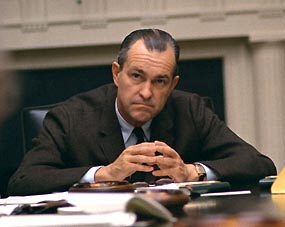
CIA Director Richard Helms
The man who had prepared the NIE and gave it to Helms was the CIA’s chief science and technology officer, Carl Duckett. After Helms met with Johnson, the CIA Director told Duckett about the President’s rather odd reaction. LBJ did not get upset, and he did not order an investigation into how it happened. Further, he did not tell Helms to let both the Defense Department and State Department know about it so they could establish intelligence inquiries or consider sanctions.
Instead, Johnson did the opposite. He told Helms to keep the news secret and specifically told the Director not to let the secretaries of State or Defense know about it.
Helms obeyed the orders of his Commander in Chief, but he decided to talk to the FBI about how this development had occurred earlier than expected. Thus begins Roger Mattson’s Stealing the Atom Bomb: How Denial and Deception Armed Israel, the riveting story of duplicity, betrayal, cover-ups and deceit.
As the book shows, the cover-ups and duplicity did not just come from Israel and its agents in America. The deceit also came from men inside the American government who, for whatever reasons, decided to cast a blind eye on what was really happening under their jurisdiction, even after they had been alerted to it.
What Mattson reveals is no less than an atomic heist – one that could have been prevented if men in high positions had done their duty.
Highly Enriched Uranium
After Johnson told Helms not to tell State or Defense, the CIA Director called Attorney General Ramsey Clark, because what made this news even more ominous — and a potential crime — was what the CIA had discovered when it conducted a chemical test around the Israeli nuclear reactor at Dimona, in the Negev desert.

U.S. AG Ramsey Clark with Lyndon Johnson in 1967
Duckett had concluded that Israel had something that they should not have possessed at that time: HEU, or highly enriched uranium, which could only be produced by one of the five major powers that already had nuclear weapons.
But the test had also revealed characteristics that showed the material had originated in the United States. (Mattson, p. 97) Specifically, the HEU came from Portsmouth, Ohio and then was further processed at a plant in Apollo, Pennsylvania.
The importance of this information was that the HEU was processed to such a degree – well over 90 percent U 235 – that it was classified as weapons grade uranium. The technical term for it is the acronym SNM, or Special Nuclear Material, meaning that it is fissile: it can easily be split with neutrons. Although the Portsmouth plant is shut down today, beginning in 1956 it did produce weapons-grade uranium.
It was in Apollo, Pennsylvania, that the trail of the SNM and the crime of its diversion becomes exceedingly suspect. The plant that did the further processing of HEU, and the ultimate shipping, was named Nuclear Materials and Equipment Corporation, or NUMEC, and there were a number of reasons why suspicion had centered on NUMEC even before Helms called Clark.
First, NUMEC had a rather unreliable record when it came to keeping track of HEU and other materials that had been given to it through the Atomic Energy Commission (AEC). The way the system worked is that the particular company would forward its business requests — from either private or governmental agencies — to the AEC. The AEC would then estimate how much nuclear material NUMEC would need to fulfill the contract. If a company was using up more material than the AEC properly estimated, that company would be fined quite a lot of money. If the shortages persisted, the AEC and the FBI could then open up an investigation.
With CIA’s discoveries, the possibility presented itself that a diversion of the nuclear material could be taking place. Either someone from the outside was stealing the material, or someone on the inside was embezzling it.
As Mattson shows with charts, graphs and testimony, NUMEC had an extraordinarily bad record in this regard. The company was eventually fined over $2 million for missing materials, which, with inflation factored in, would be about $15 million today. Mattson adduces that from 1959 to 1977, about 345 kilograms of HEU went missing from NUMEC, which translates to well over 700 pounds. (ibid, p. 286)
Explaining the Deficits
In just one year, there was a loss of over 56 kilograms (or about 123 pounds). The company made up all sorts of rationales as to why this much HEU was missing, including losses during the mechanical processing. But as the author points out, there are two problems with this accounting.
First, no other plant in America reported losses of this magnitude. The AEC concluded that the losses at Apollo were more than double what they were at any other comparably sized atomic plant in the U.S. (ibid, p. 65)
Secondly, even if one chalks up some of the missing HEU to a processing loss, that still does not account for the entire record of NUMEC. Mattson figures that, even giving the company the benefit of the doubt, it still leaves about 200 pounds of missing HEU. (ibid, p. 67) That’s enough for about six atomic bombs, larger than the one used on Hiroshima.
As Mattson reports, what makes NUMEC an even more intriguing suspect is the fact that the company had some legitimate business transactions with Israel, concerning the irradiation of plants. And these legitimate packages were sent at about the time the HEU went missing. Further, the inventory records at NUMEC were extremely sloppy and some appear to have been destroyed in direct violation of the AEC code, meaning NUMEC should have been cited, but wasn’t. (ibid, p. 75)
That brings us to the founders of the NUMEC plant in Apollo, Pennsylvania, a small town of approximately 1,600 people that lies about 30 miles northeast of Pittsburgh. In 1955, the Apollo Steel Plant was purchased by David Lowenthal. Two years later, Lowenthal and Zalman Shapiro cooperated in forming NUMEC.
Shapiro, a very accomplished metallurgist who lived next door to Lowenthal, had been employed for a number of years at the nearby Bettis Atomic Power Laboratory, which supported the AEC’s Office of Naval Reactors.
In May 1958, Lowenthal merged Apollo Steel with the San Toy Mining Company in Maine. San Toy then changed its name to Apollo Industries, with the main operating officers of this new corporation Morton Chatkin, Ivan Novick and Lowenthal. (ibid, p. 43)
The board comprised these three men plus Shapiro, and later others. In the early 1960s, the steel plant’s name was changed to Raychord Steel, but with the decline of the steel industry, Raychord became a subsidiary company to Apollo.
Ties to Zionist Groups
Novick, one of Apollo’s officers, later served as national president of the Zionist Organization of America, in which Chatkin, another officer, also held a leadership role. The ZOA was a member group of the American Zionist Council, which later became the American Israel Public Affairs Committee, which today is considered to be the leading lobbying group for Israel and one of the most powerful lobbying groups in Washington.
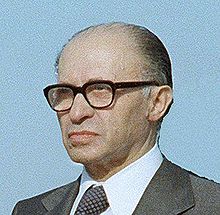
Israeli Prime Minister Menachem Begin
Novick also later served as a personal liaison between Ronald Reagan’s White House and the administration of Israeli Prime Minister Menachem Begin.
Lowenthal, who was born in Poland in 1921, came to America in 1932 and served in the American armed forces in World War II, eventually becoming a citizen in 1945. After the war, he worked with the Haganah, the Jewish paramilitary force inside Palestine, on the Zionist mission to ferry Jews into Palestine in 1947 on board the boat SS Exodus.
Since almost none of the passengers had legal immigration certificates to enter Palestine, the British Royal Navy, which ran the Palestinian Mandate, seized the ship and deported its passengers back to Europe. Lowenthal’s mission was a practical failure, but a tremendous propaganda success for the Zionist cause. The event was novelized by author Leon Uris in the number-one best-selling book Exodus, which was published in 1958 and was made into a movie two years later by director Otto Preminger, starring Paul Newman.
Lowenthal later served on board the ship Pan York, which also attempted to evade the British quarantine but was captured in Cyprus with the crew arrested, including Lowenthal. He escaped and fled to Palestine where he served with the Haganah during the war that broke out there in 1948 after the British abandoned the mandate early. (ibid, p. 44)
Lowenthal ended up serving under the legendary Meir Amit, the leading intelligence officer in Israel during the 1960s. Lowenthal was also personally acquainted with future prime ministers David Ben Gurion and Golda Meir.
Nuclear Experience
Shapiro, who had advanced degrees in chemistry and metallurgy from Johns Hopkins, worked for Westinghouse and the Navy on the nuclear reactor that powered America’s first atomic submarine, the Nautilus. Shapiro also helped develop the fuel for the first commercial nuclear reactor, the Shippingport Atomic Power Station in Pennsylvania.
Like Lowenthal, Novick and Chatkin, Shapiro also was active in supporting Israeli causes, although his activities had a slightly educational tone. He was a member of the Technion Society, which supported advances in Israeli science and technology. Indeed, he became an Honorary Life Member of the group.
He also was a Director of Hillel, an international organization that tries to acquaint Jewish students with each other on campuses and organize student trips to Israel. Like Novick and Chatkin, he was a member of the Zionist Organization of America. Many years later, it was discovered that Shapiro was on the Board of Governors of the Israeli Intelligence Center, which honors spies for Israel who clandestinely advanced the interests of the state. (Mattson, p. 84)
Beyond the individual backgrounds of these four men, there was also something else which should have attracted the U.S. intelligence community’s attention prior to Helms’s meeting with President Johnson. While running NUMEC, both men – Shapiro and Lowenthal – were taking trips to Israel and had contacts with high officials of Israeli intelligence as well as Israel’s version of the AEC.
Further, NUMEC had a guest worker, an Israeli metallurgist, in its plant, as part of an agreement NUMEC had with Israel to serve as a training consultancy which resulted in the formation of a joint company with Israel called ISORAD that initially was to deal with irradiation of citrus fruits through gamma rays. But the FBI later discovered that NUMEC also had contracts with Israel for the development of plutonium oxide as fuel elements in nuclear reactors. (Mattson, pgs. 80-81)
Since Lowenthal had so many acquaintances in high positions, he often visited Israel, including a most curious instance at about the time he purchased Apollo Steel in 1956. It was at this time that Israel was making decisions about foreign sourcing for nuclear materials and technology.
A year later, NUMEC was formed and Shapiro immediately applied for a license from the AEC to process uranium fuel in a building formerly occupied by Apollo Steel. John Hadden, CIA station chief in Tel Aviv, later noted the unusual coincidence of these events on two continents. (ibid, p. 45)
Israeli Visits

Israel’s Dimona nuclear weapons plant
But declassified FBI files reveal that the visitations were not just one way, i.e. from Apollo, Pennsylvania, to Israel. There were also visits and meetings of Israeli officials who went to Apollo.
At the time of those meetings, there were four main branches of Israeli intelligence. The Shin Bet corresponded with the Federal Bureau of Investigation; the Mossad with the Central Intelligence Agency; the Aman roughly with the Defense Intelligence Agency; and the LAKAM, which was responsible for security at Dimona and for procuring scientific and technological data from Western sources. (Mattson, p. 108)
In the mid-1960s, France started scaling back its support for the Dimona reactor, which was supposedly a research facility. With France’s pullback, LAKAM began seeking out and purchasing parts and supplies from other sources to complete the project.
LAKAM’s job included concealing the reactor’s true function – the development of a nuclear bomb – from American inspections. (ibid) During an American inspection in 1964, LAKAM even created a “Potemkin village” control room to deceive the visitors.
Unlike American intelligence, Israel also had a special operations unit that served all branches. Established in 1957, it was run by Rafi Eitan and his deputy, Avraham Bendor. (In the 1980s, Eitan became notorious for the Jonathan Pollard spy case, in which Pollard, a navy intelligence employee, was paid tens of thousands of dollars to spy for Israel in the United States with Eitan his ultimate control agent.)
In September 1968, the AEC told the FBI that they were giving permission to NUMEC for a visit by four Israelis, including Eitan and Bendor. However, in the application to the AEC, the occupations of the two were disguised. Eitan was said to be a chemist in the Defense Ministry; Bendor supposedly worked for the electronics division. (ibid, p. 110)
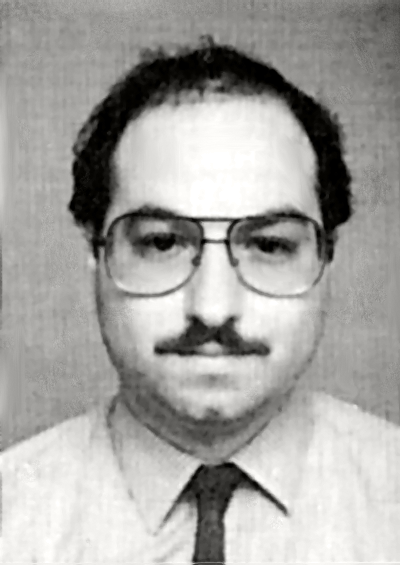
Convicted Israeli spy Jonathan Pollard
The other two men were Avraham Hermoni, who was billed as a Scientific Counselor in the Israeli Embassy in Washington, and Dr. Ephraim Biegun, described as working in the Division of Electronics for Defense. Again, this was misleading. Hermoni did, at times, work out of Washington’s Israeli Embassy, but his prime and most important function was overseeing and planning Israel’s nuclear weapons program, which he did from 1959-69. Biegun was actually head of the technical division of the Mossad from 1960-70.
CIA Suspicions
After the visit, NUMEC reported that the four men were in Apollo to buy thermo-electrical generator systems. (ibid, p. 119) Why Eitan and Bendor had to be there for that purpose is not readily apparent.
CIA officer John Hadden thought the real reason for the visit was that Shapiro was divulging top-secret technical information about plutonium manufacture – and that he was aided in this by the visiting Israeli scientist working at NUMEC. The FBI later came to agree that this was most likely the true reason for the visit. (ibid, p. 120)
Hermoni revisited Shapiro in November 1968, but the capstone to the visits to Apollo came later that month. As noted previously, France had cut back on its support for Dimona in the mid-1960s, halting the supply of uranium fuel in 1967.
In late November 1968, the Mossad arranged a covert operation called Operation Plumbat, which employed a front company in West Germany to purchase 200 tons of uranium yellowcake from Belgium. The transaction was approved by Euratom, the European organization controlling such transactions, but once the transport ship set sail for the port of Genoa, Italy, it was intercepted by another ship used by the Mossad. When the original ship reached port, the hull was empty.
The timing of this operation, on the heels of the mysterious visits by Israeli intelligence agents to Apollo, seems to constitute powerful circumstantial evidence of Israeli intentions.
Then, right after the completion of the Plumbat mission, who arrived in Israel? None other than Zalman Shapiro. The FBI discovered that in November 1968, in addition to the personal visits, Shapiro was in frequent phone contact with a number of Israeli intelligence agents, including Hermoni. (Mattson, p. 126)
A Longstanding Goal
Israel’s long trail of subterfuge and duplicity was part of a longstanding goal. As early as 1948, David Ben-Gurion, Israel’s first prime minister, stated that what Einstein, Teller and Oppenheimer did for America, they could easily do for Israel, since they were all Jews. In fact, he offered Einstein Israeli citizenship, which the great man declined. (ibid, p. 22) Ben-Gurion then had two meetings with Oppenheimer and numerous ones with Teller.
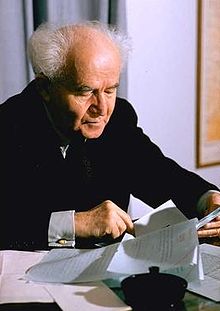
David Ben-Gurion, Israel’s first PM
Ultimately, Israel settled on David Bergmann, a brilliant chemist whom Ben-Gurion appointed first chief of the Israel Atomic Energy Commission in 1952. By 1955, Bergmann was essentially running the day-to-day operations of Israel’s atomic program.
In a conversation with the American ambassador, Bergmann said the Israeli science education program was adequate in physics and chemistry but weak in engineering and non-existent in metallurgy. He also revealed that the design he had laid out for a reactor was the same as the one at Shippingport, Pennsylvania, an intriguing clue because Shapiro was a metallurgist and had worked on the Shippingport power station.
Indeed, Shapiro eventually met Bergmann and the two became close friends and colleagues, serving on the board of ISORAD, which was a joint venture of NUMEC and the IAEC. Bergmann made his first visit to America for IAEC in 1956, the year before Lowenthal turned Apollo Steel into NUMEC.
There were two significant investigations of Shapiro and NUMEC. The first was instigated by Dick Helms’s call to Ramsey Clark in 1968 and the discovery of the highly enriched uranium at Dimona. (Mattson, p. 99) The second began in 1976 when Jim Conran, a whistleblower at the Nuclear Regulatory Commission, voiced complaints about the background and actions of Shapiro. Conran was a security officer and his warnings eventually got the attention of the White House. (ibid, p. 161)
During the first investigation, the FBI could not find enough evidence to justify a violation by Shapiro of the Foreign Agents Registration Act, which mandates that any person in the U.S. who is representing a foreign country’s interests has to register with the Justice Department. But the FBI did recommend cancelling Shapiro’s security clearances, based on wiretaps that revealed Shapiro in close contact with Israeli intelligence officials and with members of the IAEC. (ibid, p. 138)
During these calls Shapiro reportedly said he would help Israel in any way that he could. He also expressed frustration with the new ownership at NUMEC, which had been purchased by ARCO. But his Israeli contacts said he was too valuable to leave and encouraged him to stay there. (ibid, p. 139)
FBI Surveillance
One of the most curious episodes that the FBI surveillance revealed was a meeting between Shapiro and a man named Jeruham Kafkafi, a suspected Mossad officer working under diplomatic cover. He had left Washington by air on the morning of June 20, 1969, and met Shapiro at the Pittsburgh airport for about an hour. He then left and flew back to Washington.
As a result of that surveillance, Shapiro was interviewed by the AEC in August 1969, with some of Shapiro’s answers to questions rather dubious. For instance, he said he did not know Hermoni was in charge of the Israeli nuclear development program and thought he was a university professor. Shapiro said his discussions in September and October 1968 with the Israeli officers were about water contamination, saboteur detection and military activities.
When asked why the Israelis could not have talked to the Defense Department about those topics, Shapiro had no answer. The interviewer wrote in his summary that Shapiro was cool and calm throughout except when the Kafkafi meeting was brought up. At first, Shapiro said he could not recall it, even though it happened just two months earlier. He then said he did remember it, claiming it was about an overdue invoice and a power supply resource. (p. 142)
The AEC investigators did not find the last reply credible, since it did not seem to justify an airline flight from Washington to Pittsburgh and back. Shapiro adjusted his answer by saying that there was some discussion of an investigator whom he knew from America who was going to visit Israel. He also added the figure of $32,000 as to how much Israel owed NUMEC. As Mattson notes, again, this explanation does not seem to justify an air flight and an hour-long meeting with a clandestine Mossad officer.
Closing the Inquiry
The man who ultimately decided to close this initial inquiry was Glenn Seaborg, head of the AEC. Not only did he not see any civil or criminal charges as being viable, but when President Richard Nixon’s Attorney General John Mitchell recommended revoking Shapiro’s security clearances, Seaborg balked at that also.
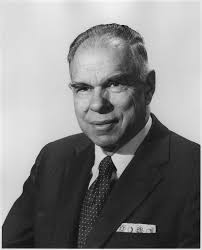
Glenn Seaborg, chairman of the AEC
Mattson clearly sees Seaborg as being a villain in the piece. Late in the book, he explicitly accuses him of running a cover-up. (see p. 297) And, there is evidence to back up this charge. It was later discovered, during the second inquiry, that Seaborg had a close personal friendship with Shapiro. (ibid p. 268)
Earle Hightower, assistant director of safeguards at AEC, explicitly stated that the whole case regarding NUMEC was rigged because it was known that Seaborg would not take action. Little more than three years after Seaborg left the AEC, it was dissolved in 1975 and was replaced by the Nuclear Regulatory Commission, in part, because critics accused the AEC of an insufficiently aggressive regulatory program.
The second, much longer, and more vigorous inquiry into NUMEC and Shapiro came about at the creation of the NRC when Jim Conran was tasked with reviewing the record of how safeguards had worked previously for the AEC so they could be strengthened in the future. In that review process, he came across the case of Shapiro and NUMEC.
When Conran asked to see more files on both, he was denied access, causing him to go up the NRC ladder to Chairman William Anders, who was briefed by, among others, Carl Duckett of the CIA. Since Anders was about to leave for a diplomatic post, he took his concerns to James Connor at President Gerald Ford’s White House.
In March 1976, the CIA’s Duckett addressed an informal gathering of pilots and astronauts, saying there was little doubt Israel had about 20 nuclear warheads. Although this was supposed to be off the record, the information leaked. In April 1976, Time reported that this claim was accurate, except the newsmagazine put the size of the arsenal at 13 bombs and added that the warheads could be delivered by Phantom jets or Jericho missiles.
Duckett wrote a memo to CIA Director George Bush in which he said he suspected that the Israeli program was jumpstarted by a diversion of enriched uranium from the NUMEC plant. (p. 165) He attached various appendices to the memo to show the results of previous inquiries into NUMEC and explain why his belief was justified.
One of the appendices consisted of a paper by John Hadden in which he expressed the suspicion that NUMEC was actually a shell company the Israeli government had set up for the express purpose of diverting materials, technology and information that Israel needed to speed up and facilitate its longstanding quest for atomic weapons. (ibid, p. 166)
A New Investigation
Attorney General Edward Levi was then sent a summary of the FBI’s previous investigation of NUMEC. Levi alerted Ford that he thought NUMEC was culpable for several crimes and, with Ford’s permission, he wished to begin a criminal inquiry. Since Ford’s close adviser James Connor was also disturbed by these findings, the President approved the investigation.
What followed was a tedious bureaucratic battle between the CIA and FBI. The FBI felt it did not have direct proof that a diversion had taken place, while the CIA had the proof — the chemical tests at Dimona — but was reluctant to reveal the intelligence to the FBI. Also, the CIA did not want to furnish the FBI with technical experts to help educate the investigating agents so they could effectively cross-examine important witnesses. Thus, the FBI’s inquiry dragged on through three presidents: Ford, Jimmy Carter and Ronald Reagan.
But even with these obstructions, the FBI did eventually find witnesses to a diversion from the Apollo plant. It turned out that the FBI did not do enough interviews of plant employees in its initial inquiry because there were at least four of them willing to talk. Those witnesses form the climax of Mattson’s book.
In 1980, one witness said that when he read newspaper accounts about the losses of enriched uranium at Apollo, he had to chuckle to himself. When asked why, he replied that in 1965 or 1966, he was walking near the loading dock at Apollo and saw people loading containers – the dimensions that were used for HEU packets – into equipment boxes. He noticed that the shipping papers for the boxes revealed that the packages were destined for Israel. This witness then suggested some other workers at the plant who had seen similar activity. (Ibid, p. 272)
Suspicion Shipment
One of these witnesses saw a flatbed truck backed up into the loading dock area with Shapiro pacing around the area while the driver was loading “stove pipes” into a cabinet on the truck. This struck the witness as odd because the plant had regularly assigned workers for loading duties during the day but this shipment was being prepared in the evening. He explained that “stove pipes” were cylindrical containers that the plant used to pack enriched uranium inside. Each stove pipe usually contained three or four packets of HEU.
When he glanced at the clipboard resting on a package, he saw the destination was Israel. The clipboard then was yanked away and an armed guard escorted him off the dock. He also said it was unusual to see Shapiro in this area of the plant, and further, that Shapiro was very seldom there at night. (ibid, p. 275)
There were two other witnesses who told the FBI about similar events. The FBI also interviewed an NRC inspector named James Devlin, who told the agents that, contrary to what Shapiro had said, the security at the Apollo plant was below par and that NUMEC did not employ a professional security force. The company had one regular armed guard and Devlin happened to know who he was, since he was also a deputy for the township. The only other guards were unarmed and non-uniformed. (ibid, pgs. 272-73)
By this time, the FBI did not want to continue the investigation, believing that nothing would come of it, although the Justice Department urged the investigators on. But the FBI was correct since, as Mattson notes more than once in his book, the last president who really wanted to stop Israel from becoming a nuclear power was John F. Kennedy. (See pgs. 38-40, p. 256)
Richard Helms’s conversation with a disinterested President Johnson underscores how that attitude changed after Kennedy’s death. As Mattson further notes, opposition to Israel’s nuclear-weapons program was more or less negated by President Richard Nixon’s meeting with Prime Minister Golda Meir in 1969 when he agreed that the U.S. would not make any public statements revealing Israel’s nuclear arsenal nor demand that it sign the Non-Proliferation Treaty, as long as Israel did no testing and made no public threats.
Even that policy was probably violated in 1979 with the Vela Incident: a suspected Israeli nuclear test done in the Indian Ocean.
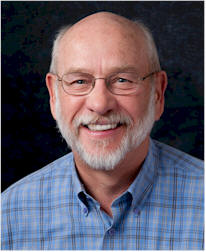
Author Roger Mattson
Author Roger Mattson was part of the inquiry about the illegal transfer of atomic secrets to Israel, working in the NRC’s safeguards department when Conran first voiced his fears about a diversion at NUMEC. Thus, Mattson became part of an internal review of the Shapiro case, seeing firsthand how certain intelligence agencies were, by accident or design, obstructing the investigation.
Mattson concludes his important book by stating that this policy of casting a deliberate blind eye towards a nuclear heist by Israel places the U.S. in a compromised position when trying to enforce a policy of non-proliferation on other nations because of the obvious double standards.
To point out one paradox, the U.S. government executed Julius and Ethel Rosenberg for purportedly supplying nuclear secrets to the Soviet Union with less evidence. Plus, the tinder box of the Middle East is probably the last place where America should have allowed atomic weapons to proliferate, but it did.
Because of that, the U.S. has little or no moral authority on the issue today.
James DiEugenio is a researcher and writer on the assassination of President John F. Kennedy and other mysteries of that era. His most recent book is Reclaiming Parkland.
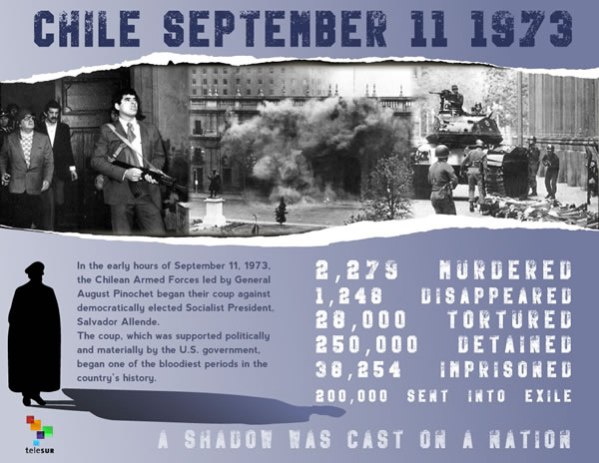
Last words to the nation of Salvador Allende
Last words to the nation of Salvador Allende
Surely this will be the last opportunity for me to address you. The Air Force has bombed the towers of Radio Portales and Radio Corporación.
My words do not have bitterness but disappointment. May they be a moral punishment for those who have betrayed their oath: soldiers of Chile, titular commanders in chief, Admiral Merino, who has designated himself Commander of the Navy, and Mr. Mendoza, the despicable general who only yesterday pledged his fidelity and loyalty to the Government, and who also has appointed himself Chief of the Carabineros [national police].
Given these facts, the only thing left for me is to say to workers: I am not going to resign!
Placed in a historic transition, I will pay for loyalty to the people with my life. And I say to them that I am certain that the seed which we have planted in the good conscience of thousands and thousands of Chileans will not be shriveled forever.
They have strength and will be able to dominate us, but social processes can be arrested neither by crime nor force. History is ours, and people make history.
Workers of my country: I want to thank you for the loyalty that you always had, the confidence that you deposited in a man who was only an interpreter of great yearnings for justice, who gave his word that he would respect the Constitution and the law and did just that. At this definitive moment, the last moment when I can address you, I wish you to take advantage of the lesson: foreign capital, imperialism, together with the reaction, created the climate in which the Armed Forces broke their tradition, the tradition taught by General Schneider and reaffirmed by Commander Araya, victims of the same social sector which will today be in their homes hoping, with foreign assistance, to retake power to continue defending their profits and their privileges.
I address, above all, the modest woman of our land, the farmer who believed in us, the worker who labored more, the mother who knew our concern for children. I address professionals of Chile, patriotic professionals, those who days ago continued working against the sedition sponsored by professional associations, class-based associations that also defended the advantages which a capitalist society grants to a few.
I address the youth, those who sang and gave us their joy and their spirit of struggle. I address the man of Chile, the worker, the farmer, the intellectual, those who will be persecuted, because in our country fascism has been already present for many hours — in terrorist attacks, blowing up the bridges, cutting the railroad tracks, destroying the oil and gas pipelines, in the face of the silence of those who had the obligation to protect them. They were committed. History will judge them.
Surely Radio Magallanes will be silenced, and the calm metal instrument of my voice will no longer reach you. It does not matter. You will continue hearing it. I will always be next to you. At least my memory will be that of a man of dignity who was loyal to [inaudible] the workers.
The people must defend themselves, but they must not sacrifice themselves. The people must not let themselves be destroyed or riddled with bullets, but they cannot be humiliated either.
Workers of my country, I have faith in Chile and its destiny. Other men will overcome this dark and bitter moment when treason seeks to prevail. Go forward knowing that, sooner rather than later, the great avenues will open again where free men will walk to build a better society.
Long live Chile! Long live the people! Long live the workers!
These are my last words, and I am certain that my sacrifice will not be in vain, I am certain that, at the very least, it will be a moral lesson that will punish felony, cowardice, and treason.
A new international control regime on armed drones led by the US? What is going on?
By Chris Cole • Drone Wars UK • September 2, 2016
The United States has begun moves to develop what amounts to a new international control regime on the proliferation and use of armed drones. US officials presented details of a ‘Proposed Joint Declaration of Principles for the Export and Subsequent Use of Armed or Strike-Enabled Unmanned Aerial Systems (UAS)’ to international export control officials during the arms trade treaty review conference in Geneva this week.
US officials told Defense News, who first revealed the initative, that the joint declaration – to be signed by as many nations as possible – is the first of a two-stage process. The declaration, official stated, would addresses “the misperceptions” about the use of armed drones, as well as “the complicated, sensitive and controversial aspects”. Although the draft joint declaration has not been made public, it appears to echo the US’ own policy guidance on the export of armed drones put in place in Spring 2015. Defense News reports that the current draft
“lays out five key principles for international norms, including the “applicability of International law” and human rights when using armed drones; a dedication to following existing arms control laws when considering the sale of armed unmanned systems; that sales of armed drone exports take “into account the potential recipient country’s history regarding adherence to international obligations and commitments”; that countries who export unmanned strike systems follow “appropriate transparency measures” when required; and a resolution to continue to “ensure these capabilities are transferred and used responsibly by all States.”
The second stage of the process is the establishment of an international working group on armed drones for those who sign the declaration, which will devise “a voluntary Code of Conduct for exporting and importing nations.”
Why is this happening?
Over the past three years, as we have written previously, there has been a real rise in the proliferation of drones by Israel, the US and in particular by China. Iraq, Nigeria, and apparently Egypt have all gone on to launch drone strikes over the past two years utilising armed drones bought from China.
On the one hand US drone industry lobbyists have long argued that their industry is hampered by the US membership of the Missile Technology Control Regime (MTCR) which controls the export of larger drones as neither China nor Israel are members (although Israel says it abides by its rules voluntarily). The drone industry has argued that the MTCR rules need to be ‘relaxed’ in order for the US to gain its fair share of the market. This new initiative seemingly therefore arises in part from drone industry lobbying to put in place a process which they want to see as levelling the playing field.
On the other hand, the outgoing Obama administration is also legacy shopping. Stung by international criticism of its use of armed drones over the past decade it wants at least the appearance of putting in place international rules to restrict the proliferation and use of such technology
It seems these two disparate and contrary ideas have come together in this new process.
Prospects for success?
Although a number of countries are working individually or jointly to develop an advanced drone industry, currently the US, Israel and China are the market leaders. While China is unlikely to be involved in this new US-led initiative, US officials apparently believe that they can persuade Israel to join. Israel has never even confirmed that it operates armed drones, so Israeli officials often refuse to talk on the record about the issue but early reports indicate a great deal of scepticism and alarm from Israel about the initiative.
Israel and China however will not be the only nations suspicious of any drone control initiative led by US, fearing that it is simply about the US promoting its own commercial and political interests. Campaigners and the human rights community too will need convincing that such an initiative is a genuine attempt to curb proliferation and use beyond the bounds of international law. After all, we have spent the last decade watching the US “interpret” (i.e. bend and break) international law in this area in its own interests.
However, despite genuine suspicions, the seeming acceptance of the need for an international control regime on the proliferation and use of armed drones is to be welcomed. Armed drones are a real and genuine danger to international peace and security. While there is a long, long way to go and many – if not most – will need to be convinced, that this is the right process, failure will also play into the hands of those who argue that there should not and cannot be such controls.
Reported Death Of TTIP – An Abhorrent Political Deception

By Graham Vanbergen | TruePublica | September 9, 2016
The global mainstream media have loudly hailed the stunning success of the peoples uprising against the Transatlantic Trade and Investment Partnership or TTIP in the light of its demise. In the last few years protests broke out all over Europe as the unelected bureaucrats steamed ahead with this unpopular trade deal, even after the results of the largest ever consultation study in the EU Commission’s history resulted in a 97% negative response of 150,000 people.
The emerging movement spawned enormous online activism never seen before, culminating in the largest petition in Europe’s history with a staggering collective of over 3.2 million signatures delivered by passionate foot-soldiers right to the epicentre of where the political elite inhabit in the EU. The beating heart of TTIP activism was Berlin, Paris and London. This is not to forget the huge protest effort made by citizens across almost all of the EU’s major cities.

Infographic: Corporate Europe Observatory
When preparing for TTIP negotiations, 560 meetings took place between 2012 and 2013. Just 4% were represented by public interest and civil society. Unashamedly, the Commission allowed 92% of all TTIP meetings to be dominated by lobbyists and corporate trade associations Today, these shadowy agitators amount to over 30,000 grey suits stalking the halls of the Commission HQ in the de facto capital of the European Union in Brussels.
In May of this year Wikileaks confirmed that TTIP amounted to “a huge transfer of power from people to big business.” Greenpeace Netherlands then leaked 248 secret pages of the controversial trade deal between the U.S. and EU, exposing how environmental regulations, climate protections and consumer rights were effectively being “bartered away behind closed doors.” Tensions amongst civil society rose to fever pitch with the devastating news.
Der Spiegel Germany wrote “Protests Threaten Trans-Atlantic Trade Deal” as the leaks became public. With concerted effort activists seemingly brought the trade agreement to the brink of collapse within days. At the same time, Merkel’s grandly staged meeting with US President Barack Obama in Hanover was nothing more than showmanship. It aimed to show the strain of negotiations, as if somehow Germany (and therefore the EU) was going to get a better deal from TTIP and pacify the building rage of her citizens.
As if to rub salt into the wounds a report by TruePublica, published in The European Financial Review confirmed that corruption in the EU trading bloc had now reached 14 per cent of GDP – a staggering €1 trillion. By now 70 per cent of all European citizens believe corruption to be at the heart of their respective governments and the EU Commission itself, and that a corporate coup d’tat is taking the place of democratic principles that Europe fought so hard for over generations.
Then, out of the blue, an unexpected announcement is made last week. The media on all sides of the spectrum is broadly going along with the story that French Prime Minister Manuel Valls and German Vice Chancellor and Economy Minister Sigmar Gabriel have agreed that negotiations between the EU and the US on TTIP, have essentially failed. That’s it – the deal is dead. Hoorah!
The Telegraph – “EU’s TTIP trade deal with the US has collapsed, says Germany”
The Independent – “TTIP negotiations should stop, French government says”
ZeroHedge – “The Americans Give Us Nothing”: France Effectively Kills TTIP’
RT – ‘TTIP negotiations between EU and US have de facto failed’ – German economy minister”
Not so fast. You don’t think that the American’s are going to let the biggest trade deal in human history fail just because 97% of citizens reject it do you? No, France and Germany just need a plan. After Brexit, Britain can stay out of the firing line of the protest movement for a while.
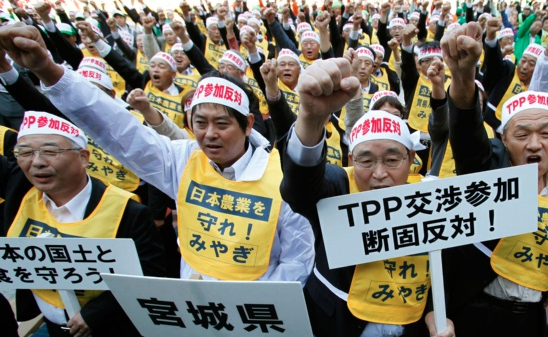
Mass protests in Japan
So, they looked to Japan. It had the same problem with its version of the trade deal similarly called TPP. Mass protests broke out as the same secret meetings gripped the political foreground. Its Prime Minister “Shinzo Abe, instructed the coalition early in the year not to “forcibly” proceed with the TPP negotiations until after elections, Kyodo News reported. Abe genuinely “feared a voter backlash in the Upper House elections” amid the growing scandal of a 242 page leaked document laying bare the bones of the deal. Having been elected June 11th, Abe now intends to force the deal through “this fall”.
I made enquiries with sources close to the ground on the EU/US TTIP deal along the same lines; was this simply a delaying tactic until after elections in 2017 for France’s Hollande and Germany’s Merkel? The response was not wholly unexpected.
“The seemingly early celebration of the end of TTIP has also surprised us a bit. Despite last week’s statements by the German and French trade ministers and the way these have been portrayed, we are continuing to campaign against the deal.”
In another exchange:
“The declarations of French and German leaders aim to: divert attention away from CETA, reduce the numbers in the streets of Germany on 17th September, put TTIP on hold while elections take place in France, Germany and the USA. The fifteenth round of TTIP negotiations will happen in the first week of October… This has been confirmed by our US friends.”
I then contacted Corporate Europe Observatory (CEO). It is a research and campaign group working to expose and challenge the privileged access and influence enjoyed by corporations and their lobby groups in EU policy making. They have been exposing the misinformation and propaganda of the EU Commission for years.
The CEO response to my same question was emphatic and quite clear:
“Public opposition to CETA and TTIP has led French and German leaders to please voters with words against TTIP. Unfortunately, the next round of TTIP negotiations is scheduled for early October and no EU leader has publicly said he or she will vote against CETA in the EU Council in October. This is clearly not the end of TTIP and CETA, just the beginning of electoral campaigns in France and Germany.”
Germany and France have taken the same stance as Japan on these trade agreements, they are not dead at all – they are lying.
I then spoke to Peter Koenig, an economist and geopolitical analyst. He is also former World Bank staff and worked extensively around the world in the fields of environment and water resources and posed the same question. He said:
“Following a debate on PressTV Edition Française, where I was one of the interviewees, the focus was on the German and French Ministers’ expressed conclusion that TTIP negotiations failed. I wrote an article “The TTIP is Dead”, hoping that spreading of this ‘promise’ by the highest authorities of the two key countries in the EU would make sure among the European populace that any deviation from this ‘promise’ would be perceived as a lie and receive strongest public expressions of protest.”
“In the meantime, it has become clear that the TTIP and TISA ‘deals’ are not at all dead. In fact, shortly after the German and French announcements, Jean-Claude Juncker, the unelected President of the European Commission, declared majestically that for him the negotiations are not dead.”
Koenig continues,
“There are other means to infiltrate the TTIP into the EU, i.e. through CETA and according to Juncker, doesn’t need ratification of each EU members’ parliament. Then there is TISA, the even more secret ‘trade agreement’ between 50 countries around the globe. TISA could easily be used to clandestinely impose TTIP rules on Europe.”
Nick Dearden, Director of Global Justice Now confirmed what Peter Koenig is saying in a Guardian piece “Think TTIP is a threat to democracy? There’s another trade deal that’s already signed”
“TTIP is not alone. Its smaller sister deal between the EU and Canada is called CETA (the Comprehensive Economic and Trade Agreement). CETA is just as dangerous as TTIP; indeed it’s in the vanguard of TTIP-style deals, because it’s already been signed by the European commission and the Canadian government. It now awaits ratification over the next 12 months.
The one positive thing about CETA is that it has already been signed and that means that we’re allowed to see it. Its 1,500 pages show us that it’s a threat to not only our food standards, but also the battle against climate change, our ability to regulate big banks to prevent another crash and our power to renationalise industries.
CETA contains a new legal system, open only to foreign corporations and investors. Should the British government make a decision, say, to outlaw dangerous chemicals, improve food safety or put cigarettes in plain packaging, a Canadian company can sue the British government for “unfairness”. And by unfairness this simply means they can’t make as much profit as they expected. The “trial” would be held as a special tribunal, overseen by corporate lawyers.”
What is missing from this statement is that any American corporation headquartered in Canada can sue any nation in the EU via CETA for the same reasons – namely, loss of ‘expected’ profits. They don’t actually have to be Canadian corporations.
As Global Justice also confirms, Canada has itself fought and lost a plentiful and diverse range of legal cases brought by US corporations under the North American Free Trade Agreement (Nafta) for “outlawing carcinogenic chemicals in petrol, reinvesting in local communities and halting the devastation of quarries.” If TTIP doesn’t bring this horrific erosion of democratic power to the shores of Europe, CETA will. ‘Brexit’ will mean for nothing. It will be sold to the British people as a global trade agreement which will be heralded as a great success and supported by much of the media who themselves have a vested interest in such deals.
In the end, does it matter if it’s called TTIP, CETA, TISA and the like, they are all shadowy unaccountable acronyms designed to enrich the few via extreme neoliberal capitalism under the guise of free trade.
North Korea’s Understandable Fears
By James Bradley | Consortium News | September 10, 2016
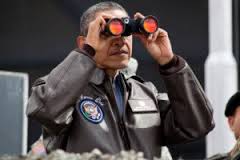
‘Near the ceasefire line’ (Photo by Pete Souza)
North Korea carried out its fifth nuclear test on Friday, drawing condemnation from President Obama and a charge from the Pentagon that the test was a “serious provocation.” Ho-hum, here we go again.
Every year, America pays its vassal-state South Korea huge sums of U.S. taxpayer money to mount 300,000-man-strong military “games” that threaten North Korea. North Koreans view images that never seem to make it to U.S. kitchen tables: hundreds of millions of dollars’ worth of U.S. armaments swarming in from the sea, hundreds of tanks and thousands of troops – their turrets and rifles pointed north – and nuclear-capable U.S. warplanes screaming overhead.
But when a young dictator straight out of central casting responds to U.S. threats with an underground test on North Korea’s founding day, it’s the number-one story on the front page of the New York Times.
Let’s connect some dots. Washington and their note takers in the American press constantly tell us that crazies in Pyongyang and Tehran are nuclear threats. The misplaced, but easily sold, fears of the “North Korean missile threat” and the “Iran missile threat” allows the Pentagon to install “defensive” missile systems in South Korea and Eastern Europe which actually amount to offensive systems targeting Beijing and Moscow (by making first strikes against China and Russia more feasible).
We need to look beyond the simplistic, race-based cartoon-like scaremongering to see that far more reality-based and frightening is the nuclear threat posed by the United States.
President Obama — the Nobel Prize winner who pledged to lead a nuclear-free world — has committed over $1 trillion dollars to modernize America’s nuclear arsenal. Almost unreported by the press, we have been spending a bundle to make nukes “usable,” by miniaturizing them. And to top it off, Obama has maintained a “first use” option for the U.S. nuclear arsenal.
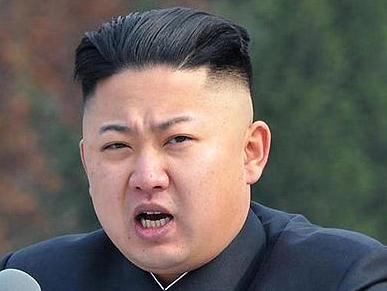
North Korean leader Kim Jong Un
Forget the tin-pot dictator with a bad crew-cut who leads an impoverished country. Here’s for some really scary reading:
Obama’s Trillion-Dollar Nuclear-Arms Train Wreck
Obama plans to retain first-use nuclear option
New U.S. Nuclear Bomb Moves Closer to Full-Scale Production
THAAD: A Major Security Risk for the ROK
James Bradley is author of several bestsellers including Flyboys and Flags of Our Fathers. His most recent book is The China Mirage: The Hidden History of American Disaster in Asia.
Featured Video

Piers Corbyn on religion of climate change
or go to
Aletho News Archives – Video-Images
Book Review
How the U.S. Navy Sold the Vietnam War
By Gareth Porter | TruthDig | March 27, 2019
Dr. Tom Dooley, whose best-selling book “Deliver Us From Evil” helped create a favorable climate of opinion for U.S. intervention in South Vietnam, has long been linked to legendary CIA officer Edward G. Lansdale and his black operations in Vietnam between 1954 and 1955. But the real story about Dooley’s influential book, which has finally emerged from more recent scholarly research, is that it was engineered by an official of the U.S. Navy’s Pacific Command, Capt. William Lederer.
Lederer is best known as the co-author, with Eugene Burdick, of the 1958 novel “The Ugly American,” which was turned into a 1963 movie starring Marlon Brando. Far more important, however, is the fact that from 1951 through 1957 Capt. Lederer was on the staff of the commander in chief of the U.S. Pacific Fleet (CINCPAC), Adm. Felix Stump. … continue
Blog Roll
 Aletho News
- “Inside Gaza” wins best documentary at Montreal’s Cinemania film festival
- Activists block German munitions plant over arms exports to ‘Israel’
- The Nasser Hospital attack and Israel’s relentless lies
- Could it be satan? No, Huckabee, just the Americans you work for
- AIPAC and more: Network of pro-Israel influence in US Congress
- Putin aide reveals Moscow’s stance on Europe at peace talks
- Imran Khan warns Pakistani judges he may die in prison
- IOF used Amazon facial recognition to track millions of Palestinians
- More EU Citizens Face Sanctions For Criticizing The Ukraine Proxy War
- In Mexico, the CIA Is Playing a Dangerous Game
- If Americans Knew
- An error has occurred; the feed is probably down. Try again later.
- No Tricks Zone
- New Study: Barents Sea Temperatures Were Warmer And Sea Ice Less Extensive In The 1700s Than Today
- German Authorities Start Initiative To Evaluate Public Register For Climate “Disinformation” Spreaders!
- Zonal Asymmetry of Temperature Change in the Antarctic Circumpolar Current
- New Study: The Net Fossil Fuel Contribution To Rising Atmospheric CO2 Has Been Zero For 500 Years
- Germany’s Green Energy Transition Becoming Increasingly Expensive…Another 6 Trillion Euros!
- Sudden Stratospheric Warming, Powerful El Niño Combination May Lead To Extreme Europe Cold, Energy Crisis!
- Two New Studies Find Thwaites Glacier Melt Cannot Be Driven By Human Activity Or A Warming Ocean
- E-Cars Reduce CO2 Emissions By Only 41% Compared To Internal Combustion Engine Vehicles
- Predictions Made By Renowned Climate Professor Over Past Decades Have Been Proven To Be Poor
- New Study Suggests Large Regions Of The Pacific Ocean Have Been Cooling For The Last 80 Years

