Russia questions “artificial” delay in Syrian peace talks
The BRICS Post | June 5, 2016
Russian Foreign Minister Sergey Lavrov, in a phone conversation with his US counterpart John Kerry, has expressed concern over “artificial” delays in the Syrian peace talks.
The UN-backed parties have not set a date for the resumption of the peace talks after the High Negotiations Committee suspended its participation over the intensifying of regime air strikes in recent weeks.
“They have discussed the situation in Syria in development of the telephone conversation they had a day earlier,” the Russian Foreign Ministry said. “Besides stressing the urgent task to separate the “moderate” opposition from Jabhat Al-Nusra, as the U.S. has promised earlier, Lavrov has expressed concern of the attempts to delay resuming of political talks for various artificial reasons, which was seen clearly during the UN Security Council briefing on Syria on June 3,” said a Russian Foreign Ministry statement.
The phone call was initiated by the US side.
Lavrov’s comments came amid a major Russian-backed offensive against the de-facto home of the Islamic State that aided the Syrian army’s push into Raqqa province on Saturday.
The Syrian army had made territorial gains and inflicted heavy casualties on the militants, state media reports said.
The UK-based Syrian Observatory for Human Rights said on Saturday at least 26 Islamic States militants had been killed along with nine from the Syrian and allied forces.
Meanwhile, more than 1,000 militants have begun an offensive against Syrian army positions southwest of Aleppo, the Russian ceasefire monitoring centre in Syria said in a statement on Saturday.
The chief peace negotiator of Syria’s main opposition bloc said last week that he was resigning over the failure of the UN-backed Geneva peace talks to bring a political settlement to the Syria crisis.
Hillary Comes Out as the War Party Candidate

By Diana Johnstone | CounterPunch | June 3, 2016
On June 2, a few days before the California primary, Hillary Clinton gave up trying to compete with Bernie Sanders on domestic policy. Instead, she zeroed in on the soft target of Donald Trump’s most “bizarre rants” in order to present herself as experienced and reasonable. Evidently taking her Democratic Party nomination for granted, she is positioning herself as the perfect candidate for hawkish Republicans.
Choosing to speak in San Diego, home base of the U.S. Pacific Fleet, on a platform draped with 19 American flags and preceded by half an hour of military marching music, Hillary Clinton was certain of finding a friendly audience for her celebration of American “strength”, “values” and “exceptionalism”. Cheered on by a military audience, Hillary was already assuming the role to which she most ardently aspires: that of Commander in Chief of the Armed Forces.
Whenever Hillary speaks, one must look for the lies. The biggest lies in this speech were lies of omission. No mention of her support for the invasion of Iraq, no mention of the disaster she wrought in Libya, no mention of her contribution to pursuing endless death and destruction in the Middle East.
But she also lied in claiming partial credit for the Iran nuclear deal, which she had tended to block, and most profoundly in presenting herself as a champion of diplomacy. As Secretary of State, she blocked diplomacy that would have prevented or ended conflict, most notoriously concerning Libya, where even senior U.S. military officers were told to cut off their contacts with Gaddafi agents seeking a peaceful compromise.
The Washington Post reported prior to the speech that her campaign “hopes there are many more national-security-minded Republicans and independents who would vote for her, even grudgingly, rather than see Trump win the White House.”
The Washington Post noted that the state of California’s “defense industry and military bases lend a backdrop for her speech.” Indeed! Hillary Clinton is quite simply catering to the military-industrial complex, as she has been doing throughout her career. She is catering to the arms industry, which needs to keep the American people scared of various “threats” in order to continue draining the nation’s wealth into their profitable enterprises. She needs the support of military men and women who believe in all those threats invented by intellectuals in think tanks and editorial offices.
This is the core of the “national-security-minded” electorate that Hillary is targeting. She warned that Trump would jeopardize the wonderful bipartisan foreign policy that has been keeping us great and safe for decades.
In reality, such “national-security-minded” leaders as Dick Cheney and Clinton herself have led the United States into wars that create chaos, inspire enemies and endanger everybody’s national security. Despite the geographically safe position of the United States, it is that bipartisan War Party that has created genuine threats to U.S. national security by prodding the hornets’ nest of religious fanaticism in the Middle East and provoking nuclear-armed Russia by aggressive military exercises right up to its borders.
The basis of Hillary Clinton’s world view is that notorious “American exceptionalism” which Obama has also celebrated. If we don’t rule the world, she suggested, “others will rush in to fill the vacuum”. She clearly cannot conceive of dealing respectfully with other nations. The United States, she proclaimed, is “exceptional – the last best hope on earth.”
Not all people on earth feel that way. So they must be brought to heel. In practice, this “exceptionalism” means acting above the law. It means a unipolar world policed by U.S. armed forces. In practice, Hillary’s devotion to “our allies” means fighting wars in the Middle East for the benefit of Israel and of Saudi Arabia, whose arms purchases are indispensable for our military industrial complex. It means bombing countries and overthrowing foreign governments, from Honduras to Syria and beyond, in order to help them conform to “our values”.
Trump is groping clumsily, at times idiotically, toward a major shift in US foreign policy. He is ill-prepared for the task. If ever elected, he would have to fire the neocons and take on a whole new team of experts to educate and guide him. That would be something of a miracle.
But some of Hillary’s reproaches aimed at Trump’s “reckless, risky” foreign policy statements are not as self-evident as she assumes. For example, his statement that he would sit down to negotiate with North Korean dictator Kim Jong Un. Is that really such a crazy idea?
North Korea is a small country, whose leaders call themselves “communist” but who are essentially a dynasty that emerged from the resistance against Japanese invaders in World War II. Their quarrel with South Korea stemmed from the domination of Japanese collaborators in that part of the country. That is practically ancient history, and today North Korea feels threatened – and is indeed threatened – by the everlasting U.S. military presence on its borders. A small isolated country like North Korea is not a real “threat” to the world. Even with nuclear weapons. Its much-vaunted nuclear weapons are clearly meant both to defend itself from attack and as a bargaining chip.
So would it be so terrible to sit down and find out what the bargain might be? Basically, North Korean leaders would like to make a deal to lessen the U.S. threat and bring their country out of isolation. Why not discuss this, since it could lead to the end of the “North Korean threat” which is artificial anyway?
Hillary’s reaction is typical. She boasts that her solution is to build up an expensive missile defense shield in Japan and increase everybody’s military buildup in the region. As usual, she goes for the military solution, ridiculing the notion of diplomacy.
Hillary Clinton’s speech will certainly sound convincing to the “national security minded” because it is so familiar. The same as George W. Bush but delivered with much greater polish. America is good, America is great, we must remain strong to save the world. This is the road to disaster.
Hillary Clinton is the clear candidate of the War Party.
 Diana Johnstone is the author of Fools’ Crusade: Yugoslavia, NATO, and Western Delusions. Her new book is Queen of Chaos: the Misadventures of Hillary Clinton. She can be reached at diana.johnstone@wanadoo.fr
Letting ‘Wall Street’ Walk
By Michael Brenner | Consortium News | June 3, 2016
Illicit financial behavior has been decriminalized in the United States – for all practical purposes. Despite the revelations of massive misconduct by banks and other financial services businesses, criminal investigations are rare, indictments exceptional and guilty judgments extraordinary.
Most potentially culpable actions are overlooked by authorities, slighted, reduced from criminal to civil status when pursued, individuals evade penalties much less punishment, and the appeals courts take extreme liberties in exonerating culprits when and if the odd conviction reaches them.
The last mentioned are establishing new frontiers in the formulation of ingeniously sophistic arguments to justify letting financial malefactors off the hook. As some wit suggests, all 32 or so judicial inventions should be assembled in a legal code called the Goldman Variations.
Our elected officials, our regulators, our politicos and the media have come to accept this as the natural order of things. Business Sections of newspapers, like The New York Times, read like the gazette for the world of organized crime in its heyday when the five Mafia families were on top of their game. (substitute Goldman Sachs, Chase Morgan, Bank of America, CITI, Wells Fargo). As for the Wall Street Journal and the legion of business magazines, they blend features of VARIETY and Osservatore Romano.
The reasons for this phenomenon are multiple: the rule of money in our politics; the neutering of regulatory bodies by the appointment of business friendly officers in symbiotic relationships with former or prospective employers; a wider culture in which the cult of wealth pervades all; and the timidity of a political class that defers to the power centers who enjoy rank, status and respect.
Obama’s appointment of Mary Jo White, from the white gloves law firm Debevoise & Plimpton which specialized in advising and representing Wall Street during the financial crisis (where she was head of litigation), to head the Security Exchange Commission is roughly analogous to appointing Dominick “Quiet Dom” Cirillo, consigliore of the Vito Genovese Mafia family, to run the FBI’s Organized Crime Task Force in Manhattan.
In White’s case, her earlier experience as United States Attorney for the Southern District of New York (the financial district) made her an exceptionally valuable acquisition when she switched sides in 2003 – 2013. Her record at the SEC since 2013 confirms her adherence to the Holder philosophy of leniency toward financial misdeeds – and confirms where her loyalties lie.
Appointments to senior positions dealing with financial matters have been primarily “parachutists.” Several of them are more egregious than the White case. So too was former Attorney-General Eric Holder. Within days of leaving the Justice Department, he was back at his former corporate law firm – albeit as a “counselor” for the one-year stipulated transition period.
During his years in private practice, Holder represented the Swiss private bank UBS. Because of this, he recused himself from participating in the Department of Justice investigation of UBS’s abetting of tax evasion by U.S. account-holders.
Such is the privileged status of our largest financial institutions that the Obama administration has amended, de facto, the Constitution to accommodate their claim to being above the law. Former Attorney General Holder is the author of the doctrine that posits the principle of “too-big-to-prosecute.”
Fearing Economic Damage
Holder’s publicly stated view is that he, the Justice Department and the Executive Branch generally have a right to exempt financial institutions from criminal prosecution when they believe that doing so would cause “unacceptable” damage to the national economy. It first took shape during Bill Clinton’s administration.
Holder presented the full-blown doctrine in a startling confession during testimony before the Senate Judiciary Committee on March 5, 2011. “I am concerned that the size of some of these institutions becomes so large that it does become difficult for us to prosecute them when we are hit with indications that if you do prosecute, if you do bring a criminal charge, it will have a negative impact on the national economy, perhaps even the world economy,” Holder said, according to The Hill newspaper.
Holder’s comments didn’t come as a total surprise. His underlings had already made similar confessions to The New York Times the previous year, after they declined to prosecute HSBC for flagrant, years-long violations of money-laundering laws, out of fear that doing so would hurt the global economy.
Lanny Breuer, formerly in charge of doling out the Justice Department’s wrist slaps to banks, told Frontline as much in the documentary “The Untouchables” which aired in January 2011.
Of course, President Obama and Attorney-General Holder had taken oaths to uphold the laws of the land. That pledge does not allow them personal discretion as to whom it applies. Yet, they have acted as if the Justice Department and the Executive Branch generally have a right to exempt financial institutions from criminal prosecution when they believe that doing so would cause “unacceptable” damage to the national economy.
Let us be clear; Holder is not referring to the interpretation and application of any legal standard. He is referring to a purely subjective standard that has nothing to do with the law. In a similar vein, it is reported that the Obama administration has instructed the Department of Justice and the FBI to make mortgage fraud its lowest priority and, indeed, to dismiss hundreds of cases without any investigation whatsoever. (Report of the Inspector General, Department of Justice March 11, 2014).
The administration also improperly has diverted funds appropriated for this specific purpose to other areas. This arbitrary exclusion from investigation of the largest category of financial crime has been made in the face of a well-publicized and solemn undertaking by both President Obama and Attorney General Holder to take bold and expeditious action in this area.
“Equal protection of the laws” is a principle enshrined in the Constitution. There is no allowance for the President or the Attorney General, who serves at the President’s pleasure, to establish special classes of persons who are exempt from the laws’ stipulations – either to make them immune or to deny them due process. Yet, that is what they explicitly have done.
In a commencement address at NYU in 2014, Holder stated bluntly: “Responsibility remains so diffuse, and top executives so insulated, that any misconduct could again be considered more a symptom of the institution’s culture than a result of the willful actions of any single individual.”
The Holder-Obama doctrine concentrates heavily on the disruptive effects on the nation’s (and the world’s) financial system were any of the too-big-to-fail banks brought low by a combination of criminal convictions and financial penalties that were greater than the profits made from systematically skirting the law – as currently done.
Addressing the Problem
That is a highly debatable proposition on purely technical grounds. Whatever the appraisal one makes, there are two straightforward solutions to the problem as stated.
First, one should break them up so that were they to “fail,” the systemic consequences would be manageable. Second, risk is increased rather than lowered by following a legal cum political strategy that has the effect of encouraging the managers of mega-financial institutions to play fast-and-loose in their financial maneuverings.
To return to the analogy of the five Mafia families, a law enforcement strategy that favored civil action over criminal prosecution, that entailed fines rather than prison time, and that kept those fines at a level where they could be calculated as a cost of doing a very lucrative business would result in a flourishing of criminal organizations – at great cost to society.
Moreover, were there a practice of Mafia bosses and police commissioners/district attorneys parachuting from one sphere to another, the collateral damage inflicted on all law enforcement would be enormous.
The Holder claim for corporate immunity is unsustainable by any reasonable legal standard and reading of the Constitution. Such reasonableness, though, no longer prevails. Witness the widespread passive acceptance of this novel revolutionary doctrine when it was pronounced – and its only slight rhetorical qualification since.
The radical idea that nominally criminal acts should be understood contextually and that judgment as well as punishment should be administered accordingly opens up a wide assortment of questions about the conduct of our judicial system.
There is no reason why it could not be applied generally to the entire range of criminal conduct and proceedings. Following the Holder-Obama logic, this should be done at every stage of jurisprudence: indictment, trial, judgment and punishment. A recent case in New York City illustrates what the implications might be.
In that instance, a woman was arrested at Kennedy airport for possession of 500 grams of cocaine. She was detained, indicted and convicted of a felony. All that followed the well-trod legal path. It was the sentencing that broke the mold.
Judge Frederick Block placed the woman on probation rather than throwing her into the slammer. His main argument, developed in a closely reasoned 46-page opinion, concentrated on the “collateral consequences” of her conviction. Those consequences were deemed adequate punishment to meet the requirements of the law, society and the felon’s long-term integration into the community. The addition of prison time would have made the punishment disproportionate to the crime. It would have exceeded – not fit – the crime.
What the judge pointed out is that so many legal disabilities attach to anyone convicted of a felony as to deny the person a reasonable chance of pursuing a normal life upon release. Those disabilities include disqualification for all kinds of access to government assistance programs which cover education, housing and employment. The net result would be a high likelihood of recidivism. From society’s perspective, that translates into a higher likelihood of costs associated with welfare, medical care, and possible re-institutionalization. In addition, there are the tangible and intangible costs for possible maintenance of any children she might bear.
The woman in question lives with her mother in New Haven where she was enrolled in college and was working part time as a nail technician. For her, the collateral consequences could be expected to be particularly high. The underlying logic, though, applies generally.
Setting Examples
What about the “systemic consequences?” Isn’t punishment for the commission of a crime supposed to act as a deterrent for others? Yes – in principle. That consideration, however, did not figure in the Holder-Obama doctrine as applied to financial misdeeds whose perpetrators are in a more visible position to set an example.
Indeed, one could argue that the sense of entitlement and expectation of having a right to act with impunity free of worry about accountability is far more pronounced among Wall Street executives than it is among inner city poor. Thereby, the positive value of criminal conviction followed by individual punishment would be commensurately greater in terms of a benefit to society.
The case cited above involves a felonious criminal act whose commission was proven in a court of law. American prisons, today, confine hundreds of thousands whose crimes are of a lesser order. Indeed, a significant percentage may not have committed any crime at all but rather are victims of police campaigns to cleanse the streets of those who allegedly have committed relatively minor misdemeanors.
Draconian enforcement of “zero tolerance” philosophies has led to widespread abuse of the police power in cities like New York. The absurd “three strikes and you’re out” strategy initiated in California and promoted nationwide by President Bill Clinton, has had even more dire results in spiking the incarceration rates, for longer terms – jailing mainly marijuana and other drug users who are a threat only to themselves rather than to society.
Much has been made of the dogmatic claim that a crackdown on misbehavior is the reason for the drastic drop in urban violent crime. This is an urban legend. In New York City, former Mayor Rudi Giuliani and his Police Commissioner Bill Bratton, have been lionized for this supposed achievement. Yet, the story is pure fiction.
The unprecedented sharp decline occurred under David Dinkins, his black predecessor who was widely criticized for being “soft on crime” and stinting in his support for the police. The truth is that violent crime was closely correlated with the crack epidemic and its recession – reinforced by other trends that registered nationwide.
For these categories of criminals and alleged criminals whose misdeeds fall in the category of misdemeanors, Judge Block’s concept of “collateral consequences” is even more compelling. The concept, in fact, should be broadened to pertain to arrest and prosecution as well as sentencing. The consequences to be taken into account properly should aggregate their weight for both the individual and society. Then, there are the intangible costs of mass criminalization and imprisonment.
Unsettling Markets
Yet, while rulings like Judge Block’s may be rare regarding “street crimes,” they have become routine regarding Wall Street crimes, which are not prosecuted in the name of the Holder doctrine concerned about the unsettling effects on investor confidence and markets from casting a dark cloud over “Wall Street.”
Again, this is dubious on technical grounds; and the logical responses obvious. Let us shift ground and think of the unsettling effects produced by legally stigmatizing a considerable slice of inner-city populations. Disruption of families, instilling widespread feelings of persecution, aggravation of relations with the police, more estranged race relations, etc. It may be difficult to place numbers on these costs, but the negative consequences for society are great.
The full extent of the decade-long police “zero tolerance” campaign, and its demoralizing impact on largely minority neighborhoods, is one of the great unreported stories of our times. Corruption was its hallmark: in its misleading justifications, in its methods that systematized entrapment and fabrication of charges (Examples: creating a public nuisance by drinking a beer from a can on the steps of your house; impeding pedestrian movement by stopping to chat while walking your dog at midnight; loitering in the hallway of your own apartment building).
Other elements of the corruption included its degeneration into a crass quota system, its abuse of the criminal justice system that jailed hundreds of thousands of innocents who couldn’t meet bail or hire a lawyer, forcing them to admit to misdemeanors that leave a permanent stain on their records in order to be released, and its exploitation by cynical politicians.
The one first-hand account that tells the tale is Matt Taibbi’s deeply disturbing DIVIDE (Spiegel & Grau 2014). It deals with New York City, but the same phenomenon is visible across urban America.
Collateral consequences can be a valuable concept – one that has multiple meanings. But it should be applied where it serves justice not iniquity.
Michael Brenner is a professor of international affairs at the University of Pittsburgh. mbren@pitt.edu
The Lazy Pundit’s Guide to Which Candidate’s Lies You Shouldn’t Care About
By Jim Naureckas | FAIR | June 1, 2016
Thomas Friedman kicks off the summer punditry season with a column (New York Times, 6/1/16) explaining that while “lying is serious business,” some candidates’ lies are more serious than others. For example, “Hillary’s fibs or lack of candor are all about bad judgments she made on issues that will not impact the future of either my family or my country,” whereas “Trump and Bernie Sanders have been getting away with some full Burger King Double Whoppers that will come crashing down on the whole country if either gets the chance to do what he says.”
The Donald Trump portion of the column mainly illustrates the laziness of a wealthy pundit looking forward to beach season. Friedman explains to Trump why “we can’t carpet-bomb the terrorists without killing all the civilians around them”—forgetting, or not caring, that carpet-bombing terrorists was Ted Cruz’s line, not Trump’s.
He demands an explanation from Trump: “On Mexico, please tell me why it would pay for a multibillion-dollar wall on our border and how we would compel our neighbor to do so.” Trump has been claiming since last year, at least, that he could force Mexico to pay for the wall by blocking immigrant workers from sending home money—but Friedman seems not to have heard about it.
His attack on Sanders doesn’t display much more enterprise:
He is promising to break up the big banks. Under what legal authority? What would be the economic fallout? And how would this raise stagnant incomes for middle-class Americans? Bernie mumbles on these questions.
Here Friedman picks the most obvious target, the issue that corporate media—following the lead of the Clinton campaign—most concertedly beat up Sanders over. The problem is that many of those same outlets, when they filed follow-up stories about the controversy (e.g. New York Times, 4/6/16; Washington Post, 4/7/16; Politico, 4/14/16), walked back the criticism, acknowledging that, as the Times’ Peter Eavis put it, “Bernie Sanders probably knows more about breaking up banks than his critics give him credit for.”
Friedman also cites the Tax Policy Center’s figures for increased federal spending under Sanders’ proposals—which mostly come from the Urban Institute’s estimates for the cost of his single-payer plan, which have come under heavy criticism from experts on single-payer financing. Without rehashing the entire argument, it’s worth noting, as the Urban Institute does in its defense of its report, that the bulk of the huge numbers thrown about do not reflect new spending:
Of the $32.0 trillion in additional federal costs, only $6.6 trillion reflects new health spending in the system; the remaining $25.4 trillion is produced by shifting existing state and local government spending and private spending to the federal government.
As for why every other wealthy country can provide healthcare to all citizens and pay considerably less per capita to do so, but single-payer would supposedly raise and not lower costs in the US, the Urban Institute report offers this: “Political compromises with the entire panoply of health care stakeholders would be necessary to make the plan acceptable.” In other words, it’s impossible to do anything that would significantly change the distribution of income in the United States (other than to make it more unequal, as we have already done)—an assumption that not only the Sanders campaign but millions of Americans would certainly reject.
So those are the lies being told by Sanders and Trump, according to Thomas Friedman. What about Hillary Clinton’s “struggles with the whole truth on certain issues”? Not important. “Private email servers? Cattle futures? Goldman Sachs lectures? All really stupid, but my kids will not be harmed by those poor calls.”
Let’s put aside the issue that Goldman Sachs, the benefactor that Clinton won’t come clean about, was intimately involved in the economic crisis that certainly harmed millions of kids, though maybe not Friedman’s. Isn’t there anything else—something that even a low-information pundit like Thomas Friedman might have heard of?
Well, yeah. There is that. “Debate where she came out on Iraq and Libya, if you will, but those were considered judgment calls, and if you disagree don’t vote for her.”
Judgment calls? “I believe the facts that have brought us to this fateful vote are not in doubt,” Clinton said in her October 10, 2002, speech on the Senate floor explaining her vote for war:
In the four years since the inspectors left, intelligence reports show that Saddam Hussein has worked to rebuild his chemical and biological weapons stock, his missile delivery capability, and his nuclear program…. If left unchecked, Saddam Hussein will continue to increase his capacity to wage biological and chemical warfare, and will keep trying to develop nuclear weapons…. Now this much is undisputed.
Not only were those facts very much disputed and in doubt, they were flat-out wrong. It’s not clear why questioning cost estimates for your programs qualifies as “lying,” but maintaining that there was no debate about issues that were in fact intensely debated is merely a “judgment call.” But there’s another part of her speech that deals with events that she must have witnessed first hand—and she misrepresents those events:
When Saddam blocked the inspection process, the inspectors left. As a result, President Clinton, with the British and others, ordered an intensive four-day air assault, Operation Desert Fox, on known and suspected weapons of mass destruction sites and other military targets.
This sequence is precisely backwards: President Clinton decided to bomb Iraq, the inspectors left to facilitate that bombing, and subsequently Saddam Hussein refused to allow back in the inspectors who had been used as a pretext for bombing.
These events were reported accurately at the time; presumably Hillary Clinton observed them at close range. Her willingness to reinvent them for political purposes just four years later is a graphic example of how lies can “come crashing down on the whole country”—and why lying is, indeed, serious business.
Jim Naureckas can be followed on Twitter: @JNaureckas.
You can send a message to the New York Times at letters@nytimes.com (Twitter:@NYTimes). Please remember that respectful communication is the most effective.
The Bigger Nuclear Risk: Trump or Clinton?
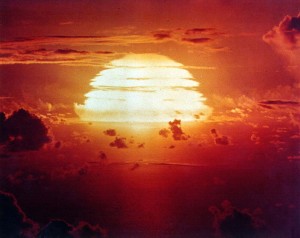
A U.S. government photograph of Operation Redwing’s Apache nuclear explosion on July 9, 1956.
By Robert Parry | Consortium News | June 2, 2016
Hillary Clinton made a strong case for why handing the nuclear codes over to a President Donald Trump would be a scary idea, but there may be equal or even greater reason to fear turning them over to her. In perhaps the most likely area where nuclear war could break out – along Russia’s borders – Clinton comes across as the more belligerent of the two.
In Clinton’s world view, President Vladimir Putin, who has been elected multiple times and has approval ratings around 80 percent, is nothing more than a “dictator” who is engaged in “aggression” that threatens NATO following the U.S.-backed “regime change” in Ukraine.
“Moscow has taken aggressive military action in Ukraine, right on NATO’s doorstep,” she declared. But stop for a second and think about what Clinton said: she sees Russia responding to an unconstitutional coup in Ukraine – which installed a virulently anti-Russian regime on Russia’s border – as Moscow acting aggressively “on NATO’s doorstep.”
That’s the same NATO, whose job it was to protect Western Europe from the Soviet Union, that — following the Soviet Union’s collapse — added country after country right up to Russia’s border. In other words, NATO muscled its way into Russia’s face and has announced plans to incorporate Ukraine as well, but when Russia reacts, it’s the one doing the provoking.
Clinton’s neoconservative interpretation of what’s happening in Eastern Europe is so upside-down and inside-out that it could ultimately become the flashpoint for a nuclear war between Russia and the West.
While she sees Russia as the “aggressor” against NATO, the Russians see NATO moving troops up to its borders and watch the deployment of anti-ballistic-missile systems in Romania and Poland, thus making a first-strike nuclear attack against Russia more feasible. Russia has made clear that it views these military deployments, just kilometers from major Russian cities, as an existential threat.
In response, Russia is raising its alert levels and upgrading its strategic forces. Yet, Hillary Clinton believes the Russians have no reason to fear NATO’s military encirclement and no right to resist U.S.-supported coups in countries on Russia’s periphery. It is just such a contradiction of viewpoints that can turn a spark into an uncontrollable inferno.
What might happen, for instance, if Ukraine’s nationalist — and even neo-Nazi — militias, which wield increasing power over the corrupt and indecisive regime in Kiev, received modern weaponry from a tough-talking Clinton-45 administration and launched an offensive to exterminate ethnic Russians in eastern Ukraine and to reclaim Crimea, where 96 percent of the voters opted to secede from Ukraine and rejoin Russia?
A President Hillary Clinton would have talked herself into a position of supporting this “liberation” of “Russian-occupied territory” and her clever propagandists would surely present this “heroic struggle” as a war of good against evil, much as they justified bloody U.S. invasions of Iraq and Libya which Clinton supported as U.S. senator and Secretary of State, respectively.
What if the Ukrainian forces then fired missiles striking Russia’s naval base at Sevastopol in Crimea, killing some of the 20,000 Russian troops stationed there and inflicting damage on Russia’s Black Sea fleet? What if Kremlin hardliners finally got their way and unleashed the Russian army to launch a real invasion of Ukraine, crushing its military, rumbling through to Kiev and accomplishing their own “regime change”?
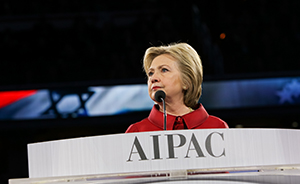
(Photo credit: AIPAC)
How would President Hillary Clinton respond? Would she put herself in the shoes of Russia’s leaders and search for some way to de-escalate or would she get high-and-mighty and escalate the crisis by activating NATO military forces to counter this “Russian aggression”?
Given what we know about Clinton’s tough-talking persona, the odds are good that she would opt for an escalation – and that could set the stage for nuclear war, possibly starting because the Russians would fear the imminence of a NATO first strike, made more possible by those ABM bases in Romania and Poland.
Clinton’s Non-Nuclear Wars
There are other areas in the world where a President Hillary Clinton would likely go to war albeit at a sub-nuclear level. During the campaign, she has made clear that she intends to invade Syria once she takes office, although she frames her invasions as humanitarian gestures, such as creating “safe zones” and “no-fly zones.”
In other words, although she condemns Russian “aggression,” she advocates aggressive war herself, seemingly incapable of recognizing her hypocrisies and only grudgingly acknowledging her “mistakes,” such as her support for the invasion of Iraq.
So, on Thursday, even as she made strong points about Trump’s mismatched temperament for becoming Commander-in-Chief, she flashed a harsh temperament of her own that also was unsettling, although in a different way.
Trump shoots from the lip and has a thin skin, while Clinton is tightly wound and also has a thin skin. Trump lets his emotions run wild while Clinton is excessively controlled. Trump engages in raucous give-and-take with his critics; Clinton tries to hide her decision-making (and emails) from her critics.
It’s hard to say which set of behaviors is more dangerous. One can imagine Trump having free-form or chaotic diplomatic encounters with allies and adversaries alike, while Clinton would plot and scheme, insisting on cooperation from allies and demanding capitulation from adversaries.
Clinton sprinkled her speech denouncing Trump with gratuitous insults aimed at Putin and undiplomatic slaps at Russia, such as, “If Donald gets his way, they’ll be celebrating in the Kremlin. We cannot let that happen.”
In short, there is reason to fear the election of either of these candidates, one because of his unpredictability and the other because of her rigidity. How, one might wonder, did the two major political parties reach this juncture, putting two arguably unfit personalities within reach of the nuclear codes?
[For more on this topic, see Consortiumnews.com’s “Yes, Hillary Clinton Is a Neocon” and “Would a Clinton Win Mean More Wars?’]
Investigative reporter Robert Parry broke many of the Iran-Contra stories for The Associated Press and Newsweek in the 1980s. You can buy his latest book, America’s Stolen Narrative, either in print here or as an e-book (from Amazon and barnesandnoble.com).
Dismantling Civil Society in Bahrain
By Rannie Amiri | CounterPunch | June 3, 2016
Like a vise which first grips its object and then slowly, deliberately and inexorably crushes it, the al-Khalifa regime has done similarly to civil society in Bahrain. It did not stop when peaceful, pro-democracy, reform protests erupted in 2011 and were violently put down by government forces aided by an invasion of Saudi troops in March of that year. Indeed, the vise continues to close and relentlessly so.
Nationalities have been revoked, mosques razed, citizens deported, human rights activists imprisoned on flimsy charges of insulting the monarchy at the least or plotting its overthrow at worst, and the most perfunctory of dialogues with the opposition abandoned. By smothering the figures and institutions who dare challenge the authority of the ruling dynasty in the most benign of fashions – a tweet, waving the country’s flag, tearing up a photo or merely questioning the tenure of the world’s longest serving prime minister – the Bahraini regime and its Gulf allies would like to believe monarchal rule has been preserved. Such desperate measures however, only speak to its precarity.
The stalwart activist Zainab al-Khawaja was given a sentence of three years and one month in Dec. 2014 for (again) tearing up a picture of King Hamad. She refused to be separated from her infant son whom she took with her to prison. Al-Khawaja has just been released on “humanitarian” grounds after serving 15 months in jail.
Her father though, Abdulhadi al-Khawaja, remains imprisoned serving a life sentence on trumped-up charges of attempting to topple the government. While authorities may have set Zainab al-Khawaja free, they simultaneously doubled the sentence of Sheikh Ali Salman, head of al-Wefaq, an opposition political party. Initially given a term of four years incarceration for alleged incitement against the regime, it was increased to nine years on appeal. The unflinching President of the Bahrain Center for Human Rights (BCHR) and founding Director of the Gulf Centre for Human Rights Nabeel Rajab, remains banned from leaving the country despite the need to secure medical treatment for his wife.
Busy highlighting the nation’s cordial relations with the United Kingdom and United States, the latter of which headquarters its Navy’s Fifth Fleet in the capital Manama, the Western media has largely ignored the plight of Bahrain’s ordinary citizens. The arrest and torture of disabled youth has now been documented by the BCHR. Indeed, for more than a decade, the Center has meticulously chronicled the dismantling of Bahrain’s civil society in all its forms by the al-Khalifa regime.
Most recently, with the passage of a law preventing any religious figure from joining political societies or engaging in political activities, the BCHR issued a statement condemning, “… the Bahraini parliament and Shura Council’s passage of amendments to the Political Societies Law, which places a ban on participation in political decision-making based on discriminatory religious grounds. In defense of this draft amendment, lawmakers supporting this motion argued it would prevent religious acts from being politicized. This decision restricts people’s ability to freely engage in religious practices, as those members willing to join political activities pertinent to the legislative process in Bahrain would now need to refrain from any activities carrying religious connotations.”
In the face of widespread and open abuses in civil society, lack of proportional parliamentary representation, curfews, detentions, and imprisonment and torture of those who dissent, these practices have nonetheless failed to adversely impact the ties enjoyed between Bahrain and the United States. But when a regime becomes alienated from those whom it rules and for example, gives lengthy jail sentences for tweets it finds offensive, it speaks to a tenuous reign.
The pillars of civil advocacy in Bahrain – Nabeel Rajab, Abdulhadi al-Khawaja, Maryam and Zainab al-Khawaja, Abduljalil al-Singace (sentenced to life in prison for participating in pro-democracy protests), Naji Fateel, Hussain Jawad and countless others both named and unnamed – have consistently engaged in purely secular, non-sectarian activism. Unlike the practice of the regime, the designations Sunni and Shia need not be applied when discussing the ongoing struggle for legal, political and socioeconomic rights in Bahrain. The people have waited too long for the West to recognize their demands are not based on sect, but on equity.
Despite an oppressive regime and the long shadow cast by the U.S. Fifth Fleet, resilient Bahrainis remain unintimidated.
Rannie Amiri is an independent commentator on Middle East affairs.
Clinton’s Vice President: A Match Made on Wall Street
By Eric Draitser | CounterPunch | June 2, 2016
Earlier this week, Bernie Sanders warned that Hillary Clinton’s eventual vice presidential pick must not be someone from the milieu of Wall Street and Corporate America. And while Sanders is still fighting to win the Democratic Party nomination in what many have argued is a rigged system with a foregone conclusion, it appears that Sanders is also intent on influencing the course of the Clinton campaign and the party itself.
In a thinly veiled demand that Clinton embrace the core principles of the Sanders campaign in order to secure the support of Sanders’s political base, the insurgent Democratic candidate hoped aloud “that the vice-presidential candidate will not be from Wall Street, will be somebody who has a history of standing up and fighting for working families, taking on the drug companies… taking on Wall Street, taking on corporate America, and fighting for a government that works for all of us, not just the 1%.”
And while that description may sound positive for its sheer idealism, it does not seem to account for the fact that banks and corporations effectively own both major parties, and that nearly every top Democrat is in various ways connected to the very same entities. In any event, it is useful still to examine a few of the potential Clinton running mates in order to assess just what sort of forces are going to be put in motion to help deliver a Clinton presidency.
The Actors on the Playbill
Beltway pundits are fond of remarking that Tim Kaine, the underwhelming centrist Democrat senator (and former Governor) from Virginia, is at the top of the list for Clinton. He’s safe. He’s experienced. He’s safe. He’s a Democratic Party loyalist with experience fundraising. Oh, and did I mention that he’s safe? Such is the general tenor of the conversation around Kaine, a politician with a long track record and a mostly forgettable personality known more to DC insiders than to the general voting public.
What could be better for Hillary Clinton, perhaps the least liked Democratic (presumptive) nominee in decades, than to have a party establishment insider who represents the status quo as her running mate in an election year that will undoubtedly be remembered for the ostensibly anti-establishment candidates and rhetoric on display throughout?
To be fair, Kaine does represent Virginia, a swing state that is crucial for Donald Trump, and which could spell victory for Clinton should she carry it. And of course, Kaine can also posture as “tough on Wall Street” from his days as DNC Chairman and party mouthpiece during the passage of the so-called “Wall Street reform” bill. Despite nothing substantive coming out of the bill, Kaine is still able to cash in the political currency derived from that bill, and perhaps meekly shield Clinton from continued attacks vis-à-vis her connections to Wall Street.
Of course Kaine also comes with his own baggage, including his anti-abortion stance which earned him the ire of many pro-choice activists in Virginia when he was Governor. Considering the shameless droning from Clinton and her backers about being “the first woman president,” it would certainly raise serious questions – and open up an obvious angle of attack for Trump – were she to sport her feminism and focus on women’s reproductive rights by selecting a man with an anti-abortion record.
A look down the list of other potential choices reveals that Clinton truly has very little to choose from. Both Housing and Urban Development (HUD) Secretary Julian Castro, as well as Labor Secretary Tom Perez, have both had their names bandied around as Clinton seeks to solidify the Latino vote in an election where the Republican candidate has worked tirelessly to alienate that all-important demographic as much as possible. But of course, the obvious question to be asked in response to either of these potential selections would be “Who?” Neither Castro nor Perez is well known nationally, nor have either of them won major elections or really done anything of note in their tenure in Obama’s cabinet. Despite being Latinos, they are utterly forgettable, and unlikely to bring significant returns to Clinton.
While other names such as New Jersey junior senator Cory Booker, as well as Ohio senator Sherrod Brown, have been discussed, both men hail from states with Republican governors, meaning that were they to accept a VP slot, their senate vacancies would be likely filled by Republicans, a scenario that Senate Minority Leader Harry Reid has already said “Hell no!” to, vowing to “yell and scream to stop that.”
Who Else Is “Ready for Hillary”?
So that then leaves the two most interesting potential running mates: Elizabeth Warren and Bernie Sanders himself. Warren, who conspicuously refused to endorse Clinton over Sanders, has tremendous upside for Clinton as she has been perhaps the Democratic Party’s most vehement opponent of Wall Street, having led many high profile attacks on the major banks in her tenure in the Senate. From a public relations branding perspective, she is essentially the female Bernie Sanders, a progressive Democrat who presents herself as an ally of working people and an enemy of bankers. For Clinton, Warren would also round out the “First Woman…” card, allowing the Clinton campaign to quite literally become a campaign about breaking the glass ceiling in US politics. The stump speeches almost write themselves.
Finally, there’s Mr. #FeelTheBern himself. His latest comments (mentioned above) certainly do have a subtext that implies his willingness to accept a running mate slot. Having fashioned himself as the champion of the middle class and threat to the Washington establishment, Bernie would provide much in the way of credibility to a lackluster Clinton campaign which has failed to excite even many ardent Democrats. Sanders would also guarantee a unified Democratic Party ticket, and provide much needed defense of Clinton’s left flank. In short, Sanders, like Warren, would give anti-Clinton progressives the pretext many of them need to justify their voting for the much-hated Clinton.
Never mind the fact that neither Sanders nor Warren would actually do anything to combat Wall Street finance capital as Vice President. Never mind the fact that no one on Wall Street is particularly scared of either politician being given the ceremonial power that comes with the Vice Presidency. These are just the kind of uncomfortable, but inescapable, facts that progressives must choose to ignore.
The difficulty for either Sanders or Warren is the marketing of their decision to left progressives, some of whom would see collaboration with Clinton and the Clinton political machine as a betrayal and a complete sell-out. However, aside from driving a some relatively small number of progressives to vote for Jill Stein and the Green Party (or stay home entirely), it is unlikely that the negative impact in the progressive base would amount to anything more than some hurt feelings followed by the usual acquiescence to the Democratic Party line.
If such an analysis sounds cynical and jaded, that’s because it is. Perhaps a better descriptor would be disdainful. Indeed, as someone who watched with bemused melancholy as progressives lined up to support Al Gore in 2000, John Kerry in 2004, and Barack Obama in 2008 and 2012, my position on support for ANY Democrat is the same as Harry Reid’s position on swing state senator VP picks: Hell no!
Indeed, the very notion of collaboration with a war criminal and Wall Street puppet such as Clinton is anathema to everything the left and “progressives” are supposed to stand for.
Of course, there is also the elephant (and donkey) in the room: both major parties are wholly owned subsidiaries of finance capital and the corporations that rule over us. This is the realization that millions of Americans have already made, and which millions more are making. This is the realization that keeps Democratic and Republican apparatchiks up at night. And this critical revelation is what Bernie, Liz, & Co. are there to suppress.
Cluster Bombs or Not, Washington Still Helps Saudis to ‘Wreck Yemen’
Sputnik – June 1, 2016
Washington has apparently decided to stop selling cluster munitions to Saudi Arabia as Riyadh’s is waging its devastating military campaign in Yemen with US-made weapons, however the long overdue measure will come too late, if it is implemented at all, Daniel Larison wrote for the American Conservative.
“There have been credible reports of the Saudi use of cluster bombs in civilian areas for more than a year, so the administration’s action is inexcusably tardy,” he observed.
The latest attack involving cluster munitions in Yemen took place less than five months ago. The Saudi military unleashed CBU-105 sensor fused weapons on a cement factory in the Amran governorate on February 15, Human Rights Watch reported. The Saudis have used cluster bombs in six assaults in total since launching an offensive on the poorest Arab country in the world in March 2015.
Saudi Arabia purchased as many as 1,300 CBU-105s from the US in August 2013. The weapons were supposed to be delivered by December 2015, but the shipments could take longer. It remains unclear whether Washington’s decision covers the existing agreement or is only meant to prevent future deals from taking place.
“The fact that it has taken the administration more than a year of indiscriminate coalition attacks on civilian areas to take even this first step shows how thoroughly the US has been enabling the Saudi-led war on Yemen,” Larison observed. “For the most part, the US is still enabling that war.”
Cluster bombs are air-dropped ground-launched explosive weapons that disperse over a large area and leave smaller bombs behind. If their remnants do not explode on impact, they turn into landmines. Cluster munitions have been banned by a treaty that more than 110 countries signed in 2008, but Saudi Arabia and the US are not among them.
If Washington’s decision to stop selling cluster munitions to the oil kingdom is an isolated step, it will change nothing.
“We shouldn’t let this small bit of good news make us forget that the US still provides weapons, fuel, and intelligence to assist the Saudis and their allies in wrecking Yemen, and Washington backs the coalition blockade that is starving Yemen to death,” the analyst noted.
Amnesty International warned earlier this month that the Saudi-led coalition has essentially turned civilian areas in Yemen into minefields.
Locals “cannot live in safety until contaminated areas in and around their homes and fields are identified and cleared of deadly cluster bomb submunitions and other unexploded ordnance,” Senior Crisis Advisor at Amnesty International Lama Fakih asserted.
Tim Canova’s Statements Are Even More Pro-Israel than Wasserman Schultz
By Sam Husseini | May 31, 2016
Congressional candidate Tim Canova, a professor of law and public finance, is widely depicted as being a progressive challenger to Rep. Debbie Wasserman Schultz. Wasserman Schultz of course chairs the Democratic National Committee and has rightly come in for lots of criticism on a host of issues.
Canova was recently endorsed by Bernie Sanders. Sanders, at the New York debate with Hillary Clinton in April had showed some minimal concern for rights of Palestinians, rare in U.S. politics, saying that Israel’s attack on Gaza was “disproportionate.”
Recently however, on MSNBC, Canova criticized Wasserman Schultz for being unreliable on a host of issues, then added: “even support for Israel, people don’t know where she stands.”
The subject of Israel doesn’t come up in many pieces on Canova, including his lengthy interview with Glenn Greenwald early this year.
As the Jewish Daily Forward recently noted: “when it comes to Israel and the Middle East, Canova is trying to take on Wasserman Schultz from the right.”
Canova’s website states he “visited Israel many times … returning to his former kibbutz as a volunteer time and again, and participating in workshops on citizenship, war, and counter-terrorism at Tel Aviv University.”
He’s also adopted an extremely anti-Iran position. Writes AP : “Despite the big fundraising haul, Canova faces a daunting task to defeat a strong Jewish Democratic incumbent in a district dominated by Jewish and Hispanic voters, where U.S. relations with Israel and Cuba are debated as often as jobs and the economy. … Canova supports ending the U.S. embargo on Cuba but believes it must be done ‘in stages.’ He said ‘trade liberalization needs political liberalization.’ He thinks the landmark Iran nuclear agreement was filled with ‘holes’ and that it was wrong to give Iran access to $100 billion in frozen assets.”
Canova has said: “I would like to see a Palestinian state, [but] to me, I don’t see how you have one as long as all of these neighbors of Israel still don’t recognize its right to exist … as long as Iran is still funding Hamas, [as long as] Saudi Arabia has telethons for families of suicide bombers!”
In contrast, apparently Saudi Arabia’s misogyny, authoritarianism, blood soaked interventions and invasions and fine with Canova. Well, the same would seem to be true regarding Israel’s bigotry and carnage.
I should note I use the term “pro-Israel” with implied scare quotes. An increasingly aggressive Israel could be “successful” in perpetuating oppression. And it could be disastrous for many, including many of the Jewish citizens of Israel.
The funny part is that I’ve promoted Canova on Institute for Public Accuracy news releases. But then again, unlike lots of folks, I try not to have a litmus test for people. I try to put people on news releases for what they’re best at. And Canova seems sharp and good on financial issues, so I use him on that without prejudice for how he is when it comes to Israel.
It often doesn’t work the other way. I’ve had odd looks for working with “rightwingers” on some issues. I find that there’s often a whole series of double standards associated with that. If you only want to work with people who agree with you across the board, fine. Do that. If you’re flexible about who you work with, fine, do that. But there’s something really wrong when people have a litmus test sometimes, but not others.
Featured Video
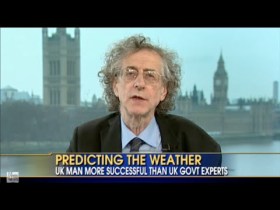
Piers Corbyn on religion of climate change
or go to
Aletho News Archives – Video-Images
New Documentary
“Inside Gaza” wins best documentary at Montreal’s Cinemania film festival
Palestine Information Center – November 16, 2026
MONTREAL – The documentary “Inside Gaza,” which chronicles the experiences of Palestinian journalists working with Agence France-Presse (AFP) while covering the Israeli war on the Gaza Strip, won the Best Documentary Award at the 32nd Cinemania International Francophone Film Festival held in Montreal, Canada.
Directed by Helene Lam Trong, the 72-minute film follows the daily lives of four AFP journalists who bear witness to the difficulties of reporting in a war-torn territory largely closed off to international media.
The film is compiled from material produced by the team on the ground, as well as from interviews conducted after they left.
The film also won the People’s Choice Award at the festival on Saturday. … continue
Blog Roll
 Aletho News
- Austria seeks to strip former foreign minister of citizenship over Russia ties
- “Inside Gaza” wins best documentary at Montreal’s Cinemania film festival
- Activists block German munitions plant over arms exports to ‘Israel’
- The Nasser Hospital attack and Israel’s relentless lies
- Could it be satan? No, Huckabee, just the Americans you work for
- AIPAC and more: Network of pro-Israel influence in US Congress
- Putin aide reveals Moscow’s stance on Europe at peace talks
- Imran Khan warns Pakistani judges he may die in prison
- IOF used Amazon facial recognition to track millions of Palestinians
- More EU Citizens Face Sanctions For Criticizing The Ukraine Proxy War
- If Americans Knew
- An error has occurred; the feed is probably down. Try again later.
- No Tricks Zone
- Argentina’s Perito Moreno Glacier Joins Antarctica and Arctic In Defying Doomsday Melt Claims
- New Study: Barents Sea Temperatures Were Warmer And Sea Ice Less Extensive In The 1700s Than Today
- German Authorities Start Initiative To Evaluate Public Register For Climate “Disinformation” Spreaders!
- Zonal Asymmetry of Temperature Change in the Antarctic Circumpolar Current
- New Study: The Net Fossil Fuel Contribution To Rising Atmospheric CO2 Has Been Zero For 500 Years
- Germany’s Green Energy Transition Becoming Increasingly Expensive…Another 6 Trillion Euros!
- Sudden Stratospheric Warming, Powerful El Niño Combination May Lead To Extreme Europe Cold, Energy Crisis!
- Two New Studies Find Thwaites Glacier Melt Cannot Be Driven By Human Activity Or A Warming Ocean
- E-Cars Reduce CO2 Emissions By Only 41% Compared To Internal Combustion Engine Vehicles
- Predictions Made By Renowned Climate Professor Over Past Decades Have Been Proven To Be Poor

