DeBasification… A Fancy Word for Booting the US Out of the Middle East
By Larry C. Johnson | SONAR21 | July 21, 2026
Tehran delivered to Washington via Pakistan in early April, a formalized demand for the withdrawal of US combat forces from military bases across the region. It sat in a package alongside the lifting of all sanctions and UN resolutions, the release of Iranian assets held overseas, reparations, and Iran’s right to nuclear enrichment.
Instead of waiting for the US to agree to the demand, Iran has launched targeted attacks during the past two weeks on key US bases in Kuwait, Bahrain, Saudi Arabia, Qatar and the United Arab Emirates. This has produced a de facto evacuation of US forces and equipment from most of these bases. The US Navy’s Fifth Fleet Headquarters in Bahrain is in shambles; the Combined Air Operations Center (CAOC) at Al Udeid in Qatar has been closed and moved to Shaw Air Force Base in South Carolina. And Iran continues to pound bases in Bahrain, Kuwait and Qatar to ensure that no US aircraft or missile launchers remain intact at those locations.
Besides the bases in the Persian Gulf nations, Iran also has pummeled the Muwaffaq Salti Airbase and the Prince Hassan Airbase in Jordan. There are grainy satellite images showing that the United States has removed all aircraft from the open-air parking lot at the Muwaffaq al-Salti airbase, fearing that they would be destroyed by Iranian missiles.
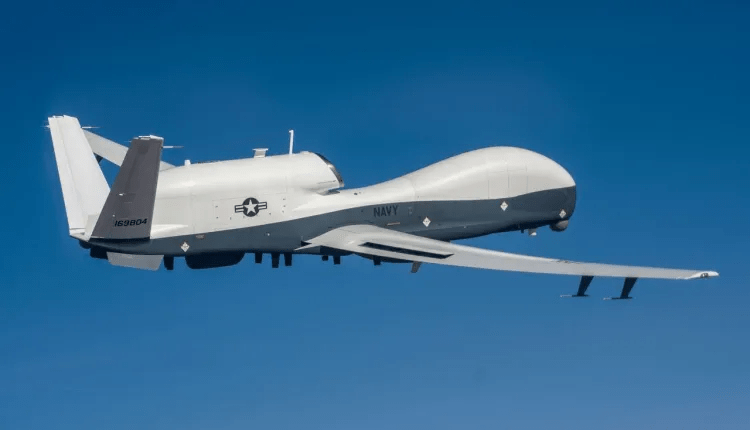
The US also has relocated the $250 million MQ-4C Triton. In early May 2026, the US dispatched the MQ-4C Triton drone to Jordan:
The second US Navy MQ-4C Triton (reg. 169804) drone has yesterday departed from Naval Air Station Sigonella and relocated to Al Hussein Air Base in Jordan, further reducing the US Navy’s high-altitude ISR presence in Sicily. The aircraft involved is the Triton that had arrived in recent weeks to replace the drone lost in the Gulf area during operations linked to the regional crisis. . . .
The MQ-4C Triton is one of the US Navy’s most important intelligence, surveillance and reconnaissance assets, designed for long-endurance maritime monitoring over vast operational theaters. From Sigonella, the platform has regularly supported surveillance missions across the Mediterranean, Black Sea, North Africa and the Middle East.
Relocating both surviving Tritons to Jordan suggests a clear operational reprioritization. By operating from Al Hussein, the drones gain shorter transit times toward the Red Sea, Arabian Peninsula, Iraq and Iran-related operational areas, allowing longer on-station persistence and more responsive ISR coverage during a period of continued regional instability.
Following massive missile strikes by Iran on 11 and 12 July on Jordan’s two airbases hosting US combat aircraft, including the MQ-4C Triton, the US pulled the plug on keeping the Triton in Jordan. Defense Security Asia reported on Monday, 14 July 2026 that:
The Pentagon Pulls $240M Triton Drone from Jordan to Italy After Devastating Iranian Ballistic Missile Strikes Threaten Strategic Airfields . . . . According to regional military planners, the strategic redeployment of the multi-million dollar maritime surveillance platform from forward-deployed hubs in Jordan to permanent facilities in Italy reflects an urgent effort to mitigate severe attrition risks.
The repositioning directly follows a series of sophisticated adversarial long-range strikes that successfully breached localized air defense networks and targeted high-value infrastructure. Open-source intelligence analysts observed that specialized hangar facilities designed to shield premium unmanned platforms sustained direct impacts during these intense bombardments.
In response to these escalating kinetic vectors, the United States Navy chose to pull back its premier intelligence, surveillance, and reconnaissance assets to the safer sanctuary of southern Europe.
During the first 43 days of the 2026 Iran war (Operation Epic Fury, beginning 28 February), Iran systematically targeted the sensor and communications layer of the US military’s integrated air defense architecture across the Persian Gulf. Rather than simply overwhelming interceptors with mass drone and missile barrages, Iran prioritized destroying the radars and SATCOM terminals that make the entire network function — a strategy described by analysts as “blinding US eyes in the Middle East.”
By the end of the first 43 days, Iran had hit at least 12–19 radar and SATCOM systems across seven countries, with total damage estimated at $3.15 to $5+ billion. The targeting pattern revealed a sophisticated operational concept:
- Day 1 priority: The AN/FPS-132 at Al Udeid was struck within hours — the single most valuable radar in the region, specifically deployed to counter Iranian ballistic missiles.
- THAAD radars next: All four deployed AN/TPY-2s (Jordan, UAE ×2, Saudi Arabia) were hit within 48–72 hours, effectively neutralizing the upper-tier missile defense layer.
- SATCOM infrastructure: Command-and-control nodes at Bahrain’s 5th Fleet HQ and Kuwait’s Camp Arifjan were destroyed, degrading the ability to coordinate defenses across distributed bases.
- Layered approach: After stripping away early warning and upper-tier defense, Iran could then attrit remaining Patriot batteries with mass drone waves — a cost-exchange ratio heavily favoring Iran (Shahed-136 at ~$20K–$50K vs. PAC-3 MSE at ~$4M).
The destruction forced interception duties onto already-depleted Patriot systems, compounding a crisis that saw the US and GCC allies burn through 86% of their combined Patriot inventory within five weeks.
Now, with the MoU dead, Iran is focused on making life on the bases that are still hosting US troops and aircraft a living hell. It is no longer up to the US to decide to leave the Persian Gulf… Iran is making that decision for them.
US doesn’t have what it takes to repel Iranian counterattacks – expert
Sputnik – 20.07.2026
While the US does retain an enormous offensive capability, which allows it to conduct an intense wave of attacks against Iranian facilities, it can only weaken Iran, veteran war correspondent Elijah J. Magnier tells Sputnik.
The US has plenty of offensive weapons to attack Iran, but at the same time has a limited supply of interceptors needed to repel Iranian counterattacks against US assets, allies and Israel.
“The United States could therefore launch a major campaign, but sustaining it would force difficult choices: which bases to protect, which cities to defend, which incoming threats to intercept,” Magnier explains.
In the meantime, Iran will likely seek to widen the “geography of the conflict, multiplying the number of targets Washington must defend, and raising the political and above all economic costs of an additional American strike.”
Using concentrated ballistic and cruise missile attacks to saturate enemy air defenses, and forcing the US and its allies to expend their interceptors on decoys, Iran can unleash hell upon US bases, logistics hubs, ports, radar installations, and fuel storage facilities in the region.
Attacks upon the US allies in the Gulf can ramp up domestic pressure on local governments, which could prompt them to demand the US to back down.
The Iran also maintains its hold on the Strait of Hormuz, requiring very little resources to ensure that “no insurance company will accept to insure a tanker navigating in a war theater, and no ship owner will take the risk of jeopardizing his asset in that area.”
US media earlier reported that the growing American military presence in the Persian Gulf may signal preparations for a major confrontation.
Trump booed during FIFA World Cup trophy presentation to Spain
Press TV – July 20, 2026
US President Donald Trump was received with loud boos from sections of the crowd during the 2026 FIFA World Cup trophy presentation.
Trump was booed at MetLife Stadium in New Jersey on Sunday at the FIFA World Cup final between Argentina and Spain as he presented the Spaniards with the trophy after their 1-0 victory over their rival.
Trump was asked to step aside by the “winners” of the globally sought Gold Cup, with Spain’s captain Rodrigo Hernández Cascante, also known as Rodri, ushering Trump to exit the stage before the World Cup trophy lifting ceremony. He, however, refused to leave the scene and awkwardly lingered on the side of the giant podium as the loud boos and whistles rang out across the stadium. Eventually, a brief exchange between FIFA President Gianni Infantino and Trump resulted in the host of the event giving in to his unpopularity and leaving the world stage viewed by billions of football fans across the globe.
Trump has spent much of his second term in office berating Spain over its NATO military spending and refusal to allow American forces to use Spanish bases in the illegal US-Israeli war of aggression against Iran, calling the Latinos in general, and Spaniards, in particular, “losers.”
The American president has also branded Spain as a “hopeless” country, deriding the Latino people as “bad people” and briefly threatened to cut off all trade in goods with Madrid.
For his part, Spanish Prime Minister Pedro Sánchez has been a vocal critic of Trump’s aggressive foreign policy for nearly two years.
Sánchez and Trump were present at the final match, both sitting in the VIP section of the stadium.
However, the two Western countries with a long history of territorial wars appear to be at loggerheads still over issues ranging from NATO spending to US militarism in West Asia, Latin America, and beyond.
Madrid censured Washington over US military operations in Venezuela, warning that Washington’s actions endanger sovereignty, international law, and the country’s natural resources.
How to Honor the Dead US Service Members
By Ron Paul | July 20, 2026
Over the weekend the Pentagon announced that four more US soldiers have been killed in President Trump’s war on Iran. That brings the total to 17, but many believe the real number of dead US servicemembers is much higher than that. The Pentagon has claimed it has no obligation to reveal how many military personnel have been injured, which suggests that number may be much higher than we are hearing. Many of these injuries will be horrific and life-altering.
Back on April 12th, President Trump told Fox News that Iran, “has no cards. Their navy is gone. Their air force is gone. Totally gone. They have nothing.” Yet three months later, US bases in the region continue to be successfully attacked, US military equipment worth billions continues to be destroyed, and US servicemembers continue to be killed and injured.
This war was launched by President Trump without Congressional approval in February because the President believed that Iran, at 6,000 miles away, posed an existential threat to the United States. At the same time, he believed that the Iranian government was so weak that after a couple of days of bombing the political system would collapse and a “US-friendly” government could be installed in its place.
This makes no sense. How can a country be strong enough to threaten the United States but be so weak it is about to collapse?
Now, five months later, we continue to attack Iran to open a Hormuz Strait that was open before the war and to end a nuclear weapons program that does not exist. And the American middle and working classes are hit with a price tag for this senseless war that could exceed one trillion dollars.
That is why our Constitution requires that war be declared by the US Congress after extensive deliberation. The Framers wanted to safeguard the new country from the whims of a King George or other monarch who could take the country to war at will. The patriots fought for independence from exactly the political system we have in place today because they understood how destructive endless and foolish wars can be to a country.
The Framers also assumed that Members of the Legislative Branch of government would be of sufficiently good character that they would not allow an executive to abuse power in such a way. They were given all the tools they needed to prevent this, but today Congressmembers remain silent, unwilling to perform the duty required by their office. Most would rather not have the burden of declaring war because they are afraid that an unpopular war might hurt their re-election chances.
A recent poll featured in the Washington Post reveals that nearly seven in ten Americans disapprove of President Trump’s handling of the Iran war. Along with the economy, the Iran war is the most important issue concerning the American people today.
Over the weekend President Trump announced that “we hit (Iran) very hard again… in honor of the three” servicemembers who were killed in recent days. But hitting Iran again does not honor the dead US servicemembers. It only guarantees that more Americans will follow them. If the President really wants to honor our military, he will declare an end to this pointless war, bring all of our troops home from the region, and announce that the destroyed US bases will not be rebuilt. It is time to end the American empire and come home.
Yemen imposes naval blockade against Saudi Arabia in tit-for-tat move
Press TV – July 20, 2026
Yemen has declared a naval blockade against Saudi Arabia, with the country’s military spokesman stressing that it will come into effect immediately.
In a statement on Monday, Yemeni armed forces spokesperson Brigadier General Yahya Saree announced “a maritime embargo against the criminal Saudi enemy, based on the equation of ‘siege for siege,’” adding that “it will come into force from the moment this statement is issued.”
According to the statement, the blockade was imposed in response to Saudi Arabia’s continued “unjust and oppressive siege on our dear people for nearly 12 years, plundering our resources and imposing a comprehensive blockade on [the country’s] ports and airports by land, sea, and air” as well as the recent attacks on the Sana’a International Airport.
The spokesman affirmed the Yemeni armed forces’ “complete readiness for all options,” warning that “any foolish act” by Riyadh will be met with a “harsh” response.
The statement hailed the steadfastness of the Yemeni nation and its participation in million-strong demonstrations in support of the Sana’a government, saying “we assure them that we will spare no effort in restoring their plundered rights and ending the unjust siege against them, regardless of the results and repercussions.”
Tensions flared earlier this month when Saudi Arabia tried to prevent the return of an Iranian plane carrying a delegation of Yemeni officials, who had traveled to Tehran for the funeral of Iran’s martyred Leader Ayatollah Seyyed Ali Khamenei. The plane was diverted after the Sana’a airport was bombed and landed safely in the city of Hudaydah.
Yemen prepared to enter all-out war: Official
Meanwhile, Hizam al-Assad, a senior member of Ansarullah’s political bureau, warned that Yemen is prepared to escalate to all-out war if the 11-year siege of Yemen is not lifted.
He said it is unacceptable for Riyadh to continue exporting oil and purchasing weapons to bomb and blockade Yemen while the Yemeni people remain silent.
“We are today facing a difficult dilemma: either we die of starvation, or we reclaim our right by resorting to force,” al-Assad said in remarks cited by Al-Mayadeen.
Al-Assad warned that Yemen’s armed forces are ready to target Saudi oil facilities, refineries, and export ports with missiles and drones if the blockade continues.
He said that Saudi Arabia bears responsibility for the environmental consequences of burning oil wells, pipelines, and petrochemical plants.
On Sunday, Abdullah al-Nu’ami, another member of Ansarullah’s political bureau, said Saudi Arabia is full of “valuable targets” within reach of Yemen’s armed forces. He added that the region is on the brink of explosion and Saudi Arabia is aware of that fact.
Ansarullah official says aggression against Iran and the blockade on Yemen is pushing the region toward a major blast.
The official said Ansarullah is studying its options and is prepared to pay the highest price to lift the blockade. He warned that if the United States joins Saudi Arabia in a war against Yemen, it will find itself in a predicament.
“We are ready to pay the highest price to lift the blockade, and the region is on the brink of explosion, and Saudi Arabia is aware of this,” al-Nu’ami told Al-Mayadeen.
Saudi Arabia and its Arab allies launched the blockade on Yemen as part of a full-scale war on March 26, 2015, with military, political, and logistical support from the United States and other Western states.
The war has killed tens of thousands of Yemenis, while consistently falling short of its main objective of restoring power to Yemen’s former Riyadh-friendly regime.
The government had fled the country amid a power struggle, prompting Ansarullah, Yemen’s popular resistance movement, to start running state affairs.
Following a fragile UN-brokered ceasefire in 2022, the United States, Britain, and the Israeli regime waged many rounds of wholesale aggression against Yemen.
The attacks sought to cripple Sana’a’s capability to stage solidarity strikes against Israeli targets in response to Tel Aviv’s war of genocide on the Gaza Strip.
Complicit: How the West is Helping Israel Seize the West Bank
Al Jazeera Investigates | July 16, 2026
An undercover investigation by Al Jazeera reveals how western donors evade charity law to provide aid to illegal Israeli settlements.
Since October 7, 2023, Israel has killed more than 1,000 Palestinians in the West Bank. More than 230 of them are children. Attacks by settlers on rural Palestinian communities have increased, destroying property and capturing livestock, driving families from their homes. At the same time, the Israeli military has launched a large-scale assault on the densely populated Jenin refugee camp.
This film provides a comprehensive picture of the tactics the Israeli government uses to support the settlers and then, through infrastructure and building programmes, annex Palestinian land.
Western governments claim to oppose Israel’s occupation of the West Bank and uphold international law. However, undercover reporters from Al Jazeera expose how donors based in some Western countries fund the expansion of illegal settlements.
Al Jazeera journalists secretly film meetings with pro-settler organisations in Israel, claiming to be donors based in the UK looking to make large contributions to their projects. They’re told how funds can be paid as tax-deductible donations to charities in the UK and Canada who then pay the money on to their organisations. It is unlawful for charities in the UK and Canada to use donations to support the illegal settlement of the West Bank.
The Israeli organisations tell our undercover reporters how donations can be used to campaign for the demolition of Palestinian homes and provide military-grade security equipment such as drones and night vision cameras to settlers. We are also told that funds can be used to buy guns for settlers in occupied East Jerusalem and equipment for soldiers serving in the Israeli army.
The Israeli organisations are aware that their activities are considered unlawful in Canada and the UK and suggest ways to disguise the intended purpose of the donations, routing the funds through affiliated third parties and, in some cases, misreporting the true nature of their spending.
Charities in the UK and Canada are required to do extensive due diligence on how funds paid overseas are spent and to ensure they comply with the law. Al Jazeera’s evidence points to serious failings in this process.
Rolling Blackouts Hit New York
By Francis Menton | Manhattan Contrarian | July 18, 2026
At least since New York passed its Climate Leadership and Community Protection Act (CLCPA) back in 2019, it has been clear that trouble has been coming for New York’s electrical grid. The CLCPA effectively prohibits construction of new fossil fuel power plants, even natural gas plants; and the old ones are aging and are forbidden to be replaced or upgraded. Supposedly, lots of wind and solar generators were going to be added to the system. But those have been slow to come and, more importantly, can’t be counted on to generate anything when you need them. In addition, new construction of such things has now been stalled by the end of federal subsidies. At some point the lines of diminishing reliable generation and increasing demand would have to cross.
However, here at this website I have held off predicting imminent grid failure. The reason is that I don’t want to be the boy who cried wolf. Our grid operators are competent people, and they have a lot of tricks up their sleeves to hold things together even in difficult circumstances. In a pinch, they can start up every ancient “peaker” plant, and then import some power from PJM, or New England, or even from Canada. Despite New York’s hostile energy environment, they could get lucky and avoid blackouts for at least several more years.
So I think it is important to report that on this past July 2 and 3, Con Edison ran out of options and imposed rolling blackouts in parts of the North Bronx and Southern Westchester County.
You haven’t heard about this? It’s another example of the legacy media burying an inconvenient story. Checking to see what the New York Times has to say about these blackouts, I find just one sentence in the sixth paragraph of a July 3 article that is otherwise reporting on the heat wave that hit that weekend. The sentence in question reads, “The heat also put stress on power grids, contributing to scattered outages in New Jersey, New York and Ohio for tens of thousands of utility customers on Thursday, according to the tracking website PowerOutage.us.” The heat put “stress” on the grid, leading to “scattered outages.” That’s it. No mention in the Times that the blackouts on that day in New York were intentionally imposed, or that the ongoing degradation of grid reliability had anything to do with it.
I have been waiting to report on this until I could find a credible source attributing the blackouts to an intentional act by Con Edison versus, for example, a heat-related accident of some sort. On July 16, the Institute for Energy Research had a piece with the headline “New York City Cuts Power During July 4th Heat Wave.” Excerpt:
Con Edison shut off electricity to over 5,000 customers in the Riverdale section of the Bronx, leaving residents there without air conditioning. Affected residents were directed to city cooling centers for relief. Con Edison had decided the N.Y. grid could not handle the load, saying the shutoffs were necessary to reduce strain on the grid, protect equipment, and speed up restoration. The company also cut voltage by 8% in areas of the city as a precaution to protect equipment and keep service running while crews worked.
So it was not just blackouts for 5,000 customers, but also 8% voltage cuts in various “areas of the city.” IER does not specify the extent of the areas covered by the voltage cuts.
Nor were the blackouts limited to just the Bronx. My colleague Richard Ellenbogen lives in Southern Westchester County, in a town called Pelham. Pelham is just north of the Bronx, and also within Con Edison service territory. In a July 12 email that he sent to his distribution list, Ellenbogen described what happened in his area:
[Over the weekend of July 3-5], [t]here were numerous power surges associated with the rolling blackouts where the lights went on and off several times before going out. . . . Those surges destroyed a bunch of equipment in my home despite having surge suppressors on the equipment. . . . I missed the Friday evening [July 3] rolling blackout and I returned to a mess. There is thousands of dollars in damages related to the surges. Based upon the Facebook Page MOPS (Mothers of Pelham), my home was not the only one impacted as many people are complaining about electronic equipment not working after the blackouts, notably air conditioners. . . . My home is going to need about $3000 worth of new battery backups. . .
I don’t find any reporting in the press about these blackouts in Westchester.
New York definitely experienced a severe heat wave in early July. The temperature at the Central Park weather station in New York City reached 100° F on July 2, and 98° F on July 3. These are unusually high temperatures that are not reached in most years. Indeed, the last time it reached 100° F at Central Park was in 2012. On the other hand, these temperatures were by no means records. The highest temperature ever recorded at the Central Park station (with data going back into the late 1800s) was 106° F in 1936. Here from recordtemps.in is a list of the highest temperatures ever recorded at the Central Park weather station:
-
07-09-1936: 106°F
-
07-21-1977: 104°F
-
07-22-2011: 104°F
-
08-07-1918: 104°F
-
07-03-1966: 103°F
-
07-06-2010: 103°F
-
08-09-2001: 103°F
-
08-26-1948: 103°F
-
07-04-1949: 102°F
-
07-10-1993: 102°F
In other words, we have had temperatures over 100° F many times in the past, and undoubtedly we will have them again. But with temperatures on July 2 and 3 that were well short of the records, the grid operators had to resort to imposing rolling blackouts and/or voltage reductions in various areas of the City and Westchester County. One can only imagine how much more extensive the outages would have been if the temperature had gone up another 6° F to match the 1936 record.
Without any ability to add reliable generation to it grid, New York faces more of same every time the heat gets into this range. There is nothing inevitable about this. It is entirely a consequence of intentional decisions made by politicians.
Iran air defense downs multiple enemy drones, cruise missile
Press TV – July 19, 2026
Iran’s integrated air defense network has successfully intercepted and destroyed several enemy aircraft and a missile across multiple regions of the country, including an MQ-9 Reaper drone in the west, a cruise missile, a “Lucas” drone, and another MQ-9 over Ahvaz, as Iranian forces continue to demonstrate their aerial dominance against US aggression.
The Army’s Air Defense Force, operating under the unified national air defense network, shot down an MQ-9 Reaper drone in the western region of the country on Sunday, the Army announced.
This was followed by the interception of a cruise missile belonging to the American aggressor enemy in the same western region, which was successfully tracked and destroyed by Army air defense systems.
Earlier in the day, the Army’s Naval Forces intercepted and shot down a “Lucas” drone over southern Iran, using naval air defense systems operating under the integrated command network.
In a separate operation, the Islamic Revolution Guards Corps (IRGC) Aerospace Force announced it had shot down another MQ-9 Reaper drone over the skies of Ahvaz in southwestern Iran using an advanced new air defense system.
Additionally, fighters from the 48th Fath Brigade of Kohgiluyeh and Boyer-Ahmad province successfully brought down an enemy spy drone in the southern operational zones.
The drone was captured intact after being forced to land, having been conducting reconnaissance and espionage missions over the country’s southern operational areas.
Iran’s air defense record
Iran’s air defense forces have compiled a remarkable record of aerial victories during the ongoing war and previous conflicts with the US.
During the 40-day US-Israeli war of aggression, Iranian air defense units destroyed hundreds of advanced enemy drones, including MQ-9 Reapers, Hermes, and LUCAS models.
The IRGC has also successfully targeted multiple US fighter jets, including F-35 stealth fighters, F-15s, and F-16s, along with refueling planes.
In a single 24-hour period on April 3, 2026, Iranian forces downed an F-15E Strike Eagle, an A-10 Thunderbolt II, multiple MQ-9 Reaper drones, Hermes reconnaissance platforms, and a salvo of cruise missiles.
The downing of three MQ-9 drones and a cruise missile in less than 24 hours comes as Iran’s armed forces continue their sustained retaliation against US military bases across the region, following repeated American violations of a fragile ceasefire and the collapse of the Islamabad Memorandum of Understanding.
They Are Coming to Take Us Away
The White House discovers more “commies” and terrorists

By Philip Giraldi • Unz Review • July 19, 2026
In Donald Trump’s America it is always possible to wake up in the morning and peruse online the overnight headlines to discover something new and exciting. Over the past week it has been a medley of going to war (again) with Iran coupled with a complicated performance on other issues as President Trump apparently takes aim at his enemies in the US and elsewhere. America’s Secretary of War Pete Hegseth is fully on board with a surge in worldwide mayhem. He is looking forward to an increase in US initiated violence, ordering that male soldiers, airmen, sailors and marines be tested for their testosterone levels. “Hegseth argues the effort, to become part of the military’s periodic health assessment for troops over 30, will ensure the optimal performance and long-term health of warfighters… the move plays into Hegseth’s focus on appearances and masculinity, which one Democrat said this week borders on ‘homoeroticism’.” Those who fail to have sufficient of the “male characteristics” hormone in their systems will be determined to be not fit for combat, where lethal instincts as encouraged under Hegseth require a satisfactory level of anger. Some soldiers might be offered therapy to increase their hormone levels.
And perhaps not so strangely, it often seems that much of the daily news relates to America’s “best friend and closest ally” Israel. One of the great ironies of the Israel against the rest of the world competition is how the “Torah” Old Testament is regularly being cited by Washington and the national media to justify anything the Jewish state does. That occurs in spite of the fact that Biblical Judea has little in common with the real Israel of today apart from providing an enduring mythology interwoven with the “holocaust” fantasy to sustain the myth of “chosen-ness.” In reality, Judea ceased to exist as an actual nation in 70 AD when the Romans destroyed to include the Second Temple in Jerusalem, of which absolutely nothing physical remains, and forced the Jews to depart. After that, what is now described as Palestine was ruled in various fashions by Rome, Byzantium, Muslim Arabs, Christian Europeans, Mamelukes, Turks, and the British until the politically driven re-creation of a Jewish state in 1948. That means for nearly 1900 straight years there was no such thing as an “Israel” or a Jewish nation and any Jewish presence was marginal in the region where the religion was born. Clearly there was no historical mandate to move a group of foreigners, whose only tie was to a religion that many of them did not actually practice, into a land that those foreigners then began to depopulate of its indigenous inhabitants who had lived in that place under both Christian and Muslim foreign rule for two millennia.
Recent American presidents have certainly tried to make the brutal Israeli suppression and occupation of what was supposed to be a neighbor state called Palestine somehow seem to be something quite acceptable. This is particularly due to the nonsense regurgitated by a group of American fundamentalists that many refer to as Christian Zionists (CZ), best exemplified by the delusional US Ambassador to Israel Mike Huckabee. These are folks that revere the Jewish Bible, as one might describe it, as “explained” by the nineteenth century Scofield Bible. Huckabee insanely even claims that “Without Israel, without the Jewish foundation, there would not be America.”
Unfortunately for the rest of us, the CZ exist in large numbers in southern and some midwestern so-called Bible Belt states and they vote reliably for congressmen and even presidents who are Israel Firsters. So we get monsters like Texan Ted Cruz, Arkansan Tom Cotton and the recently deceased South Carolinian Lindsey Graham calling the shots on foreign policy. And we get presidents like Joe Biden and Donald Trump, both of whose exceptional loyalty to Israel should have been challenged when they ran for office!
The latest bid by Congress to allow Israel to be even more intolerant of the Christians and Muslims that it is supposed to share the former Palestine with is a recently passed amendment calling for equal Jewish prayer rights on Jerusalem’s Temple Mount. The Mount currently houses the Al-Aqsa Mosque, one of three most holy religious sites for Muslim believers, reputedly the location where Mohammed himself was spirited up to heaven by Allah. When Israel was created in 1948 Jerusalem was categorized by the UN as an international city inclusive of all faiths. The Mount was regarded as special for Muslims and believers in other faiths had only limited access to it. More recently, there has been constant agitation from extremist Jewish politicians in Israel to open up the site and there have even been calls to build a Jewish Third Temple on it as well even more radical demands to demolish al-Aqsa completely as part of the process. This has been accompanied by increased persecution and even closure of churches and mosques located elsewhere in the city with the clear intention of making Jerusalem more exclusively Jewish. Trump and company have, of course, not raised any objections to the Jewish activism even when Christians are being actively persecuted and denied access to their churches and holy sites.
Israel aside, the views of Americans who value the First Amendment Freedom of Speech right should be particularly concerned by the authoritarian direction the federal government is moving in. One must pay attention to last week’s denunciations by Trump and National Security Adviser and Secretary of State Marco Rubio of “communists” and “terrorists” among the predominantly progressives who apparently are in the forefront of those who are opposing the enlightened policies being promoted by the White House. It is apparently the belief that labeling opponents in that fashion will guarantee victory in the upcoming November midterm elections where Democrats will inter alia be labeled as anti-Israel and it will also make it easier to root some such folks out for deportation or imprisonment to silence them as has already been happening with foreign students at American universities.
Regarding what is developing, Trump’s activation of the little known “alien terrorist” deportation court presumably will conveniently provide the president and his fanatics with a new tool to cleanse the country of anyone who might object to killing people without any constitutional or legal process as has been taking place in the Caribbean, Iran and Sudan. Not that Trump needed a new court since he is no friend of “rule of law” and has been repeatedly acting in one of his rages whenever he sees fit to punish both American citizens and foreigners. One might cite the recent arrest of an American citizen who was traveling in Spain. As reported by The Guardian, “Spanish authorities, operating on a US extradition request, arrested the 41-year-old James Chambers, a US citizen and wealthy donor to leftwing and humanitarian projects worldwide, last Friday in Ibiza. He has been transferred to a prison in Madrid. The Trump administration’s Department of Justice is seeking his extradition for alleged financial support of Hamas, according to a spokesperson for the Spanish high court. This is the first known case of the US seeking extradition of a citizen over alleged support for Hamas… It is unfolding as Marco Rubio, the US secretary of state, convened 66 countries this week – including Spain – as part of a broader effort to discredit leftwing activity as terrorism…”
In reality, of course, Hamas is a legitimate resistance movement and the ones who should be arrested on terrorism charges are Israelis, starting with Prime Minister Benjamin Netanyahu if he dares to visit the UN in New York in August, but that fine point is not about to bother Donald Trump and Marco Rubio. One can only assume that the Trump Administration will be moving sharply to the right over the next three months, labeling all critics as threats to the security of the United States of America. The initial focus will be on foreigners living in the United States, but the mechanism will easily be expanded to include all critics or supporters of resistance groups, like is happening to American citizen James Chambers in Spain. It is easy to go to Congress or have the White House declare some entity “terrorist” and people who support them in their resistance to US policy will begin to be on the receiving end of punishment. That is what is coming unless we the people unite to put an end to it right now!
Philip M. Giraldi, Ph.D., is Executive Director of the Council for the National Interest, a 501(c)3 tax deductible educational foundation (Federal ID Number #52-1739023) that seeks a more interests-based U.S. foreign policy in the Middle East. Website is https://councilforthenationalinterest.org address is P.O. Box 2157, Purcellville VA 20134 and its email is inform@cnionline.org.
The strange death of James V. Forrestal, the first US Secretary of Defense
Did Israel start its serial assassination campaigns of its American opponents much earlier than we assume?
By Hua Bin | July 19, 2026
I have always enjoyed reading a wide variety of books on somewhat arcane subjects. Many are triggered by references from other books, and they form a sort of chain reaction.
Around 10 years ago, I read Webster Griffin Tarpley’s book 9/11 Synthetic Terror: Made in USA, my first exposure to alternative 9/11 theories of what truly happened in 2001.
Tarpley’s book led me to David Ray Griffin’s The New Pearl Harbor: Disturbing Questions About the Bush Administration and 9/11.
I subsequently read perhaps 30 books on the subject such as Kevin Ryan’s Another Nineteen: Investigating Legitimate 9/11 Suspects, Chris Bollyn’s Solving 9/11: The Deception That Changed the World, Jim Fetzer’s The 9/11 Conspiracy – the Scamming of America, and more.
Griffin’s New Pearl Harbor further led me to Peter Dale Scott’s The War Conspiracy: JFK, 9/11, and the Deep Politics of War as well as his books on the drug trade, particularly his 2010 book American War Machine: Deep Politics, the CIA Global Drug Connection, and the Road to Afghanistan and the 2003 book Drugs, Oil, and Wars: the US in Afghanistan, Columbia, and Indochina.
Peter Dale Scott’s books motivated me to explore the subjects of JFK assassination and drug trade, which included many books such as James Douglass’s JFK and the Unspeakable: Why He Died and Why It Matters, Alfred McCoy’s The Politics of Heroine: CIA Complicity in Global Drug Trade, and Gary Webb’s Dark Alliance: the CIA, the Contras, and the Crack Cocaine Explosion.
Two books were particularly intriguing among the many on the subjects: Michael Collins Piper’s 1994 book Final Judgement: The Missing Link in the JFK Assassination Conspiracy and Salvador Astucia’s Opium Lords – Israel, Golden Triangle, and the Kennedy Assassination.
Piper was among the first to connect the JFK assassination to Mossad as Kennedy was adamantly opposed to the Israeli nuclear weapons project and therefore became a threat to Israel to be eliminated.
This theory has been further supported by French historian Laurent Guyenot in his books JFK to 9/11: 50 Years of Deep State and The Unspoken Kennedy Truth.
Salvador Astucia, in turn, developed the thesis that Israel used drug-related interest to carry out the assassination, fingering the hitmen as French-Corsican heroin traffickers and associates of Meyer Lansky, the head of Jewish mafia in the US.
One obscure reference by Astucia in his book led me to a book written by David Martin in 2019 The Assassination of James Forrestal, subject of this article.
(By the way, I am planning to write on the US state-sponsored narco trade at some point with the information learned from the reading list. It is the height of iron that the US is the original and ultimuate Narco State while it labels Venezuela under Maduro as such.)
Who was James Forrestal and how he died
James Vincent Forrestal (1892–1949) was a highly influential American politician who served as the last cabinet-level US Secretary of the Navy and the very first United States Secretary of Defense.
He played a pivotal role in shaping America’s military structure and foreign policy during World War II and the early stages of the Cold War.
According to his official biography, Forrestal died on May 22, 1949, after falling from a 16th-floor kitchen window at the Bethesda Naval Hospital, where he allegedly was being treated for severe depression and exhaustion.
His death was widely accepted as a suicide, but the official Navy investigation never actually used the word “suicide” in its final ruling.
The official Willcutts Report, the official US Navy board of inquiry report into his death, concluded only that Forrestal died from the fall, that his behavior indicated severe mental depression, and that no naval personnel were negligent or to blame.
Investigators found a leather-bound book, An Anthology of World Poetry, open on a radiator next to his bed. The book was bookmarked to a dark, mournful passage from the ancient Greek tragedy Ajax by Sophocles.
On a sheet of hospital memorandum paper, Forrestal had been hand-copying the text. His transcription of the poem stopped abruptly in the middle of a word.
He had written “Woe, woe! will be the cry…” and stopped after writing the letters “Night—” while attempting to copy the word “nightingale”.
In the play, the Greek hero Ajax descends into madness out of grief and political betrayal, ultimately committing suicide.
The press and historians heavily focused on this, noting that Forrestal likely identified with Ajax’s tragic downfall.
David Martin concludes assassination after studying declassified details of Forrestal’s alleged suicide
The Navy kept the official investigation secret for 55 years and finally released it via Freedom of Information Act in 2004.
Researchers immediately found several inconsistencies that have fuelled decades of assassination theories:
- Bathrobe cord: When Forrestal’s body was found on the 3rd-floor roof, the sash/cord of his dressing gown was tightly knotted and wrapped around his neck. This led to speculation that he may have tried to hang himself from the radiator before falling, or that he was strangled.
- Handwriting discrepancies: Independent researchers who analyzed the handwritten poem alongside Forrestal’s known personal letters argued that the handwriting in the poem did not match his.
- Guard’s testimony: Early press reports claimed a guard saw Forrestal writing the poem right before the jump, but the official Willcutts Report showed the guard on duty testified that Forrestal appeared to be asleep with the lights off when he checked in.
David Martin’s book further highlighted major anomalies omitted from initial public reports. These include unexplained broken glass in Forrestal’s room and dynamic scratch marks on the outside windowsill.
Evidence suggested a struggle in the room, with broken glass photographed on his bed.
Contrary to reports of a mental breakdown, several doctors had previously indicated that 4 out of 5 doctors felt Forrestal was not suffering from severe mental illness, with some suggesting he was misdiagnosed.
Martin believes this is evidence that stories of Forrestal’s “sudden breakdown” prompting hospitalization were likely false.
David Martin concluded the strange death of James Forrestal was in fact an assassination that was covered up as a suicide. His view is widely shared by other researchers.
Martin frames the assassination as one of the earliest operations of the post-WWII American “Deep State” and foreign intelligence, namely Mossad.
He outlines the primary geopolitical motives for Forrestal’s removal as his opposition to the creation of Israel.
Forrestal was the most prominent cabinet official arguing against US support for the partition of Palestine. He believed it would permanently destabilize the Middle East and jeopardize Western access to oil.
Forrestal argued that the American military machine and civilian industrial expansion relied heavily on Middle Eastern petroleum.
He strongly believed that backing a Zionist state would deeply alienate Arab nations. This alienation, he warned, would jeopardize US access to oil pipelines and vital Persian Gulf supplies.
As a fierce anti-communist, Forrestal feared that Middle Eastern instability would open the door for the Soviet Union to expand its influence in the region.
He believed a war between Arabs and Jews would destabilize the area and leave it vulnerable to Soviet intervention.
Forrestal famously told White House advisors to “look at the numbers,” pointing out that there were roughly 30 million Arabs compared to 600,000 Jews.
He believed the Arab forces would eventually overwhelm a Jewish state, potentially forcing the U.S. to deploy its own military forces to defend it.
This was a commitment he felt the post-WWII, heavily demobilized US military could not afford.
According to his published diaries, Forrestal was deeply critical of how both the Democratic and Republican parties handled the issue.
He complained that President Harry Truman’s administration was basing crucial national security decisions on capturing the domestic “Jewish vote” and securing campaign contributions in key states like New York.
He unsuccessfully attempted to build a bipartisan agreement to completely remove the Palestine issue from American domestic politics.
Martin concluded that Forrestal’s resistance to the establishment of Israel earned him the ire of the Zionists and the Jewish community within the US and Israel, who decided to remove him once and for all.
Parallels can be found with other suspicious deaths of prominent anti-Zionist figures in this period, including T.E. Lawrence “of Arabia”. They may have been assassinations by the same perpetrators.
The Zionists themselves have documented Forrestal’s opposition to the establishment of Israel in their own records.
An article titled “The Wise Men” Oppose U.S. Recognition of Israel, published on Temple Beth Sholom, described Forrestal and George Marshall’s opposition to Israel. https://tbshamden.com/odds-a-ends/list-of-restricted-funds/
Marshall was the US Army Chief of Staff in WW2, the Secretary of State when Israel was established, and the architect of the Marshall Plan. He shared Forrestal’s negative view on the formation of the Jewish state.
Why is it important and relevant today?
The strange death of James Forrestal is a reminder how far Israel has been willing to go to eliminate its perceived threats.
It vindicates researchers like Michael Collins Piper who concludes that Israel murdered President Kennedy to protect its nuclear program.
Many senior US officials opposed Israel’s establishment as they believed it would create regional chaos, which proved prescient.
Israel, from its inception, has been an outlaw and a terrorist state capable of doing anything with the help of US Zionists. This includes the 9/11 false flag attack that triggered US “forever wars” in the Middle East for the benefit of Israel.
Similarly, the strange assassination of Charlie Kirk seems to have Israel’s hand all over it. Is Trump also under Israeli threats to launch the insane war on Iran despite his campaign promises?
As we move into another phase of US’s war on Iran for Israel, it is worth bearing in mind what kind of rogue actor the world is dealing with.
The Sordid History of the CIA – Part 4
Tales of the American Empire | July 16, 2026
Tales of the American Empire produces short historical videos about the American empire, like “The Sordid History of the CIA” series that are linked in the description. Most viewers are interested in the American CIA, so this is another episode about videos detailing the evils of the CIA. Some CIA officers work with murderous dictators and criminal organizations involved in the drug trade, arms dealing, and government contract fraud. These evil deeds are sometimes uncovered by the media but receive little attention.
There are great documentaries that provide insight into covert CIA operations. This is far too much material to condense into a short video. Here is a quick review of more great stories about the sordid CIA with a link to them in the description. If the link no longer works, the content has been removed. Two videos from the first part of this series have since disappeared from YouTube. They may be found on smaller hosting websites like Rumble, Bitchute, or Odyssey.
___________________________________________
“Your Favorite Movies Are CIA Propaganda”; Moon; April 13, 2026;  • Your Favorite Movies Are CIA Propaganda
“The American Colony of Thailand”; September 1, 2022; • The American Colony of Thailand
“Operation Gladio – 1992 documentary”; BBC; 1992; (this has been scrubbed from the BBC website but can be watched here); • Operation Gladio – Full 1992 documentary BBC
“The Destruction of Laos”; October 14, 2021; • The Destruction of Laos
“Exposing The 9/11 Cover-Up | TMZ Investigates: The Fifth Plane”; TMZ; June 3, 2025; • Exposing The 9/11 Cover-Up | TMZ Investiga…
“The CIA in Ethiopia”; September 14, 2023; • The CIA in Ethiopia
“Ex-CIA Agent on the Most Successful Propaganda Campaigns the US Engaged In”; Tucker Carlson; February 18, 2026; • Ex-CIA Agent on the Most Successful Propag…
“The Fake War on Terror in the Philippines”; January 7, 2021; • The Fake War on Terror in the Philippines
“Some Ugly History of the CIA”; Bio-weapons; Phaedrus; April 27, 2024; https://odysee.com/@Learntoswim:1/Tru…
“Did the US Military Withdraw from Afghanistan because of Fentanyl?”; May 22, 2025; • Did the US Military Withdraw from Afghanis…
Tales’ playlist: “The CIA”; • The CIA
Featured Video

“Historic Russia”: The Land Putin Will Not Give Back
or go to
Aletho News Archives – Video-Images
From the Archive
How Ukraine Tortured and Slaughtered Donbass
By Kit Klarenberg | Al Mayadeen | July 11, 2024
Almost immediately after the proxy war erupted, ISIS-tier footage of the torture and murder of Russians in Ukrainian custody emerged.
On July 6th, the New York Times published an astonishing investigation: In Ukraine, Killings of Surrendering Russians Divide an American-Led Unit. The article documents in grim detail how Chosen Company, an international volunteer battalion for Kiev, routinely executes Russian prisoners of war. It is the very first mainstream admission that this practice – a brazen breach of the Geneva Conventions, and a grave war crime – is widespread among Ukraine’s fighters, both foreign and homegrown. … continue
Blog Roll
 Aletho News
- Gates, Bourla on Trial in Netherlands Accused of ‘Great Reset’ Scheme at Vaccine Injury Hearing
- BRITAIN’S WARNING: PREPARE FOR WAR
- “Historic Russia”: The Land Putin Will Not Give Back
- How the Cambridge Analytica scandal still haunts Mark Zuckerberg
- The Ongoing Cancellation Campaign Against a Dissenting Academic in Norway
- Yemen and ‘the Houthis’: Challenging Sami Hamdi’s Narrative
- No, Christians did not invent Zionism
- AIPAC-led lobbying network opens branches in Cypriot, Greek parliaments
- Araghchi blasts ‘parasitic’ alliance as US taxpayers pay for Israel’s war on Iran
- Easy fix for Europe’s chaos? Stop fueling war against Russia
- If Americans Knew
- Damning report shows the media must confront its failures on Gaza
- BBC senior broadcaster speaks out on Gaza coverage
- Netanyahu vows vast West Bank invasion in response to 20-minute skirmish that left 2 Israeli soldiers and 2 Palestinian fighters dead
- Tied up and tortured: Israel using US-made electroshock weapons on Palestinian detainees
- The outsourced risk: how newsrooms rely on Gaza’s freelancers without protecting them
- Gaza bakeries forced to shut as Israel blocks flour shipments
- Gaza’s breast cancer patients face a deadly wait for treatment amid Israel’s genocide
- DAILY UPDATE: Latest essential news on Palestine, Israel, & region
- The Israel Lobby’s Changing Fortunes
- AIPAC has become such a political liability that it’s shifting to a more “nimble” approach to buying politicians
- No Tricks Zone
- Two New Studies Find Thwaites Glacier Melt Cannot Be Driven By Human Activity Or A Warming Ocean
- E-Cars Reduce CO2 Emissions By Only 41% Compared To Internal Combustion Engine Vehicles
- Predictions Made By Renowned Climate Professor Over Past Decades Have Been Proven To Be Poor
- New Study Suggests Large Regions Of The Pacific Ocean Have Been Cooling For The Last 80 Years
- Germany’s Green Energy Debacle: High Energy Costs Force Kahla Porzellan to Close After 182 Years!
- New Study: 50 Years Of The Most Aggressive ‘Net Zero’ Policies Can Only Affect The Global Climate By 0.03°C
- US September “Heat” Was No Record…Many Records Set Decades Ago
- Latest European Green Energy Debacle; Portugal’s Largest Flagship Solar Park Insolvent!
- Green Energy Debacle: German Expert Professor Fritz Vahrenholt Warns Of Severe Economic And Social Consequences
- Two More Paleo Reconstructions Affirm Meters-Higher Sea Levels Across Ireland, Brazil 7000-6000 Years Ago

