Son Alleges Texas Hospital’s COVID Treatment Plan Killed Unvaccinated Father
By Michael Nevradakis, Ph.D. | The Defender | August 21, 2023
For decades, Constantine “Gus” Kotsanis was a respected otolaryngologist in Grapevine, Texas. Having emigrated from Greece at age 15, Constantine became a University of Texas-Southwestern medical professor, a cancer and autism researcher and founder of the Kotsanis Institute of Functional Medicine.
In an interview with The Defender, Constantine’s son, Andy Kotsanis, said that in the 1980s, his father helped transform what was previously the Grapevine Medical Center into the Baylor Scott & White Medical Center — Grapevine, affiliated with Baylor University. It is now the largest not-for-profit health system in Texas.
It was in that same hospital, that on March 14, 2021, Constantine “violently lost his life,” his son said — days after being admitted with respiratory problems and a subsequent COVID-19 diagnosis.
Andy said he believes his father’s death resulted from the treatment he received, including remdesivir, fentanyl and other drugs Constantine and his family had not authorized.
Andy also alleges he was “threatened and assaulted by the police and the hospital administrator” as his father was dying, and barred from the room as his father passed away.
Today, Andy is raising awareness about his father’s death — and the stories of others who endured similar treatment — through his own activism and as a social media outreach coordinator for the FormerFedsGroup Freedom Foundation.
Andy discussed his family’s experience around his father’s hospitalization and subsequent death at Baylor Scott & White, and the activism he is now involved in as a result. He shared extensive documentation and photos with The Defender to corroborate his story.
Hospital president to victim’s family: ‘I’m not letting you see him’
Andy told The Defender that he was the very first baby born at Baylor Scott & White’s then-new outpatient operating room. Just days earlier, his father “was the first physician to do a procedure in that operating room,” he said. “So, there’s a very long history with my father and Baylor.”
“This is a story of tragedy, but also betrayal, because he helped build that place,” Andy said.
According to Andy, his father was not vaccinated for COVID-19. “He was not a fan of it,” he said. He said he now believes his father’s vaccination status may have played a crucial role in the treatment he received in the hospital.
After hearing about Gail Seiler’s story, Andy said, “Maybe they played that same game with him and did not tell the truth completely to us,” he said.
Andy said his father spent “a little over six days” in the hospital. He was admitted when “he had a hard time breathing. … He was really struggling, [in] a great state of hypoxia, almost to the point where he was exhausted with breathing.”
At the hospital, his father tested positive for COVID-19 and was admitted. According to Andy, the pulmonologist assigned to his father, Dr. Jagadeshwar Gummi Reddy, administered four rounds of remdesivir daily.
“At first, my father was calling me, saying ‘I feel a little bit better, everything’s fine,’” Andy said. “Then things started to go downhill very quickly. … I didn’t understand at the time what remdesivir was, how powerful it was and what it did to people or how deadly it was.”
A few days later, another phone call came from the hospital, this time from nurse Sarah Grice, who told Andy’s mother, “I had to put your husband in restraints, because he was confused about why he had tubes in his lungs.”
After his father’s death, Andy discovered that hospital medical records claimed no restraints were used.
“At the time, I didn’t know that there’s a formula that they follow: They sedate you and they’ll put you in restraints if they have to put remdesivir in you,” Andy said. “We requested to speak to the hospital administrator, Chris York, president of Baylor Grapevine at the time.”
According to Andy, York “arrogantly” told them, “‘I don’t care who your dad was or who your husband was, I’m not letting you see him.’ I said, ‘I think this is criminal. You’re not letting me see my dad. I don’t know what’s going on. Please let me see my father.’”
But York told them, “If you think it’s a crime, call the police,” according to Andy, who said, “I’ll never forget that sentence for the rest of my life.”
Nurse ‘started performing the most violent chest compressions I’ve ever seen’
Grice called the family again, telling Andy’s mother, “Your husband said he wants to die and be put on a ventilator.” This sounded nothing like my dad, Andy said, “because all over his chart, it says he didn’t want to be intubated. No ventilator, no remdesivir.”
“So how do you go from ‘No, I don’t want to be on a ventilator’ to ‘I want to die, put me on the ventilator’ in a matter of less than six days?” Andy asked.
On what turned out to be the day before his father’s death, Andy, his mother and their attorney “barged in the front door … demanding to see my father,” Andy said. “We were ready to press charges if they didn’t let us in.”
Subsequently, York “made the decision to only let my mother in,” Andy said, while Reddy spoke to him in person. According to Andy, this discussion was peculiar.
“He came downstairs with his mask off, with his hands shaking like he was scared, like someone was after him,” Andy said. “He introduced himself [and said] ‘My hands are tied. There’s nothing I can do.’ I said, ‘That’s not a good answer, sir,’ and he just walked away. It was almost like he was being bullied.”
Reluctantly, Andy’s mother approved the use of the ventilator that day, Andy said. But at 5 a.m. the next morning, the hospital called to say his dad was coding.
Again, only one family member was allowed into Andy’s father’s hospital room, so the family decided to let Katerina, his sister, be that person.
Expecting “some humane treatment,” Andy said they were instead met at the front door by Donna, an older nurse, and Demorrius Jones, a policeman, who “arrogantly greeted us in a very rude way.”
According to Andy, they got York on the phone, who said, “No one can go into the room. You have to watch him die through the glass.”
Andy told The Defender that, through the glass, they saw nurse practitioner Rommel Villas Lantajo handing a syringe to Grice, who then injected Constantine.
“Before she injected him, I saw the heart monitor,” Andy said. “He had a pulse of 122. So, I’m thinking to myself ‘Why is he coding? He has a heartbeat.’”
After the injection, “his pulse started to drop rapidly, and she [the nurse] started to do the most violent chest compressions I’ve ever seen,” Andy said.
“His body was bouncing 10 inches off the table. It was like watching someone get chainsawed in half. It was very violent and brutal, and looked more like she was trying to kill him, not save his life,” Andy said.
Andy said his father’s health was “already compromised with all those drugs they gave him” in the preceding day, which included fentanyl, adding that “he was still on the ventilator when she [Grice] was doing what she was doing.”
Grice subsequently stopped administering chest compressions and, according to Andy’s mother, “turned off all the machines.” Immediately following this, “My dad lifted his chest off the table, and then he had a seizure and died in front of my mother” while she was screaming “Stop, stop, stop!”
Andy was not present as his father died, though, because the police officer had “forced me out of the ICU. He threatened to arrest me if I didn’t leave the hospital immediately.”
Father’s death ‘malicious and arbitrary’
“They did this to a very kind, gentle soul,” Andy said, adding that his father’s death was “malicious and arbitrary, on behalf of Chris York, the administrator.”
“I’m still in shock,” Andy said, telling The Defender :
“The aftermath was so bad. I’m still in therapy over it. I’m very sad. I can’t put into words what a panic attack is like. I didn’t have irritable bowel syndrome until my dad died. You only get that when you experience something traumatic. Some people consider that a form of PTSD [post-traumatic stress disorder].”
“I’ve had several panic attacks,” Andy added. “I’ve lost count.” He said he’s “almost had to institutionalize” his mom. “I put my whole life on hold and I’m still, to this day, at her aid, trying to help her. She’s still not the same,” he said.
Andy also noted the anomaly of an extraordinary number of pages — many of them duplicates — in his father’s medical charts. “You’re in the hospital for six days but the chart is 948 pages long?” he asked. Another anomalous document dealt with “permission to be filmed,” he said, calling it “a very suspicious document.”
‘This is a huge cover-up’
His father’s experience led Andy to become an activist, he said.
“I’m trying to promote my story on my website and to inform everyone, the whole planet, that we’re witnessing the collapse of the healthcare system. … They’re using drugs in hospitals that are clearly not working,” he said. “I’m trying to show people that this is what they did to me. This is what they probably plan to do to you if you’re in there.”
“If that’s how you want to say goodbye to a loved one, go to Baylor Scott & White,” Andy said. “They’ll be more than happy to accommodate you if that’s your desire. That’s how I feel about this organization.”
“Hopefully, in the future, this can be a reference point for people to go, ‘We don’t want to be like Baylor, don’t pull a Baylor, don’t be like Baylor.’ That’s where I’m going with this,” Andy said. “This was so vicious and atrocious. I’ll never forget it.”
Aside from his website, Andy’s activism has included “putting road signs out, [placing] cards on doors,” he said, adding that such acts are “perfectly legal in the state of Texas” due to the Texas Citizens’ Participation Act.
However, just weeks after Andy began these activities, he was warned by local police and a local detective to “be careful” where he placed his signs and cards because his “First Amendment rights are limited.”
Andy said he experienced more difficulty with police when he attempted to press manslaughter charges against Baylor Scott & White. Local police referred him to Baylor Police and the Texas Rangers. When Andy contacted the Rangers, they advised him to “start a paper trail” by calling Baylor Police.
Yet, Baylor Police refused to take a report, telling him to “call our legal department.”
“So, this is a huge cover-up,” Andy told The Defender. “The police are covering up, in my opinion, what I would consider a homicide.”
Andy said his efforts, though, have managed to secure a degree of professional difficulty for York. According to Andy, “He orchestrated this, and now he’s no longer in the state of Texas. For a small while, he was an administrator in Arkansas, but thanks to my efforts informing his new employer, he’s no longer [there].”
In addition to his individual activism, Andy joined the FormerFedsGroup Freedom Foundation, which advocates on behalf of victims of COVID-19 hospital protocols and others with similar experiences. He described them as “the best group you can find if you’re a victim.”
“We’re on a mission,” Andy said. “We’re here to help as many people get as many stories out there and turn the narrative around.”
Many people have reached out to him through the FormerFeds Group but also through his own website, said Andy, describing similar treatment that they or loved ones experienced at hospitals, including at Baylor Scott & White.
Referring to the COVID-19-related hospital protocol prescribed by the Centers for Disease Control and Prevention, Andy said he is not certain if it was followed by Baylor Scott & White in his father’s case. But he noted that his and other victims’ experience make it sound like “there’s a formula they’re following.”
Andy said these efforts are important to everyone, even if they haven’t been victims of COVID-19 hospital protocols or similar treatment.
“We all get old and will need a little extra attention,” he said. “The question is, what kind of attention is that going to be? I’m hoping it’s going to be a real standard of care.”
Andy shared some words of advice for individuals who have had similar experiences or who may end up in the hospital for similar reasons.
“If you can get the chart, get the chart, print the chart. Read it before you do any reporting. Do your own homework,” he said.
He also recommends seeking professional help to grieve. “It’s okay to ask for help.”
“Also, understand that there are people like me out there, a lot of us that are going to, for as long as we’re alive, try to turn this thing around,” he added. “Don’t give up because you feel like you’re going nowhere. I have felt that way many times. … Believe in yourself. Don’t give up. Be persistent.”
Michael Nevradakis, Ph.D., based in Athens, Greece, is a senior reporter for The Defender and part of the rotation of hosts for CHD.TV’s “Good Morning CHD.”
This article was originally published by The Defender — Children’s Health Defense’s News & Views Website under Creative Commons license CC BY-NC-ND 4.0. Please consider subscribing to The Defender or donating to Children’s Health Defense.
Hurricane Katrina and the “Angels of Mercy”
Ethical boundaries in medical decision-making
By Jonathan Engler and Jessica Hockett | HART | August 21, 2023
The debate as to how much “pandemic” harm was caused not by a virus, but rather by the dystopian response to the perceived threat of a virus, has been raging for some time now.
Jonathan tweeted about this last year in relation to Lombardy and that thread was turned into this Panda article.
An analysis of the spatial characteristics of deaths during the spring 2020 wave in Northern Italy was carried out by him along with a Panda colleague; this suggested that it looked nothing like a spreading virus, and more like the sudden imposition of a policy response.
More recently, Jessica has essentially come to the same conclusions about New York: that something terrifyingly unnatural appears to have happened, which cannot be explained by the sudden spread of a deadly virus.
It surely does not require any scientific understanding whatsoever to glance at the below graph of total mortality rate in NYC going back to 2015 and see that what happened in a few weeks during spring 2020 suggests an abrupt episode of ferocious lethality which was at odds not only with anything observed anywhere at the time or thereafter, but also with even the highest estimates of the infection fatality rate alleged to have caused “the pandemic”.

If we look back even further, it can be seen that the reported spring 2020 mortality spike in New York is actually around double that observed in the autumn of the 1918 pandemic. But other places in 2020 did not see waves of deaths anywhere near those observed during the 1918 pandemic.
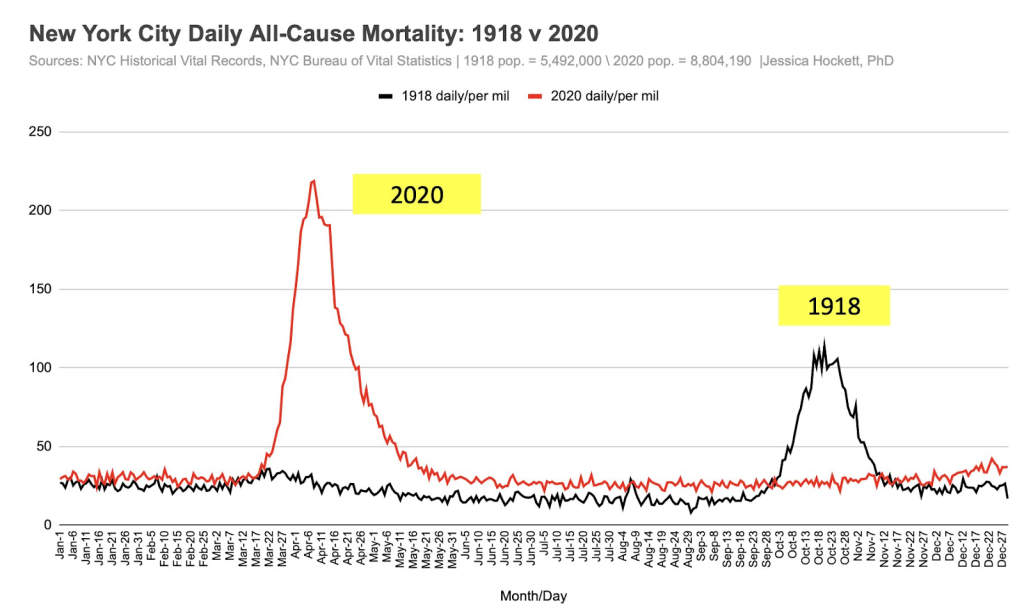
Moreover, unlike elsewhere, the increase in deaths was seen across a younger demographic, not exclusively in the elderly.
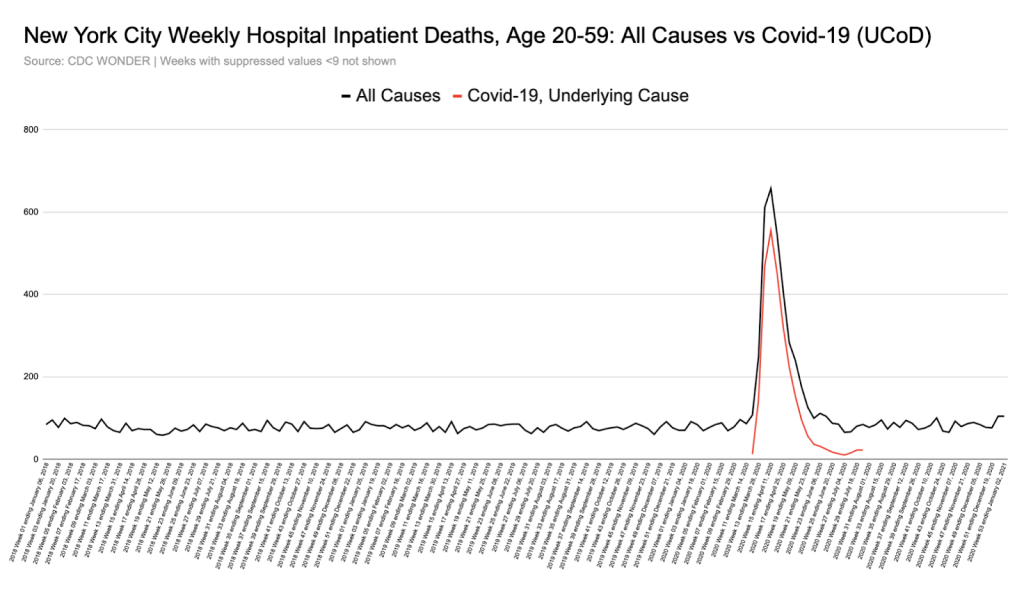
As shown in the graph below, all-cause hospital inpatient weekly death counts in the 20-59 age group were dramatically elevated for a short period, by a shocking 6-fold at their peak, with nearly all these deaths being coded as ‘covid’.
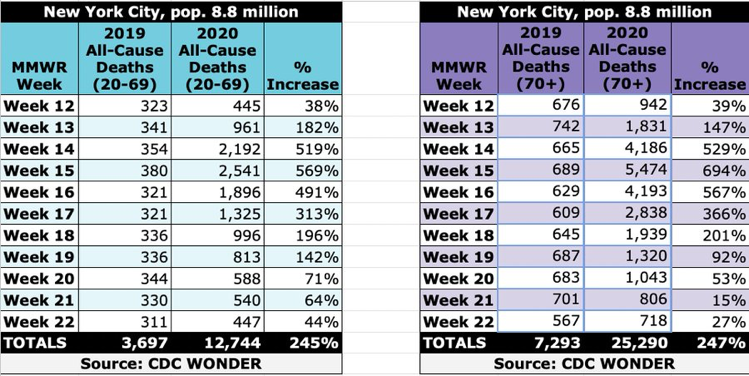
In fact, in New York, the % increase in all-cause deaths during the spring “1st wave” period was the same in the 20-69 year old age group as in the 70s and over:
In other places, however, what we were told was the same disease caused by the same virus left the younger age groups largely untouched, with nearly all deaths being in the elderly.
This discrepancy remains completely unexplained. It seems unarguable that certain difficult questions certainly need asking about what happened in New York in 2020 if we are to unravel the truth about what happened there.
Of course, the narratives emerging from Northern Italy and New York in 2020 were instrumental in driving fear and hysteria worldwide. Moreover, the number of deaths in both places informed early estimates of the IFR. These inciting incidents directly sparked much of the worldwide exaggerated, fear-driven response to what we now know was (if anything) a virus mainly affecting the frail and elderly, to which most people already had sufficient immunity to prevent severe illness.
For these reasons, it is essential that particular attention is paid to try to ascertain precisely what happened in these specific places.
It’s worth detailing – as evidence for the deeply dystopian mindset operating at the time – just some of the many deviations from normality that adversely affected human health and immunity, or which constituted sudden changes to healthcare practice.
These included (but were not limited to):
- Stress and anxiety from confinement (being told to stay home) and fear propaganda
- Discouragement to attend hospitals if ill
- Reduced community prescribing of broad-spectrum antibiotics
- Low staff levels in healthcare settings due to self-isolation of those “testing positive,” even with no symptoms
- Isolating the elderly
- Barring loved ones from hospital and care homes
- Fear (on the part of HCWs) of tending to covid positive patients, compromising basic medical and care needs.
- Early and inappropriate invasive ventilation
- Overuse of midazolam and opiates
Inevitably, and rightly, some researchers have started to perform post-pandemic autopsies analysing the motives and reasoning used to justify policies and other changes in behaviour and to examine their real world consequences.
Some medical practitioners have taken umbrage at any suggestion that the stressful environment and sudden expectations and pressures laid upon them may have resulted in well-meaning medical staff crossing ethical lines, or violating the Hippocratic Oath.
Those who wish to point out that there is historical precedent for medical staff behaving diabolically while thinking they are doing good often invoke atrocities during the 1930s and 1940s (and receive opprobrium as a result).
However, there is a much more recent example, and one which we were oblivious to until recently, despite this incident being totally “out in the open”, the subject of a lengthy investigative article, book, and a TV mini-series: the post Hurricane Katrina incident at Memorial Hospital Center in New Orleans in 2006.
Wikipedia provides the basic facts:
In the hurricane aftermath, the basement of Memorial Hospital Center flooded, power failed, and battery power for essential equipment started to run out. Most, but not all, patients were successfully evacuated.
The hurricane occurred on 29th August. A shocking finding was made in the aftermath, as described in the Wikipedia article:
On September 11, mortuary workers recovered 45 bodies from the hospital. Toxicology tests were performed on 41 bodies, and 23 tested positive for one or both of morphine and the fast-acting sedative midazolam [branded as Versed in the US], although few of these patients had been prescribed morphine for pain.
In the following weeks, it was reported that staff had discussed euthanizing patients. Some reports went further; Bryant King, an internist at Memorial, told CNN that he believed “the discussion of euthanasia was more than talk.”
LifeCare told the state Attorney General’s office that nine of their patients might “have been given lethal doses of medicines by a Memorial doctor and nurses.”
King publicly charged that one or more healthcare workers had killed patients, based on conversations with other health care workers. King told CNN that when he believed a doctor was about to kill patients, he boarded a boat and left the hospital. King explained his actions in terms of his opposition to Pou’s alleged actions, arguing “I’d rather be considered a person who abandoned patients than someone who aided in eliminating patients.”
Following an investigation into the deaths described above, the local DA (“District Attorney”) decided there was sufficient evidence to charge three medical staff with four counts of second-degree murder. Charges against two were later dropped in exchange for testimony.
The prosecution was deeply unpopular. Despite substantial evidence of deliberate actions taken to terminate lives – indeed, enough to satisfy the legal definition for homicide – many members of the public felt medical staff were simply “doing their best” under very trying circumstances. According to a local reporter the incident “ignited a furious debate in New Orleans and elsewhere about whether sharp ethical boundaries can be drawn around decisions on patient comfort made in a crisis.”
The DA failed to win re-election, and when the new DA convened a Grand Jury* at an undisclosed location, much of the previously amassed evidence was not presented and some of the key witnesses not called. The Grand Jury decided that charges should be dropped.
Unsurprisingly, several commentators (e.g., Loyola University Law Professor Dane Ciolono) opined that the Grand Jury was convened and run in such a way as to ensure charges would be dropped while providing “cover” for such an outcome.
Whatever actually occurred at Memorial Hospital, or whatever the staff’s motives, the incident speaks to an unsettling, yet undeniable truth: during a crisis, “ethical red lines” – however deeply held and valued – may be easily crossed. Society may judge those decisions acceptable or understandable, as appears to have happened with the Memorial Hospital case.
In summary, it would appear that the legal process was manipulated to assure an outcome which accorded with public opinion – that is to say to extinguish the possibility of prosecution while maintaining the pretence of due legal process. In this way, facing up to the stark reality – that as a society we mete out justice arbitrarily when we wish to – was avoided. Perhaps the well-ordered rules-based system suggested by statutory definitions of what actions constitute crimes, is to some extent just “for show”.
The Memorial Hospital case obliterates – with a relatively recent example – the notion that doctors and nurses all have the same ethical boundaries which they simply will not cross under any circumstances.
Could such boundaries have been crossed during the recent covid event?
A number of commentators are considering the possibility that changes in the policies and practices around the use of certain drugs (midazolam and opiates), and procedures (invasive ventilation) – sometimes in combination – may have contributed to the high mortality reported, at least in some specific places.
In relation to drugs, in an article published on his Substack last year, the blogger known as Bartram’s Folly explored the possibility that (in the UK) sheer fear and panic may well have driven medical staff to use midazolam and opiates more liberally in patients with covid, which may have encompassed anyone with a positive covid test.
In the UK one such mechanism which may have encouraged this measure is the NICE Guideline NG163 (no longer on their website but available here or as PDF download here), about which others have also written in detail. This guideline effectively transposed the advice for treating end-stage cancer patients with midazolam and opiates into that for covid patients. More detail on this here.
Of the guideline, Bartram said,
“… the NICE guidelines appear to have introduced a pathway for doctors which allowed for (perhaps even encouraged) more than a gentle nudge for those who were ill with Covid towards death, some of whom might well have survived given the chance. This iatrogenesis hypothesis would mean that at least some of the deaths recorded as with Covid might well have been a direct result of the care guidelines as set out by NICE.“
Later, Bartram makes the point that the pretext of a crisis situation or emergency may establish the grounds for ethical boundaries to be crossed or disregarded, at least temporarily, under the auspices of ignorance or ‘doing one’s best’ with the information said to be known or available at the time:
It is important to note that in the iatrogenesis hypothesis it isn’t necessary for some people to have had an evil intent – it is entirely possible that individuals promoted and exercised a policy that resulted in needless deaths while believing that they were ‘doing the right thing’ (e.g., see Hannah Arendt’s concept of the banality of evil).
In particular, ‘petty bureaucrats’ appear to be readily able to think up policies without seeing the need to consider the full consequences, and when these consequences are eventually revealed will usually point to the minutes from endless meetings with other petty bureaucrats to show that they weren’t personally responsible for the policy and they were simply following process.
Of course, once a framework had been decided front-line staff might have been grateful for the guidance offered given the challenging times, at least until the negative consequences of the guidance became painfully clear.
It should also be remembered that – in the US at least – certain extraordinary policy measures may have been important factors. For example, during the emergency NYC Governor Cuomo issued executive orders and suspended laws which gave doctors and nurses immunity and absolved hospitals of the responsibility to keep close patient records. (The order itself can be found here, and some legal commentary on it here.) Articles in JAMA can be interpreted as giving ethical permission for physicians to issue unilateral DNR orders, avoid CPR, and ration ventilators and critical care beds.
Moreover there are numerous examples of doctors, nurses and others in the US who later said they were following guidance, learning as they went. (See this interesting essay by Dr Kory, for example.) Under these circumstances it is easy to see how they could assume that something which ordinarily might have been questionable would become acceptable as “everyone else was doing it”.
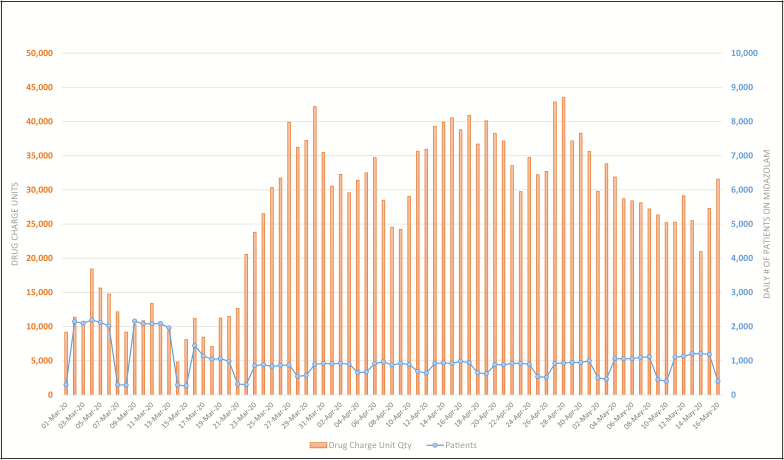
Evidence of increased midazolam use can be seen in the US as well as in the UK. This graph from a study describing the use of 7 specific drugs in 47 hospitals in NY shows the daily count of patients (blue) who received midazolam and the disproportionate quantities used (orange) between March 1 and May 16, 2020.
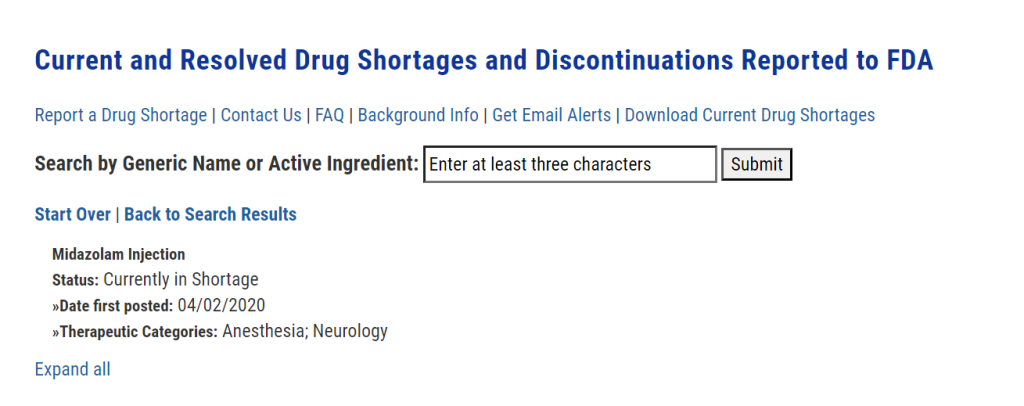
Moreover, midazolam is currently listed by the FDA to have been in short supply since 2 April 2020:
This Guardian article from 13 April 2020 reports on a letter sent by “a group of prominent medical practitioners and experts” to capital punishment states imploring them to:
“release their stocks of essential sedatives and paralytics that they hoard for executions” so that they can be “used for intubations and mechanical ventilation of the most severely ill coronavirus patients who cannot breathe for themselves”.
The tone of this letter can be taken to illustrate the sense of sheer panic prevailing at the time – certainly not conducive to rational decision-making – combined with the assumption that invasive ventilation was going to be extensively required and used.
This takes us to the question of invasive ventilation, whether it might have been used too often, inappropriately, and why.
As well as panic, the role of fear on the part of healthcare workers cannot be underestimated. Here is Dr Vinay Prasad stating that:
“It is a unique situation in medicine. In our whole medical career, doctors have never been personally afraid the way they were [with covid].”
Official guidance (see for example this from a British anaesthetists’ professional association) certainly reinforced the idea that one of the benefits of early intubation was to reduce the aerosolization of virus, such that it would be safer for those caring for the patients, compared to when non-invasive forms of ventilation were used.
This JAMA Clinical Update “Care for Critically Ill Patients With COVID-19” published on 11 March 2020 strongly supports the idea that the thinking was very much that non-invasive oxygen augmentation could be dangerous for healthcare workers:

The journalist Alex Berenson was early to point out that ventilator shortage may have more to do with overuse “to protect staff” than to being overwhelmed by patients in respiratory failure.
It seems like fear may well have been augmented by official guidance to result in significant overuse of this measure.
It is important to understand the differences between the Memorial Hospital incident and what may have happened in the early stages of the covid crisis. In New Orleans, it may indeed have been reasonable to assume that it was going to be impossible to evacuate the patients (who were given midazolam and opiates to ease suffering) in time, and that they were indeed unsaveable due to the extraordinary circumstances. (Whether or not this was actually the case will probably never be known, because of the legal shenanigans described above.)
However, whether that applies to all, some, or just a few of those who died in spring 2020 after being administered the same or other drugs (or placed on mechanical ventilators or issued a unilateral DNR, etc.) is still a matter of debate whereas for sure, Hurricane Katrina was self-evidently an extreme weather event that created devastation and emergency conditions in its fury and wake.
Certainly, it seems clear that personal fear and a belief in the lethality of this infection drove much medical decision-making in the early days. It is not hard to imagine actions being taken which were then rationalised by imagining the suffering that had been prevented, limited resources preserved, and many lives saved. The deaths witnessed could easily have acted as positive reinforcement in the minds of healthcare workers as to how serious the illness was. These protocols could lead to the deaths of patients who were not particularly old and frail and thus reinforce the message that the virus was potentially fatal even in such people
The decisions that healthcare workers made, and the influences on and factors involved in those decisions, will be discussed and dissected for decades to come. When humanity is ready to confront what occurred – and admit that ethical inversions in hospitals and care homes contributed to unintentional iatrogenic death, we can move toward keeping it from happening again.
* (A Grand Jury in the US is a specific type of court empowered by law to determine whether probable cause exists to support criminal charges for a suspect in a crime. Louisiana – in which New Orleans is situated – is one of 23 US states that use grand juries for indictments in serious crimes.)
Americans urged to ‘immediately’ leave Belarus
RT | August 21, 2023
Any US citizens in Belarus should leave right away, the State Department said in a bulletin on Monday, citing new closures of border crossings by Lithuania and the possibility of more to come.
“The Lithuanian government on August 18 closed two border crossings with Belarus at Tverecius/Vidzy and Sumskas/Losha,” the department said. “The Polish, Lithuanian, and Latvian governments have stated that further closures of border crossings with Belarus are possible.”
“US citizens in Belarus should depart immediately,” the bulletin added.
Americans were urged to travel by land using the “remaining border crossings with Lithuania and Latvia,” because Poland has closed the border, or by plane, though not to Russia or Ukraine.
The Ukraine-Belarus border has likewise been closed. Meanwhile, most Western airlines have halted flights to Minsk and Western nations have closed their airspace to Belarusian and Russian flights, so it was unclear how Americans might fly out without passing through Russia.
Washington has urged its citizens not to travel to Belarus for years, first citing the Covid-19 pandemic, then the 2020 unrest following the presidential election – which the US claims to have been rigged or stolen – and since February 2022, Minsk’s support for Moscow’s military operation against Kiev.
According to the State Department, Belarus is also dangerous due to “the arbitrary enforcement of local laws, the potential of civil unrest, the risk of detention,” and the inability of the US to assist its citizens, since the embassy in Minsk “suspended operations” at the end of February 2022 .
The Polish government has increased its military presence along the border with Belarus over the past month, citing what they called a threat of “hybrid warfare” by Wagner Group fighters who left Russia at the end of July, following a failed mutiny.
Minsk has repeatedly insisted that there is no threat and that Warsaw is getting hysterical due to domestic politics ahead of the general election. Meanwhile, Moscow has warned that any attack on Belarus would be treated as an attack on Russia itself.
US offloads oil from seized Iranian tanker despite Tehran’s warnings
The Cradle | August 20, 2023
An oil tanker seized by the US Navy for allegedly carrying sanctioned Iranian oil began transferring its cargo to another tanker off the coast of Texas on 20 August, despite threats from Tehran to target shipping in the Persian Gulf in response.
Ship-tracking data analyzed by The Associated Press showed the Marshall Islands-flagged Suez Rajan began the ship-to-ship transfer of its oil to the MR Euphrates, a tanker located some 70 kilometers southeast of Houston in the Gulf of Mexico. The value of the oil on the 800,000-barrel tanker is estimated to be $56 million.
Washington illegally seized the Marshall Islands-flagged Suez Rajan supertanker in April of this year in what was described by the Pentagon as “a sanctions-enforcement operation.” Washington also charged the ship’s owner with “sanctions evasion” and directed the stolen cargo to the waters off the Texas coast.
According to the Wall Street Journal, the Suez Rajan came under Washington’s radar after an anti-Iran organization – the New York-based United Against Nuclear Iran (UANI) – provided information about the ship’s cargo to government officials. Lawyers representing the families of victims of the 11 September attacks, “whom US courts have given the right to claim compensation from [Tehran],” filed a lawsuit against one of the ship’s former owners.
However, oil firms in the US had been reluctant to unload the shipment of stolen Iranian oil sitting, saying they were “too worried about Iranian reprisal” to touch the cargo, sources familiar with the matter told the WSJ.
“Companies with any exposure whatsoever in the Persian Gulf are literally afraid to do it,” a Houston-based energy executive told the US outlet, adding that companies fear “the Iranians would take retribution against them.”
“I don’t know if anybody’s going to touch it,” another executive at a shipping company had said.
The transfer of the Iranian oil comes as the US Navy has bolstered its forces in the Persian Gulf in recent weeks, including by sending the troop-and-aircraft-carrying USS Bataan through the Strait of Hormuz. Washington is also considering placing US troops on commercial vessels to prevent Tehran from seizing them in response to Washington’s own seizures of Iranian ships.
US theft of Iranian oil from the Suez Rajan also comes as Tehran and Washington seek to complete a prisoner exchange that also involves the US releasing between $6 and $10 billion in seized Iranian oil proceeds held in banks in South Korea and Europe.
Iran has been resisting US sanctions by continuing to sell its oil abroad, while the US has been seizing cargoes since 2019 after withdrawing from the nuclear deal negotiated between the two rival countries. The 2015 nuclear deal held that Iran would limit the enrichment of uranium for its nuclear program in exchange for sanctions relief. The US withdrew from the deal unilaterally in 2018. Washington accuses Iran of seeking to develop nuclear weapons, however, Iranian leaders have stated the nuclear program is for peaceful purposes and that developing nuclear weapons is forbidden by Islam.
US not in a position to send more missiles to Ukraine – media
By Lucas Leiroz | August 21, 2023
Western criticism of the Ukrainian “counteroffensive” is increasing. In response to Kiev’s unlimited demand for arms, Western media claim that the US is not in a position to send more heavy weapons to the regime. According to a major western outlet, Washington does not produce enough tactical ballistic missiles to send the number that would be needed to guarantee the Ukrainian counterattack’s victory.
In a recent article for the Financial Times called “US grows doubtful Ukraine counteroffensive can quickly succeed”, Western experts reported that the US does not manufacture enough tactical ballistic missiles to make a difference on the battlefield. The “necessity” to send weapons to Ukraine coexists with the need for internal supply for the arsenal of the American armed forces, with no possibility of accelerating production significantly in the short term.
In addition, the newspaper’s informants allege that Washington is currently “holding back” as many missiles as possible, as Americans are concerned about the possibility of escalation in the conflict. Kiev’s officials blamed the failure of the counteroffensive on the supposed “slowness” in the supply of weapons, mainly high-range missiles capable of reaching the undisputed territory of the Russian Federation. Many American experts, however, seem to disagree with this analysis.
Samuel Charap, a senior political scientist at the US think tank Rand Corporation, told Financial Times’s journalists that ballistic missiles are capable of causing damage to Russian logistics, but assessed that this is not the main problem to be solved by Ukrainians to achieve victory. According to him, there are no “magic wands” able to make the counteroffensive become successful, thus echoing the growing Western pessimism with the Ukrainian military moves.
“I don’t think that you’ll hear an argument from anyone that this [Ukraine’s counteroffensive] is going well right now or that this is heading to a place that people would view as good, but there is not much by way of plan B (…) There’s no magic wands,” Charap said. “It’s hard to make the case that long-range strike [missiles] can fix the problem of minefields or all these defences (…) It will complicate Russian logistics but that’s not the main or the only problem the Ukrainians are facing today”, Charap said.
In fact, this assessment exposes growing dissatisfaction on the part of the West with Ukraine’s progress in the conflict. The strategy used by the Ukrainians – certainly instructed by NATO agents – failed on the battlefield and Kiev quickly lost massive amounts of soldiers and equipment. The Ukrainian defeat was so evident that it was not even possible for the western media to continue doing its propaganda work, which meant that more critical and pessimistic opinions began to be exposed by the newspapers.
For its part, Kiev responds to the criticism by demanding even more weapons. It became commonplace among the regime’s officials and Western warmongers to blame a supposed “failure” in NATO’s aid for the fiasco of the counteroffensive. It is said that the more lethal and long-range weapons Ukraine receives the faster it will achieve victory against Russian forces. But, in practice, this has not been seen so far.
The West sent heavy – and even illegal – weapons to its proxy regime as much as it could. Packages including banned cluster bombs, radioactive depleted uranium ammunition and British long-range missiles arrived in Kiev and were used on the battlefield, not to seek any military victory, but to murder civilians and bomb undisputed demilitarized zones, making “counteroffensive” a mere wave of terrorist attacks.
Apparently, American experts understood that the more lethal weapons they send to Ukraine, the greater the risks of escalation and, consequently, the greater the regime’s losses will be. In this sense, in the Financial Times article, it is also said that until next year, military aid to Kiev is expected to decrease, at least in terms of quality – lethality of the weapons. There is a concern to avoid greater losses in an eventual scenario of escalation by Russia – which is aggravated by the upcoming presidential elections and the inability of the American defense industry to produce arms in even larger quantities.
“Even if Congress authorizes the latest package of Ukraine funding requested by the White House, some US officials and analysts say it is unlikely that Washington will be able to offer the same level of lethal assistance to Ukraine next year, given the looming presidential election and munitions manufacturers’ longer-term schedule to increase production”, the article reads.
This scenario of American disappointment with Ukraine must be analyzed from a realistic point of view. Washington does not want the war to end. On the contrary, it wants to prolong the hostilities in order to generate friction with Russia for as long as possible. And this is precisely why the country is avoiding increasing the deployment of long-range weapons, as it fears that Russian responses to Ukrainian provocations could be strong enough to end the conflict quickly.
For the US and NATO, what matters is to keep Russia fighting on multiple flanks as the alliance prepares for a direct military conflict with China. With no hope of defeating Russia on the battlefield, the US just wants to keep Moscow fighting in various proxy conflicts. Therefore, it is in Washington’s interest to prolong the war in Ukraine as well as to generate provocations in other regions where Russia could be militarily involved.
The Green Energy Future Is Arriving Faster Than You Think — Or Not
By Francis Menton | Manhattan Contrarian | August 19, 2023
Among the media sources serving as propagandists and cheerleaders for the “green energy transition,” two of the most prominent are the New York Times and Bloomberg News. To get an idea how the “transition” is going, let’s take a look at the latest from those two.
From the Times, in this morning’s print edition, we have a feature article that apparently first appeared online a couple of days ago, August 17. The headline is: “The Clean Energy Future Is Arriving Faster Than You Think.” The sub-head continues the excitement: “The United States is pivoting away from fossil fuels and toward wind, solar and other renewable energy, even in areas dominated by the oil and gas industries.”
But then Bloomberg News comes out yesterday with an editorial that seems to reach the exact opposite conclusion. Headline: “Net Zero Is Stalling Out. What Now?”
So which is it? Is the green energy future arriving “faster than you think,” or “stalling out”? Both can’t be right. Who has the better side of this?
Let’s look first at the Times piece. It is an uncritical litany of every possible piece of good news for the generation of electricity from wind and sun in the U.S. It is filled with more than twenty photographs and charts designed to impress you with the great progress being made: massive wind turbines, vast solar arrays, rows of EV charging stations, teams of serious-looking workers in a modern factory working away on some unnamed but clearly complex piece of equipment.
On the other hand, the piece is devoid of meaningful data on how the “transition” is progressing. Are wind and solar electricity actually making progress toward supplanting fossil fuels? You won’t find the answer to that here.
I’ll give you a few choice excerpts so you can get an idea of the technique:
Delivery vans in Pittsburgh. Buses in Milwaukee. Cranes loading freight at the Port of Los Angeles. Every municipal building in Houston. All are powered by electricity derived from the sun, wind or other sources of clean energy. . . . The nation that burned coal, oil and gas for more than a century to become the richest economy on the planet, as well as historically the most polluting, is rapidly shifting away from fossil fuels. A similar energy transition is already well underway in Europe and elsewhere. . . . Wind and solar power are breaking records. . . . Automakers have made electric vehicles central to their business strategies and are openly talking about an expiration date on the internal combustion engine. Heating, cooling, cooking and some manufacturing are going electric.
So what are these Bloomberg people talking about when they say that the “Net Zero” thing is “stalling out”? It turns out that they have plenty of data points, mostly (but not entirely) from Europe, and all relating to collapsing public support as costs become apparent:
[V]oters have legitimate questions about net-zero policies: How much will they cost? What benefits will they bring? Will they actually work as advertised? Such skepticism is already changing politics, from the recent losses suffered by Germany’s Greens to the fall of the Dutch governing coalition, which was partly fueled by farmers’ anger over forced reductions in nitrogen-oxide emissions. Even some avowed environmentalists — such as the governor of New Jersey and the leader of the UK’s Labor Party — have lately been siding with voters who feel aggrieved at the costs of environmental policies.
Can we get any actual data as to whether wind and solar energy are rapidly increasing their market share for energy production in the U.S.? The best source of information is the Energy Information Administration (part of the Department of Energy). The most recent two full years for which they have data are 2021 and 2022. Here’s the 2021 chart showing U.S. primary energy consumption by source:

Add up the percentages for petroleum (36%), natural gas (32%) and coal (11%), and you get 79% from fossil fuels in the aggregate.
And how about 2022? The chart is in a different format that is more difficult to read, but here is the key line of text: “Fossil fuels—petroleum, natural gas, and coal—accounted for 79% of total U.S. energy consumption in 2022.” Oh, that’s the exact same percentage as in 2021. It didn’t budge by even 1%.
Here is the chart they provide for 2022. As you can see, it is not so easy to calculate the percentages by source from this chart, but the general result is still obvious:

For 2023, EIA has put out monthly data through April as part of its Monthly Energy Review. There are no pretty charts, but through April fossil fuels have generated 26.082 quadrillion BTUs out of total primary energy consumption of 33.209 quadrillion BTUs. That would be 78.53% for fossil fuels. In other words, to the nearest whole percent, it’s still 79%. All the billions upon billions of government subsidies don’t seem to be moving the needle in any noticeable way.
To be fair, these figures reflect little if any of the massive subsidies brought forth by the big federal green energy bill (“Inflation Reduction Act” [sic]), which was signed a year ago on August 16, 2022 and is just getting cranked up. Will those subsidies move this needle at all? You would think that they couldn’t help moving the needle at least a little. But my own prediction is that the percent of primary energy from fossil fuels will decrease only minimally.
Over at Bloomberg, while they report honestly that Net Zero seems to be stalling out, they are not happy about it. What is the remedy? Obviously, the government planners directing the green energy transition need to go about this in a more “purposeful” and “strategic” manner:
If the government is going to ban the sale of gas boilers in 2035, as it says, it will need to make sure that cheaper alternatives are available. Likewise with a planned ban on new gas and diesel cars: It’s a fine goal, but it won’t go anywhere unless consumers have compelling incentives, charging infrastructure can meet demand and the government has otherwise laid the needed groundwork. . . . Above all, what’s needed is leadership. Decarbonization can drive economic growth, create jobs and bring substantial benefits to the environment and public health. But it must be done purposefully and strategically.
It’s the usual touching faith that central planning really is going to work this time, because it will be done more intelligently. No amount of real world failures will ever convince the true believers otherwise.
Air quality board approves sweeping demands on large buildings to start cutting greenhouse gas emissions
Big buildings in Colorado will now be on an energy diet
By Michael Booth | The Colorado Sun | August 18, 2023
Colorado’s largest buildings will have to follow a carbon consumption diet plan to cut state greenhouse gas emissions, with the Air Quality Control Commission passing the controversial regulations over days of intense opposition testimony from property managers.
State air and clean energy officials said they tried to accommodate objections that efficiency modifications had premature deadlines, would cost too much, and may not achieve the targeted emissions cuts. But in the end, the commission late Thursday approved the basic plan requiring 8,000 Colorado buildings to slash carbon emissions 7% by 2026, and 20% by 2030.
Regulation 28 applies to apartments, office and industrial buildings over 50,000 square feet, and fulfills 2021 legislation that called for Colorado’s building sector to share in the carbon cuts demanded from other major polluters such as transportation, utilities and oil and gas drilling. Colorado regulators say large buildings are one of the five highest categories of commerce contributing to state greenhouse gas emissions, which must be trimmed overall by 50% by 2030, from a 2005 benchmark.
“Reducing pollution from large buildings is essential to meet our greenhouse gas pollution reduction targets and ensure that the state’s existing buildings are ready for Colorado’s clean energy future,” Colorado Energy Office Executive Director Will Toor said after the measure passed. “Today’s investments to improve building energy efficiency and reduce building energy use will save Coloradans money on energy costs and improve Colorado’s air quality for decades to come.”
Owners and managers of large buildings have been conducting energy use audits and greenhouse gas emission inventories and filing them with the state. They must now plan upgrades that will lower emissions from those initial benchmarks.
Landlords can cut the emissions they are responsible for through insulated windows, thickening walls, replacing furnaces and other appliances with efficient models running on clean electricity, and other measures. Under the state law and the new rules, the gains must be separate from requirements that Colorado’s utilities deliver cleaner power to their doorstep, and not double-count those emissions cuts.
Property managers continued their months of objections at days of hearings over the regulation. Building owners around the Purgatory ski resort in southwestern Colorado said they are isolated, with a single propane pipeline supplier whose own investments need to be paid back over time, so they can’t easily switch power sources. They also said individual condo owners in large residential buildings could be hit with expensive special assessments when efficiency renovations prove difficult.
Timing alone could make the efficiency rules impossible to meet, the Colorado Real Estate Alliance said, in rebuttals filed with the commission for the hearing.
“A 2026 target of any level will be difficult to attain,” the alliance said. “The final rule likely will not become effective much before the end of calendar year 2023. That will leave building owners with less than two years to secure and carry out audits to identify potential compliance pathways, raise capital, secure contractors, and acquire equipment in an economy still suffering from supply chain disruptions.”
A LoDo Denver building manager told The Colorado Sun before the hearing that meeting the targets would require renovations such as tripling insulation and thickening walls, and could cost $6 million for one five-story structure. … Full article
Biden rival labels F-16s for Ukraine ‘a disaster for humanity’
RT | August 20, 2023
The looming delivery of US-made F-16 fighter jets to Ukraine will not prevent the “collapse” of the country’s military and will only benefit the military-industrial complex, Democrat presidential hopeful Robert F. Kennedy Junior has claimed.
The Ukrainian conflict should be resolved through negotiations, RFK Jr. argued in a thread on social media platform X (formerly Twitter), stating that supplying F-16s to Kiev was a “great decision for the defense industry, but a disaster for Ukraine and humanity.”
“F-16s won’t stop the collapse of the Ukrainian military (which some experts say is imminent). These planes require a lot of training and maintenance. This isn’t the movies,” Kennedy stressed.
The presidential hopeful has long-opposed the enduring Western aid to Ukraine, spearheaded by Washington, arguing that the US should admit its “failure” in the country and focus on domestic issues instead. Kennedy’s criticism of the fighter-jet delivery comes after Washington enabled its European allies to re-export older planes to Ukraine, and hours before the move was officially announced by Denmark and the Netherlands.
The upcoming delivery was heralded by Dutch PM Mark Rutte on Sunday as he hosted Ukrainian President Vladimir Zelensky at a military airbase in Eindhoven.
“Today we can announce that the Netherlands and Denmark commit to the transfer of F-16 aircraft to Ukraine and the Ukrainian Air Force, including cooperation with the United States and other partners once the conditions for such a transfer have been met,” Rutte said at a press conference.
Simultaneously, the Danish Ministry of Defence released a statement confirming its pledge to provide Kiev with F-16s from its inventory, once certain “conditions” are met. The conditions “include, but are not limited to, successfully selected, tested and trained Ukrainian F-16 personnel as well as necessary authorizations, infrastructure and logistics,” it said.
Kiev has long-demanded modern aircraft, as well as other, increasingly sophisticated weaponry, from its Western backers, arguing the planes would help it turn the tide of the conflict with Russia, which has been going on since February 2022. Moscow has repeatedly urged the collective West to stop the military deliveries, arguing they would only prolong the hostilities rather than change their ultimate outcome.
US Policymakers Are Caught In A Dilemma Of Their Own Making After The Failed Counteroffensive
BY ANDREW KORYBKO | AUGUST 20, 2023
Politico reported on Friday that US policymakers are starting to wonder whether “Milley had a point” when he suggested that last November was a good time to resume peace talks. Kiev had just reconquered the western half of Kherson Region less than two months after expelling Russian forces from the rest of Kharkov Region. Furthermore, the coming winter was bound to force a de facto freeze along the frontlines. In hindsight, Ukraine’s negotiating position was the strongest it had ever been.
Instead of seizing the opportunity, the decision was made to prepare for summer’s counteroffensive, which spectacularly failed and has recently sparked a vicious blame game between those responsible for this disaster as reported by two leading US outlets last week. Russian Foreign Minister Lavrov reaffirmed several days back that the US is obsessed with dealing a strategic defeat to Russia, hence why it’s not interested in peace, yet Politico’s latest piece hints that its calculations might be changing.
According to them, one of their unnamed official sources lamented that “We may have missed a window to push for earlier talks” in spite of paradoxically insisting that there aren’t any regrets about the counteroffensive. Another such source went even further by claiming that the Biden Administration is now asking itself the following question: “If we acknowledge we’re not going to do this forever, then what are we going to do?”
Politico then reminded their readers that these views are being shared shortly after the Washington Post revealed that “U.S. intelligence says Ukraine will fail to meet offensive’s key goal”. Although not mentioned in their article, all of this occurred during the same week that a leading NATO official proposed that Ukraine formally cedes its former regions to Russia in exchange for joining that bloc. They retracted their idea shortly after, but it still made observers suspect that the West is becoming fatigued.
NATO’s “race of logistics”/“war of attrition” with Russia that Secretary General Stoltenberg declared in February is taking its toll as Moscow’s edge grows in parallel with the depletion of the West’s stockpiles. The frontlines still remain largely frozen due to the counteroffensive failing to break the stalemate that set in since November, but there are now reports that Russia might be preparing for its own offensive sometime this fall that could capitalize on the aforesaid to scale into a full-blown campaign by spring.
President Putin’s series of reminders two months ago that Russia is still sincerely interested in a political solution to this conflict might become irrelevant if he decides to seize the opportunity presented by the counteroffensive’s spectacular failure to militarily ensure his side’s objective national security interests. At minimum, the Kremlin seeks to obtain full control over the entirety of those four former Ukrainian regions that unified with Russia last September, but its forces might have to go further to guarantee this.
After all, Kiev’s NATO-supplied artillery, drone, and missile arsenals can still threaten those regions’ residents even if they’re deployed far away from the frontlines, thus compelling Moscow to advance deeper into the Ukrainian hinterland in order to carve out a buffer zone for protecting them. The further that Russia moves in that direction, the more hysterical NATO will become, which could lead to the bloc as a whole escalating or some of its members like Poland unilaterally intervening to stop the tide.
In any case, the preceding scenario spikes the risk of a larger war by miscalculation, which both sides presumably want to avert. Therein lies the rationale behind US policymakers starting to wonder whether it’s time to consider a compromise before it’s too late, the thoughts of which were unexpectedly voiced by that previously mentioned leading NATO official who later retracted their proposal under pressure. Despite the Biden Administration denying that any such plans are in the cards, Kiev became spooked.
Many of its lawmakers from different factions united in the aftermath of last week’s scandals to table a resolution prohibiting territorial concessions, which will likely pass just like last fall’s similar such one prohibiting Zelensky from negotiating with his Russian counterpart. Neither parliamentary reaction would have happened if the Rada sincerely had faith that the US wouldn’t ever coerce Ukraine into walking back its maximalist demands for ending the conflict.
Unlike then, this scenario is now more realistic than ever as evidenced by last week’s spree of reports aimed at preconditioning the public to accept the possibility of a compromise for resolving the NATO-Russian proxy war in Ukraine before its cycle of self-sustaining escalations spirals out of control. If the political will is present on both the American and Russian sides, then it’s possible that they could reach a deal, but this can’t be taken for granted due to the dilemma that US policymakers inadvertently created.
Despite Politico reporting that officials are now wondering whether “Milley had a point” about last November being a good time to resume peace talks, politicians might fear the public’s wrath if they do so now after all that was spent on the counteroffensive for nothing. Moreover, Ukraine and the West’s newfound military-political weaknesses that were brought about by this debacle might have made Moscow disinterested in peace talks for the time being if it already decided on another offensive.
Each therefore has their reasons for staying the course: America wants to “save face” after this summer’s disaster while Russia might want to seize the aforesaid opportunity to militarily ensure its minimum national security interests by obtaining full control over the entirety of its new regions. That said, the first’s motivations relate to an intangible interest of dubious importance and are therefore negotiable, while the second’s concern a tangible issue of premier importance and thus aren’t negotiable.
Accordingly, the only way to reduce the risk of a larger war by miscalculation is for the US to make concessions on its abovementioned intangible interests in order to meet Russia’s tangible ones, which is likely one of the possibilities being discussed during their reportedly ongoing informal negotiations. In the event that an understanding is reached, then it could take the form of the US pulling Kiev’s strings (possibly through threats of curtailing arms shipments) to coerce it into informally accepting a ceasefire.
Just like it can’t be assumed that America and Russia both have the political will to agree to this, nobody should take for granted that Kiev would go along with it even if those two reach a related deal, not to mention Poland. Each has their own reasons not to, which thus results in a multidimensional dilemma that’ll likely necessitate the US having to practically force those latter two to comply if it’s to stand any chance of success, though it’s also difficult to imagine that happening too.
The takeaway is that US policymakers are now caught in a quandary completely of their own making, which lessens the odds of a political solution to the NATO-Russian proxy war materializing anytime soon and correspondingly spikes the risk of a larger war by miscalculation. Unless the US accepts that it’ll have to sacrifice its soft power by forcing Kiev and Poland to freeze the conflict against their will, which first requires accepting the loss of its unipolar hegemony, then the worst-case scenario can’t be ruled out.
US, Ukraine Split Over Counteroffensive, Washington Braces for War of Attrition – Reports
Sputnik – 20.08.2023
Tensions are mounting between officials in Washington and Kiev over Ukraine’s strategy in the counteroffensive, with the United States seemingly girding for a war of attrition amid limited results on the battlefield, the Western media reported on Sunday.
US officials reportedly urged Ukraine to stop avoiding risks and make full use of its forces in the south. Washington also advised Kiev against concentrating its main forces in the eastern direction, but Ukraine instead sent its best units there, the newspaper said.
The report added that US officials are privately preparing for a war of attrition in Ukraine, which may last into 2024, while they continue to publicly reiterate support for Kiev’s counteroffensive.
Republican Congressman Andy Harris, a co-chair of the Ukraine Caucus in the US House of Representatives, said at a meeting with voters earlier this week that the counteroffensive “failed” and that aid to Kiev should be slashed, the report said. He also expressed doubt that the conflict is “winnable” for Ukraine.
Earlier this week, US magazine reported that the Ukrainian political leadership was allegedly misled by the military command on the true scale of Ukraine’s losses in the counteroffensive.
Ukraine launched its much-touted counteroffensive in early June after multiple postponements. Citing the counteroffensive’s needs, Kiev pushed its Western donors to step up the military and financial aid. According to the Russian Defense Ministry’s estimates, as of August 4, Ukraine’s losses in the counteroffensive were about 43,000 troops and 4,900 units of military equipment.
Medical Board Chief who wanted Doctors delicensed for ‘misinformation’ in bed with PR firm tied to CDC, Pfizer, Moderna
By Michael Nevradakis, Ph.D. | The Defender | August 18, 2023
The head of a national medical organization who publicly called for doctors to lose their licenses unless they supported government narratives on COVID-19 treatments and vaccines concealed his relationship with a public relations firm whose client list also included Pfizer, Moderna and the Centers for Disease Control and Prevention (CDC).
Dr. Richard Baron, president and CEO of the American Board of Internal Medicine (ABIM) is a client of Weber Shandwick, investigative journalist Paul D. Thacker reported on Wednesday.
In late 2021, Baron publicly pushed for doctors who spread “misinformation” about COVID-19 and the vaccines to lose their license and certification. Baron said then that “putting out flagrant misinformation is unethical and dangerous during a pandemic.”
Weber, the world’s second-largest PR firm, has branded its team as “misinformation and disinformation” experts and says it provides clients with services to help manage any perceived threats posed by spreaders of such information.
The firm has organized conference panels on “medical misinformation” in which Baron participated.
Last year, Baron partnered with Weber Shandwick to propose a South by Southwest (SXSW) panel titled “When Doctors Prescribe Misinformation.” The proposal was subsequently accepted and the panel took place at SXSW in Austin, Texas, on March 13.
According to Thacker, “Weber Shandwick’s panel featuring Dr. Baron has been widely promoted by the PR firm’s employees,” including Sarah Mahoney, executive vice president, Healthcare Communications, Strategy & Planning for Weber Shandwick, who in a LinkedIn post, wrote she “can’t think of a more important topic right now.”
The CDC’s National Center for Immunization and Respiratory Diseases (NCIRD) in September 2020 awarded Weber a $50 million contract “to promote the vaccination of children, pregnant women and those at risk for flu and increase the general acceptance and use of vaccines,” according to the PR firm’s website.
Under the contract, Weber employees were embedded in the NCIRD to “communicate the risks and recommended actions for outbreaks and convey vaccine recommendations to healthcare providers,” according to Thacker.
Medicine has always been ‘in bed with Big Pharma’
Several doctors have faced disciplinary action by state medical boards for allegedly spreading “misinformation.” One of them is internist and biological warfare epidemiologist Dr. Meryl Nass, a member of Children Health Defense’s scientific advisory committee.
Nass on Thursday sued the Maine Board of Licensure, which suspended her license in January 2022.
The board’s suspension arose from its adoption of a position statement promulgated by the Federation of State Medical Boards (FSMB) threatening physicians “who generate and spread COVID-19 vaccine misinformation” with suspension or revocation of their medical license.
In 2021, ABIM and FSMB collaborated to create the statement used to discipline Nass.
Nass told The Defender that in order to get certified by organizations like ABIM, there are several requirements, primarily related to demonstrating competence in one’s field of specialization, including completing a residency, being certified by the residency director, and paying for and passing the board examinations.
Nass told The Defender that in order to get certified by organizations like ABIM, there are several requirements. She explained:
“You complete a medical residency in your field of specialization. Your residency director certifies your competence and moral character, and you must pay for and pass your board examination to demonstrate your command of your specialty.
“When you’ve paid them for board certification and successfully completed all the requirements, how can they change the rules 20 or 50 years later and say, ‘we’re going to decertify you now because we don’t like your viewpoint?’
“There was nothing in any documentation from the Board of Internal Medicine about misinformation, or any other standards that the board can impose apart from competency to practice when it issued certifications.”
Dr. Richard Eggleston, a retired ophthalmologist in Clarkston, Washington, also faces disciplinary action — by the Washington Medical Commission — arising from articles he published in a local newspaper in 2021, questioning the official narrative and medical advice related to COVID-19.
Doctors aren’t being targeted exclusively for spreading “misinformation” — some, like Dr. Mary Kelly Sutton, an integrative physician, were targeted for their less-than-100% support for COVID-19 vaccines.
Last month, the Massachusetts medical board revoked Sutton’s medical license, claiming she improperly exempted eight children from required school vaccinations. This came a year after California also revoked Sutton’s medical license.
Sutton told The Defender, “The voice of medicine today is determined by the marketing wisdom of Madison Avenue, not by what is sound information from scientific research.”
Sutton said the whole practice of medicine rests on sharing and providing information necessary for informed decisions and consent. When specialty boards issue vague accusations, they engage in “harassment,” and an “egregious overreach of power” and are obstructing the practice of medicine.
A California law aimed at punishing doctors for providing “misinformation” to their patients is now in “legal limbo” following conflicting rulings in state courts earlier this year, which could affect Sutton’s and other California doctors’ cases going through the courts.
This trail of evidence demonstrates medical boards are not simply acting on their own authority but in collusion with state governments, federal agencies and private companies.
“There’s no one who is a ‘misinformation’ or ‘disinformation’ expert whose opinion does not align with the government and with the corporations,” Thacker told The Defender. “That’s what makes them an ‘expert.’”
“What’s always been true is that medicine has been in bed with Big Pharma,” he added. “It’s now becoming a lot more transparent. These relationships are much more transparent.”
‘A very political attempt to shut down people from having alternative viewpoints’
According to Thacker, Baron began his “crusade for the biopharmaceutical industry” in September 2021. In a post for ABIM’s blog, Baron said, “I want to state unequivocally that ABIM can and does take action, independent of state licensing boards, to remove certification from physicians for unprofessional and unethical behavior.”
For Thacker, Baron’s concern about “misinformation” was first triggered when physicians spoke out against COVID-19 vaccine safety, efficacy and side effects. “These are the same concerns held by Weber Shandwick, who Pfizer and Moderna are paying big buck[s] to promote their vaccines,” he said.
“Baron’s relationship with Weber Shandwick was not disclosed” by JAMA, Thacker said, “nor in an accompanying viewpoint Baron wrote for JAMA.”
After an inquiry by Thacker, JAMA’s editor-in-chief, Kirsten Bibbins-Domingo, said, “We initiated our internal investigation earlier this week, in accordance with our standard processes for allegations of non-disclosure of conflicts.”
“It is notable that Baron has done his best to mislead the public and other physicians about what he is doing,” Nass said. “He claims the ABIM is trying to ‘protect the legitimacy of medical expertise’ rather than censoring viewpoints it does not like.”
Nass said Baron “conjures up examples of what the board might censure.” She pointed to a Feb. 23, 2023, New England Journal of Medicine (NEJM) article Baron co-authored with attorney Carl J. Coleman, which stated:
“When a licensed physician insists that viruses don’t cause disease or that COVID-19 vaccines magnetize people or connect them to cell towers, professional bodies must be able to take action in support of fact and evidence based practice.”
“Yet this is a fabrication,” Nass said, adding:
“Instead, Dr. Baron, who earns about $1.2 million yearly from the ABIM and the ABIM Foundation, has decertified Drs. Peter McCullough, Paul Marik and Pierre Kory — all highly celebrated, published and esteemed doctors in their fields.
“None of them have uttered any mumbo-jumbo about cell towers, magnetism or a non-viral etiology for COVID-19. All have had their board certifications revoked for the viewpoints they expressed — viewpoints that are supported by a preponderance of the medical literature.”
In a January 2022 article for Health Affairs, Coleman wrote, “Licensing boards are state agencies subject to the First Amendment, and as such they are limited in their ability to penalize physicians based on the content of their speech.”
Yet, a 2022 NEJM article co-authored by Baron argued that while “Differences of opinion in medicine are necessary for progress … there are some opinions that have been so thoroughly repudiated by existing evidence as to be considered definitively wrong.”
‘All this money is sloshing around now for misinformation research’
According to Thacker, “PR firms are now moving into the ‘disinformation’ space after decades of deceit on behalf of multiple industries,” with Weber Shandwick having “expanded into the disinformation space in late 2021,” promoting tactics that help “brands combat misinformation and disinformation that may implicate them.”
Speaking to Thacker, Dr. Aaron Kheriaty, director of bioethics at the Ethics and Public Policy Center, said, “The ABIM is clearly part of this ‘medical misinformation’ push, which is orchestrated by pharmaceutical companies and their PR allies” and which serves “the interests of Big Pharma.”
Remarking on the presence of a “medical misinformation” panel at SXSW, long known as a music, film and technology festival, Thacker told The Defender, “Anyone and everyone is getting involved in ‘misinformation’ and ‘disinformation.’”
“Baron has given a TED Talk, for instance. Why is TED Talks involved in this?” he asked.
In 2019 Baron delivered a talk at TEDx Chicago titled, “Please Don’t Confuse Your Google Search with My Medical Degree.”
For Thacker, the answer relates to financial interests. “All this money is sloshing around now for ‘misinformation’ research. Anyone can hop up and down saying ‘I’m an expert on misinformation and disinformation, get me a grant, get me on a panel,’” he said.
Weber embedded staffers within the CDC while representing Pfizer, Moderna
Thacker wrote that prior to discovering Baron’s ties to Weber Shandwick, he had confirmed the PR firm’s ties to COVID-19 vaccine manufacturers Pfizer and Moderna.
These ties did not prevent the CDC from awarding the $50 million contract to Weber Shandwick in September 2020 to push vaccines. The Daily Mail subsequently reported Thacker’s findings.
Medical Marketing and Media reported “Weber’s duties include providing 10 on-site health communications staffers, seven health comms specialists, two health research specialists and one social media specialist” to NCIRD, as well as “generating story ideas, distributing articles and conducting outreach to news, media and entertainment organizations.”
In October 2020, a blog post by Stacy Montejo, senior vice president at Weber Shandwick, disclosed that Pfizer is one of the firm’s clients. A month later, with Moderna’s COVID-19 vaccine awaiting Emergency Use Authorization, the company hired Weber Shandwick to handle the vaccine’s publicity, according to PR Week.
Such relationships have continued to the present. In June, Moderna announced a new communications strategy “to further educate the world about Moderna’s mRNA technology and its promise to transform the future of human health.”
The effort is led by Laura Schoen, “who is sometimes titled president of global healthcare at Weber Shandwick, and other times chief healthcare officer at IPG DXTRA, Weber Shandwick’s parent company,” Thacker wrote.
Lucy Rieck, a Weber Shandwick employee, previously publicly tweeted support for a panel Moderna proposed for this year’s SXSW, titled “COVID, Monkeypox, Disease X, What’s Next?” That proposal does not appear to have been accepted for presentation.
Conflicts of interest between Weber Shandwick, the CDC and NCIRD, and Pfizer and Moderna do not appear to have been disclosed.
In October 2022, Sen. Rand Paul (R-Ky.) sent a letter to the CDC inquiring about its relationship with Weber Shandwick and requesting “information regarding the nature of Weber’s work for the NCIRD.” It’s unclear whether the CDC complied with the request.
Todd S. Richardson, one of the attorneys representing Eggleston, told The Defender “While it is certainly understandable that governmental agencies will hire PR firms to help them get their message out … it becomes of real concern to me when those agencies, or people working within the agencies, try to silence those who disagree.”
According to Thacker, the web of relationships between Weber Shandwick doesn’t just extend to Big Pharma companies, the CDC and its agencies, or to doctors such as Baron. Academics such as Brown University’s Claire Wardle, Ph.D., a key figure in the “misinformation research” space, have participated in some of the firm’s events.
Wardle, a professor of the practice of Health Services, Policy and Practice at Brown University who has no scientific or medical credentials, participated in an online meeting organized by Weber Shandwick in October 2020 to discuss “election misinformation.”
Subsequently, Wardle played a key advisory role in the Biden administration, federal agencies, social media platforms and Ivy League institutions as they sought to censor content that ran counter to the government’s COVID-19 narrative.
According to Thacker, she “helped organize many of today’s campus disinformation groups … with funding from Google” and later sent Twitter a report aimed at countering the “growing threat of disinformation to trust in COVID-19 vaccines.”
Thacker said the biopharmaceutical industry is “the smartest at putting out disinformation. What other industry has bought off the medical community and the science community?” he asked. “They bought off the researchers, the government, the academic journals.”
Thacker said he believes much of what is labeled “misinformation” in medicine and academic research “is really just corporate PR,” and that “Congress needs to take a harder look at funding for ‘misinformation research.’“
Michael Nevradakis, Ph.D., based in Athens, Greece, is a senior reporter for The Defender and part of the rotation of hosts for CHD.TV’s “Good Morning CHD.”
This article was originally published by The Defender — Children’s Health Defense’s News & Views Website under Creative Commons license CC BY-NC-ND 4.0. Please consider subscribing to The Defender or donating to Children’s Health Defense.
Featured Video

The Search for Truth: Charlie Kirk’s Assassination One Year Later
or go to
Aletho News Archives – Video-Images
From the Archives
The 9/11 “Double-Cross” Conspiracy Theory
BY LAURENT GUYÉNOT • UNZ REVIEW • SEPTEMBER 6, 2022
Is it true that “9/11 was an inside job”? Yes, insofar as Israel is “inside” the U.S. But for the 9/11 truthers who have identified Israel as the main perpetrators, “9/11 was an inside job” is at best a half-truth, and at worst an integral part of the Zionist operation, like a secondary flag sewn as a lining under the false flag of Islamism. Victor Thorn (1963-2017) wrote in his book 9/11 made in Israel: The Plot Against America (2011): “In essence, the ‘9-11 truth movement’ was created prior to Sept. 11, 2001 as a means of suppressing news relating to Israeli complicity. . . . The slogan ‘9-11 was an inside job’ was quite possibly the greatest example of Israeli propaganda ever devised.” In milder terms, it is “controlled opposition”.
A genuine truth movement would have pointed to Israel as the prime suspect from the start. From day one, it was obvious who would benefit. … continue
Blog Roll
 Aletho News
- Europe’s mounting social chaos… chickens coming home to roost for proxy war against Russia
- US-Russia Diesel Deal Becomes Massive Defeat for Ukraine
- Hormuz and the Looming Economic Catastrophe
- Dhubab offensive, media blitz and the rapid unraveling of Saudi-backed coalition’s new gambit
- Putin Conveys to Trump Iran’s Vision on Possible Conflict Resolution – Kremlin
- The Search for Truth: Charlie Kirk’s Assassination One Year Later
- ‘Harsh reality’: Iran says France seeks monopoly on power and intimidation, not peace for all
- When Will This White House Madness End?
- Huckabee aide goes to ‘unusual lengths’ to portray ‘Israel’ positively
- Trump Announces Diesel Supply Deal With Putin Following Phone Call
- If Americans Knew
- Israeli forces kill another child in Gaza – Daily Update
- Gaza ceasefire exists in name only, say more than 100 organizations
- Nearly 2 Million in Gaza Need Urgent Shelter Assistance as Winter Looms: IOM Chief Warns
- Suppressing Palestinian resistance: US charity under fire for AI monitoring of Gaza classrooms
- Thousands Are Held in Israeli Torture Camps. This Is What Happens Inside
- Israel puts Gaza’s sick, injured, newborn in peril – Daily Update
- Report claimed Mark Levin used by Israeli government to influence Trump
- Over 2,000 Gazans have died awaiting medical evacuation amid Israel’s continued siege
- How a U.S. Diplomat Suppressed and Altered Reports Critical of Israel
- 5 Palestinians Die from Israeli Strikes in Gaza as Relentless Attacks Continue
- No Tricks Zone
- New Study: 50 Years Of The Most Aggressive ‘Net Zero’ Policies Can Only Affect The Global Climate By 0.03°C
- US September “Heat” Was No Record…Many Records Set Decades Ago
- Latest European Green Energy Debacle; Portugal’s Largest Flagship Solar Park Insolvent!
- Green Energy Debacle: German Expert Professor Fritz Vahrenholt Warns Of Severe Economic And Social Consequences
- Two More Paleo Reconstructions Affirm Meters-Higher Sea Levels Across Ireland, Brazil 7000-6000 Years Ago
- New Study: Earth And Venus Surface Warmth Largely Explained By Convection And Lapse Rate, Not CO2 Or Radiation
- 2025 Nature Paper Claiming Worsening Global Drought Gets RETRACTED …Heavily Flawed
- New Study: ‘Global Drought Shows No Detectable Recent Acceleration Under Climate Warming’
- Economic Masterminds: German Socialists Suggest Taxing Productivity Gains Stemming From Using AI
- The South China Sea Has Not Been Cooperating With The Climate Change Narrative


